




The CBSE Class 10 Science Syllabus 2027 covers 13 chapters across five units. Theory carries 80 marks. The syllabus of Science Class 10 CBSE is based entirely on the rationalized NCERT Class 10 Science textbook.
- The syllabus is based on NCERT Class 10 Science textbooks and covers five thematic units:
- Unit I: Chemical Substances
- Unit II: World of Living
- Unit III: Natural Phenomena
- Unit IV: Effects of Current
- Unit V: Natural Resources
- Chemistry and Biology together account for 50 out of 80 theory marks, making them important areas for revision.
- Physics preparation should focus on ray diagrams, mirror and lens formulas, Ohm’s law, resistance, electric power, magnetic fields and domestic circuits.
- The CBSE Class 10 Science syllabus 2027 was released on April 2, 2026, for the 2026–27 academic session.
- NCERT textbooks, in-text questions, chapter-end exercises, diagrams and prescribed activities should form the foundation of board exam preparation.
Related Links:
- CBSE Class 10 Exam Pattern 2027: Subject-wise Marks, Question Types & Marking Scheme
- CBSE Class 10 Preparation Tips 2025: Subject-Wise Guidelines, Sample Papers
- CBSE Class 10 Mock Test (Available): Attempt Free Subject-wise test, CBSE Class 10 PYQs
Key Summary
- The CBSE Class 10 Science Syllabus 2027 has 13 chapters across 5 units, worth 80 marks in theory and 20 marks in internal assessment.
- Chemical Substances and World of Living are the highest-weightage units, each carrying 25 marks.
- Periodic Classification of Elements, Sources of Energy, and Sustainable Management of Natural Resources are deleted chapters. They do not appear in the board paper.
- NCERT remains the only source for board questions. Every in-text question and chapter-end question is exam-relevant.
CBSE Class 10 Science Syllabus 2027: Overview
CBSE prescribes the Class 10 syllabus for the annual board examination held in February–March 2027. The 2026–27 syllabus follows NCERT textbooks and the board's rationalized curriculum.
- The exam follows a single annual format. There is no term-wise split.
- Competency-based questions make up 50% of the theory paper.
- Every core subject carries 100 total marks: 80 for theory and 20 for internal assessment.
| Particulars | Details |
|---|---|
| Conducting Body | Central Board of Secondary Education (CBSE) |
| Examination Name | CBSE Class 10 Board Examination 2027 |
| Academic Session | 2026–27 |
| Official Website | CBSE.gov.in / CBSEacademic.nic.in |
| Theory Marks per Subject | 80 marks |
| Internal Assessment per Subject | 20 marks |
| Total Marks per Subject | 100 marks |
| Competency-Based Questions | 50% of the Science theory paper |
| Syllabus Basis | NCERT textbooks (Class 10) |
| Syllabus Release Date | April 2, 2026 |
Ques. When was the CBSE Class 10 Science syllabus 2027 released?
Ans. The CBSE Class 10 Science syllabus was released on April 2, 2026.
Ques. How many core subjects does CBSE Class 10 have?
Ans. There are five mandatory subjects: Mathematics, Science, Social Science, English, and Hindi.
Check Out:
- CBSE Class 10 Question Paper 2026(Available): Download PDF & Check CBSE Previous Year Question Papers with Solution
- CBSE Class 10 Question Paper 2025: Check Previous Year Question Paper with Solution PDF (2024-2013)
- CBSE Class 10 Question Paper 2024 (Available): Check Previous Year Question Paper with Solution PDF (2024-2013)
CBSE Class 10 Science Syllabus 2027
The CBSE Class 10 Science Syllabus 2027 covers five thematic units and 13 chapters. Theory carries 80 marks. Practicals and internal assessment carry 20 marks. All board questions come directly from NCERT.
- Unit I and Unit II carry the most marks. Prepare Chemistry and Biology first.
- Some chapters are marked formative-only. Study them for school assessment, but do not expect them in the board paper.
Class 10 Science Index: Unit-wise Chapter List
- Unit I: Chemical Substances – Nature and Behaviour: Chemical Reactions and Equations; Periodic Classification of Elements; Acids, Bases and Salts; Metals and Non-metals; Carbon and Its Compounds
- Unit II: World of Living: Life Processes; Control and Coordination; Reproduction; Heredity; Evolution
- Unit III: Natural Phenomena: Light – Reflection and Refraction; The Human Eye and the Colourful World
- Unit IV: Effects of Current: Electricity; Magnetic Effects of Electric Current
- Unit V: Natural Resources: Our Environment
| Chapter / Topic | Detailed Syllabus |
|---|---|
| Chemical Reactions and Equations | Chemical reactions, chemical equations, balanced chemical equations, combination reactions, decomposition reactions, displacement reactions, double displacement reactions, precipitation reactions, endothermic and exothermic reactions, oxidation and reduction. |
| Periodic Classification of Elements (Formative assessment only) | Döbereiner's Triads, Newlands' Law of Octaves, Mendeléev's Periodic Table, Modern Periodic Table, metallic and non-metallic properties. |
| Acids, Bases and Salts (Formative assessment only) | Acids and bases in terms of furnishing H⁺ and OH⁻ ions; identification using indicators; chemical properties, examples and uses; neutralization; pH scale (logarithmic definition not required); importance of pH in everyday life; preparation and uses of sodium hydroxide, bleaching powder, baking soda, washing soda and Plaster of Paris. |
| Metals and Non-metals (Formative assessment only) | Properties of metals and non-metals, reactivity series, formation and properties of ionic compounds, basic metallurgical processes, corrosion and its prevention. |
| Carbon and Its Compounds (Formative assessment only) | Covalent bond formation and properties of covalent compounds; versatile nature of carbon; saturated and unsaturated hydrocarbons; homologous series; nomenclature of alkanes, alkenes, alkynes and compounds containing halogens, alcohols, ketones and aldehydes; combustion, oxidation, addition and substitution reactions; properties and uses of ethanol and ethanoic acid; soaps and detergents. |
| Life Processes | Meaning of living beings; basic concepts of nutrition, respiration, transport and excretion in plants and animals. |
| Control and Coordination | Tropic movements in plants; introduction to plant hormones; nervous system in animals; voluntary, involuntary and reflex actions; chemical coordination through animal hormones. |
| Reproduction | Reproduction in plants and animals (asexual and sexual); reproductive health; need for and methods of family planning; safe sex and HIV/AIDS; childbearing and women's health. |
| Heredity | Heredity; Mendel's contribution; laws of inheritance of traits; sex determination (brief introduction). |
| Evolution (Formative assessment only) | Acquired and inherited traits, speciation, evolution and Classification, tracing evolutionary relationships, fossils, evolution by stages and human evolution. |
| Light – Reflection and Refraction | Reflection of light by curved surfaces; images formed by spherical mirrors; centre of curvature, principal axis, principal focus and focal length; mirror formula (derivation not required); magnification; refraction and its laws; refractive index; refraction through spherical lenses; images formed by spherical lenses; lens formula (derivation not required); magnification; power of a lens. |
| The Human Eye and Colourful World | Functioning of a lens in the human eye; defects of vision and their correction; applications of spherical mirrors and lenses; refraction through a prism; dispersion and scattering of light; applications in daily life, excluding the colour of the Sun at sunrise and sunset. |
| Electricity | Electric current and potential difference; Ohm's law, resistance and resistivity; factors affecting the resistance of a conductor; series and parallel combinations of resistors and their daily-life applications; heating effect of electric current and its applications; electric power; relationships among P, V, I and R. |
| Magnetic Effects of Electric Current | Magnetic field and field lines; magnetic field due to a current-carrying conductor, coil and solenoid; force on a current-carrying conductor; Fleming's Left-Hand Rule; direct current (DC); alternating current (AC), its frequency and advantages over DC; domestic electric circuits. |
| Additional Topics (Formative assessment only) | Electric motor, electromagnetic induction and electric generator. |
| Our Environment | Ecosystem, environmental problems, ozone depletion, waste production and its solutions, biodegradable and non-biodegradable substances. |
Ques. How many chapters are in the Class 10 science NCERT syllabus?
Ans. 13 chapters across five units are in the Class 10 science NCERT syllabus.
Ques. What is the Class 10 science chapter name list for 2027?
Ans. Chemical Reactions and Equations, Periodic Classification of Elements, Acids Bases and Salts, Metals and Non-metals, Carbon and Its Compounds, Life Processes, Control and Coordination, Reproduction, Heredity, Evolution, Light, The Human Eye, Electricity, Magnetic Effects of Electric Current, and Our Environment.
Also Check:
- Chemical Reactions and Equations Class 10 Science PYQ PDF
- Metals and Non-metals Class 10 Science PYQ PDF Download
- Magnetic Effects of Electric Current Class 10 Notes
This video by the channel “Green Board” provides detailed information about the CBSE Class 10 Science syllabus, explaining the NCERT structure of 13 chapters and sharing important exam preparation tips and resources through the Prahar Batch.
CBSE Class 10 Science 2027: Unit-wise Weightage
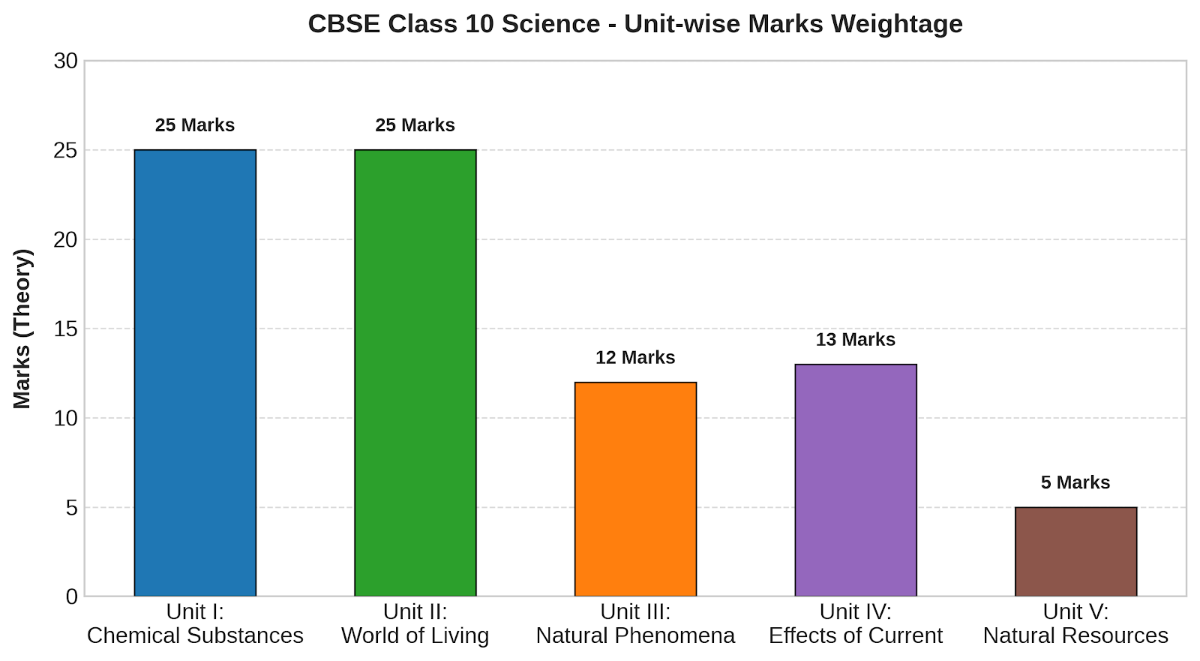
Unit I and Unit II carry the highest marks in the Science syllabus Class 10. Together they account for exactly half the theory paper.
- Unit I and Unit II each carry 25 marks. Together they total 50 marks out of 80.
- Unit IV carries 13 marks. Unit III carries 12 marks.
- Unit V carries the lowest weightage at 5 marks.
| Unit | Theme | Marks (Theory) |
|---|---|---|
| Unit I | Chemical Substances – Nature and Behaviour | 25 |
| Unit II | World of Living | 25 |
| Unit III | Natural Phenomena | 12 |
| Unit IV | Effects of Current | 13 |
| Unit V | Natural Resources | 5 |
| Total | 80 |
Ques. Which unit carries the highest weightage in the CBSE Class 10 science syllabus?
Ans. Unit I (Chemical Substances) and Unit II (World of Living), each worth 25 marks.
Also Check:
CBSE Class 10 Science: Important Topics
Life Processes and Chemical Reactions/Acids, Bases & Salts are the largest single-chapter score blocks. Expect at least two high-value numericals: one from Light and one from Electricity. Diagram-based questions appear frequently from the Human Eye, Neuron/Brain models, and Reproductive anatomy.
- Chemistry questions test balancing equations, identifying reaction types, and writing formulas for common salts.
- Biology questions test labelled diagrams and genetic cross ratios.
- Physics questions test ray diagrams, formula application, and circuit calculations.
- Environmental Science questions are short, reasoning-based, and test ecological flow charts.
| Subject / Unit | High-Yield Topics |
|---|---|
| Chemistry (Unit I: Chemical Substances) | Balancing equations & identifying types (Redox, Decomposition); Common names, formulas, & preparation of Salts (Baking soda, POP); Reactivity series applications & Ionic compound properties; Nomenclature, Homologous series, & Carbon reactions (Addition, Cleansing micelle) |
| Biology (Unit II: World of Living) | Alveoli, Heart circulation, Nephron structure & function; Reflex arc, Plant hormones (Auxin, ABA), & Animal Endocrine glands; Sexual reproduction in flowering plants & Human reproductive health; Mendel's Monohybrid & Dihybrid crosses; Sex determination mechanisms |
| Physics (Unit III: Natural Phenomena) | Convex lens & Concave mirror ray diagrams; Mirror and Lens formulas; Power of lens computations; Correction diagrams for Vision defects (Myopia, Hypermetropia); Atmospheric refraction (Prism dispersion, Tyndall effect) |
| Physics (Unit IV: Effects of Current) | Ohm's Law applications & factors affecting Resistivity; Series and Parallel resistor circuit calculations; Joule's Law of Heating & Electric Power / Commercial energy units; Field lines around a Solenoid; Fleming's Left-Hand Rule; Domestic wiring safety |
| Environmental Science (Unit V: Natural Resources) | 10% Energy Law & Trophic levels in Food chains; Biological Magnification effects; Ozone layer depletion causes & Waste management mechanisms |
Ques. Which chapters are most important in the NCERT syllabus for Class 10 science?
Ans. Life Processes, Chemical Reactions and Equations, Acids Bases and Salts, Light, and Electricity.
Check Out:
CBSE Class 10 Science Question Paper 2026 with Solutions
| CBSE Class 10 Science Question Paper 2026 | Question Paper PDF | Solution PDF |
|---|---|---|
| CBSE Class 10 Science Question Paper 2026 (Set 1 - 31/1/1) | Download PDF | Check Solutions |
| CBSE Class 10 Science Question Paper 2026 (Set 2 - 31/1/2) | Download PDF | Check Solutions |
| CBSE Class 10 Science Question Paper 2026 (Set 3 - 31/1/3) | Download PDF | Check Solutions |
| CBSE Class 10 Science Question Paper 2026 (Set 1 - 31/2/1) | Download PDF | Check Solutions |
| CBSE Class 10 Science Question Paper 2026 (Set 2 - 31/2/2) | Download PDF | Check Solutions |
| CBSE Class 10 Science Question Paper 2026 (Set 3 - 31/2/3) | Download PDF | Check Solutions |
| CBSE Class 10 Science Question Paper 2026 (Set 1 - 31/3/1) | Download PDF | Check Solutions |
| CBSE Class 10 Science Question Paper 2026 (Set 2 - 31/3/2) | Download PDF | Check Solutions |
| CBSE Class 10 Science Question Paper 2026 (Set 3 - 31/3/3) | Download PDF | Check Solutions |
CBSE Class 10 Science 2025 Question Paper with Solution PDF
| Set | Question Paper | Solution PDF |
|---|---|---|
| CBSE Class 10 Science Set 1 - 31-6-1 Question Paper | Download PDF | Check Solutions |
| CBSE Class 10 Science Set 2 - 31-4-2 Question Paper | Download PDF | Check Solutions |
| CBSE Class 10 Science Set 3 - 31-4-3 Question Paper | Download PDF | Check Solutions |
| CBSE Class 10 Science Set 3 - 31-6-3 Question Paper | Download PDF | Check Solutions |
CBSE Class 10 Science Deleted Topics 2027
The CBSE syllabus for 2026–27 continues the rationalized curriculum. Several chapters were removed in earlier rounds. They remain out of scope for the 2027 board exam. Prepare only the chapters listed in the official PDF. Deleted chapters will not appear in the paper.
- Periodic Classification of Elements is entirely removed as an assessable chapter.
- Sustainable Management of Natural Resources and Sources of Energy are both removed.
- The Human Eye: the subtopic explaining colour variations of the sun at sunrise and sunset is omitted.
- Magnetic Effects of Current: Electric Motor, Electromagnetic Induction, Fleming's Right-Hand Rule, and Electric Generator are deleted from board assessment.
| Topic / Chapter Removed | Remarks |
|---|---|
| Periodic Classification of Elements | Entire chapter removed; Dobereiner's Triads, Newlands' Law, Mendeleev's and Modern Periodic Table are not assessed |
| Sustainable Management of Natural Resources | Entire chapter removed; only 'Our Environment' is retained under Unit V |
| Sources of Energy | Chapter removed; conventional and non-conventional energy sources are not in scope |
| Evolution (portions from Heredity chapter) | Chapter renamed 'Heredity'; evolution-related concepts significantly reduced, verify exact scope in official PDF |
Ques. Is Periodic Classification of Elements in the Class 10 science syllabus 2027?
Ans. No. It is a fully deleted chapter.
Ques. Are Sources of Energy and Sustainable Management of Natural Resources tested?
Ans. No. Both chapters have been removed from the board exam.
Also Check:
How to Download CBSE Class 10 Science Syllabus 2027 PDF
Follow these steps to download the official CBSE Class 10 syllabus 2027 PDF from the CBSE academic portal.
- Visit the official CBSE academic website at CBSEacademic.nic.in.
- Click the "Curriculum" tab in the main navigation menu.
- Select "Secondary Curriculum (Classes IX–X)" from the dropdown.
- Locate the 2026–27 section and click the subject whose syllabus you need.
- Click the download icon in your PDF viewer to save the file to your device.
The NCERT Science book Class 10 PDF is a separate PDF to download, available directly from the NCERT website.
Ques. Where can I download the NCERT Science book Class 10 PDF?
Ans. From the official NCERT website, under the Class 10 Science textbook section.
Ques. Is the Class 10 science syllabus PDF the same as the NCERT textbook?
Ans. No. The syllabus PDF lists chapters, deleted topics, and marks weightage. The NCERT Science Class 10 textbook contains the actual lessons.
Check Out:
CBSE Class 10 Science Exam Pattern 2027
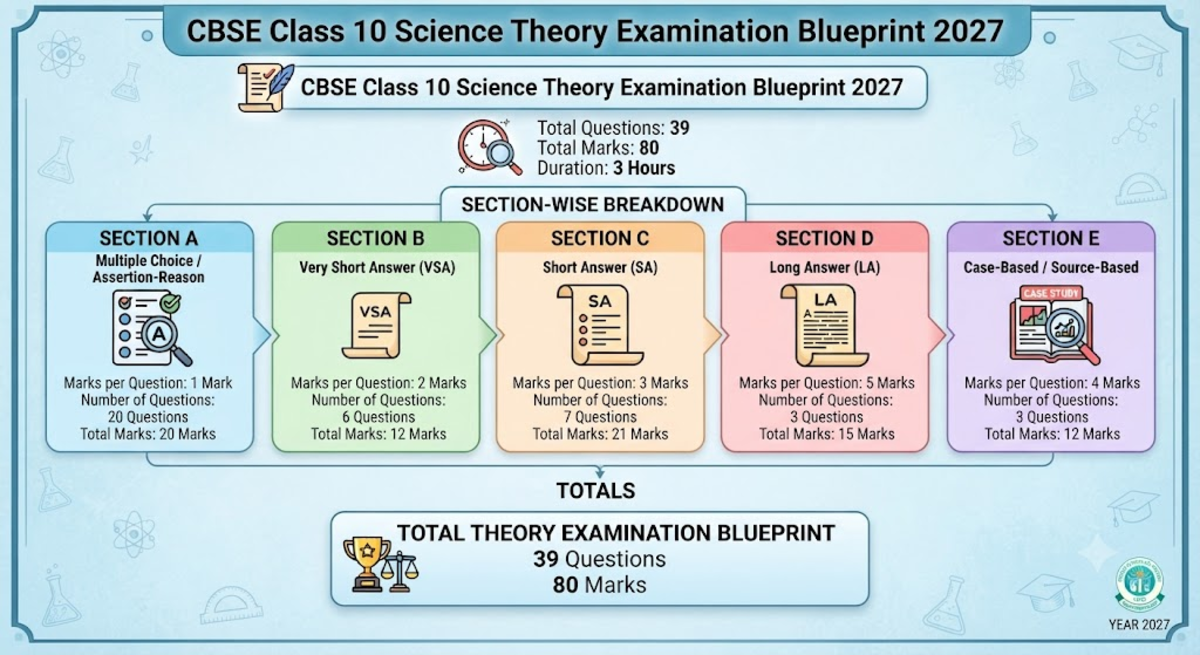
The CBSE Class 10 board examination 2027 follows a single annual format. Each subject paper carries 80 marks for theory and 20 marks for internal assessment. The paper includes competency-based questions, case-based questions, MCQs, and descriptive questions.
- The CBSE Class 10 Mathematics theory paper carries 80 marks and includes 39 questions across five sections.
- Section A contains 20 one-mark objective questions, while Sections B, C and D include 2-mark, 3-mark and 5-mark questions, respectively.
- Section E consists of three case-based questions worth 4 marks each, testing conceptual understanding and practical application.
| Section | Question Type | Marks per Question | Number of Questions | Total Marks |
|---|---|---|---|---|
| Section A | Multiple Choice / Assertion-Reason | 1 Mark | 20 Questions | 20 Marks |
| Section B | Very Short Answer (VSA) | 2 Marks | 6 Questions | 12 Marks |
| Section C | Short Answer (SA) | 3 Marks | 7 Questions | 21 Marks |
| Section D | Long Answer (LA) | 5 Marks | 3 Questions | 15 Marks |
| Section E | Case-Based / Source – Based | 4 Marks | 3 Questions | 12 Marks |
| Total | Theory Examination Blueprint | — | 39 Questions | 80 Marks |
Ques. How many marks do MCQs carry in the CBSE Class 10 Science syllabus exam?
Ans. 20 marks, from 20 one-mark questions.
Check Out:
Best Books for CBSE Class 10 Science Board Exam 2027
NCERT textbooks are the primary and most important resource for CBSE Class 10 preparation. All theory questions come from NCERT content. Use reference books only after finishing NCERT thoroughly.
- The NCERT Science Class 10 textbook is the only source for board questions.
- Lakhmir Singh and Manjit Kaur's subject-wise volumes help separate Physics, Chemistry, and Biology prep.
- NCERT Exemplar problems mirror the competency-based questions seen in the 2027 paper.
| Book Name | Author / Publisher | Why This Book |
|---|---|---|
| NCERT Science Class 10 | NCERT |
|
| Science for Class 10 (Physics, Chemistry, Biology volumes) | Lakhmir Singh and Manjit Kaur / S. Chand |
|
| NCERT Exemplar Problems – Science Class 10 | NCERT |
|
Ques. Is the NCERT Science book Class 10 PDF enough for board exam preparation? Ans. Yes, for theory. Pair it with Exemplar problems for competency-based questions.
Also Check:
NCERT Exemplar Book Class 10 Science: All Chapters
Use the table below to download the NCERT Exemplar PDF for any other Class 10 Science chapter, 2026-27 session.
| Chapter | Exemplar Book PDF |
|---|---|
| Chapter 1 | Chemical Reactions and Equations Exemplar PDF |
| Chapter 2 | Acids, Bases and Salts Exemplar PDF |
| Chapter 3 | Metals and Non-metals Exemplar PDF |
| Chapter 4 | Carbon and its Compounds Exemplar PDF |
| Chapter 6 | Control and Coordination Exemplar PDF |
| Chapter 7 | How do Organisms Reproduce Exemplar PDF |
| Chapter 8 | Heredity Exemplar PDF |
| Chapter 9 | Light Reflection and Refraction Exemplar PDF |
| Chapter 10 | The Human Eye and the Colourful World Exemplar PDF |
| Chapter 11 | Electricity Exemplar PDF |
| Chapter 12 | Magnetic Effects of Electric Current Exemplar PDF |
| Chapter 13 | Our Environment Exemplar PDF |
CBSE Class 10 Science Preparation Tips 2027
Theory board exams are expected in February–March 2027. From October 2026, you have four to five months to cover the full syllabus and revise. Use the subject-wise tips below to plan preparation.
- Chemical Substances and World of Living each carry 25 marks. Together they account for 62.5% of the theory paper.
- Read every NCERT in-text question and chapter-end question carefully. Board questions come directly from them.
- Draw and label diagrams regularly — electric circuits, the human eye, the digestive system, and Mendel's cross diagrams appear in 2–3 mark questions every year.
- Complete all prescribed practical experiments before the internal assessment in January 2027. Practical marks are straightforward to secure.
- Skip the deleted chapters entirely: Periodic Classification of Elements, Sustainable Management of Natural Resources, and Sources of Energy.
Ensure your study material strictly aligns with the rationalized syllabus. Do not waste time on Periodic Classification of Elements, Sources of Energy, or Sustainable Management of Natural Resources. They are completely excluded from board evaluation.
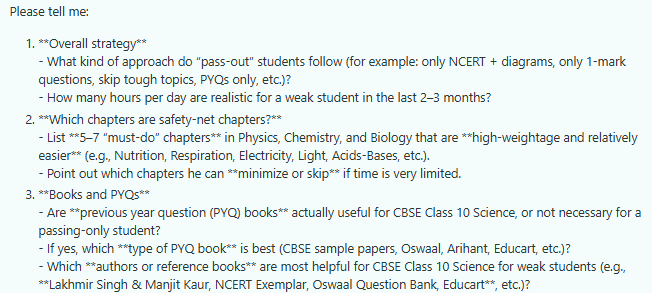
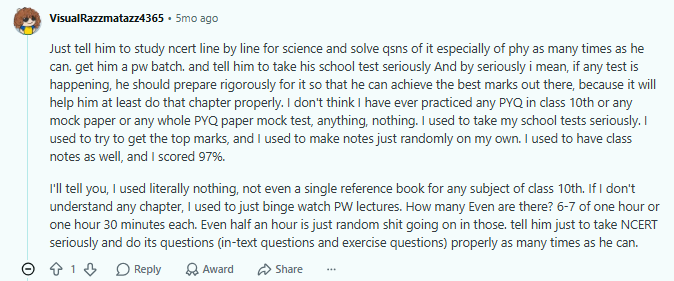
Students on Reddit share the following CBSE Class Science exam preparation tips:
- Thoroughly read NCERT line-by-line and practice all in-text and exercise questions multiple times (especially for Physics), as reference books, extra PYQ question banks, or mock tests are not strictly necessary.
- Take every school test seriously and prepare for each unit rigorously to master the chapters step-by-step; dedicating around 2–3 hours daily is effective.
Source: Reddit
Also Check:
FAQs on CBSE Class 10 Science Syllabus 2027
Ques. What is the syllabus of Class 10 science for 2027?
Ans. 13 chapters across five units: Chemical Substances, World of Living, Natural Phenomena, Effects of Current, and Natural Resources — worth 80 theory marks.
Ques. What is the Class 10 Science NCERT index for 2027?
Ans. Chemical Reactions and Equations, Periodic Classification of Elements, Acids Bases and Salts, Metals and Non-metals, Carbon and Its Compounds, Life Processes, Control and Coordination, Reproduction, Heredity, Evolution, Light, The Human Eye, Electricity, Magnetic Effects of Electric Current, and Our Environment.
Ques. How many marks does science carry in CBSE Class 10?
Ans. 100 total — 80 for theory and 20 for internal assessment.
Ques. Is the Class 10th science syllabus NCERT reduced for 2027?
Ans. Yes. Periodic Classification of Elements, Sources of Energy, and Sustainable Management of Natural Resources have been deleted.
Ques. Which chapters carry the most marks in the Class 10 science chapters list?
Ans. Chemical Substances and World of Living, each worth 25 marks.
Ques. Where can I find the official NCERT Class 10 science syllabus?
Ans. On CBSEacademic.nic.in, under Secondary Curriculum (Classes IX–X), 2026–27 section.
Ques. Is the NCERT Science Class 10 textbook the only book needed for Science?
Ans. For theory, yes. Add Lakhmir Singh or NCERT Exemplar only after finishing NCERT.



Comments