



Content Writer
Trigonometric Functions are the functions that explain the relationship between the sides and angles of a triangle. There are six basic trigonometric functions, namely sine, cosine, tangent, cosecant, secant, and cotangent.
- Trigonometric Functions are also known as circular functions and angle functions.
- They are used to calculate the values using trigonometric formulas.
- In 190-120 B.C., a mathematician named Hipparchus invented trigonometry.
- It is usually used in right-angled triangles.
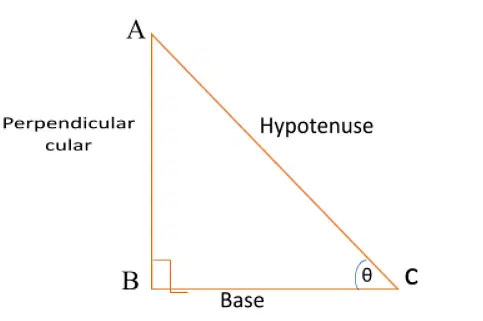
- A right-angle triangle has three sides, namely, perpendicular, Hypotenuse, and base.
- Trigonometric functions can be defined in terms of ratios of the coordinates of x and y.
- It can be applied to the field of engineering and navigation.
- These functions are majorly used in Calculus, Geometry, and Algebra.
Read More: NCERT Solutions for Class 11 Mathematics Trigonometric Functions
Key Terms: Trigonometric Functions, Trigonometry, Right-angled Triangle, Sine, Cosine, Tangent, Cosecant, Secant, Cotangent, Calculus, Algebra, Geometry, Functions
What are Trigonometric Functions?
[Click Here for Sample Questions]
Trigonometric Functions are six basic functions in trigonometry that describe the relationship between the sides and angles of a right-angle triangle. It was first created to solve the problem of astronomy.
- The three primary trigonometric functions are sine, cosine, and tangent.
- The other three functions, cotangent, secant, and cosecant, can be derived from the primary functions.
- These functions are expressed in terms of sides of a triangle.
- Each of these six functions has a corresponding inverse function and analogue of the hyperbolic function.
Example of Trignometric FunctionsExample 1: Trigonometric functions are used by archaeologists to determine the tools used in the earlier civilization. In this process, they measure the distance from underground water systems. Example 2: The functions are used in the case of criminology to calculate the trajectory and determine how a bullet has hit the person. |
Trigonometric Functions Detailed Video Explanation
Trigonometric Functions
Read More:
Six Trigonometric Functions
[Click Here for Previous Years’ Questions]
The six trigonometric functions are the sine function, cosecant function, tangent function, cosine function, secant function, and cotangent function. The below diagram is called sin-cos-tan triangle.
- All these functions are explained in detail below.
Sine Function
Sine Function refers to the ratio between the length of the opposite side of the triangle to the length of the hypotenuse of the triangle.
Sin A = Opposite Side/Hypotenuse = AB/AC
Cos Function
Cosine Function refers to the ratio between the length of the adjacent side of the triangle to the length of the hypotenuse of the triangle.
Cos A = Adjacent Side /Hypotenuse = BC/AC
Tan Function
Tangent Function refers to the ratio between the length of the opposite side of the triangle to the adjacent side length.
Tan A = Opposite Side/Adjacent Side = AB/BC
- Tan A can also be represented as
Tan A = sin A/cos A
Secant Function
Secant Function is the reciprocal of the cosine function. It can be represented as:
Sec A = 1/(Cos A) = Hypotenuse/Adjacent Side = AC/BC
Cosecant Function
Cosecant Function is the reciprocal of the sine function. It can be represented as:
Cosec A = 1/(Sin A) = Hypotenuse/Opposite Side = AC/AB
Cotangent Function
Cotangent Function is the reciprocal of the tangent function. It can be represented as:
Cot A = 1/(Tan a) = Adjacent Side/Opposite Side = BC/AB
Solved Example of Six Trigonometric FunctionExample : Find the value of the trigonometric functions, for the given value of 4tanθ = 3. Ans: Given 4tanθ = 3, and we have tanθ = 3/4 tanθ = Perpendicular/Base = 3/4 Applying the Pythagorean theorem we have: Hypotenuse2 = Perpendicular2 + Base2 Hyp2 = 32 + 42 = 9 + 16 = 25 Hyp = 5 Hence the other trigonometric functions are as follows. sinθ = Perp/Hyp = 3/5 cosθ = Base/Hyp = 4/5 cotθ = Base/Perp = 4/3 secθ = Hyp/Base = 5/4 cosecθ = Hyp/Perp = 3/5 |
Trigonometric Functions Formulas
[Click Here for Sample Questions]
The formulas to find the basic trigonometric functions for a right-angled triangle are listed as follows:
Formulas for Angle θ
The formulas used for angle are as follows:
- sin θ = Opposite side/Hypotenuse
- cos θ = Adjacent side/Hypotenuse
- tan θ = Opposite side/Adjacent side
- cot θ = Adjacent side/Opposite Side
- sec θ = Hypotenuse/Adjacent side
- cosec θ = Hypotenuse/Opposite Side
Reciprocal Identity
The formulas used for Reciprocal Identities are as follows:
- sin θ = 1/cosec θ
- cos θ = 1/sec θ
- tan θ = 1/cot θ
- cot θ = 1/tan θ
- sec θ = 1/cos θ
- cosec θ = 1/sin θ
The below table summaries the trignometric functions formulas:
| Formulas for Angle θ | Reciprocal Identity |
|---|---|
| sin θ = Opposite side/Hypotenuse | sin θ = 1/cosec θ |
| cos θ = Adjacent side/Hypotenuse | cos θ = 1/sec θ |
| tan θ = Opposite side/Adjacent side | tan θ = 1/cot θ |
| cot θ = Adjacent side/Opposite Side | cot θ = 1/tan θ |
| sec θ = Hypotenuse/Adjacent side | sec θ = 1/cos θ |
| cosec θ = Hypotenuse/Opposite Side | cosec θ = 1/sin θ |
Read More: Trigonometric Functions: Important Questions
Trigonometric Functions Identities
[Click Here for Previous Years’ Questions]
Trigonometric Functions Identities are divided into the following types:
Even and Odd Functions
Cosecant and Secant are even functions, and the rest of the others are odd. Some important functions are as follows:
- sin (-A) = – sinA
- cos (-A) = cos A
- cosec (-A) = -cosec A
- cot (-A) = -cot A
- tan (-A) = – tan A
- sec (-A) = sec A
Reciprocal Identities
Some important Trigonometric Identities are as follows:
- cosec θ = 1/sin θ
- sec θ = 1/cos θ
- cot θ = 1/tan θ
- sin θ = 1/cosec θ
- cos θ = 1/sec θ
- tan θ = 1/cot θ
Pythagorean Identities
When the Pythagoras theorem is described in the form of trigonometry functions, it is called a Pythagorean identity. There are three main identities in Pythagorean Identities:
- sin2θ + cos2θ = 1
- 1 + tan2θ = sec2θ
- 1 + cot2θ = cosec2θ
Periodic Functions
Trigonometric functions are periodic functions in which the smallest periodic cycle is 2π but for tangent and the cotangent, it is π. Some important functions are as follows:
- sin(x+2nπ) = sin x
- cos(x+2nπ) = cos x
- tan(x+nπ) = tan x
- cot(x+nπ) = cot x
- csc(x+2nπ) = csc x
- sec(x+2nπ) = sec x
Here, n is any integer.
Sum and Difference Identities
Some important Trigonometry Functions of Sum and Difference of Angles are as follows:
- sin(x+y) = sin(x).cos(y)+cos(x).sin(y)
- sin(x–y) = sin(x).cos(y)–cos(x).sin(y)
- cos(x+y) = cosx.cosy–sinx.siny
- cos(x–y) = cosx.cosy+sinx.siny
- tan(x+y) = [tan(x)+tan(y)]/[1-tan(x)tan(y)]
- tan(x-y) = [tan(x)-tan(y)]/[1+tan(x)tan(y)]
Product Identities
Some important functions are as follows:
- 2sinx⋅cosy=sin(x+y)+sin(x−y)
- 2sinx⋅siny=cos(x−y)−cos(x+y)
- 2cosx⋅cosy=cos(x+y)+cos(x−y)
Sum of Identities
Some important functions are as follows:
- cosx+cosy=2cos((x+y)/2) . cos((x−y)/2)
- cosx−cosy=−2sin((x+y)/2 . sin((x−y)/2)
- sinx+siny=2sin((x+y)/2) . cos((x−y)/2)
- sinx−siny=2cos((x+y)/2) . sin((x−y)/2)
Half-Angle Identities
Some important functions are as follows:
- sin A/2 = ±√[(1 - cos A) / 2]
- cos A/2 = ±√[(1 + cos A) / 2]
- tan A/2 = ±√[(1 - cos A) / (1 + cos A)] (or) sin A / (1 + cos A) (or) (1 - cos A) / sin A
Double Angle Identities
Some important functions are as follows:
- sin(2x) = 2sin(x) cos(x) = [2tan x/(1+tan2 x)]
- cos(2x) = cos2(x)–sin2(x) = [(1-tan2 x)/(1+tan2 x)]
- cos(2x) = 2cos2(x)−1 = 1–2sin2(x)
- sec (2x) = sec2 x/(2-sec2 x)
- cosec (2x) = (sec x. cosec x)/2
- tan(2x) = [2tan(x)]/ [1−tan2(x)]
- cot(2x) = [cot2(x) - 1]/[2cot(x)]
Triple Angle Identities
Some important functions are as follows:
- Sin 3x = 3sin x – 4sin3x
- Cos 3x = 4cos3x - 3cos x
- Tan 3x = [3tanx-tan3x]/[1-3tan2x]
Solved Example of Trigonometric Functions IdentitiesExample: Calculate the value of Sin75°. Ans: The formula for these types of functions include Sin(A + B) = SinA.CosB + CosA.SinB. In this the value of A = 30° and B = 45° Sin 75° = Sin(30° + 45°) = Sin30°.Cos45° + Cos30°.Sin45° = (1/2) (1/√2) + (√3/2) (1/√2) = 1/2√2 + √3/2√2 = (√3 + 1) / 2√2 |
Read More: Trigonometry Ratio Important Formula
Trigonometric Ratio Table
[Click Here for Sample Questions]
The trigonometric table for six basic trigonometric functions sin, cos, tan, cosec, sec, and cot is as follows:
| Trigonometric Ratios | 0 ° | 30 ° | 45 ° | 60 ° | 90 ° |
|---|---|---|---|---|---|
| Sin θ | 0 | 1/2 | 1/√2 | √3/2 | 1 |
| Cos θ | 1 | √3/2 | 1/√2 | 1/2 | 0 |
| Tan θ | 0 | 1/√3 | 1 | √3 | ∞ |
| Cosec θ | ∞ | 2 | √2 | 2/√3 | 1 |
| Sec θ | 1 | 2/√3 | √2 | 2 | ∞ |
| Cot θ | ∞ | √3 | 1 | 1/√3 | 0 |
Solved Example of Trigonometric Ratio TableExample. What are the values of Sin 90°, Cos 30°, and Tan 30°? Ans. Using the Trigonometric Ratio Table, we get
|
Read More: Tangent Circle Formula
Domain and Range of Trigonometric Functions
[Click Here for Previous Years’ Questions]
Domain of a trigonometric function is the value of θ and the resultant value is the range of the trigonometric function. Usually, the domain of the trigonometric function is a real number.
- In some cases, values of a few angles are excluded as it results in a range as an infinite value.
The domain and range of trigonometric functions that are to be graphed in the XY plane are as follows:
| Function | Domain | Range |
|---|---|---|
| Sine | x ∈ R | − 1 ≤ sin x ≤ 1 |
| Cosine | x ∈ R | − 1 ≤ cos x ≤ 1 |
| Tangent | x ∈ R , x≠(2k+1)π/2, | − ∞ < tan x < ∞ |
| Cotangent | x ∈ R , x ≠ k π | − ∞ < cot x < ∞ |
| Secant | x ∈ R , x ≠ ( 2 k + 1 ) π / 2 | sec x ∈ ( − ∞ , − 1 ] ∪ [ 1 , ∞ ) |
| Cosecant | x ∈ R , x ≠ k π | csc x ∈ ( − ∞ , − 1 ] ∪ [ 1 , ∞ ) |
Read More: Angle Between Two Lines
Trigonometric Functions Graph
[Click Here for Sample Questions]
Trigonometric Functions Graphs have the domain value θ represented on the x-axis and the range value represented along the y-axis. The graphs of trigonometric functions sin θ and tan θ pass through the origin.
- The graphs of other functions do not pass through the origin.
- The graphs of all six trigonometric functions are given as follows:
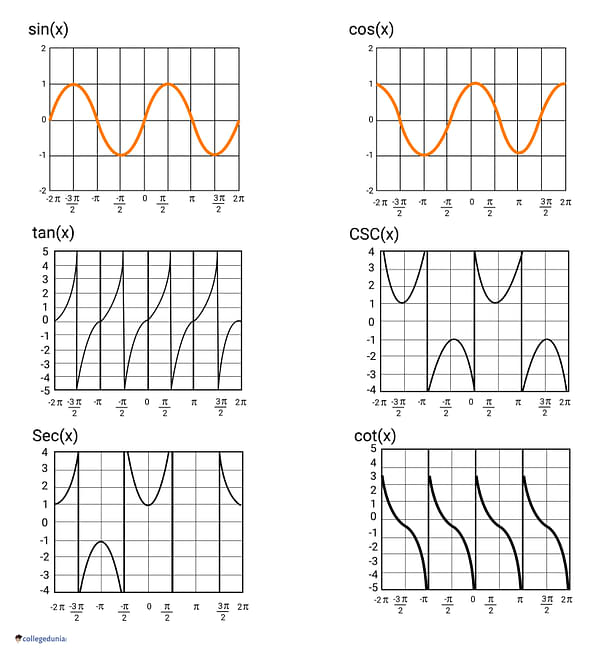
Trigonometric Functions Graph
Read More: Sin 30 Degrees
Inverse Trigonometric Functions
[Click Here for Previous Years’ Questions]
Inverse Trigonometric Functions are defined as the inverse ratio of the basic trigonometric ratios. All the trigonometric formulas can be changed into inverse trigonometric functions.
Arbitrary Values
Inverse Trigonometric Ratio for arbitrary values is applicable for all the basic trigonometric functions. In the case of the inverse trigonometric functions of sin, tan, and cos, the negative of the values is changed as the negatives of the function.
- The functions of cosec, sec, and cot are changed as the subtraction of the function from the π value.
The important inverse trigonometric functions are as follows:
- Sin-1(-x) = -Sin-1x
- Tan-1(-x) = -Tan-1x
- Cosec-1(-x) = -Cosec-1x
- Cos-1(-x) = π - Cos-1x
- Sec-1(-x) = π - Sec-1x
- Cot-1(-x) = π - Cot-1x
Reciprocal Functions
Inverse Trigonometric Formulas of inverse sine, cosine, and tangent are expressed in the following forms.
- Sin-1x = Cosec-11/x
- Cos-1x = Sec-11/x
- Tan-1x = Cot-11/x
Complementary Functions
Complementary functions of sine-cosine, tangent-cotangent, and secant-cosecant add up to π/2.
- Sin-1x + Cos-1x = π/2
- Tan-1x + Cot-1x = π/2
- Sec-1x + Cosec-1x = π/2
Read More:
| Class 11 Mathematics Related Concepts | ||
|---|---|---|
| Heights and Distances | Value of Sin 180 | Sin 180 Degrees Value and Derivation |
| Cosine Rule | Value of Cos 180 | Difference Between Codomain and Range |
Trigonometric Functions Derivatives
[Click Here for Sample Questions]
The slope of the tangent of a curve is given by the differentiation of trigonometric functions. Differentiation of trigonometric functions is used to find the equation of a tangent, normal, and find out the errors in calculations.
- d/dx. Sinx = Cosx
- d/dx. Cosx = -Sinx
- d/dx. Tanx = Sec2x
- d/dx. Cotx = -Cosec2x
- d/dx.Secx = Secx.Tanx
- d/dx. Cosecx = - Cosecx.Cotx
Read More: Cot Tan Formula
Integration of Trigonometric Functions
[Click Here for Previous Years’ Questions]
The integration of trigonometric functions is used to find the area under the graph of a particular trigonometric function. It is very useful when it comes to finding the area of irregularly shaped plane surfaces.
Some important integration of trigonometric function formulas are as follows:
- ∫ cosx dx = sinx + C
- ∫ sinx dx = -cosx + C
- ∫ sec2x dx = tanx + C
- ∫ cosec2x dx = -cotx + C
- ∫ secx.tanx dx = secx + C
- ∫ cosecx.cotx dx = -cosecx + C
- ∫ secx dx = log|secx + tanx| + C
- ∫ cosecx.dx = log|cosecx - cotx| + C
- ∫ tanx dx = log|secx| + C
- ∫ cotx.dx = log|sinx| + C
Read More: Differentiation Rules
Things to Remember
- Trigonometric functions are related to right-angled triangles.
- It defines the relationship between the sides and angles of a triangle.
- Sin, Cos, and Tan are three primary trigonometric functions, and other functions are derived from them.
- The concept can be used in the design of video games and oceanography.
- The value of θ indicates the value of the domain of a trigonometric function.
- The value obtained by solving the functions is the range.
Read More: Difference Between Trigonometry and Geometry
Previous Years’ Questions
- If cosec θ − cot θ = 2017, then quadrant in which θ lies is… (TS EAMCET - 2017)
- Find the value of cos(29π/3)... (JKCET - 2014)
- A value of θ satisfying sin 5θ − sin3θ + sinθ = 0 such that…
- In any triangle ABC, the simplified form of… (KCET - 2011)
- Consider a triangular plot ABC with sides AB = 7m, BC = 5m… (JEE Main - 2019)
- If the sum of all the solutions of the equation… (JEE Main - 2018)
- Let a vertical tower AB have its end A on the level ground. Let… (JEE Main - 2017)
- Which one of the following is not true… (AMUEEE - 2013)
- The number of solutions of the equation ∣cotx∣… (COMEDK UGET - 2015)
Sample Questions
Ques. Name the six main trigonometric functions. Give their formulas? (3 Marks)
Ans. The six main trigonometric functions are Sine, Cosine, Tangent, Cosecant, Secant, and Cotangent. Their formulas are as follows:
- sin x = Opposite Side/Hypotenuse
- cos x = Adjacent Side/Hypotenuse
- tan x = Opposite Side/Adjacent Side
- cot x = Adjacent Side/Opposite Side
- sec x = Hypotenuse/Adjacent Side
- cosec x = Hypotenuse/Opposite Side
Ques. Find the value of Sin 105°? (3 Marks)
Ans. On simplification, Sin 105° can also be written as sin (60° + 45°) which is similar to sin (A + B).
Now, sin (A + B) = sin A × cos B + cos A × sin B
Thus, using the above formula,
sin 105° = sin (60° + 45°) = sin 60° × cos 45° + cos 60° × sin 45°
= √3/2 × 1/√2 + 1/2 × 1/√2
= √3/2√2 + 1/2√2
= (√3+1)/2√2
Thus, the value of Sin 105° is (√3+1)/2√2.
Ques. Find the value of cos 570° sin 510° + sin (-330°) cos (-390°)? (3 Marks)
Ans. It is given that
cos(570) sin(510) + sin(-330) cos(-390)
= cos(570) sin(510) + [ –sin(330)] cos(390) [As sin(–x) = –sinx and cos(–x) = cos x]
= cos(570) sin(510) – sin(330)
= cos (90 * 6 + 30) sin (90 * 5 + 60) – sin (90 * 3 + 60) cos (90 * 4 + 30)
= - cos(30).cos(60) –[ - cos(60)]cos(30)
= – cos(30) cos(60) + cos(30) sin(60)
= 0
Ques. What is the value of Sin 75°? (3 Marks)
Ans. On simplification, Sin 75° can be written as sin (30° + 45°) which is similar to sin (A + B).
Now, sin (A + B) = sin A × cos B + cos A × sin B
Thus, using the above formula,
Sin 75° = Sin30° x Cos45° + Cos30° x Sin45°
= (1/2) (1/√2) + (√3/2) (1/√2)
= 1/2√2 + √3/2√2
= (√3 + 1) / 2√2
Thus, the value of Sin75° is (√3 + 1) / 2√2.
Ques. What are the values of Sin 45°, Cos 60°, and Tan 60°? (2 Marks)
Ans. Using the Trigonometric Ratio Table, we get
- Sin 45° = 1/√2
- Cos 60° = 1/2
- Tan 60° = √3
Ques. Calculate the Value of Sin λ, Cos λ, and Tan λ, if λ = 30 degrees? (2 Marks)
Ans. If λ = 30 degrees,
Then,
- Sin λ = Sin 30° = ½
- Cos λ = Cos 30° = √3/2
- Tan λ = Tan 30° = 1/√3
Ques. What is the product of the six trigonometric functions? (3 Marks)
Ans. It is known that
- Cosec x is the reciprocal of sin x
- Sec x is the reciprocal of cos x
- Tan x is the ratio of sin x and cos x
- Cot x is the ratio of cos x and sin x.
Now, according to the question,
sinx × cosx × tanx × cotx × secx × cosecx =?
Substituting the values, we get
sinx × cosx × (sinx/cosx) × (cosx/sinx) × (1/cosx) × (1/sinx)
= (sinx × cosx) / (sinx × cosx) × (sinx/cosx) × (cosx/sinx)
= 1 × 1
= 1
Thus, the product of the six trigonometric functions is 1.
Ques. Anjali sees a bird sitting on the branch of a tree at an angle of elevation of 20°. Find the height at which the bird is sitting if Anjali is standing 10 miles away from the tree? (3 Marks)
Ans. Let us assume a right triangle ABC in which A is the position of the bird, B is the tree touching the ground, and C is the position of Anjali.
Thus,
- BC = 10 miles
- Angle C = 20°
- AB = x miles
Tan C = Opposite Side/Adjacent Side
tan(20°) = x/10
x = 10 × tan(20°)
x = 10 × 0.36 = 3.6
Thus, the bird is sitting at a height of 3.6 miles from the ground.
Ques. Explain the formulas for differentiation of Trigonometric Functions? (3 Marks)
Ans. The differentiation of the trigonometric functions is as follows:
- d/dx. Sinx = Cosx
- d/dx. Cosx = -Sinx
- d/dx. Tanx = Sec2x
- d/dx. Cotx = -Cosec2x
- d/dx.Secx = Secx.Tanx
- d/dx. Cosecx = - Cosecx.Cotx
Ques. Are the values of Trigonometric Functions the same? (1 Mark)
Ans. No, trigonometric functions have different values for different angles between the hypotenuse and the base of the given right triangle.
Ques. Riya sees a bird sitting on the branch of a tree at an angle of elevation of 30°. Find the height at which the bird is sitting if Riya is standing 20 miles away from the tree? (3 Marks)
Ans. Let us assume a right triangle ABC in which A is the position of the bird, B is the tree touching the ground, and C is the position of Anjali.
Thus,
- BC = 20 miles
- Angle C = 30°
- AB = x miles
Tan C = Opposite Side/Adjacent Side
tan(30°) = x/20
x = 20 × tan(30°)
x = 20 × 0.57 = 11.5
Thus, the bird is sitting at a height of 11.5 miles from the ground.
Ques. Find the value of the trigonometric functions, for the given value of 8tanθ = 6? (4 marks)
Ans. Given 8tanθ = 6, and we have tanθ = 6/8
tanθ = Perpendicular/Base = 6/8
Applying the Pythagorean theorem we have:
Hypotenuse2 = Perpendicular2 + Base2
Hyp2 = 62 + 82
= 36 + 64
= 100
Hyp = 10
Hence the other trigonometric functions are as follows.
sinθ = Perp/Hyp = 6/10
cosθ = Base/Hyp = 8/10
cotθ = Base/Perp = 8/6
secθ = Hyp/Base = 10/8
cosecθ = Hyp/Perp = 10/6
Ques. If the value of sec θ + tan θ = 25, then evaluate sec θ – tan θ? (3 marks)
Ans. We know, sec2θ – tan2θ =1
Or, (sec θ + tan θ)( sec θ – tan θ)=1
Or, 16(sec θ – tan θ)=1
Or, sec θ – tan θ =1/25
So, the value of sec θ – tan θ =1/25.
Ques. A man observed a pole of height 60 ft. According to his measurement, the pole cast a 30 ft long shadow. Find the angle of elevation of the sun from the tip of the shadow using trigonometry? (2 marks)
Ans. Let x be the angle of elevation of the sun, then
tan x = 60/30 = 2
x = tan-1(2)
Check-Out:



Comments