



Education Journalist | Study Abroad Lead
The Right Triangle Altitude Theorem, also known as the geometric mean theorem, is an important concept in geometry. It relates the lengths of the three sides of a right triangle to the length of the altitude drawn from the right angle to the hypotenuse.
- A right triangle is a triangle that has one of its interior angles of the value 90 degrees.
- The altitude of a triangle is the perpendicular line segment from a vertex to the opposite side or to the line that contains the opposite side.
- The side opposite the right angle is called the hypotenuse, while the other two sides are called the legs.
| Table of Content |
Key terms: Right triangle, altitude, hypotenuse, geometric mean, similar triangle
Read More: Right Angle Triangle Theorem
Altitude of a Right Triangle
[Click Here for Sample Questions]
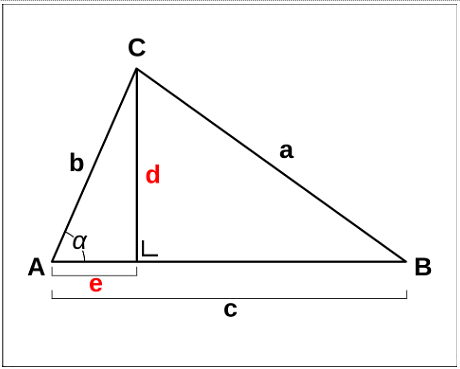
The altitude of a right triangle is the perpendicular line segment from the right angle vertex to the hypotenuse. It is also known as the height of the triangle. In the case of a right angled triangle the altitude breaks down the triangle into two similar ones. In the below image d is the altitude.
Altitude of a Right Triangle
What is right triangle altitude theorem?
[Click Here for Sample Questions]
In a right triangle, the altitude drawn from the right angle to the hypotenuse divides the opposite side, the hypotenuse into two line segments. According to the right triangle altitude theorem, the altitude on the hypotenuse is equal to the geometric mean of line segments formed by altitude on the hypotenuse.
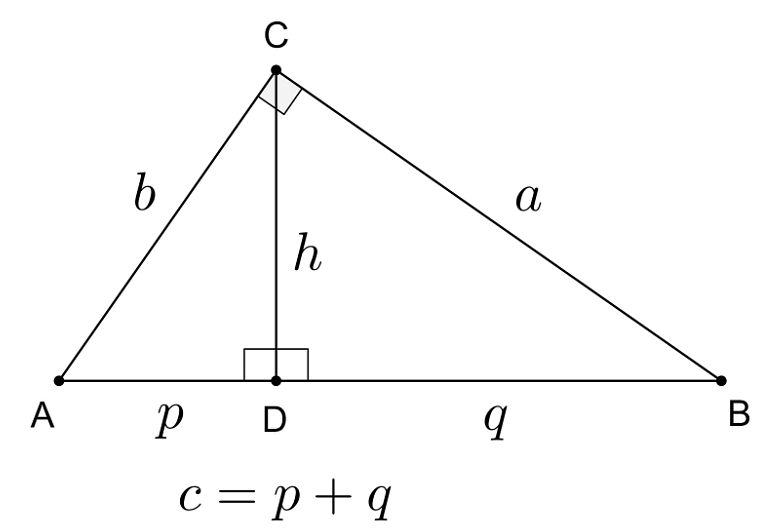
Consider a right triangle ABC with right angle at C, and let D be the foot of the altitude from C to AB, as shown below:
Here, hypotenuse AB = c
AC = b
BC = a
AD = p
BD = q
So, we get c = p+q
For two similar triangles we have the following,
i) Corresponding angles of both the triangles will be equal and
ii) Corresponding sides of both the triangles will be in proportion to each other.
Thus, two triangles ACB and MNR are similar if they have,
- ∠A = ∠M , ∠C = ∠N and ∠B= ∠R
- \(\frac{AC}{MN} = \frac{CB}{NR}= \frac{BA}{RM}\)
Check More:
| Relevant Concepts | ||
|---|---|---|
| Area of a Trapezoid Formula | Isosceles Trapezoid Formula | Types of Quadrilaterals |
| Areas of Parallelograms and Triangles | Area of a Triangle | Area of Parallelogram |
Proof of Right Triangle Altitude Theorem
[Click Here for Sample Questions]
The purpose of the theorem is to show that CD is the geometric mean of AD and BD.
Let us use constructions, in ACB and consider ∠DCA = y and ∠DCB = x given in the following image below:
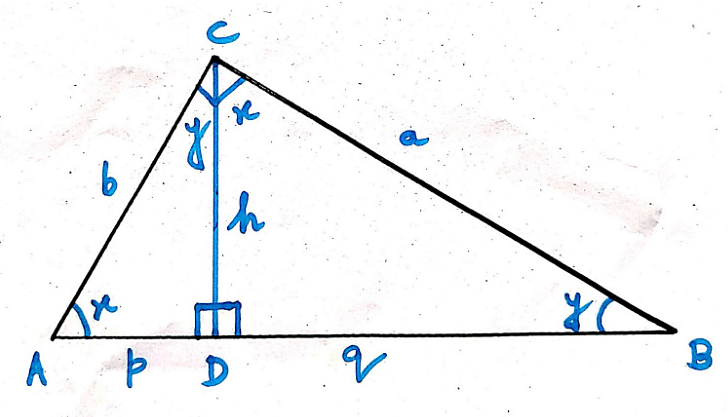
Thus we obtain from the given figure,
In the case of triangles, ADC and BDC
∠ADC = ∠BDC [Both are of 90o]
Since ACB is rectangular at point C, this means,
∠ACB = ∠C = y + x = 90o -(i)
In ADC, using the angle sum property, we get,
∠ACD + ∠CDA + ∠DAC = 180o
∠DAC = ∠A = {180o – (90o+y)}
= (90 - y)o
= x (using equation (i))
Similarly, for BDC, using the angle sum property, we obtain,
∠BCD + ∠CDB + ∠DBC = 180o
∠DBC = ∠B = {180o-(90o+x)}degrees
= (90 - x)o
= y (using equation (i))
Thus by AA axiom of similarity ΔADC ≈ ΔBDC
So we get, \(\frac{DC}{DB}= \frac{DA}{DC}\)
⇒ \(\frac{h}{q}= \frac{p}{h}\)
⇒ h= \(\sqrt{pq}\)
This completes the proof of the right triangle altitude theorem.
The converse of the theorem is also true. The theorem states, for any triangle in which the altitude equals the geometric mean of the two line segments created by it, is a right triangle.
Applications of Right Triangle Altitude Theorem
[Click Here for Sample Questions]
The right triangle altitude theorem has many applications in geometry and trigonometry.
- This theorem can be used to create a square, whose area is equal to a given rectangle.
- Another application is that this theorem is used to provide a geometrical proof of the AM-GM inequality for any two given numbers.
- This method also helps in finding the length of the altitude of a right triangle given the lengths of the line segments formed by the altitude on hypotenuse.
Things to remember
- The formula of the altitude in the right triangle altitude theorem is h =\(\sqrt{pq}\)
- The altitude of a triangle is the perpendicular distance from the vertex to the opposite side of the triangle.
- The altitude of a right-angled triangle divides the given triangle into two triangles which are similar to each other.
- In the right triangle altitude theorem, the altitude is the geometric mean of the line segments that it creates.
- This theorem is an important tool for solving problems involving right triangles.
Read More:
Sample Questions
Ques: The right triangle theorem ABC has a hypotenuse of 12 cm long and a part of the hypotenuse is 7 cm. Then find out the altitude of this triangle. (3 marks)
Ans: It is given that the hypotenuse of a right triangle is 12 cm and the length of a part of it is 7 cm. So the length of the other part of the hypotenuse is (12-7)= 5cm. Now as, we know the altitude of the right triangle is the geometric mean of the line segments that it creates on the hypotenuse, i.e h = \(\sqrt{pq}\), where h is the altitude and p,q are the parts of the hypotenuse. Then putting the values of these we get,h=\(\sqrt{7 \times 5} = \sqrt{35} cm\).
Ques: Find The Altitude Using the Hypotenuse Divided into Two Segments Determine the length of PQ. (3 marks)

Ans: We note that Q is the projection of P onto RS and that △PRS is a right triangle at P. We can then recall that the corollary of the Euclidean theorem tells us that PQ = RQ × SQ.
Substituting in the given lengths gives PQ = 4 × 9 = 36.
Taking the square root of both sides of the equation, noting that PR is a length and so is nonnegative, we get PQ = √36 =6
Ques: Find the Area of a Triangle Using the Right Triangle Altitude Theorem. Calculate the area of △HGK. (5 marks)

Ans: We start by recalling that the area of a triangle is half the length of the triangle’s base multiplied by the triangle’s perpendicular height. Since △HBK is a right triangle at K, we can choose GK as the base and then HK is the perpendicular height, giving us area △HBK = ½(GK×HK)
We can find the length of HK using the Euclidean theorem and then the length of GK using the Pythagorean theorem. First, we note that K is the projection of G onto HL and that △HGL is a right triangle at G . The Euclidean theorem then tells us that HG2=HL× HK.
We substitute HG=22cm and HL=33cm to get 222=33×HK.
We then divide the equation by 33, giving us HK=\(\frac{22^2}{33}\)=14.6cm
We now have the lengths of two sides of the right triangle HGK.We can find the third length by applying the Pythagorean theorem, which gives HG2 =GK2+HK2.
Substituting HG=22 cm and HK =14.6cm gives 222=14.62+GK2.
We can then rearrange and simplify the equation:GK2= 222-(14.6)2=270.4
We then take the square root of both sides of the equation, noting that BD is a length and so is nonnegative, which gives GK=√270.4=16.4cm
We now substitute HK=14.6cm and GK=16.4cm into the formula for the area of △HGK to get the area △HGK=½((16.4)×(14.6))=120.04.
Ques: The altitude of a right triangle is 7 cm less than its base. If the hypotenuse is 13 cm, find the other two sides. (5 marks)
Ans: Let us say, the base of the right triangle is y cm.
Given, the altitude of the right triangle = (y – 7) cmGiven
From Pythagoras theorem, we know,
base2 + altitude2 = hypotenusee2
∴y2 + (y-7)2 =169
⇒ y2 + y2 + 49 – 14y = 169
⇒ 2y2 – 14y – 120 = 0
⇒ y2 – 7y – 60 = 0
⇒ y2 – 12y + 5y – 60 = 0
⇒ y(y – 12) + 5(y – 12) = 0
⇒ (y – 12)(y + 5) = 0
Thus, either y – 12 = 0 or y + 5 = 0,
⇒ y = 12 or y = – 5
Since sides cannot be negative, the only possible value of y is 12
Therefore, the base of the given triangle is 12 cm and the altitude of this triangle will be,
(12 - 7) = 5 cm.
Ques: The two legs of a right triangle are equal and the square of its hypotenuse is 98 cm2 Find the length of each leg. (3 marks)
Ans: Let's call the length of each leg "x".
According to the Pythagorean theorem, which applies to any right triangle, the length,
Of the hypotenuse( c),
c2 = a2 + b2
where a and b are the lengths of the legs.
Since the legs are equal in this problem, we can rewrite this as:
c2 = x2 + x2 = 2x2
We also know that c2 = 98 cm2, so we can substitute that in:
98 cm2 = 2x2
To solve for x, we can divide both sides by 2:
98 cm2 = x2
Taking the square root of both sides, we get:
x = √49 cm = 7 cm
So each leg of the right triangle is 5 cm long.
Ques: The ABC right triangle with a right angle at C with side a = 17, and height h = 8, Calculate the perimeter of the triangle. (5 marks)
Ans: In an ABC right triangle with a right angle at C, we have:
a is the hypotenuse (the side opposite the right angle)
b is the length of the side opposite angle B
c is the length of the side opposite angle A
We can use the Pythagorean theorem to find b:
b2 = a2 – c2
Since the triangle is an ABC right triangle, we know that:
c = h = 8
b2 = a2 – c2 = 172 - 82 = 225
Taking the square root of both sides, we get:
b = 15
So the sides of the triangle are:
a = 17
b = 15
c = 8
The perimeter of the triangle is simply the sum of the lengths of its sides:
P = a + b + c = 15 + 8 + 17 = 40
Therefore, the perimeter of the ABC right triangle is 40 cm.
Ques: The length of one side of a triangle is 3.5 cm and the length of its hypotenuse is 6.5 cm. Find the length of its third side. (3 marks)
Ans: Given that length of one side is 3.5 cm
Length of the hypotenuse is 6.5 cm
Using Pythagoras' theorem the length of the third side will be
\(\sqrt{(6.5)^2 – (3.5)^2} = \sqrt{30} cm\)
Ques: Find the value of x in the image below by using Right Triangle Altitude Theorem. (3 marks)

Ans: Identify the hypotenuse formed when the altitude
is drawn from the right angle to the hypotenuse.
The lengths of the segments given are 16 and 4.
The geometric mean of the lengths of the segments is given by the formula x = \(\sqrt{ab}\)
Here a = 16 and b = 4
Thus, x = \(\sqrt{16(4)} =\sqrt{ 64}\) = 8 cm
Ques: In PQR, PQ = 63 cm, PR = 12 cm and QR = 6 cm. Find the measure of angle ∠P (3 marks)
Ans: In PQR, PQ = 6\(\sqrt{3}\) cm, PR = 12 cm and QR = 6 cm
PQ2= (6\(\sqrt{3}\))2=108
PR2 = 122= 144
QR2= 62 = 36
From this we obtain , 108 + 36 = 144
In case of a right angled triangle the square of one side is equal to the sum of the squares of the
remaining two sides.
In a right angled triangle if one side is half of the hypotenuse then the angle opposite to that is 30o
Here , QR is half of PR.
Hence, ∠P = 30o, .
Ques: Calculate the length of the segments CD, AD and BC in the figure below. (3 marks)

Ans: The Euclidean and the right triangle altitude theorem will be used to solve the problem.
Using these, we get b = \(\sqrt{x(AB)}\) , h = \(\sqrt{xy}\) and a = \(\sqrt{y(AB)}\)
Starting with , h = \(\sqrt{x(AB)}\), we get , b = \(\sqrt{x(x+7)}\)
Squaring both sides we get,
144 =x2+ 7x
⇒ x2+ 7x -144 = 0
⇒ (x-9)(x+16) = 0
⇒ x=9, x =- 16 but x = -16 is not possible as length cannot be negative.
⇒ x= 9
AD = 9 cm
So, h = CD= \(\sqrt{xy} = \sqrt{9x7} = \sqrt{37}\) cm
Now, a = BC = \(\sqrt{y(AB)} = \sqrt{7(16)}\)= 4\(\sqrt{7}\) cm
Ques: Calculate the missing side lengths in the picture below. (3 marks)

Ans: According to the Right Triangle Altitude theorem, h = \(\sqrt{xy}\)
Putting the values we get, h = \(\sqrt{xy}\) = \(\sqrt{ 15 \times 1}\) = \(\sqrt{15}\) cm
Now using the Eucleadin theorem, b = \(\sqrt{15(16)}\) = b = 4\(\sqrt{5}\) cm
For Latest Updates on Upcoming Board Exams, Click Here: https://t.me/class_10_12_board_updates
Check-Out:



Comments