



Education Journalist | Study Abroad Lead
Cotangent is one of the functions of Trigonometry. It is usually represented as ‘cot’. Cotangent and all the other trigonometric ratios are defined on a right-angled triangle. Cotangent is one of the six trigonometric functions that are defined as the ratio of the sides of a right-angled triangle. The basic trigonometric functions are sin, cos, tan, cot, sec, cosec. Cot is the reciprocal of tan and it can also be derived from other functions. The value of cotangent of any angle is the length of the side adjacent to the angle divided by the length of the side opposite to the angle. There are many uses of cotangent and other trigonometric functions in Trigonometry and Calculus.
Read More: Domain and Range of Trigonometric Functions
| Table of Contents |
Key Terms: Cotangent, Trigonometric Functions, Trigonometry, Trigonometric Identities, Calculus, Cotangent Law, Domain of Cotangent, Range of Cotangent, Cotangent Formula, Trigonometric Ratios, Derivatives
What is Cotangent?
[Click Here for Sample Questions]
Being one of the six basic trigonometric functions, cotangent is one of the reciprocal trigonometric ratios along with csc and sec. This function is usually denoted as "cot x", where x is the angle between the base and hypotenuse of a right-angled triangle. In short, the cotangent of an angle in a right triangle is defined as the ratio of the adjacent side (the side adjacent to the angle) to the opposite side (the side opposite to the angle).
Read More: Sin Cos Tan
Cotangent Formula:-
The general cotangent formula for an angle θ is
cot θ = (Adjacent side) / (Opposite side)
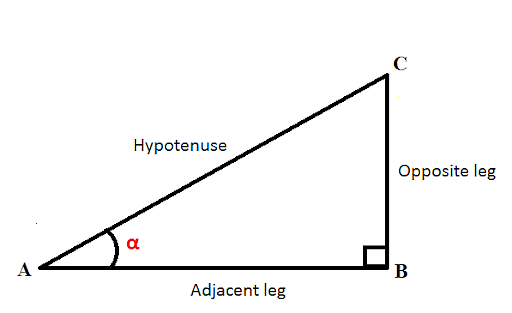
Cotangent Formula
For example, given above is a right-angled triangle ABC that is right-angled at B. Here, AB is the side adjacent to A and BC is the side opposite to A.
Thus, the cotangent of A (cot A) is
cot A = (Adjacent side of A) / (Opposite side of A) = (AB) / (BC).
If we consider AC = 3 and BC = 4 then,
Cot A = AC/BC = ¾
Read More: Trigonometry Values
Properties of Cotangent
[Click Here for Sample Questions]
We have learnt that cot x = adjacent side / opposite side.
But apart from this, we can also mention cotangent in terms of other trigonometric ratios which are explained below in detail.
-
Cotangent in Terms of Cos and Sin
It is known that sin θ = opposite side/hypotenuse
Also we know that cos θ = adjacent side/hypotenuse
(cos θ) / (sin θ) = (Adjacent) / (Hypotenuse) / (Hypotenuse) / (Opposite)
= (Adjacent) / (Opposite)
= cot θ
There we can represent cot θ as cos θ / sin θ in terms of cos and sin.
-
Cotangent in Terms of Tan
It is known that tan θ = opposite side / adjacent side
And cot θ = adjacent side / opposite side,
We can see that cot and tan are inverses of each other.
We can write cot θ = 1/ tan θ or tan θ = 1/cot θ
So we can represent cot in terms of tan as
Cot θ = 1 / tan θ
We can also write cot in terms of tan as
cot θ = tan (π/2 - θ) (or) tan(90° - θ)
Read More: Inverse Tan
-
Cotangent in Terms of Cosec
To represent cot in terms of cosec we have to revise one of the trigonometric identities which is, cosec2θ - cot2θ = 1
Cot2 θ = cosec2 θ – 1
Cot θ = √ (cosec2 θ – 1)
Therefore we can write cot in terms of cosec θ as
Cotθ = √ (cosec2 θ – 1)
Cotangent Law
[Click Here for Sample Questions]
Consider a triangle ABC where AC= b, AB = c, BC = a. The cotangent law is similar to sine law but it involves half of the angles
The cotangent law states that
(cot A/2) / (s - a) = (cot B/2) / (s - b) = (cot C/2) / (s - c)
Where s is the semi perimeter of the triangle i.e, s = (a + b+ c )/2
Period and Sign of Cotangent
[Click Here for Sample Questions]
The value of cot is positive only in the first and third quadrant and is negative in the second and fourth quadrants. So we can write it as
- Cot(π - θ) = - cot θ (2nd quadrant)
- Cot (π + θ) = cot θ (3rd quadrant)
- Cot (2 π - θ) = - cot θ (4th quadrant)
- Cot (2π + θ) = cot θ (1st quadrant)
We have learnt that trigonometric functions are periodic functions. To find the period of the cotangent function, we should look at the above values of the cot in different quadrants.
We have Cot (2 π + θ) = cot θ. But cot can have a smaller period π as this function is positive in the first and third quadrant.
Thus we conclude that the period of cotangent function is π, i.e., cot (π + θ) = cot θ.
-
Cotangent of Negative Angles
The cotangent of negative angle is negative of cot of the same positive angle. This means that
cot( - x ) = - cot x for any x in the domain
This shows that cotangent is an odd function.
Read More: Introduction to Trigonometry Formula
Cotangent on Unit Circle
[Click Here for Sample Questions]
We know that points on the unit circle give the values of sin and cos of corresponding angles. To find cotangent, we just have to divide the corresponding value of cos by the corresponding value of sin because we have the cot x formula as cot x = (cos x) / (sin x). Tabulated below are the values of cot θ for some standard angles:
| Degree | Radian | Sin θ | Cos θ | cot θ = cos θ /sin θ |
|---|---|---|---|---|
| 0 | 0 | 0 | 1 | Undefined |
| 30 | π/6 | 1/2 | √3/2 | √3 |
| 45 | π/4 | √2/2 | √2/2 | 1 |
| 60 | π/3 | √3/2 | 1/2 | 1/√3 |
| 90 | π/2 | 1 | 0 | 0 |
Similarly, one can also calculate the cotangent of all angles of the unit circle. Given below is the unit circle chart:
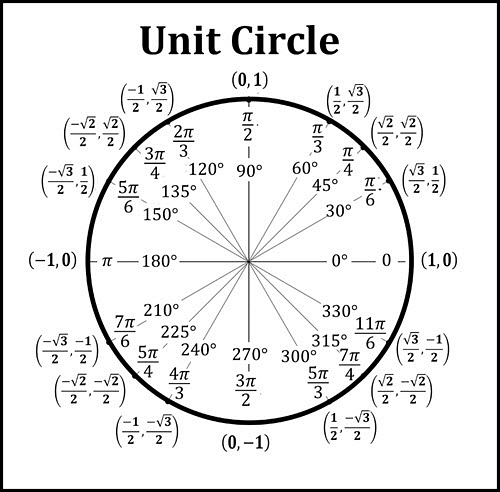
Unit circle
Domain and Range of Cotangent
[Click Here for Sample Questions]
We know that cot is not defined at 0° (0π), 180° (1π), and 360° (2π), i.e, cotangent is not defined wherever sin x is equal to zero as cot x = (cos x)/(sin x)). As we know that sin x is equal to zero for integer multiples of π, thus, the cotangent function is undefined for all integer multiples of π. Hence we can say that, cot nπ is not defined for any integer n.
Therefore, the domain of cotangent is the set of all real numbers except nπ (where n ∈ Z). additionally, from the unit circle, we can derive that the cotangent function can result in all real numbers, and thus, its range is the set of all real numbers (R).
- The domain of cotangent can be understood as the set of real numbers except for all the integer multiples of π.
- The range of cotangentrefers to the set of all real numbers, which is
cot x: R - {nπ / n ∈ Z} → R
- Graph of Cotangent
Since the values of the cot are not defined on integral multiples of π, the graph is vertical asymptotes at all multiples of π. Apart from that, from the unit circle, we can observe that cotangent is 0 at all odd multiples of π/2 and that in an interval say (0, π), the values of cot decrease as the angles increase. Thus, we can classify cot as a decreasing function. Here is what the graph of the cotangent function looks like.

Cotangent Graph
- Here y = cot x
- Domain = R – nπ
- Range = R
Read More: Increasing and Decreasing Functions in Calculus
Derivative and Integral of Cotangent
[Click Here for Sample Questions]
In order to find out the derivative and the integral of cotangent, we will use the identity cot x = (cos x) / (sin x).
-
Derivative of Cotangent
Let us assume y = cot θ = (cos θ) / (sin θ). Then,
Dy/dθ= [ sin θ . d/dθ (cos θ) - cos θ d/dθ(sin θ) ] / (sin θ)2
= [sin θ (- sin θ) - cos θ (cos θ) ] / sin2θ
= [-sin2θ - cos2θ]/ sin2θ
= - [sin2θ + cos2θ]/ sin2θ
= -1/sin2θ [Using trigonometric identity sin2θ+ cos2θ = 1]
= -cosec2θ [Because sin x = 1/csc x and csc x = 1/sin x]
Thus, the derivative of cot θ is -cosec2θ
-
Integral of Cotangent
∫ cot θ = ∫ (cos θ / sin θ ) dθ
Here we will evaluate this integral by substitution method. Let sin θ = v. Then cos θ dθ = dv.
Then using the above integral becomes,
∫ (1/v) dv = ln |v| + C, where C is the integration constant.
Substitute v = sin θ back here,
∫ cot θ dθ = ln |sin θ| + C
Thus, the integral of cot x is ln |sin x| + C.
Read More: List of Integral Formulas
Things to Remember
- Cotangent is one of the six basic trigonometric functions and is usually denoted as "cot x".
- The general cotangent formula for an angle θ is cot θ = (Adjacent side) / (Opposite side)
- The cotangent of negative angle is negative of cot of the same positive angle, i.e, cot( - x ) = - cot x for any x in the domain which shows that cotangent is an odd function.
- The domain and range of cot x: R - {nπ / n ∈ Z} → R
- The trigonomtric identity for cot is Cot θ = √ (cosec2θ – 1)
- The derivative of cot x is -cosec2θ
- The integral of cot x is given as ln |sin x| + C.
- The cotangent law can be stated as (cot A/2) / (s - a) = (cot B/2) / (s - b) = (cot C/2) / (s - c)
Also Read:
Sample Questions
Ques. If the value of sin x = 3/5 and cos x = 4/5, find the value of cot x. (3 Marks)
Ans. We know that
Tan x = Sin x/Cos x
So, tan x = (3/5)/(4/5) = 3/4
Now, we know that
Cot x = 1/tan x = 4/3
Ques. Find the cotangent of x if sin x = 3/5 and cos x = -4/5 using the cotangent formula. (3 Marks)
Ans. We know that cot x = cos x / sin x
Cot x = - 4/5 * 5/3
Cot x = -4/3 (ans)
Ques. Prove the identity: csc x / (tan x + cot x) = cos x. (3 Marks)
Ans. We know that, cot x = (cos x) / (sin x) and tan x = (sin x)/ (cos x). Also, cosec x = 1/sin x. Then we get
LHS = csc x / (tan x + cot x)
= (1/sin x) / (sin x/cos x + cos x/sin x)
= (1/sin x) / [ (sin2x + cos2x)/sin x cos x ]
= (1/sin x) / (1/sin x cos x) --- [Because sin2x + cos2x = 1]
= (1/sin x) × (sin x cos x)/1
= cos x
= RHS
Ques. Given that tan 2A = cot (A – 18°), where 2A is an acute angle, find the value of A. (3 Marks)
Ans. We are Given that
tan 2A = cot (A- 18°)
cot (90° – 2A) = cot (A – 18°) ( tan X = cot (90° – X))
Comparing the angles we obtained
90° – 2A = A – 18°
3A = 108°
A = 36°
Therefore, value of A = 36°.
Ques. Find Cot x if tan x = 5/6. (3 Marks)
Ans. We know that cot x = 1 / tan x
We get cot x = 1/tan x
= 1/5/6
= 6/5
Thus, Cot x = 6/5
Ques. For the given triangles find the value of secant, cosecant and cotangent of angle theta. (3 Marks)

Ans. From given diagram we can see that adjacent = 6 , opposite = 8 amd hypotenuse = 10
We know that sec =hypotenuse/adjacent = 10/6= 5/3
cosec = hypotenuse / opposite = 10 / 8 = 5/4
cot = adjacent / opposite = 6/8 = 3/4
Ques. What will be the value of θ in cot, if the length of the adjacent side of the right angle triangle is 6√3 cm and the length of the right-angle triangle is 6 cm. (3 Marks)
Ans. The cotangent formula is
Cot θ= AdjacentSide/OppositeSide
cot = 6√3 / 6
Thus, the cot = √3
Now, we can obtain the value of θ from the trigonometric ratio table.
Thus, the answer would be Cot 30°
For Latest Updates on Upcoming Board Exams, Click Here: https://t.me/class_10_12_board_updates
Check-Out:



Comments