


What is meant by adjacent sides?

Collegedunia Team logo

Collegedunia Team

Content Curator

In mathematics and geometry, adjacent sides refer to sides that share a common endpoint or vertex. Adjacent sides can be found in various two-dimensional shapes, such as squares, rectangles, triangles, and polygons.

For example, in a square, each of the four sides is adjacent to the two sides it touches. In a rectangle, two sides that are opposite each other are referred to as "opposite sides," while the other two sides are considered to be adjacent. Any two sides that share a common vertex are considered to be adjacent sides in a triangle.

Adjacent sides play an important role in many geometric calculations and measurements, such as finding the perimeter of a shape, calculating the area, and determining the interior and exterior angles of a shape. By understanding the relationships between adjacent sides, it is possible to make more precise calculations and predictions about various shapes and figures.
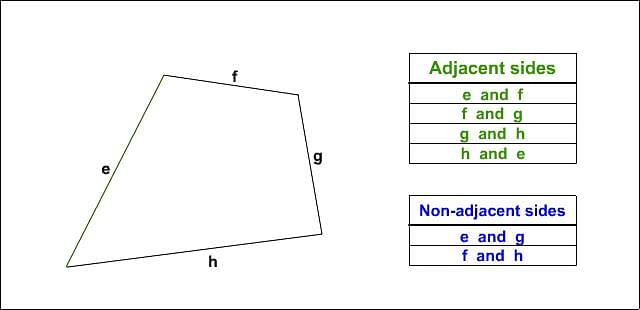
Adjacent Sides

Adjacent Sides

Also check:

CBSE CLASS XII Related Questions

  • 1.

    Evaluate :

    \[ I = \int_{-\pi}^{\pi} \frac{2x\,(1+\sin x)}{1+\cos^2 x}\,dx \]


      • 2.

        If \(P(A) = 0.3\), \(P(B) = 0.7\) and \(P(B/A) = 0.5\), then \(P(A \cup B)\) is :

          • \(0.35\)
          • \(0.85\)
          • \(0.5\)
          • \(0.21\)

        • 3.

          If \(y = \sqrt{\log \left\{ \sin \left( \dfrac{x^2}{3} + 1 \right) \right\}}\), then show that

          \[ \frac{dy}{dx} = \frac{x \cot \left( \dfrac{x^2}{3} + 1 \right)}{3y}. \]


            • 4.

              The motion of a particle is described as \( S = 2t^{3} - 6t^{2} + 8 \). Its velocity \( \frac{dS}{dt} \), when the acceleration \( \frac{d^{2}S}{dt^{2}} \) vanishes is :

                • \( -6 \) unit/sec
                • \( 0 \) unit/sec
                • \( 18 \) unit/sec
                • \( 6 \) unit/sec

              • 5.

                For events A and B, if \(P(B)=\frac{3}{5}\), \(P(A/B)=\frac{1}{2}\) and \(P(A\cup B)=\frac{4}{5}\), then \(P(A)\) is :

                  • \(\frac{1}{2}\)
                  • \(\frac{3}{5}\)
                  • \(\frac{1}{5}\)
                  • \(\frac{3}{10}\)

                • 6.

                  Solve the differential equation \( y + \frac{d}{dx}(xy) = x(\sin x + \log x) \).

                    CBSE CLASS XII Previous Year Papers

                    Comments


                    No Comments To Show
