



Content Curator
Hypotenuse is the side which is opposite to the right angle in a right angled triangle and is the largest amongst all sides. We use Pythagorean theorem to find out the length of the hypotenuse which states- “The square of the length of the hypotenuse equals the sum of the squares of the lengths of the other two sides.”
| Table of Content |
Key Takeaways: Pythagoras Theorem, Right Angled Triangle, Congruency of Triangles.
Hypotenuse Definition
[Click Here for Sample Questions]
Hypotenuse implies the longest side in a right-angled triangle. The hypotenuse side is present opposite to the biggest angle of all the three angles in a right-angled triangle which is the right angle. Fundamentally, the hypotenuse is the property of just the right triangle and no other triangle. Presently, this is better clarified when we learn about the Pythagorean theorem. These ideas are significantly utilized in Geometry.

Hypotenuse
The video below explains this:
Pythagoras Theorem Detailed Video Explanation:
Also Read:
| Related Articles | ||
|---|---|---|
| Angle Formula | Similarity of Triangles | Introduction to Three-Dimensional Geometry |
| Trigonometry Values | Introduction to Constructions | Prime Numbers |
Pythagoras Theorem
[Click Here for Sample Questions]
Pythagoras was a Greek philosopher of sixth century B.C. who founded a very important and useful property of the right-angled triangles which was later named after him.
It is a geometric theorem in which the sum of squares at the base and perpendicular of the right triangle is equal to the square of its hypotenuse.
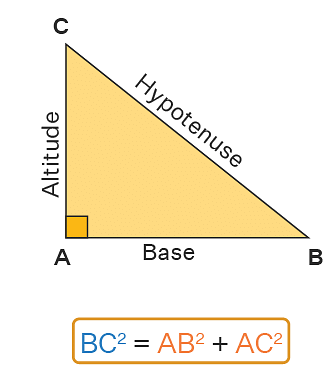
Pythagoras Theorem
This can be mathematically written as,
h2=p2+b2
Where
h= height of the right-angled triangle
p= perpendicular of the right-angled triangle
b= base of the right-angled triangle
This theorem is mainly used to find the length of the sides and angles of a right-angled triangle which is unknown. A right-angled triangle is a type of triangle having one of the angles as right angle (90°). Using this theorem, we can derive the perpendicular, base, and hypotenuse formulas.
Read Also: Pythagoras Theorem
Calculating Hypotenuse
[Click Here for Sample Questions]
We can calculate the length of the hypotenuse by using the square root function which is implied by the Pythagorean theorem. If we denote the base and perpendicular by a and b respectively and the hypotenuse by c, we can find out the hypotenuse via this relation
C = \(\sqrt{a^2+b^2} \)
This relation is called Pythagoras theorem. This length can also be derived by observing that the angle opposite the hypotenuse is 90° from the law of cosines
Also Read:
| Related Articles | ||
|---|---|---|
| Angle Between Two Planes | Symmetric Matrix | Angle Between a Line and a Plane |
| Ordinate | Vertex | Practical Geometry MCQs |
Things to Remember
[Click Here for Sample Questions]
- The term hypotenuse finds its origin from the ancient Greek word hypoteinousa, meaning subtending the right angle’.
- The Hypotenuse is the longest side in a right triangle since it is located opposite the biggest point of the triangle, the 90 degrees point.
- The shortest side is located opposite to the smallest angle in a right triangle.
- If you know the medium point, the adjoining side to it is the shortest.
- Hypotenuse cannot be used to solve a right angled triangle and it is mathematically impossible.
- Geometrical concepts are useful in physics, engineering, navigation, construction etc.
Read More: Angle between Two Lines
Sample Questions
Ques. An engineer has been given a contract to construct a ramp with 8m of horizontal space with 6 meters of height for the elevation of goods. What is the length of the ramp built? [2 Marks]
Ans. Base of the ramp= 8 meters
Height of the ramp= 6 meters
Height of the ramp= ?
According to Pythagoras theorem, h2=p2+b2
Putting our values in the above equation,
h2=82+62
h= \(\sqrt{64+36}\) m
h = \(\sqrt 100 \) m
h = 10 m
Therefore, Length of the ramp is 10 meters
Ques. What is the equation of the hypotenuse h of a right triangle in terms of its area A and its perimeter P? [3 Marks]
Ans. 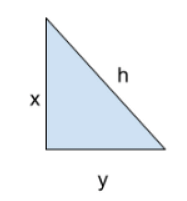
Area = \(\frac{1}{2} \times x \times y\)
→ 2A = xy
x + y + h = P
→ x + y = P – h
x2 + y2 = h2
→ x2 + y2 + 2xy – 2xy = h2
→ (x + y)2 – 2xy = h2
→ (P – h)2 – 2 (2A) = h2
→ P2 – 2Ph + h2 – 4A = h2
→ \(\frac{P^2 - 4 A}{2P} = \frac{2Ph}{2P}\)
→ h = \(\frac{P^2 - 4 A}{2P}\)
Ques. Find the maximum area of a triangle that contains hypotenuse 15 [4 Marks]
Ans. Let x and y be sides of right angled triangle ABC,
By pythagoras theorem,
x2+y2=225
y=225-x2
Area of triangle from the sides,
A= xy2
A= 12 x 225-x2
Differentiating area function, we get
A’ = 12 225-2x2225-x2
Setting derived function equal to zero
2x2 = 225
x = 152
Maximum Area of the triangle, 2254 = 56.25
Ques. In a right angled triangle, the length of the hypotenuse is 17. One of the sides is 7 units bigger than the other side. What are the lengths of these two sides? [4 Marks]
Ans. x2 + ( x+ 7)2 = 172
x2 + x2 + 14x + 49 = 289
2x2 + 14x2— 240 = 0
x² + 7x2— 120 = 0
(x + 15)(x-8) = 0
x = 8 (rejecting the negative value -15)
So the lengths of the two shorter sides are 8 cms and 8 + 7 = 15 cms.
Ques. Can we solve a 30°-60°-90° right triangle if we are provided with only the hypotenuse? [2 Marks]
Ans. The side lengths in a 30–60–90 right-angled triangle are in the ratio of- 1:√3:2
If we write this ratio in variable form we get: x:x√3:2x
Taking an example, if the hypotenuse is given as 20, then 2x=20 and x=10, therefore, the short leg is 10 and the long leg is 10√3.
Ques. Given tan A = 2/3, calculate hypotenuse? [2 Marks]
Ans. According to question, tan A=23=pb
22 + 32=13
Therefore the length of the hypotenuse comes out to be 13
Ques. If we assume sin x = 1/2, what are the possible values for the sides and the hypotenuse of the right-angled triangle? [2 Marks]
Ans. Given, sin x = 12 = The unknown sidehypotenuse=t2t
where t is a positive number which means that the side opposite x is t and that of the hypotenuse is 2t.
We will find the other side l of this right angled triangle by using the Pythagorean theorem.
t2+l2=(2t)2
t2+l2=4t2
l2=3t2
And l=t3
So, the side which is opposite angle x is t, the side adjacent to x is t√3 and the hypotenuse is 2t.
Ques. If the smallest side of the right angled triangle measures 13cm, then what will the measurement of hypotenuse be and eventually also find out the length of the second largest side. [3 Marks]
Ans. 13, 84, 85 forms a Pythagorean Triplet.
→ If the smallest side of the right angled triangle is 13, then the hypotenuse will be 85.
Since, the largest and second largest sides of a primitive Pythagorean Triplet always differ by 1.
Assuming largest side as x and second largest side to be x2-1, we get
x2 = (x -1)2 + 132
x2 = x2 -2x + 1 + 169
x = 170/2 = 85 = Hypotenuse
→ Second largest side = 85-1 =84
For Latest Updates on Upcoming Board Exams, Click Here: https://t.me/class_10_12_board_updates
Also Read:



Comments