



Study Abroad Expert | Updated On - Oct 16, 2026
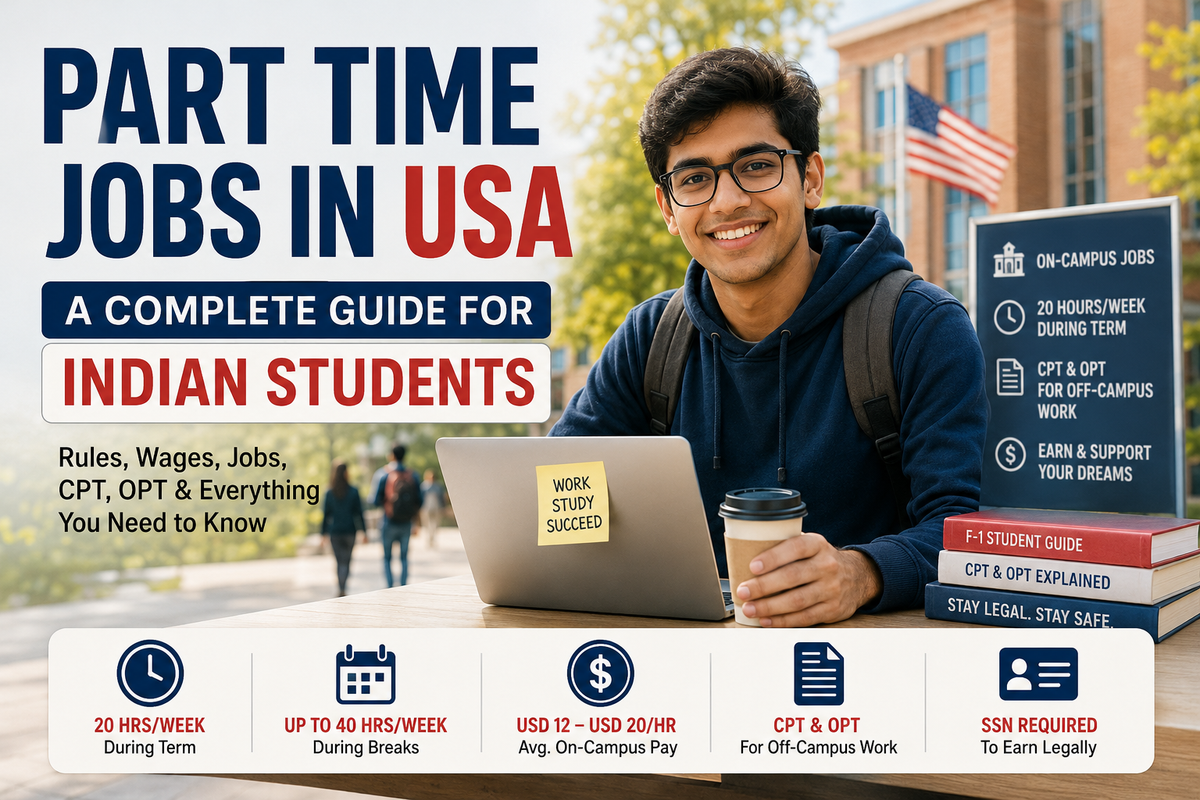
Part time jobs in USA are capped at 20 hours per week for F-1 Indian students on campus during term. Students can work full-time during breaks. Off-campus work needs CPT or OPT approval first.
- On-campus work is the only safe default for your first academic year. Everything else needs paperwork.
- CPT and OPT unlock legal off-campus work, but each has strict course and timing rules.
- Freelance gigs on Upwork, Fiverr or Uber are not "harmless side work". They can end your visa.
- Earnings cover living costs in cheaper cities. Tuition still needs a loan, scholarship or family funding.
Check the full Study in USA guide for Indian students
Recent Reddit and GradCafe threads show Indian students have been quitting part-time jobs over fear of deportation checks since early 2025. The on-campus route is the one that stays safe. A legal part-time job can take INR 15,000 to INR 50,000 of monthly pressure off a US education budget. The wrong one can take the degree away.
Quick Facts on Part Time Jobs in USA
| Parameter | Detail |
|---|---|
| Weekly work cap (term) | 20 hours per week |
| Weekly work cap (breaks) | Up to 40 hours per week |
| First-year off-campus work | Not allowed without CPT or OPT |
| Federal minimum wage | USD 7.25 per hour (around INR 690) |
| Average on-campus wage | USD 12 to USD 20 per hour (around INR 1,142 to INR 1,903) |
| OPT duration (non-STEM) | 12 months post-graduation |
| OPT duration (STEM) | Up to 36 months with the 24-month extension |
| Required document to earn wages | Social Security Number (SSN) |
Conversions based on a USD-INR rate of INR 95.16 as of October 15, 2026. Rates fluctuate; check the current rate before financial planning.
- Part Time Jobs in USA Rules Explained
- On Campus Jobs for Indian Students
- Off Campus Work With CPT and OPT
- Average Hourly Wages for Part Time Jobs
- US Minimum Wage State by State
- How to Find a Part Time Job in USA
- SSN and Tax Rules for F-1 Students
- Why Freelance and Off Campus Gigs Backfire
- Can Part Time Jobs Cover US Living Costs
Part Time Jobs in USA Rules Explained
Part time jobs in USA for F-1 Indian students follow two simple rules. On-campus is the default. Off-campus needs CPT or OPT.
In the first academic year, students may only take on-campus roles. The limit is 20 hours per week while classes run. During summer and winter breaks, students can switch to full-time hours. Any paid work outside this frame counts as unauthorized employment under 8 CFR 214.2(f)(9)(i).
Unauthorized work ends in a terminated SEVIS record. A terminated record cancels the F-1 visa. A cancelled visa triggers a three-year or ten-year re-entry ban. The F-1 interview rules warn applicants about this directly.
- Students must stay enrolled full-time to keep work rights alive.
- Total hours across all on-campus jobs must stay under 20 per week.
- Permission from the Designated School Official (DSO) is often needed before starting.
- Source: USCIS and SEVP guidance.
Key Insight: On-campus work does not need USCIS approval. The International Student Office at the university handles it. Off-campus work always needs a federal paper trail.
If a student works more than 20 hours during term time, the F-1 status breaks. That means Z. No warning, no second chance. The campus HR system reports hours straight into SEVIS.
On Campus Jobs for Indian Students
On-campus jobs are the safest earning route for first-year Indian students in the USA. They need no USCIS filing, carry no visa risk and often pay USD 12 to USD 20 per hour.
Roles sit in two groups. The first group is academic: Teaching Assistant (TA), Research Assistant (RA) and Graduate Assistant (GA). These pay higher and sometimes include tuition waivers. The second group is service: library desk, bookstore, campus cafe, IT help desk and tour guide.
| On-Campus Role | Average Hourly Pay (USD) | Monthly Earning (INR, 20 hrs/week) |
|---|---|---|
| Tour Guide | USD 25.72 | INR 1.95 lakh |
| Peer Tutor | USD 21.31 | INR 1.62 lakh |
| Research Assistant | USD 19.88 | INR 1.51 lakh |
| Campus Tech Support | USD 19.72 | INR 1.50 lakh |
| Teaching Assistant | USD 15.50 to USD 18.50 | INR 1.18 to INR 1.41 lakh |
| Library Assistant | USD 13.24 | INR 1.00 lakh |
| Barista or Dining | USD 11.59 | INR 88,000 |
TA and RA roles often need a TOEFL Speaking score of 26 or higher. Universities enforce this to protect classroom quality. Source: compiled from Rochester Institute of Technology, Shorelight and MPower data.
What on-campus jobs give you:
- Legal income without a work-permit filing.
- Short walk from class, no commute cost.
- Supervisor contacts for later referrals and reference letters.
What on-campus jobs do not cover:
- Full tuition. Even top wages at 20 hours a week cannot touch a USD 40,000 bill.
- Field experience in your major. For that, you need CPT or OPT.
Read More: Cheapest Universities in USA for Indian Students 2026
Off Campus Work With CPT and OPT
Off-campus part time jobs in USA need CPT or OPT authorization from day one. Working without either is unauthorized employment and ends F-1 status.CPT stands for Curricular Practical Training. It is used while the student is still studying. The job must link directly to the degree. The DSO approves CPT inside SEVIS and prints it on a fresh I-20. Work can start only after that I-20 is in hand.
OPT stands for Optional Practical Training. It gives up to 12 months of full-time or part-time work in the student’s field. Students can use it during studies (pre-completion OPT) or after graduation (post-completion OPT). OPT needs USCIS approval and takes 90 to 150 days. STEM graduates can add 24 more months through the OPT vs CPT extension pathway, giving up to 36 months in total.
| Rule | CPT | OPT |
|---|---|---|
| When used | During studies | During or after studies |
| Approval by | DSO (university) | USCIS (federal) |
| Processing time | 3 to 7 days | 90 to 150 days |
| Job type | Must count for course credit | Must match the major |
| Hour limit (term) | Part-time up to 20 hrs/week | Part-time up to 20 hrs/week |
| Total duration | Unlimited part-time | 12 months, STEM adds 24 more |
| Fee | Free | USD 410 (around INR 39,000) to USCIS |
Twelve months or more of full-time CPT wipes out OPT eligibility. Many Indian masters students miss this and lose their post-study work window. Source: USCIS and university DSO handbooks.
What students actually say on GradCafe: "The hardest part was not finding a CPT job. It was waiting for my DSO to sign the I-20 before I could start work."
If a job offer arrives mid-semester, students sometimes rush. That means filing CPT before the course credit alignment is confirmed. If the course does not match, the authorization fails later audits. The paper trail must line up.
Average Hourly Wages for Part Time Jobs
Average pay for part time jobs in USA for Indian students sits between USD 10 and USD 25 per hour. The number depends on the state, the city and the type of work.
Three city tiers roughly set the pay band. Tier 1 cities like New York, San Francisco, Boston and Seattle pay USD 17 to USD 25 per hour even for entry roles. Tier 2 cities like Chicago, Dallas and Atlanta pay USD 13 to USD 18 per hour. Tier 3 towns in Ohio, Texas and Florida run USD 10 to USD 13 per hour.
| Job Type | Hourly Wage (USD) | Hourly Wage (INR) |
|---|---|---|
| Tutor or Peer Mentor | USD 23.94 | INR 2,278 |
| Office Admin or Receptionist | USD 17 to USD 21 | INR 1,618 to INR 1,998 |
| Sales or Store Associate | USD 14.50 to USD 17.50 | INR 1,380 to INR 1,665 |
| Call Centre (CPT) | USD 16 to USD 22 | INR 1,523 to INR 2,094 |
| Translator (CPT) | USD 26.19 | INR 2,492 |
| Grad Assistantship (stipend) | USD 1,800 to USD 2,800 per month | INR 1.71 to INR 2.66 lakh per month |
Graduate assistantships are the top earners in rupee terms. They often come with tuition remission on top. Source: Shorelight, Instarem and university career data.If the city is cheap, then wages still buy more.That means a USD 14 role in Dallas can out-save a USD 20 role in Manhattan. Rent eats the difference.
US Minimum Wage State by State
The federal minimum wage is USD 7.25 per hour, but most states Indian students study in pay far more. California, Washington and New York top the chart.
The federal floor has not moved since 2009. Thirty states and dozens of cities set their own higher rates. For 2026, Washington leads with USD 17.13 per hour. New York City, Long Island and Westchester hit USD 17. California stands at USD 16.90 statewide. Texas and Florida still match the federal floor at USD 7.25.
| State or City | Minimum Wage 2026 (USD/hour) | INR Equivalent |
|---|---|---|
| Washington State | USD 17.13 | INR 1,630 |
| New York City | USD 17.00 | INR 1,618 |
| California | USD 16.90 | INR 1,608 |
| California (fast food) | USD 20.00 | INR 1,903 |
| Upstate New York | USD 16.00 | INR 1,523 |
| Illinois | USD 15.00 | INR 1,427 |
| Ohio | USD 10.70 | INR 1,018 |
| Texas | USD 7.25 | INR 690 |
| Florida | USD 7.25 | INR 690 |
State wage rules override federal rules when they are higher. Source: OnPay and state labour department filings for 2026.
- Choose a university in a high-wage state only if the cost of rent still leaves savings.
- City wages often beat state wages: Seattle sits above Washington State, Chicago above Illinois.
- Fast food, healthcare and farm workers often have their own higher-wage carve-outs.
How to Find a Part Time Job in USA
Most Indian students find on-campus part time jobs in USA through Handshake, the university career portal or direct department emails. The hiring season starts in August and January. Handshake is the main platform. Every US university uses it. Students log in through the career services page, filter by "Part-Time" and "On-Campus", and apply with a one-page resume and a cover letter. Jobs post from mid-July for Fall and mid-November for Spring.
Direct outreach works better than Handshake for TA and RA roles. Students email the professors whose research they want to join. A short note with a CV, grades and one line on fit lands more replies than a form application.
- Build a US-format one-page resume with month-year dates and action verbs.
- Pick five target departments linked to your course and skills.
- Email three professors per week starting six weeks before term.
- Walk into the library, bookstore and student centre to ask about open shifts.
- Attend career fairs in the first two weeks of each semester.
Key Insight: On-campus hiring is often first-come, first-served. Reddit posts from r/gradadmissions show the best library shifts fill up in the first week of orientation.
If a student applies late, then the roles with flexible hours vanish. That means stuck with night shifts or weekend slots that clash with lab work. Early action compounds.
CPT jobs are harder. Students need a course-aligned internship offer in hand before the DSO files the I-20. Platforms like LinkedIn, Indeed and company career pages are the usual sources. The role must be at a US-based employer with a tax ID. Volunteer and unpaid work still needs CPT if it is in the student’s field.
- Internships at FAANG companies, startups and research labs dominate CPT demand.
- Many Fall-admit students join a CPT internship in Summer after their second semester.
- GPA matters. A 3.5 or higher opens more employer doors.
SSN and Tax Rules for F-1 Students
An F-1 student needs a Social Security Number (SSN) before taking home any paycheck from a part time job in USA. The job offer letter is required to apply.
The SSN application is handled by the Social Security Administration. Students must bring the signed I-20, passport, F-1 visa stamp, I-94 record and a job offer letter from the hiring department. The letter must list the student’s name, job title, start date and supervisor contact. Processing takes two to four weeks.
The SSN card arrives stamped "not authorized for employment without DHS authorization". That stamp confuses many first-year students. It only means the SSN itself does not grant work rights. The F-1 visa plus the job authorization already does. Payroll uses the SSN to report wages to the IRS.
- SSN is tied to taxable income reporting. Students without an SSN cannot receive wages.
- Non-wage scholarship income uses an ITIN, not an SSN.
- Students must file Form 8843 every year even with zero income.
- Wage earners also file Form 1040-NR by April 15.
- Source: IRS Publication 519 and university tax offices.
Why Freelance and Off Campus Gigs Backfire
Freelance jobs on Upwork, Fiverr and Uber are unauthorized employment for F-1 Indian students. Even remote work paid in INR to an Indian bank account counts as a violation.
USCIS treats all paid work by F-1 holders as employment. The location of the client, the currency and the duration do not matter. One client, one short project, one logo design job for a US firm, all count as work. Without CPT or OPT, all of them are illegal.
Since early 2025, enforcement has tightened under the current US administration. The Deccan Herald and Business Standard reported in January 2025 that Indian students began quitting part time jobs in large numbers after workplace document checks became common. Indian government data showed deportations rose from three a day to around eight a day between January and July 2025.
What students actually say on Reddit: "Three friends on my block switched off their Uber accounts last semester. The small weekly cash is not worth a ten-year re-entry ban."
Common unauthorized traps:
- Driving for Uber, Lyft or DoorDash on an F-1 visa.
- Freelance coding, design, writing or translation on Upwork and Fiverr.
- Babysitting, pet-sitting or tutoring for cash paid off the books.
- Running a side business or online store that takes payments.
- Working at a restaurant or gas station without CPT.
If the work is unauthorized, then the SEVIS record can be terminated by the DSO or by USCIS. That means visa cancellation, loss of OPT eligibility and a long re-entry ban. Students who want to freelance should wait for post-completion OPT and only take jobs that match their major.
Can Part Time Jobs Cover US Living Costs
A legal part-time job in USA can cover most living costs in affordable cities, but it cannot pay tuition. The math works only when the degree is already funded by scholarship, loan or family support.
Living costs run USD 1,000 to USD 1,500 per month in cheap cities. New York, San Francisco and Boston push that to USD 2,000 to USD 2,500. A 20-hour-per-week job at USD 15 per hour grosses USD 1,200 a month. After federal and state tax, that is roughly USD 1,000 in hand, or around INR 95,000.
| City Tier | Monthly Cost (USD) | Monthly Cost (INR) | 20-hr Job Coverage |
|---|---|---|---|
| Tier 3 (Houston, Dallas, Atlanta) | USD 1,200 | INR 1.14 lakh | Full cover at USD 15/hr |
| Tier 2 (Chicago, Pittsburgh) | USD 1,600 | INR 1.52 lakh | Partial cover, needs USD 20/hr |
| Tier 1 (New York, Boston, SF) | USD 2,300 | INR 2.19 lakh | Not possible on 20 hrs alone |
Tuition still sits at USD 25,000 to USD 60,000 per year. Even at USD 25 per hour, a 20-hour cap caps total pay at around USD 20,000 a year. That is useful but not a tuition replacement. Loan sources like HDFC Credila, Avanse, SBI Global Ed-Vantage, PNB Udaan and Prodigy Finance remain the main route.
If savings matter more than the city, then tier-3 US cities are the smart choice. That means lower rent, lower food cost and a part-time job that actually balances the monthly budget.
Also Check:
| OPT vs CPT Comparison Guide | MBA in USA Fees for Indian Students | USA Scholarships for Indian Students |
| F-1 Visa Interview Questions | Ivy League Universities Guide | Banks Offering US Education Loans |
Part time jobs in USA for Indian students work best when the goal stays small and legal. Pay the rent, buy the groceries, build US work experience for a reference letter. On-campus work in the first year, CPT for internships, OPT after graduation. Nothing outside this frame. Freelance gigs, Uber and off-the-books cash all carry a bigger cost than they pay. Treat the 20-hour cap as a hard rule, not a guideline, and the degree stays safe.
FAQs
Ques. Can Indian students work part time in USA on F-1 visa?
Ans. Yes. F-1 Indian students can work up to 20 hours per week on campus during term time. They can work full-time during breaks. Off-campus work needs CPT or OPT approval first.
Ques. How much can an Indian student earn from a part time job in USA?
Ans. Around USD 1,000 to USD 1,500 per month at 20 hours per week. That works out to roughly INR 95,000 to INR 1.43 lakh at the October 2026 rate. Pay depends on the state and the role.
Ques. What is the minimum wage for part time jobs in USA?
Ans. The federal minimum wage is USD 7.25 per hour. Many states pay more. California sits at USD 16.90, New York City at USD 17.00 and Washington State at USD 17.13 for 2026. Texas and Florida still match the federal floor.
Ques. Can F-1 students work off campus in the first year?
Ans. No. Off-campus work is not allowed in the first academic year. Students must complete one full year on F-1 status before applying for CPT or OPT. On-campus work is allowed from day one.
Ques. Do Indian students need an SSN to work part time in USA?
Ans. Yes. A Social Security Number is required for any paid work. Students apply after a job offer letter is signed. The process takes two to four weeks. The SSN is used only for wage reporting to the IRS.
Ques. Can I drive for Uber or do freelance work on Upwork as an F-1 student?
Ans. No. Driving for Uber, DoorDash or Lyft is unauthorized employment. Freelance work on Upwork or Fiverr is also banned without OPT approval. Even remote work for an Indian client paid in INR counts as a violation.
Ques. What is the difference between CPT and OPT for part time work?
Ans. CPT is for jobs tied to a course and approved by the DSO. OPT is a 12-month federal work permit, extendable to 36 months for STEM. CPT is instant. OPT takes 90 to 150 days through USCIS.
Ques. Which on-campus jobs pay the most for Indian students?
Ans. Graduate assistantships pay the most. A TA or RA stipend runs USD 1,800 to USD 2,800 per month, often with tuition waiver. Tour guide and peer tutor roles pay USD 21 to USD 26 per hour. Research assistant roles pay around USD 20.
Ques. Can part time jobs cover tuition and living costs in USA?
Ans. No for tuition. Yes for living costs in cheap cities. A 20-hour cap and USD 15 pay rate caps yearly income near USD 20,000. Tuition runs USD 25,000 to USD 60,000 a year. A loan or scholarship is still needed.
Ques. Do Indian students pay tax on part time jobs in USA?
Ans. Yes. Federal and state income tax apply. Students file Form 1040-NR each April. Indian students are exempt from Social Security (FICA) and Medicare tax for the first five years on F-1. Check pay stubs for wrong deductions.
Ques. How do I find on-campus jobs as a new international student?
Ans. Log into Handshake through the university career services. Filter for part-time and on-campus roles. Email professors directly for TA and RA openings. Walk into the library, bookstore and dining halls in orientation week to ask about open shifts.
Ques. What happens if I work more than 20 hours per week on F-1?
Ans. Working over 20 hours during term time breaks F-1 status under 8 CFR 214.2(f)(9)(i). The SEVIS record can be terminated. That leads to visa cancellation and a possible three-year or ten-year re-entry ban to the USA.



Comments