



Study Abroad Expert | Updated On - Nov 12, 2026
Yale and 36 US higher-ed groups urged DHS to scrap the USD 70,000 OPT fee on November 9, 2026. The joint comment was filed through the American Council on Education. The letter landed as the 30-day public consultation window closed. The push defends 97,556 Indian STEM graduates on the Optional Practical Training route.
- Indian students form the largest OPT cohort in the US, per the Open Doors 2025 report from the Institute of International Education.
- The rule charges universities USD 70,000 for the first OPT year and USD 30,000 for each STEM extension year.
- The ACE letter says the fees go "far beyond the cost of processing each OPT application" and warns schools cannot absorb the bill.
DHS published the proposed rule on October 8, 2026. The comment window drew submissions from Ivy League schools, state university systems, and research councils. A final rule now awaits agency review and White House sign-off.
Also Read: STEM OPT Extension
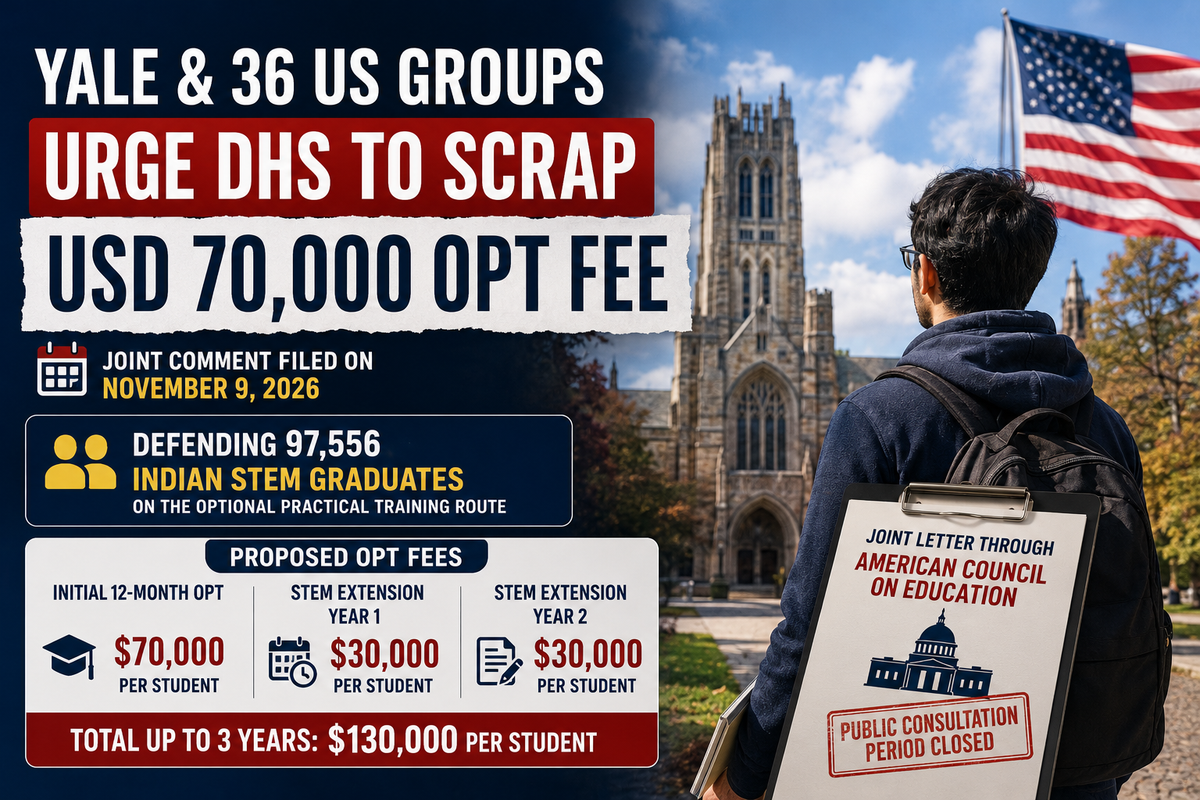
What the DHS Rule Proposes for OPT Fees
The proposed rule rewrites who pays and how much. Universities, not students or employers, carry the bill. The levy applies per student, per year, for up to three years.
| OPT Stage | Current Fee (USD) | Proposed Fee (USD) |
|---|---|---|
| Initial 12-month OPT | 470 | 70,000 |
| STEM Extension Year 1 | 470 | 30,000 |
| STEM Extension Year 2 | 0 | 30,000 |
| Three-year total per student | 940 | 130,000 |
Important Distinction: The bill lands on universities, not students. Schools decide whether to absorb the cost, raise tuition, cap OPT sponsorships, or trim STEM admissions where the maths fails.
Why Yale and 36 Higher-Ed Bodies Want It Scrapped
The ACE comment letter argues the fee is not tied to processing cost. USCIS adjudicators handle OPT applications, and current processing fees sit under USD 500. The signatories call the gap arbitrary and legally vulnerable.
Yale has backed OPT publicly before. The university co-signed an amicus brief defending OPT in 2020. It also expanded its Curricular Practical Training programme earlier this year to help international students stuck in work-permit limbo. A survey cited in the joint comment filing found 80% of international students would reconsider staying in the US if the full STEM OPT fee hit USD 100,000.
How Much Would Indian STEM Students Actually Pay
The rule puts the fee on universities, but the cost will flow through to tuition. At today’s rate of ₹88.5 per USD (November 2026), the full OPT levy converts to:
- Year 1 fee: USD 70,000 or ₹61.9 lakh.
- STEM extension (2 years): USD 60,000 or ₹53.1 lakh.
- Total per Indian STEM graduate: USD 130,000 or ₹1.15 crore.
That sits on top of US Masters tuition of USD 50,000 to USD 90,000 (₹44 lakh to ₹80 lakh) per year. The Masters cohort is the hardest hit. Most Indian students use the full three-year OPT window to secure an H-1B before heading home or shifting routes.
What it means for Indian Students: Expect universities to tighten admissions where OPT economics do not add up. Non-STEM Indian applicants and smaller Masters programmes face the biggest squeeze, since their tuition revenue is smaller than the proposed fee.
What Should Indian F-1 Students Do Right Now?
The rule is proposed, not final. Current OPT holders keep their existing approval. Students applying before the final rule file under the old fees. New entrants from Fall 2027 onward are the most exposed cohort. Immigration lawyers expect DHS to publish the final rule no earlier than mid-2027. Litigation is almost certain the day it drops.
Indian applicants targeting Fall 2027 should widen their options now. Apply to at least one UK, Irish, or Canadian backup programme. The UK Graduate Route and the Canada Post-Graduation Work Permit stay fee-neutral for students.
The USD 70,000 fee is not law yet. Indian STEM graduates currently on OPT, or filing before the final rule, remain on the old fee under USD 500. Fall 2027 entrants face the sharpest uncertainty, and the next inflection point is the DHS final rule.
Action Plan for Indian STEM Applicants
- Lock in your Fall 2026 or Spring 2027 intake if admitted. Earlier entry secures the current OPT fee structure.
- Ask your target school whether it will absorb the OPT fee or pass it through to tuition.
- Apply to one UK or Canadian backup programme with matching STEM content.
- Track DHS final-rule publication via the Federal Register weekly.
- Budget your US total cost with the OPT fee as a possible tuition add-on from 2027.
Keep an Eye On: DHS must now review public comments and publish the final OPT fee rule. Immigration lawyers expect the final rule no earlier than mid-2027, with legal challenges likely the day it drops. Fall 2027 Indian applicants should track the Federal Register weekly.



Comments