




CUET PG History Vedic Age and Age of Religion Handwritten Notes, free to download as a 20-page PDF. HUQP09 asks 75 questions at four marks each, and this part of Unit 1 takes roughly two days to learn, so keep the religions for the second.

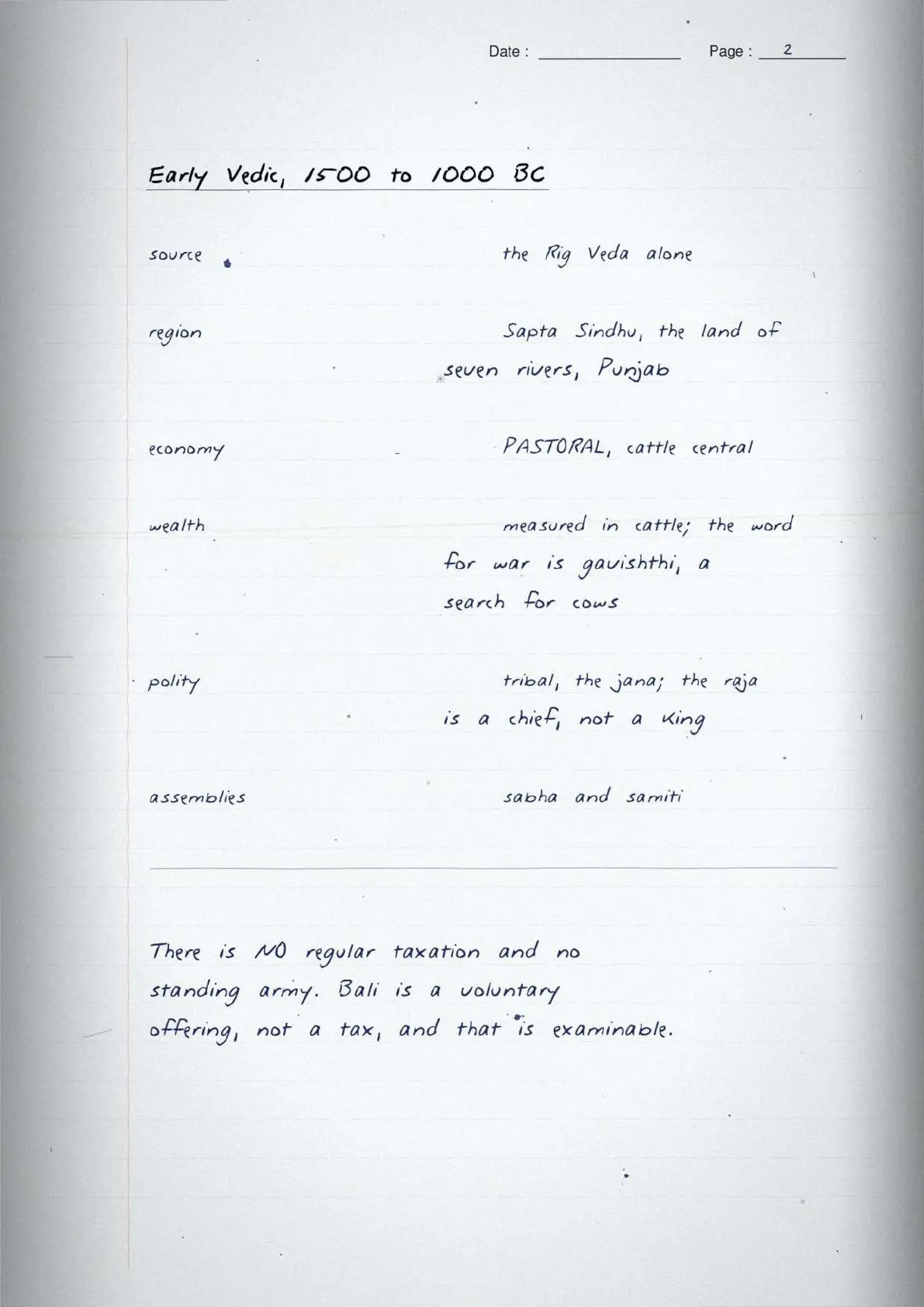


The notes are scans of a real notebook: short lines, boxed rules, and a margin note wherever something is easy to get wrong.
Where This Sits in HUQP09
The HUQP09 syllabus names four periods and asks 75 bilingual questions across them. This topic is the middle of Unit 1, between the Harappan cities and the Mauryas.
| Unit | Period | Span |
|---|---|---|
| 1 | Ancient History of India | 10000 BC to 1206 AD |
| 2 | Early Medieval India | 750 AD to 1206 AD |
| 3 | Medieval History of India | 1206 to 1707 AD |
| 4 | Modern History of India | 1707 to 1947 |
What the Notes Cover
- Early Vedic society, its pastoral economy and the tribal assemblies
- Later Vedic change: eastward movement, iron, settled farming and kingship
- A side-by-side comparison of the two Vedic ages, which is how the paper asks it
- The four Vedas, the Brahmanas, Aranyakas and Upanishads, and what each is for
- The sixteen mahajanapadas and the four that mattered
- Why Magadha won, and the Haryanka, Shishunaga and Nanda dynasties
- Jainism: Mahavira, the three jewels, the sects and the councils
- Buddhism: the four truths, the eightfold path, the councils and the schools
How to Approach the Topic
The Vedic age is the first period in the syllabus with texts, and the texts are the source of nearly every question. Knowing that the Gayatri mantra is in the Rigveda and that the Upanishads are philosophical rather than ritual will answer more questions than any amount of narrative.
The shift from Early to Later Vedic is best held as a set of paired opposites: cattle to land, tribe to kingdom, raja to samrat, sabha and samiti to a court. Every question on the period is testing one of those pairs.
Magadha's rise has a standard four-part answer, and it is worth memorising as four rather than as prose: iron at Rajgir, fertile alluvium, the Ganga as a trade route, and elephants from the eastern forests. The rest of the story is dynastic sequence.
Common Mistakes
- Putting the Gayatri mantra in the Yajurveda. It is Rigvedic
- Treating varna as fixed in the Early Vedic period. It hardens later
- Giving Mahavira the founding of Jainism. He is the twenty-fourth tirthankara
- Saying the Buddha wrote the texts. They were compiled at the councils after him
- Mixing the councils: the first was at Rajgriha, the fourth in Kashmir under Kanishka
- Reversing the Jain sects. Digambara is sky-clad, Shvetambara white-clad
- Calling Bimbisara a Nanda. He is Haryanka
Video Revision
Source: UGC NET Testbook
How to Use These Notes
Page 4 is the two-column comparison of Early against Later Vedic, and page 15 does the same for Jainism against Buddhism. Those two pages carry most of the topic.
Page 8 sets out why Magadha won in four points, and page 19 is the recall grid for the morning of the exam.
The previous set covers the Stone Age and the Harappans, and the next one takes the story into the Mauryan empire.
CUET PG History Vedic Age and Age of Religion Notes FAQs
Ques. What separates the Early and Later Vedic periods?
Ans. Wealth measured in cattle becomes wealth measured in land, the tribe becomes a kingdom, the raja becomes a samrat, and the sabha and samiti lose their power to a court. Iron and settled agriculture on the Ganga plain drive the change.
Ques. Which text is the Gayatri mantra in?
Ans. The Rigveda, in the third mandala. It is addressed to Savitri.
Ques. Was Mahavira the founder of Jainism?
Ans. No. He is the twenty-fourth and last tirthankara. Parshvanatha, the twenty-third, precedes him, and Rishabhanatha is counted first.
Ques. Why did Magadha become the dominant mahajanapada?
Ans. Iron ore near Rajgir, the alluvial soil of the Ganga plain, control of the river as a trade route, and access to elephants from the eastern forests. Kosala, Vatsa and Avanti had some of these; Magadha had all four.
Ques. Can the notes be downloaded free?
Ans. Yes. All 20 pages can be read on this page and downloaded at no cost.



Comments