




Inside the Political Parties previous year question set for Class 10 Civics, you will find 16 real CBSE board questions: three objective questions, four two-mark asks on the role of parties, one source-based case study on party systems, and seven five-mark either-or pairs. A Detailed Solutions section answers all sixteen, restating each question and working through it step by step.
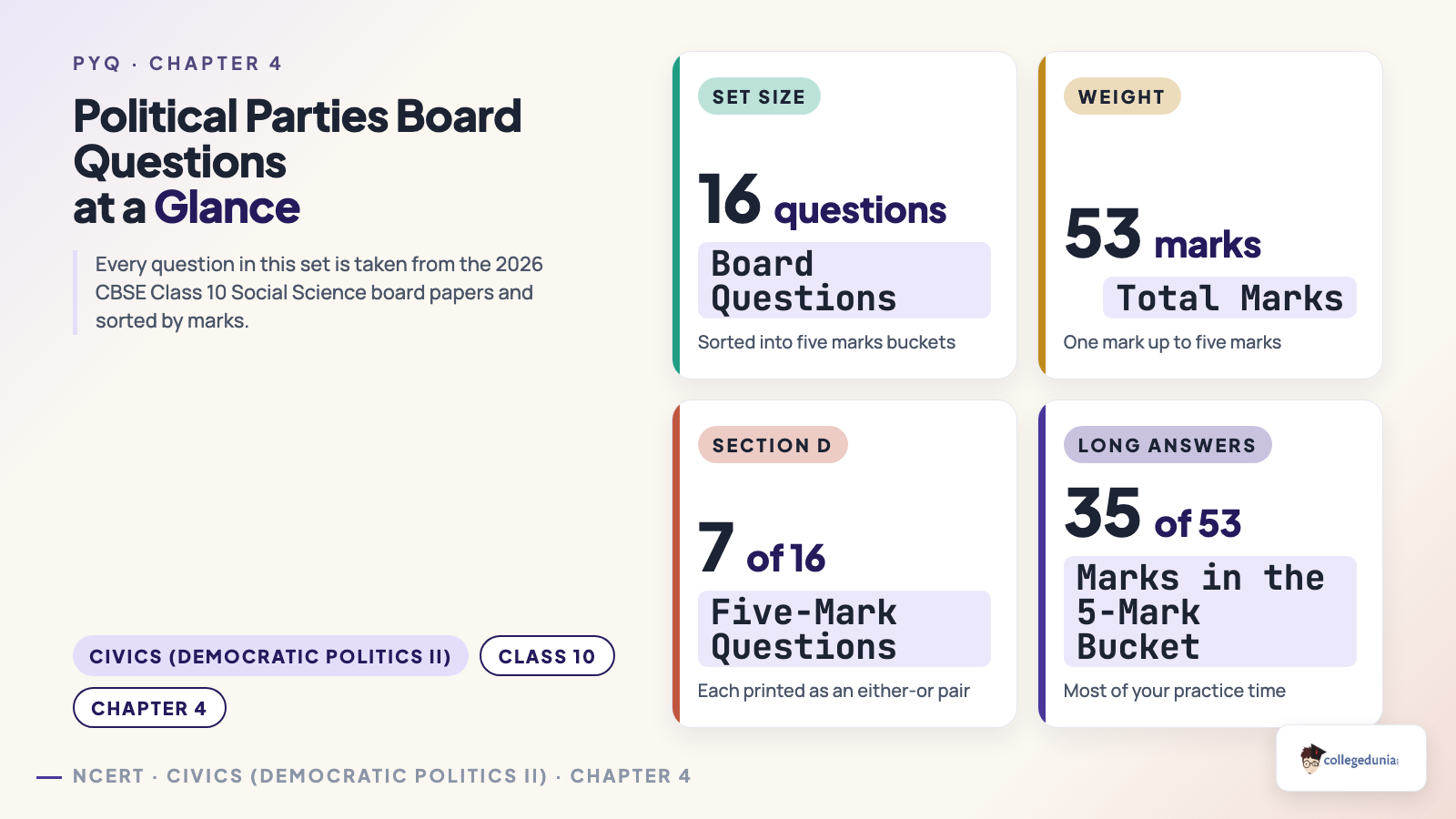
- 16 board questions worth 53 marks in total, sorted into five marks buckets from one mark to five marks.
- Seven five-mark questions, each printed as an either-or pair exactly as the board set it.
- 15 pages: the questions with their exam year and set code, then a full worked solution for each one.
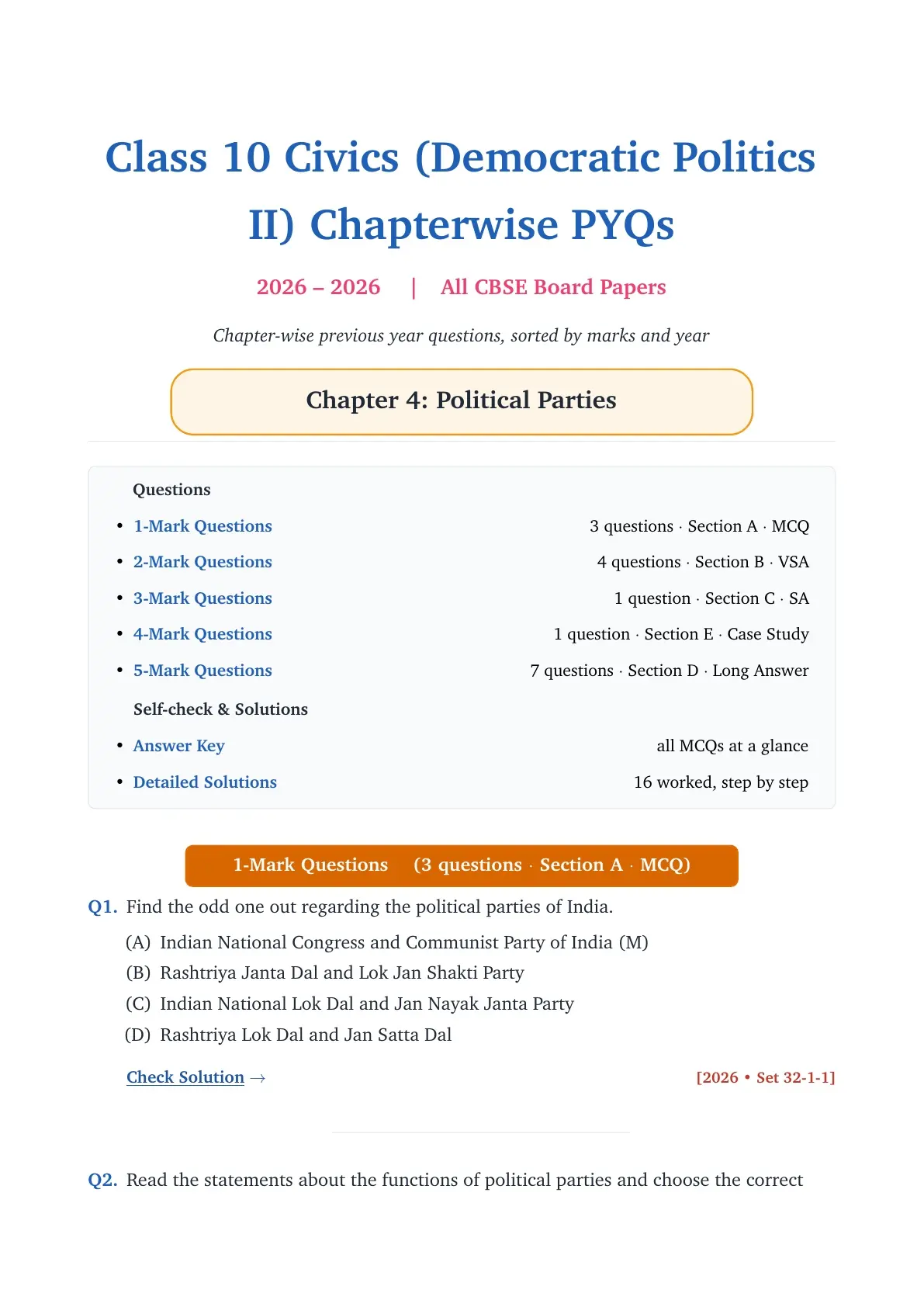
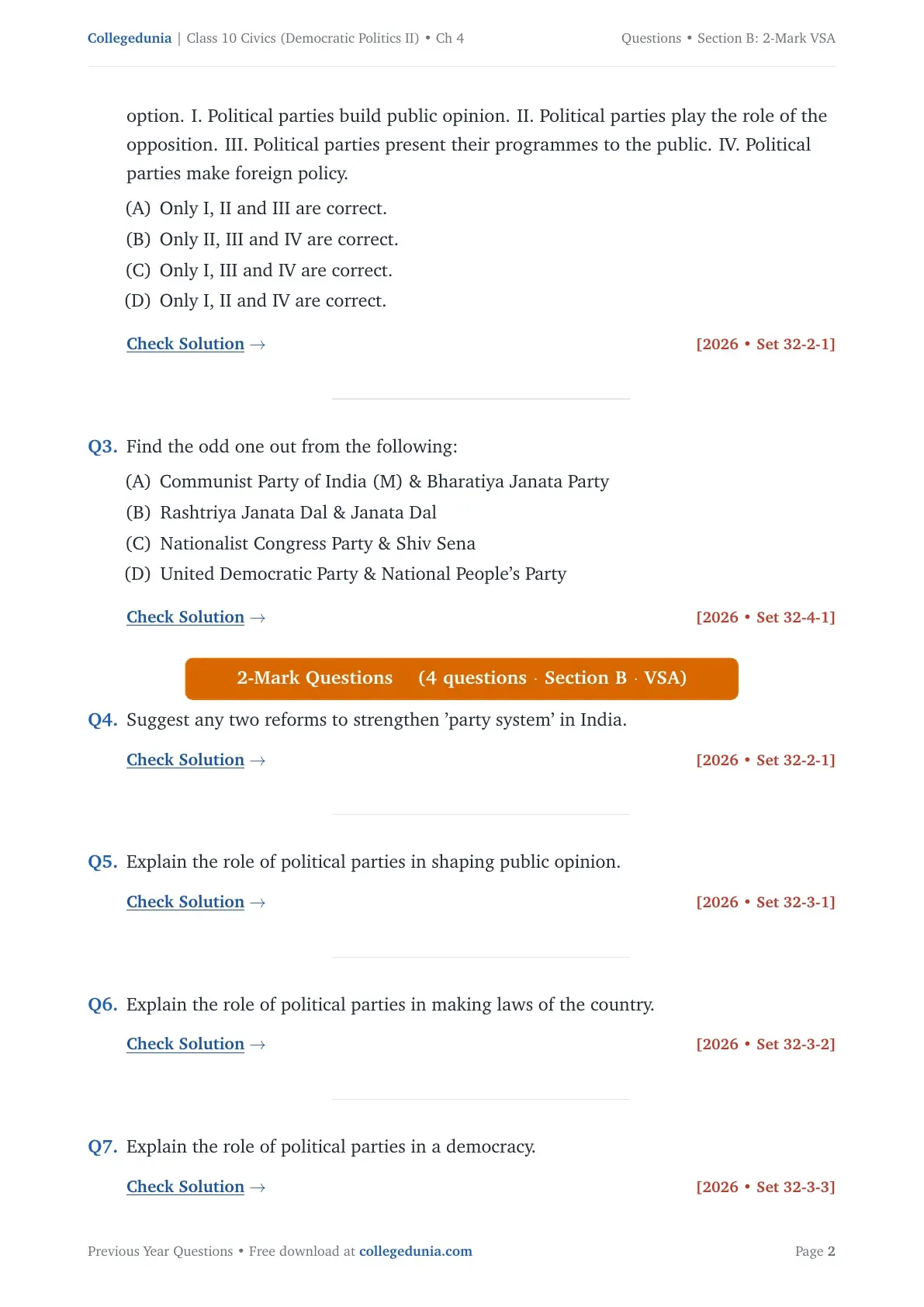
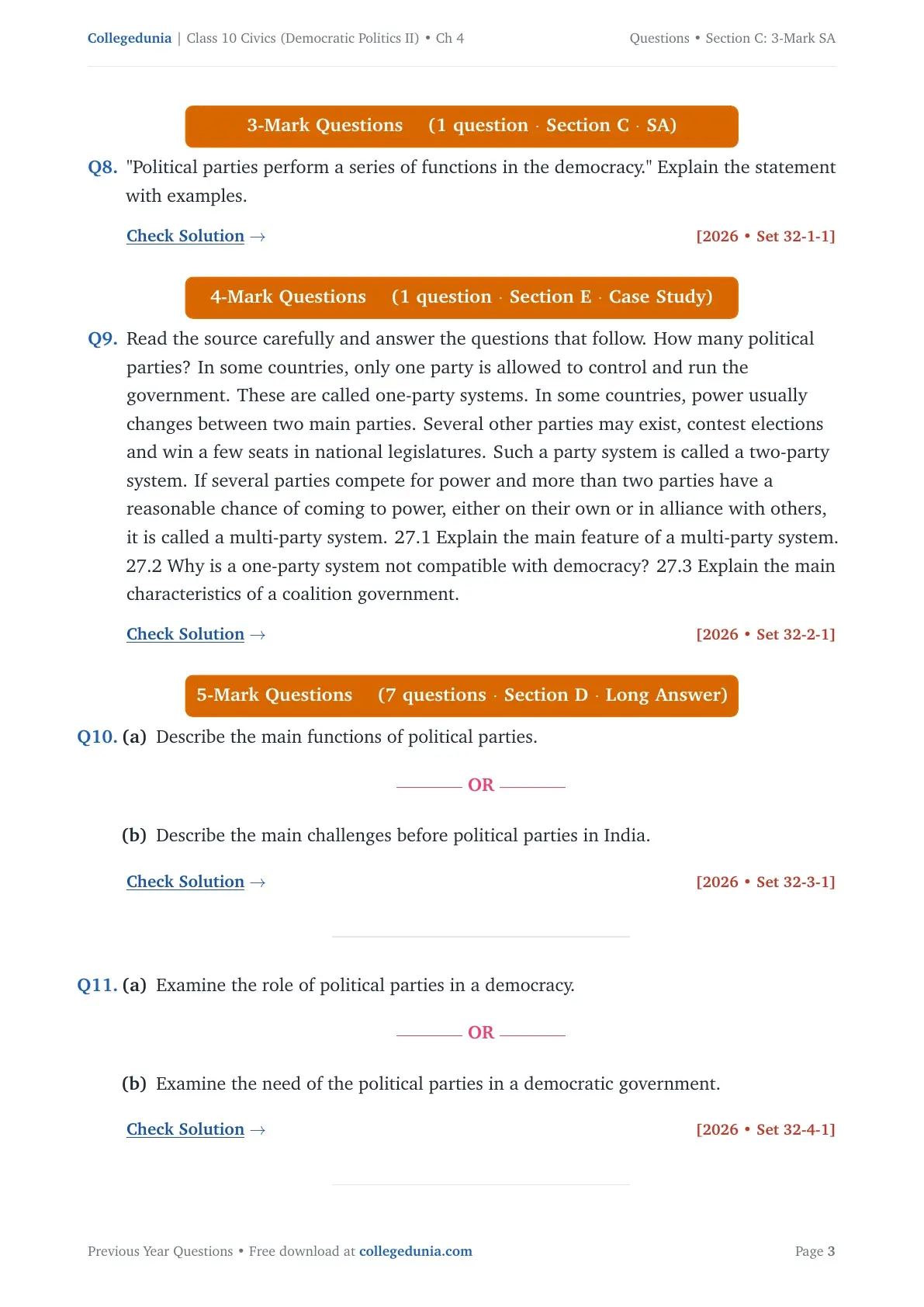
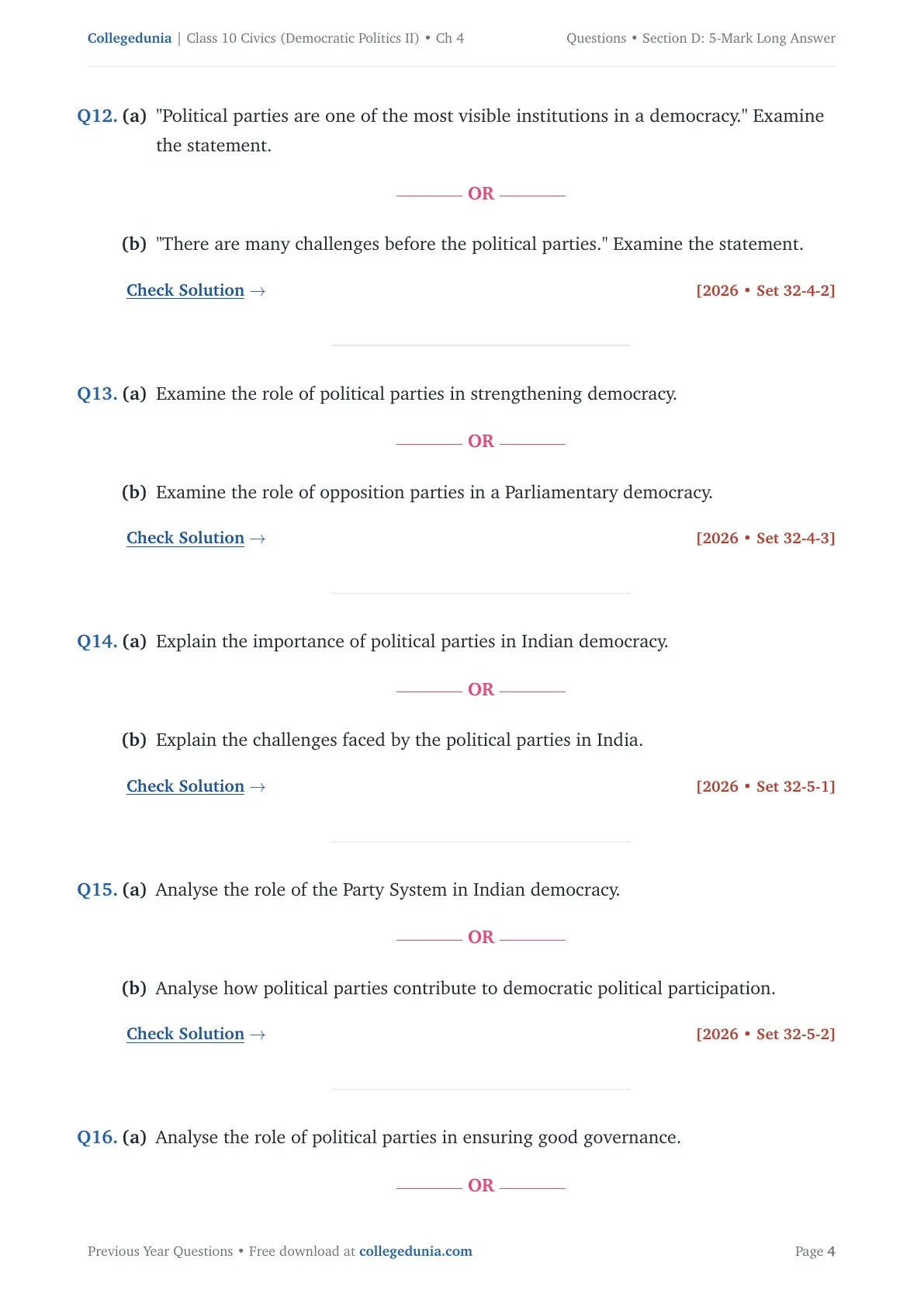
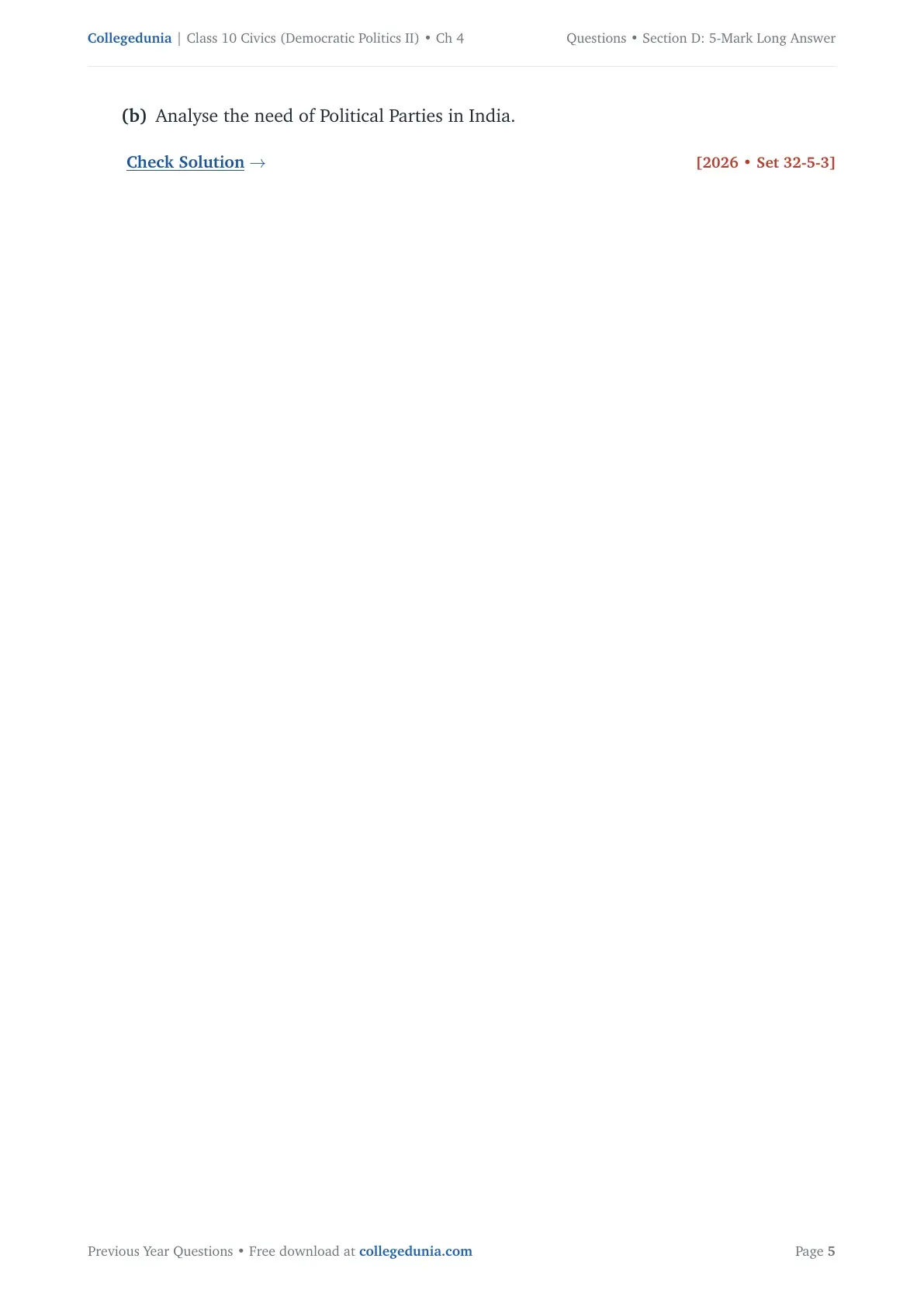

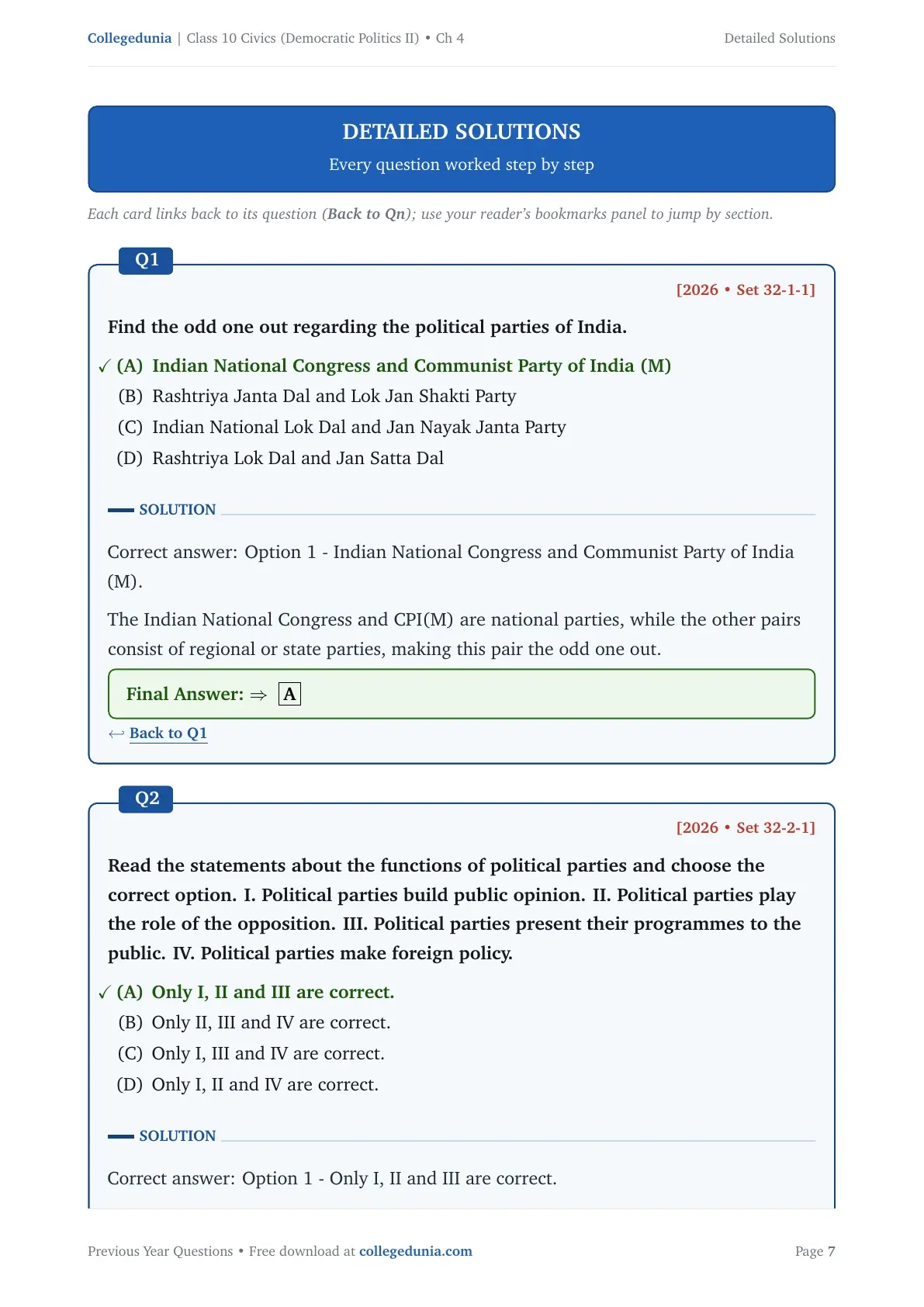
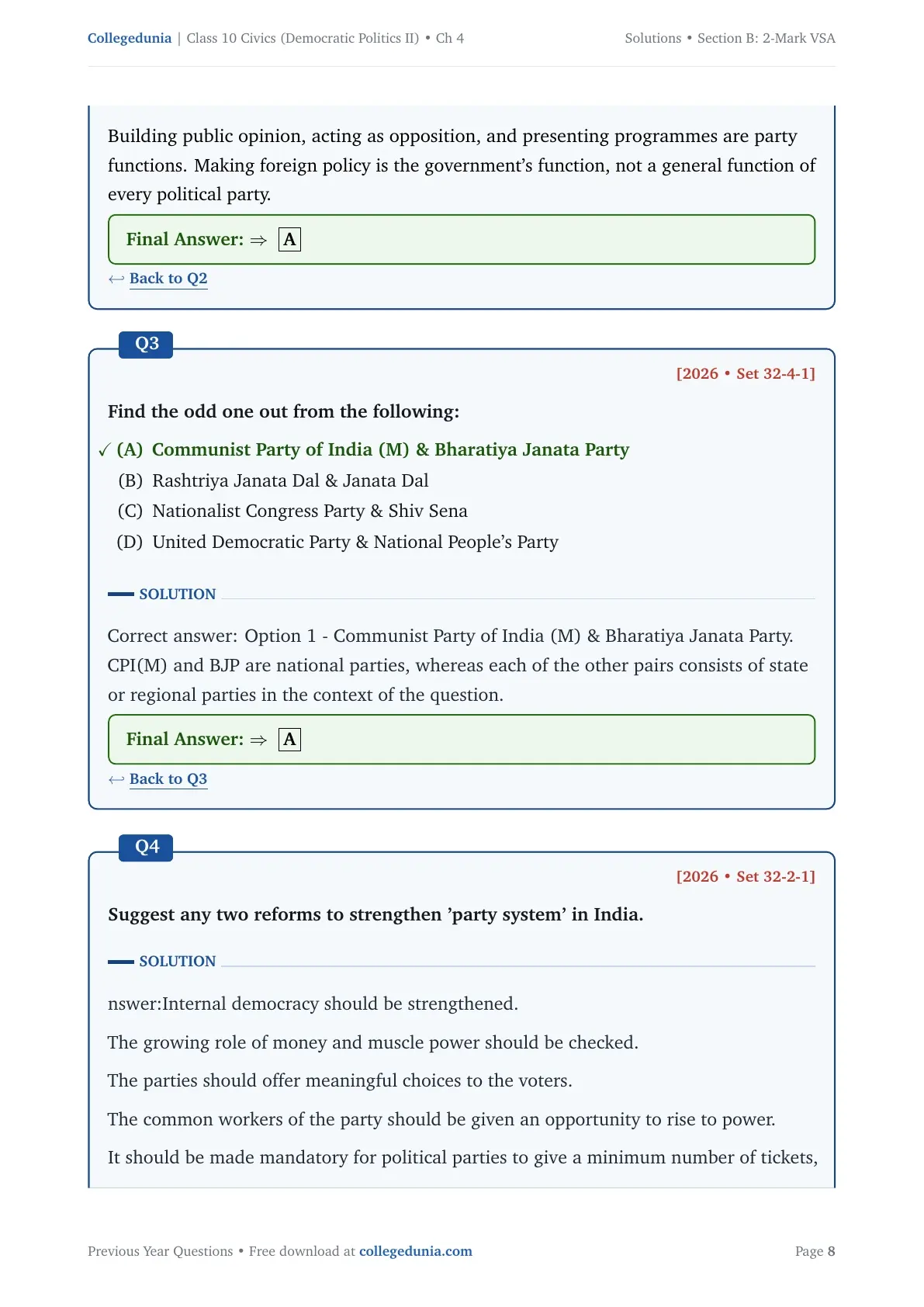
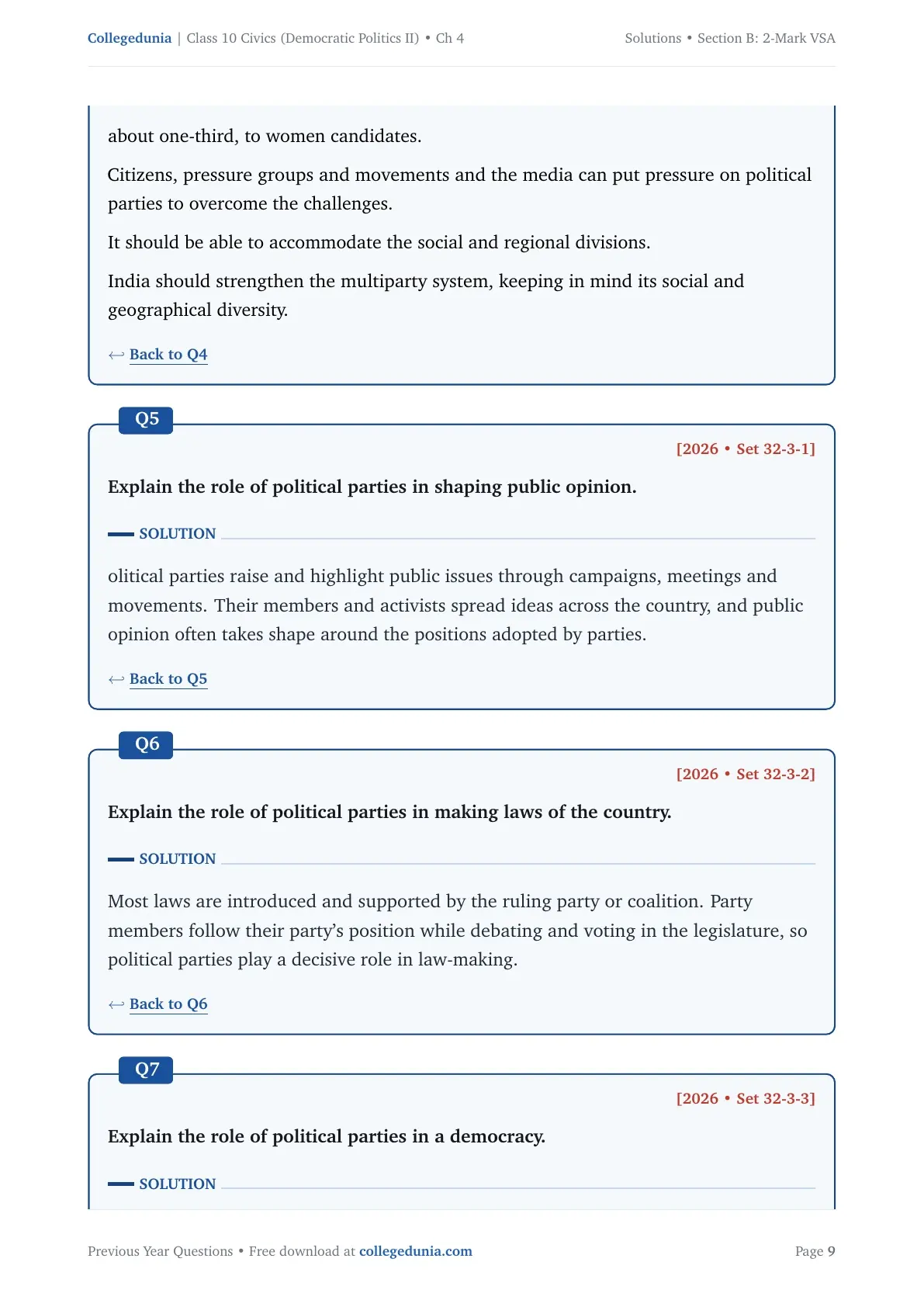
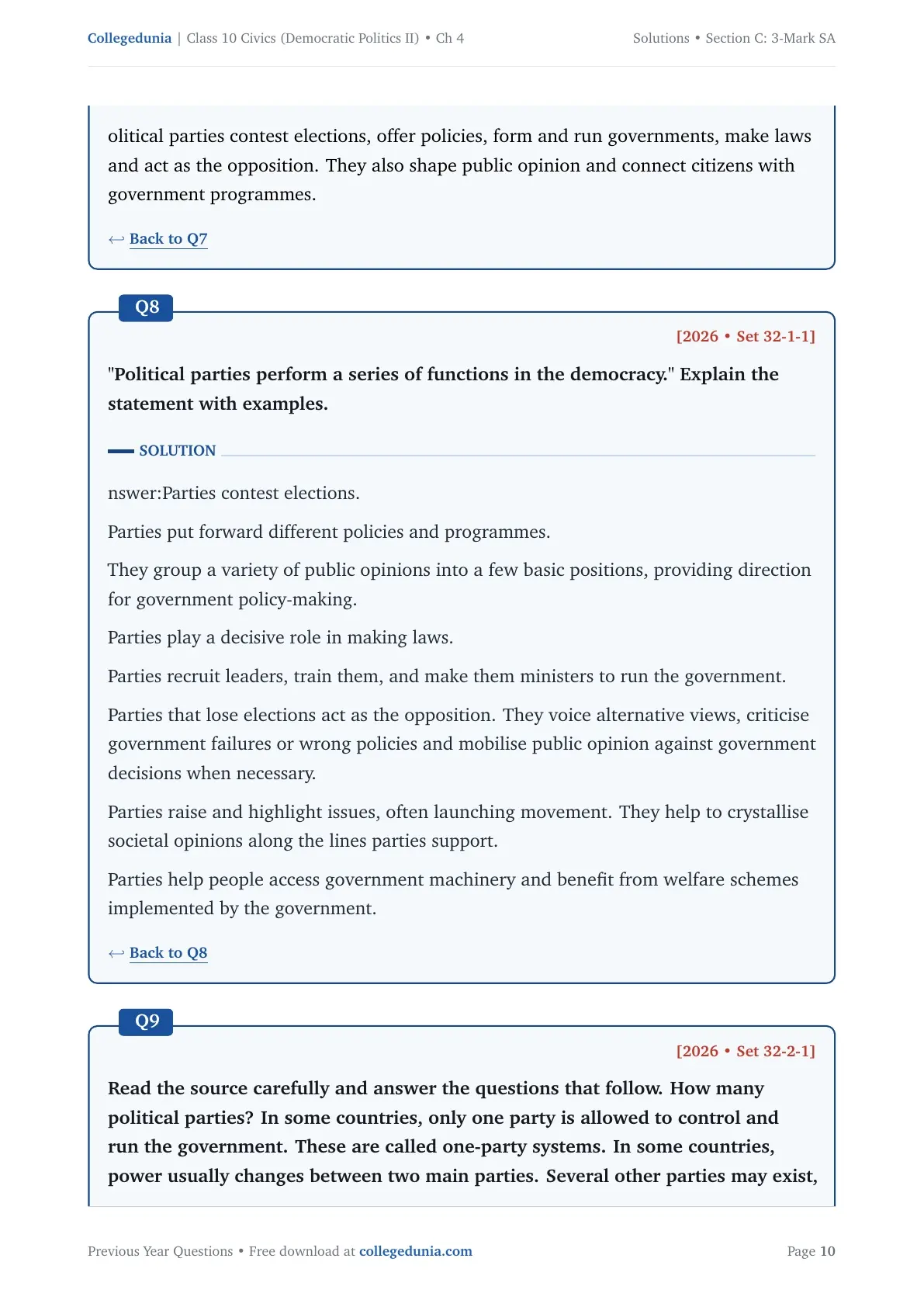
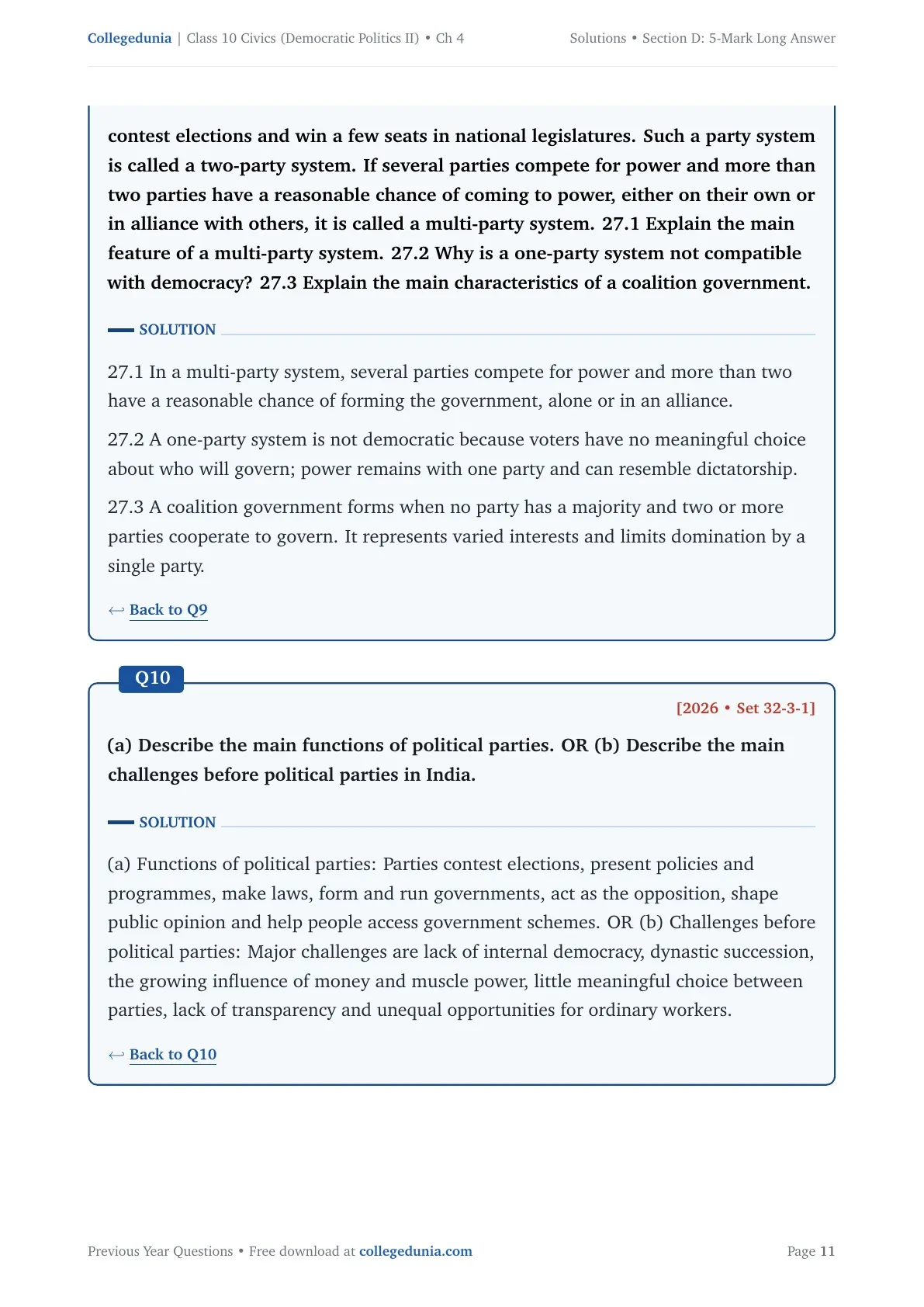
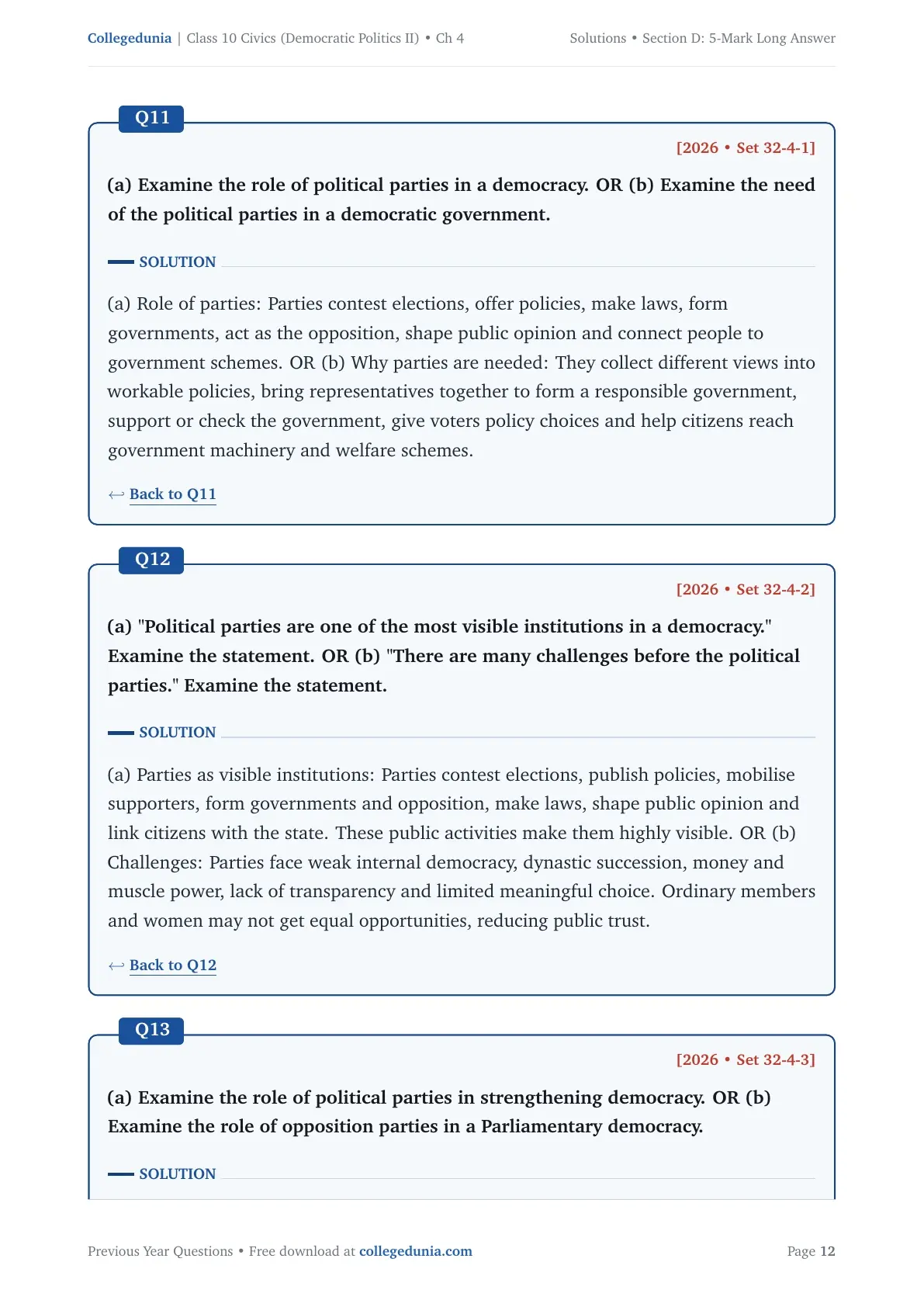
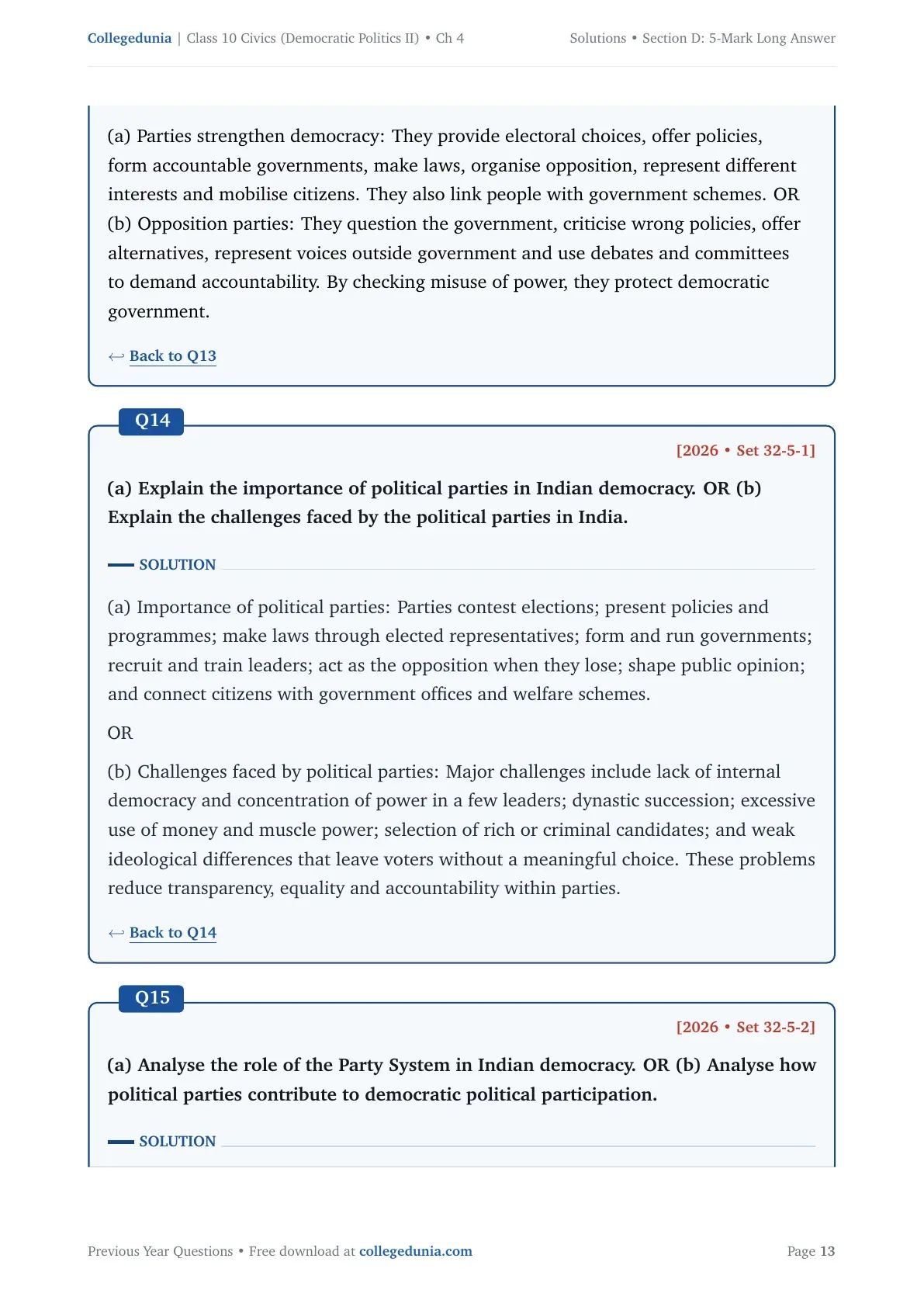
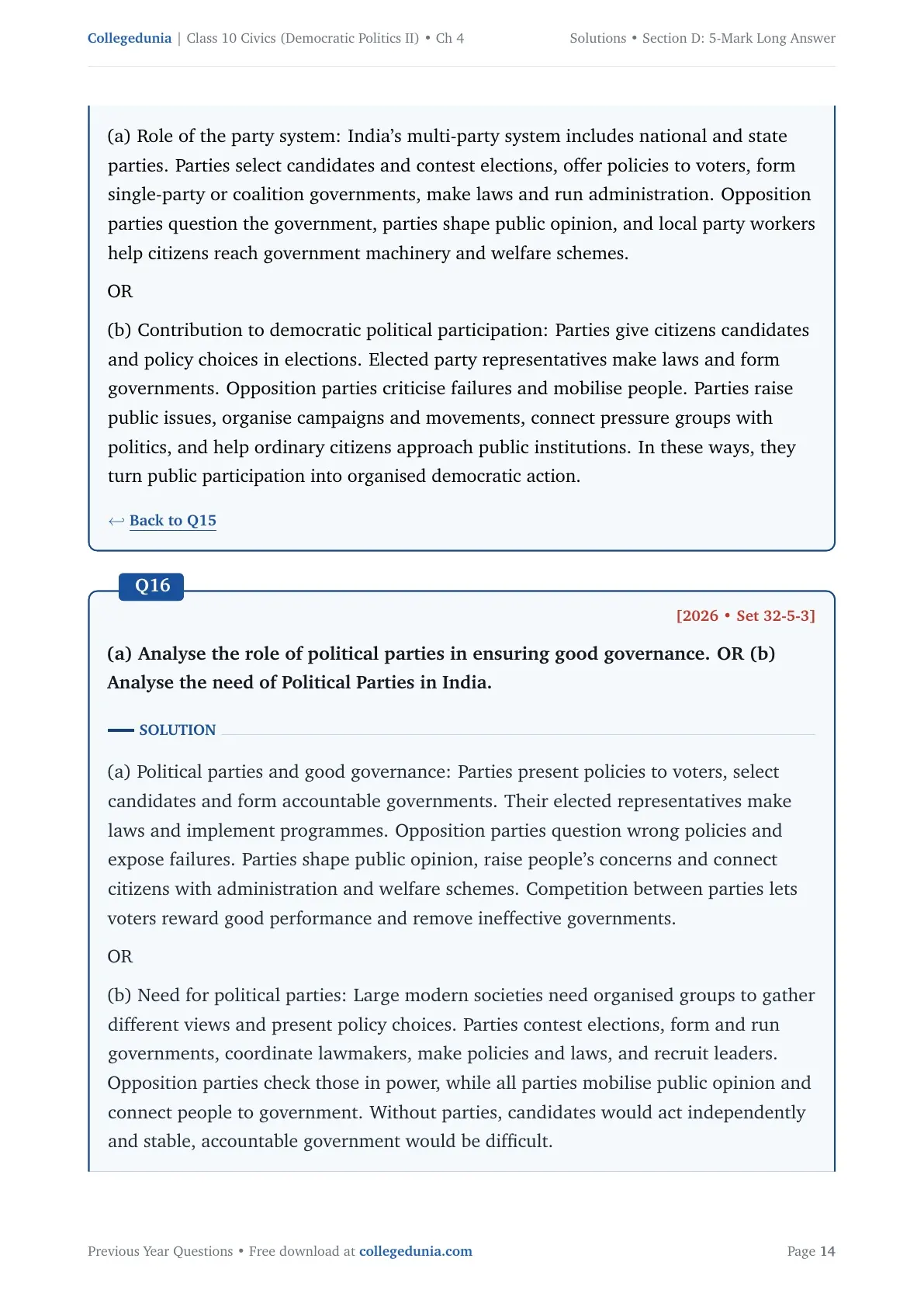

Every question in this Political Parties previous year question set is taken from an actual CBSE Class 10 Social Science board paper and checked against the 2026-27 NCERT Democratic Politics II textbook.
What the Political Parties Class 10 PYQ PDF Contains
The file is a practice set and a solutions guide in one. A contents card lists the five marks buckets, the questions run in order, and the worked answers follow in the same file.
- 16 questions taken from CBSE Class 10 Social Science board papers and grouped by marks.
- The year and set code sit in red beside each question, for example 2026, Set 32-2-1.
- The objective questions keep all four options as the board printed them, and the case study keeps its full source passage with its three sub-parts.
- A step-by-step worked solution for all 16 questions, filling most of the 15 pages. Each solution restates its question and links back to it.
Sixteen questions is a focused set, not a full question bank. Treat it as a pattern check once you have finished reading the chapter.
Marks-Wise Split of the Political Parties Board Questions
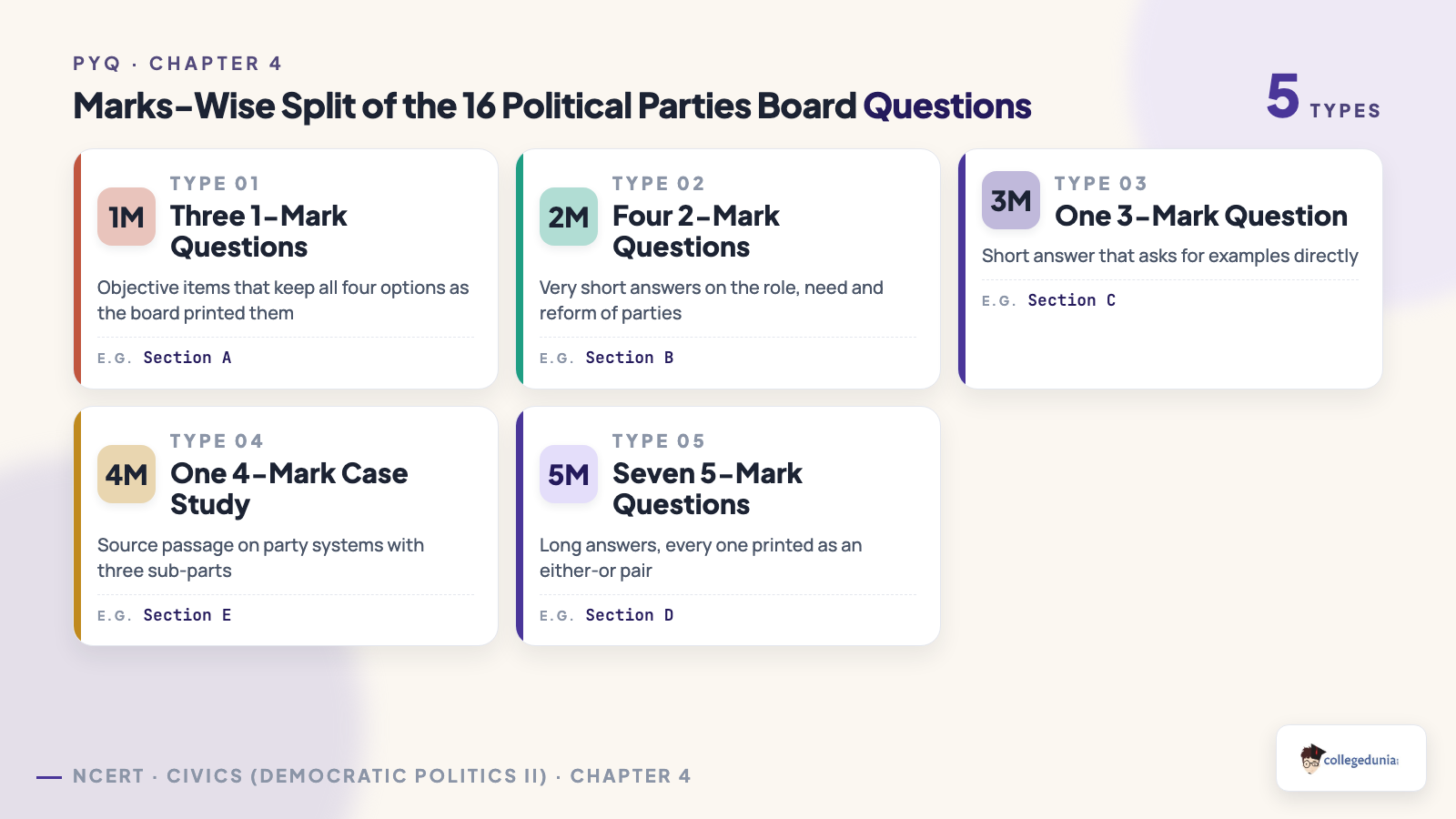
This chapter behaves differently from most of Democratic Politics II. It carries the long answer load, so the five-mark bucket is the biggest one in the set.
| Marks | Questions in the PDF | Board section | Question type |
|---|---|---|---|
| 1 mark | 3 | Section A | Objective, four options |
| 2 marks | 4 | Section B | Very short answer |
| 3 marks | 1 | Section C | Short answer |
| 4 marks | 1 | Section E | Source-based case study |
| 5 marks | 7 | Section D | Long answer, either-or |
Total: 16 questions worth 53 marks. Thirty-five of those 53 marks sit in the five-mark bucket, so most of your practice time on this chapter goes into long answers.
Why the Political Parties Chapter Carries So Many Five-Mark Questions
Every five-mark question in this set is printed as an either-or pair, which is how Section D works. You attempt only one part, and the two parts usually pull from two different halves of the chapter.
- Option (a) in most pairs asks about the functions, role, need or importance of parties in a democracy.
- Option (b) usually swings to the challenges before political parties, the party system, or the role of the opposition.
- Because both halves keep repeating, preparing the functions list and the challenges list covers almost every five-mark ask in this set.
Tip: read both options before you pick. Students often start option (a), run out of points at three, and then have no time to switch.
Political Parties Topics the 2026 CBSE Papers Asked About
The 16 questions sit on four parts of the chapter. The list below stays with the textbook's own terms and does not go beyond what the syllabus covers.
- Functions of political parties. Contesting elections, putting forward policies and programmes, making laws, forming and running governments, acting as the opposition, shaping public opinion, and providing access to government machinery and welfare schemes.
- Why parties are necessary. Several questions ask for the need and the importance of parties in a democratic government, and one asks how they help democratic political participation.
- Party systems. The four-mark case study prints the textbook's own passage on one-party, two-party and multi-party systems, then asks about the multi-party system, the one-party system and coalition government.
- National and state parties. The objective questions are odd-one-out items that test whether you can separate national parties from state parties using the Election Commission's recognition criteria.
- Challenges and reforms. One two-mark question asks for reforms to strengthen the party system, and several five-mark options ask for the challenges before parties in India.
How to Attempt the Political Parties Long Answer Questions in the Board Exam
A five-mark answer in Civics is five points, not five paragraphs. The structure below matches how the board's questions in this set are worded.
- Underline the command word. "Describe", "Examine", "Explain" and "Analyse" all appear in this set and all want a short reason with each point.
- Write a one-line opening that repeats the question's own words.
- Give five separate points, each with a heading word in bold and one or two sentences under it.
- Add one example where the question allows it. The three-mark question in this set asks for examples directly.
- Close with a single line, not a paragraph.
For the four-mark case study, answer the three sub-parts in order and keep each one to two or three sentences. Do not copy the source passage back into your answer.
Common Mistakes Students Make in the Political Parties Chapter
These are the slips that cost marks on the exact questions printed in this set.
- Confusing functions with challenges. The either-or pairs put both on the same page. Read which one you picked before you start writing.
- Mixing up national and state parties. The difference is the Election Commission's recognition criteria, not how well known a party is.
- Writing four points for a five-mark question. Count your points before you move on.
- Treating a two-party system as a multi-party system. The case study passage defines all three systems, so use the passage's own wording.
- Giving reforms with no mechanism. "Parties should improve" scores nothing. Name the reform, such as an organisational election or a declaration of assets and criminal cases.
Student Feedback on the Political Parties Question Practice
What 12,840 students told us about this chapter before the 2026 boards.
- 71% of students rated the odd-one-out objective questions as the hardest one-markers in Democratic Politics II.
- Students said the five-mark bucket was the easiest to score in, because the same functions and challenges lists keep returning.
- The average student needed about 70 minutes to write all 16 answers in the first sitting.
Source: 2026-27 Class 10 Civics student poll. Sample of 12,840 students from CBSE schools across 16 states.
How the Political Parties PYQ Set Pairs with Notes and Solutions
This PDF answers its own 16 questions, so the pages below are for what sits outside that set: the rest of the chapter, and the textbook exercise questions.
| Resource | Use it for |
|---|---|
| Political Parties Class 10 NCERT Solutions | Checking your five-mark points against full textbook answers |
| Political Parties Class 10 Revision Notes | A quick read before you attempt the set |
| Political Parties Class 10 Handwritten Notes | Last-day recall of the functions and challenges lists |
| Political Parties Class 10 NCERT Book PDF | Reading the chapter in the textbook's own words |
Class 10 Civics Previous Year Question Sets for All Five Chapters
Democratic Politics II has five chapters in the 2026-27 syllabus. The practice sets and the solutions pages for each one are listed below.
| Chapter | Previous year questions | NCERT Solutions |
|---|---|---|
| Chapter 1: Power Sharing | Power Sharing Class 10 PYQ (coming soon) | Power Sharing Class 10 NCERT Solutions |
| Chapter 2: Federalism | Federalism Class 10 PYQ (coming soon) | Federalism Class 10 NCERT Solutions |
| Chapter 3: Gender, Religion and Caste | Gender, Religion and Caste Class 10 PYQ (coming soon) | Gender, Religion and Caste Class 10 NCERT Solutions |
| Chapter 4: Political Parties | You are on this page | Political Parties Class 10 NCERT Solutions |
| Chapter 5: Outcomes of Democracy | Outcomes of Democracy Class 10 PYQ (coming soon) | Outcomes of Democracy Class 10 NCERT Solutions |
FAQs on Political Parties Class 10 Previous Year Questions
Political Parties Class 10 Board Questions: Student Queries
Ques. How many questions are in the Political Parties Class 10 PYQ PDF?
Ans. There are 16 questions across 15 pages, worth 53 marks: 3 one-mark, 4 two-mark, 1 three-mark, 1 four-mark case study and 7 five-mark questions, each with a worked solution.
Ques. Does the PDF carry answers?
Ans. Yes. A Detailed Solutions section works through all 16 questions step by step, restating each question and linking back to it. Attempt the set first and then check, or read it straight through as a revision resource.
Ques. Is this a complete question bank for the chapter?
Ans. No. It is a focused set of 16 questions from recent board papers. It shows the pattern the board follows but does not cover every topic in the chapter.
Ques. Which year are these Political Parties board questions from?
Ans. All 16 come from the 2026 CBSE Class 10 Social Science board papers, and each carries its set code, such as Set 32-3-1.
Ques. What are the main functions of political parties?
Ans. The textbook lists contesting elections, putting forward policies and programmes, making laws, forming and running governments, acting as the opposition, shaping public opinion, and giving people access to government machinery and welfare schemes.
Ques. What is a multi-party system?
Ans. The chapter defines it as a system in which several parties compete for power and more than two have a reasonable chance of coming to power, either on their own or in alliance with others.
Ques. How is a national party different from a state party?
Ans. Both are recognised by the Election Commission, but the vote share and seat thresholds differ. A state party qualifies on its performance in one state, while a national party has to meet the criteria across several states.
Ques. What are the challenges before political parties in India?
Ans. The chapter names four: lack of internal democracy, dynastic succession, the growing role of money and muscle power, and the absence of a meaningful choice for voters.



Comments