



Change and Development in Rural Society looks at how the two big forces of post-independence India, land reforms and the Green Revolution, reshaped agrarian life in Indian villages, and how contract farming and globalisation are reshaping it again today. This PYQ set brings together 15 CBSE board questions from 2017 to 2024 on the chapter, and every one comes with a full step-by-step solution, so you can check your own answer against a complete worked explanation.
- 15 questions, CBSE 2017-2024: Section A (3 MCQs, 1 mark), Section B (5 VSA, 2 marks), Section C (4 SA, 4 marks), Section D (3 LA, 6 marks).
- Full solutions included: every question has a worked, step-by-step answer, not just the bare question paper.
- Topics covered: post-independence land reforms, the Green Revolution and rural inequality, contract farming, labour migration, and globalisation's impact on rural society.
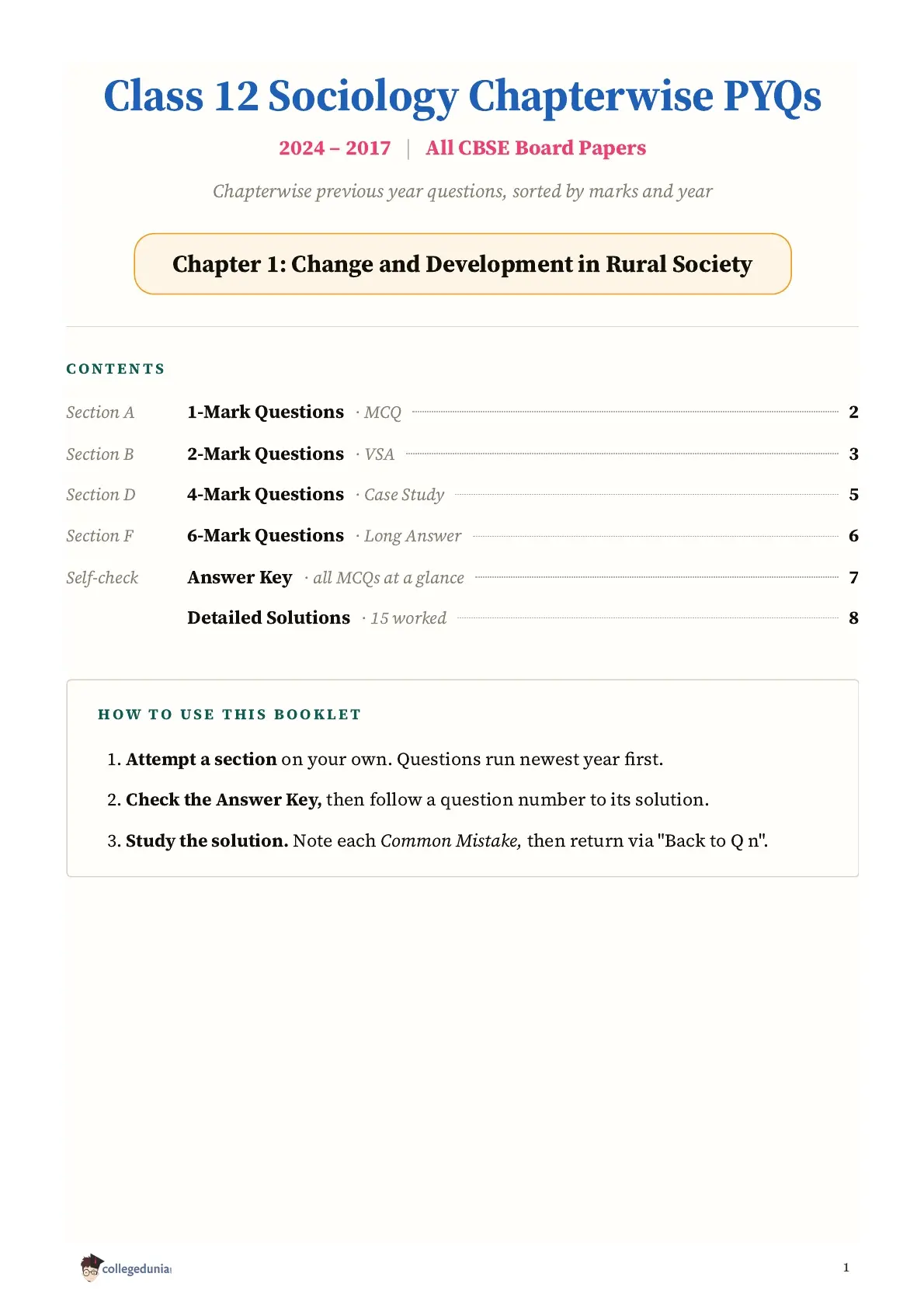
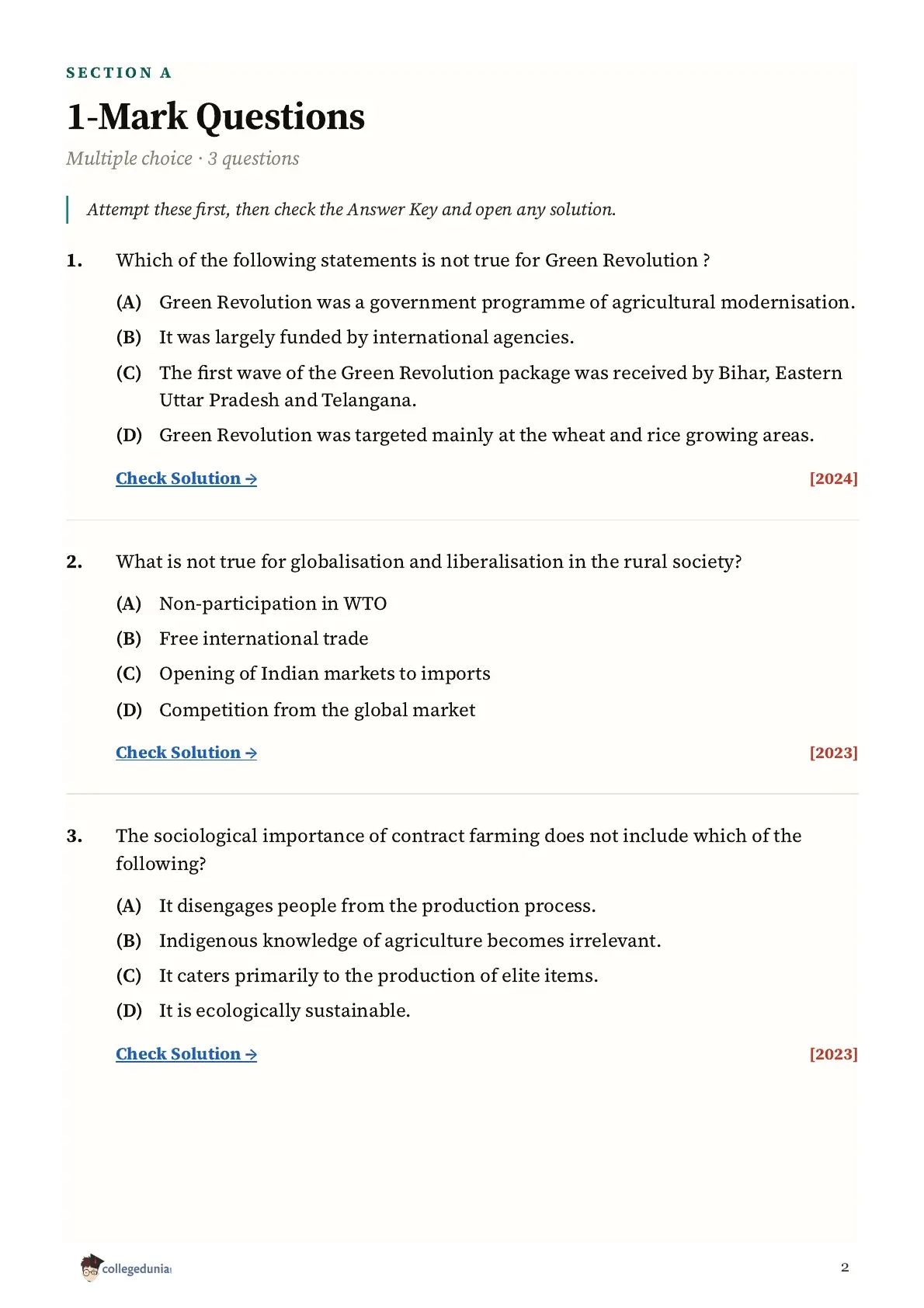
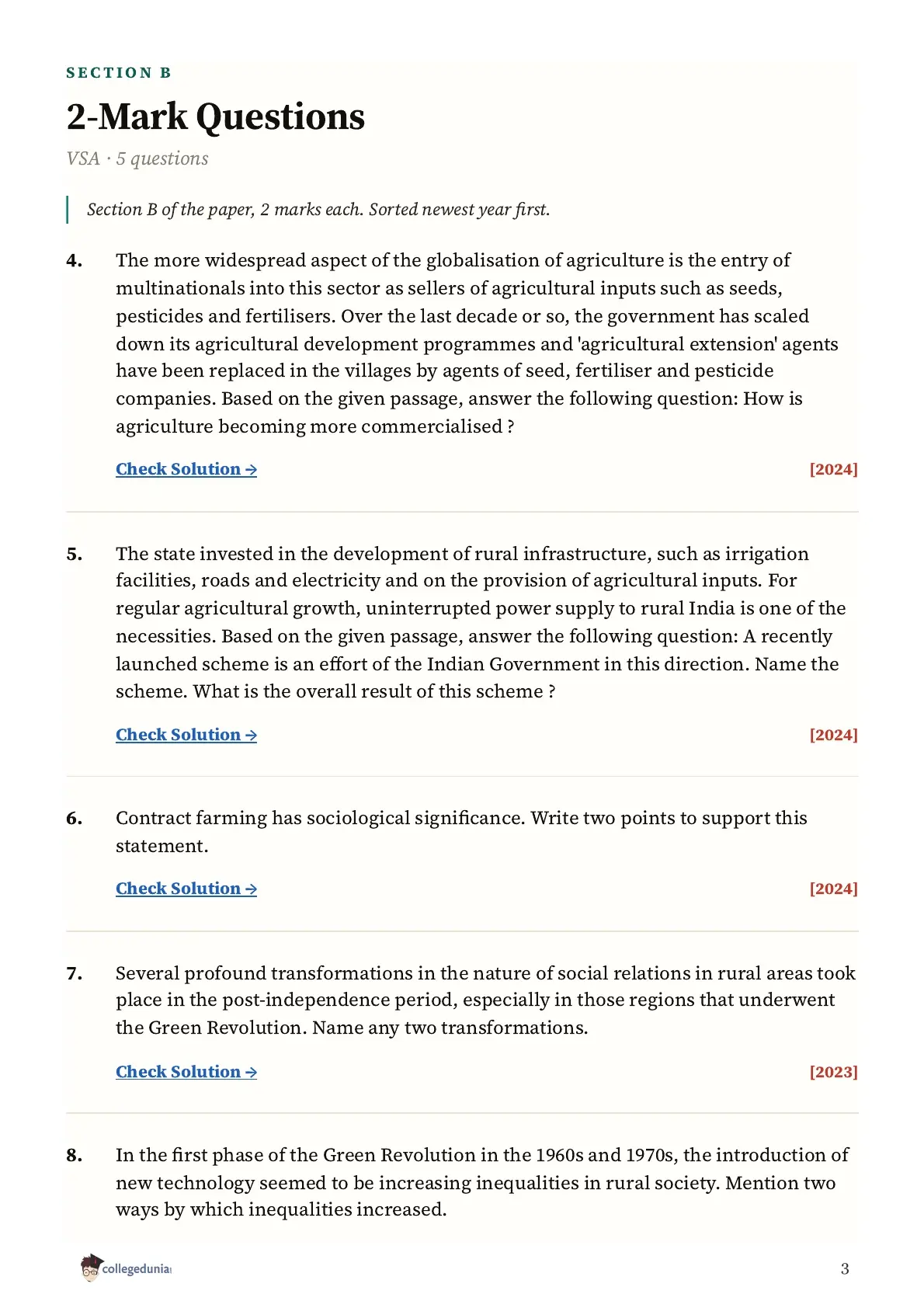

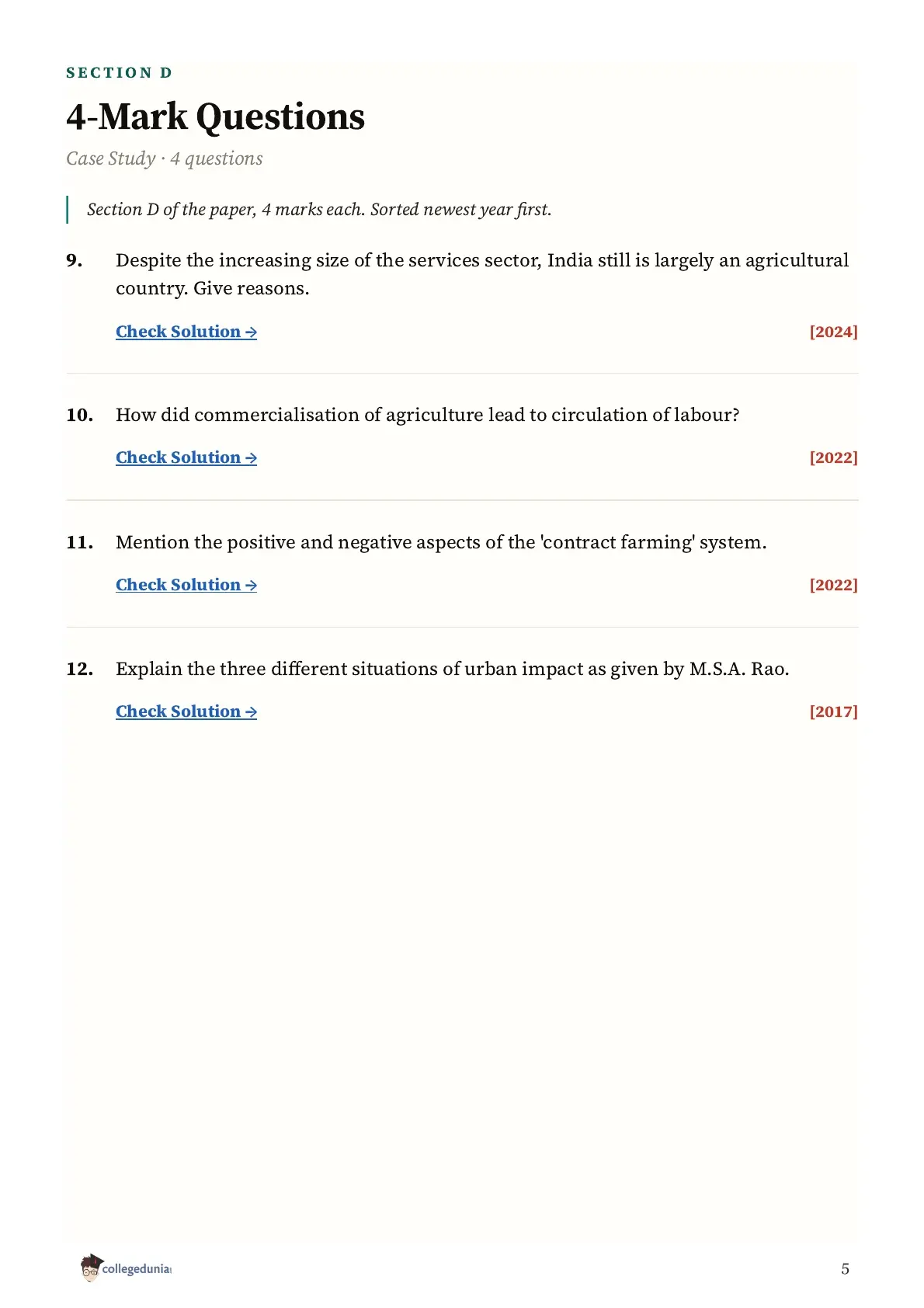
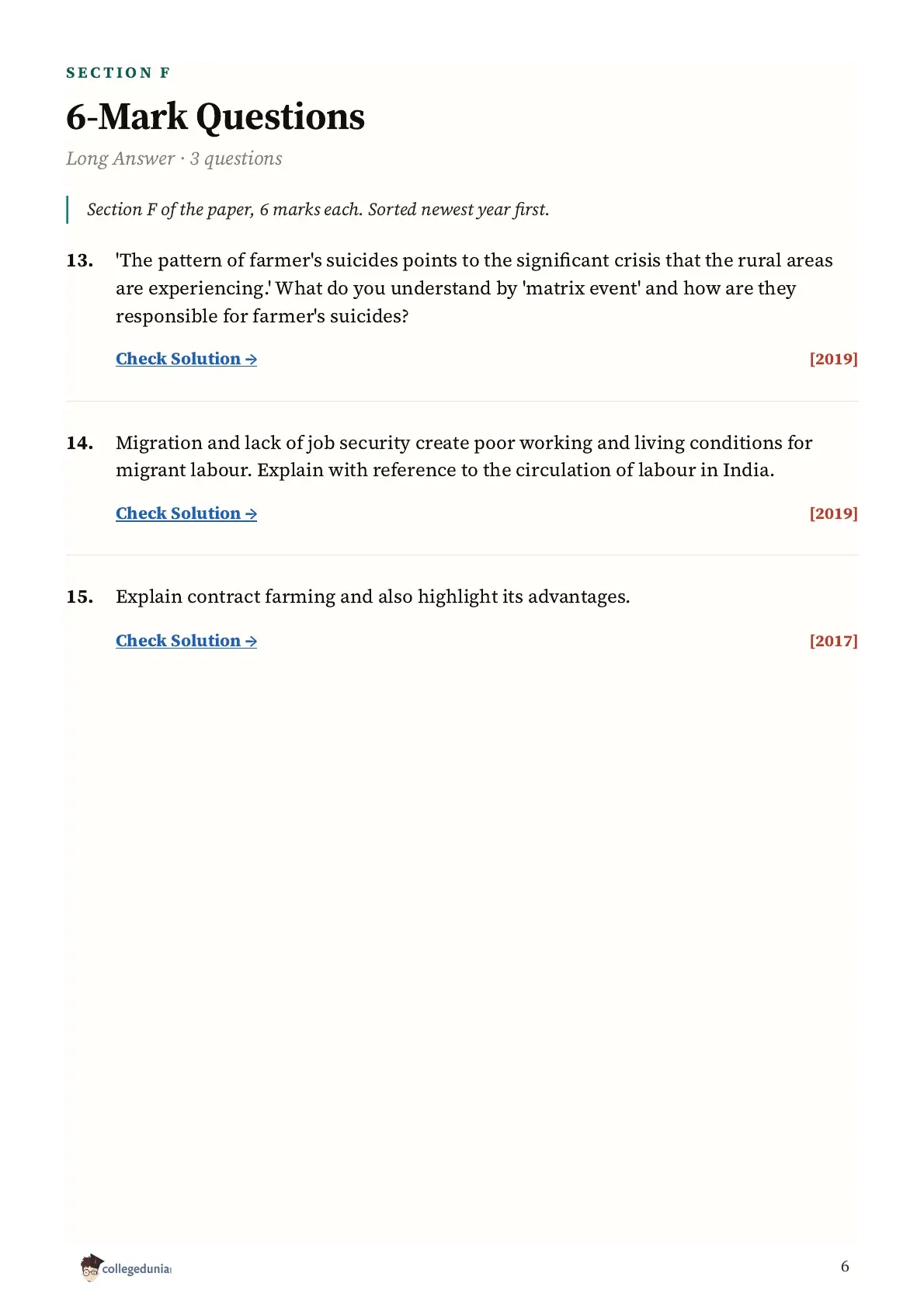

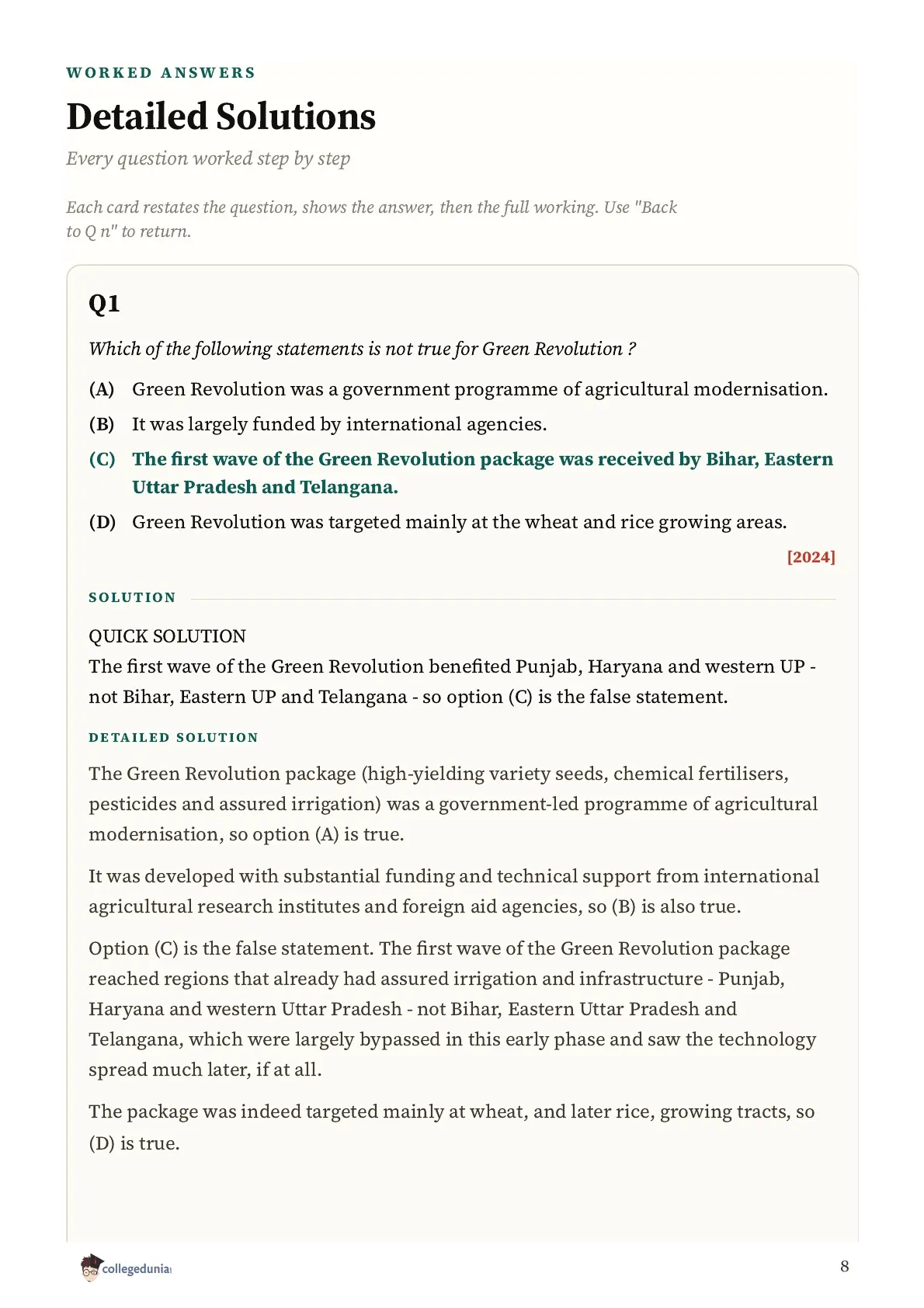
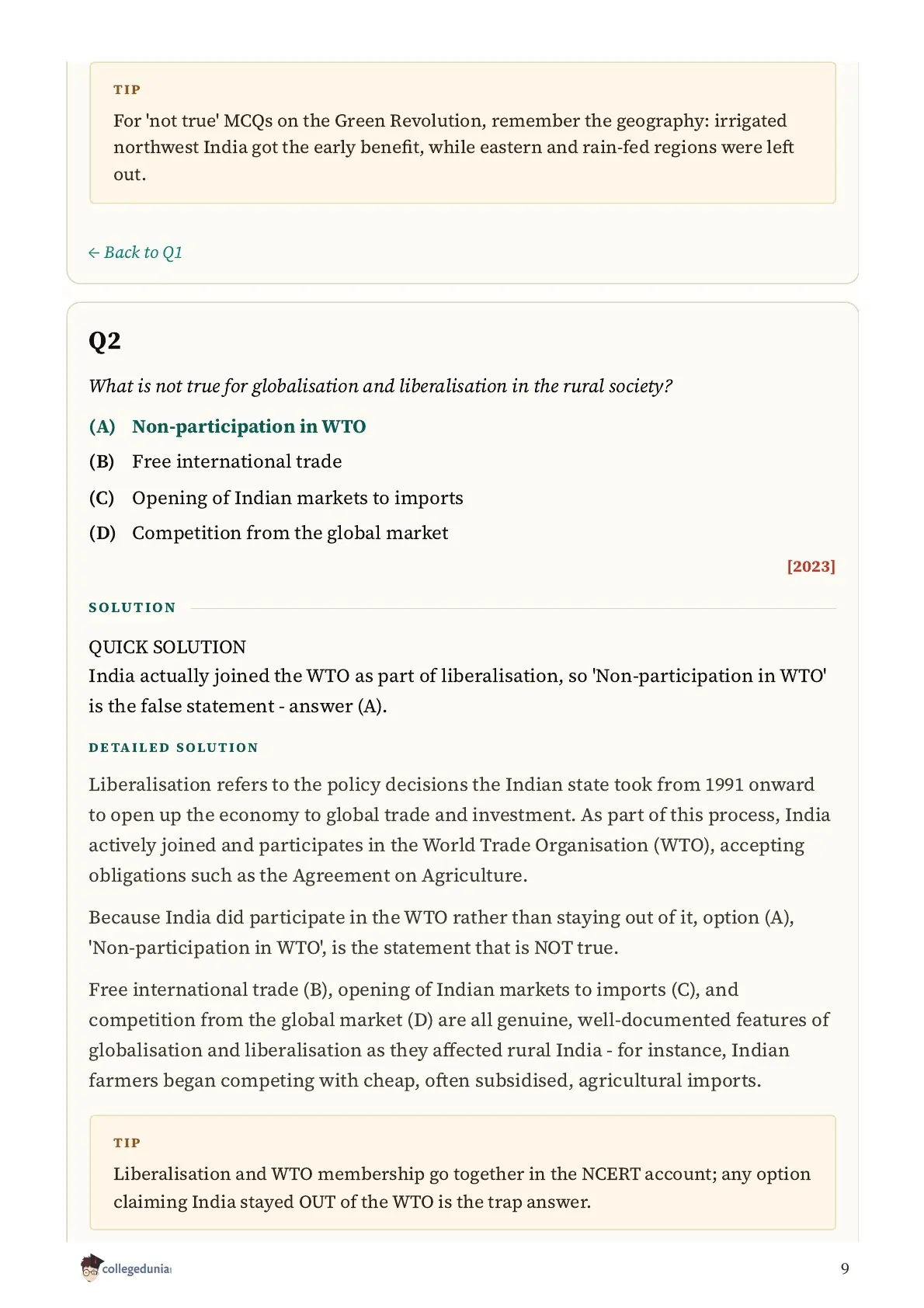
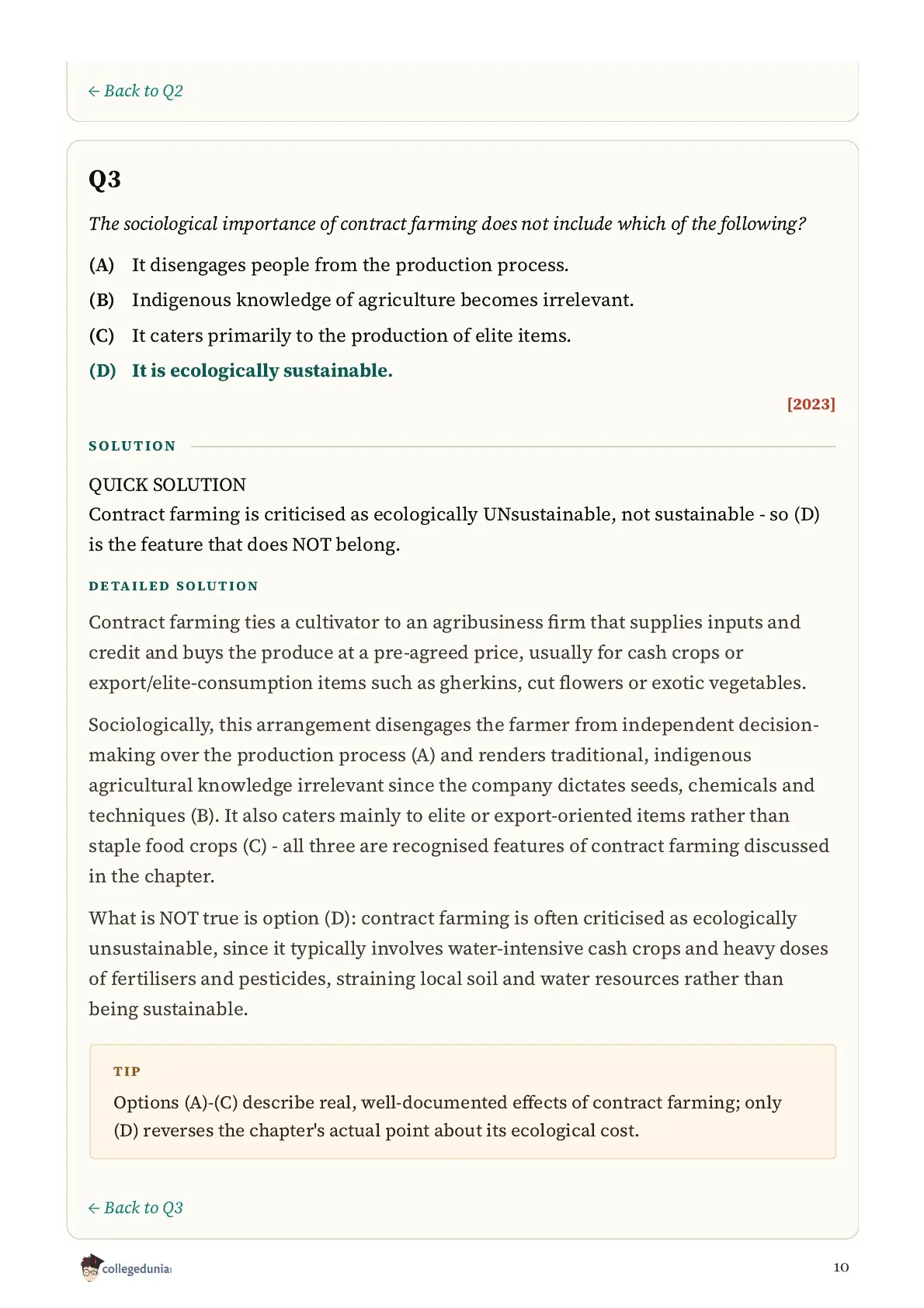
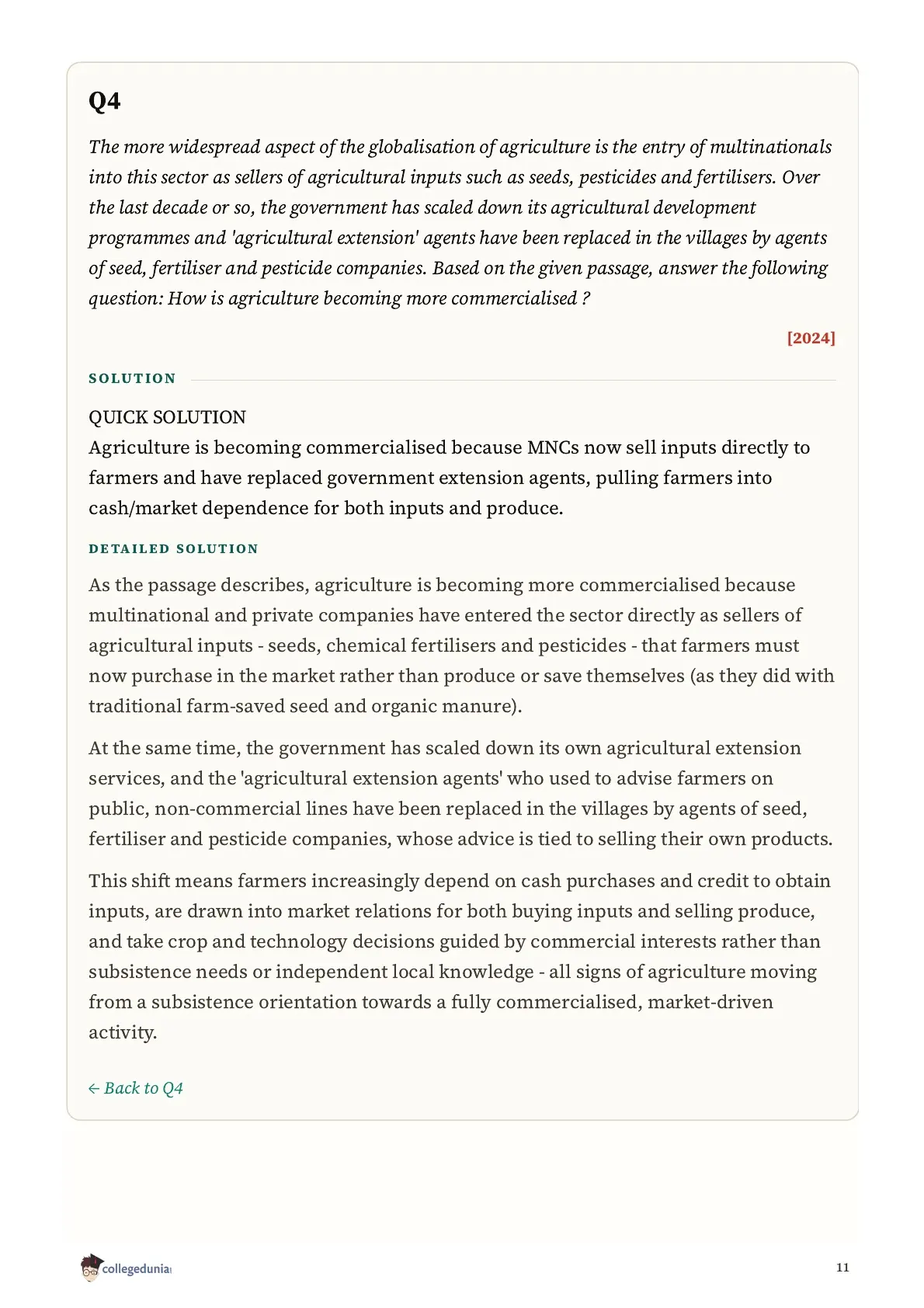
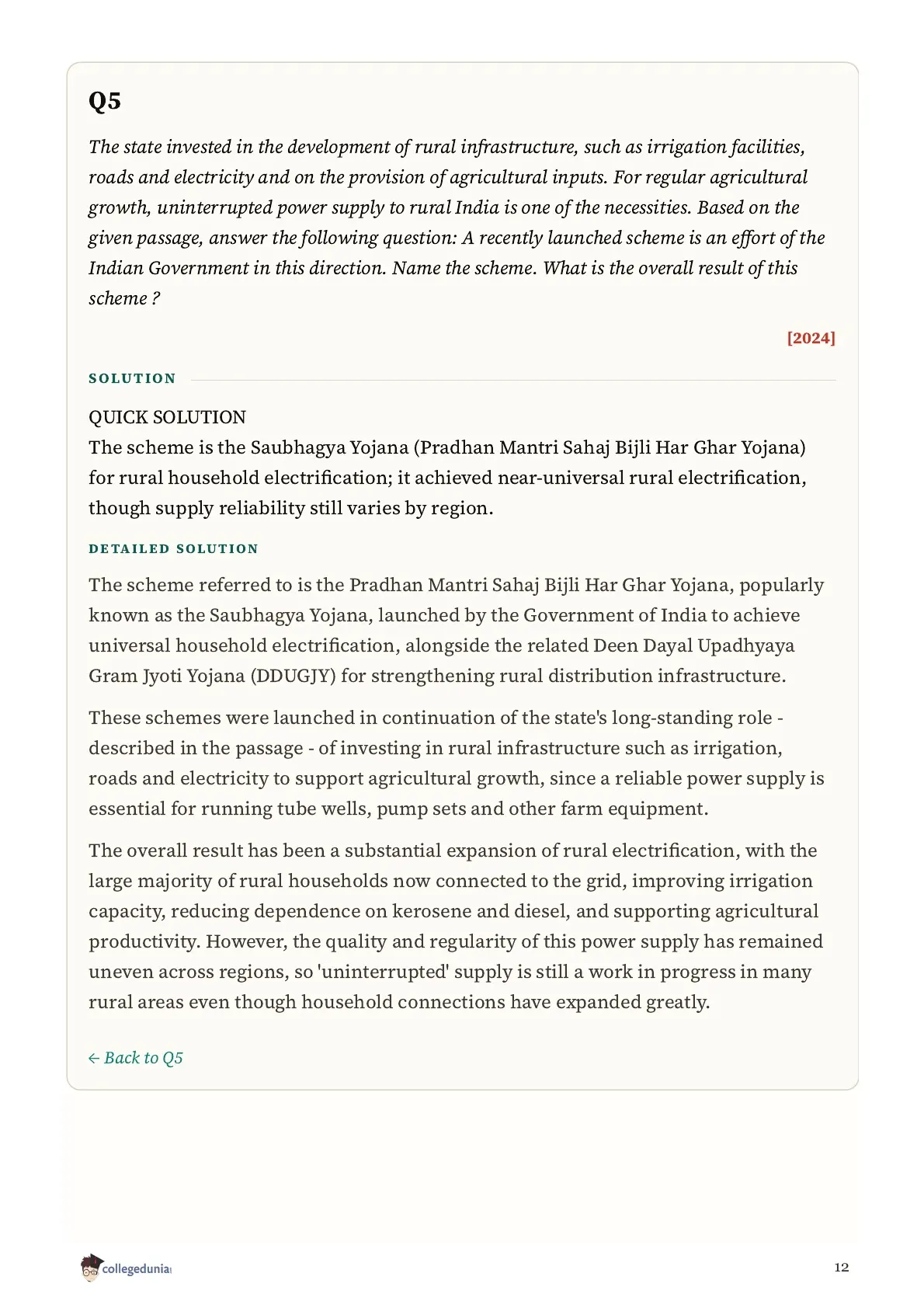
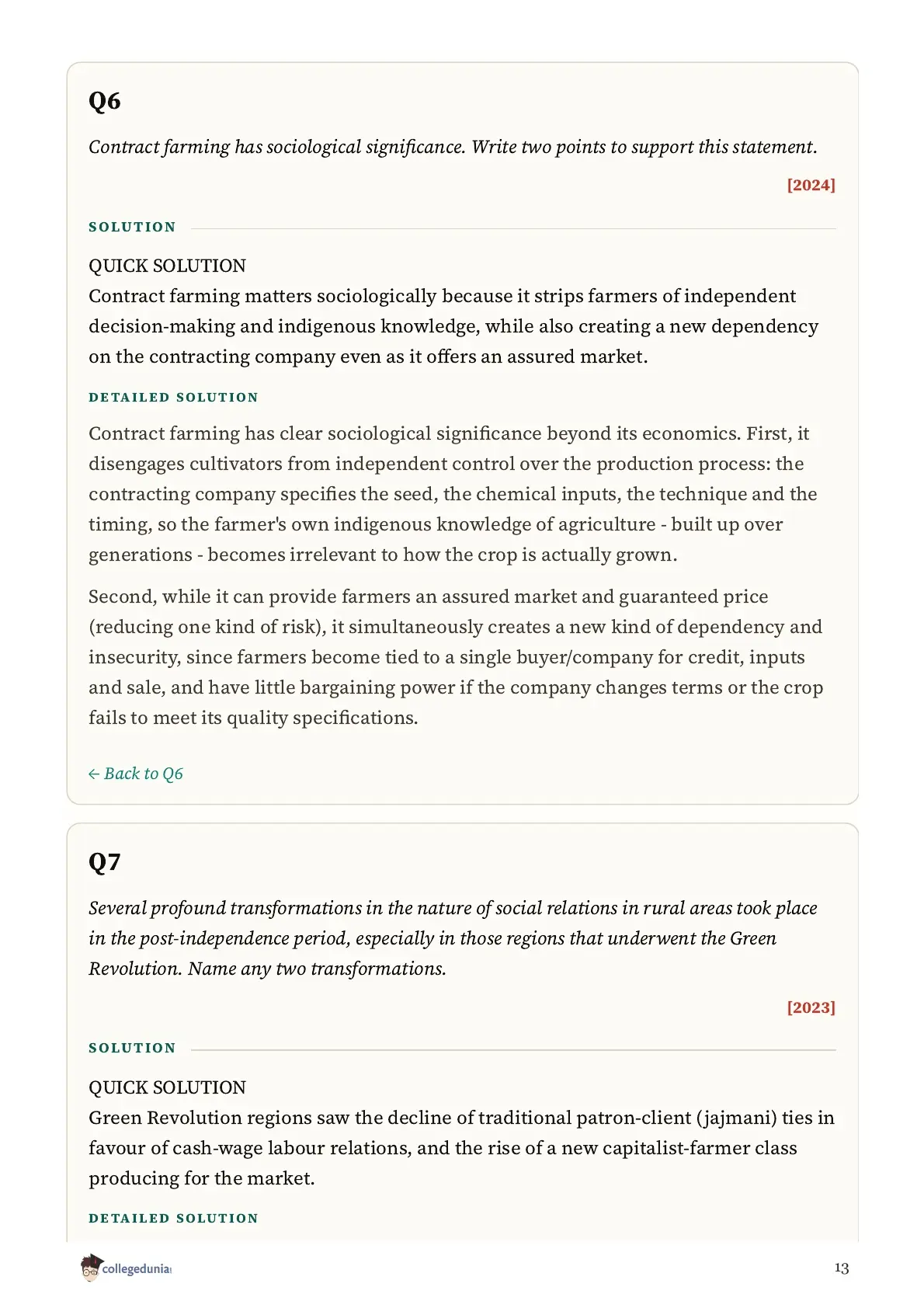
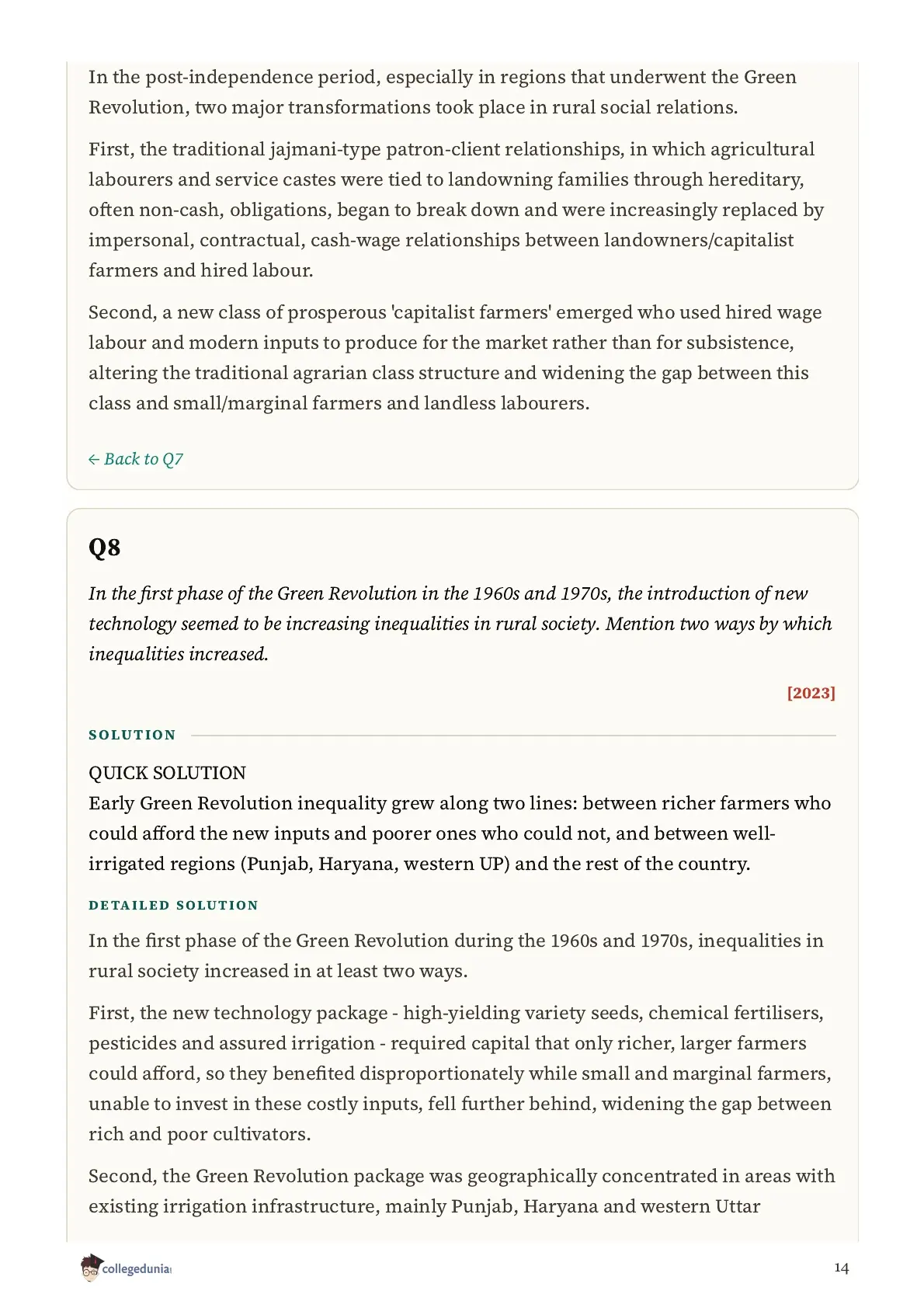
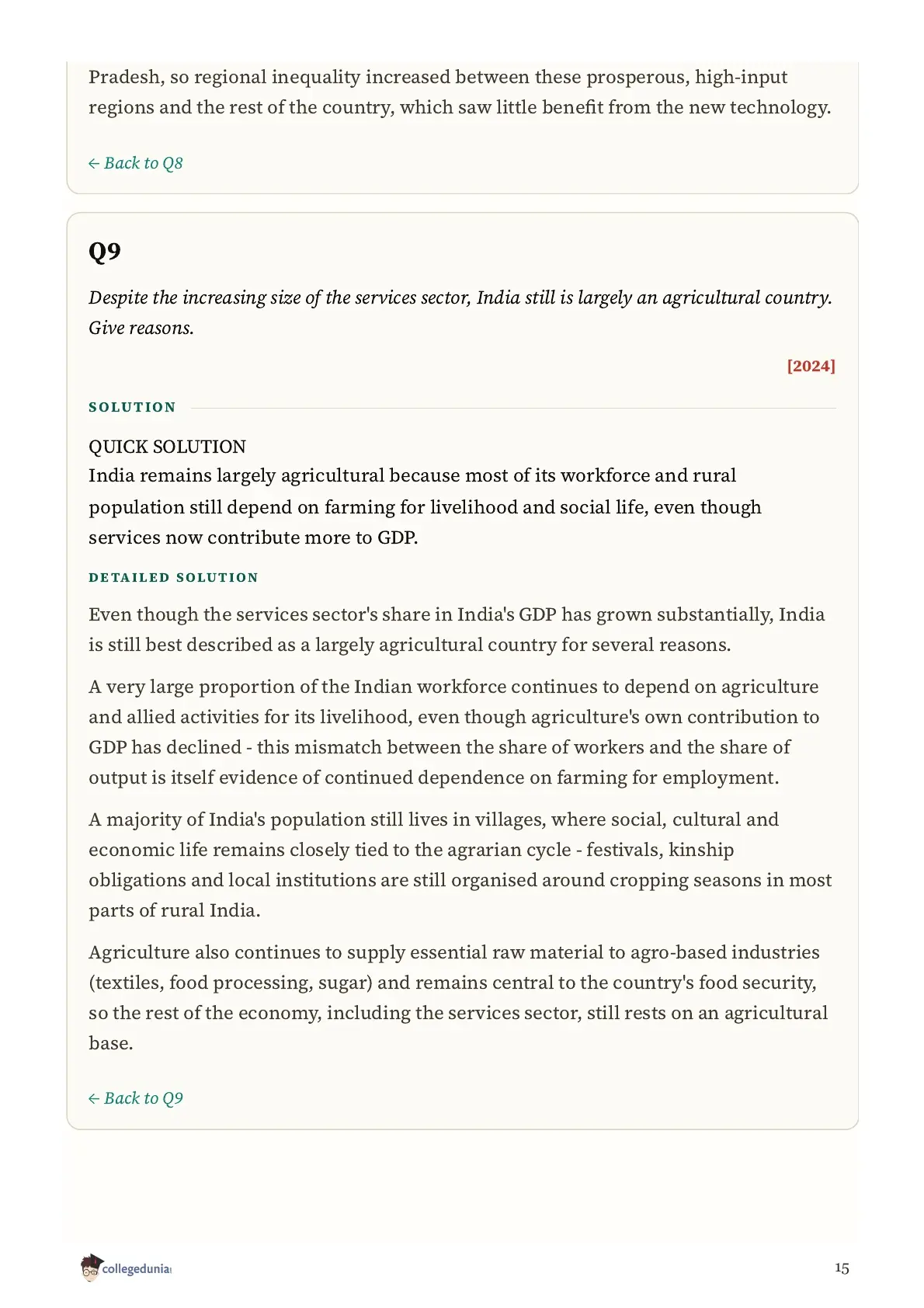
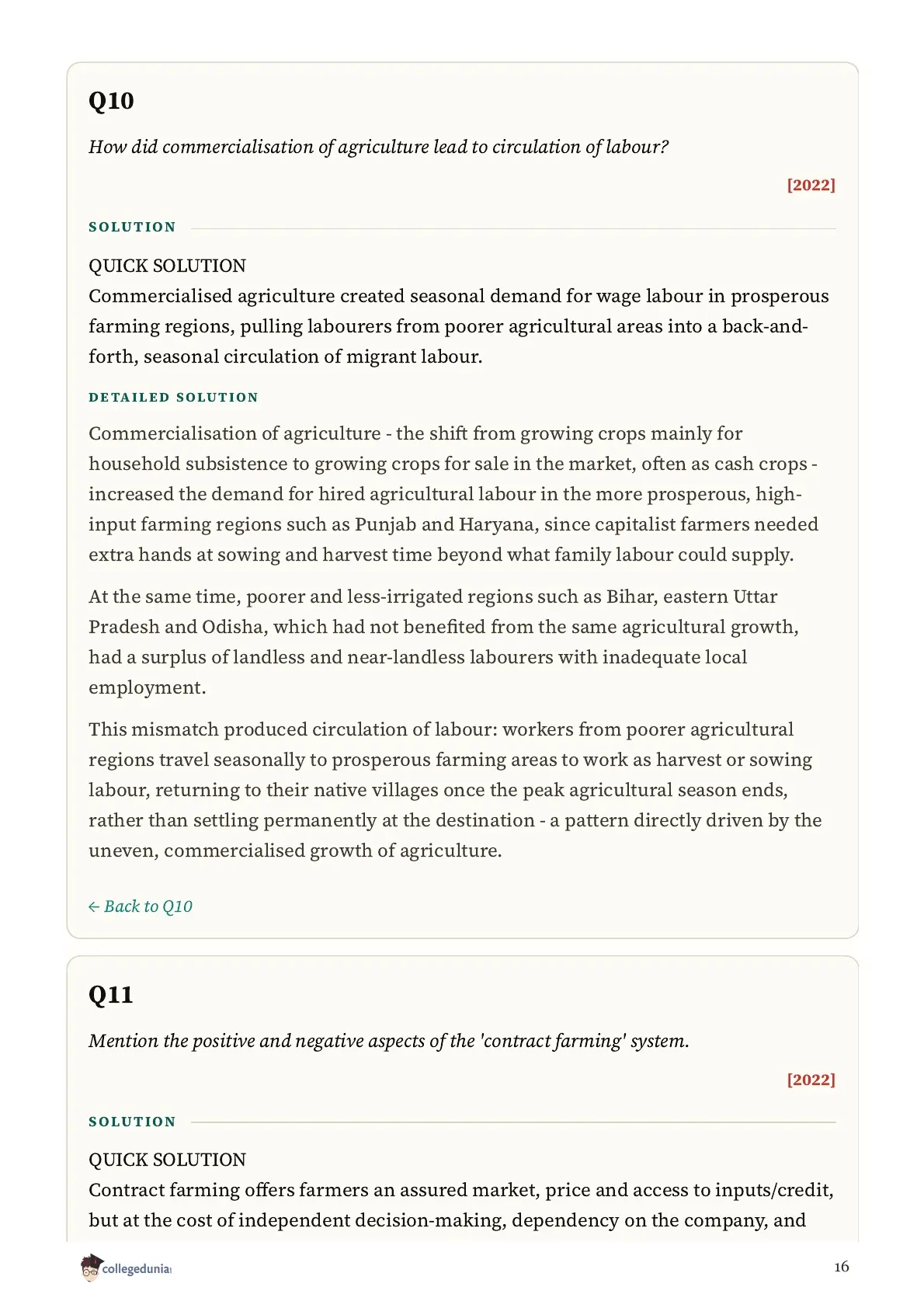
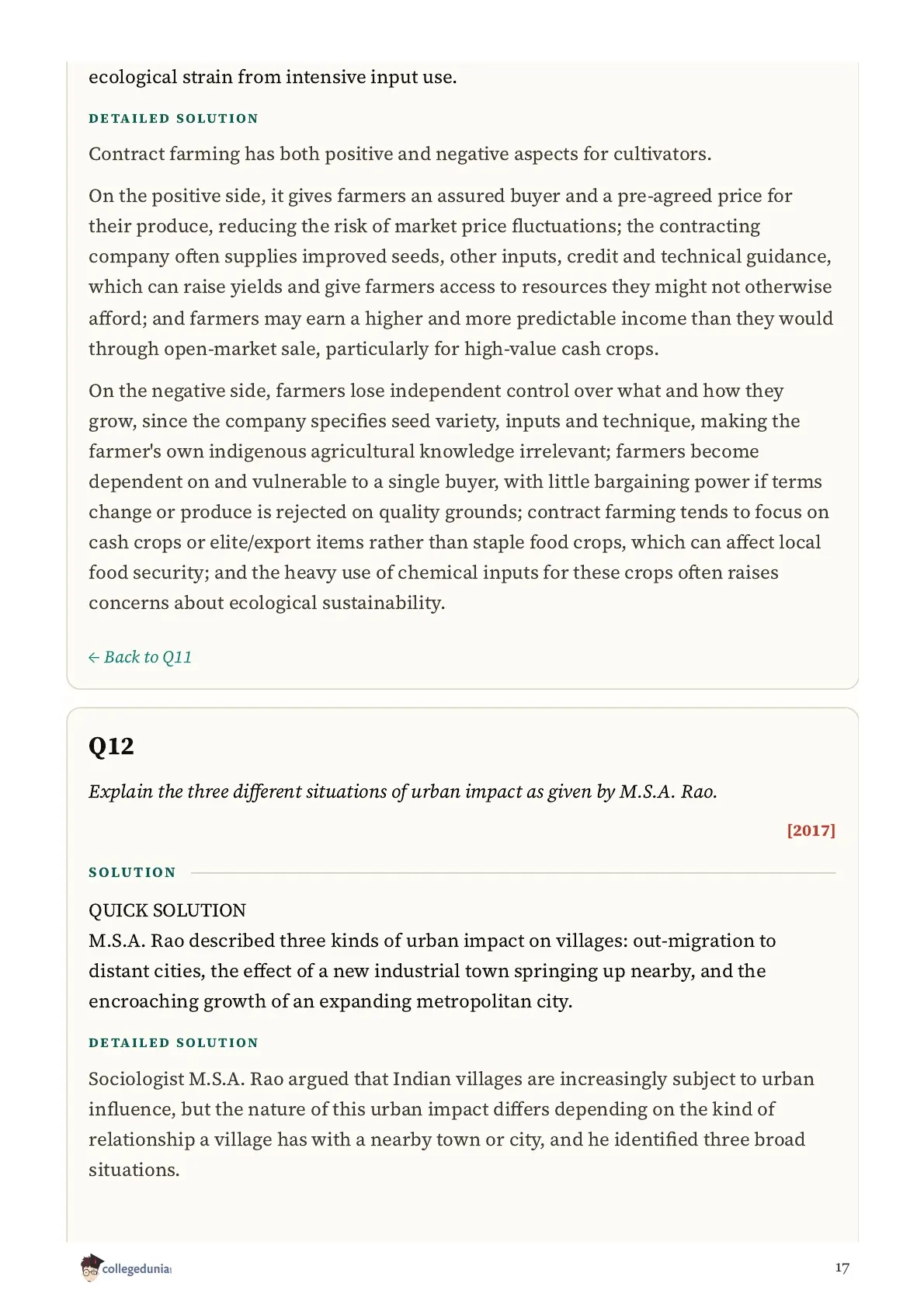
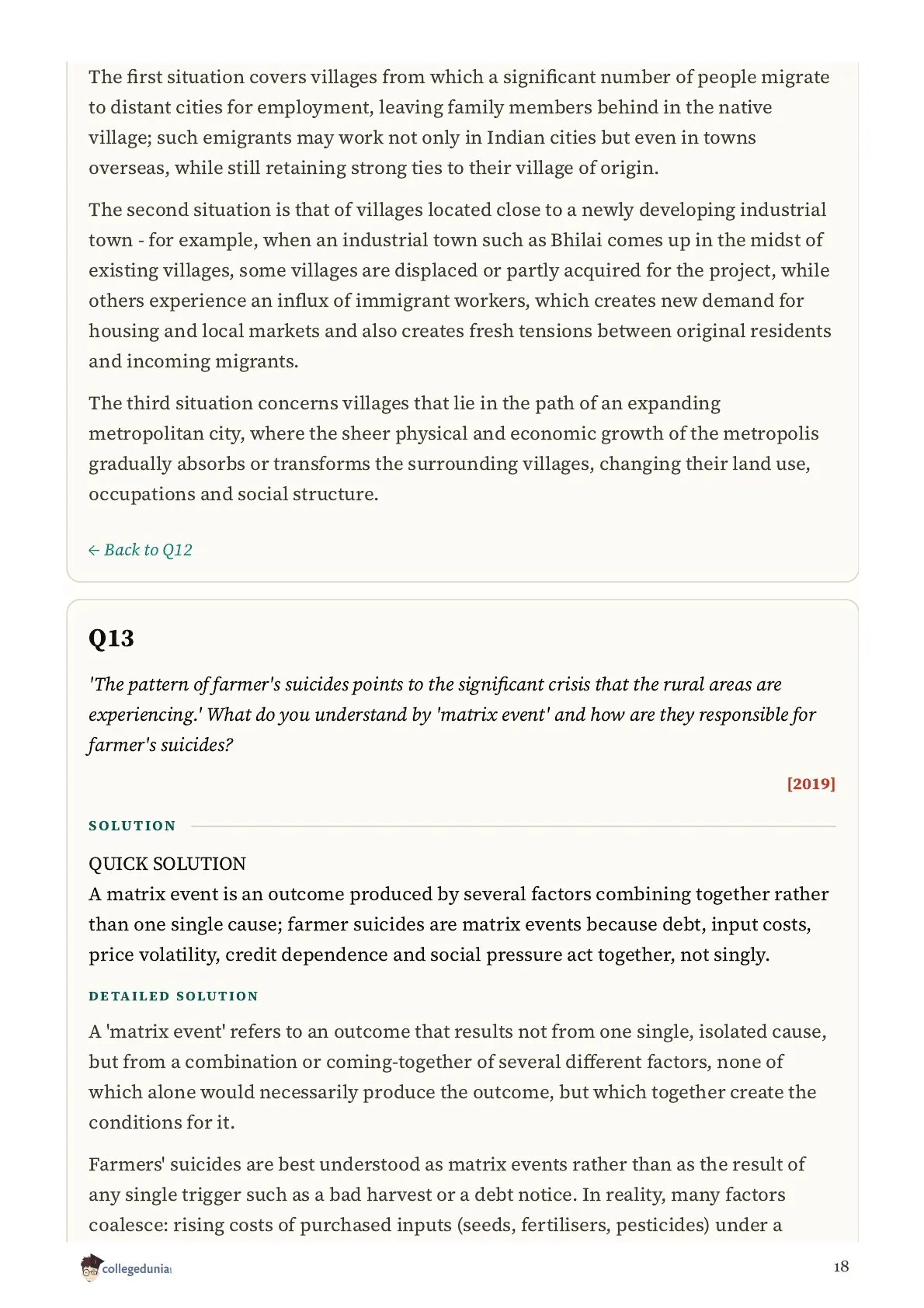

Every question in this Class 12 Sociology Chapter 4 (Social Change and Development in India) PYQ set is lifted from an actual CBSE board paper (2017-2024) and answered in full by Collegedunia's Sociology experts, according to the 2026-27 NCERT syllabus.
What Class 12 Sociology Chapter 4 (SCDI) PYQs Test: Land Reforms, Green Revolution and Contract Farming
Change and Development in Rural Society is where CBSE checks how well you understand the agrarian transformation of independent India, starting with land reforms and the Green Revolution and moving through to contract farming and globalisation. Board papers pull questions from post-independence land reforms, the Green Revolution's regionally uneven impact, the rise of the capitalist farmer, circulation of migrant labour, M.S.A. Rao's situations of urban impact, and contract farming under globalisation. Questions on rural distress and farmer suicides also recur.
- Land reforms: the three components (abolition of intermediaries, tenancy reform, land ceiling laws) and why implementation stayed patchy.
- Green Revolution: which regions and crops it touched, and how it sharpened rather than reduced rural inequality.
- Agrarian class structure: the emergence of the capitalist farmer and the changing nature of the agrarian economy.
- Labour and migration: circulation of migrant labour and M.S.A. Rao's situations of urban impact on villages.
- Globalisation and contract farming: sociological significance, pros and cons, and the link to matrix events behind farmer suicides.
Marks-wise Distribution of Rural Society PYQs
The 15 questions are spread across four CBSE mark bands. Section B carries the most questions (5 VSA), but Section D's long-answer questions carry the most marks per question.
| Section | Marks Each | Question Type | Number of Questions |
|---|---|---|---|
| Section A | 1 mark | MCQ | 3 |
| Section B | 2 marks | Very Short Answer (VSA) | 5 |
| Section C | 4 marks | Short Answer (SA) | 4 |
| Section D | 6 marks | Long Answer (LA) | 3 |
MCQs test whether you can identify a term or concept correctly, such as naming the class of farmer described in a scenario. Long-answer questions test whether you can explain a full process, such as the three components of land reform or the regional spread of the Green Revolution, in an organised, multi-part answer.
Year-wise Spread of Rural Society PYQs: 2017 to 2024
The bank covers five CBSE board papers spread across eight years. 2024 contributed the most questions (5), followed by 2023 (4), while 2017, 2019 and 2022 each contributed 2.
| Year | Number of Questions |
|---|---|
| 2024 | 5 |
| 2023 | 4 |
| 2022 | 2 |
| 2019 | 2 |
| 2017 | 2 |
Practising all five years together shows how CBSE keeps returning to land reforms and the Green Revolution as anchor topics, while rotating the exact angle, definition, comparison, or application, from one paper to the next.
Which Topics Repeat Most in Rural Society PYQs
Land reforms and the Green Revolution dominate the question mix in this chapter. The Green Revolution's regional impact and its role in rising rural inequality, along with the components of post-independence land reforms, show up most often, across MCQs as well as the longer answer questions. Contract farming and its sociological significance recur almost as frequently, and labour migration, globalisation, and M.S.A. Rao's work on urban impact turn up in at least one question most years.
- Most frequent: post-independence land reforms and their three components; Green Revolution regions and impact; Green Revolution and rising rural inequality.
- Frequent: contract farming, its sociological significance, and its pros and cons.
- Regular: circulation of migrant labour, globalisation and liberalisation in rural society, globalisation of agriculture, M.S.A. Rao's situations of urban impact, matrix events and farmer suicides.
How to Attempt Rural Society PYQs
Start with the MCQs in Section A. They move fast and build confidence before you reach the longer questions. Then work through Section D's long-answer questions, since these carry the most marks and reward a clear, multi-part structure.
- Always name the three components of land reform explicitly. Abolition of intermediaries, tenancy reform, and land ceiling laws, not a vague summary of "land reform".
- Describe the Green Revolution's impact as regionally uneven, never uniformly beneficial. Name the states that gained most (Punjab, Haryana, western Uttar Pradesh) rather than writing that it helped "Indian agriculture" as a whole.
- For contract farming questions, cover both sides. State the market-integration benefit and the autonomy or sustainability concern in the same answer.
- Keep VSA answers to 2-3 lines and SA answers to a short paragraph with one concrete example or region named.
Sample Question and Answer Approach for Rural Society
Here is how to structure two typical question types from this chapter's PYQs. The pattern below is the same one the PDF's step-by-step solutions follow.
| Question Type | How to Structure the Answer |
|---|---|
| 1-mark MCQ (e.g. identifying the class of farmer described in a scenario) | Read the description first and check whether it mentions wage labour, market-oriented production, or capital investment. These point to the capitalist farmer, not a traditional landlord or subsistence cultivator. |
| 6-mark long answer (e.g. explaining the Green Revolution's impact on rural society) | Open with a one-line definition of the Green Revolution, list the specific inputs involved (high-yielding seeds, irrigation, chemical fertilisers), name the regions that benefited most, then explain why this created rather than removed inequality between farmers and regions. |
This two-step habit, name the specific process, then locate it in a real region or group, is what separates a 2-mark answer from a full 6-mark one.
Common Mistakes Students Make in Rural Society Questions
Watch out for these recurring errors:
- Describing land reforms as fully or successfully implemented. The reforms had clear aims, but enforcement was patchy and often circumvented through benami transfers and legal loopholes. Answers that claim complete success lose marks.
- Treating contract farming as purely positive. It does integrate farmers into wider markets, but the chapter also raises concerns about farmer autonomy and ecological sustainability that many students leave out.
- Confusing the "capitalist farmer" with a traditional landlord. A capitalist farmer employs wage labour and produces for the market; a traditional landlord typically relied on tenancy and rent, a different agrarian relationship entirely.
- Presenting rural-urban migration as one-way and permanent. The chapter describes it as circular and seasonal, with workers moving back and forth between village and city, not a single permanent shift.
Student Feedback: Rural Society Difficulty Rating
What 9,280 students told us about this chapter's PYQs
In a Collegedunia poll of 9,280 Class 12 Sociology students conducted before the 2025 boards, 61% rated the Green Revolution and land reform questions as the hardest part of this chapter, mainly because they forget to name specific regions or the exact three components of land reform under exam pressure. Students who practised all five years of PYQs together reported fewer vague answers on the actual paper.
Source: 2026-27 Class 12 Sociology student poll. Sample of 9,280 students from CBSE schools across 12 states.
How These PYQs Pair with Other Class 12 Sociology Chapter 4 (SCDI) Resources
This PYQ set works best alongside the other Chapter 4 resources already live on Collegedunia. Read the notes first, revise from the handwritten notes, solve these PYQs, then cross-check tricky answers against the full NCERT solutions.
| Resource | Link |
|---|---|
| NCERT Notes | Change and Development in Rural Society Class 12 Notes |
| Handwritten Notes | Change and Development in Rural Society Class 12 Handwritten Notes |
| NCERT Solutions | Change and Development in Rural Society Class 12 NCERT Solutions |
| NCERT Book PDF | Change and Development in Rural Society Class 12 NCERT Book PDF |
| PYQ (this page) | Change and Development in Rural Society Class 12 PYQ |
Five other Class 12 Sociology chapters from this same PYQ series are already live: Structural Change, Cultural Change, Social Institutions: Continuity and Change, The Market as a Social Institution, and The Story of Indian Democracy. See also each of these for the full spread of Class 12 Sociology PYQs.
How to Use the Rural Society PYQ PDF Effectively
Don't jump to the solution on the first read. Try to name the process and sketch an answer yourself, then check it against the step-by-step solution in the PDF.
- First pass: attempt all 15 questions without looking at the solutions, section by section.
- Second pass: compare each answer against the solution and mark where a region, component, or specific term was missing.
- Third pass: redo only the questions you got wrong, a day or two later, from memory.
Downloading and Using the PYQ PDF
The PDF is 21 pages and free to download. It opens with the question paper sorted by mark band, closes with a self-check answer key, and links every question to its full solution.
Change and Development in Rural Society Class 12 Sociology PYQ FAQs
Ques. How many questions are in the Change and Development in Rural Society Class 12 PYQ PDF?
Ans. The PDF has 15 questions from CBSE board papers between 2017 and 2024: 3 one-mark MCQs, 5 two-mark VSA, 4 four-mark SA and 3 six-mark long-answer questions.
Ques. Does this PYQ PDF include solutions, or only the questions?
Ans. It includes full solutions. Every one of the 15 questions has a step-by-step answer written out in the PDF, so you can check your own attempt against a worked solution rather than just an answer key.
Ques. Which years of CBSE board papers does this PYQ set cover?
Ans. It covers five years: 2017, 2019, 2022, 2023 and 2024. 2024 has the most questions (5), followed by 2023 (4), and 2017, 2019 and 2022 with 2 each.
Ques. Where can I download the Change and Development in Rural Society PYQ PDF?
Ans. You can download it directly from this page. It is free and runs to 21 pages, with the questions sorted by mark band and every question linked to its solution.
Ques. Is this PYQ set aligned with the 2026-27 CBSE syllabus?
Ans. Yes. The chapter content and question pattern match the current 2026-27 NCERT Sociology syllabus for Class 12, under Social Change and Development in India.
Ques. What were India's post-independence land reforms?
Ans. The land reforms had three components: abolition of intermediaries such as zamindars, tenancy reform to protect cultivators, and land ceiling laws to cap how much land one person could hold. Implementation stayed patchy across states, and many landowners circumvented the ceiling laws through benami transfers, so the reforms achieved far less redistribution than intended.
Ques. Why did the Green Revolution increase rural inequality?
Ans. The Green Revolution relied on high-yielding seeds, assured irrigation and chemical fertilisers, inputs that only resource-rich farmers could afford. It concentrated in a few regions, particularly Punjab, Haryana and western Uttar Pradesh, so farmers and regions with capital and irrigation access pulled further ahead of those without, widening the gap rather than closing it.



Comments