The NCERT Solutions for Class 12 Sociology Chapter 4 Change and Development in Rural Society answer every back-exercise question on agrarian structure, land reforms, the Green Revolution, the circulation of labour and the globalisation of agriculture, set to the latest 2026-27 CBSE syllabus. Each answer is written in plain points so students can revise fast and write full board answers.
Covers all 8 back-exercise questions from Change and Development in Rural Society, with point-wise model answers.
This Class 12 Sociology chapter usually carries 4 to 6 marks per board paper.
Pairs with the Notes, Handwritten Notes and NCERT Book PDF linked lower on this page.
Every solution for Class 12 Sociology Chapter 4 Change and Development in Rural Society in this Collegedunia compilation is written by subject experts from the official NCERT Social Change and Development in India textbook, and checked against the last five years of CBSE board papers.
Student Feedback: In a Collegedunia poll of 7,210 Class 12 Sociology students taken before the 2026 boards, 68% of students said the link between agrarian structure and the lack of upward mobility for labourers was the part of this chapter they most wanted model answers for. Most students said one labelled chart of the agrarian classes made the whole chapter click.
Source: 2026-27 Class 12 Sociology student poll. Sample of 7,210 students from CBSE schools across 12 states.
What the Change and Development in Rural Society Chapter Is About
Change and Development in Rural Society is the fourth chapter of Social Change and Development in India, the second Class 12 Sociology book. It studies how Indian villages have changed since Independence, and who has gained or lost from that change. India still lives largely in its villages, so the chapter starts from one simple fact: land is the most valued resource in rural society, and who owns it decides power, caste and status.
The chapter answers three big questions that students must keep in mind:
How is rural society organised? Through an agrarian structure of landowners, tenants and labourers.
What changed it? Land reforms, the Green Revolution and, later, the globalisation of farming.
Who gained, who lost? The change was uneven, so it created new wealthy classes and left labourers behind.
So the chapter is really about unequal change in the village. A student who keeps these three threads in mind can connect almost any question in Change and Development in Rural Society class 12 back to one of them. This is why revision works best when you sort each fact under "structure", "change" or "who gained" first.
Agrarian Structure: Land, Caste and Class
Rural society rests on its agrarian structure, which is the pattern of land ownership and the relations it creates between people. To answer the "structure" questions well, students must see how land, caste and class line up together in the village.
Land decides power: the more land a household owns, the more power it holds over others.
Caste and class overlap: the big landowners often belong to a dominant caste that also runs village affairs.
Labour at the bottom: landless agricultural labourers work for daily wages and depend on the owners.
Tenancy in the middle: tenants and sharecroppers rent land and pay in cash or a share of the crop.
A key exam point is that land is not just an economic asset, it is the basis of social status. Because caste and land overlap, the dominant caste controls both the economy and the social life of the village. Marks come from making this overlap of caste and class clear before listing the groups.
Land Reforms and the Green Revolution
After 1947 the state tried to change the unequal village through land reforms, and from the 1960s the Green Revolution changed how farming itself was done. Both appear in long answers, so students should learn what each tried to do and how far it worked.
Measure
What it tried to do
Abolition of intermediaries
Removed zamindars so the tiller dealt directly with the state.
Tenancy reform
Gave tenants security and limited the rent owners could charge.
Land ceilings
Capped how much land one family could own, to free land for the landless.
Green Revolution
Brought high-yielding seeds, fertilisers and irrigation to raise output.
The honest exam point is that these changes were uneven and partly fell short. Land ceilings were often dodged, and the Green Revolution helped well-irrigated regions like Punjab far more than dry ones. So output rose, but the gap between rich and poor farmers, and between regions, also grew. A balanced answer names both the gains and these limits.
New Dominant Classes and Rural Entrepreneurs
The Green Revolution did not just raise crops, it created new wealthy classes in the countryside. This is the "who gained" thread, and it is a favourite "explain the factors" question. The list below sorts what let certain groups rise.
Surplus from new farming: high-yielding crops gave landowning castes a cash surplus.
Reinvestment: they put that surplus into business, transport and money-lending.
Market links: they sold to wider markets and moved into towns.
Political power: they used their numbers and land to gain a say in state politics.
One sharp point: the old landed castes turned themselves into a new entrepreneurial dominant class. The book points to groups in states like Punjab, Andhra Pradesh and Maharashtra who moved from farming into agribusiness and politics. A high-marks answer names the surplus, the reinvestment and the new power together, and adds a state example.
Circulation of Labour and Migrant Workers
While some groups rose, many rural workers were pushed to move for work. This is the human cost of uneven change, and it appears in both passage and field questions. The table keeps the cause and the result side by side.
Why labourers migrate
What happens to them
Little or no land at home
They have no steady income in the village.
Seasonal farm work only
They circulate to other areas for harvests, then return.
Recruited by a mukadam
A labour contractor takes them to building sites and brickyards.
Below minimum wage
They are paid little, with no security or rights.
The point that earns marks is that this is a circulation of labour, not a one-way move. Workers leave poor villages for farms or cities, then come back, so they stay tied to both places. Their low wages and weak rights keep them at the bottom, which is exactly the link the passage questions test.
Globalisation of Agriculture and Farmers' Movements
From the 1990s, open markets reached the village too. Imported goods, cash crops and contract farming changed rural life and sparked farmers' movements. These appear in the fruit-seller and report questions, so a short, sorted list helps.
Imported produce: goods like apples from abroad now compete with local fruit in the market.
Contract farming: companies tie farmers to grow set crops at set prices.
Market risk: farmers face price swings and rising input costs, which can lead to distress.
Movements: farmers organise to demand fair prices and protection.
The point that earns marks is that globalisation linked the village to world markets, for better and worse. It opened new chances to sell crops, but it also brought price shocks and debt. In an answer, name both the opportunity and the risk before judging it.
Change and Development in Rural Society Exercise-wise Coverage
The chapter exercise has 8 questions, a mix of passage, descriptive and field-study prompts. The table maps each one to its topic so students can plan revision and find the right NCERT answer fast. The full point-wise solution for each sits in the question set lower on this page.
Question
Topic it tests
Q 1
Passage on the maliks, state power and harsh labour conditions
Q 2
Measures to protect landless labourers and migrant workers
Q 3
Linkages that block the upward mobility of agricultural workers
Q 4
Factors that create new entrepreneurial dominant classes
Q 5
A film set in rural India and how realistic its portrayal is
Q 6
Field study of migrant workers and the mukadam
Q 7
Field study of a fruit-seller and imported versus local fruit
Q 8
A report on the environmental situation in rural India
Questions 2, 3 and 4 are the most-asked written answers, so students preparing Change and Development in Rural Society class 12 important questions should learn those first. The field and report prompts (Q5 to Q8) reward your own observation, so plan a clear structure for them.
Students who want the offline copy can save the class 12 sociology chapter 4 pdf from the download card above and tick off each question as they finish it.
Change and Development in Rural Society Important Questions and Previous Year Trends
CBSE sets a steady mix of short and long answers from this chapter. Knowing the pattern helps students decide how much to write. The chapter is a regular source of one 4-mark or 6-mark question, which is why a focused list of Change and Development in Rural Society important questions saves a lot of revision time.
Long answer (5 to 6 marks): the factors that create new dominant classes, or the effects of the Green Revolution.
Short answer (4 marks): measures to protect migrant workers, or the linkages that block mobility.
Source-based: a passage on agrarian power, the maliks or labour conditions, with sub-parts.
Objective: key terms such as circulation of labour, dominant caste, mukadam and contract farming.
For quick recall before the exam, students often practise the class 12 sociology chapter 4 question answer set and a list of Change and Development in Rural Society class 12 important questions. The most repeated items are the rise of new dominant classes and the lives of migrant labourers, so keep those answer points ready in your own words.
Working through the ncert solutions class 12 sociology chapter 4 set twice, once open-book and once from memory, fixes the agrarian structure and key terms well before the board exam.
Common Mistakes Students Make in This Chapter
A few errors cost marks every year in this chapter. Most come from treating change as good for everyone, or forgetting the human cost. Avoiding them is the fastest way to lift a score.
Saying the Green Revolution helped everyone - it mostly helped well-irrigated regions and large farmers.
Treating caste and class as separate - in the village the dominant caste and the big landowners are often the same group.
Calling migration a one-way move - it is a circulation of labour between village and workplace.
Forgetting that land reforms were often dodged, so land ceilings did not free much land.
Writing that globalisation only helped farmers - it also brought price shocks, debt and distress.
Students who fix these five points usually move from average to high marks on the long answers. The exam rewards a balanced view, so always give both the gain and the cost of any change before you judge it.
Change and Development in Rural Society PDF Download Formats and Languages
The solutions are free to download in more than one format, so students can pick what suits their device and revision style. The download card at the top of the page carries each option for this chapter.
Normal and HD PDF: the class 12 sociology chapter 4 pdf comes in a normal size for quick downloads and an HD version for clear printing.
English medium: all 8 answers are written in simple English for the CBSE board paper.
Question-only set: a print-and-practise sheet of Change and Development in Rural Society extra questions for self-testing.
Whole-book pack: the solutions sit in one set that runs through every Social Change and Development in India chapter, so you can revise from Chapter 1 onwards in one place.
Many students search for class 12 sociology chapter 4 answers on their phone the night before a test, so a saved PDF means you can revise even without internet. Keep both the question set and the solved version handy for a full self-check.
How the Rural Society Solutions Pair with Notes and the Book PDF
These NCERT Solutions answer the back-exercise questions. To revise the full chapter, students should use them alongside the other resources for the same chapter, all linked in the table below.
Reading the original NCERT chapter text and examples
Tip: read the Notes first, then attempt these solutions on your own, and only then check the model answers here. That order builds memory faster than copying answers straight away.
All NCERT Solutions for Class 12 Sociology
The table links the NCERT Solutions for every chapter in both Class 12 Sociology books, so students can move across the course in one click. Change and Development in Rural Society is highlighted.
All NCERT Solutions for Change and Development in Rural Society with Step-by-Step Solutions
Below are all 8 NCERT exercise questions for this chapter, exactly as they appear in the textbook. Tap Check Solution for the model answer or Expert Solution for the topper-style approach.
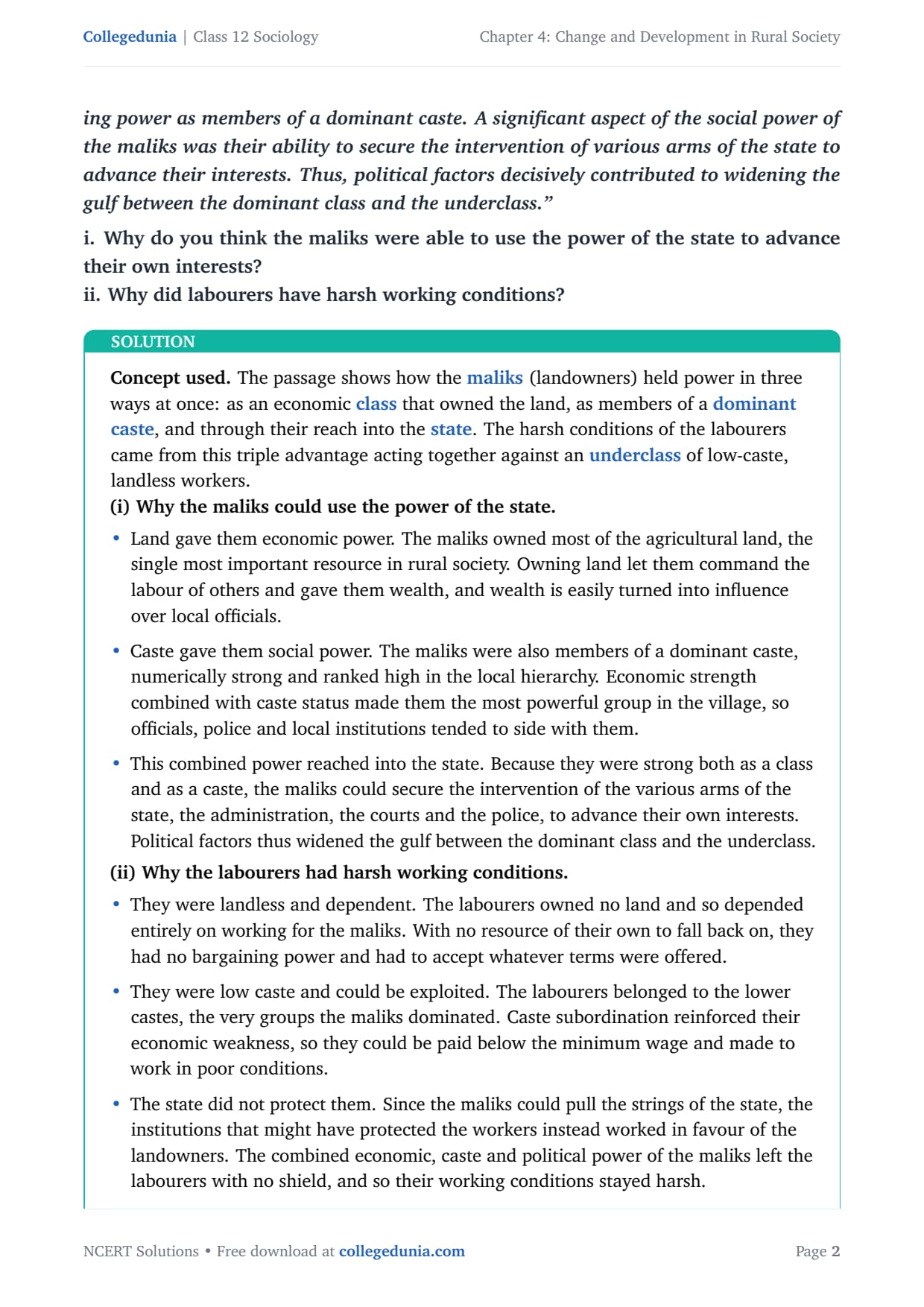
Q 4.1
Read the passage given and answer the questions: [2pt]
``The harsh working conditions suffered by labourers in Aghanbigha were
an outcome of the combined effect of the economic power of the maliks as a
class and their overwhelming power as members of a dominant caste. A
significant aspect of the social power of the maliks was their ability to
secure the intervention of various arms of the state to advance their
interests. Thus, political factors decisively contributed to widening the gulf
between the dominant class and the underclass.'' [4pt]
i. Why do you think the maliks were able to use the power of the state to
advance their own interests?
ii. Why did labourers have harsh working conditions?
Concept used. The passage shows how the maliks (landowners)
held power in three ways at once: as an economic class that owned
the land, as members of a dominant caste, and through their reach
into the state. The harsh conditions of the labourers came from this
triple advantage acting together against an underclass of low-caste,
landless workers.
(i) Why the maliks could use the power of the state.
Land gave them economic power. The maliks owned most of the
agricultural land, the single most important resource in rural society.
Owning land let them command the labour of others and gave them wealth,
and wealth is easily turned into influence over local officials.
Caste gave them social power. The maliks were also members of a
dominant caste, numerically strong and ranked high in the local
hierarchy. Economic strength combined with caste status made them the
most powerful group in the village, so officials, police and local
institutions tended to side with them.
This combined power reached into the state. Because they were strong
both as a class and as a caste, the maliks could secure the
intervention of the various arms of the state, the administration, the
courts and the police, to advance their own interests. Political
factors thus widened the gulf between the dominant class and the
underclass.
(ii) Why the labourers had harsh working conditions.
They were landless and dependent. The labourers owned no land and so
depended entirely on working for the maliks. With no resource of their
own to fall back on, they had no bargaining power and had to accept
whatever terms were offered.
They were low caste and could be exploited. The labourers belonged to
the lower castes, the very groups the maliks dominated. Caste
subordination reinforced their economic weakness, so they could be paid
below the minimum wage and made to work in poor conditions.
The state did not protect them. Since the maliks could pull the strings
of the state, the institutions that might have protected the workers
instead worked in favour of the landowners. The combined economic,
caste and political power of the maliks left the labourers with no
shield, and so their working conditions stayed harsh.
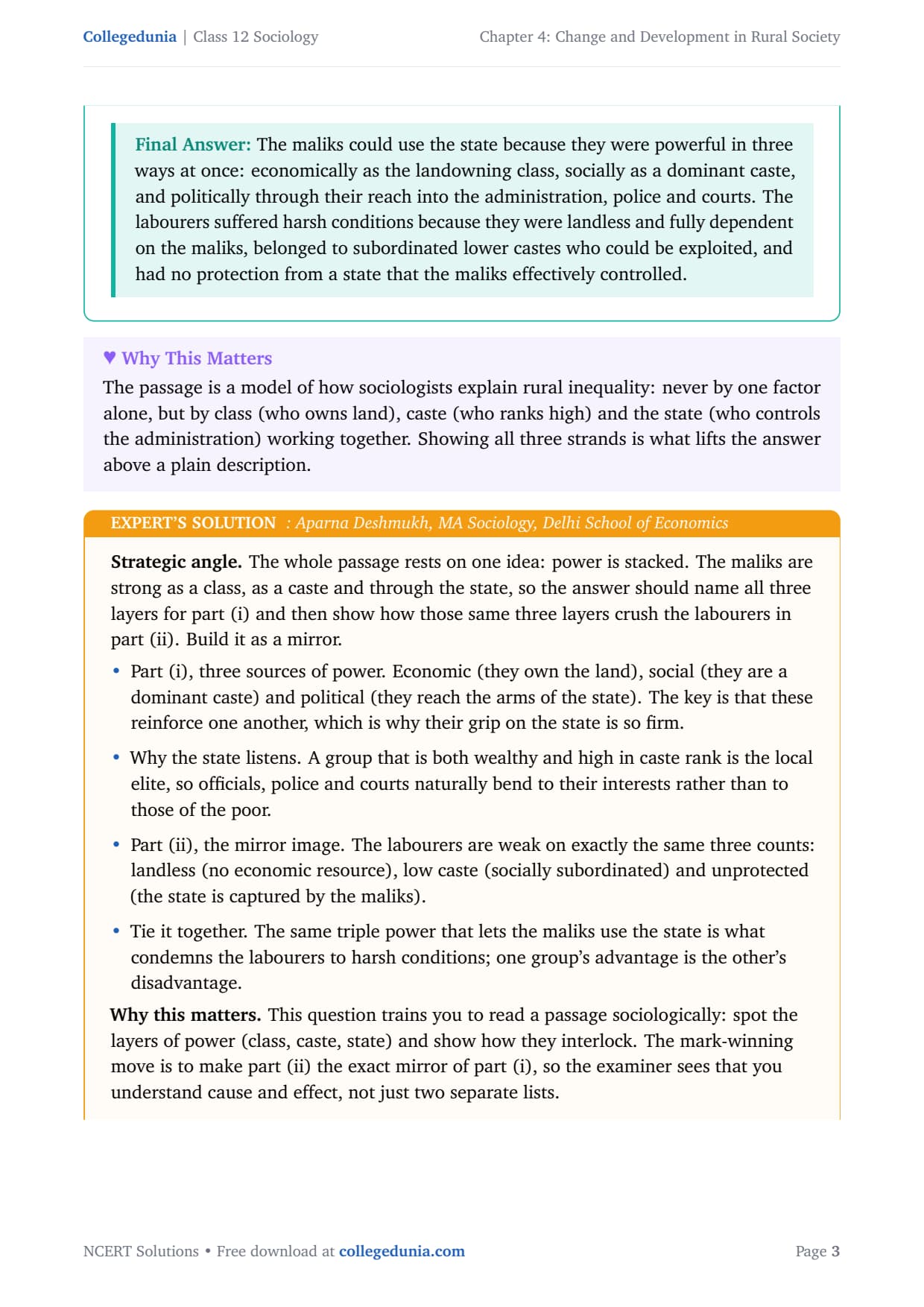
The maliks could use the state because they were powerful in three
ways at once: economically as the landowning class, socially as a dominant
caste, and politically through their reach into the administration, police and
courts. The labourers suffered harsh conditions because they were landless and
fully dependent on the maliks, belonged to subordinated lower castes who could
be exploited, and had no protection from a state that the maliks effectively
controlled.
AD
Aparna Deshmukh
MA Sociology, Delhi School of Economics
Verified Expert
Strategic angle. The whole passage rests on one idea: power is
stacked. The maliks are strong as a class, as a caste and through the state, so
the answer should name all three layers for part (i) and then show how those
same three layers crush the labourers in part (ii). Build it as a mirror.
Part (i), three sources of power. Economic (they own the land), social
(they are a dominant caste) and political (they reach the arms of the
state). The key is that these reinforce one another, which is why their
grip on the state is so firm.
Why the state listens. A group that is both wealthy and high in caste
rank is the local elite, so officials, police and courts naturally bend
to their interests rather than to those of the poor.
Part (ii), the mirror image. The labourers are weak on exactly the same
three counts: landless (no economic resource), low caste (socially
subordinated) and unprotected (the state is captured by the maliks).
Tie it together. The same triple power that lets the maliks use the
state is what condemns the labourers to harsh conditions; one group's
advantage is the other's disadvantage.
Why this matters. This question trains you to read a passage
sociologically: spot the layers of power (class, caste, state) and show how
they interlock. The mark-winning move is to make part (ii) the exact mirror of
part (i), so the examiner sees that you understand cause and effect, not just
two separate lists.
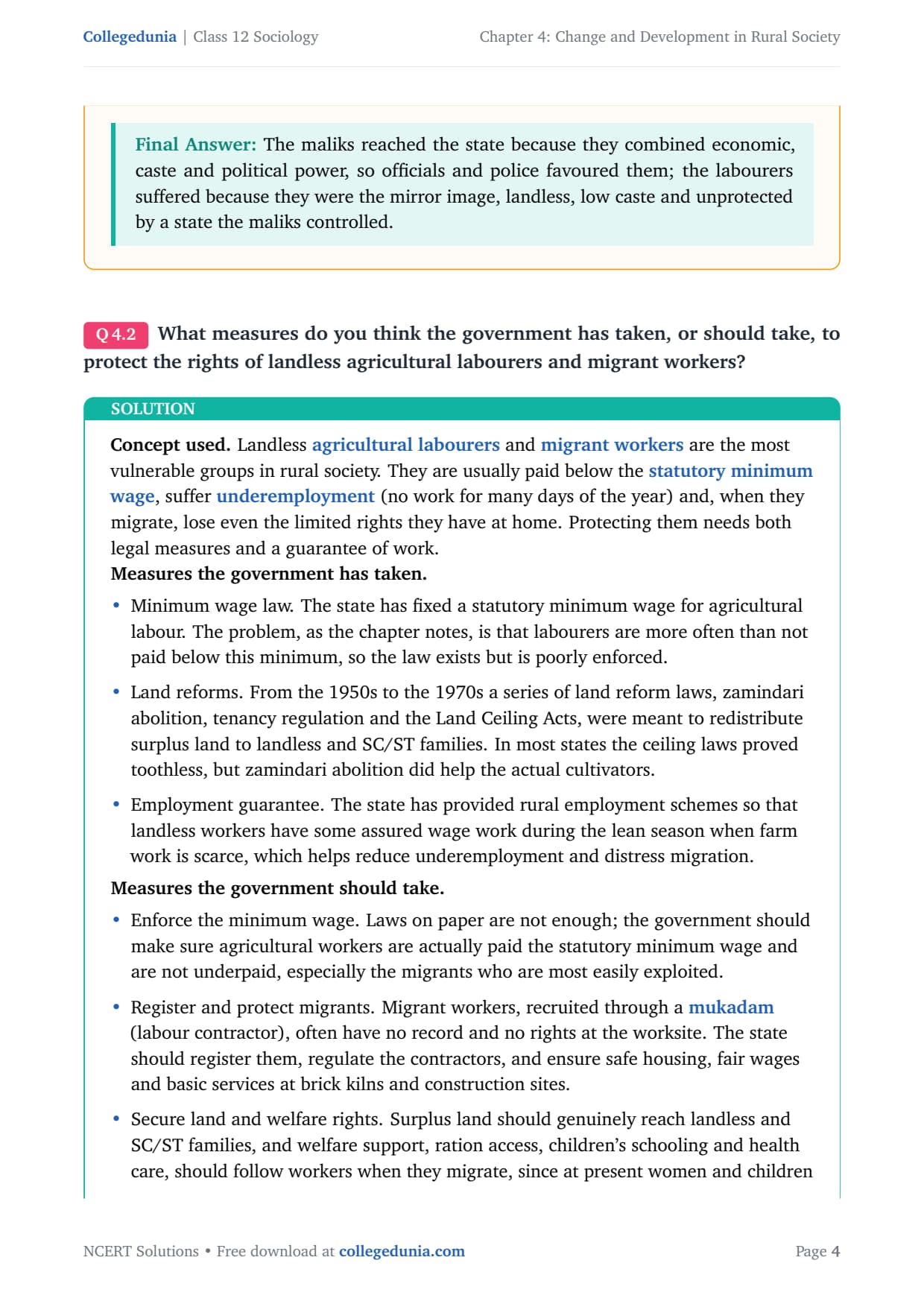
The maliks reached the state because they combined economic, caste
and political power, so officials and police favoured them; the labourers
suffered because they were the mirror image, landless, low caste and
unprotected by a state the maliks controlled.
Q 4.2
What measures do you think the government has taken, or should take,
to protect the rights of landless agricultural labourers and migrant workers?
Concept used. Landless agricultural labourers and
migrant workers are the most vulnerable groups in rural society. They
are usually paid below the statutory minimum wage, suffer
underemployment (no work for many days of the year) and, when they
migrate, lose even the limited rights they have at home. Protecting them needs
both legal measures and a guarantee of work.
Measures the government has taken.
Minimum wage law. The state has fixed a statutory minimum wage for
agricultural labour. The problem, as the chapter notes, is that
labourers are more often than not paid below this minimum, so the law
exists but is poorly enforced.
Land reforms. From the 1950s to the 1970s a series of land reform laws,
zamindari abolition, tenancy regulation and the Land Ceiling Acts, were
meant to redistribute surplus land to landless and SC/ST families. In
most states the ceiling laws proved toothless, but zamindari abolition
did help the actual cultivators.
Employment guarantee. The state has provided rural employment schemes
so that landless workers have some assured wage work during the lean
season when farm work is scarce, which helps reduce underemployment and
distress migration.
Measures the government should take.
Enforce the minimum wage. Laws on paper are not enough; the government
should make sure agricultural workers are actually paid the statutory
minimum wage and are not underpaid, especially the migrants who are
most easily exploited.
Register and protect migrants. Migrant workers, recruited through a
mukadam (labour contractor), often have no record and no
rights at the worksite. The state should register them, regulate the
contractors, and ensure safe housing, fair wages and basic services at
brick kilns and construction sites.
Secure land and welfare rights. Surplus land should genuinely reach
landless and SC/ST families, and welfare support, ration access,
children's schooling and health care, should follow workers when they
migrate, since at present women and children are often left behind
without support.
The government has fixed a minimum wage, passed land reform laws and
run rural employment schemes, but enforcement has been weak: workers are often
paid below the minimum and ceiling laws stayed toothless. It should now enforce
the minimum wage strictly, register and protect migrant workers and their
contractors at worksites, redistribute surplus land to the landless and SC/ST
families, and make welfare benefits portable so migrants and their families are
not left without support.
RB
Rohit Bhandari
MA Sociology, Jawaharlal Nehru University
Verified Expert
Structural observation. The question has two halves, taken and should
take, so answer in two visible blocks. The chapter hands you the existing
measures (minimum wage, land reforms, employment guarantee) and their failures;
your job is to turn each failure into a recommendation.
Taken, block one. Minimum wage fixed, land reforms passed,
employment-guarantee work provided. State each with its limit:
underpayment, toothless ceiling laws, seasonal cover only.
Why they fall short. The common thread is weak enforcement and the easy
exploitation of those with no bargaining power, especially landless and
migrant workers.
Should take, block two. Convert each gap into a fix: enforce the wage,
register and protect migrants and regulate the mukadam, deliver surplus
land to the landless, and make welfare portable so migration does not
strip away rights.
Add the gender point. Because men migrate while women and children stay
behind, support must reach the family left in the village too, which the
chapter highlights through the feminisation of agricultural labour.
Why this matters. This is an application question: the examiner wants
you to connect the chapter's facts (minimum wage, mukadam, land ceilings) to
real policy. The strongest answers do not just list schemes; they pair every
existing measure with the reason it has not worked and a specific way to fix
it, which shows genuine understanding rather than rote recall.
Taken: minimum wage, land reforms and rural employment schemes, all
weakly enforced. Should take: strict wage enforcement, registration and
protection of migrants and their contractors, real redistribution of surplus
land to the landless, and portable welfare so migration does not cost workers
and their families their basic rights.
Q 4.3
There are direct linkages between the situation of agricultural
workers and their lack of upward socio-economic mobility. Name some of them.
Concept used.Upward socio-economic mobility means moving up
to a better economic and social position over time. Agricultural workers are
trapped at the bottom because several disadvantages, lack of land, low and
insecure wages, low caste status and lack of protection, all reinforce one
another and block any climb upward.
Landlessness. Agricultural workers own no land, the single most
important resource and form of property in rural society. With no asset
of their own, they cannot generate a surplus, invest or save, so the
first rung of mobility is missing.
Low and insecure income. Most agricultural labourers are daily-wage
workers paid below the statutory minimum wage. They face
underemployment, no work for many days of the year, so their incomes
are low and uncertain, leaving nothing to invest in a better future.
Low caste status. Most landless workers belong to the lower castes,
the SCs, STs and OBCs, who were historically not allowed to own land
and provided most of the agricultural labour. Caste subordination keeps
them socially low and limits their access to power and privilege.
Dependence and weak bargaining power. Being landless and low caste,
workers depend completely on the dominant landowners for work. They have
little bargaining power, are easily exploited, and where bonded or
hereditary labour relations survive, they are tied to landlords with no
freedom to seek better terms.
Distress migration. Because work and wages at home are inadequate,
workers migrate seasonally to brick kilns, farms and construction sites.
Migrants have even fewer rights, are paid lower wages and live in poor
conditions, so migration relieves immediate distress but does not raise
them up the social ladder.
The linkages that block the upward mobility of agricultural workers
include landlessness (no productive asset), low and insecure daily wages below
the minimum with underemployment, low caste status that historically denied
them land and power, total dependence on dominant landowners with little
bargaining power (and at times bonded or hereditary labour), and distress
migration that brings still fewer rights and lower wages. Each disadvantage
feeds the next, locking workers at the bottom.
SI
Sneha Iyer
MPhil Sociology, University of Hyderabad
Verified Expert
Quick reading. The word to underline is linkages. The answer is
a chain in which each disadvantage causes the next, so list them in order and
show how they loop back to keep the worker down: no land, low wage, low caste,
dependence, distress migration.
Start with the root. Landlessness is the base: with no land there is no
asset, no surplus and no savings, so nothing to climb with.
Add the income trap. Daily wages below the minimum plus underemployment
mean low, uncertain earnings and no spare income to invest in
education or assets.
Bring in caste. Low caste status historically barred land ownership and
still limits access to power, so social subordination locks in the
economic one.
Show the dependence. Landless and low caste, the worker depends on the
dominant landowner, has weak bargaining power, and may be tied by
bonded or hereditary labour.
Close with migration. Distress migration is the safety valve, but
migrants get fewer rights and lower wages, so even the escape route
leads nowhere up. The chain feeds back on itself.
Why this matters. The examiner is testing whether you can see a
system, not a list. The mark-winning insight is that these factors are
not separate problems but a single reinforcing cycle: landlessness causes
poverty, low caste status keeps the worker subordinated and dependent, and that
dependence forces distress migration, while each of those in turn keeps the
poverty in place.
Landlessness, low and insecure daily wages with underemployment, low
caste status that denied land and power, complete dependence on dominant
landowners with weak bargaining power (sometimes bonded labour), and distress
migration to fewer rights and lower wages: a self-reinforcing chain that blocks
the upward mobility of agricultural workers.
Q 4.4
What are the different factors that have enabled certain groups to
transform themselves into new wealthy, entrepreneurial, dominant classes? Can
you think of an example of this transformation in your state?
Concept used. In regions of rapid agricultural development, the old
landed or cultivating castes turned themselves into a dynamic
entrepreneurial, rural-urban dominant class. This transformation was
driven by the profits of the Green Revolution, the
diversification of those profits into other businesses, and the
spread of higher education that carried their children into urban
professions.
Benefit from the Green Revolution. It was mainly the medium and large
farmers who could afford the expensive inputs, high-yielding seeds,
fertilisers, pesticides and machinery, of the Green Revolution. They
produced a surplus for the market, earned high profits, and so grew
steadily richer while small farmers were left behind.
Diversification of profits. In agriculturally rich regions such as
coastal Andhra Pradesh, western Uttar Pradesh and central Gujarat,
well-to-do farmers of the dominant castes invested their farm profits in
other business ventures. This diversification moved them out of pure
agriculture and into trade, industry and services in the growing towns.
Spread of higher education. The growth of private professional colleges
in rural and semi-urban areas let the new rural elites educate their
children. Many of these children joined professional or white-collar
occupations or started businesses, feeding into the expanding urban
middle classes.
Rise of new regional elites. Together, these changes produced new
entrepreneurial groups who moved into the towns and became economically
and politically dominant: a rural-urban dominant class, as studied by
Rutten in western India.
Example. In Punjab, the Jat Sikh landowning farmers benefited most
from the Green Revolution, ploughed their wheat-and-rice profits into transport,
agro-machinery and commission-agent businesses, educated their children in
professional colleges, and emerged as a wealthy, politically dominant
rural-urban class. (You can replace this with the dominant landowning caste of
your own state, for example the Kammas and Reddis in Andhra Pradesh or the
Patidars in Gujarat.)
The factors are: large and medium farmers benefiting from the Green
Revolution and producing a market surplus; the diversification of farm profits
into other businesses in regions like coastal Andhra Pradesh, western U.P. and
central Gujarat; and the spread of private higher education that carried their
children into urban professions. Together these turned old landed castes into a
new entrepreneurial, rural-urban dominant class, for example the Jat Sikh
farmers of Punjab.
VS
Vikram Saluja
MA Sociology, Panjab University
Verified Expert
Strategic angle. Treat this as a three-factor causal chain plus a
local example. The chain is: Green Revolution profits, diversification of those
profits, education of the next generation. Each factor leads to the next, ending
in a new dominant class. Keep one state example ready to prove you can apply it.
Factor one, the profit engine. Only big and medium farmers could afford
Green Revolution inputs, so they captured the gains and built up
capital. This is the starting fuel for the whole transformation.
Factor two, where the money went. They diversified, investing farm
profits in trade, transport and industry in nearby towns, which moved
them beyond agriculture into the wider economy.
Factor three, the next generation. Private professional colleges let
them educate their children into white-collar and business careers,
cementing the family's rise and linking it to the urban middle class.
The result and the example. The outcome is a new rural-urban dominant
class, economically and politically powerful. Anchor it with a state
example: the Jat Sikhs of Punjab, or the Kammas and Reddis of Andhra
Pradesh, or the Patidars of Gujarat.
Why this matters. This question rewards a clear cause-and-effect
structure and a concrete local example. The deeper insight examiners look for is
that the Green Revolution did not just raise crop yields; it reshaped the class
structure, turning a landed caste into an entrepreneurial elite that straddles
village and town and reaches into regional politics.
Green Revolution profits captured by large and medium farmers,
diversification of those profits into urban business, and the higher education
of the next generation together produced a new entrepreneurial, rural-urban
dominant class, as seen in the Jat Sikh farmers of Punjab.
Q 4.5
Hindi and regional language films were often set in rural areas.
Think of a film set in rural India and describe the agrarian society and
culture that is shown in it. How realistic do you think the portrayal is? Have
you seen any recent film set in rural areas? If not how would you explain it?
Concept used. Cinema is a mirror of agrarian society and
culture. The chapter stresses that the rural is not just agriculture but ``a
way of life,'' bound up with land, caste, class and agrarian
distress. A good film set in rural India should show this: the centrality of
land, the inequality between landlords and the landless, and the cultural life
tied to farming.
Pick a film and describe its agrarian society. A classic example is
Mother India (1957) or Do Bigha Zamin (1953). These
films show land as the most important resource, the moneylender or
landlord as the powerful figure, the small peasant burdened by debt and
rent, and the constant threat of losing the land. This matches the
chapter's account of an unequal agrarian structure where a few own land
and many depend on it.
Describe the culture shown. Such films show festivals tied to the
harvest, the rhythm of sowing and reaping, joint family life, and the
strong pull of land as not just property but identity and dignity. This
fits the chapter's point that many of our cultural practices can be
traced to our agrarian backgrounds.
Judge how realistic it is. The portrayal is realistic in its core
themes: debt, dependence on the moneylender, the power of the landlord
and the vulnerability of the small peasant all match real agrarian life.
It can be less realistic where it romanticises village harmony or gives
a melodramatic, heroic ending that real distress rarely allows.
Recent films and why they are fewer. Recent cinema is set far more often
in cities than in villages. This can be explained by rapid urbanisation,
the urban location of film audiences and markets, and the pull of
glamorous city themes. As films chase urban viewers, rural life appears
less, even though the majority of Indians still live in villages.
A film such as Mother India or Do Bigha Zamin shows
agrarian society as the chapter describes it: land as the central resource, a
powerful landlord or moneylender, a debt-ridden small peasant, and a culture
woven around farming, harvest festivals and the land as identity. The portrayal
is realistic in its themes of debt, dependence and inequality, though sometimes
romanticised or melodramatic. Recent films are set in rural areas far less
often, mainly because of urbanisation and the urban location of film audiences
and markets.
IC
Ira Choudhury
MA Sociology, Jadavpur University
Verified Expert
Picture-first. Begin by choosing the film and picturing its village:
who owns the land, who works it, who holds the debt. Then read that picture
against the chapter, the unequal agrarian structure, the centrality of land,
the culture tied to farming, and judge how closely the two match.
Choose and picture. Take Mother India or Do Bigha
Zamin: a poor peasant family, a grasping moneylender or landlord, land
under constant threat. That image already carries the chapter's agrarian
structure.
Read the society. Land is the most important resource and form of
property; a few hold power, many depend on them; debt and rent crush the
small cultivator. The film dramatises exactly this inequality.
Read the culture. Harvest festivals, joint family bonds and land as
dignity and identity reflect the chapter's claim that culture is rooted
in the agrarian way of life.
Judge and update. The core is realistic; the romantic or melodramatic
ending is not. Then explain the modern shift: films now follow urban
audiences and city themes, so rural settings have become rarer despite
most Indians being rural.
Why this matters. This question links the chapter's sociology to
popular culture, testing whether you can use concepts (agrarian structure,
land as a way of life) to read a film critically. The strongest answers do not
just retell the plot; they map the film onto the chapter and explain, with the
logic of urbanisation, why such films have grown scarce.
A film like Mother India or Do Bigha Zamin portrays
the unequal agrarian structure, land as the central resource, the powerful
landlord-moneylender, the debt-ridden peasant, and a culture built around
farming and harvest. It is realistic in theme but sometimes romanticised. Rural
settings are rarer in recent cinema mainly because films now follow urban
audiences and markets.
Q 4.6
Visit a construction site in your neighbourhood, a brickyard, or
other such place where you are likely to find migrant workers. Find out where
the workers come from. How are they recruited from their home villages, who is
the `mukadam'? If they are from rural areas, find out about their lives in
their villages and why they have to migrate to find work.
Concept used. This is a field-study question on the
circulation of labour. The chapter explains that thousands of workers
migrate seasonally between their home villages and prosperous areas, recruited
through a labour contractor called a mukadam. Jan Breman called such
migrants footloose labour, but this does not mean freedom: they have
few rights and are usually not paid the minimum wage.
Where the workers come from. On most construction sites and brick kilns
you will find that the workers come mainly from drought-prone and less
productive rural regions, far poorer than the place where they now work.
They migrate to prosperous areas, Punjab, Haryana, or cities like Delhi
and Bangalore, where the demand for labour and wages are higher.
How they are recruited: the mukadam. Workers are recruited from their
home villages by a labour contractor known as the mukadam. The mukadam
is the middleman who brings together the workers and the employer; he
recruits the labourers, often by giving an advance loan, transports them
to the worksite, and manages them there. This ties the workers to him
and limits their freedom.
Their lives in the village. In their home villages most are landless or
marginal, depending on agricultural labour that is seasonal and poorly
paid. As a livelihood strategy, the men migrate out periodically while
women, children and the elderly are often left behind. Where men are
away much of the year, cultivation becomes mainly a female task, the
feminisation of agricultural labour.
Why they migrate. They migrate because work and wages at home are
inadequate: increasing rural inequality since the mid-1990s, the
decline of traditional patronage, drought, and the lack of secure local
work force households to combine several occupations. Migration is a
survival strategy, not a free choice, which is why ``footloose'' does
not mean free.
In a field visit to a construction site or brick kiln you would
typically find migrant workers from drought-prone, less productive rural
regions, recruited from their villages by a labour contractor called the
mukadam, who often advances them a loan and transports and controls them at the
worksite. In their villages most are landless or marginal, dependent on
seasonal farm labour, with men migrating while women and children stay behind.
They migrate because local work and wages are inadequate, driven by rural
inequality, drought and the breakdown of old patronage, making migration a
survival strategy rather than a free choice.
KA
Kabir Anand
MA Sociology, Tata Institute of Social Sciences
Verified Expert
Structural observation. A field question still needs a sociological
spine. Organise the answer around four questions the prompt itself asks: where
from, how recruited (the mukadam), village life, and why they migrate. Pour the
chapter's circulation-of-labour facts into that frame.
Origin. Migrants come from drought-prone, less productive regions and
move to prosperous Green Revolution areas and big cities where labour is
in demand and wages are higher.
Recruitment. The mukadam, a labour contractor, recruits them in their
villages, often through an advance loan, then transports and supervises
them, binding them to him and limiting their freedom.
Village life. At home they are landless or marginal, dependent on
seasonal farm labour; men migrate while women and children remain,
producing the feminisation of agricultural labour.
Cause of migration. Rural inequality, drought, the collapse of old
patronage and the lack of secure local work push them out. Breman's
``footloose labour'' captures the mobility but, as he stresses, not
freedom, since migrants lack rights and the minimum wage.
Why this matters. This field exercise turns an abstract concept,
circulation of labour, into something you can observe. The mark-winning move is
to use the right vocabulary (mukadam, footloose labour, feminisation of
agricultural labour) and to insist that migration is forced by distress, not
chosen freely, which is the chapter's central correction to the romantic idea
of the ``free'' migrant.
Migrant workers at sites and kilns come from drought-prone, poor rural
regions, recruited by a mukadam (labour contractor) who advances loans and
controls them. In their villages they are landless or marginal, the men
migrating while women and children stay behind. They migrate because of rural
inequality, drought and the lack of secure local work: footloose, in Breman's
term, but not free.
Q 4.7
Visit your local fruit-seller, and ask her/him about the fruits
she/he sells, where they come from, and their prices. Find out what has
happened to the prices of local products after fruits began to be imported
from outside of India (such as apples from Australia). Are there any imported
fruits cheaper than Indian fruits?
Concept used. This is a field-study question on
globalisation and liberalisation. Since the late 1980s, India's
policy of liberalisation and its membership of the World Trade
Organization (WTO) have opened Indian markets to imports. Indian farmers, once
protected by import substitution policies, are now exposed to
competition from the global market, and imported fruits now appear on local
shelves.
What the fruit-seller sells and where it comes from. On talking to a
local fruit-seller you would find a mix of Indian and imported fruits.
Local fruits come from nearby states; imported items, such as apples
from Australia or the United States, kiwis from New Zealand, and oranges
or grapes from abroad, now sit alongside them, which was not the case a
few years ago under import-substitution policies.
Why imports have appeared. These imports are a direct result of
liberalisation and WTO membership, which require India to open its
markets to foreign goods. The chapter notes that we now see imported
fruits and food items on local shelves that were earlier unavailable.
Effect on the price of local products. Exposed to this competition, the
prices of local products are often pushed down, because the imported
fruit competes for the same buyers. Indian farmers, who once enjoyed
protected markets, must now compete with global produce, which can hurt
their incomes.
Are imported fruits cheaper? In some cases imported fruits can be as
cheap as, or cheaper than, Indian fruits, especially when foreign
produce is subsidised, mass-produced or arrives in a glut. More often
imported fruits are dearer because of transport and import costs, but
the key point is that their very presence increases competition and
pressure on local prices.
A field visit shows the local fruit-seller now stocks both Indian and
imported fruits, the imports (apples from Australia, kiwis, foreign grapes) a
direct result of liberalisation and WTO membership opening Indian markets. The
arrival of imports increases competition and tends to push down the prices of
local products, exposing Indian farmers, once protected, to the global market.
Some imported fruits can be as cheap as or cheaper than Indian ones, especially
when subsidised or in glut, though many cost more because of transport; either
way, their presence raises competitive pressure on local growers.
NR
Naina Reddy
MA Sociology, University of Hyderabad
Verified Expert
Picture-first. Stand at the fruit cart and notice what is new: foreign
apples, kiwis, grapes that were not there a decade ago. That single observation
is globalisation made visible. Then trace it back to policy (liberalisation,
WTO) and forward to its effect on local growers.
Observe the stall. Indian fruits sit beside imports, apples from
Australia, kiwis, foreign grapes, that import-substitution once kept
out.
Trace the cause. Liberalisation since the late 1980s and WTO membership
require India to open its markets, so these imports are policy-driven,
not accidental.
Read the price effect. Competition from imports tends to push down the
prices of local products and exposes once-protected Indian farmers to
the global market, squeezing their incomes.
Answer the cheaper question. Imported fruit can sometimes undercut
Indian fruit when subsidised or in glut, though often it costs more
because of transport; the deeper point is the competitive pressure it
creates either way.
Why this matters. This everyday observation, a foreign apple on a local
cart, is the chapter's globalisation argument in miniature. The mark-winning
move is to connect the small fact to the big policy (liberalisation and the WTO)
and then to its social cost: the exposure of protected Indian farmers to global
competition, which links straight to contract farming and agrarian distress.
The fruit-seller now sells Indian and imported fruits side by side,
the imports a direct result of liberalisation and WTO-driven market opening.
They increase competition and tend to depress local product prices, exposing
once-protected Indian farmers to the global market. Imported fruits are
sometimes as cheap as or cheaper than Indian ones, especially when subsidised
or in glut, though often dearer due to transport.
Q 4.8
Collect information and write a report on the environmental situation
in rural India. Examples of topics: pesticides; declining water table; impact
of prawn farming in coastal areas; salination of soil and waterlogging in canal
irrigated areas; loss of biodiversity. Possible source: State of India's
Environment Reports, Reports from Centre for Science and Development and the
magazine Down to Earth.
Concept used. This is a report-writing question on the
environmental impact of modern agriculture. The chapter notes that
the Green Revolution and contract farming brought ``adverse environmental
impacts'': heavy use of pesticides and fertilisers, a falling water
table, soil damage and loss of biodiversity. A good report should
cover these themes with reference to the suggested sources.
Pesticides and fertilisers. Modern, ``scientific'' cultivation relies on
high doses of chemical pesticides and fertilisers. These contaminate
soil, water and food, harm farm workers' health, and kill useful insects
and organisms. Contract farming of elite items needs especially heavy
chemical inputs and is often not ecologically sustainable.
Declining water table. Green Revolution crops need assured irrigation,
so farmers pump groundwater intensively, especially in Punjab, Haryana
and western U.P. Over-extraction has caused the water table to fall
sharply, threatening the long-term availability of water for farming.
Soil damage: salination and waterlogging. In canal-irrigated areas,
poor drainage and over-irrigation lead to waterlogging and the
salination of soil, where salts build up and reduce fertility, turning
once-productive land barren.
Loss of biodiversity. As hybrid, high-yielding and genetically modified
seeds are promoted as more productive and ``scientific,'' the many
traditional varieties of seeds and crops developed by farmers over
centuries are being lost. The shift from multi-crop to mono-crop farming
further narrows biodiversity. Coastal issues, such as the impact of
prawn farming, add to the damage.
How to write the report. Open with the link between modern agriculture
and environmental stress, devote one short section to each topic above using
data from the State of India's Environment Reports, the Centre for Science and
Environment and Down to Earth, and close with the chapter's
suggestion: a number of scientists and farmers' movements now call for a return
to traditional, more organic seeds and methods of cultivation.
A report on the environmental situation in rural India should cover:
heavy pesticide and fertiliser use that pollutes soil, water and food and harms
health; a falling water table from intensive groundwater pumping for Green
Revolution crops; salination and waterlogging of soil in canal-irrigated areas;
and loss of biodiversity as traditional seeds give way to hybrid, high-yielding
and genetically modified varieties and as farming shifts from multi-crop to
mono-crop. Drawing on the State of India's Environment Reports, the Centre for
Science and Environment and Down to Earth, the report should end by
noting the call from scientists and farmers' movements for a return to organic,
traditional methods.
AV
Aditya Verghese
MA Sociology, University of Delhi
Verified Expert
Strategic angle. A report needs structure. Take the five topics the
question lists, devote one tight paragraph to each, and bind them with one
theme: modern, chemical-intensive agriculture has damaged the rural
environment. Cite the named sources to show research, and close with the
organic remedy.
Frame the report. State the link up front: the Green Revolution and
contract farming raised output but brought adverse environmental
impacts, which the report will document topic by topic.
Chemicals and water. Cover heavy pesticide and fertiliser use (pollution
and health harm) and the declining water table from over-pumping
groundwater for thirsty crops.
Soil and biodiversity. Cover salination and waterlogging in
canal-irrigated areas, then the loss of biodiversity as hybrid and GM
seeds replace traditional varieties and mono-crop replaces multi-crop;
add coastal damage such as prawn farming.
Source and solution. Draw figures from the State of India's Environment
Reports, the Centre for Science and Environment and Down to
Earth, and end with the chapter's remedy: a return to traditional,
organic seeds and methods urged by scientists and farmers' movements.
Why this matters. This question tests whether you can turn the
chapter's scattered environmental remarks into an organised, evidence-backed
report. The strongest answers do two things examiners reward: they group the
damage under clear headings (chemicals, water, soil, biodiversity) and they
finish with the constructive, organic solution rather than ending on a bleak
note of damage alone.
The report should document the environmental cost of modern
agriculture: pesticide and fertiliser pollution, a falling water table from
intensive irrigation, salination and waterlogging of canal-irrigated soil, and
loss of biodiversity as traditional seeds and multi-crop farming give way to
hybrid, GM and mono-crop systems. Using the State of India's Environment
Reports, the Centre for Science and Environment and Down to Earth, it
should close with the call from scientists and farmers' movements for a return
to organic, traditional methods.
FAQs on Change and Development in Rural Society Class 12 NCERT Solutions
Change and Development in Rural Society Class 12 Sociology Common Questions
Ques. Where can I get the class 12 sociology chapter 4 NCERT Solutions PDF?
Ans. You can download the Change and Development in Rural Society Class 12 Sociology NCERT Solutions PDF directly from this page. It is free, follows the 2026-27 NCERT, and answers all 8 back-exercise questions in plain points.
Ques. How many questions are there in Change and Development in Rural Society class 12 questions and answers?
Ans. The chapter has 8 back-exercise questions. They include a passage question, descriptive answers on labourers and dominant classes, and field-study and report prompts on migrant workers, fruit prices and the rural environment.
Ques. What is the circulation of labour in Change and Development in Rural Society?
Ans. The circulation of labour is the seasonal movement of rural workers from poor villages to farms, building sites and cities for work, and then back home. Because they keep moving between two places, they stay tied to both, which keeps wages and rights low.
Ques. How did the Green Revolution change rural society?
Ans. The Green Revolution brought high-yielding seeds, fertilisers and irrigation, which raised farm output. But it mostly helped well-irrigated regions and large farmers, so it widened the gap between rich and poor farmers and between regions, and it helped create new dominant classes.
Ques. What is a dominant caste in rural society?
Ans. A dominant caste is a landowning caste with the numbers, land and power to control village life. Because caste and class overlap in the village, the dominant caste usually owns most of the land and runs both the economy and the social affairs of the village.
Ques. Is class 12 sociology chapter 4 easy to score in the board exam?
Ans. Yes. It is a scoring chapter if you learn the agrarian structure, land reforms, the Green Revolution and the circulation of labour. Practise the linkages question and the new-dominant-classes answer, and keep a balanced view of who gained and who lost.








Comments