




Download the Class 11 Biology Chapter 19 Chemical Coordination and Integration NCERT Exemplar Book PDF, the official 2026-27 NCERT Exemplar problems for this chapter. The Exemplar gives higher-order MCQs, assertion-reason and short and long answer questions that go beyond the textbook, and it is a favourite source for NEET, CBSE boards and CUET.
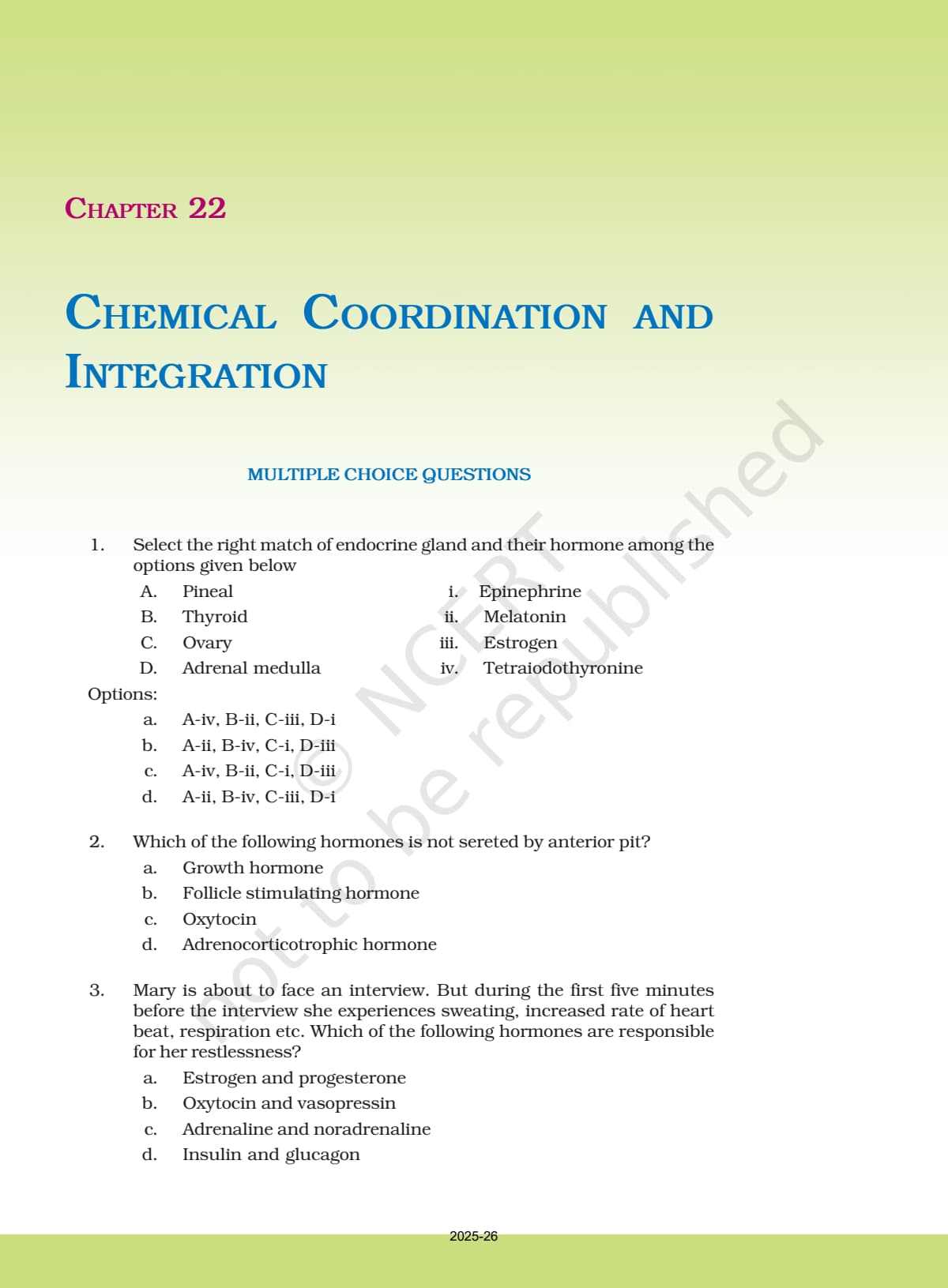
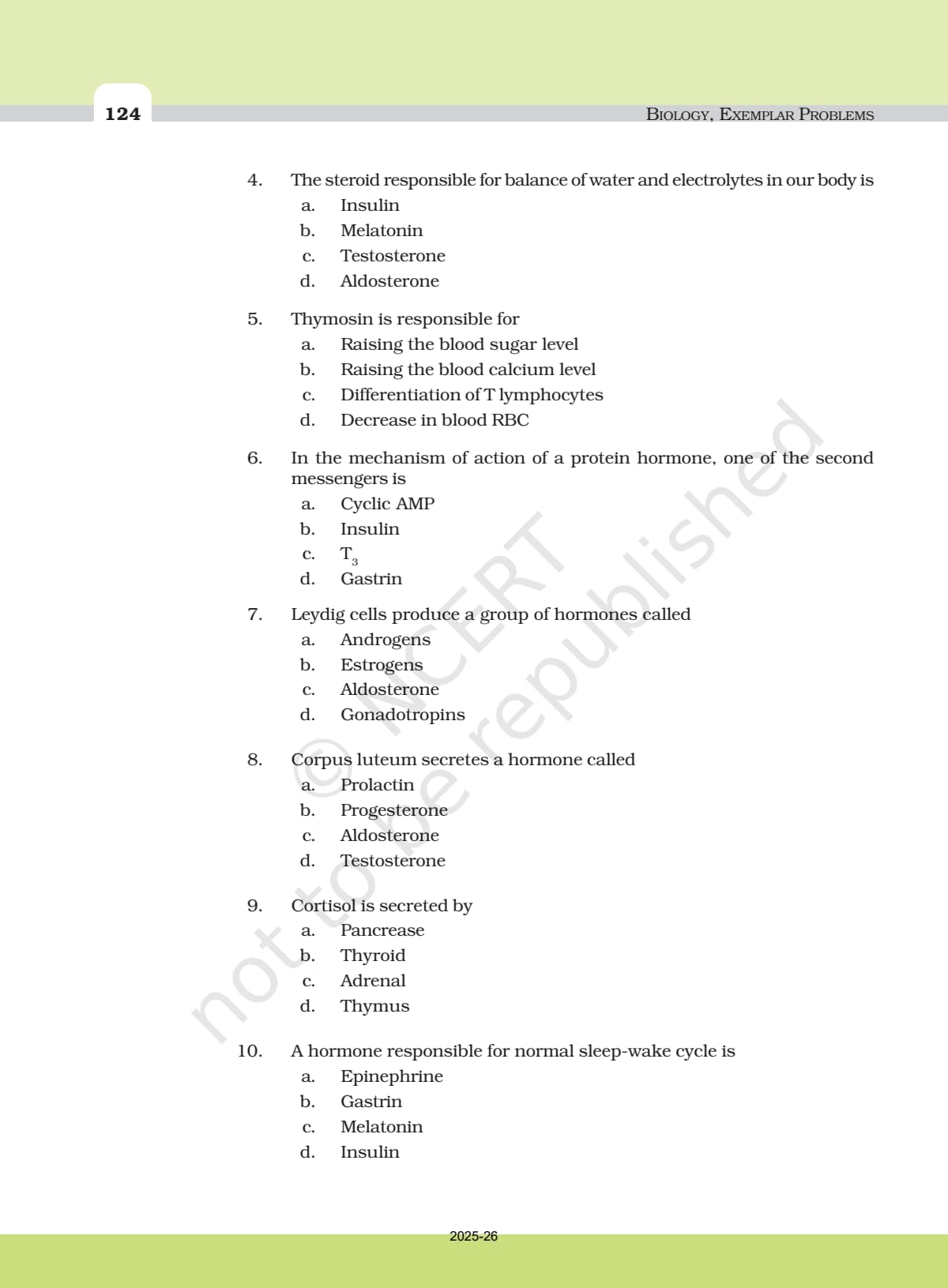
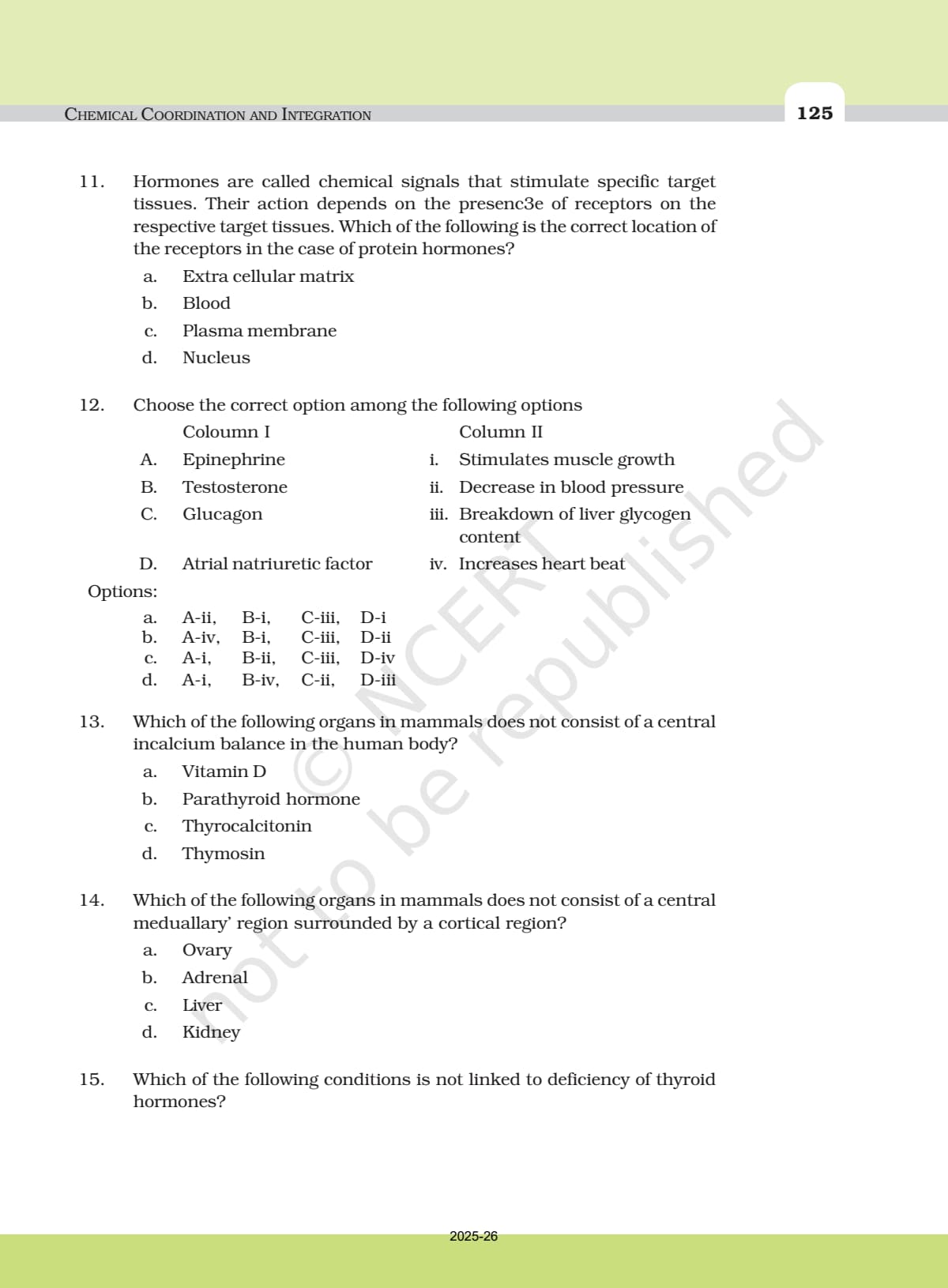
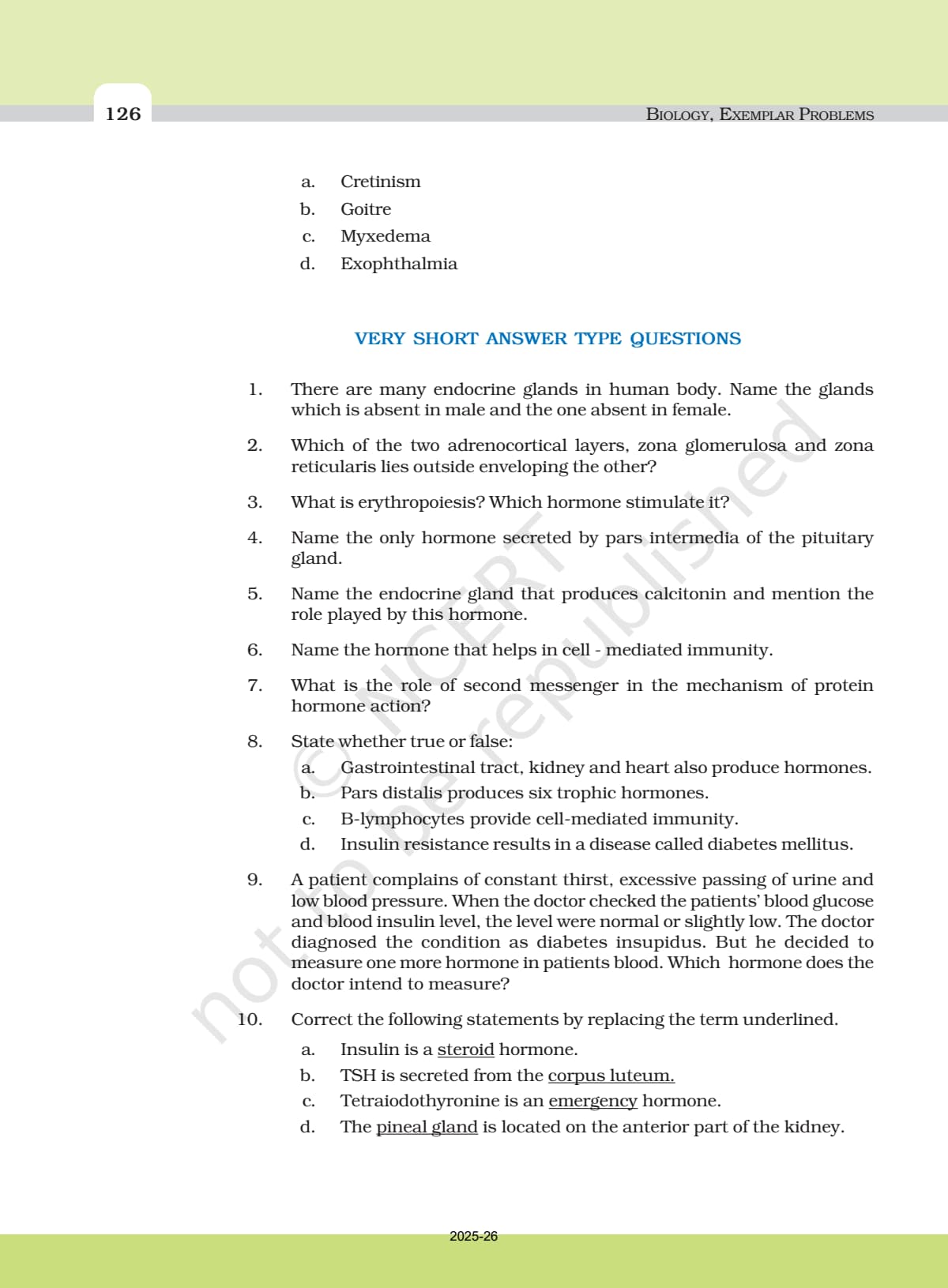
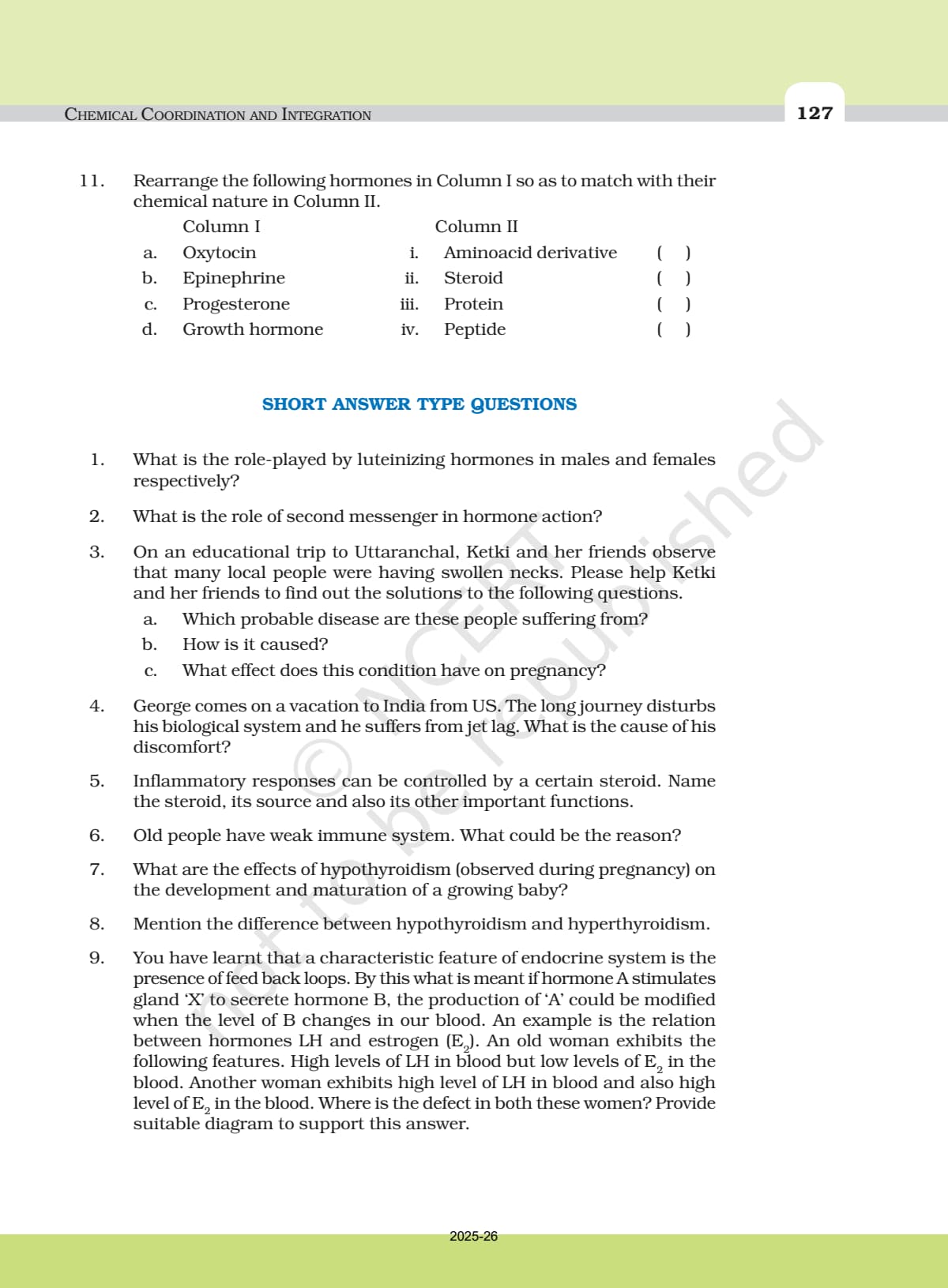
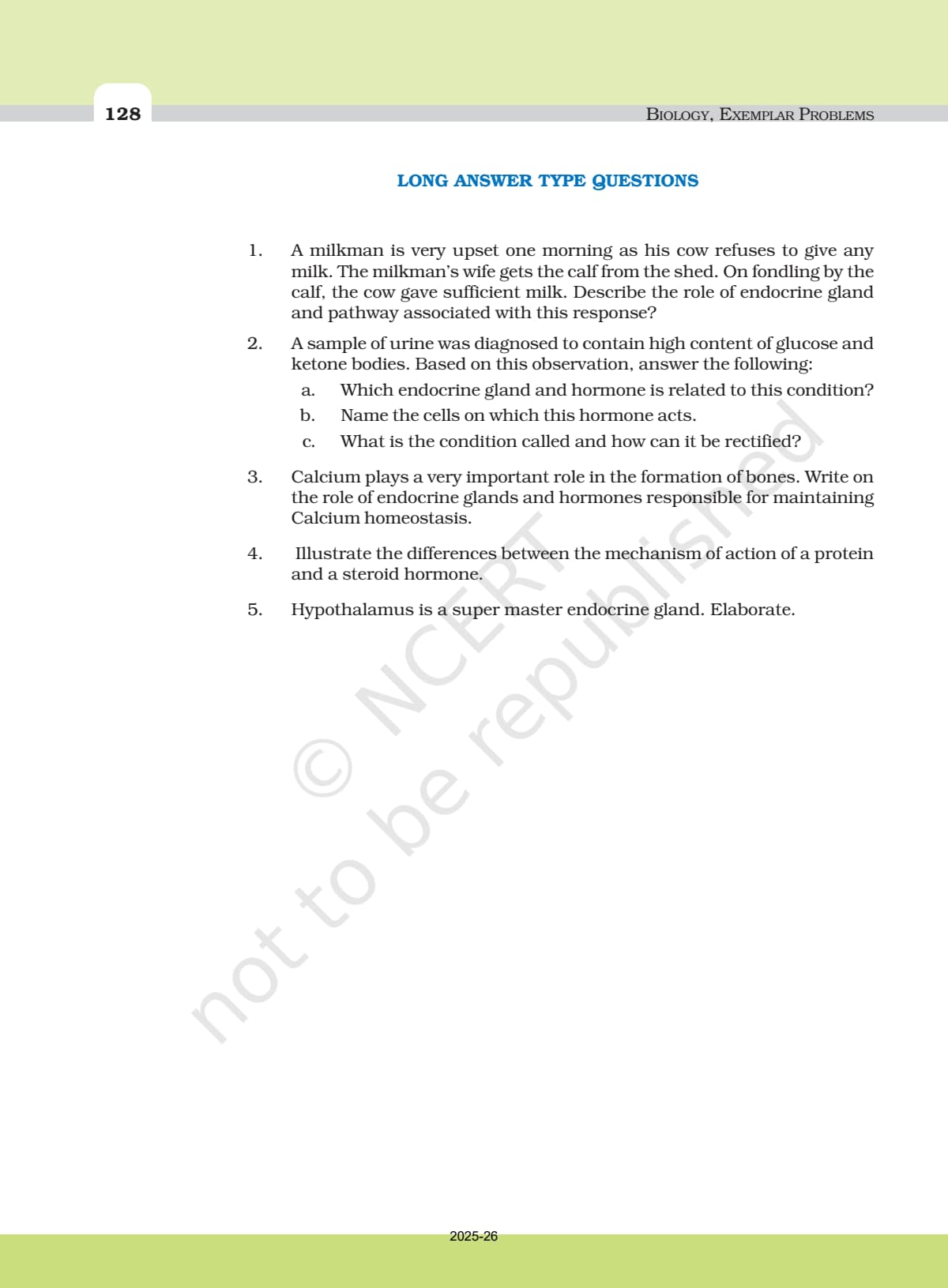
- Official NCERT Exemplar 2026-27 problems for this chapter.
- Includes MCQs, assertion-reason, and short and long answer questions.
- Ideal for extra practice after the NCERT textbook and back exercises.
This Class 11 Biology Chapter 19 Chemical Coordination and Integration NCERT Exemplar Book PDF is the official 2026-27 NCERT Exemplar, checked against the latest edition.
What the Chemical Coordination and Integration Exemplar Covers
The Exemplar tests the same chapter as the textbook but at a higher level of difficulty. Its questions probe the human endocrine glands and their hormones, the hypothalamus and pituitary link, the mechanism of hormone action and the feedback control of secretion. Because this chapter is a long list of glands, hormones and their effects, the Exemplar checks whether students can match each gland with its hormone, trace a feedback loop, and tell a steroid hormone from a protein hormone by how it acts.
- The human endocrine system, from the hypothalamus and pituitary to the thyroid, parathyroid, adrenal, pancreas and gonads.
- The major hormones, their target organs and the disorders of hyper and hyposecretion.
- The mechanism of hormone action for protein and steroid hormones, and feedback regulation.
| Question Type | What it tests |
|---|---|
| Multiple Choice (MCQ) | Quick recall of glands, their hormones, target organs and the disorders of over or under secretion |
| Assertion-Reason | Whether a statement about a feedback loop, a tropic hormone or hormone action and its reason are both correct and linked |
| Very Short and Short Answer | One-line answers on terms like tropic hormone, insulin, thyroxine and the second messenger |
| Long Answer | Explaining the mechanism of hormone action or the human endocrine system with a labelled diagram |
Why Practise the Exemplar for This Chapter
The Exemplar bridges the gap between the NCERT textbook and the level of a competitive exam. For chemical coordination and integration, its questions are close to the style asked in NEET and CUET, where a single detail about a gland, a hormone or a feedback loop can decide a mark. Because this chapter is a long list of glands and their hormones, the Exemplar is where students meet the application-based questions and assertion-reason sets that a plain reading of the textbook rarely throws up.
- Higher-order questions on the mechanism of hormone action that the textbook exercises do not cover.
- Assertion-reason sets that sharpen your grip on feedback control and tropic hormones.
- MCQs on the glands, their hormones and the related disorders at exam level.
How to Use the Exemplar for Chemical Coordination and Integration
Attempt the Exemplar only after you have finished the NCERT textbook chapter and its back exercises. Treat it as your second, harder pass over the chapter. Because much of this chapter is a gland-and-hormone list, students gain the most by building a table of gland, hormone and function and writing out each feedback loop rather than only marking the option, so the links stay fixed in memory for the exam.
- Solve the MCQs first to test recall of glands and hormones, then move to assertion-reason.
- Attempt each short and long answer fully before checking the Exemplar Solutions.
- Build a table of gland, hormone, target and disorder, and revise it daily.
- Mark the questions you got wrong and redo them after two days.
Other Class 11 Biology Chemical Coordination and Integration Resources
Use the Exemplar with the textbook PDF, the solved answers, the formula sheet and the revision notes for the same chapter. Working across all resources gives students the definitions, the practice and the higher-order questions they need for both the CBSE board exam and NEET.
| Resource | Link |
|---|---|
| NCERT Book PDF | Chemical Coordination and Integration NCERT Book PDF |
| Exemplar Solutions | Chemical Coordination and Integration Exemplar Solutions |
| NCERT Solutions | Chemical Coordination and Integration NCERT Solutions |
| Notes | Chemical Coordination and Integration Notes |
| Formula Sheet | Chemical Coordination and Integration Formula Sheet |
Student Feedback on the Chemical Coordination and Integration Exemplar
More than 10,000 Class 11 students used these Collegedunia NCERT resources during the 2026 boards and NEET preparation. Their feedback shaped how we present this chapter, and the message on Chapter 19 was consistent: the Exemplar is what turns the long gland-and-hormone list into exam-ready recall.
- Students rated the questions on hormone action and feedback as the most useful part for NEET.
- Many said the Exemplar MCQs on the glands and hormones matched the board and NEET questions they later saw.
- Students preparing for CUET found the short-answer terms a fast way to revise the whole chapter.
NCERT Exemplar Book for Class 11 Biology: All Chapters
Download the Exemplar for every chapter from one place. Each link opens the official NCERT Exemplar Book PDF for that chapter.
| Chapter | Exemplar Book PDF |
|---|---|
| Chapter 1 | The Living World |
| Chapter 2 | Biological Classification |
| Chapter 3 | Plant Kingdom |
| Chapter 4 | Animal Kingdom |
| Chapter 5 | Morphology of Flowering Plants |
| Chapter 6 | Anatomy of Flowering Plants |
| Chapter 7 | Structural Organisation in Animals |
| Chapter 8 | Cell: The Unit of Life |
| Chapter 9 | Biomolecules |
| Chapter 10 | Cell Cycle and Cell Division |
| Chapter 11 | Photosynthesis in Higher Plants |
| Chapter 12 | Respiration in Plants |
| Chapter 13 | Plant Growth and Development |
| Chapter 14 | Breathing and Exchange of Gases |
| Chapter 15 | Body Fluids and Circulation |
| Chapter 16 | Excretory Products and their Elimination |
| Chapter 17 | Locomotion and Movement |
| Chapter 18 | Neural Control and Coordination |
| Chapter 19 | Chemical Coordination and Integration |
FAQs on Class 11 Biology Chapter 19 NCERT Exemplar PDF
Chemical Coordination and Integration Exemplar PDF - Frequently Asked Questions
Ques. Is this the latest 2026-27 NCERT Exemplar for Class 11 Biology Chapter 19?
Ans. Yes. This is the official NCERT 2026-27 Exemplar for Class 11 Biology Chapter 19 Chemical Coordination and Integration, checked against the latest edition.
Ques. How is the Exemplar different from the NCERT textbook?
Ans. The NCERT textbook builds the concepts, while the Exemplar tests them with harder MCQs, assertion-reason sets and detailed short and long answer questions. The Exemplar is meant for practice after you finish the textbook.
Ques. Is the Class 11 Biology Exemplar useful for NEET and CUET?
Ans. Yes. The Exemplar for chemical coordination and integration has higher-order and application-based questions that are close to the NEET and CUET style, so it is strong extra practice alongside the CBSE board syllabus.
Ques. Where can I download the Class 11 Biology Chapter 19 Exemplar PDF?
Ans. You can download the Class 11 Biology Chapter 19 Chemical Coordination and Integration NCERT Exemplar Book PDF free from the download card at the top of this page, in standard and HD quality.



Comments