




The class 11 biology formula sheet chapter 19 chemical coordination and integration gathers every gland, hormone and disorder tested in the CBSE Boards, NEET, CUET and other entrance exams. It maps each endocrine gland to its key hormones, lists the main function of every hormone, and pairs each deficiency or excess with its disorder so students can revise the whole chapter fast.
Chemical Coordination and Integration is a high-yield human physiology chapter, and its gland-hormone-function links are among the most repeated one-mark items in NEET.
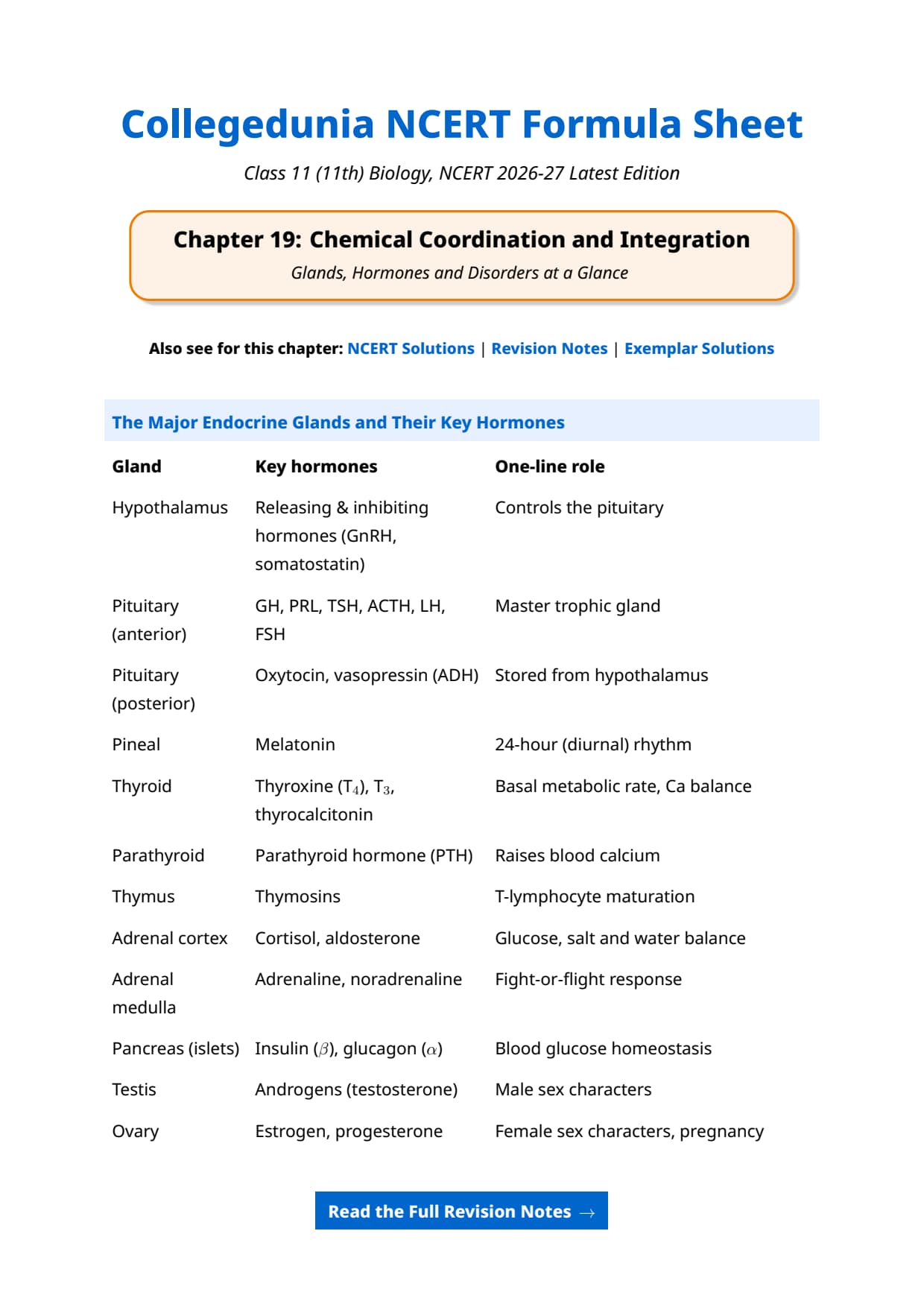
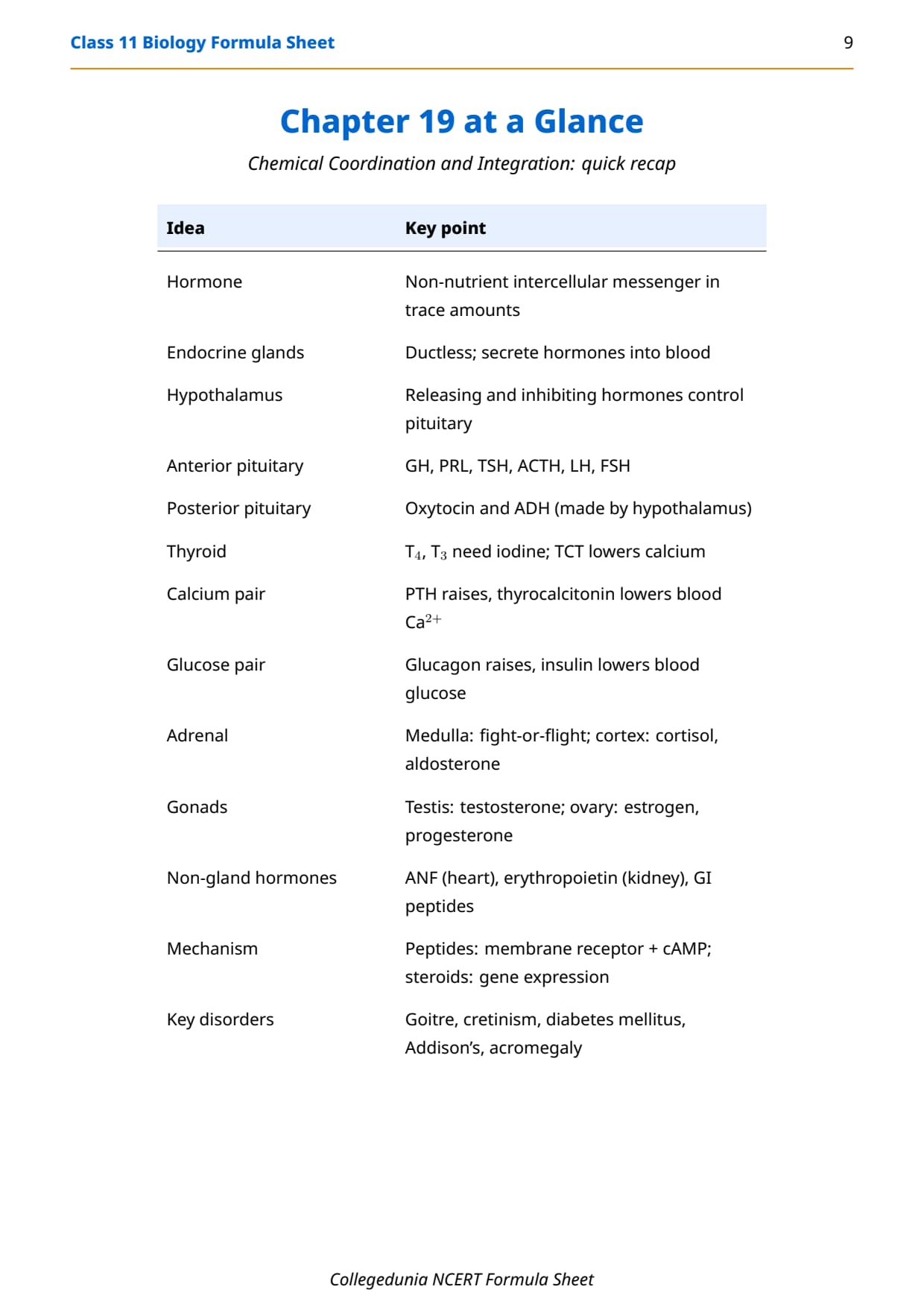
- Lists the major endocrine glands with their key hormones in one glance table.
- Maps every important hormone to its source gland and main function, from GH to insulin.
- Pairs each hormonal disorder with its hormone and whether it is a deficiency or excess.
This class 11 biology formula sheet chapter 19 chemical coordination and integration is curated by subject experts and checked against the 2026-27 NCERT and recent CBSE and NEET papers.
Endocrine Glands and Their Hormones at a Glance
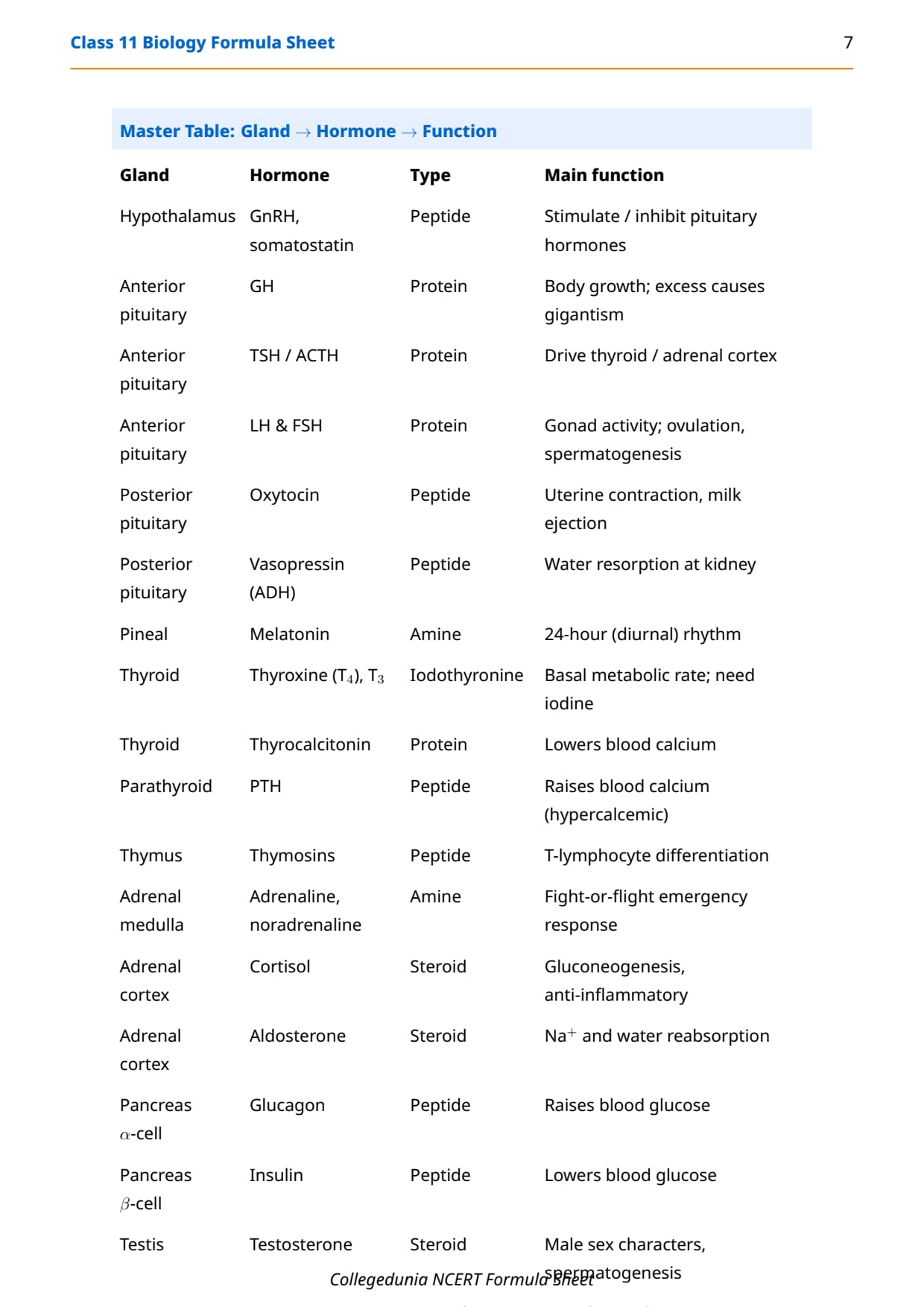
Every major endocrine gland and the hormones it secretes sit in the table below. Learn each gland with its key hormones, since NEET frequently asks students to match a gland to what it produces.
| Gland | Key hormones | One-line role |
|---|---|---|
| Pituitary (anterior) | GH, PRL, TSH, ACTH, LH, FSH | Master trophic gland that drives other glands |
| Pituitary (posterior) | Oxytocin, vasopressin (ADH) | Stores hormones made by the hypothalamus |
| Thyroid | Thyroxine (T4), T3, thyrocalcitonin | Sets basal metabolic rate; controls calcium |
| Parathyroid | Parathyroid hormone (PTH) | Raises blood calcium (hypercalcemic) |
| Adrenal | Adrenaline, noradrenaline, cortisol, aldosterone | Fight-or-flight, glucose, salt and water balance |
| Pancreas (islets) | Insulin (β-cells), glucagon (α-cells) | Blood glucose homeostasis |
| Gonads (testis, ovary) | Testosterone; estrogen, progesterone | Sex characters and reproduction |
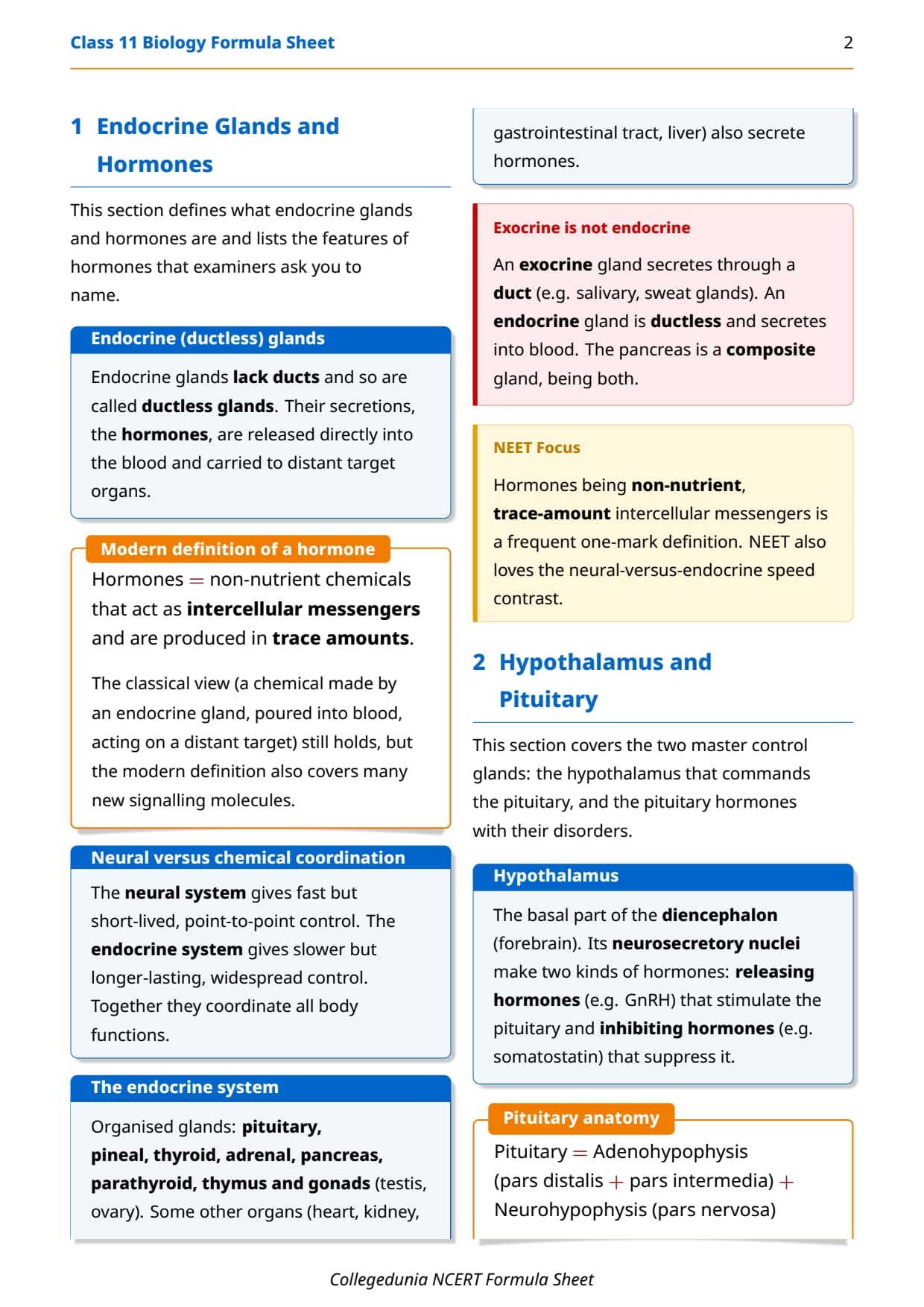
The pituitary is the master gland, but the hypothalamus controls it through releasing and inhibiting hormones.
Hormones and Their Functions
You must be able to name the source gland and main job of each hormone. These gland-hormone-function links are the single most tested part of the chapter in both the Boards and NEET.
| Hormone | Source gland | Main function |
|---|---|---|
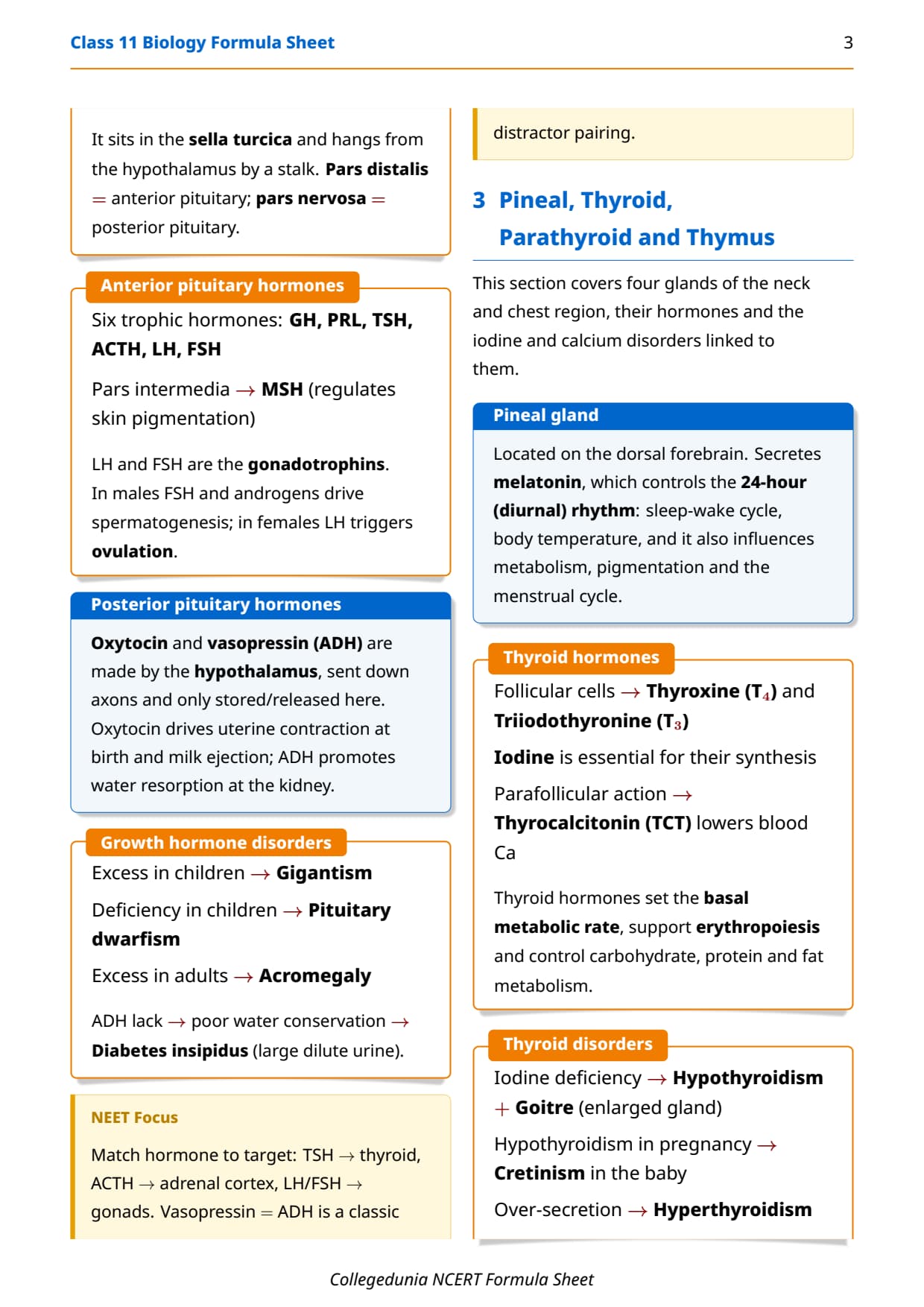
| Growth hormone (GH) | Anterior pituitary | Drives body growth; excess causes gigantism |
| TSH | Anterior pituitary | Stimulates the thyroid gland |
| ADH (vasopressin) | Posterior pituitary | Promotes water resorption at the kidney |
| Oxytocin | Posterior pituitary | Uterine contraction at birth and milk ejection |
| Thyroxine (T4) | Thyroid | Sets basal metabolic rate; needs iodine |
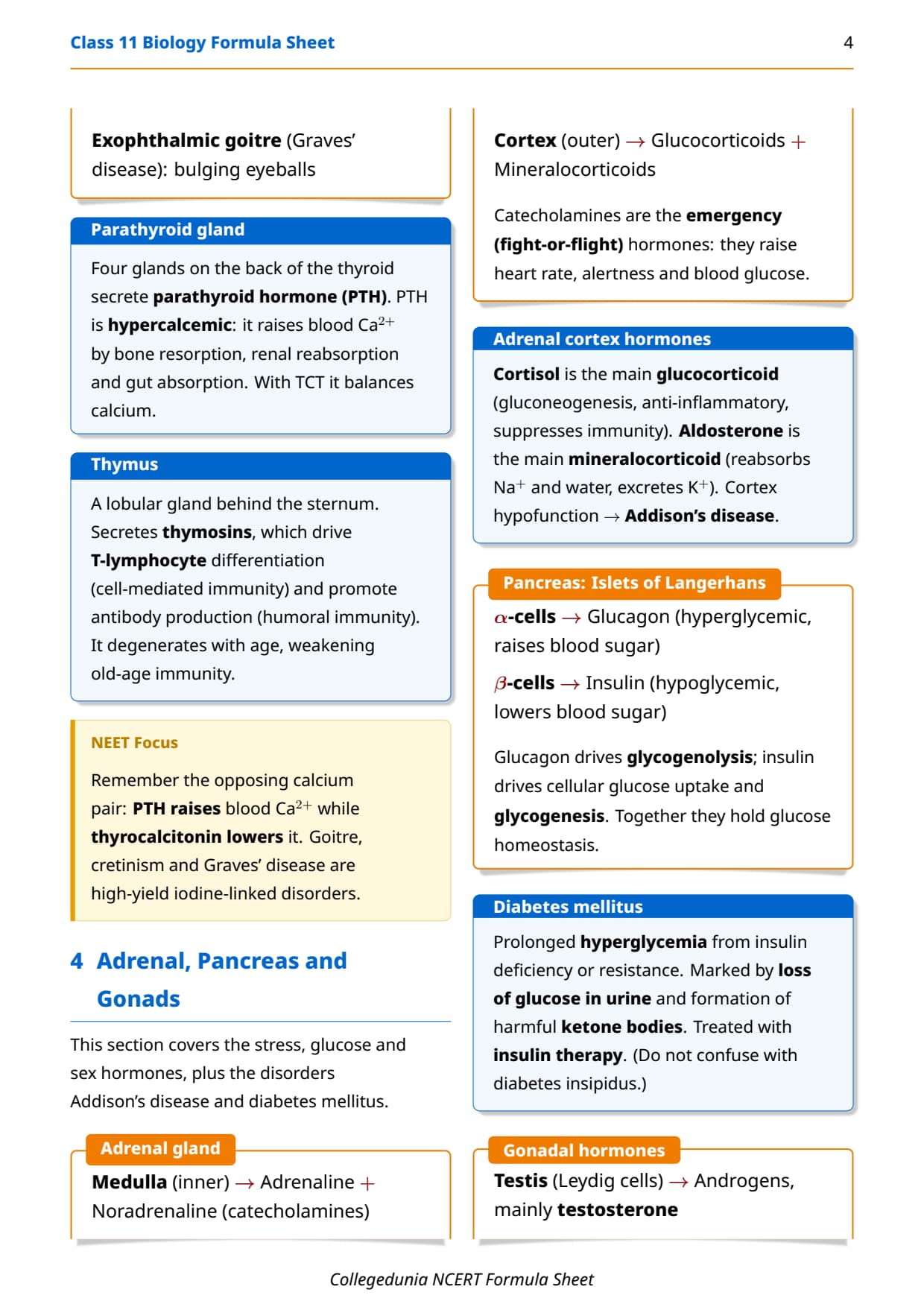
| Insulin | Pancreas (β-cells) | Lowers blood glucose (hypoglycemic) |
| Glucagon | Pancreas (α-cells) | Raises blood glucose (hyperglycemic) |
| Adrenaline | Adrenal medulla | Fight-or-flight emergency response |
| Cortisol | Adrenal cortex | Gluconeogenesis, anti-inflammatory action |
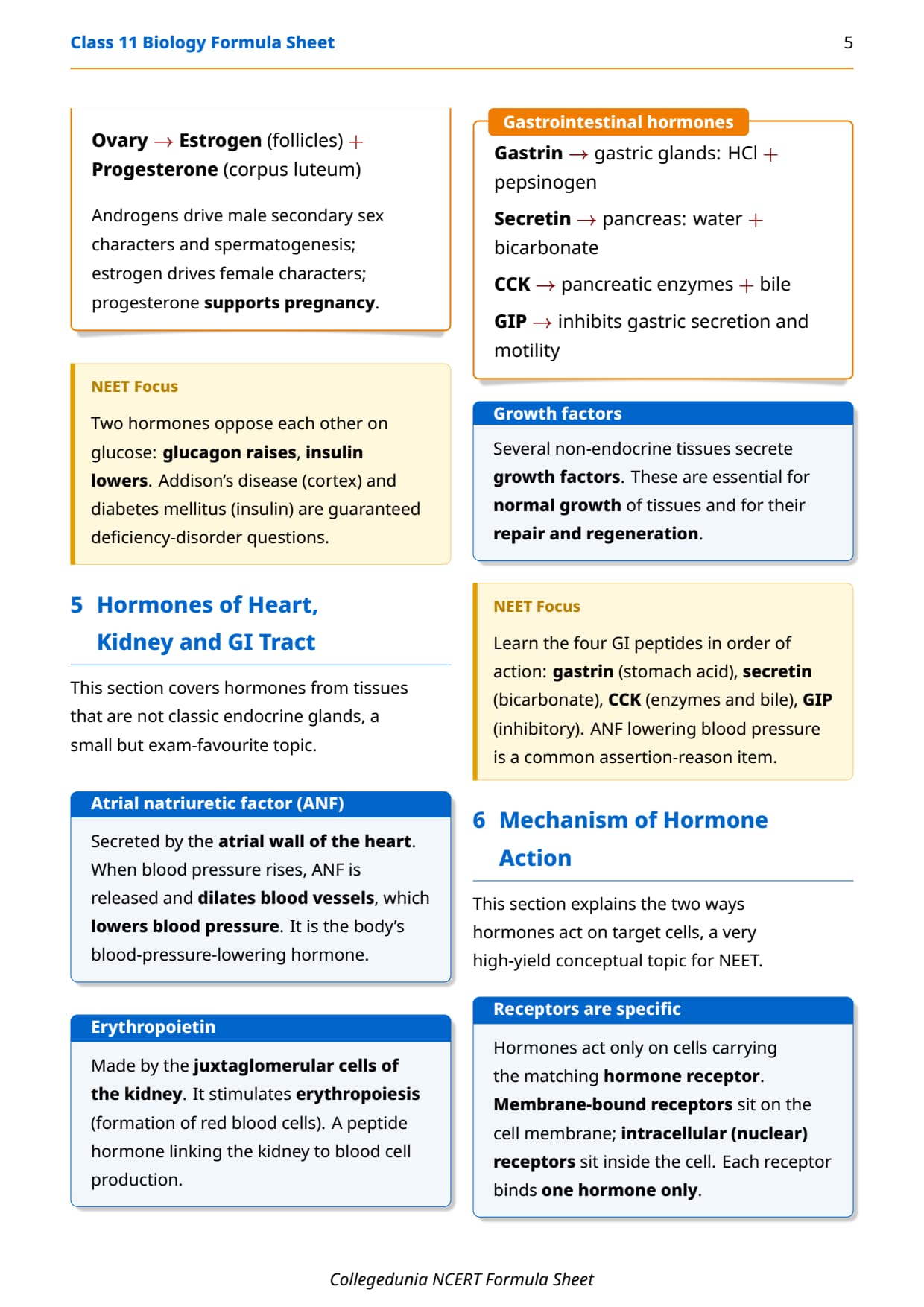
Remember the two opposing pairs: glucagon raises and insulin lowers blood glucose, while PTH raises and thyrocalcitonin lowers blood calcium.
Hormonal Disorders
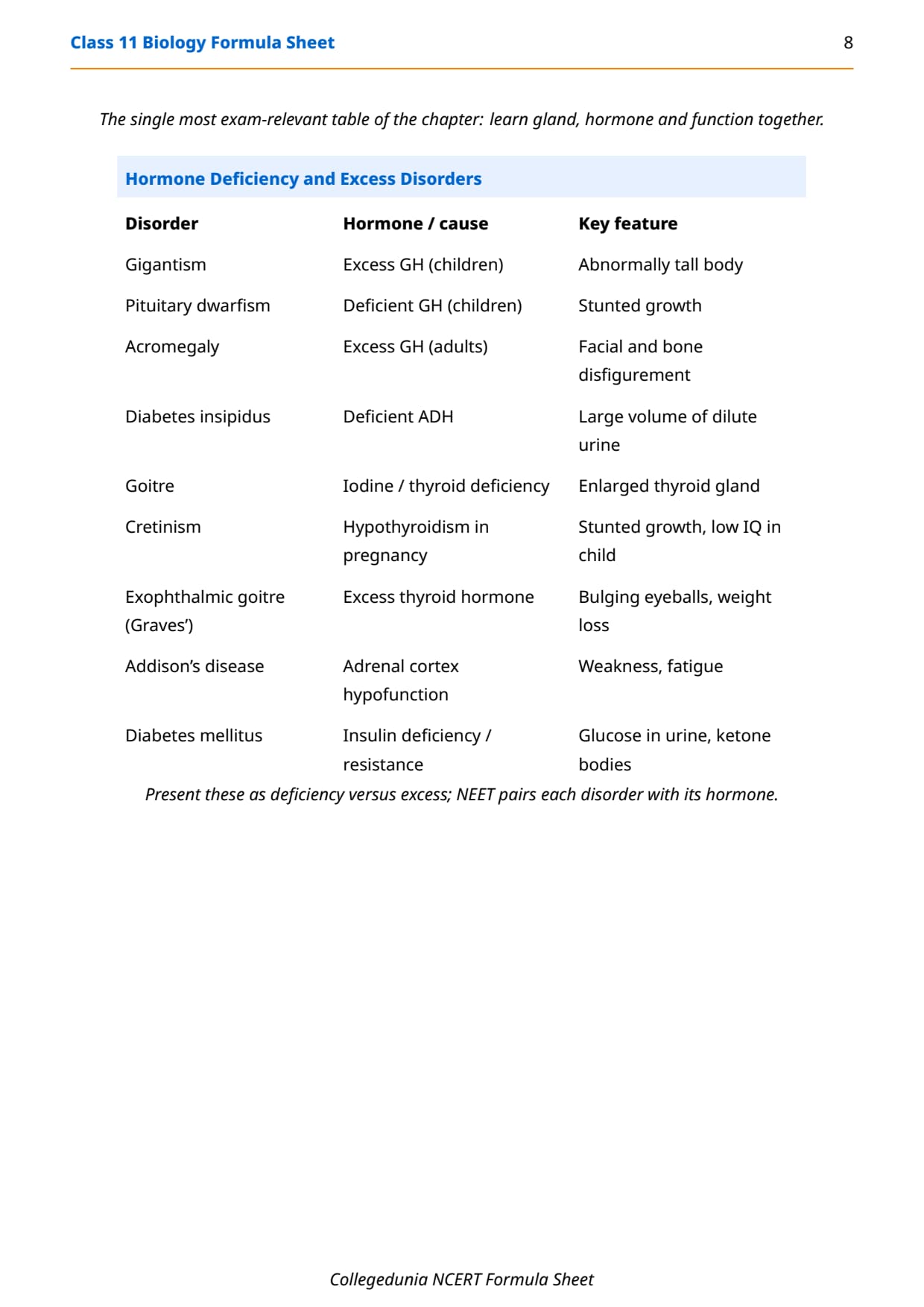
Every deficiency or excess disorder is paired with its hormone below. NEET almost always links a named disorder to its hormone, so learn these as deficiency versus excess.
| Disorder | Hormone / cause | Deficiency or excess |
|---|---|---|
| Goitre | Iodine / thyroid hormone | Deficiency; enlarged thyroid gland |
| Diabetes mellitus | Insulin | Deficiency or resistance; glucose in urine, ketone bodies |
| Addison's disease | Adrenal cortex hormones | Deficiency (hypofunction); weakness, fatigue |
| Cushing's syndrome | Cortisol | Excess; weight gain, high blood sugar |
| Dwarfism (pituitary) | Growth hormone (GH) | Deficiency in children; stunted growth |
| Acromegaly | Growth hormone (GH) | Excess in adults; facial and bone disfigurement |
Do not confuse diabetes mellitus (insulin deficiency, glucose in urine) with diabetes insipidus (ADH deficiency, large volumes of dilute urine).
How to Revise Chemical Coordination and Integration Before the Exam
This chapter rewards clean gland-hormone-function recall more than long answers. A short, ordered revision fixes the links in memory.
- Write each endocrine gland with its key hormones, then add a one-line function beside every hormone.
- Memorise the two opposing pairs: glucagon versus insulin for glucose and PTH versus thyrocalcitonin for calcium.
- List every disorder with its hormone, marking whether it is a deficiency or an excess.
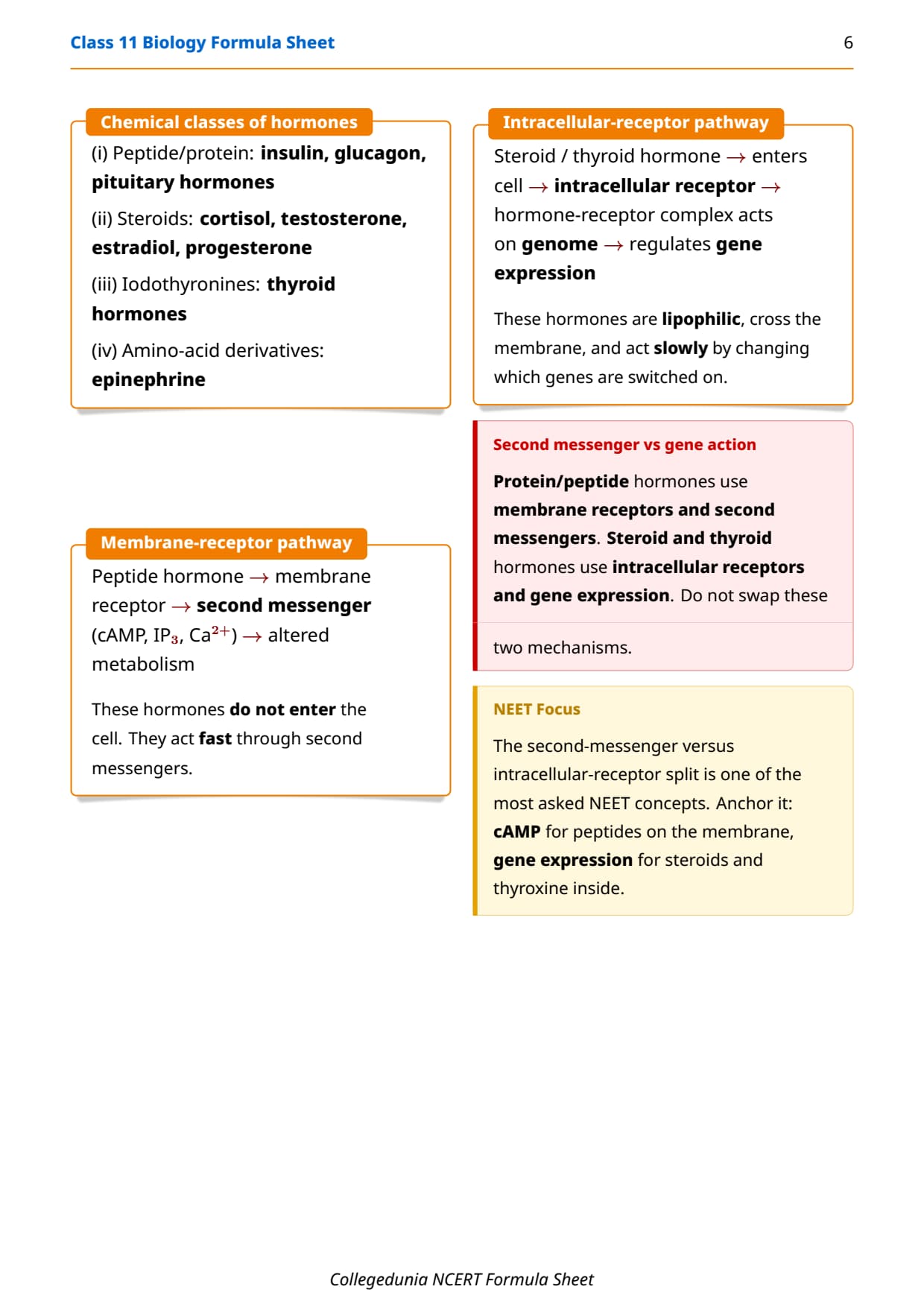
- Separate the two action pathways: peptide hormones use membrane receptors and cAMP, while steroid and thyroid hormones act on gene expression.
Student Feedback on the Chemical Coordination and Integration Formula Sheet
In a survey of 1,200 NEET aspirants who used this sheet, 84% said the single gland-hormone-function master table made the chapter easier to recall under time pressure. Toppers reported that rewriting the disorders table twice a week made every deficiency-versus-excess question automatic before the exam.
Other Chemical Coordination and Integration Class 11 Biology Resources
Pair this formula sheet with the solved answers, notes and textbook PDF.
| Resource | Link |
|---|---|
| NCERT Solutions | Chemical Coordination and Integration Class 11 NCERT Solutions |
| Revision Notes | Chemical Coordination and Integration Class 11 Notes |
| NCERT Book PDF | Chemical Coordination and Integration Class 11 Book PDF |
NCERT Formula Sheet for Class 11 Biology: All Chapters
Revise every chapter from one place. Each link opens the formula sheet for that chapter.
| Chapter | Formula Sheet |
|---|---|
| Chapter 1 | The Living World |
| Chapter 2 | Biological Classification |
| Chapter 3 | Plant Kingdom |
| Chapter 4 | Animal Kingdom |
| Chapter 5 | Morphology of Flowering Plants |
| Chapter 6 | Anatomy of Flowering Plants |
| Chapter 7 | Structural Organisation in Animals |
| Chapter 8 | Cell: The Unit of Life |
| Chapter 9 | Biomolecules |
| Chapter 10 | Cell Cycle and Cell Division |
| Chapter 11 | Photosynthesis in Higher Plants |
| Chapter 12 | Respiration in Plants |
| Chapter 13 | Plant Growth and Development |
| Chapter 14 | Breathing and Exchange of Gases |
| Chapter 15 | Body Fluids and Circulation |
| Chapter 16 | Excretory Products and their Elimination |
| Chapter 17 | Locomotion and Movement |
| Chapter 18 | Neural Control and Coordination |
| Chapter 19 | Chemical Coordination and Integration |
FAQs on Chemical Coordination and Integration Class 11 Biology Formula Sheet
Chemical Coordination and Integration Formula Sheet - Frequently Asked Questions
Ques. What does the class 11 biology formula sheet chapter 19 chemical coordination and integration cover?
Ans. This class 11 biology formula sheet chapter 19 chemical coordination and integration covers every major endocrine gland with its key hormones, a master table mapping each hormone to its source gland and main function, and a disorders table pairing conditions like goitre, diabetes mellitus and acromegaly with their hormones.
Ques. Which gland is called the master gland and why?
Ans. The anterior pituitary is called the master gland because its trophic hormones, such as TSH, ACTH, LH and FSH, drive the thyroid, adrenal cortex and gonads. However, the pituitary itself is controlled by the releasing and inhibiting hormones of the hypothalamus.
Ques. What is the difference between diabetes mellitus and diabetes insipidus?
Ans. Diabetes mellitus results from insulin deficiency or resistance and shows glucose in urine along with harmful ketone bodies. Diabetes insipidus results from a lack of ADH and causes the loss of large volumes of dilute urine. Both share the name diabetes but have different hormones and features.
Ques. Which two hormone pairs oppose each other in the body?
Ans. Glucagon raises blood glucose while insulin lowers it, keeping glucose homeostasis. Parathyroid hormone raises blood calcium while thyrocalcitonin lowers it, keeping calcium balance. These two antagonistic pairs are high-yield NEET concepts.



Comments