




The Class 11 Physics NCERT Solutions Chapter 5 Work, Energy and Power will help students prepare for Boards, JEE Main, JEE Advanced, NEET, CUET and NDA in 2026-27. Every back-exercise question is solved with full working, so students can check each work calculation, kinetic and potential energy step, power value, and collision problem line by line.
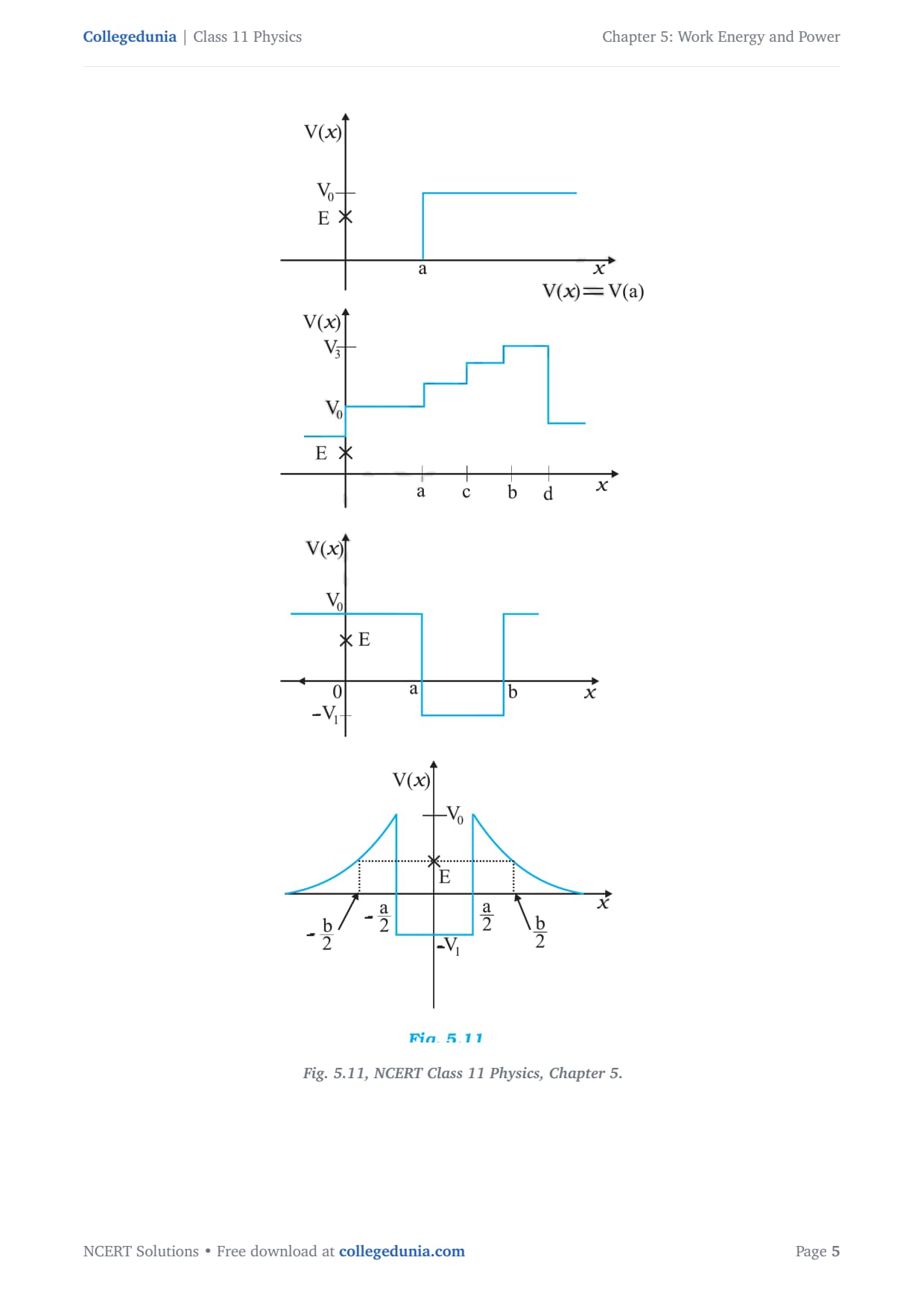
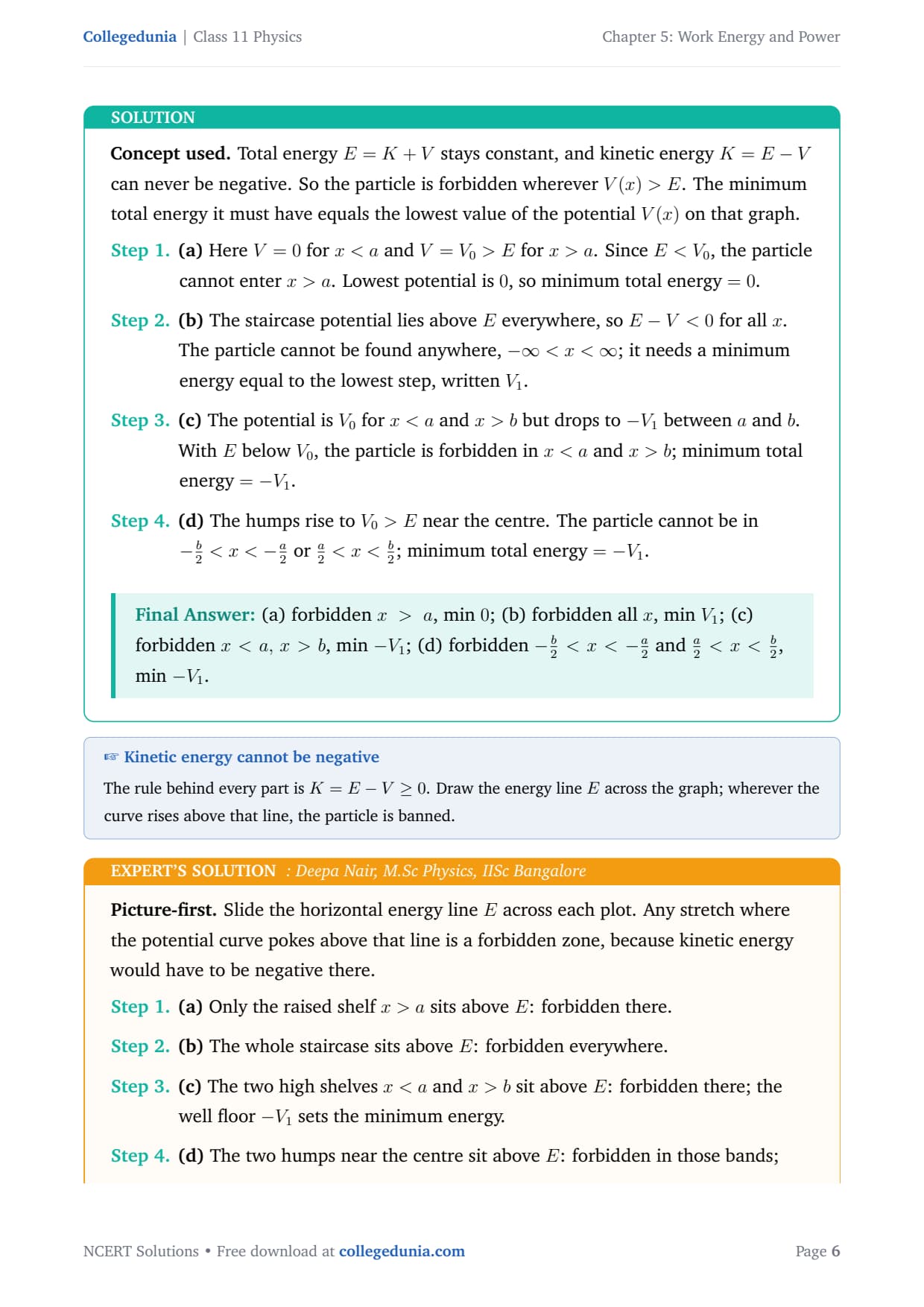
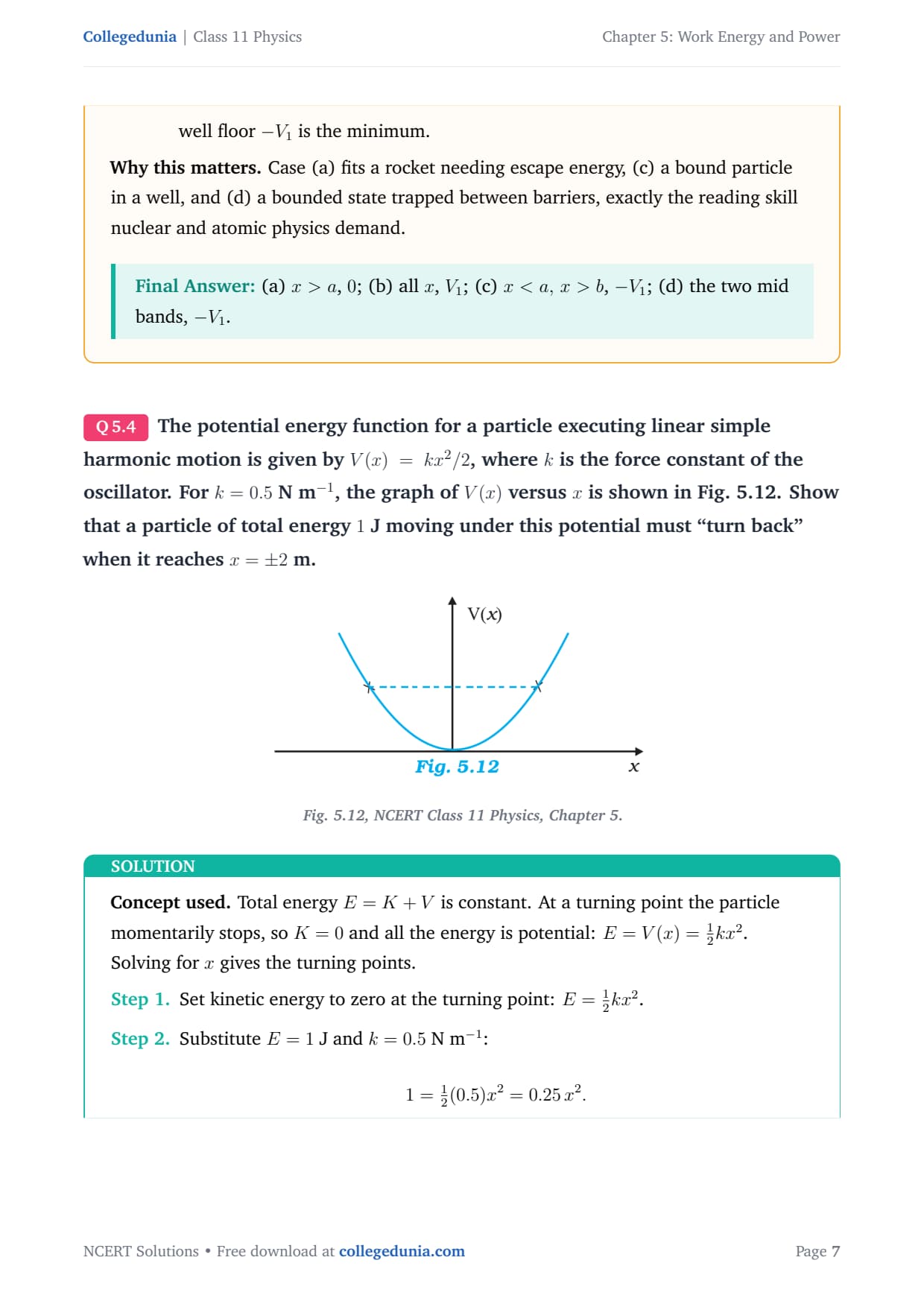
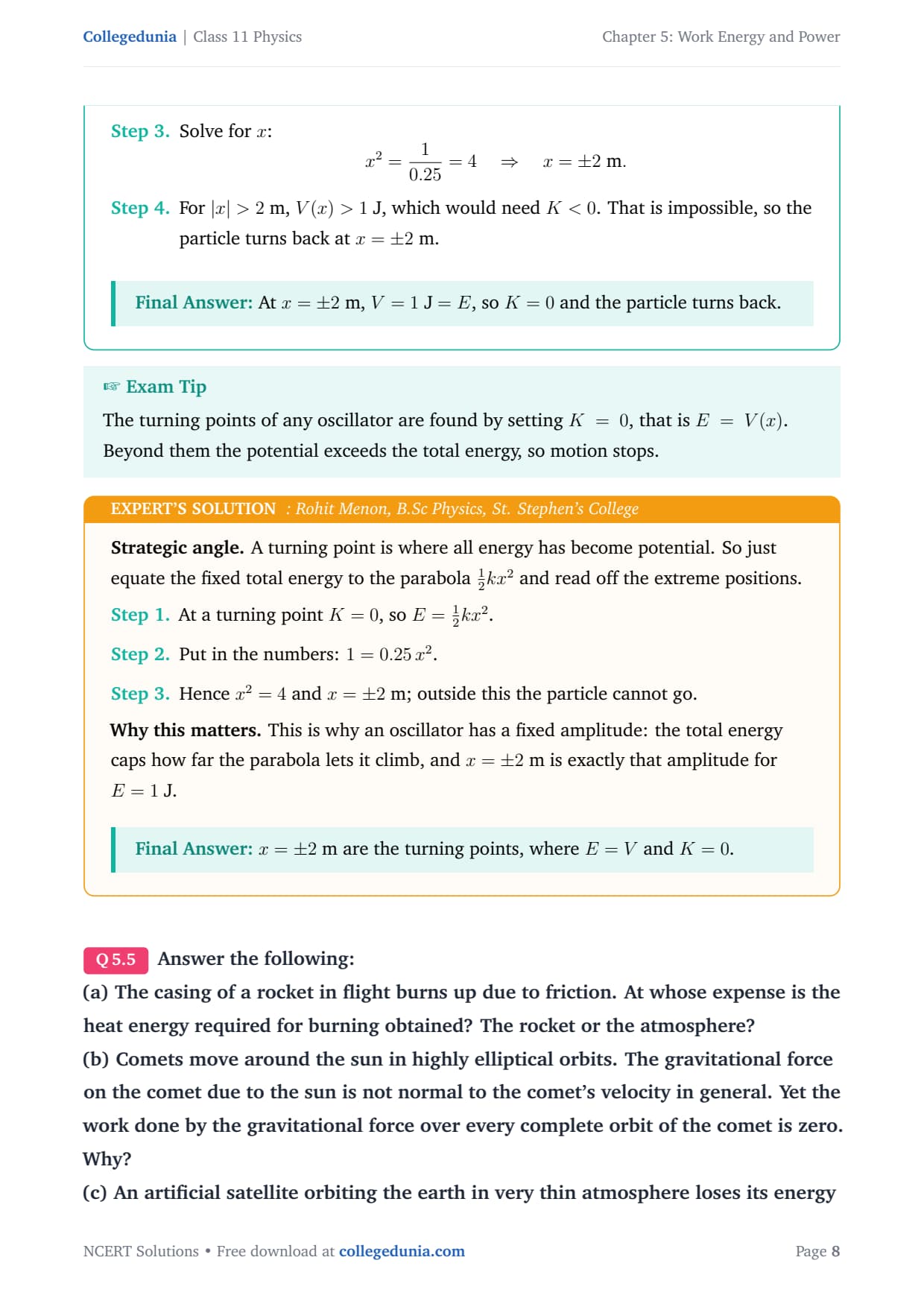
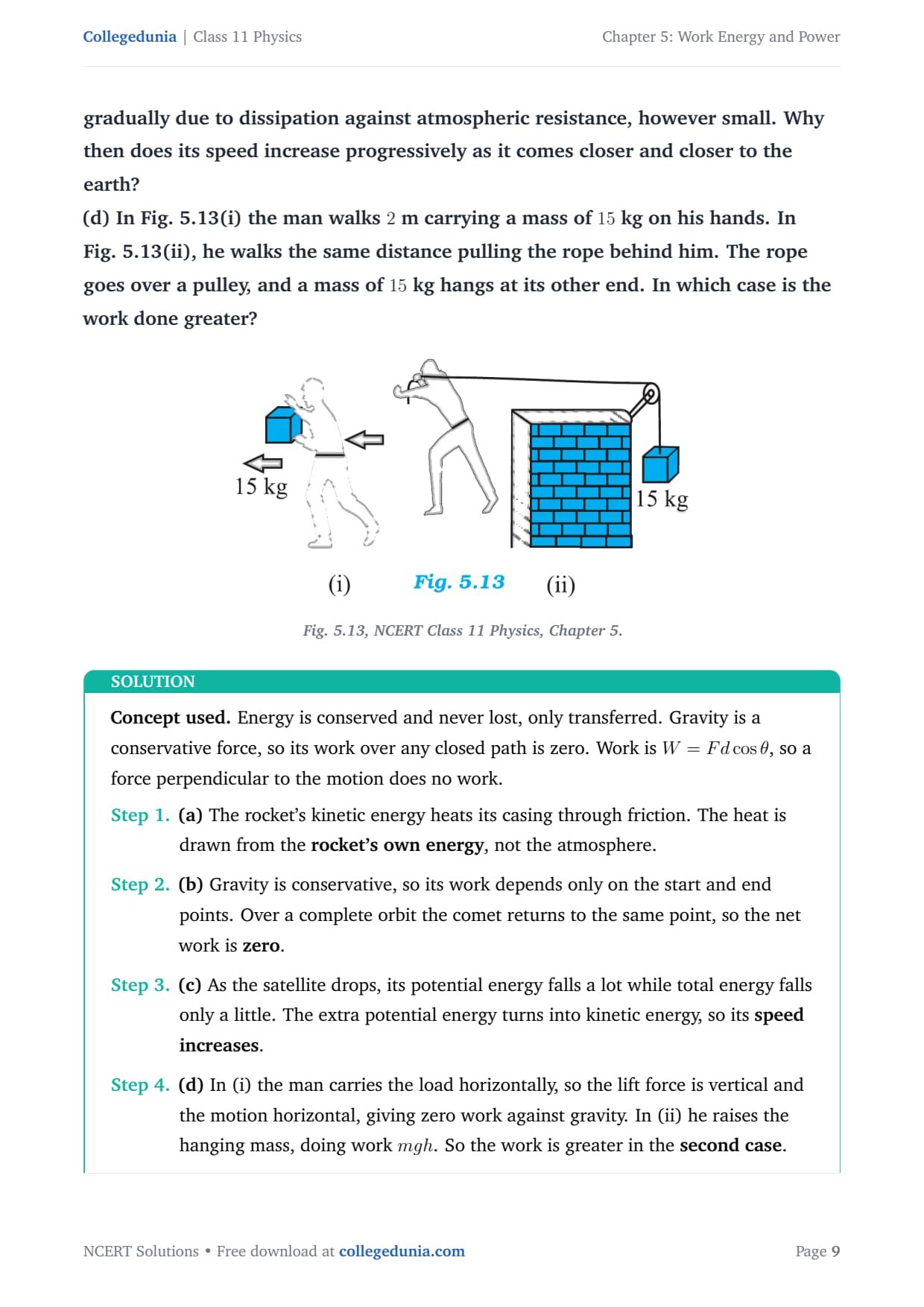
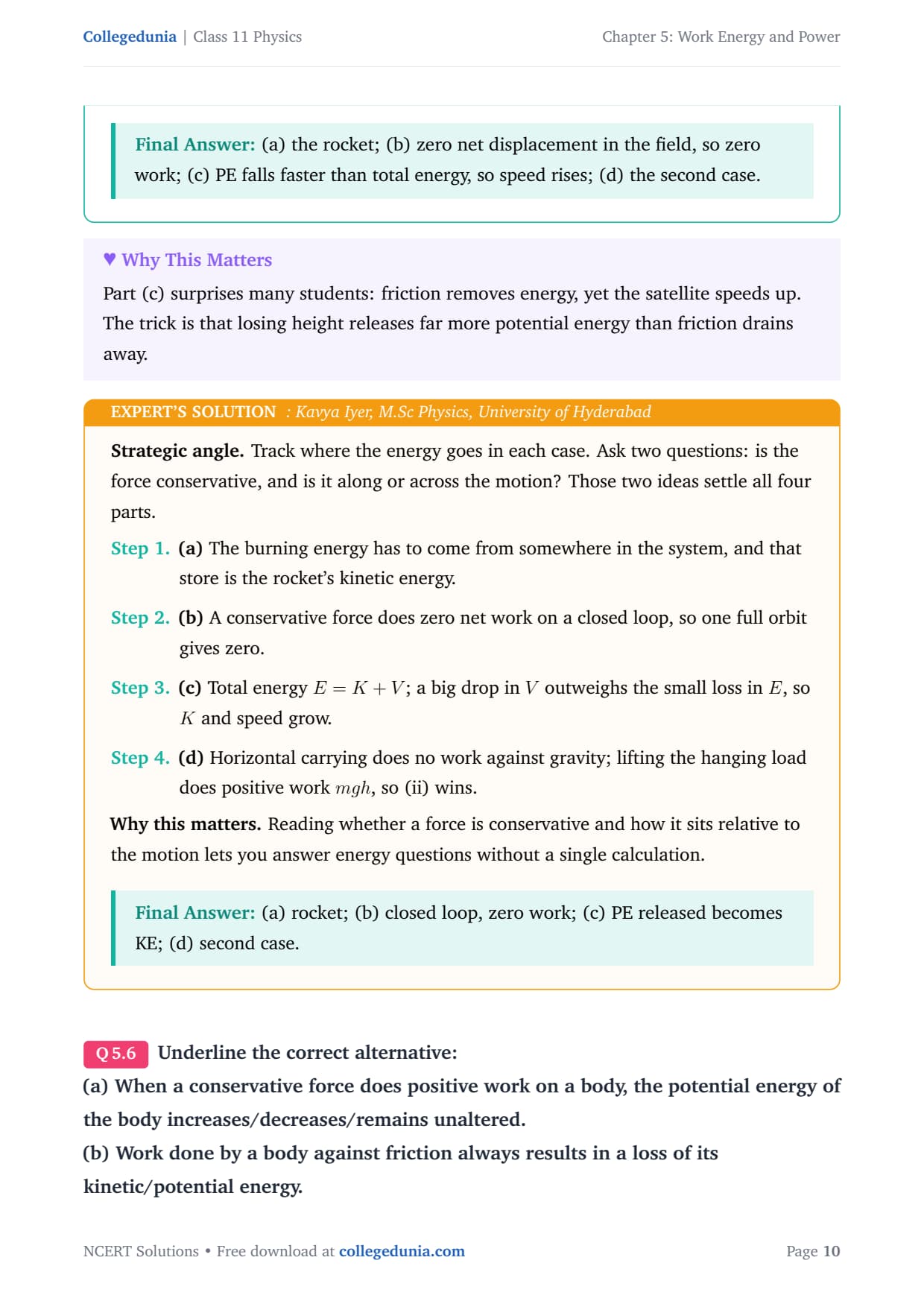
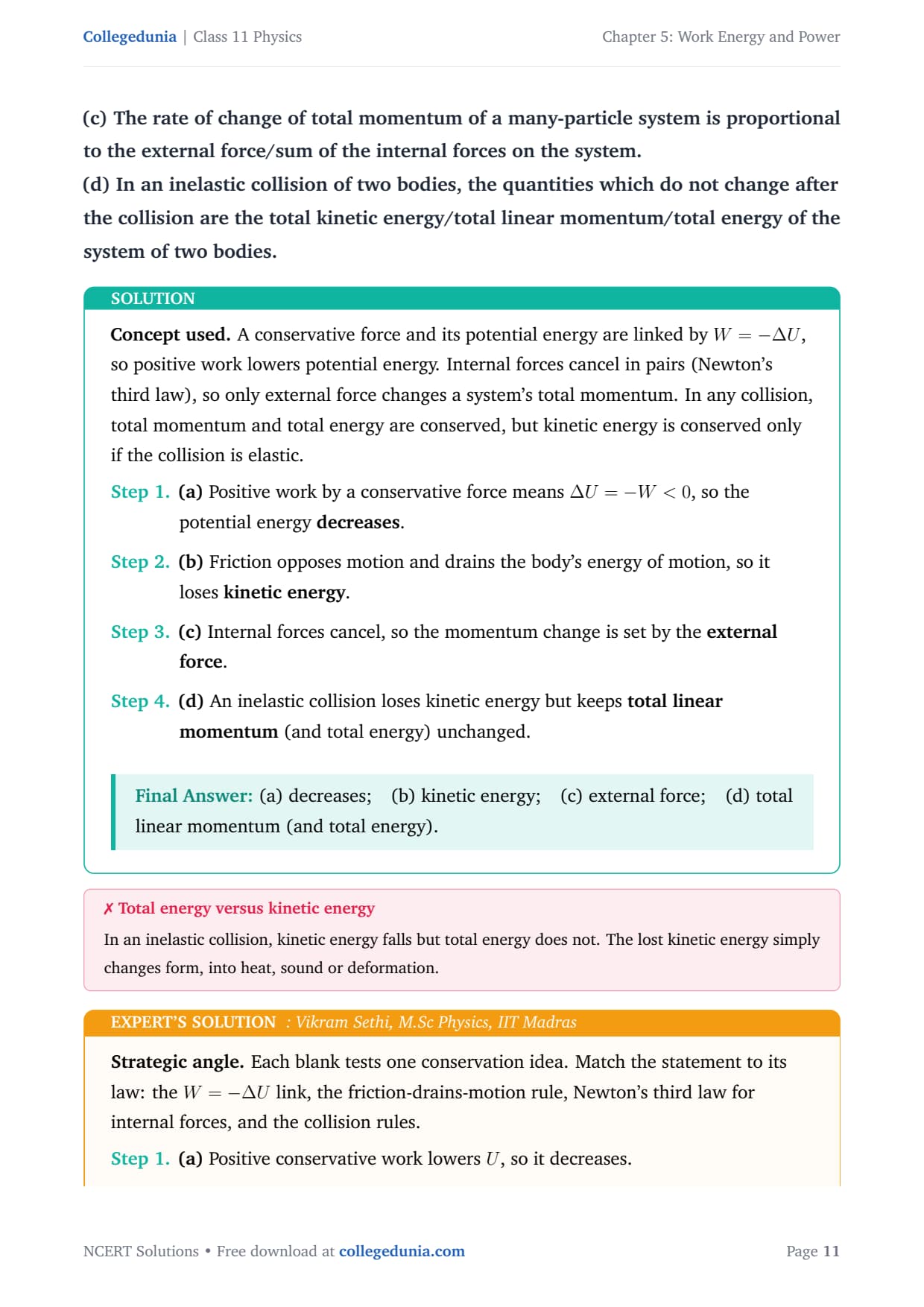
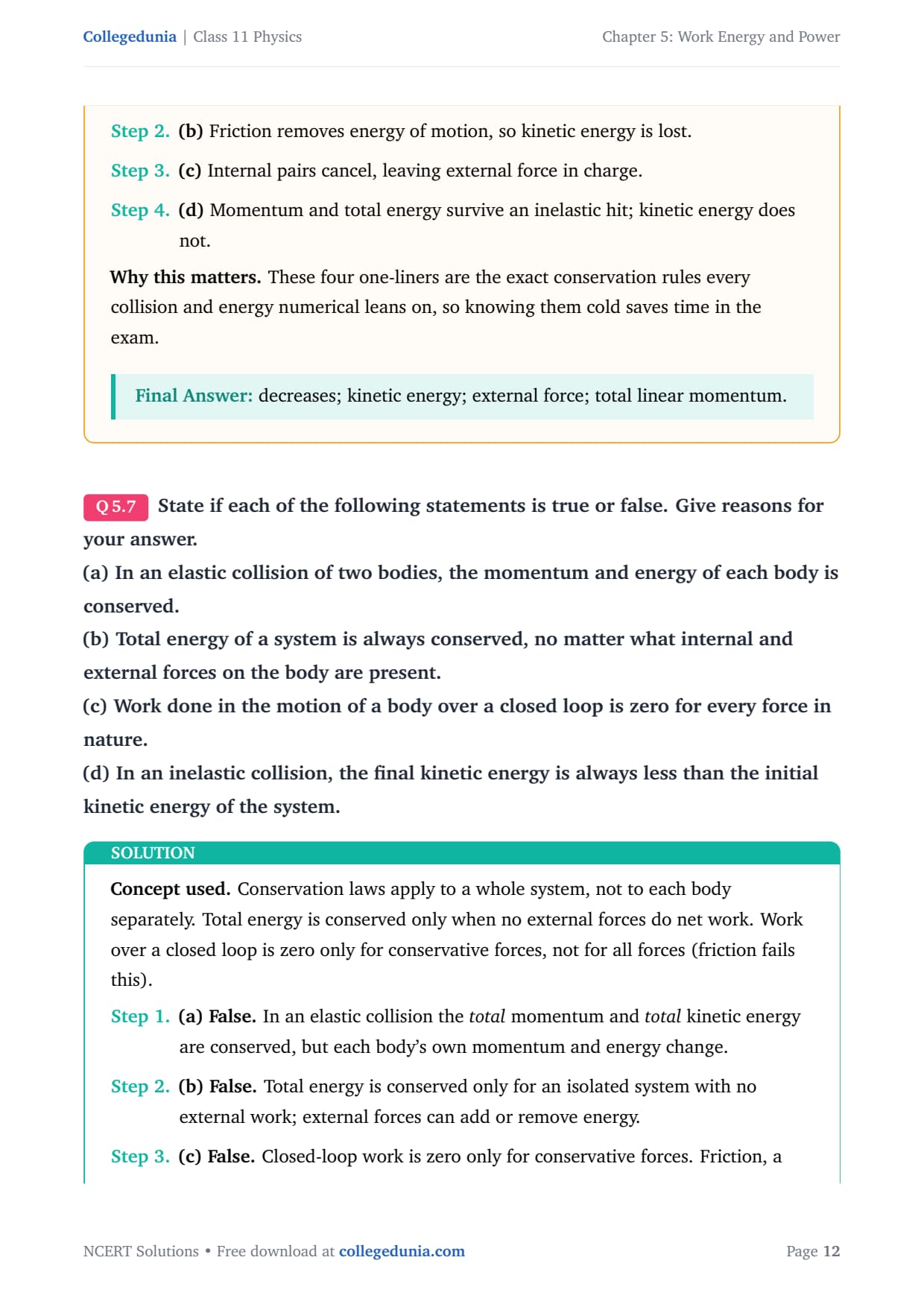
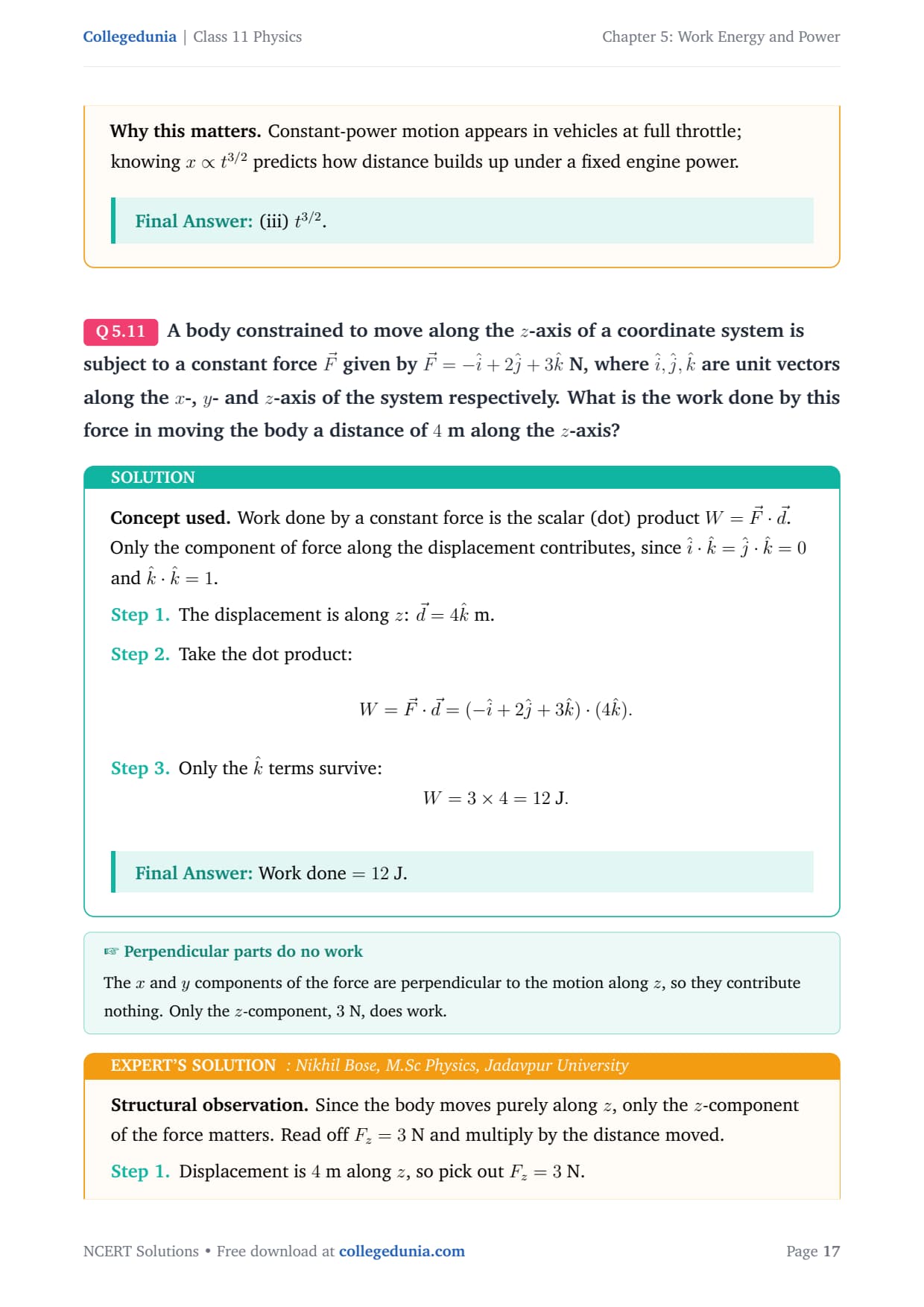
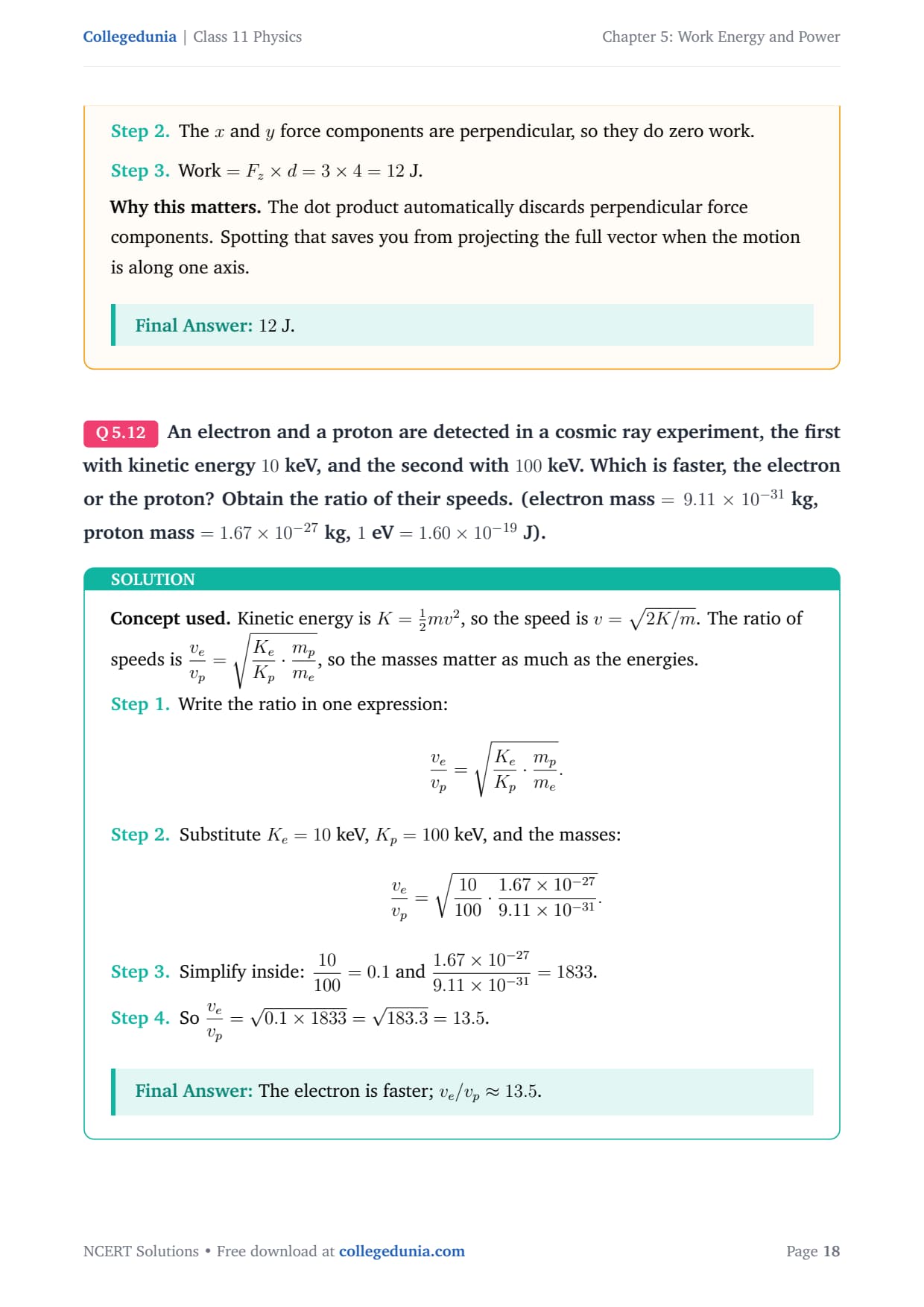
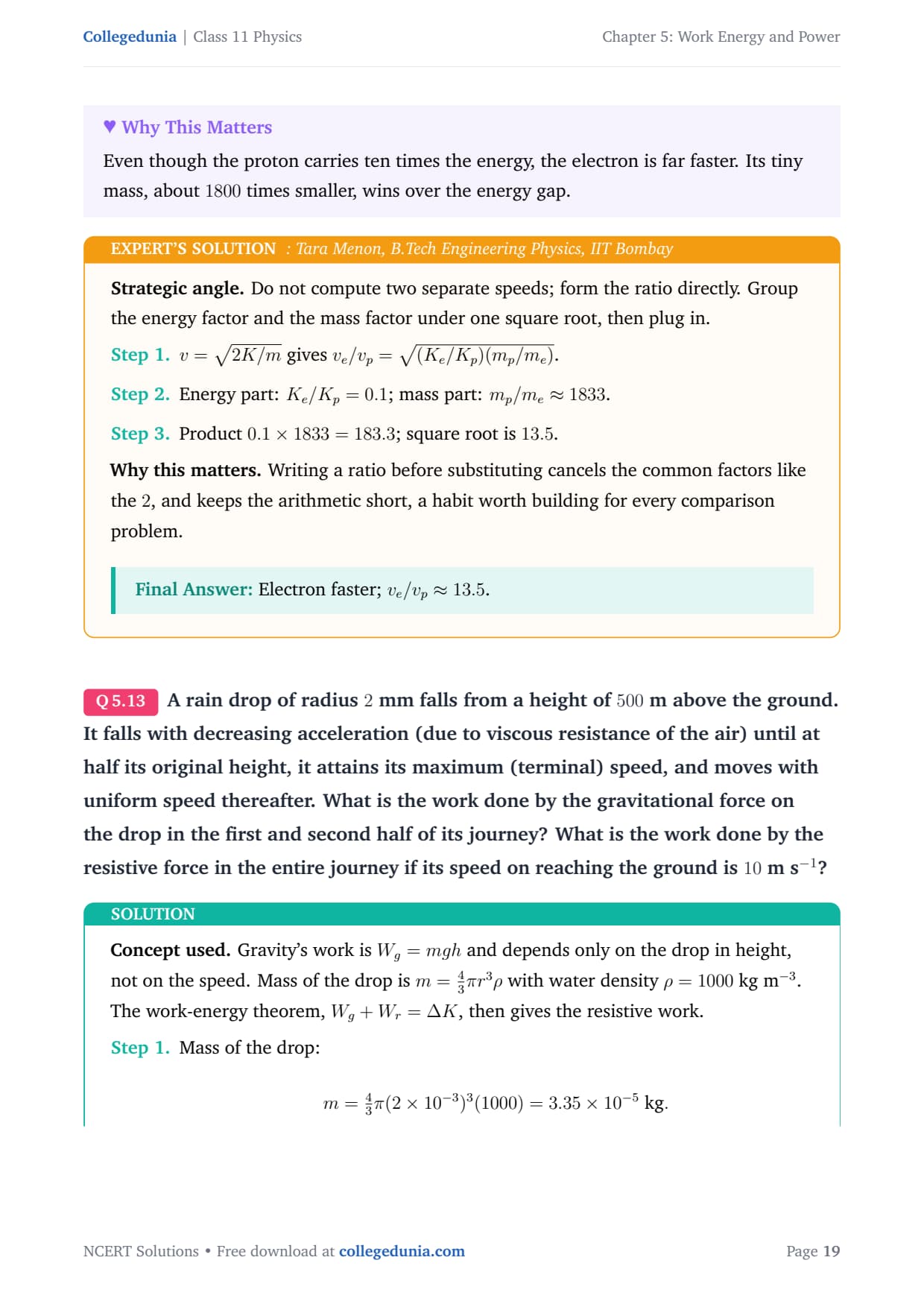
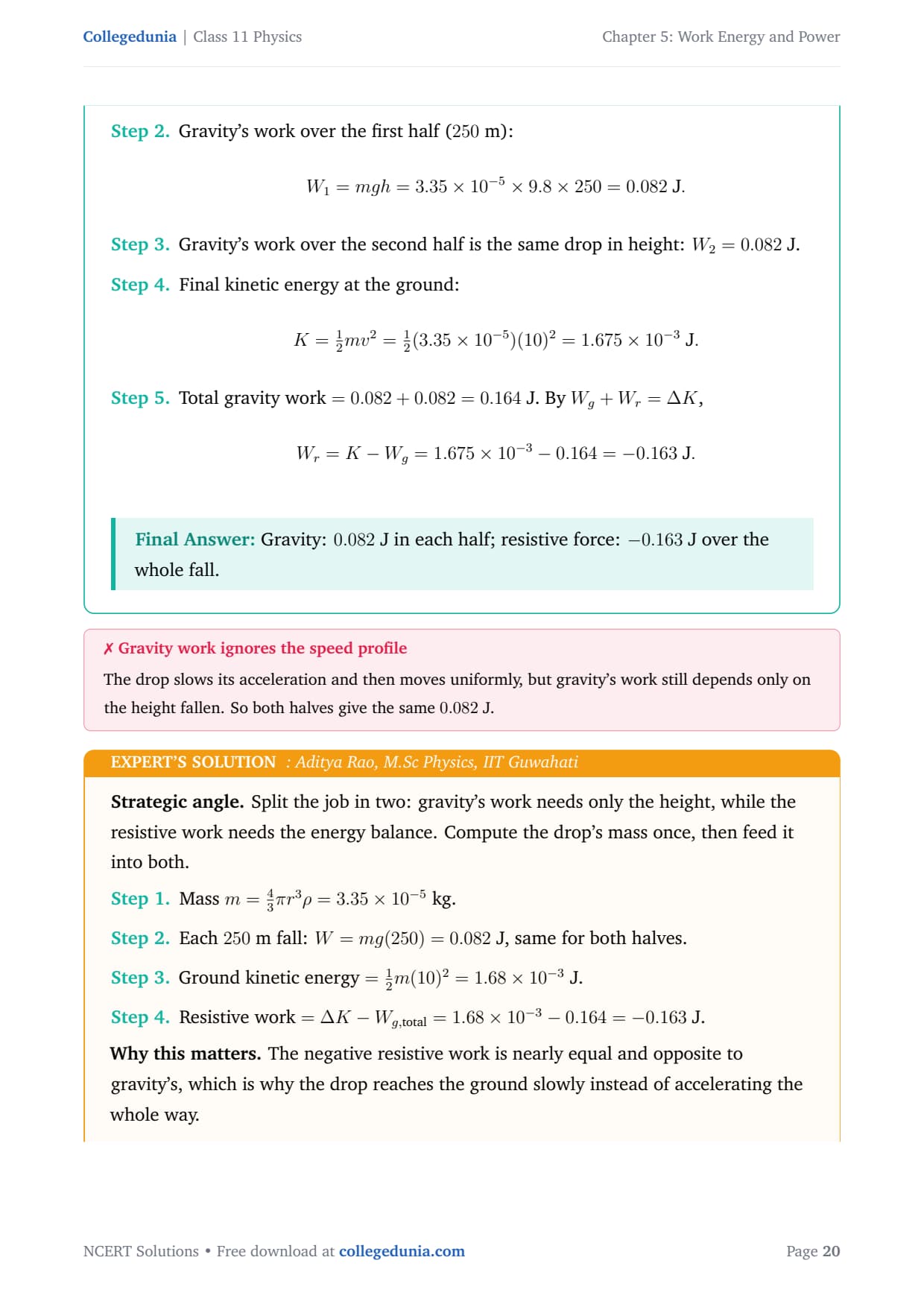
This chapter turns force problems into energy problems, and the energy method it teaches is used again in gravitation, oscillations and thermodynamics.
- CBSE Weightage: 6 to 8 marks, usually one numerical on the work-energy theorem plus one on power or collisions.
- Questions solved: all Exercise 5.1 onward, covering work, kinetic energy, potential energy, conservation of energy, power and collisions.
- Key formulas: W = F d cosθ, work-energy theorem, KE = ½mv², spring PE = ½kx², P = F·v.
Each solution in this Class 11 Physics NCERT Solutions Chapter 5 Work, Energy and Power compilation is curated by subject experts, based on the 2026-27 NCERT textbook, and refined against the last five years of CBSE Board, JEE Main and NEET papers.
Work Done by a Constant and a Variable Force
Work has an exact meaning in physics. Work is done only when a force moves its point of application through a distance. The chapter starts here, and most numericals in the exercise use one of the two forms below. Getting the angle right is the first step in every work problem.
| Case | Formula | Meaning |
|---|---|---|
| Constant force | W = F d cosθ | Only the force component along the displacement does work |
| Vector form | W = F⃗ · d⃗ | Work is the dot product of force and displacement |
| Variable force | W = ∫ F dx | Work is the area under the force-displacement graph |
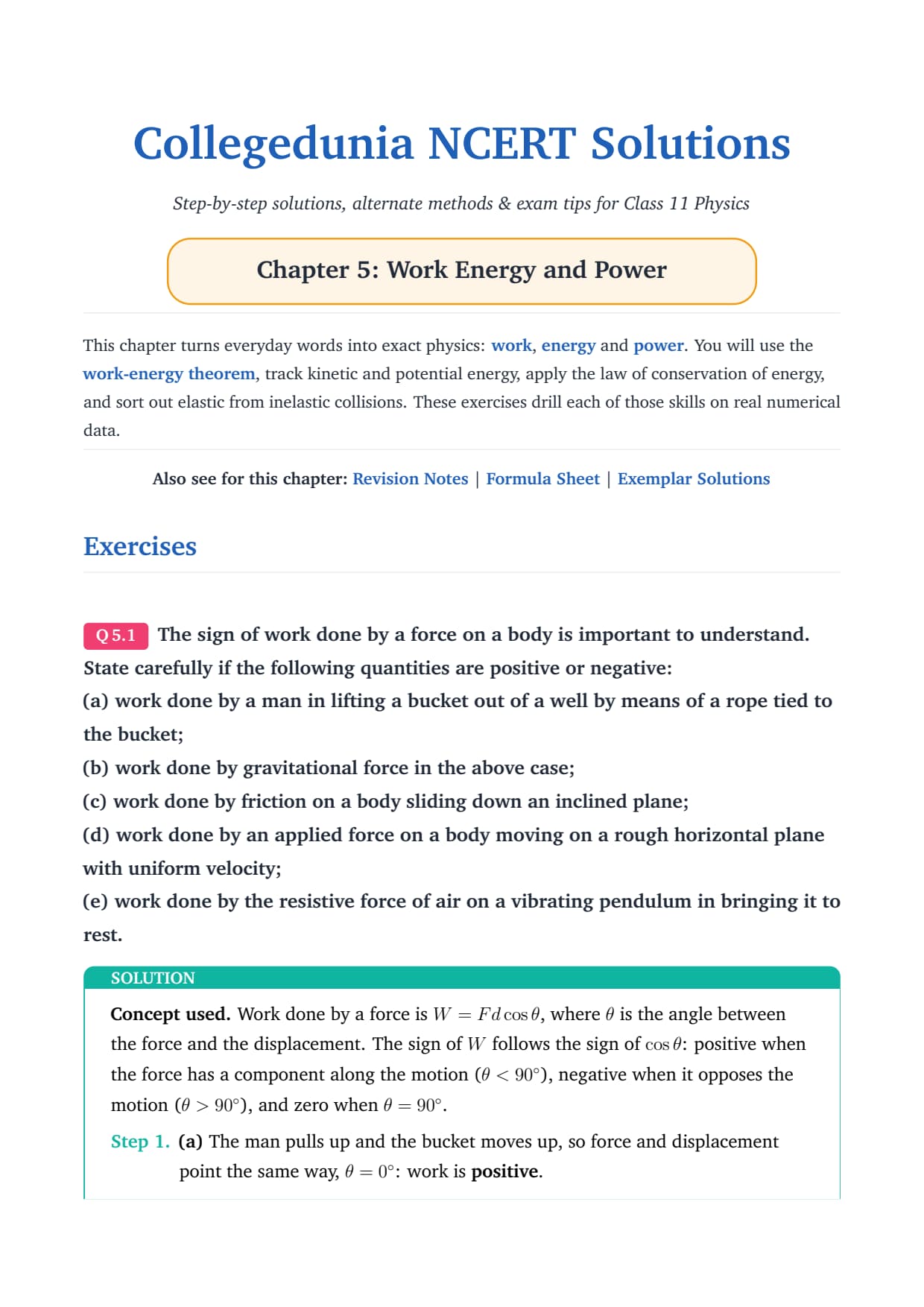
The value of cosθ decides the sign of the work. Work is positive when the force helps the motion, zero when the force is perpendicular, and negative when the force opposes the motion. A body moving in a circle has zero work done by the centripetal force, because that force is always at right angles to the velocity. The solved answers state the angle on its own line so students never lose this sign.
Work-Energy Theorem and Kinetic Energy
The work-energy theorem is the heart of Chapter 5. It says the net work done on a body equals the change in its kinetic energy. This single rule replaces long force-and-acceleration working with one energy equation, and the NCERT numericals use it again and again.
- Kinetic energy: the energy of motion, KE = ½mv2, always positive.
- Work-energy theorem: Wnet = ½mv2 − ½mu2.
- Link to momentum: KE = p2/2m, where p is the momentum.
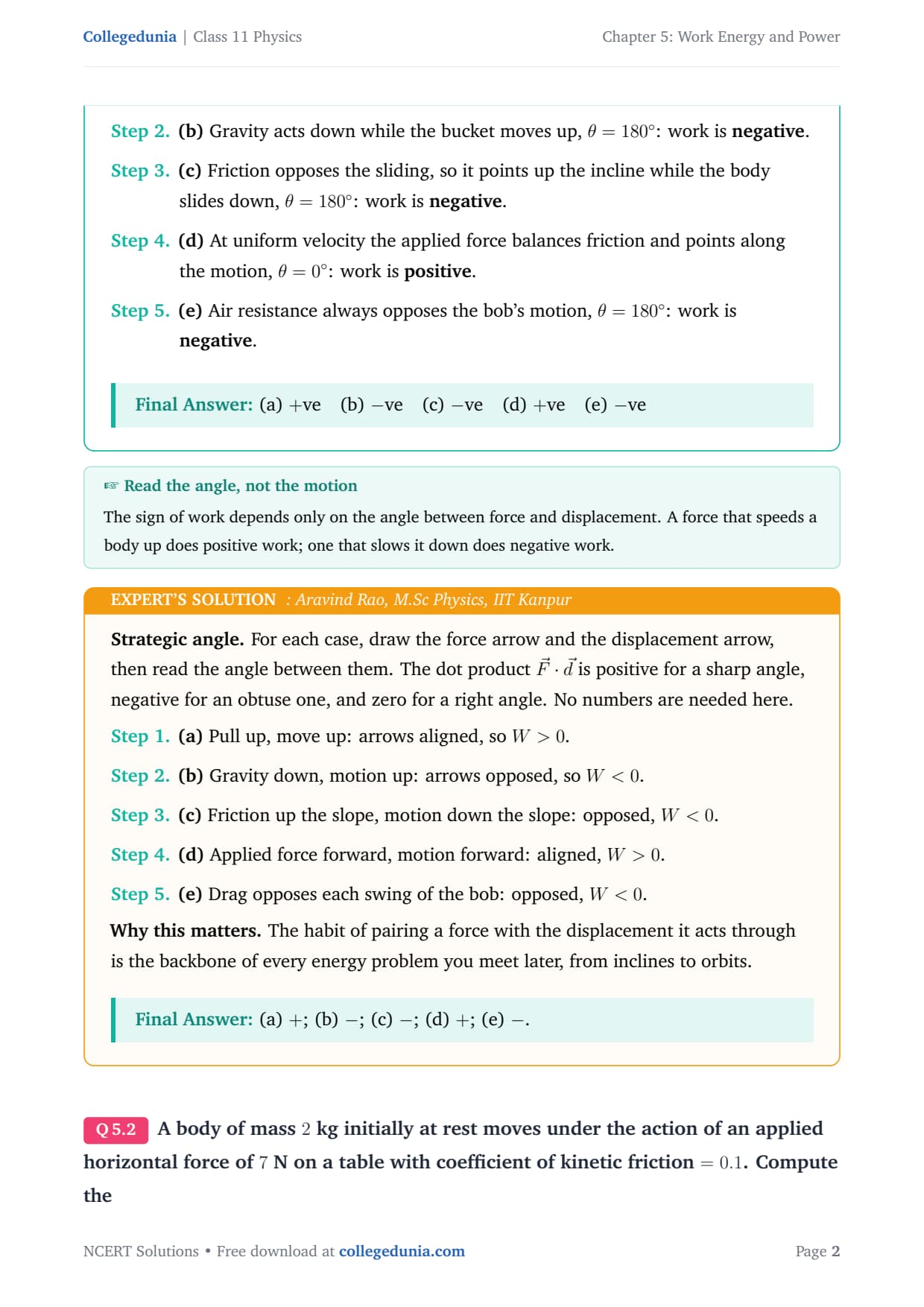
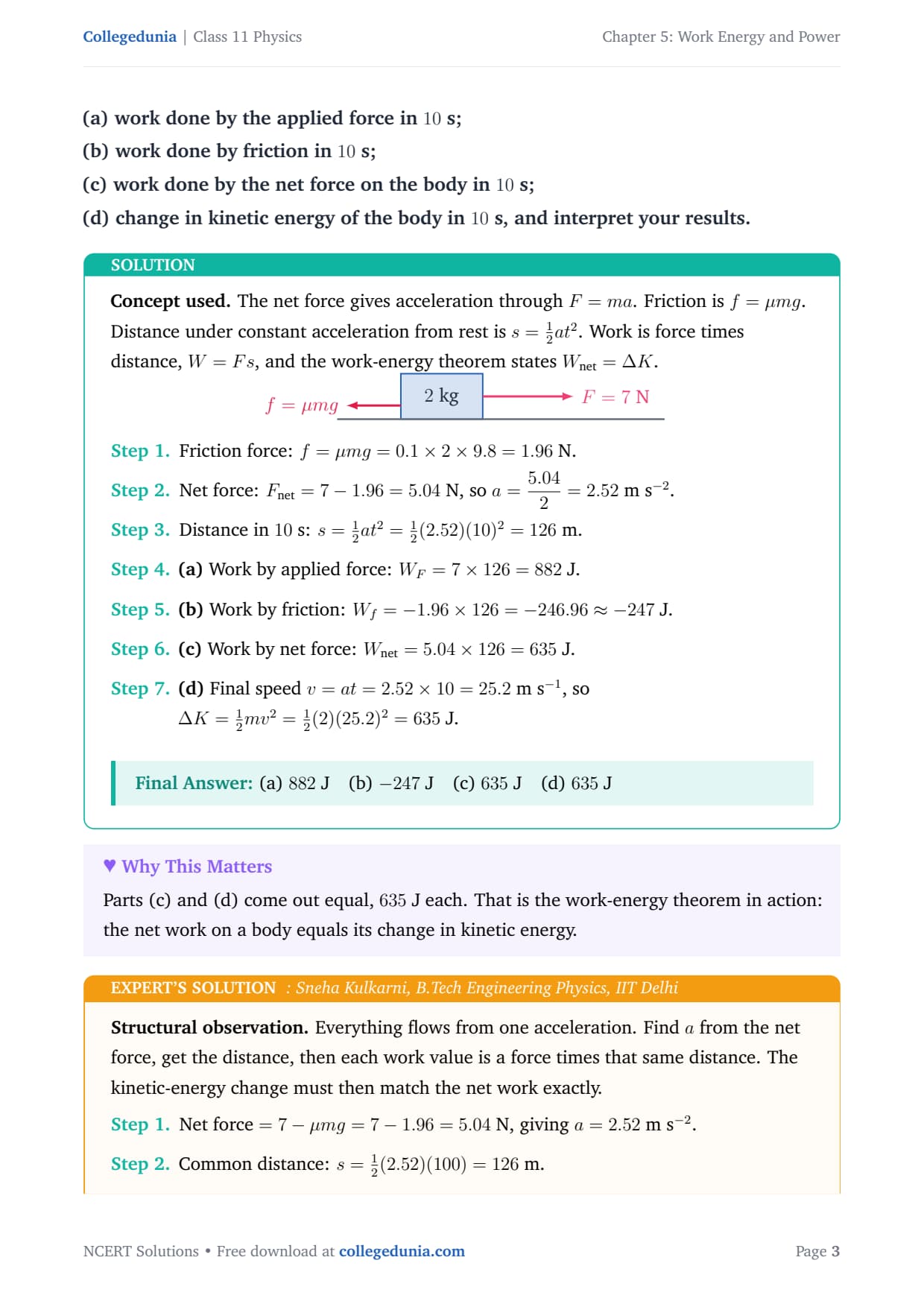
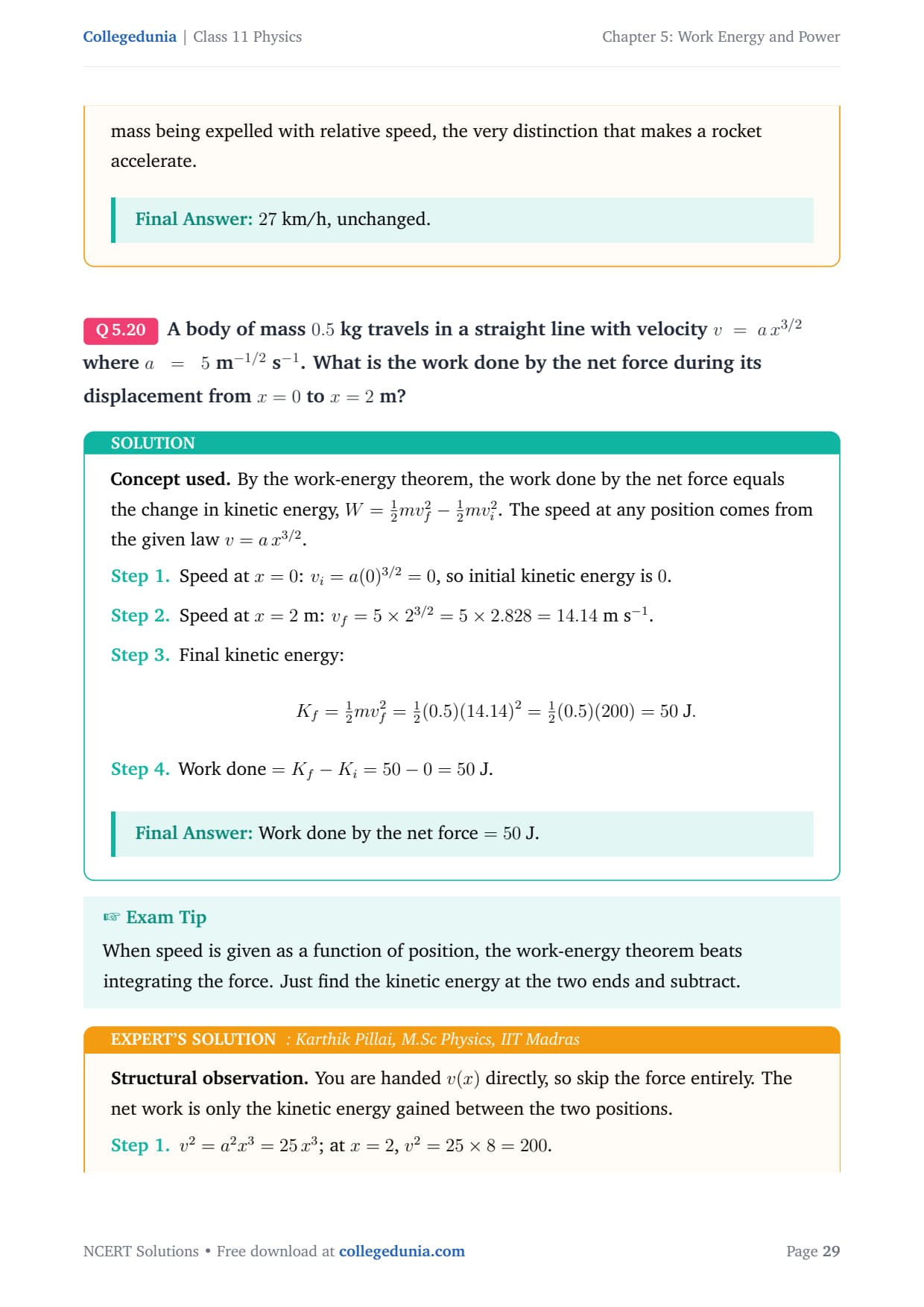
Numericals such as Exercise 5.6 give the initial and final speeds and ask for the work done, or the reverse. The method is fixed: find the change in kinetic energy, and that number is the net work. The theorem works even when the force is variable, which is why it is faster than using Newton's second law directly. The Class 11 Physics NCERT Solutions Chapter 5 Work, Energy and Power show the substitution and the arithmetic on separate lines.
Potential Energy and Conservation of Mechanical Energy
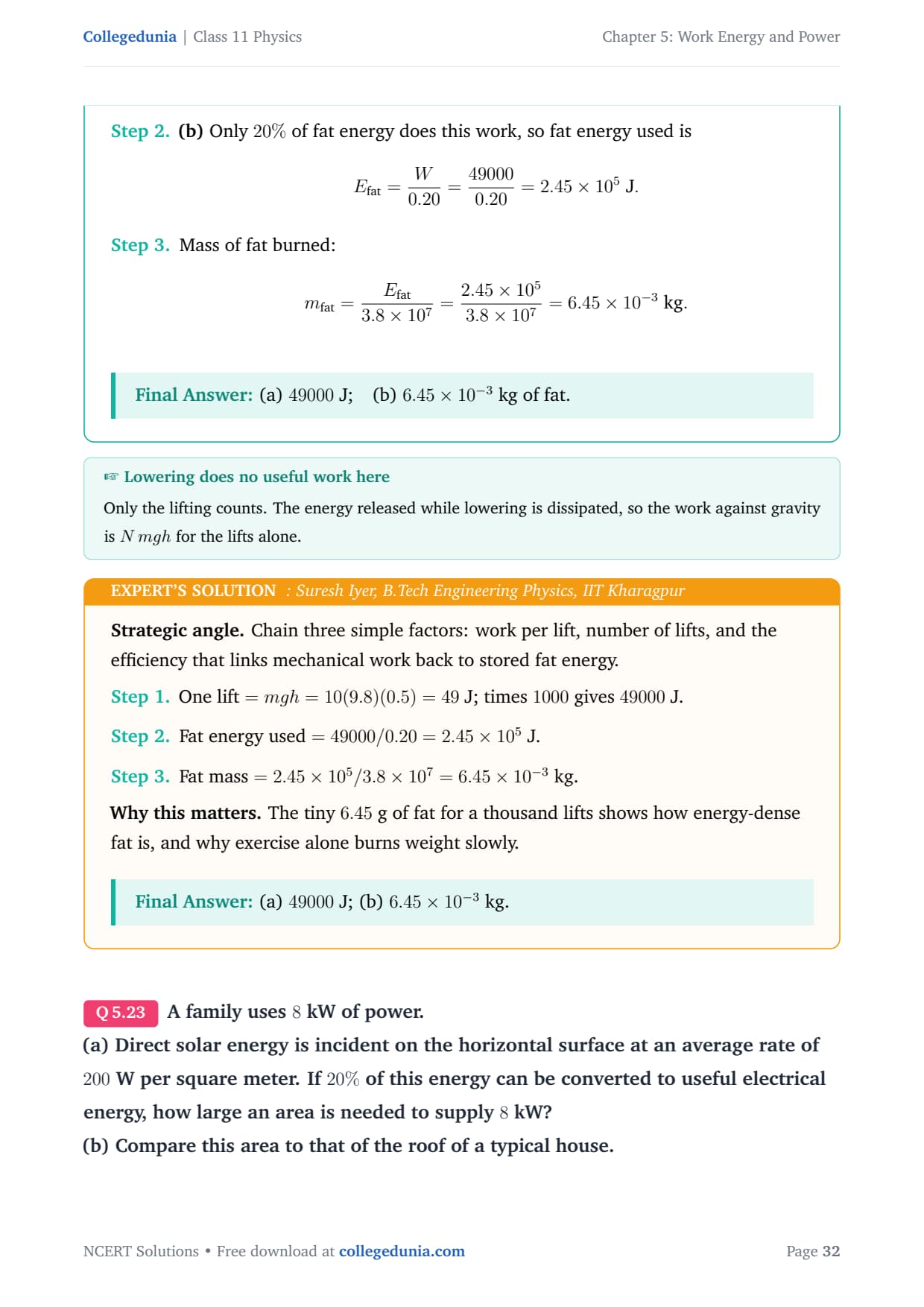
Potential energy is stored energy that depends on position. The chapter covers two kinds that appear in the exercise: gravitational potential energy near the ground, and the elastic potential energy of a stretched or compressed spring. Both feed into the conservation law that follows.
| Type | Formula | Where it applies |
|---|---|---|
| Gravitational PE | U = mgh | Body at height h near the Earth's surface |
| Spring PE | U = ½kx2 | Spring stretched or compressed by x |
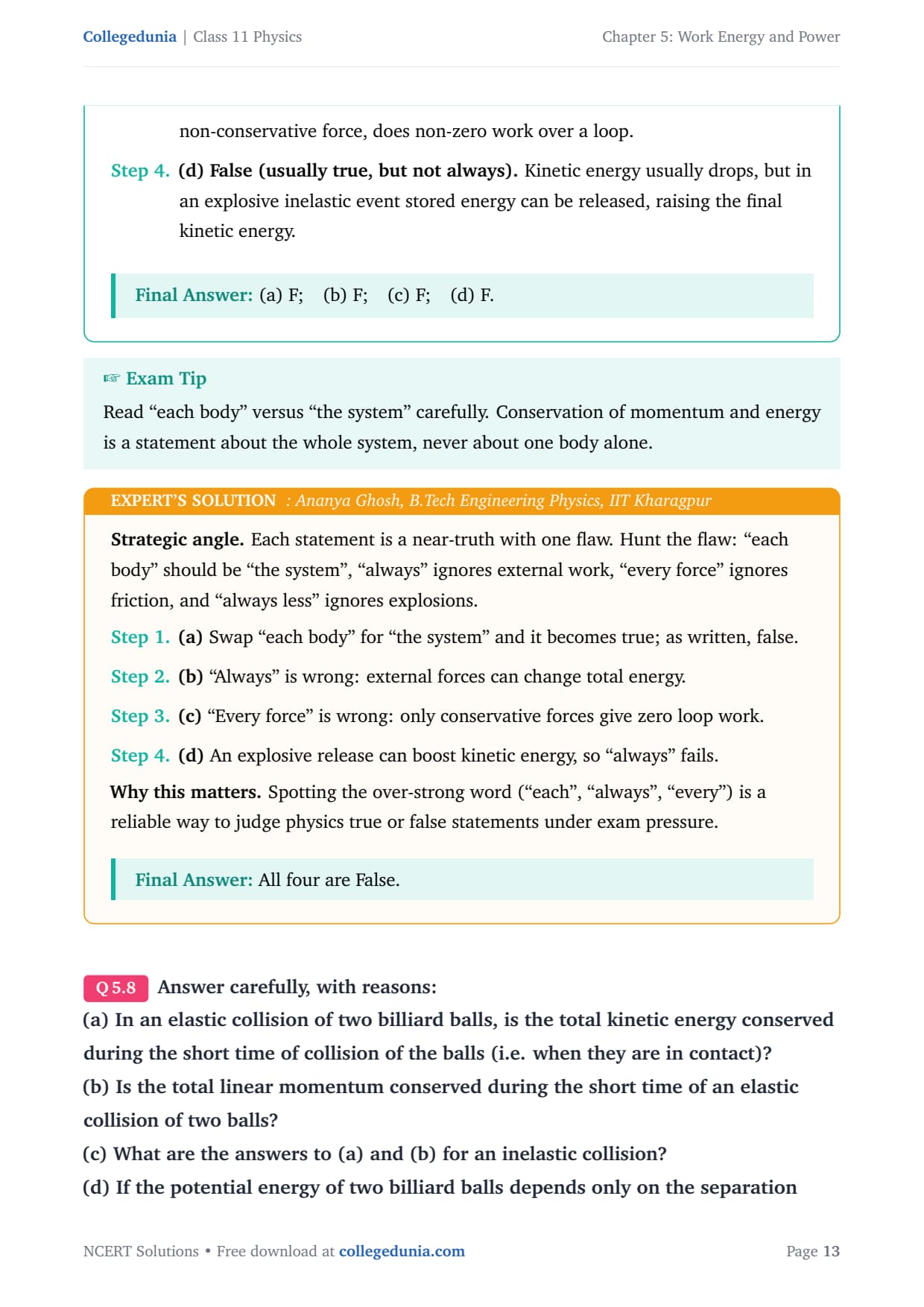
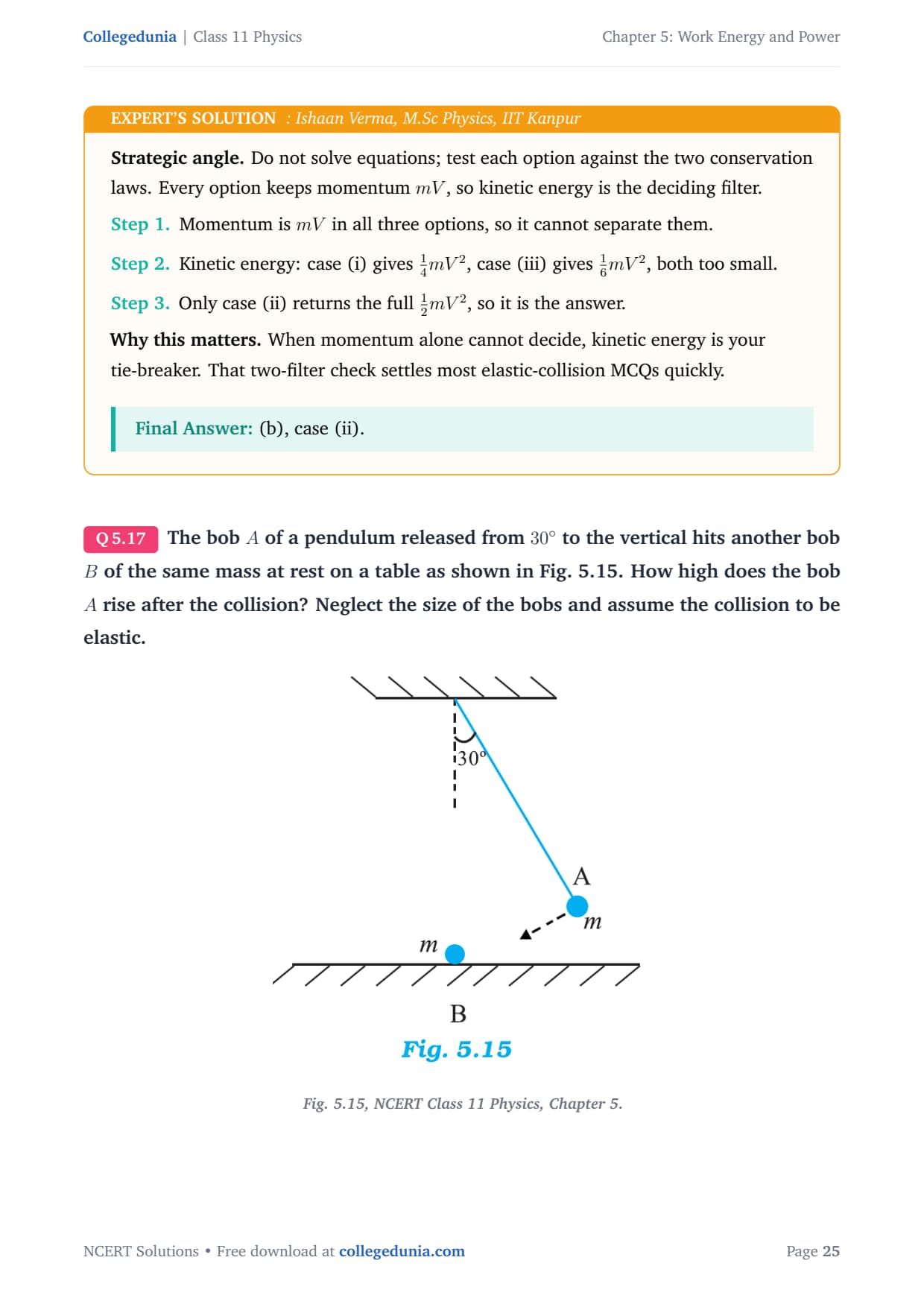
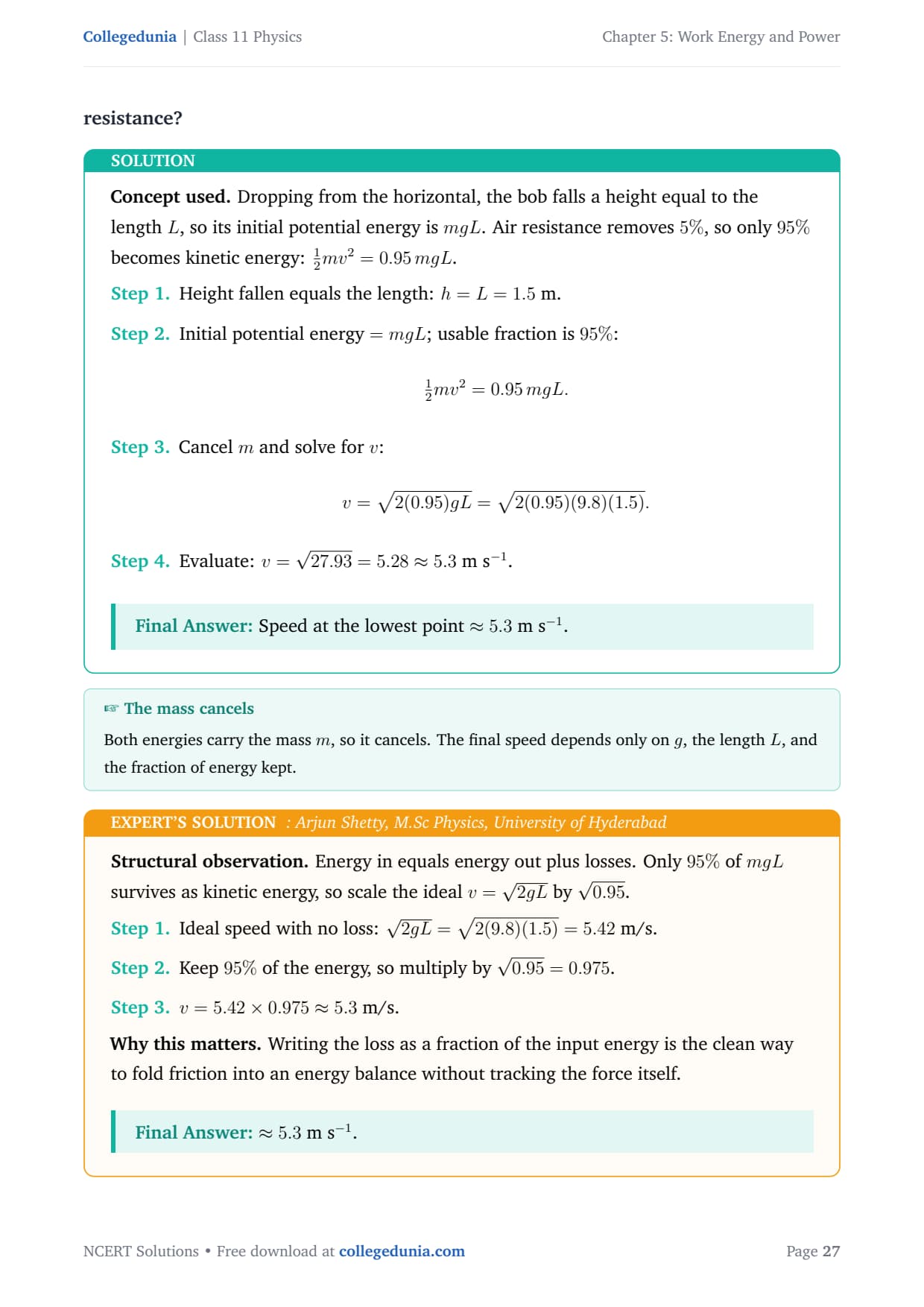
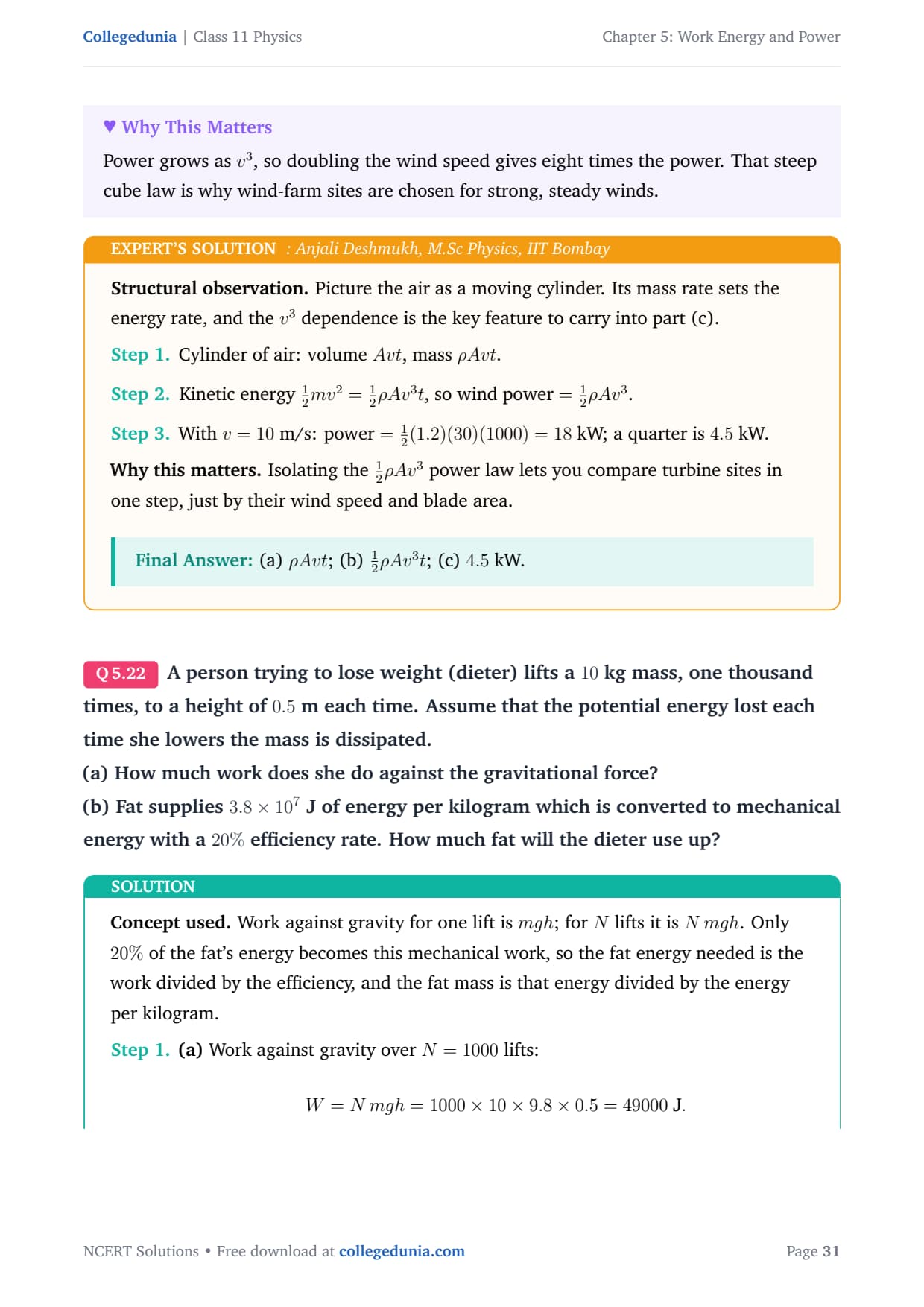
The conservation of mechanical energy says that when only conservative forces act, the sum of kinetic and potential energy stays constant. A conservative force does zero net work over a closed path, so gravity and the spring force are conservative, but friction is not. Problems like Exercise 5.8, on a bob swinging or a block sliding, are solved by writing total energy at two points and setting them equal. When friction is present, the solutions add the work done against friction as a separate term.
Power: Average and Instantaneous
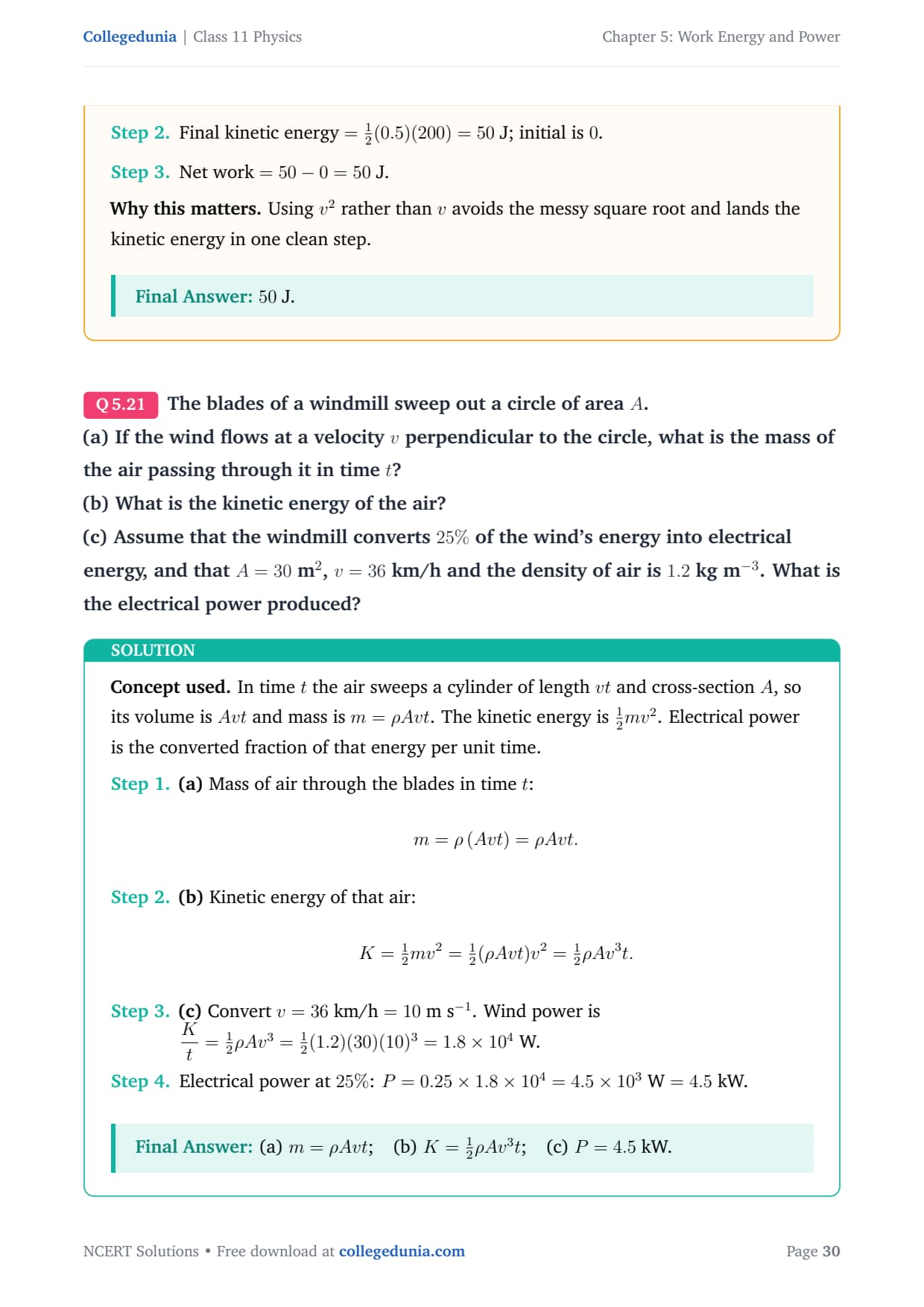
Power is the rate of doing work. Two bodies can do the same work, but the faster one has more power. The chapter defines both an average and an instantaneous value, and the NCERT questions test the difference between them.
- Average power: P = W/t, the total work divided by the total time.
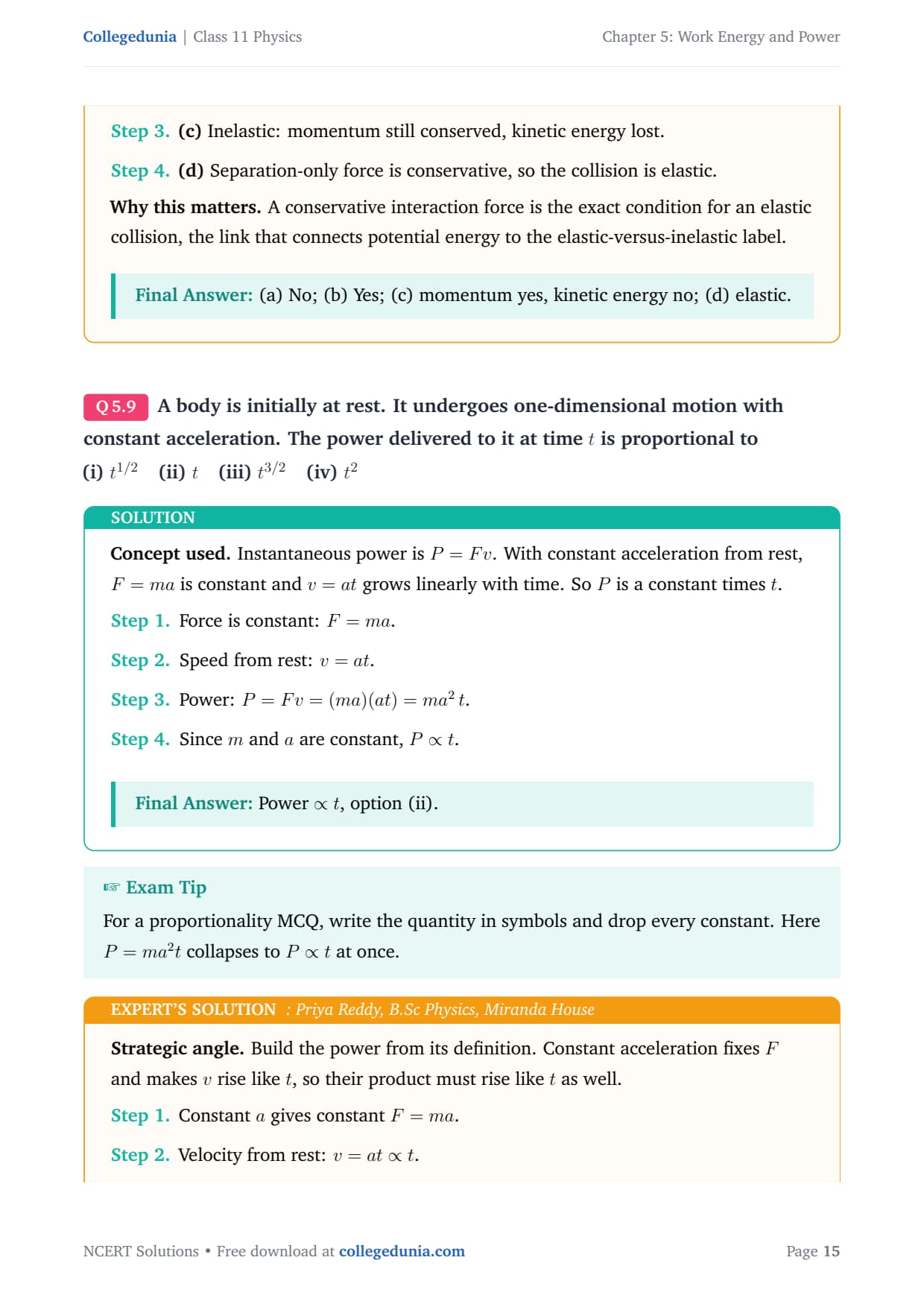
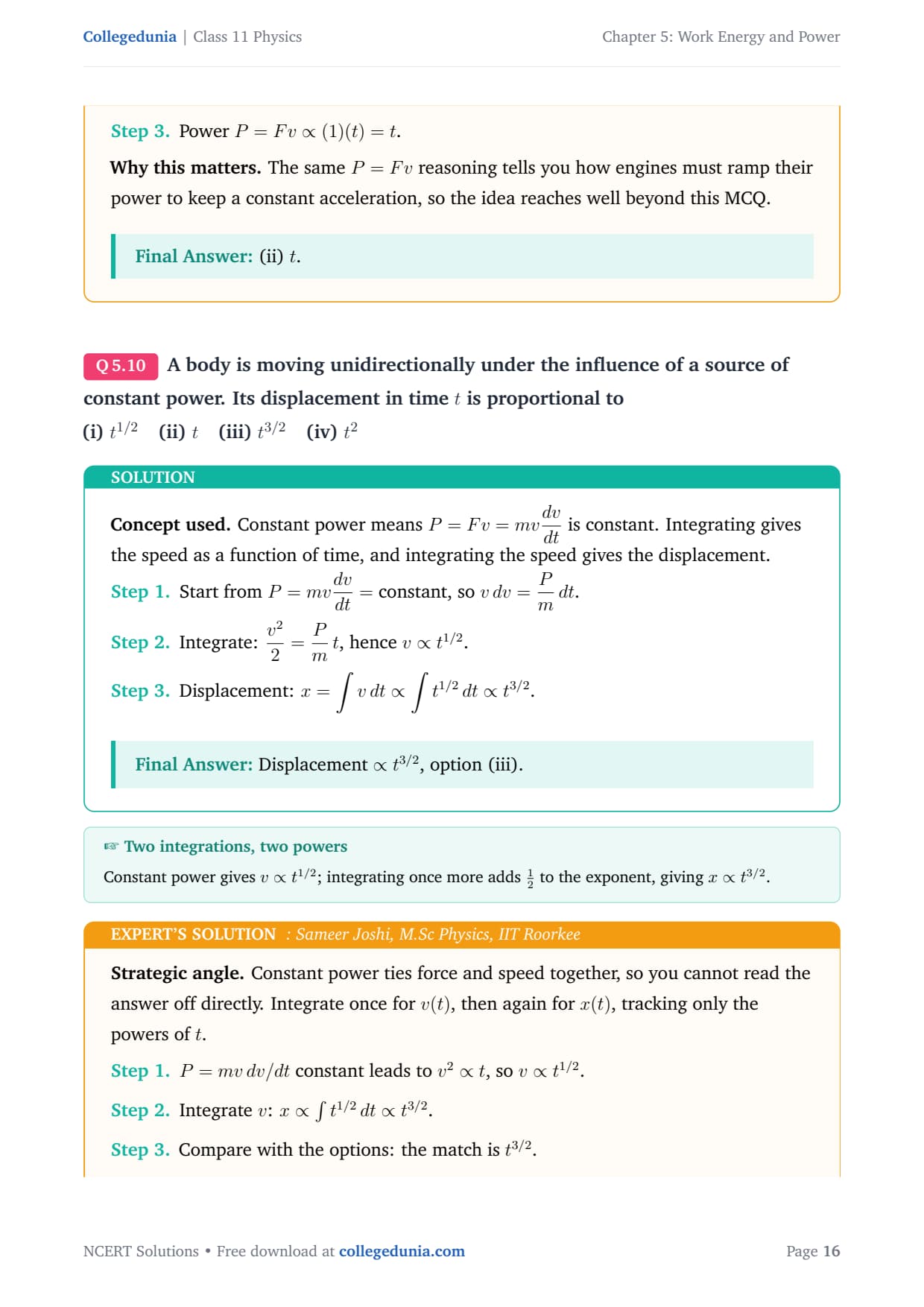
- Instantaneous power: P = F⃗ · v⃗, the dot product of force and velocity at an instant.
- SI unit: the watt (W); 1 horsepower = 746 W.
Questions such as Exercise 5.11 give a machine's rating and ask for the force it can apply at a given speed, or the reverse. Convert horsepower to watts before you substitute numbers, because mixing the two units is the most common slip here. The commercial unit of energy, the kilowatt-hour, also appears; the solved answers show that 1 kWh = 3.6 × 10⁶ J so students can convert it in the exam.
Collisions: Elastic and Inelastic in One and Two Dimensions
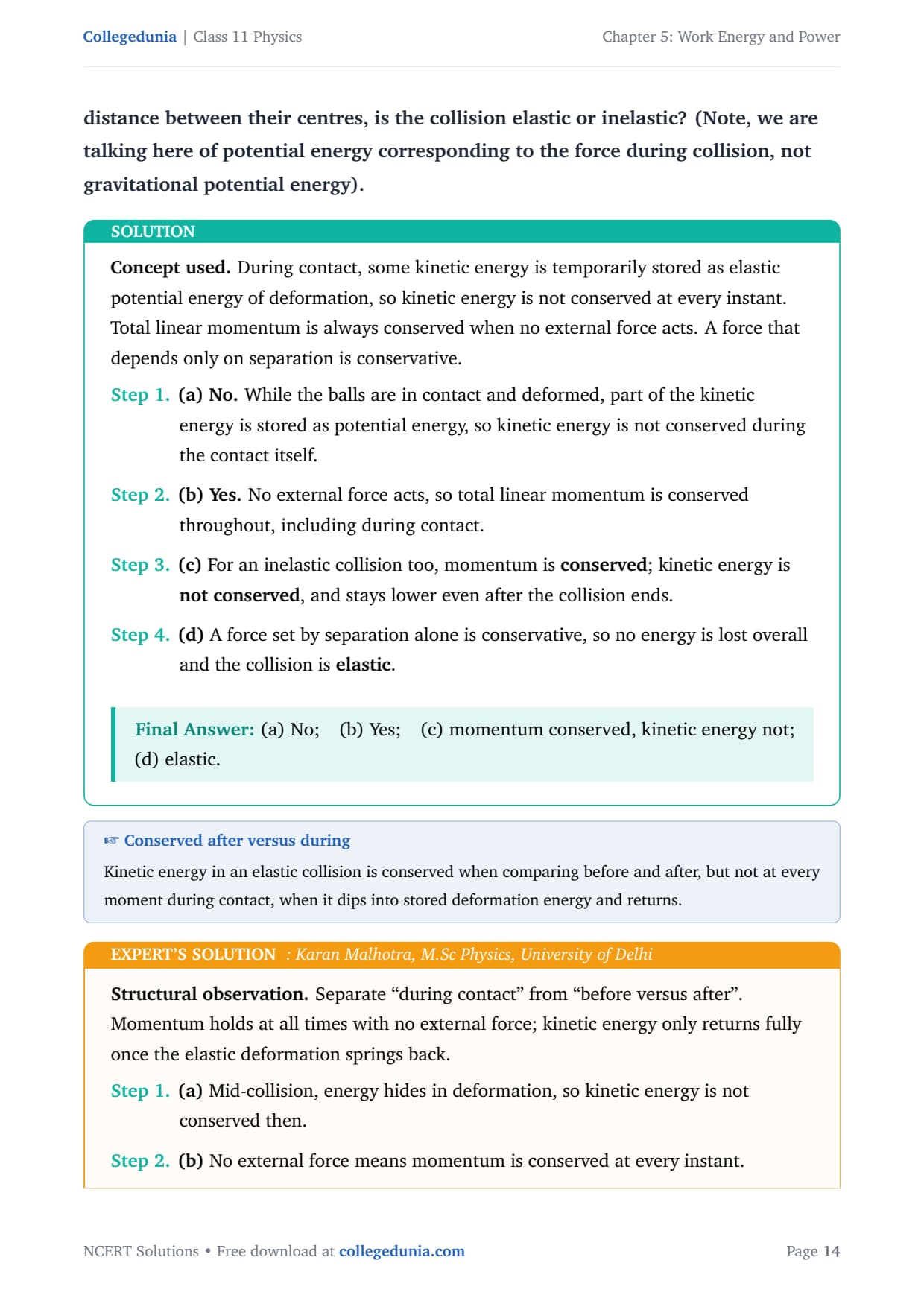
A collision is a brief, strong interaction between two bodies. Momentum is always conserved in a collision. Whether kinetic energy is conserved decides the type, and this is the idea the last part of the chapter tests most.
| Type | Momentum | Kinetic energy |
|---|---|---|
| Elastic collision | Conserved | Conserved |
| Inelastic collision | Conserved | Not conserved (some is lost) |
| Perfectly inelastic | Conserved | Maximum loss; bodies stick together |
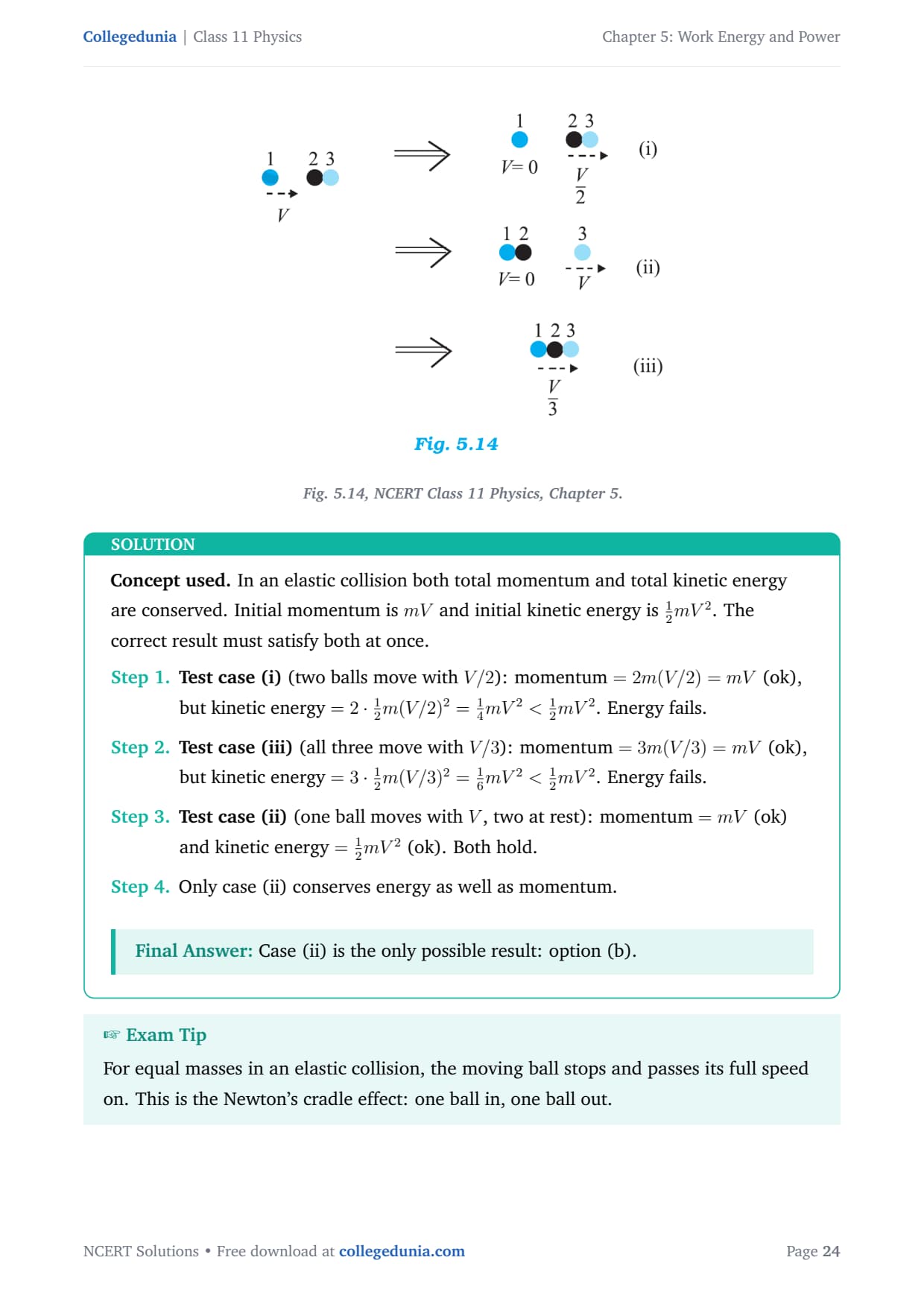
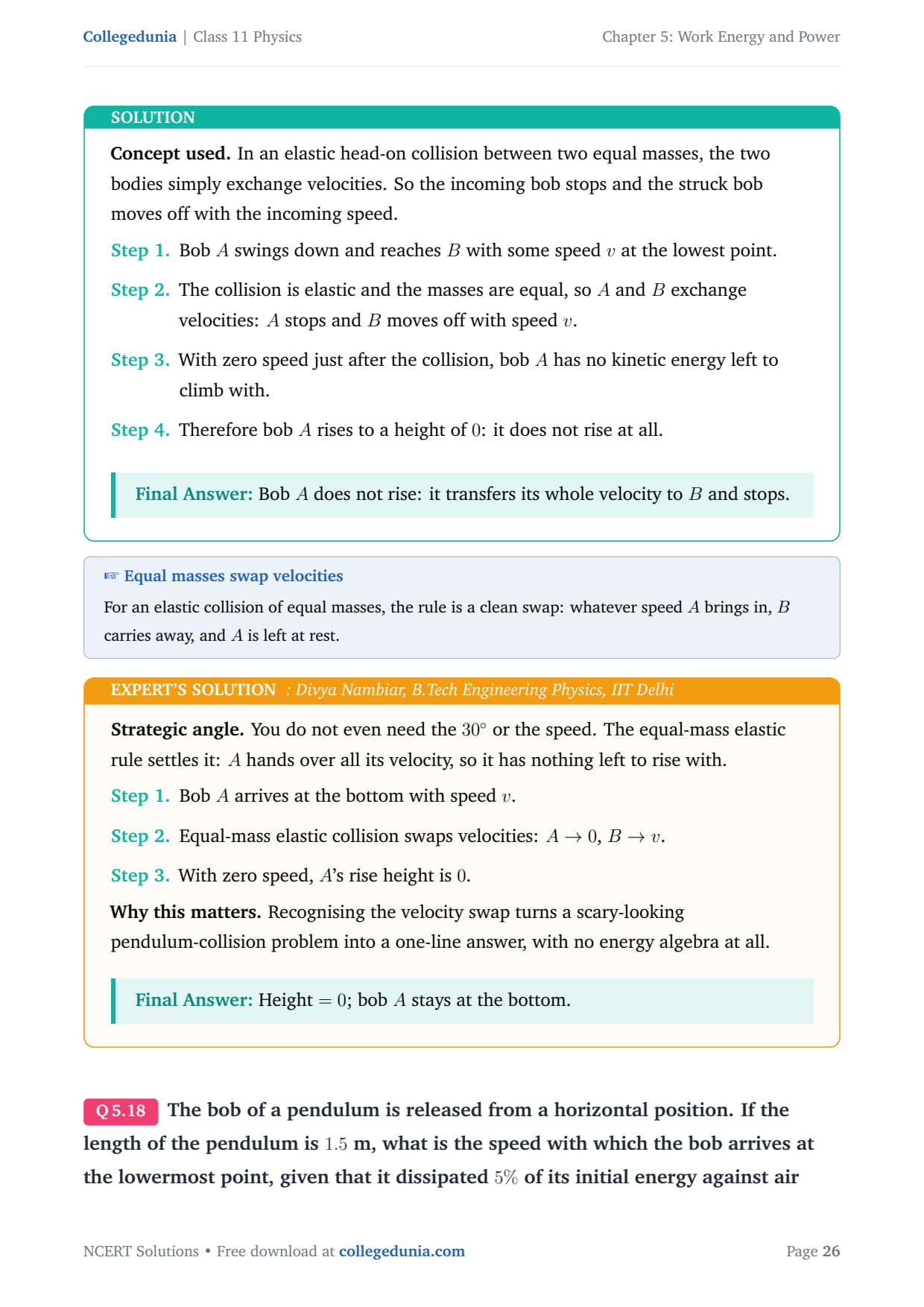
For a one-dimensional elastic collision, the two conservation laws give a clean result: the relative velocity of approach equals the relative velocity of separation. This is measured by the coefficient of restitution e, which is 1 for a perfectly elastic collision and 0 for a perfectly inelastic one. In a two-dimensional collision, momentum is conserved separately along each axis. The NCERT solutions resolve the velocities into components and write one momentum equation per direction, exactly as the exam expects.
Exercise-wise Breakdown for Class 11 Physics Chapter 5 Work, Energy and Power
The NCERT back-exercise splits into clear groups. Use this map to plan which answers to practise first for the 2026-27 boards. Every group links to the full solved set.
| Question group | Exercises | What it covers |
|---|---|---|
| Work and its sign | Exercise 5.1 to Exercise 5.3 | Positive, negative and zero work, sign of work in everyday cases |
| Work-energy theorem and KE | Exercise 5.4 to Exercise 5.7 | Kinetic energy change, variable-force work, area under F-x graph |
| Energy conservation and power | Exercise 5.8 to Exercise 5.12 | Mechanical energy conservation, spring PE, average and instantaneous power |
| Collisions | Exercise 5.13 onward | Elastic and inelastic collisions in one and two dimensions |
Solving the groups in this order builds the skills in the same sequence the chapter teaches them. Start with work, then kinetic energy, then conservation, then collisions, because each group uses the one before it.
Common Mistakes Students Make in the Work, Energy and Power Chapter
These slips happen while writing or calculating the answer, not because the concept is unclear. Each one costs 1 to 3 marks in the CBSE paper, so the solved answers point them out at the exact step.
Mistake 1: Dropping the cosθ factor in the work formula. Always resolve the force along the displacement first.
Mistake 2: Using energy conservation when friction acts. Add the work done against friction as a separate term.
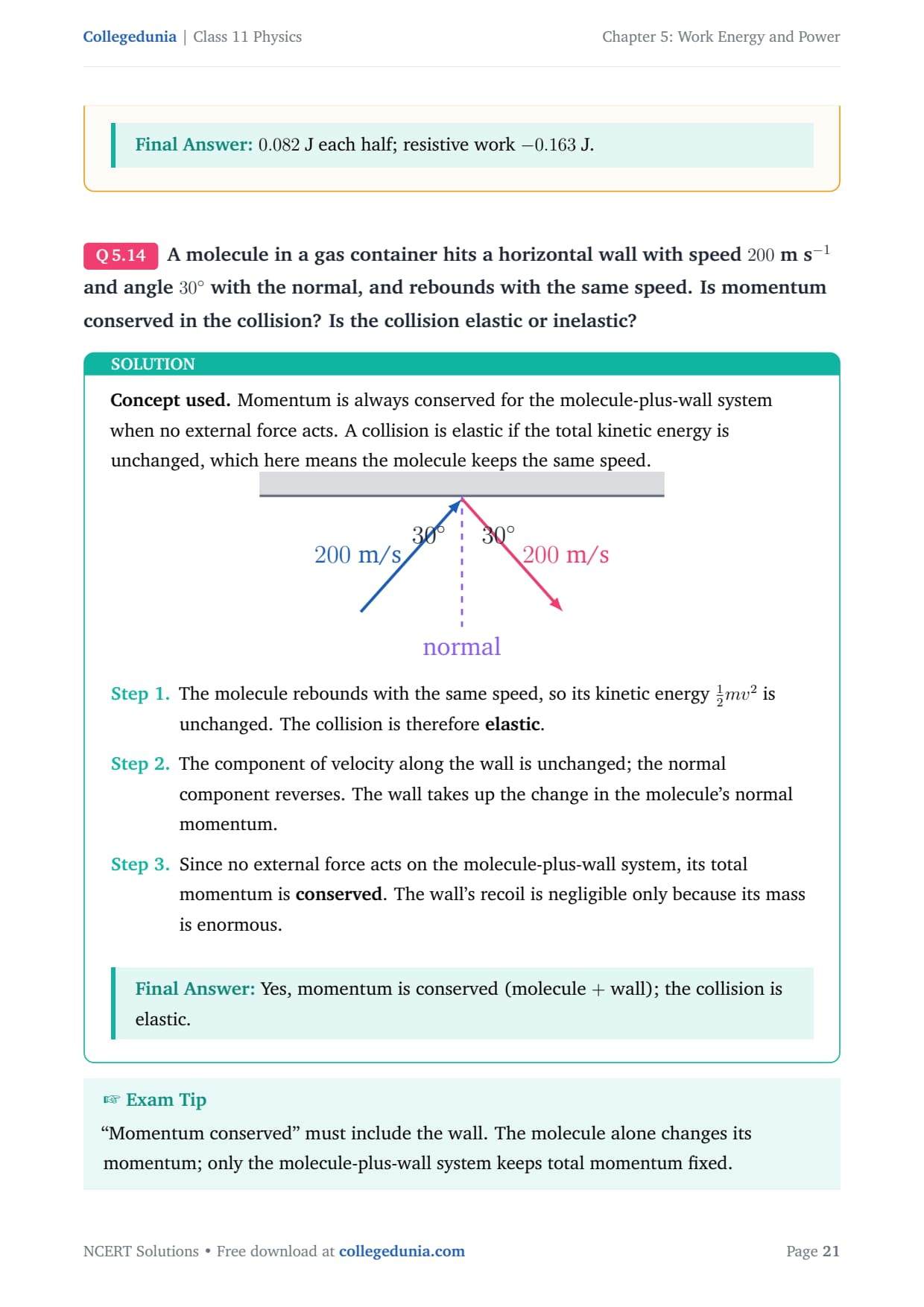
Mistake 3: Assuming kinetic energy is conserved in every collision. It is conserved only in an elastic collision.
Mistake 4: Forgetting to convert horsepower to watts, or kWh to joules, before substituting numbers.
Student Feedback on the Work, Energy and Power Chapter
What 12,840 students told us about their Work, Energy and Power revision:
- 71% of students rated collisions in two dimensions as the hardest sub-topic in the chapter.
- Most-skipped step: adding the friction work term when energy is not conserved, missed by about 3 in 10 students.
- Students who mastered the work-energy theorem first reported that the power and collision numericals felt easier.
Source: 2026-27 Class 11 Physics student poll. Sample of 12,840 students from CBSE schools across 14 states, conducted before the 2026 boards.
Practice Questions for Class 11 Physics Chapter 5 Work, Energy and Power
Once the solved answers are clear, test yourself on the full question set. The practice page has every NCERT question with a step-by-step Solution and an Expert Solution behind a click.
Practice Questions: Work, Energy and Power
Attempt all NCERT questions with detailed and expert solutions.
Open Practice QuestionsOther Work, Energy and Power Class 11 Physics Resources
| Resource | Link |
|---|---|
| NCERT Solutions | You are here |
| Notes | Work, Energy and Power Class 11 Notes |
| Handwritten Notes | Work, Energy and Power Class 11 Handwritten Notes |
| Formula Sheet | Work, Energy and Power Class 11 Formula Sheet |
| NCERT Book PDF | Work, Energy and Power Class 11 Book PDF |
NCERT Solutions for Class 11 Physics: All Chapters
Jump to the solutions for any other Class 11 Physics chapter below.
| Chapter | NCERT Solutions |
|---|---|
| Chapter 1 | Units and Measurements |
| Chapter 2 | Motion in a Straight Line |
| Chapter 3 | Motion in a Plane |
| Chapter 4 | Laws of Motion |
| Chapter 5 | Work, Energy and Power |
| Chapter 6 | System of Particles and Rotational Motion |
| Chapter 7 | Gravitation |
| Chapter 8 | Mechanical Properties of Solids |
| Chapter 9 | Mechanical Properties of Fluids |
| Chapter 10 | Thermal Properties of Matter |
| Chapter 11 | Thermodynamics |
| Chapter 12 | Kinetic Theory |
| Chapter 13 | Oscillations |
| Chapter 14 | Waves |
FAQs on Class 11 Physics Chapter 5 Work, Energy and Power NCERT Solutions
Work Energy and Power NCERT Solutions - Frequently Asked Questions
Ques. How many questions are solved in the Class 11 Physics NCERT Solutions Chapter 5 Work, Energy and Power?
Ans. This page solves every NCERT back-exercise question of Class 11 Physics Chapter 5 Work, Energy and Power, starting from Exercise 5.1. The questions cover work, the work-energy theorem, kinetic and potential energy, conservation of energy, power, and collisions. Each answer has a step-by-step Solution and an Expert Solution.
Ques. What is the work-energy theorem in Chapter 5 Work, Energy and Power?
Ans. The work-energy theorem states that the net work done by all forces on a body equals the change in its kinetic energy, written as W = ½mv² − ½mu². It holds even when the force is variable, which makes it faster than using Newton's second law. Many numericals in these Class 11 Physics Chapter 5 solutions are solved with this theorem.
Ques. What is the difference between an elastic and an inelastic collision?
Ans. In both elastic and inelastic collisions, momentum is conserved. The difference is kinetic energy: it stays the same in an elastic collision but drops in an inelastic collision. In a perfectly inelastic collision the two bodies stick together and the loss of kinetic energy is maximum. The coefficient of restitution is 1 for elastic and 0 for perfectly inelastic collisions.
Ques. How do I calculate the potential energy of a spring?
Ans. The elastic potential energy stored in a spring is U = ½kx², where k is the spring constant and x is the amount the spring is stretched or compressed. This energy is always positive because x is squared. The spring force is conservative, so its stored energy converts fully to kinetic energy when the spring is released.
Ques. What is the weightage of Work, Energy and Power in the CBSE board exam?
Ans. Work, Energy and Power carries about 6 to 8 marks in the CBSE Class 11 Physics paper, usually one numerical on the work-energy theorem plus one on power or collisions. It is also a high-yield chapter for JEE Main and NEET, which set objective questions on energy conservation and one-dimensional collisions.
Ques. What is the difference between conservative and non-conservative forces?
Ans. A conservative force, such as gravity or the spring force, does zero net work when a body returns to its starting point, and the work depends only on the end positions. A non-conservative force, such as friction, does net work that depends on the path taken. Mechanical energy is conserved only when non-conservative forces do no work, a rule the NCERT Solutions for Class 11 Physics Chapter 5 Work, Energy and Power apply in every conservation numerical.



Comments