




The How Forces Affect Motion Class 9 Science Formula Sheet puts every relation from Chapter 6 of the new Exploration book on one page. In one place you get the definition of the newton, the net force rules, the effect of friction, Newton's three laws, and the numerical formulae for acceleration, weight, and momentum. Use it as a quick reference before any class test or the 2026-27 exam, since these are the formulae that carry the most marks in this chapter.
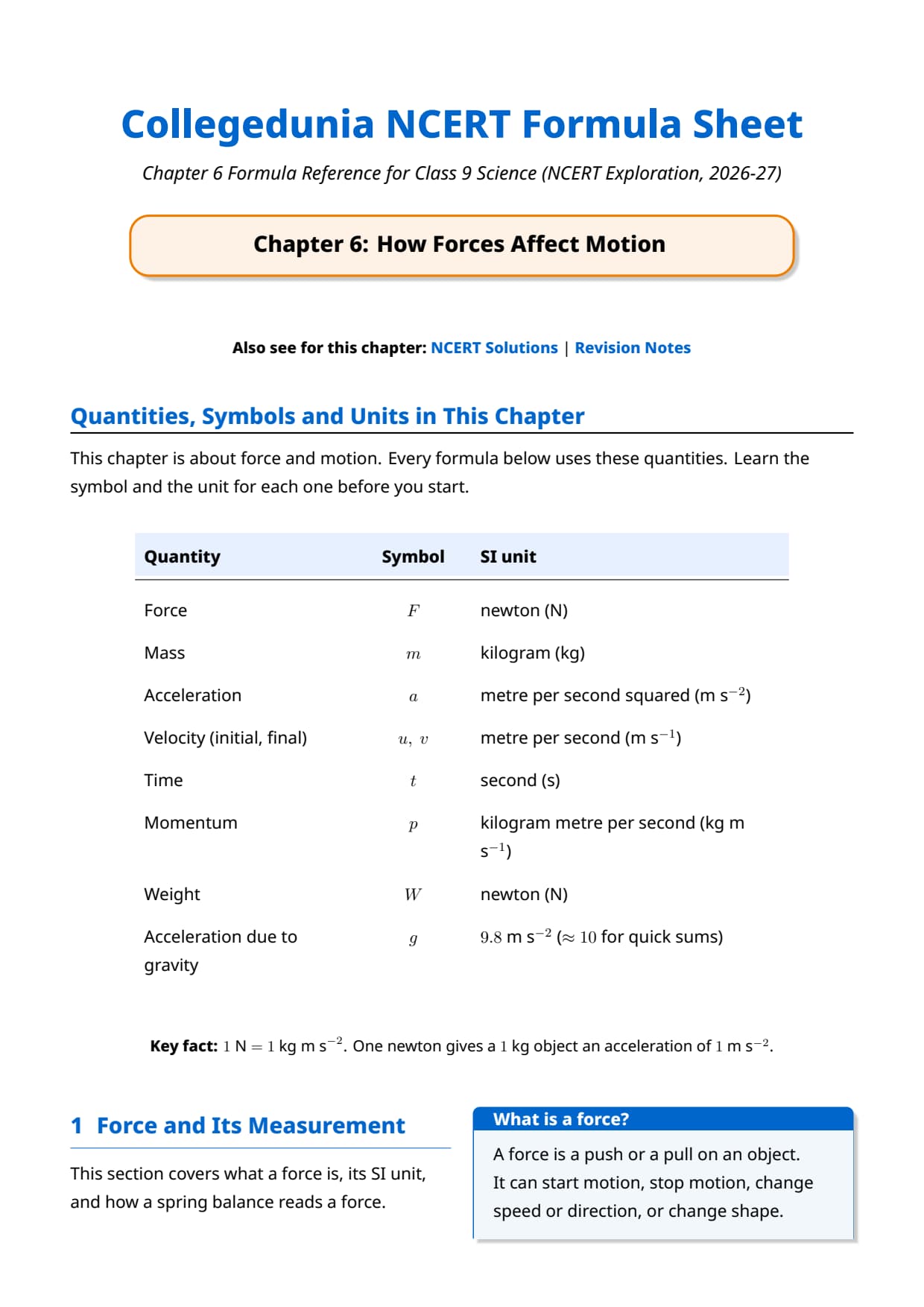
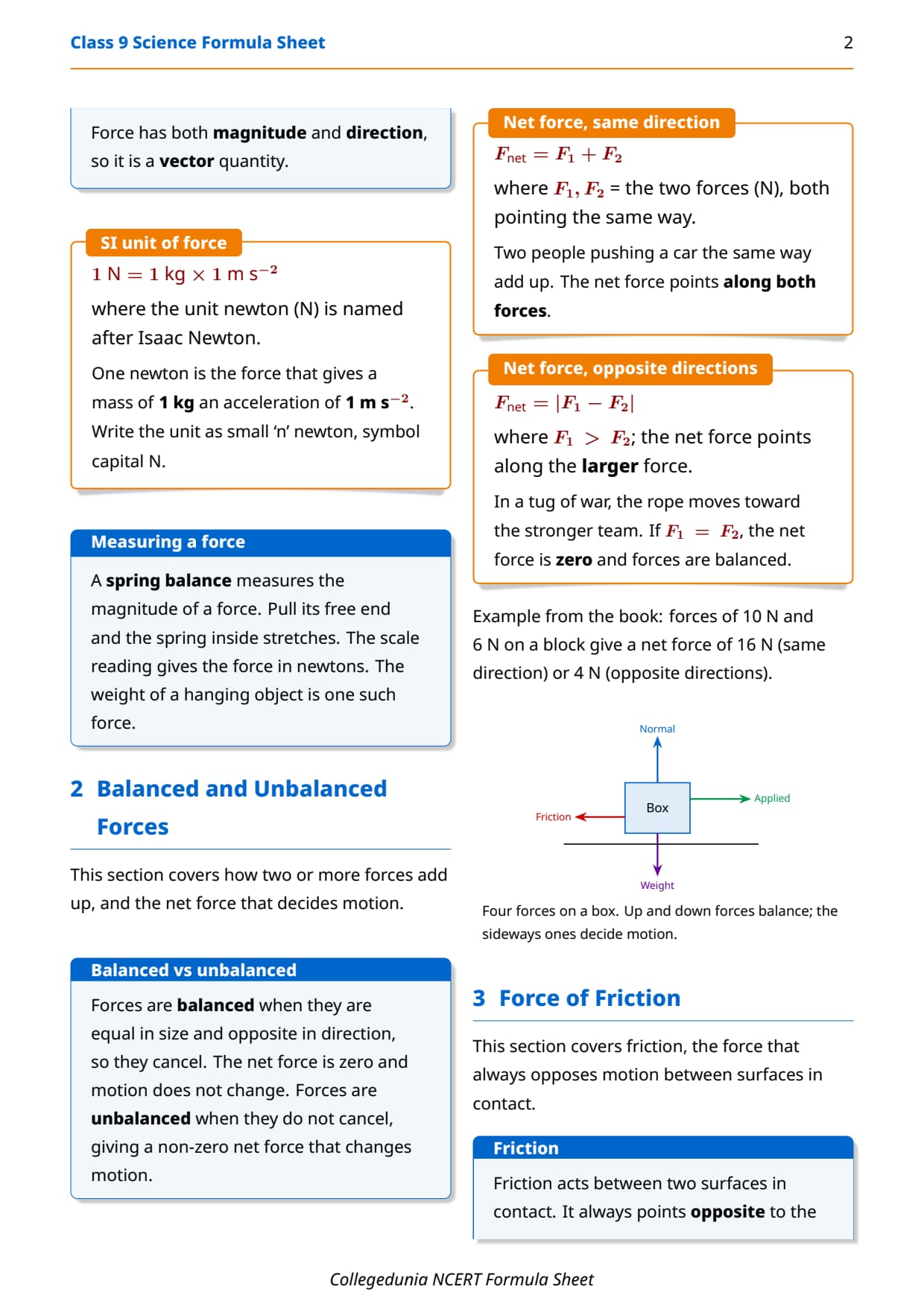
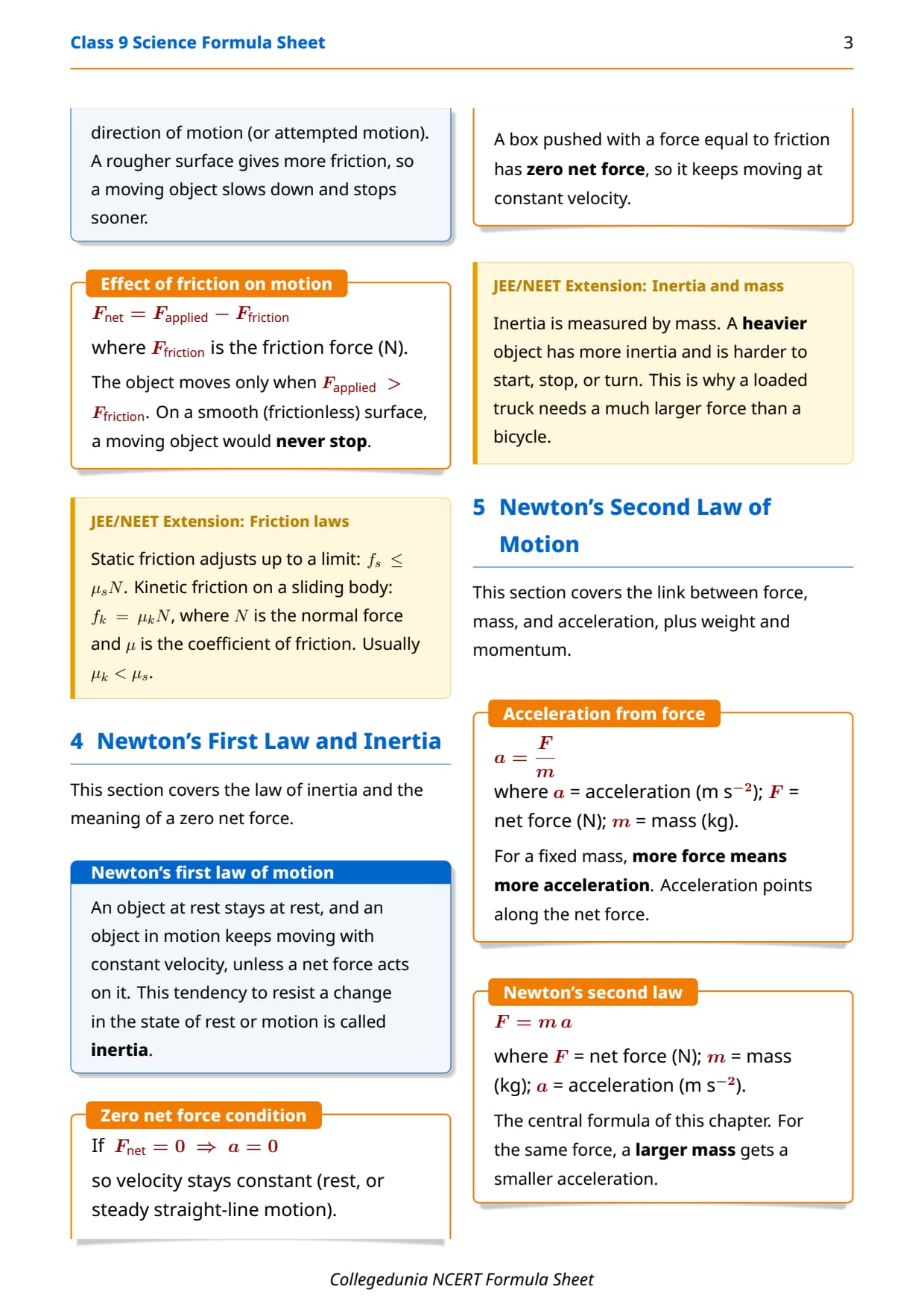
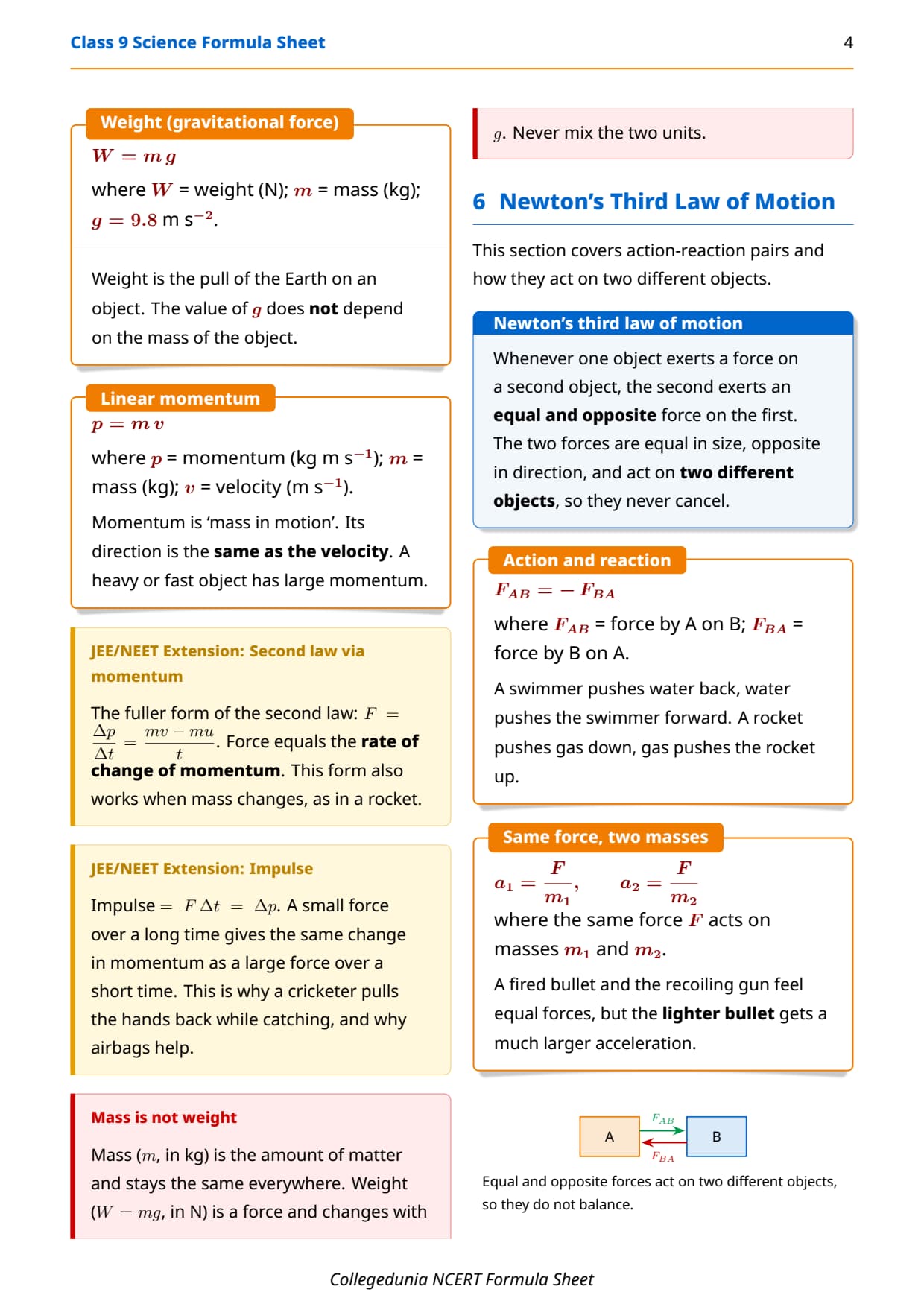
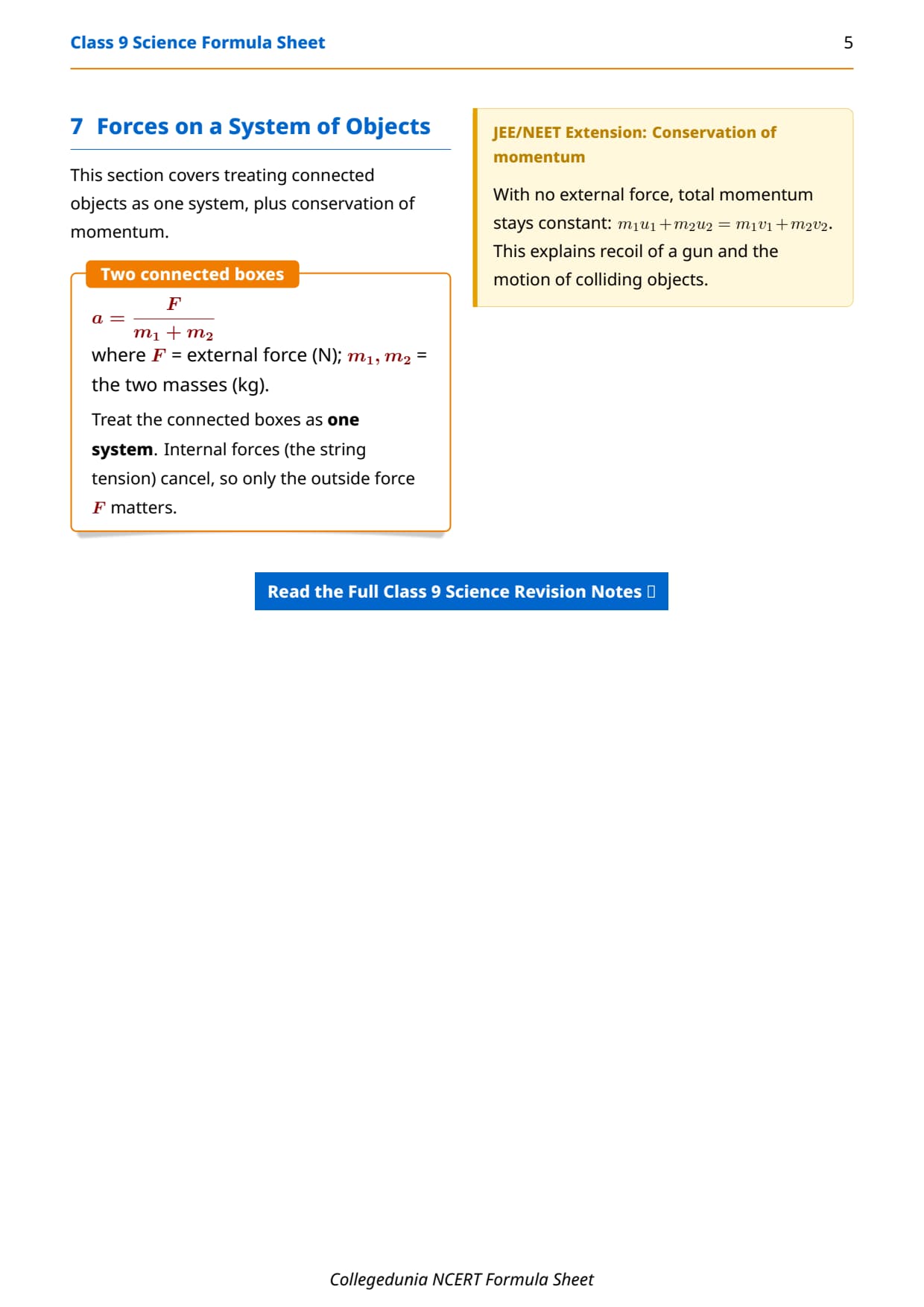
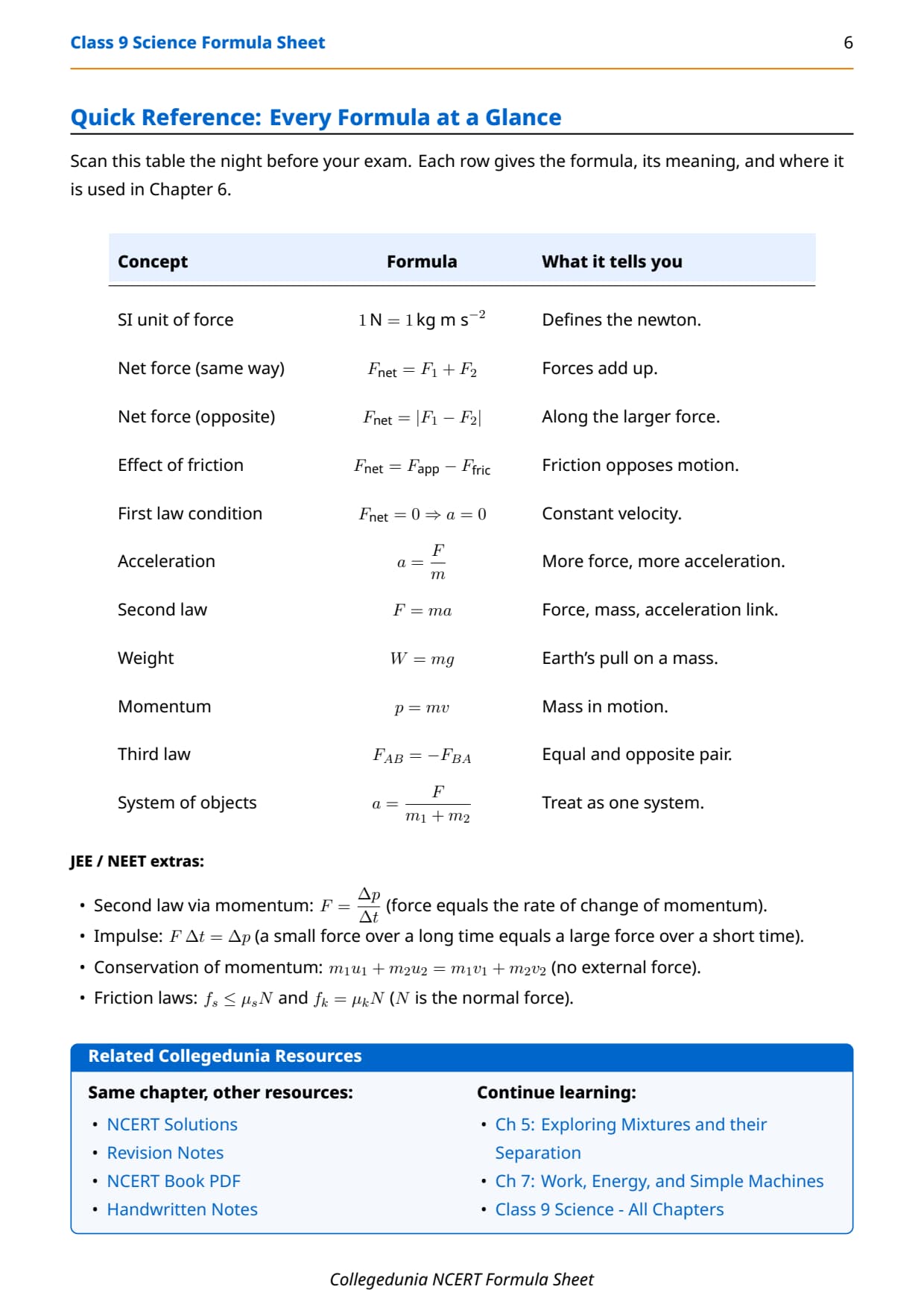
- Full formula coverage: the newton unit, net force, friction, the first, second, and third laws, plus F = ma, W = mg, and p = mv in one set.
- Best used for: force and acceleration sums, weight numericals, momentum questions, and quick one-mark recall of the three laws of motion.
- Why it matters: Chapter 6 is the base for later physics on motion, work, energy, and every force-based numerical in higher classes and in JEE and NEET.
Student Feedback
In a Collegedunia study of 1,210 Class 9 students, 81% said keeping F = ma, weight, and momentum on one page cut their errors in force numericals. About 4 out of 5 rated the balanced versus unbalanced forces card the clearest tool in this chapter, and many said the units table stopped them from mixing up mass and weight.
Also Check:
- How Forces Affect Motion Class 9 Science NCERT Solutions
- How Forces Affect Motion Class 9 Science Notes
How Collegedunia's How Forces Affect Motion Formula Sheet Helps You
This Formula Sheet gathers every relation you need for Class 9 Science Chapter 6 numericals on one page, in the order the Exploration book introduces them. Chapter 6 is a numerical chapter, so a clean list of formulae saves you time in the exam and stops small slips.
- 2026-27 NCERT alignment: every formula, from the newton unit and the net force rules to F = ma, weight, and momentum, matches the current Exploration syllabus.
- The three laws in one view: the first, second, and third laws of motion sit next to their formulae, so you can recall the law and its equation together.
- Quick-fact cards for MCQs: key facts like 1 N = 1 kg m s-2 and g = 9.8 m s-2 sit in a colour-coded card row for last-minute recall.
How Forces Affect Motion Class 9 Science Video Revision
Source: Magnet Brains on YouTube
How Forces Affect Motion Class 9 Science Complete Formula Reference
The table lists every formula in Chapter 6, mapped to its meaning and its SI unit. Learn the formula and its unit together, since many marks are lost by writing the wrong unit.
| Concept | Formula | SI Unit | What it tells you |
|---|---|---|---|
| SI unit of force | 1 N = 1 kg m s-2 | newton (N) | Defines the newton, the unit of force |
| Net force (same direction) | Fnet = F1 + F2 | N | Forces in the same direction add up |
| Net force (opposite) | Fnet = |F1 − F2| | N | Net force points along the larger force |
| Effect of friction | Fnet = Fapplied − Ffriction | N | Friction opposes motion, so it subtracts |
| First law condition | Fnet = 0 ⇒ a = 0 | — | Zero net force means constant velocity |
| Acceleration from force | a = Fm | m s-2 | More force gives more acceleration |
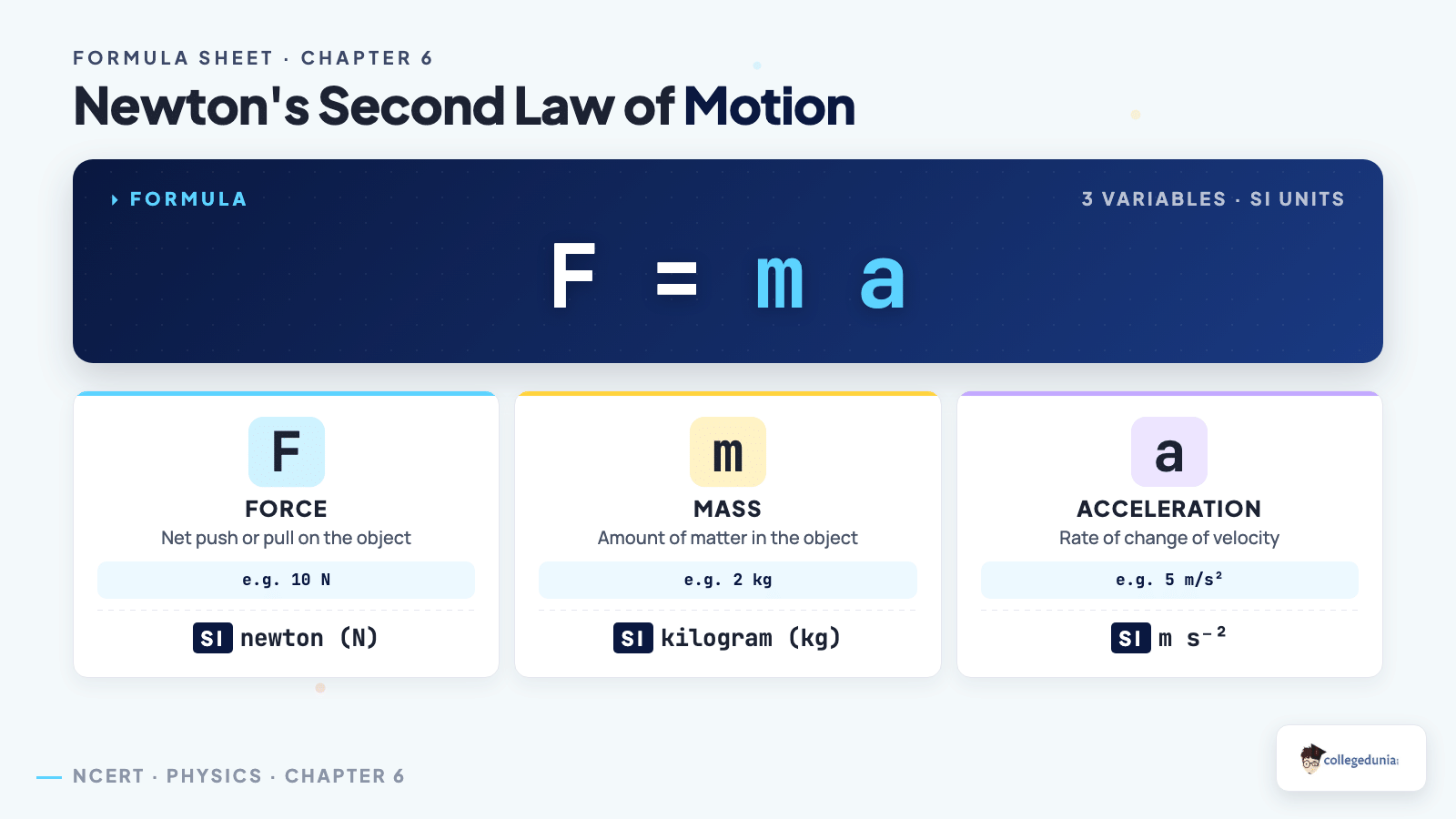
| Newton's second law | F = m a | N | The central formula of the chapter |
| Weight | W = m g | N | The Earth's pull on a mass |
| Linear momentum | p = m v | kg m s-1 | Mass in motion; same direction as velocity |
| Newton's third law | FAB = −FBA | N | Equal and opposite action-reaction pair |
| System of objects | a = Fm1 + m2 | m s-2 | Treat connected masses as one system |
Learning these eleven relations covers nearly every force and motion numerical asked from Chapter 6 in Class 9 Science.
When to Use Which Formula in How Forces Affect Motion Class 9
Picking the right formula is the difference between full marks and a slip. The list below tells you which relation to apply based on what the question gives you. Read the situation first: if the forces cancel, the object does not change its motion; if they do not cancel, there is a net force and an acceleration.
- Force and mass given, asks acceleration: second law a = F/m.
- Mass and acceleration given, asks force: F = m a. Answer is in newtons.
- Mass given, asks weight: W = m g, with g = 9.8 m s-2 (use 10 for a quick sum).
- Mass and velocity given, asks momentum: p = m v. Momentum points the same way as the velocity.
- Two forces on one object: add them if they point the same way, subtract if opposite, using the net force rules.
- Applied force with friction: the object moves only when Fapplied > Ffriction; the net force is the difference.
- One force pulling two joined masses: use a = F/(m1 + m2) and treat them as one system.
How Forces Affect Motion Class 9 Quick-Fact Cards for MCQ Recall
These atomic facts are the ones MCQ writers reach for most often. Glance over them the morning of any test, since each one appears again and again in Chapter 6 questions.
Symbol Glossary and Units for Class 9 Science Chapter 6
Every symbol used above, decoded with its SI unit. Note that mass m stays fixed everywhere, while weight W depends on g and can change from place to place.
| Symbol | What it means | SI Unit |
|---|---|---|
| F | Force (a push or a pull) | newton (N) |
| m | Mass (amount of matter) | kilogram (kg) |
| a | Acceleration | m s-2 |
| u, v | Initial and final velocity | m s-1 |
| t | Time | second (s) |
| p | Linear momentum | kg m s-1 |
| W | Weight (the Earth's pull) | newton (N) |
| g | Acceleration due to gravity (9.8 m s-2) | m s-2 |
How Forces Affect Motion Top Formulae Recap: Quick Revision for Class 9
The five relations below carry the largest share of marks in Chapter 6 numericals. Revise these first, then fill in the rest of the sheet.
| Formula | Where it is used |
|---|---|
| F = m a | Find force from mass and acceleration, or acceleration from force |
| a = Fm | Acceleration of an object under a net force |
| W = m g | Weight of an object of known mass |
| p = m v | Momentum of a moving object |
| a = Fm1 + m2 | Two connected masses pulled by one force |
Full step-by-step numericals: How Forces Affect Motion Class 9 Science NCERT Solutions
One-Shot Revision Tips for How Forces Affect Motion Class 9
Treat the sheet as a checklist you tick off as you recall every relation the night before a test.
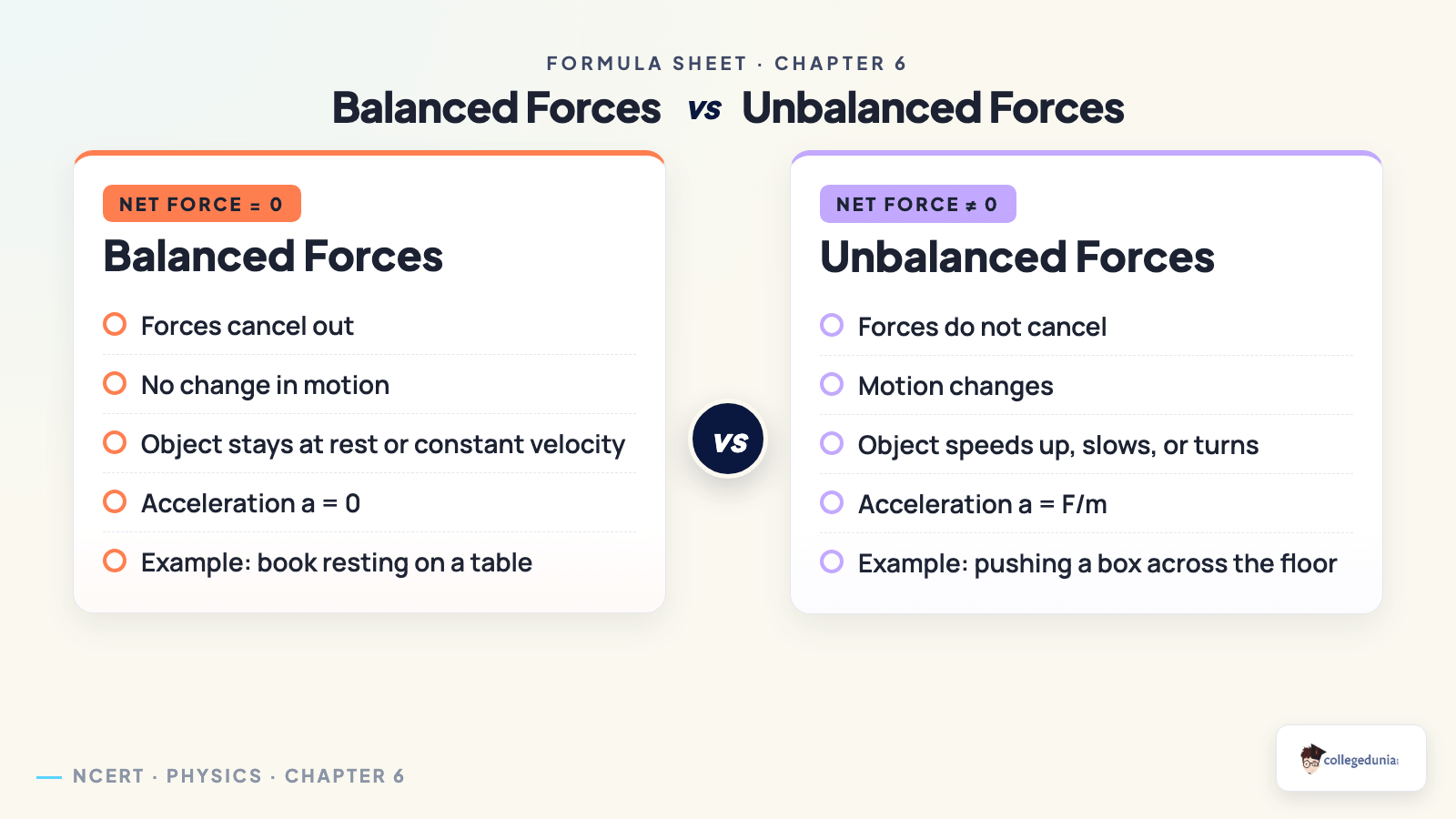
- "Balanced shares nothing, unbalanced changes motion." If the net force is zero, velocity stays constant; if not, the object accelerates in the direction of the net force.
- Keep the second law central: F = m a links force, mass, and acceleration. For a fixed force, a larger mass gets a smaller acceleration.
- Mass versus weight: mass in kilograms never changes; weight W = m g in newtons changes with g. Never mix the two units.
- Third law acts on two bodies: action and reaction are equal and opposite but act on different objects, so they never cancel. A swimmer pushes water back and the water pushes the swimmer forward.
- Momentum: p = m v is mass in motion. A heavy or a fast object has large momentum, and its direction is the direction of motion.
Full topic-by-topic walkthrough: How Forces Affect Motion Class 9 Science Notes
More How Forces Affect Motion Class 9 Science Resources
Use the table below to move between the other Collegedunia resources for this same chapter, from full solutions to handwritten notes.
| Resource | Open |
|---|---|
| Formula Sheet | How Forces Affect Motion Class 9 Science Formula Sheet |
| NCERT Solutions | How Forces Affect Motion Class 9 Science NCERT Solutions |
| Revision Notes | How Forces Affect Motion Class 9 Science Notes |
| Handwritten Notes | How Forces Affect Motion Class 9 Science Handwritten Notes |
| NCERT Book PDF | How Forces Affect Motion Class 9 Science NCERT Book PDF |
NCERT Formula Sheet for Class 9 Science: All Chapters
Formula Sheets are available for the numerical chapters of Class 9 Science. Open any other one below.
| Chapter | Formula Sheet |
|---|---|
| Chapter 5 | Exploring Mixtures and their Separation Formula Sheet |
| Chapter 6 | How Forces Affect Motion Formula Sheet |
| Chapter 7 | Work, Energy, and Simple Machines Formula Sheet |
| Chapter 8 | Journey Inside the Atom Formula Sheet |
| Chapter 9 | Atomic Foundations of Matter Formula Sheet |
| Chapter 10 | Sound Waves Characteristics and Applications Formula Sheet |
How Forces Affect Motion Class 9 Formula Sheet FAQs
Ques. Where can I download the How Forces Affect Motion Class 9 Formula Sheet PDF?
Ans. You can download the How Forces Affect Motion Class 9 Science Formula Sheet PDF free from this page. It covers the newton unit, the net force rules, the effect of friction, Newton's three laws, and the formulae for acceleration, weight, and momentum in the 2026-27 Exploration Chapter 6.
Ques. Is this Formula Sheet aligned with the 2026-27 NCERT?
Ans. Yes. The sheet reflects the current 2026-27 syllabus for the new Class 9 Science Exploration book. Chapter 6 covers force, balanced and unbalanced forces, friction, the three laws of motion, weight, and momentum.
Ques. What is Newton's second law of motion in Class 9 Science Chapter 6?
Ans. Newton's second law says the force on an object equals its mass times its acceleration, so F = m a. For a fixed force, a larger mass gets a smaller acceleration. This is the central formula of the chapter and is used in most numericals.
Ques. What is the difference between mass and weight?
Ans. Mass m is the amount of matter in an object, measured in kilograms, and it stays the same everywhere. Weight W = m g is the force of the Earth's pull, measured in newtons, and it changes with the value of g. Never report weight in kilograms.
Ques. What is the formula for momentum in Class 9 Science?
Ans. Linear momentum is the product of mass and velocity: p = m v. Its SI unit is kg m s-1, and it points in the same direction as the velocity. A heavy or a fast object has large momentum.
Ques. What are balanced and unbalanced forces?
Ans. Forces are balanced when they are equal in size and opposite in direction, so they cancel and the net force is zero; the motion does not change. Forces are unbalanced when they do not cancel, giving a net force that changes the motion. Only an unbalanced force can accelerate an object, using a = F/m.
Ques. How is one newton defined in Chapter 6?
Ans. One newton is the force that gives a mass of one kilogram an acceleration of one metre per second squared, so 1 N = 1 kg m s-2. The unit is named after Isaac Newton and is written with a capital N.
Ques. Which formula do I use for the acceleration of an object?
Ans. Use a = F/m, where F is the net force and m is the mass. For a fixed mass, more force gives more acceleration, and the acceleration points along the net force. This is just Newton's second law rearranged.
Ques. What is Newton's third law of motion?
Ans. Newton's third law states that when one object exerts a force on a second object, the second exerts an equal and opposite force on the first, so FAB = −FBA. The two forces act on different objects, so they do not cancel. A rocket pushes gas down and the gas pushes the rocket up.
Ques. Which is the most important formula in How Forces Affect Motion Class 9?
Ans. Newton's second law F = m a is the highest-yield formula, along with weight W = m g and momentum p = m v. Together they account for the bulk of the numericals asked from Chapter 6 in Class 9 Science.



Comments