




The Atomic Foundations of Matter Class 9 Science Formula Sheet puts every rule of Chapter 9 from the new Exploration textbook on one page. It covers the law of conservation of mass, the law of constant proportions, valency, the criss-cross method for writing chemical formulae, and how to find molecular mass and formula unit mass. The sheet uses short lines and simple words, so you can revise the full chapter fast before a class test or the 2026-27 exam.
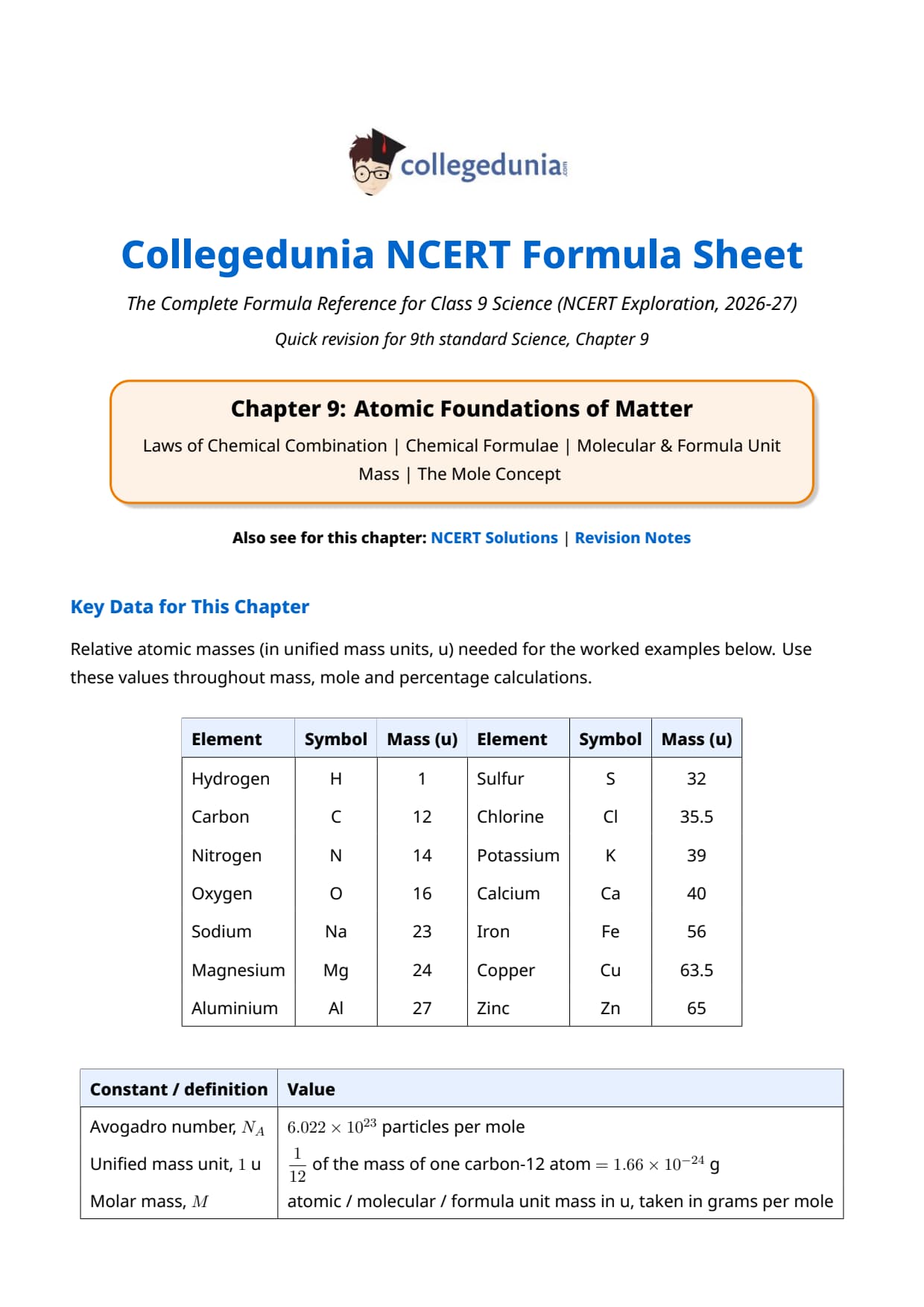
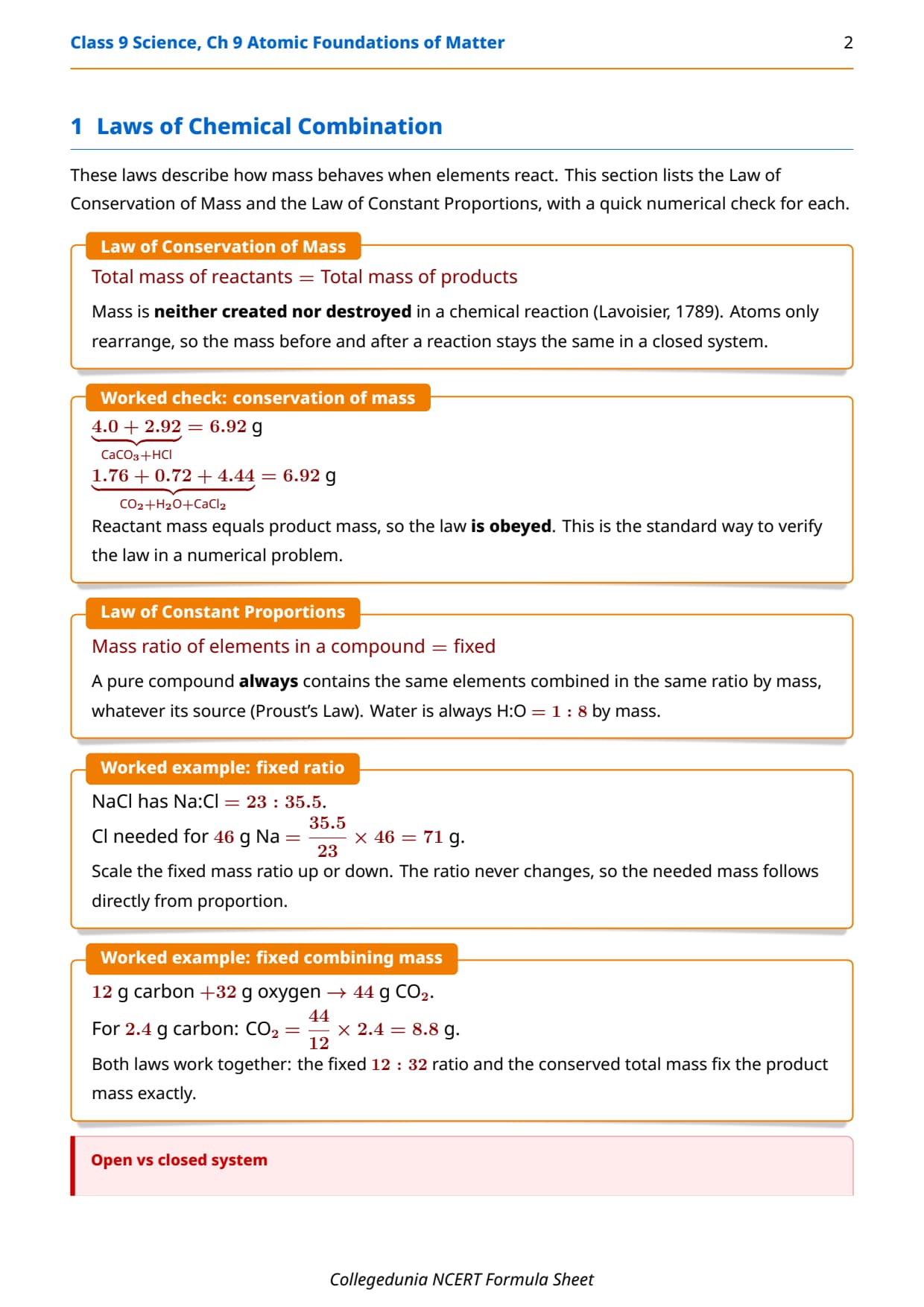
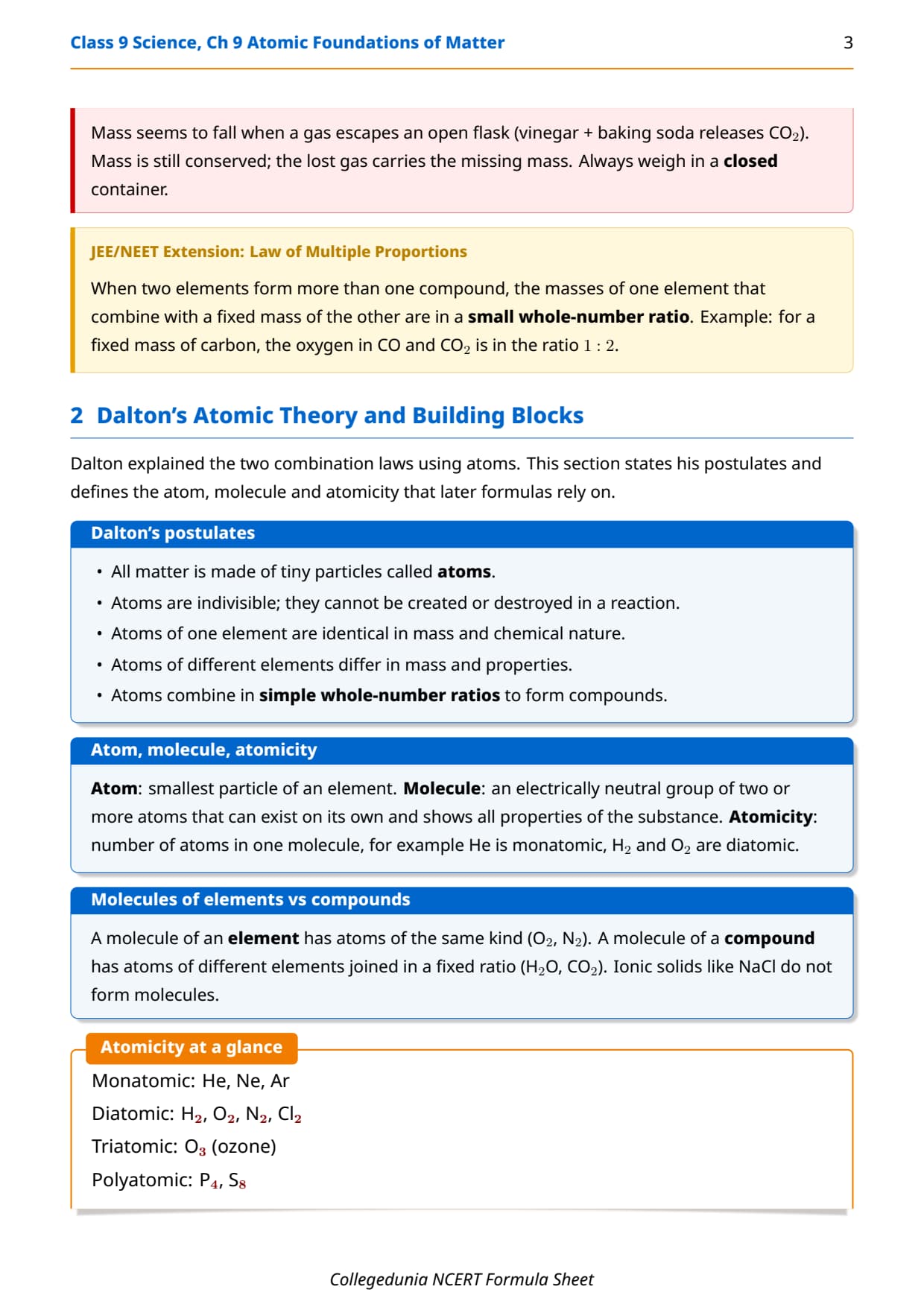
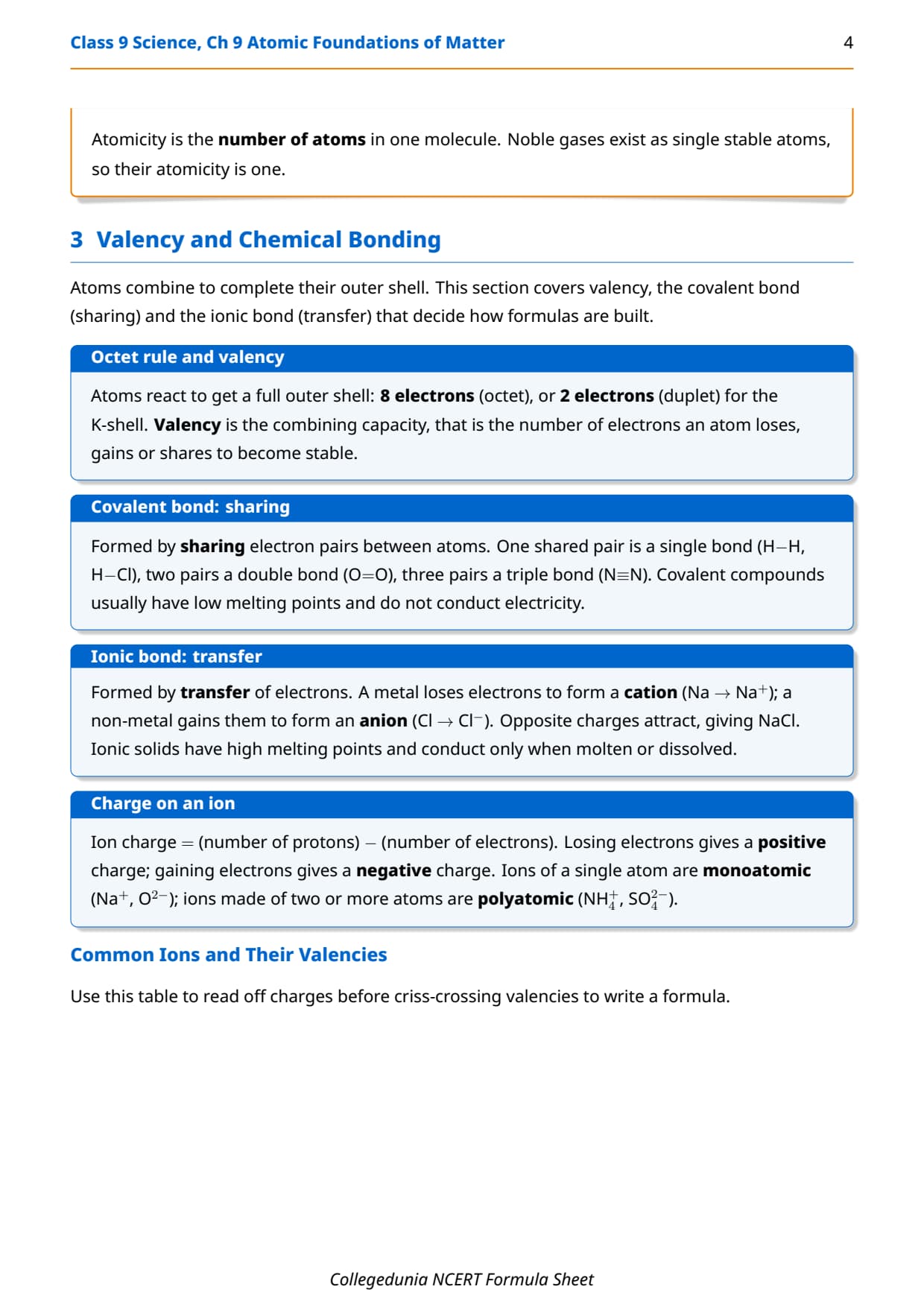
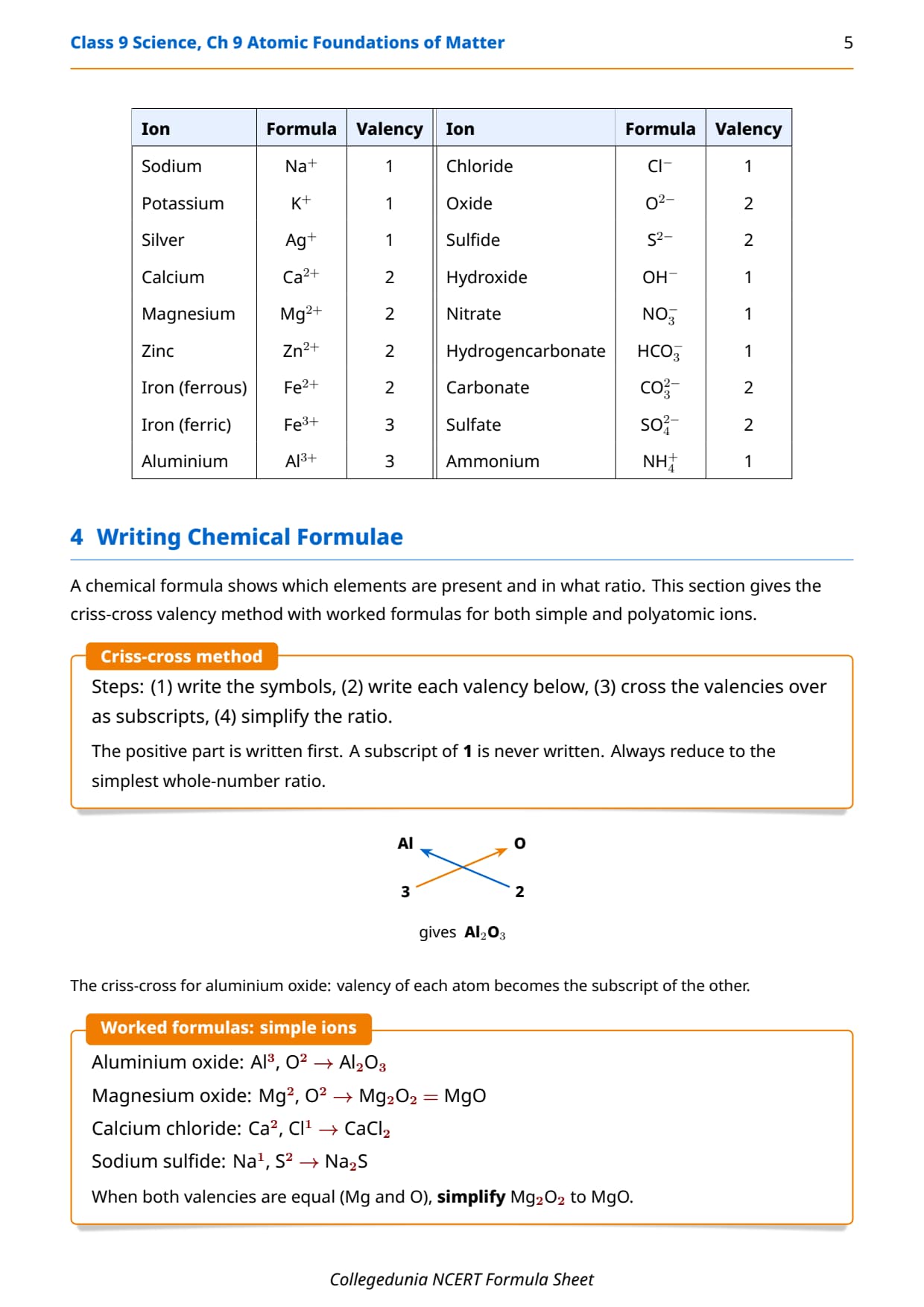
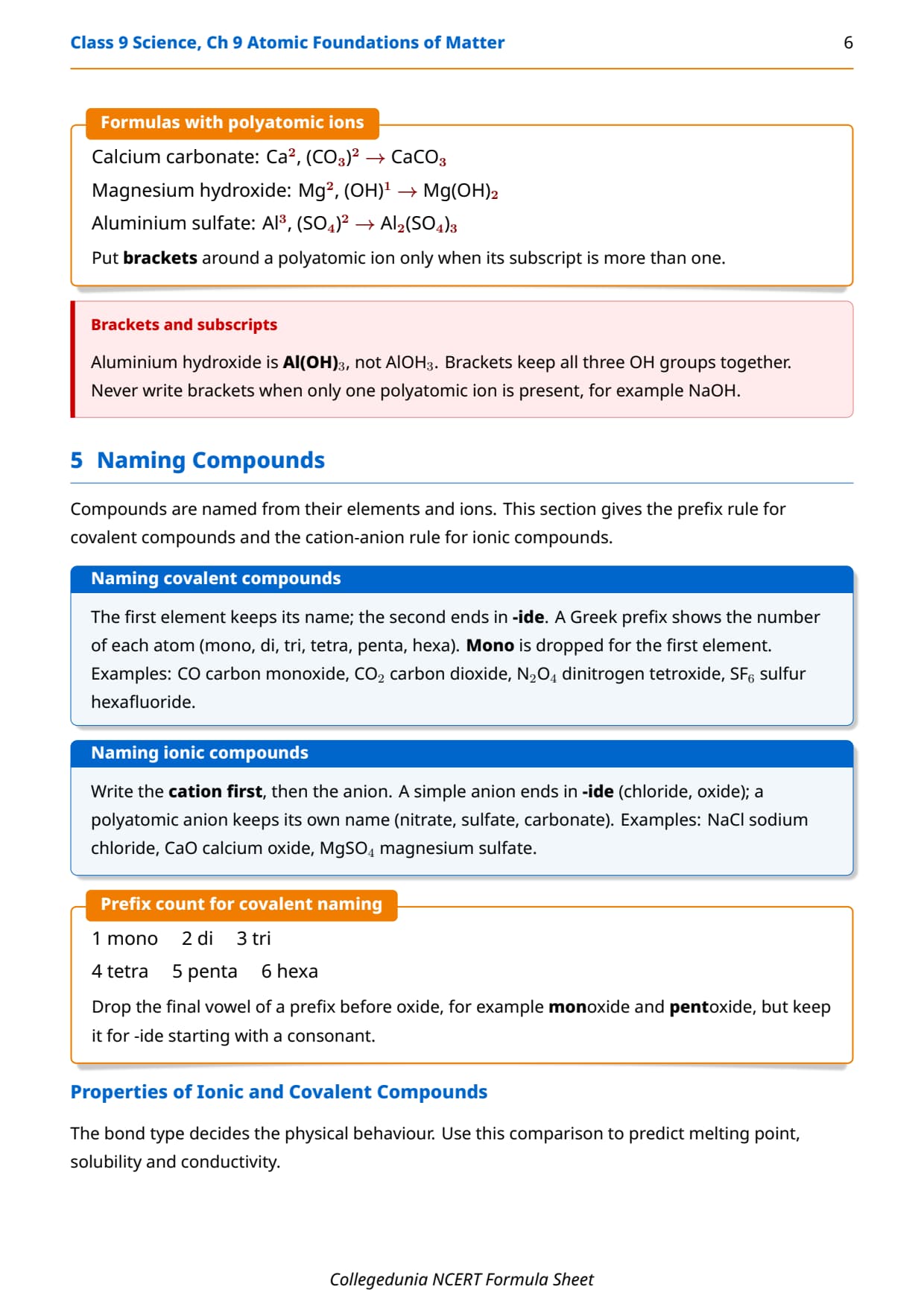
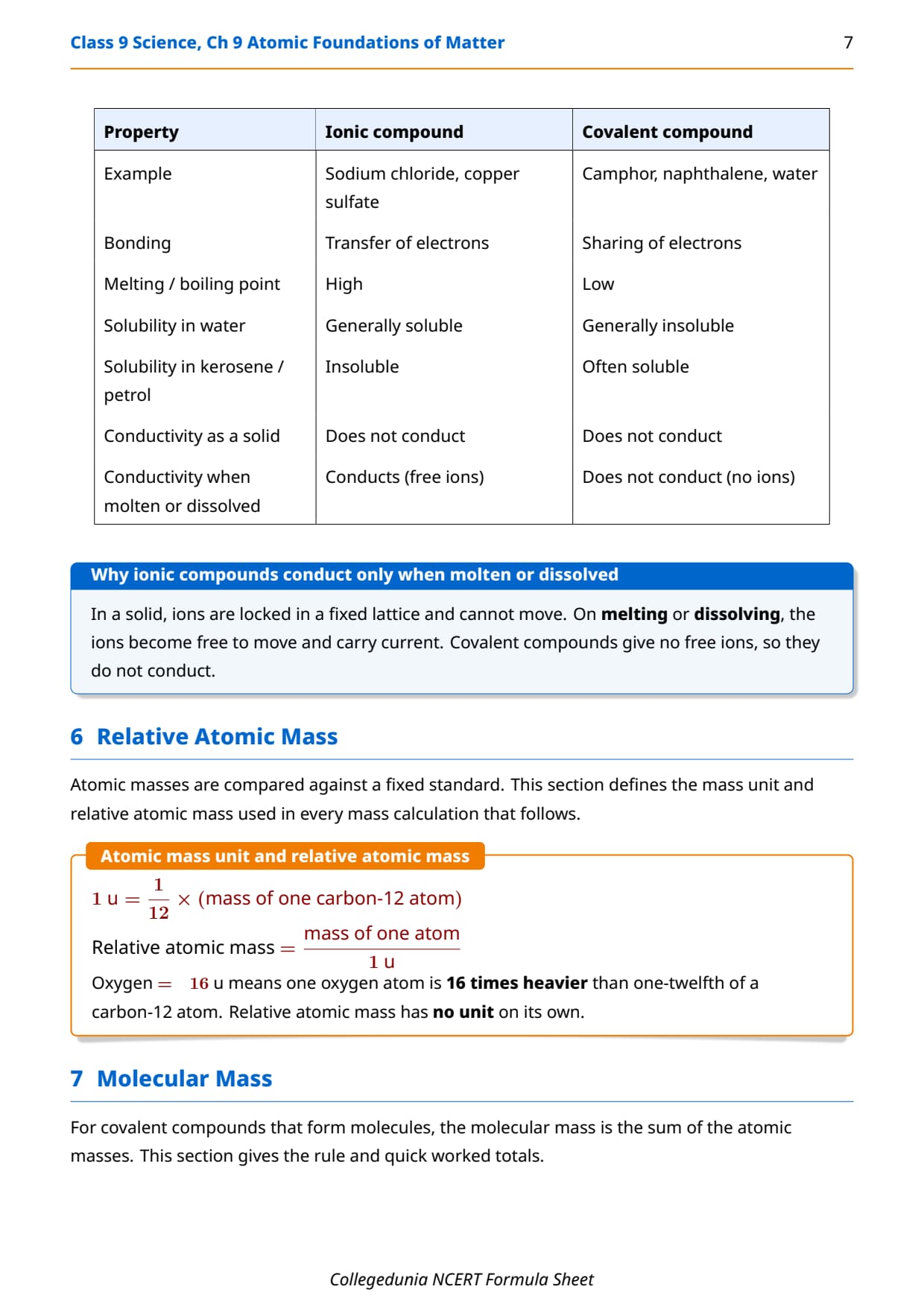
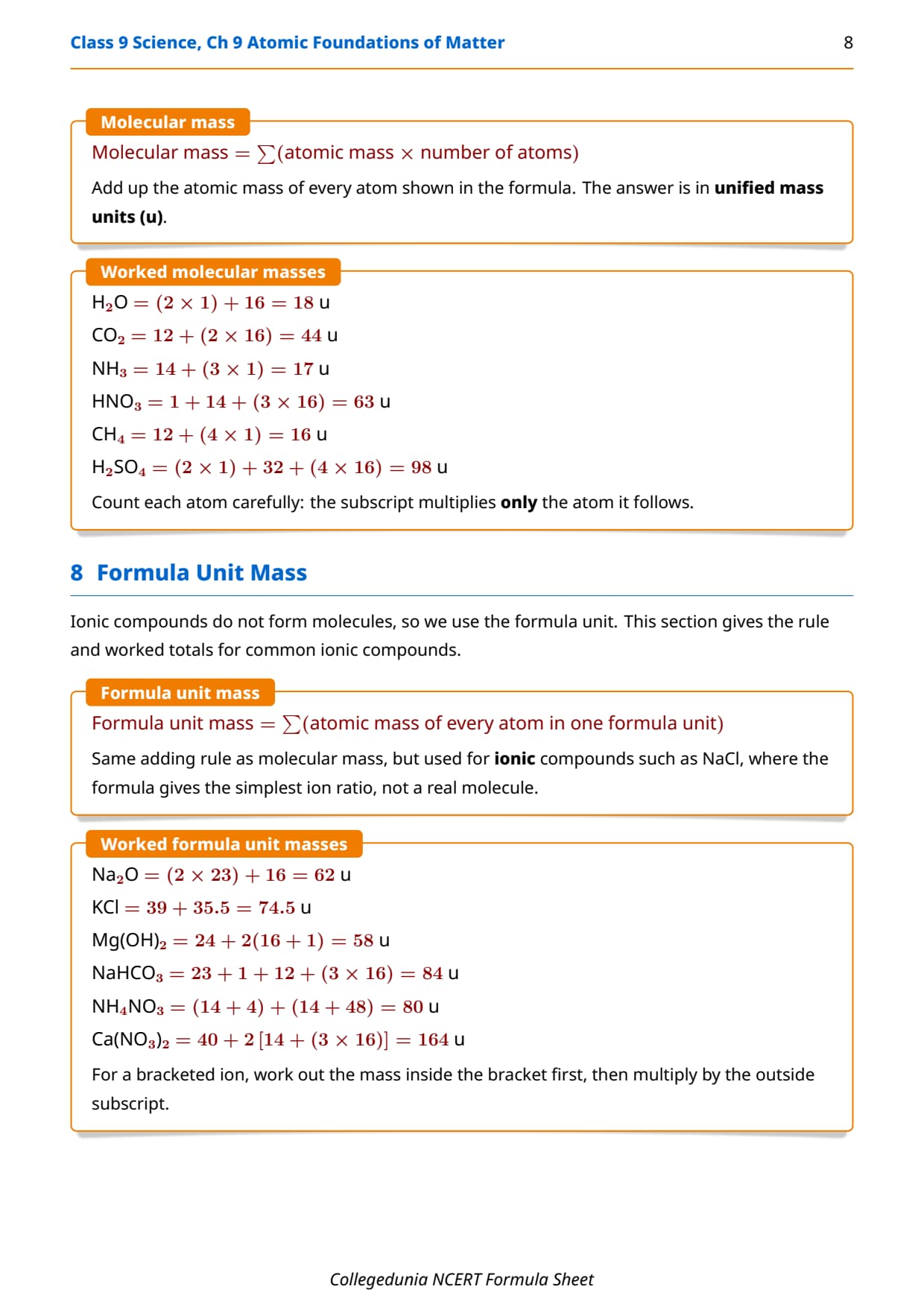
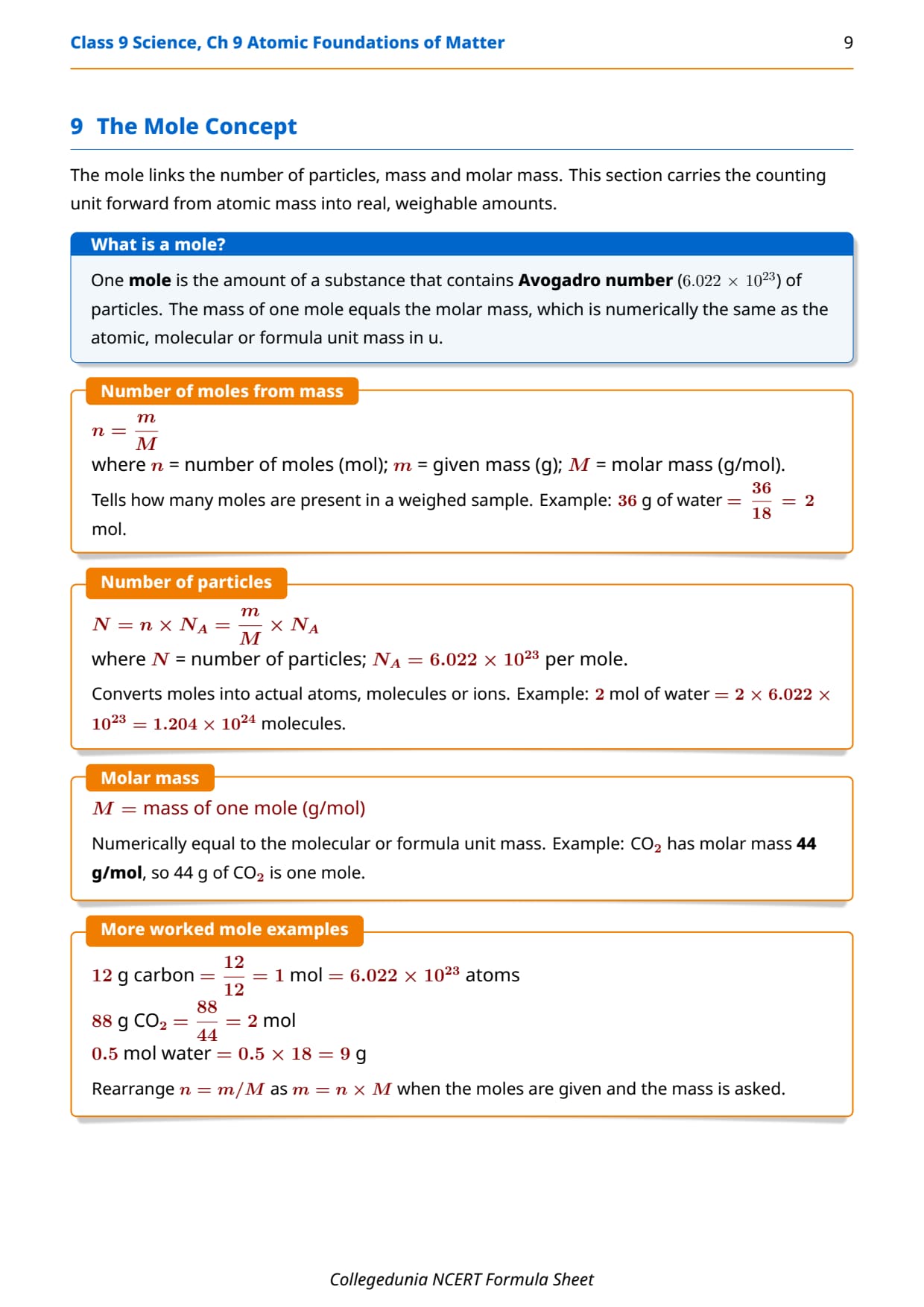
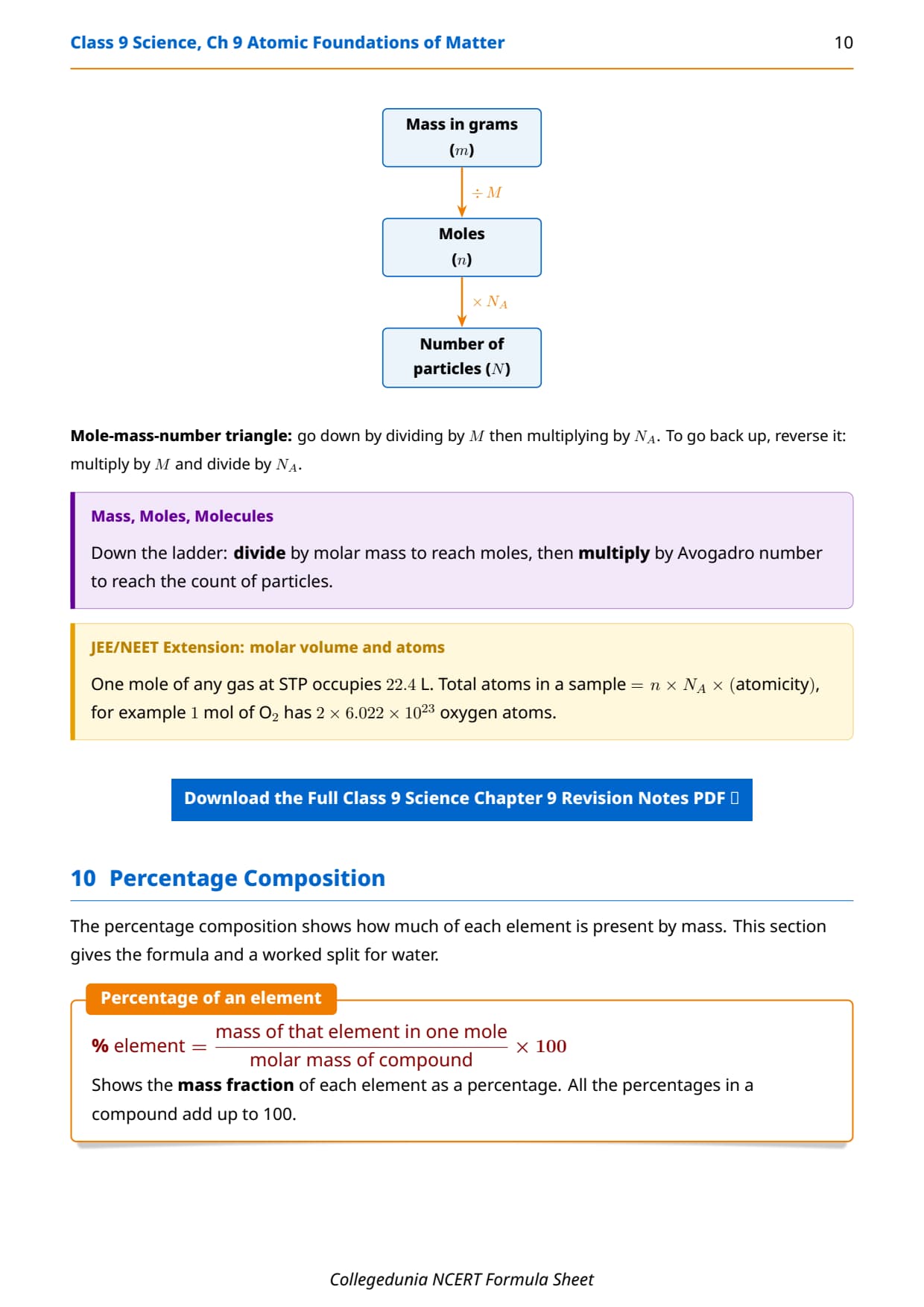
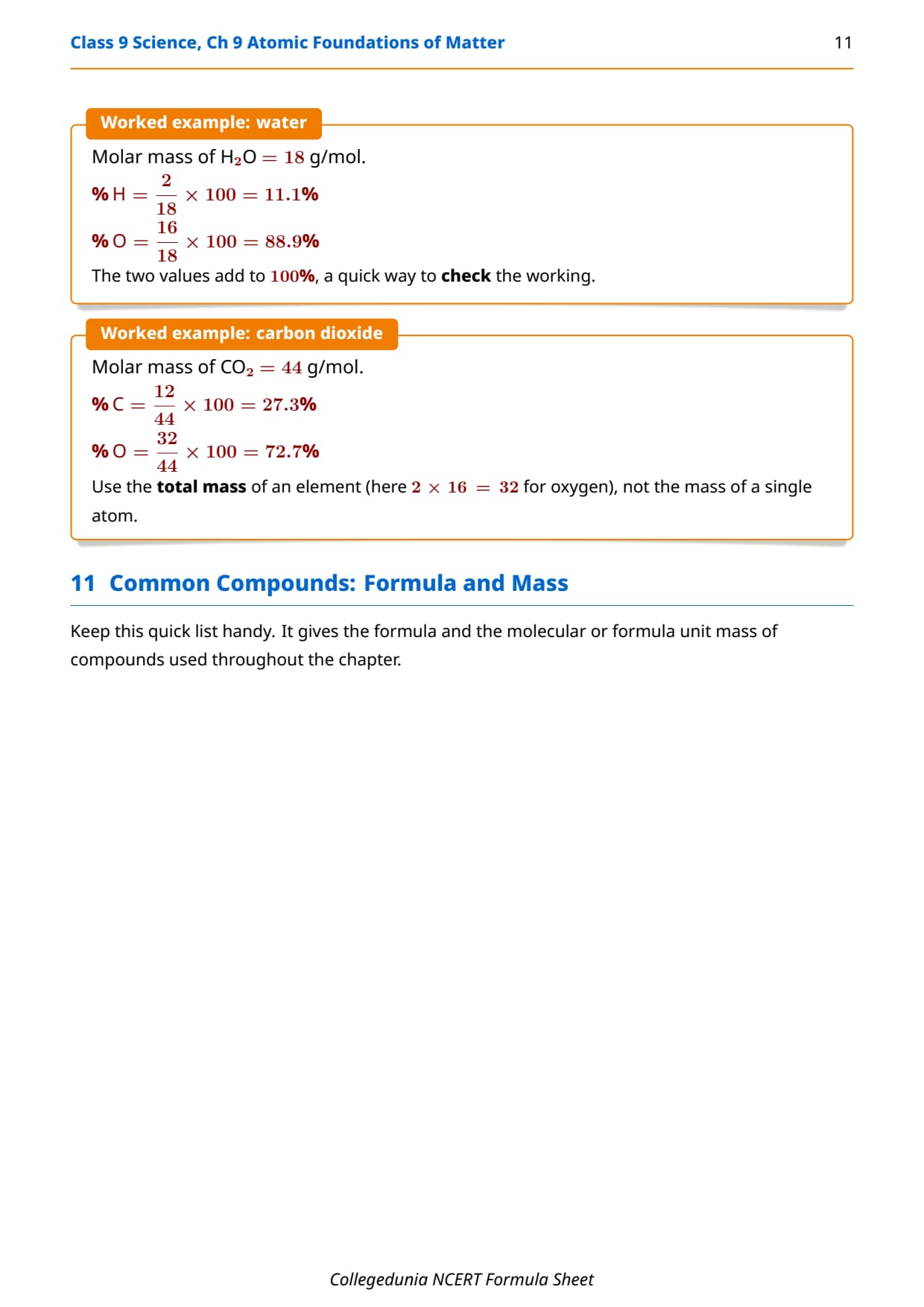
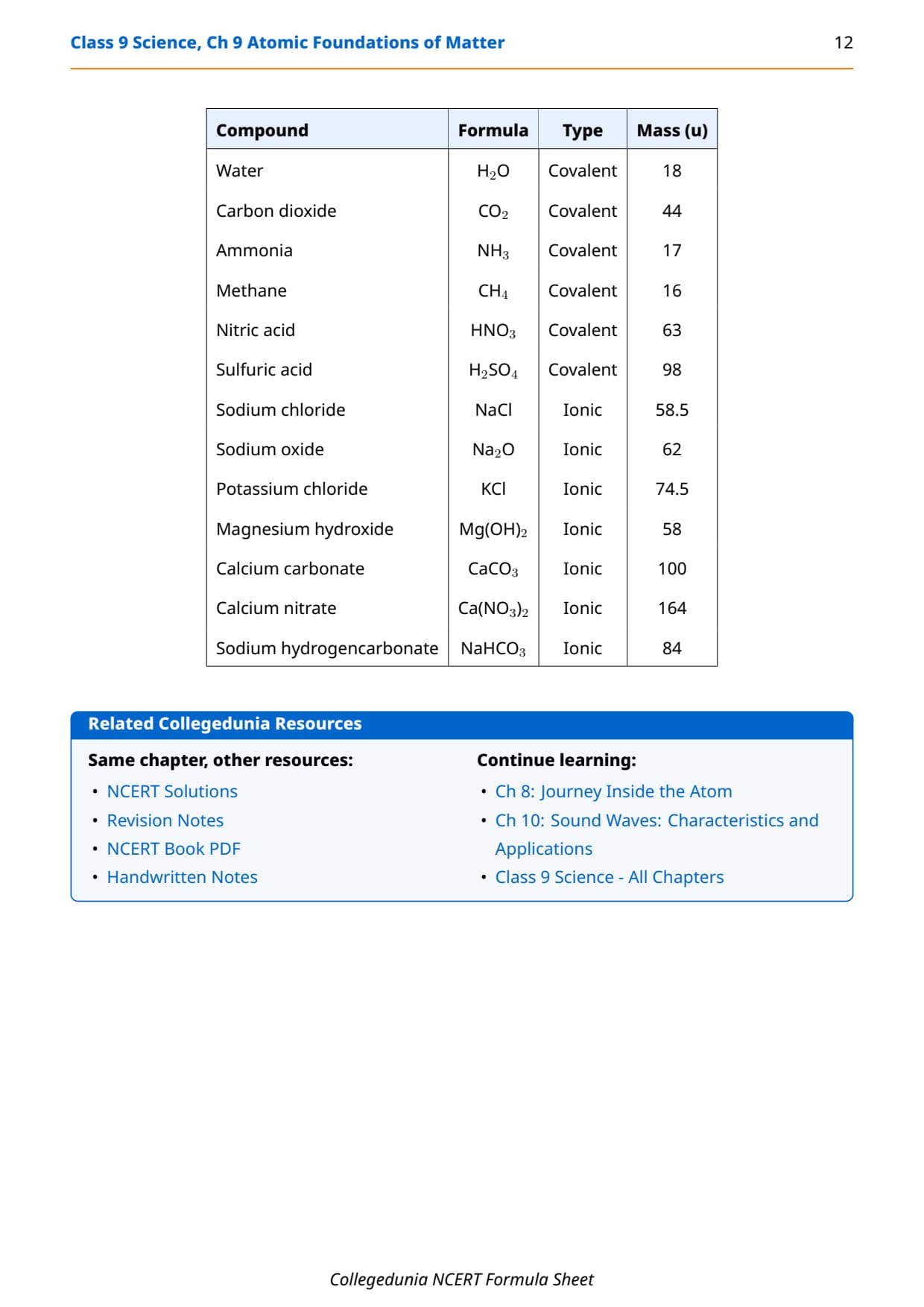
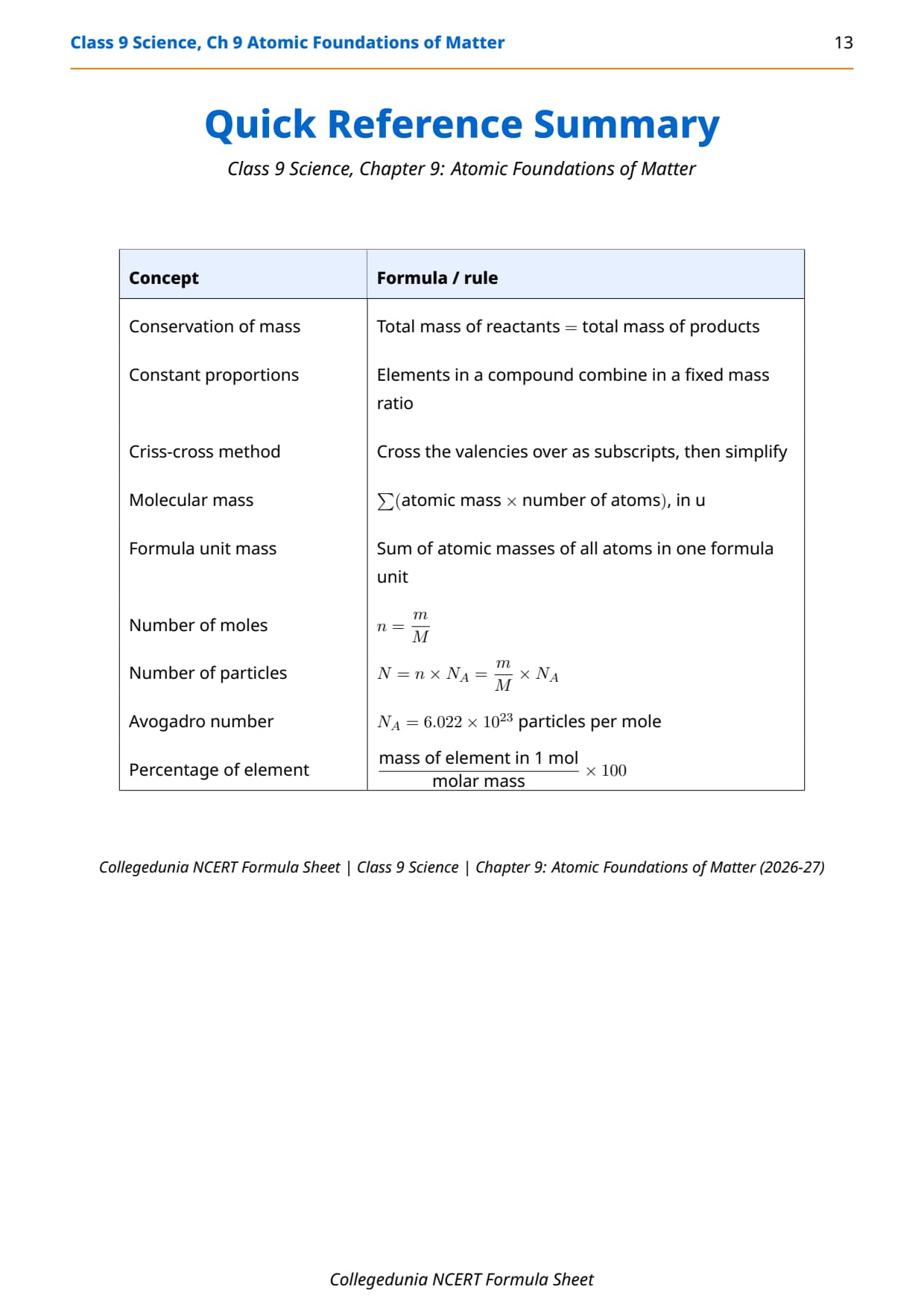
- All rules in one place: conservation of mass, constant proportions, valency, the criss-cross method, molecular mass, and formula unit mass.
- Best used for: writing correct formulae, mass calculations like H2O = 18 u, and quick MCQ recall of atomicity and valency.
- 2026-27 match: mapped to the new Class 9 Science Exploration book and its Revise, Reflect, Refine exercise.
Student Feedback
In a Collegedunia study of 1,180 Class 9 students, 79% said keeping the criss-cross steps and the mass rules on one page helped them write chemical formulae without slips. About 4 out of 5 rated the molecular mass versus formula unit mass card the clearest part, and many said the quick-fact cards made one-mark questions easy.
|
Table of Contents |
What You Get in the Atomic Foundations of Matter Class 9 Science Formula Sheet
Chapter 9 explains how atoms join to build every substance, and why mass and proportions stay fixed while this happens. This Formula Sheet gathers every rule you need in the same order as the Exploration book, so your revision follows the flow of the chapter. Remember, this chapter stops at molecular mass and formula unit mass, so there is no mole concept to learn in this chapter.
- Two basic laws: the law of conservation of mass and the law of constant proportions, with a quick way to check each in a numerical.
- Atoms and bonding: valency, atomicity, and how covalent and ionic bonds form.
- Writing formulae: the criss-cross valency method for both simple and polyatomic ions.
- Mass calculations: relative atomic mass, molecular mass, and formula unit mass, all in unified mass units.
Atomic Foundations of Matter Class 9 Science in One Shot
Source: Alakh Pandey - Class 9th & 10th on YouTube
Atomic Foundations of Matter Class 9 Science Complete Formula Reference
The table lists every rule and formula in Chapter 9, with its meaning and the unit of the answer. Keep it open while you solve the Revise, Reflect, Refine questions.
| Concept | Formula / Rule | Meaning | Unit |
|---|---|---|---|
| Law of conservation of mass | mass of reactants = mass of products | Total mass stays the same in a closed reaction | gram (g) |
| Law of constant proportions | mass ratio of elements = fixed | A pure compound always has the same ratio by mass | ratio (no unit) |
| Valency | combining capacity of an atom | Electrons lost, gained, or shared to become stable | whole number |
| Atomicity | atoms in one molecule | He is 1, O2 is 2, O3 is 3 | whole number |
| Charge on an ion | charge = protons − electrons | Lose electrons gives positive; gain gives negative | unit charge |
| Criss-cross method | Ax By → AyBx | Cross the valencies over as subscripts, then simplify | - |
| Unified mass unit | 1 u = 112 of a carbon-12 atom | The standard for comparing atomic masses | u |
| Relative atomic mass | mass of one atom1 u | How many times heavier an atom is than 1 u | no unit |
| Molecular mass | ∑ (atomic mass × number of atoms) | Sum of atomic masses in a molecule (covalent) | u |
| Formula unit mass | ∑ atomic masses in one formula unit | Same rule for an ionic compound like NaCl | u |
Learning this one table covers nearly every formula-writing and mass question asked from Class 9 Science Chapter 9.
When to Use Which Formula in Atomic Foundations of Matter Class 9
Picking the right rule is the difference between a clean answer and a lost mark. Read what the question gives you, then choose from the list below.
- Reactant and product masses given, asks if a law holds: use the law of conservation of mass. Add all reactant masses and all product masses; if the totals match, the law is obeyed.
- Mass of one element given, asks for the other: use the law of constant proportions and scale the fixed mass ratio up or down.
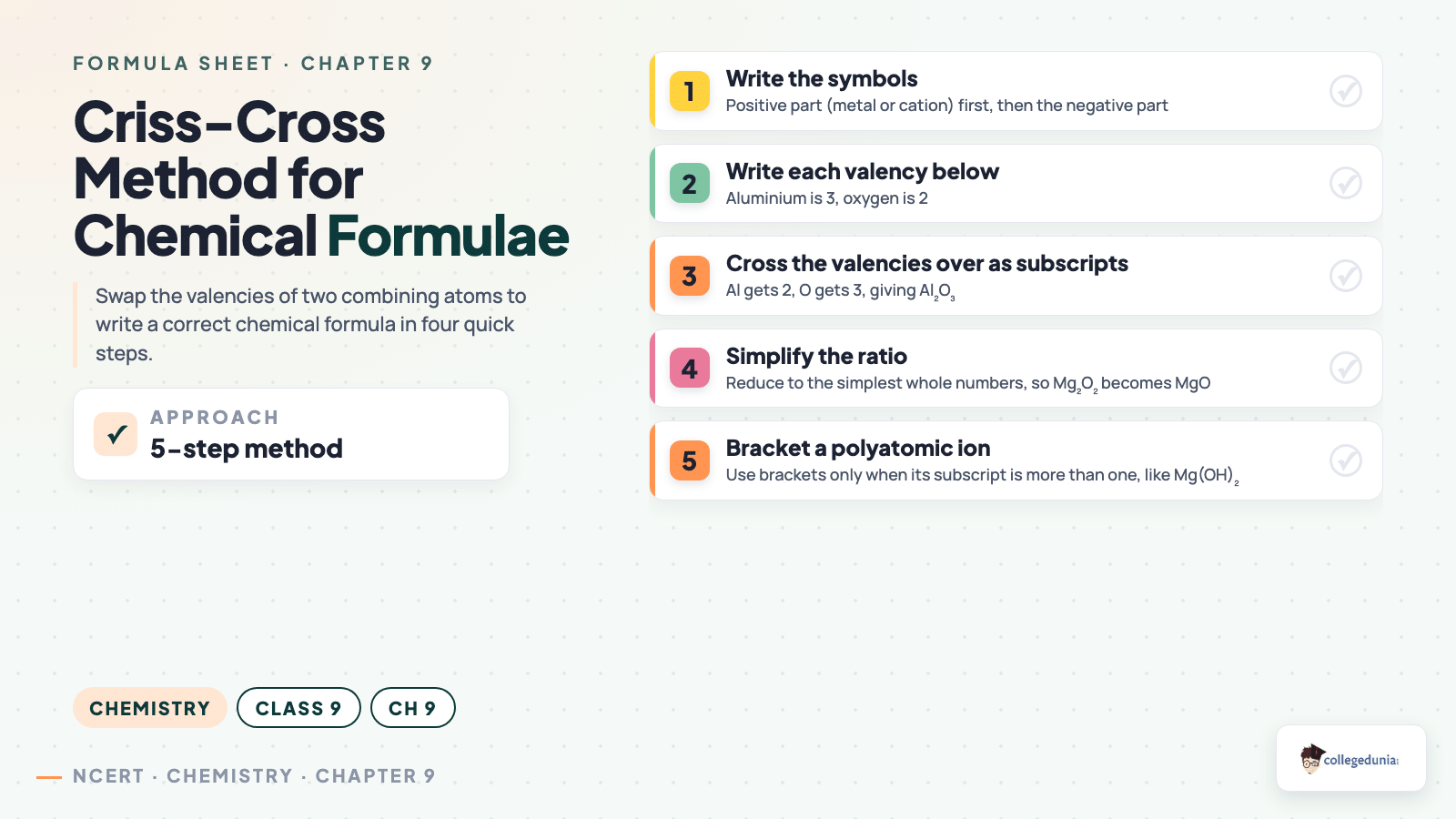
- Two symbols and their valencies given: use the criss-cross method Ax By → AyBx, then reduce to the simplest ratio.
- Formula of a covalent compound given: find its molecular mass by ∑ (atomic mass × number of atoms).
- Formula of an ionic compound given: find its formula unit mass by adding the atomic masses of every atom in one formula unit.
- A polyatomic ion has a subscript: work out the mass inside the bracket first, then multiply by the outside subscript, as in Ca(NO3)2.
Atomic Foundations of Matter Class 9 Quick-Fact Cards for MCQ Recall
These small facts are the ones MCQ writers reach for most often. Glance over them the morning of any test.
Symbol Glossary and Units for Class 9 Science Chapter 9
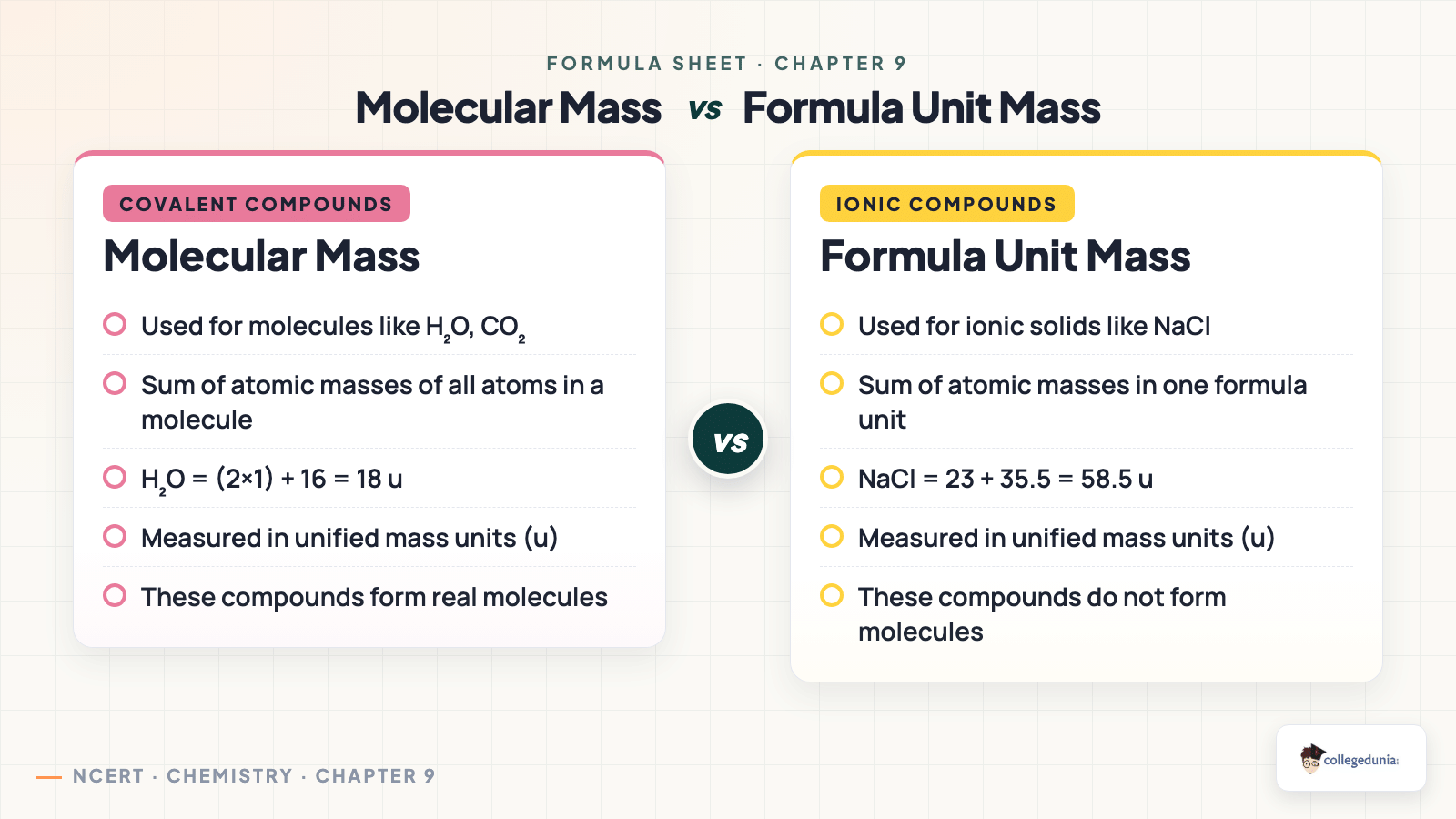
Every term used above, decoded with its unit. Note that molecular mass is used for covalent compounds and formula unit mass for ionic compounds, but the adding rule is the same.
| Term | What it means | Unit |
|---|---|---|
| u | Unified mass unit, one-twelfth of a carbon-12 atom | u |
| Relative atomic mass | Mass of an atom compared to 1 u | no unit |
| Molecular mass | Sum of atomic masses in one molecule | u |
| Formula unit mass | Sum of atomic masses in one formula unit | u |
| Valency | Combining capacity of an atom | whole number |
| Atomicity | Number of atoms in one molecule | whole number |
| Cation | Positive ion formed by losing electrons | - |
| Anion | Negative ion formed by gaining electrons | - |
Atomic Foundations of Matter Top Formulae Recap: Quick Revision for Class 9
The five rules below carry the largest share of marks from this chapter. Revise them last, right before the exam.
| Concept | Formula / rule to remember |
|---|---|
| Conservation of mass | mass of reactants = mass of products |
| Constant proportions | Elements in a compound combine in a fixed mass ratio |
| Criss-cross method | Cross the valencies over as subscripts, then simplify |
| Molecular mass | ∑ (atomic mass × number of atoms), in u |
| Formula unit mass | Sum of the atomic masses of all atoms in one formula unit |
Full step-by-step solutions: Atomic Foundations of Matter Class 9 Science NCERT Solutions
One-Shot Revision Tips for Atomic Foundations of Matter Class 9
Treat this sheet as a checklist you tick off as you recall every rule the night before a test.
- Weigh in a closed container: mass looks lost when a gas escapes an open flask, but the law of conservation of mass still holds because the gas carries the mass away.
- Positive part first: in every formula, write the metal or cation before the non-metal or anion, as in NaCl and CaCO3.
- Bracket a polyatomic ion only when needed: use brackets when its subscript is more than one, so aluminium hydroxide is Al(OH)3, not AlOH3.
- Never show charges in the final formula: write Al2O3, not Al23+O32-.
- Check with the mass ratio: the law of constant proportions applies to compounds, not mixtures, because a mixture has no fixed ratio.
Full topic-by-topic notes: Atomic Foundations of Matter Class 9 Science Notes
How Collegedunia's Atomic Foundations of Matter Formula Sheet Helps You
Collegedunia gives you the full Class 9 Science Chapter 9 Formula Sheet as one clean, easy-to-read page.
- 2026-27 Exploration match: every rule follows the new textbook and stops exactly where the chapter does, at molecular mass and formula unit mass.
- Simple English: short lines and everyday words, so a Class 9 student can revise without help.
- Formula and table ready: the criss-cross method, mass rules, and quick-fact cards in one view.
- Free PDF: download the sheet and revise offline before your exam.
More Atomic Foundations of Matter Class 9 Science Resources
Use the table below to move between the other Collegedunia resources for this same chapter, from full solutions to handwritten notes.
| Resource | Open |
|---|---|
| Formula Sheet | Atomic Foundations of Matter Class 9 Science Formula Sheet |
| NCERT Solutions | Atomic Foundations of Matter Class 9 Science NCERT Solutions |
| Revision Notes | Atomic Foundations of Matter Class 9 Science Notes |
| Handwritten Notes | Atomic Foundations of Matter Class 9 Science Handwritten Notes |
| NCERT Book PDF | Atomic Foundations of Matter Class 9 Science NCERT Book PDF |
NCERT Formula Sheet for Class 9 Science: All Chapters
Formula Sheets are available for the numerical chapters of Class 9 Science. Open any other one below.
| Chapter | Formula Sheet |
|---|---|
| Chapter 5 | Exploring Mixtures and their Separation |
| Chapter 6 | How Forces Affect Motion |
| Chapter 7 | Work, Energy, and Simple Machines |
| Chapter 8 | Journey Inside the Atom |
| Chapter 9 | Atomic Foundations of Matter |
| Chapter 10 | Sound Waves Characteristics and Applications |
Atomic Foundations of Matter Class 9 Science Formula Sheet FAQs
Ques. Where can I download the Atomic Foundations of Matter Class 9 Science Formula Sheet PDF?
Ans. You can download the Atomic Foundations of Matter Class 9 Science Formula Sheet PDF free from this page. It maps to the 2026-27 Exploration book and covers the laws of chemical combination, valency, the criss-cross method, molecular mass, and formula unit mass.
Ques. Does Class 9 Science Chapter 9 include the mole concept?
Ans. No. In the new Exploration textbook, Chapter 9 stops at molecular mass and formula unit mass. The mole concept, molar mass, and Avogadro number are not part of this chapter, so this Formula Sheet does not include them.
Ques. How do I use the criss-cross method to write a chemical formula?
Ans. Write the symbols with the positive part first, write the valency below each, then cross the valencies over as subscripts and simplify. For example, aluminium (valency 3) and oxygen (valency 2) give Al2O3.
Ques. What is the difference between molecular mass and formula unit mass?
Ans. Molecular mass is the sum of atomic masses in one molecule of a covalent compound, like H2O = 18 u. Formula unit mass is the same sum for an ionic compound like NaCl = 58.5 u, which does not form molecules. The adding rule is the same for both.
Ques. What is the law of conservation of mass in Class 9 Science Chapter 9?
Ans. The law of conservation of mass, given by Antoine Lavoisier, states that the total mass of the reactants equals the total mass of the products in a chemical reaction. To check it in a numerical, add the reactant masses and the product masses; if the two totals match, the law is obeyed.
Ques. Is this Formula Sheet aligned with the 2026-27 NCERT?
Ans. Yes. The sheet reflects the current 2026-27 syllabus for the new Class 9 Science Exploration book. Chapter 9 keeps the laws of chemical combination, Dalton's atomic theory, valency and bonding, writing chemical formulae, and molecular and formula unit mass.
Ques. How do I find the molecular mass of a compound in Chapter 9?
Ans. Add the atomic mass of every atom shown in the formula, using ∑ (atomic mass × number of atoms). For carbon dioxide, CO2 = 12 + (2 × 16) = 44 u. The answer is in unified mass units (u).
Ques. Which rules from Chapter 9 are most important for the exam?
Ans. The law of conservation of mass, the law of constant proportions, the criss-cross method for formulae, and the molecular mass and formula unit mass calculations carry the most marks. Together they cover almost every question asked from this chapter in the 2026-27 exam.



Comments