




The How Forces Affect Motion Class 9 Science Handwritten Notes are a topper's own neat revision of Chapter 6 from the new Exploration textbook. Every idea, force, net force, balanced and unbalanced forces, friction, and Newton's three laws, is written by hand with the key formula F = ma boxed in the margin. You revise the whole 2026-27 chapter in one short sitting, just as you would set it out in the exam.
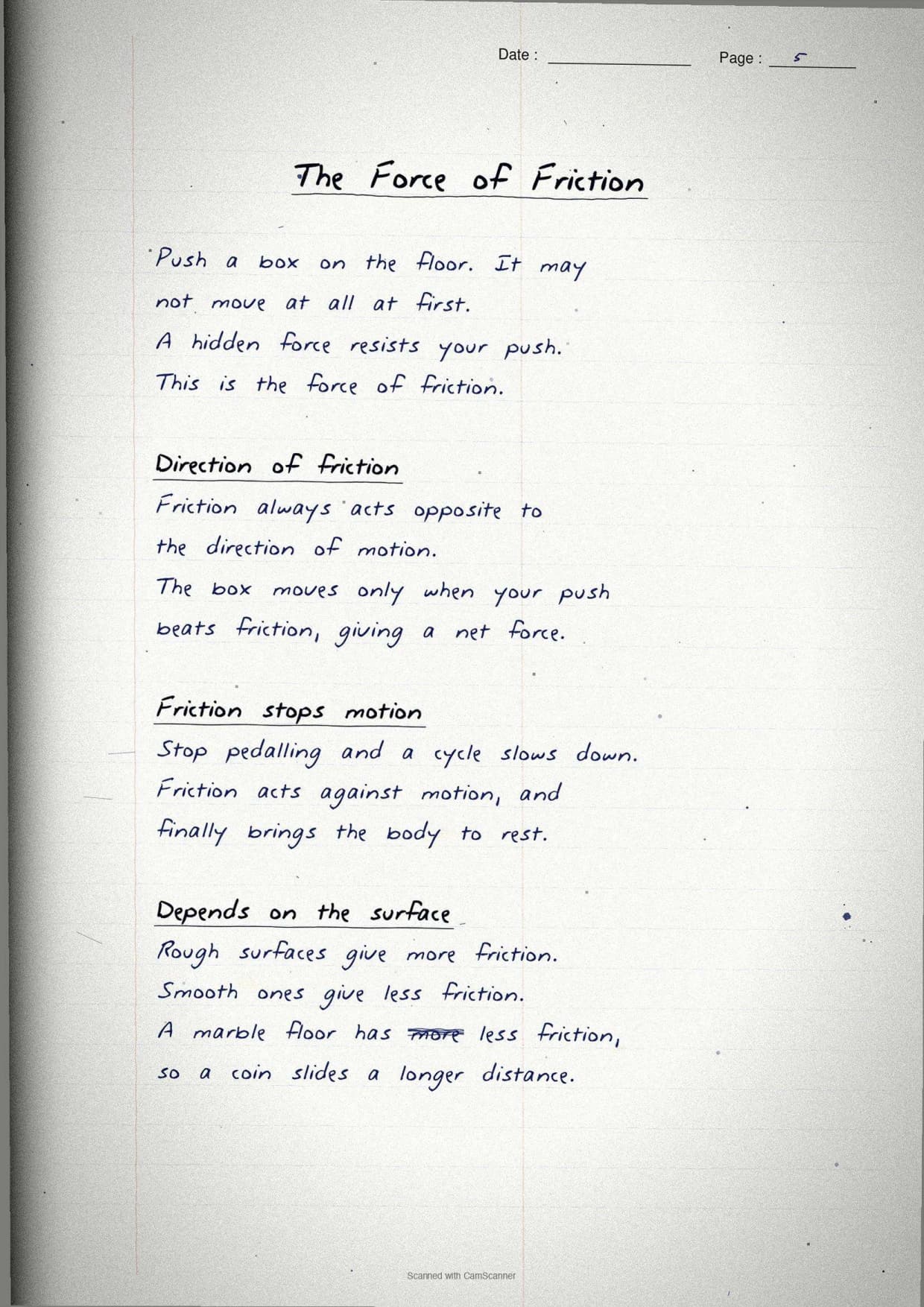
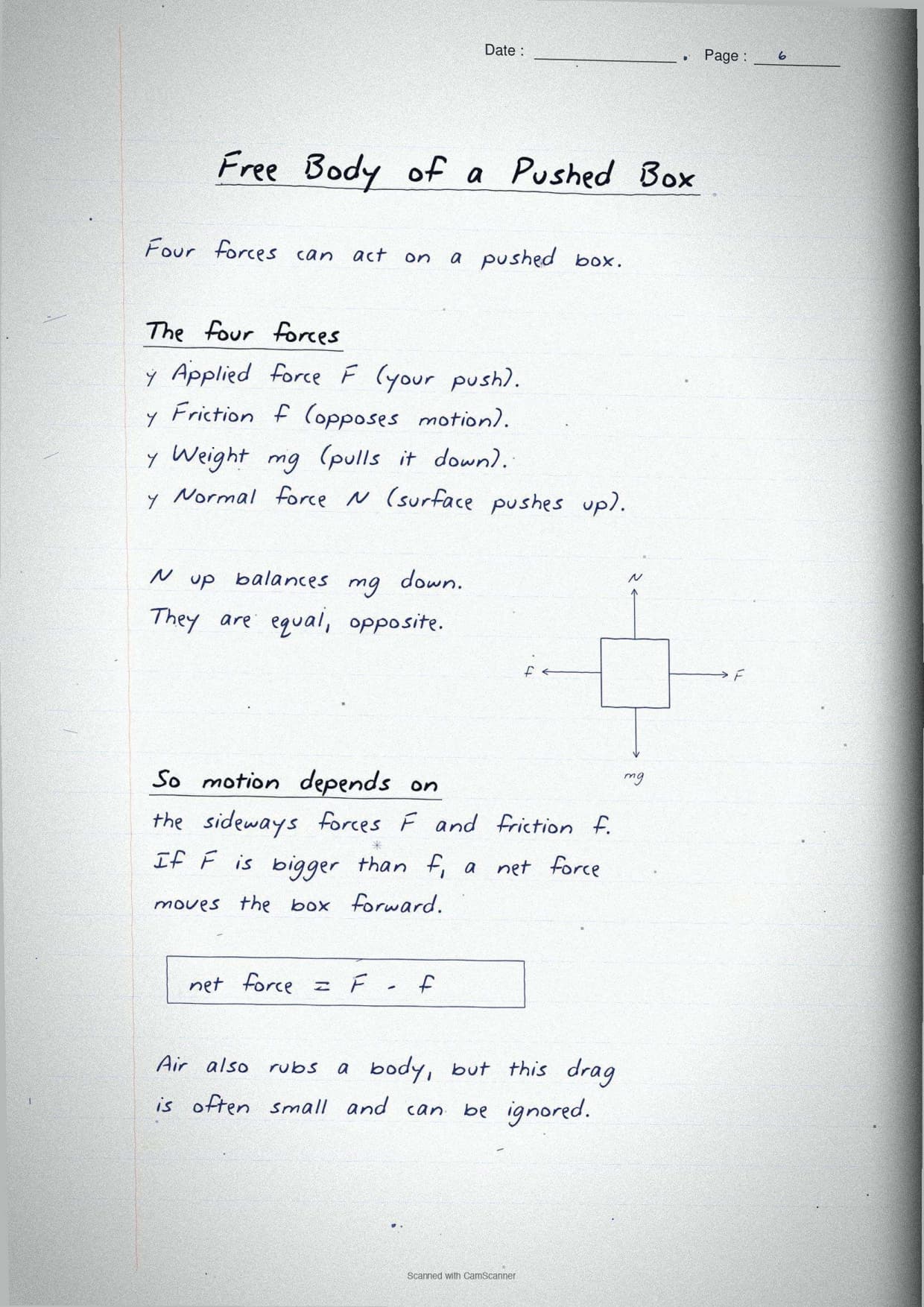
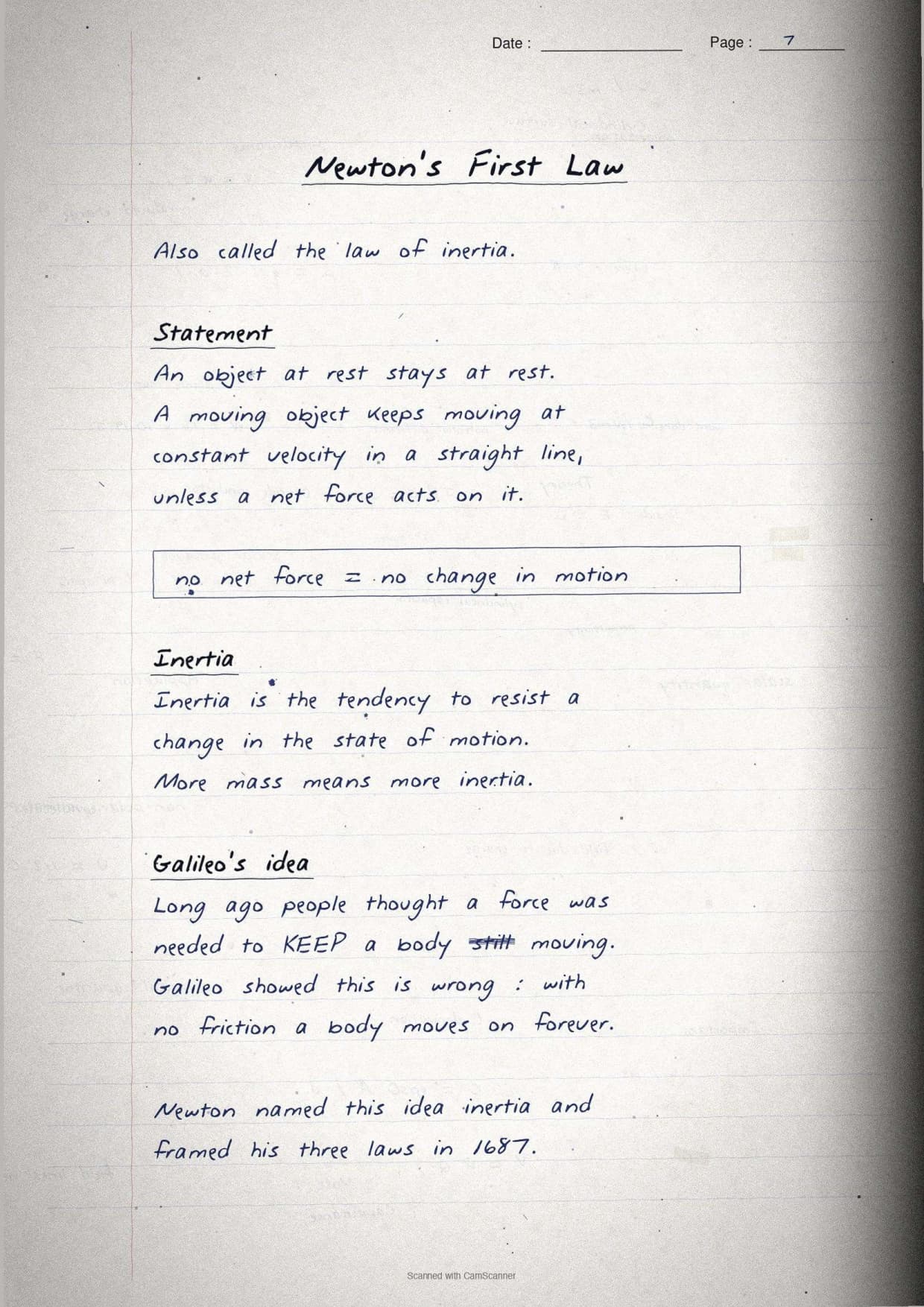
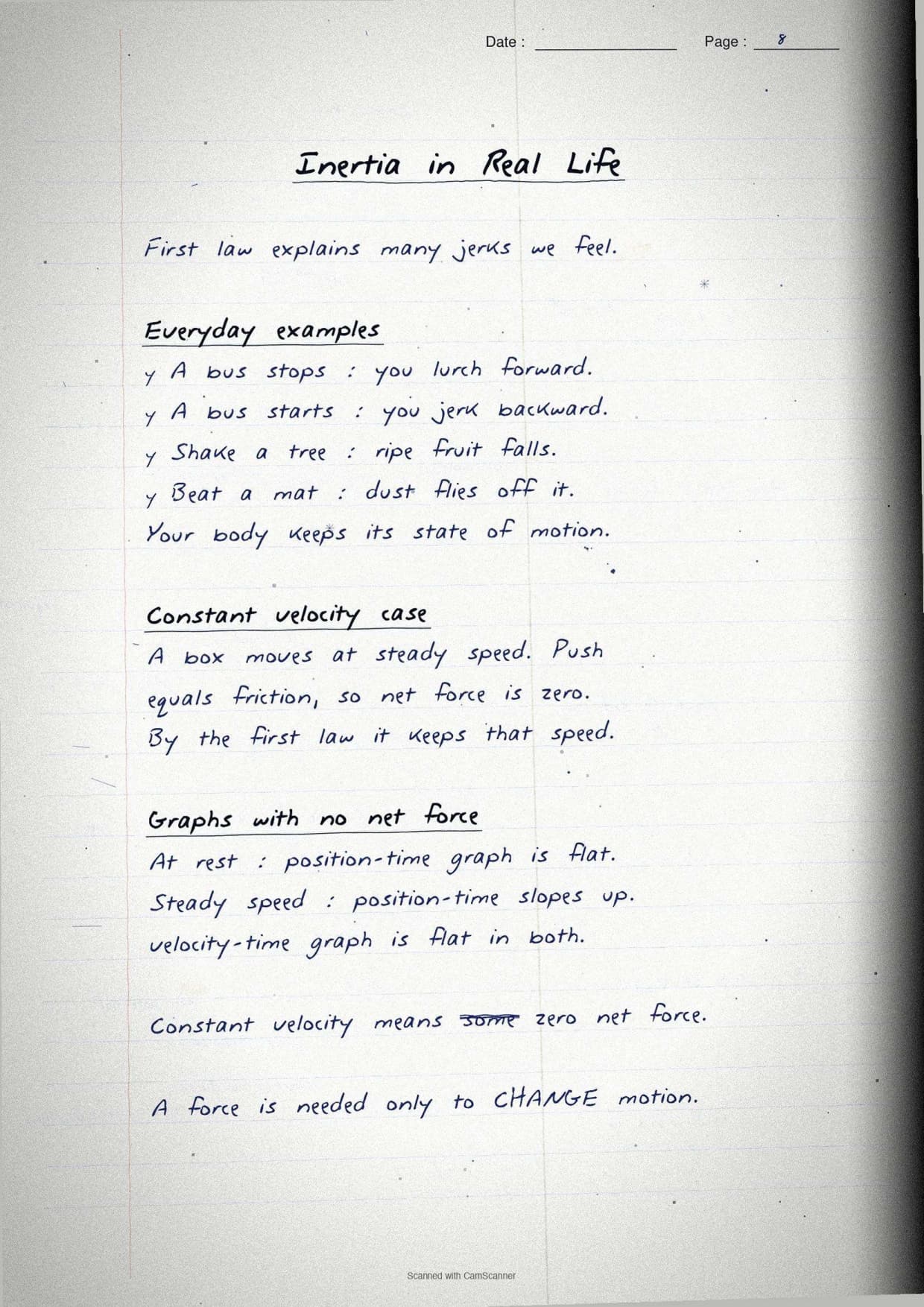
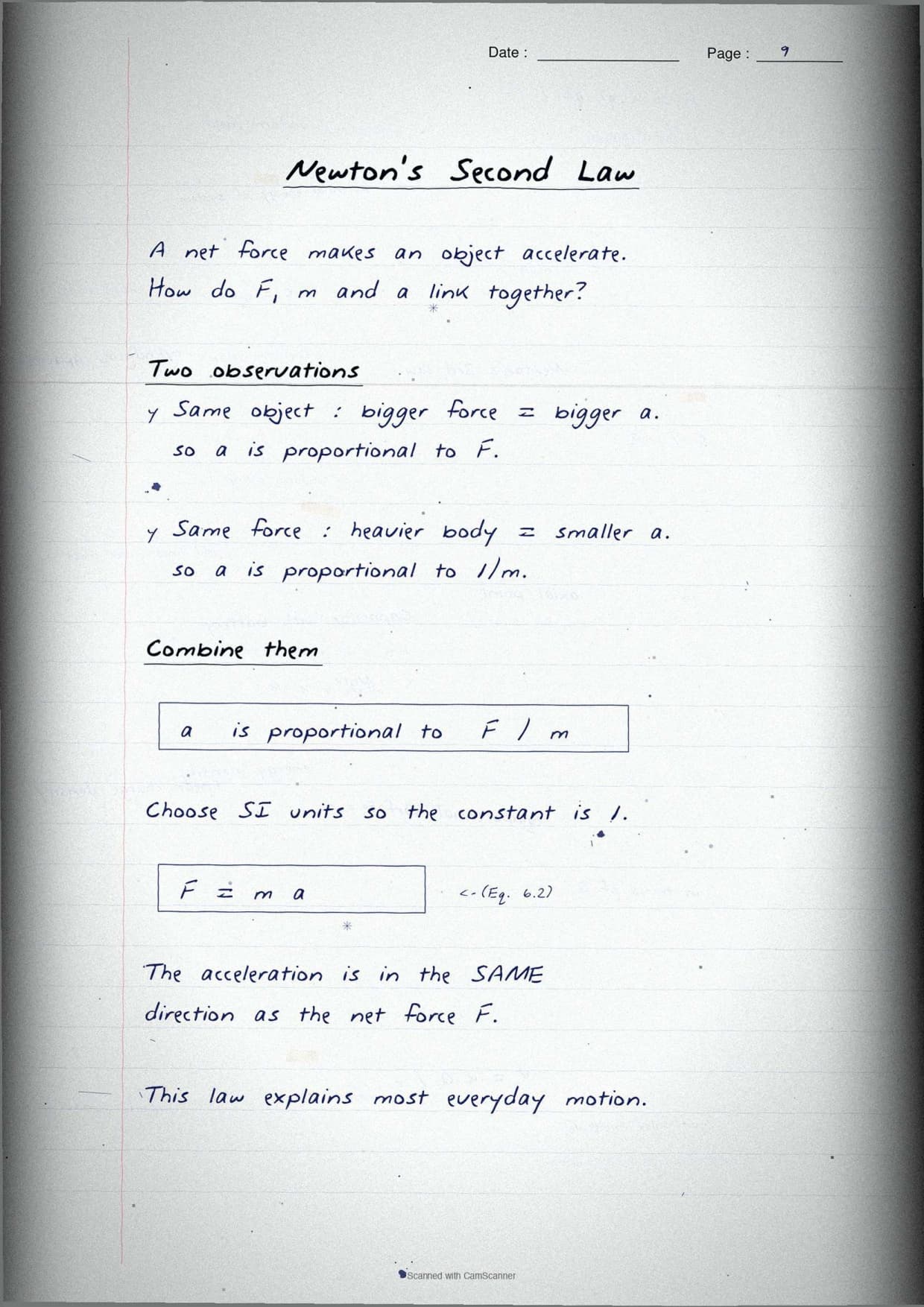
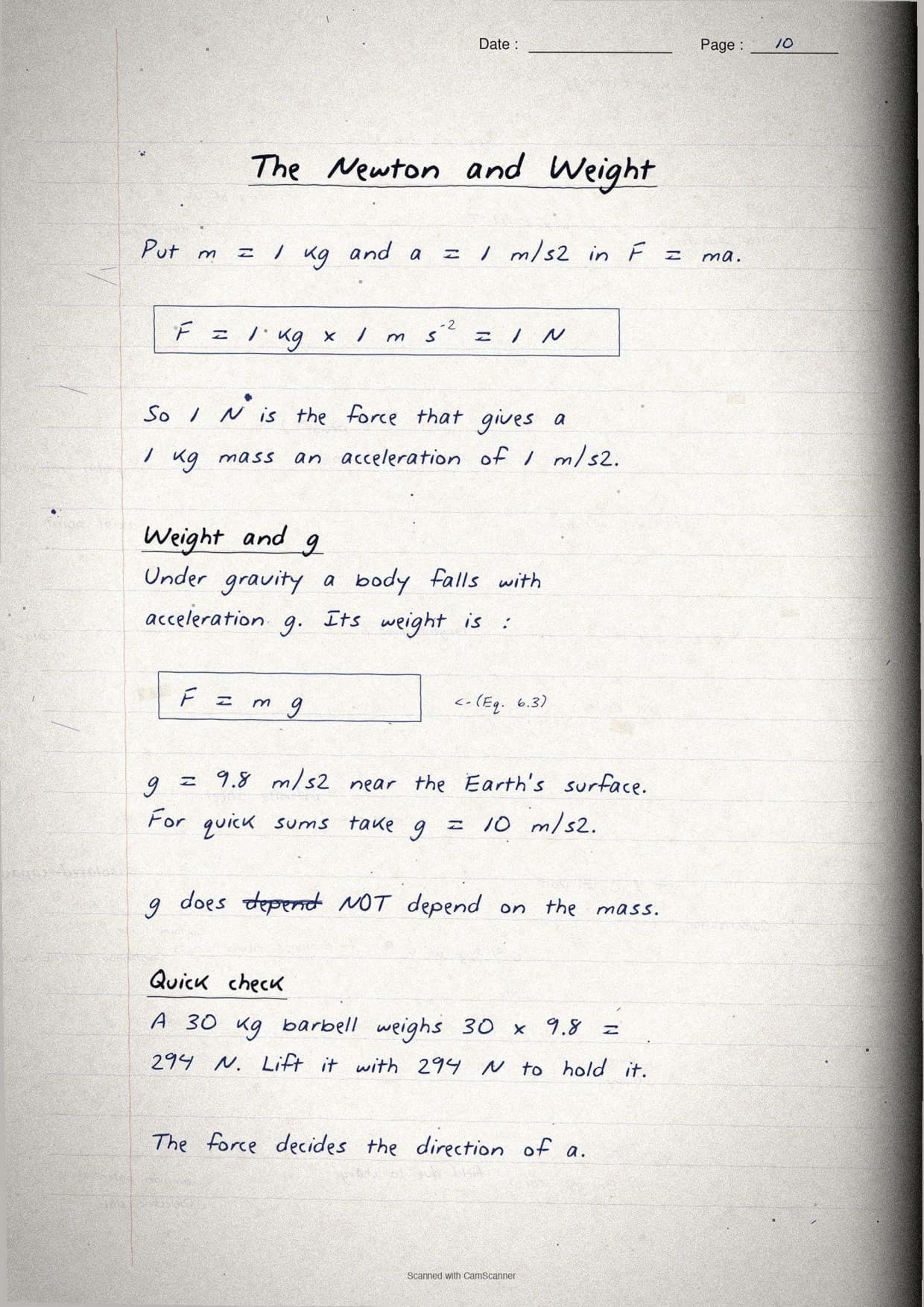
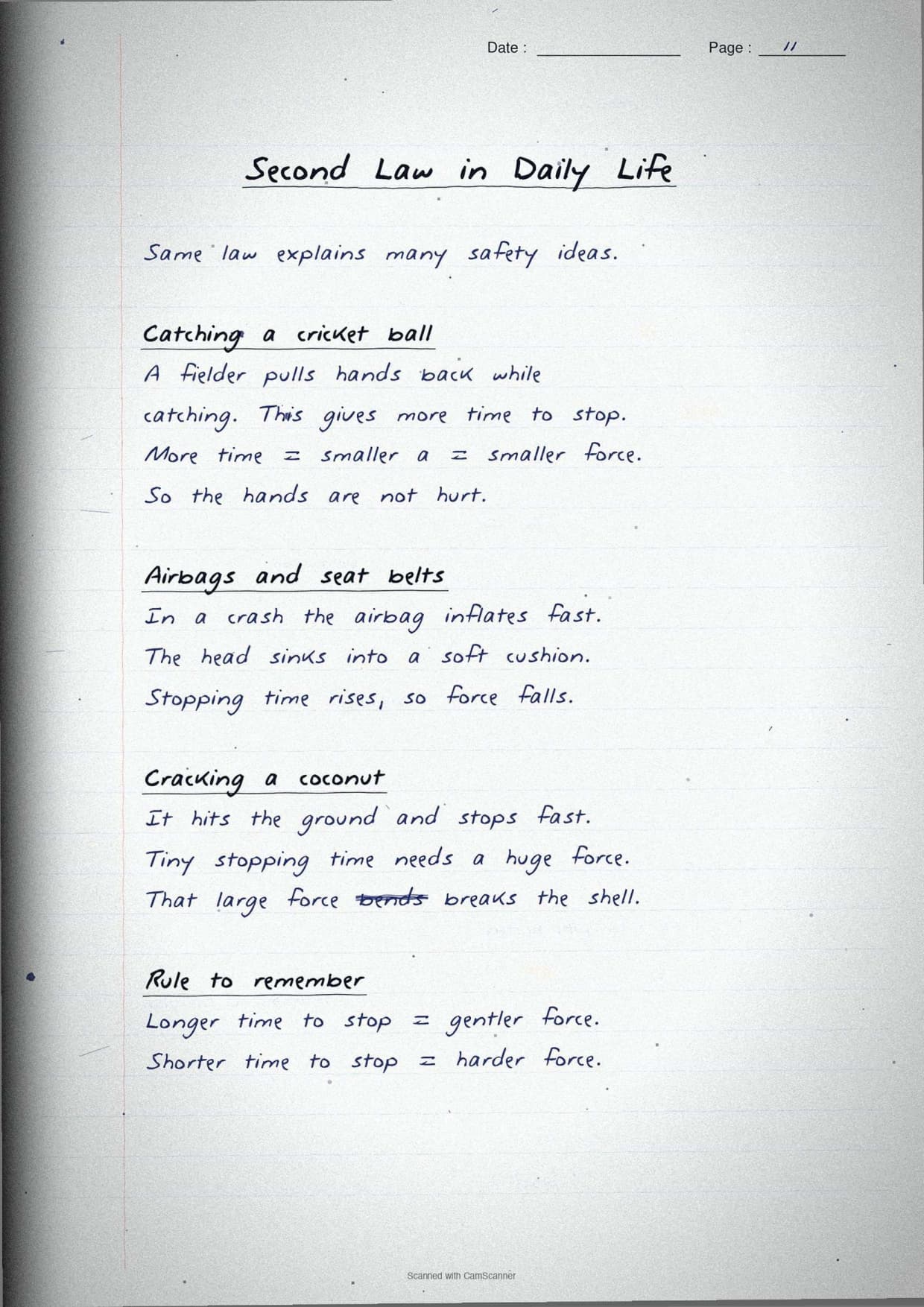
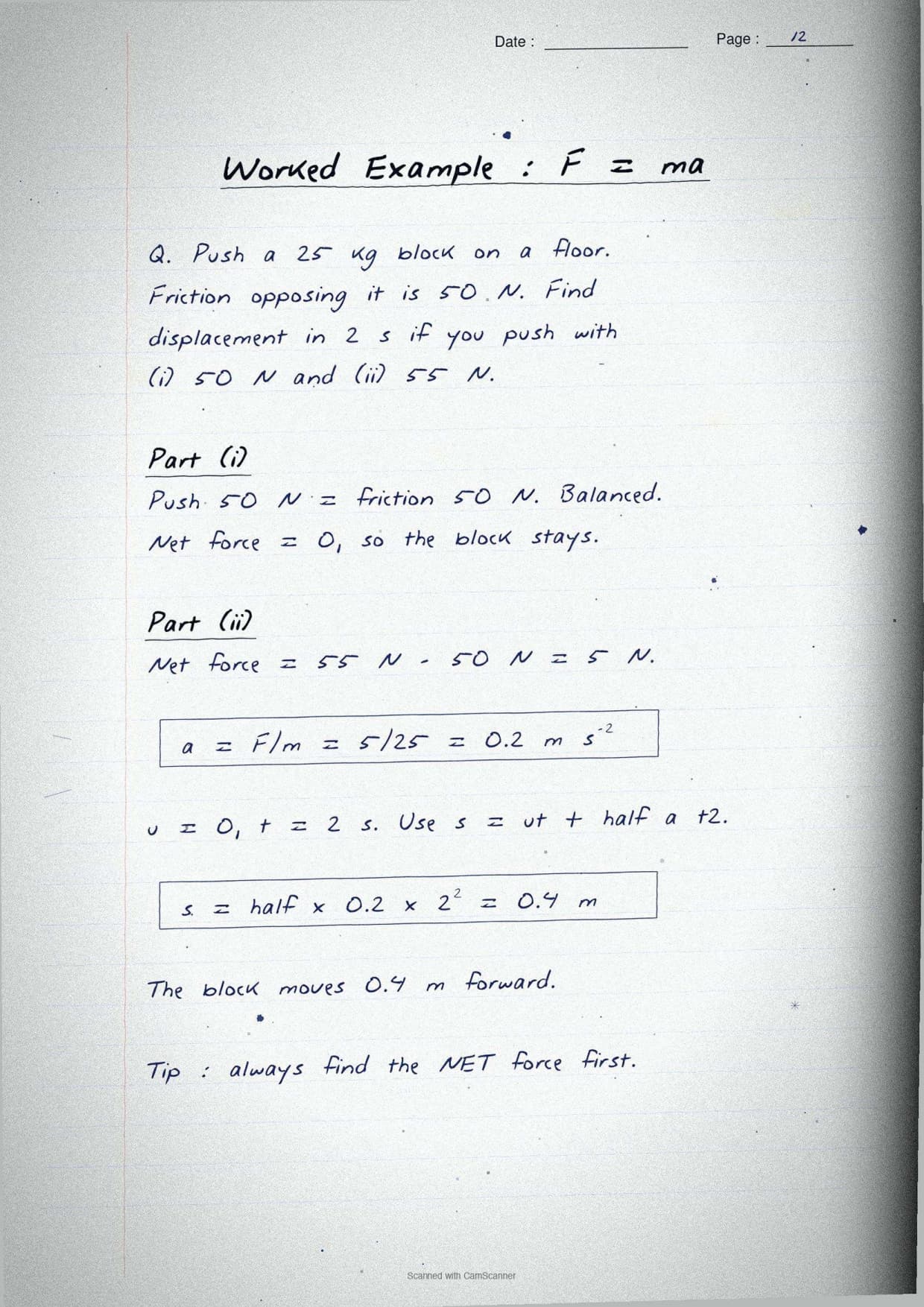
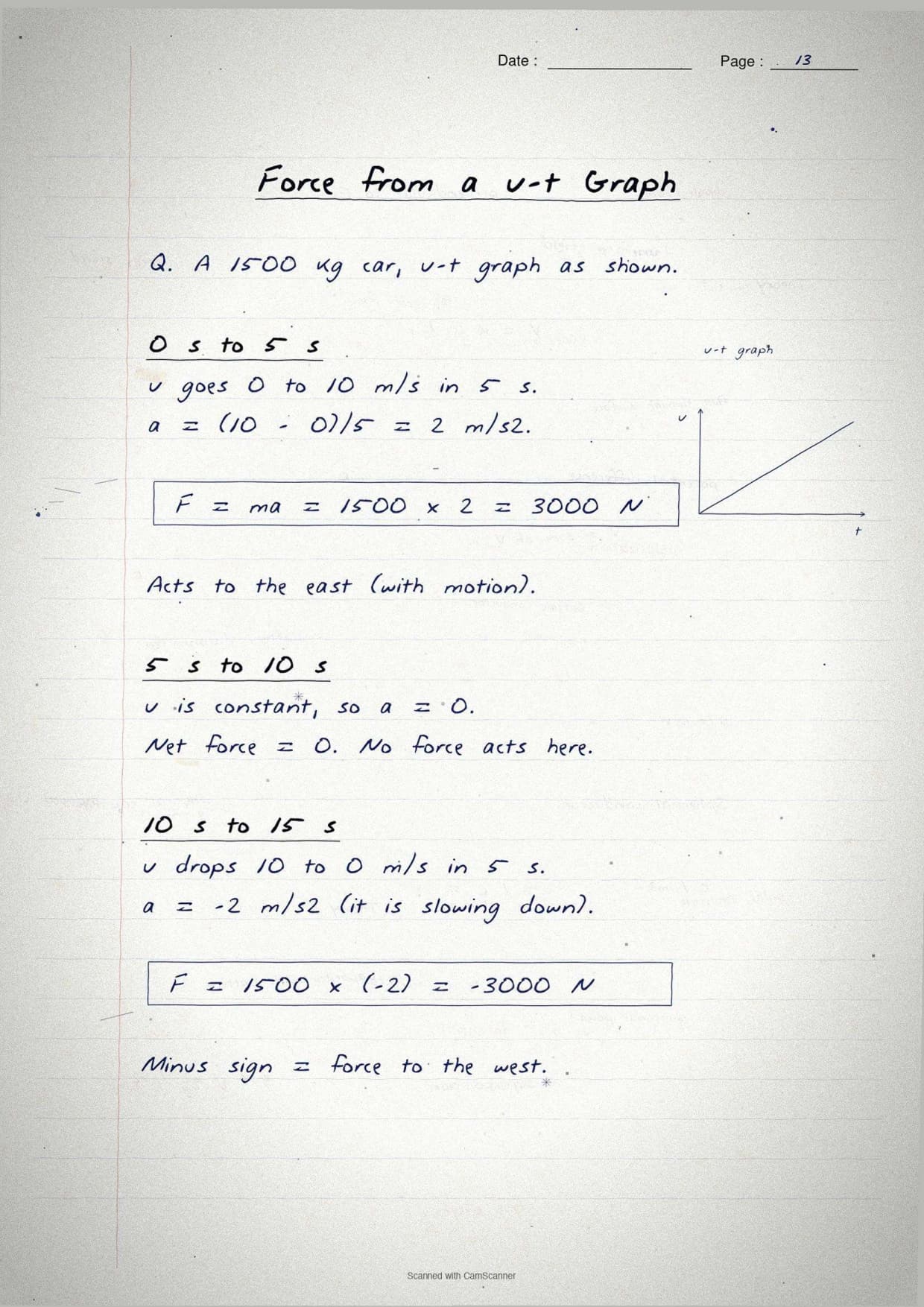
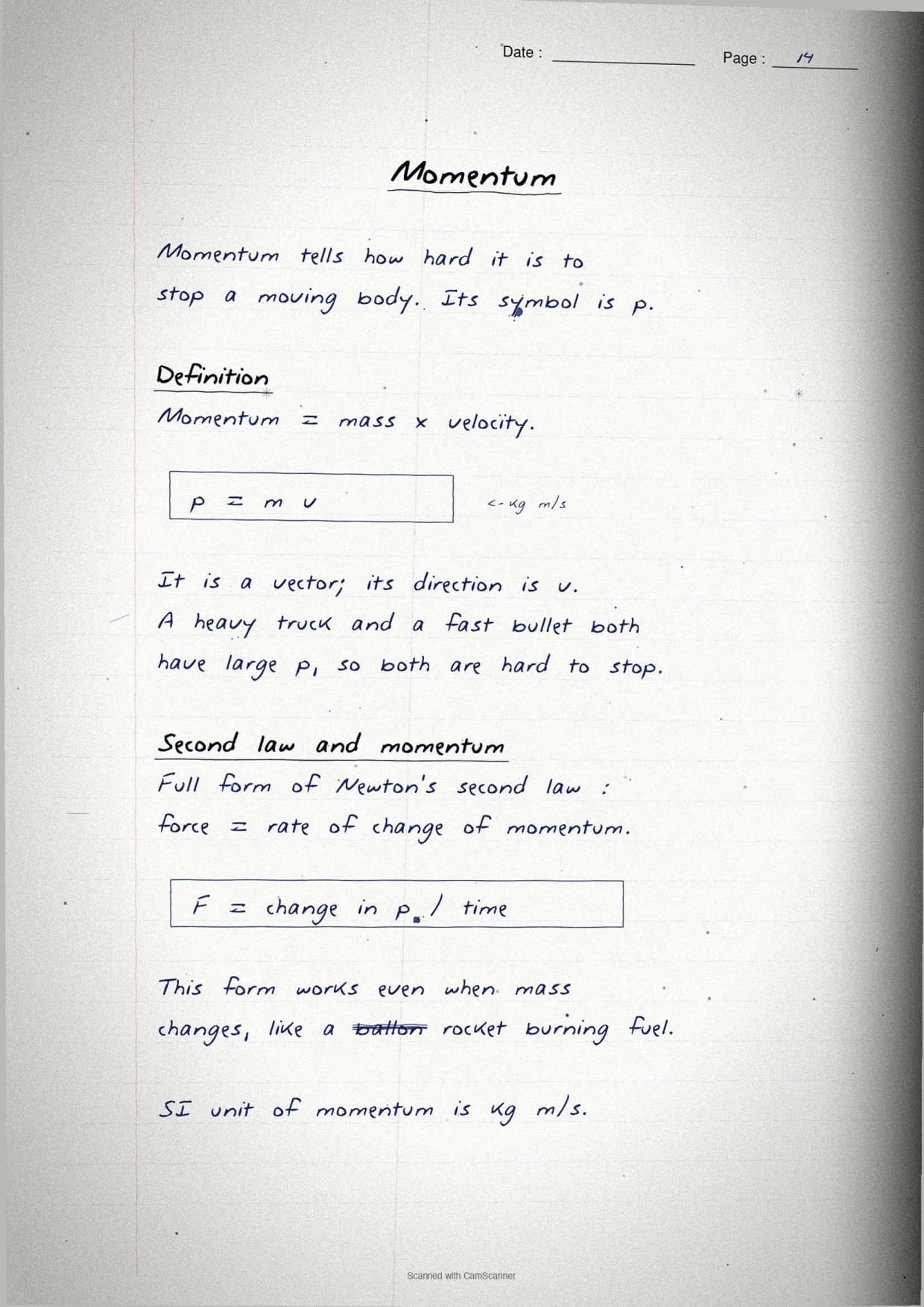
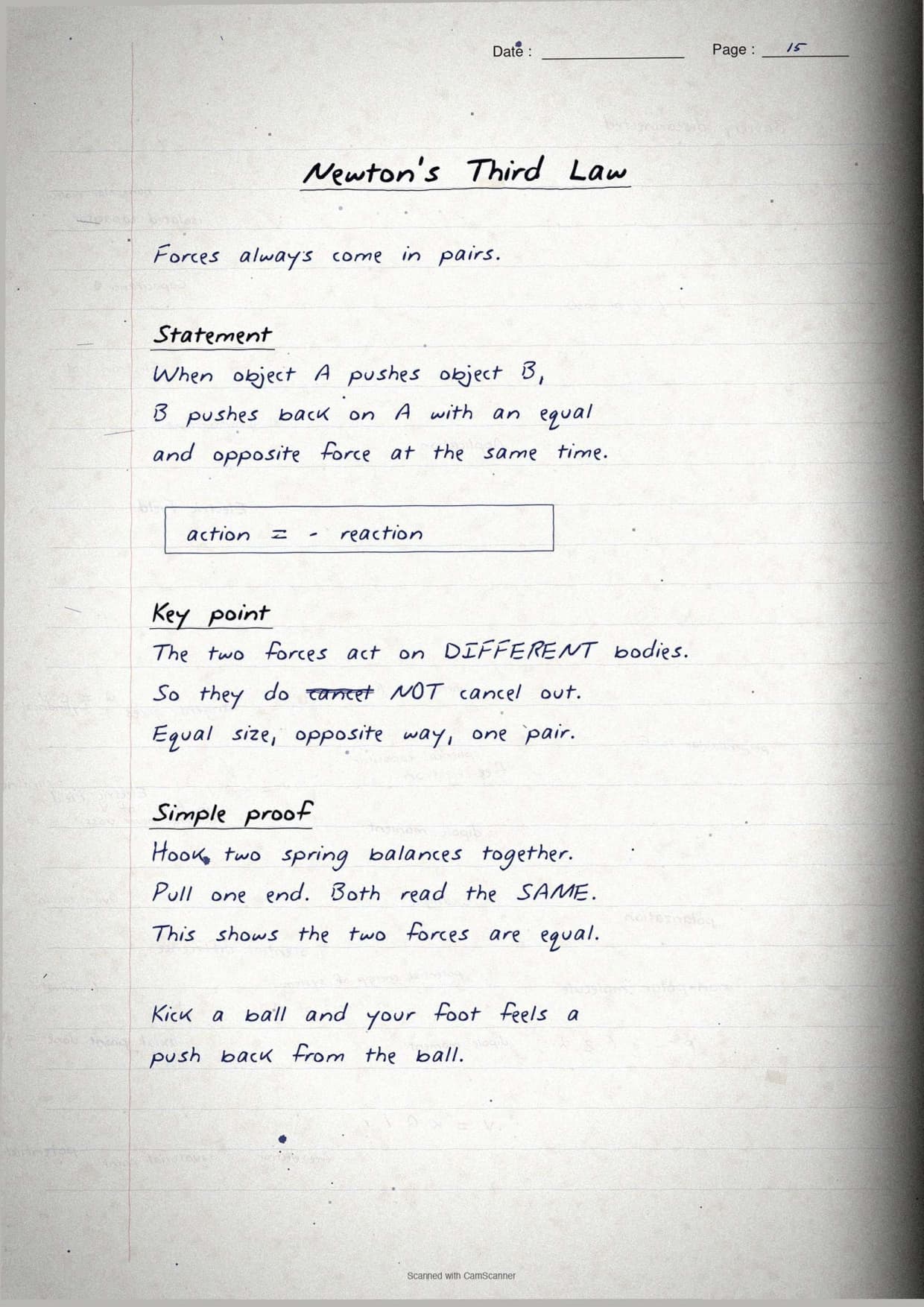
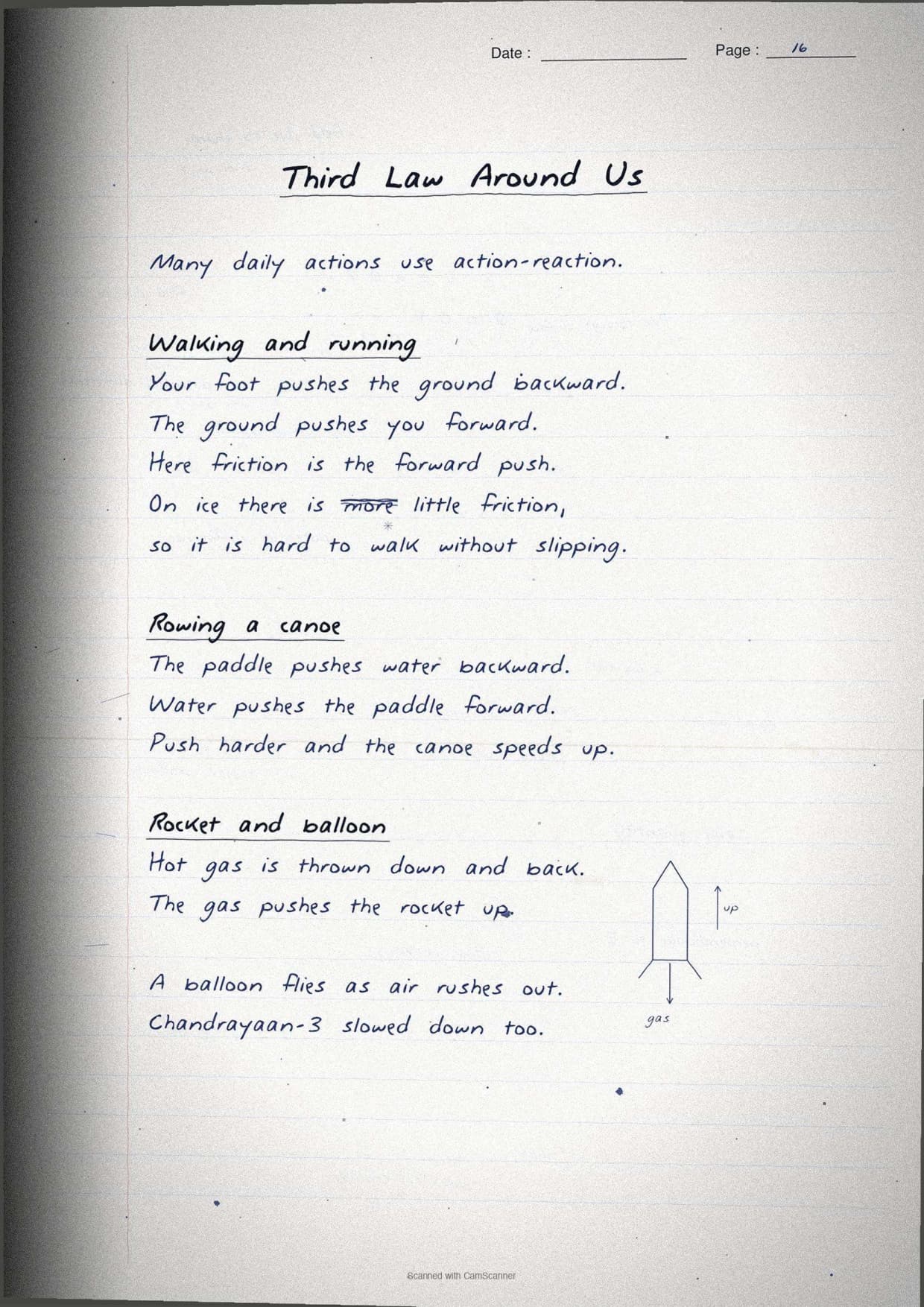
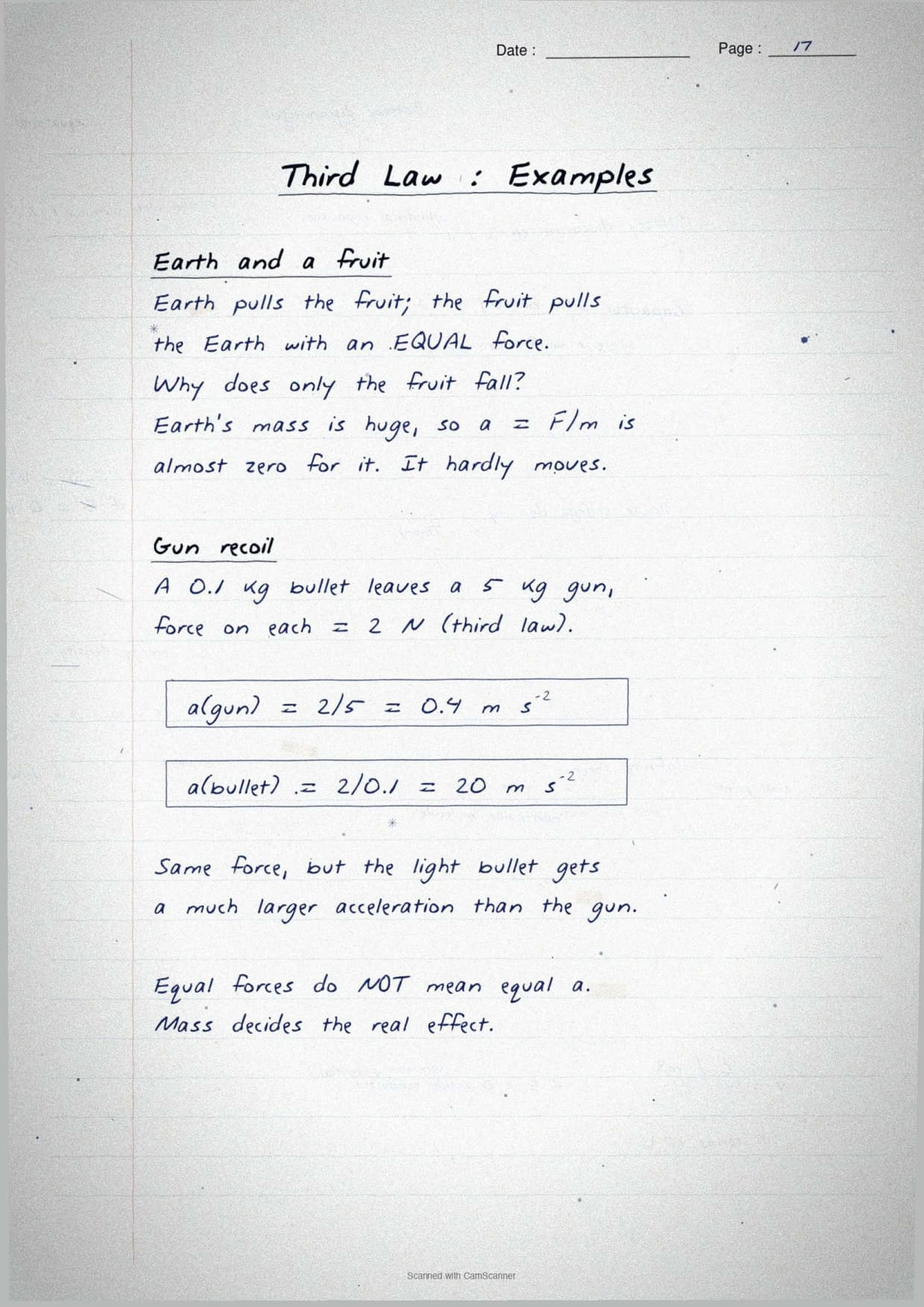
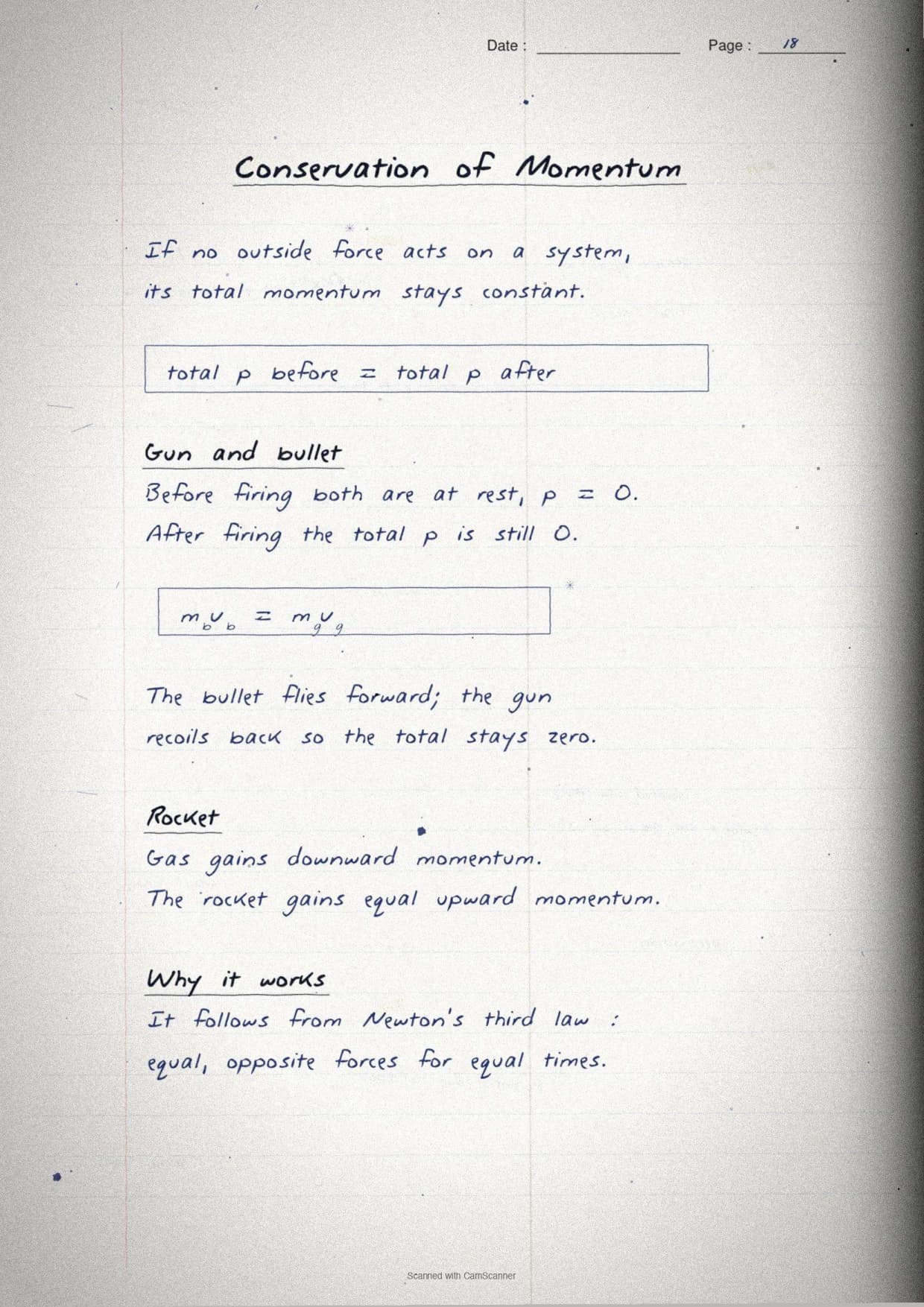
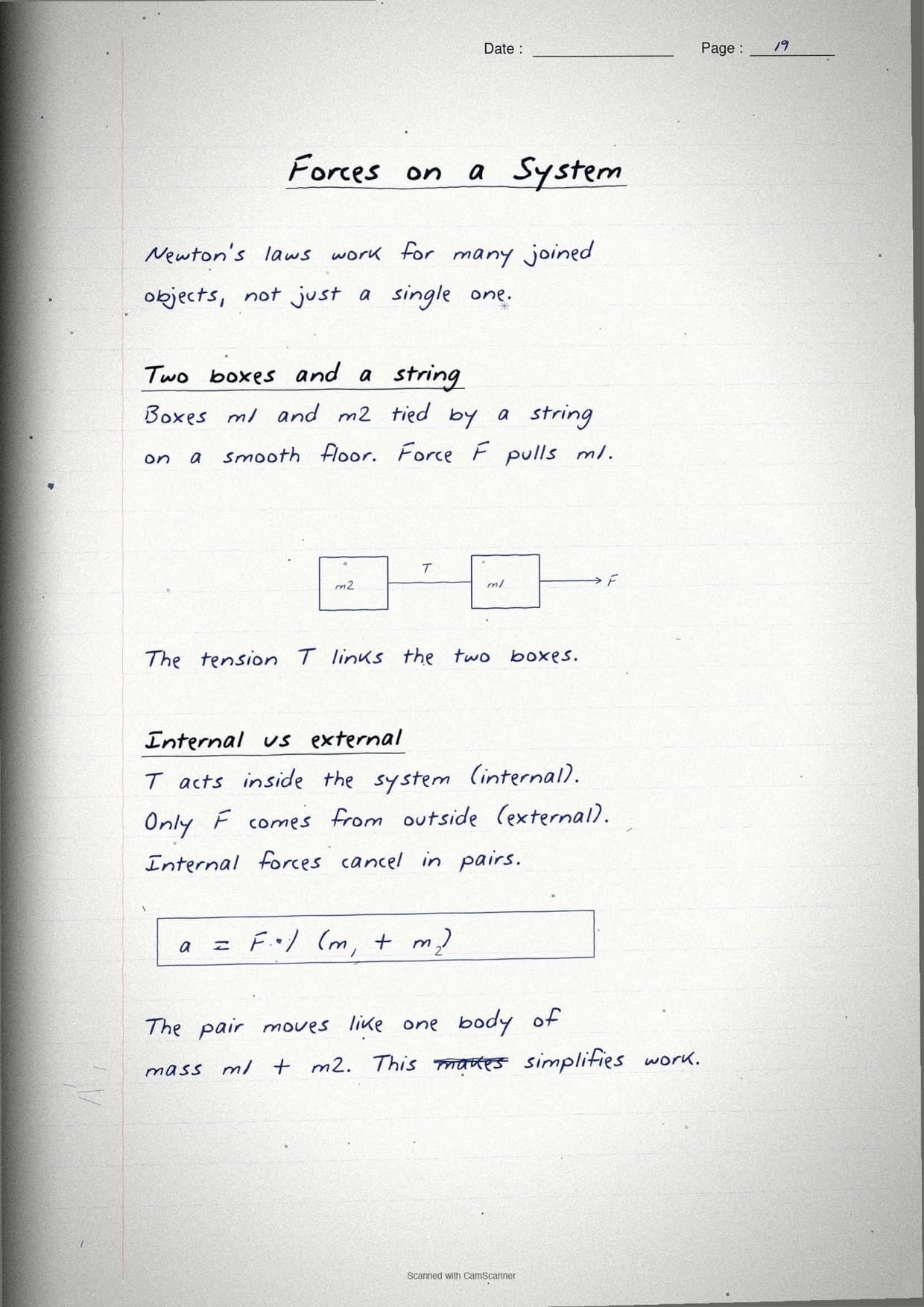
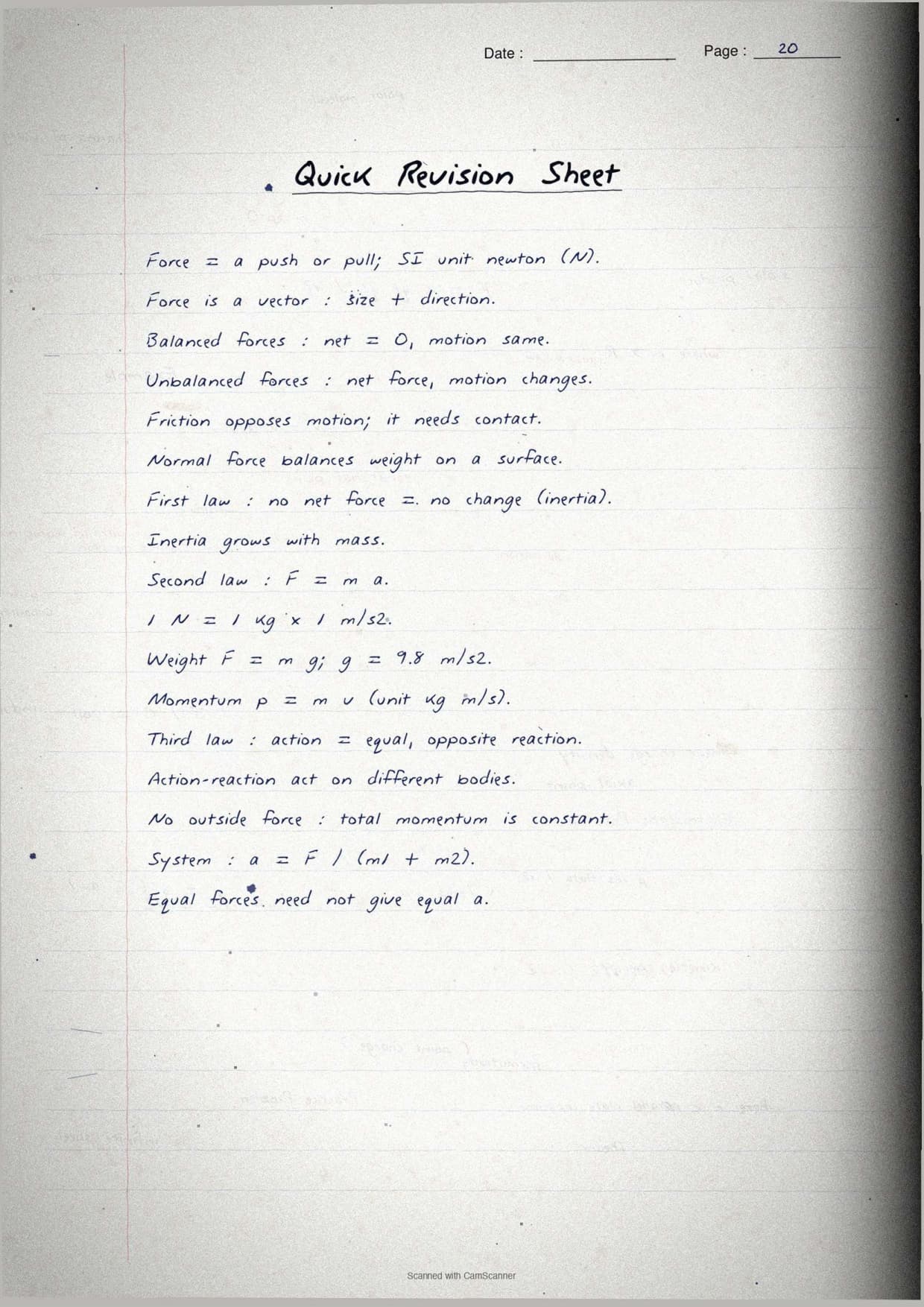
- What you get: force, net force, balanced and unbalanced forces, friction, and Newton's three laws, all in clear handwriting.
- Colour-coded: new sub-topics in red, each formula in a hand-drawn box, and solved examples in blue.
- Why by hand: writing F = ma and each free-body sketch by hand helps you recall it fast in the exam.

Student Feedback
In a Collegedunia study of 1,180 Class 9 students, 78% said hand-written pages of Newton's laws were easier to recall than typed notes. About 4 out of 5 rated the boxed F = ma formula and the red-marked mistakes as the most useful part before a test.
How Forces Affect Motion Class 9 Science Explained in One Shot
Source: Alakh Pandey - Class 9th & 10th on YouTube
Why Use Handwritten Notes for Class 9 Science Chapter 6 How Forces Affect Motion
Chapter 6 mixes short definitions with a few formulas and many force diagrams, so a clean, hand-written page saves real time. The How Forces Affect Motion Class 9 Science Handwritten Notes keep one idea per line, with a small force sketch beside it, so nothing runs together. You revise the full chapter in one sitting without flipping through the Exploration book.
- Each formula, like F = ma, sits in its own hand-drawn box.
- A quick free-body sketch is drawn next to the idea it explains.
- Red sub-headings split the chapter into short, easy parts.
- The wording is plain, like a senior showing you the method.
What Is Inside the How Forces Affect Motion Handwritten Notes PDF
The PDF runs to 22 pages of neat, hand-written revision. It moves from what a force does, to net force, balanced and unbalanced forces, Newton's three laws, and friction, with a solved example after each idea. The colour code below tells you what every mark means.
- Red: new sub-topic headings, such as Net Force, Inertia, or Action and Reaction.
- Boxes: each formula, like F = ma and the net-force rule, drawn by hand.
- Blue: solved examples and the numbers worked out in them.
Force, Net Force and Free-Body Sketches in the Notes
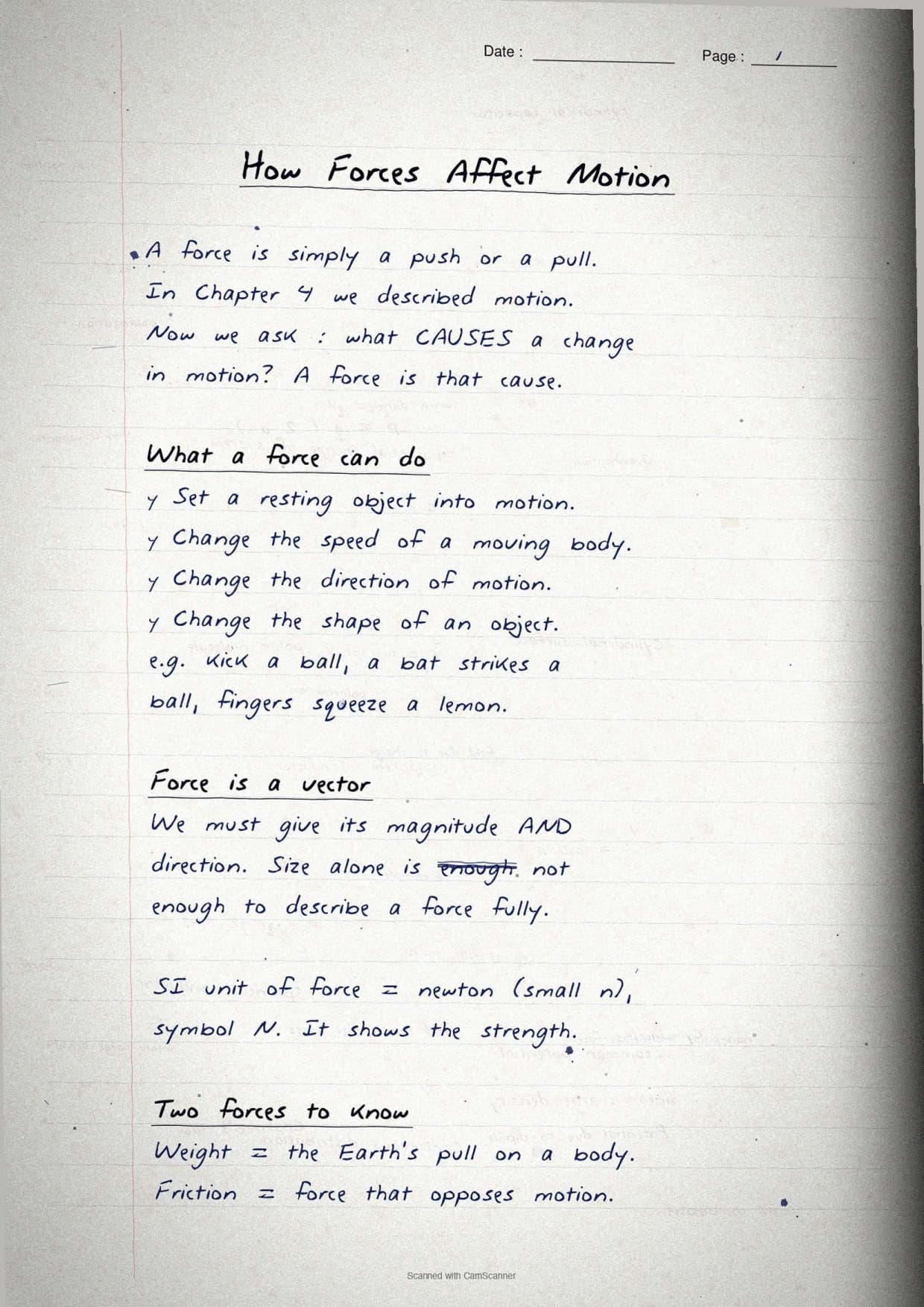
Force is the central idea of the chapter, so the notes open here. A force is any push or pull one object applies on another. It is a vector, so the notes always mark both its size and its direction with a small arrow.
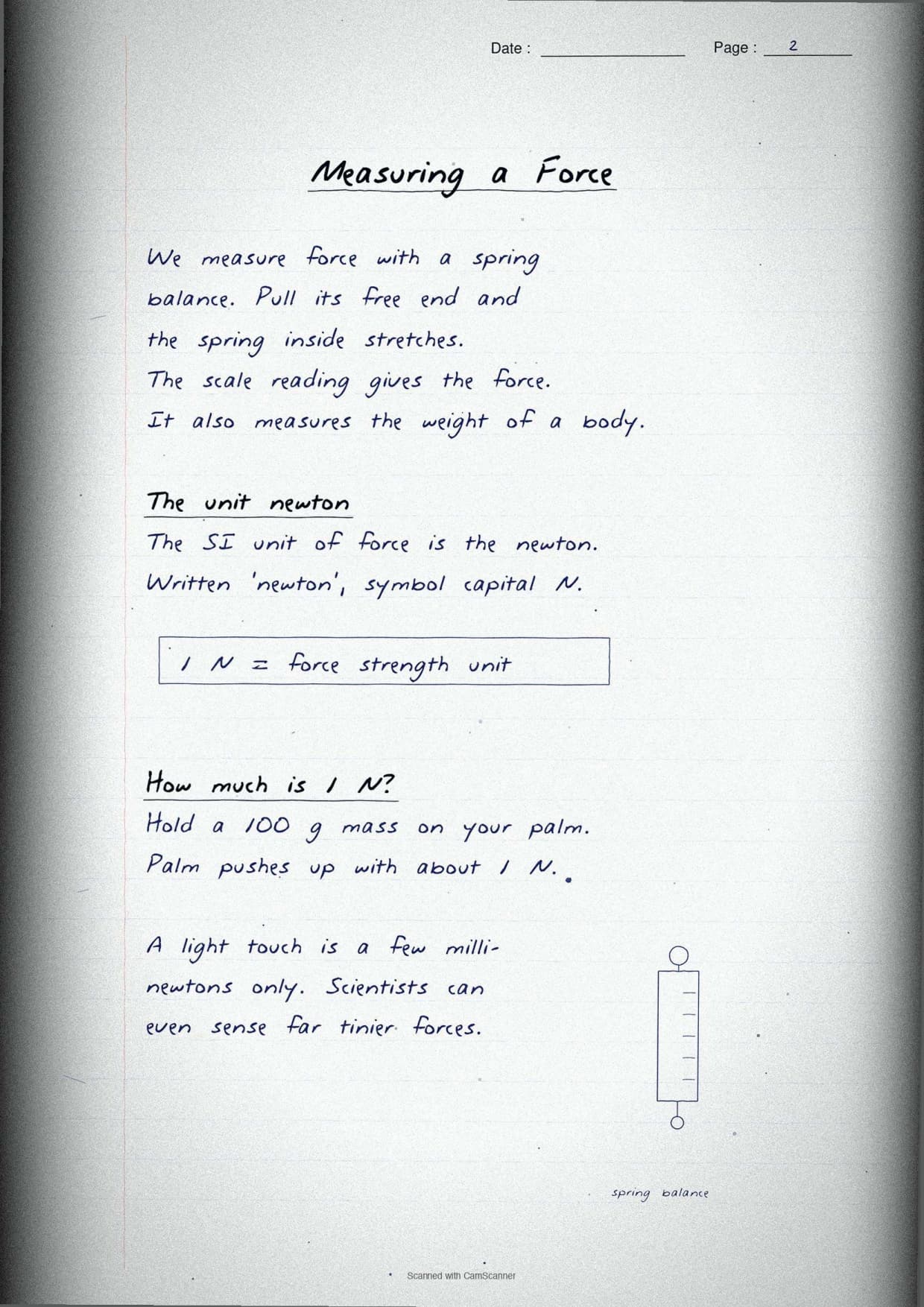
- SI unit: the newton, written with a small letter and the symbol N.
- What a force can do: start motion, speed an object up, slow it down, change its direction, or change its shape.
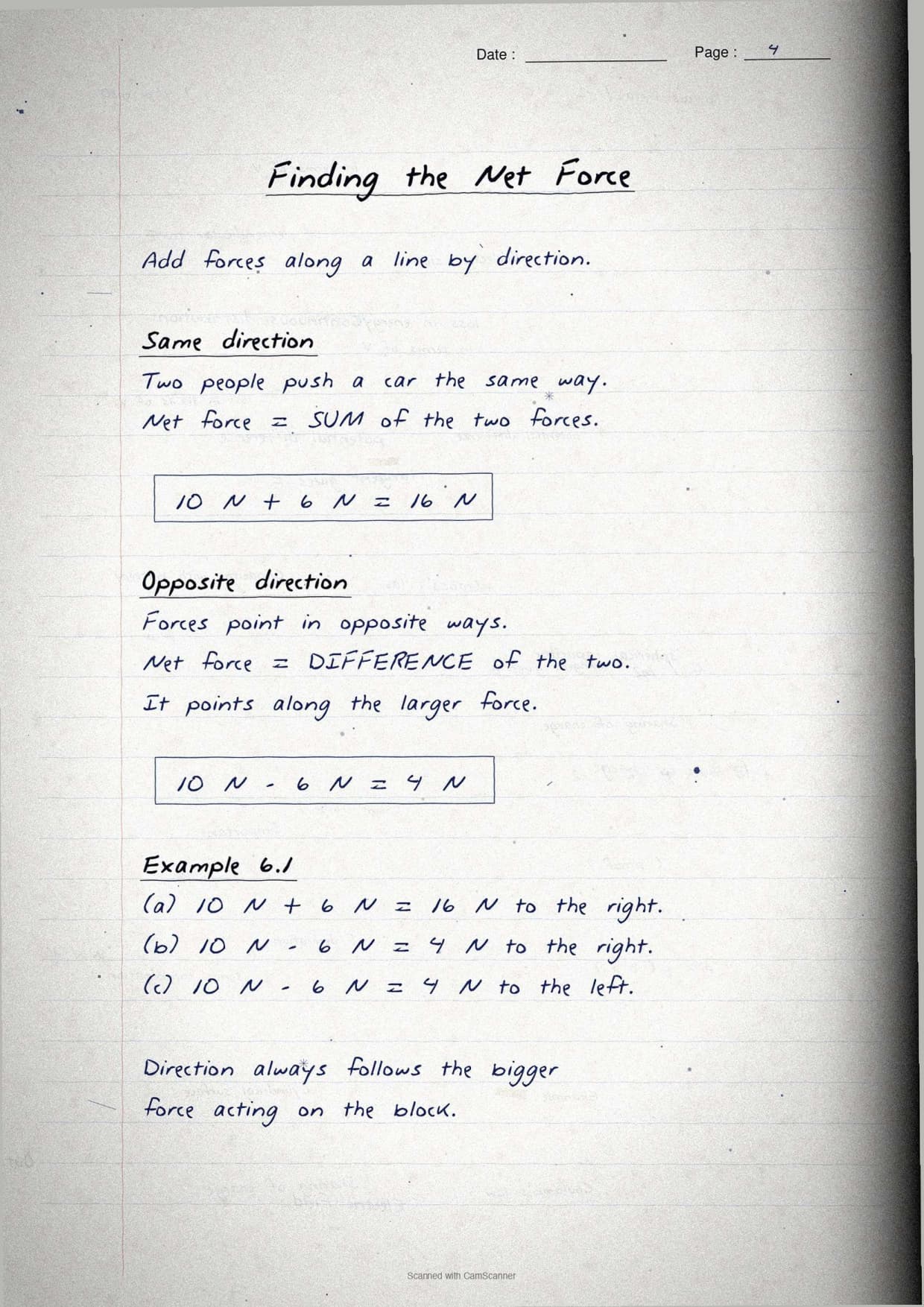
- Net force: add same-way forces, subtract opposite-way forces, and draw the leftover arrow.
Because force has direction, the notes teach you to draw a quick free-body sketch first, then add the arrows. That single habit makes the net force clear and turns most numericals into one easy subtraction.

Balanced and Unbalanced Forces: Hand-Drawn Table
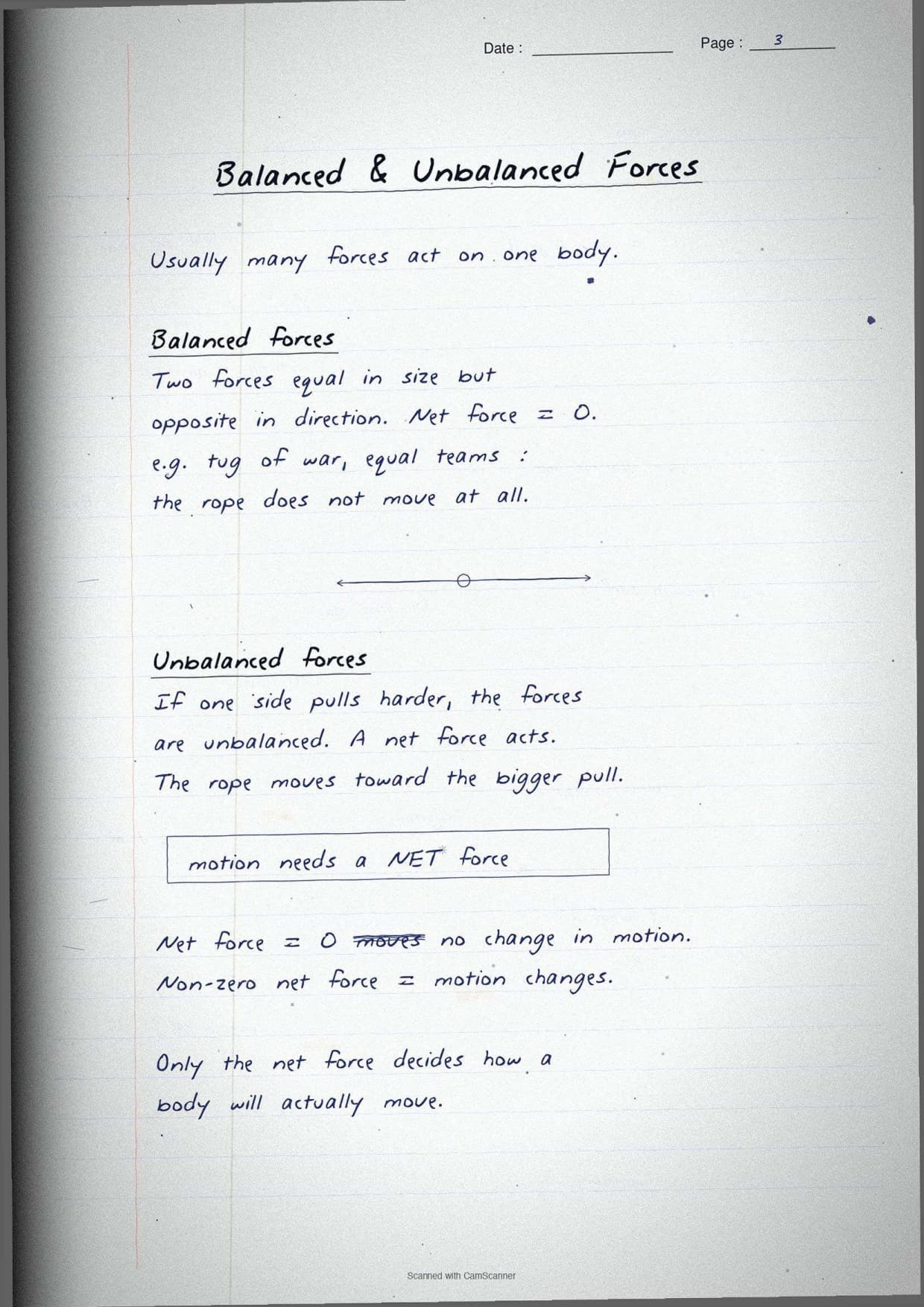
This is one of the most tested ideas in Chapter 6, so the notes give it a clear hand-drawn table. When the forces on an object add to zero, they are balanced. When one force is left over, they are unbalanced, and that leftover force changes the motion.
| Feature | Balanced forces | Unbalanced forces |
|---|---|---|
| Net force | Zero | Not zero |
| Acceleration | Zero | Present, along the net force |
| Effect on motion | Stays at rest or moves at constant velocity | Speed or direction changes |
| Notebook example | A book resting on a table | A ball being kicked |
The notes flag one common trap in red: an object moving at constant velocity has zero net force, not no force. A steady push can still act, but friction cancels it exactly, so the forces stay balanced.

Newton's Three Laws of Motion in Your Own Handwriting
Most of Chapter 6 comes back to three simple rules, so the notes box each one and add a real example beside it. Learn these three lines and the rest of the chapter becomes easy to recall.
| Law | Simple statement | Key idea |
|---|---|---|
| First law (inertia) | An object stays at rest or keeps constant velocity unless a net force acts. | No net force means no change in motion. |
| Second law | A net force gives acceleration in its own direction, F = ma. | More force means more acceleration; more mass means less. |
| Third law | Every action has an equal and opposite reaction. | The two forces act on different objects. |
- First law: the notes sketch a bus stopping to show why you jerk forward. Your body keeps moving.
- Second law: the workhorse of the chapter. Know any two of force, mass, and acceleration and you find the third.
- Third law: a small drawing of a boat and a jumping sailor shows the equal, opposite push.
Formula Boxes and Units Drawn by Hand
Keep these boxed formulas ready for the numericals in the Revise, Reflect, Refine exercise. Each one is written out in the notes exactly as you should copy it in the exam.
- Newton's second law: F = ma, with F in newtons, m in kilograms, and a in m s-2.
- Acceleration: a = v - ut, read as the slope of a velocity-time graph.
- Net force on a line: Fnet = (sum of forward forces) − (sum of backward forces).
Friction and Everyday Examples Marked in the Margins
Friction shows up across the chapter, so the notes give it a short block of its own. Friction is a contact force that always acts opposite to the motion, or attempted motion, between two surfaces.
- Friction lets you walk, write, and stop a moving cycle, so the notes call it helpful, not just a nuisance.
- When a box moves at constant velocity, the push you apply is exactly balanced by friction.
- Smooth or "frictionless" surfaces are used in problems to keep the focus on the applied force alone.
Everyday examples are pinned in the margins so the ideas stick: a seat belt uses the first law, rowing a boat uses the third law, and pushing a loaded trolley uses the second law.
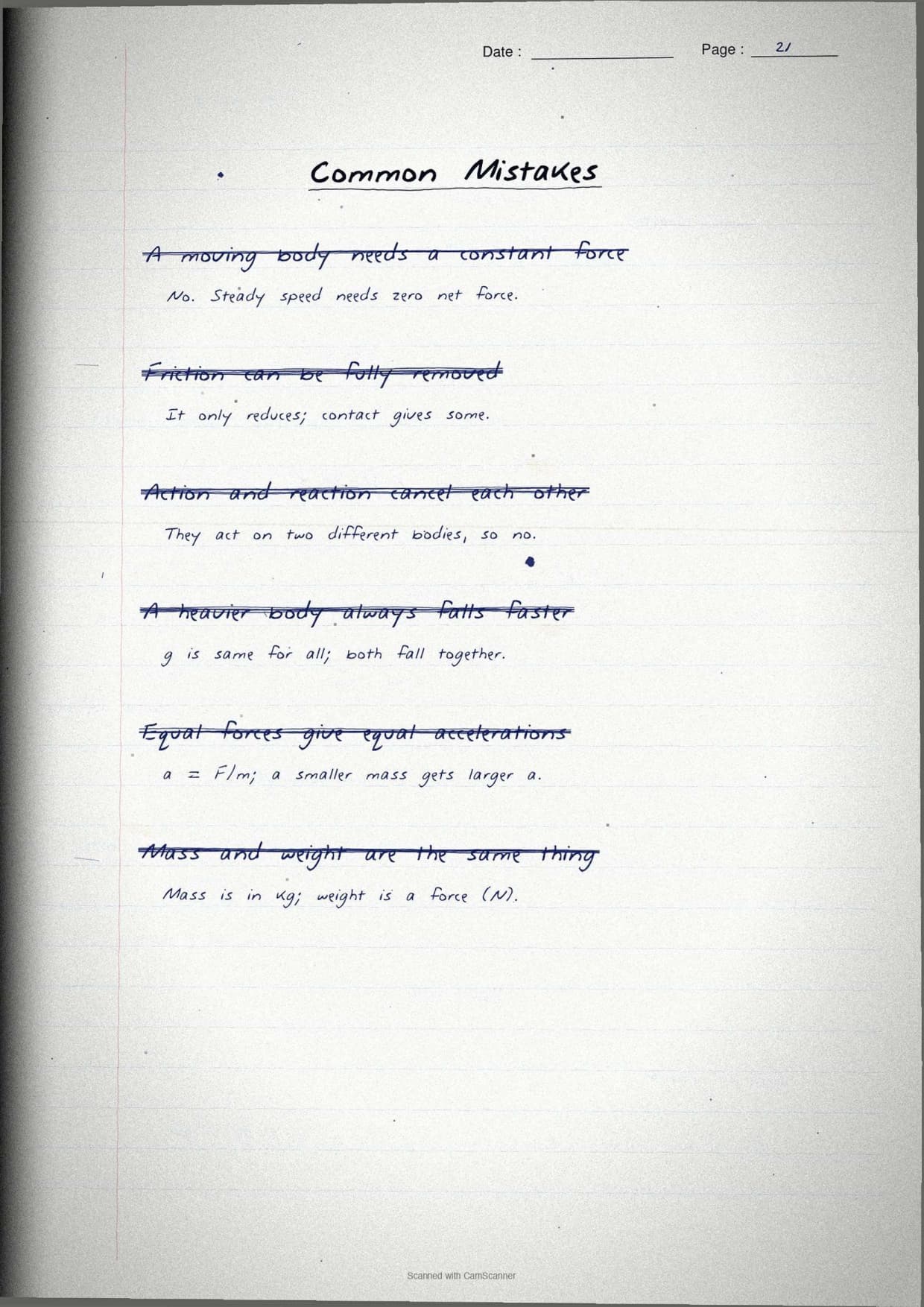
Common Mistakes Flagged in Red
Most lost marks in this chapter come from small slips, not hard ideas. The handwritten notes circle these in red so you fix them while you revise.
- Adding forces that point in opposite directions instead of subtracting them.
- Treating action and reaction as forces on the same object, so they seem to cancel.
- Forgetting that acceleration points in the same direction as the net force.
- Mixing up mass (in kilograms) with weight (a force, in newtons).
Last-Minute Revision with These Handwritten Notes
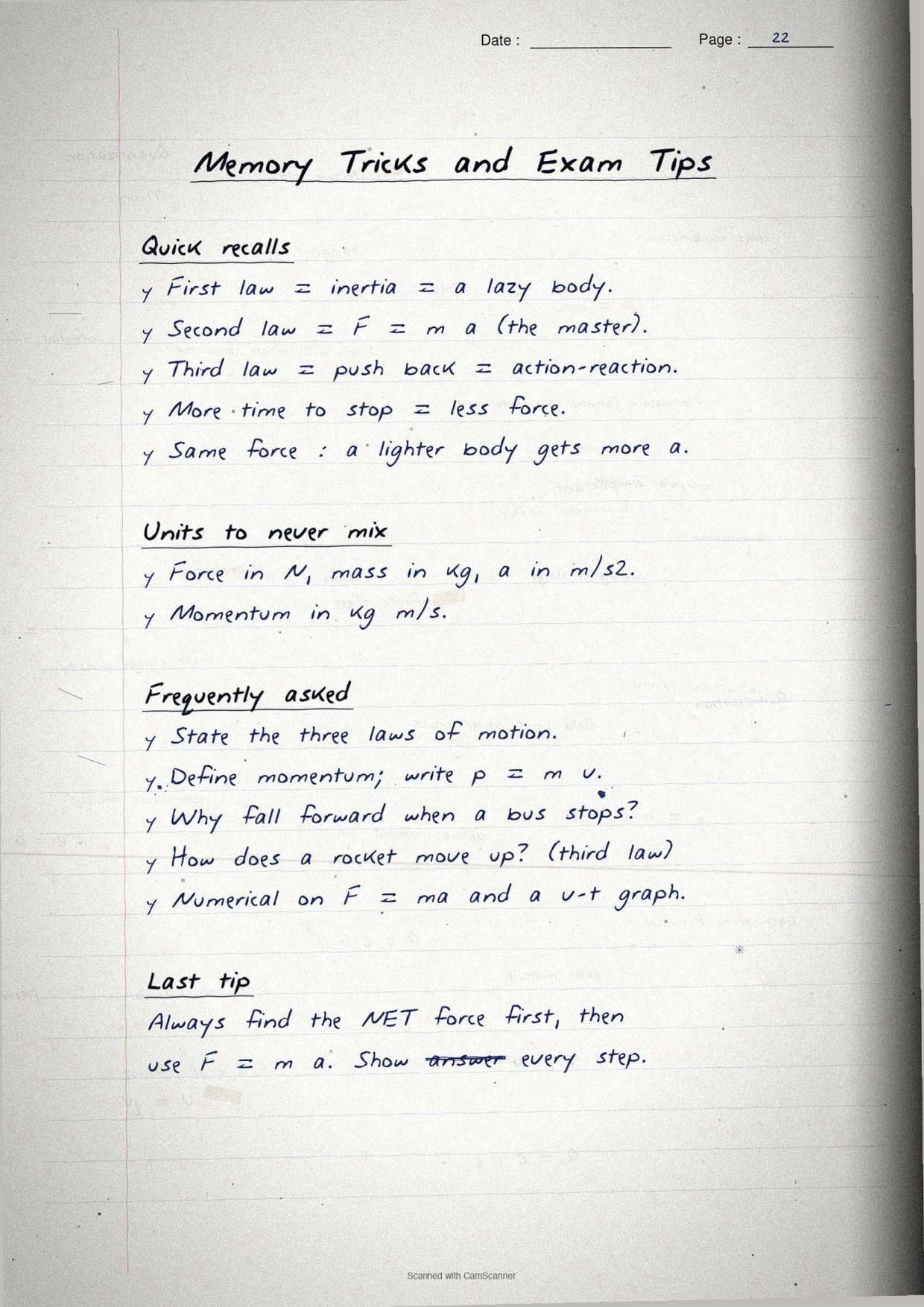
The night before your exam, the How Forces Affect Motion Class 9 Science Handwritten Notes work as a quick skim. Every boxed formula and red heading is a checkpoint, so you can cover the whole chapter in well under an hour.
- State what a force can do and name its SI unit.
- Write F = ma from its box and give each unit.
- Recall the balanced versus unbalanced forces table in one glance.
- Say all three of Newton's laws with one example each.
- Read the red mistake note before you close the notes.
How Collegedunia's Handwritten Notes Help You With Forces and Motion
Collegedunia brings you the How Forces Affect Motion Class 9 Science Handwritten Notes as a free, clear PDF you can open on any phone. It saves you the time of making your own notes and matches the new Exploration book.
- 2026-27 match: every page follows the new textbook and the Revise, Reflect, Refine flow.
- Clean handwriting: a topper's neat writing makes each formula and sketch easy to read.
- Exam-ready: boxes and colour cues let you revise fast before the annual exam, and later for CBSE, JEE, and NEET basics.
- Free download: keep the PDF offline and revise any time.
More How Forces Affect Motion Class 9 Science Resources
Use the table below to open the other resources for this chapter of the new Class 9 Science Exploration book.
| Resource | Open |
|---|---|
| Handwritten Notes | How Forces Affect Motion Class 9 Science Handwritten Notes |
| NCERT Solutions | How Forces Affect Motion Class 9 Science NCERT Solutions |
| Revision Notes | How Forces Affect Motion Class 9 Science Notes |
| Formula Sheet | How Forces Affect Motion Class 9 Science Formula Sheet |
| NCERT Book PDF | How Forces Affect Motion Class 9 Science NCERT Book PDF |
NCERT Handwritten Notes for Class 9 Science: All Chapters
Use the table below to open the handwritten notes for any other chapter of the new Class 9 Science Exploration book.
| Chapter | Handwritten Notes |
|---|---|
| Chapter 2 | Cell The Building Block of Life |
| Chapter 3 | Tissues in Action |
| Chapter 4 | Describing Motion Around Us |
| Chapter 5 | Exploring Mixtures and their Separation |
| Chapter 6 | How Forces Affect Motion |
| Chapter 7 | Work, Energy, and Simple Machines |
| Chapter 8 | Journey Inside the Atom |
| Chapter 9 | Atomic Foundations of Matter |
| Chapter 10 | Sound Waves Characteristics and Applications |
| Chapter 11 | Reproduction How Life Continues |
| Chapter 12 | Patterns in Life Diversity and Classification |
| Chapter 13 | Earth as a System Energy, Matter, and Life |
How Forces Affect Motion Class 9 Science Handwritten Notes FAQs
Ques. How many pages are the How Forces Affect Motion Class 9 Science handwritten notes?
Ans. The handwritten notes run to 22 pages. They cover the full chapter, from force and net force to balanced and unbalanced forces, Newton's three laws, and friction, with a solved example after each idea.
Ques. Are these real handwritten notes?
Ans. Yes. They are a topper's own clear handwritten revision notes, with each formula boxed, free-body sketches drawn by hand, and sub-headings colour-coded in red.
Ques. What is the main formula in the Chapter 6 notes?
Ans. The key formula is Newton's second law, F = ma, where F is net force in newtons, m is mass in kilograms, and a is acceleration in metres per second squared.
Ques. Can I use these handwritten notes for last-minute revision?
Ans. Yes. The boxed formulas and red headings let you skim the whole chapter in under an hour, so they suit the night before your annual exam.
Ques. Is How Forces Affect Motion part of the new Class 9 Science book?
Ans. Yes. How Forces Affect Motion is Chapter 6 of the new Exploration textbook for the 2026-27 syllabus. It is a core base chapter for later work, energy, and motion topics.



Comments