




The Journey Inside the Atom Class 9 Science formula sheet puts every rule and relation of Chapter 8 from the new Exploration textbook on one page. This chapter is more about rules than heavy sums, so the sheet gives you the key relations you must remember: the atomic number and mass number links, the neutron count N = A − Z, the 2n2 shell capacity rule, the valency rule, and the difference between isotopes and isobars. Use it as a quick revision before any class test or the 2026-27 exam.
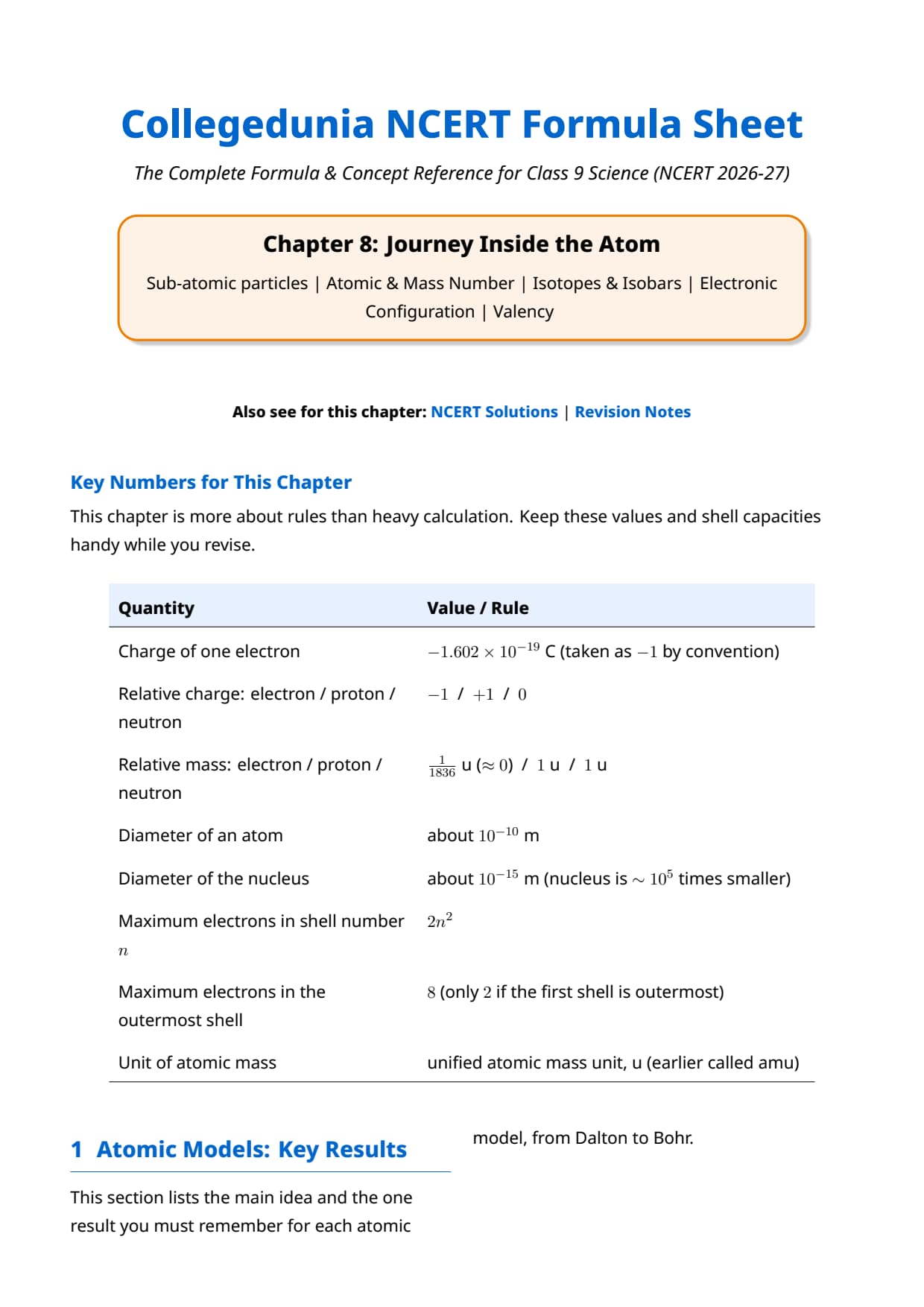
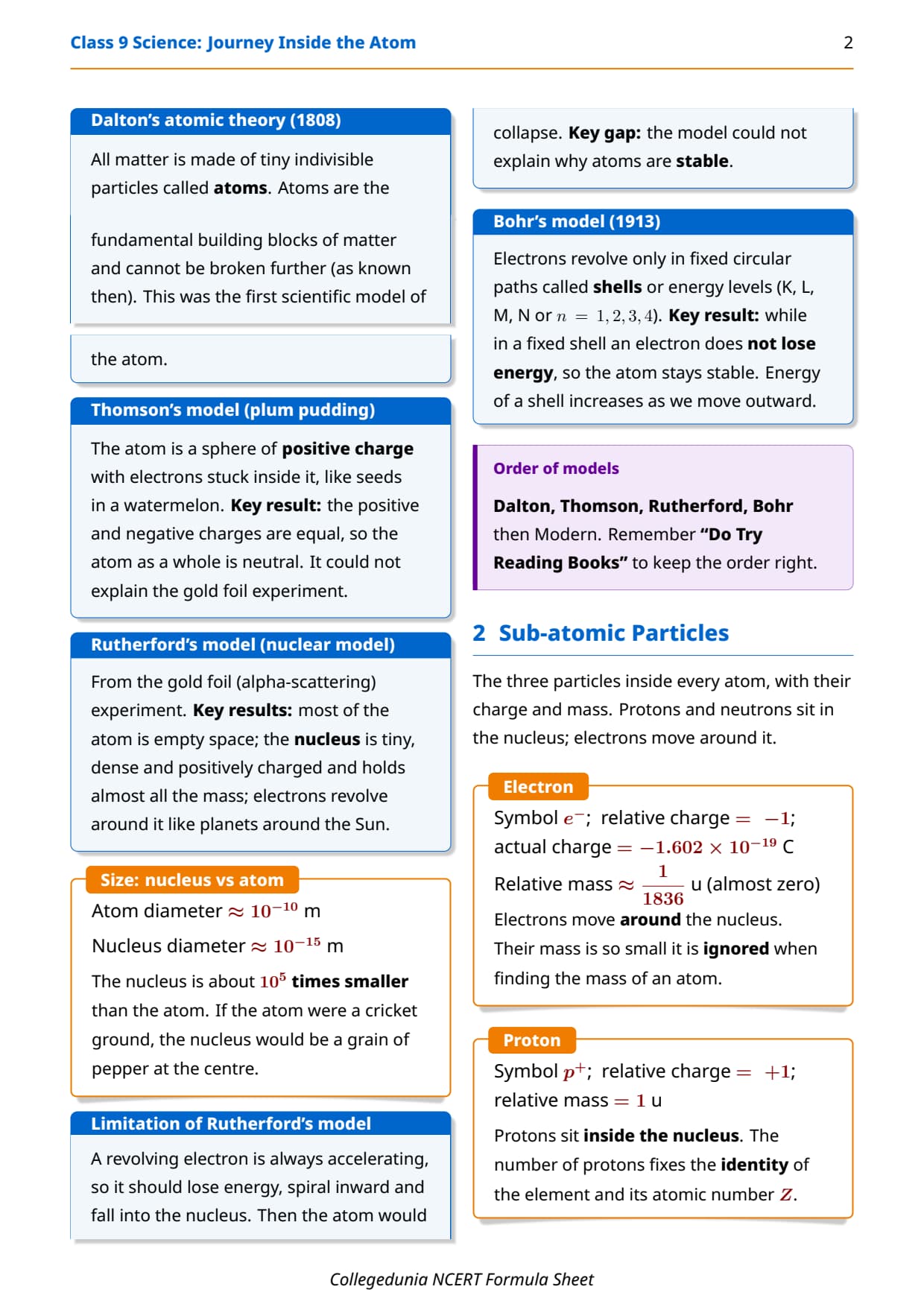
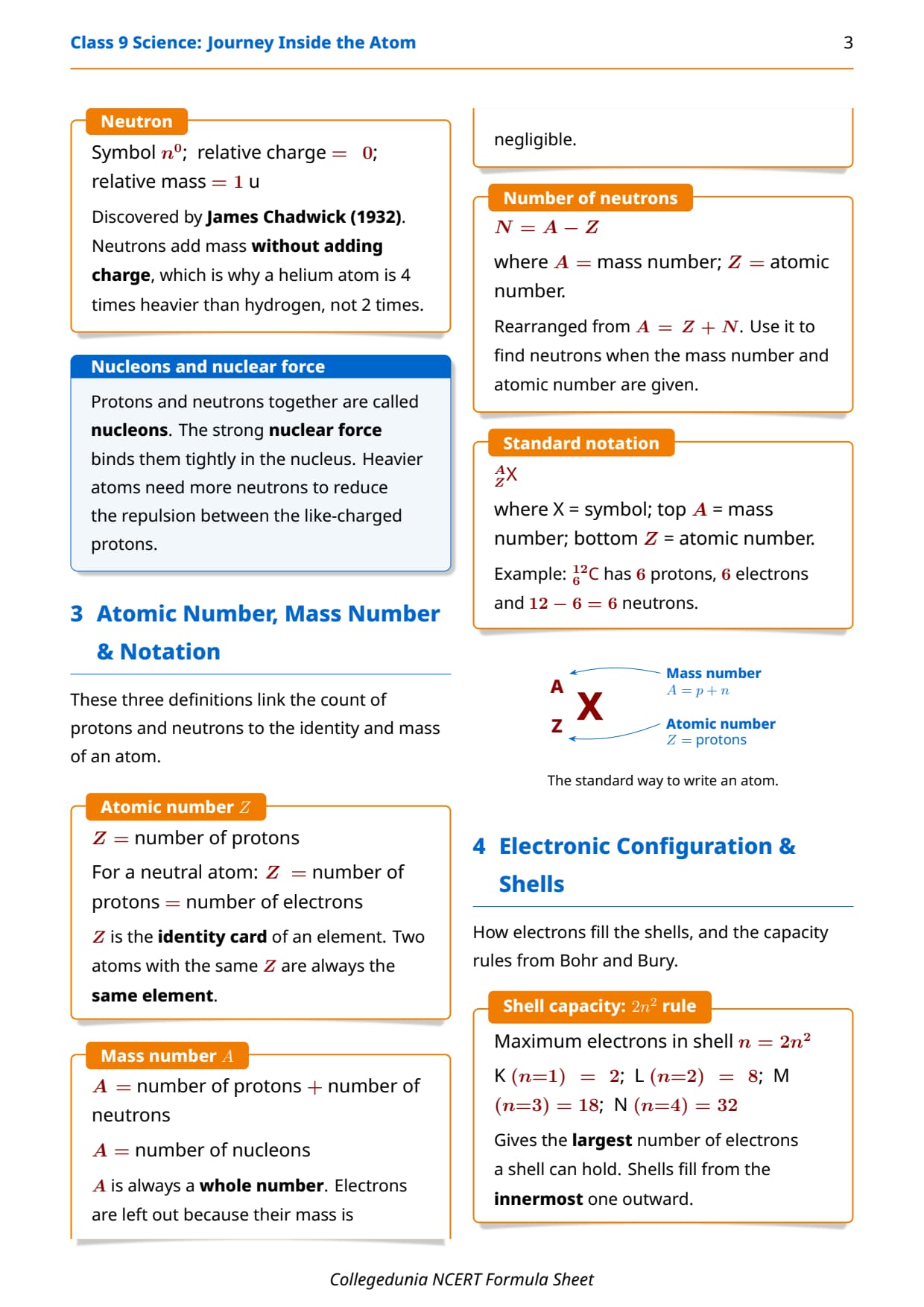
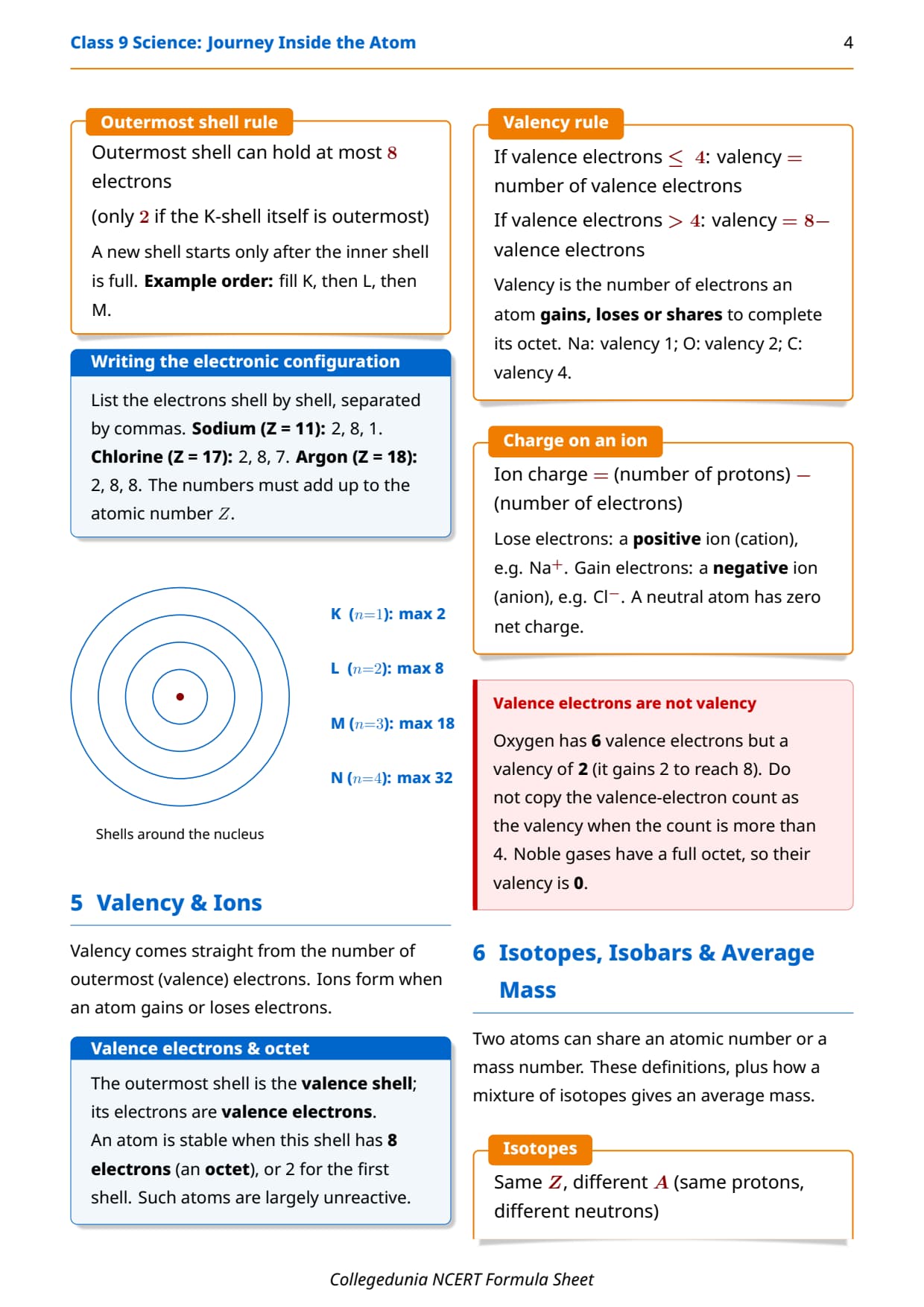
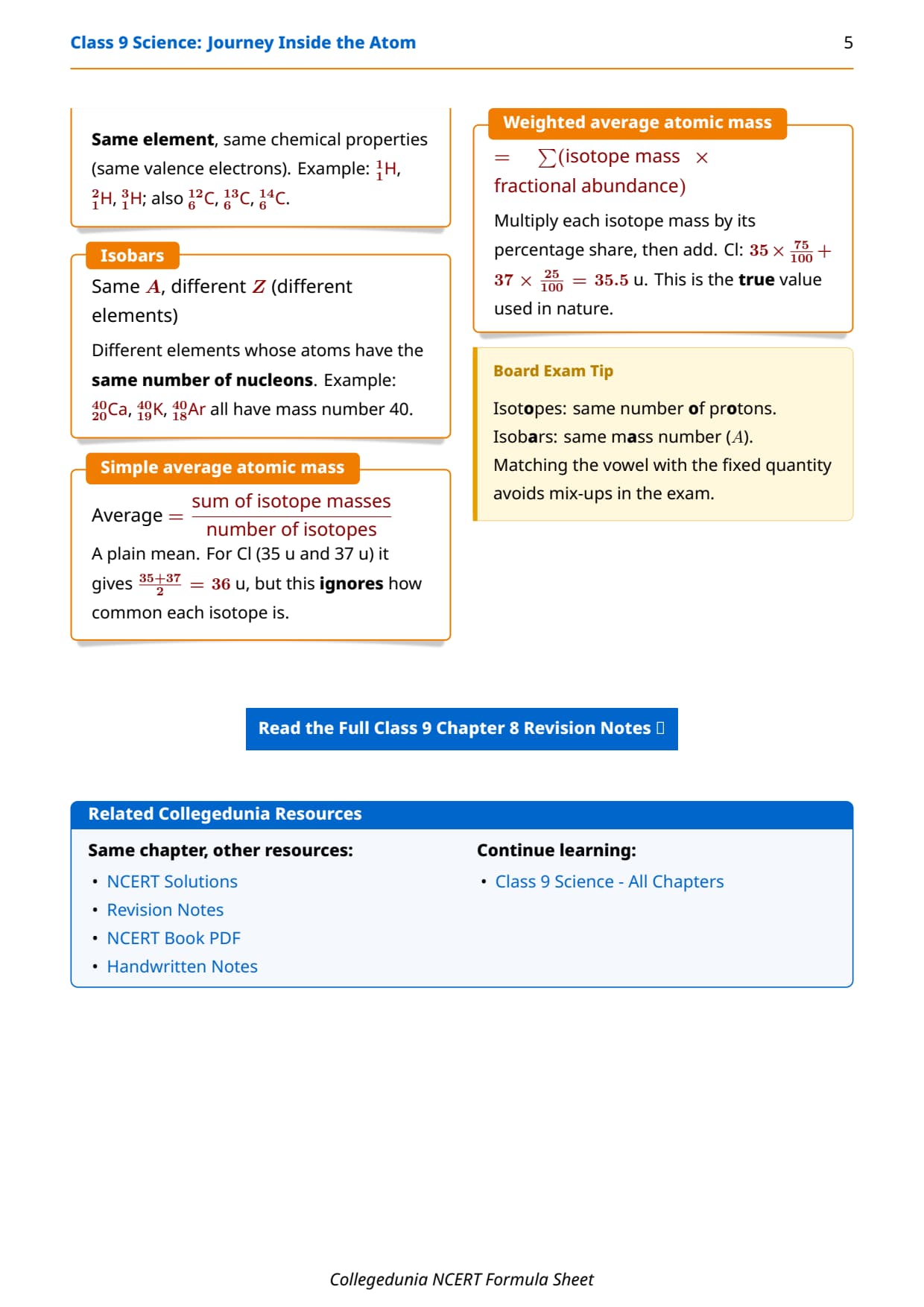
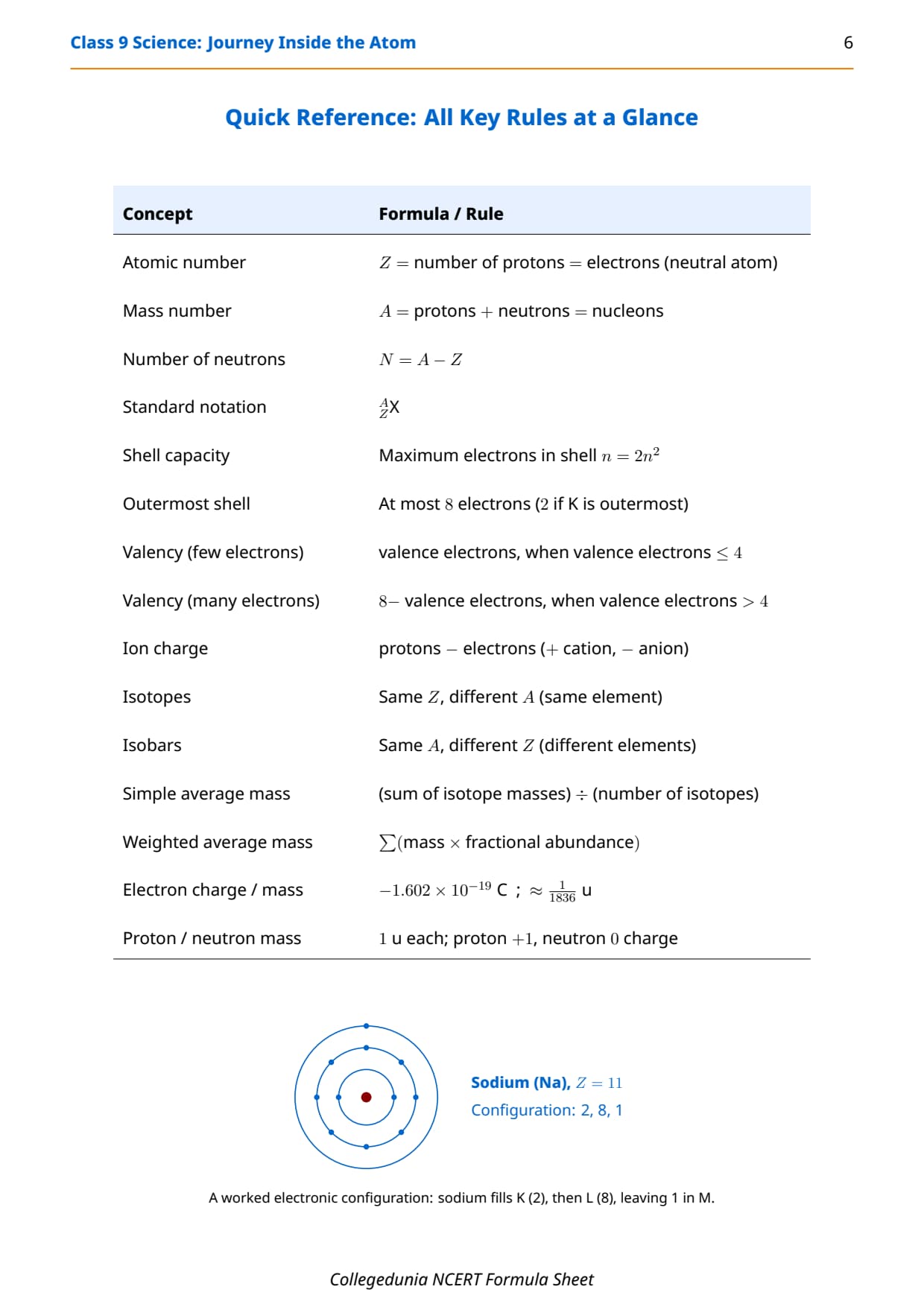
- Full rule map: atomic number Z, mass number A, the neutron relation A = Z + N, the 2n2 rule, the valency rule, and average atomic mass, all in one place.
- Best used for: finding protons, neutrons and electrons, writing electronic configurations, deciding valency, and telling isotopes from isobars in MCQ and one-mark questions.
- Why it matters: Chapter 8 is the base for Atomic Foundations of Matter, chemical bonding, and later CBSE, JEE and olympiad chemistry.
Student Feedback
In a Collegedunia study of 1,150 Class 9 students, 81% said keeping A = Z + N and the 2n2 rule on one page cut their slips in atom numericals. About 4 out of 5 rated the isotopes versus isobars card the clearest part, and many said the valency rule finally made sense once it sat next to a worked value.
|
Table of Contents |
How Collegedunia's Journey Inside the Atom Formula Sheet Helps You
Chapter 8 of the new Class 9 Science Exploration book takes you inside the atom, from the first models to the rules that decide how electrons sit in shells. Most questions here test rules and definitions, not long calculations, so a clean one-page sheet is the fastest way to revise. This Formula Sheet gathers every relation in the order the NCERT introduces it.
- 2026-27 NCERT alignment: every rule, from the atomic number and mass number links to the 2n2 shell rule, the valency rule and average atomic mass, matches the current syllabus.
- Relation cards ready: the three most-used relations, A = Z + N, the 2n2 rule and the valency rule, sit together so you pick the right one at a glance.
- Quick-fact cards for MCQs: key values like the electron charge 1.602 × 10⁻¹⁹ C and the octet number 8 sit in a colour-coded row for last-minute recall.
Journey Inside the Atom Class 9 Science Video Revision
Source: Magnet Brains on YouTube
Journey Inside the Atom Class 9 Science Complete Formula Reference
The table lists every relation in Chapter 8, with its meaning and the unit or note you should remember. Keep this as your master reference while you revise.
| Concept | Relation / Rule | Meaning | Unit / Note |
|---|---|---|---|
| Atomic number | Z = protons = electrons | Identity of the element (neutral atom) | whole number |
| Mass number | A = protons + neutrons | Total number of nucleons | u (whole number) |
| Number of neutrons | N = A − Z | Neutrons from mass and atomic number | count |
| Standard notation | AZX | How to write an atom of element X | symbol form |
| Shell capacity | max = 2n2 | K = 2, L = 8, M = 18, N = 32 | electrons |
| Outermost shell | ≤ 8 electrons | Only 2 if the K-shell is outermost | electrons |
| Valency (few) | valency = valence electrons | When valence electrons ≤ 4 | Na: 1, C: 4 |
| Valency (many) | valency = 8 − valence electrons | When valence electrons > 4 | O: 2, Cl: 1 |
| Ion charge | charge = protons − electrons | Lose electrons: cation; gain: anion | + or − |
| Isotopes | same Z, different A | Same element, different neutrons | e.g. C-12, C-14 |
| Isobars | same A, different Z | Different elements, same nucleons | e.g. Ca-40, Ar-40 |
| Simple average mass | sum of isotope massesnumber of isotopes | A plain mean of the isotope masses | u |
| Weighted average mass | ∑(mass × abundance) | True value used in nature | u |
| Nucleus vs atom size | atom ≈ 10-10 m | Nucleus ≈ 10-15 m, about 105 times smaller | metre (m) |
Remembering these rules alone covers almost every Journey Inside the Atom question asked in Class 9 tests and the Revise, Reflect, Refine exercise.
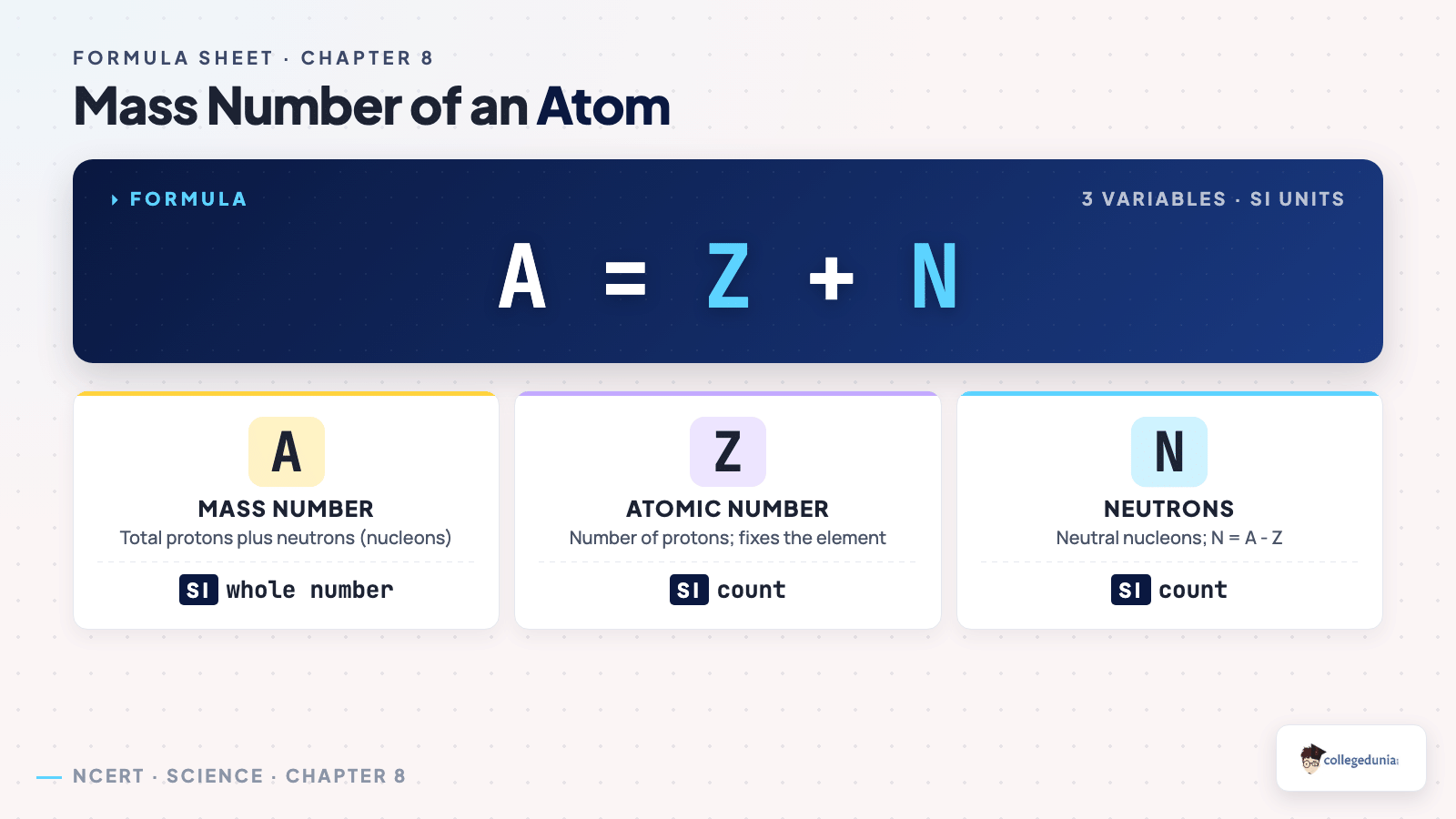
Atomic Structure Relation Cards for Journey Inside the Atom Class 9
Three relations do most of the work in this chapter. Learn these cards well and you can answer nearly every numerical on protons, neutrons, electrons and valency.
These three cards are built from the atom's structure. The atomic number Z counts the protons and fixes the element; the mass number A adds the neutrons; and the way electrons fill the shells decides the valency. A worked example ties them together: sodium has Z = 11, so its configuration is 2, 8, 1, its outer shell has 1 electron, and its valency is 1.
When to Use Which Relation in Journey Inside the Atom Class 9
Picking the right relation is the whole skill in this chapter. The list below tells you which rule to apply based on what the question gives you. Read the data first: if you are given the mass number and atomic number, you are almost always being asked for neutrons or for the electronic configuration.
- Given protons, asks for the element or electrons: use Z = protons = electrons for a neutral atom.
- Given mass number and atomic number, asks for neutrons: use N = A − Z.
- Asks to arrange electrons in shells: fill using the 2n2 rule, keeping the outermost shell at 8 or less.
- Asks for valency: count the valence electrons, then apply the valency rule (electrons if 4 or fewer, else 8 − that count).
- Asks for the charge on an ion: use charge = protons − electrons; losing electrons gives a positive cation, gaining gives a negative anion.
- Two atoms compared: same Z means isotopes, same A means isobars.
- Asks for average atomic mass: use the weighted average with abundances when percentages are given, or the simple mean when they are not.
Journey Inside the Atom Class 9 Quick-Fact Cards for MCQ Recall
These atomic facts are the ones MCQ writers reach for most often. Glance over them before any test; each one is a common one-mark or assertion-reason point in Chapter 8.
A few discovery facts round out the recall list: the neutron was discovered by James Chadwick in 1932, Bohr proposed his shell model in 1913, and Dalton gave the first atomic theory in 1808. Protons and neutrons together are called nucleons, and both have a relative mass of 1 u.
Symbol Glossary and Units for Class 9 Science Chapter 8
Every symbol used above, decoded with its meaning and unit. Note that Z fixes the element, while A fixes the mass in unified atomic mass units.
| Symbol | What it means | Unit / Value |
|---|---|---|
| Z | Atomic number (number of protons) | whole number |
| A | Mass number (protons + neutrons) | u |
| N | Number of neutrons | whole number |
| n | Shell number (K = 1, L = 2, M = 3, N = 4) | 1, 2, 3, 4 |
| e- | Electron (charge −1) | 1.602 × 10⁻¹⁹ C; mass ≈ 11836 u |
| p+ | Proton (charge +1, inside the nucleus) | 1 u |
| n0 | Neutron (charge 0, inside the nucleus) | 1 u |
| u | Unified atomic mass unit (earlier called amu) | unit of atomic mass |
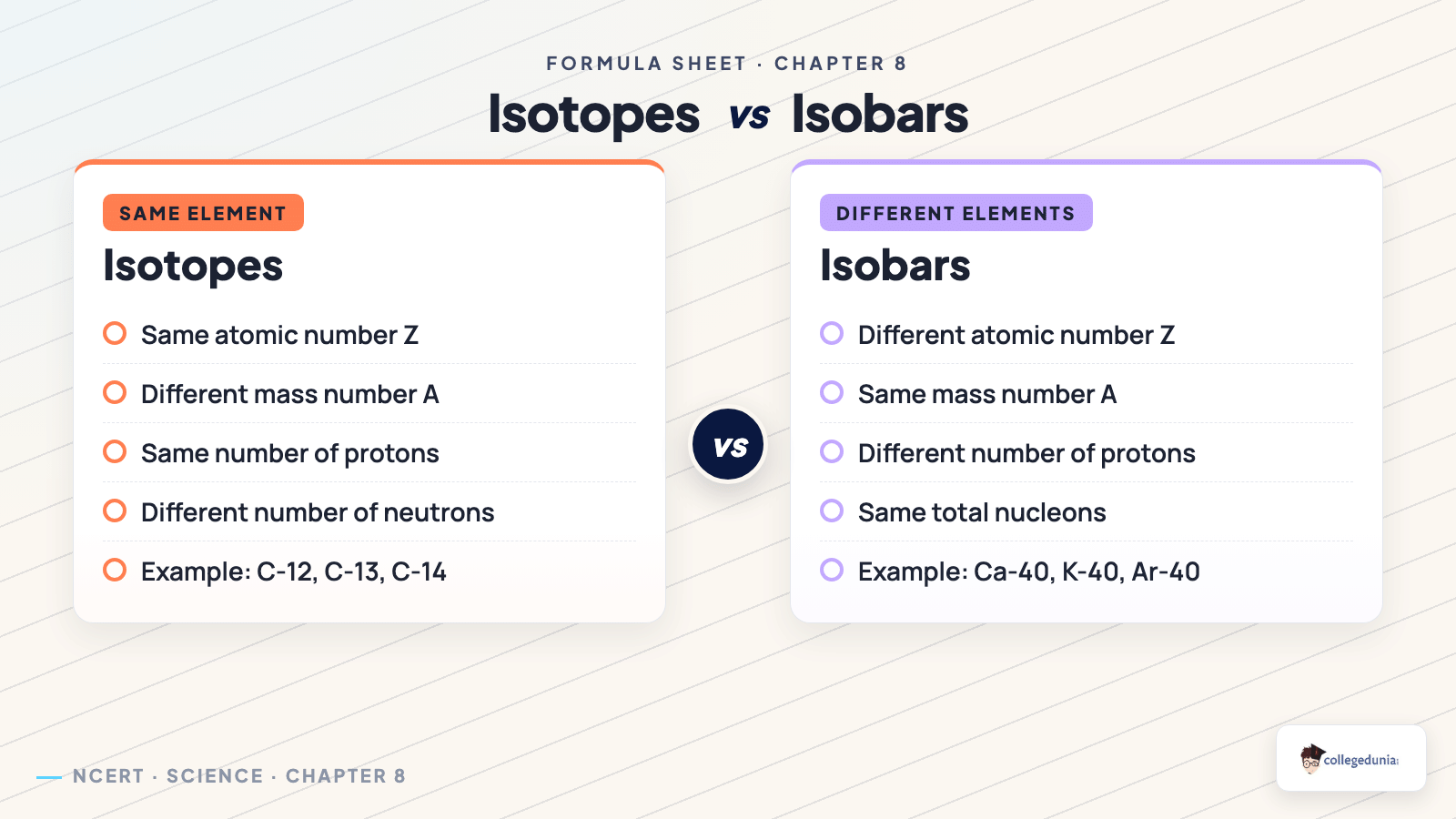
Isotopes and Isobars Recap: Quick Revision for Class 9
Isotopes and isobars are two of the most tested ideas in this chapter, and students mix them up in the exam. The comparison above and the table below fix the difference in one look.
| Feature | Isotopes | Isobars |
|---|---|---|
| Atomic number Z | Same | Different |
| Mass number A | Different | Same |
| Element | Same element | Different elements |
| Example | 11H, 21H, 31H | 4020Ca, 4018Ar |
Because a mixture of isotopes exists in nature, the atomic mass we use is an average. For chlorine, the simple mean of 35 u and 37 u is 35 + 372 = 36 u, but this ignores how common each isotope is. The true value comes from the weighted average: 35 × 75100 + 37 × 25100 = 35.5 u.
One-Shot Revision Tips for Journey Inside the Atom Class 9
Treat the sheet as a checklist you tick off the night before a test. Recall each rule and one example for it.
- Model order: Dalton, Thomson, Rutherford, Bohr, then Modern. Remember "Do Try Reading Books" to keep the order right.
- Nucleus is tiny: the atom is about 105 times bigger than its nucleus, yet almost all the mass sits in that tiny nucleus.
- Bohr saved stability: Rutherford's electron should spiral in and collapse; Bohr fixed this by saying an electron in a shell does not lose energy.
- Fill shells inside out: use 2n2, cap the outermost at 8, and check the numbers add up to Z. Sodium is 2, 8, 1; chlorine is 2, 8, 7.
- Valency from the octet: an atom gains, loses or shares electrons to reach 8. That number of electrons is its valency.
- Averages: use the weighted average when abundances are given; the plain mean only when they are not.
Full topic-by-topic revision: Journey Inside the Atom Class 9 Science Notes
More Journey Inside the Atom Class 9 Science Resources
Use the table below to move between the other Collegedunia resources for this same chapter, from full solutions to handwritten notes.
| Resource | Open |
|---|---|
| Formula Sheet | Journey Inside the Atom Class 9 Science Formula Sheet |
| NCERT Solutions | Journey Inside the Atom Class 9 Science NCERT Solutions |
| Revision Notes | Journey Inside the Atom Class 9 Science Notes |
| Handwritten Notes | Journey Inside the Atom Class 9 Science Handwritten Notes |
| NCERT Book PDF | Journey Inside the Atom Class 9 Science NCERT Book PDF |
NCERT Formula Sheet for Class 9 Science: All Chapters
Formula Sheets are available for the numerical chapters of Class 9 Science. Open any other one below.
| Chapter | Formula Sheet |
|---|---|
| Chapter 5 | Exploring Mixtures and their Separation Formula Sheet |
| Chapter 6 | How Forces Affect Motion Formula Sheet |
| Chapter 7 | Work, Energy, and Simple Machines Formula Sheet |
| Chapter 8 | Journey Inside the Atom Formula Sheet |
| Chapter 9 | Atomic Foundations of Matter Formula Sheet |
| Chapter 10 | Sound Waves Characteristics and Applications Formula Sheet |
Journey Inside the Atom Class 9 Science Formula Sheet FAQs
Ques. Where can I download the Journey Inside the Atom Class 9 Science Formula Sheet PDF?
Ans. You can download the Journey Inside the Atom Formula Sheet PDF free from this page. It covers the atomic number and mass number links, the neutron relation, the 2n2 shell rule, the valency rule, and average atomic mass for the 2026-27 Exploration Chapter 8.
Ques. What is the relation between mass number, atomic number and neutrons?
Ans. The mass number is the sum of protons and neutrons, so A = Z + N. Rearranged, the number of neutrons is N = A − Z. For example, 126C has N = 12 − 6 = 6 neutrons.
Ques. What is the 2n squared rule in Class 9 Science Chapter 8?
Ans. The 2n2 rule gives the maximum number of electrons a shell can hold, where n is the shell number. So K holds 2, L holds 8, M holds 18, and N holds 32. The outermost shell can never hold more than 8 electrons.
Ques. How do you find the valency of an atom?
Ans. Count the electrons in the outermost shell. If they are 4 or fewer, the valency equals that count. If they are more than 4, the valency is 8 − the count. For oxygen with 6 valence electrons, valency = 8 − 6 = 2.
Ques. What is the difference between isotopes and isobars?
Ans. Isotopes have the same atomic number Z but different mass number A, so they are the same element with different neutrons, like 126C and 146C. Isobars have the same mass number A but different atomic number, so they are different elements, like 4020Ca and 4018Ar.
Ques. How is the average atomic mass of chlorine calculated?
Ans. Chlorine has two isotopes, 35 u and 37 u, with abundances of about 75% and 25%. The weighted average is 35 × 75100 + 37 × 25100 = 35.5 u. This is why chlorine's atomic mass is not a whole number.
Ques. Is Journey Inside the Atom part of the new Class 9 Science book?
Ans. Yes. Journey Inside the Atom is Chapter 8 of the new Exploration textbook for the 2026-27 syllabus. It covers sub-atomic particles, atomic and mass number, isotopes and isobars, electronic configuration, and valency, and it is the base for Chapter 9 Atomic Foundations of Matter.



Comments