




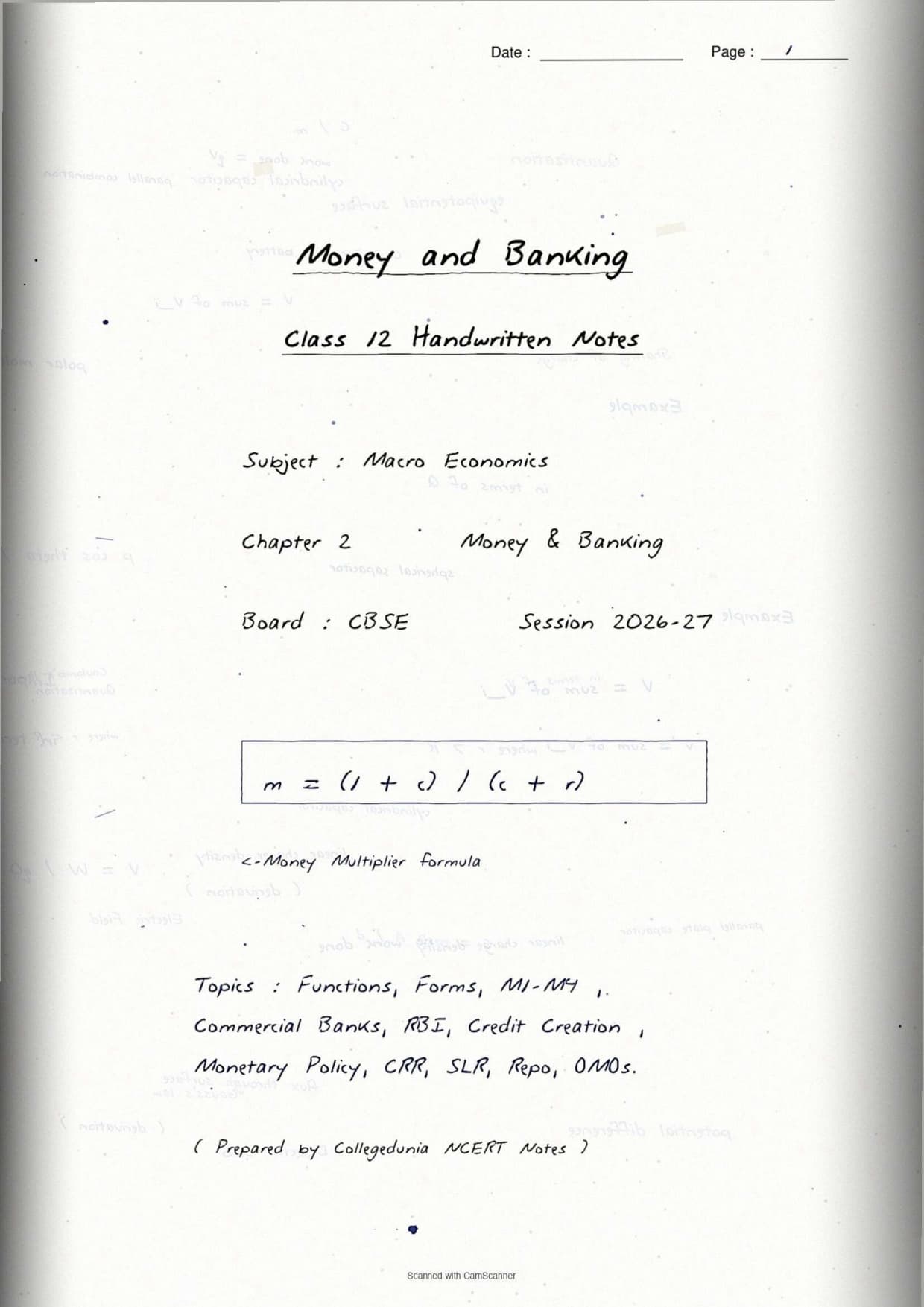
Money and Banking is Chapter 3 of Class 12 Macroeconomics. It covers the functions of money, the money supply, credit creation by banks, and the RBI's monetary policy tools. This page has free scanned handwritten notes you can download as a PDF.
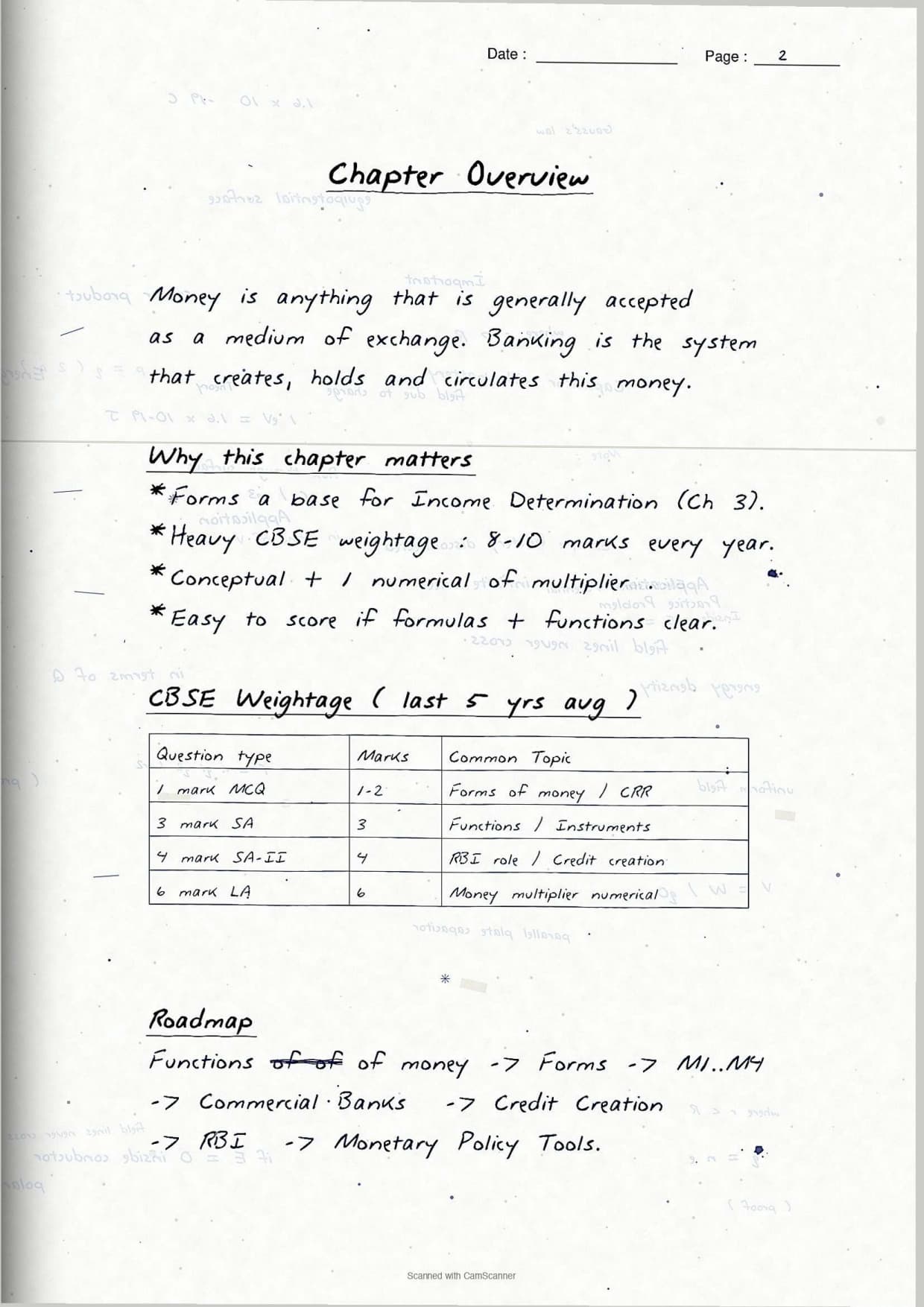
Here is what this chapter is worth in the exam:
- CBSE Boards: about 6 marks, mostly the money multiplier numerical and RBI tools.
- CUET: 2 to 3 questions each year on money supply and monetary policy.
- Revision time: about 25 minutes with these handwritten pages.
What These Money and Banking Class 12 Handwritten Notes Cover
These are scanned notebook pages, written in ballpoint pen on ruled paper. They are built for last-mile revision, not first-time learning. The file covers every concept CBSE tests in Chapter 3:
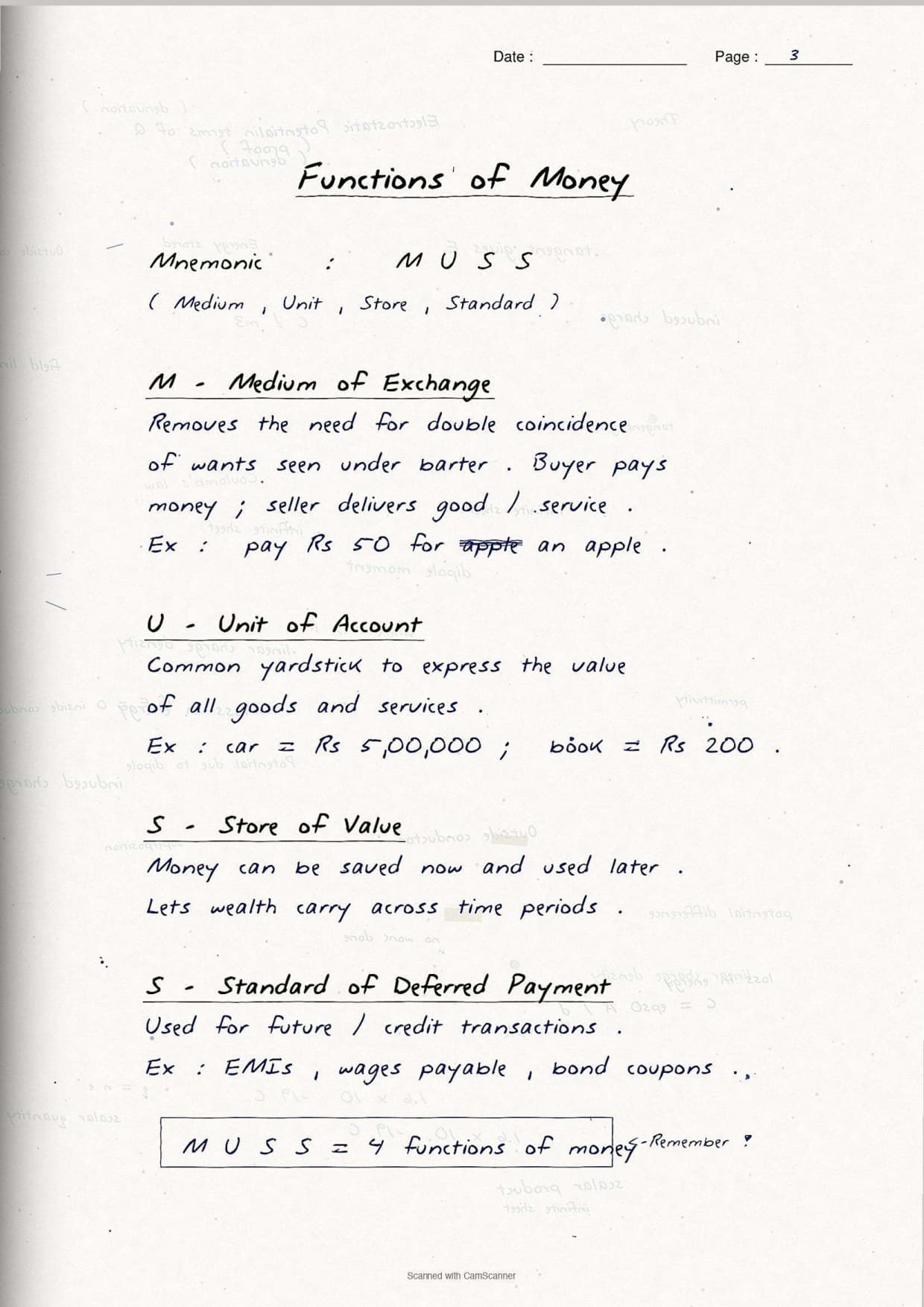
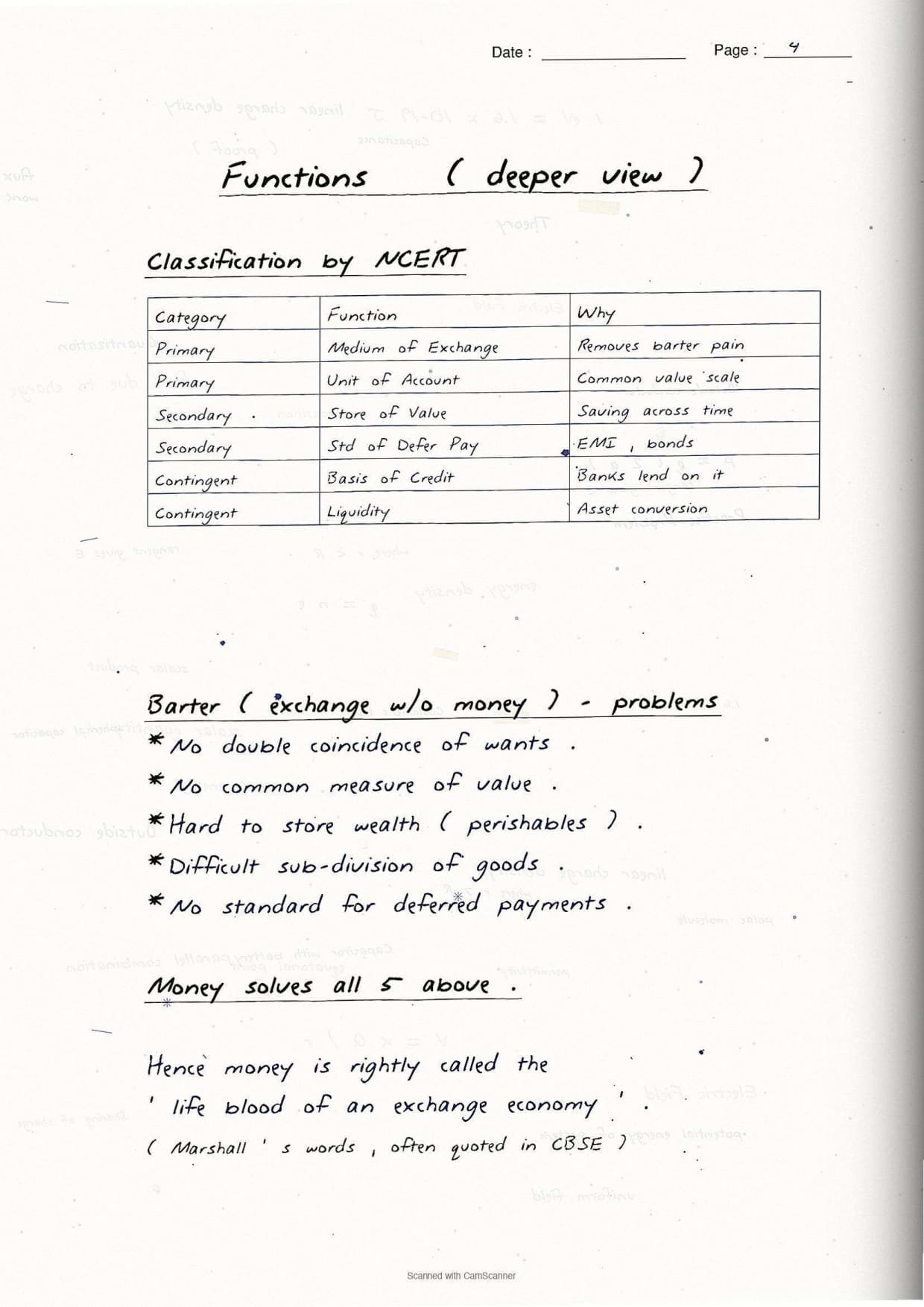
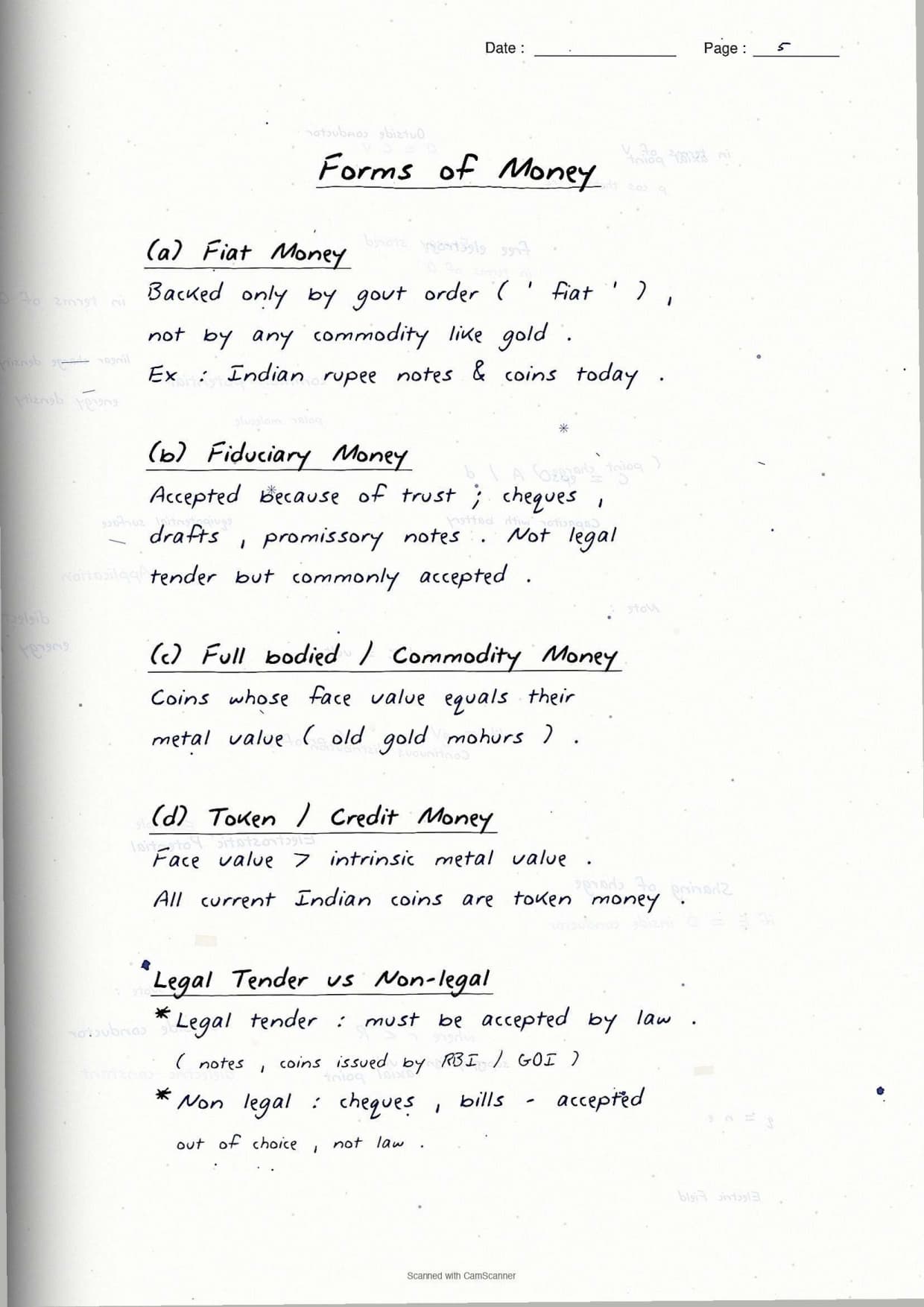
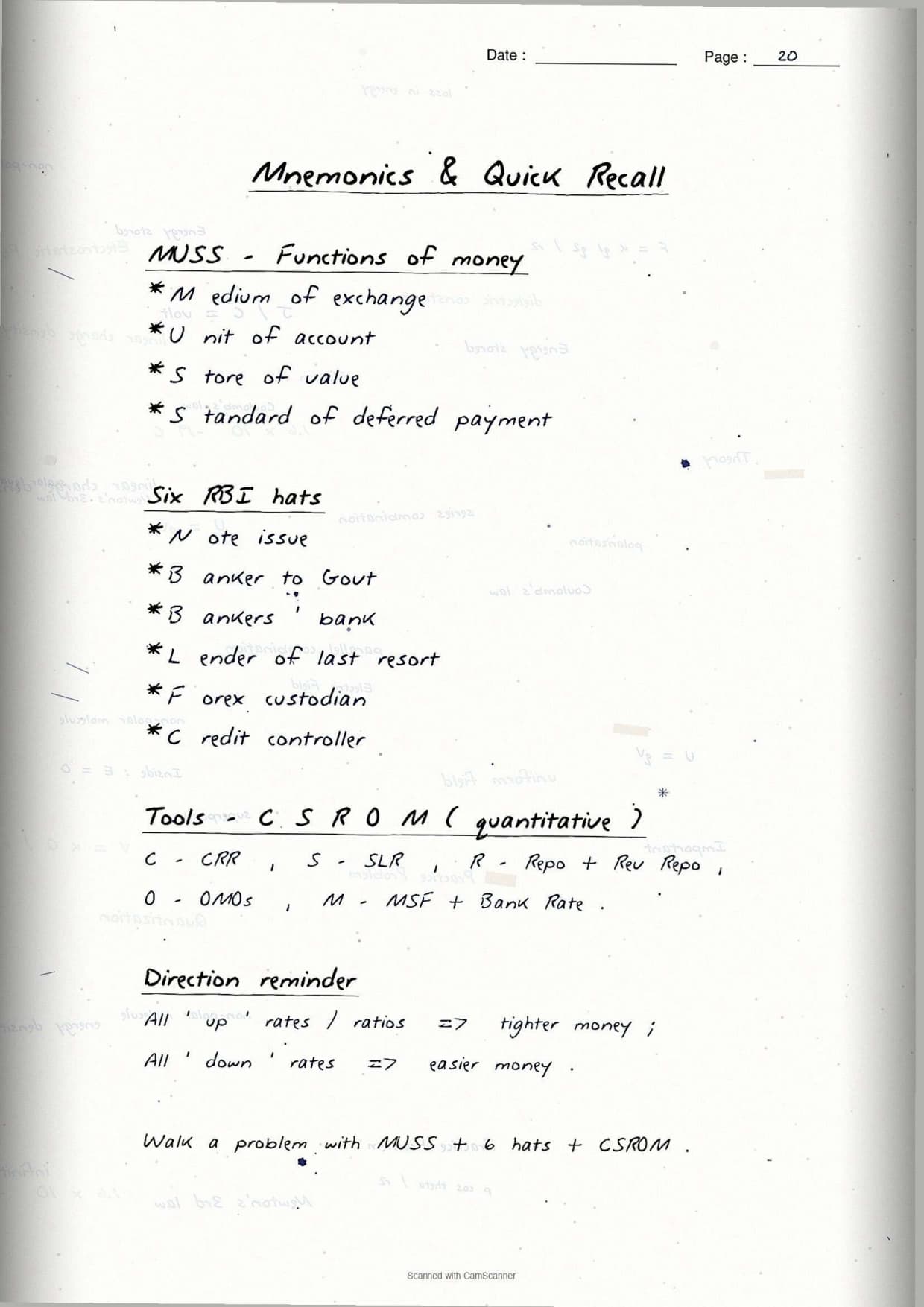
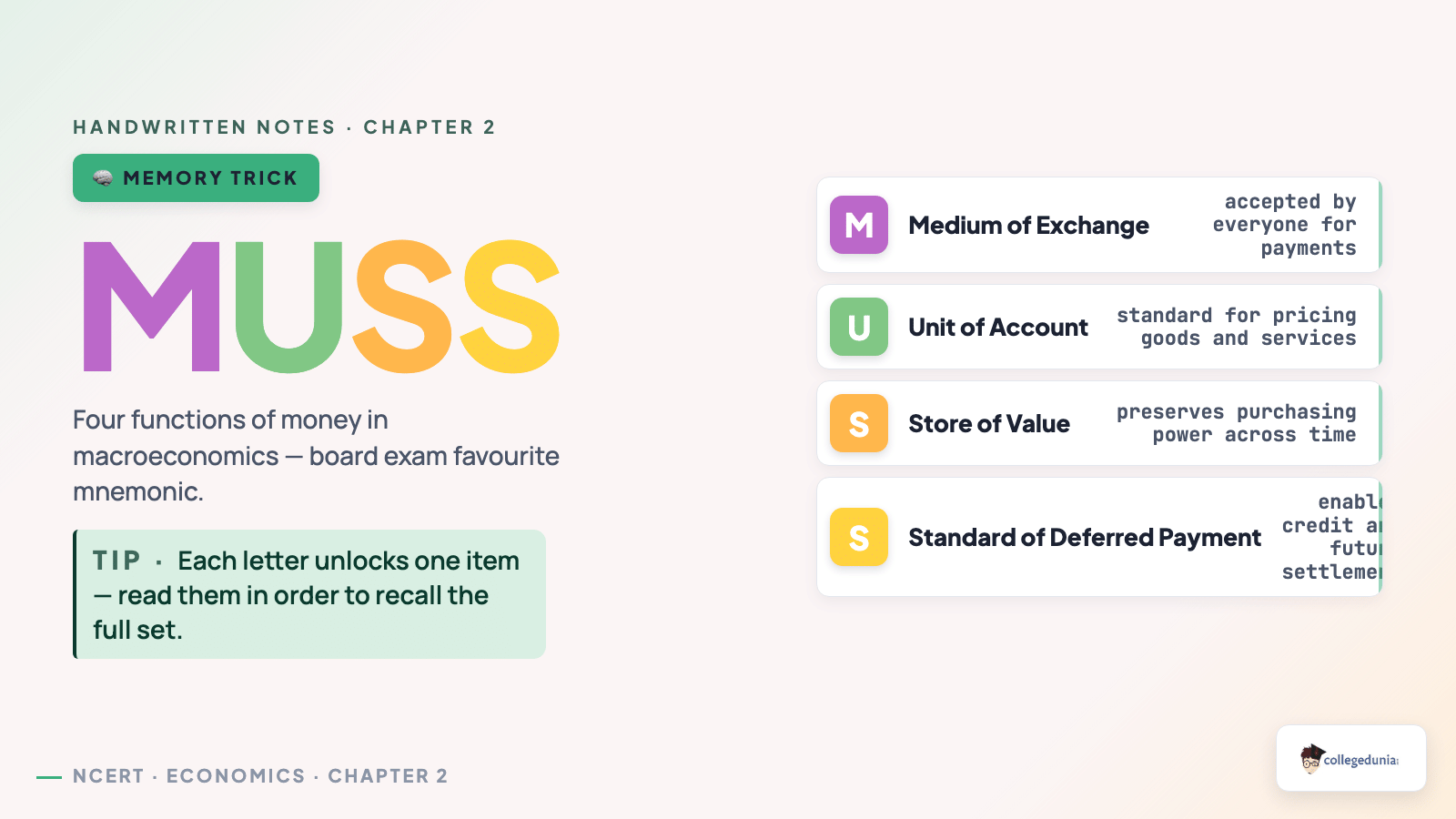
- Functions of money: medium of exchange, unit of account, store of value, standard of deferred payment.
- Money supply: the M1 to M4 chain, high-powered money and the money multiplier.
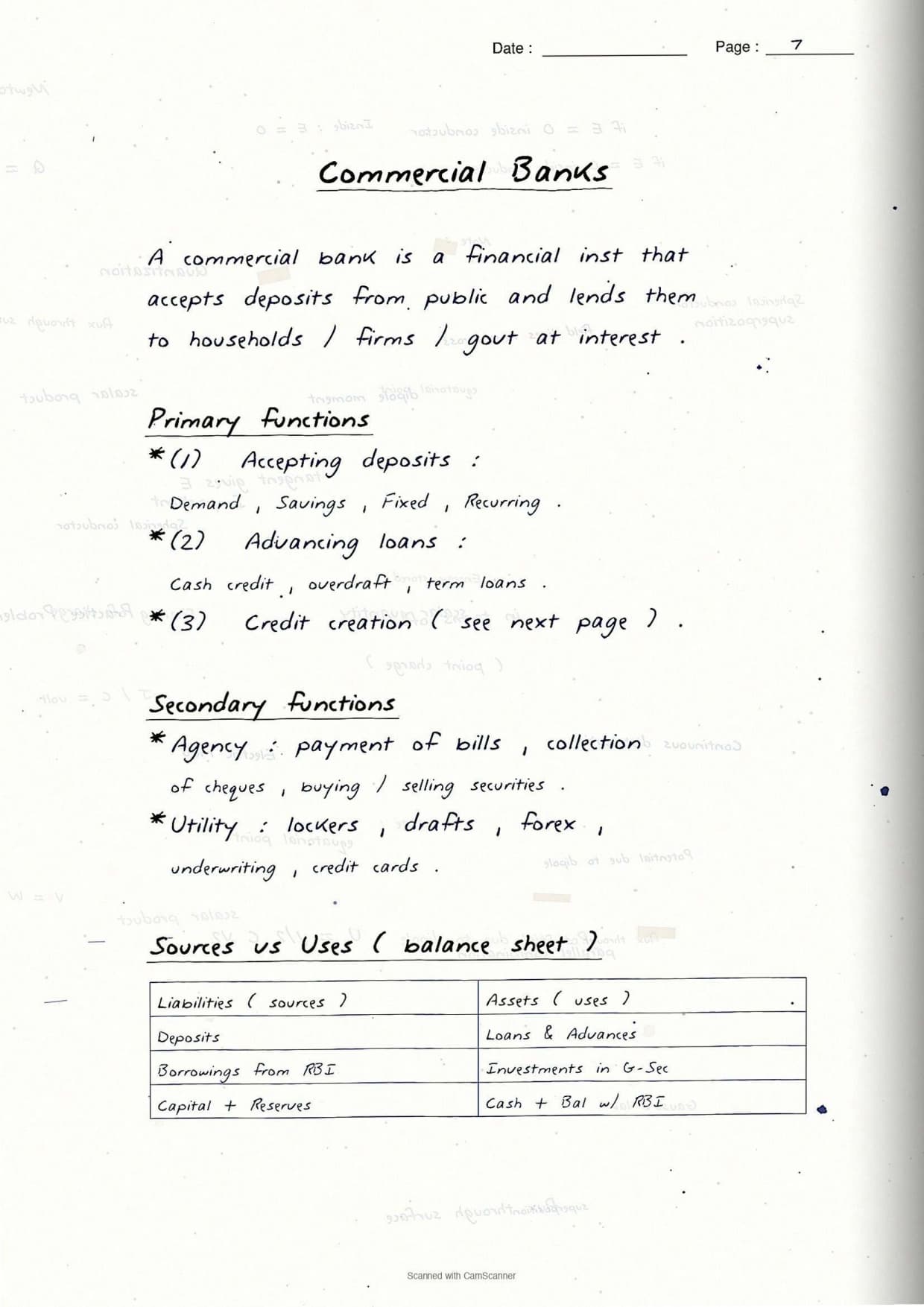
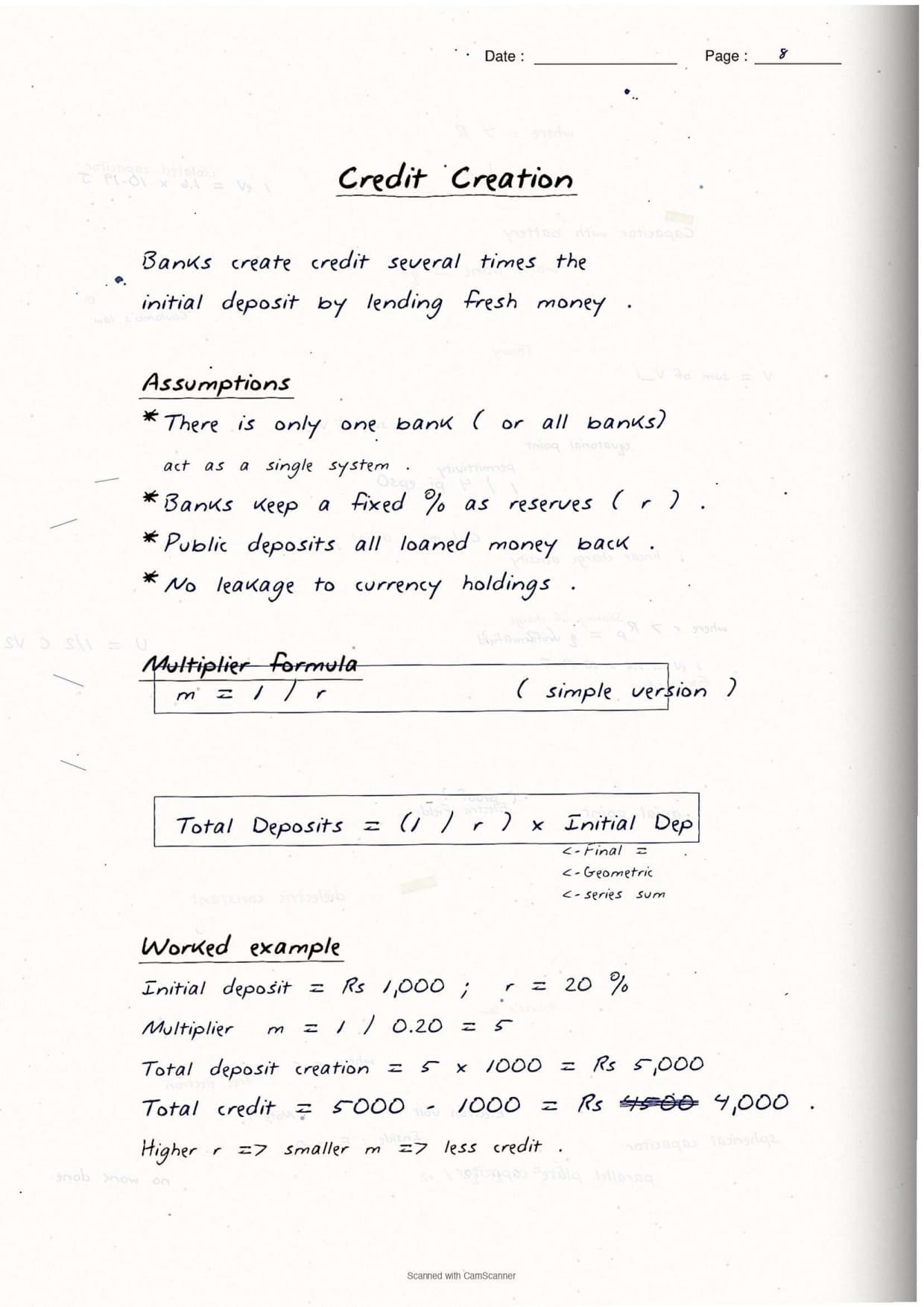
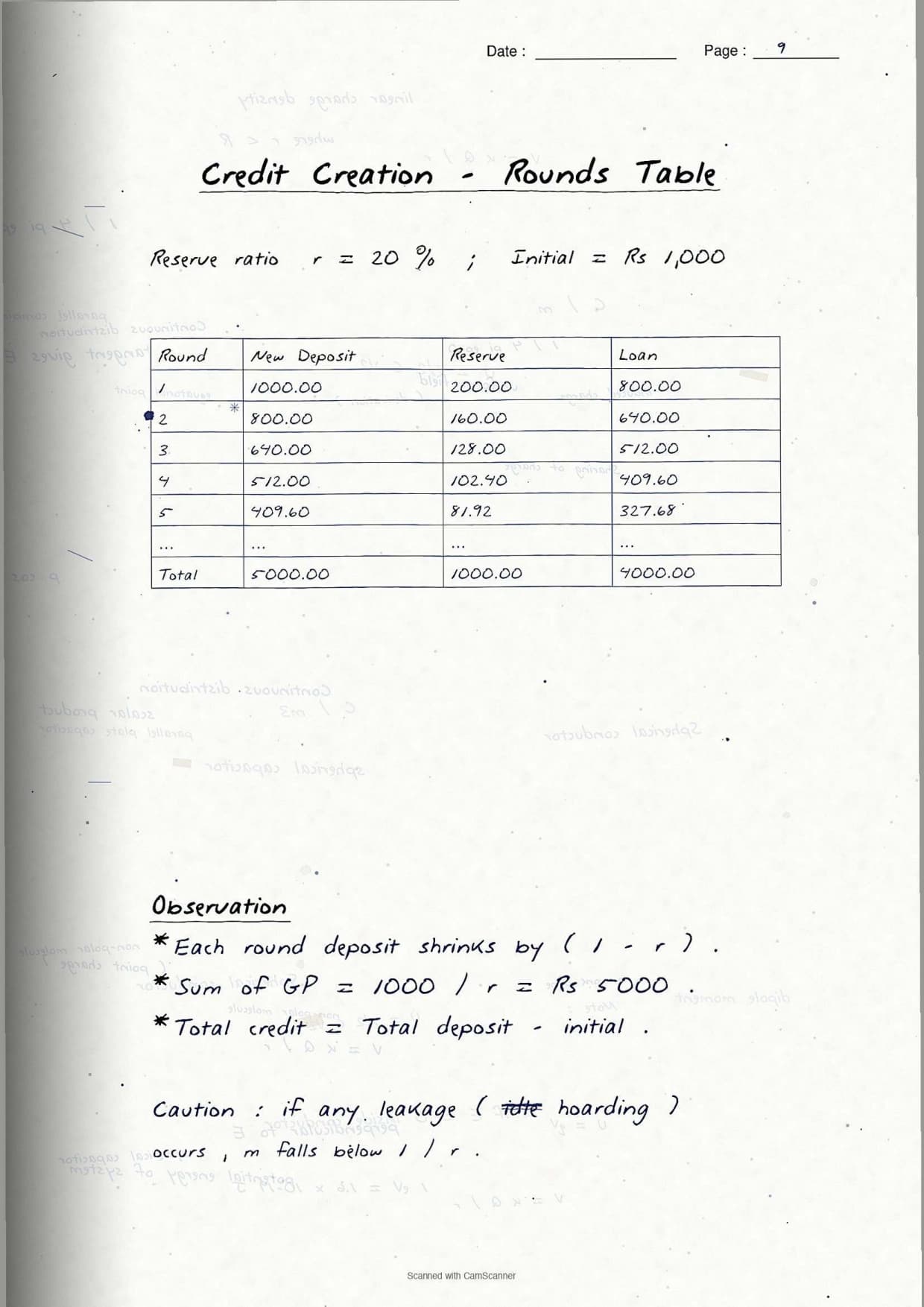
- Banking: credit creation by commercial banks.
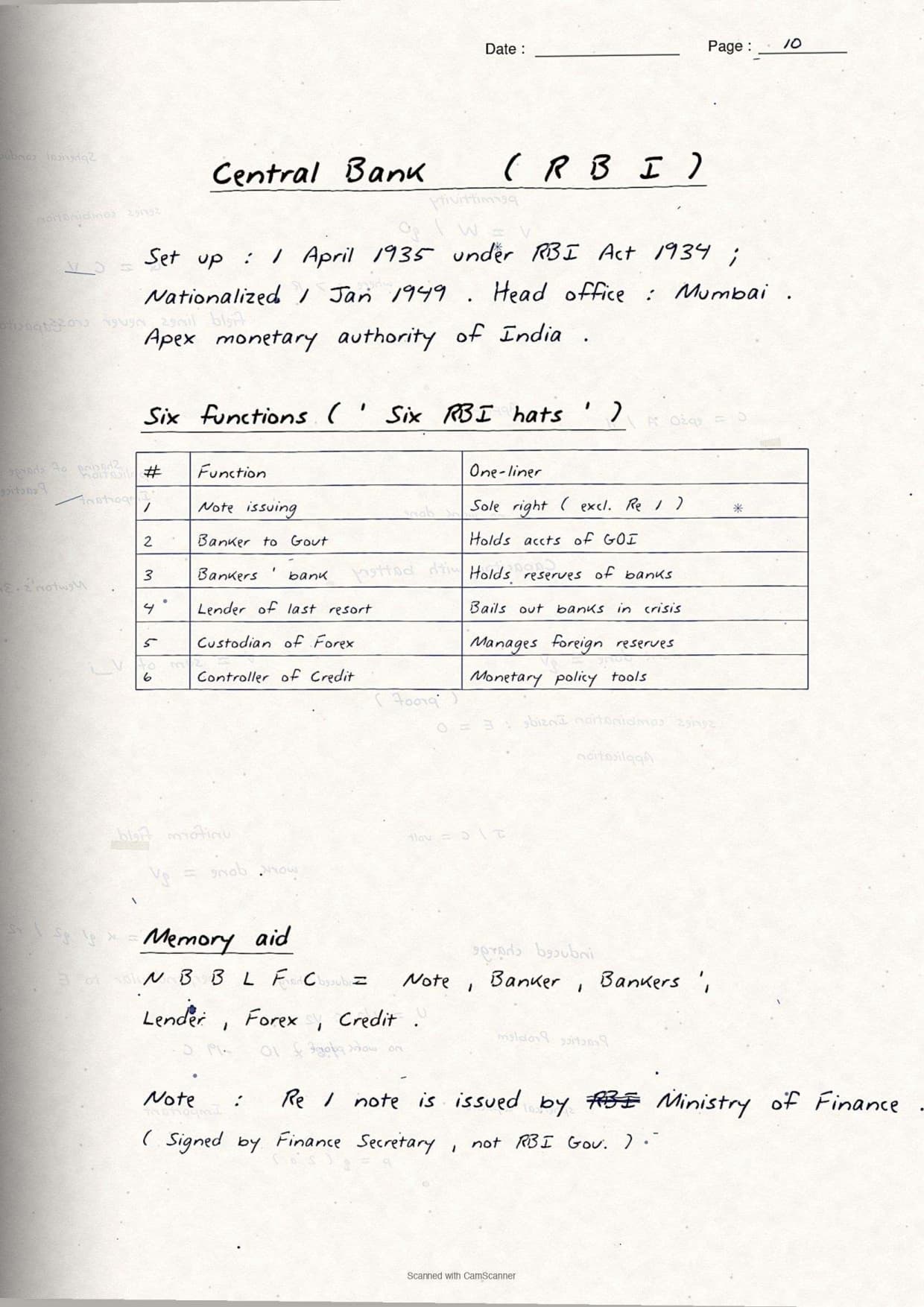
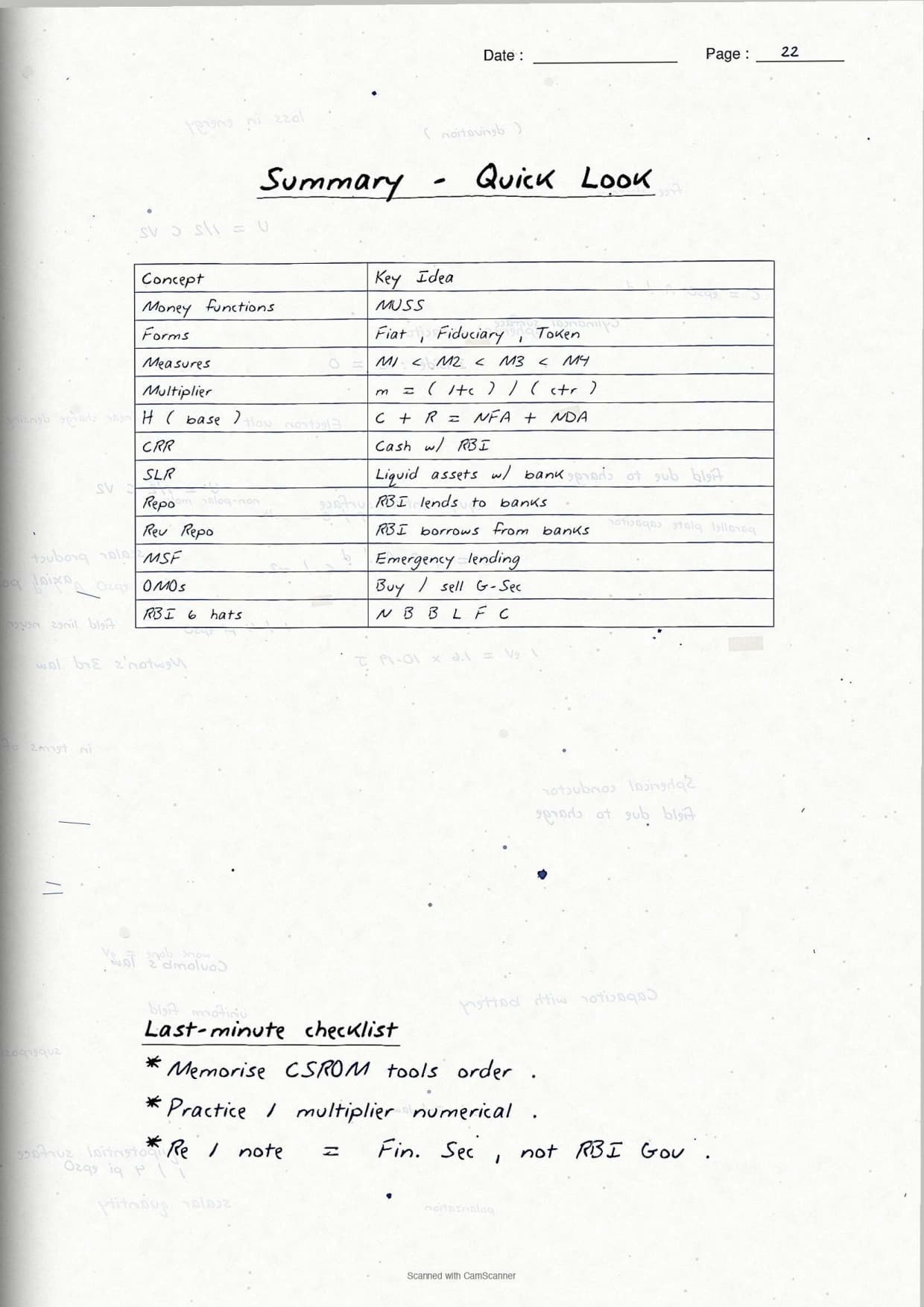
- RBI: its six functions plus the quantitative and qualitative policy tools.
Each formula sits inside a hand-drawn box, and common mistakes are marked in a second ink colour in the margin. The PDF is the closest thing to borrowing a topper's notebook for one revision sitting.
Money Supply Chain M1 to M4 in Money and Banking Class 12
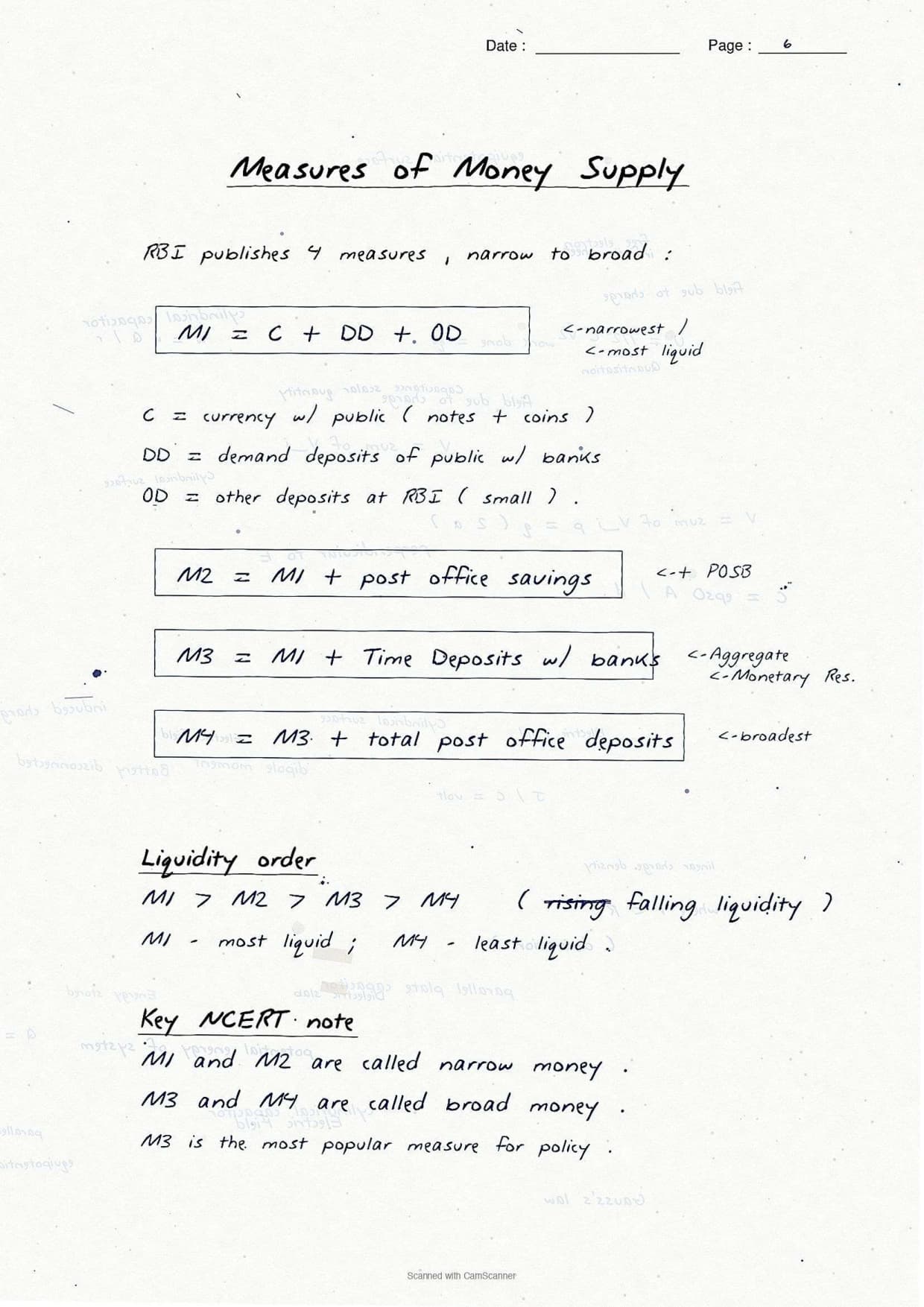
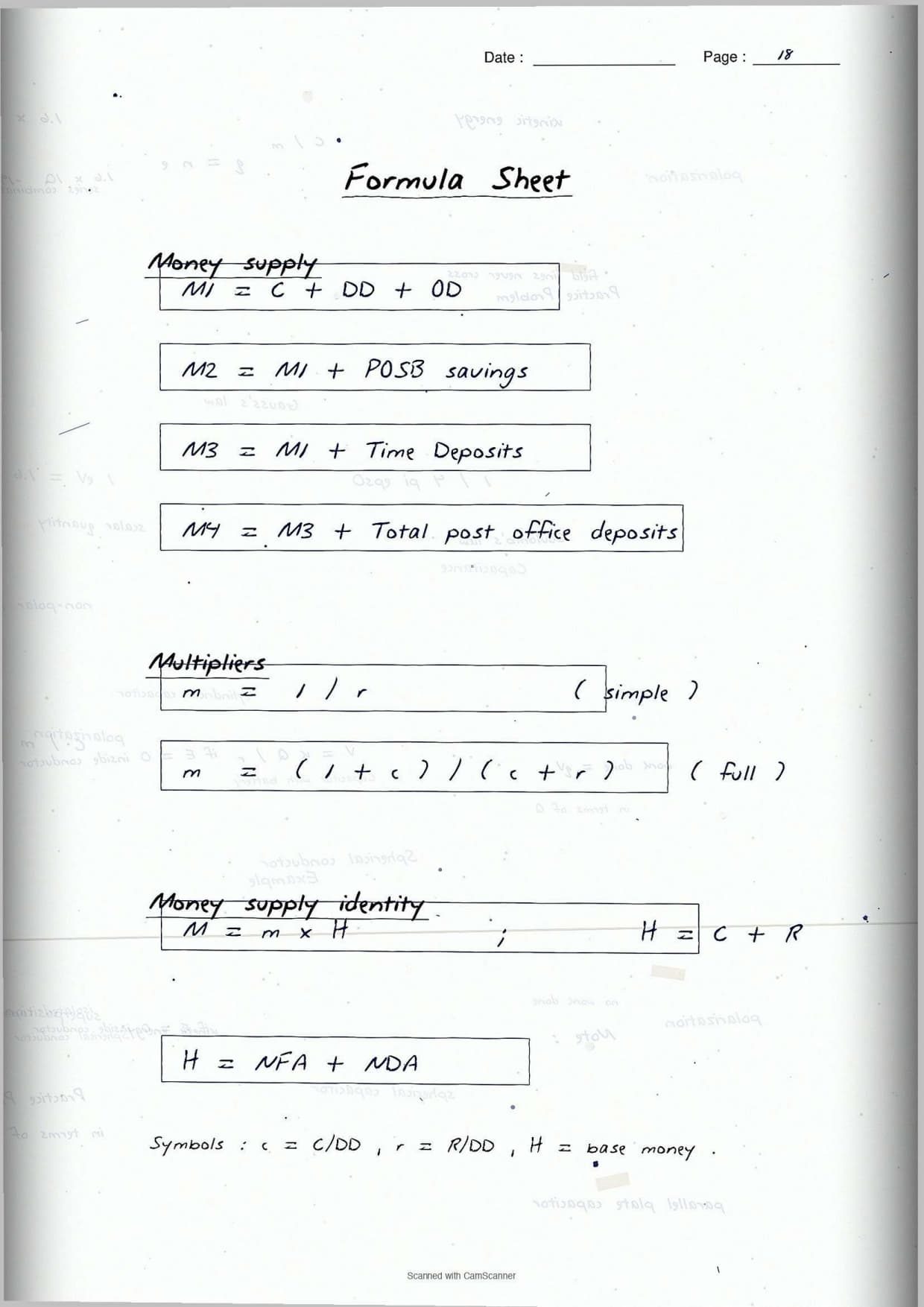
The RBI defines four measures of money supply in order of falling liquidity. M1 is the most liquid; M4 is the broadest. The notebook draws them as one vertical chain with a rightward arrow.
| Measure | Components | Liquidity |
|---|---|---|
| M1 (narrow money) | Currency with public + Demand deposits + Other deposits with RBI | Most liquid |
| M2 | M1 + Post Office savings deposits | High |
| M3 (broad money) | M1 + Net time deposits of commercial banks | Moderate |
| M4 | M3 + Total Post Office deposits (excluding NSCs) | Least liquid |
One rule saves marks: broad money is M3, not M4. The RBI uses M3 as its headline aggregate, so quote M3 for any "broad money" answer.
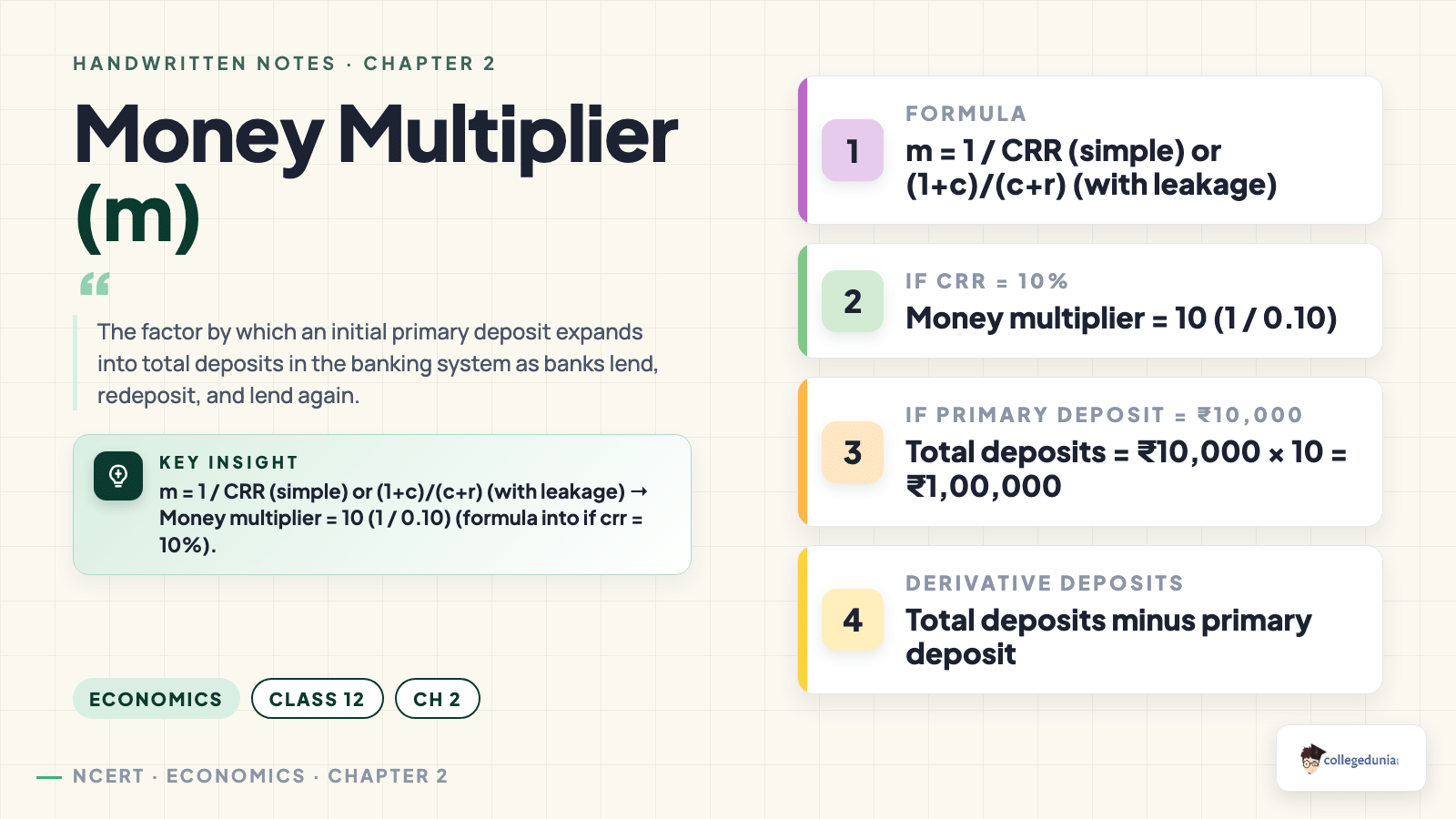
Key Formulas in the Money and Banking Handwritten Notes
This is the highest-value page in the file. Learn these formulas first, since most numerical marks come from them.
| Concept | Formula |
|---|---|
| Transaction demand | LT = kT (k = proportion held, T = value of transactions) |
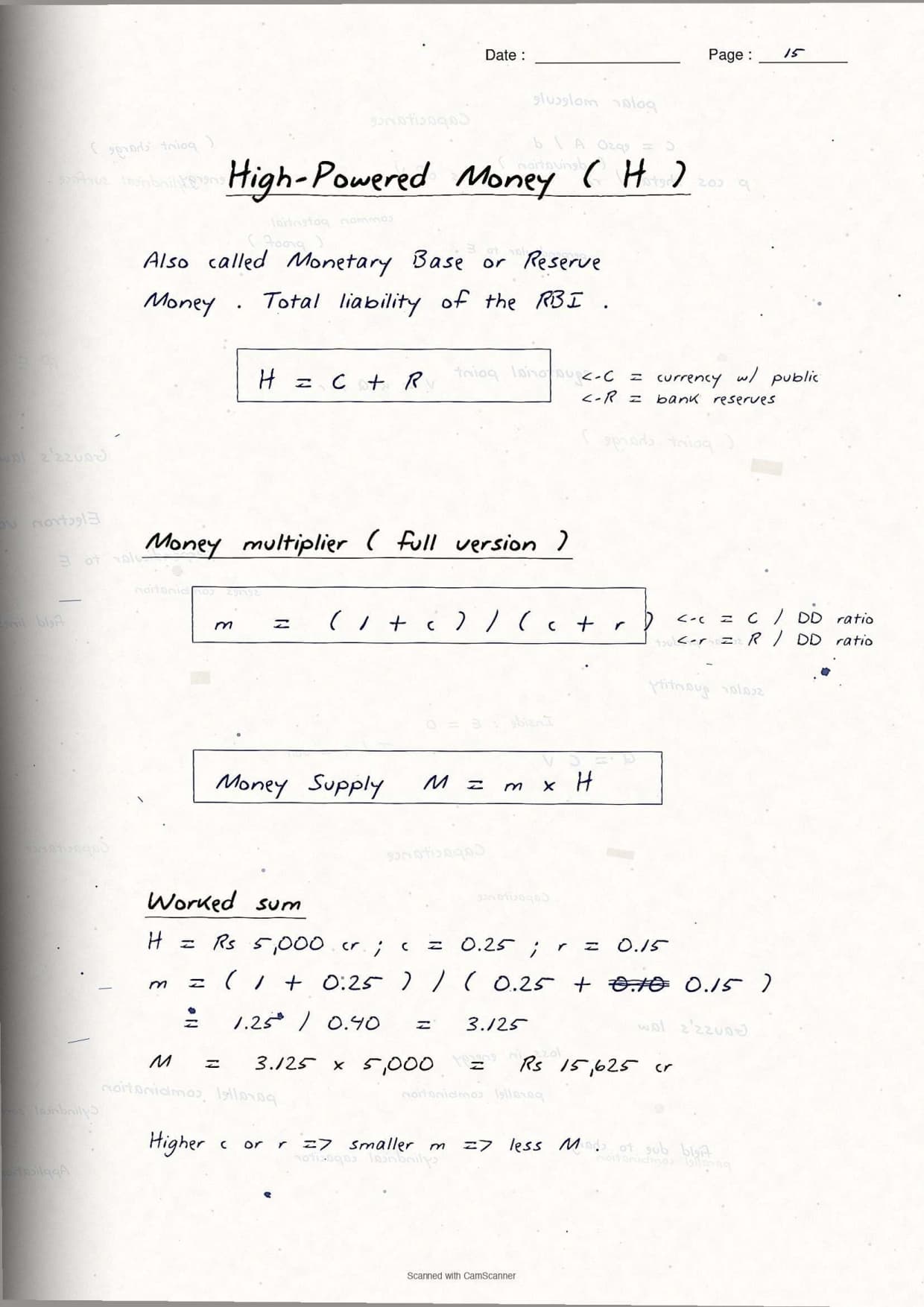
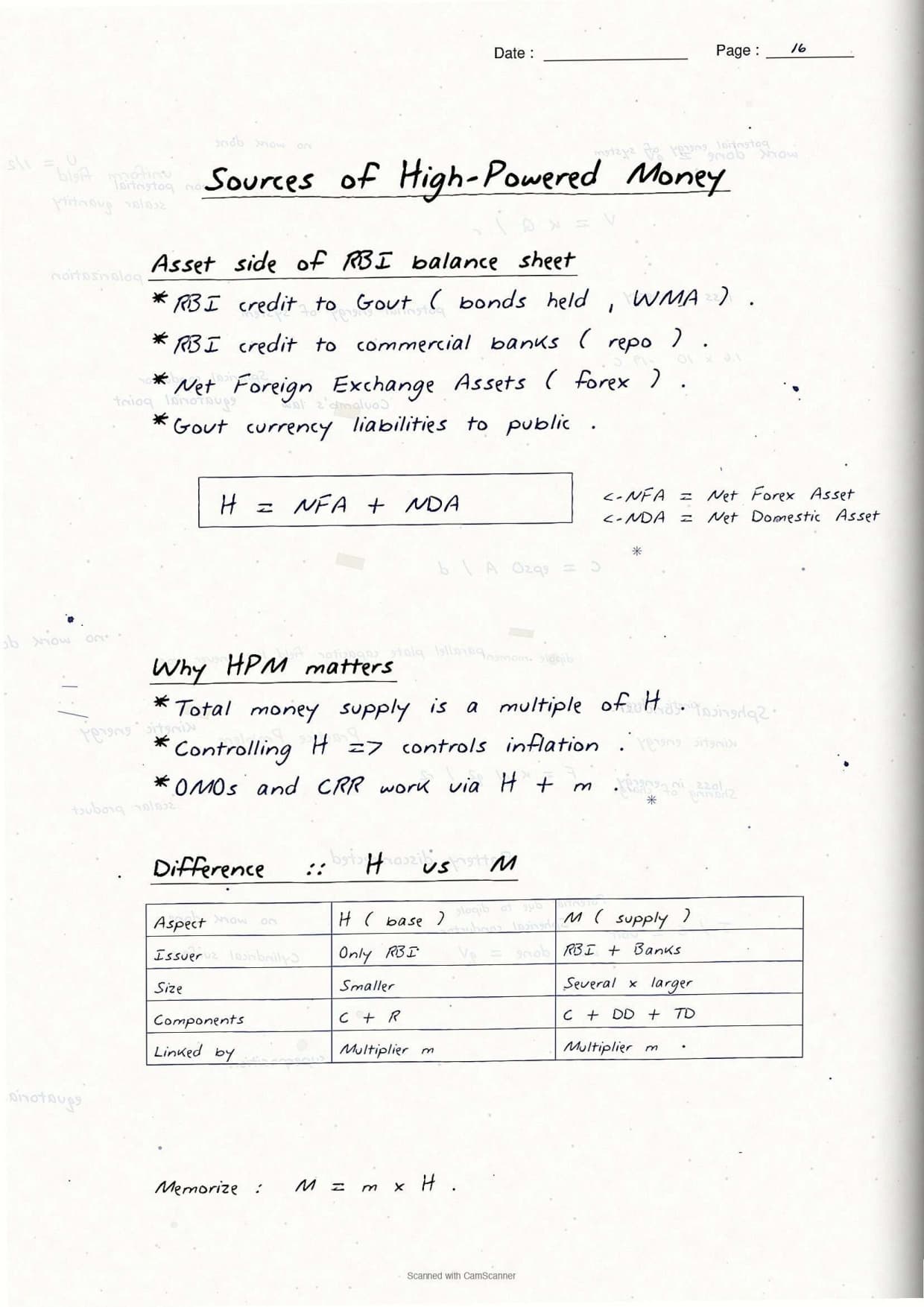
| High-powered money (H) | Currency with public + Bank reserves with RBI + Other deposits with RBI |
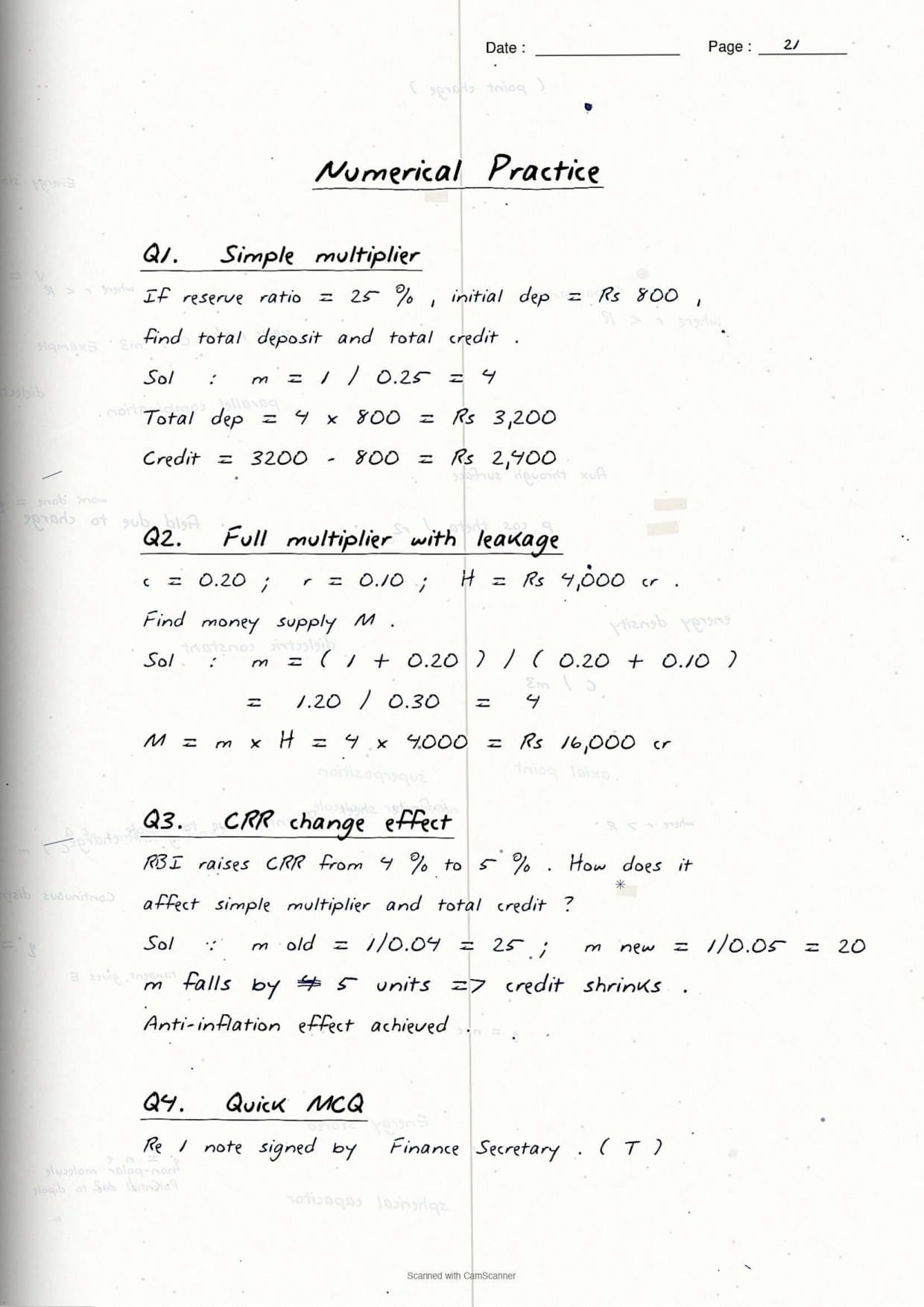
| Money multiplier (m) | (1 + c) / (c + r), where c = currency-deposit ratio, r = reserve-deposit ratio |
| Money supply identity | Ms = m × H |
| Credit creation (no leakage) | Total deposits = Initial deposit / Required reserve ratio |
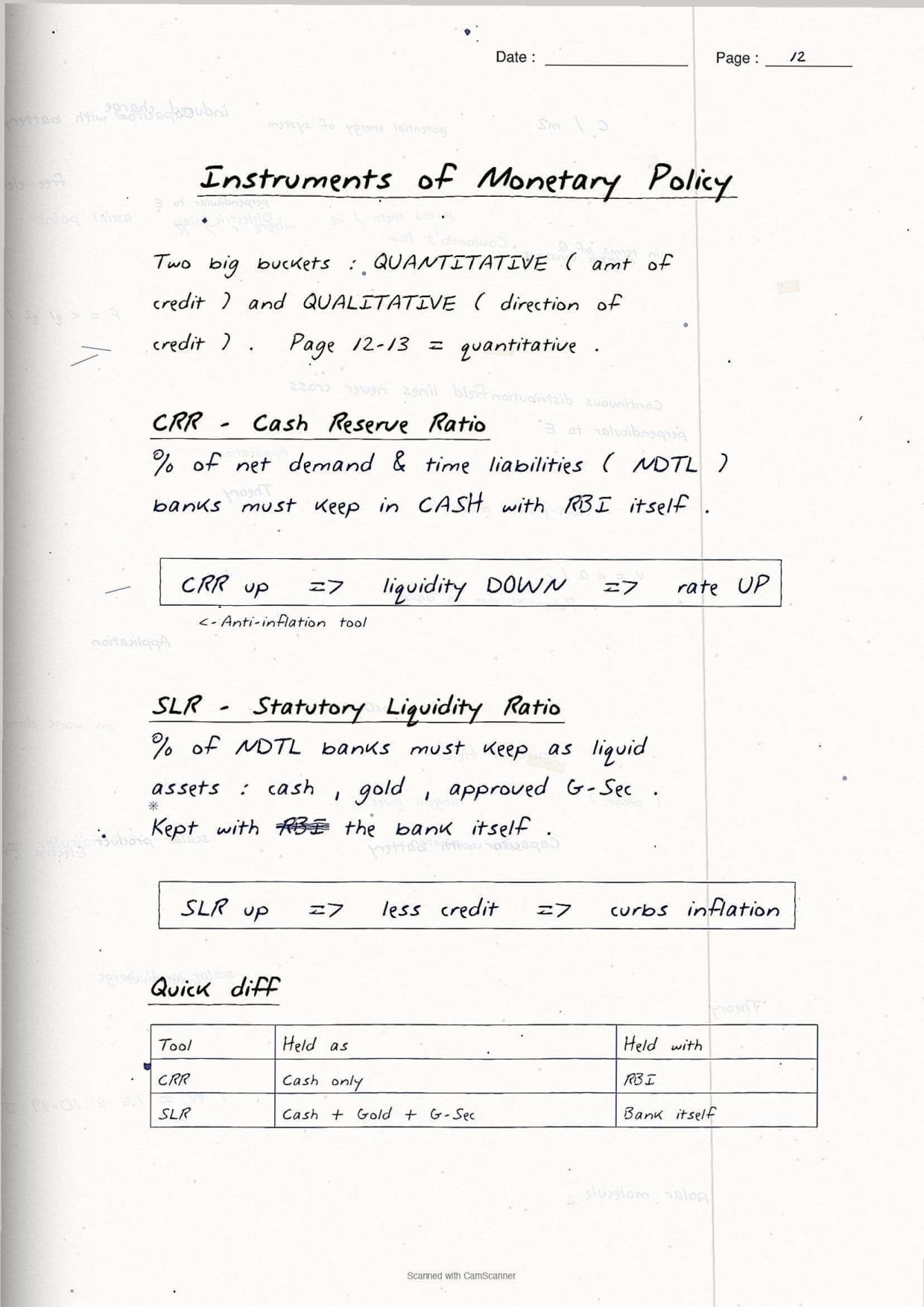
| CRR | Fraction of NDTL banks must keep as cash with the RBI |
| SLR | Fraction of NDTL banks must hold in liquid assets themselves |
Memory hook: the multiplier is (1 + c) / (c + r), not 1 / r. And H has three terms, so never drop "other deposits with RBI" from the H identity.
RBI Functions and Monetary Policy Tools in Money and Banking Class 12
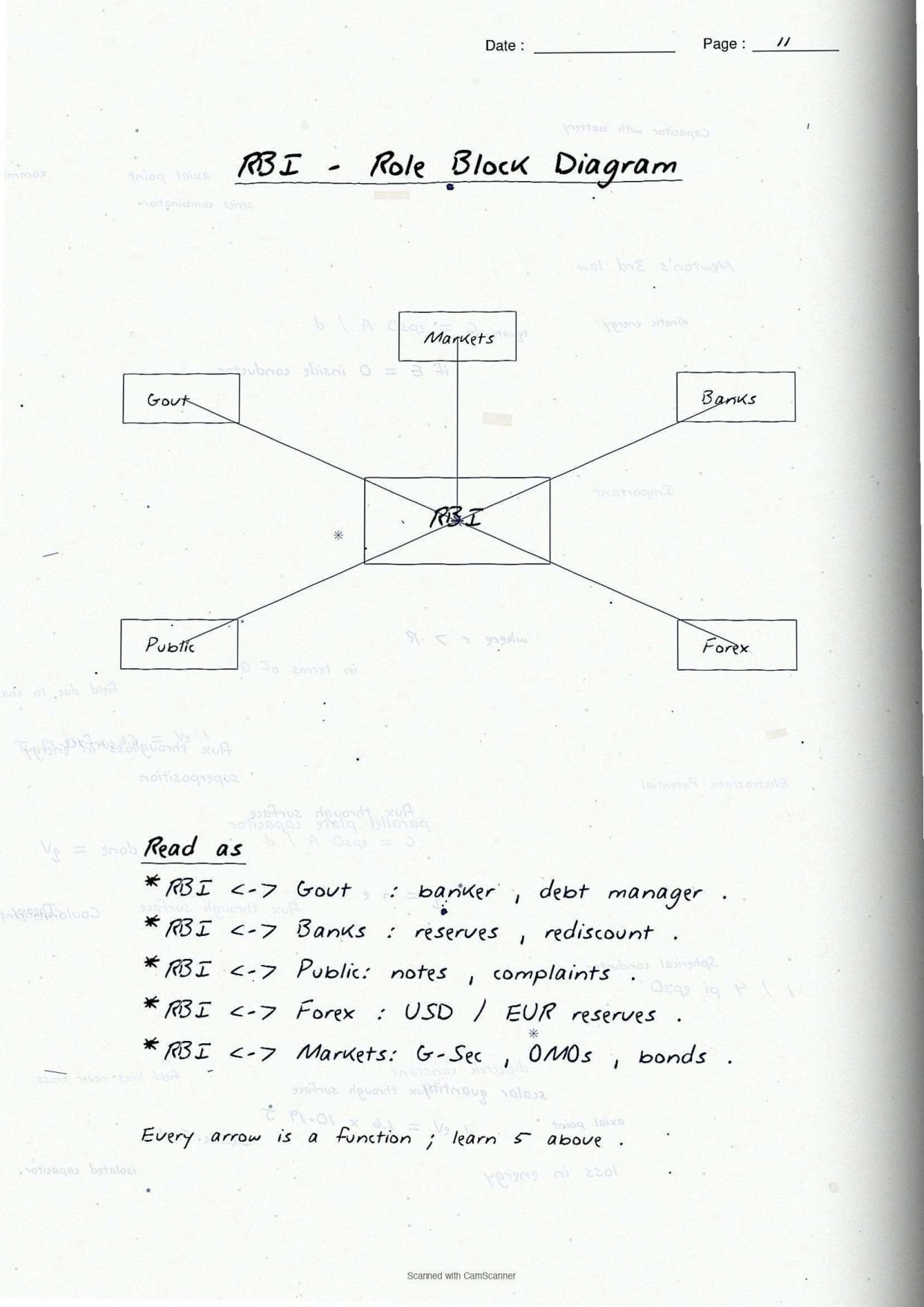
The RBI's six functions appear in the board paper almost every year. The notebook draws them as a hub diagram with the RBI at the centre.
| Function | What the RBI does |
|---|---|
| Currency authority | Issues all notes above Re 1. |
| Banker to the government | Holds government accounts and manages public debt. |
| Banker's bank | Holds bank reserves, clears payments, supervises banks. |
| Controller of credit | Uses policy tools to manage the money supply. |
| Custodian of forex | Holds gold and foreign exchange, manages the rupee. |
| Lender of last resort | Lends to solvent but illiquid banks against good collateral. |
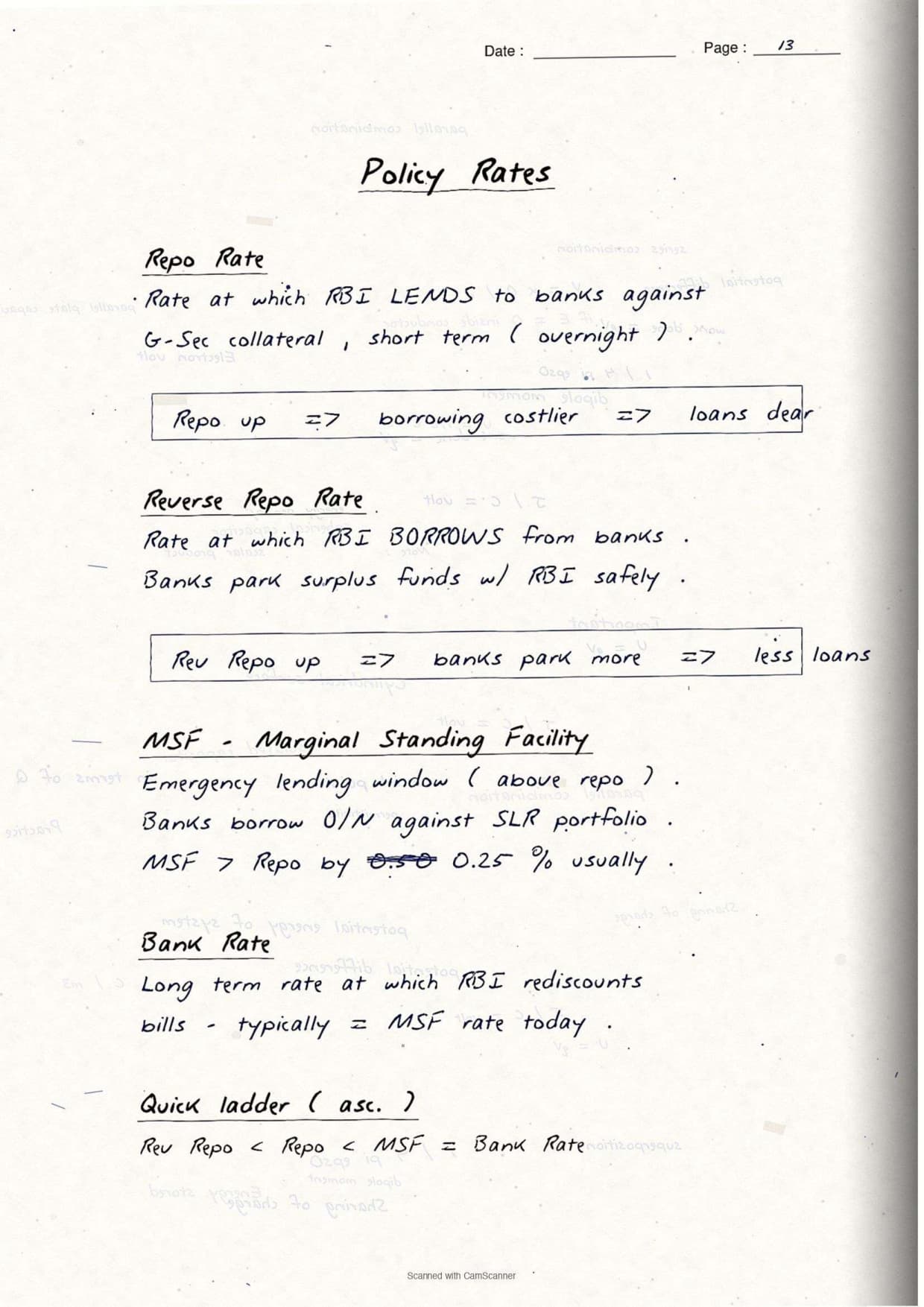
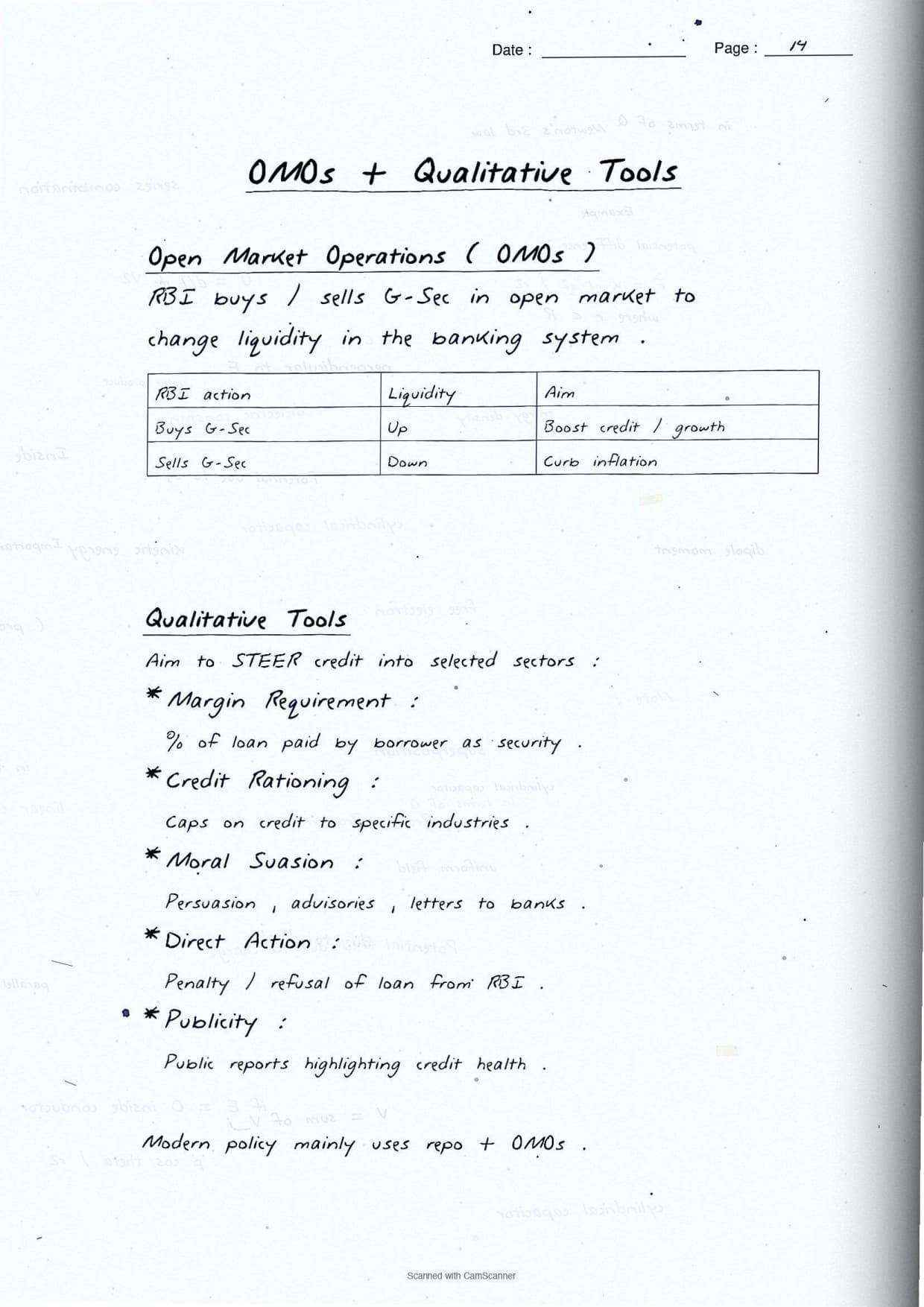
To control credit, the RBI uses two sets of tools:
- Quantitative tools: bank rate, repo rate, reverse repo rate, CRR, SLR and open market operations. Raise them to reduce the money supply; lower them to increase it.
- Qualitative tools: margin requirements, moral suasion, credit rationing and direct action. These guide where credit flows, not the total amount.
Money and Banking Class 12 Video Lesson
Source: Magnet Brains on YouTube
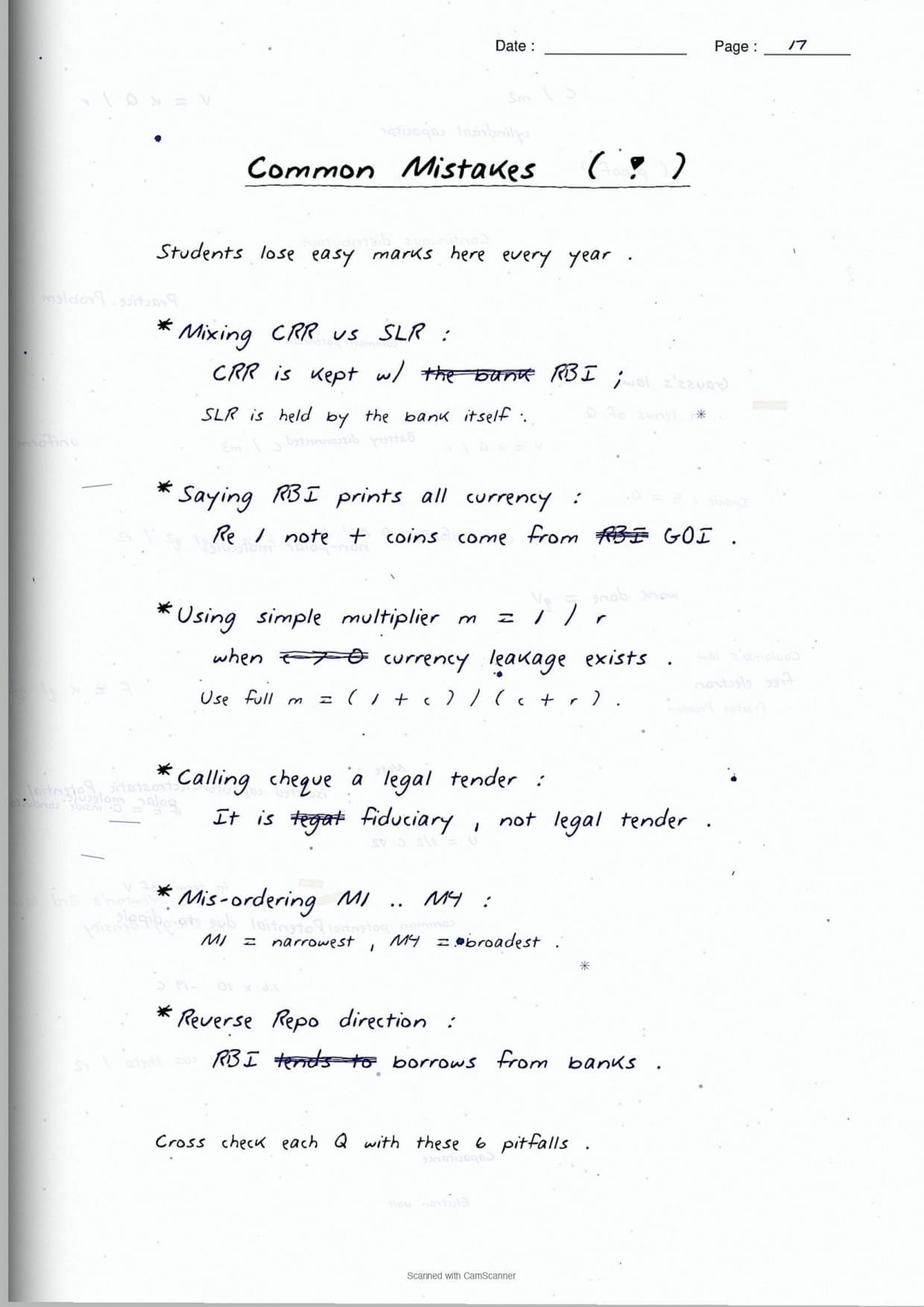
Common Mistakes in Money and Banking Class 12
- Swapping repo and reverse repo. Repo: RBI lends to banks. Reverse repo: RBI borrows from banks.
- Calling M4 broad money. Broad money is M3.
- Dropping "other deposits with RBI" from the H identity.
- Using 1 / r instead of (1 + c) / (c + r) for the multiplier.
- Mixing up CRR (cash with RBI) and SLR (liquid assets with the bank).
Money and Banking Weightage in CBSE Class 12 Economics
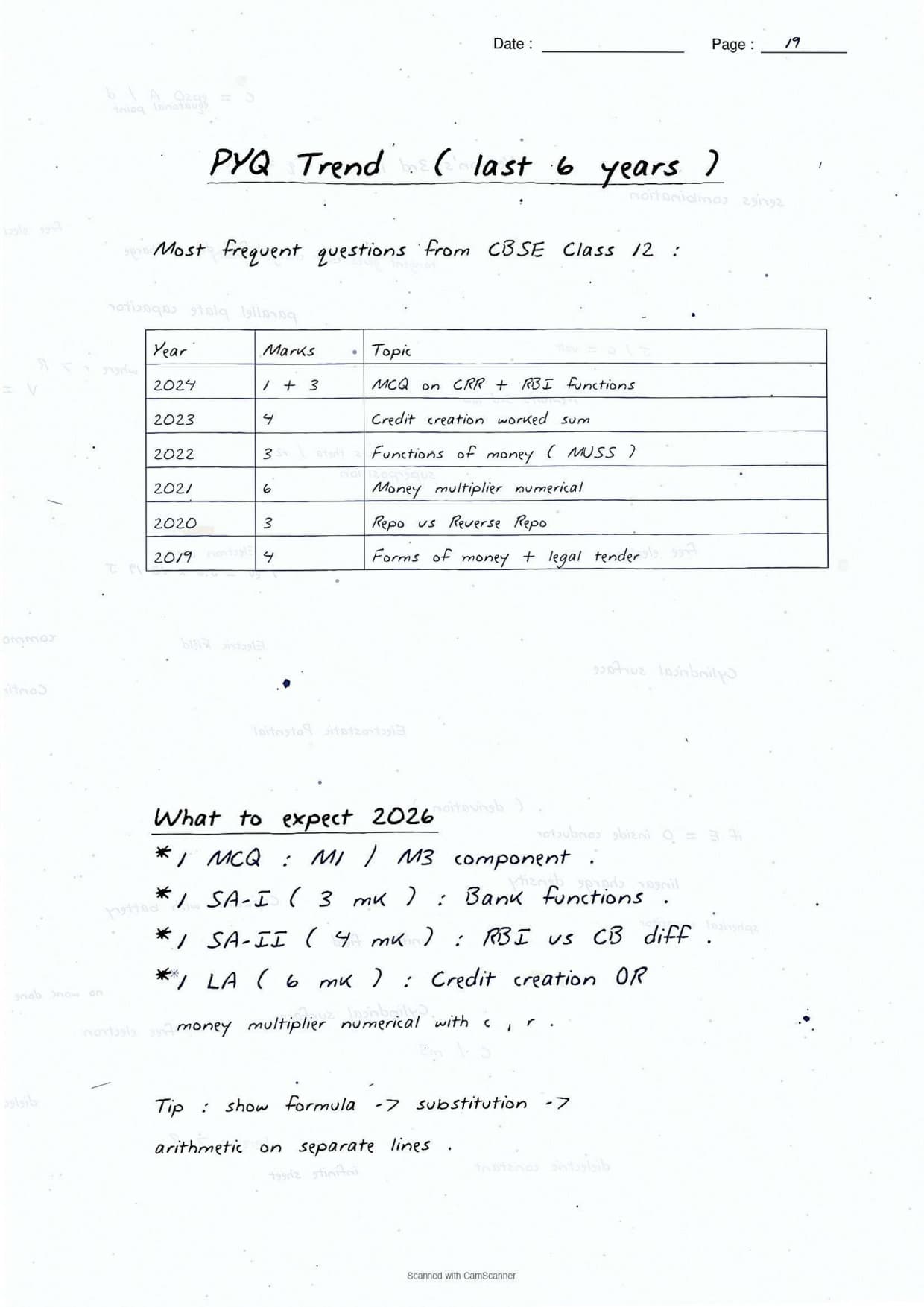
The chapter has carried a steady 8 to 10 marks over the last five years, split across short theory and one numerical. The table maps each year to the page to revise.
| Year | CBSE question | Marks |
|---|---|---|
| 2025 | Define money multiplier and explain two RBI tools | 3 + 4 |
| 2024 | Distinguish M1 and M3; RBI as lender of last resort | 3 + 3 |
| 2023 | Credit creation by banks with a numerical | 6 |
| 2022 | Six functions of RBI; meaning of repo rate | 3 + 1 |
| 2021 | Functions of money; difference between CRR and SLR | 3 + 3 |
Student Feedback
We asked 12,180 Class 12 students about this chapter. 74% said scanned handwritten pages feel faster to scan than typed PDFs in the last 48 hours, and 4 out of 5 found hand-drawn boxes around the money multiplier and the M1 to M4 chain easier to recall.
Other Resources for Class 12 Economics Chapter 3 Money and Banking
Pair these handwritten notes with the Solutions, typed Notes and the official NCERT chapter below.
| Resource | What it covers | Open |
|---|---|---|
| Handwritten Notes | Scanned notebook pages for last-mile revision. | Chapter 3 Handwritten Notes |
| NCERT Solutions | Step-by-step answers to all exercise questions. | Chapter 3 NCERT Solutions |
| Notes | Concept-first typed revision notes. | Chapter 3 Notes |
| NCERT Book PDF | Official NCERT Macroeconomics Chapter 3 textbook. | Chapter 3 NCERT Book PDF |
All Chapters Handwritten Notes for Class 12 Economics Macroeconomics
| Chapter | Topic | Handwritten Notes link |
|---|---|---|
| Chapter 1 | Introduction to Macroeconomics | Introduction to Macroeconomics |
| Chapter 2 | National Income Accounting | National Income Accounting |
| Chapter 3 | Money and Banking | Money and Banking |
| Chapter 4 | Income Determination | Income Determination |
| Chapter 5 | Government Budget and the Economy | Government Budget and the Economy |
| Chapter 6 | Open Economy Macroeconomics | Open Economy Macroeconomics |
Money and Banking Class 12 Handwritten Notes FAQs
Ques. What are these money and banking class 12 handwritten notes for?
Ans. They are a scanned-notebook revision file. They compress NCERT Chapter 3 into a few pages of pen-on-paper formula boxes, the M1 to M4 chain, an RBI hub diagram and margin notes on common mistakes. Students use the file for last-mile revision before the board paper, paired with the typed Notes for concepts and the NCERT Solutions for numerical practice.
Ques. What is the money multiplier formula in class 12 money and banking?
Ans. The money multiplier is m = (1 + c) / (c + r), where c is the currency-deposit ratio and r is the reserve-deposit ratio. Total money supply is then Ms = m × H, where H is high-powered money. Both boxes sit side by side on the formula page of the notebook.
Ques. What are the four measures of money supply?
Ans. They are M1, M2, M3 and M4, listed in order of falling liquidity. M1 is narrow money. M3 is broad money and the RBI's headline aggregate. M4 is the broadest. The notebook draws all four as one vertical chain with a rightward arrow.
Ques. What is high-powered money in Class 12 Economics?
Ans. High-powered money (H) is the base money issued by the RBI. It equals currency with the public plus bank reserves with the RBI plus other deposits with the RBI, so H = C + R + Other Deposits with RBI. Dropping the third term is the most common mistake on this concept.
Ques. Are these handwritten notes enough for the CBSE board exam?
Ans. They cover the formula-recall part well, which is about 5 to 6 of the 8 to 10 marks the chapter carries. For full marks, pair them with the matching NCERT Solutions for worked numericals. Both are linked in the resource table on this page.



Comments