




These topper's handwritten notes on Class 12 Geography Chapter 3 Human Development give you quick last-mile revision, in line with the 2026-27 CBSE syllabus. The pages cover all key ideas in the chapter: the concept of human development, the four pillars, the four approaches, HDI components, and the global classification of countries. Use the PDF in the 24 hours before the board paper.
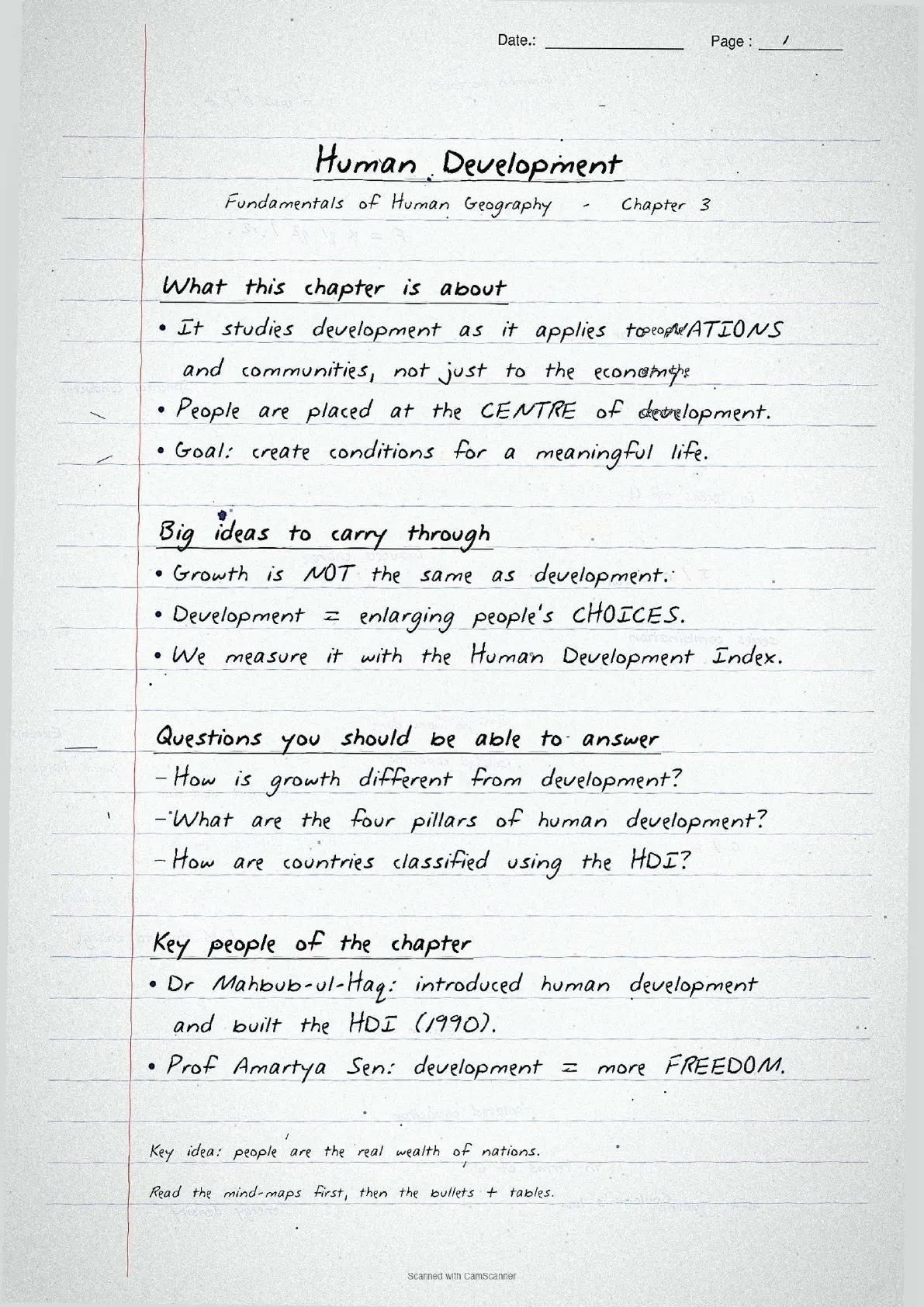
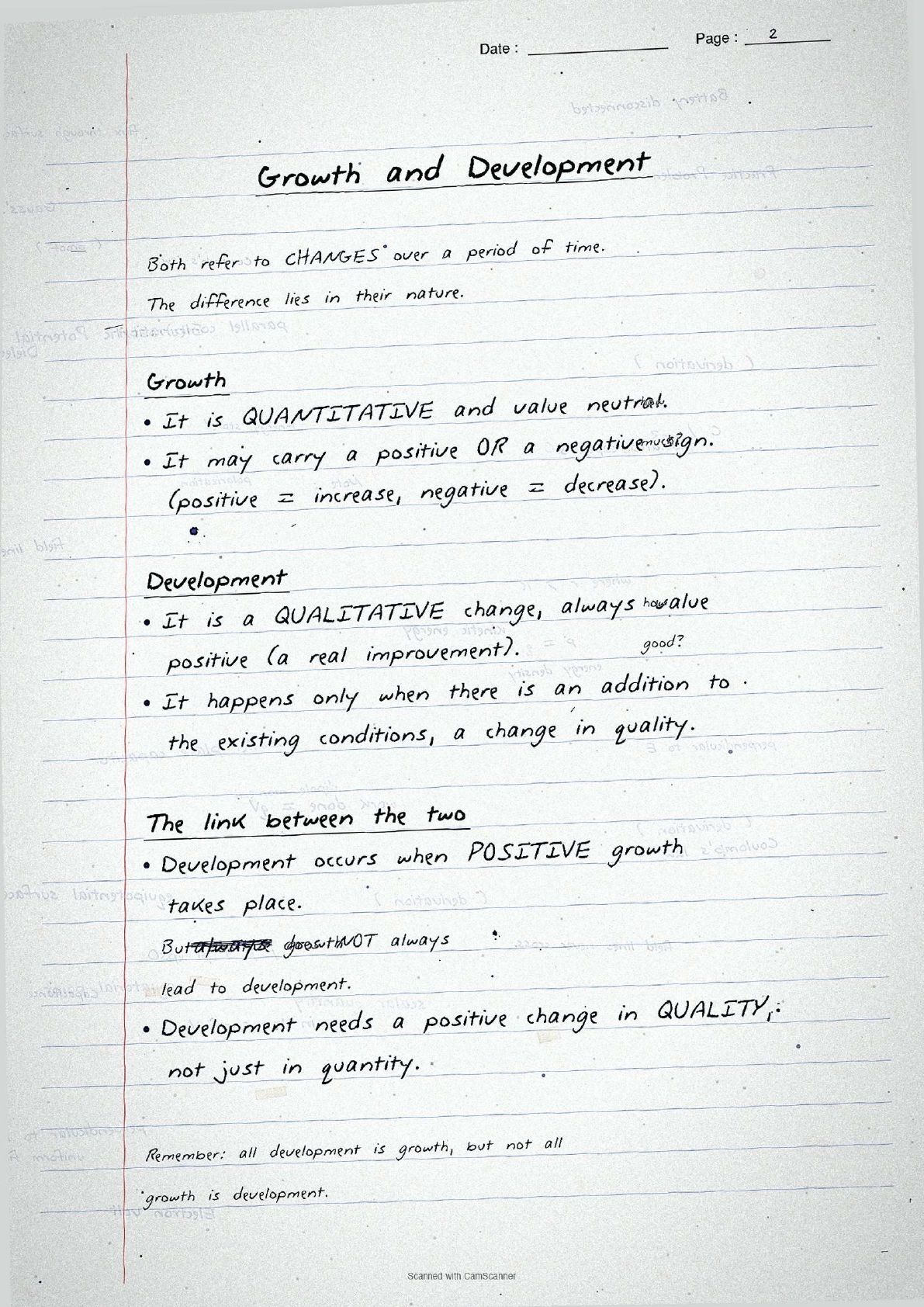
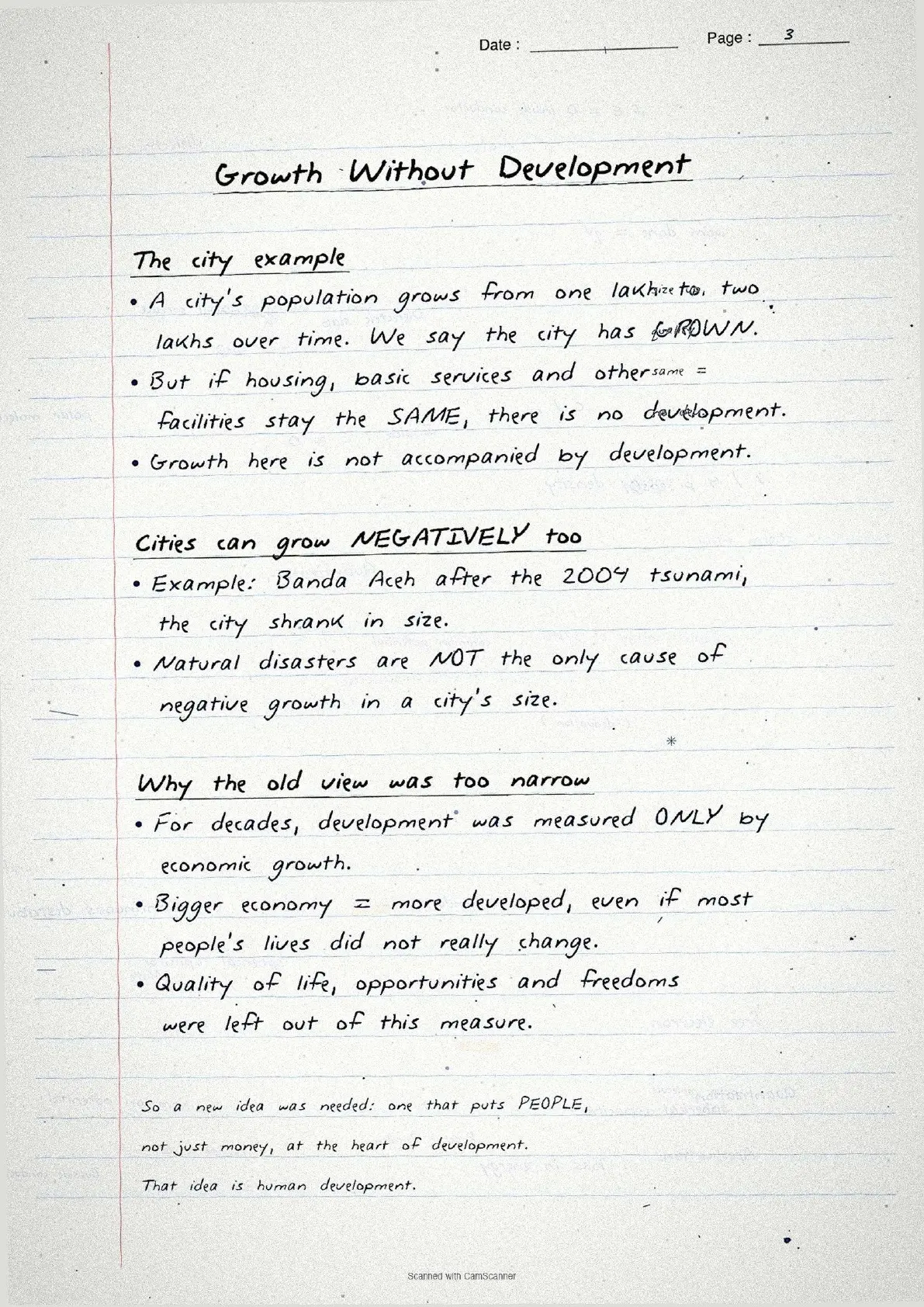
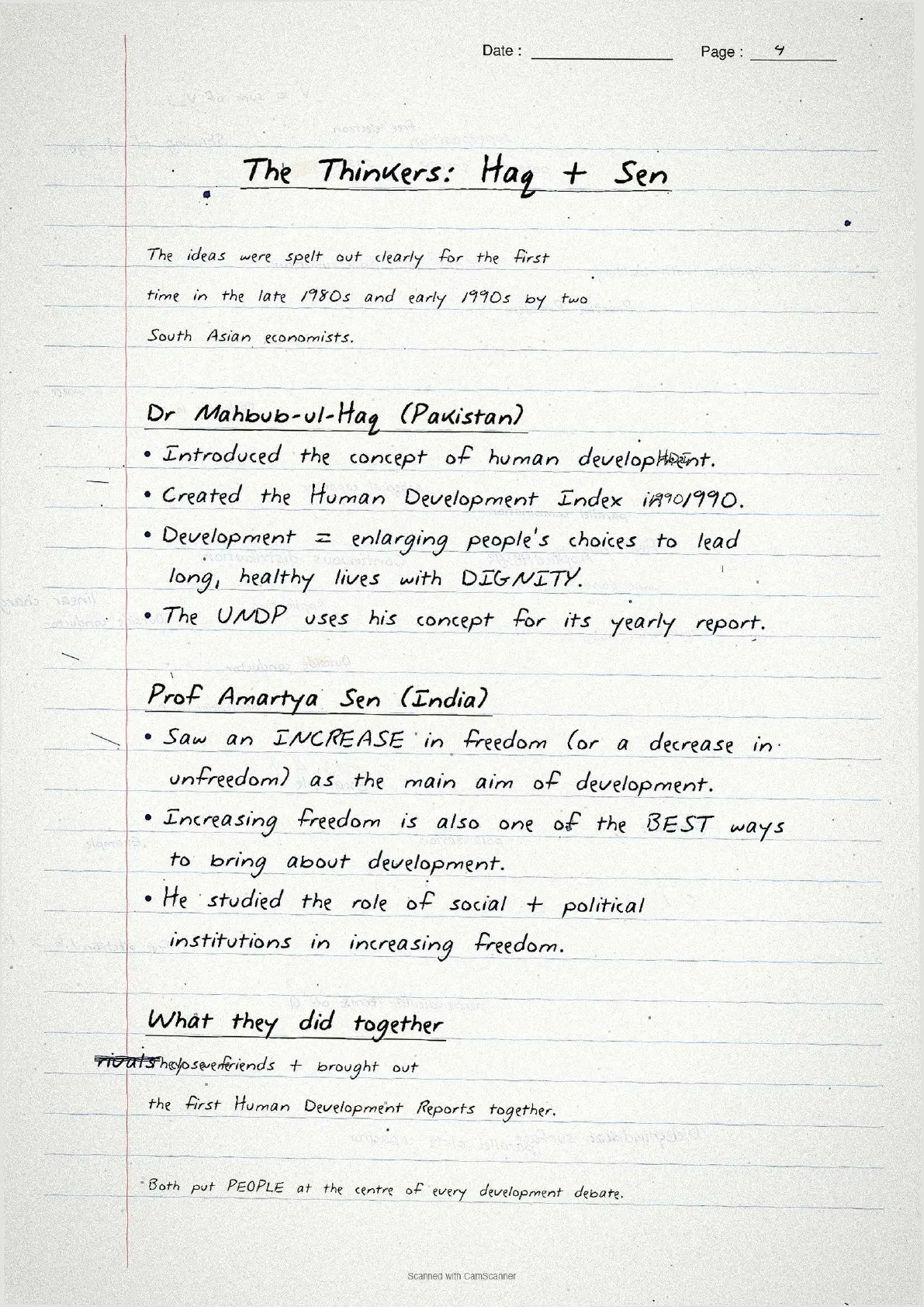
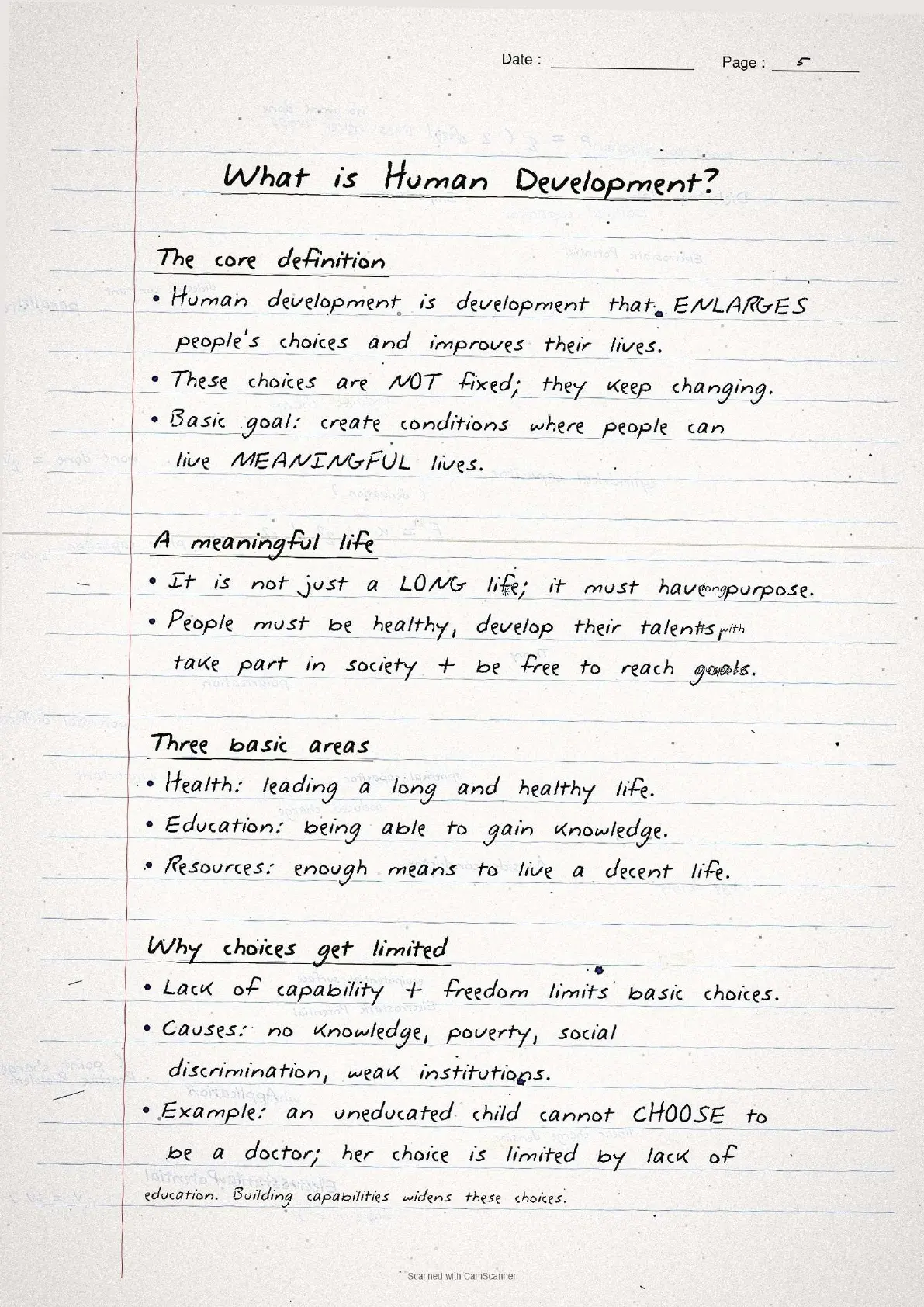
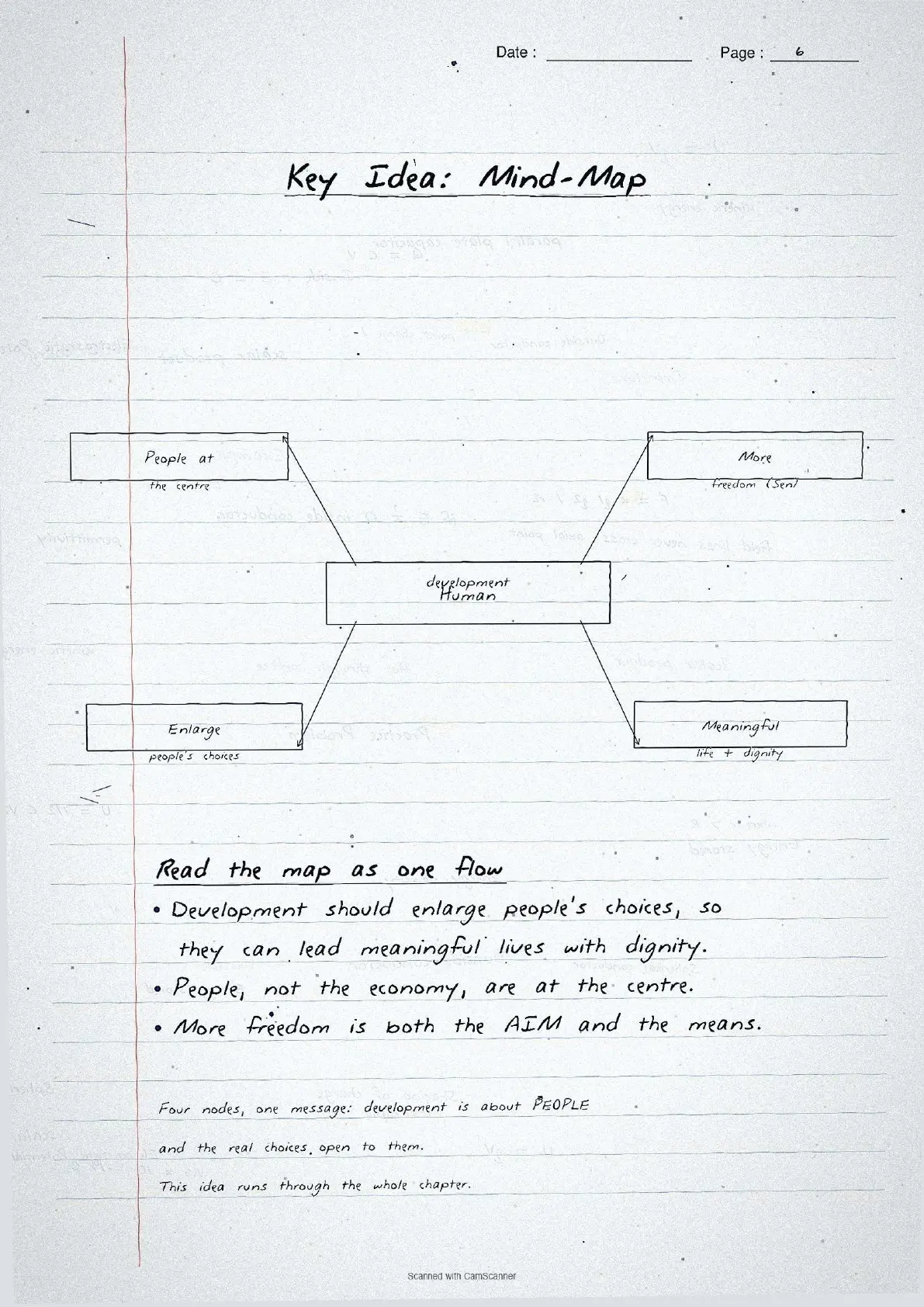
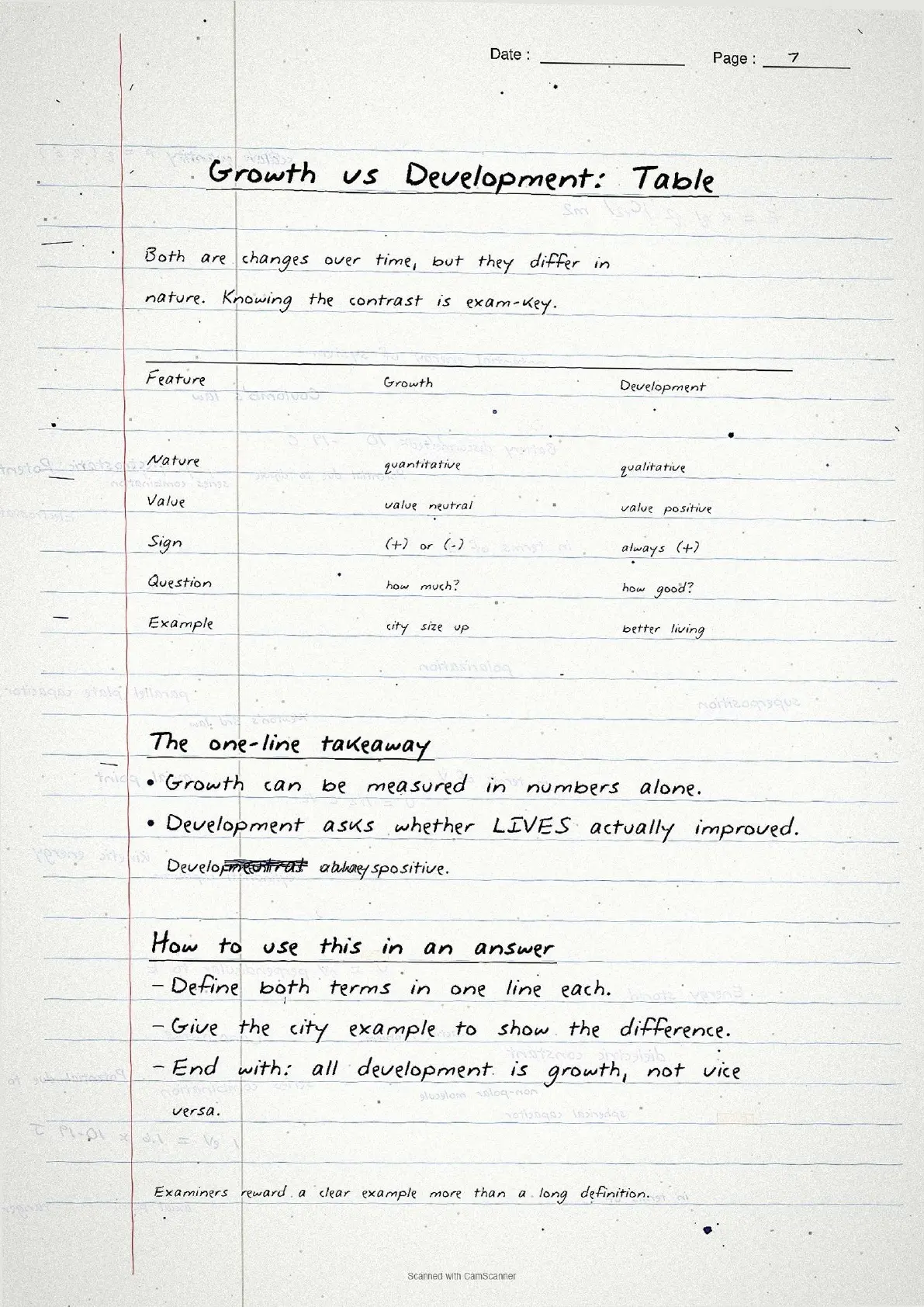
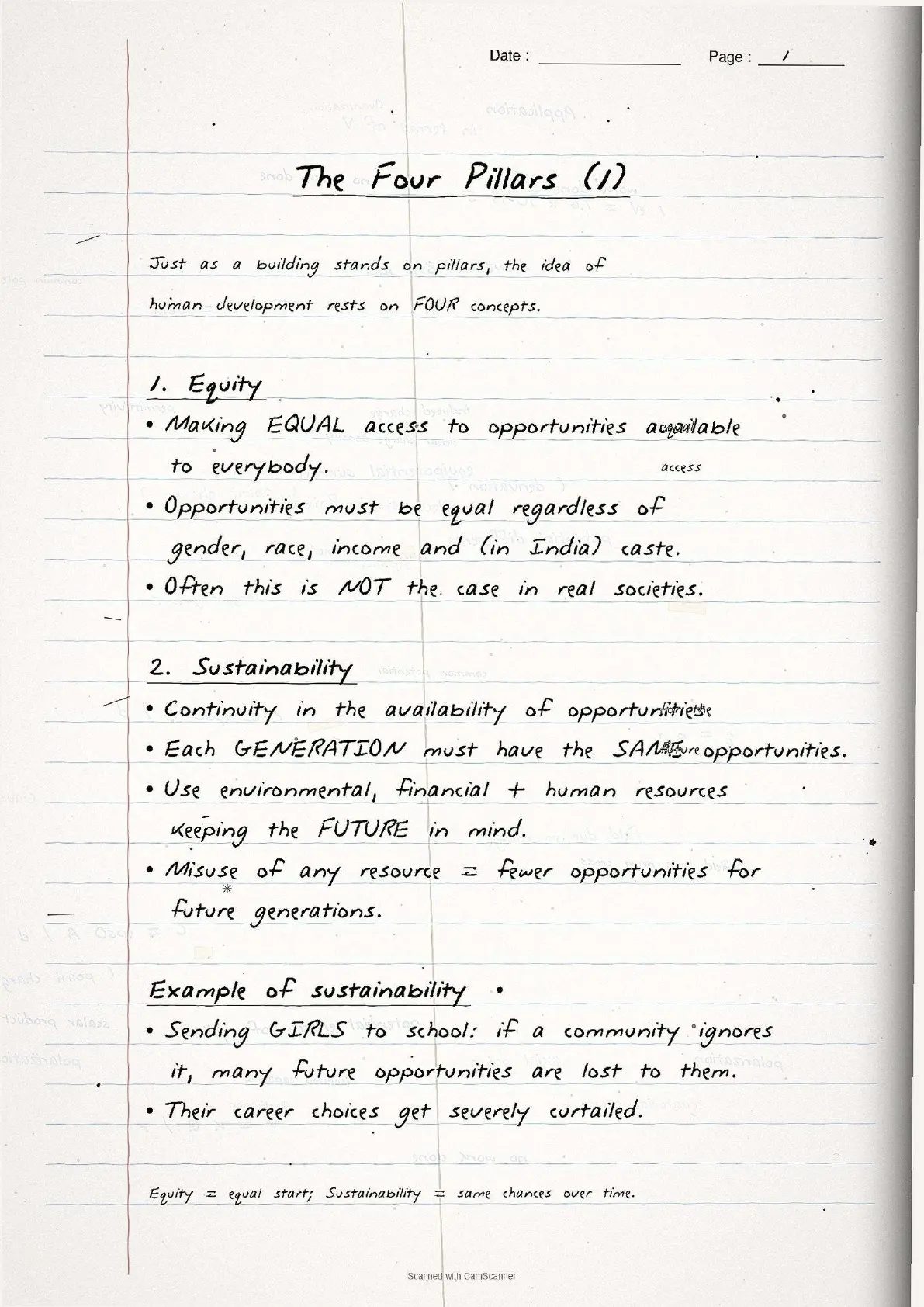
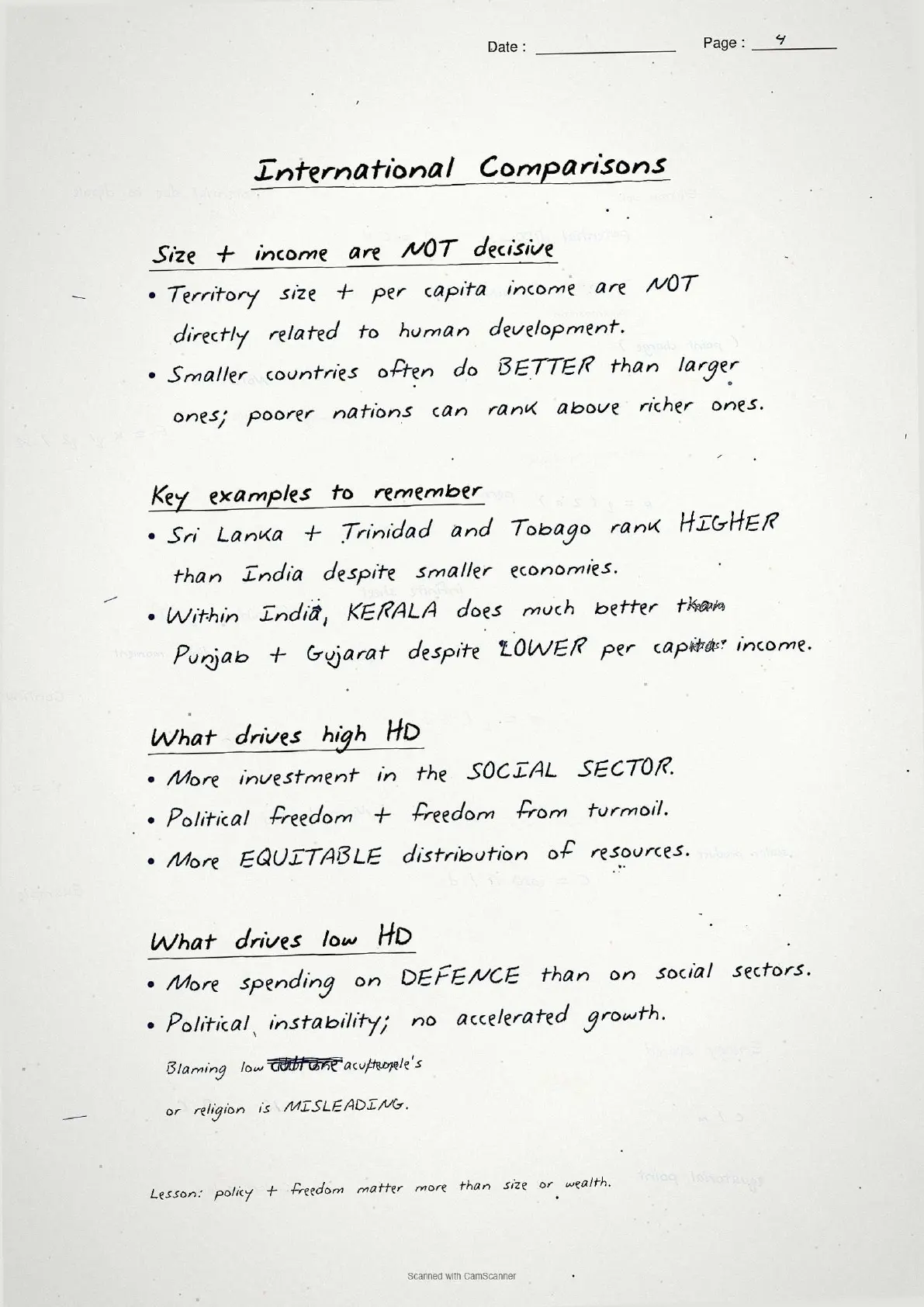
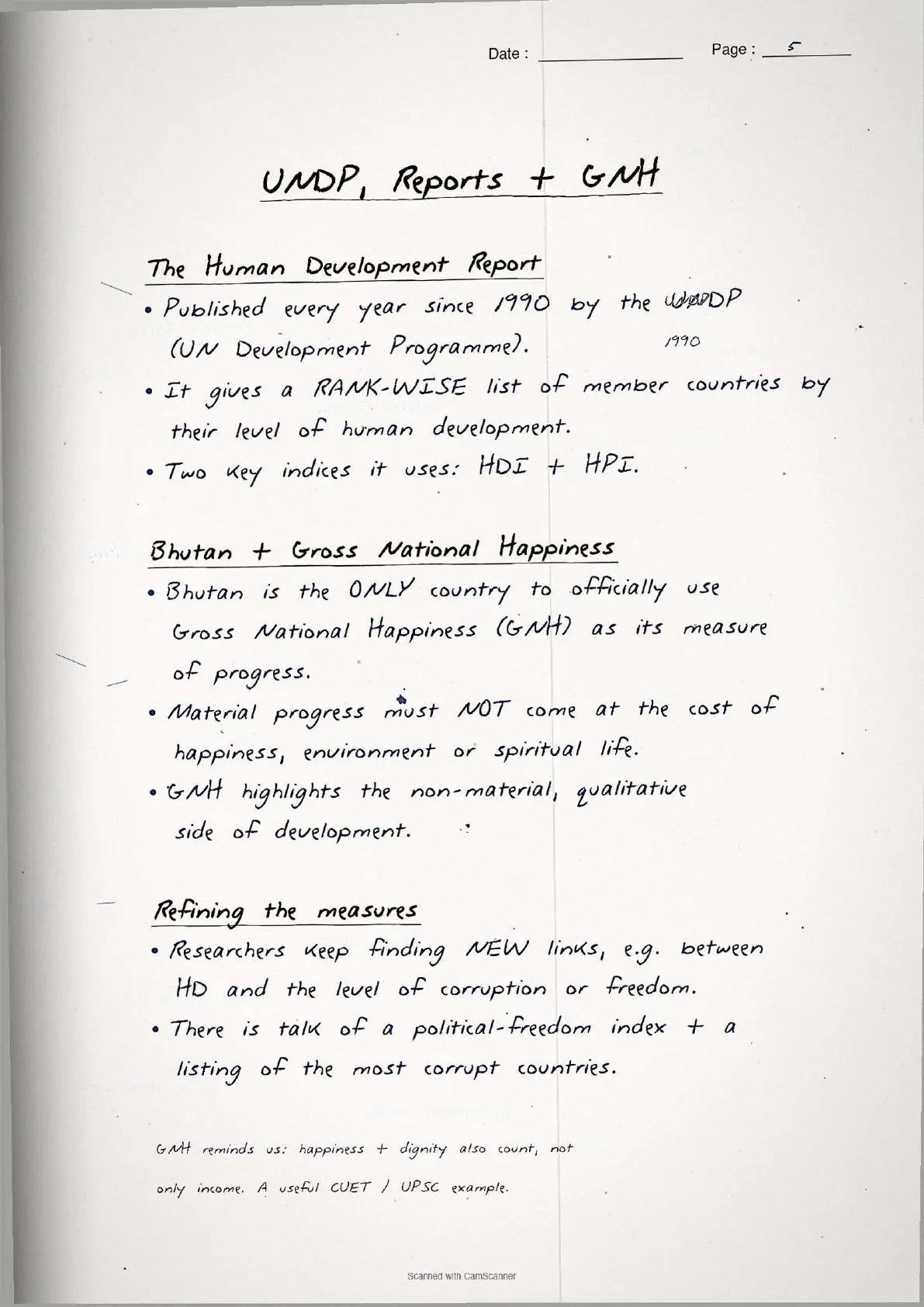
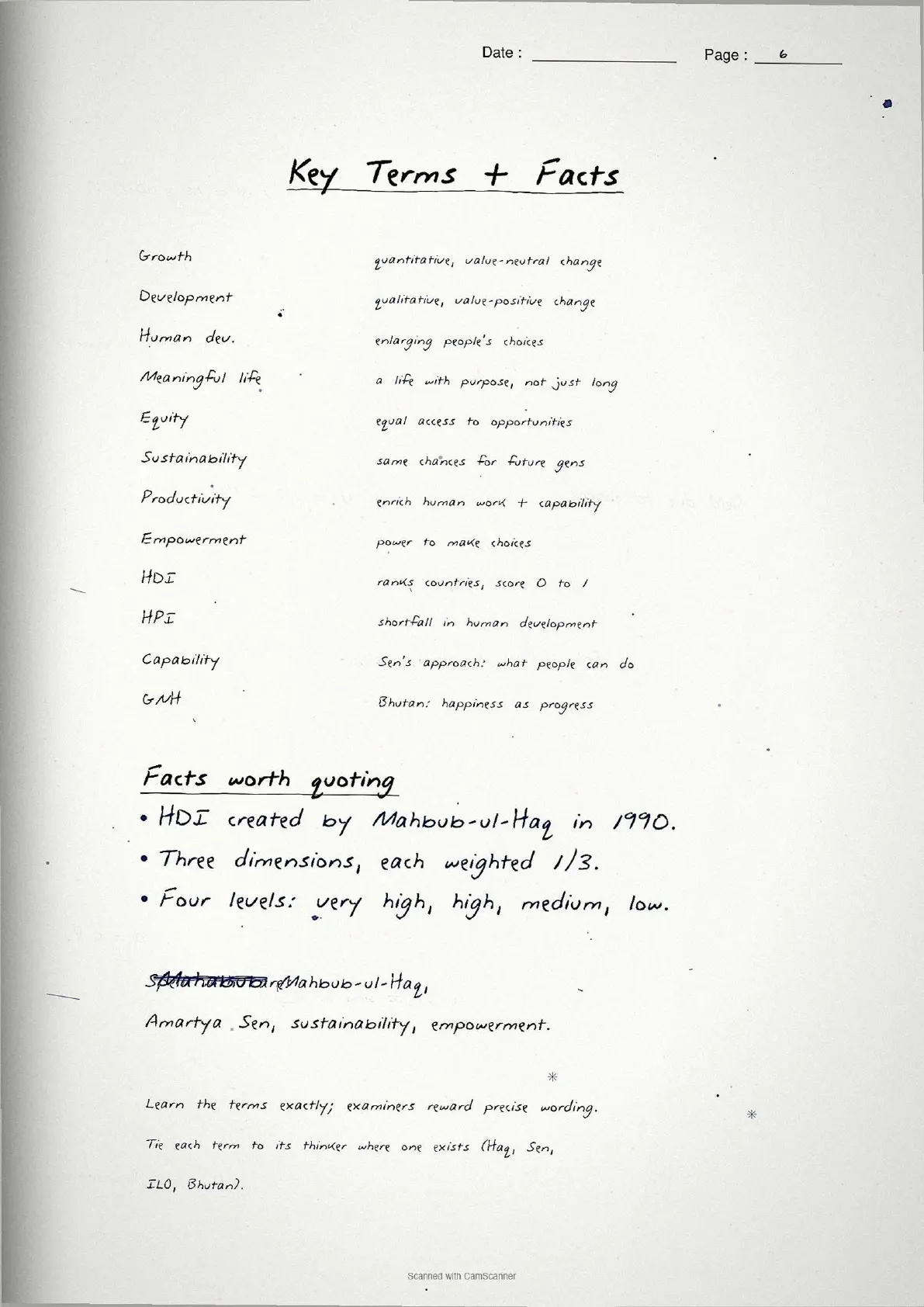
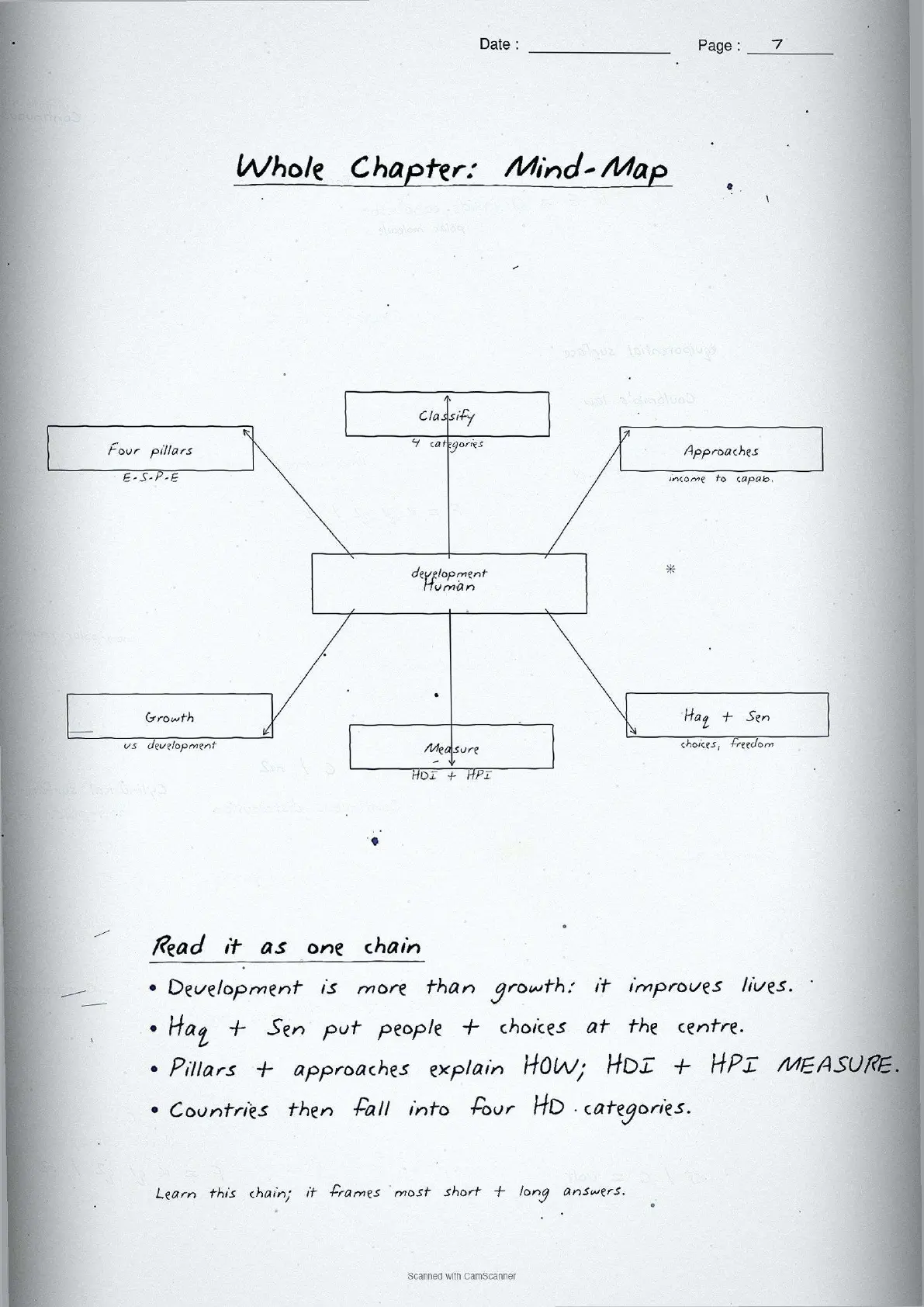
- Topper's handwritten revision notes covering all of CBSE Class 12 Geography Fundamentals of Human Geography Chapter 3.
- 4-6 marks weightage in the Class 12 Geography board paper, with the four pillars of human development (equity, sustainability, productivity, empowerment) worked out by hand in a concept diagram.
- Pairs with the typed NCERT Solutions, typed Notes and the official NCERT Book PDF for the same chapter.
Each page of these human development class 12 handwritten notes is hand-copied by a Collegedunia subject expert, mapped to the 2026-27 NCERT Fundamentals of Human Geography textbook, and cross-checked against the last five years of CBSE Class 12 Geography board papers.
Student Feedback
69% of Class 12 students said handwritten notes feel faster to revise than typed PDFs in the final 48 hours before the board exam, and 4 out of 5 said pen-on-paper concept boxes stick in memory better when revising human development class 12. The average student finished one full pass in about 19 minutes.
Source: 2026-27 Class 12 Geography handwritten-notes poll, 10,240 CBSE students.
What These Handwritten Notes Include
These human development class 12 handwritten notes run 3 to 4 pages. Every page is written by hand in ballpoint pen, with boxes around key definitions, arrow-tagged diagrams of the four pillars, and neat corrections in a second colour where a concept was tightened. The file is built for last-mile revision, not first-time concept building.
The pages capture every concept tested in this chapter: the difference between growth and development, the work of Mahbub-ul-Haq and Amartya Sen, the four pillars (equity, sustainability, productivity, empowerment), the four approaches (income, welfare, minimum needs, capabilities), the HDI components, the HPI, and the global classification of countries by HDI score.
| Page | What the page covers | Approx revision time |
|---|---|---|
| Page 1 | Growth vs development, Mahbub-ul-Haq and Amartya Sen, meaningful life concept, four pillars overview. | 5 minutes |
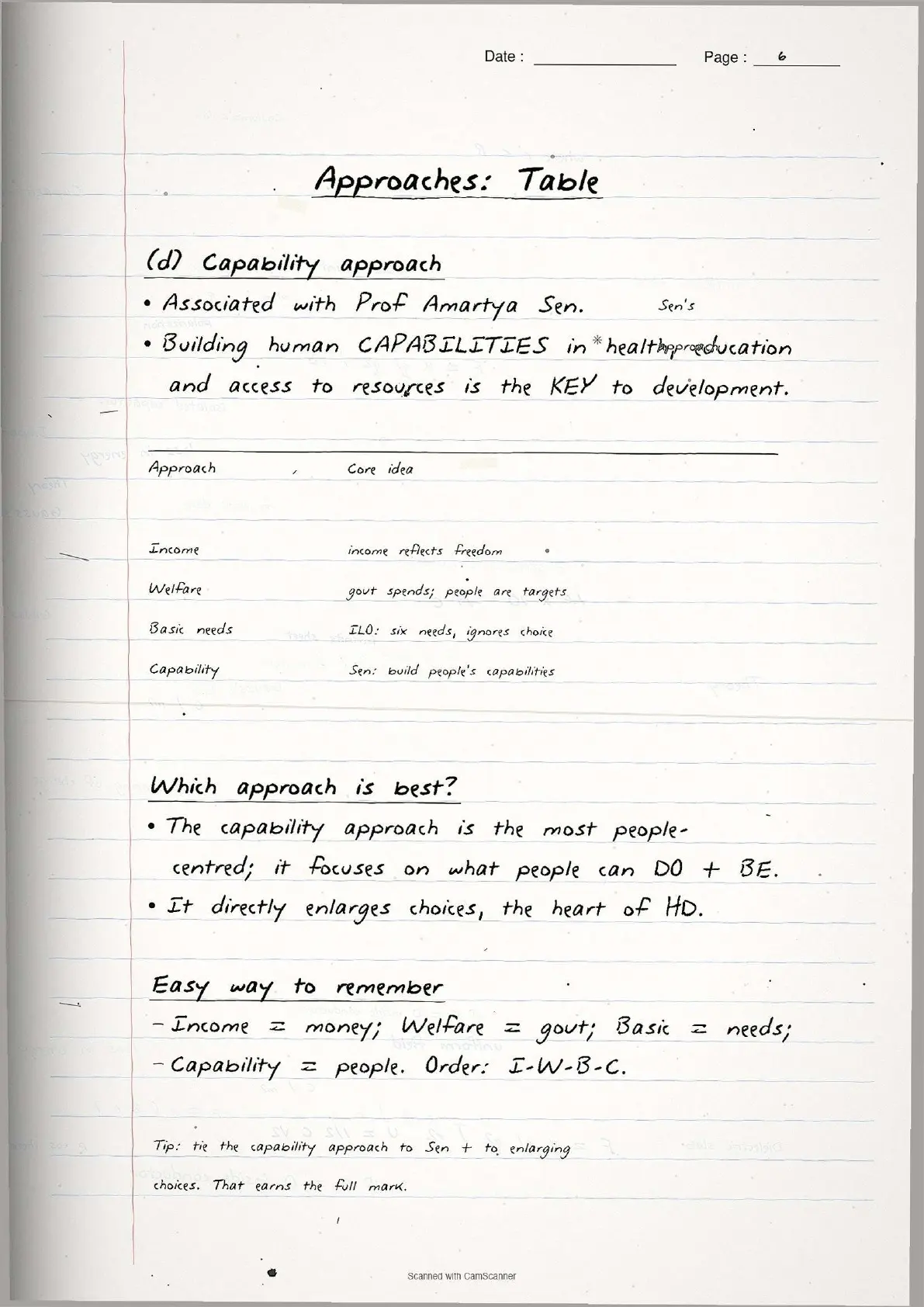
| Page 2 | Four approaches to human development with hand-drawn comparison boxes (income, welfare, minimum needs, capabilities). | 6 minutes |
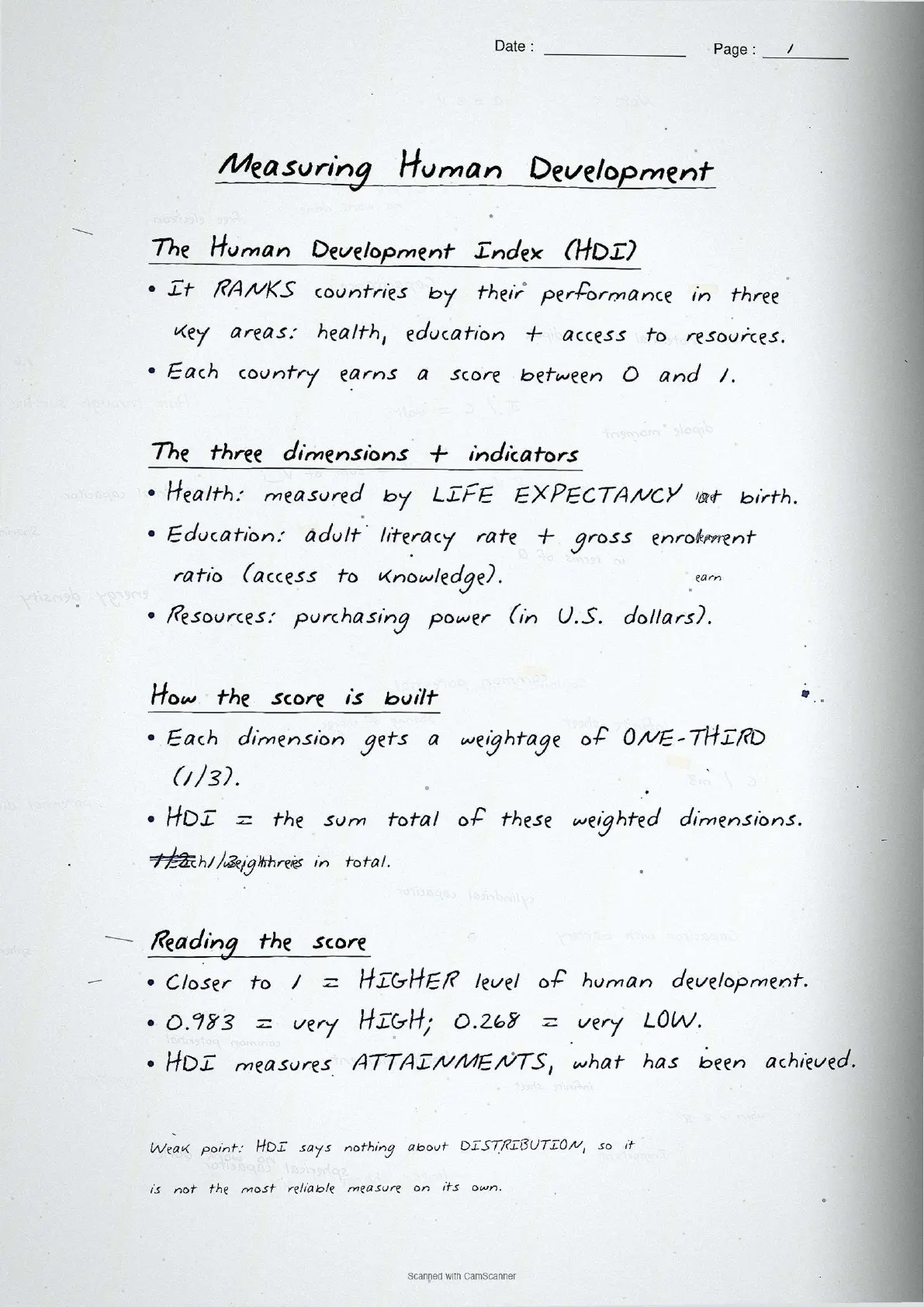
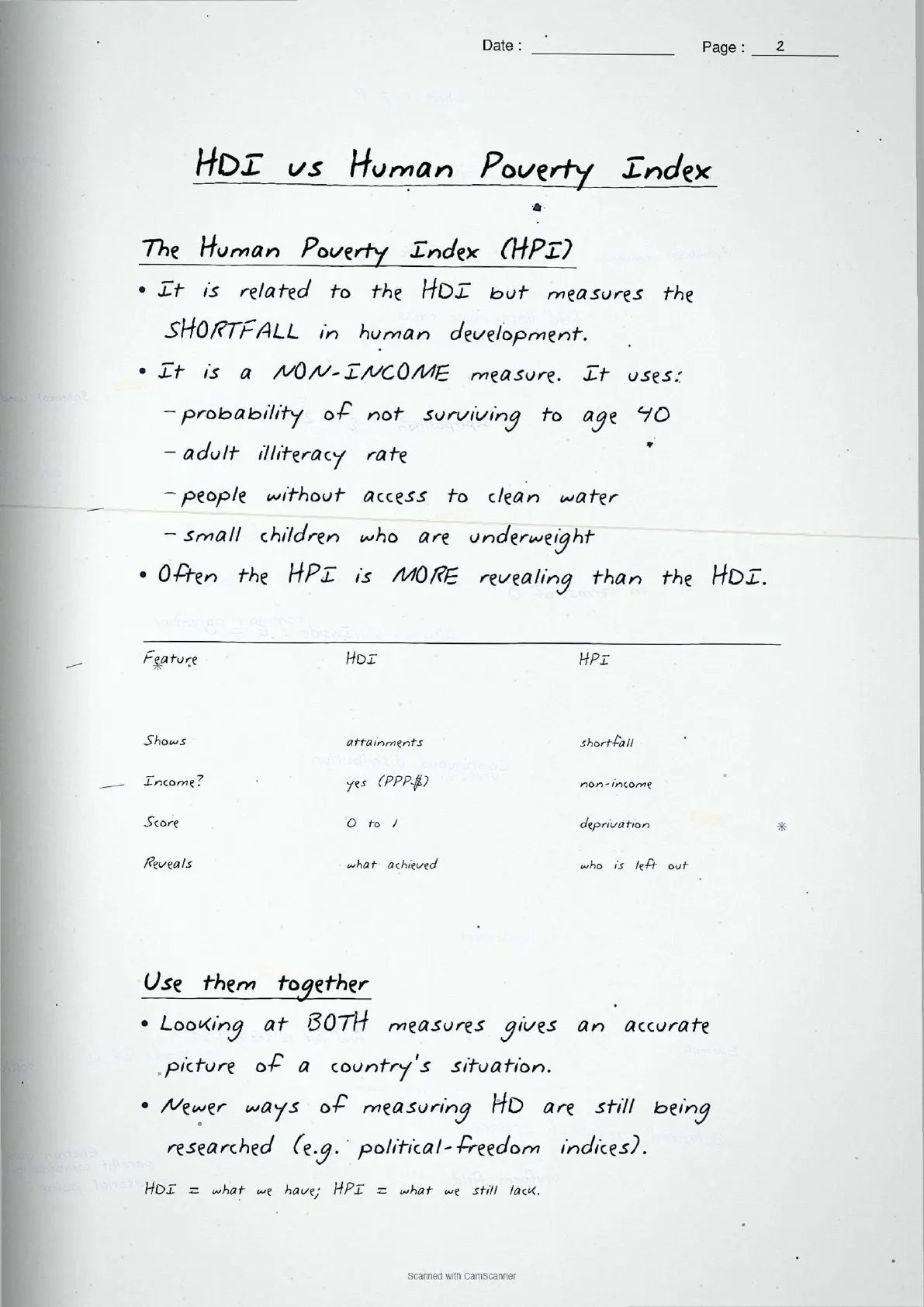
| Page 3 | HDI components (life expectancy, adult literacy, GER, purchasing power), HDI scoring, HPI. | 5 minutes |
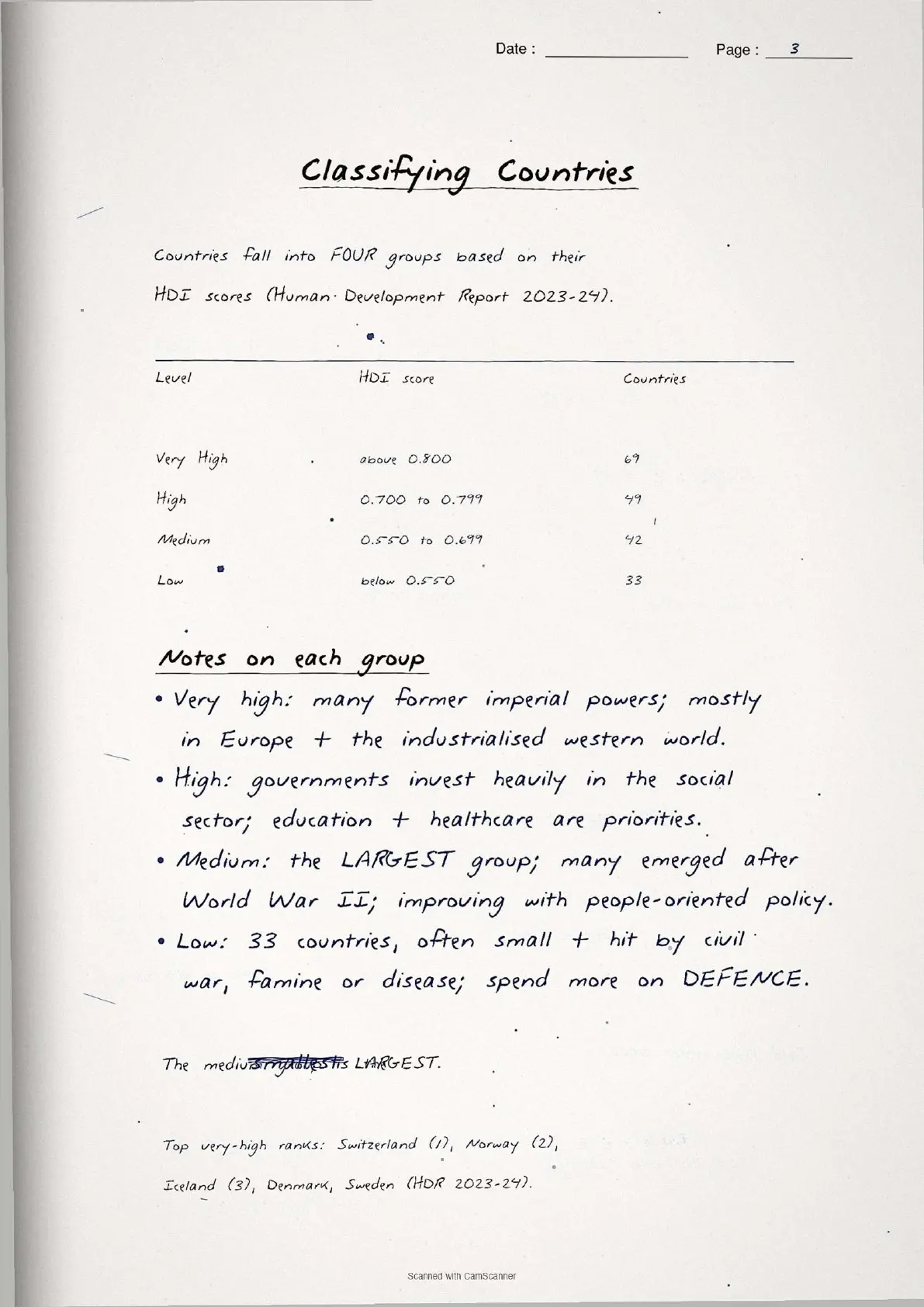
| Page 4 | Global classification of countries (high, medium, low HDI), government expenditure patterns, exam-ready summary. | 3 minutes |
Page-by-Page Look at the Human Development Notes
Source: Humanities Wallah - Class 12th on YouTube
Page 2, the approaches page, carries the highest revision density. It holds four concept boxes drawn one below the other, income, welfare, minimum needs and capabilities, each with a one-line gloss below ("higher income = higher development", "govt spending on social sectors", "basic services for all", "expand freedoms and choices"). A red-ink note on the capabilities box reminds students it was coined by Amartya Sen, not Mahbub-ul-Haq. The same layout repeats across all four pages, so students can revise the full file in under 20 minutes.
Key Concepts in Handwritten Style
The concept sheet is the highest-leverage block in the file. The table below lists every definition and key idea students need to memorise for the CBSE Class 12 Geography board paper, in the same order as the handwritten page. In the handwritten file each definition sits inside a hand-drawn box for quick visual recall.
| Concept | Handwritten definition (as drawn) | NCERT exercise Q |
|---|---|---|
| Growth | Quantitative, value-neutral change; may be positive or negative | Q1(i) |
| Development | Qualitative, always value-positive change; positive growth in quality | Q1(i) |
| Human Development (Mahbub-ul-Haq) | Development that enlarges people's choices and improves their lives; people are central | Q3(i) |
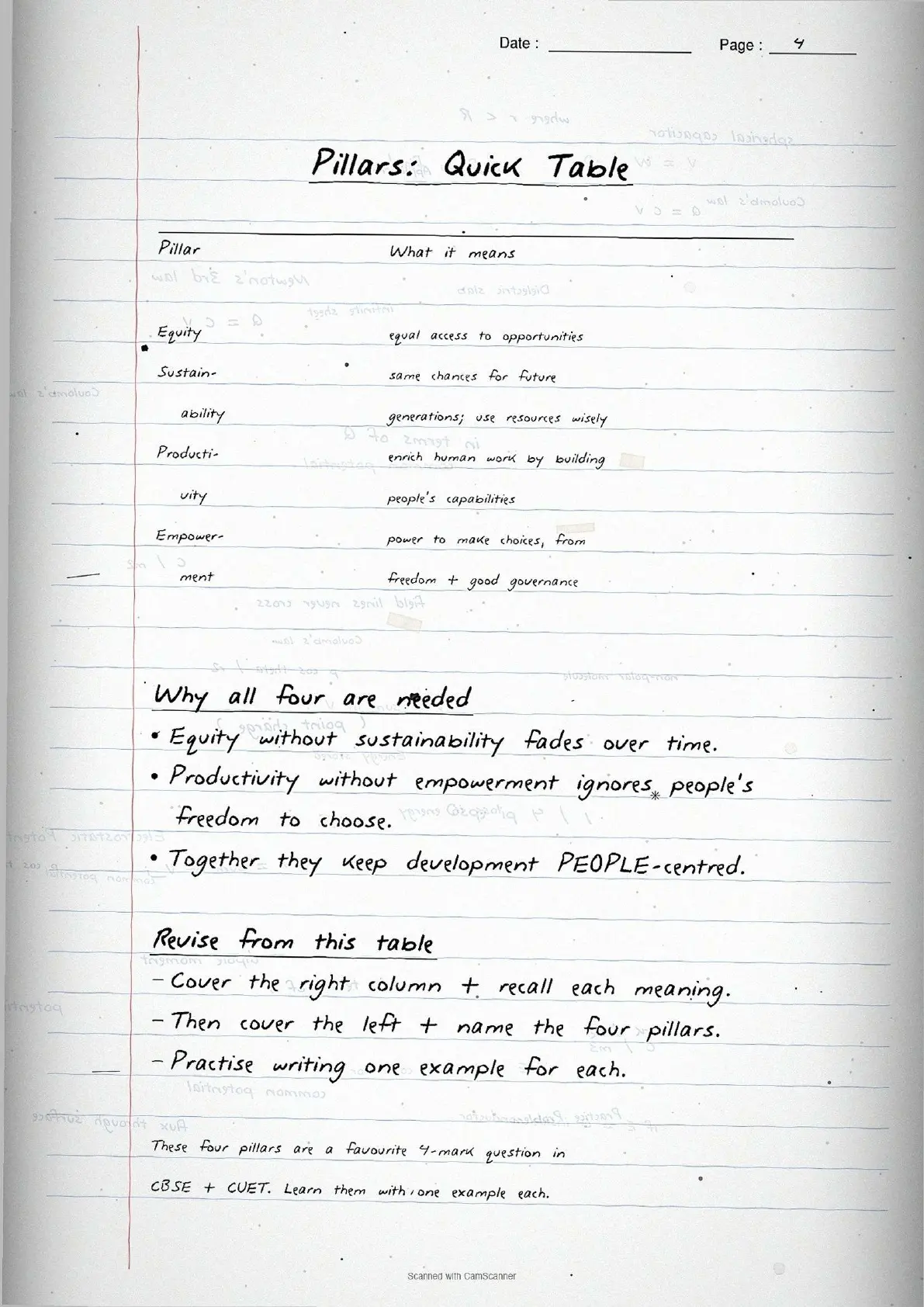
| Equity | Equal access to opportunities for all, irrespective of gender, race, income, caste | Q3(ii) |
| Sustainability | Continuity in availability of opportunities; each generation must have the same opportunities | Q3(ii) |
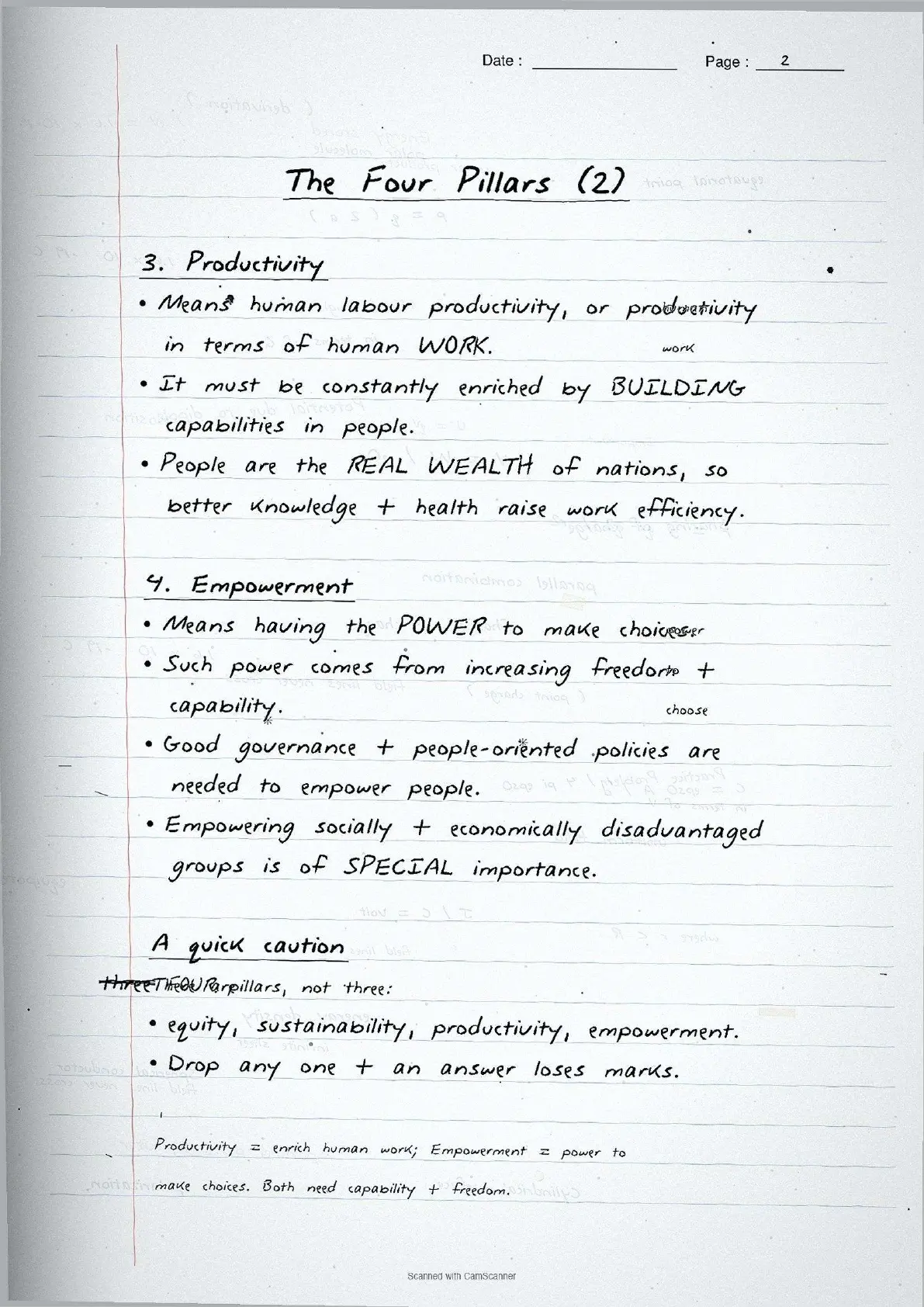
| Productivity | Human labour productivity; enriched by building capabilities; people are the real wealth of nations | Q2(ii) |
| Empowerment | Power to make choices; comes from increasing freedom and capability; needs good governance | Q2(ii) |
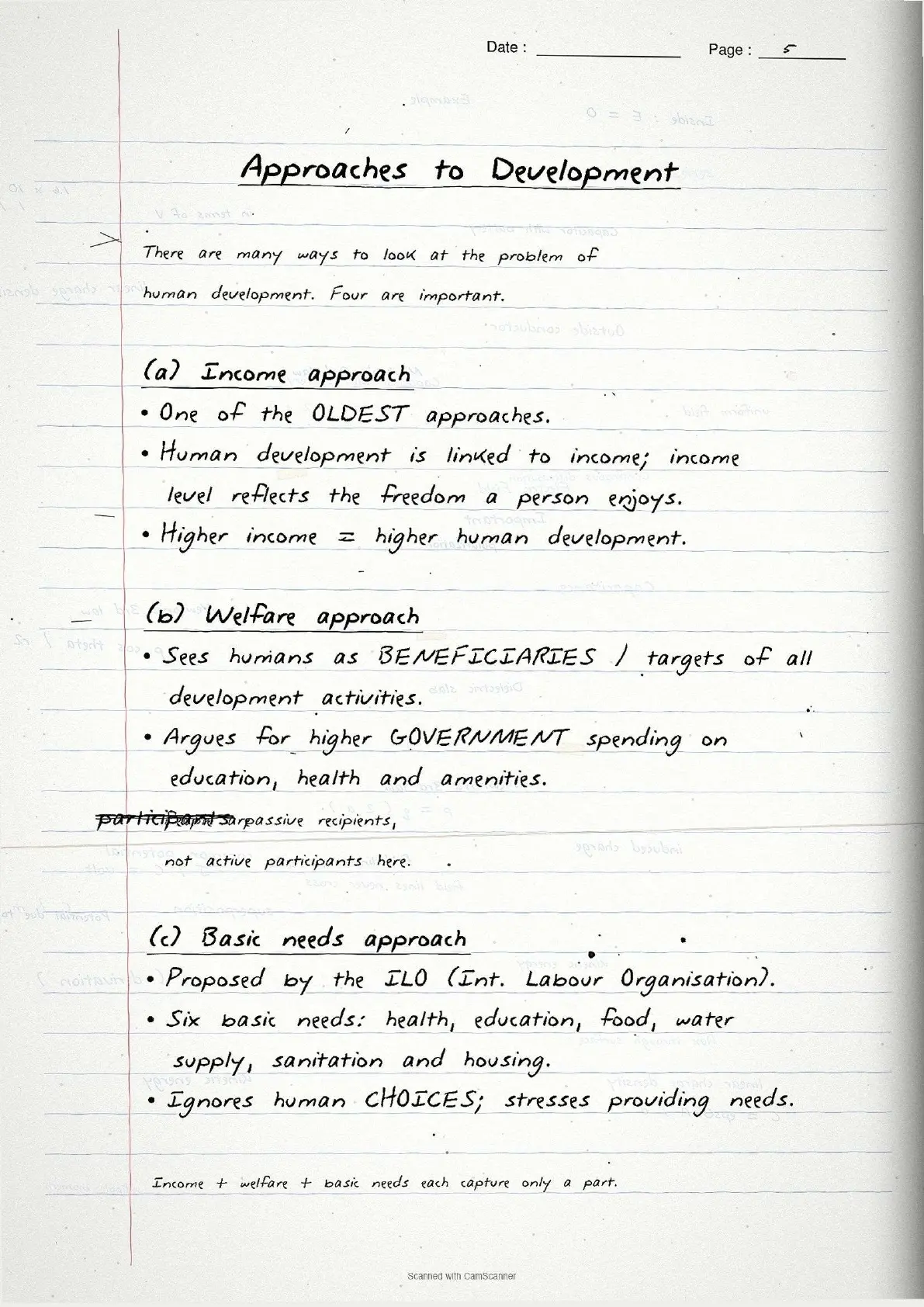
| Income Approach | Oldest approach; level of income reflects freedom; higher income = higher development | Q2(i) |
| Welfare Approach | People as beneficiaries; higher govt spending on education, health, social amenities | Q2(i) |
| Minimum Needs Approach | Focus on providing minimum basic services (education, health, food, shelter) to all | Q2(i) |
| Capabilities Approach (Sen) | Building capabilities in health, education, access to resources to enlarge choices | Q2(i) |
| HDI Score | Sum of weights on health + education + resources; score 0 to 1; closer to 1 = higher development | Q2(iii) |
Tip: Each concept sits in a hand-drawn box with a corner arrow to a real-world example (equity points to the school-dropout example, sustainability to the girl-child education example). Revising from visual blocks helps students recall scholar names faster on exam day.
Four Pillars of Human Development
The four pillars are the backbone of Class 12 Geography Chapter 3, drawn together on one comparison page. Every CBSE board paper since 2021 has asked at least one question from this section.
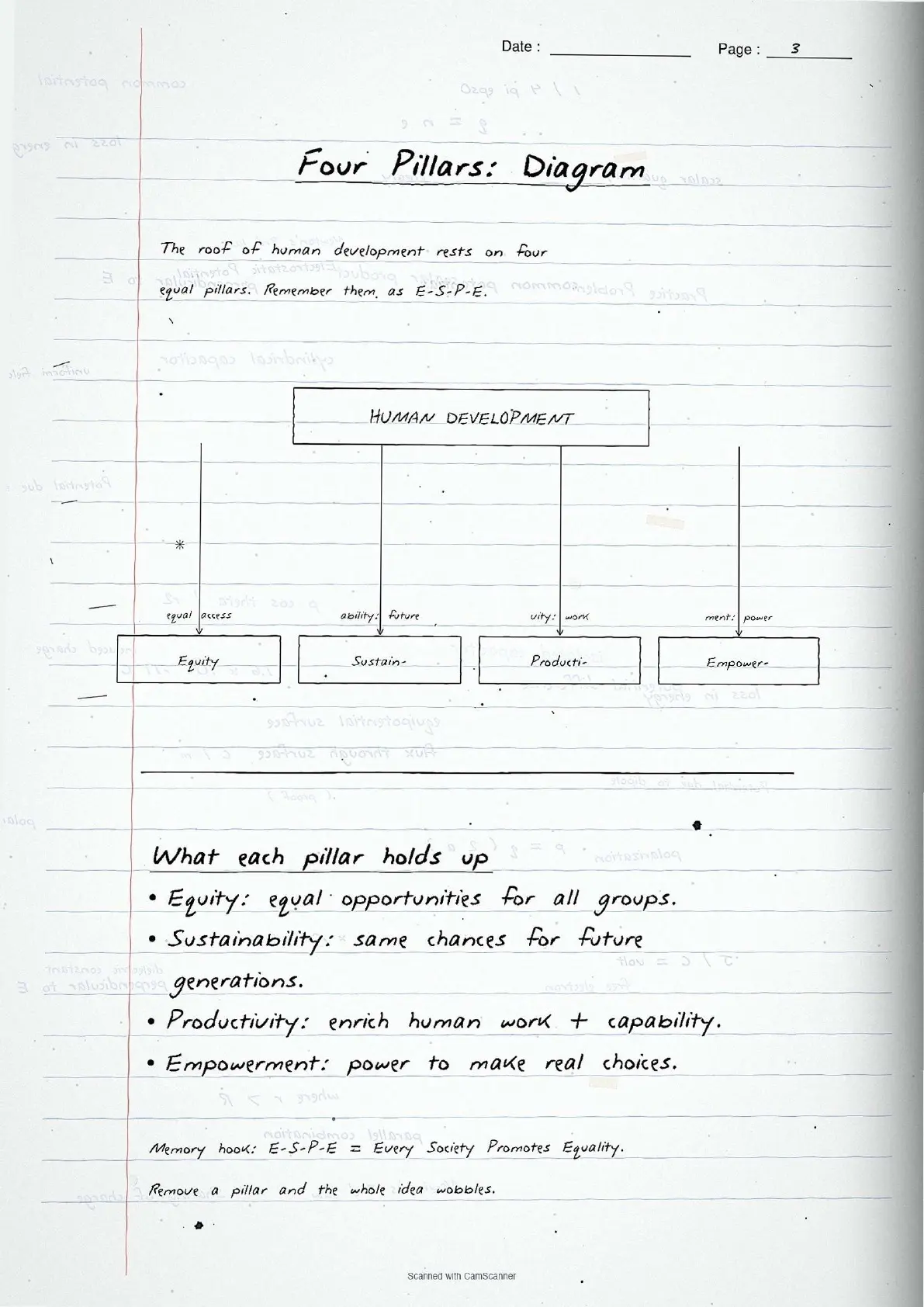
- Equity: equal access to opportunities for all, irrespective of gender, race, income and caste. The go-to example is the school-dropout gap, where women and backward-group persons lose choices through lack of access to knowledge.
- Sustainability: continuity in the availability of opportunities, so each generation gets the same chances by using resources with the future in mind (the girl-child education example).
- Productivity: human labour productivity, enriched by building capabilities. The key exam phrase is "People = Real Wealth of Nations".
- Empowerment: the power to make choices, which comes from freedom, capability and good governance, especially for disadvantaged groups.
Important: Learn each pillar with its one-line definition. Equity is equal access, sustainability is future generations, productivity is human capability, empowerment is freedom to choose. Mixing equity and empowerment is a common mistake in the 3-mark answer.
Measuring Human Development: HDI and HPI
The Human Development Index (HDI) and the Human Poverty Index (HPI) are the two key measurement tools in this chapter, both on Page 3.
| Dimension | Indicator used | What it measures |
|---|---|---|
| Health | Life expectancy at birth | Chance of living a long and healthy life |
| Education (access to knowledge) | Adult literacy rate + Gross Enrolment Ratio (GER) | Ability to read, write and access schooling |
| Access to Resources | Purchasing power in US dollars | Ability to afford a decent standard of living |
Each dimension gets a weight of 1/3. The HDI is the sum of these weighted scores, a number between 0 and 1. A score of 0.983 means very high development; 0.268 means very low. The handwritten page sketches the weighting as three equal pie slices.
| HDI Category | Number of countries (as per latest HDR) | Key characteristics |
|---|---|---|
| High Human Development | 49 countries | High social-sector investment, good governance, mostly European and some non-European nations |
| Medium Human Development | 42 countries | Largest group; mostly post-World War II emerging nations; some former colonies |
| Low Human Development | 33 countries | Political turmoil, civil war, famine, high disease incidence; urgent policy attention needed |
The HPI measures the shortfall in human development, not the achievement, focusing on deprivation in the same three areas: health, knowledge and resources. A red arrow in the notes sums it up: "HDI = what has been achieved; HPI = what is still missing."
Common Mistakes Highlighted in the Notes
The six repeat-offender mistakes CBSE examiners flag each year on human development class 12 answers, each marked as a margin note in the handwritten file.
- Saying growth and development are the same. Growth is quantitative and value-neutral; development is qualitative and value-positive.
- Attributing the capabilities approach to Mahbub-ul-Haq. Haq introduced human development and the HDI; the capabilities approach is Amartya Sen's.
- Confusing equity and empowerment. Equity is equal access; empowerment is the power to choose.
- Forgetting HDI weighs all three dimensions equally. Health, education and resources each get 1/3 weight.
- Mixing HDI and HPI. HDI measures attainment; HPI measures shortfall.
- Using religion or culture to explain low HDI. NCERT warns this is misleading; the real drivers are government spending and political stability.
The scholar-attribution note reads "Haq = Index; Sen = Capabilities", the most-quoted memory hook in the file.
Previous Year Question Trends
The CBSE Class 12 Geography board paper has carried a stable 4 to 6 marks from Chapter 3 over the last five years, split across one or two theory questions.
| Year | Question asked | Marks | Notes page to revise |
|---|---|---|---|
| 2025 | Explain any four pillars of human development + define HDI | 4 + 2 | Page 1 + Page 3 |
| 2024 | Distinguish between growth and development + name four components of HDI | 3 + 2 | Page 1 + Page 3 |
| 2023 | Explain equity and sustainability with one example each | 4 | Page 1 |
| 2022 | Describe the capabilities approach to human development + classify countries by HDI level | 3 + 3 | Page 2 + Page 4 |
| 2021 | What is human development according to Mahbub-ul-Haq? Give two indicators of HDI. | 3 | Page 1 + Page 3 |
The theory question has rotated among the pillars, the approaches and the HDI components on a roughly equal cycle, so revise all concept boxes on Pages 1 and 2 together, not selectively.
Other Resources for Class 12 Geography Chapter 3 Human Development
Pair these handwritten notes with the matching NCERT Solutions, typed Notes and the official NCERT Book chapter for Class 12 Geography Chapter 3.
| Resource | What it covers | Open |
|---|---|---|
| Handwritten Notes | Topper's handwritten revision pages for last-mile board exam prep. | You are here |
| NCERT Solutions | Step-by-step answers to all NCERT exercise questions with Expert's Solution alternatives. | Class 12 Geography Chapter 3 NCERT Solutions |
| Notes | Concept-first typed revision notes with definitions, pillars, approaches, HDI and common mistakes. | Class 12 Geography Chapter 3 Notes |
| NCERT Book PDF | Official NCERT Fundamentals of Human Geography Chapter 3 textbook in PDF form. | Class 12 Geography Chapter 3 NCERT Book PDF |
| Subject Hub | All chapters of Class 12 Geography with every resource in one place. | Class 12 Geography Subject Hub |
All Chapters Handwritten Notes for Class 12 Geography Fundamentals of Human Geography
Related Links: Use the table below to navigate to the handwritten notes for the other chapters of Class 12 Geography Fundamentals of Human Geography. Every chapter ships with the same concept boxes and margin-note common mistakes.
| Chapter | Topic | Handwritten Notes link |
|---|---|---|
| Chapter 1 | Human Geography: Nature and Scope | Class 12 Geography Human Geography Nature and Scope Handwritten Notes |
| Chapter 2 | The World Population: Distribution, Density and Growth | Class 12 Geography World Population Handwritten Notes |
| Chapter 3 | Human Development | You are here |
| Chapter 4 | Primary Activities | Class 12 Geography Primary Activities Handwritten Notes |
| Chapter 5 | Secondary Activities | Class 12 Geography Secondary Activities Handwritten Notes |
| Chapter 6 | Tertiary and Quaternary Activities | Class 12 Geography Tertiary and Quaternary Activities Handwritten Notes |
| Chapter 7 | Transport and Communication | Class 12 Geography Transport and Communication Handwritten Notes |
| Chapter 8 | International Trade | Class 12 Geography International Trade Handwritten Notes |
Human Development Class 12 Handwritten Notes FAQs
Ques. What are these human development class 12 handwritten notes meant to be used for?
Ans. The human development class 12 handwritten notes are a topper's handwritten revision file: they compress the full NCERT Chapter 3 of Class 12 Fundamentals of Human Geography into 3 to 4 pages of concept boxes, pillar diagrams and margin-note common mistakes. Students typically use the file for last-mile revision in the 24 hours before the board paper, paired with the typed Notes PDF for concept building and the NCERT Solutions PDF for answer-writing drill.
Ques. How are handwritten notes different from the typed human development class 12 notes?
Ans. The typed human development class 12 notes carry deeper prose around each concept (scholar profiles, extended examples, critique of each approach) and run 6 to 8 pages long. The handwritten notes compress that prose down to concept boxes alone, sit at 3 to 4 pages, and lean on visual recall (ruler-drawn boxes, arrow-tagged pillar diagrams, pen-touch corrections) rather than typed explanations. The two files are designed to be used together, not as substitutes. Read the typed Notes first, then collapse to the handwritten file for the second and third revision passes.
Ques. What is human development according to NCERT Class 12 Geography?
Ans. According to NCERT Class 12 Geography, human development is development that enlarges people's choices and improves their lives, as defined by Dr Mahbub-ul-Haq. People are central to all development under this concept. The choices are not fixed but keep changing. The basic goal of development is to create conditions where people can live meaningful lives: long and healthy lives with the ability to gain knowledge and access adequate resources. This concept was first clearly articulated in the late 1980s and early 1990s by Dr Haq and Prof Amartya Sen through the Human Development Reports published by the UNDP since 1990.
Ques. What are the four pillars of human development Class 12?
Ans. The four pillars of human development Class 12 are equity, sustainability, productivity and empowerment. Equity means equal access to opportunities for all regardless of gender, race, income or caste. Sustainability means each generation must have the same opportunities by using environmental, financial and human resources responsibly. Productivity means enriching human labour by building capabilities, because people are the real wealth of nations. Empowerment means having the power to make choices, which comes from increasing freedom and capability through good governance and people-oriented policies. The handwritten notebook draws all four pillars as a hand-sketched diagram on Page 1 with one-line glosses below each box.
Ques. What are the four approaches to human development Class 12?
Ans. The four approaches to human development in NCERT Class 12 Geography are: (a) Income Approach, which is the oldest approach linking development to income level; (b) Welfare Approach, which argues for higher government expenditure on education, health and social amenities; (c) Minimum Needs Approach, which focuses on providing minimum basic services to all people; and (d) Capabilities Approach developed by Amartya Sen, which focuses on building capabilities in health, education and access to resources to enlarge people's choices. Each approach is drawn as a separate hand-drawn box on Page 2, with a one-line gloss below for quick recall.
Ques. How is the Human Development Index measured in Class 12 Geography?
Ans. The Human Development Index (HDI) in Class 12 Geography ranks countries on three dimensions, each given a weight of 1/3. The health dimension is measured by life expectancy at birth. The education dimension is measured by adult literacy rate and the Gross Enrolment Ratio (GER). The access to resources dimension is measured by purchasing power in US dollars. The HDI score is the sum total of these weighted dimensions, on a scale of 0 to 1. A score closer to 1 means higher human development: 0.983 is very high while 0.268 is very low. Countries are classified as high (49 countries), medium (42 countries) and low (33 countries) based on their HDI scores from the latest UNDP Human Development Report.
Ques. What is the difference between HDI and HPI in Class 12 Geography?
Ans. The Human Development Index (HDI) measures what a country has achieved in human development: it reflects attainment in health, education and access to resources. The Human Poverty Index (HPI) is related to the HDI but measures the shortfall in human development, that is, the deprivation that still exists in the same three areas. While HDI tells you how far a country has come, HPI tells you how far it still has to go. The handwritten notebook draws both on Page 3, with a red arrow linking them labelled "HDI = achievement; HPI = gap remaining."
Ques. Are these notes enough for the CBSE Class 12 Geography board exam?
Ans. The handwritten notes are sufficient for the concept-recall component (roughly 4 to 5 marks of the 4 to 6 marks the chapter typically carries), but the extended-answer practice in this file is limited to concept boxes, not 150-word essay answers. Students aiming for 90-plus in CBSE Class 12 Geography should pair the handwritten file with the matching NCERT Solutions PDF and at least one previous year paper practice set. All three resources are linked in the cross-resource table on this page.
Ques. How long does it take to revise from these human development handwritten notes?
Ans. The full handwritten notes file is designed for a 19-minute first revision pass, a 12-minute targeted pass and a 7-minute final pass right before the exam. Students who already have the chapter under their belt finish the full file in under 16 minutes. Page 1 (the four pillars and scholar definitions) and Page 3 (HDI components) together take 10 to 11 minutes to revise and cover roughly 4 to 5 of the 4 to 6 marks the chapter typically carries in the CBSE Class 12 Geography board paper.
Ques. Can these handwritten notes be printed and pasted in a physical revision notebook?
Ans. Yes, and that is the recommended use pattern. The PDF is sized for A4 printing, with each page sitting cleanly inside a standard ruled notebook page. Toppers in the 2026 Class 12 Geography student poll reported that printing these pages and pasting them inside their physical revision notebook helped them recall scholar names and pillar definitions under exam pressure, because the pen-on-paper layout matches the muscle memory of writing the answer in the answer script.
Ques. Is the Class 12 Geography syllabus for Chapter 3 changing in 2026-27?
Ans. No major changes in 2026-27. The Fundamentals of Human Geography textbook Chapter 3 structure is unchanged for the current cycle, and the CBSE marking scheme continues to reward definition-plus-example answers with scholar attribution. These human development class 12 handwritten notes for the 2026-27 cycle are aligned to the unchanged textbook and the latest CBSE sample paper released for the 2026 boards.
Ques. What is the role of Mahbub-ul-Haq and Amartya Sen in human development?
Ans. Dr Mahbub-ul-Haq, a Pakistani economist, introduced the concept of human development and created the Human Development Index in 1990. He described human development as enlarging people's choices in order to lead long, healthy lives with dignity. The United Nations Development Programme has used his concept to publish the annual Human Development Report since 1990. Prof Amartya Sen, a Nobel Laureate, saw increasing freedom (or decreasing unfreedom) as the main objective of development and explored the role of social and political institutions in increasing freedom. The two economists worked closely together, with their complementary ideas placing people at the centre of any development discussion. The handwritten notebook draws both scholars in a side-by-side box on Page 1 with their key phrases underlined.



Comments