




These Class 12 Geography Chapter 5 Secondary Activities handwritten notes are a topper's genuine handwritten revision pages, matched to the 2026-27 CBSE syllabus. The pages cover all key ideas in the chapter: manufacturing industries, types of manufacturing, factors of industrial location, high-tech industries, and the global pattern of secondary activities. Use the PDF in the 24 hours before the board paper.
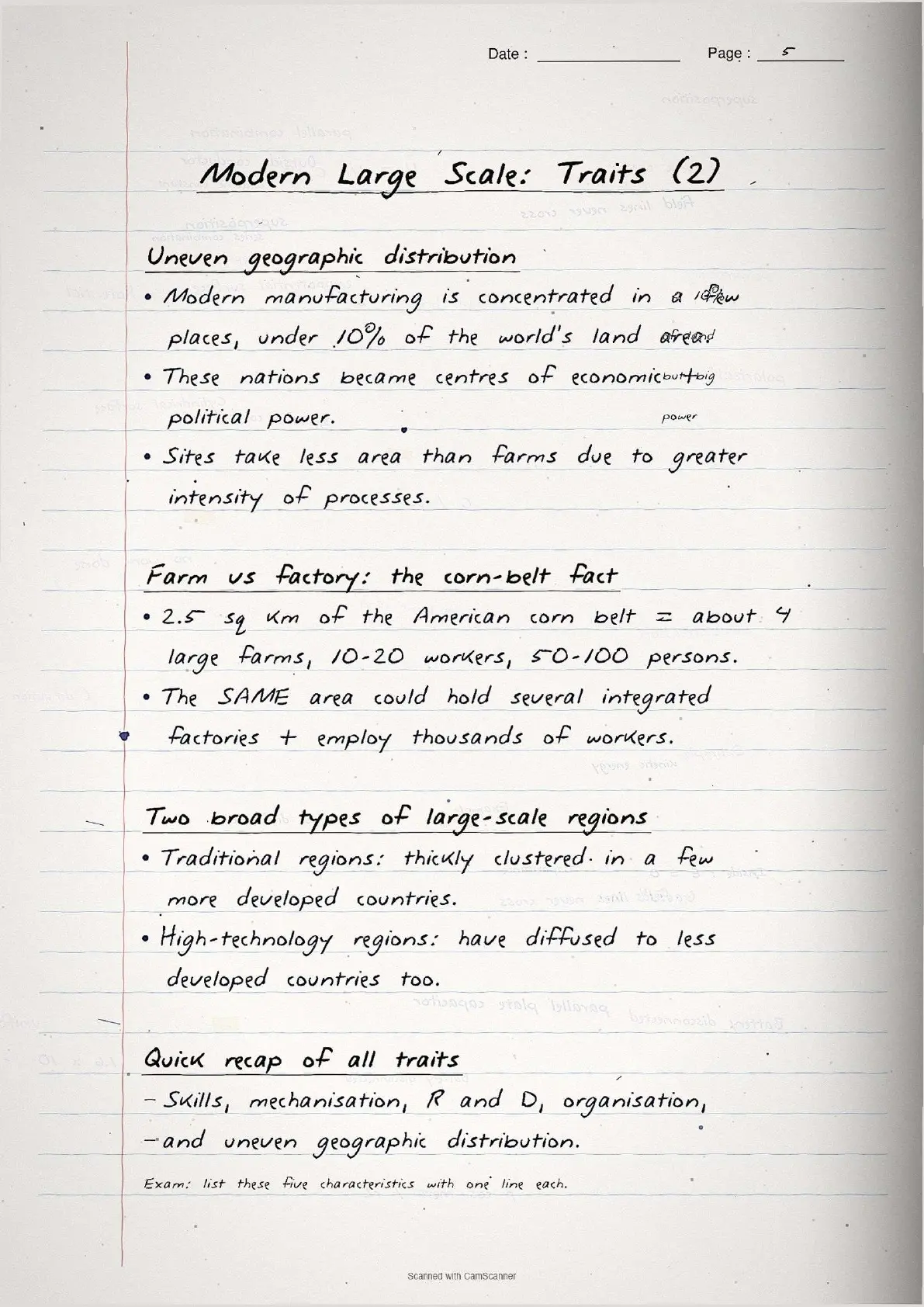
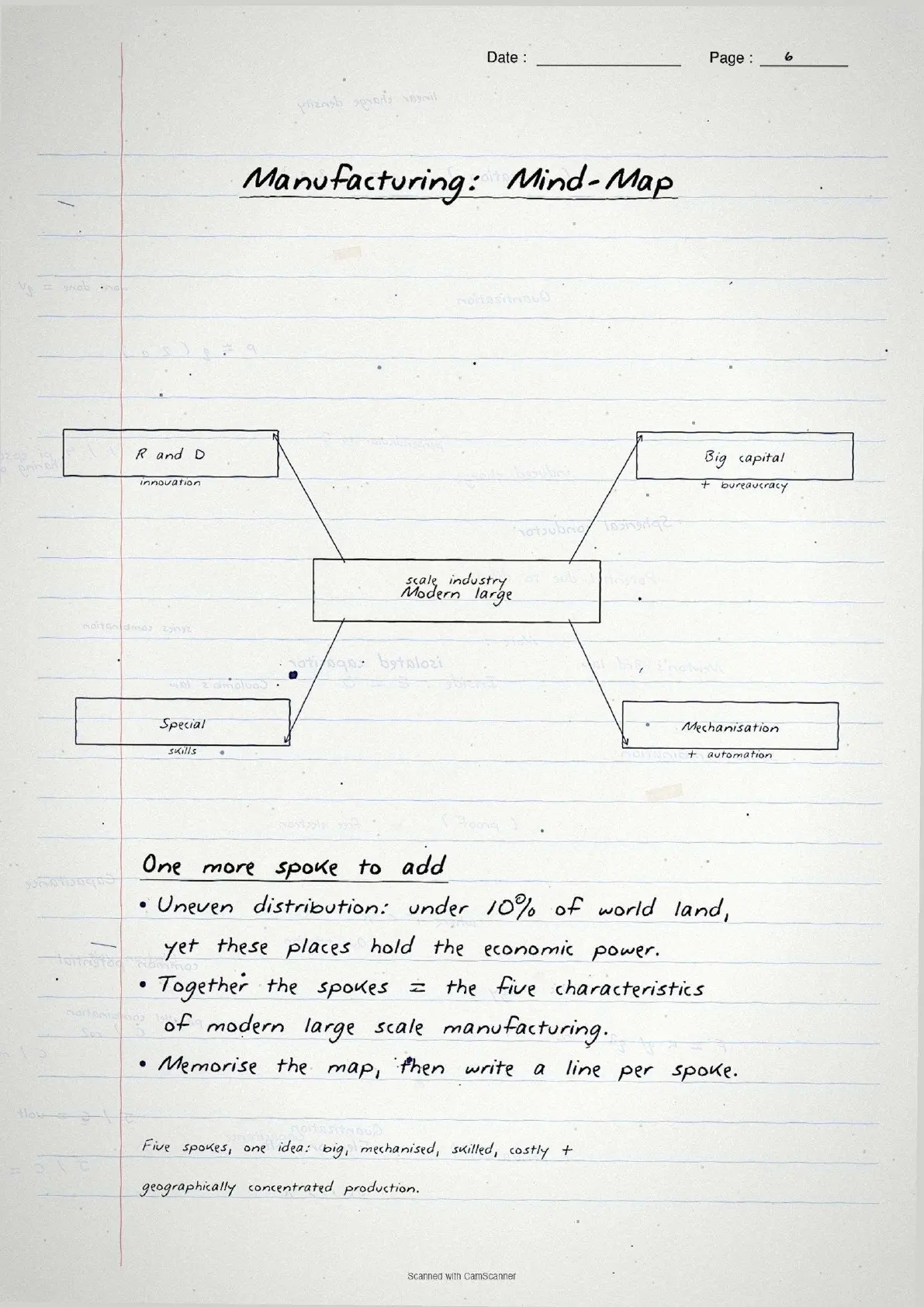
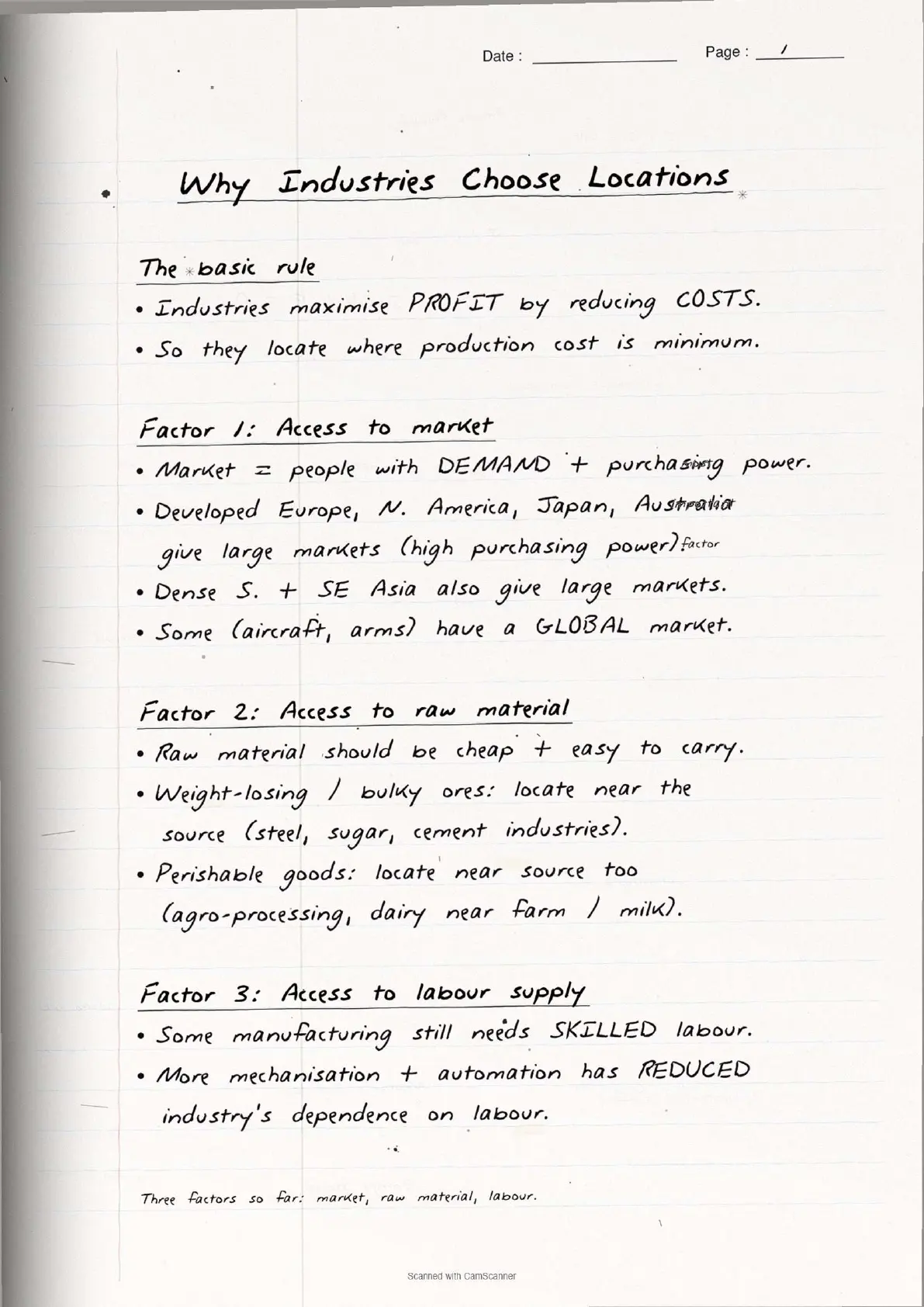
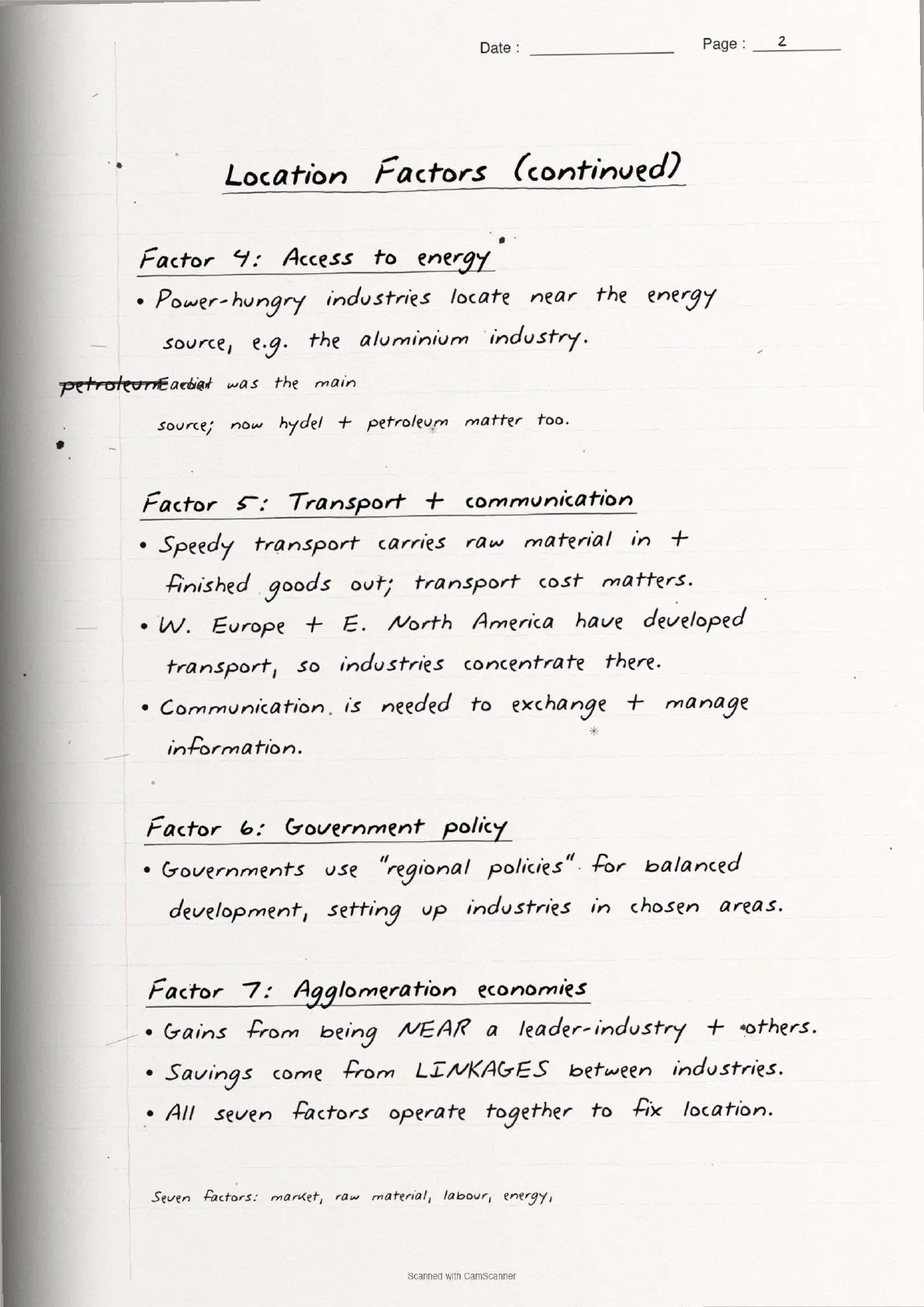
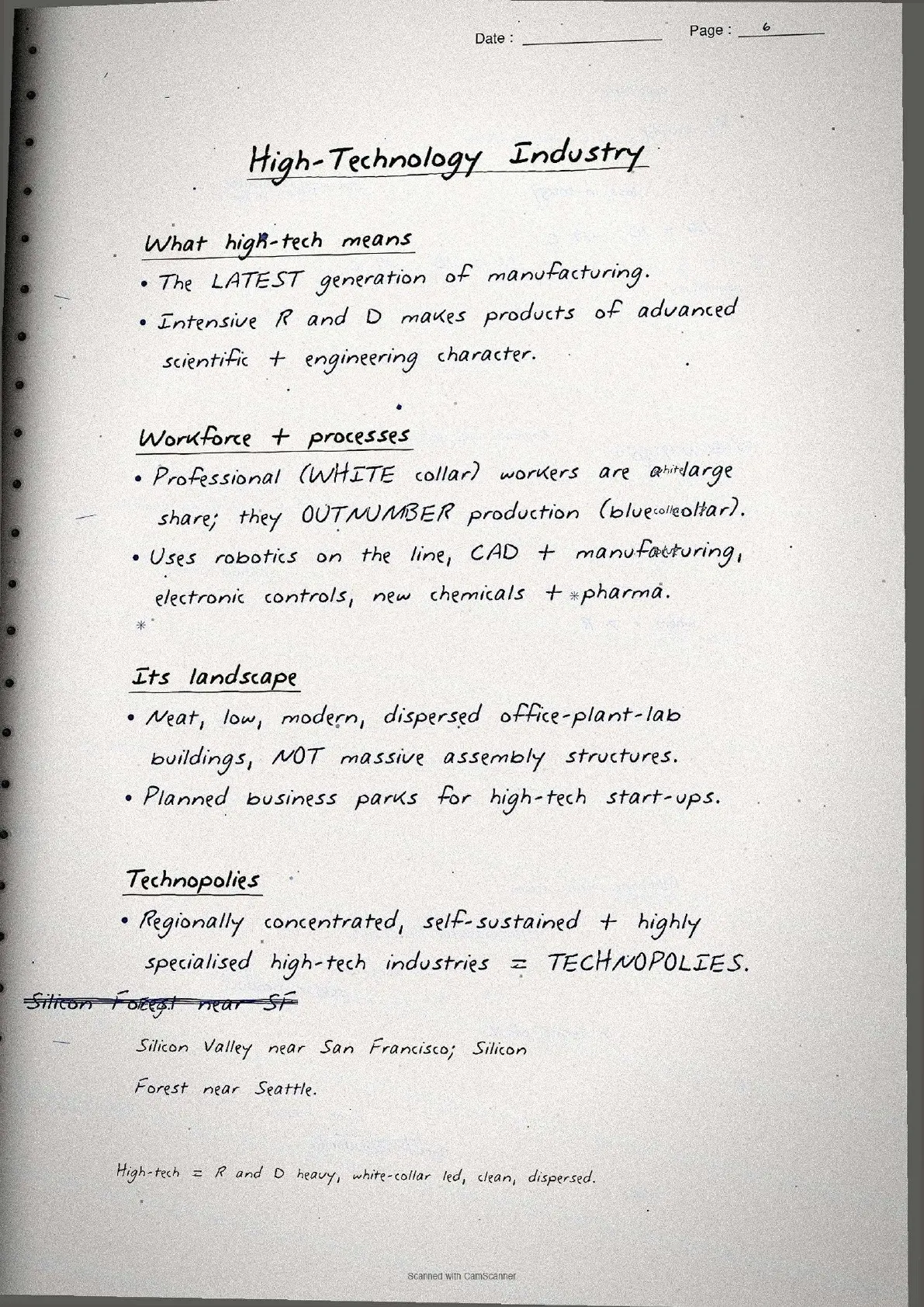
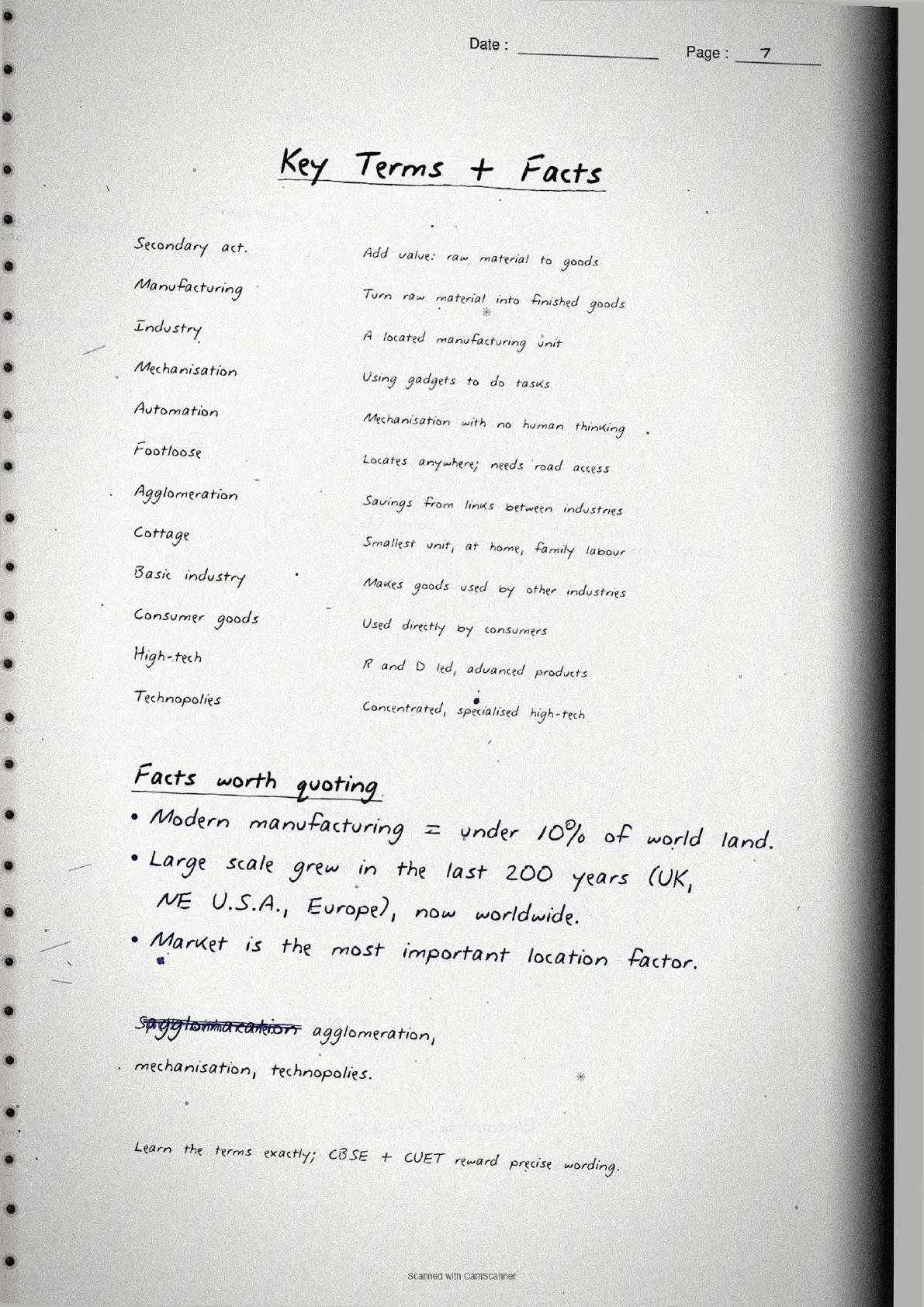
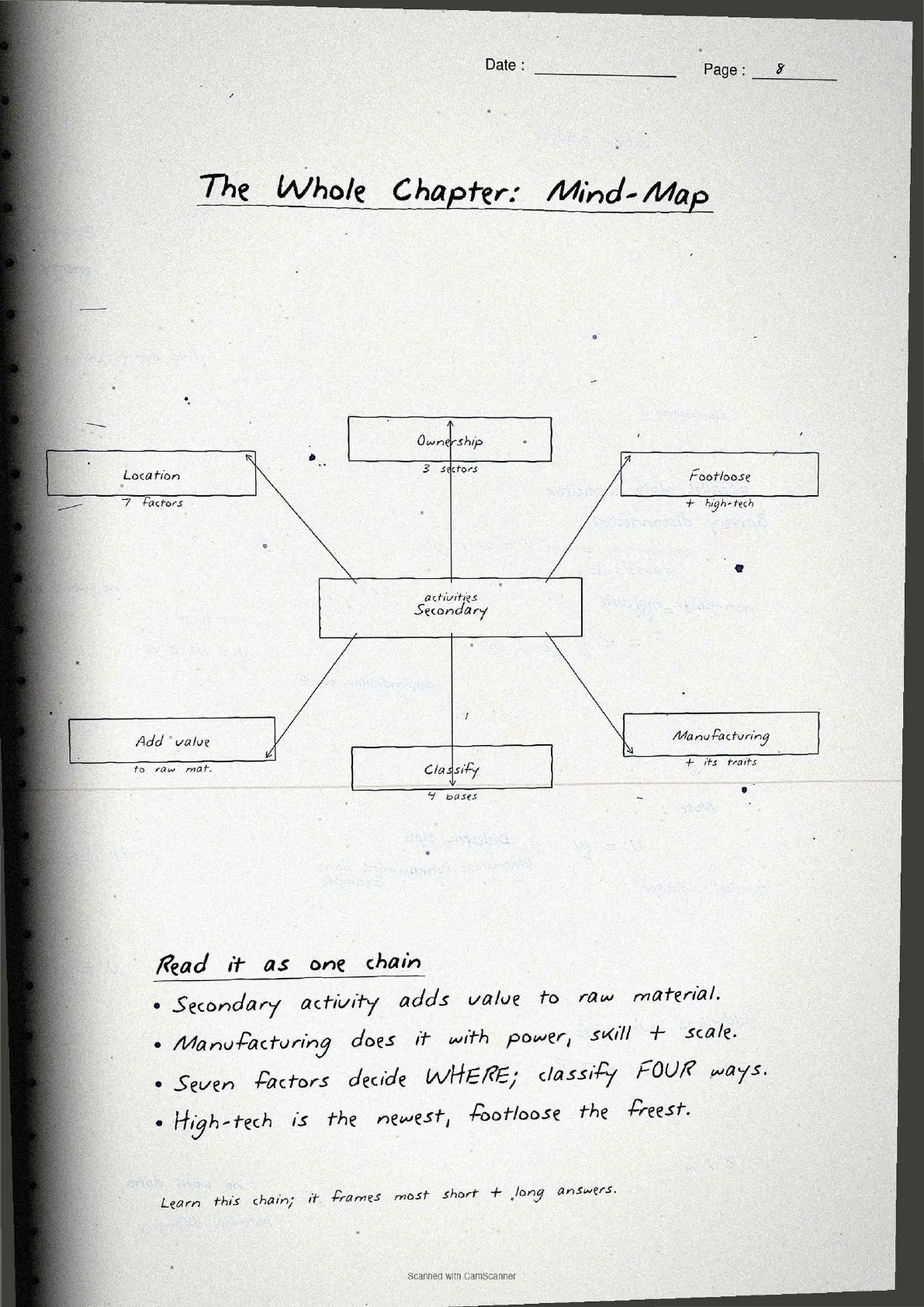
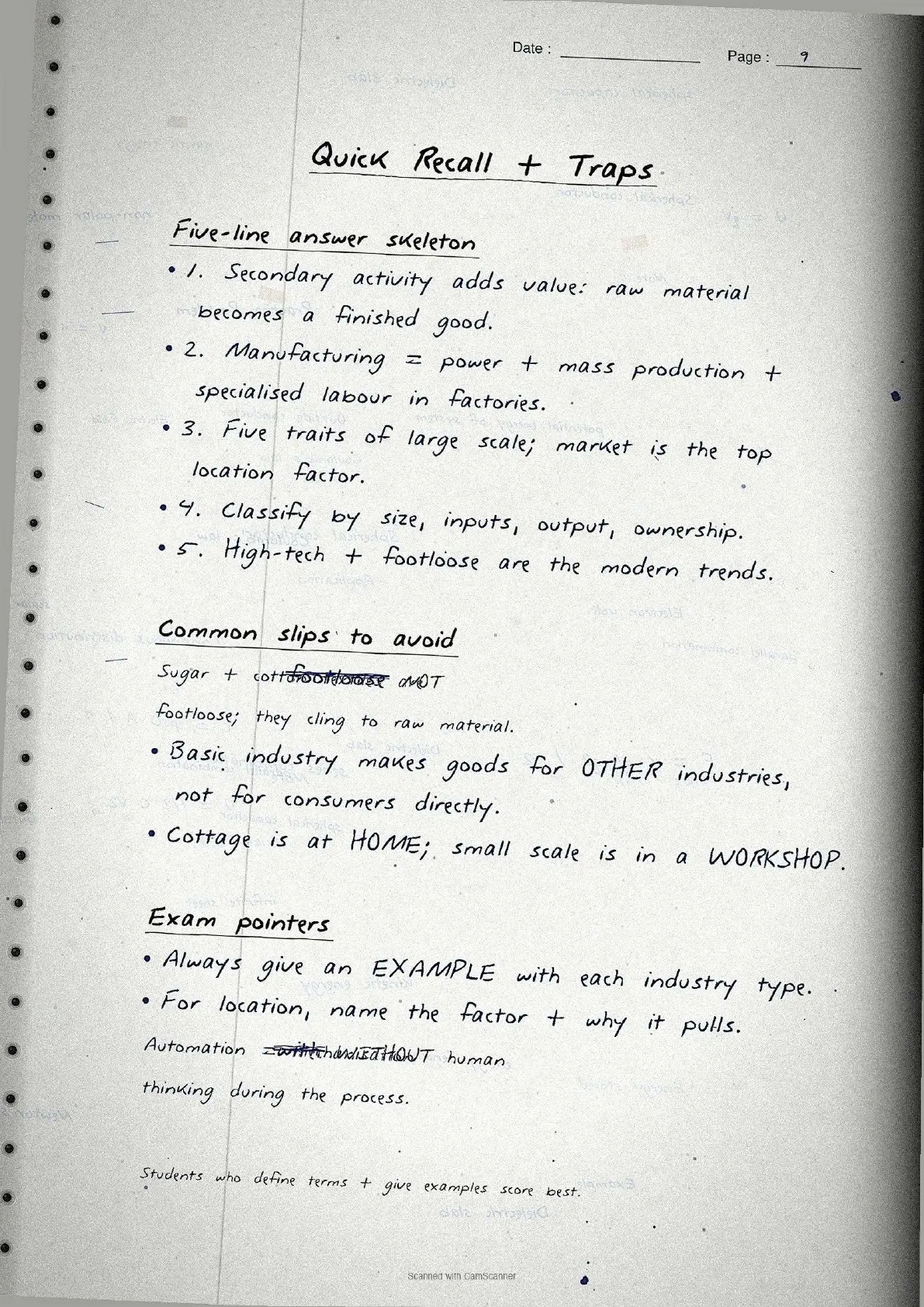
- Topper's handwritten revision notes covering all of CBSE Class 12 Geography Fundamentals of Human Geography Chapter 5.
- 5-6 marks weightage in the Class 12 Geography board paper, with industry types, location factors and technopolies laid out in clear comparison boxes.
- Pairs with the typed NCERT Solutions, typed Notes and the official NCERT Book PDF for the same chapter.
Each page of these secondary activities class 12 handwritten notes is written by a Collegedunia subject expert, mapped to the 2026-27 NCERT Fundamentals of Human Geography textbook, and cross-checked against the last five years of CBSE Class 12 Geography board papers.
Student Feedback
69% of Class 12 students said handwritten notes feel faster to scan than typed PDFs in the final 48 hours before the board exam, and 4 out of 5 students said pen-on-paper concept boxes stick in memory better when revising secondary activities class 12. The average student finished one full revision pass in about 20 minutes.
Source: 2026-27 Class 12 Geography handwritten-notes feedback poll, 10,240 CBSE students.
What These Handwritten Notes Include
The secondary activities class 12 handwritten notes PDF is a 3 to 4 page revision file. Every page is handwritten in ballpoint pen, with boxed key definitions, arrow-tagged diagrams of industry types, and neat corrections in a second ink colour. The file is built for last-mile revision, not first-time concept building.
The pages capture every concept tested in CBSE Class 12 Geography Chapter 5: what secondary activities are (raw materials transformed into finished goods of higher value), the five characteristics of modern large-scale manufacturing, the factors of industrial location, the classification of industries by size, the basic vs consumer goods distinction, and the rise of high-tech industries and technopolies like Silicon Valley.
| Page | What the page covers | Approx revision time |
|---|---|---|
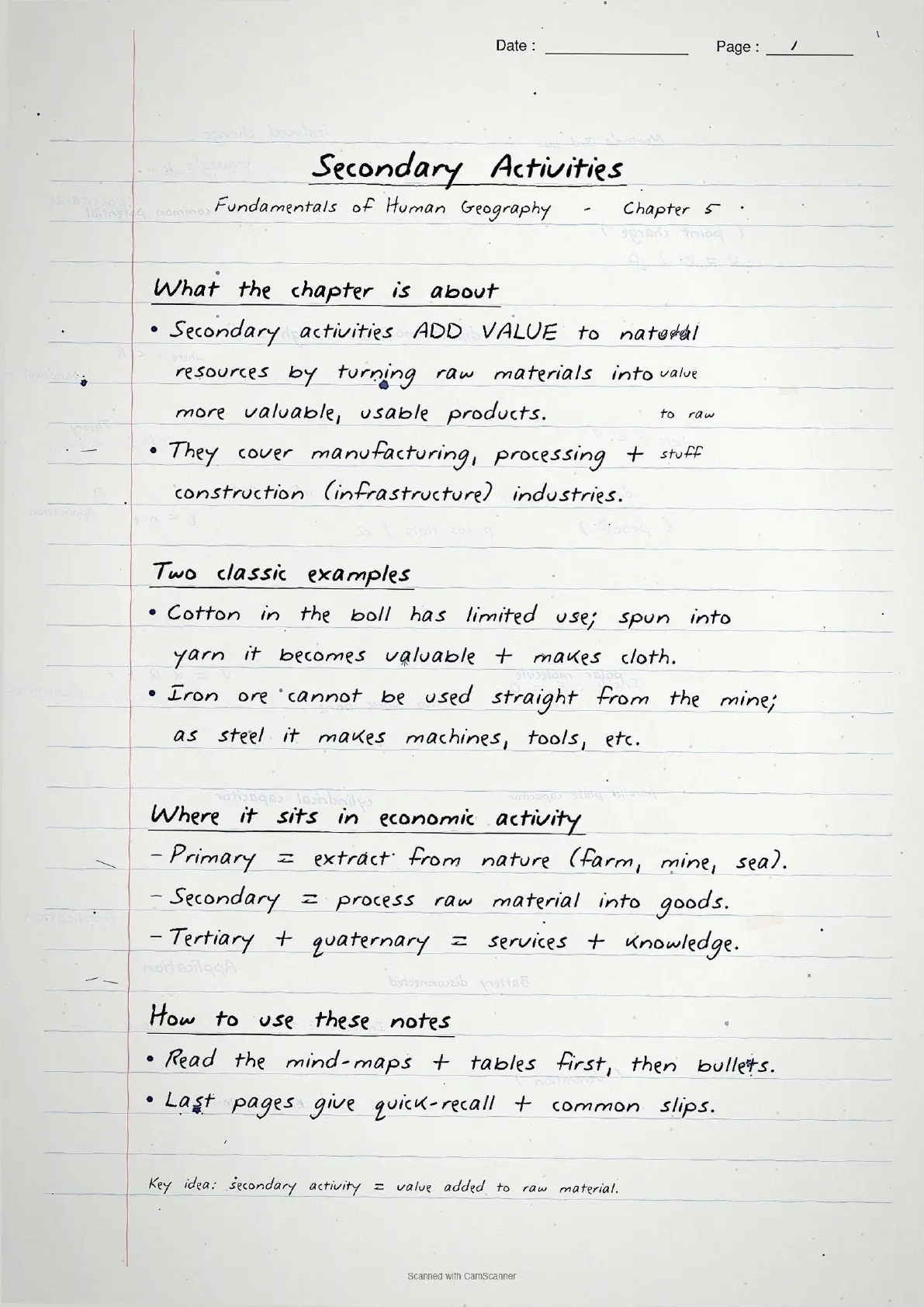
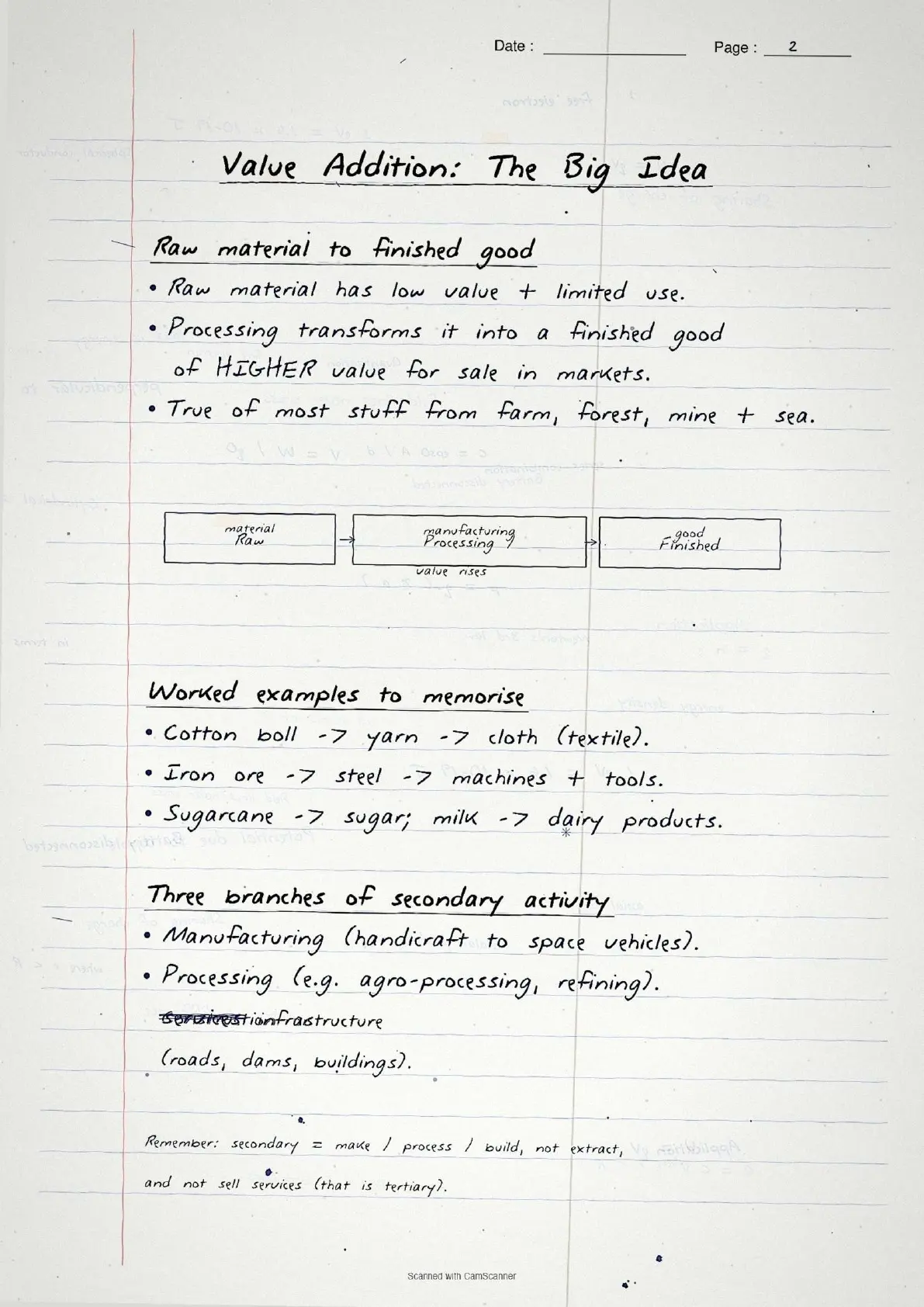
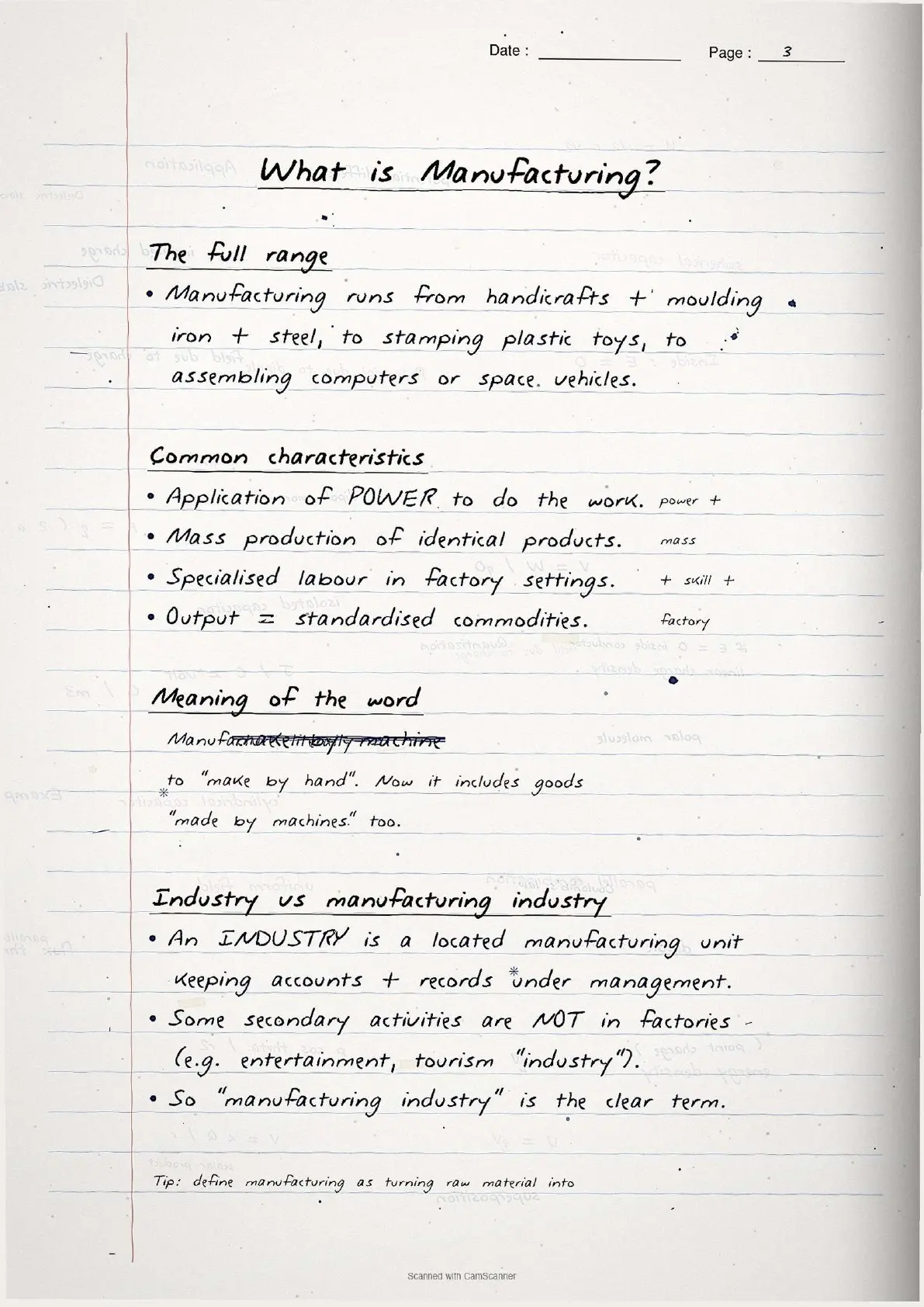
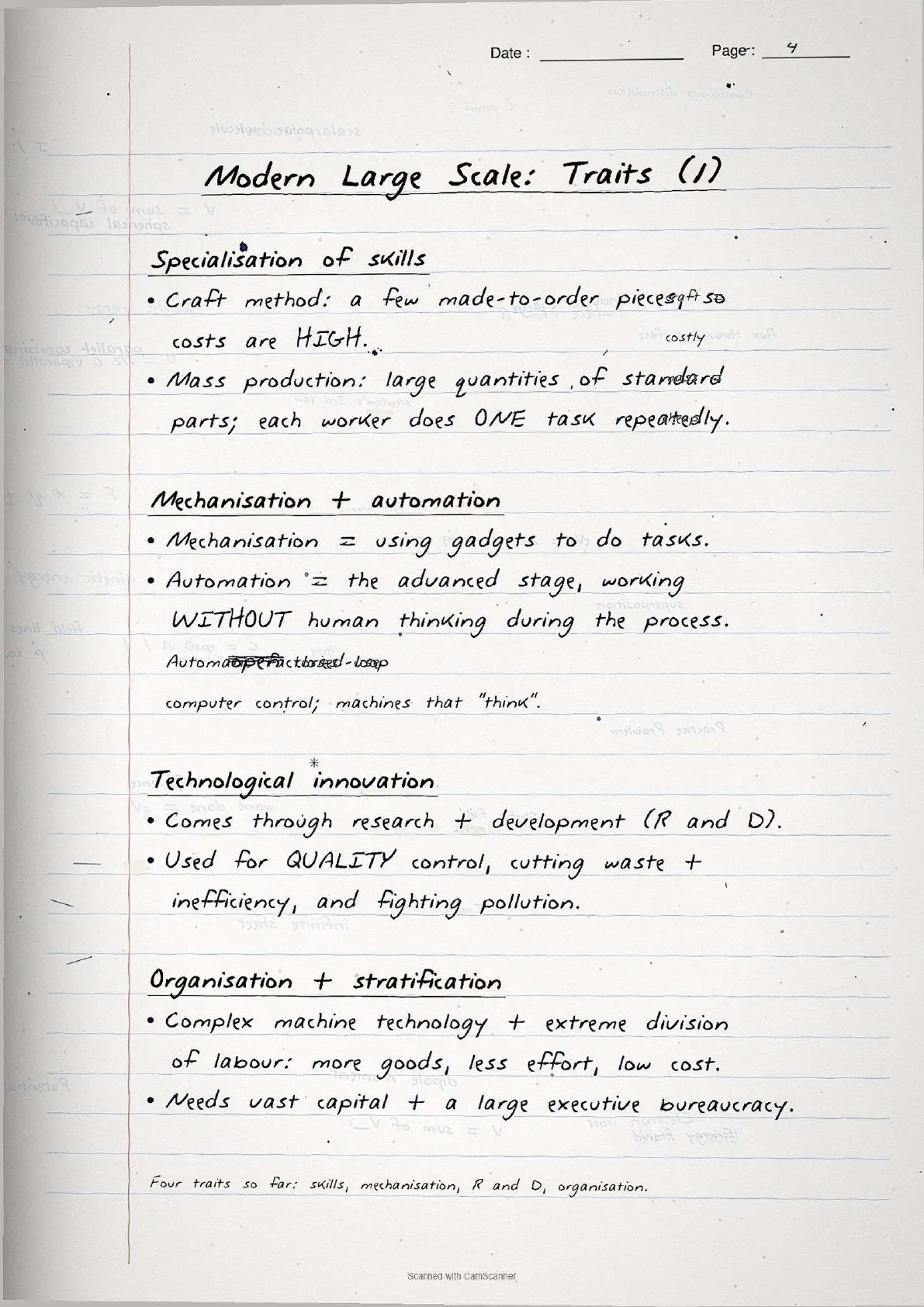
| Page 1 | Definition of secondary activities, manufacturing vs manufacturing industry, five characteristics of modern large-scale manufacturing. | 5 minutes |
| Page 2 | Factors of industrial location (eight factors), footloose industries, classification of industries by size. | 7 minutes |
| Page 3 | Household/cottage, small-scale and large-scale industry features, basic vs consumer goods industries, ownership types. | 5 minutes |
| Page 4 | High-tech industry features, technopolies, Silicon Valley example, global pattern of manufacturing activity. | 4 minutes |
Key Concepts in Handwritten Style
The concept sheet is the highest-leverage block in the file. The table below lists every definition and key idea students need for the CBSE Class 12 Geography board paper, in the exact order the pages present them.
| Concept | Handwritten definition (as drawn) | NCERT exercise Q |
|---|---|---|
| Secondary Activities | Activities that add value to raw materials by transforming them into finished goods of higher value | Q3(i) |
| Manufacturing | Transforming raw materials into finished goods; application of power, mass production, specialised labour | Q2(ii) |
| Specialisation of Skills | Each worker performs one task repeatedly (mass production); reduces cost vs craft method | Q2(ii) |
| Mechanisation | Using gadgets to accomplish tasks; automation is advanced stage where machines "think" | Q2(ii) |
| Technological Innovation | R&D-driven quality control, waste reduction and pollution combating | Q2(ii) |
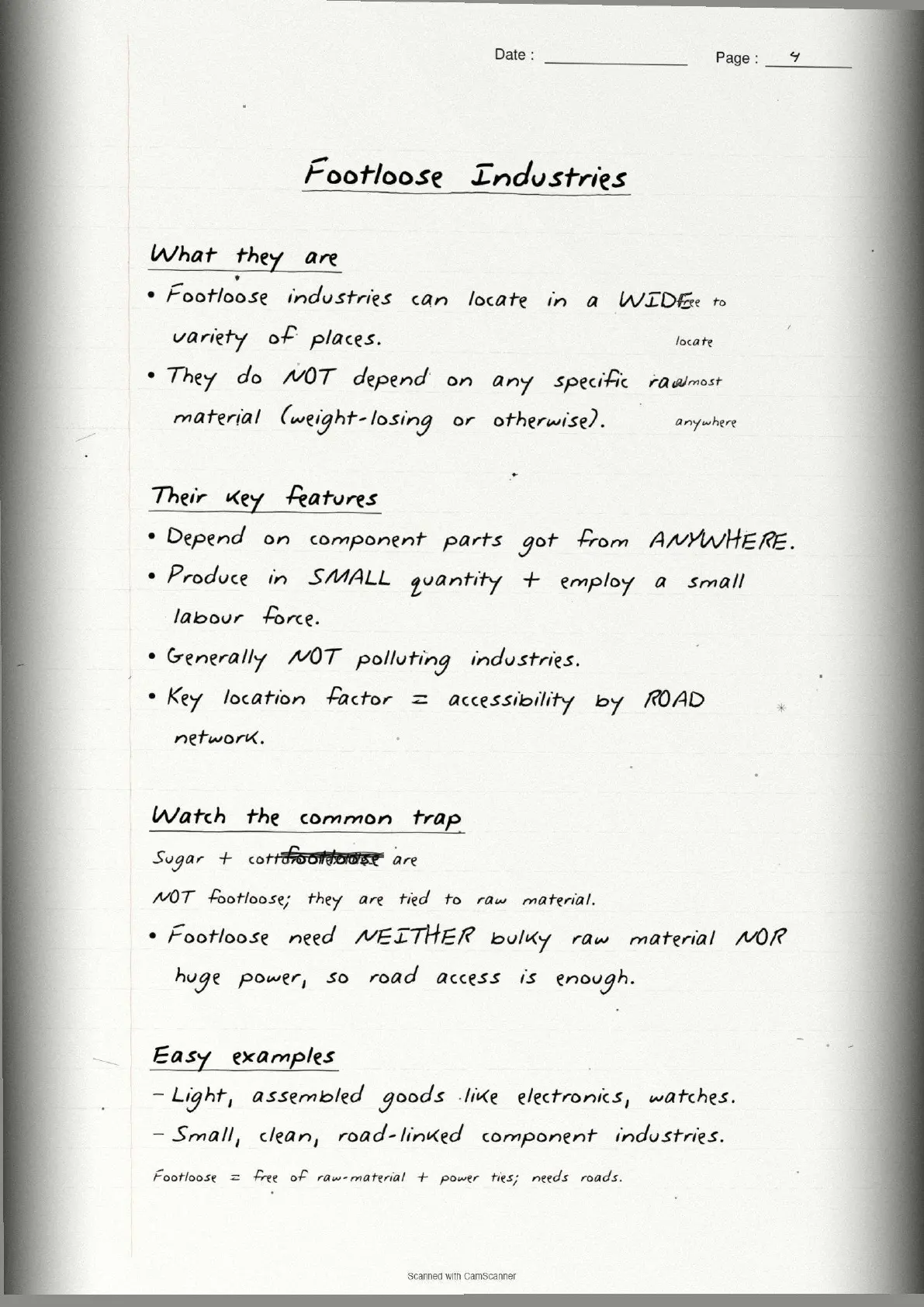
| Footloose Industries | Located anywhere; not tied to raw material or weight-losing; small labour force; road-network dependent | Q2(iii) |
| Agglomeration Economies | Benefits from nearness to a leader-industry and linked industries; shared infrastructure savings | Q3(ii) |
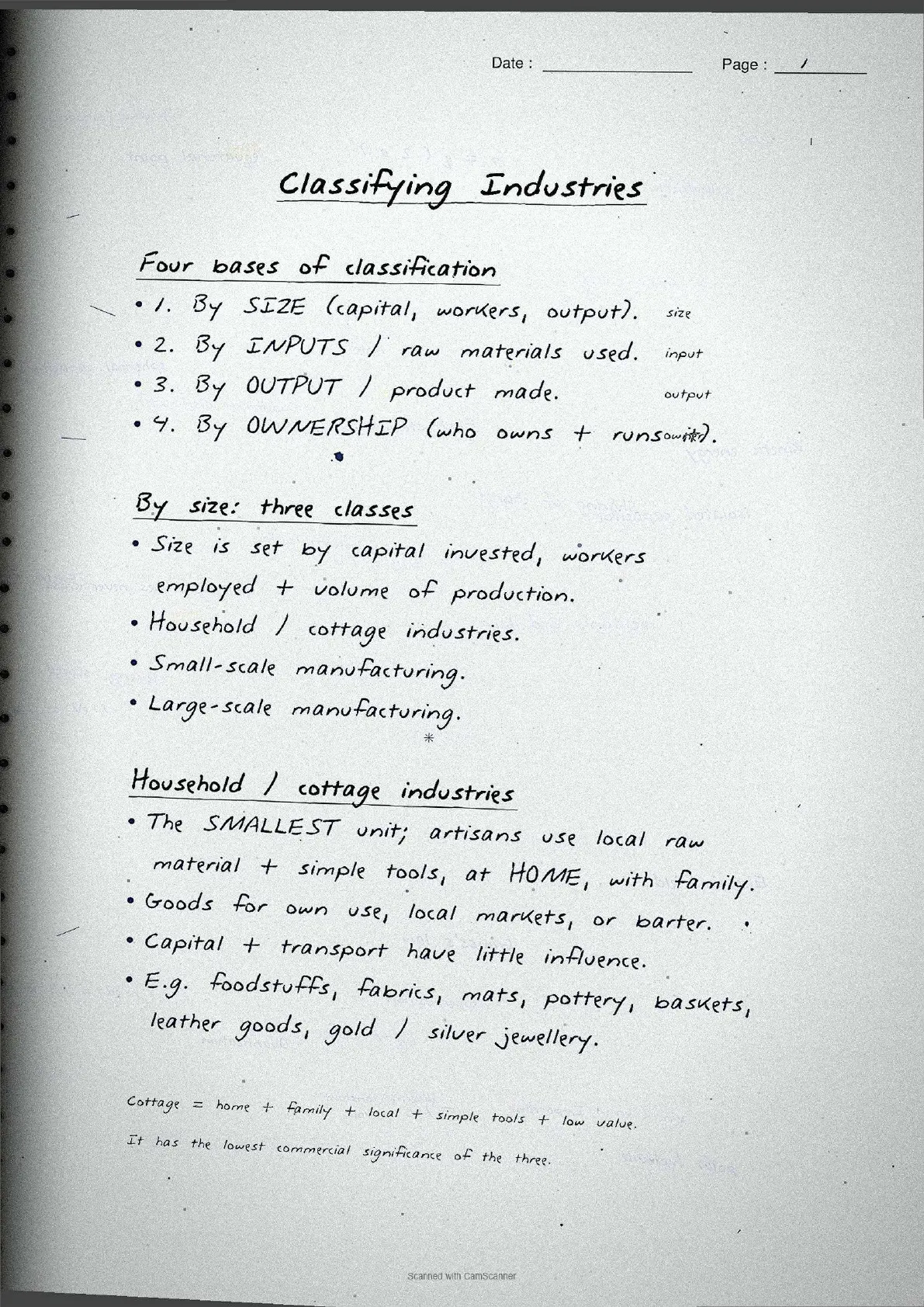
| Cottage/Household Industries | Smallest unit; local raw materials, simple tools, family labour; for home use or barter | Q2(i) |
| Basic Industries | Products used as raw materials by other industries (e.g., iron and steel) | Q1(iii) |
| Consumer Goods Industries | Produce goods for direct consumer use (e.g., bread, soap, TV) -- also called non-basic industries | Q1(iii) |
| High-Tech Industry | Application of intensive R&D to make advanced scientific and engineering products; more white-collar than blue-collar | Q2(i) |
| Technopolies | Regionally concentrated, self-sustained, highly specialised high-tech clusters (e.g., Silicon Valley) | Q3(iii) |
Tip: Each concept sits in a boxed rectangle with a corner arrow pointing to its real-world example, so students who revise from visual blocks recall key terms faster on exam day.
Types of Manufacturing Industries
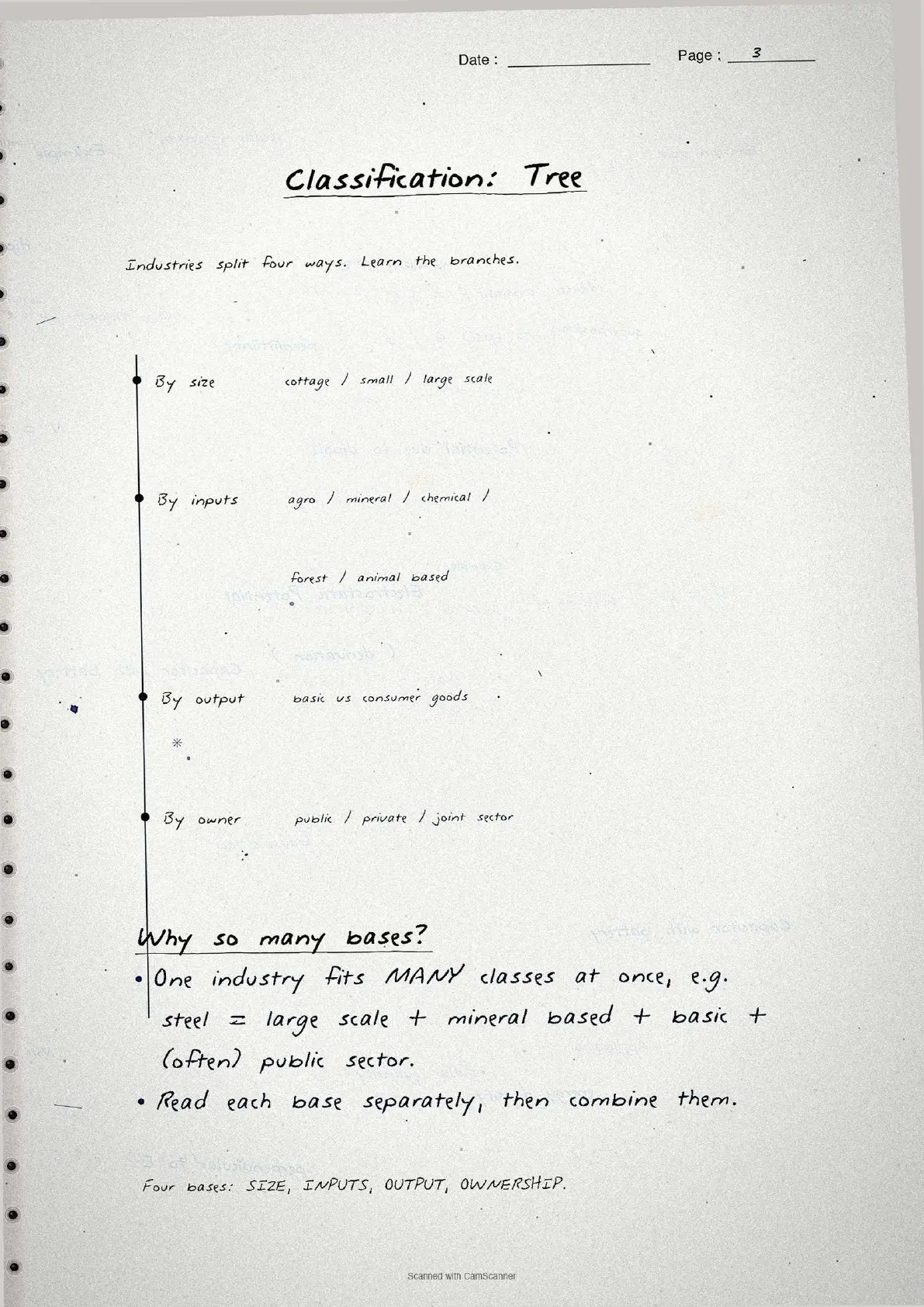
The classification of manufacturing industries is the structural backbone of Chapter 5, and the pages capture all four systems on a single comparison sheet. CBSE papers since 2021 have carried at least one question on this classification, often asking students to distinguish between two types.
Household and Cottage Manufacturing
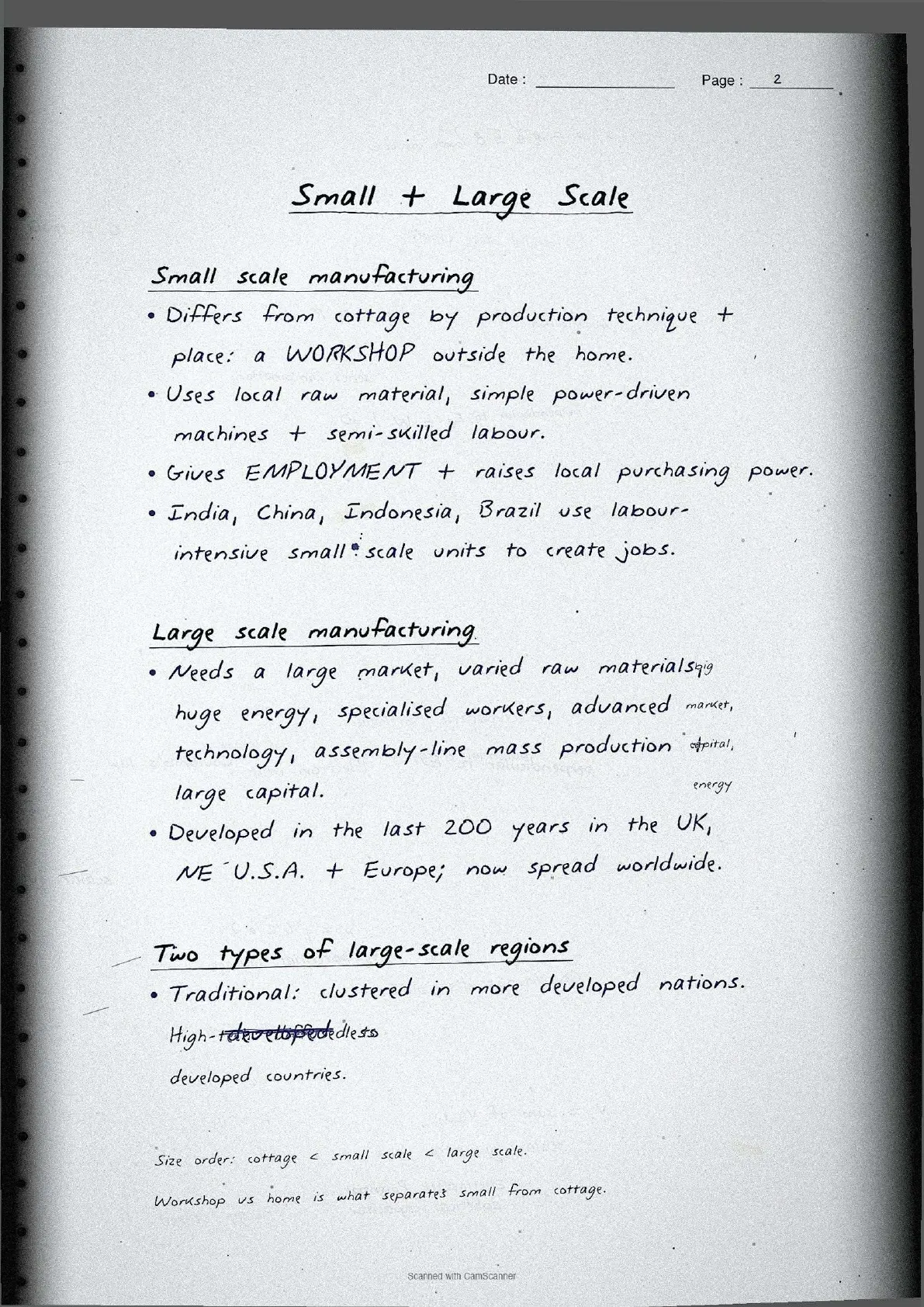
The smallest manufacturing unit. Artisans use local raw materials and simple tools to make everyday goods at home with family help: foodstuffs, fabrics, mats, pottery, jewellery and wooden items. It needs no significant capital and no transport network.
Small-Scale Manufacturing
Small-scale manufacturing happens in a workshop outside the home. It uses local raw materials, simple power-driven machines and semi-skilled labour, and provides more employment per unit of capital than large-scale industry.
Large-Scale Manufacturing
Modern large-scale manufacturing uses complex machine technology, extreme specialisation and vast capital to produce standardised goods in huge quantities. Its five defining characteristics are specialisation of skills, mechanisation, technological innovation, complex organisational structure, and uneven geographic distribution (less than 10% of world land area). The 2023 CBSE paper asked about these for 5 marks.
High-Tech Industries
High-tech industries use intensive research and development to make advanced scientific products, and employ more white-collar than blue-collar workers. Robotics, computer-aided design and advanced pharmaceutical production are examples, set in low, modern buildings in planned business parks.
Important: Technopolies are regionally concentrated, self-sustained high-tech clusters. Silicon Valley near San Francisco and Silicon Forest near Seattle are the most-cited global examples. Always write both the name AND the location city in your answer.
Factors of Industrial Location
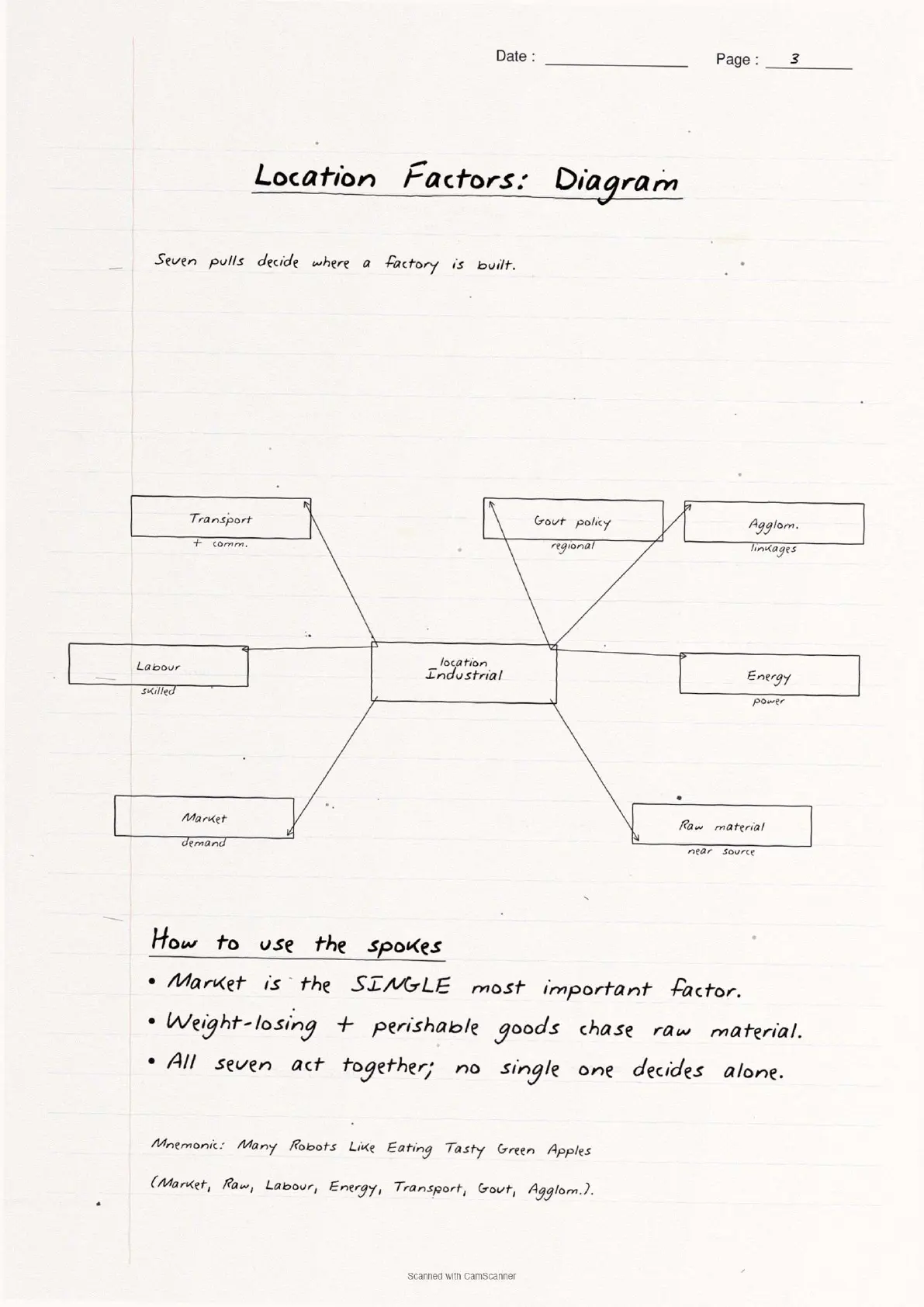
Industries try to minimise production costs by choosing their location carefully. The notes cover all eight factors from the NCERT textbook, which often come together in CBSE questions as "explain any four factors" for 4 or 6 marks.
| Factor | Key point (as written in the notes) | Industry example |
|---|---|---|
| Access to Market | Most important factor; market = people with demand AND purchasing power | Aircraft industry (global market) |
| Raw Materials | Cheap, bulky, weight-losing ores place industries near source; perishable goods near farm/supply | Steel, sugar, cement; dairy |
| Labour Supply | Some industries still need skilled labour; automation reduces dependence | Garments, electronics assembly |
| Energy Sources | Energy-intensive industries near coal, hydel or petroleum sources | Aluminium smelting near hydropower |
| Transport and Communication | Speedy transport of raw materials and finished goods; communication for information exchange | Western Europe, eastern North America clusters |
| Agglomeration Economies | Benefits from being near a leader-industry; shared infrastructure saves cost | Auto ancillary near car factories |
| Government Policy | Regional policies to promote balanced development; sets up industries in specific areas | Public sector steel plants in India |
| Capital | Vast capital needed for large-scale manufacturing; less critical for cottage industries | Petrochemical complexes |
The key insight is that no single factor explains every industrial location. The factors operate together and the dominant one shifts by industry type: market dominates footloose industries, raw material dominates weight-losing ore industries, labour dominates garments. Learn this summary with one example per factor for the 6-mark question.
Common Mistakes Highlighted in the Notes
The six repeat-offender mistakes CBSE examiners flag each year on secondary activities class 12 questions, marked in a second ink colour beside the relevant concept box.
- Confusing secondary with tertiary activities. Secondary activities transform raw materials into goods (manufacturing, processing, construction). Transport is tertiary, not secondary.
- Calling footloose industries "all industries not tied to a place". Footloose industries depend on component parts available anywhere, employ a small labour force, produce small quantity, and are not polluting. Road accessibility is their main need.
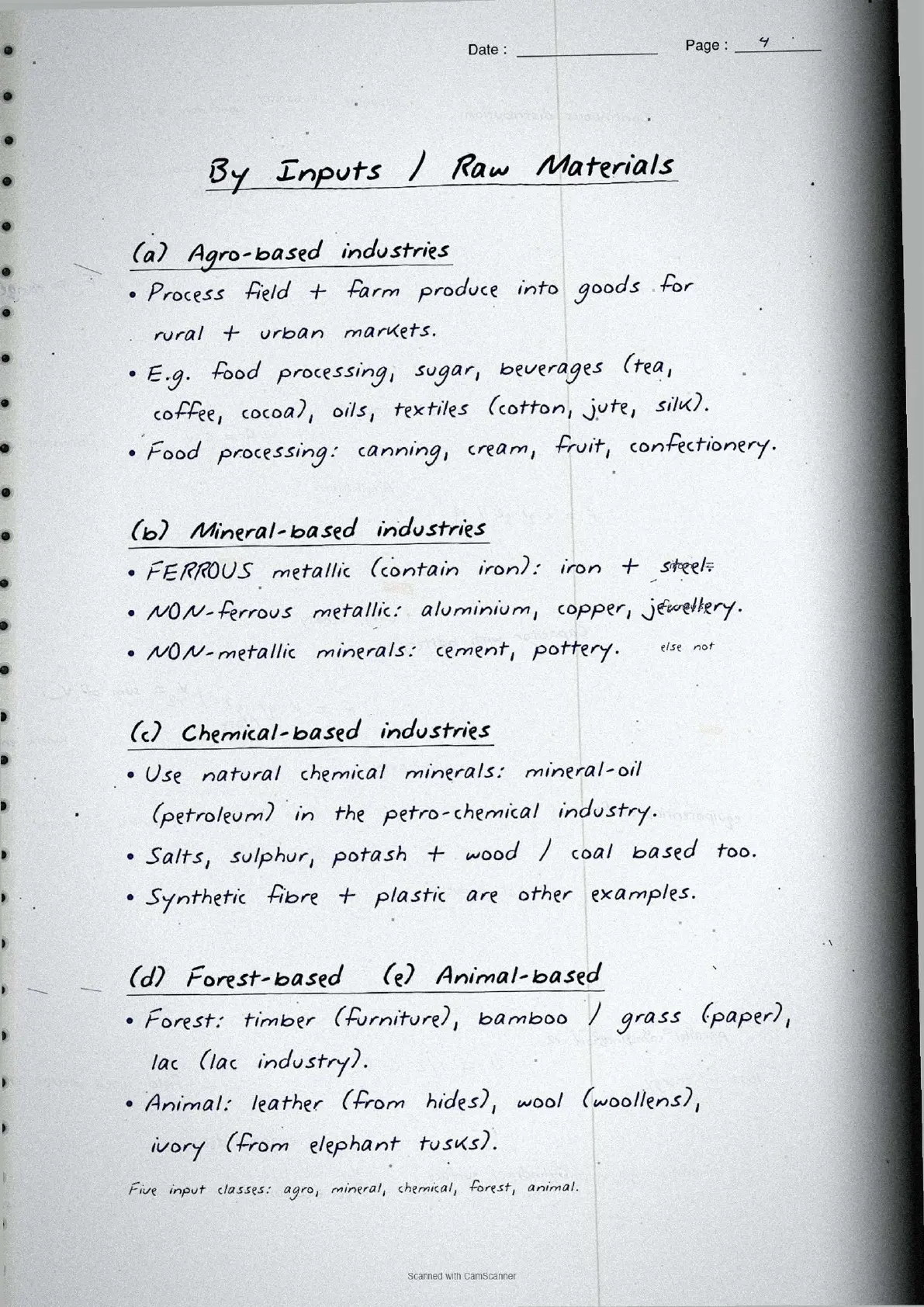
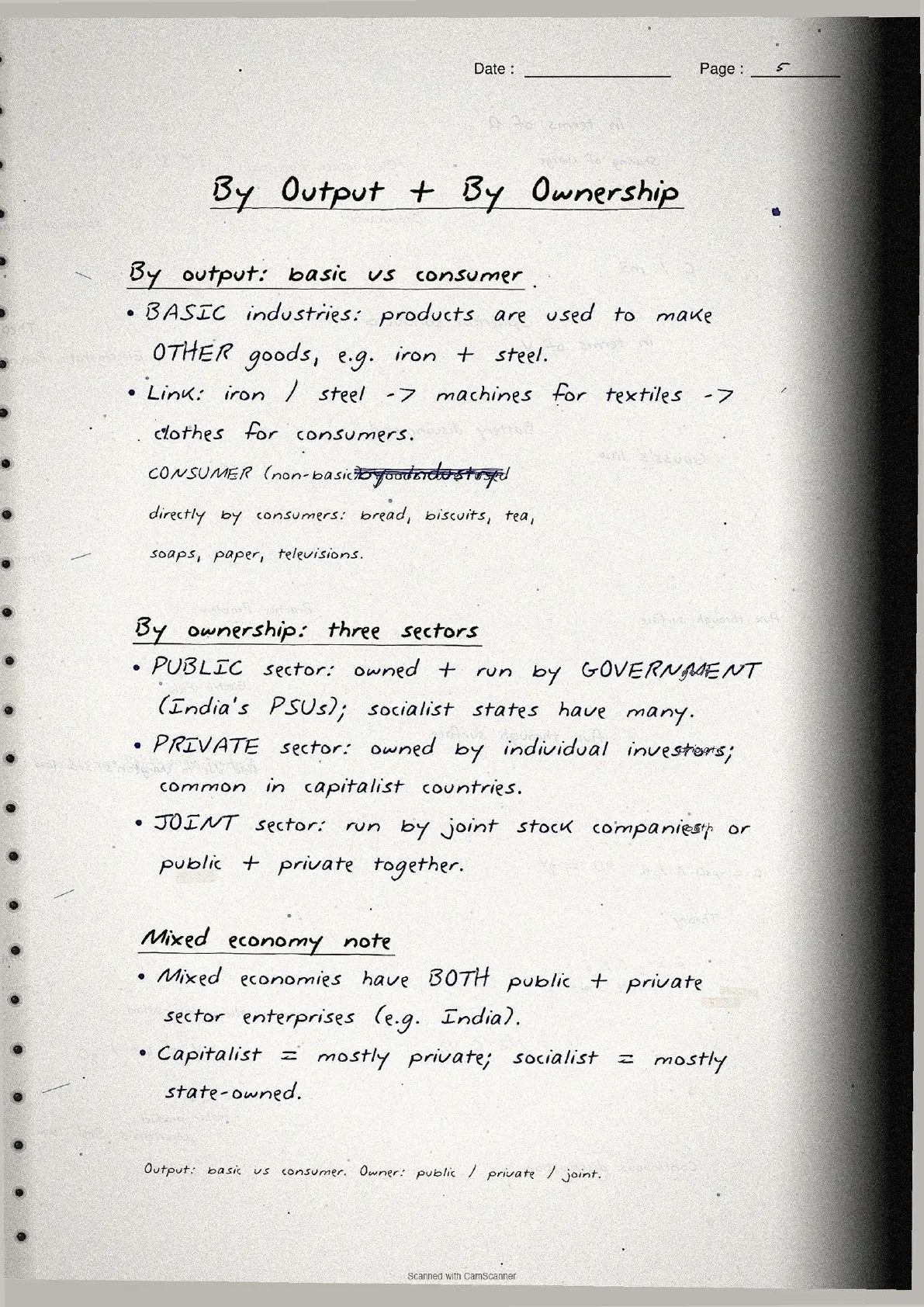
- Mixing up basic and consumer goods industries. Basic industries produce raw materials FOR other industries (iron and steel). Consumer goods industries produce for direct use (bread, soap).
- Saying high-tech industries have mostly blue-collar workers. The reverse is true: white-collar workers greatly outnumber production workers; robotics replaces blue-collar tasks.
- Naming Silicon Valley as a technopoly in India. Silicon Valley is near San Francisco and Silicon Forest near Seattle, both in the USA; these are the NCERT examples to quote.
- Writing agglomeration economies as only about sharing raw materials. They come from nearness to leader-industries AND from linkages: shared transport, a skilled-labour pool and common services.
Previous Year Question Trends
The CBSE Class 12 Geography paper has carried a stable 5 to 8 marks from Chapter 5 over the last five years, usually one short-answer (3 marks) and one long-answer (5 marks). The pages are structured around this pattern.
| Year | Question asked | Marks | Notes page to revise |
|---|---|---|---|
| 2025 | Explain any four factors affecting the location of industries + distinguish between basic and consumer goods industries | 5 + 3 | Page 2 + Page 3 |
| 2024 | What are high-tech industries? Describe their main features with one example of a technopoly | 5 | Page 4 |
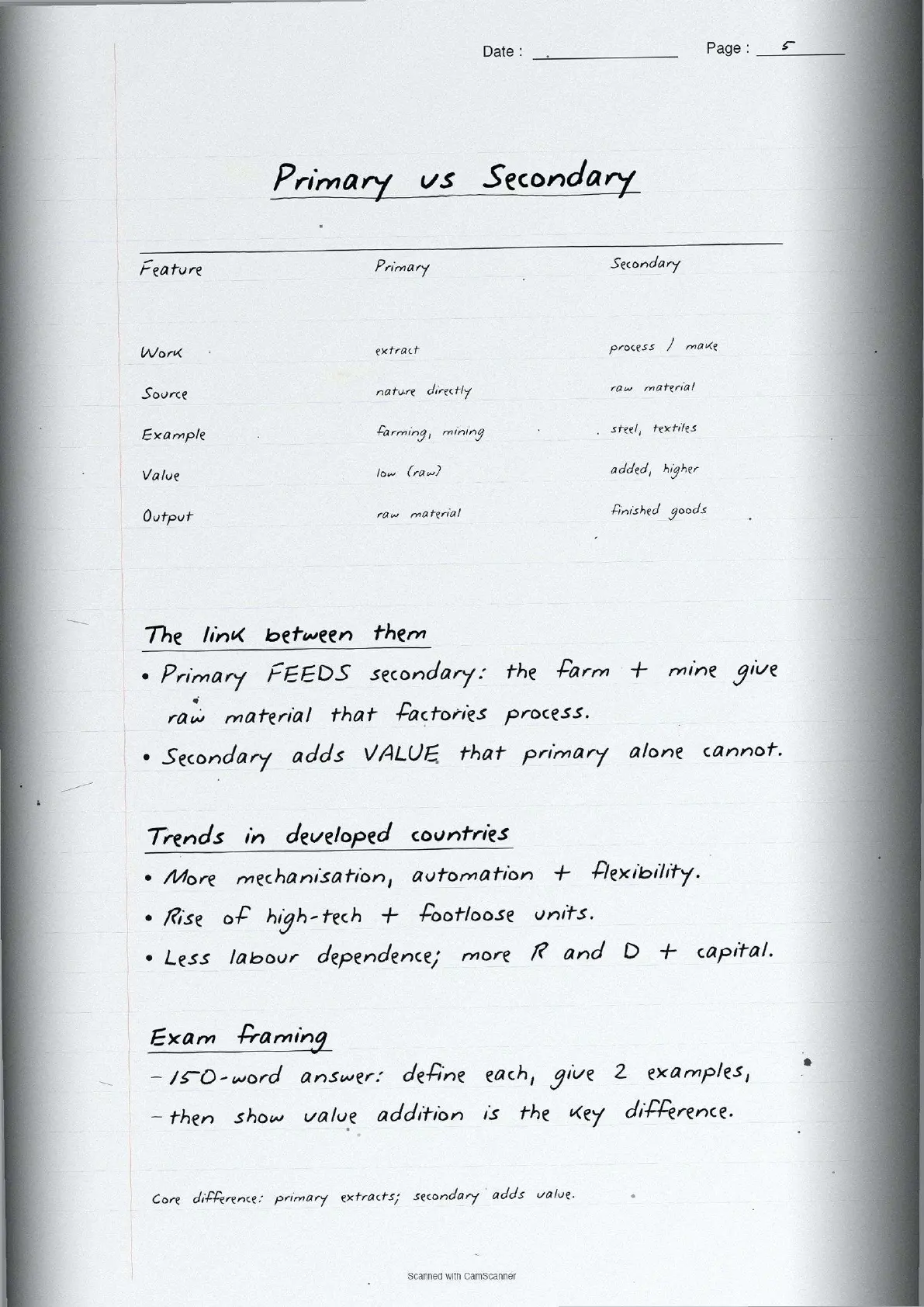
| 2023 | Differentiate between primary and secondary activities + explain footloose industries | 3 + 2 | Page 1 + Page 2 |
| 2022 | Explain the characteristics of modern large-scale manufacturing | 5 | Page 1 |
| 2021 | MCQ on basic industries + 3-mark short note on agglomeration economies | 1 + 3 | Page 2 + Page 3 |
The 5-mark question rotates between location factors, manufacturing characteristics and high-tech industries on a roughly equal cycle, so revise all four pages together, not selectively.
Other Resources for Class 12 Geography Chapter 5 Secondary Activities
Pair these handwritten notes with the matching NCERT Solutions, typed Notes and the official NCERT Book chapter.
| Resource | What it covers | Open |
|---|---|---|
| Handwritten Notes | Topper's handwritten revision pages for last-mile board exam prep. | You are here |
| NCERT Solutions | Step-by-step answers to all exercise questions with detailed explanation and CBSE-aligned reasoning. | Class 12 Geography Chapter 5 NCERT Solutions |
| Notes | Concept-first typed revision notes with definitions, classification tables, location factors and common mistakes. | Class 12 Geography Chapter 5 Notes |
| NCERT Book PDF | Official NCERT Fundamentals of Human Geography Chapter 5 textbook in PDF form. | Class 12 Geography Chapter 5 NCERT Book PDF |
| Subject Hub | All chapters of Class 12 Geography with every resource in one place. | Class 12 Geography Subject Hub |
All Chapters Handwritten Notes for Class 12 Geography Fundamentals of Human Geography
Related Links: Use the table below to open the handwritten notes for the other chapters of Class 12 Geography Fundamentals of Human Geography. Every chapter ships with the same handwritten structure, concept boxes and margin-callout common mistakes.
| Chapter | Topic | Handwritten Notes link |
|---|---|---|
| Chapter 1 | Human Geography: Nature and Scope | Class 12 Geography Chapter 1 Handwritten Notes |
| Chapter 2 | The World Population: Distribution, Density and Growth | Class 12 Geography Chapter 2 Handwritten Notes |
| Chapter 3 | Human Development | Class 12 Geography Chapter 3 Handwritten Notes |
| Chapter 4 | Primary Activities | Class 12 Geography Chapter 4 Handwritten Notes |
| Chapter 5 | Secondary Activities | You are here |
| Chapter 6 | Tertiary and Quaternary Activities | Class 12 Geography Chapter 6 Handwritten Notes |
| Chapter 7 | Transport and Communication | Class 12 Geography Chapter 7 Handwritten Notes |
| Chapter 8 | International Trade | Class 12 Geography Chapter 8 Handwritten Notes |
Secondary Activities Class 12 Handwritten Notes FAQs
Ques. What are these secondary activities class 12 handwritten notes meant to be used for?
Ans. The secondary activities class 12 handwritten notes compress the full NCERT Chapter 5 of Class 12 Geography Fundamentals of Human Geography into 3 to 4 pages of handwritten concept boxes, industry-classification diagrams and margin-callout common mistakes. Students typically use the file for last-mile revision in the 24 hours before the board paper, paired with the typed Notes PDF for concept building and the NCERT Solutions PDF for answer-writing practice. The handwritten file is the closest thing to borrowing a topper's own revision pages for one sitting.
Ques. How are handwritten notes different from the typed secondary activities class 12 notes?
Ans. The typed secondary activities class 12 notes carry deeper prose around each concept (context, examples, global patterns, common-mistake explanations) and run 6 to 8 pages long. The handwritten notes compress that prose down to concept boxes alone, sit at 3 to 4 pages, and lean on visual recall (boxed definitions, arrow-tagged industry types, pen-touch corrections) rather than typed explanations. The two files are designed to be used together, not as substitutes. Read the typed Notes first to build the concept, then move to the handwritten file for the second and third revision passes.
Ques. What are secondary activities in Class 12 Geography?
Ans. Secondary activities in Class 12 Geography are economic activities that add value to natural resources by transforming raw materials into finished goods of higher value. The NCERT textbook gives the example of cotton in the boll (limited use) becoming yarn (more valuable) becoming cloth (highest value). Secondary activities include manufacturing, processing and construction industries. The chapter distinguishes them from primary activities (extracting from nature) and tertiary activities (services). The handwritten notes draw the transformation chain on Page 1 with arrows from raw material to semi-finished to finished product.
Ques. What are the five characteristics of modern large-scale manufacturing?
Ans. The five characteristics of modern large-scale manufacturing listed in the NCERT Class 12 Geography textbook are: (1) Specialisation of Skills or Methods of Production, where mass production divides work into single repeated tasks; (2) Mechanisation and Automation, where gadgets and computers replace human effort; (3) Technological Innovation through research and development for quality control and waste reduction; (4) Complex Organisational Structure with bureaucratic management and extreme division of labour; (5) Uneven Geographic Distribution, where major manufacturing concentrations cover less than 10 per cent of the world's land area. All five appear as numbered boxes on Page 1 of the handwritten file.
Ques. What are footloose industries according to NCERT Class 12?
Ans. Footloose industries, according to the NCERT Class 12 Geography Chapter 5 textbook, are industries that can be located in a wide variety of places because they are not dependent on any specific raw material (whether weight-losing or otherwise). They rely on component parts that can be obtained anywhere, produce in small quantity, employ a small labour force and are generally not polluting industries. Their key location factor is road network accessibility. IT companies and electronics assembly units are classic examples. The handwritten notes draw the footloose-industry box with a road-sign arrow to emphasise road accessibility as the defining locational need.
Ques. What is the difference between basic and consumer goods industries?
Ans. Basic industries produce goods that are used as raw materials by other industries. Iron and steel is the classic example: the steel is used to make machines for the textile industry, which then makes clothes for consumers. Consumer goods industries, also called non-basic industries, produce goods that are directly consumed by people: bread, biscuits, tea, soap, televisions and writing paper. The key test is whether the product goes to another industry or to a consumer. The handwritten notes draw this as a chain: iron ore to steel (basic) to textile machine to cloth (consumer good), with a bracket labelling each step.
Ques. What is a technopoly in Class 12 Geography?
Ans. A technopoly, in Class 12 Geography NCERT Chapter 5, is a high-tech industrial cluster that is regionally concentrated, self-sustained and highly specialised. The term was coined to describe places like Silicon Valley near San Francisco and Silicon Forest near Seattle, which serve as the world's leading examples. Technopolies are characterised by planned business parks with low, modern office-plant-lab buildings rather than massive assembly factories, a high ratio of white-collar to blue-collar workers, and intense research and development activity. Students often lose marks by writing only the name without the location city in exam answers.
Ques. How many marks does Chapter 5 Secondary Activities carry in the CBSE Class 12 Geography board exam?
Ans. Chapter 5 Secondary Activities typically carries 5 to 8 marks in the CBSE Class 12 Geography board exam across both theory and map-based components. The marks usually come as one 3-mark short-answer question (for example, explain footloose industries or distinguish basic from consumer goods) and one 5-mark long-answer question (for example, explain four factors of industrial location or describe the characteristics of modern manufacturing). The handwritten notes are structured around exactly this question pattern, with the eight location factors on Page 2 and the industry classification on Page 3 designed for 5-mark answers.
Ques. Is the Class 12 Geography syllabus for secondary activities changing in 2026-27?
Ans. No major changes for 2026-27. The Fundamentals of Human Geography textbook chapter structure is unchanged for the current cycle, and the CBSE marking scheme continues to reward precise definitions with examples and structured answers with relevant points. These secondary activities class 12 handwritten notes for the 2026-27 cycle are aligned to the unchanged textbook and the latest CBSE sample paper released for the 2026 boards.
Ques. Can these handwritten notes be printed and pasted in a physical revision notebook?
Ans. Yes, and that is the recommended use pattern. The PDF is sized for A4 printing, with each page sitting cleanly inside a standard ruled page. Toppers in the 2026 Class 12 Geography student poll reported that printing the pages and pasting them inside their physical revision notebook added 2 marks on average on the 5-mark long-answer question for this chapter, because the pen-on-paper concept boxes match the visual recall needed when writing a structured answer in the exam hall.
Ques. What is the difference between primary and secondary activities according to NCERT?
Ans. Primary activities involve extracting resources directly from nature: agriculture, mining, forestry, fishing and animal rearing. Secondary activities involve transforming those natural resources into goods of higher value: manufacturing iron ore into steel, cotton into yarn and then cloth, timber into furniture. The key distinction is that primary activities produce raw materials while secondary activities process and add value to them. The NCERT textbook emphasises that secondary activities revolve around using the resources obtained by primary activities, which is why the two chapters (Chapter 4 and Chapter 5) are best revised together for a complete picture of economic activities.



Comments