




These Class 12 Geography Chapter 1 Human Geography Nature and Scope handwritten notes are a topper's genuine handwritten revision pages, mapped to the 2026-27 CBSE syllabus. The pages cover all key ideas in the chapter: the definitions of human geography, environmental determinism, possibilism, neo-determinism, and the full table of sub-fields. Use the PDF in the 24 hours before the board paper.
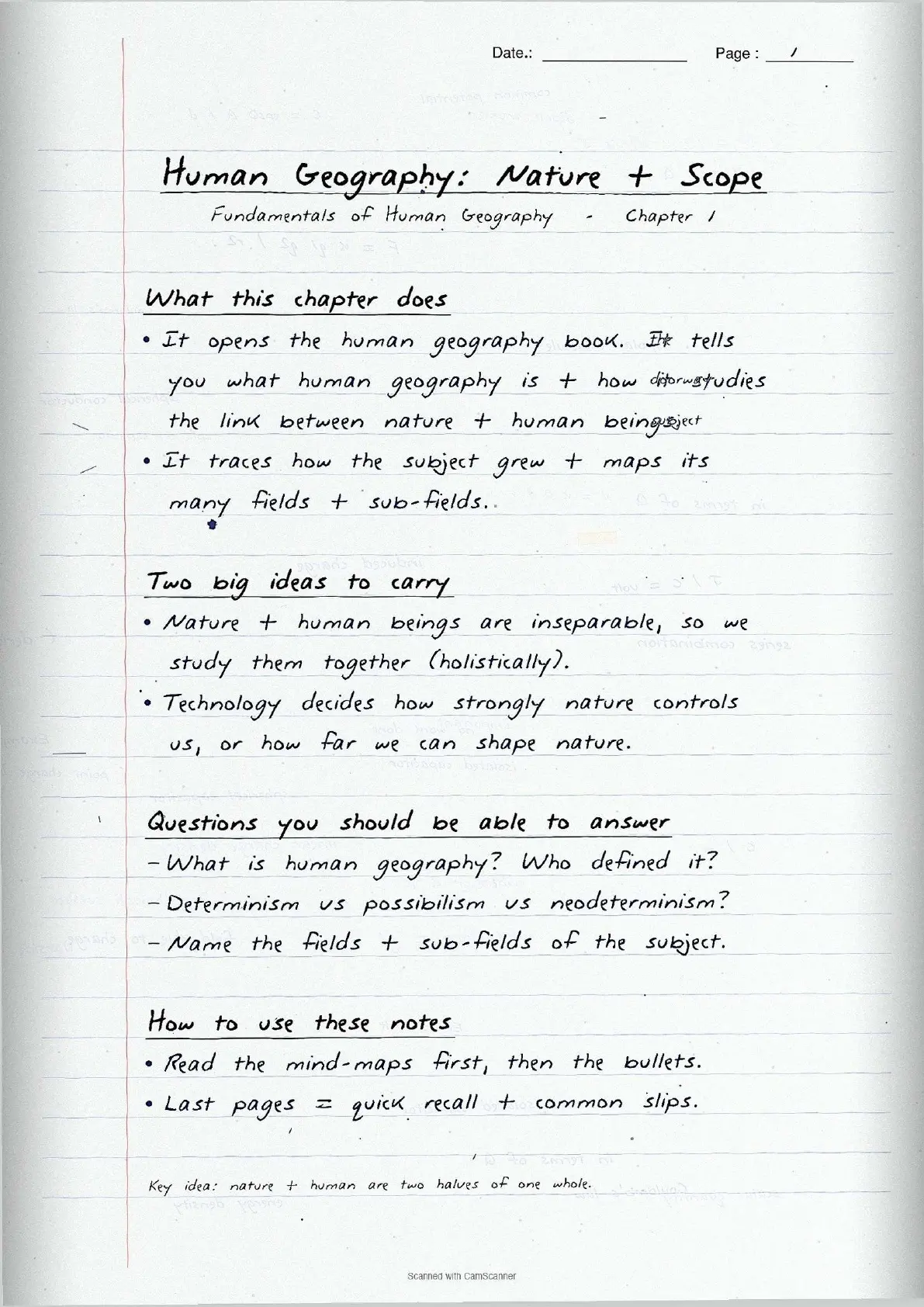
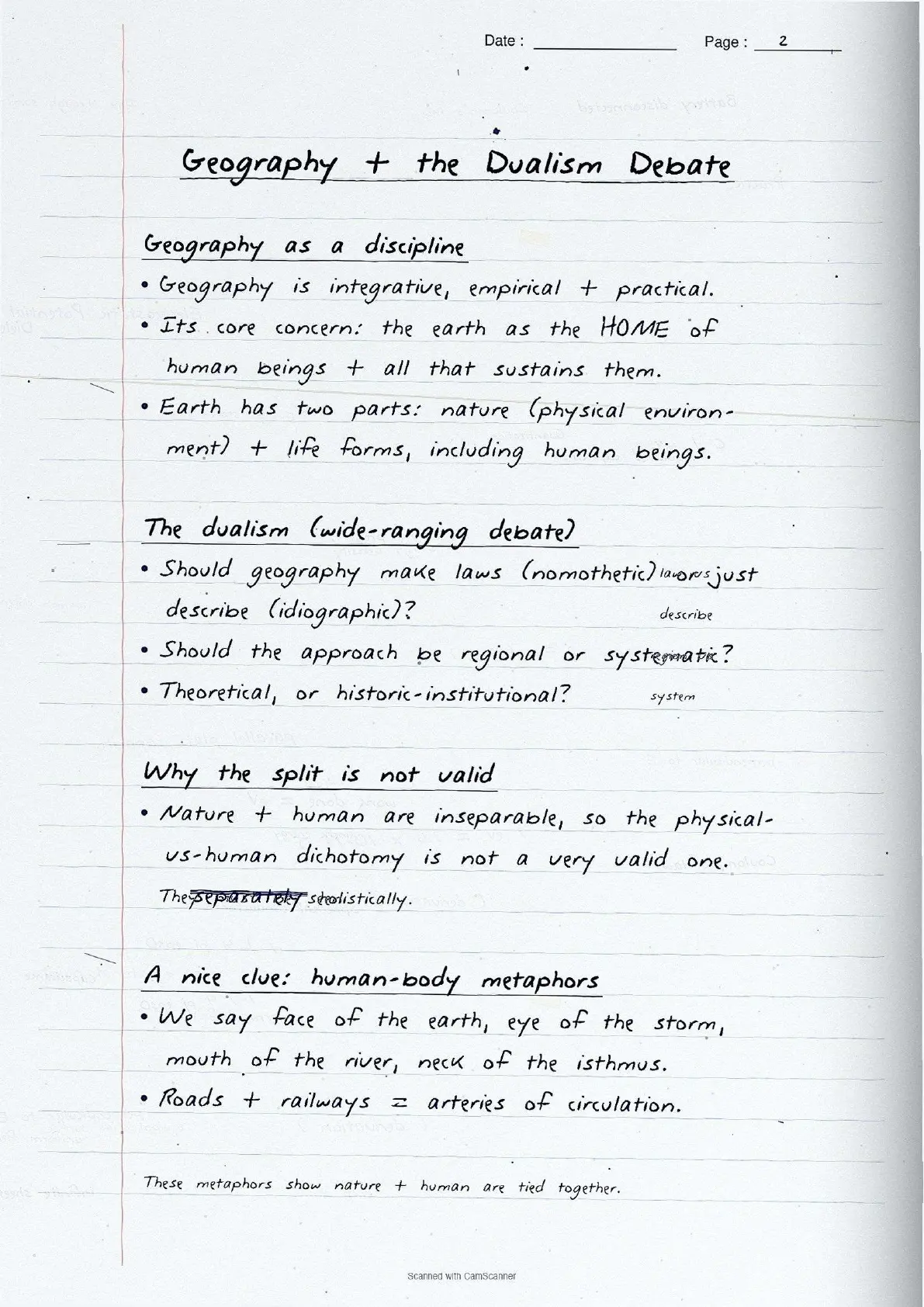
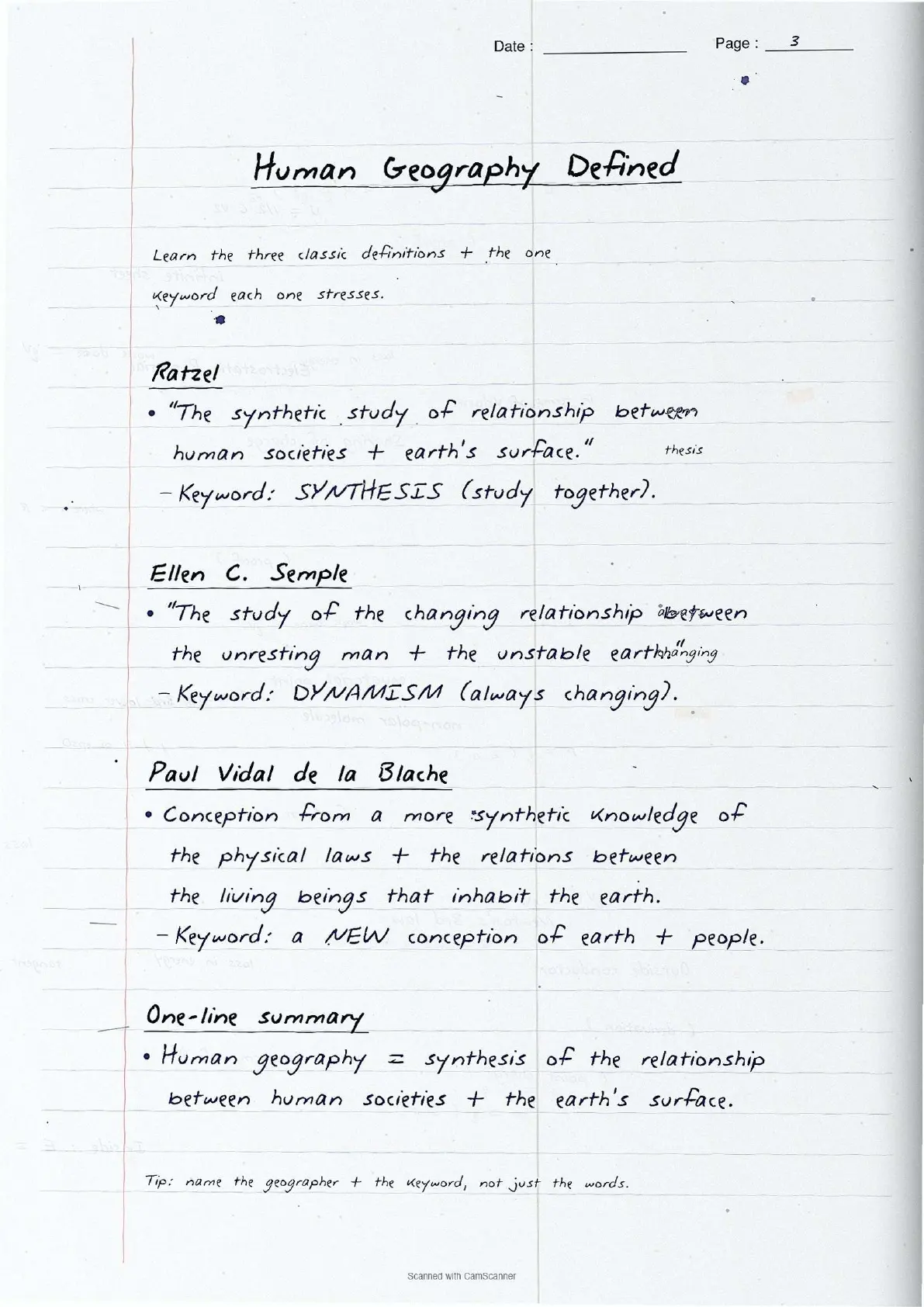
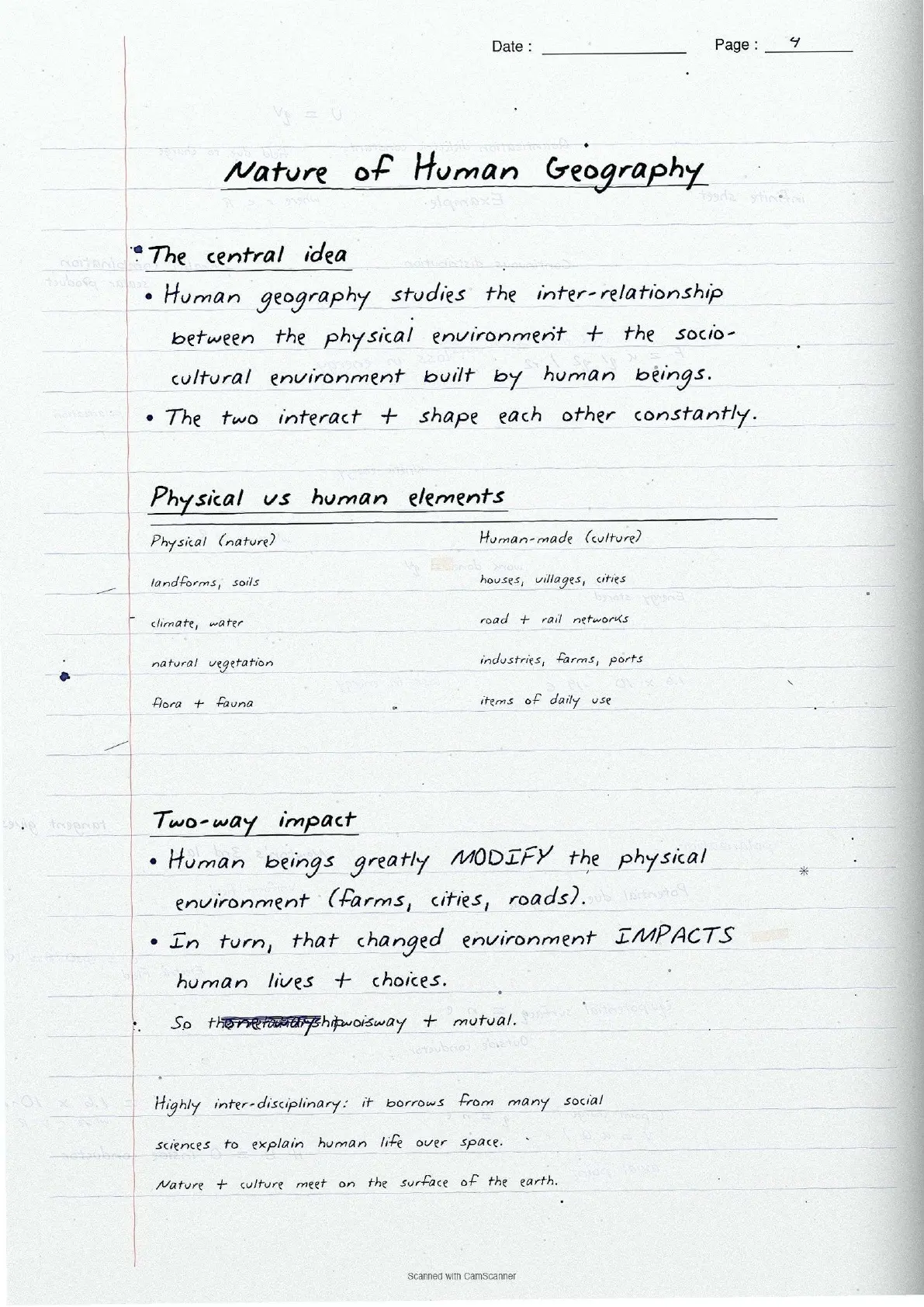
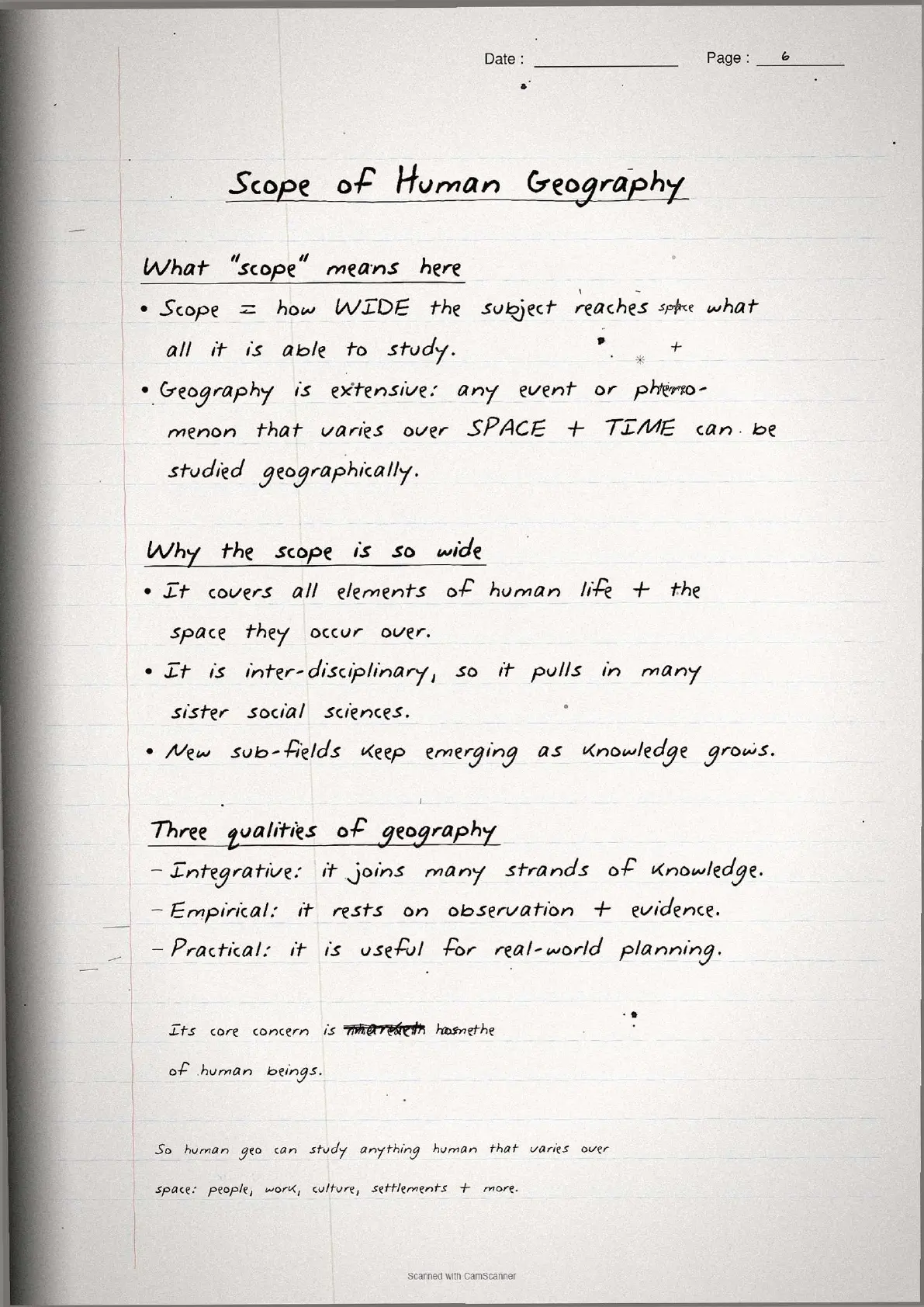
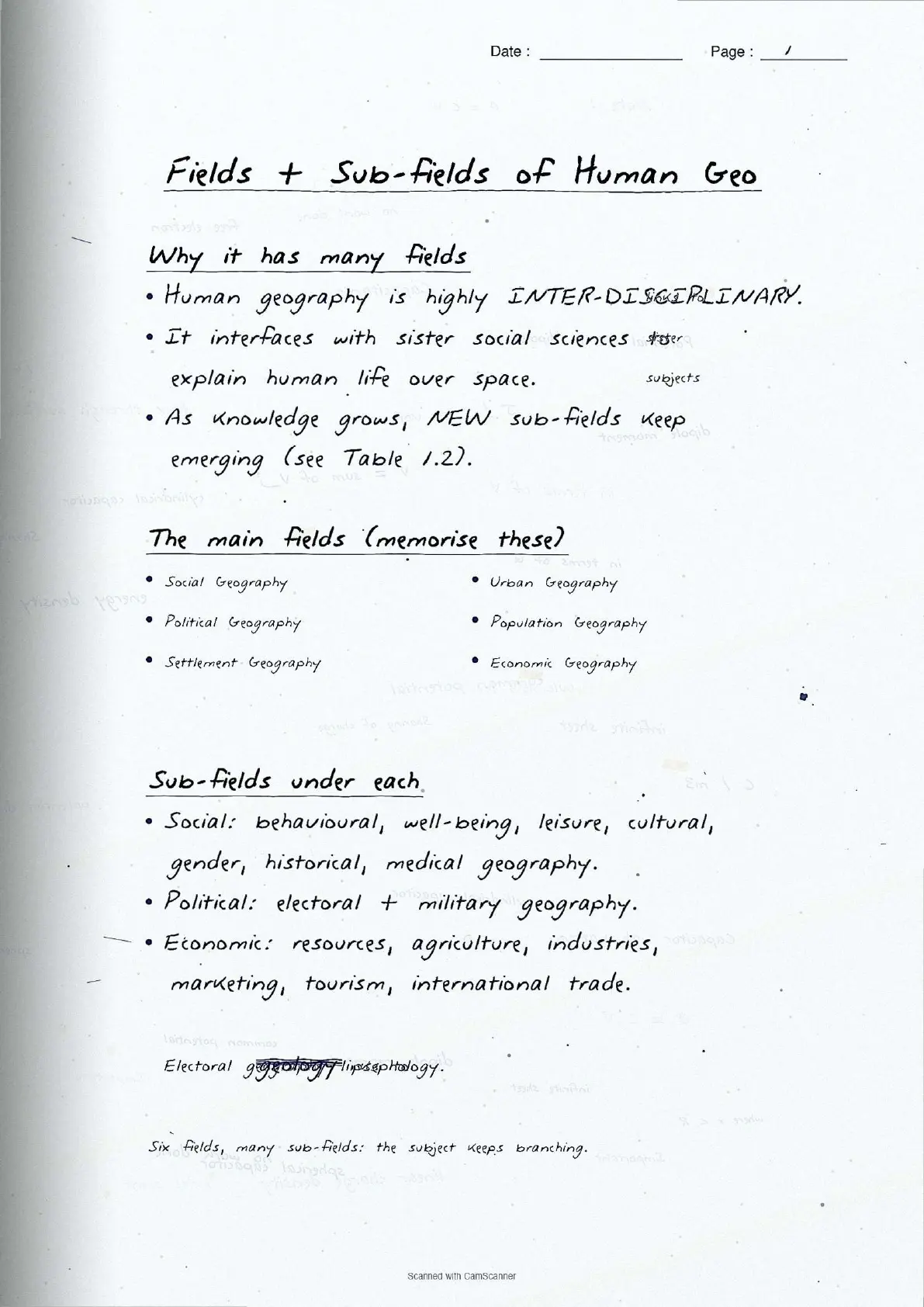
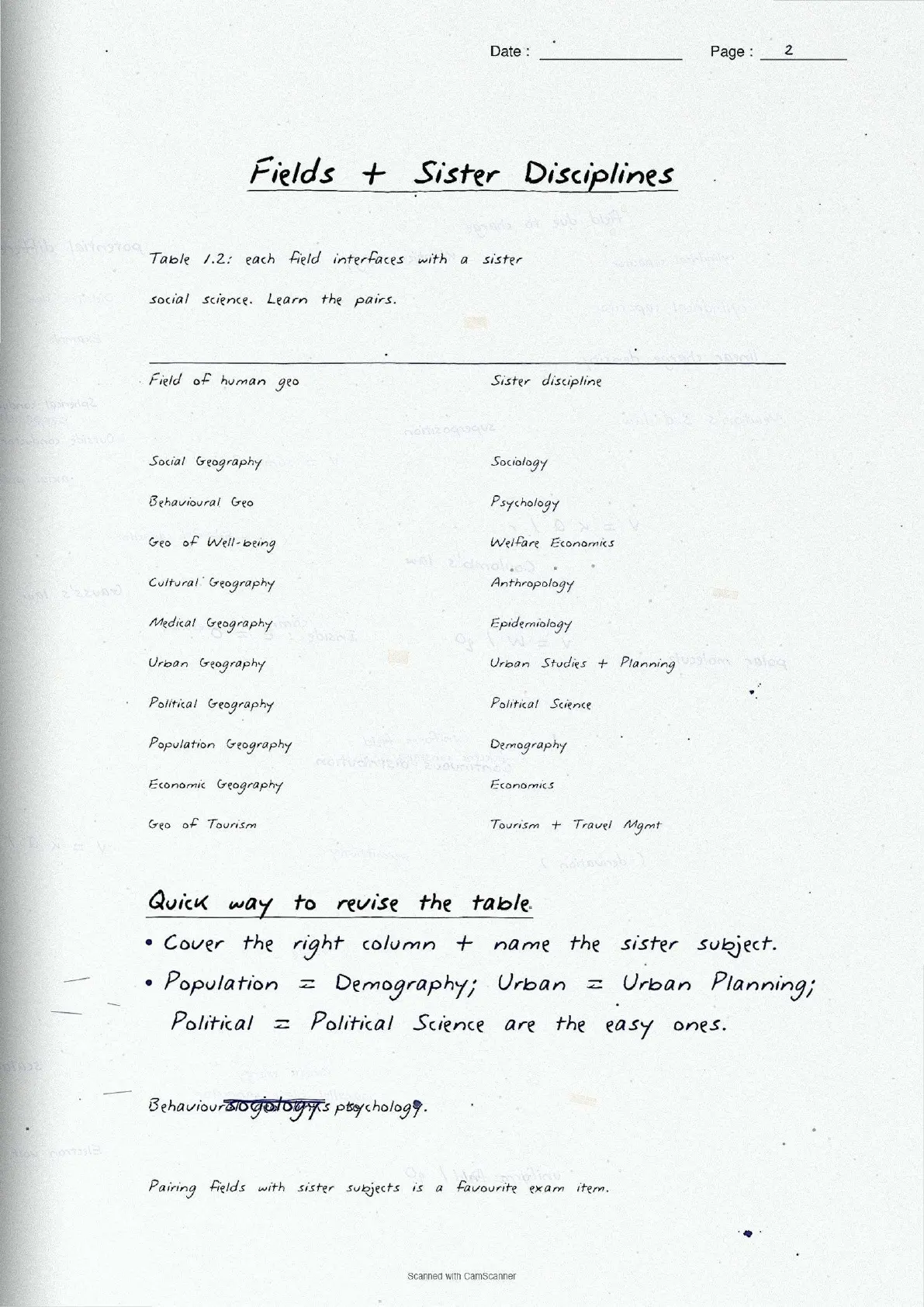
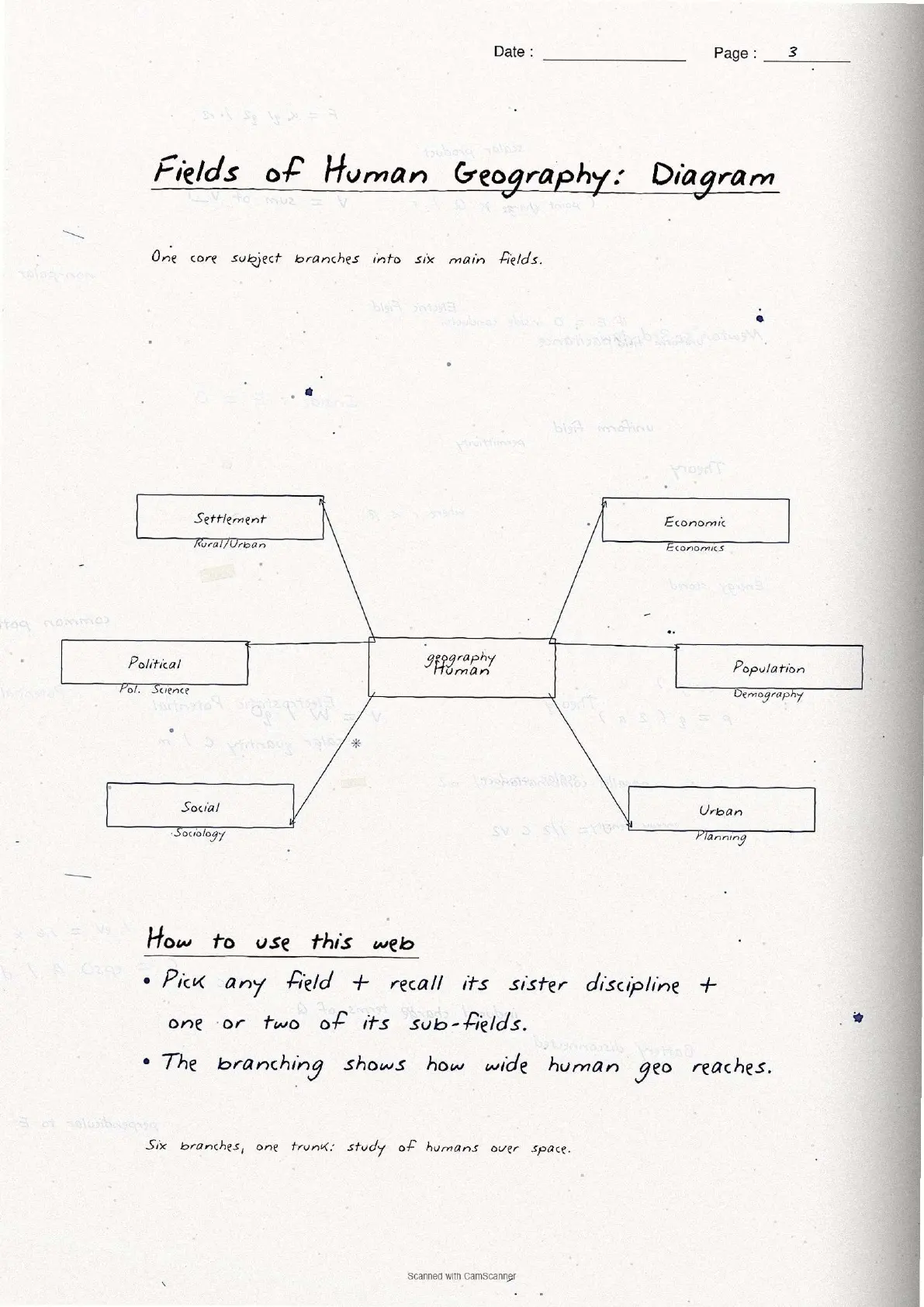
- Topper's handwritten revision notes covering all of CBSE Class 12 Geography Fundamentals of Human Geography Chapter 1.
- 4-5 marks weightage in the Class 12 Geography board paper, with the determinism-possibilism-neo-determinism spectrum drawn as a hand-made timeline.
- Pairs with the typed NCERT Solutions, typed Notes and the official NCERT Book PDF for the same chapter.
Each page of these human geography nature and scope class 12 handwritten notes is written by a Collegedunia subject expert, mapped to the 2026-27 NCERT Fundamentals of Human Geography textbook, and cross-checked against the last five years of CBSE Class 12 Geography board papers.
Student Feedback
68% of Class 12 students said handwritten notes feel faster to scan than typed PDFs in the final 48 hours before the board exam, and 4 out of 5 said pen-on-paper concept boxes stick in memory better. Most finished one full revision pass in about 18 minutes.
Source: 2026-27 Class 12 Geography handwritten-notes poll, 9,820 CBSE students.
What These Handwritten Notes Include
The human geography nature and scope class 12 handwritten notes PDF is a 3 to 4 page revision file. Every page carries hand-drawn boxes around key definitions, an arrow-tagged diagram of the determinism-possibilism-neo-determinism spectrum, and colour corrections where a concept is tightened. It is built for last-mile revision, not first-time concept building.
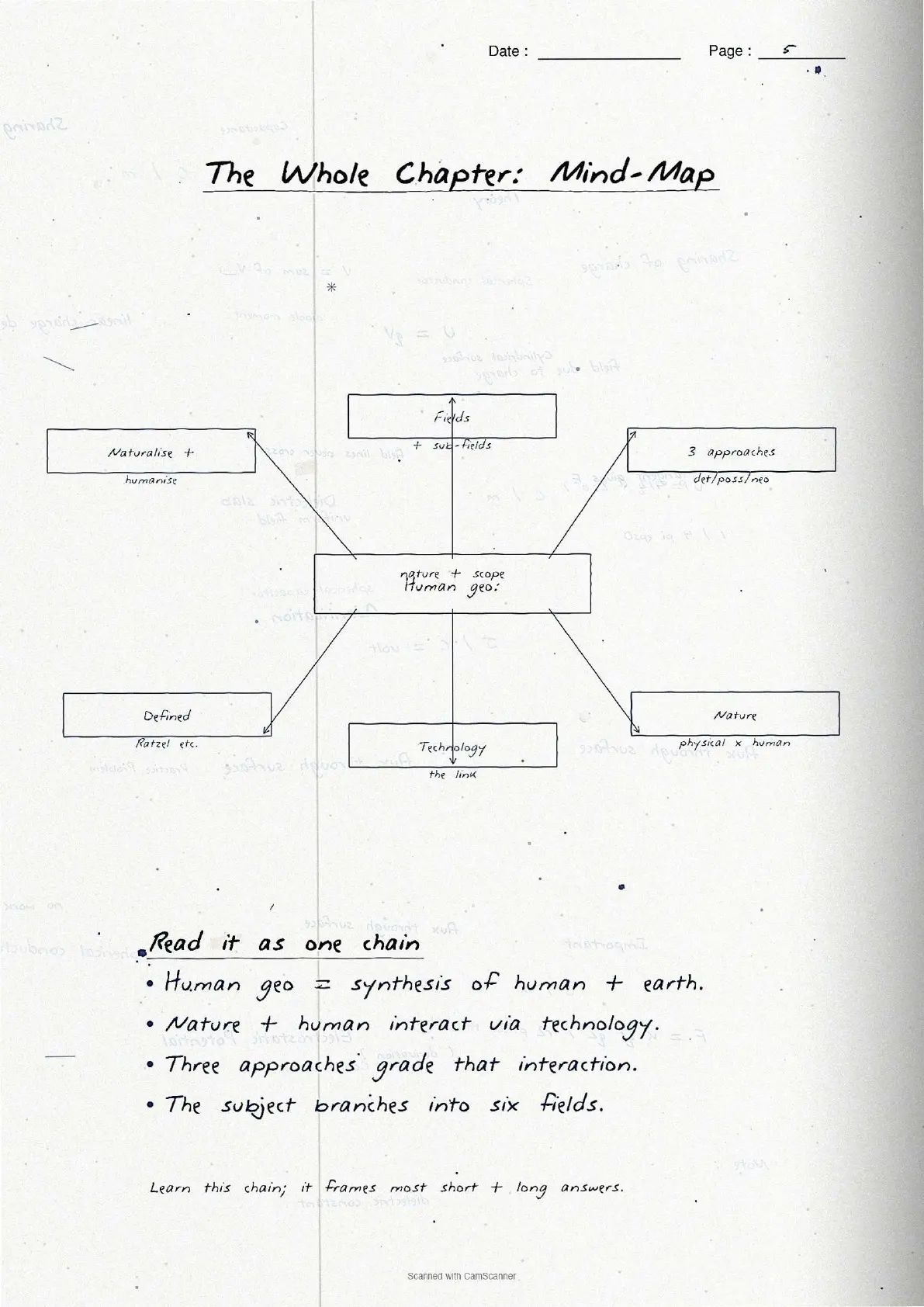
The notes capture every concept tested in Chapter 1: the definitions by Ratzel, Semple and Vidal de la Blache, the nature of human geography (integrative, empirical, practical), the three paradigms, naturalisation vs humanisation, the stages and approaches from colonial to post-modernism, and the full sub-fields table.
| Page | What the page covers | Approx revision time |
|---|---|---|
| Page 1 | Definition of human geography by three scholars, nature of the subject, integrative-empirical-practical triad. | 5 minutes |
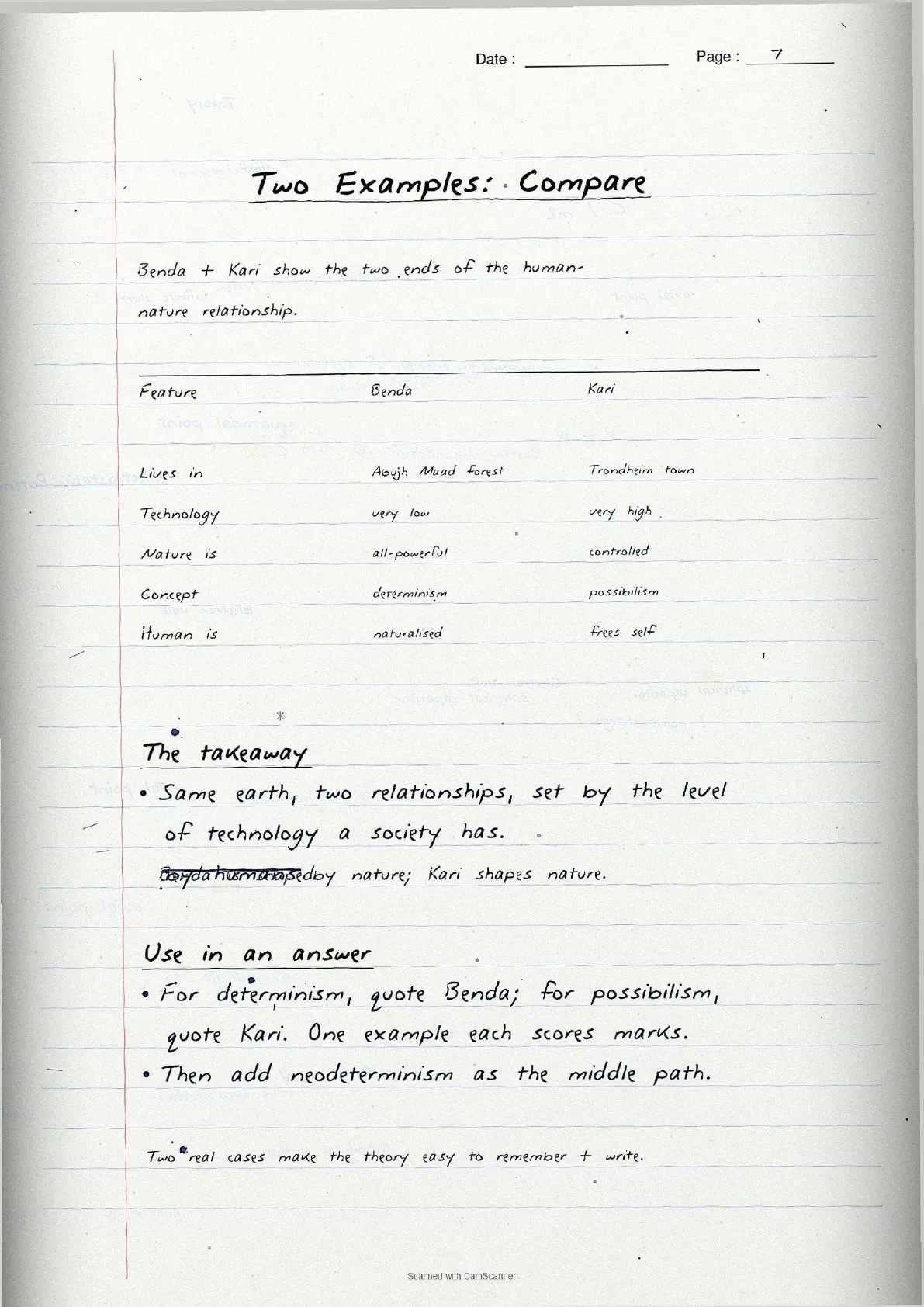
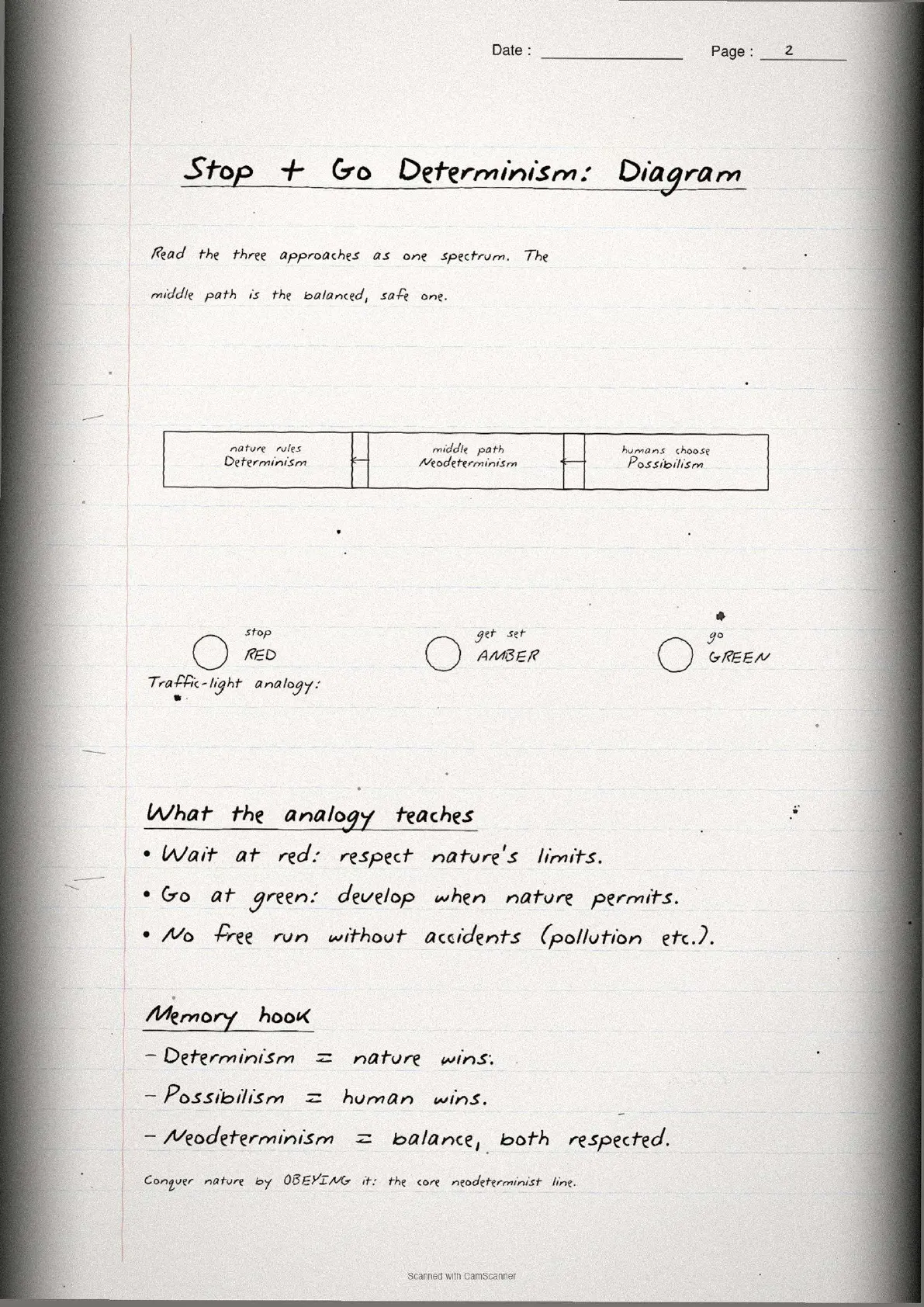
| Page 2 | Environmental determinism, possibilism, neo-determinism (stop-and-go), with the Benda and Kari case-study boxes. | 6 minutes |
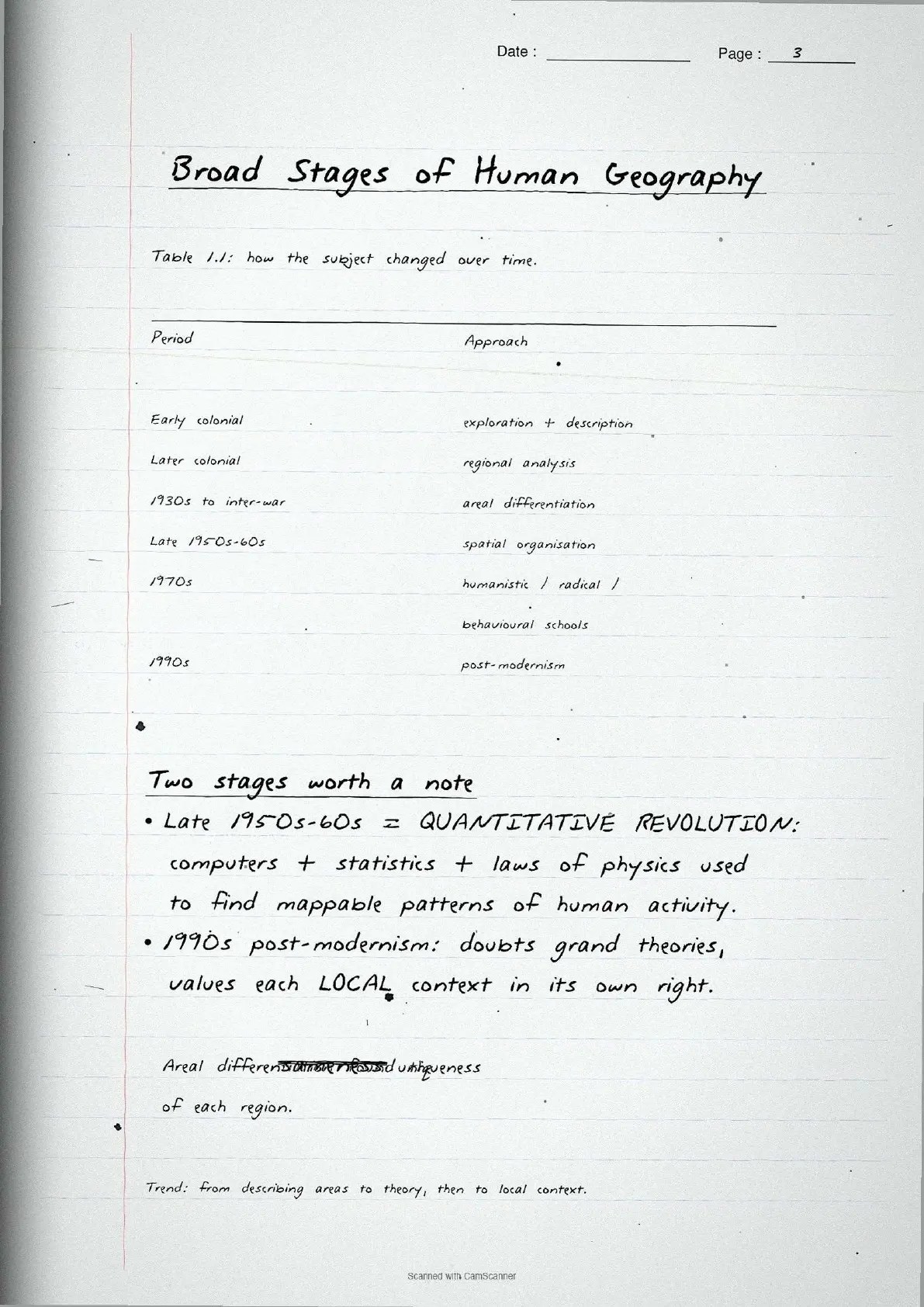
| Page 3 | Stages of human geography from colonial exploration to post-modernism, with a timeline arrow across the page. | 4 minutes |
| Page 4 | Sub-fields table linking social, cultural, political, economic and settlement geography to sister disciplines. | 3 minutes |
Source: Magnet Brains on YouTube
Key Concepts in Handwritten Style
This concept sheet is the highest-value block in the file. The table lists every definition students must memorise for the board paper, in the same order as the notebook page.
| Concept | Handwritten definition (as drawn) | NCERT exercise Q |
|---|---|---|
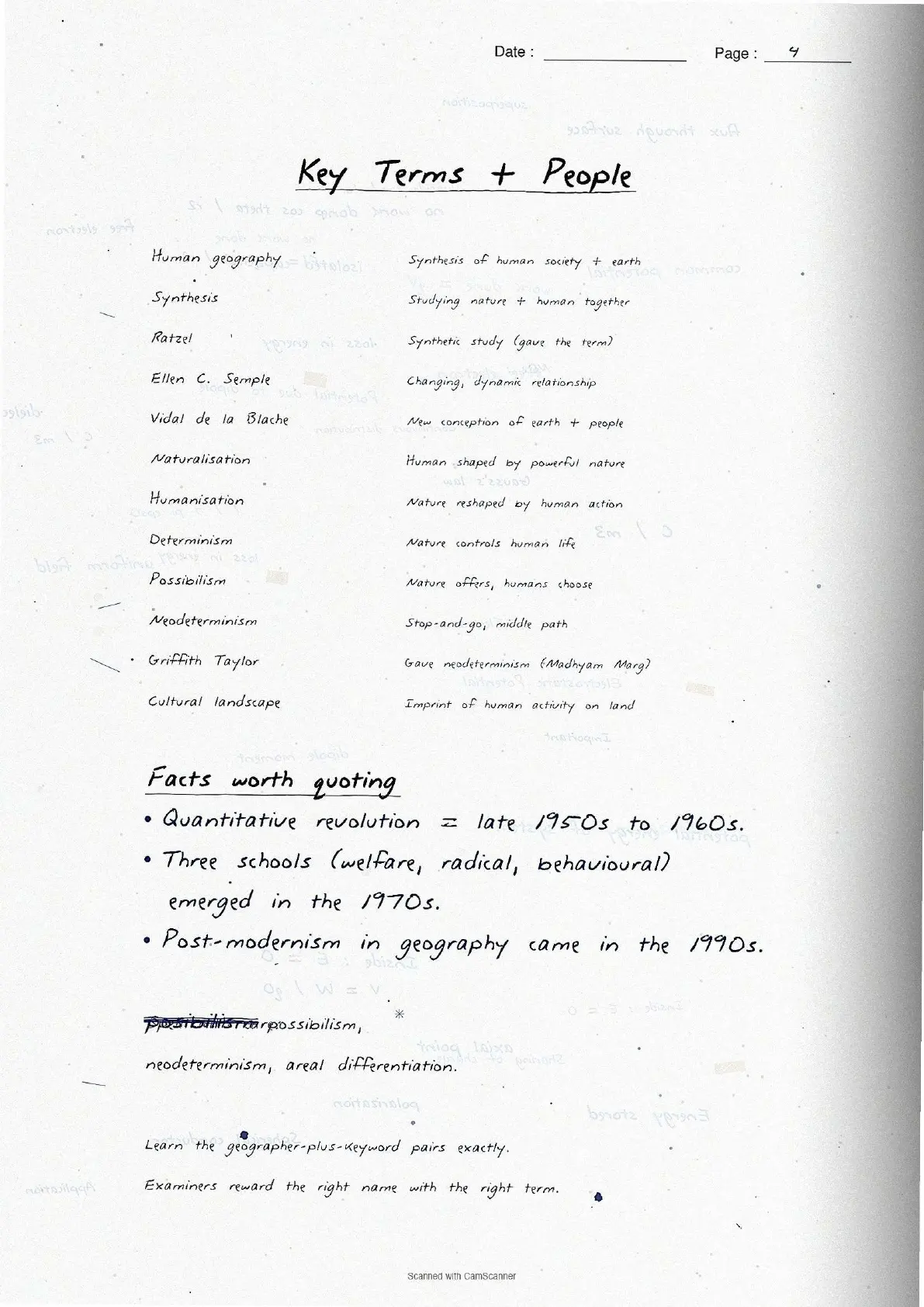
| Human Geography (Ratzel) | Synthetic study of relationship between human societies and earth's surface | Q2(i) |
| Human Geography (Semple) | Study of the changing relationship between the unresting man and the unstable earth | Q2(i) |
| Human Geography (Vidal de la Blache) | Offers a new conception of interrelationships between earth and human beings | Q2(i) |
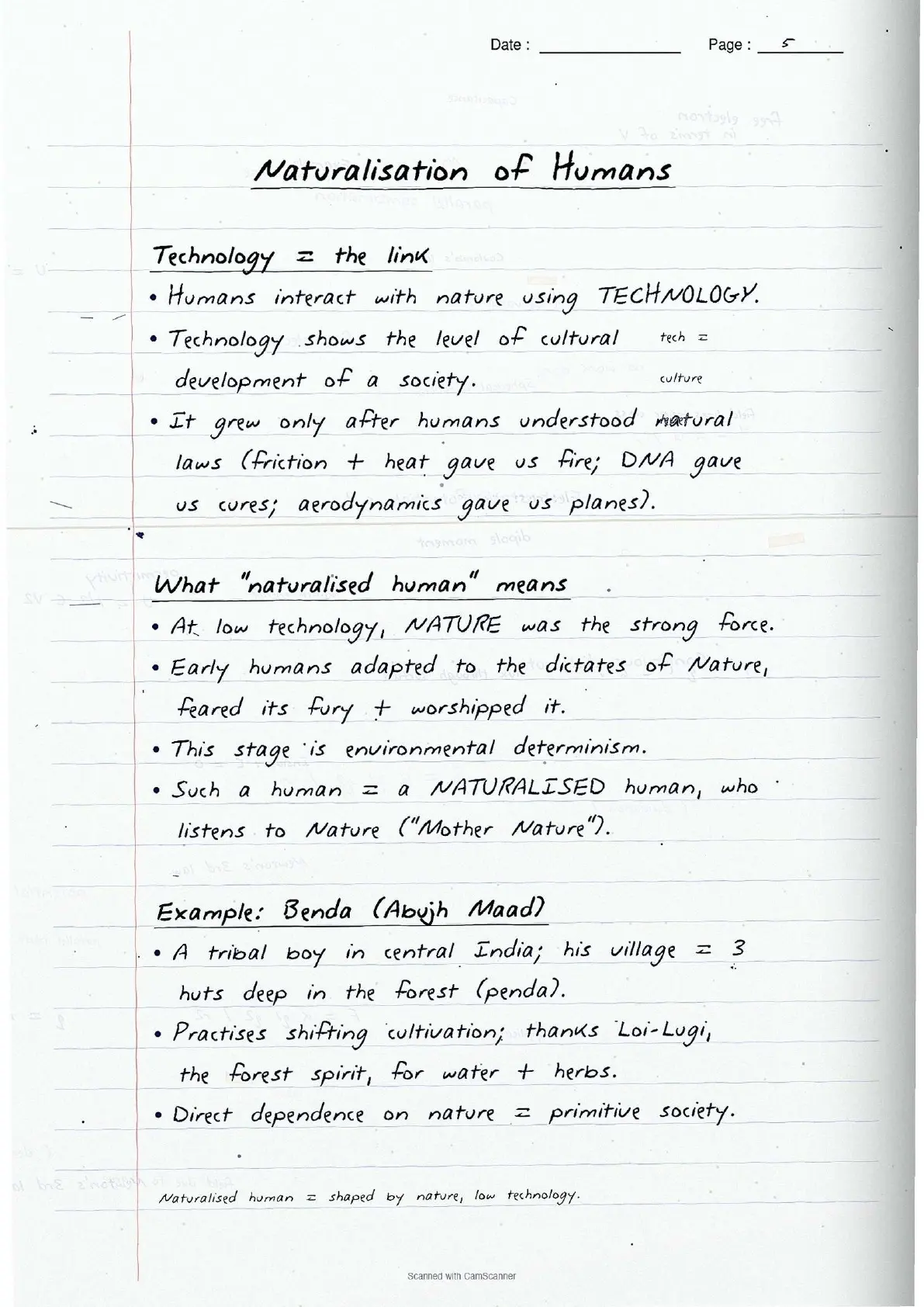
| Environmental Determinism | Primitive society fully controlled by natural forces; nature is supreme | Q3(i) |
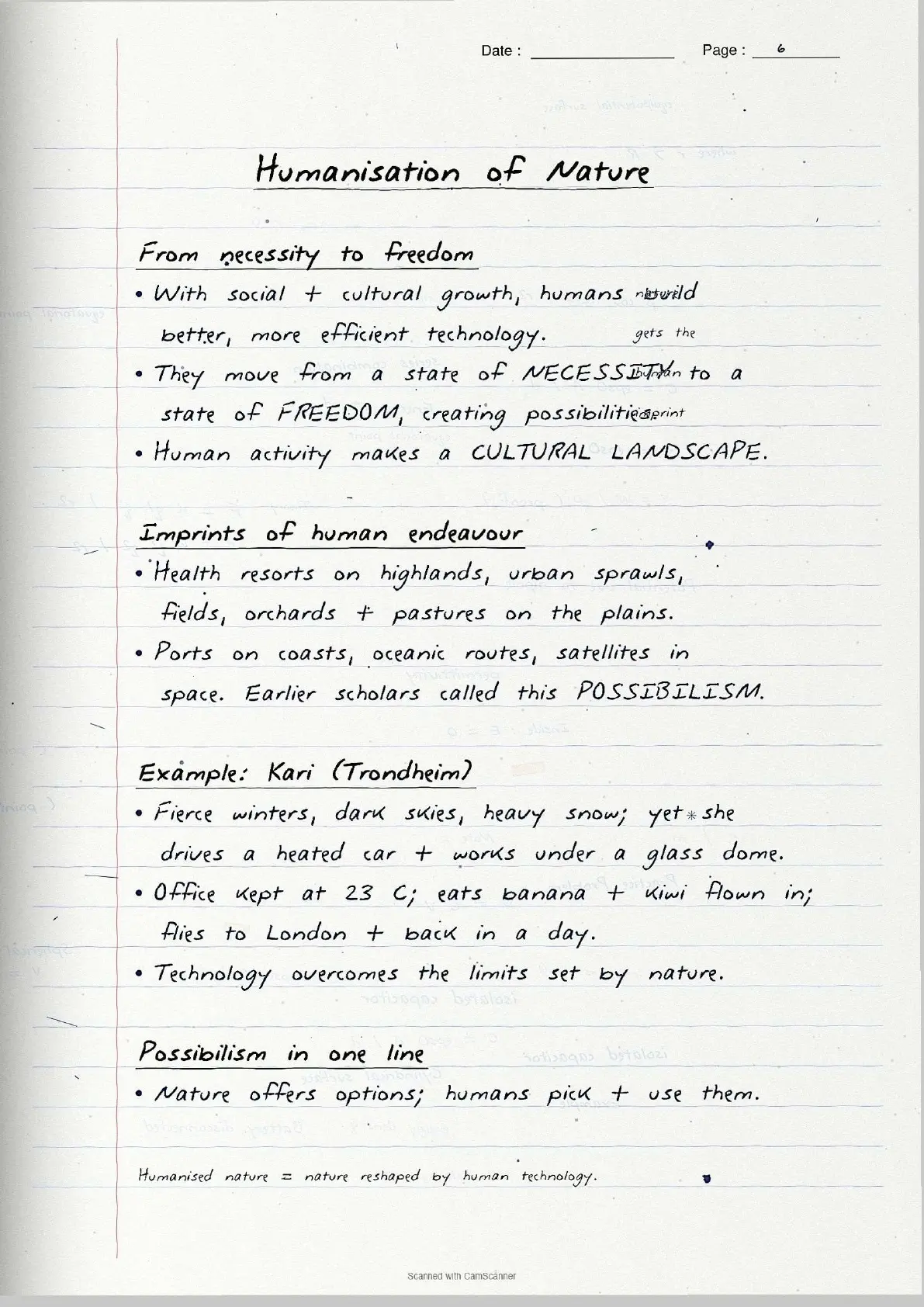
| Possibilism | Nature offers possibilities; humans use technology to choose and create | Q3(ii) |
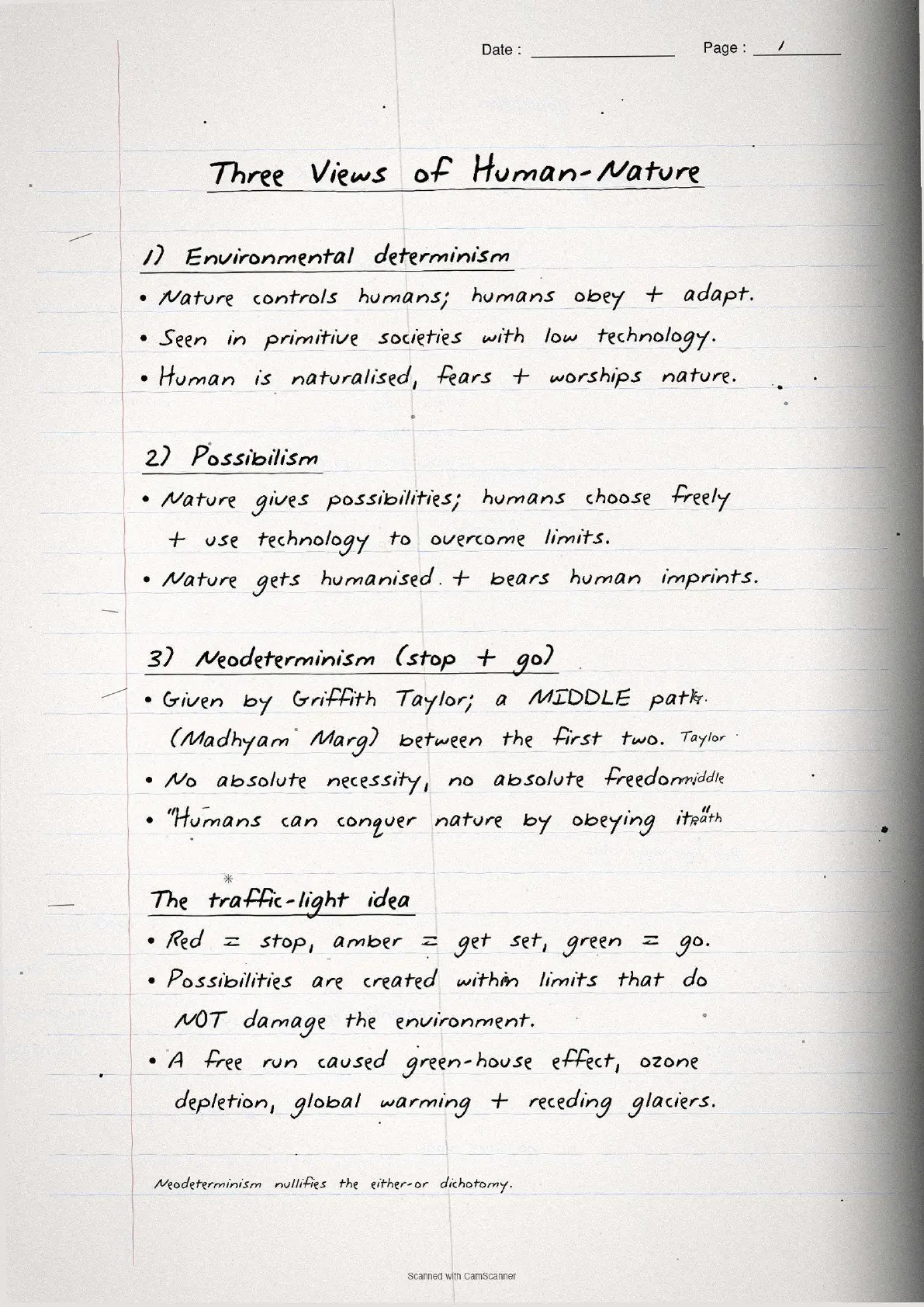
| Neo-Determinism (Griffith Taylor) | Stop-and-go determinism: red = stop, amber = wait, green = go; middle path | Q3(i) |
| Naturalisation of Humans | Humans adapt entirely to nature (example: Benda of Abujh Maad) | Q3(i) |
| Humanisation of Nature | Humans modify nature using technology (example: Kari of Trondheim) | Q3(ii) |
| Cultural Landscape | Imprints of human activity on the physical environment | Q2(ii) |
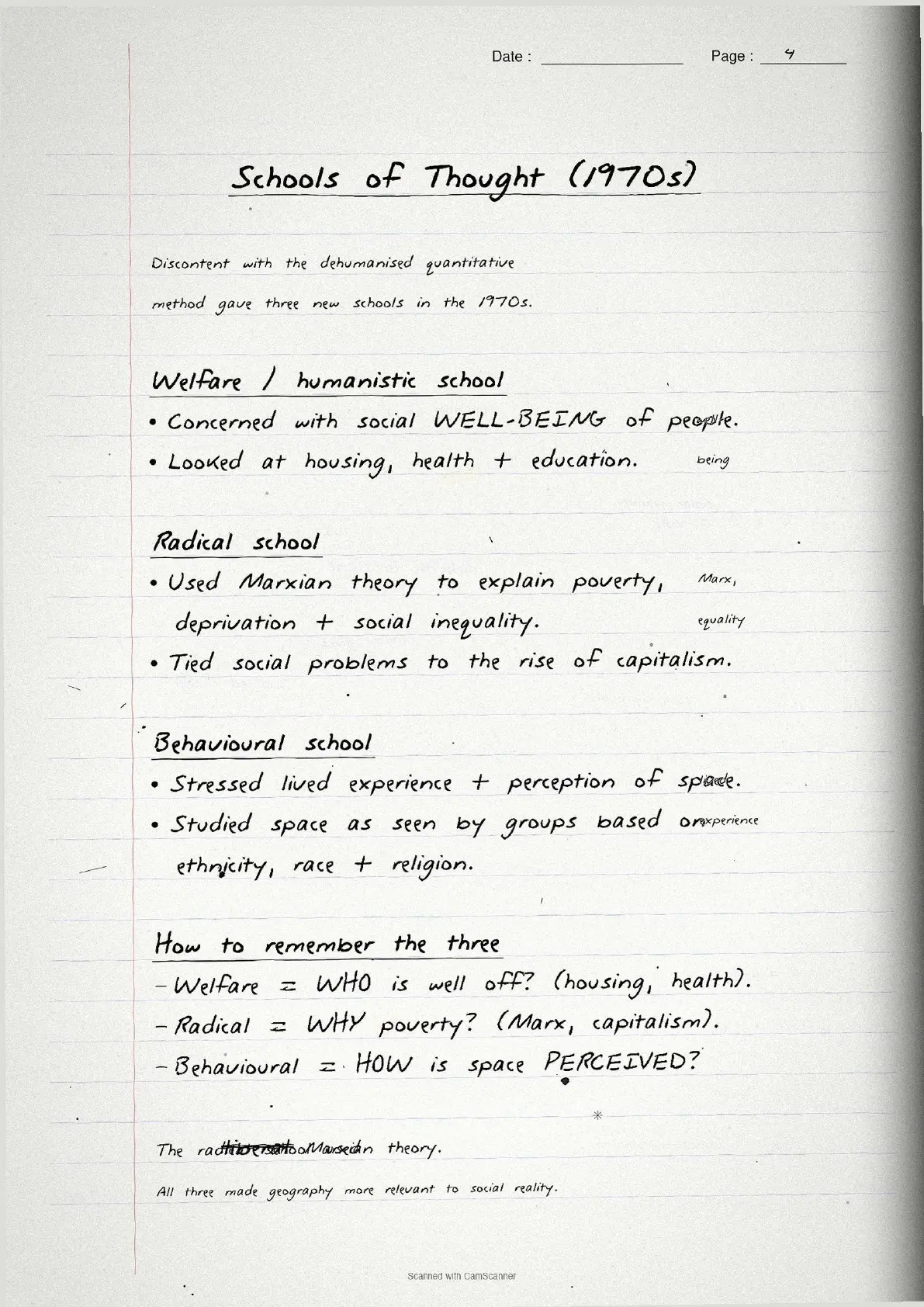
| Welfare School | Focused on housing, health and education of people | Q2(ii) |
| Radical School | Used Marxian theory to explain poverty and deprivation | Q2(ii) |
| Behavioural School | Emphasised lived experience and perception of space by social categories | Q2(ii) |
Tip: Each concept sits in a hand-drawn box with an arrow to its real-world example (Benda for naturalisation, Kari for humanisation), which makes scholar names easier to recall on exam day.
Environmental Determinism, Possibilism and Neo-Determinism
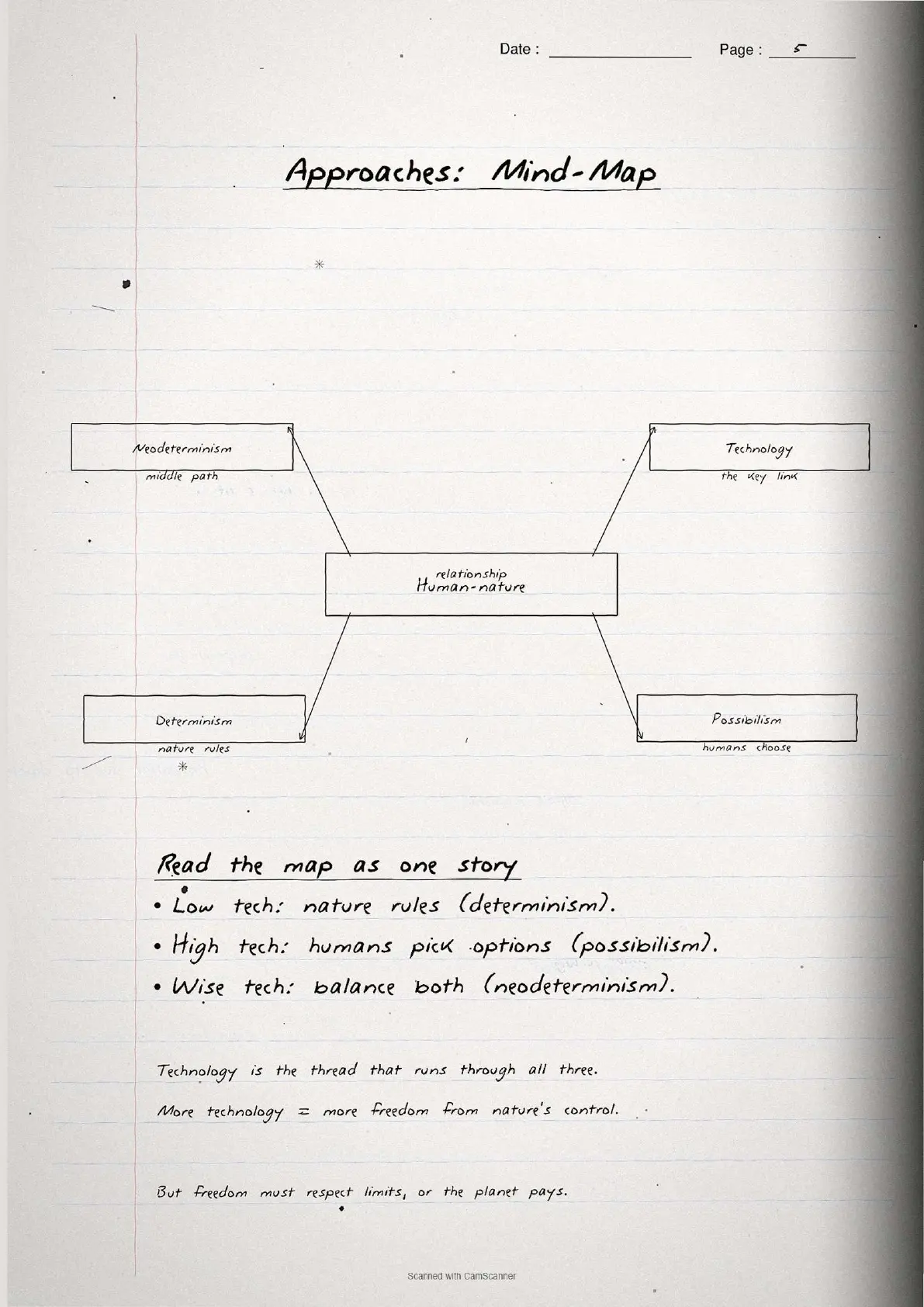
The three paradigms are the backbone of Chapter 1, and every CBSE paper since 2021 has asked at least one question from this section.
Environmental Determinism
In the early stages, humans were fully controlled by nature. Technology was low and society was primitive, so nature dictated what people could do. Benda of Abujh Maad is the standard example.
Possibilism
With better technology, humans moved from necessity to freedom. Vidal de la Blache called this possibilism: nature offers possibilities and humans choose how to use them. The cultural landscape (health resorts, ports, oceanic routes, satellites) is the evidence.
Neo-Determinism (Stop-and-Go)
Griffith Taylor's middle path uses a traffic-light idea: red means stop, amber means wait, green means go. Humans can conquer nature by obeying it. Unbounded possibilism has already caused the greenhouse effect, ozone depletion and global warming.
Important: Remember the paradigms in historical order: determinism (early colonial period), then possibilism (late colonial period), then neo-determinism (mid-20th century). Mixing the order is one of the most common mistakes in the 3-mark answer.
Sub-fields and Scope of Human Geography
The scope of human geography class 12 is best understood through its sub-fields, drawn as a condensed table on Page 4.
| Field of Human Geography | Key Sub-fields | Sister Discipline |
|---|---|---|
| Social Geography | Behavioural Geography, Gender Geography, Cultural Geography, Medical Geography | Sociology, Anthropology, Psychology |
| Political Geography | Electoral Geography, Military Geography | Political Science, Military Science, Psephology |
| Population Geography | Demography, Urban/Rural Planning | Demography, Urban Studies |
| Settlement Geography | Urban settlement patterns, rural patterns | Urban Studies and Planning |
| Economic Geography | Geography of Agriculture, Industries, Marketing, Tourism, International Trade | Economics, Business Studies |
| Historical Geography | Evolution of cultural landscapes over time | History |
This table feeds the 2-mark question "Name two sub-fields of human geography" that appears almost every year, so do not skip it.
Common Mistakes Highlighted in the Notes
The six repeat-offender mistakes CBSE examiners flag each year on human geography nature and scope class 12 answers, each marked in the margin of the notes in a second ink colour:
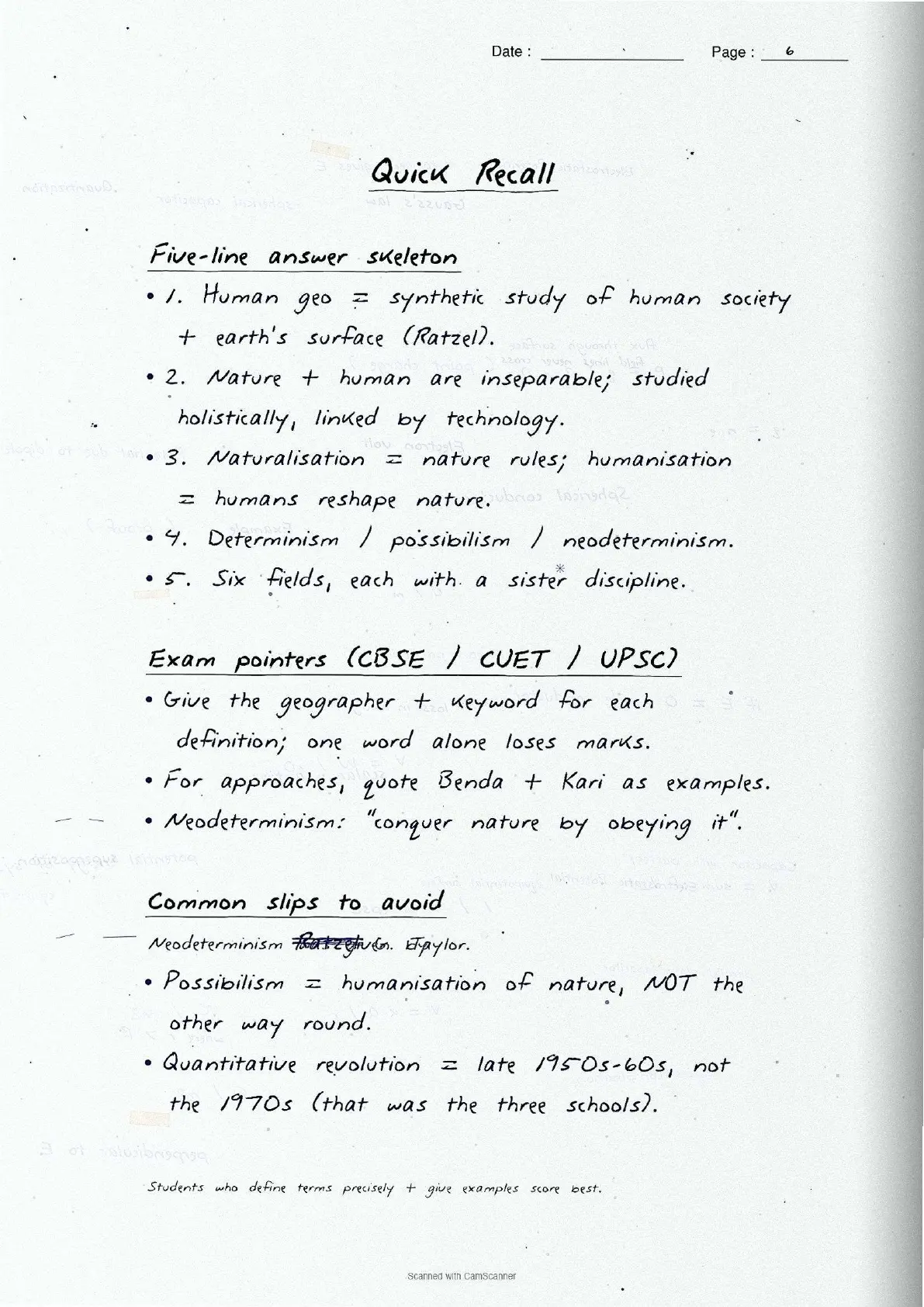
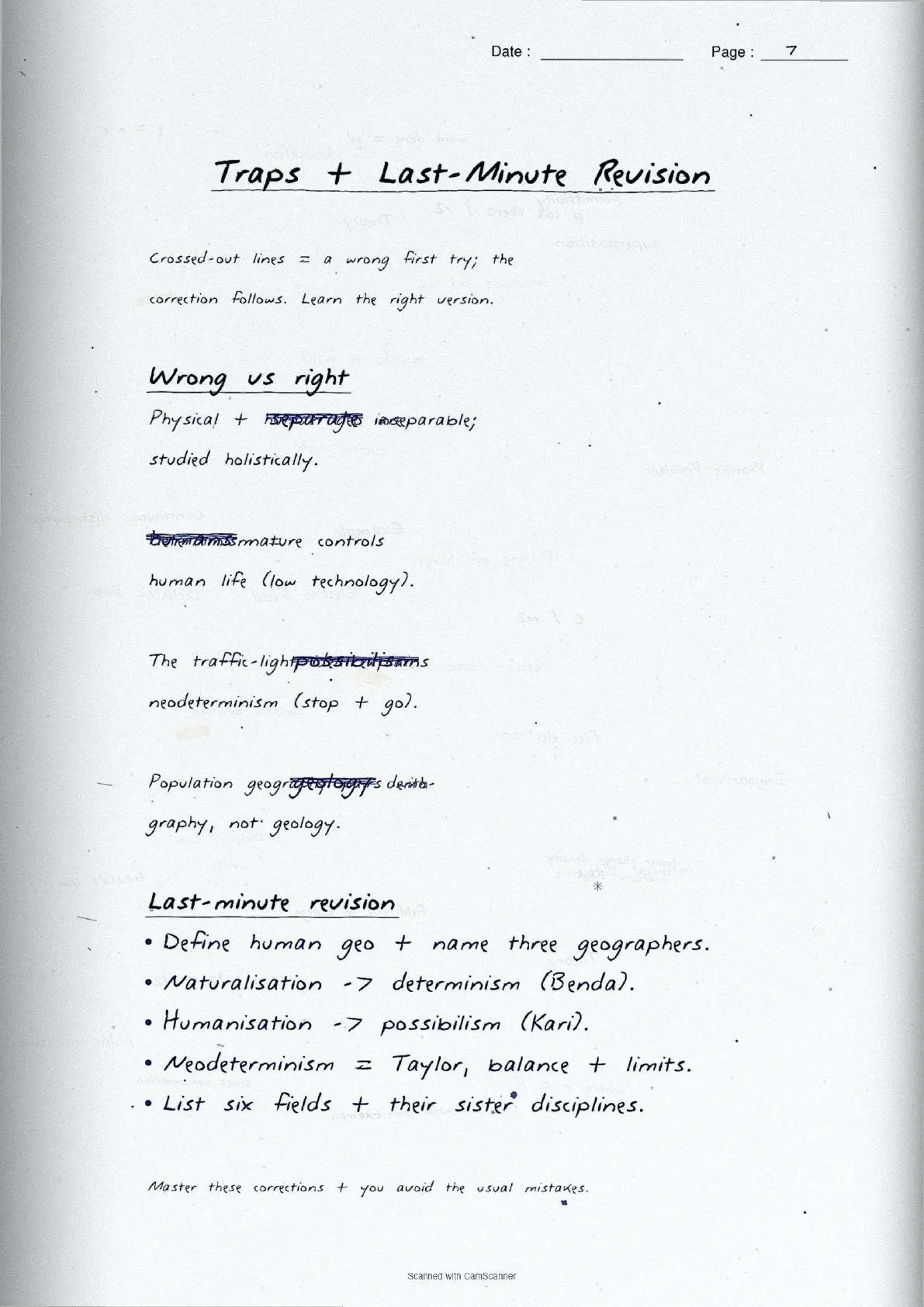
- Attributing possibilism to Ratzel. Ratzel is behind environmental determinism (and coined human geography). Possibilism is credited to Vidal de la Blache.
- Confusing naturalisation and humanisation. Naturalisation = humans adapting to nature (Benda). Humanisation = humans modifying nature (Kari).
- Calling neo-determinism "environmentalism". Neo-determinism is Griffith Taylor's paradigm, not the general idea of caring for the environment.
- Listing sub-fields without the sister discipline. The NCERT table pairs each sub-field with a sister discipline; half-marks if the pairing is missing.
- Writing only one definition of human geography. CBSE often wants at least two scholars (e.g. Ratzel and Semple) with distinct keywords.
- Ignoring the scope answer structure. The 150-word scope answer must cover nature, scope and approaches in three distinct paragraphs.
Each mistake has a one-line memory hook in the margin, the most quoted being "Vidal = Possible; Ratzel = Determined".
Previous Year Question Trends
The CBSE Class 12 Geography board paper has carried a stable 4 to 6 marks from Chapter 1 over the last five years, split across one or two theory questions.
| Year | Question asked | Marks | Notes page to revise |
|---|---|---|---|
| 2025 | Explain neo-determinism with an example + define human geography with two scholars | 3 + 2 | Page 1 + Page 2 |
| 2024 | Distinguish between naturalisation of humans and humanisation of nature | 3 | Page 2 |
| 2023 | Name any two sub-fields of human geography and their related disciplines | 2 | Page 4 |
| 2022 | Explain possibilism with reference to Vidal de la Blache + scope of human geography | 3 + 3 | Page 1 + Page 4 |
| 2021 | What is environmental determinism? Give one example. | 3 | Page 2 |
The 3-mark theory question rotates among the three paradigms on a roughly equal cycle, so revise all three concept boxes on Page 2 together.
Other Resources for Class 12 Geography Chapter 1 Human Geography Nature and Scope
Pair these handwritten notes with the matching NCERT Solutions, typed Notes and the official NCERT Book chapter.
| Resource | What it covers | Open |
|---|---|---|
| Handwritten Notes | Topper's handwritten revision pages for last-mile board exam prep. | You are here |
| NCERT Solutions | Step-by-step answers to all NCERT exercise questions with Expert's Solution alternatives. | Class 12 Geography Chapter 1 NCERT Solutions |
| Notes | Concept-first typed revision notes with definitions, paradigms, sub-fields and common mistakes. | Class 12 Geography Chapter 1 Notes |
| NCERT Book PDF | Official NCERT Fundamentals of Human Geography Chapter 1 textbook in PDF form. | Class 12 Geography Chapter 1 NCERT Book PDF |
| Subject Hub | All chapters of Class 12 Geography with every resource in one place. | Class 12 Geography Subject Hub |
All Chapters Handwritten Notes for Class 12 Geography Fundamentals of Human Geography
Related Links: Use the table below to open the handwritten notes for the other chapters of Class 12 Geography Fundamentals of Human Geography.
| Chapter | Topic | Handwritten Notes link |
|---|---|---|
| Chapter 1 | Human Geography: Nature and Scope | You are here |
| Chapter 2 | The World Population: Distribution, Density and Growth | Class 12 Geography World Population Handwritten Notes |
| Chapter 3 | Human Development | Class 12 Geography Human Development Handwritten Notes |
| Chapter 4 | Primary Activities | Class 12 Geography Primary Activities Handwritten Notes |
| Chapter 5 | Secondary Activities | Class 12 Geography Secondary Activities Handwritten Notes |
| Chapter 6 | Tertiary and Quaternary Activities | Class 12 Geography Tertiary and Quaternary Activities Handwritten Notes |
| Chapter 7 | Transport and Communication | Class 12 Geography Transport and Communication Handwritten Notes |
| Chapter 8 | International Trade | Class 12 Geography International Trade Handwritten Notes |
Human Geography Nature and Scope Class 12 Handwritten Notes FAQs
Ques. What are these human geography nature and scope class 12 handwritten notes meant to be used for?
Ans. The human geography nature and scope class 12 handwritten notes are a topper's handwritten revision file: they compress the full NCERT Chapter 1 of Class 12 Fundamentals of Human Geography into 3 to 4 pages of concept boxes, paradigm flow charts and margin-callout common mistakes. Students typically use the file for last-mile revision in the 24 hours before the board paper, paired with the typed Notes PDF for concept building and the NCERT Solutions PDF for answer-writing drill.
Ques. How are handwritten notes different from the typed human geography class 12 notes?
Ans. The typed human geography class 12 notes carry deeper prose around each concept (scholar profiles, critiques of each approach, extended examples) and run 6 to 8 pages long. The handwritten notes compress that prose down to concept boxes alone, sit at 3 to 4 pages, and lean on visual recall (ruler-drawn boxes, arrow-tagged paradigm timeline, colour corrections) rather than typed explanations. The two files are designed to be used together, not as substitutes. Read the typed Notes first, then move to the handwritten file for the second and third revision passes.
Ques. What is environmental determinism in human geography class 12?
Ans. Environmental determinism is the earliest paradigm in human geography. It holds that in the early stages of human-nature interaction, natural forces fully controlled human life. The level of technology was very low, society was primitive, and humans adapted entirely to the dictates of nature. The notes draw this as the first box on Page 2, labelled "nature is supreme", with Benda of Abujh Maad as the margin example. The CBSE Class 12 Geography board paper tests this concept as a 3-mark definition-plus-example question almost every year.
Ques. What is possibilism in human geography class 12?
Ans. Possibilism is the paradigm associated with the French geographer Vidal de la Blache. It holds that nature offers possibilities and humans, using technology, choose how to use those possibilities. As society develops, humans move from a state of necessity to a state of freedom. Cultural landscapes (health resorts on highlands, ports on coasts, satellites in space) are evidence that humans have been humanising nature. The notes draw the possibilism box on Page 2 directly below the determinism box, with an arrow labelled "technology increases" pointing from one to the other.
Ques. What is neo-determinism and who coined the term?
Ans. Neo-determinism (also called stop-and-go determinism) was introduced by Griffith Taylor. It is a middle path between environmental determinism and possibilism. Like traffic lights, red means stop (environmental constraints must be respected), amber means wait and assess, and green means go (proceed within the limits nature allows). The concept means that humans can conquer nature by obeying it, and that unbounded possibilism causes environmental damage such as the greenhouse effect, ozone depletion and global warming. The notes draw the traffic-light analogy as a hand-sketched diagram on Page 2.
Ques. Which scholars defined human geography and what are their keywords?
Ans. Three scholars define human geography in NCERT Class 12 Geography Chapter 1. Friedrich Ratzel defined it as the "synthetic study of relationship between human societies and earth's surface"; the keyword is synthesis. Ellen Churchill Semple defined it as the "study of the changing relationship between the unresting man and the unstable earth"; the keyword is dynamism. Paul Vidal de la Blache offered a "new conception of the interrelationships between earth and human beings"; the keyword is new conception or interdependence. CBSE markers award marks for citing the scholar name and the keyword correctly, and the notes underline each keyword twice.
Ques. What are the sub-fields of human geography covered in these handwritten notes?
Ans. The sub-fields table on Page 4 of the handwritten notes covers all the major fields listed in the NCERT textbook: Social Geography (behavioural, cultural, gender, medical), Political Geography (electoral, military), Population Geography (demography, urban-rural planning), Settlement Geography, Economic Geography (agriculture, industries, marketing, tourism, international trade) and Historical Geography. Each sub-field is paired with its sister discipline (Sociology, Anthropology, Political Science, Demography, Economics, History), which is exactly the pairing CBSE asks for in the 2-mark sub-fields question.
Ques. Are these notes enough for the CBSE Class 12 Geography board exam?
Ans. The handwritten notes are sufficient for the concept-recall component (roughly 4 to 5 marks of the 4 to 6 marks the chapter typically carries), but the extended-answer practice in this file is limited to concept boxes, not 150-word answers. Students aiming for 90-plus in CBSE Class 12 Geography should pair the handwritten file with the matching NCERT Solutions PDF and at least one map-pointing practice set. All three resources are linked in the cross-resource table on this page.
Ques. How long does it take to revise from these human geography handwritten notes?
Ans. The full handwritten notes file is designed for an 18-minute first revision pass, a 12-minute targeted pass and a 6-minute final pass right before the exam. Students who already have the chapter under their belt finish the full file in under 16 minutes. Page 2 (the paradigm boxes) and Page 1 (the scholar definitions) together take 9 to 11 minutes to revise and cover roughly 4 to 5 of the 4 to 6 marks the chapter typically carries in the CBSE Class 12 Geography board paper.
Ques. Can these handwritten notes be printed and pasted in a physical revision notebook?
Ans. Yes, and that is the recommended use pattern. The PDF is rendered at 150 DPI and sized for A4 printing, with each page sitting cleanly inside a standard ruled notebook page. Toppers in the 2026 Class 12 Geography student poll reported that printing the pages and pasting them inside the physical revision notebook helped them recall scholar names and paradigm keywords under exam pressure, because the pen-on-paper layout matches the muscle memory of writing the answer in the answer script.
Ques. Is the Class 12 Geography syllabus for Chapter 1 changing in 2026-27?
Ans. No major changes in 2026-27. The Fundamentals of Human Geography textbook Chapter 1 structure is unchanged for the current cycle, and the CBSE marking scheme continues to reward definition-plus-example answers with scholar attribution. These human geography nature and scope class 12 handwritten notes for the 2026-27 cycle are aligned to the unchanged textbook and the latest CBSE sample paper released for the 2026 boards.
Ques. What is the scope of human geography according to NCERT Class 12?
Ans. The scope of human geography according to NCERT Class 12 covers the study of all elements of human life and the space they occur over, making it a highly inter-disciplinary field. It includes social geography, political geography, population geography, settlement geography, economic geography and historical geography, each with its own sub-fields and interface with sister social science disciplines. The NCERT textbook also identifies the broad approaches to human geography from the early colonial period (exploration and description) through regional analysis, areal differentiation, spatial organisation, the quantitative revolution, the humanistic-radical-behavioural schools of the 1970s, and post-modernism in the 1990s.



Comments