




These Class 12 Geography Chapter 3 Human Development notes cover every NCERT definition, the four pillars of human development, the HDI components, the four approaches, and the global HDI classification system, all aligned to the 2026-27 syllabus. They are built for a quick, full-chapter revision the night before the exam.


- Concept-first revision for the entire chapter: growth vs development, four pillars (equity, sustainability, productivity, empowerment), HDI components (health, education, resources) and the four approaches.
- Every key term in the human development class 12 notes set, with CBSE-ready one-line definitions and a comparison table for the four approaches.
- CBSE and CUET question trends, common mistake alerts, and cross-pointers to NCERT Solutions, Handwritten Notes and the NCERT Book PDF.
Every line in these human development class 12 notes is written by Collegedunia Geography subject experts, mapped to the 2026-27 NCERT Fundamentals of Human Geography textbook, and pressure-tested against the last five years of CBSE Class 12 board papers and CUET Geography question patterns.
Student Feedback
71% of Class 12 Geography students said distinguishing growth from development and remembering all four pillars was the most-confused part, and 3 out of 4 rated the HDI components and four approaches as the part most worth revising from these notes. Most finished a full revision in about 28 minutes.
Source: 2026-27 Class 12 Geography student poll, 9,560 CBSE students.
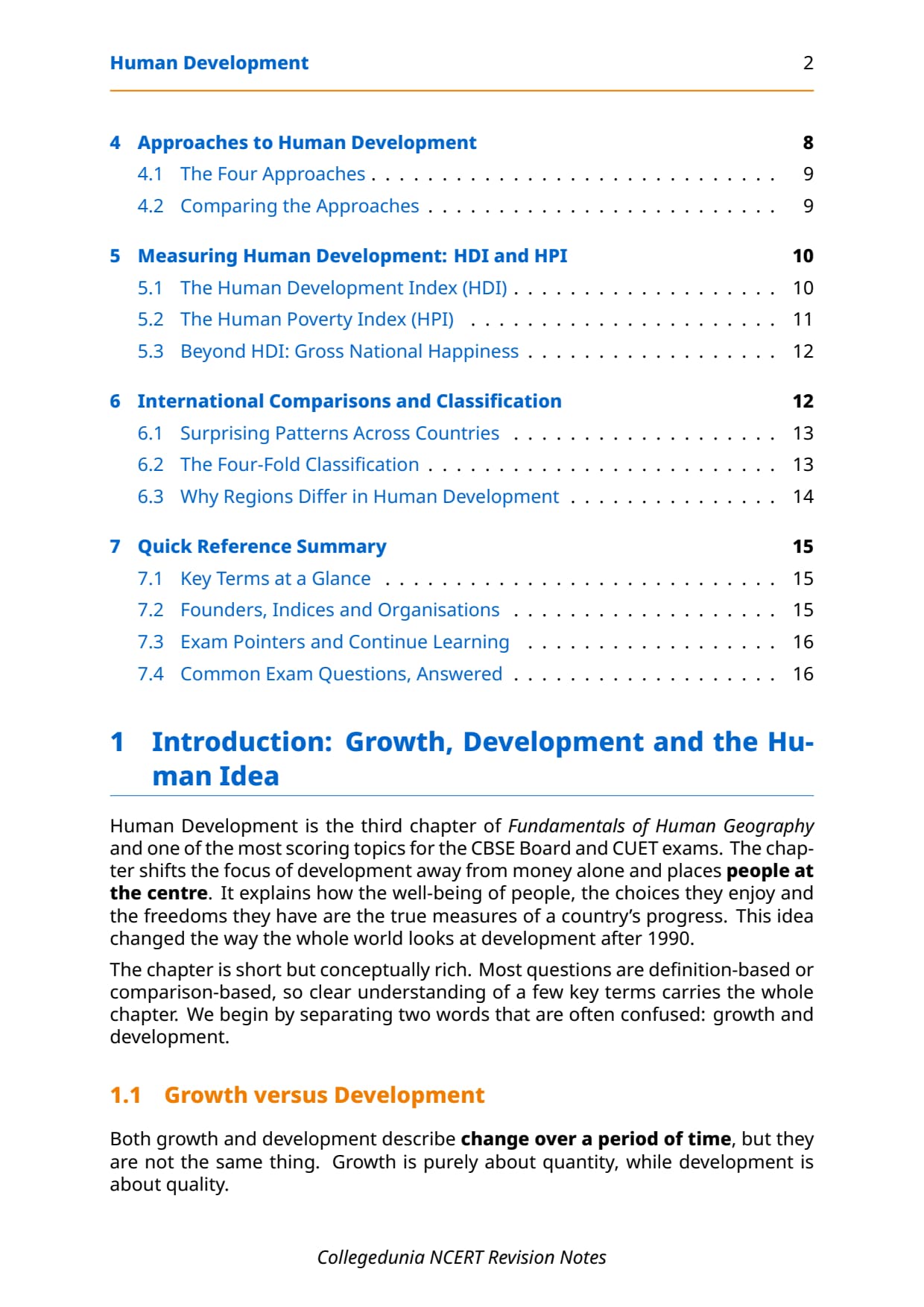
Quick Concept Recap: Human Development at a Glance
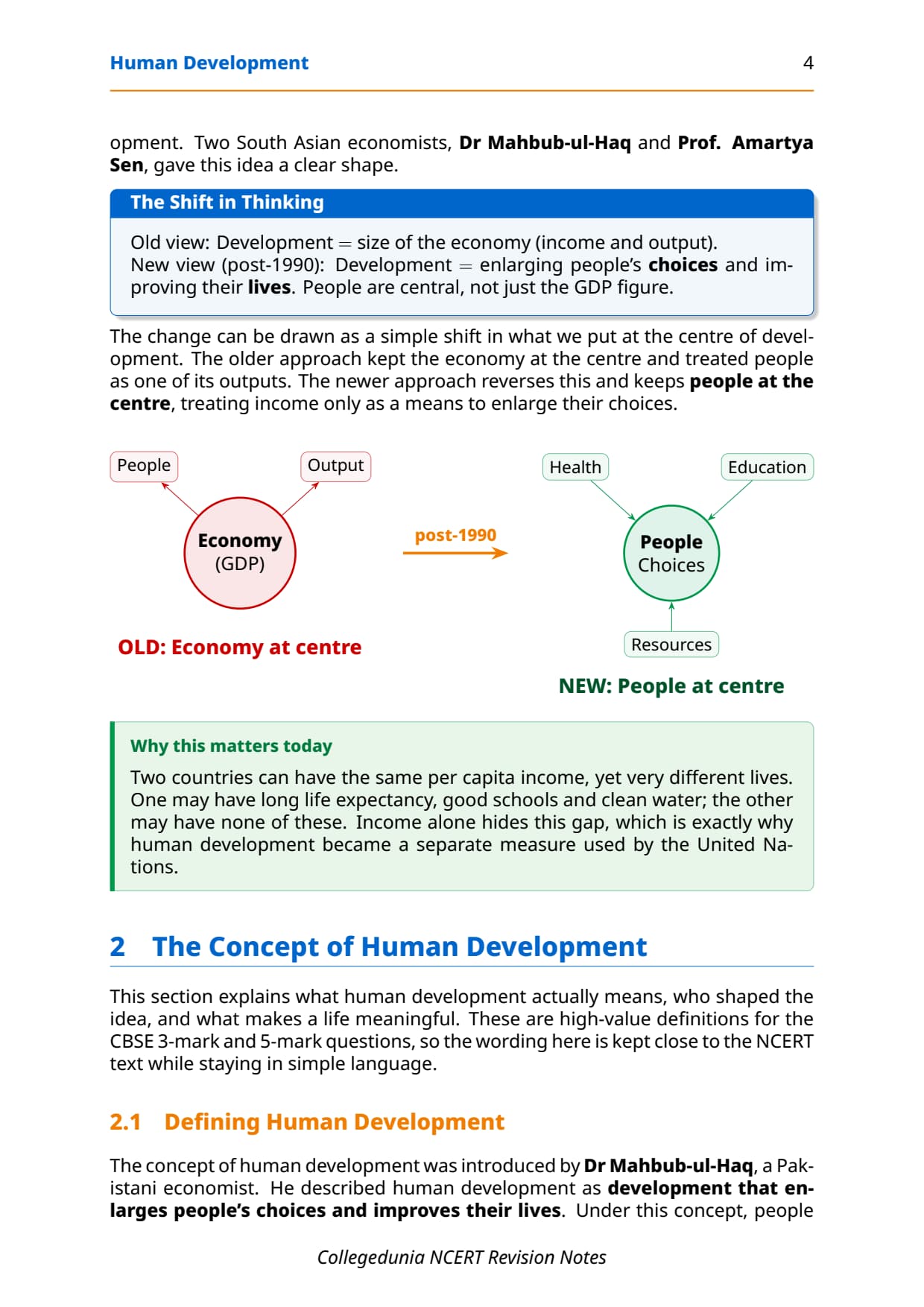
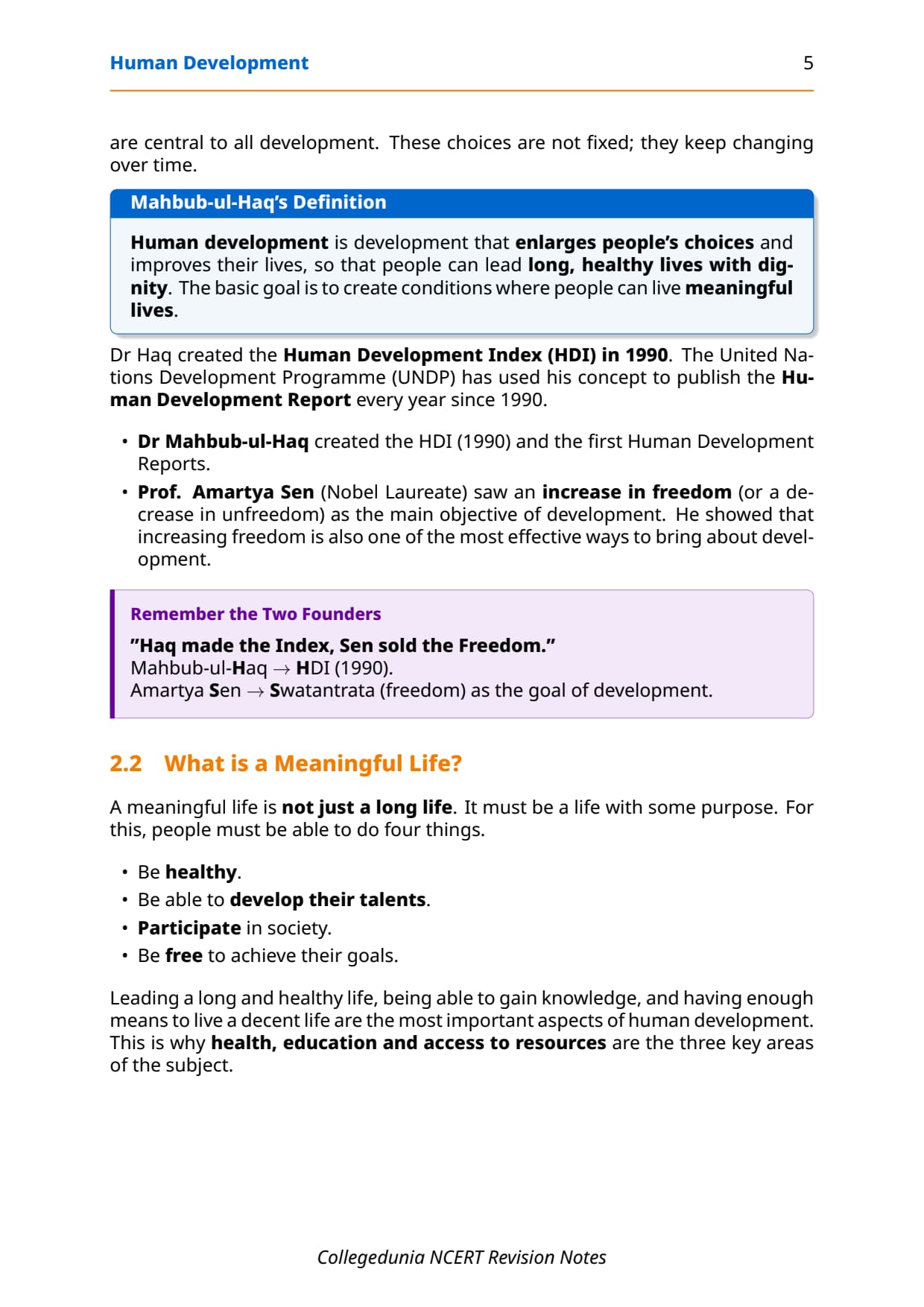
Chapter 3 of NCERT Class 12 Fundamentals of Human Geography builds the vocabulary of human development in a single arc. For decades, a country's development was measured only by its economic growth. Dr Mahbub-ul-Haq and Prof Amartya Sen changed that view in the late 1980s and early 1990s: Dr Haq created the Human Development Index in 1990, placing people and their choices at the centre of development.
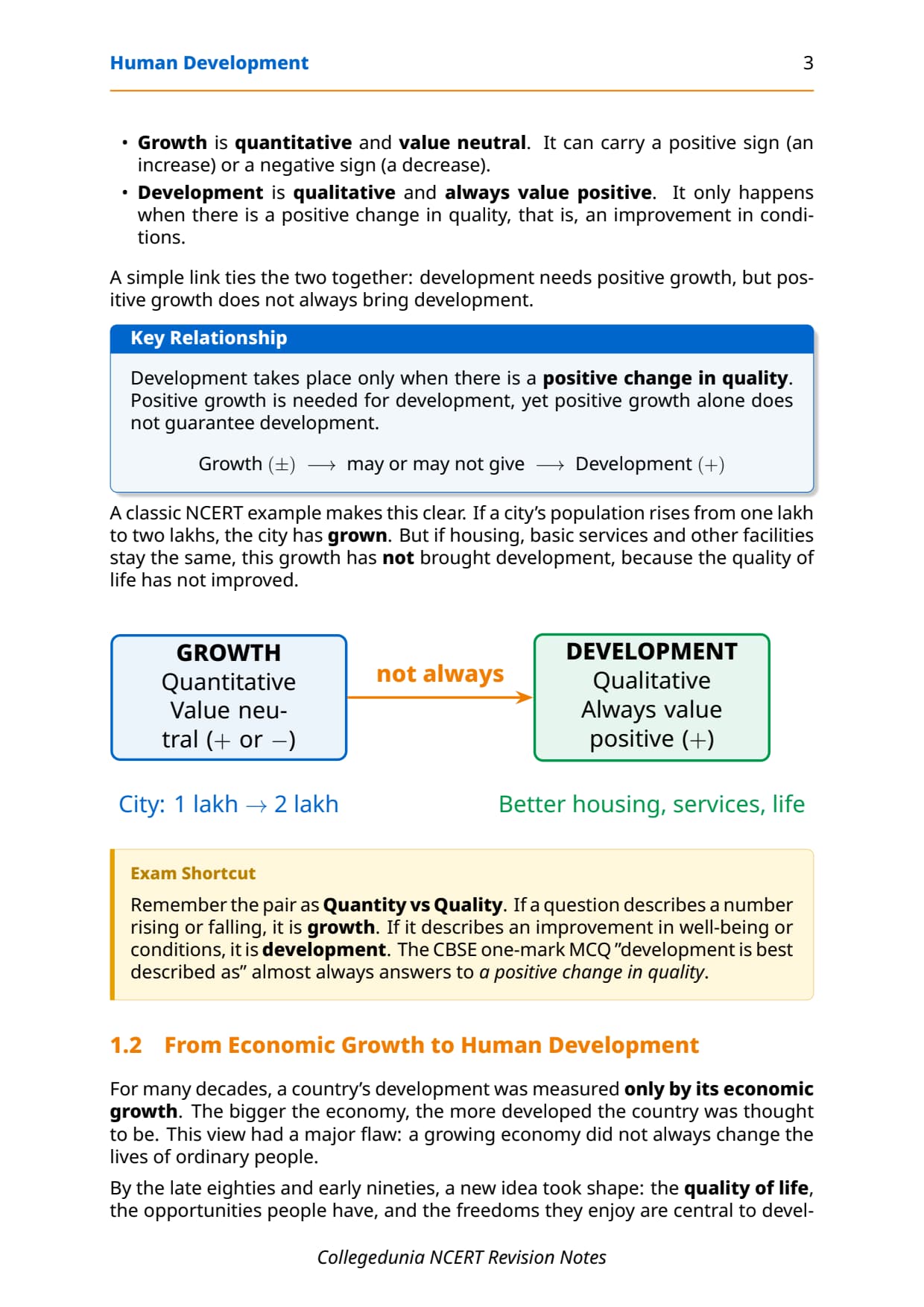
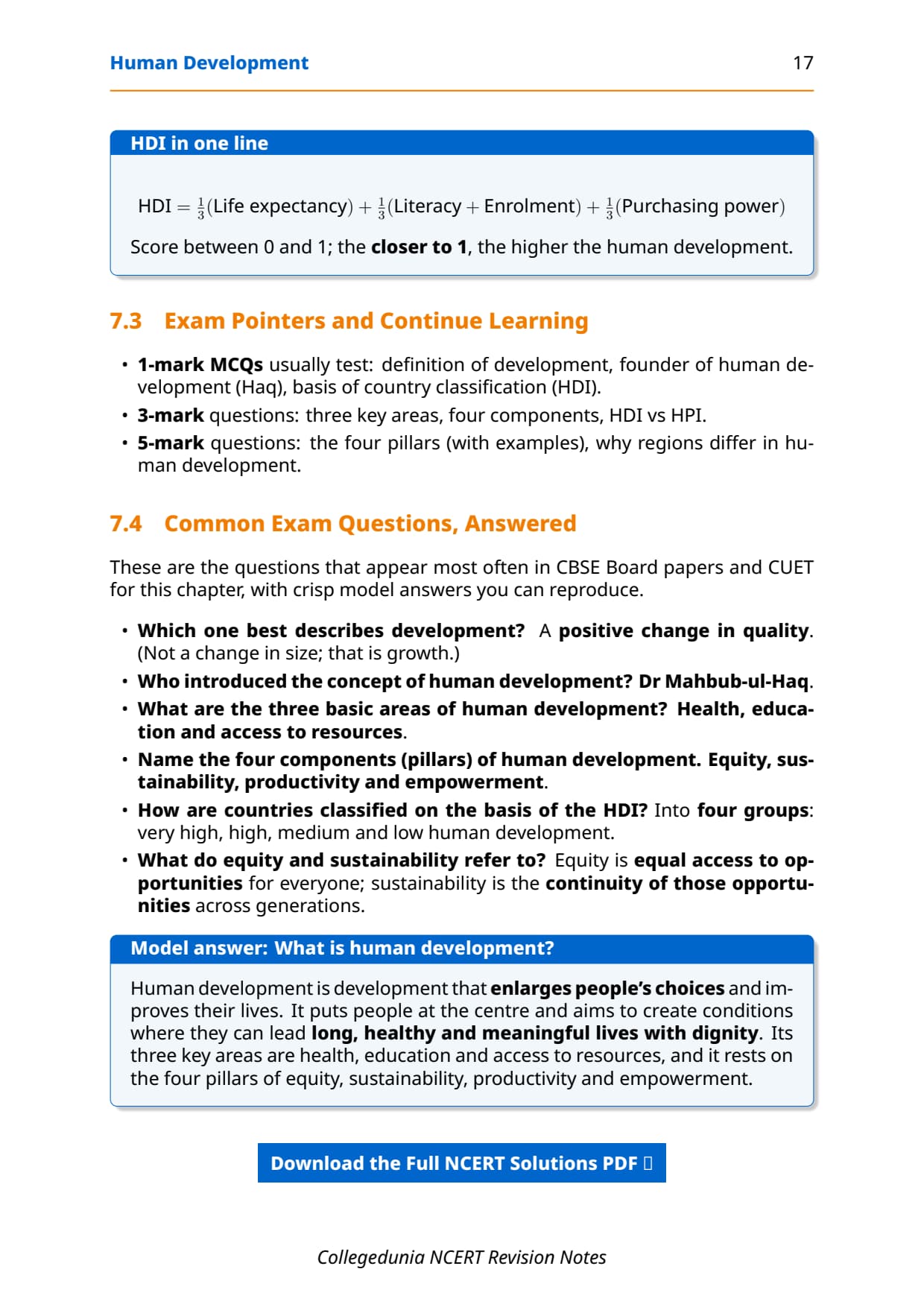
- Growth vs Development: growth is quantitative and value neutral; development is qualitative, always value positive, and improves conditions.
- Human Development concept: introduced by Dr Mahbub-ul-Haq; enlarges people's choices; people are central to all development.
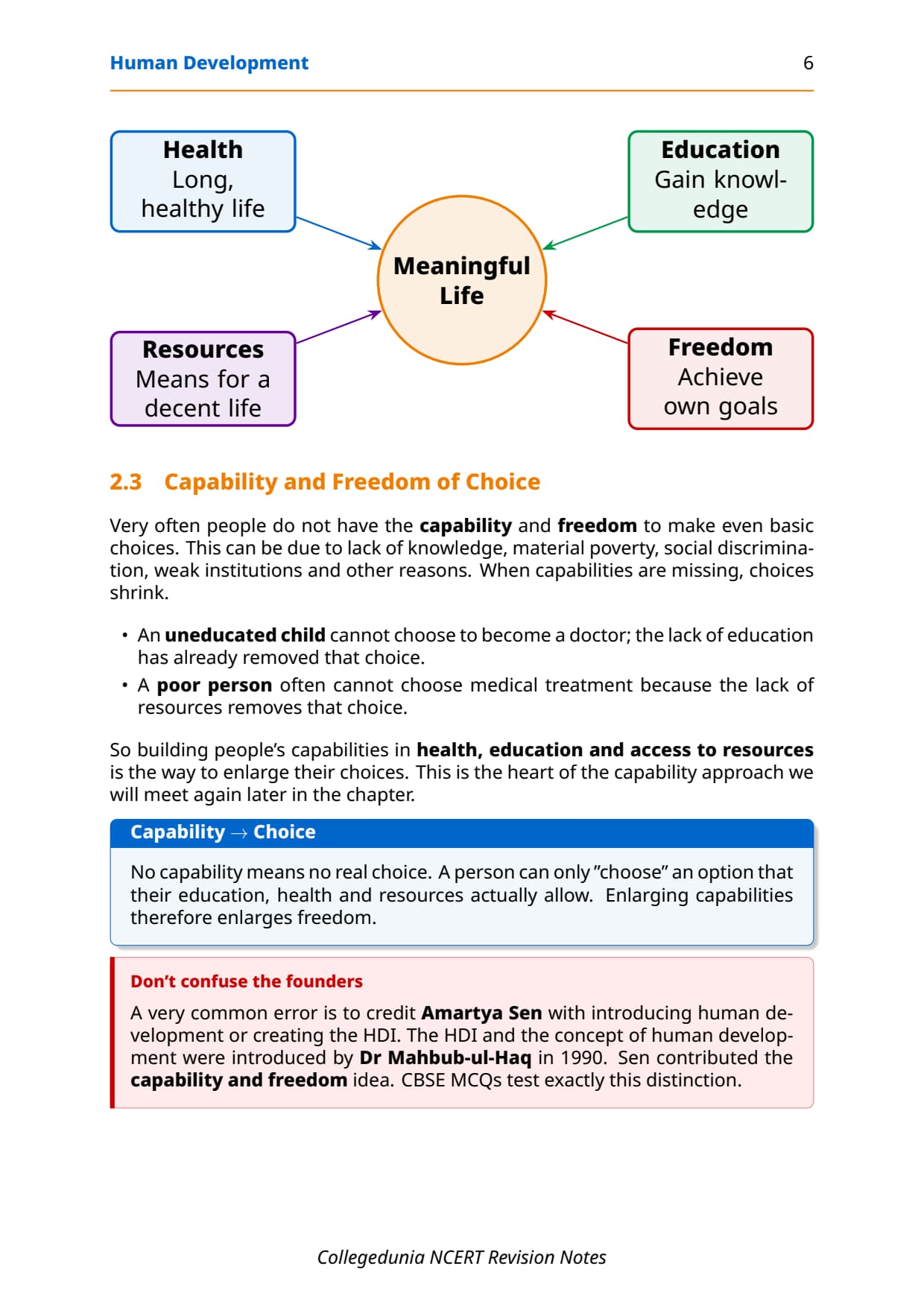
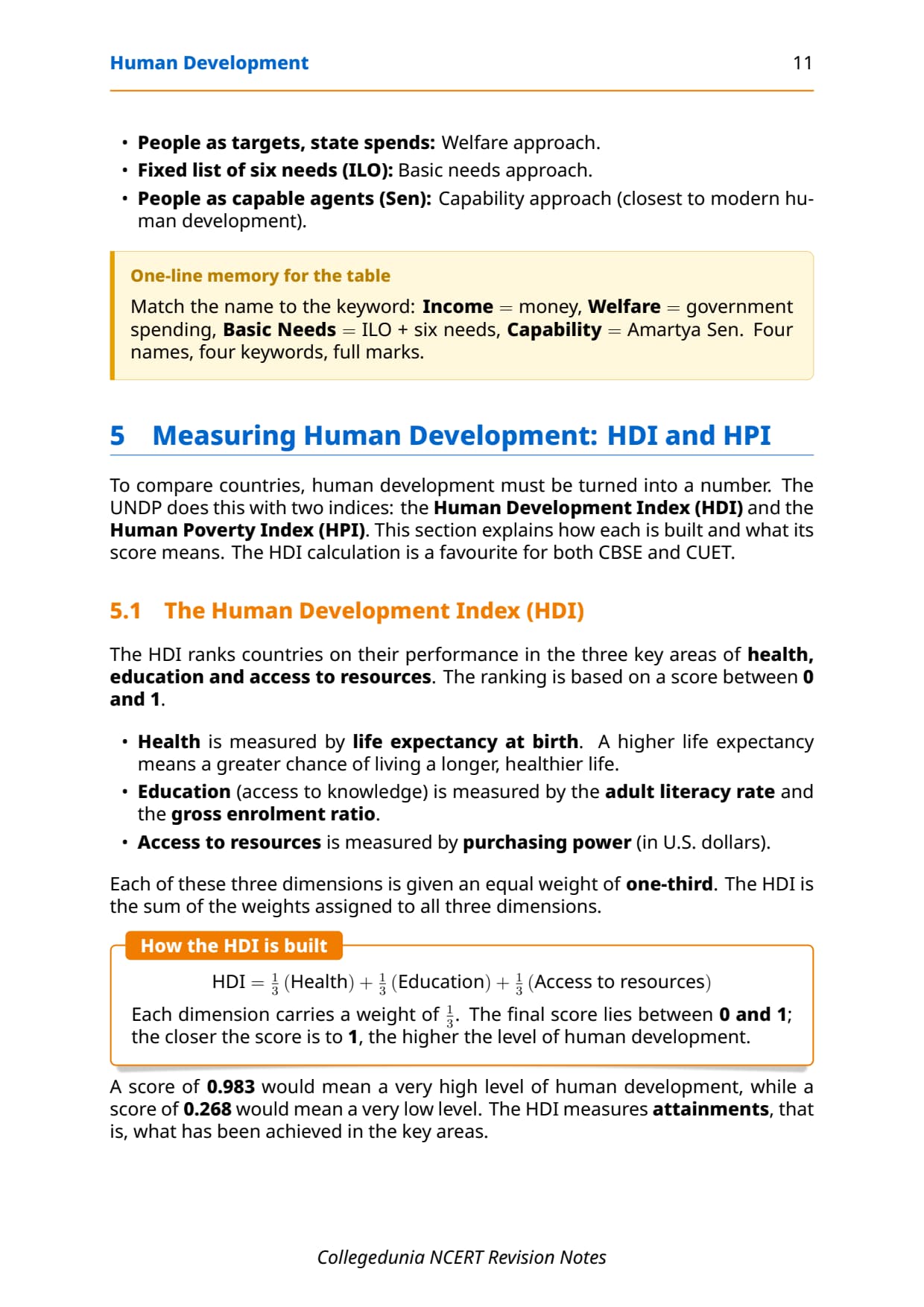
- Three key areas: access to resources, health and education; the HDI measures attainment in all three.
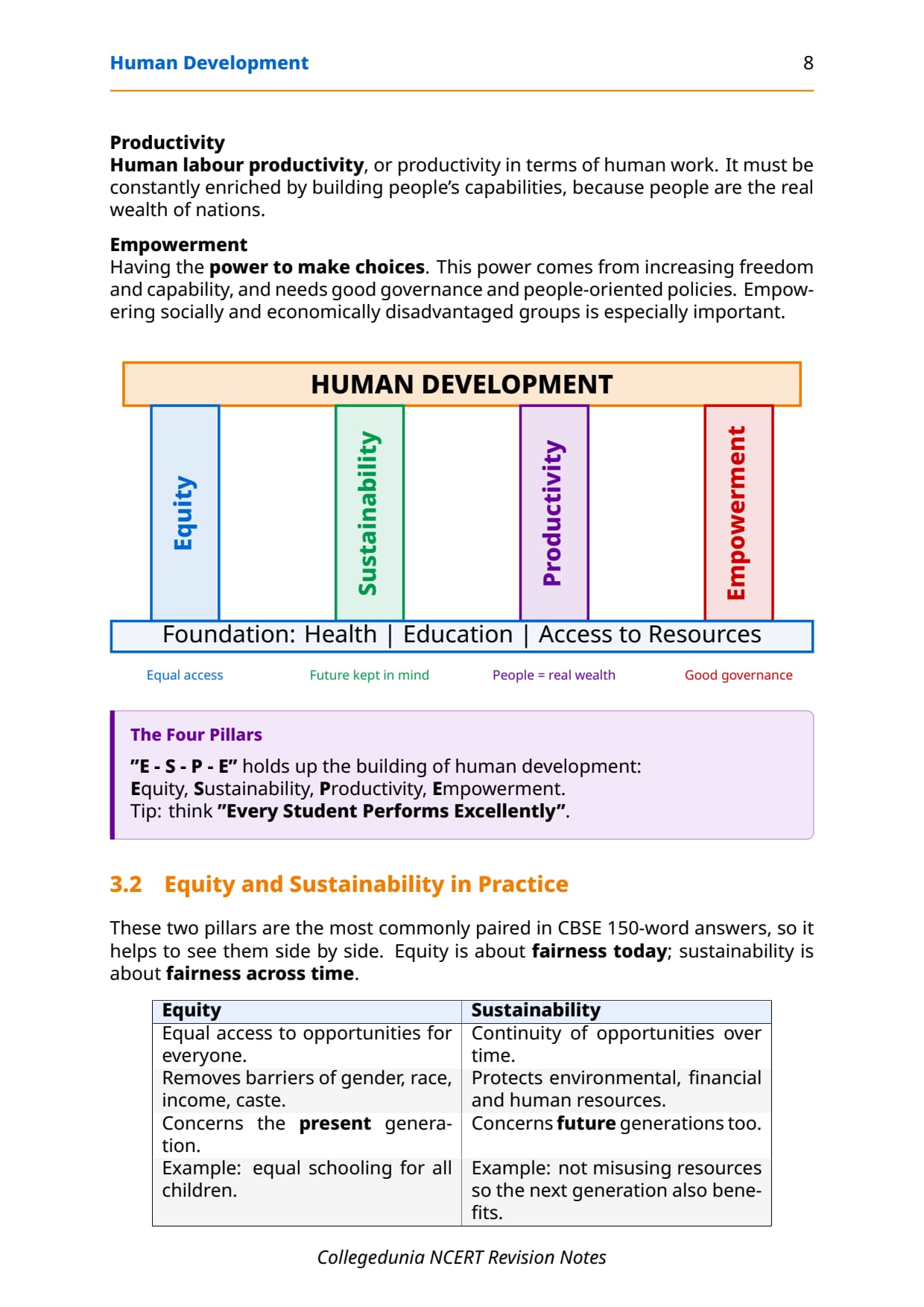
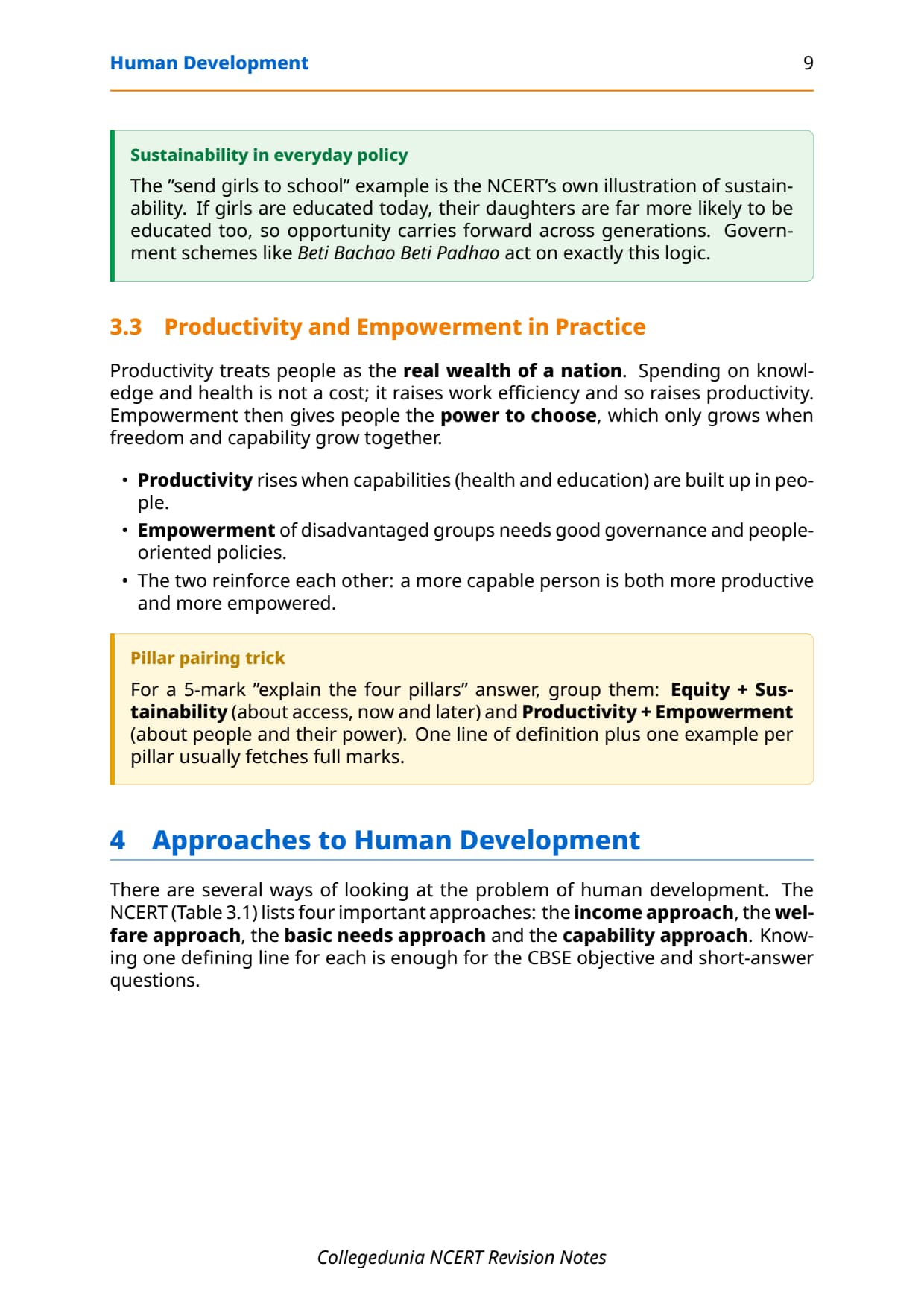
- Four pillars: equity, sustainability, productivity and empowerment.
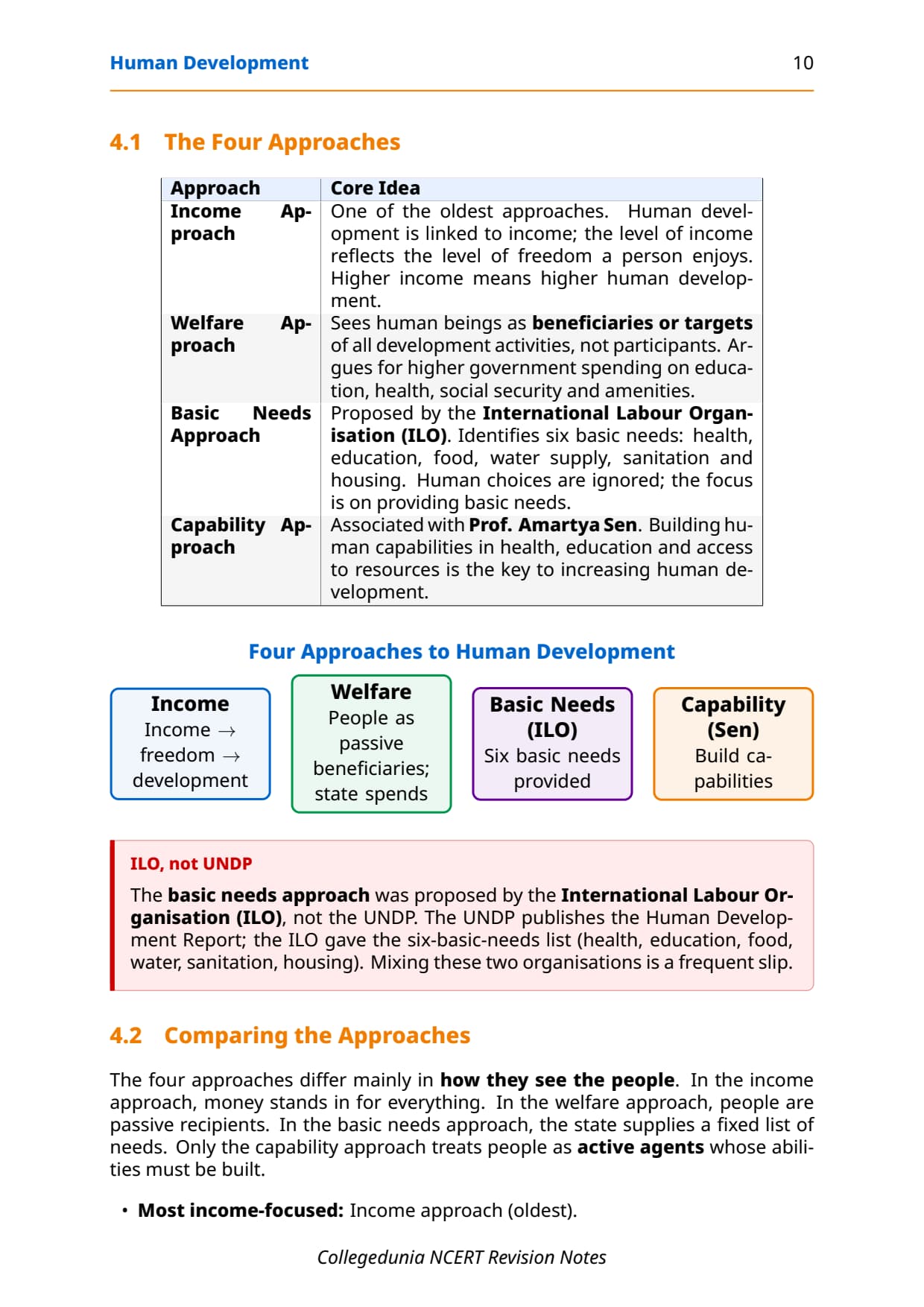
- Four approaches: income, welfare, minimum needs and capabilities; the capabilities approach (Amartya Sen) is the most comprehensive.
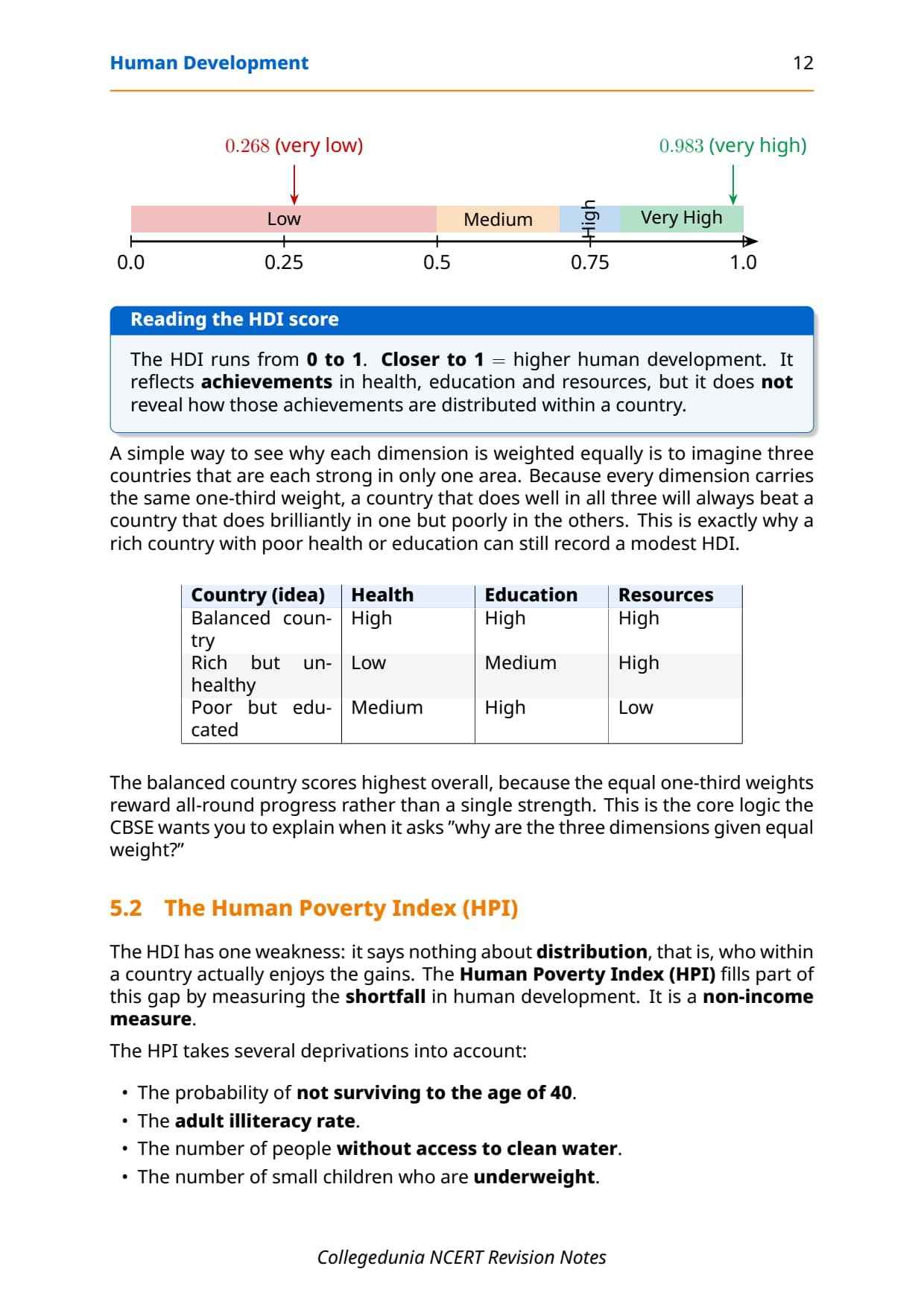
- HDI score range: 0 to 1; closer to 1 means higher human development; countries fall into very high, high, medium and low groups.
Read these notes first, then use the matching NCERT Solutions for Class 12 Geography Chapter 3 Human Development for the exercise drill.
Source: Humanities Wallah - Class 12th on YouTube
Key Definitions for Human Development Class 12 Notes
Every objective-type question on human development begins with a definition. The definitions below are written in the exact one-line form CBSE markers expect.
| Term | One-line definition | NCERT section |
|---|---|---|
| Growth | A quantitative change over time; value neutral; can be positive (increase) or negative (decrease). | Section 3.1 |
| Development | A qualitative change that is always value positive; development occurs when there is a positive change in quality of life. | Section 3.1 |
| Human Development | Development that enlarges people's choices and improves their lives; concept introduced by Dr Mahbub-ul-Haq. | Section 3.2 |
| Equity | Making equal access to opportunities available to everybody, irrespective of gender, race, income or caste. | Section 3.3 |
| Sustainability | Continuity in the availability of opportunities so that each generation has the same opportunities as the current one. | Section 3.3 |
| Productivity | Human labour productivity, enriched by building capabilities in people through investment in knowledge and health. | Section 3.3 |
| Empowerment | The power to make choices, derived from increasing freedom and capability through good governance and people-oriented policies. | Section 3.3 |
| Human Development Index (HDI) | A composite index that ranks countries based on performance in health, education and access to resources, scored between 0 and 1. | Section 3.4 |
| Life Expectancy at Birth | The indicator used in the HDI to assess health; a higher value means people have a greater chance of living longer and healthier lives. | Section 3.4 |
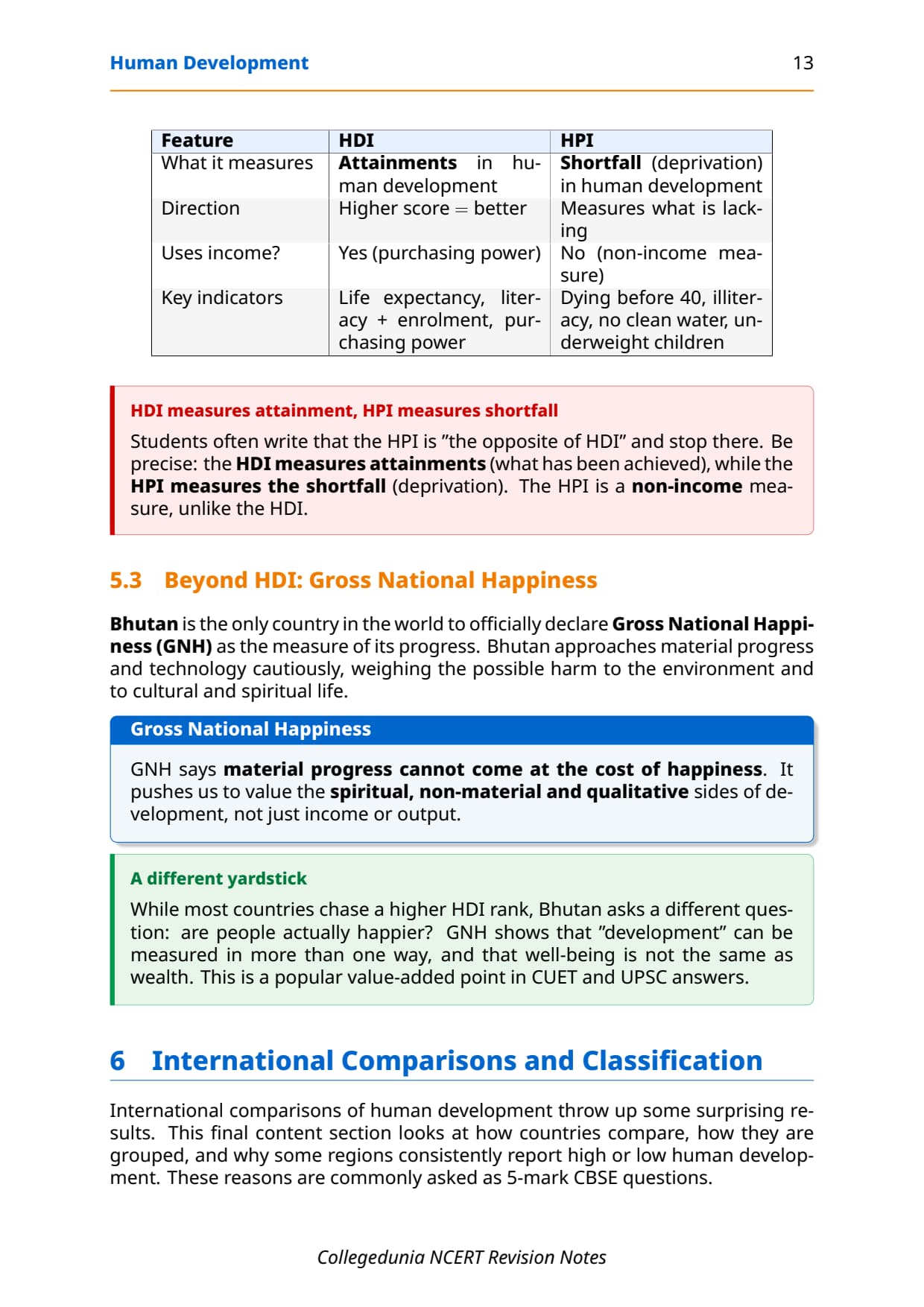
| Human Poverty Index | An index related to the HDI that measures the shortfall in human development rather than the attainment. | Section 3.4 |
These ten definitions cover roughly 8 of the 10 one-mark and 3-mark theory questions CBSE has asked on this chapter since 2021, so learn them first.
Four Pillars of Human Development (Quick Reference)
Human development rests on four concepts. Students often lose marks by mixing these up. Equity is not the same as equality: equity removes the barriers that block equal access.
- Equity: equal access to opportunities for all, irrespective of gender, race, income or caste. School dropout data shows women and backward groups losing access to knowledge more than others.
- Sustainability: each generation gets the same opportunities; no over-use of environmental, financial or human resources. Example: girls kept out of school grow up with curtailed choices, cutting opportunities for the next generation too.
- Productivity: human labour productivity enriched through investment in knowledge and health; people are the real wealth of nations.
- Empowerment: power to make choices through freedom, capability, good governance and people-oriented policies, with special focus on disadvantaged groups.
Four Approaches to Human Development
NCERT lists four ways of thinking about human development. CBSE asks students to distinguish between these in 3-mark questions, and CUET Geography includes one MCQ on them most years.
| Approach | Core idea | Key feature |
|---|---|---|
| Income Approach | Human development linked to level of income; higher income means higher freedom and higher human development. | Oldest approach; measures development through per capita income alone. |
| Welfare Approach | Looks at human beings as beneficiaries of development; argues for higher government expenditure on education, health and social amenities. | People are targets, not participants in development; government spending is the key lever. |
| Minimum Needs Approach | Focuses on providing a minimum basket of basic needs: education, health, food, water, sanitation and housing to all people. | Direct provision of basic needs rather than waiting for income growth to trickle down. |
| Capabilities Approach | Associated with Prof Amartya Sen; development seen as expansion of human capabilities and freedom to lead a good life. | Most comprehensive; development = increase in freedom (or decrease in unfreedom); social and political institutions matter. |
The capabilities approach is the most comprehensive of the four and the one that directly influenced the design of the HDI. Comparing all four in table form typically scores full marks on the 5-mark differentiation question CBSE asks every couple of years.
Human Development Index: Components and Measurement
The HDI ranks countries on three areas: health, education and access to resources. Each gets a weightage of one-third in the final score, which ranges from 0 to 1; closer to 1 means higher human development.
| HDI dimension | Indicator used | What it shows | Weightage |
|---|---|---|---|
| Health | Life expectancy at birth | Greater chance of living longer and healthier lives; higher = better health outcomes. | 1/3 |
| Education | Adult literacy rate + Gross Enrolment Ratio | Number of adults who can read/write + number of children enrolled in school; together show access to knowledge. | 1/3 |
| Access to resources | Purchasing power (in US dollars) | Ability to afford a decent standard of living; measured by per capita income in purchasing power parity terms. | 1/3 |
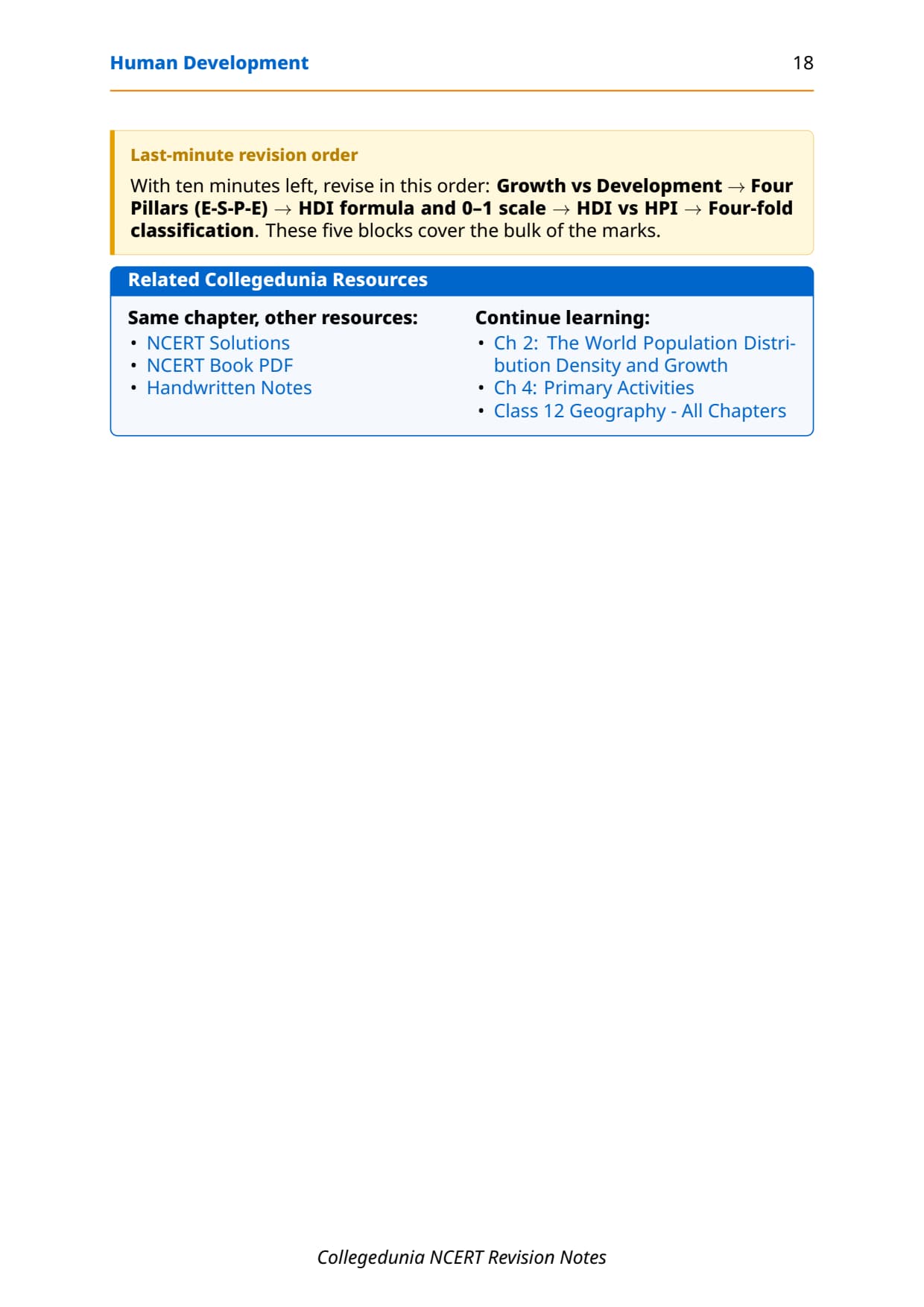
The HDI measures what has been achieved; it does not show how the gains are distributed within a country. That is why the Human Poverty Index was developed alongside, to measure the shortfall in access to health, knowledge and resources.
Memory hook: a score of 0.983 is very high, 0.268 is very low. The HDI does NOT measure inequality within a country, only average attainment, a distinction CBSE has asked three times since 2020.
Global HDI Classification and Country Groups
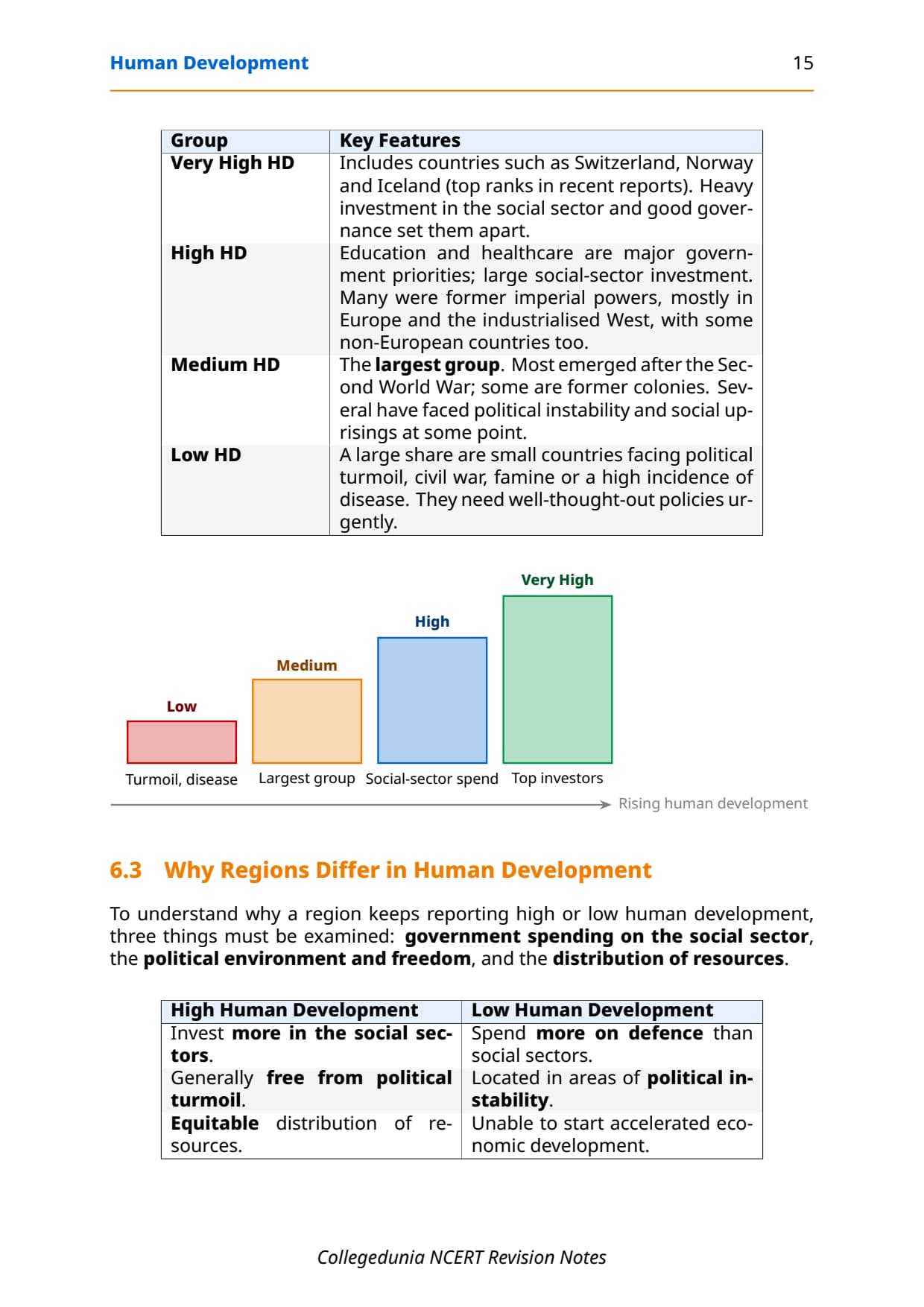
Countries are grouped into four categories based on their HDI scores. NCERT places top-ranked countries in the very high group and flags 33 low-development countries needing urgent policy attention.
- Very high human development: top 10 include Switzerland, Norway, Iceland, Hong Kong China (SAR), Denmark, Sweden, Germany, Ireland, Singapore, Australia and Netherlands, mostly stable industrial nations with large social-sector investment.
- High human development: 49 countries; education and healthcare are government priorities.
- Medium human development: 42 countries, the largest group; many are former colonies that faced instability.
- Low human development: 33 countries, often facing political turmoil, civil war, famine or disease, and spending more on defence than social sectors.
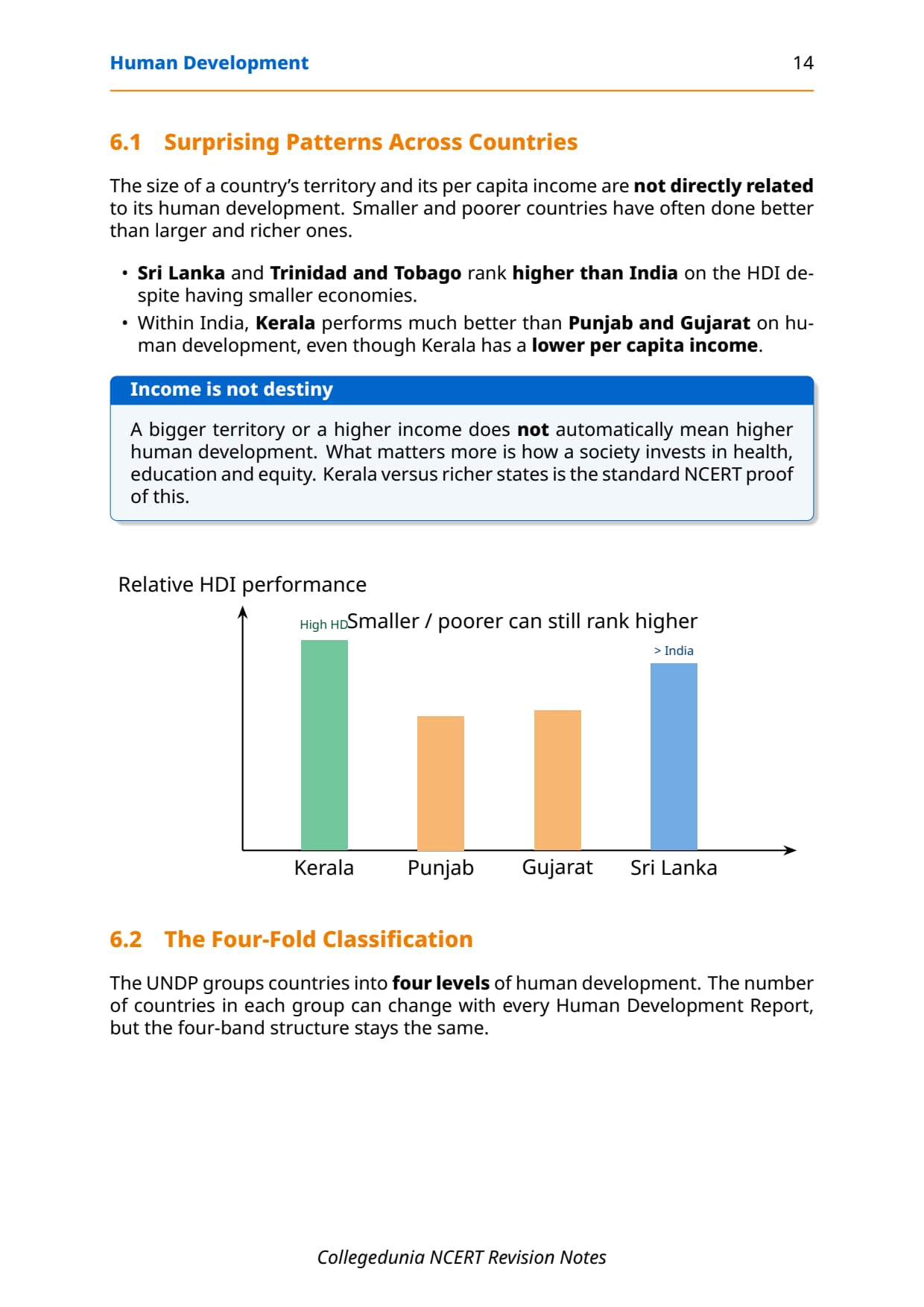
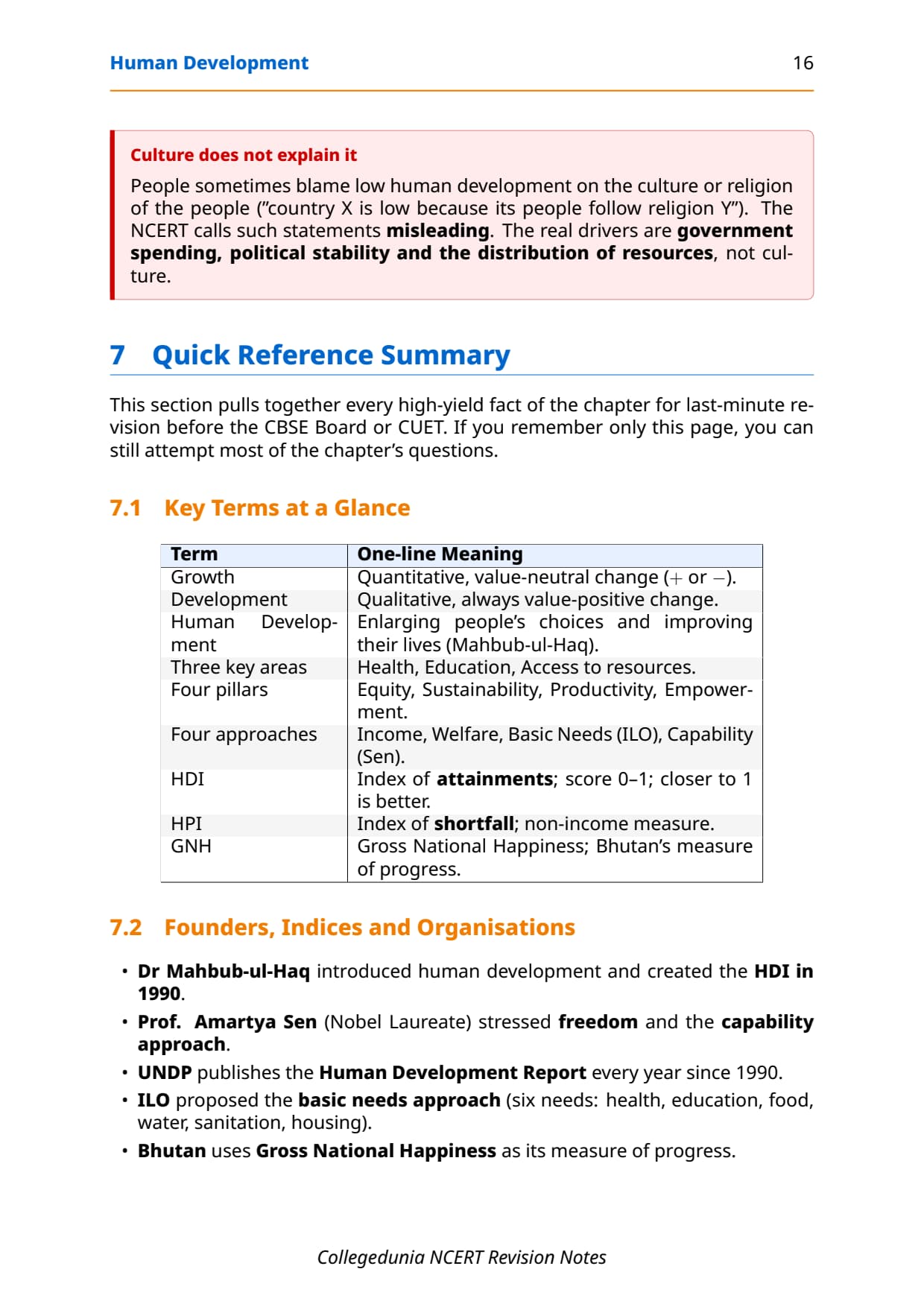
A key insight: blaming low human development on the culture or religion of a people is misleading. The real drivers are government spending on social sectors, political freedom, and equitable distribution of resources.
Common Mistakes Students Make in Human Development
The five repeat-offender mistakes CBSE examiners report each year:
- Confusing growth with development: a city can grow in population without developing if services do not improve.
- Mixing up the four pillars: equity is equal access to opportunities (not equal outcomes); empowerment is the power to make choices. Students swap these and lose method marks.
- Saying HDI measures equality: the HDI measures average attainment; it says nothing about distribution. The Human Poverty Index measures the shortfall.
- Listing the wrong HDI indicators: education is adult literacy rate PLUS gross enrolment ratio, not literacy alone.
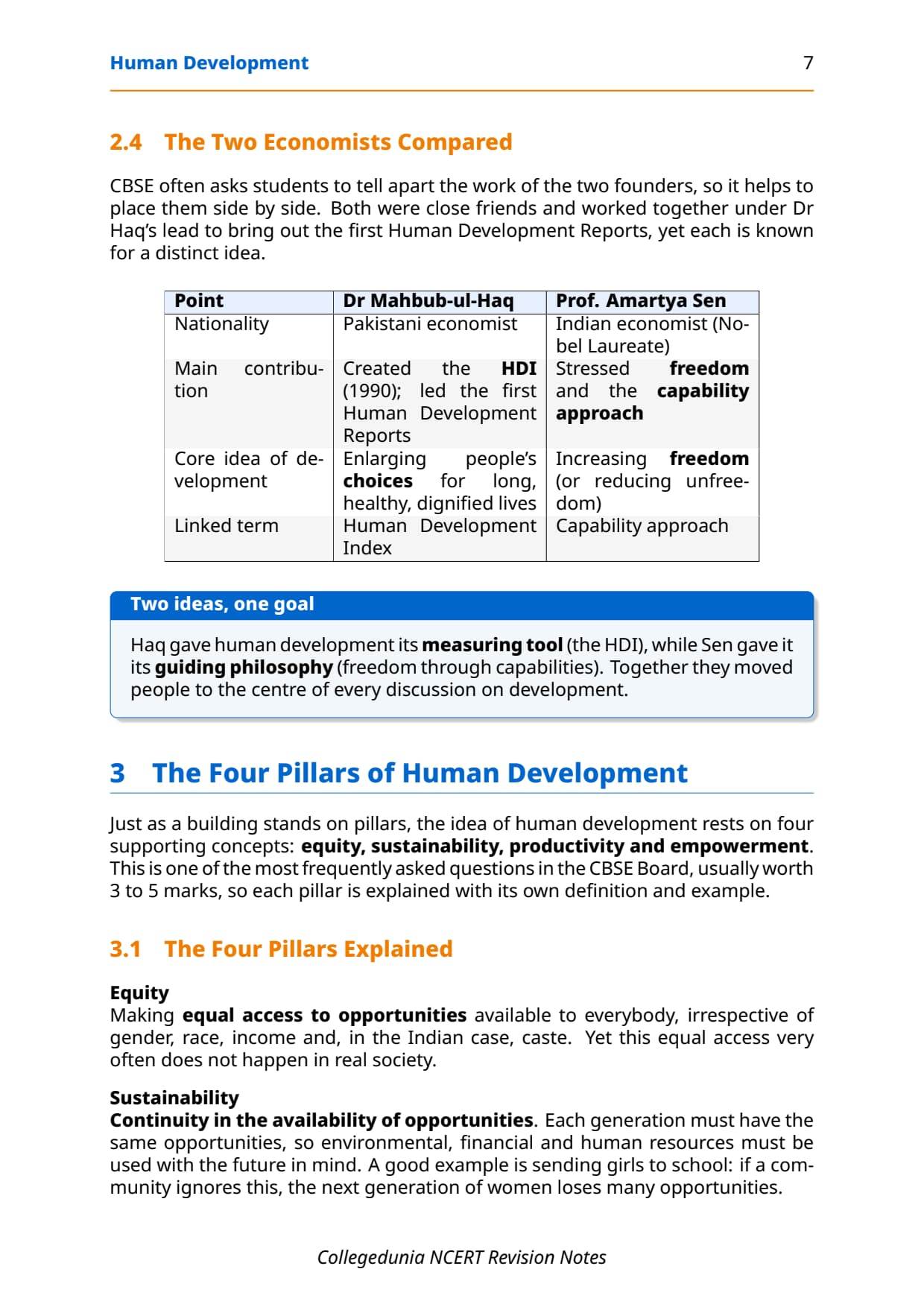
- Crediting Amartya Sen with the concept: Dr Mahbub-ul-Haq introduced human development; Sen developed the capabilities approach.
Previous Year Question Trends from Human Development Class 12
CBSE typically asks one MCQ and one or two descriptive questions from this chapter each year. The table below maps what the board has asked over the last five years.
| Year | Question type asked | Marks | Notes section to revise |
|---|---|---|---|
| 2025 | Define human development + explain any two pillars with examples | 2 + 4 | Key Definitions + Four Pillars |
| 2024 | MCQ on who introduced the concept of HDI + 150-word question on equity and sustainability | 1 + 5 | Key Definitions + Four Pillars |
| 2023 | Distinguish between growth and development + explain HDI components | 3 + 4 | Key Definitions + HDI Components |
| 2022 | Explain four pillars of human development with examples | 5 | Four Pillars section |
| 2021 | Differentiate between four approaches to human development | 5 | Four Approaches table |
The chapter carries an effective weight of 7 to 10 marks per year across MCQ, short-answer and descriptive questions combined.
Other Resources for Class 12 Geography Chapter 3 Human Development
Pair these notes with the matching resources for Class 12 Geography Chapter 3.
| Resource | What it covers | Open |
|---|---|---|
| Notes | Concept-first revision notes covering definitions, four pillars, four approaches, HDI components and country classifications. | You are here |
| NCERT Solutions | Step-by-step answers to all exercise questions with Expert's Solution for every 5-mark answer. | Class 12 Geography Chapter 3 NCERT Solutions |
| Handwritten Notes | Topper's handwritten revision pages for last-minute board exam practice. | Class 12 Geography Chapter 3 Handwritten Notes |
| NCERT Book PDF | Official NCERT Fundamentals of Human Geography Chapter 3 textbook in PDF form. | Class 12 Geography Chapter 3 NCERT Book PDF |
| Subject Hub | All chapters of Class 12 Geography with every resource in one place. | Class 12 Geography Subject Hub |
All Chapters Notes for Class 12 Geography Fundamentals of Human Geography
Related Links: Notes for the other chapters of Class 12 Geography Fundamentals of Human Geography.
| Chapter | Topic | Notes link |
|---|---|---|
| Chapter 1 | Human Geography: Nature and Scope | Class 12 Geography Chapter 1 Notes |
| Chapter 2 | The World Population: Distribution, Density and Growth | Class 12 Geography Chapter 2 Notes |
| Chapter 3 | Human Development | You are here |
| Chapter 4 | Primary Activities | Class 12 Geography Chapter 4 Notes |
| Chapter 5 | Secondary Activities | Class 12 Geography Chapter 5 Notes |
| Chapter 6 | Tertiary and Quaternary Activities | Coming soon |
| Chapter 7 | Transport and Communication | Coming soon |
| Chapter 8 | International Trade | Coming soon |
NCERT Notes Class 12 Geography Chapter 3 Human Development FAQs
Ques. What is the concept of human development introduced in Class 12 Geography Chapter 3?
Ans. The concept of human development was introduced by Dr Mahbub-ul-Haq and described as development that enlarges people's choices and improves their lives. People are central to all development under this concept. The basic goal is to create conditions where people can live meaningful lives: healthy, educated, able to participate in society and free to achieve their goals. Prof Amartya Sen contributed the capabilities approach, seeing development as the expansion of freedom and capability rather than just a rise in income.
Ques. What is the difference between growth and development in Human Development Class 12 notes?
Ans. Growth is a quantitative change over time and is value neutral. It can be positive (an increase) or negative (a decrease). Development is a qualitative change that is always value positive: it occurs only when there is a positive change in the quality of conditions. A city whose population doubles without any improvement in housing, services or education has grown but not developed. Development requires that positive growth leads to a genuine improvement in living conditions.
Ques. What are the four pillars of human development Class 12 Geography students must know?
Ans. The four pillars are equity, sustainability, productivity and empowerment. Equity means equal access to opportunities for all irrespective of gender, race, income or caste. Sustainability means each generation gets the same opportunities as the current one. Productivity means human labour productivity, enriched by building capabilities through education and health investments. Empowerment means having the power to make choices, which comes from freedom, capability and good governance. CBSE typically asks a 5-mark question requiring all four pillars with examples.
Ques. What are the three components of the Human Development Index in Class 12 Geography?
Ans. The HDI has three dimensions, each given a weightage of one-third. Health is measured by life expectancy at birth. Education is measured by the adult literacy rate combined with the gross enrolment ratio. Access to resources is measured by purchasing power in US dollars (per capita income in purchasing power parity terms). A country scores between 0 and 1; the closer to 1, the higher its human development. The HDI measures attainment but does not capture distribution within a country.
Ques. How are countries classified on the basis of the Human Development Index?
Ans. Countries are placed into four broad groups based on their HDI score. The very high human development group includes countries like Switzerland, Norway, Iceland and Australia, mostly industrialised Western nations with large social-sector investment. The high human development group has 49 countries where education and healthcare are government priorities. The medium human development group is the largest, with 42 countries, many of which were former colonies. The low human development group has 33 countries that tend to spend more on defence than social sectors and face political instability.
Ques. What is the difference between the Human Development Index and the Human Poverty Index?
Ans. The Human Development Index measures what has been achieved in health, education and access to resources. It reflects average attainment in a country. The Human Poverty Index, which is related to the HDI, measures the shortfall in human development: what proportion of the population is still denied access to these three key areas. The HDI can look healthy even when large sections of the population are excluded; the Human Poverty Index captures that exclusion. Both are asked as short-answer questions in CBSE board papers.
Ques. What are the four approaches to human development in Class 12 Geography?
Ans. The four approaches are: (a) the income approach, which links development to level of income; (b) the welfare approach, which sees people as beneficiaries of government spending on education, health and social amenities; (c) the minimum needs approach, which focuses on direct provision of basic needs such as food, water, housing and sanitation; and (d) the capabilities approach, associated with Prof Amartya Sen, which sees development as the expansion of human capabilities and freedom. The capabilities approach is the most comprehensive and directly influenced the HDI design.
Ques. Who introduced the Human Development Index and when was it first published?
Ans. The Human Development Index was created by Dr Mahbub-ul-Haq, a Pakistani economist, in 1990. The United Nations Development Programme used his concept of human development to publish the Human Development Report annually from 1990 onwards. Dr Haq worked closely with Prof Amartya Sen to develop the initial reports. The HDI shifted the global focus from measuring development purely through economic growth (GDP per capita) to measuring it through health, education and access to resources.
Ques. Why is blaming low human development on culture or religion misleading?
Ans. The NCERT textbook explicitly states that blaming low human development on the culture or religion of a people is misleading. The real drivers of low human development are the pattern of government expenditure on social sectors, the political environment and the degree of freedom people enjoy, and the equitable distribution of resources. Countries with high HDI scores invest more in people and are generally free from political turmoil. When the same cultural or religious community achieves high HDI in one country and low HDI in another, the role of governance and policy is clearly the decisive factor, not culture.
Ques. Is the Class 12 Geography syllabus for this chapter changing in 2026-27?
Ans. No major changes in 2026-27. Chapter 3 Human Development in the Fundamentals of Human Geography textbook retains the same content on growth vs development, four pillars, four approaches, HDI components and country classifications. These human development class 12 notes for the 2026-27 cycle are aligned to the unchanged textbook and the latest CBSE sample paper released for the 2026 boards. Students preparing for CUET Geography should also note that human development concepts appear regularly in CUET Domain subject questions.
Ques. What is the difference between equity and empowerment in the four pillars of human development?
Ans. Equity focuses on making equal access to opportunities available to everybody, removing barriers related to gender, race, income or caste so that no group starts at a disadvantage. Empowerment, on the other hand, focuses on giving people the power to make their own choices once those barriers are removed. Empowerment comes from increasing freedom and capability through good governance and people-oriented policies, and it pays special attention to socially and economically disadvantaged groups who face the most barriers to exercising choice.
Ques. How long does it take to revise these human development class 12 notes?
Ans. The full notes file is designed for a 25 to 30 minute first-pass revision and a 15-minute night-before pass. Students who already have the chapter under their belt finish the file in 20 minutes; first-time revisers take closer to 35 minutes. The Key Definitions table and Common Mistakes blocks alone take 8 to 10 minutes to revise and cover roughly 8 of the 10 marks the chapter typically carries in the board paper.



Comments