



The handwritten notes on Class 8 Arts (Kriti) Chapter 11 Pan Indian Dance Forms have been prepared for quick 2026-27 revision. The PDF covers the eight major dance forms of India, important posture and costume clues, folk traditions from Nagaland and Chhattisgarh, and the NCERT activities from the chapter.
- Resource focus: classical dance forms, folk dance traditions, personalities, nrtta and nrtya.
- Best use: revise one handwritten page, then fill the NCERT dance matrix.
- Exam link: follows the NCERT 2026-27 Arts (Kriti) Chapter 11 assessment cues.
Chapter11PanIndianDanceFormsHandwrittenNotes.upload.pdf?page=1&dpi=150)
Chapter11PanIndianDanceFormsHandwrittenNotes.upload.pdf?page=2&dpi=150)
Chapter11PanIndianDanceFormsHandwrittenNotes.upload.pdf?page=3&dpi=150)
Chapter11PanIndianDanceFormsHandwrittenNotes.upload.pdf?page=4&dpi=150)
Chapter11PanIndianDanceFormsHandwrittenNotes.upload.pdf?page=5&dpi=150)
Chapter11PanIndianDanceFormsHandwrittenNotes.upload.pdf?page=6&dpi=150)
Chapter11PanIndianDanceFormsHandwrittenNotes.upload.pdf?page=7&dpi=150)
Chapter11PanIndianDanceFormsHandwrittenNotes.upload.pdf?page=8&dpi=150)
Chapter11PanIndianDanceFormsHandwrittenNotes.upload.pdf?page=9&dpi=150)
Chapter11PanIndianDanceFormsHandwrittenNotes.upload.pdf?page=10&dpi=150)
Chapter11PanIndianDanceFormsHandwrittenNotes.upload.pdf?page=11&dpi=150)
Chapter11PanIndianDanceFormsHandwrittenNotes.upload.pdf?page=12&dpi=150)
Chapter11PanIndianDanceFormsHandwrittenNotes.upload.pdf?page=13&dpi=150)
Chapter11PanIndianDanceFormsHandwrittenNotes.upload.pdf?page=14&dpi=150)
Chapter11PanIndianDanceFormsHandwrittenNotes.upload.pdf?page=15&dpi=150)
Chapter11PanIndianDanceFormsHandwrittenNotes.upload.pdf?page=16&dpi=150)
Chapter11PanIndianDanceFormsHandwrittenNotes.upload.pdf?page=17&dpi=150)
Chapter11PanIndianDanceFormsHandwrittenNotes.upload.pdf?page=18&dpi=150)
Chapter11PanIndianDanceFormsHandwrittenNotes.upload.pdf?page=19&dpi=150)
Chapter11PanIndianDanceFormsHandwrittenNotes.upload.pdf?page=20&dpi=150)
Chapter11PanIndianDanceFormsHandwrittenNotes.upload.pdf?page=21&dpi=150)
Chapter11PanIndianDanceFormsHandwrittenNotes.upload.pdf?page=22&dpi=150)
Chapter11PanIndianDanceFormsHandwrittenNotes.upload.pdf?page=23&dpi=150)
Chapter11PanIndianDanceFormsHandwrittenNotes.upload.pdf?page=24&dpi=150)
Student Feedback: In a Collegedunia revision check with 8,900 Class 8 students, 74% said activity-wise handwritten notes helped them revise arts chapters faster.
Pan Indian Dance Forms Chapter Snapshot
Pan Indian Dance Forms introduces students to India's major classical dance traditions and selected folk dance traditions. The chapter connects dance with region, costume, music, posture, community life and cultural heritage.
- Students learn the eight major dance forms named in the NCERT chapter.
- The chapter asks students to compare dance styles instead of memorising isolated names.
- Activities include a dance matrix and a performance-based discussion of nrtta and nrtya.
The handwritten PDF turns the chapter into 24 revision pages. Students can revise one concept at a time, then use the NCERT table activity to compare the forms.
Eight Major Dance Forms in Chapter 11
The chapter names Bharatanatyam, Kathak, Kathakali, Kuchipudi, Manipuri, Mohiniyattam, Odissi and Sattriya. Each form has its own regional context and movement identity.
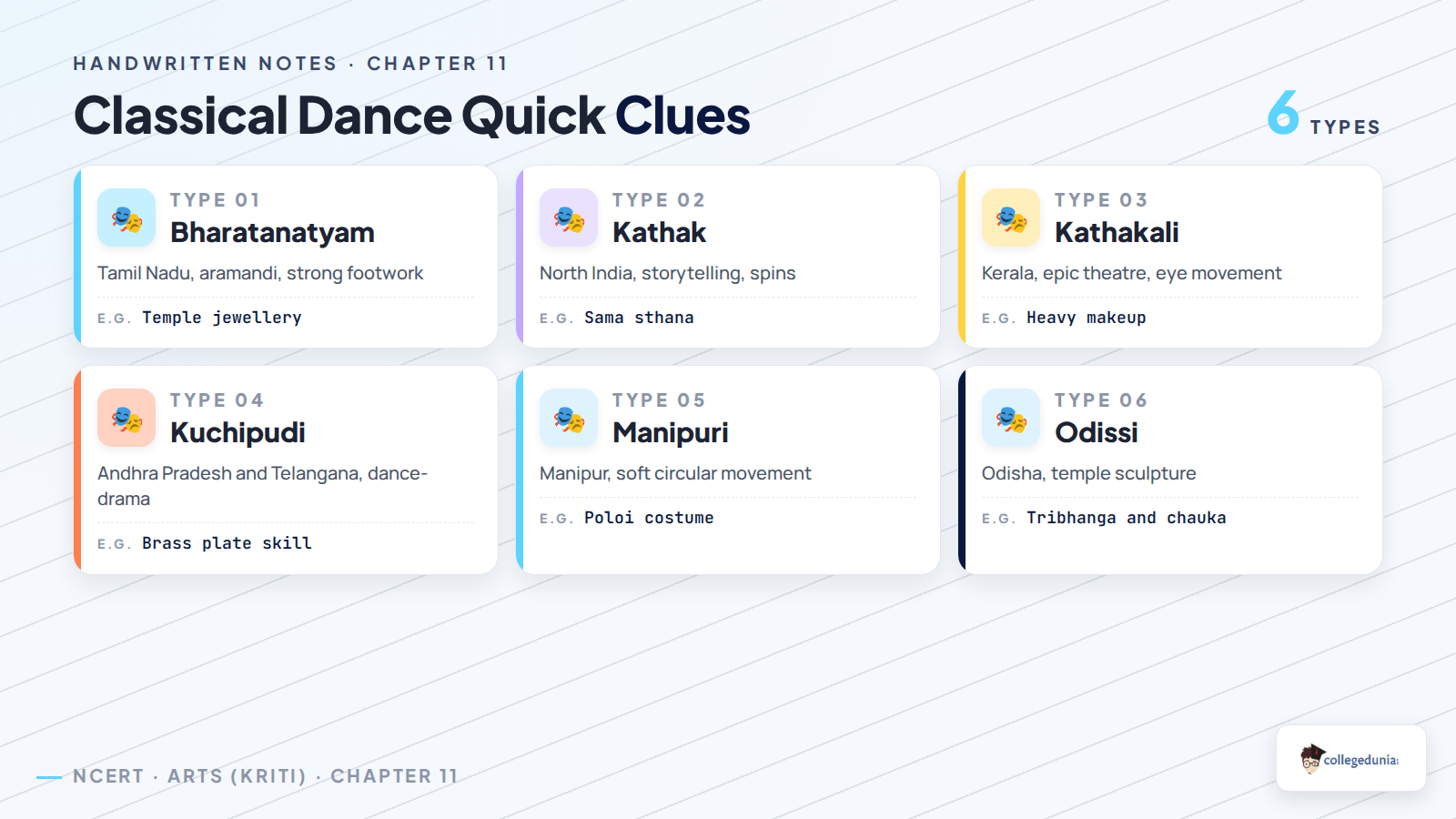
Bharatanatyam is linked with Tamil Nadu and aramandi. Kathak is rooted in northern India and storytelling. Kathakali and Mohiniyattam both come from Kerala but differ sharply in style: Kathakali is dramatic and heavily made up, while Mohiniyattam is softer and lyrical.
Kuchipudi comes from Andhra Pradesh and Telangana. Manipuri is gentle, circular and devotional. Odissi uses the tribhanga and chauka clues. Sattriya comes from Assam and began in sattras, or monasteries.
Posture, Costume and Style Clues
Students should revise each dance form through four clue groups: region, posture, costume and speciality. This method helps with classroom discussion, picture-based identification and the Chapter 11 dance matrix.
| Dance Form | Quick Clue | Memory Point |
|---|---|---|
| Bharatanatyam | Aramandi, silk pleats | Geometric grace and strong footwork. |
| Kathak | Sama sthana, spins | Storytelling through rhythm and gesture. |
| Kathakali | Atimandala, heavy makeup | Epic theatre with strong facial expression. |
| Odissi | Tribhanga, chauka | Temple sculpture-inspired postures. |
| Sattriya | Sattras, mati-akhora | Monastery tradition from Assam. |
The handwritten notes include separate pages for these clue groups so students can revise the comparison quickly before writing answers.
Pan Indian Dance Forms Audiobook
Source: NCERT OFFICIAL on YouTube
Other Dance Traditions in Chapter 11
The chapter also explains that folk dance traditions grow from community life, festivals, beliefs, rituals and daily work. These traditions carry their own histories and adapt with time.
For Nagaland, the chapter discusses the Ao Naga tribe, Moatsu Mong, Tsungrem Mong, the Sumi war dance, mungyanta and Sangyusang Pongen. For Chhattisgarh, it names Panthi, Gaud Maria, Karma, Suwa danda, Gedi and Mamta Chandrakar.
These examples show that dance is both knowledge and experience. It is not only a list of forms, but also a way communities remember work, festivals, gratitude and identity.
NCERT Activities in Chapter 11
Chapter 11 has two activity anchors. Activity 11.1 asks students to make a dance matrix. Activity 11.2 asks students to learn about important personalities and observe a performance or workshop.
| Activity | Main Skill | Revision Cue |
|---|---|---|
| Activity 11.1 | Dance matrix | Compare region, posture, footwork, speciality, costume and music. |
| Activity 11.2 | Dance as knowledge and experience | Observe nrtta and nrtya in a performance. |
| Assessment | Class discussion | Show curiosity about dance forms and important personalities. |
How to Use These Handwritten Notes
Use the handwritten notes as a short revision companion to the NCERT chapter. Start with the overview pages, then revise one dance form at a time. After that, use the matrix page to compare the forms side by side.
- Revise the eight major forms through region and posture clues.
- Use the costume clues for picture-based classroom discussion.
- Read the Nagaland and Chhattisgarh pages before answering folk-tradition questions.
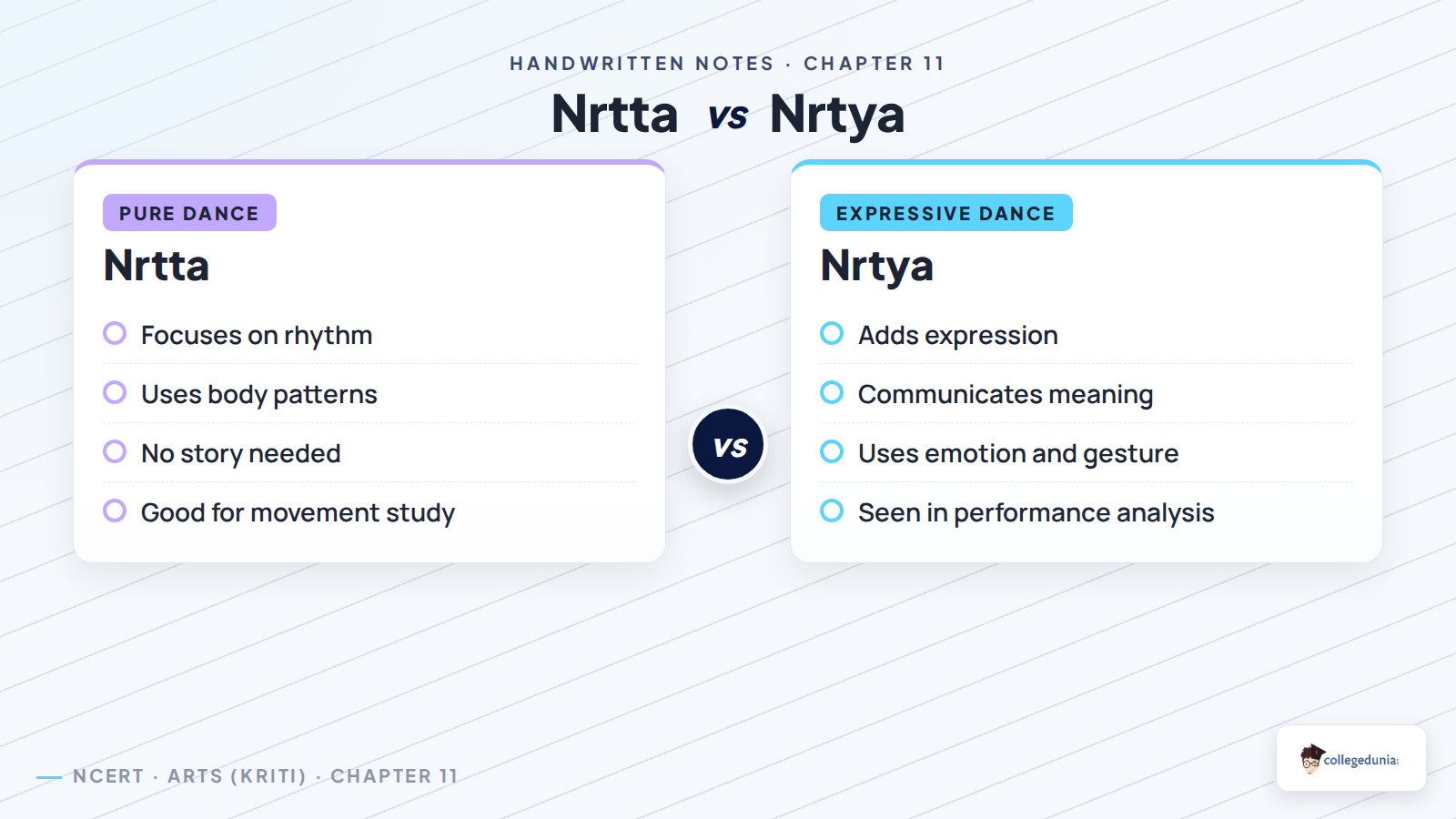
- Practise explaining nrtta as pure dance and nrtya as expressive dance.
More Arts Resources
| Resource | Use |
|---|---|
| Chapter 5 Discovering the Elements of Music | Revise the building blocks of music before the dance unit. |
| Chapter 7 Indian Classical Music | Connect classical music context with classical dance forms. |
| Chapter 9 My World of Music | Use for another arts-practice handwritten revision set. |
Arts (Kriti) Handwritten Notes for Other Chapters
| Chapter | Handwritten Notes |
|---|---|
| Chapter 1 Bringing Words Alive: Play Reading | Download Notes |
| Chapter 4 Applause and Advice | Download Notes |
| Chapter 8 Inspiration and Imagination | Download Notes |
| Chapter 9 My World of Music | Download Notes |
FAQs
Are these handwritten notes based on the latest NCERT Class 8 Arts Chapter 11?
Ans. Yes. The handwritten notes follow the 2026-27 NCERT Arts (Kriti) Chapter 11 Pan Indian Dance Forms chapter.
What topics are covered in the Pan Indian Dance Forms handwritten PDF?
Ans. The PDF covers the eight major dance forms, posture clues, costume clues, folk traditions, activities and nrtta and nrtya.
How should students revise Chapter 11 quickly?
Ans. Students should revise the region, posture, costume and speciality clue for each dance form, then practise the NCERT dance matrix.



Comments