




The handwritten notes on Class 8 Arts (Kriti) Chapter 8 Inspiration and Imagination have been carefully prepared for quick 2026-27 revision. The PDF covers inspiring artists, musical monuments, musical pillars, music institutions, future-self writing and musical autobiography activities.
- Resource focus: artist research, heritage links, sound-science examples and creative writing tasks.
- Best use: revise one handwritten page, then complete the matching NCERT activity.
- Exam link: follows the NCERT 2026-27 Arts (Kriti) Chapter 8 assessment cues.
Chapter8InspirationandImaginationHandwrittenNotes.pdf?page=1&dpi=150)
Chapter8InspirationandImaginationHandwrittenNotes.pdf?page=2&dpi=150)
Chapter8InspirationandImaginationHandwrittenNotes.pdf?page=3&dpi=150)
Chapter8InspirationandImaginationHandwrittenNotes.pdf?page=4&dpi=150)
Chapter8InspirationandImaginationHandwrittenNotes.pdf?page=5&dpi=150)
Chapter8InspirationandImaginationHandwrittenNotes.pdf?page=6&dpi=150)
Chapter8InspirationandImaginationHandwrittenNotes.pdf?page=7&dpi=150)
Chapter8InspirationandImaginationHandwrittenNotes.pdf?page=8&dpi=150)
Chapter8InspirationandImaginationHandwrittenNotes.pdf?page=9&dpi=150)
Chapter8InspirationandImaginationHandwrittenNotes.pdf?page=10&dpi=150)
Chapter8InspirationandImaginationHandwrittenNotes.pdf?page=11&dpi=150)
Chapter8InspirationandImaginationHandwrittenNotes.pdf?page=12&dpi=150)
Chapter8InspirationandImaginationHandwrittenNotes.pdf?page=13&dpi=150)
Chapter8InspirationandImaginationHandwrittenNotes.pdf?page=14&dpi=150)
Chapter8InspirationandImaginationHandwrittenNotes.pdf?page=15&dpi=150)
Chapter8InspirationandImaginationHandwrittenNotes.pdf?page=16&dpi=150)
Chapter8InspirationandImaginationHandwrittenNotes.pdf?page=17&dpi=150)
Chapter8InspirationandImaginationHandwrittenNotes.pdf?page=18&dpi=150)
Chapter8InspirationandImaginationHandwrittenNotes.pdf?page=19&dpi=150)
Chapter8InspirationandImaginationHandwrittenNotes.pdf?page=20&dpi=150)
Chapter8InspirationandImaginationHandwrittenNotes.pdf?page=21&dpi=150)
Chapter8InspirationandImaginationHandwrittenNotes.pdf?page=22&dpi=150)
Chapter8InspirationandImaginationHandwrittenNotes.pdf?page=23&dpi=150)
Chapter8InspirationandImaginationHandwrittenNotes.pdf?page=24&dpi=150)
Student Feedback: In a Collegedunia study check with 8,600 Class 8 students, 77% said activity-wise handwritten notes helped them finish arts revision faster.
Inspiration and Imagination Chapter Snapshot
Inspiration and Imagination connects music with courage, heritage and future planning. The chapter begins with artists who crossed barriers, then moves to monuments, musical pillars, music institutions and personal creative writing.
- Students revise Ravindra Jain and activity-based artist research.
- The chapter treats imagination as a practical study skill.
- Activities include research, field observation, a future report and a musical autobiography.
The handwritten PDF turns the chapter into short revision pages. Students can read one page, check the activity cue and then write their own response.
How the Chapter Builds Inspiration Step by Step
The chapter does not define inspiration in an abstract way. It shows inspiration through artist stories, music-linked places and student tasks. Each part asks students to observe, listen, write or imagine.
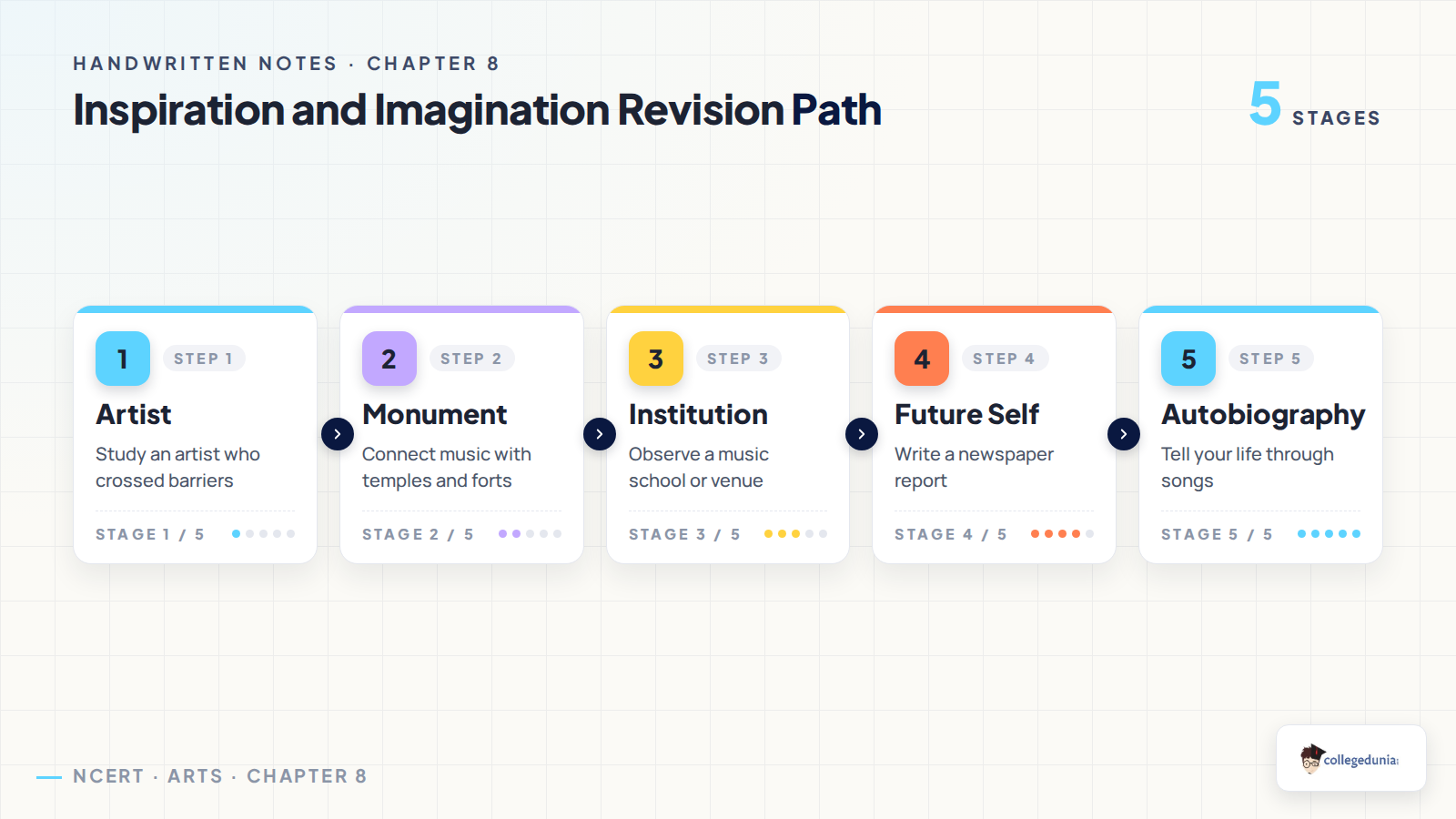
The first activity asks students to study an artist who overcame challenges. The later activities move closer to the student: a local music institution, a future-self article and a musical autobiography.
Inspiration and Imagination Audiobook
Source: NCERT OFFICIAL on YouTube
Inspiring Artists in Class 8 Arts Chapter 8
NCERT uses Ravindra Jain as a key example. He was a music composer and songwriter who worked mainly in Hindi films. Despite being blind, he composed music for more than 200 Bollywood films and also for the television series Ramayan.
Activity 8.1 asks students to learn about artists such as Ghatam Suresh Vaidyanathan and Puttaraj Gawai. The answer should include where the artist is from, the art form practised, how learning began and which barriers were crossed.
Musical Monuments and Musical Pillars
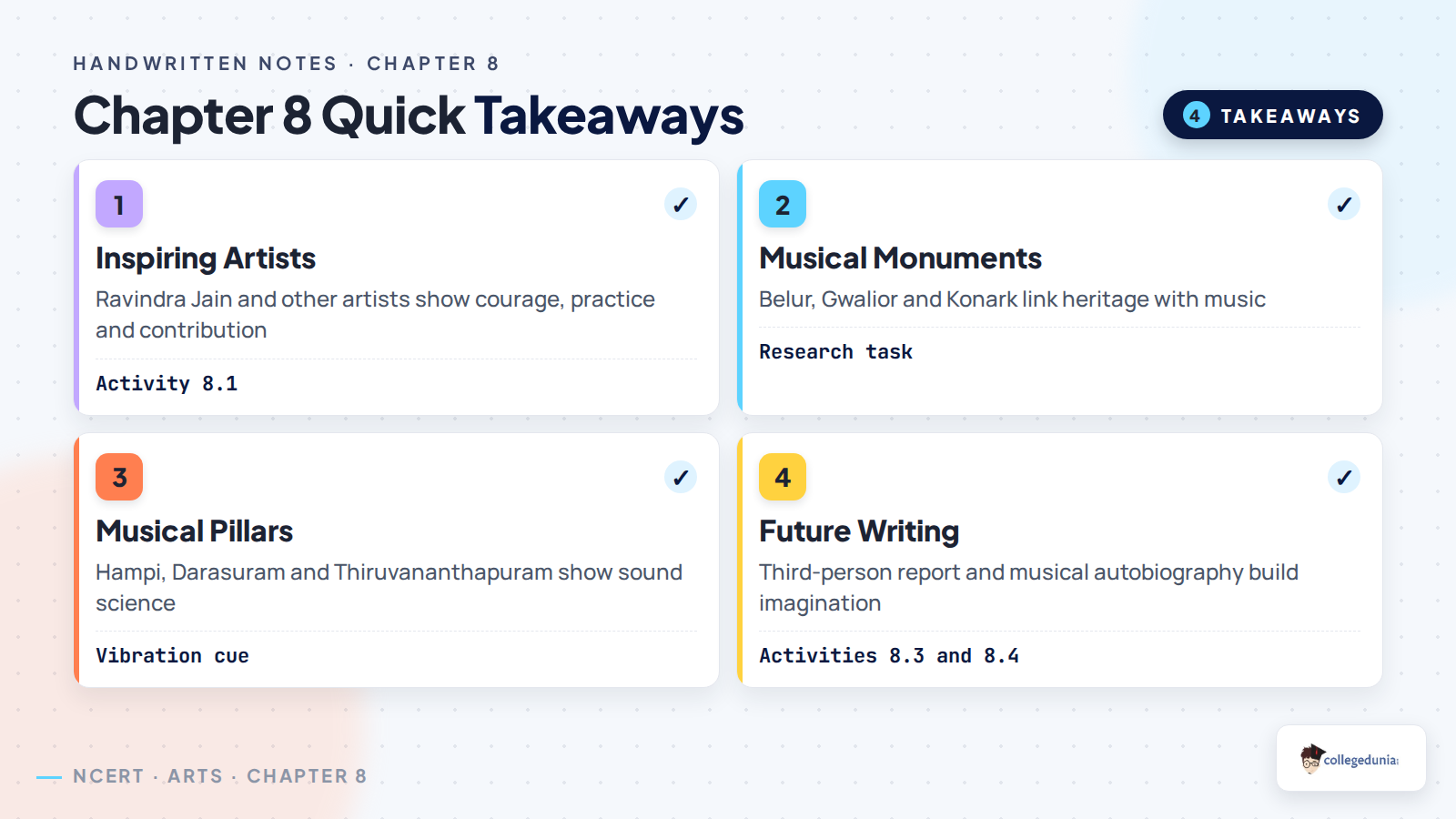
The chapter shows that music also lives inside heritage spaces. Chennakeshava Temple at Belur, Gwalior Fort and Konark Sun Temple are given as monument examples. Students should find how each place connects with music and whether concerts or festivals happen there today.
Musical pillars are the chapter's science link. Vijaya Vittala Temple at Hampi, Airavateshwara Temple at Darasuram and Padmanabha Swamy Temple at Thiruvananthapuram show how stone, carving, vibration and resonance can produce musical notes.
Activities in Inspiration and Imagination
Activity 8.2 asks students to explore a local music school, venue or institution. They must find whether it conducts classes, organises concerts or supports other music activities. If possible, the chapter suggests a real visit with family or school support.
Activity 8.3 asks students to write a newspaper article about their future self in third person. Activity 8.4 asks students to choose music pieces that tell their own life story. Both tasks train imagination through writing.
How to Use the Inspiration and Imagination Handwritten Notes
Use the PDF as an activity checklist. First revise the artist and monument pages. Then revise the three musical-pillar examples and the four activity formats.
- For Activity 8.1, prepare one artist profile with respectful language.
- For Activity 8.2, write what a music institution does and what you observed.
- For Activity 8.3, plan the headline, lead, body, quote and close.
- For Activity 8.4, match life events with songs or music pieces.
Before assessment, remember the three cues: use music to tell a personal story, reflect on a performance or institution visit and engage with contemporary artists.
More Class 8 Arts Resources for Inspiration and Imagination
| Resource | Link |
|---|---|
| NCERT Book PDF | Inspiration and Imagination Class 8 Book PDF |
| Handwritten Notes | Inspiration and Imagination Class 8 Handwritten Notes |
Class 8 Arts (Kriti) Handwritten Notes for Other Chapters
| Chapter | Handwritten Notes |
|---|---|
| Chapter 1 Bringing Words Alive: Play Reading | Download Chapter 1 Handwritten Notes |
| Chapter 2 One Stage, Many Scripts | Download Chapter 2 Handwritten Notes |
| Chapter 3 From Page to Stage | Download Chapter 3 Handwritten Notes |
| Chapter 4 Applause and Advice | Download Chapter 4 Handwritten Notes |
| Chapter 5 Discovering the Elements of Music | Download Chapter 5 Handwritten Notes |
| Chapter 6 Musical Instruments | Download Chapter 6 Handwritten Notes |
| Chapter 7 Indian Classical Music | Download Chapter 7 Handwritten Notes |
Inspiration and Imagination Class 8 Handwritten Notes FAQs
Ques. What is covered in the Inspiration and Imagination handwritten notes?
Ans. The notes cover inspiring artists, Ravindra Jain, musical monuments, musical pillars, a music institution visit, future-self writing and musical autobiography.
Ques. Are these handwritten notes based on the 2026-27 NCERT chapter?
Ans. Yes. The notes follow Class 8 Arts (Kriti) Chapter 8 Inspiration and Imagination from the 2026-27 NCERT textbook.
Ques. Which activities are included in Class 8 Arts Chapter 8?
Ans. The chapter includes artist research, music institution exploration, a future-self newspaper article and a musical autobiography activity.



Comments