




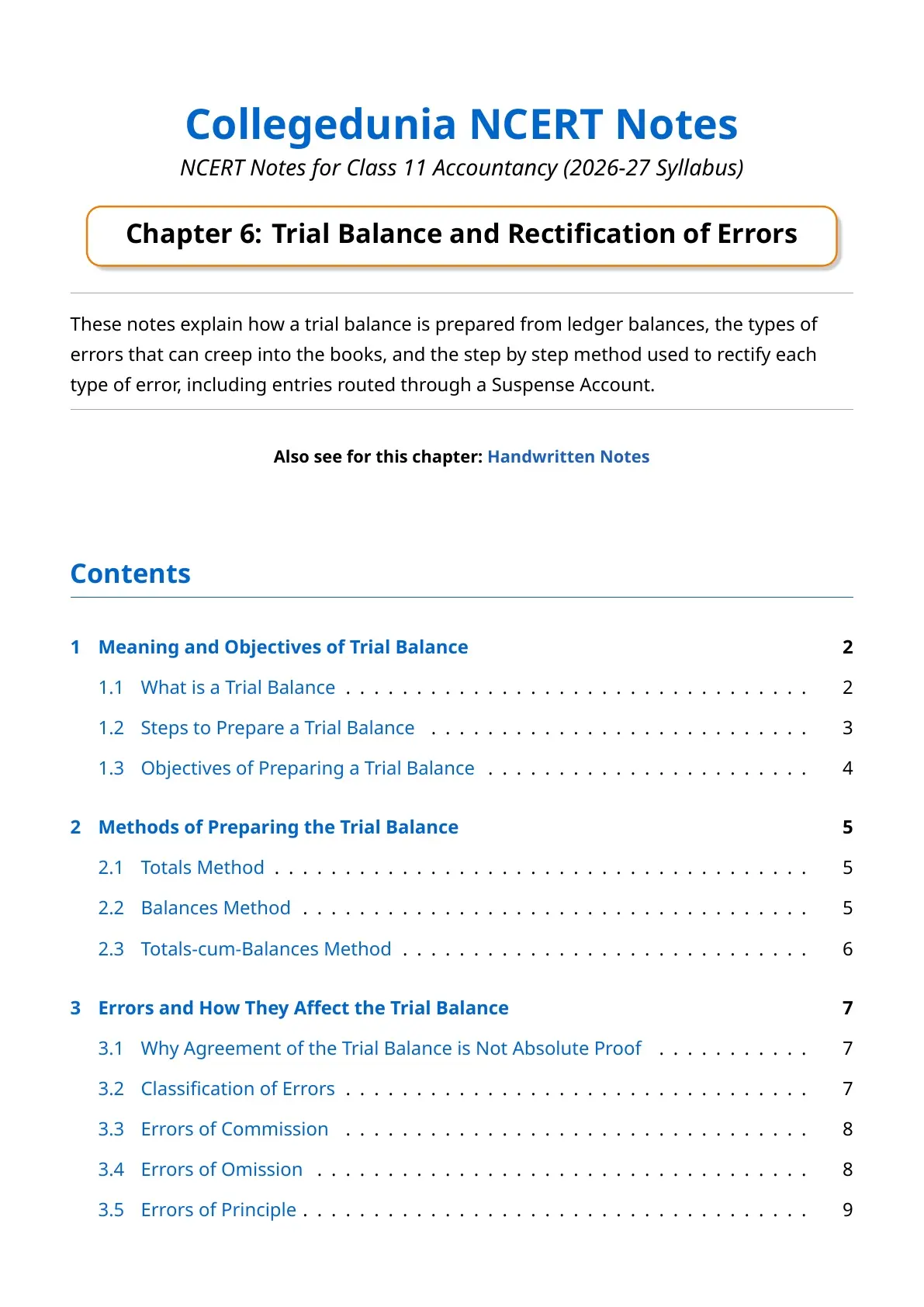
5 to 6 marks in almost every CBSE Class 11 Accountancy board paper come from Trial Balance and Rectification of Errors. Collegedunia's NCERT Notes Class 11 Accountancy Chapter 6 Trial Balance and Rectification of Errors are free to download as a 20-page PDF and cover every error type, the Suspense Account, and the exact rectification steps the 2026-27 CBSE paper expects.
- CBSE Weightage: A Suspense Account numerical, worth 4 to 6 marks, is one of the most repeated questions from this chapter.
- CUET Weightage: Classifying an error into commission, omission, principle or compensating is a recurring MCQ pattern in CUET Commerce.
- Covers: All three trial balance methods, all four error types, and rectification both before and after the trial balance, according to the 2026-27 NCERT.
This NCERT Notes Class 11 Accountancy Chapter 6 Trial Balance and Rectification of Errors page is curated by subject experts, mapped to the 2026-27 NCERT, and checked against the last five years of CBSE board question papers.
What Trial Balance Means and Why It Is Prepared
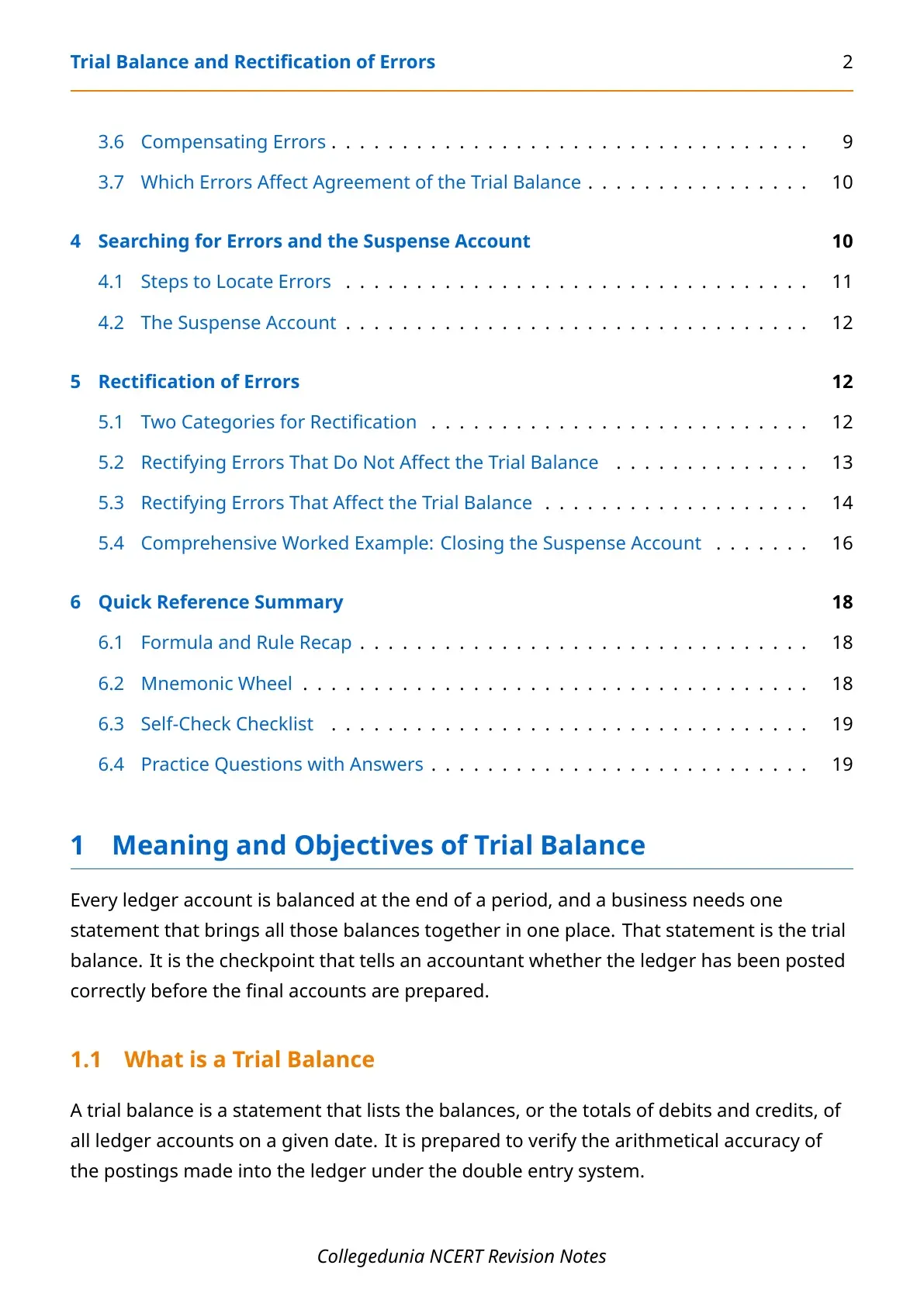
Every ledger account is balanced at the end of a period. A trial balance is the single statement that brings all of these balances together, listing each account's debit or credit balance side by side, so that the accountant can check the arithmetical accuracy of the entire ledger in one place.
- It is normally prepared at the end of the accounting year, though a firm may prepare one monthly or quarterly.
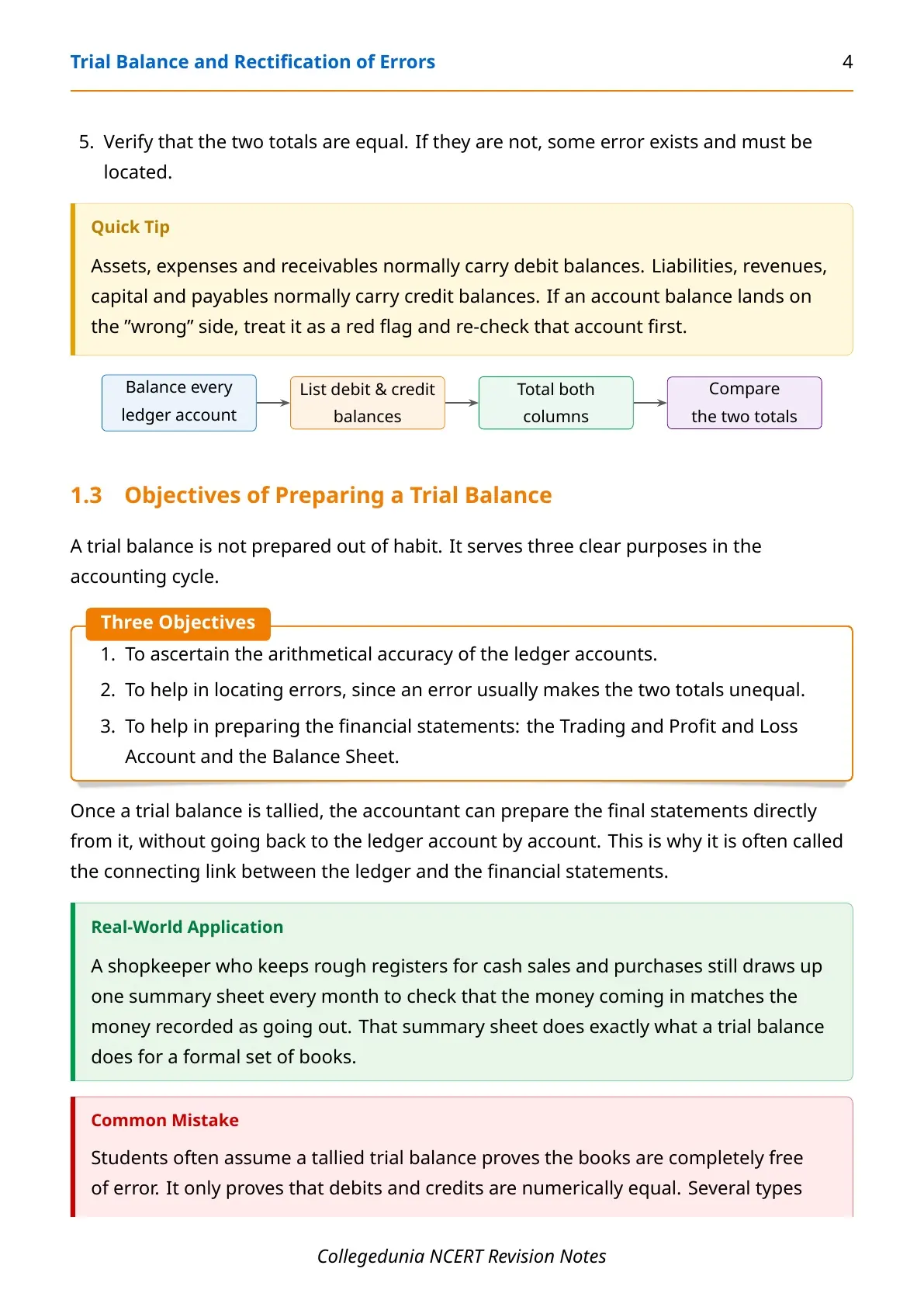
- If the debit and credit columns do not tally, at least one error exists somewhere in the books.
Trial Balance and Rectification of Errors Video Explanation
Source: GPTSir - Wonderslate on YouTube
Three Methods of Preparing the Trial Balance
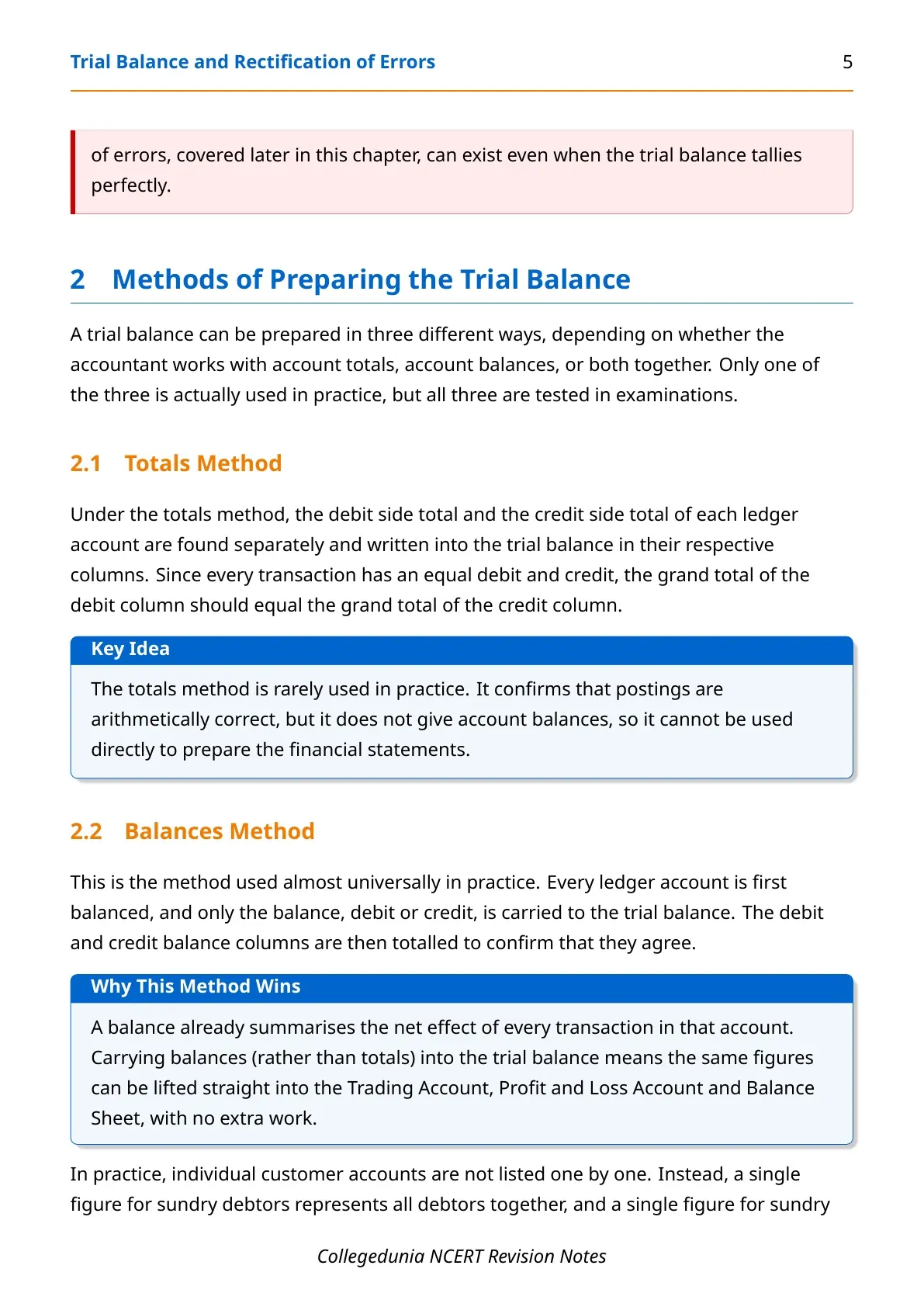
The 2026-27 NCERT explains three ways to prepare a trial balance, though only one is actually used by real businesses.
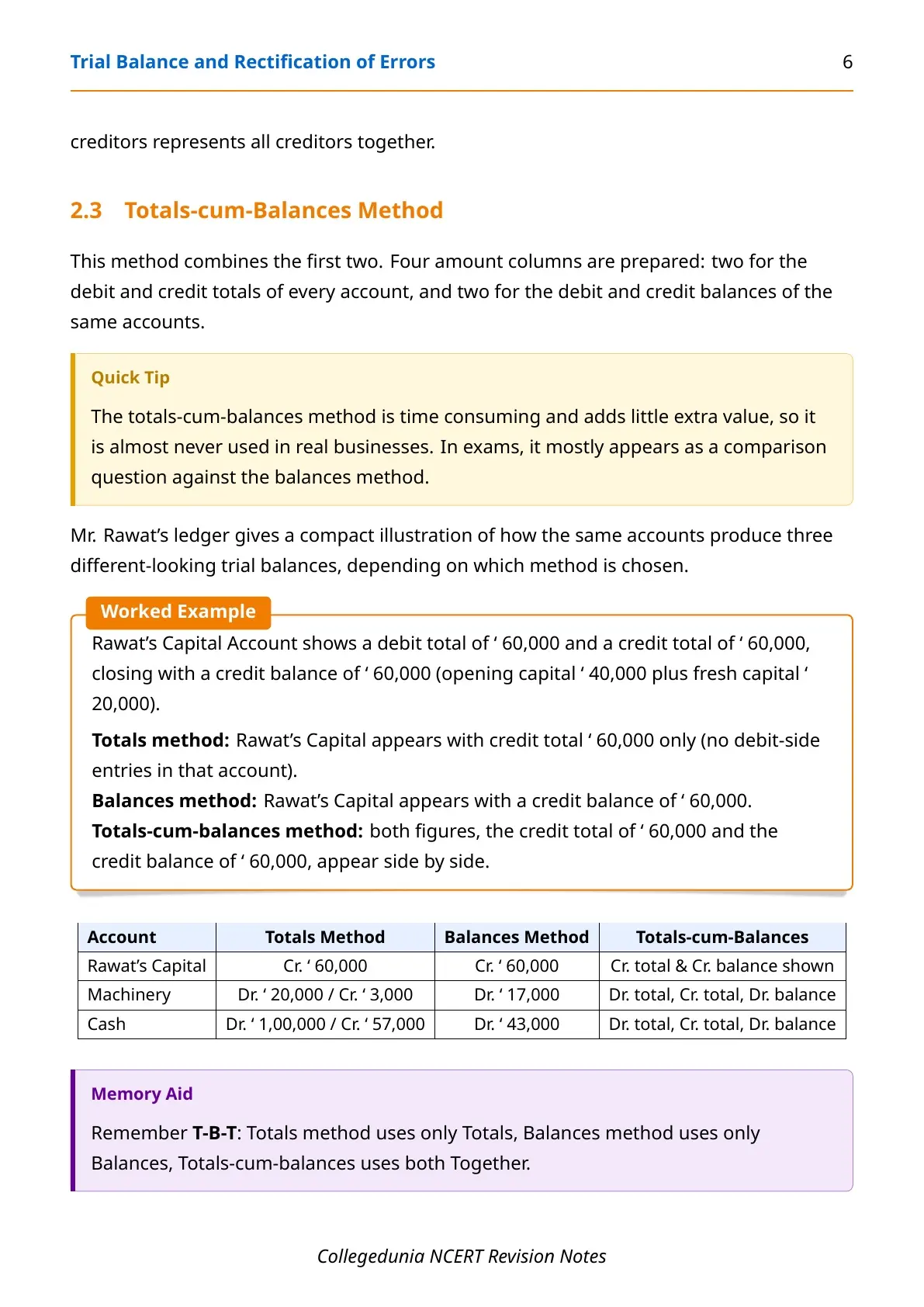
| Method | What It Carries | Used in Practice? |
|---|---|---|
| Totals Method | The debit-side total and credit-side total of each account | Rarely, does not give balances |
| Balances Method | Only the final balance, debit or credit, of each account | Yes, the standard method |
| Totals-cum-Balances Method | Both the totals and the balances, in four columns | Rarely, time-consuming |
In the Balances Method, sundry debtors are shown as one combined figure instead of listing every customer account, and sundry creditors are shown the same way. This is the method every CBSE numerical expects unless the question names another method.
The Four Types of Errors in Accountancy
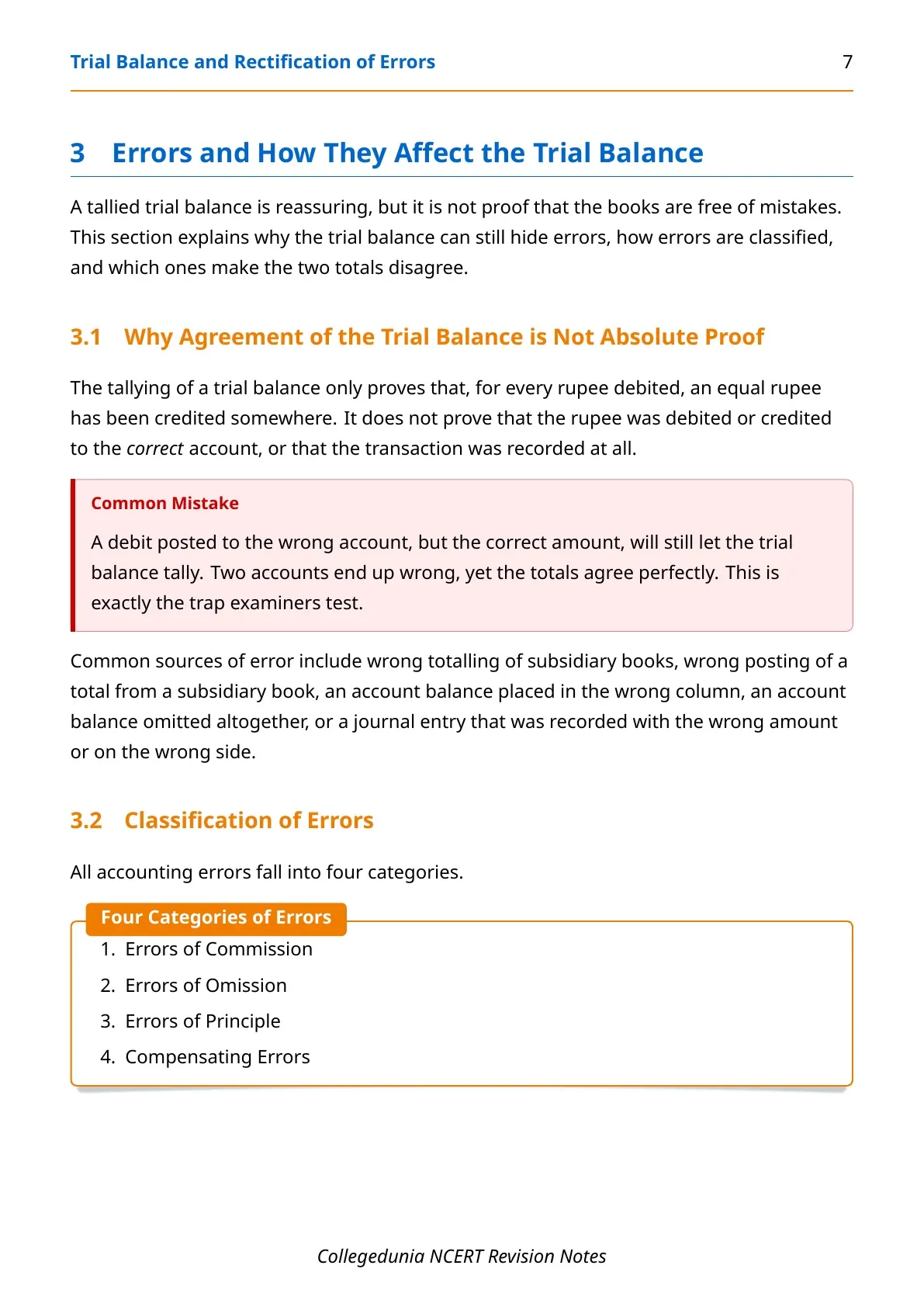
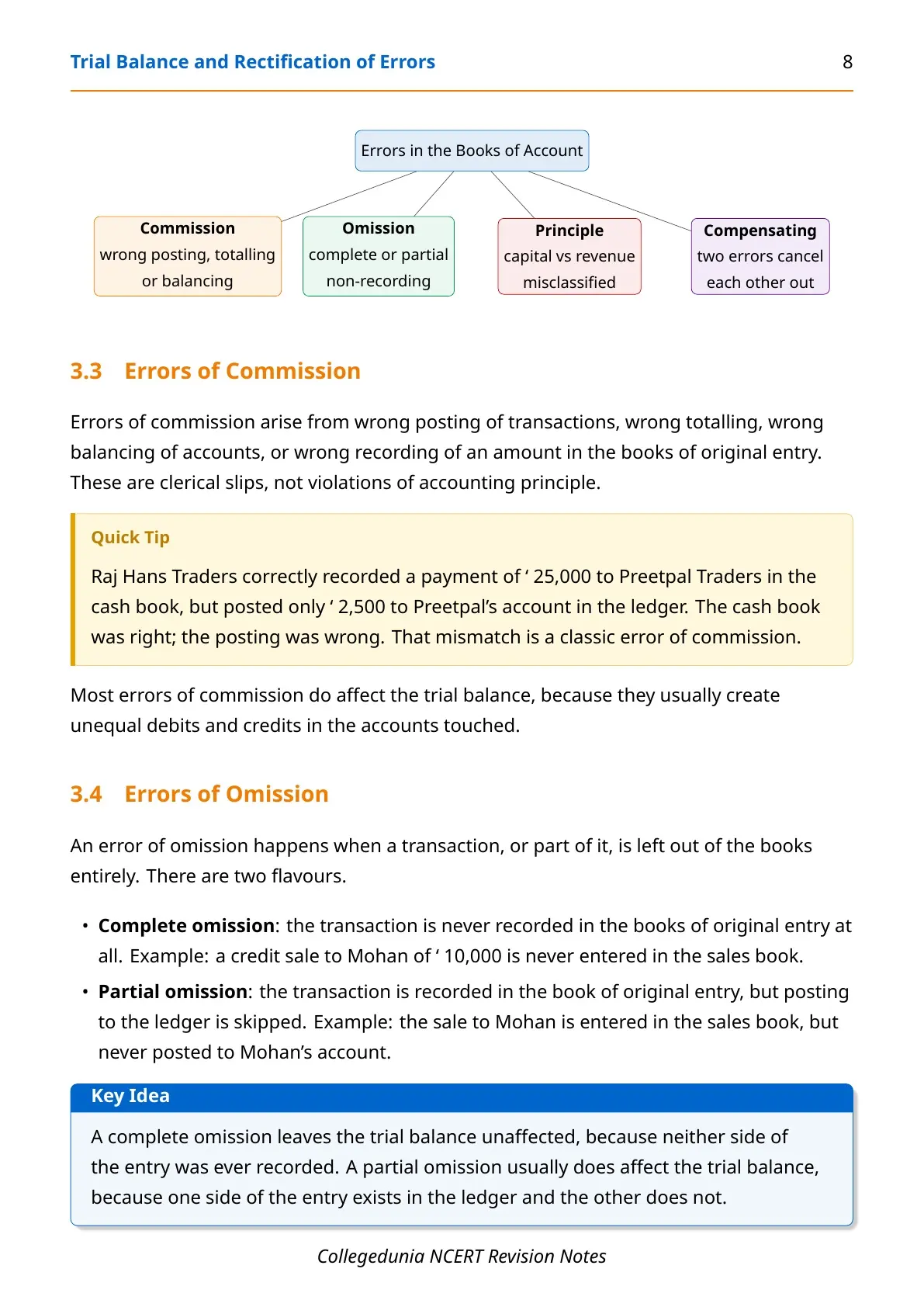
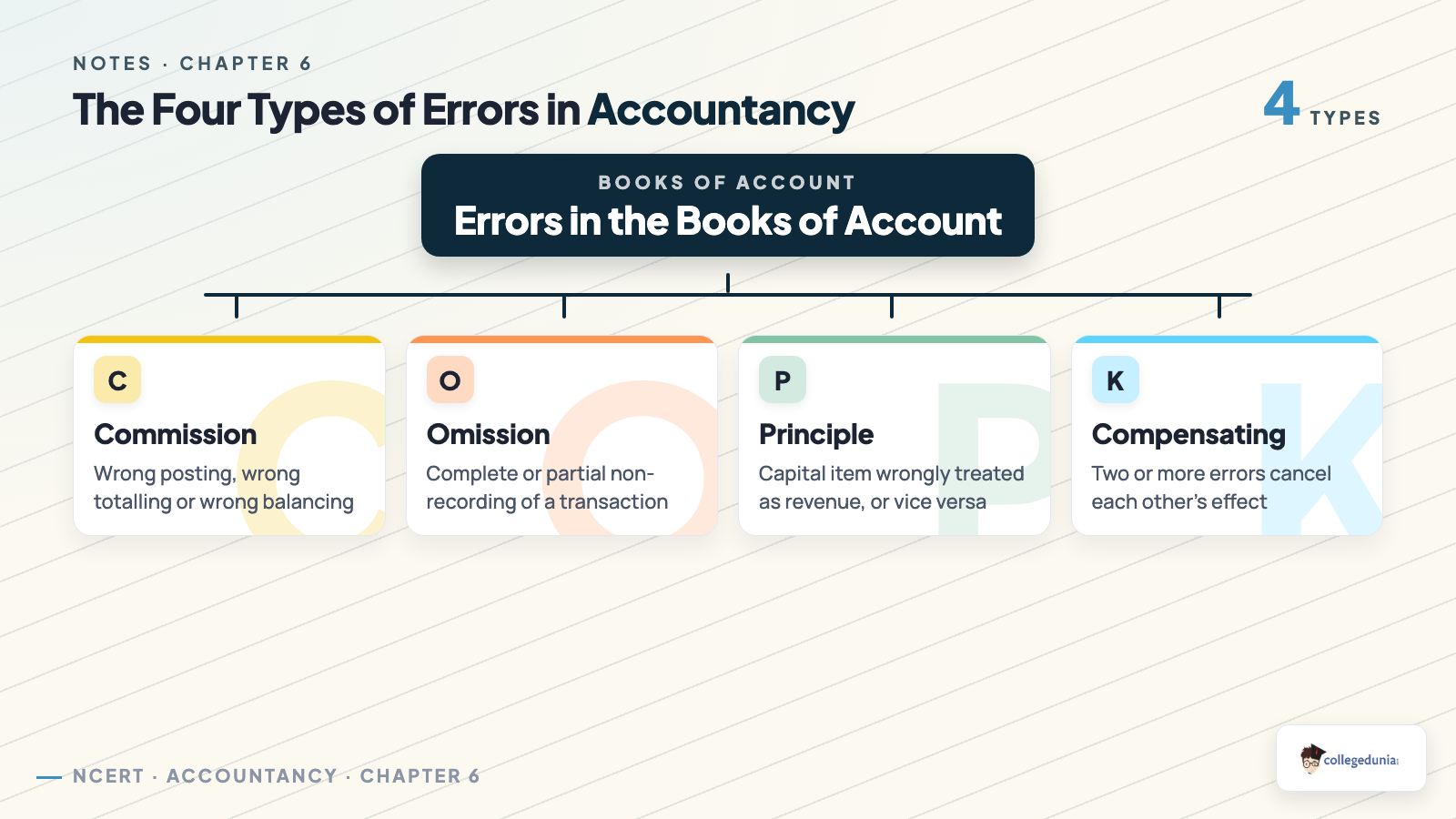
Every accounting error committed anywhere in the books falls into one of four categories. Learning which category an error belongs to is the first step before rectifying it.
| Error Type | What Causes It | Example |
|---|---|---|
| Errors of Commission | Wrong posting, wrong totalling or wrong balancing, a clerical slip | A payment of ₹25,000 posted to the ledger as ₹2,500 |
| Errors of Omission | A transaction, complete or partial, left out of the books | A credit sale never entered in the sales book at all |
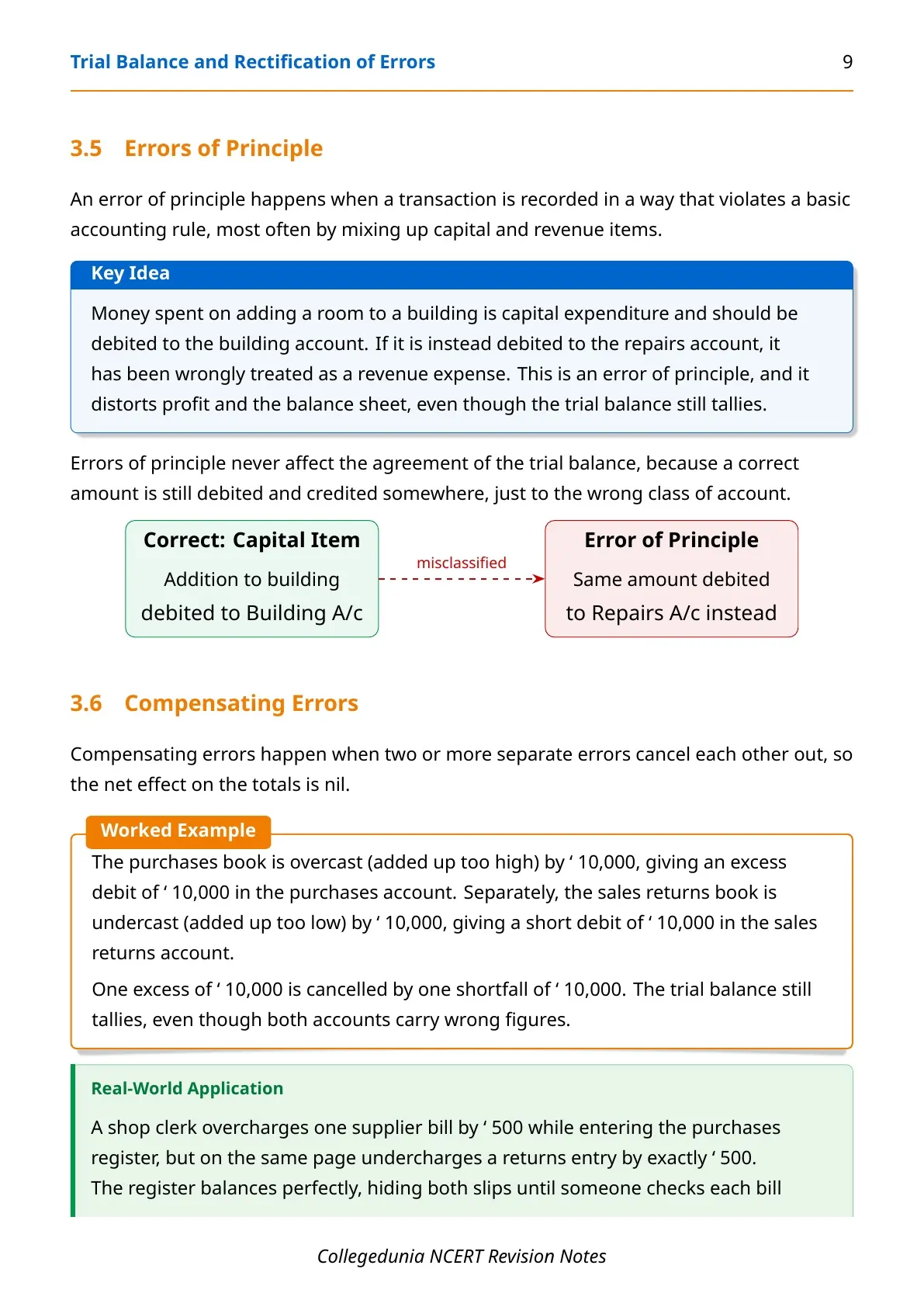
| Errors of Principle | Mixing up capital and revenue items | Money spent adding a room debited to the repairs account |
| Compensating Errors | Two or more errors cancel each other out | Purchases book overcast by ₹10,000 while sales returns book is undercast by the same amount |
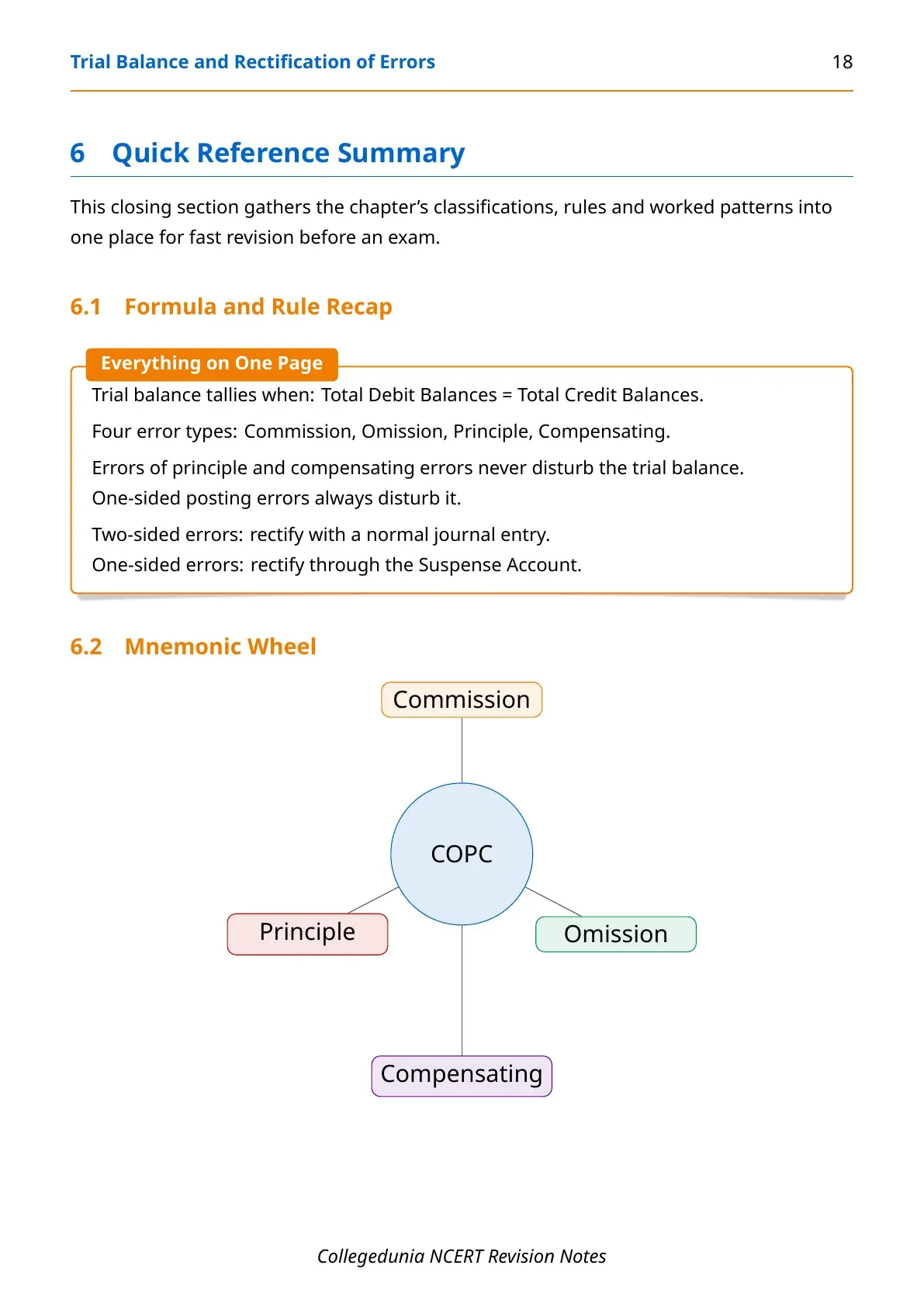
Errors of principle and compensating errors never disturb the trial balance, because a correct total amount is still debited and credited somewhere. Errors of commission and omission usually do, since one side of the double entry ends up short or missing.
Which Errors Affect the Trial Balance and Which Do Not
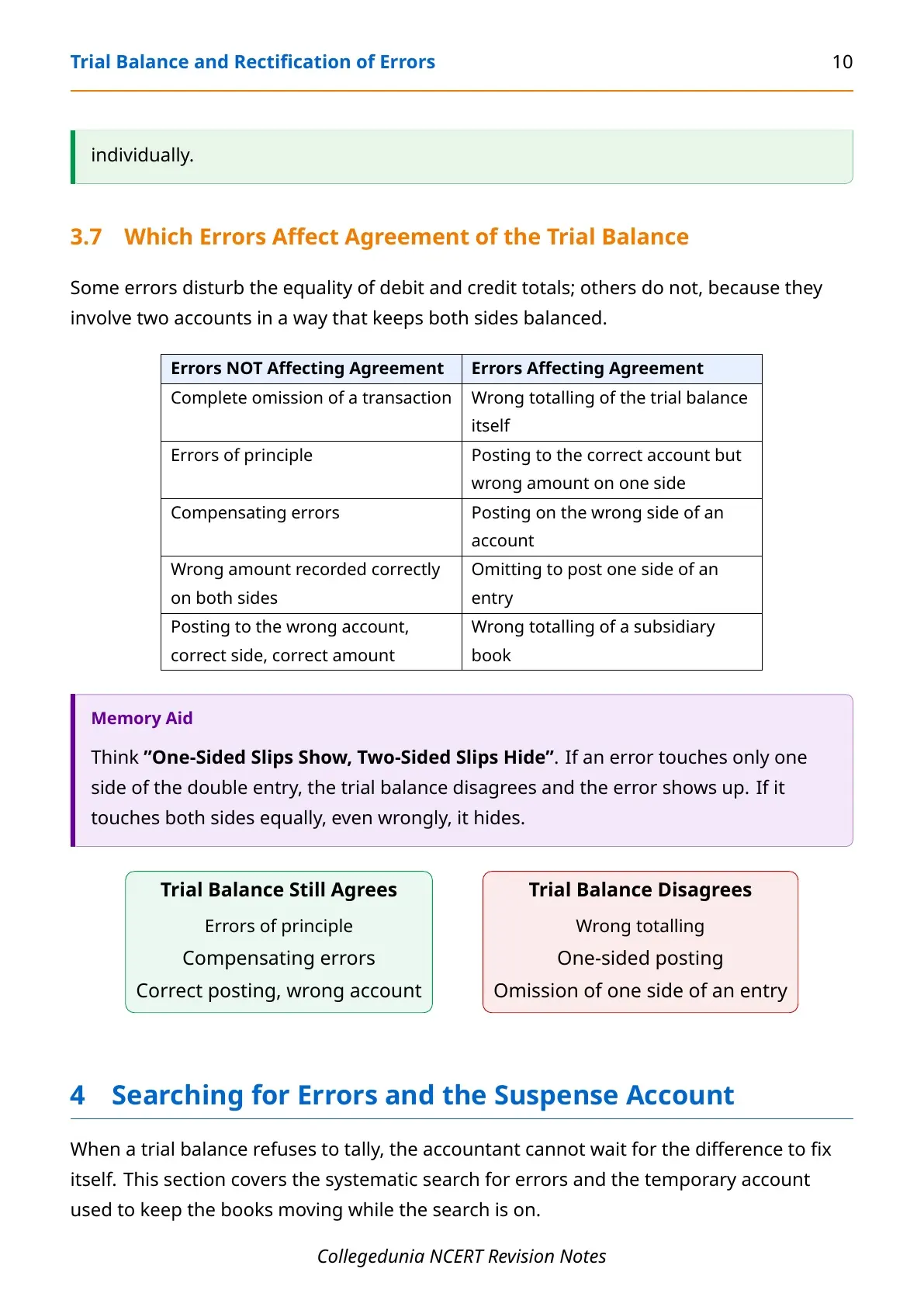
A tallied trial balance feels reassuring, but it is not proof that the books are free of mistakes. Some errors keep both sides equal, even when they are wrong.
| Trial Balance Still Tallies | Trial Balance Disagrees |
|---|---|
| Complete omission of a transaction | Wrong totalling of the trial balance itself |
| Errors of principle | Posting to the correct account but the wrong amount on one side |
| Compensating errors | Posting on the wrong side of an account |
| Posting to the wrong account, correct side, correct amount | Omitting to post one side of an entry |
A debit posted to the wrong account, but the correct amount, still lets the trial balance tally. Two accounts end up wrong, yet the totals agree, which is exactly the trap CBSE examiners test.
Searching for Errors and the Suspense Account
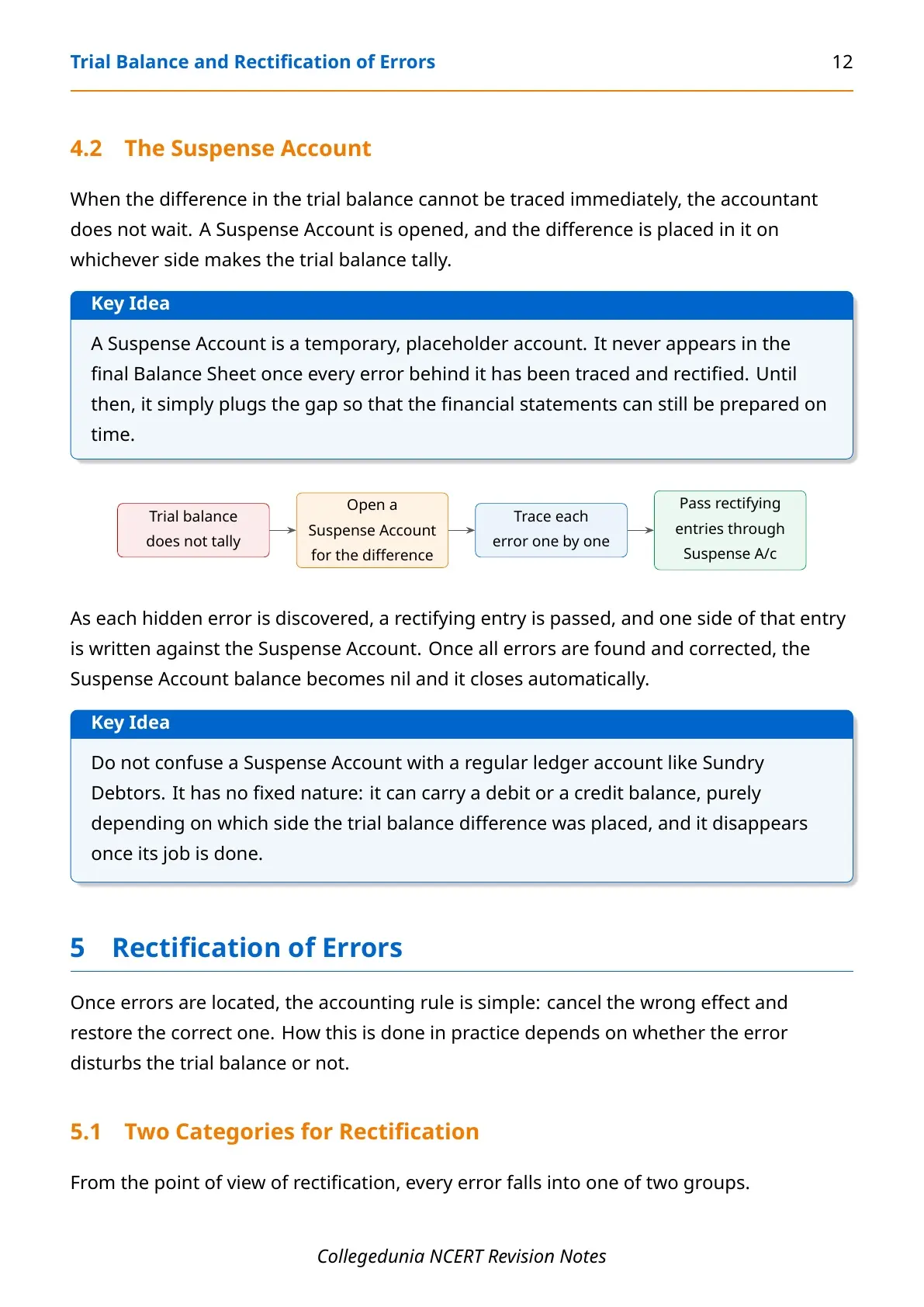
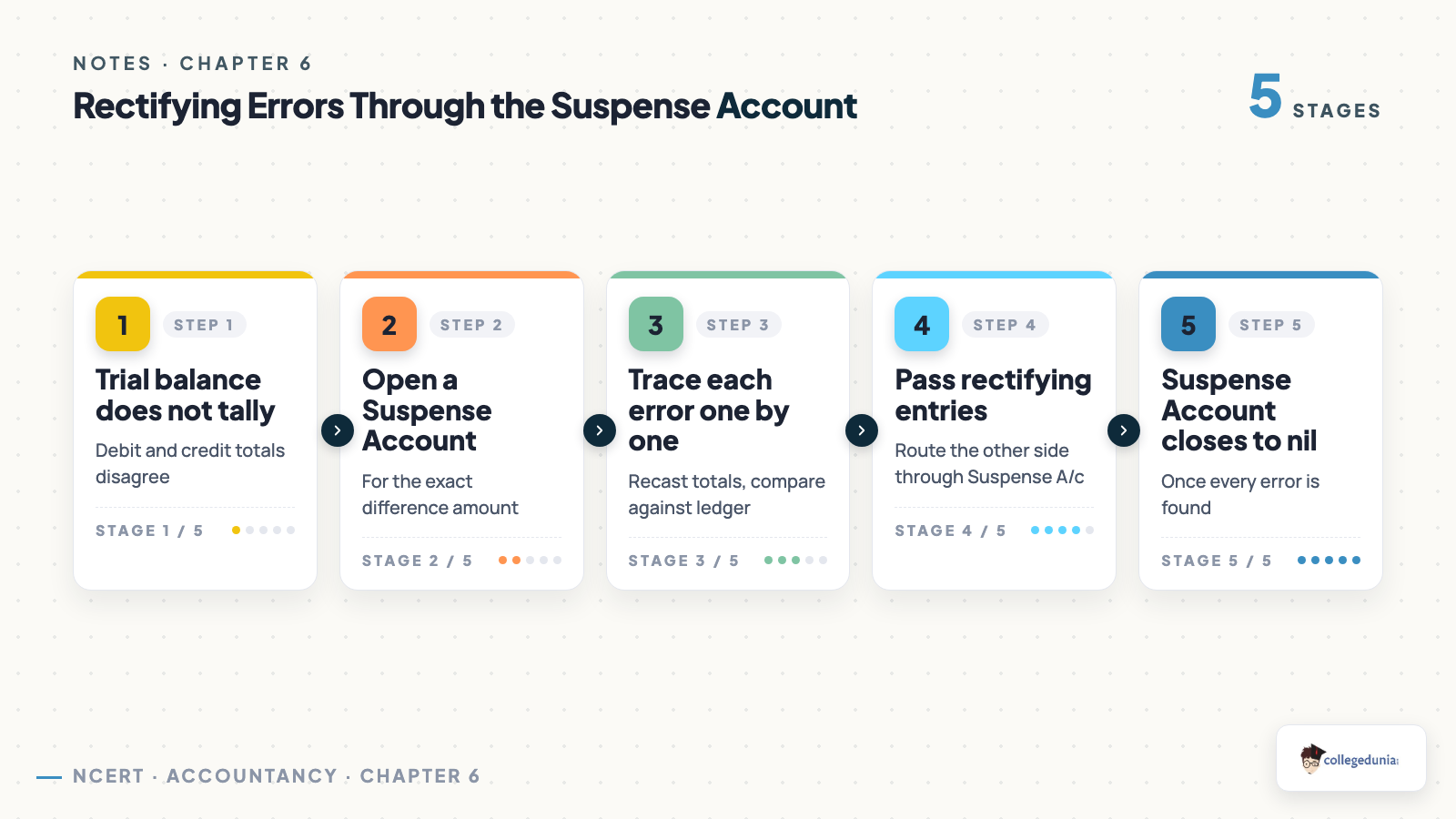
When the trial balance does not tally, the accountant does not wait for the difference to fix itself. A fixed search routine, followed by a temporary account, keeps the books moving while errors are traced.
- Recast the totals, then compare every account balance in the trial balance against the ledger.
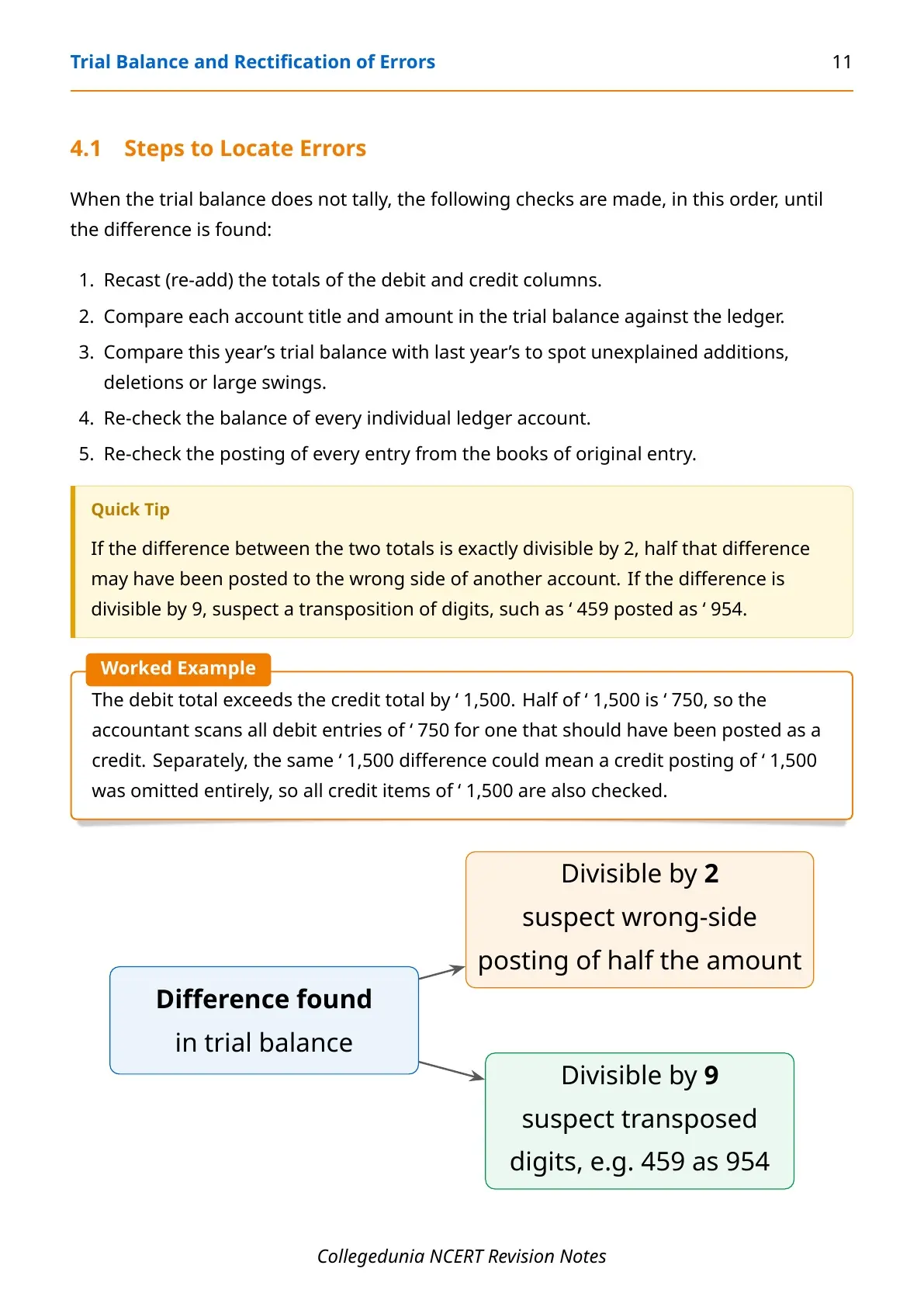
- If the difference is divisible by 2, half that amount may sit on the wrong side of another account.
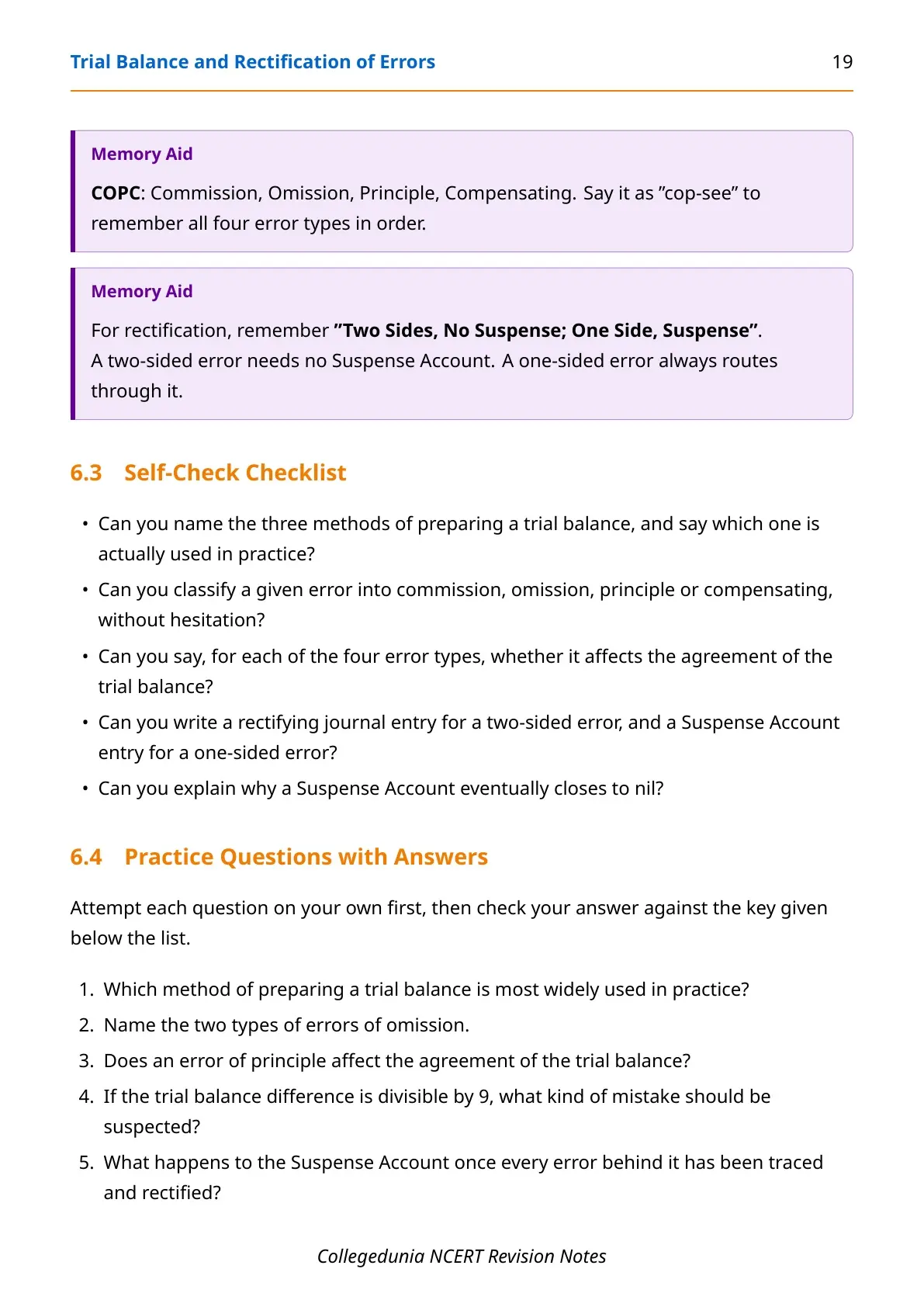
- If the difference is divisible by 9, suspect a transposition of digits, such as ₹459 posted as ₹954.
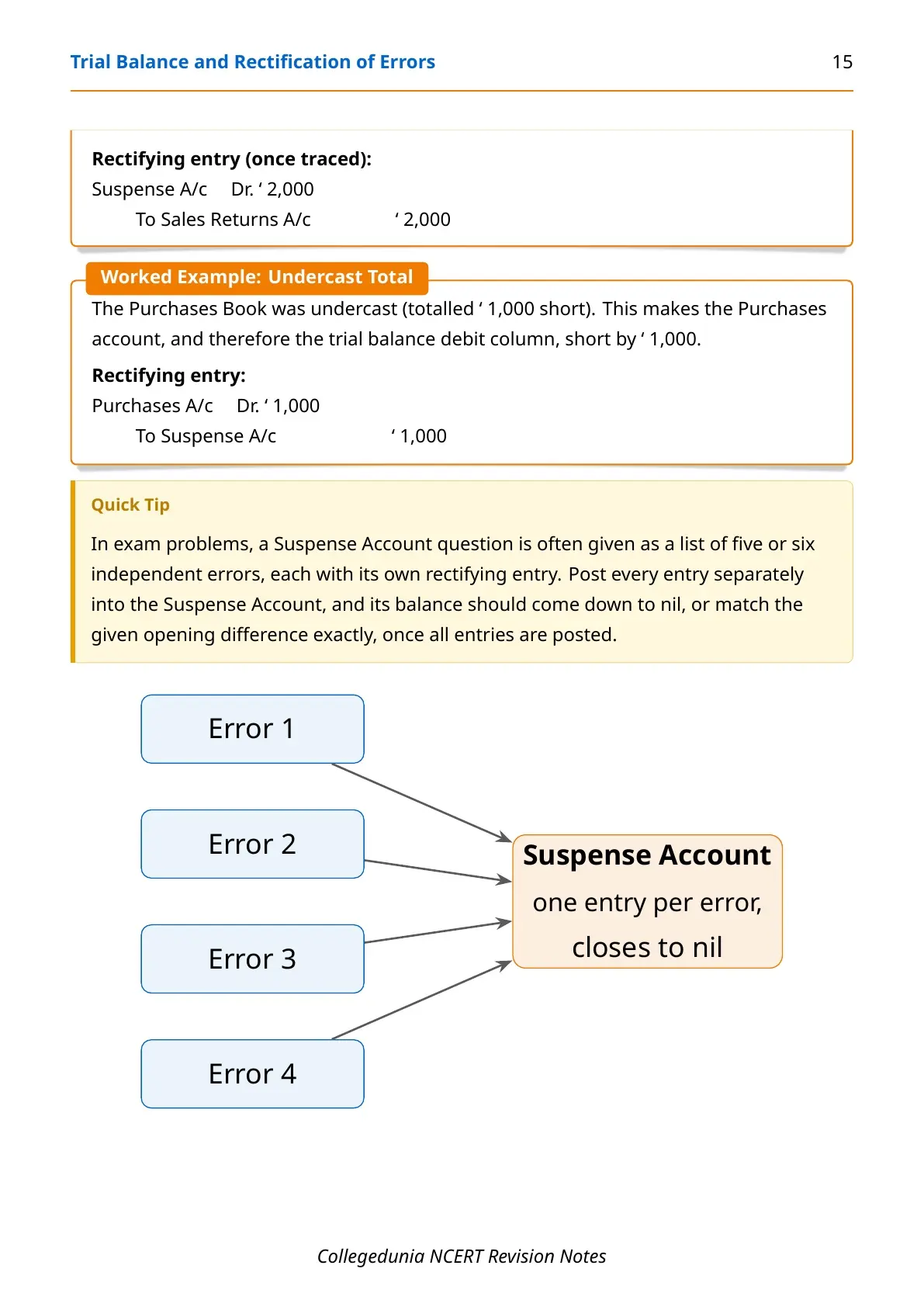
Only one Suspense Account is opened per difference. Every rectifying entry for a one-sided error is posted into that same account, one entry at a time, until its balance reaches zero.
Rectifying Errors Step by Step With Solved Examples
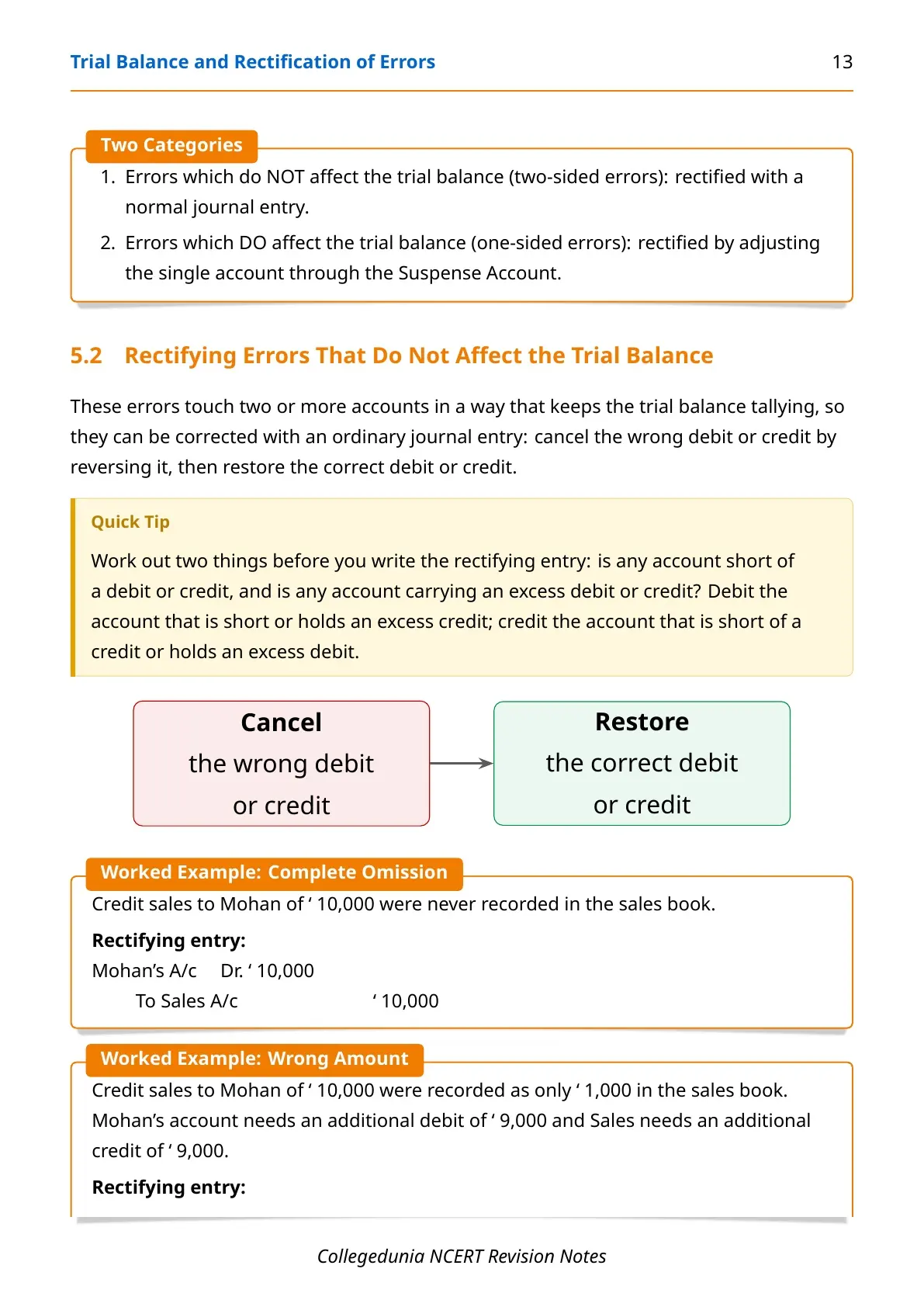
Rectification splits into two clean paths, depending on whether the original error touched one account or two.
| Error Touches | Rectified With |
|---|---|
| Two accounts (does not affect trial balance) | A normal journal entry, cancel the wrong effect then restore the correct one |
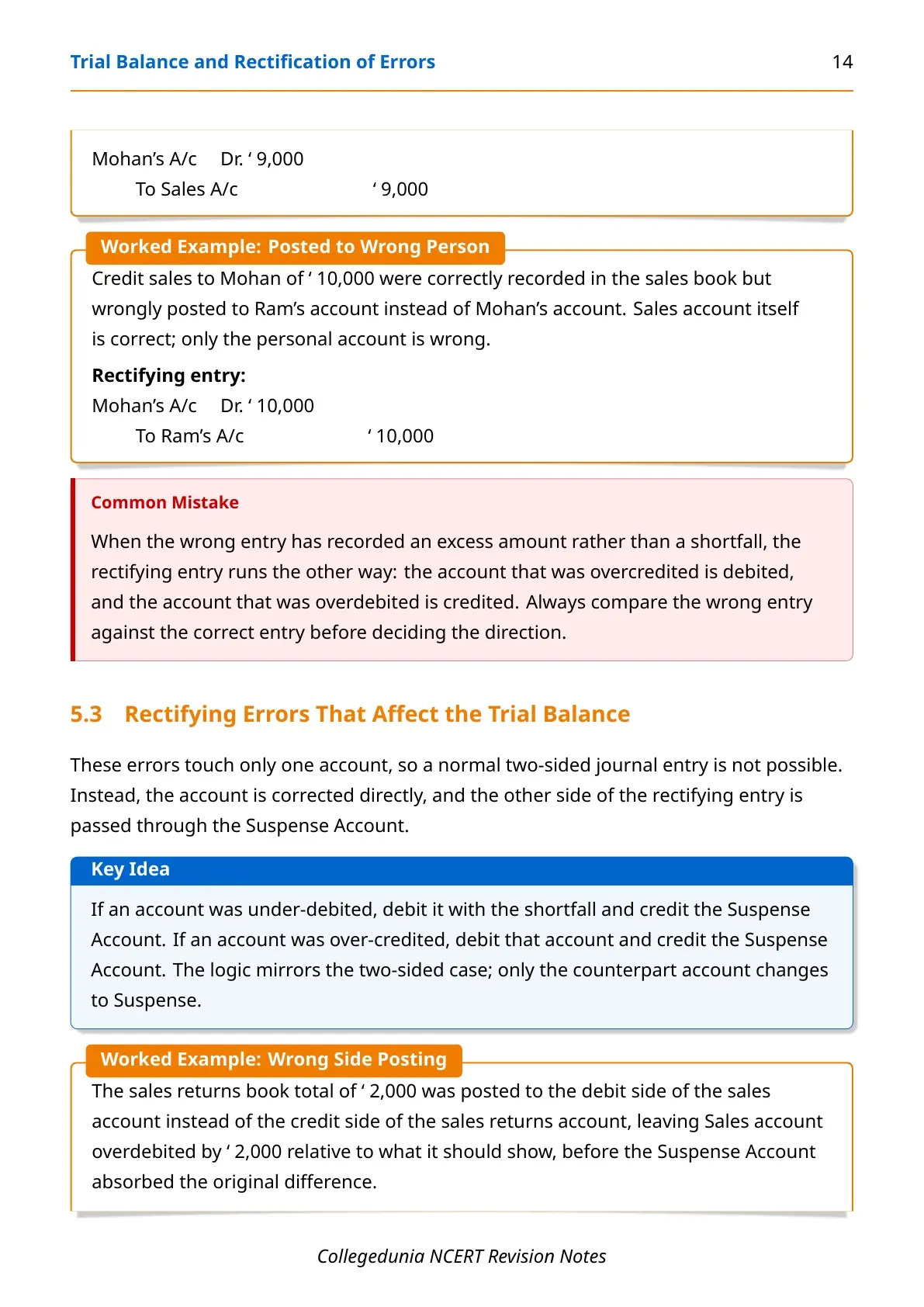
| One account (affects trial balance) | Correct that account directly, and route the other side through the Suspense Account |
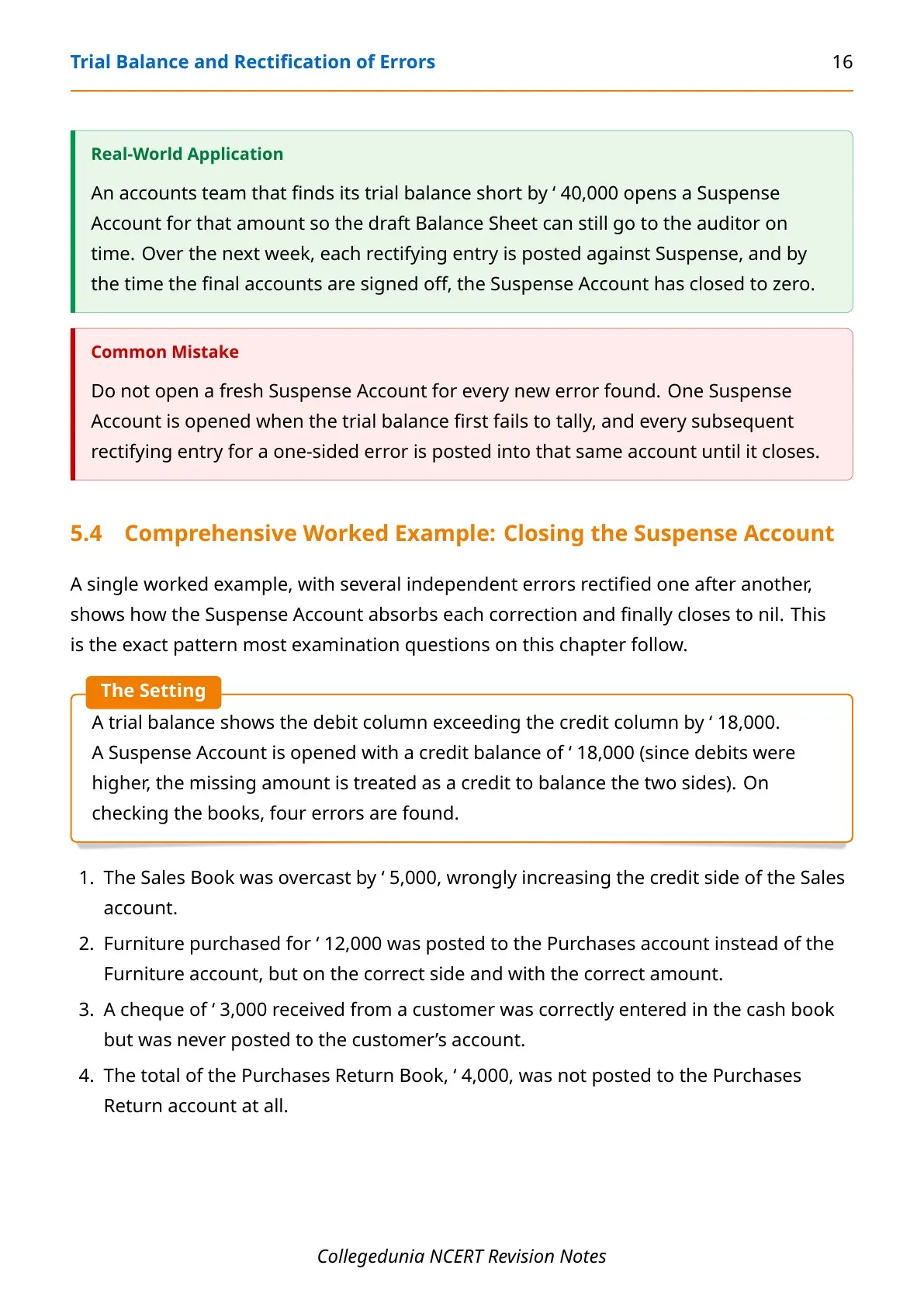
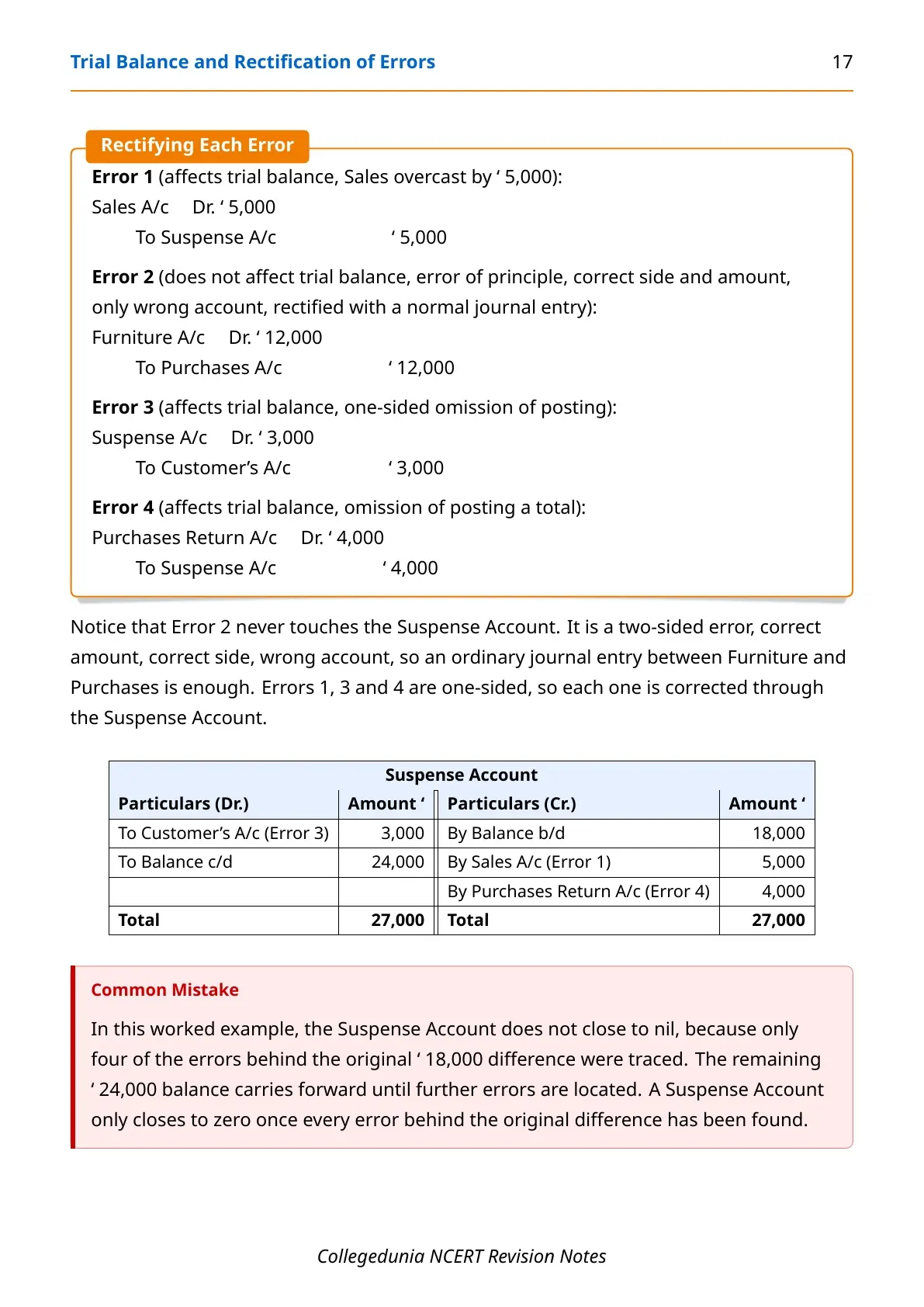
Here is one full solved example in the pattern CBSE tests most often. The complete PDF carries several such solved rectifications, ending in a comprehensive Suspense Account ledger.
| Error | Rectifying Entry |
|---|---|
| Credit sales to Mohan of ₹10,000 never entered in the sales book | Mohan's A/c Dr. ₹10,000, To Sales A/c ₹10,000 |
| Sales Book overcast by ₹5,000, wrongly raising the Sales credit side | Sales A/c Dr. ₹5,000, To Suspense A/c ₹5,000 |
| Furniture of ₹12,000 posted to the Purchases account instead of Furniture | Furniture A/c Dr. ₹12,000, To Purchases A/c ₹12,000 |
Work out two things before writing any rectifying entry: is any account short of a debit or credit, and is any account carrying an excess debit or credit. Debit the account that is short or holds an excess credit; credit the account that is short of a credit or holds an excess debit.
Trial Balance and Rectification of Errors Topic-wise Weightage for CBSE Class 11
A Suspense Account numerical is the single most predictable question this chapter sends into the board paper, since it can test all four error types in one problem.
| Sub-topic | Weightage | CBSE Frequency |
|---|---|---|
| Suspense Account rectification numerical | High | Almost every year |
| Classification of an error (commission/omission/principle/compensating) | Medium | 3 out of last 5 years |
| Which errors affect trial balance agreement | Medium | 2-3 out of last 5 years |
| Trial balance format and preparation method (theory) | Low | 1-2 out of last 5 years |
Important Formats and Rules to Remember
These are the exact rules this chapter is built on. Keep this box open while you practise rectification numericals.
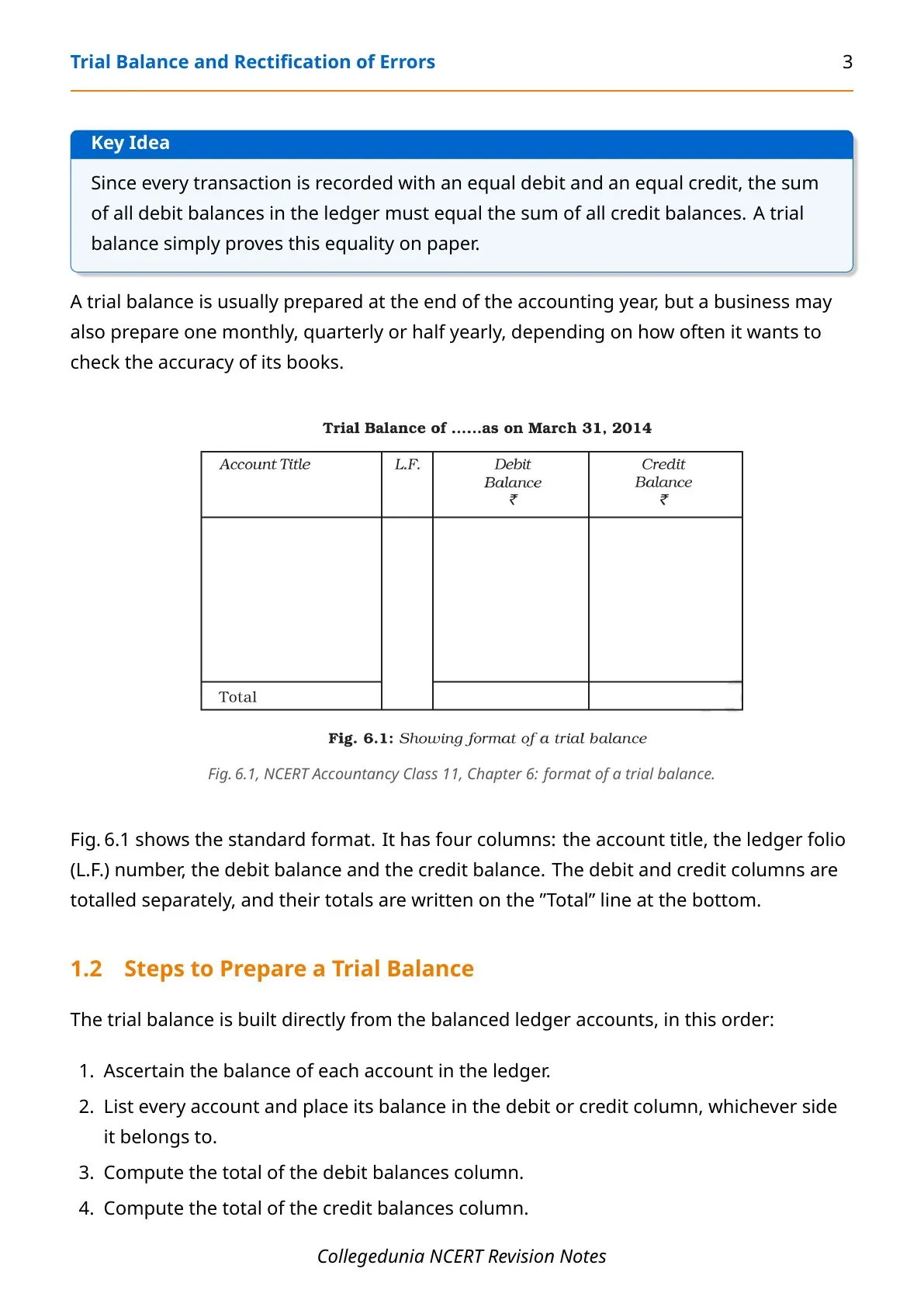
- Trial balance format: Account Title, L.F., Debit Balance, Credit Balance columns, ending in a Total row.
- Two-sided error: cancel the wrong debit or credit, then restore the correct debit or credit, using a normal journal entry.
- One-sided error: correct the account directly, and route the other side through the Suspense Account.
- Closing rule: a Suspense Account balance reaches nil only once every error behind the original difference is found.
Common Mistakes Students Make in the Trial Balance Chapter
| Mistake | Fix |
|---|---|
| Assuming a tallied trial balance proves the books are error-free | It only proves debits and credits are numerically equal, not that every entry is correct |
| Opening a fresh Suspense Account for every new error found | One Suspense Account absorbs every one-sided rectifying entry until it closes |
| Treating an error of principle as one that disturbs the trial balance | Errors of principle never disturb the trial balance, only the classification of the amount |
| Writing the rectifying entry in the wrong direction on an excess-amount error | Always compare the wrong entry against the correct entry before deciding which account to debit |
Key Accounting Terms Glossary for Trial Balance and Rectification of Errors
| Term | Meaning |
|---|---|
| Trial balance | A statement listing the debit or credit balance of every ledger account on a given date |
| Suspense Account | A temporary account opened for the trial balance difference, closed once all errors are traced |
| Error of commission | A clerical error, such as wrong posting, totalling or balancing |
| Error of omission | A transaction, complete or partial, left out of the books |
| Error of principle | A transaction recorded against a basic accounting rule, usually capital vs revenue |
| Compensating errors | Two or more errors whose net effect on the totals is nil |
| Rectification | The process of correcting an error by cancelling its wrong effect and restoring the correct one |
How Collegedunia's Notes Help You With Trial Balance and Rectification of Errors
The NCERT Notes Class 11 Accountancy Chapter 6 Trial Balance and Rectification of Errors on this page are built to match how Class 11 board papers actually test this chapter.
- 2026-27 NCERT Alignment: Every format and rule matches the current NCERT print.
- All Four Error Types Side by Side: Commission, omission, principle and compensating, each with a solved example.
- A Complete Suspense Account Ledger: One solved example that carries several errors through to a closing balance, the exact skill the board tests.
- Quick Recall Boxes: The trial balance format, the rectification rule and a mnemonic for last-day revision.
Trial Balance and Rectification of Errors Class 11 Accountancy Resources
Besides the NCERT Notes Class 11 Accountancy Chapter 6 Trial Balance and Rectification of Errors on this page, every other resource type for this chapter sits in one place below.
| Resource | Status |
|---|---|
| Trial Balance and Rectification of Errors Class 11 Notes | You are reading this page |
| Trial Balance and Rectification of Errors Class 11 Handwritten Notes | Available now |
| Trial Balance and Rectification of Errors Class 11 NCERT Solutions | (coming soon) |
| Trial Balance and Rectification of Errors Class 11 NCERT Book PDF | (coming soon) |
NCERT Notes for Class 11 Accountancy: All Chapters
Jump to the notes for any other Class 11 Accountancy chapter.
| Chapter | Notes |
|---|---|
| Chapter 1 | Introduction to Accounting |
| Chapter 2 | Theory Base of Accounting |
| Chapter 3 | Recording of Transactions-I |
| Chapter 4 | Recording of Transactions-II |
| Chapter 5 | Bank Reconciliation Statement |
| Chapter 6 | Trial Balance and Rectification of Errors (this page) |
| Chapter 7 | Depreciation, Provisions and Reserves (coming soon) |
Trial Balance and Rectification of Errors Class 11 Accountancy Notes FAQs
Ques. What is a Trial Balance in Class 11 Accountancy Chapter 6?
Ans. A trial balance is a statement listing the balances, or the totals of debits and credits, of all ledger accounts on a given date, prepared to verify the arithmetical accuracy of the postings made under the double entry system.
Ques. What are the four types of errors in accountancy?
Ans. Errors of commission, errors of omission, errors of principle and compensating errors. Commission and omission usually disturb the trial balance, while principle and compensating errors do not.
Ques. What is a Suspense Account and when is it opened?
Ans. A Suspense Account is a temporary account opened for the exact amount by which a trial balance fails to tally. Every rectifying entry for a one-sided error is posted into it, and it closes to nil once all such errors are traced.
Ques. Which errors do not affect the agreement of the trial balance?
Ans. Complete omission of a transaction, errors of principle, compensating errors, and posting to the wrong account on the correct side with the correct amount.
Ques. What is the difference between errors of commission and errors of principle?
Ans. An error of commission is a clerical slip, such as wrong posting or wrong totalling. An error of principle happens when a transaction is recorded against a basic accounting rule, most often by mixing up a capital item with a revenue item.
Ques. How do you rectify an error that does not affect the trial balance?
Ans. With a normal journal entry that cancels the wrong debit or credit by reversing it, then restores the correct debit or credit, since such an error touches two or more accounts.
Ques. How do you rectify an error that affects the trial balance?
Ans. The affected account is corrected directly, and the other side of the rectifying entry is posted against the Suspense Account, since a normal two-sided journal entry is not possible for a one-sided error.
Ques. Are these Class 11 Accountancy notes aligned with the 2026-27 NCERT?
Ans. Yes. These notes follow the current 2026-27 NCERT print for Class 11 Accountancy Chapter 6, Trial Balance and Rectification of Errors, including its trial balance format and every method the textbook covers.
Ques. How many pages is the Class 11 Accountancy Chapter 6 Notes PDF?
Ans. The Notes PDF runs to 20 pages and covers the three trial balance methods, all four error types, the Suspense Account, rectification with solved examples, and a quick-recall summary.
Ques. What is a compensating error?
Ans. A compensating error occurs when two or more separate errors cancel each other's effect, so the net effect on the trial balance totals is nil, even though individual accounts still carry wrong figures.
Ques. How is a trial balance defined?
Ans. A trial balance is defined as a statement that lists the debit and credit balances, or totals, of every account in the ledger, prepared to check that total debits equal total credits before the final accounts are drawn up.
Ques. What are the three methods of preparing a trial balance?
Ans. The Totals Method, the Balances Method and the Totals-cum-Balances Method. The Balances Method is the one used almost universally in practice, since it carries figures the financial statements can use directly.



Comments