




These Class 11 Physics Notes Chapter 7 Gravitation pull together Newton's law of gravitation, Kepler's laws, escape and orbital velocity, and every formula the Boards, JEE Main, JEE Advanced, NEET, CUET and NDA papers test in 2026-27. Use them to revise the whole chapter fast, with definitions, derivations and diagrams in one place.
Gravitation ties together the motion you learned in earlier chapters and explains how planets, satellites and falling bodies all obey one rule.
- CBSE Weightage: 4 to 6 marks, usually one short answer plus one numerical on g, orbital or escape velocity.
- Topics covered: Newton's law of gravitation, Kepler's laws, variation of g, gravitational potential energy and potential, escape velocity, satellites and weightlessness.
- Key formulas: the gravitational force, escape velocity, orbital velocity, and the time period of a satellite.
These Class 11 Physics Notes Chapter 7 Gravitation are curated by subject experts, based on the 2026-27 NCERT textbook, and checked against the last five years of CBSE Board, JEE Main and NEET papers.
Topic-by-Topic Summary of Gravitation
The chapter builds one idea at a time. It starts with the universal force between any two masses, then explains how that force governs planets, the value of g, energy, and satellites. Here is the quick map of what each topic gives you.
- Newton's law of gravitation: the universal force between any two masses, set by the constant G.
- Kepler's laws: the three rules that describe how planets move around the Sun.
- Acceleration due to gravity: the value of g and how it changes with height, depth and latitude.
- Gravitational potential energy and potential: the energy stored when masses are moved apart.
- Escape and orbital velocity: the speeds needed to leave a planet or to orbit it.
- Satellites and weightlessness: geostationary orbits and why an astronaut feels weightless.
Revise the topics in this order, because each one uses the one before it. Master the gravitational force first, and the rest of the chapter follows from it. These Class 11 Physics Notes Chapter 7 Gravitation follow the same sequence as the NCERT textbook.
Newton's Law of Gravitation and the Gravitational Constant
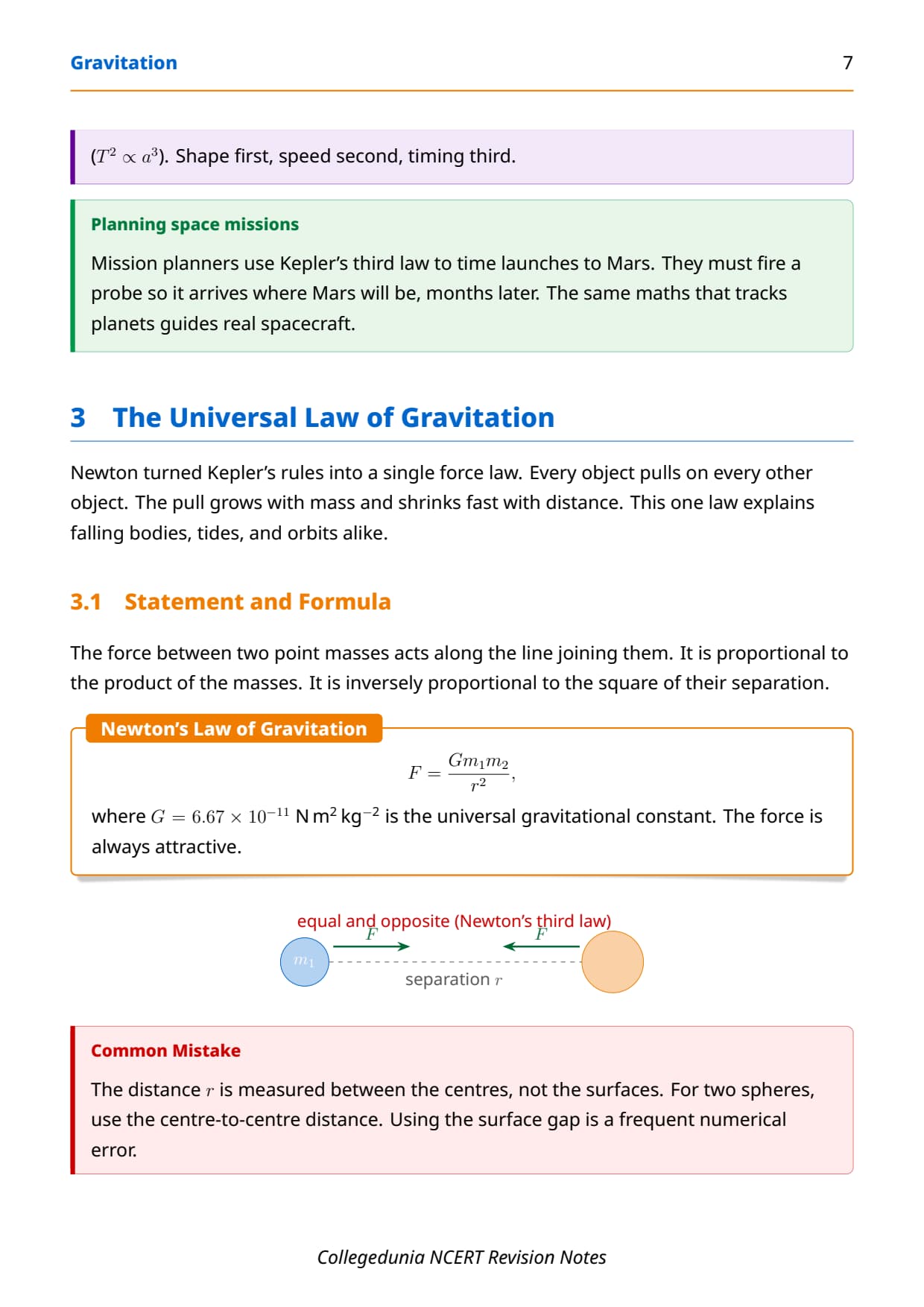
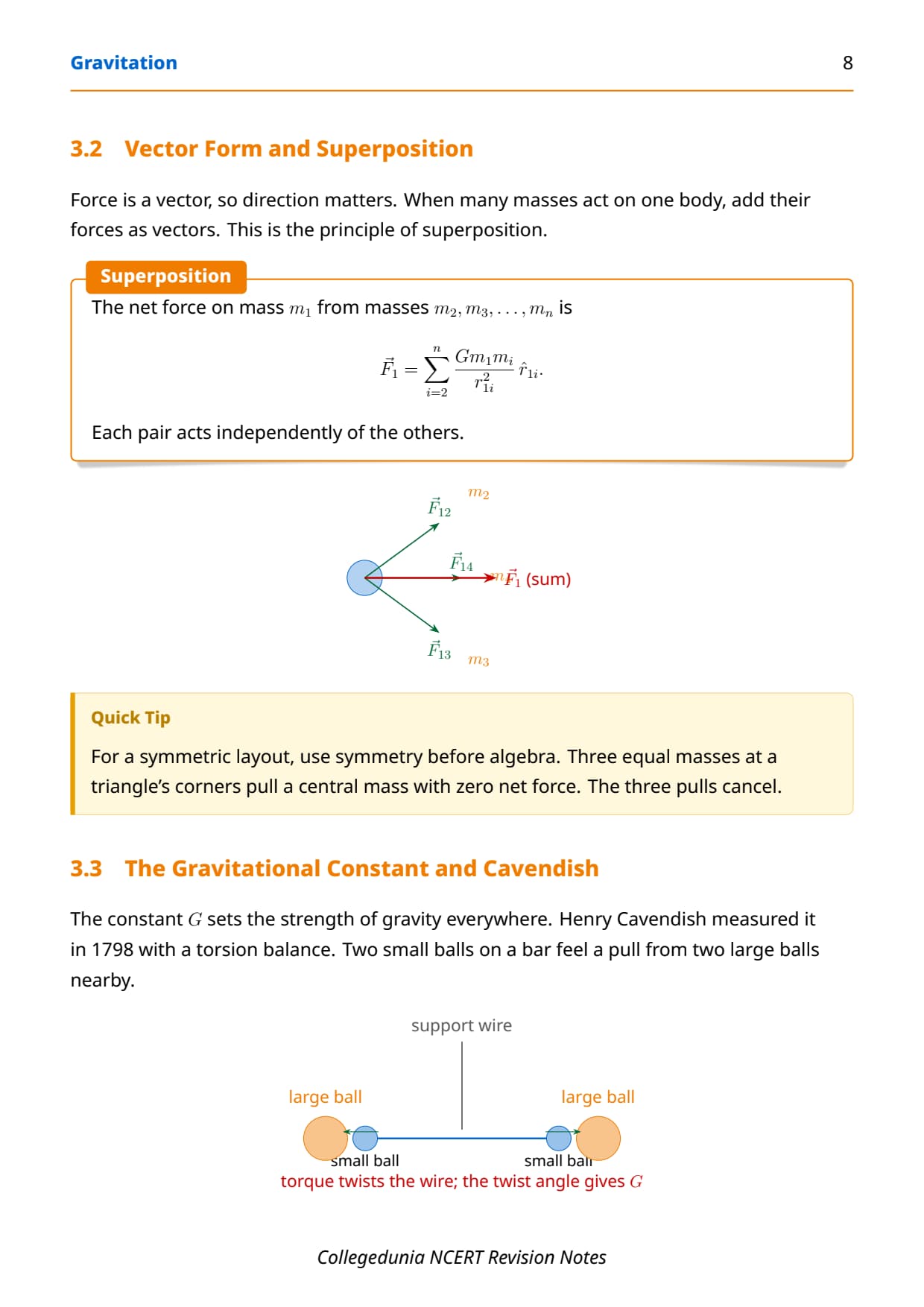
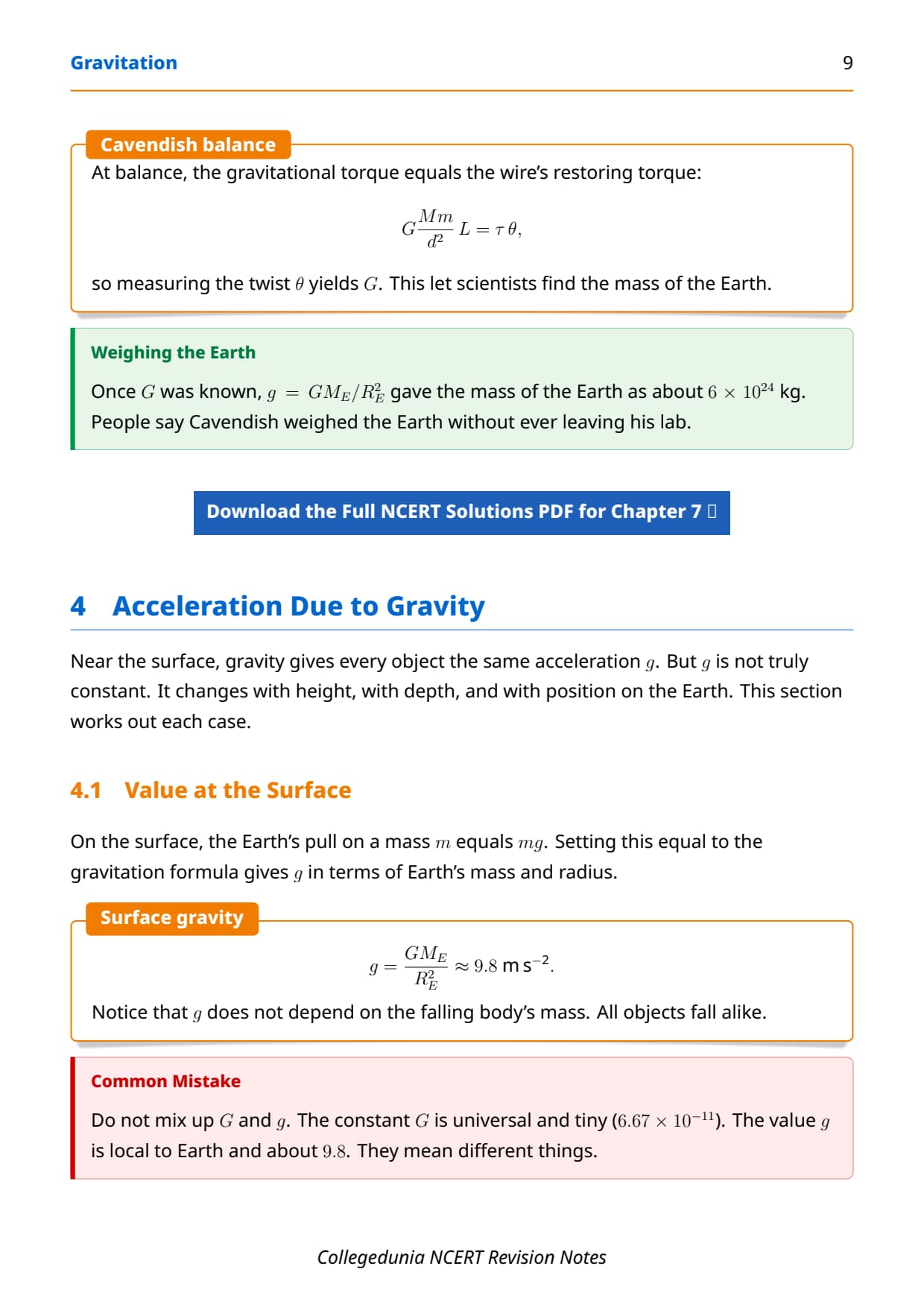
Every object with mass pulls on every other object. Newton's law of universal gravitation says this force is proportional to the product of the two masses and inversely proportional to the square of the distance between them. This one rule runs through the whole chapter.
For two point masses m1 and m2 a distance r apart, the force is F = G m1m2 / r2. The force acts along the line joining the two masses and is always attractive.
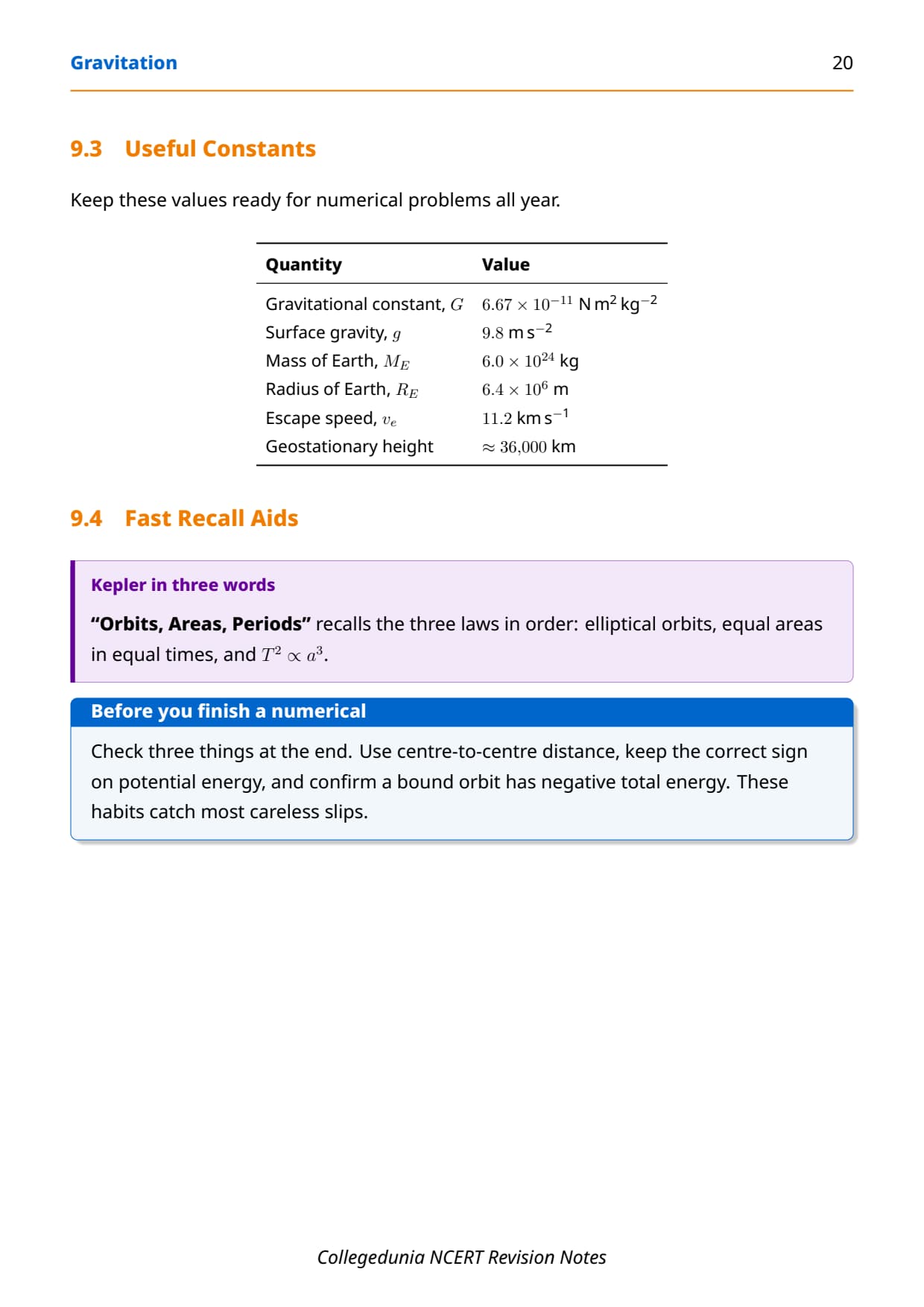
- Universal constant: G = 6.67 × 10⁻¹¹ N m2 kg-2, the same everywhere in the universe.
- Inverse-square law: double the distance and the force drops to one quarter.
- Always attractive: gravity only pulls, it never pushes.
Do not confuse the universal constant G with the acceleration g. G is fixed everywhere, while g changes from planet to planet and even across the Earth. Keeping the two apart is the first step to a clean answer.
Kepler's Laws of Planetary Motion
Long before Newton, Kepler described how planets move using three laws drawn from observation. Newton later showed all three follow from his law of gravitation. These laws appear every year in short-answer and objective questions.
| Law | What it states |
|---|---|
| Law of orbits | Every planet moves in an ellipse with the Sun at one focus. |
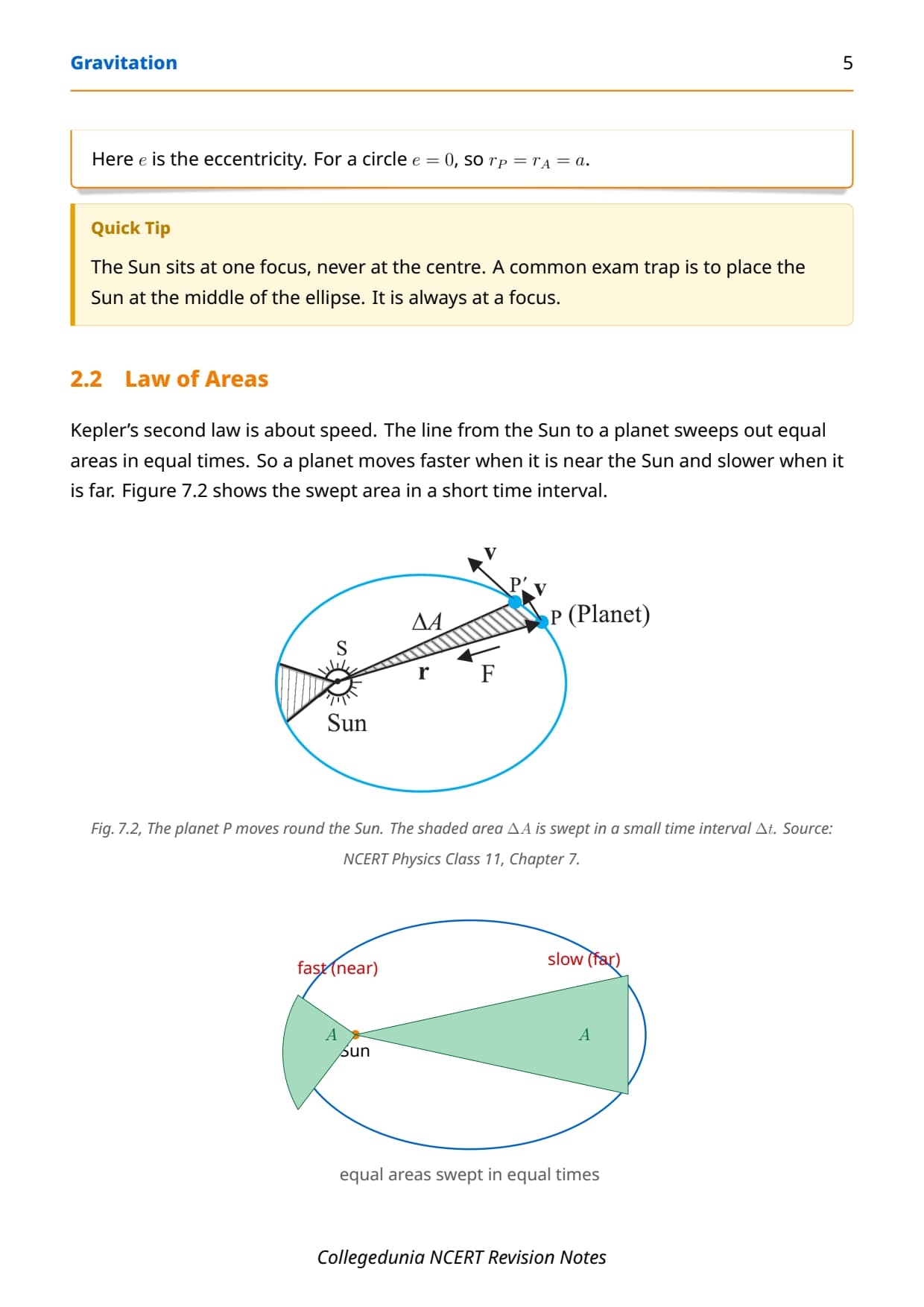
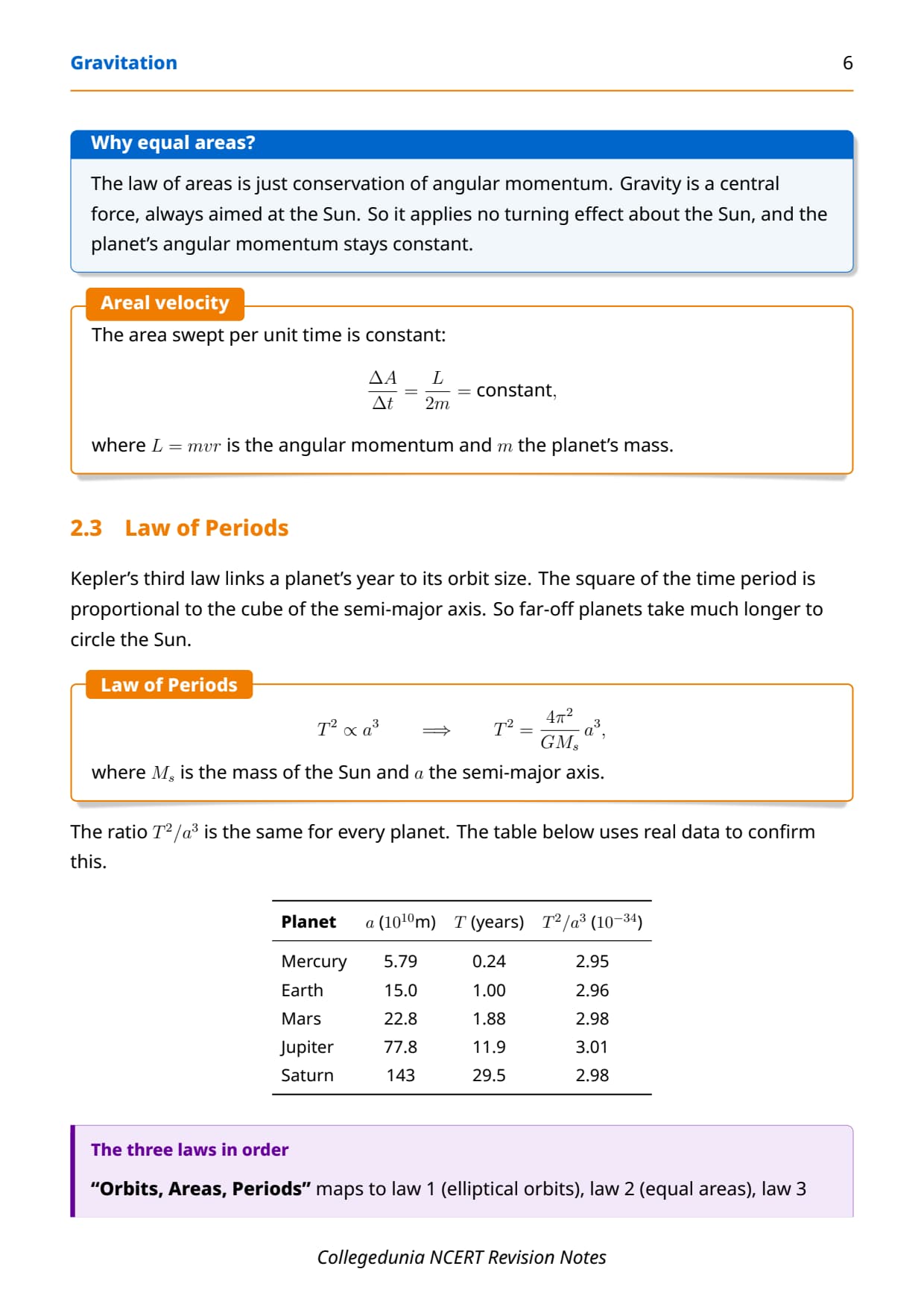
| Law of areas | The line joining a planet to the Sun sweeps equal areas in equal times. |
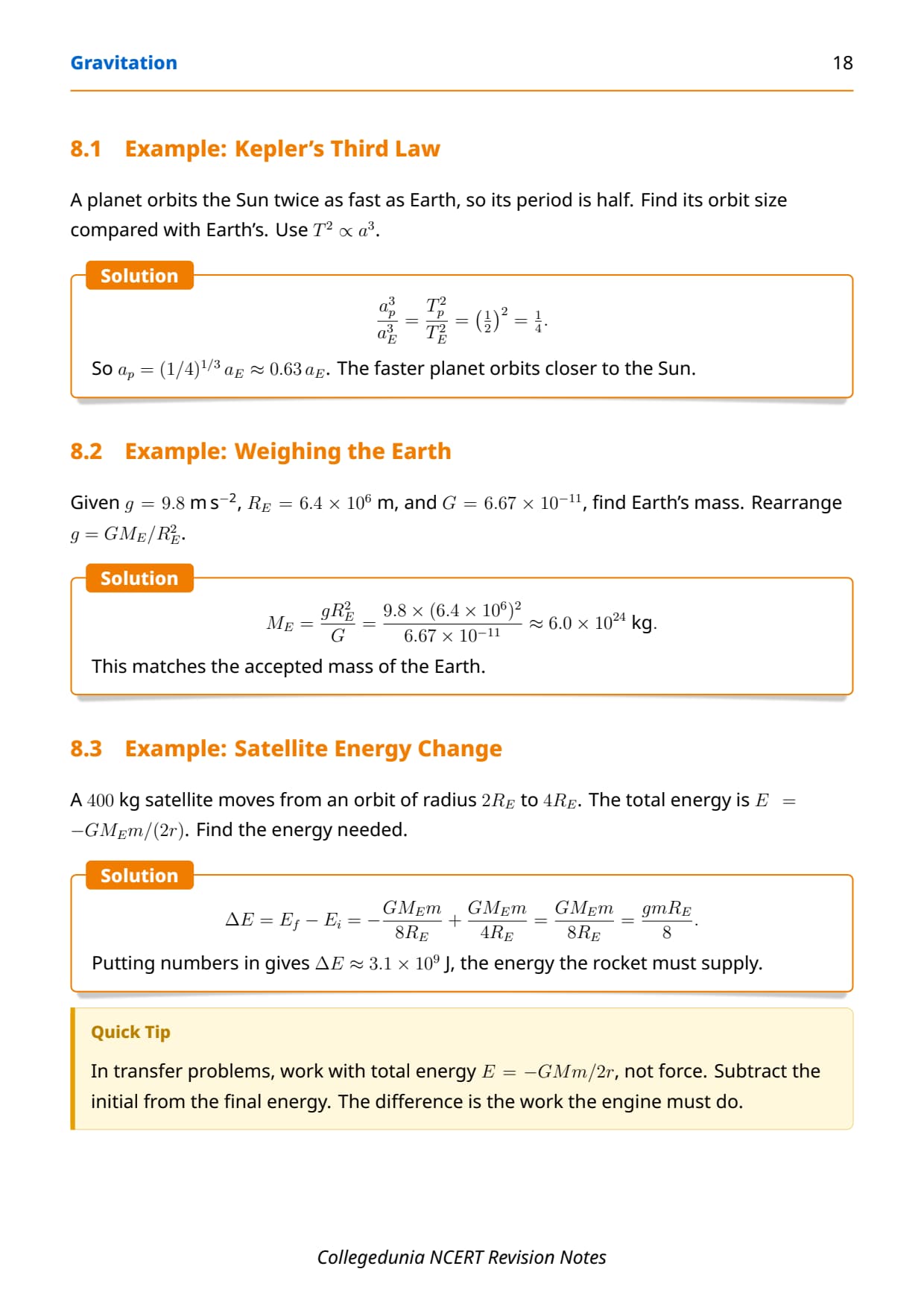
| Law of periods | The square of the time period is proportional to the cube of the semi-major axis, T2 ∝ a3. |
The law of areas is really the conservation of angular momentum. A planet moves faster when it is nearer the Sun and slower when it is farther away, so the swept area stays the same. The law of periods, T2 ∝ a3, is the one most asked in numericals, so learn to apply it both ways.
Acceleration Due to Gravity and Its Variation
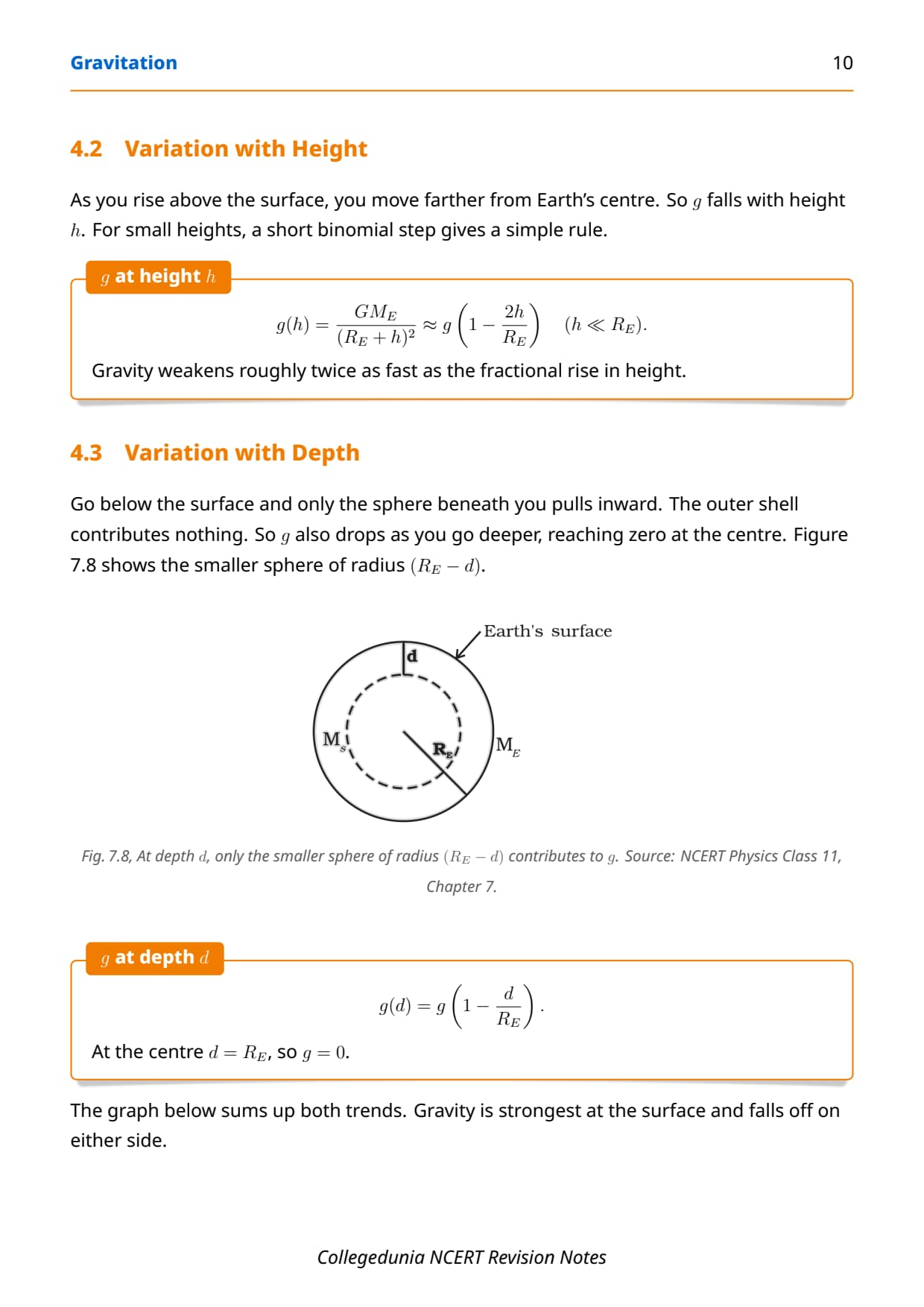
The acceleration due to gravity, g, is the acceleration a body gets from the Earth's pull. At the surface g = GM/R2, which gives about 9.8 m s-2. Its value is not the same everywhere, and the chapter tests all three ways it changes.
- With height: gh = g (1 − 2h/R) for a small height h, so g falls as you go up.
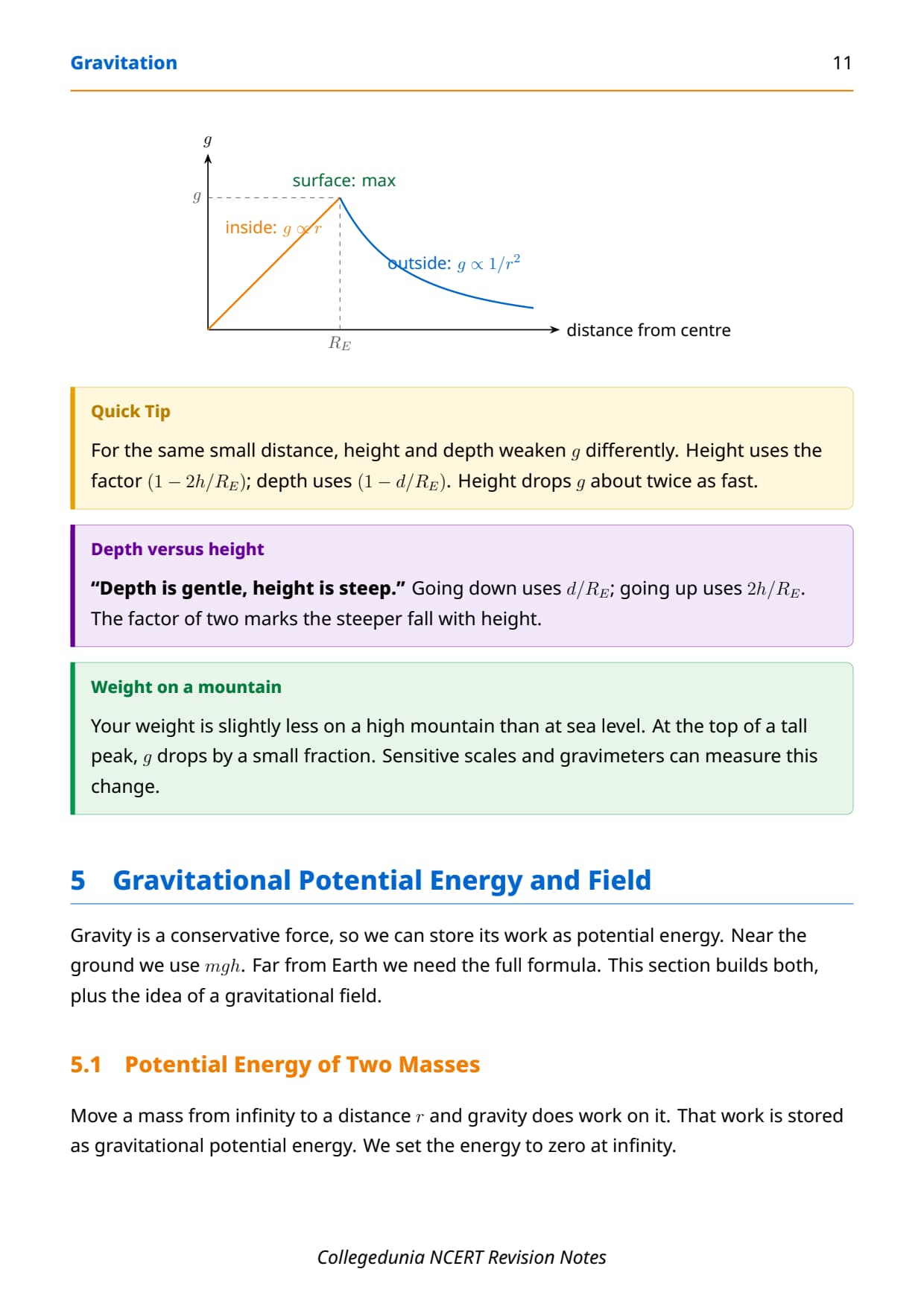
- With depth: gd = g (1 − d/R), so g also falls as you go down, reaching zero at the centre.
- With latitude: g is largest at the poles and smallest at the equator, because of the Earth's rotation and shape.
At the centre of the Earth, g is zero, not maximum. This surprises many students, so mark it clearly in your notes. The value of g is greatest just at the surface and drops off both above and below it.
Gravitational Potential Energy and Gravitational Potential
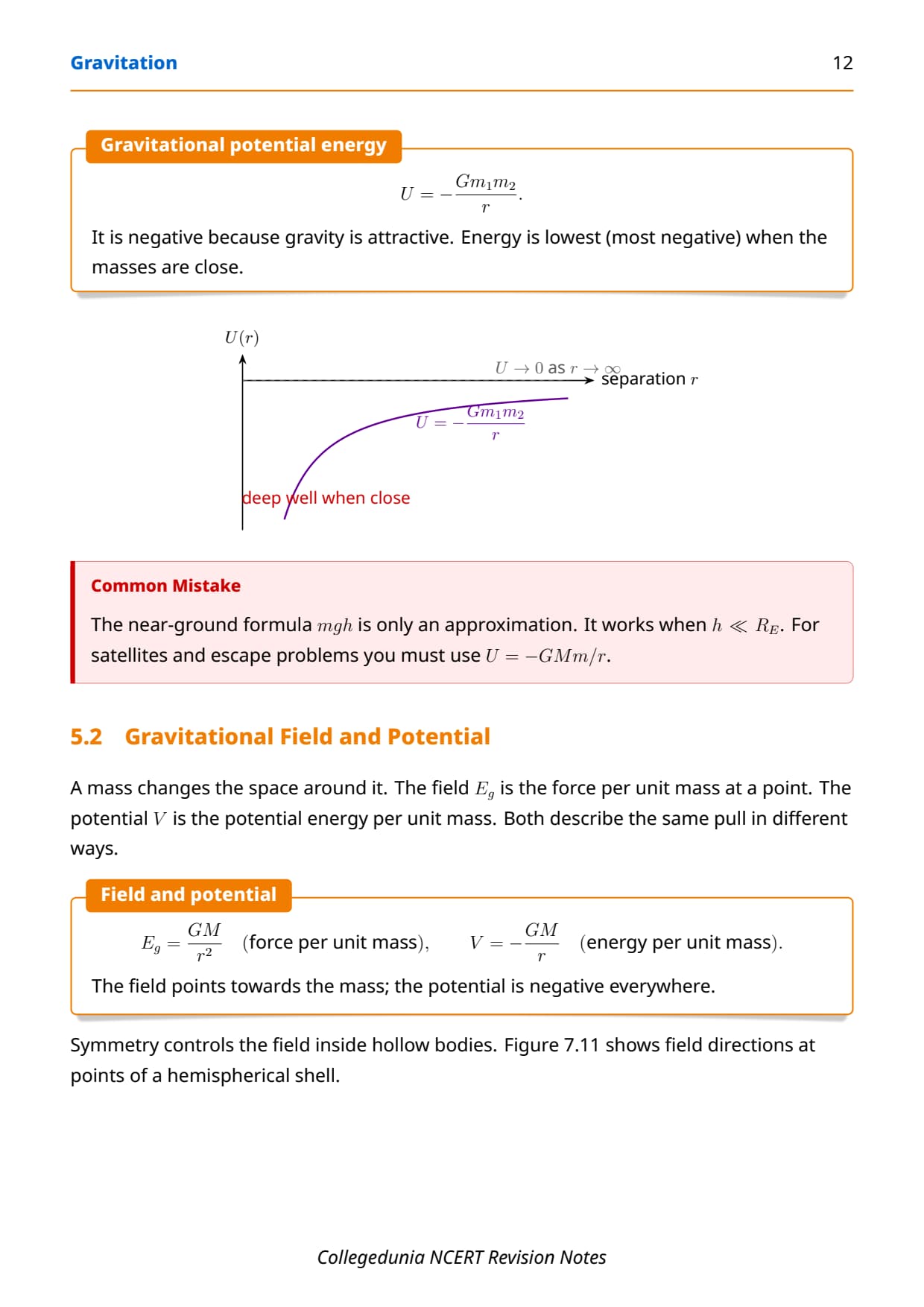
Moving a mass against gravity stores energy. Gravitational potential energy is the energy of a mass because of its position in a gravitational field. The chapter uses a reference where the energy is zero at infinity, so bound systems have negative energy.
| Quantity | Formula |
|---|---|
| Potential energy of two masses | U = −G Mm / r |
| Gravitational potential at a point | V = −GM / r |
| Relation between them | U = mV |
Both the potential energy and the potential are negative for an attractive field. The minus sign means work must be done to pull the masses apart to infinity. Gravitational potential is the potential energy per unit mass, and it decides the escape speed you meet next.
Escape Velocity and Orbital Velocity
Two speeds matter most in this chapter. Escape velocity is the least speed a body needs to break free of a planet's pull forever. Orbital velocity is the speed a satellite needs to stay in a circular orbit. Both come straight from the gravitational force.
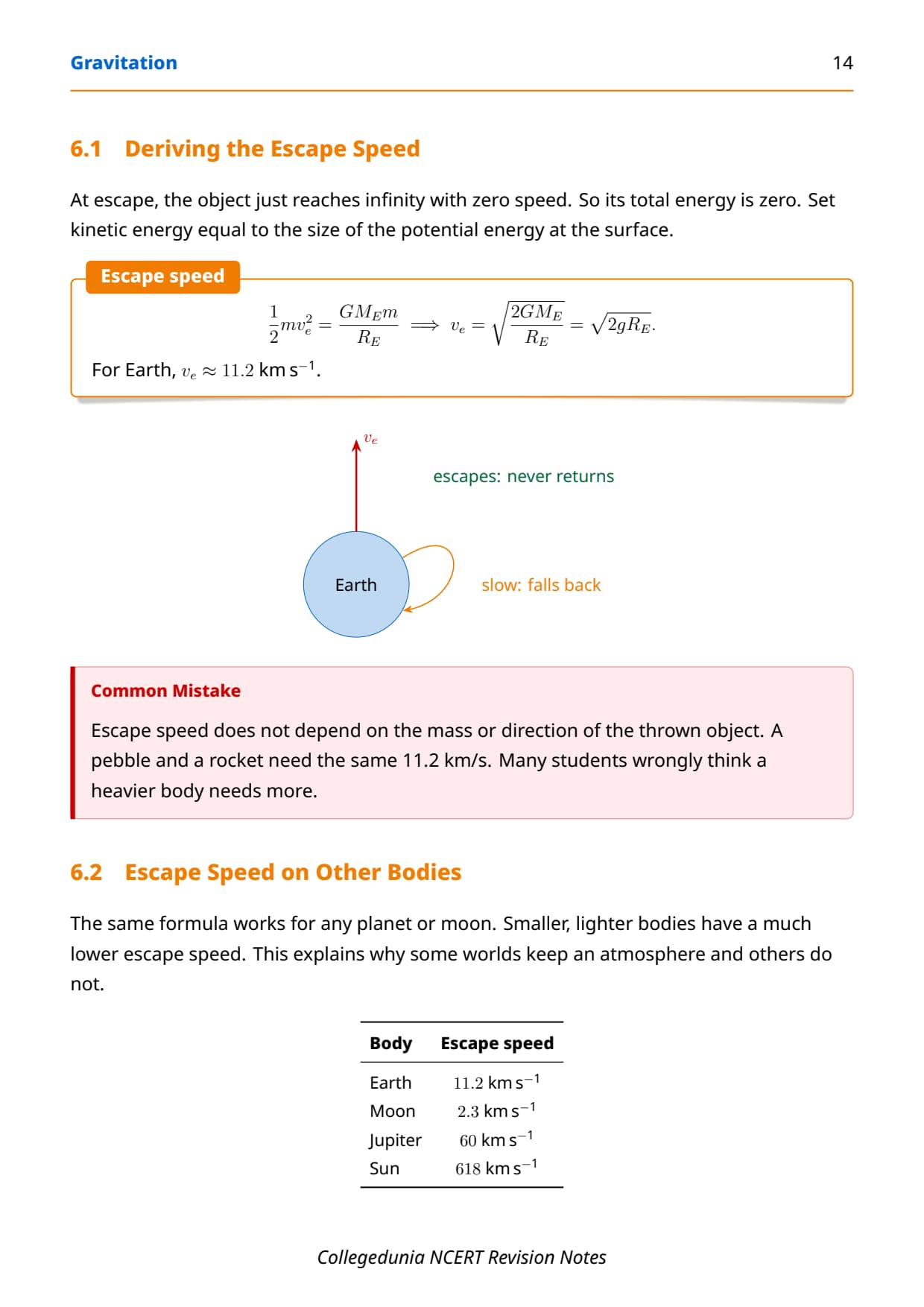
- Escape velocity: ve = √(2GM/R) = √(2gR), about 11.2 km s-1 for the Earth.
- Orbital velocity near the surface: vo = √(GM/R) = √(gR), about 7.9 km s-1.
- Key link: ve = √2 × vo, so escape speed is about 1.41 times orbital speed.
Escape velocity does not depend on the mass of the body being thrown, nor on the direction it is thrown. It depends only on the planet's mass and radius. This clean result is a favourite one-mark question in JEE Main and NEET.
All Formulas for Gravitation
Every formula you need for the chapter sits in one table below, with its meaning and its SI unit. Learn the escape-velocity and orbital-velocity rows first, since those carry the most marks in both Boards and entrance papers.
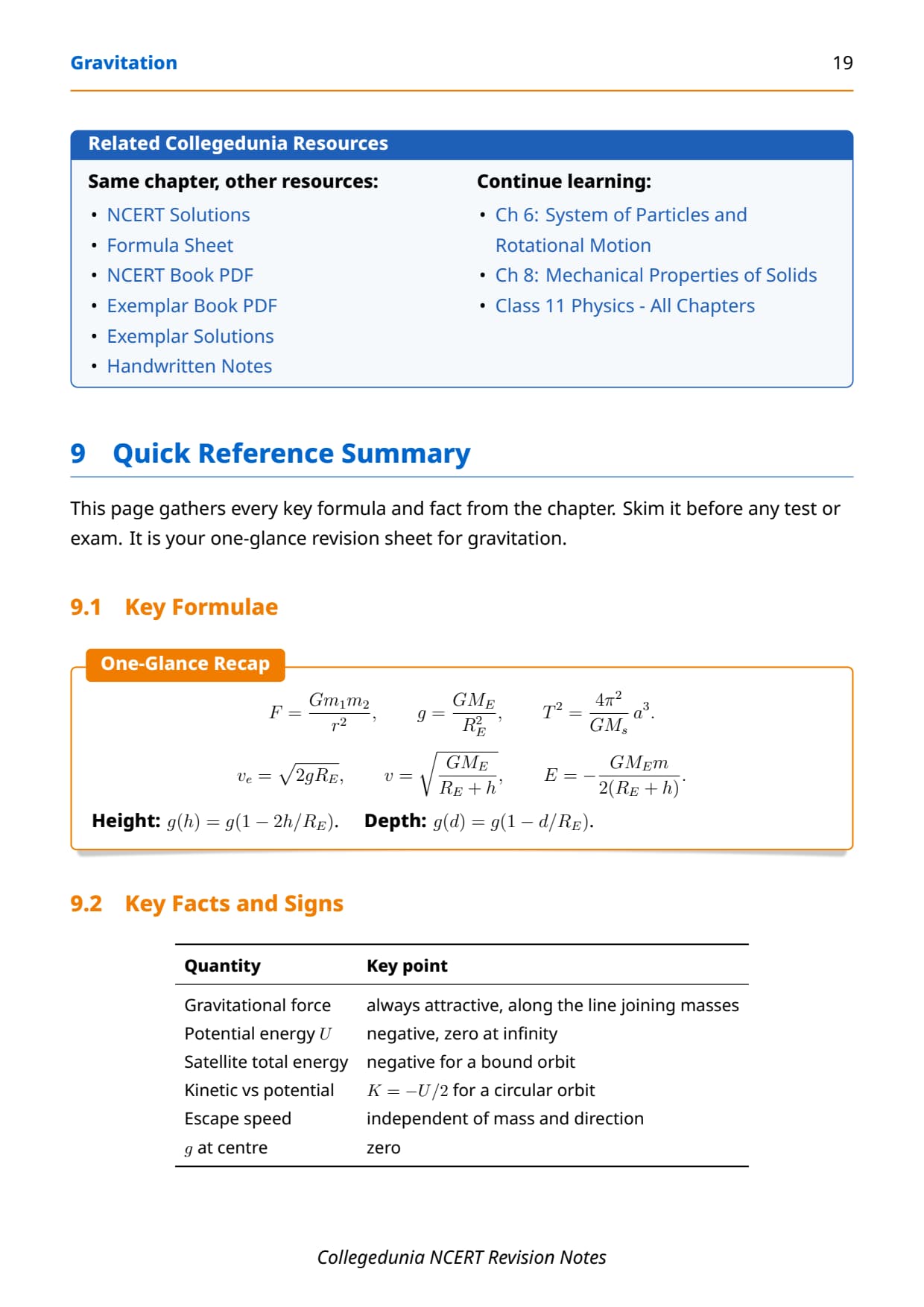
| Formula | What it means | SI unit |
|---|---|---|
| F = G m1m2 / r2 | Gravitational force between two masses | newton (N) |
| g = GM / R2 | Acceleration due to gravity at the surface | m s-2 |
| gh = g (1 − 2h/R) | Value of g at a small height h | m s-2 |
| gd = g (1 − d/R) | Value of g at a depth d below the surface | m s-2 |
| U = −G Mm / r | Gravitational potential energy of two masses | joule (J) |
| V = −GM / r | Gravitational potential at a point | J kg-1 |
| ve = √(2GM/R) | Escape velocity from a planet | m s-1 |
| vo = √(GM/(R+h)) | Orbital velocity of a satellite | m s-1 |
| T = 2π√((R+h)3/GM) | Time period of a satellite | second (s) |
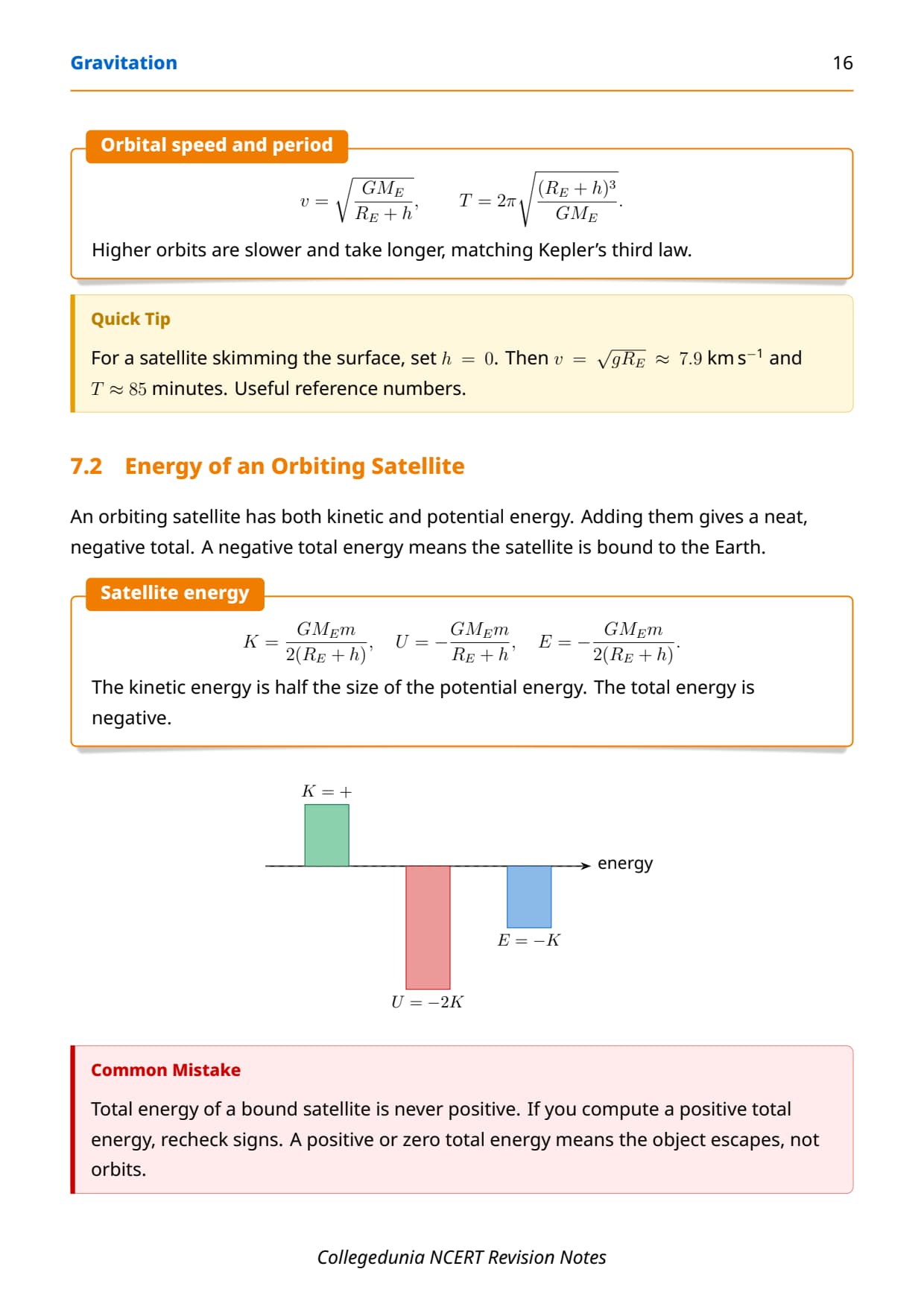
| E = −GMm / 2(R+h) | Total energy of an orbiting satellite | joule (J) |
Carry the SI unit on every line of your working. Losing the unit is a silent way to drop the final mark even when the number is right. Keep this table open while you solve the back-exercise numericals.
Key Definitions and Derivations for Gravitation
Boards short-answer questions often ask for a clean definition in one or two lines. Learn these word-for-word, because a vague definition loses easy marks. Each one also sets up a derivation you can be asked to show.
| Term | Definition |
|---|---|
| Gravitational constant | The force between two unit masses held one metre apart. |
| Acceleration due to gravity | The acceleration of a freely falling body caused by the Earth's pull. |
| Gravitational potential energy | The energy of a mass because of its position in a gravitational field. |
| Gravitational potential | The potential energy per unit mass at a point in the field. |
| Escape velocity | The least speed needed to leave a planet's field and never return. |
| Geostationary satellite | A satellite whose orbital period matches the Earth's rotation, so it stays over one spot. |
A common derivation asks you to link escape velocity to g. Set the kinetic energy equal to the work needed against gravity to get ve = √(2gR). The same energy method gives the orbital velocity and the total energy of a satellite.
Satellites, Geostationary Orbits and Weightlessness
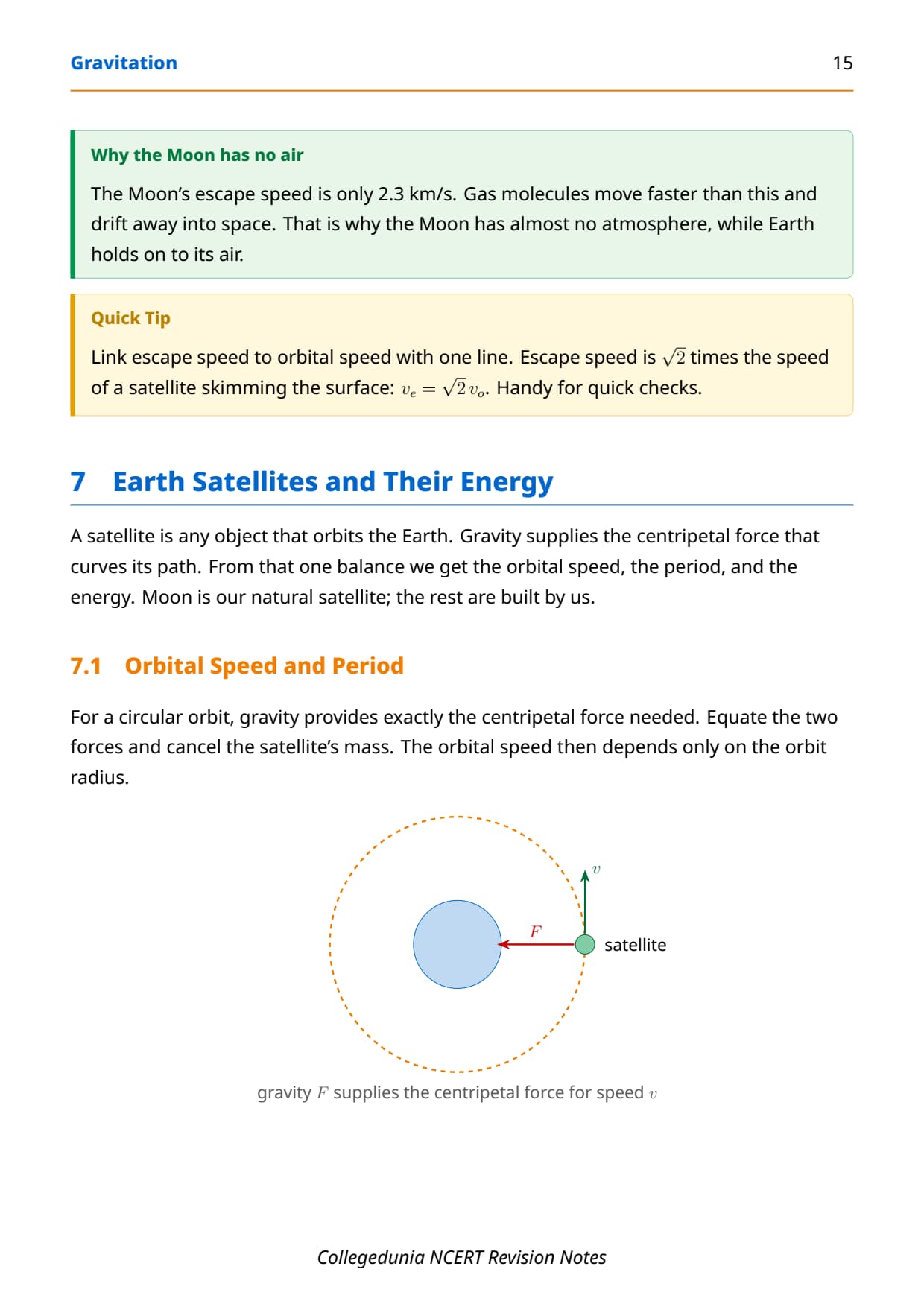
The chapter closes with artificial satellites and the strange feeling of weightlessness. A satellite stays in orbit because gravity provides exactly the centripetal force it needs. These topics appear in both short-answer and objective papers.
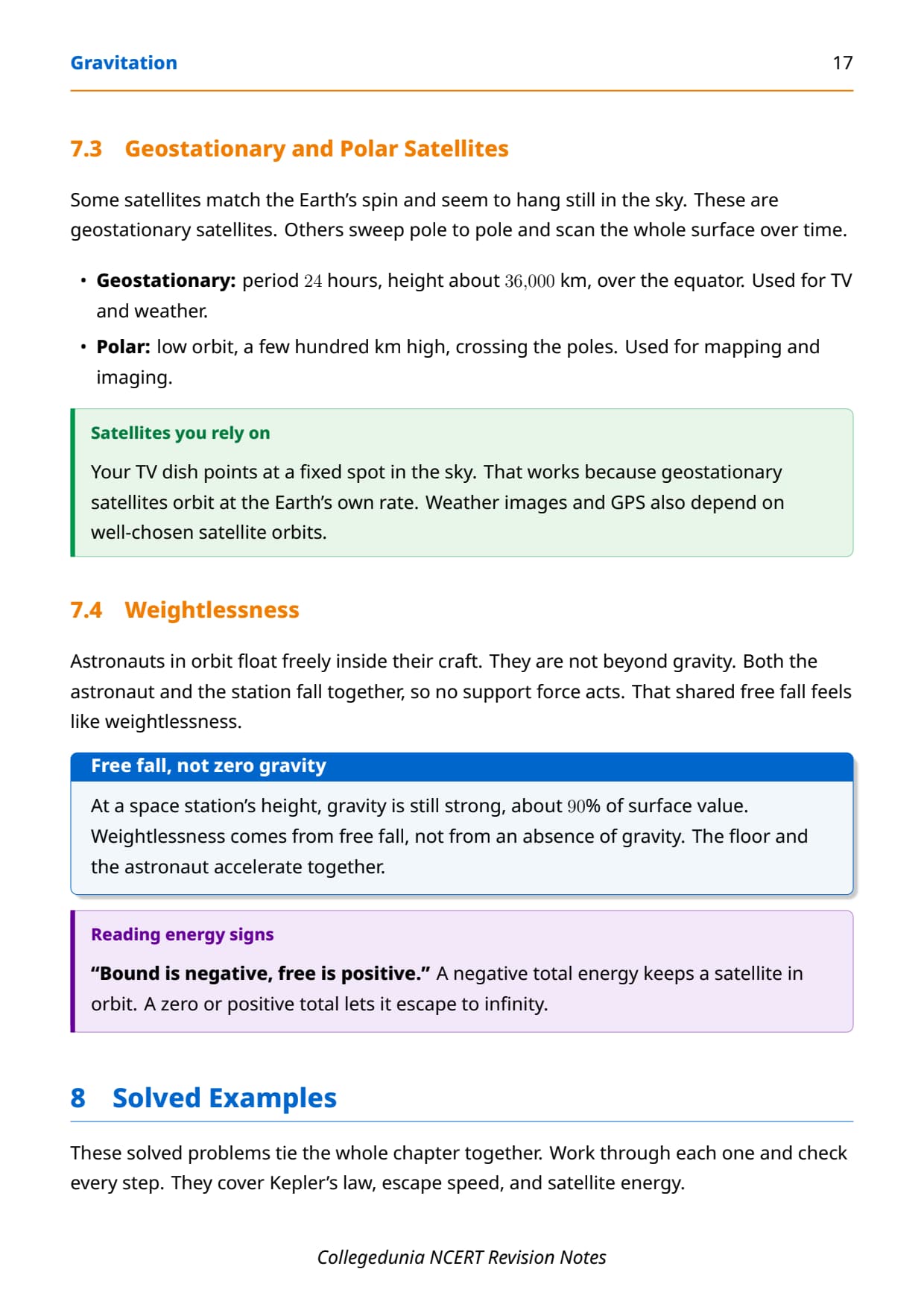
- Geostationary satellite: orbits at about 36,000 km above the equator with a period of 24 hours, so it appears fixed in the sky.
- Polar satellite: orbits at a low height over the poles and scans the whole Earth as it rotates below.
- Weightlessness: an astronaut and the satellite fall together with the same acceleration, so the astronaut feels no support force.
Weightlessness does not mean gravity is absent. Gravity is still acting; it is simply the only force, so there is no reaction from a floor to feel. A body in free fall always feels weightless, even close to the Earth. Use this idea to answer the common lift and satellite questions.
Common Mistakes Students Make in Gravitation
These slips happen while writing or calculating, not because the concept is unclear. Each one costs 1 to 3 marks in the paper, so watch for them at the exact step.
Mistake 1: Mixing up G and g. G is a universal constant; g changes with place.
Mistake 2: Forgetting the minus sign in potential and potential energy. Both are negative for an attractive field.
Mistake 3: Thinking g is maximum at the centre of the Earth. It is actually zero there.
Mistake 4: Assuming escape velocity depends on the mass or direction of the body. It depends only on the planet.
Gravitation Weightage in CBSE Boards, JEE and NEET
This chapter is small but reliable. It rarely carries a long-answer question, yet it shows up every year as a short answer plus an objective numerical. Here is how the marks split across the main exams for 2026-27.
| Exam | Typical weightage | What is asked |
|---|---|---|
| CBSE Boards | 4 to 6 marks | One short answer plus one numerical on g, escape or orbital velocity |
| JEE Main | 1 to 2 questions | Variation of g, satellite energy, and Kepler's third law |
| NEET | 1 to 2 questions | Escape velocity, orbital velocity, and weightlessness |
| CUET and NDA | 1 objective question | Newton's law of gravitation and simple numericals |
Escape velocity and the variation of g are the two most tested ideas from this chapter across all four exams. Master them first, then Kepler's laws, then satellite energy, in that order of return on effort.
How to Revise Gravitation Quickly
Use these Class 11 Physics Notes Chapter 7 Gravitation for a fast, ordered recap the night before a test. The checklist below takes about 30 minutes and hits every marks-heavy idea.
- First 10 minutes: write Newton's law, the value of G, and the three formulas for the variation of g from memory.
- Next 10 minutes: redo one numerical each on escape velocity, orbital velocity, and Kepler's third law.
- Last 10 minutes: revise potential energy, potential, and why an astronaut feels weightless.
Close the loop by checking that your escape and orbital velocities satisfy ve = √2 × vo. If you can do all three blocks without notes, the chapter is exam-ready. Keep the All Formulas table beside you for the first pass only, then try it closed-book.
Student Feedback on the Gravitation Notes
What 12,540 students told us about their Gravitation revision:
- 71% of students rated the variation of g as the hardest sub-topic in the chapter.
- Most-skipped step: keeping the minus sign in gravitational potential energy, missed by about 3 in 10 students.
- Students who revised escape and orbital velocity together said the satellite numericals felt easier.
Source: 2026-27 Class 11 Physics student poll. Sample of 12,540 students from CBSE schools across 14 states, conducted before the 2026 boards.
Other Gravitation Class 11 Physics Resources
Pair these notes with the solved answers, the handwritten notes, the formula sheet, and the textbook PDF for the same chapter.
| Resource | Link |
|---|---|
| NCERT Solutions | Gravitation Class 11 NCERT Solutions |
| Handwritten Notes | Gravitation Class 11 Handwritten Notes |
| Formula Sheet | Gravitation Class 11 Formula Sheet |
| NCERT Book PDF | Gravitation Class 11 Book PDF |
NCERT Notes for Class 11 Physics: All Chapters
Jump to the revision notes for any other Class 11 Physics chapter below.
| Chapter | NCERT Notes |
|---|---|
| Chapter 1 | Units and Measurements |
| Chapter 2 | Motion in a Straight Line |
| Chapter 3 | Motion in a Plane |
| Chapter 4 | Laws of Motion |
| Chapter 5 | Work, Energy and Power |
| Chapter 6 | System of Particles and Rotational Motion |
| Chapter 7 | Gravitation |
| Chapter 8 | Mechanical Properties of Solids |
| Chapter 9 | Mechanical Properties of Fluids |
| Chapter 10 | Thermal Properties of Matter |
| Chapter 11 | Thermodynamics |
| Chapter 12 | Kinetic Theory |
| Chapter 13 | Oscillations |
| Chapter 14 | Waves |
FAQs on Gravitation Class 11 Physics Notes
Gravitation Notes - Frequently Asked Questions
Ques. What topics do the Class 11 Physics Notes Chapter 7 Gravitation cover?
Ans. These Class 11 Physics Notes Chapter 7 Gravitation cover Newton's law of universal gravitation, Kepler's three laws, the acceleration due to gravity and its variation with height, depth and latitude, gravitational potential energy and potential, escape and orbital velocity, satellites and weightlessness. Every key formula and definition is included for fast revision.
Ques. What is the value of the universal gravitational constant G?
Ans. The universal gravitational constant is G = 6.67 × 10⁻¹¹ N m2 kg-2. It is the force between two unit masses held one metre apart, and it has the same value everywhere in the universe. Do not confuse it with g, the acceleration due to gravity, which changes with place.
Ques. How do I calculate escape velocity in this chapter?
Ans. Escape velocity is ve = √(2GM/R) = √(2gR). It is found by setting the kinetic energy equal to the work needed to move the body against gravity to infinity. For the Earth it is about 11.2 km s-1, and it does not depend on the mass or direction of the body thrown.
Ques. How does the acceleration due to gravity g change with height and depth?
Ans. At a small height h, gh = g (1 − 2h/R), so g decreases with height. At a depth d, gd = g (1 − d/R), so it decreases with depth too and becomes zero at the centre. The value of g is greatest at the surface.
Ques. What is the weightage of Gravitation in the CBSE board exam?
Ans. Gravitation carries about 4 to 6 marks in the CBSE Class 11 Physics paper, usually one short answer plus one numerical on g, escape velocity or orbital velocity. It also appears in JEE Main and NEET as objective questions on satellite energy, Kepler's laws and weightlessness.
Ques. Why does an astronaut feel weightless in a satellite?
Ans. Weightlessness happens because the astronaut and the satellite both fall towards the Earth with the same acceleration. Gravity is still acting, but it is the only force, so there is no reaction from a floor for the astronaut to feel. Any body in free fall feels weightless, even close to the Earth.



Comments