




These Class 11 Physics Notes Chapter 8 Mechanical Properties of Solids pull together every type of stress and strain, Hooke's law, the stress-strain curve, and the three elastic moduli that the Boards, JEE Main, JEE Advanced, NEET, CUET and NDA papers actually test in 2026-27. Use them to revise the whole chapter fast, with formulas, definitions and diagrams described in one place.
This chapter explains how solids resist a deforming force, and the ideas here feed straight into fluids, elasticity numericals, and material-strength questions later in the year.
- CBSE Weightage: 3 to 5 marks, usually one short answer plus one numerical on Young's modulus or the stress-strain curve.
- Topics covered: stress and strain types, Hooke's law, stress-strain curve, Young's, bulk and shear modulus, Poisson's ratio, and elastic potential energy.
- Key formulas: the three moduli of elasticity, Poisson's ratio, and the energy stored in a stretched wire.
These Class 11 Physics Notes Chapter 8 Mechanical Properties of Solids are curated by subject experts, based on the 2026-27 NCERT textbook, and checked against the last five years of CBSE Board, JEE Main and NEET papers.
Topic-by-Topic Summary of Mechanical Properties of Solids
The chapter studies how a solid changes shape under a force, and how it springs back. It starts with stress and strain, adds Hooke's law, then reads the full story off the stress-strain graph. Here is the quick map of what each topic gives you.
- Stress and strain: the internal restoring force per unit area, and the fractional change in size it causes.
- Hooke's law: within the elastic limit, stress is directly proportional to strain.
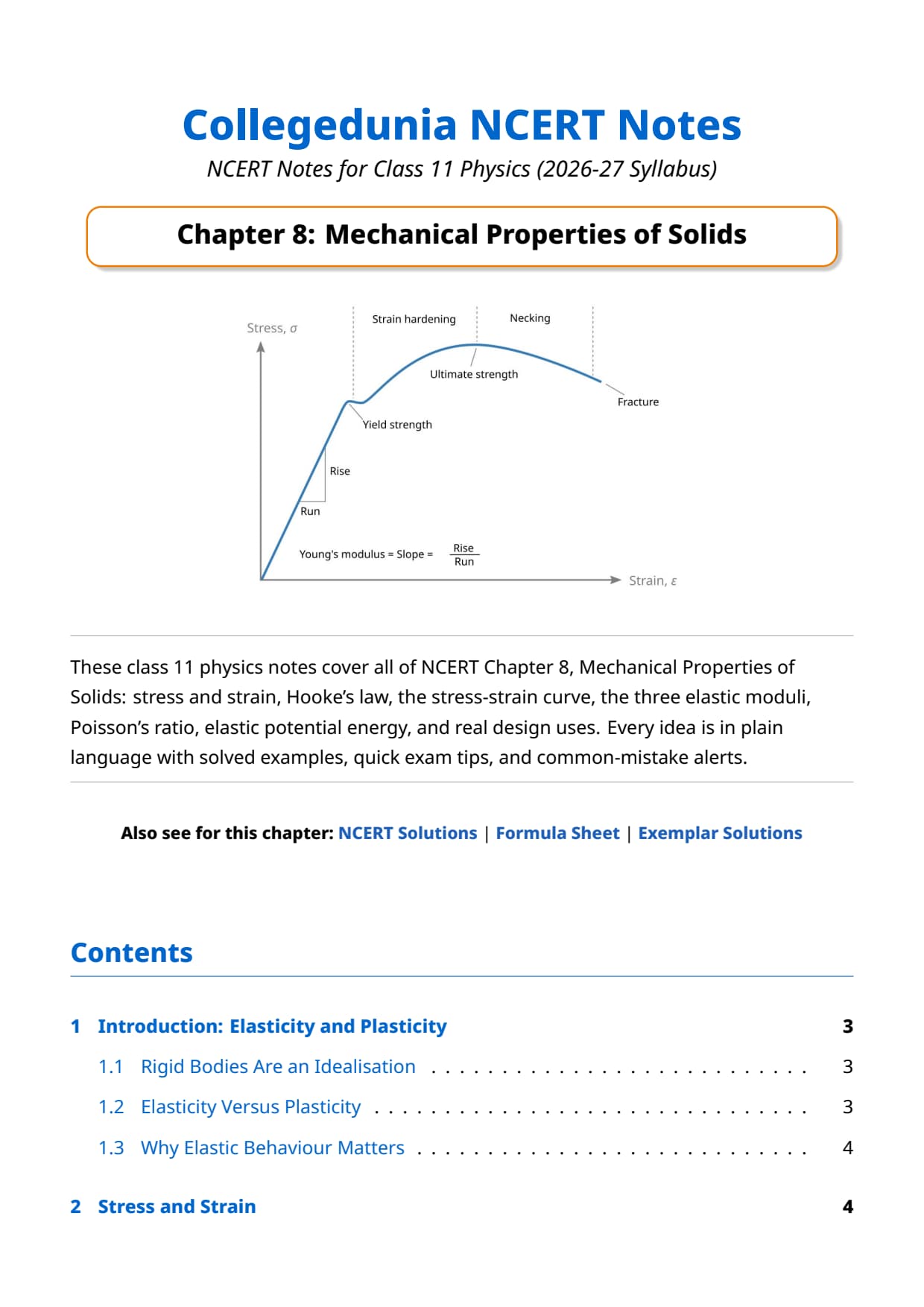
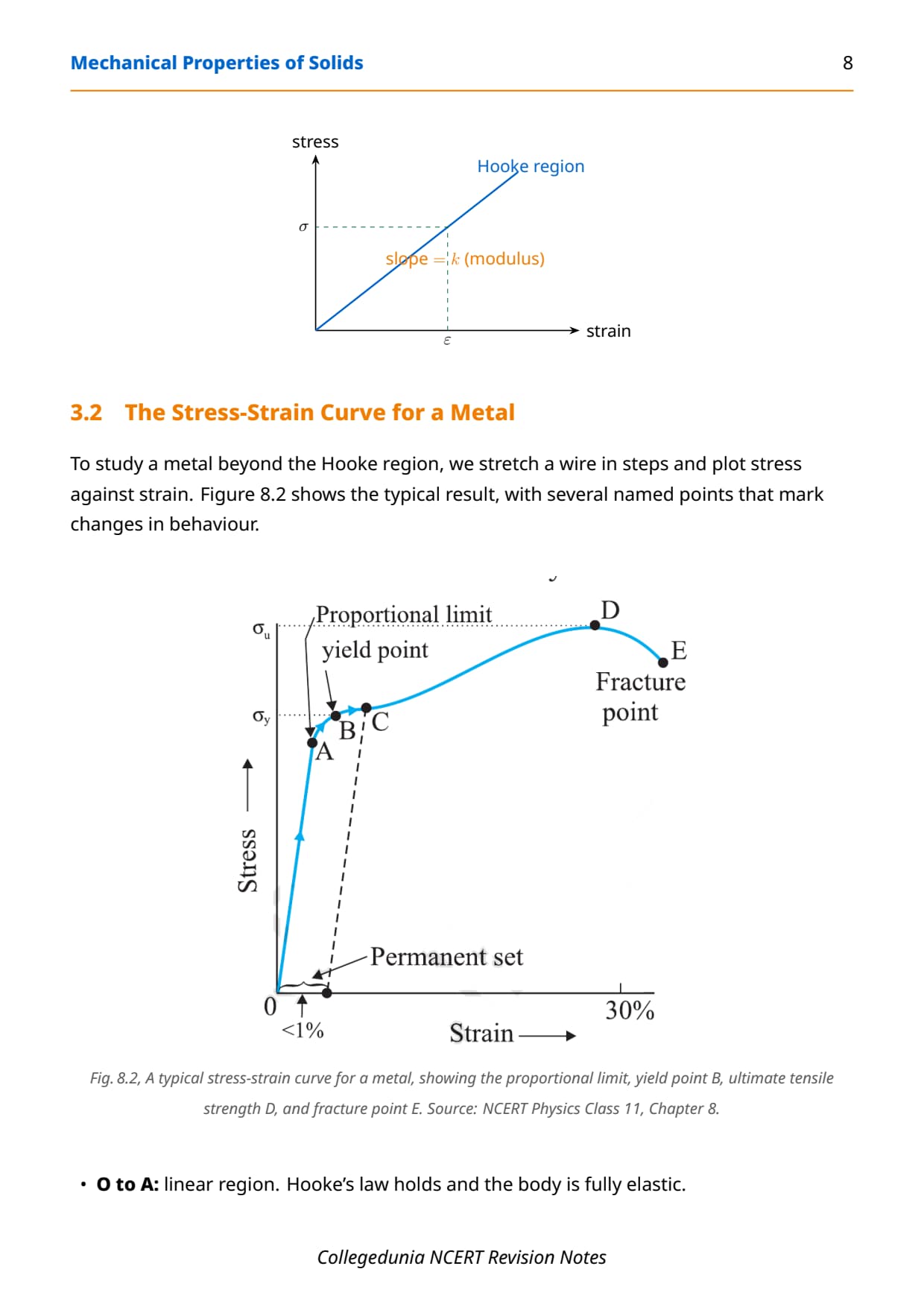
- Stress-strain curve: the graph that marks the proportional limit, elastic limit, yield point and fracture point.
- Moduli of elasticity: Young's modulus, bulk modulus and shear modulus, one for each type of strain.
- Poisson's ratio and elastic energy: the sideways-to-lengthwise strain ratio, and the energy stored in a stretched solid.
Revise the topics in this order, because each one builds on the last. Fix the three strain types first, and every modulus formula then falls into place. These Class 11 Physics Notes Chapter 8 Mechanical Properties of Solids follow the same sequence as the NCERT textbook.
Stress and Strain: The Three Types in Mechanical Properties of Solids
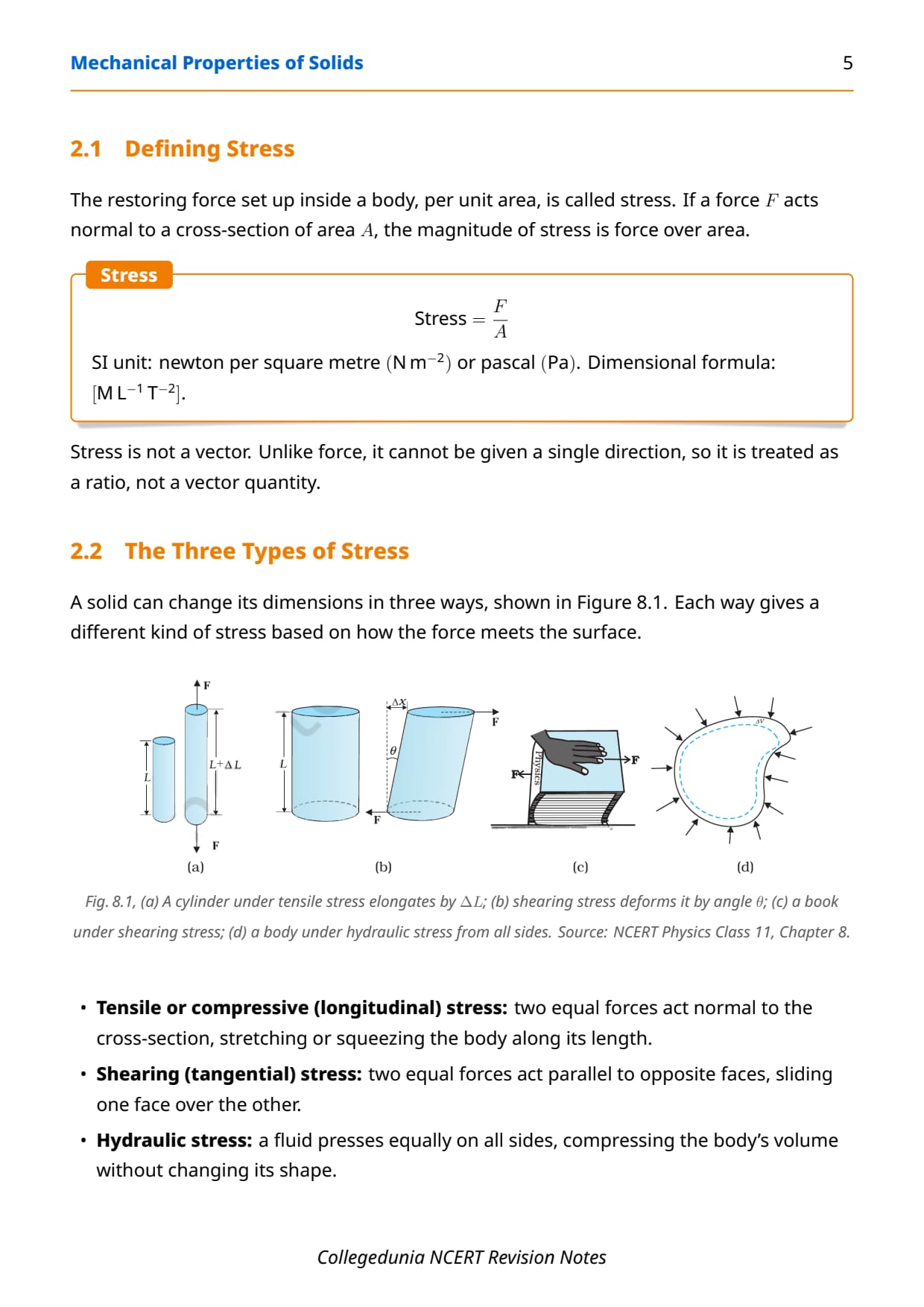
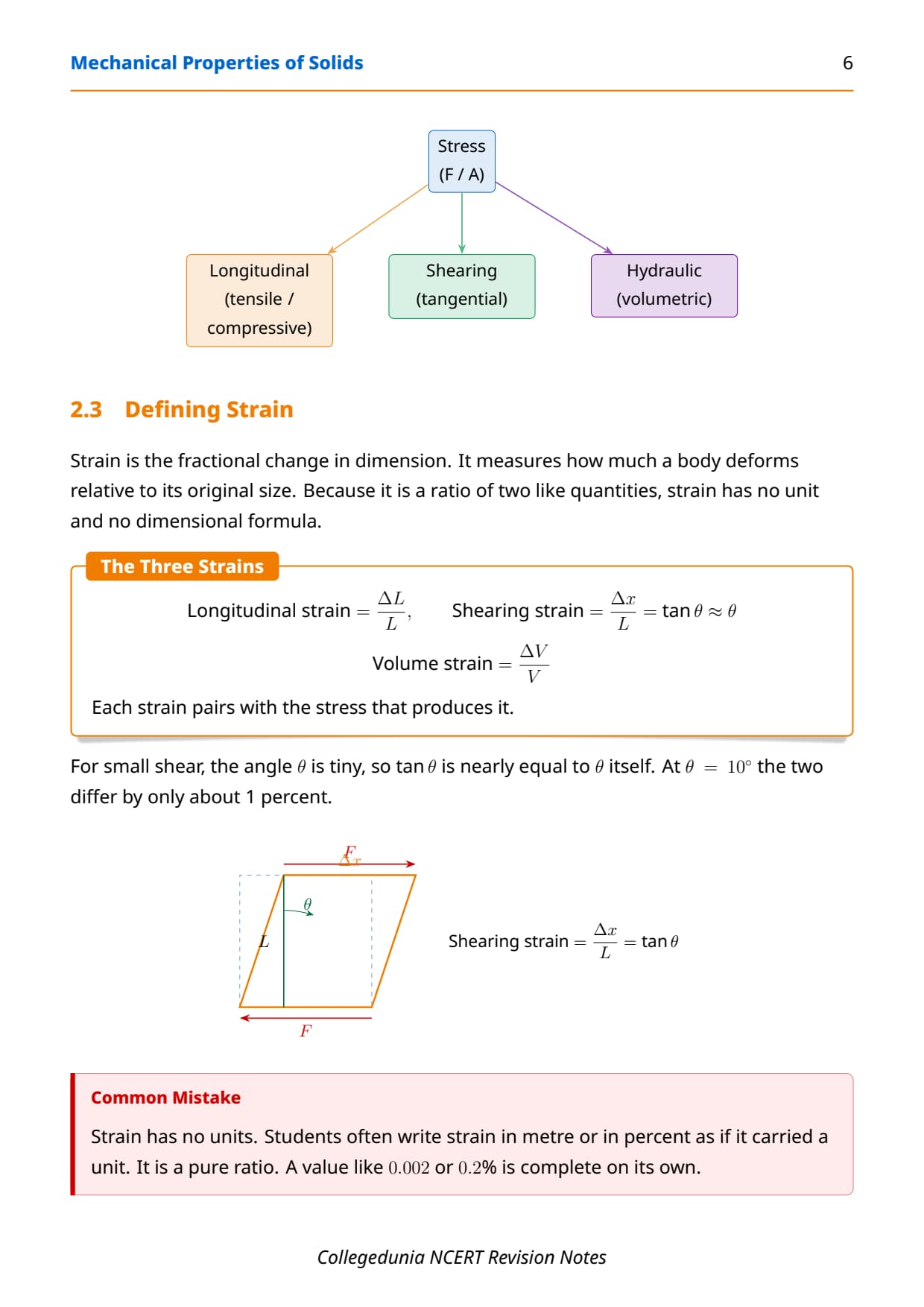
When a force acts on a solid, the body sets up an equal internal restoring force. Stress is this restoring force per unit area, and strain is the fractional change in shape or size it produces. Both come in three matching types, and every numerical starts by naming the right pair.
| Type | Stress | Strain |
|---|---|---|
| Tensile or compressive | Normal force per unit area along the length | Change in length / original length (ΔL/L) |
| Shearing (tangential) | Tangential force per unit area | Relative sideways shift / height (θ) |
| Hydraulic (volume) | Uniform pressure from all sides | Change in volume / original volume (ΔV/V) |
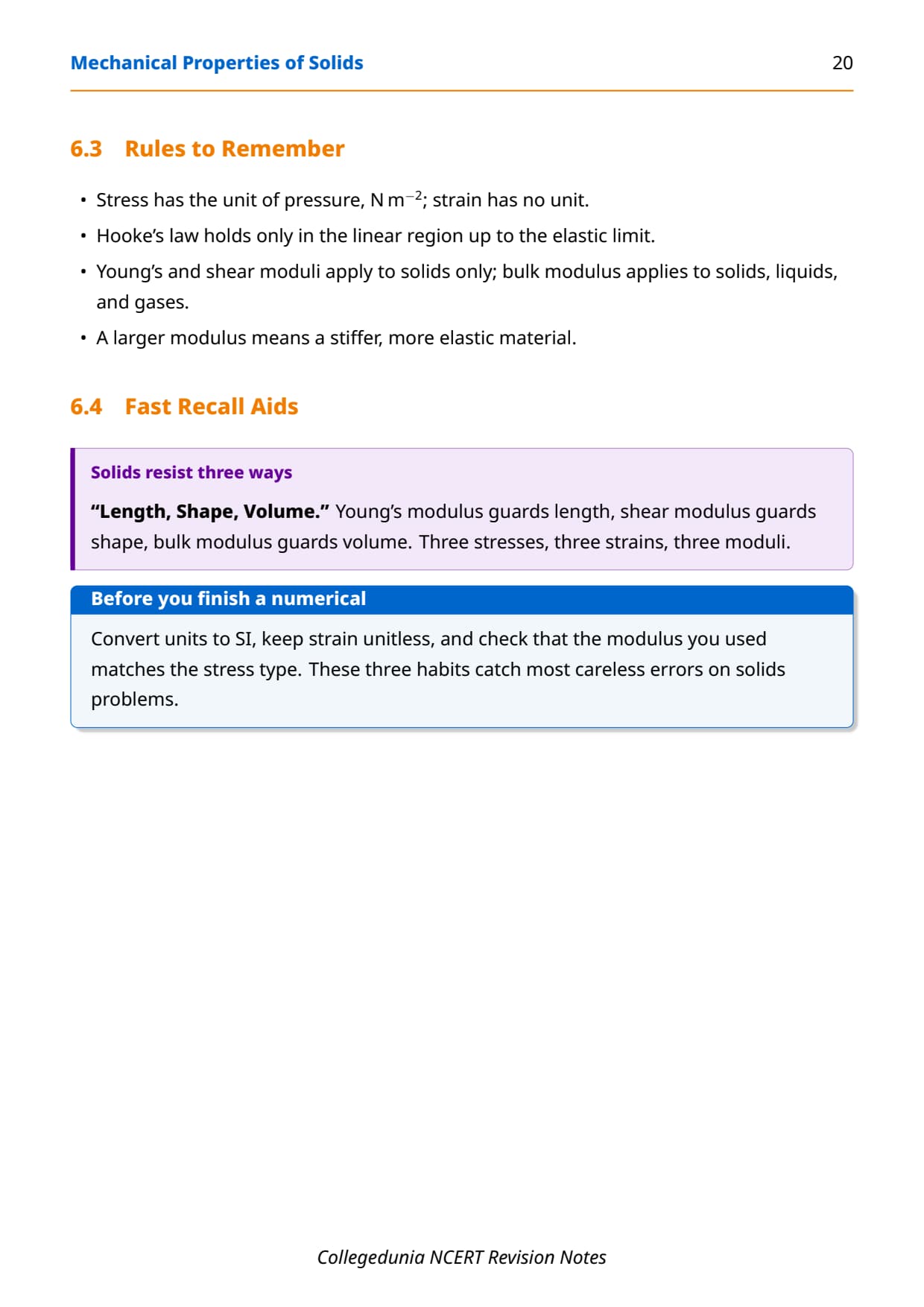
Stress has the SI unit N m-2 or pascal, the same as pressure, while strain has no unit because it is a ratio of two lengths, volumes or angles. Longitudinal stress stretches or compresses along one direction, shearing stress slides one face over another, and hydraulic stress squeezes the whole body inward. Naming the correct type first is what points you to the correct modulus later.
Hooke's Law and the Stress-Strain Curve for a Solid
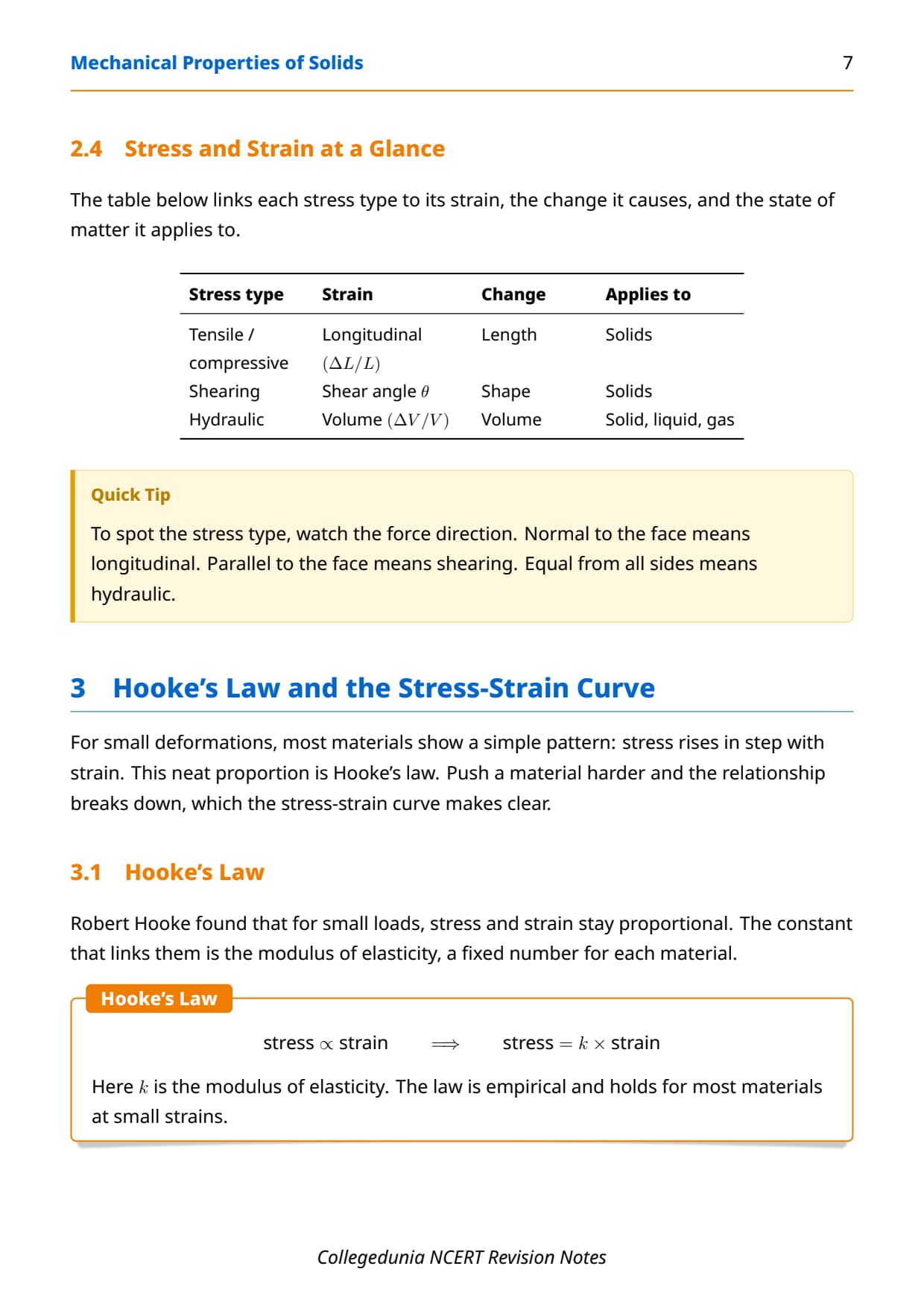
Hooke's law is the backbone of the chapter. It states that within the elastic limit, the stress in a body is directly proportional to the strain, so stress = E × strain, where E is the modulus of elasticity. The full behaviour of a material shows up on its stress-strain curve.
- Proportional limit: up to this point stress and strain follow a straight line, so Hooke's law holds.
- Elastic limit: the largest stress the body can take and still return to its original shape.
- Yield point: beyond it the material deforms permanently, called plastic deformation.
- Fracture point: the stress at which the material finally breaks.
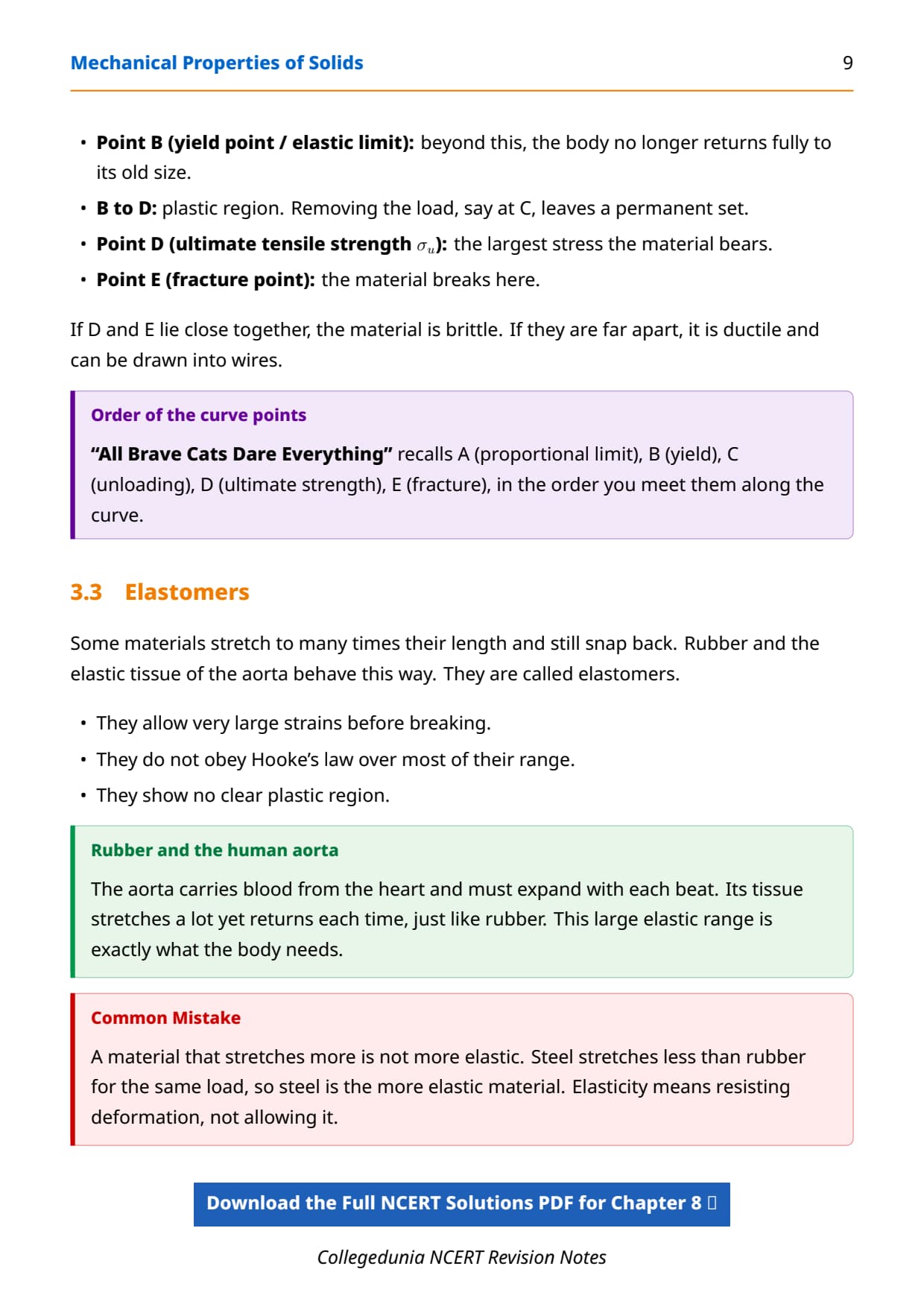
The slope of the straight-line part of the stress-strain graph gives the modulus of elasticity. A material like steel shows a long straight region and is strong, while an elastomer such as rubber has no straight part and stretches far before breaking. Reading these points off the graph is a favourite short-answer question in the Boards.
Young's, Bulk and Shear Modulus of Elasticity
Each type of strain has its own modulus of elasticity, defined as stress divided by strain. A large modulus means the material is hard to deform. These three ratios carry the most marks in the whole chapter, so learn each definition with its formula.
| Modulus | Formula | What it measures |
|---|---|---|
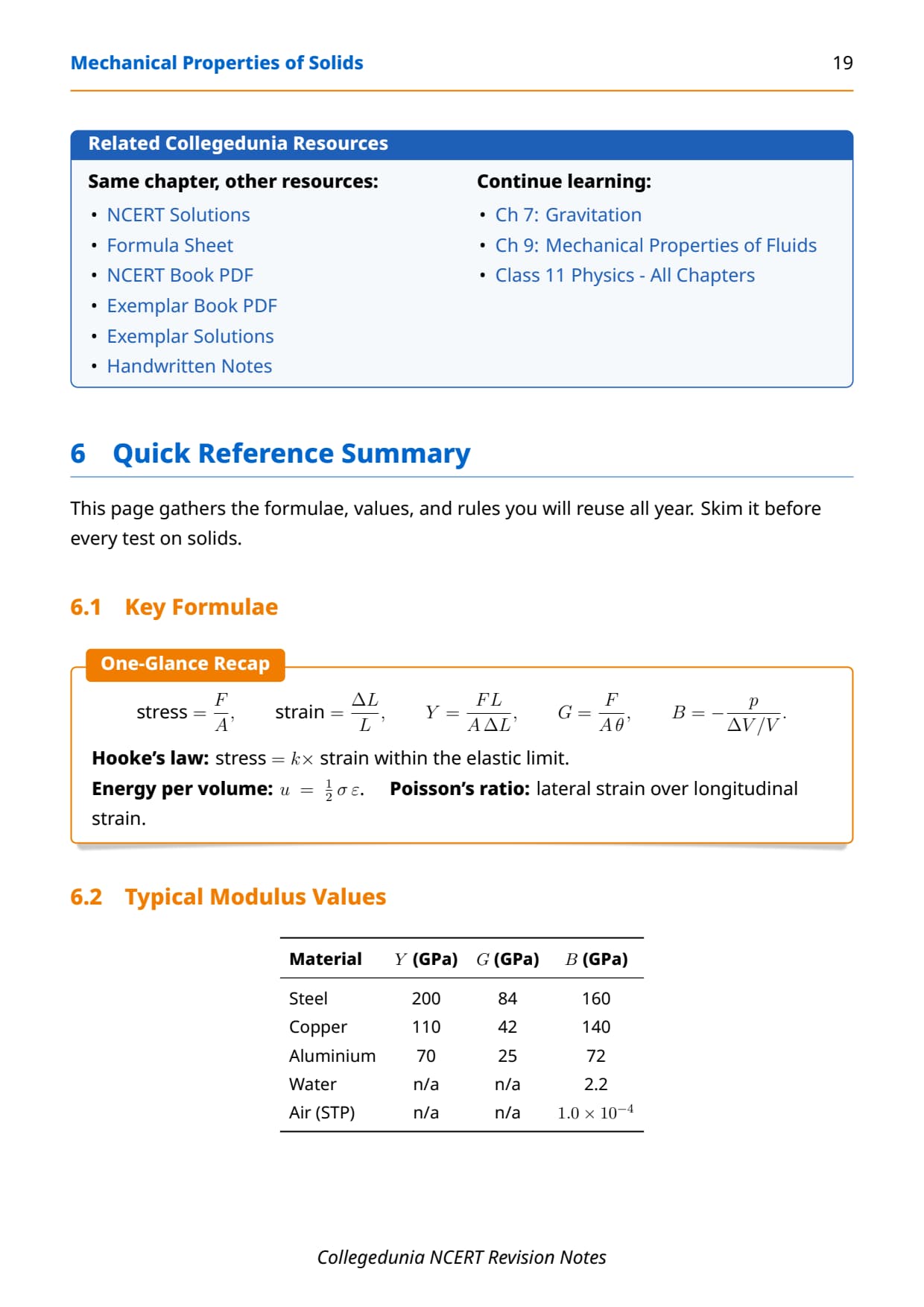
| Young's modulus (Y) | Y = (F/A) / (ΔL/L) | Resistance to change in length |
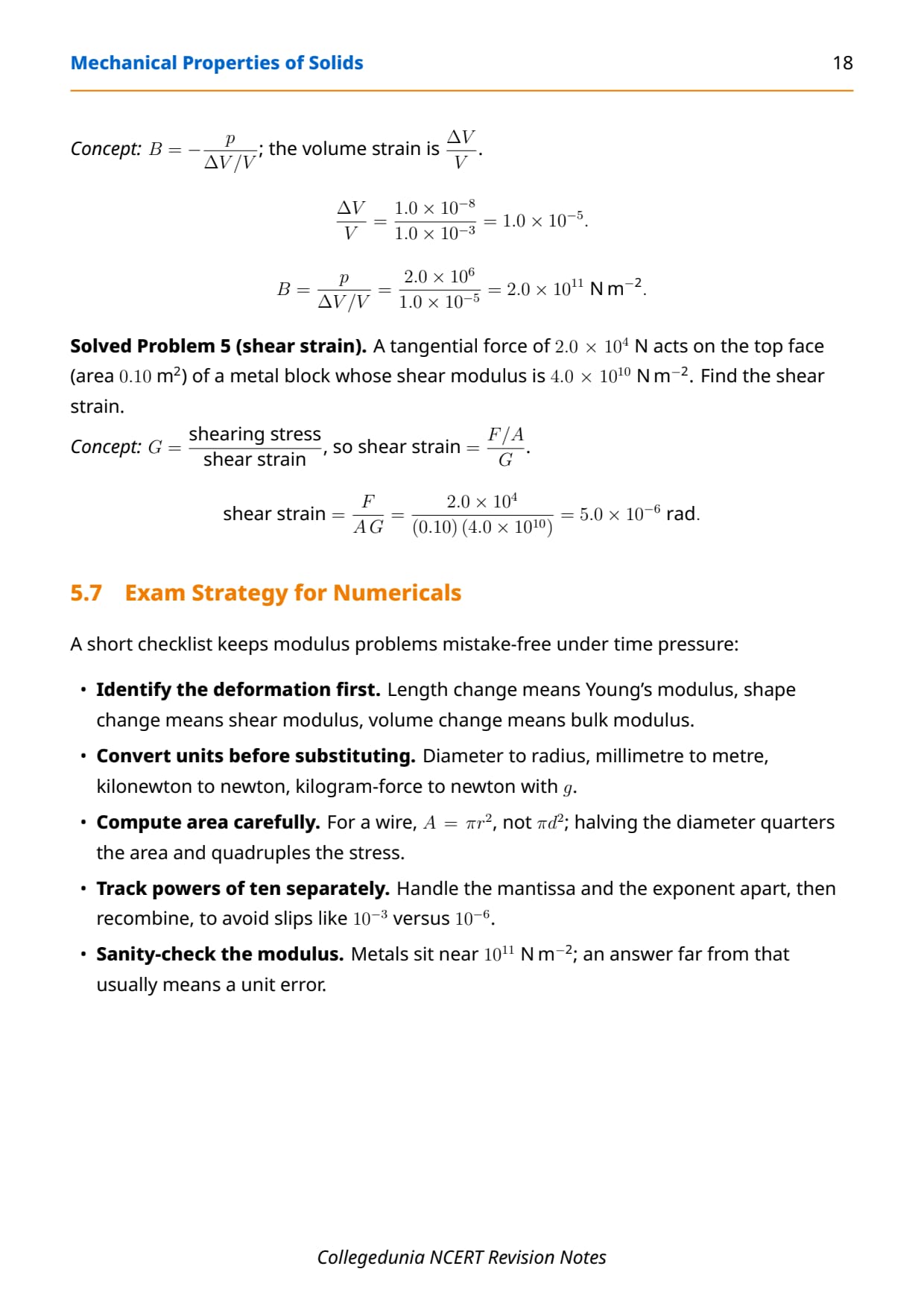
| Bulk modulus (B) | B = −P / (ΔV/V) | Resistance to change in volume |
| Shear modulus (G) | G = (F/A) / θ | Resistance to change in shape |
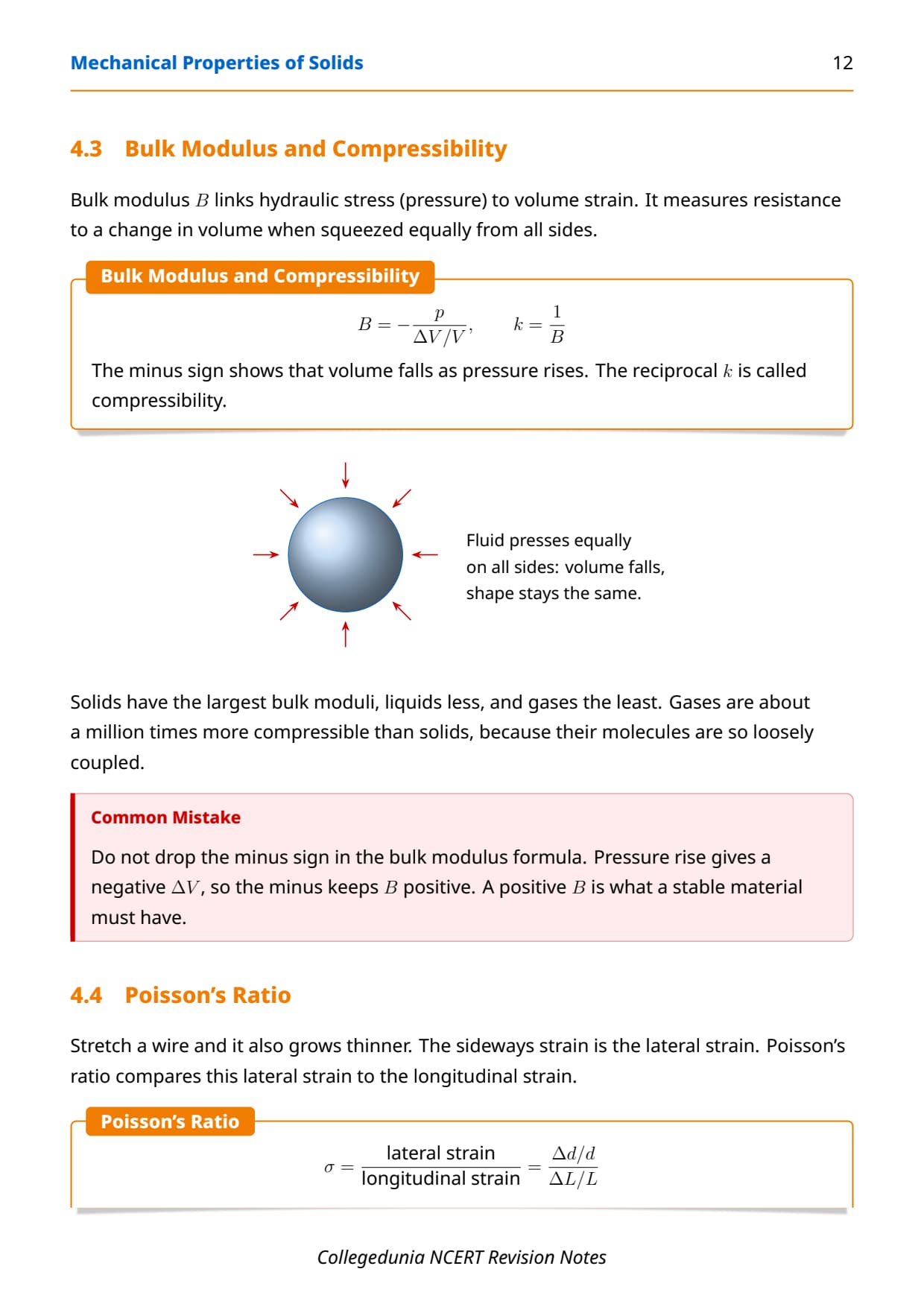
Young's modulus applies to solids only, because liquids and gases cannot support a lengthwise stress. The bulk modulus is defined for solids, liquids and gases, and the minus sign keeps it positive because volume falls as pressure rises. The reciprocal of the bulk modulus is called compressibility, which measures how easily a body is squeezed. These Class 11 Physics Notes Chapter 8 Mechanical Properties of Solids keep all three moduli side by side so you never mix them up in the exam.
All Formulas for Mechanical Properties of Solids
Every formula you need for the chapter sits in one table below, with its meaning and its SI unit. Learn the three moduli first, since those carry the most marks in both Boards and entrance papers.
| Formula | What it means | SI unit |
|---|---|---|
| stress = F/A | Restoring force per unit area | N m-2 or pascal (Pa) |
| longitudinal strain = ΔL/L | Fractional change in length | Dimensionless |
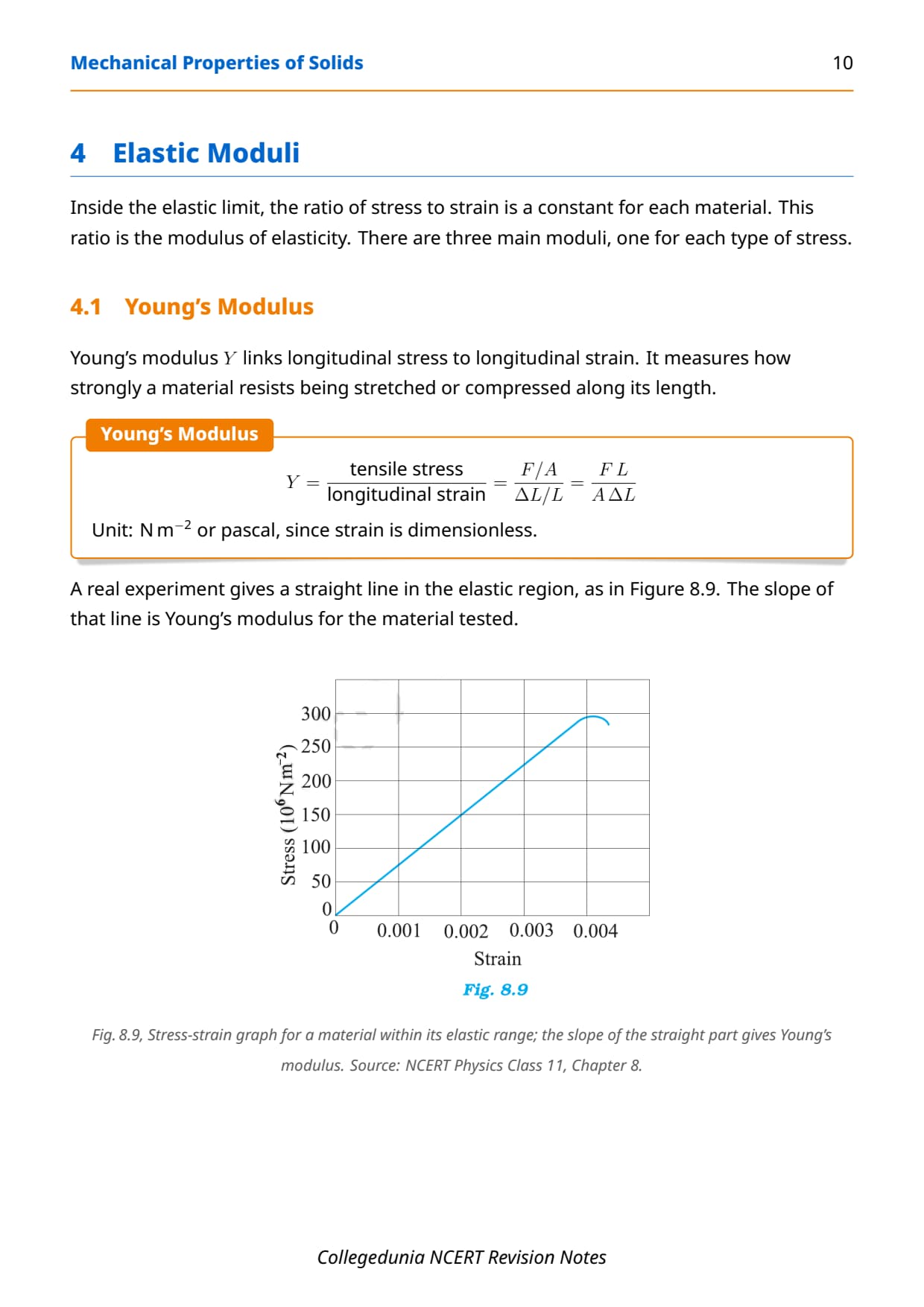
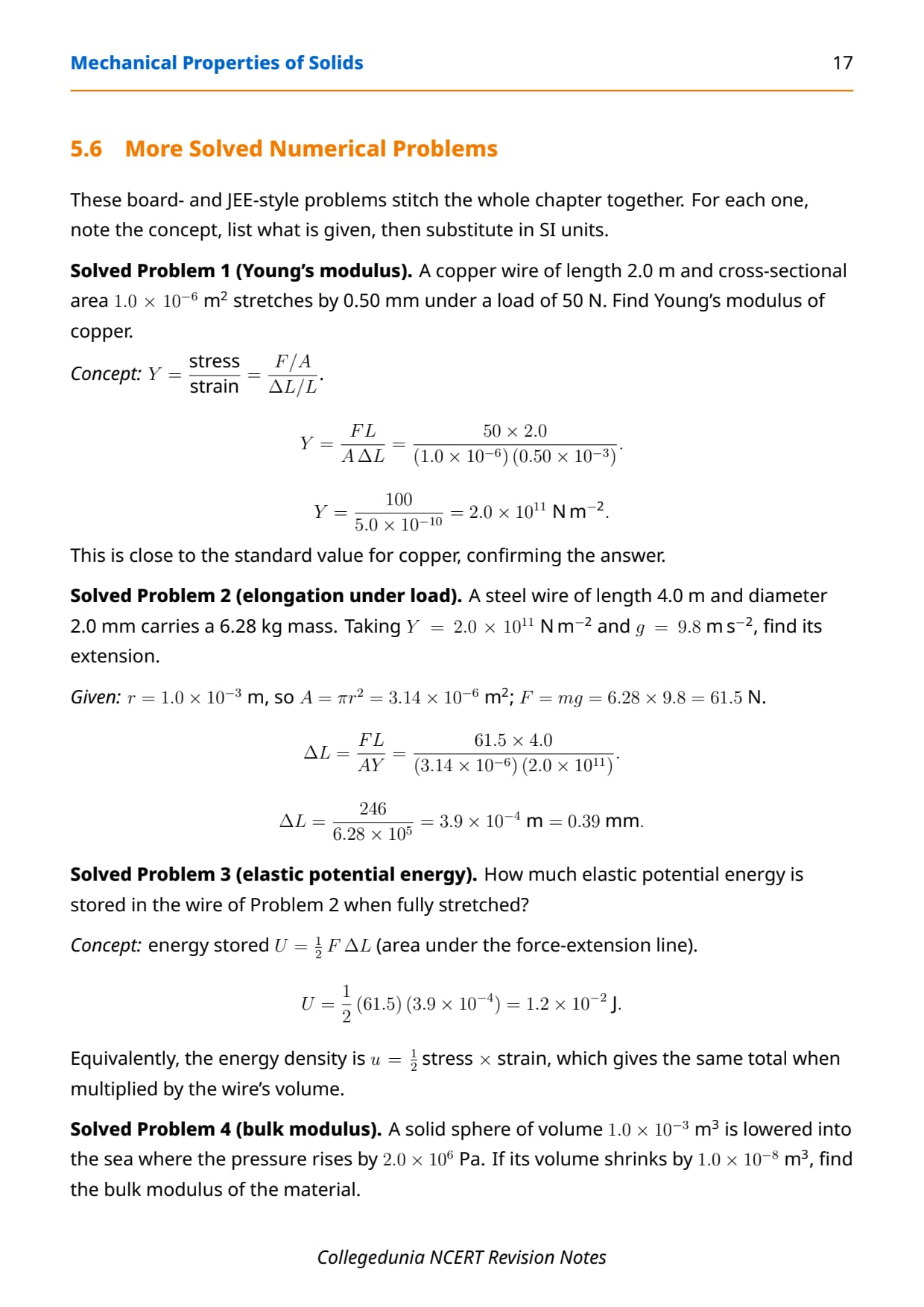
| Y = (FL) / (A ΔL) | Young's modulus of the material | pascal (Pa) |
| B = −V (ΔP/ΔV) | Bulk modulus for volume change | pascal (Pa) |
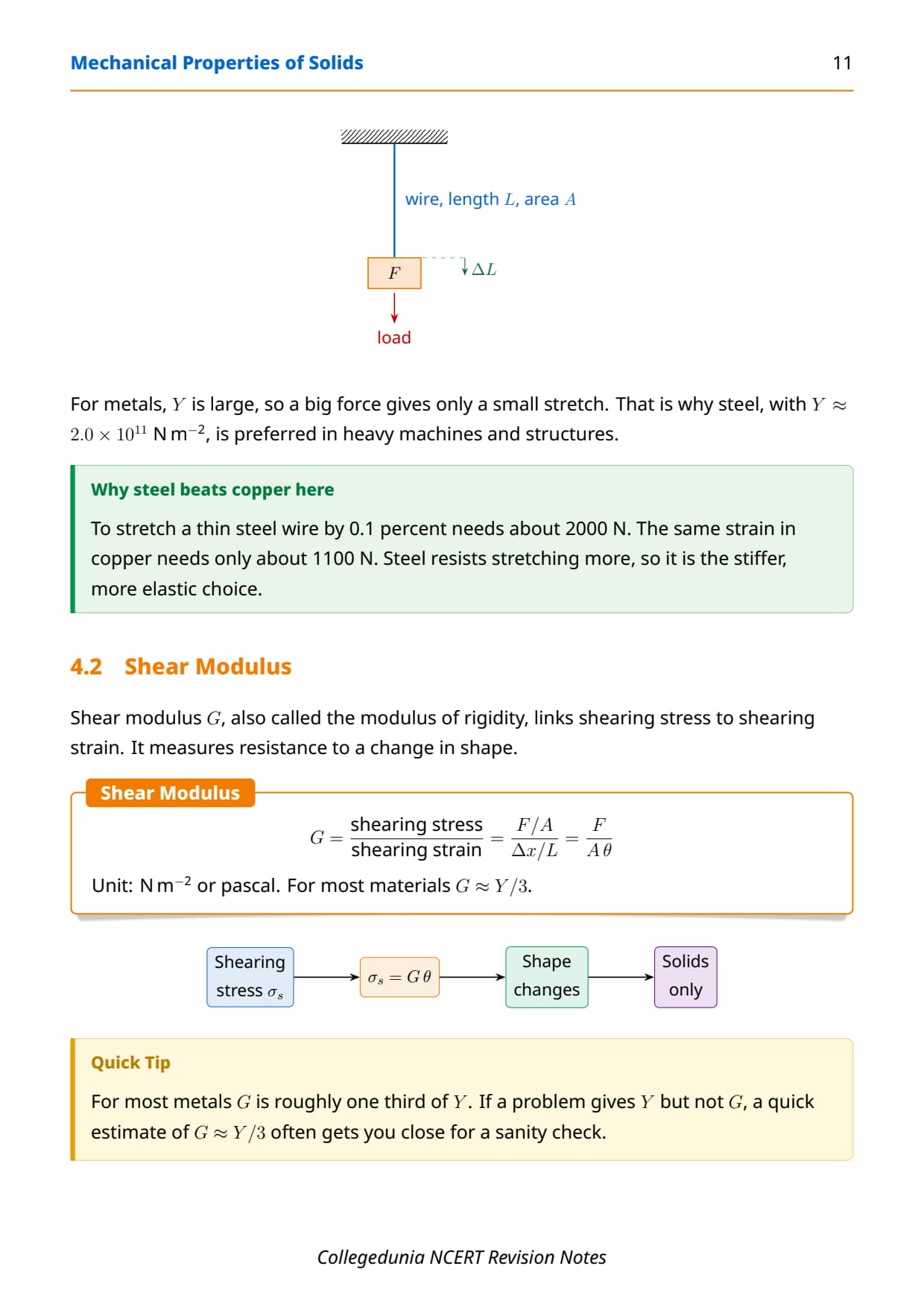
| G = F / (A θ) | Shear (rigidity) modulus | pascal (Pa) |
| k = 1/B | Compressibility, ease of squeezing | Pa-1 |
| σ = (Δd/d) / (ΔL/L) | Poisson's ratio (lateral to longitudinal strain) | Dimensionless |
| U = ½ × stress × strain × volume | Elastic potential energy stored | joule (J) |
| energy density = ½ × stress × strain | Elastic energy per unit volume | J m-3 |
Carry the SI unit on every line of your working. Since all three moduli share the pascal, students often forget it, but the marker still wants it written. Keep this table open while you solve the back-exercise numericals.
Key Definitions and Derivations for Mechanical Properties of Solids
Boards short-answer questions often ask for a clean definition in one or two lines. Learn these word-for-word, because a vague definition loses easy marks. Each one also sets up a derivation or graph you can be asked to show.
| Term | Definition |
|---|---|
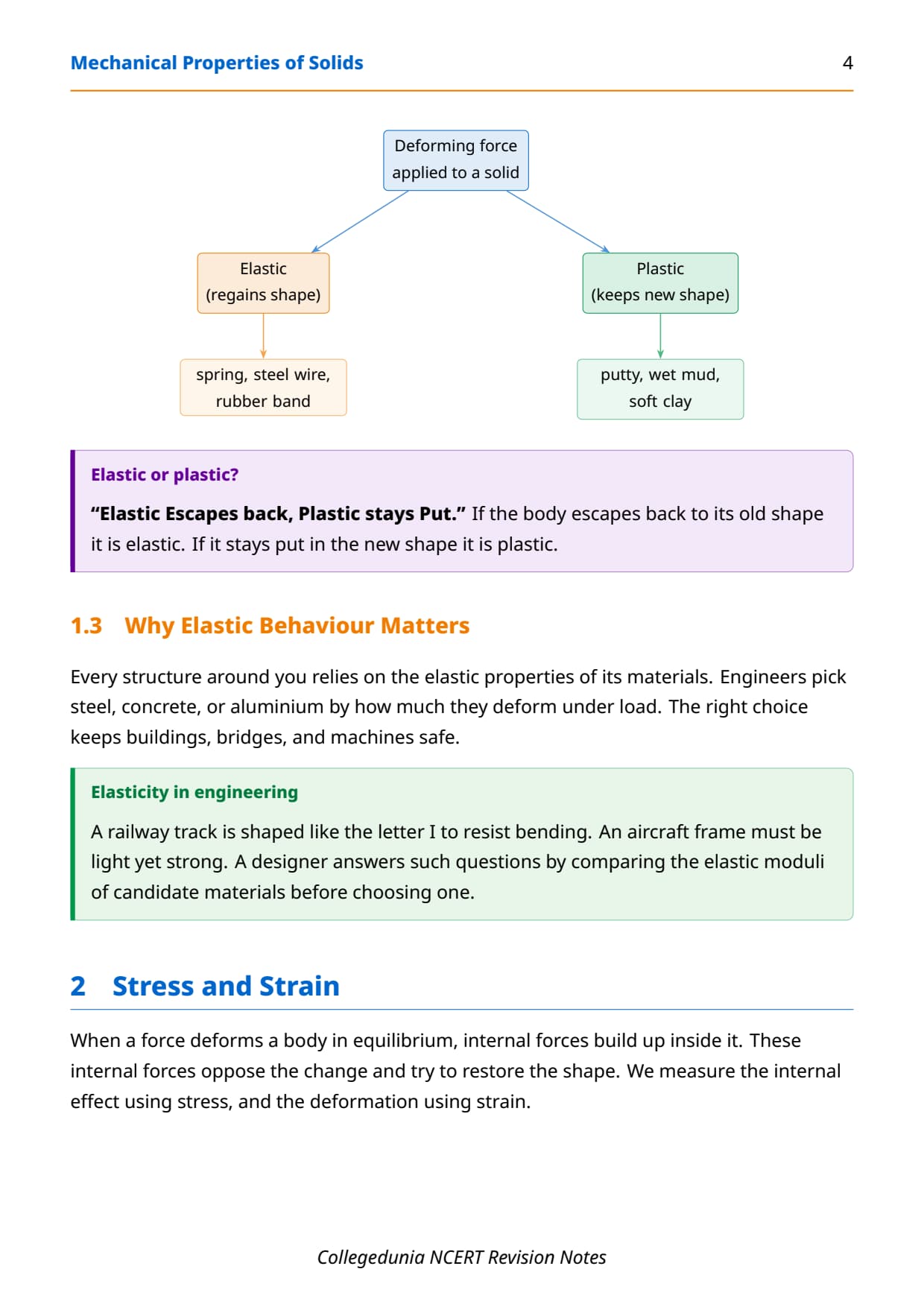
| Elasticity | The property by which a body regains its original shape after the deforming force is removed. |
| Plasticity | The property by which a body keeps its changed shape after the force is removed. |
| Elastic limit | The maximum stress a body can bear and still fully recover its shape. |
| Young's modulus | The ratio of longitudinal stress to longitudinal strain within the elastic limit. |
| Poisson's ratio | The ratio of lateral strain to longitudinal strain in a stretched wire. |
| Elastomer | A material like rubber that can be stretched to large strains and still return to shape. |
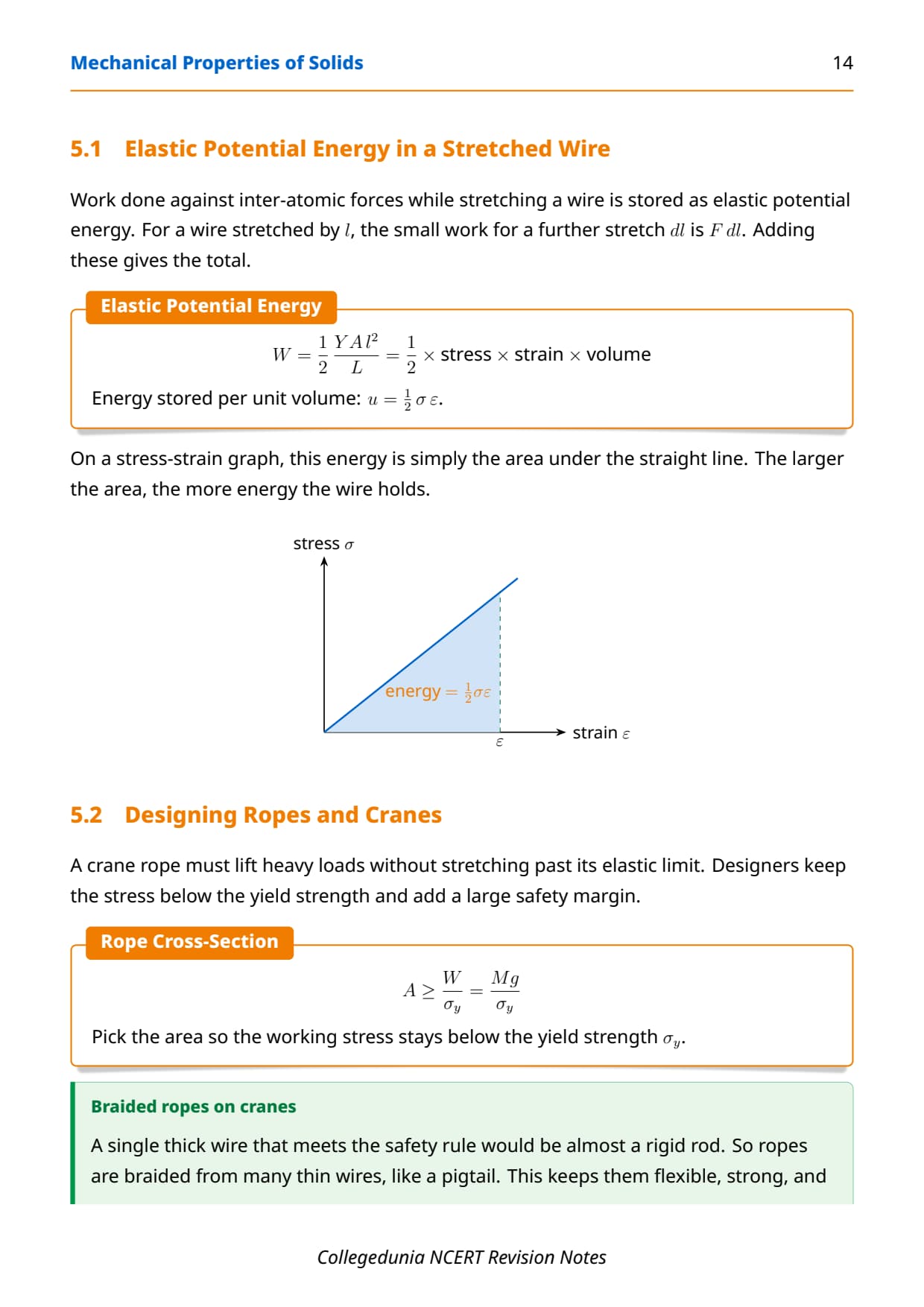
A common derivation asks you to show the energy stored in a stretched wire. The work done in stretching equals the area under the force-extension graph, which gives U = ½ × stress × strain × volume. Deriving this cleanly is worth a full short-answer question in the CBSE paper.
Poisson's Ratio and Elastic Potential Energy in a Stretched Wire
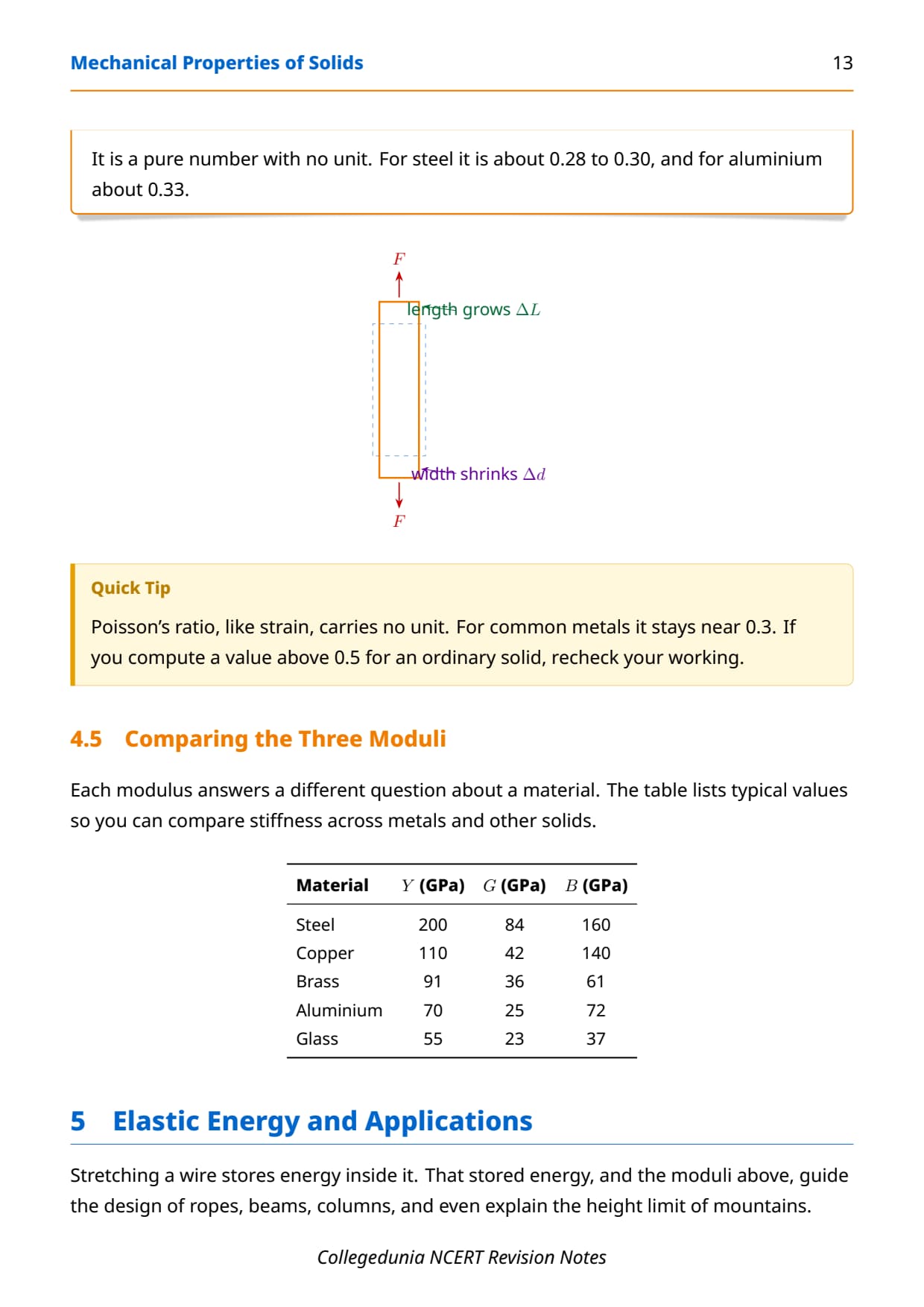
When a wire is stretched it also grows thinner. Poisson's ratio links these two changes, and the stretching stores energy inside the wire. Both ideas appear in numericals, so keep the definitions and the energy formula ready.
- Lateral strain: the fractional change in the wire's diameter, Δd/d.
- Poisson's ratio: the ratio of lateral strain to longitudinal strain, written as σ, with no unit.
- Elastic potential energy: the work stored in the wire, equal to the area under its stress-strain graph.
Poisson's ratio for most materials lies between 0 and 0.5, and it has no unit because it is a ratio of two strains. The energy per unit volume, called the strain energy density, is ½ × stress × strain. This stored energy is what makes a stretched spring or a bent bow able to do work when released, a link the NEET paper likes to test.
Applications of Elastic Behaviour: Beams, Columns and Cranes
The chapter closes by using elasticity to explain real structures. Engineers choose the shape and material of a beam or column from its Young's modulus and its breaking stress. These applications turn up as reasoning questions, so learn why each design is used.
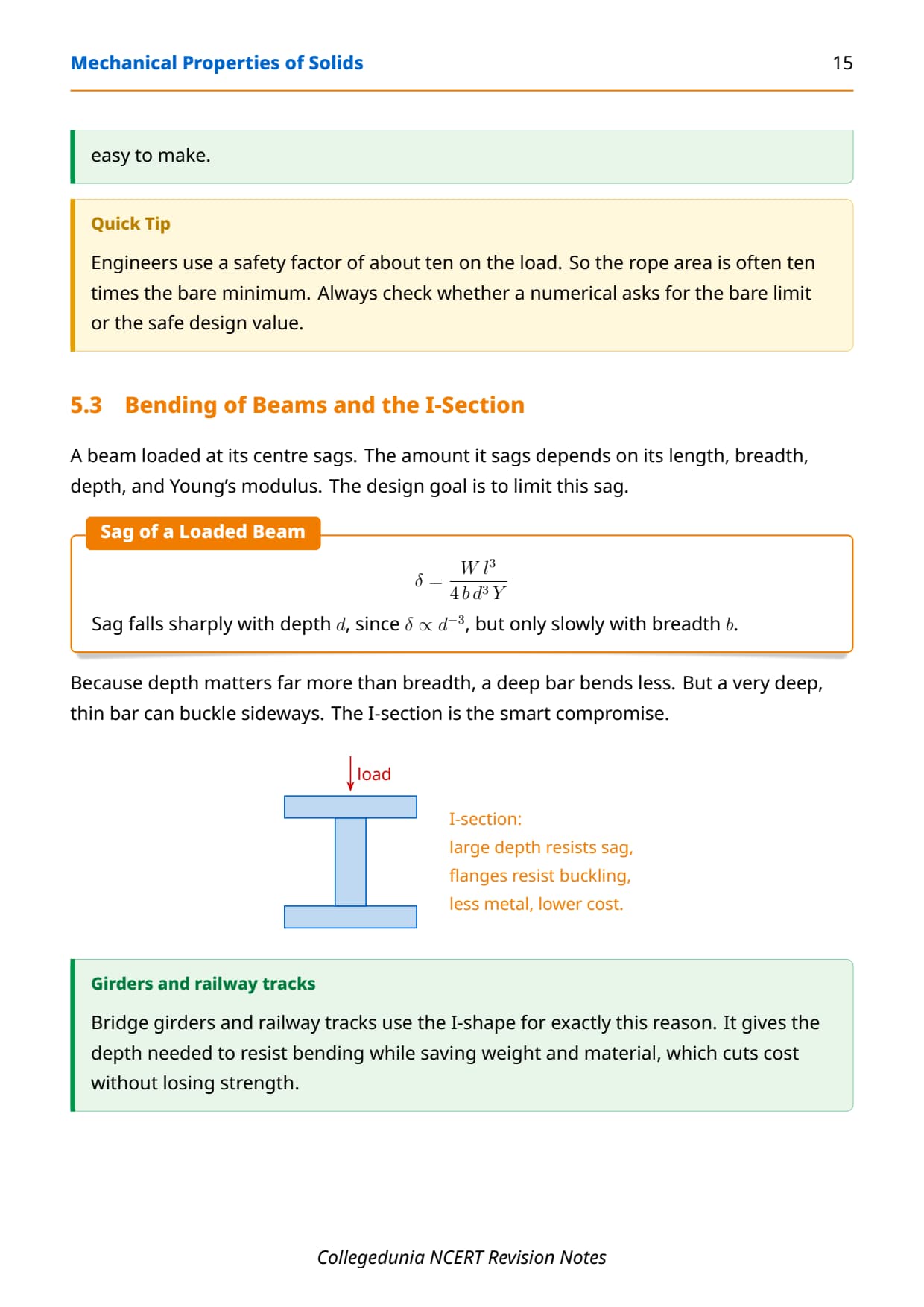
- Sag of a beam: a beam bends less when it is deep and thin, so girders are made in an I-shape to save material without losing strength.
- Bridges and cranes: the maximum stress a rope or bar can take fixes the safe load, so a safety factor is always added.
- Columns and pillars: a hollow column resists bending better than a solid rod of the same mass, which is why bones and bamboo are hollow.
The I-shaped cross-section puts most of the material where the bending stress is largest, at the top and bottom. This one idea explains girders, railway tracks and building beams in a single line. Design questions like these reward a clear reason over a long calculation.
Common Mistakes Students Make in Mechanical Properties of Solids
These slips happen while writing or calculating, not because the concept is unclear. Each one costs 1 to 3 marks in the paper, so watch for them at the exact step.
Mistake 1: Confusing stress with pressure. Stress is an internal restoring force per unit area and can act in any direction, not only inward.
Mistake 2: Giving strain a unit. Strain is a ratio of two like quantities, so it is always dimensionless.
Mistake 3: Using Young's modulus for a volume or shape change. Match each modulus to its own strain type before substituting.
Mistake 4: Forgetting the factor of one-half in the elastic energy formula, which comes from the area of a triangle under the graph.
Mechanical Properties of Solids Weightage in CBSE Boards, JEE and NEET
This chapter is short but scoring. It rarely carries a long-answer question, yet it shows up every year as a short answer plus an objective numerical. Here is how the marks split across the main exams for 2026-27.
| Exam | Typical weightage | What is asked |
|---|---|---|
| CBSE Boards | 3 to 5 marks | One short answer on the stress-strain curve plus one numerical on Young's modulus |
| JEE Main | 1 question most years | Young's or bulk modulus, elastic energy, or Poisson's ratio |
| NEET | 1 to 2 questions | Definitions of the three moduli and the stress-strain graph |
| CUET and NDA | 1 objective question | Stress, strain and Hooke's law |
Young's modulus is the single most tested idea from this chapter across all four exams. Master it first, then the stress-strain curve, then the elastic energy formula, in that order of return on effort.
How to Revise Mechanical Properties of Solids Quickly
Use these Class 11 Physics Notes Chapter 8 Mechanical Properties of Solids for a fast, ordered recap the night before a test. The checklist below takes about 30 minutes and hits every marks-heavy idea.
- First 10 minutes: write the three stress-strain pairs and the formula for Young's, bulk and shear modulus from memory.
- Next 10 minutes: sketch the stress-strain curve and label the proportional limit, elastic limit, yield point and fracture point.
- Last 10 minutes: redo one Young's modulus numerical and one elastic-energy numerical for a stretched wire.
Close the loop by stating Poisson's ratio and its typical range without looking. If you can do all three blocks without notes, the chapter is exam-ready. Keep the All Formulas table beside you for the first pass only, then try it closed-book.
Student Feedback on the Mechanical Properties of Solids Notes
What 11,540 students told us about their Mechanical Properties of Solids revision:
- 64% of students rated the stress-strain curve as the sub-topic they most often draw wrong.
- Most-skipped step: matching each modulus to its own strain type, missed by about 3 in 10 students.
- Students who learned the three strain types first said the modulus formulas felt much easier.
Source: 2026-27 Class 11 Physics student poll. Sample of 11,540 students from CBSE schools across 14 states, conducted before the 2026 boards.
Other Mechanical Properties of Solids Class 11 Physics Resources
Pair these notes with the solved answers, the handwritten notes, the formula sheet, and the textbook PDF for the same chapter.
| Resource | Link |
|---|---|
| NCERT Solutions | Mechanical Properties of Solids Class 11 NCERT Solutions |
| Handwritten Notes | Mechanical Properties of Solids Class 11 Handwritten Notes |
| Formula Sheet | Mechanical Properties of Solids Class 11 Formula Sheet |
| NCERT Book PDF | Mechanical Properties of Solids Class 11 Book PDF |
NCERT Notes for Class 11 Physics: All Chapters
Jump to the revision notes for any other Class 11 Physics chapter below.
| Chapter | NCERT Notes |
|---|---|
| Chapter 1 | Units and Measurements |
| Chapter 2 | Motion in a Straight Line |
| Chapter 3 | Motion in a Plane |
| Chapter 4 | Laws of Motion |
| Chapter 5 | Work, Energy and Power |
| Chapter 6 | System of Particles and Rotational Motion |
| Chapter 7 | Gravitation |
| Chapter 8 | Mechanical Properties of Solids |
| Chapter 9 | Mechanical Properties of Fluids |
| Chapter 10 | Thermal Properties of Matter |
| Chapter 11 | Thermodynamics |
| Chapter 12 | Kinetic Theory |
| Chapter 13 | Oscillations |
| Chapter 14 | Waves |
FAQs on Mechanical Properties of Solids Class 11 Physics Notes
Mechanical Properties of Solids Notes - Frequently Asked Questions
Ques. What topics do the Class 11 Physics Notes Chapter 8 Mechanical Properties of Solids cover?
Ans. These Class 11 Physics Notes Chapter 8 Mechanical Properties of Solids cover the three types of stress and strain, Hooke's law, the stress-strain curve with its key points, Young's, bulk and shear modulus, Poisson's ratio, elastic potential energy, and the applications of elastic behaviour. Every key formula and definition is included for fast revision.
Ques. What are the three types of stress in this chapter?
Ans. The three types of stress are longitudinal stress, which is tensile or compressive along the length, shearing or tangential stress, which slides one face over another, and hydraulic or volume stress, which is a uniform pressure from all sides. Each type produces its own kind of strain and links to one modulus of elasticity.
Ques. What is Hooke's law in Mechanical Properties of Solids?
Ans. Hooke's law states that within the elastic limit, the stress in a body is directly proportional to the strain it produces. The constant of proportionality is the modulus of elasticity. The law holds only up to the proportional limit, after which the stress-strain graph is no longer a straight line.
Ques. What is Young's modulus and its SI unit?
Ans. Young's modulus is the ratio of longitudinal stress to longitudinal strain within the elastic limit. It measures how much a material resists a change in length, so a high value means a stiff material. Its SI unit is the pascal, the same as stress, because strain has no unit. It is defined for solids only.
Ques. What is the weightage of Mechanical Properties of Solids in the CBSE board exam?
Ans. Mechanical Properties of Solids carries about 3 to 5 marks in the CBSE Class 11 Physics paper, usually one short answer on the stress-strain curve plus one numerical on Young's modulus. It also appears in JEE Main and NEET as objective questions on the three moduli, Poisson's ratio and elastic energy.
Ques. How should I revise Mechanical Properties of Solids quickly for a test?
Ans. Start by writing the three stress-strain pairs and the formulas for Young's, bulk and shear modulus from memory. Then sketch the stress-strain curve and label its key points. Finish with one Young's modulus numerical and one elastic-energy numerical. The quick-revision checklist in these Class 11 Physics Notes Chapter 8 Mechanical Properties of Solids covers all of this in about 30 minutes.



Comments