




These Class 11 Physics Notes Chapter 12 Kinetic Theory pull together the ideal gas equation, the kinetic view of pressure and temperature, degrees of freedom, and the specific-heat results that the Boards, JEE Main, JEE Advanced, NEET, CUET and NDA papers test in 2026-27. Use them to revise the whole chapter fast, with every formula, definition and derivation in one place.
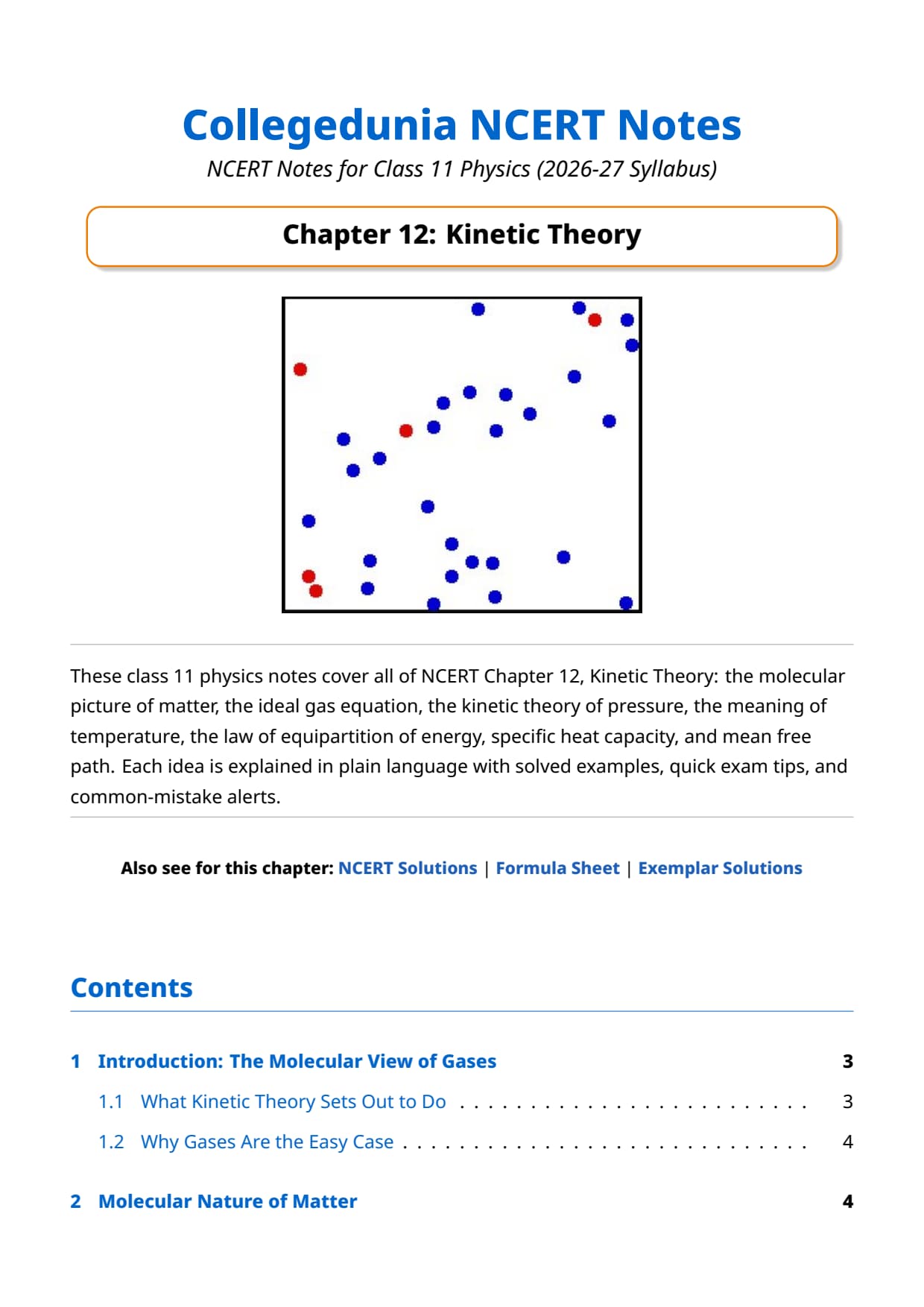
This chapter links the small-scale motion of molecules to the large-scale gas laws you already know, so it ties thermodynamics and heat together.
- CBSE Weightage: 4 to 5 marks, usually one short answer plus one numerical on RMS speed or specific heat.
- Topics covered: ideal gas equation, gas laws, kinetic pressure, kinetic energy and temperature, degrees of freedom, equipartition, specific heats, and mean free path.
- Key formulas: the pressure relation, RMS speed, average kinetic energy, and the specific-heat ratios for mono, di and polyatomic gases.
These Class 11 Physics Notes Chapter 12 Kinetic Theory are curated by subject experts, based on the 2026-27 NCERT textbook, and checked against the last five years of CBSE Board, JEE Main and NEET papers.
Topic-by-Topic Summary of Kinetic Theory
The chapter explains gas behaviour from the motion of its molecules. It starts with the ideal gas equation, then derives pressure and temperature from molecular speeds, and ends with specific heats and mean free path. Here is the quick map of what each topic gives you.
- Ideal gas equation: the single relation PV = nRT that combines all the gas laws.
- Kinetic pressure: pressure comes from molecules hitting the walls, linked to their mean square speed.
- Kinetic energy and temperature: the average kinetic energy of a molecule depends only on the absolute temperature.
- Degrees of freedom and equipartition: energy is shared equally, ½kT per degree of freedom.
- Specific heats and mean free path: the heat needed per mole, and the average distance a molecule travels between collisions.
Revise the topics in this order, because each one builds on the one before it. Get the ideal gas equation firm first, and the rest of the chapter follows from it. These Class 11 Physics Notes Chapter 12 Kinetic Theory follow the same sequence as the NCERT textbook.
Ideal Gas Equation and the Gas Laws
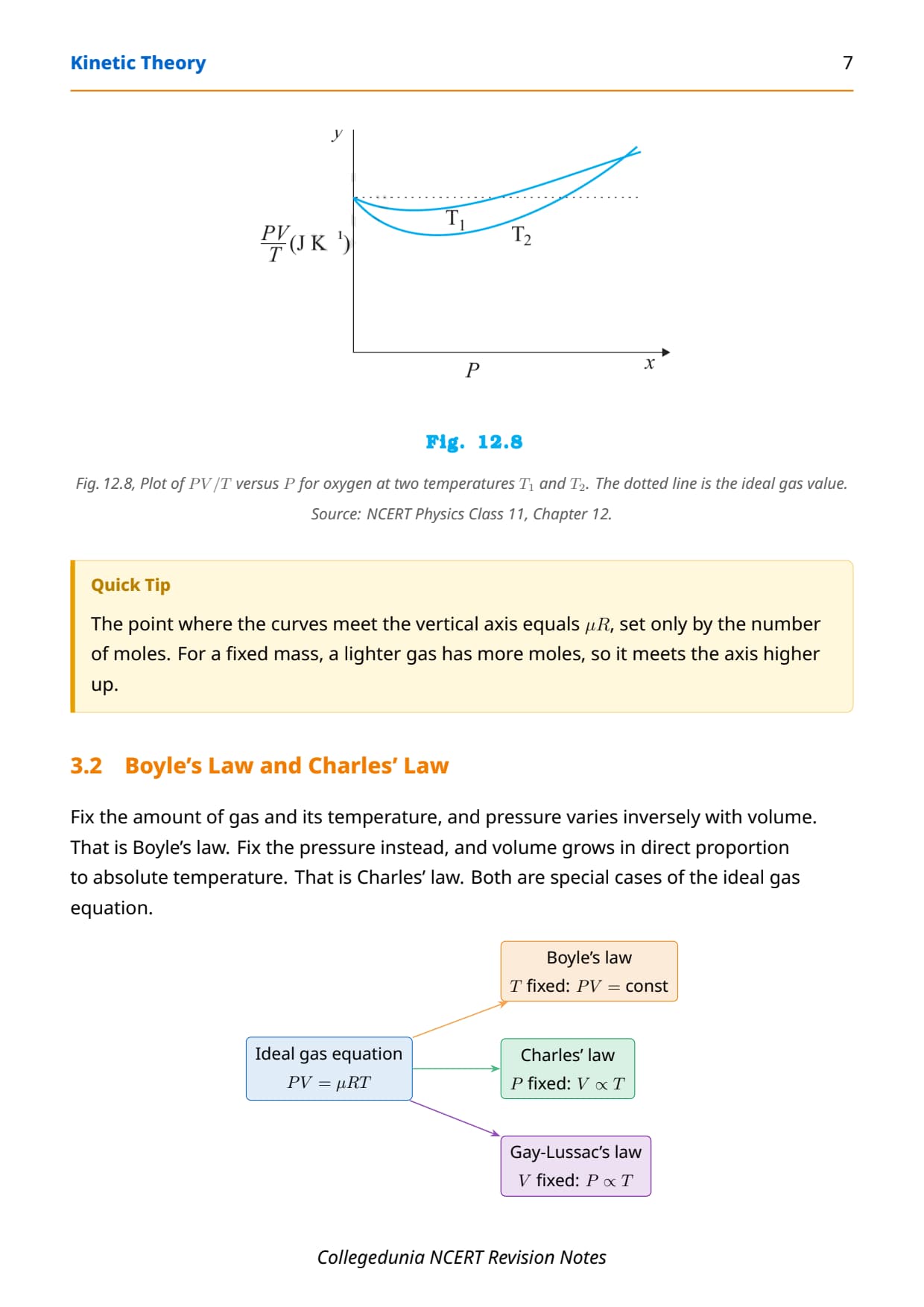
An ideal gas is a model gas whose molecules have no size and no force between them except during collisions. Its behaviour is captured by a single equation, and the three classic gas laws are just special cases of it.
| Gas law | Statement | Relation |
|---|---|---|
| Boyle's law | At constant temperature, pressure varies inversely with volume | PV = constant |
| Charles's law | At constant pressure, volume is proportional to absolute temperature | V/T = constant |
| Gay-Lussac's law | At constant volume, pressure is proportional to absolute temperature | P/T = constant |
| Avogadro's law | Equal volumes of gases at the same P and T have equal numbers of molecules | V ∝ n |
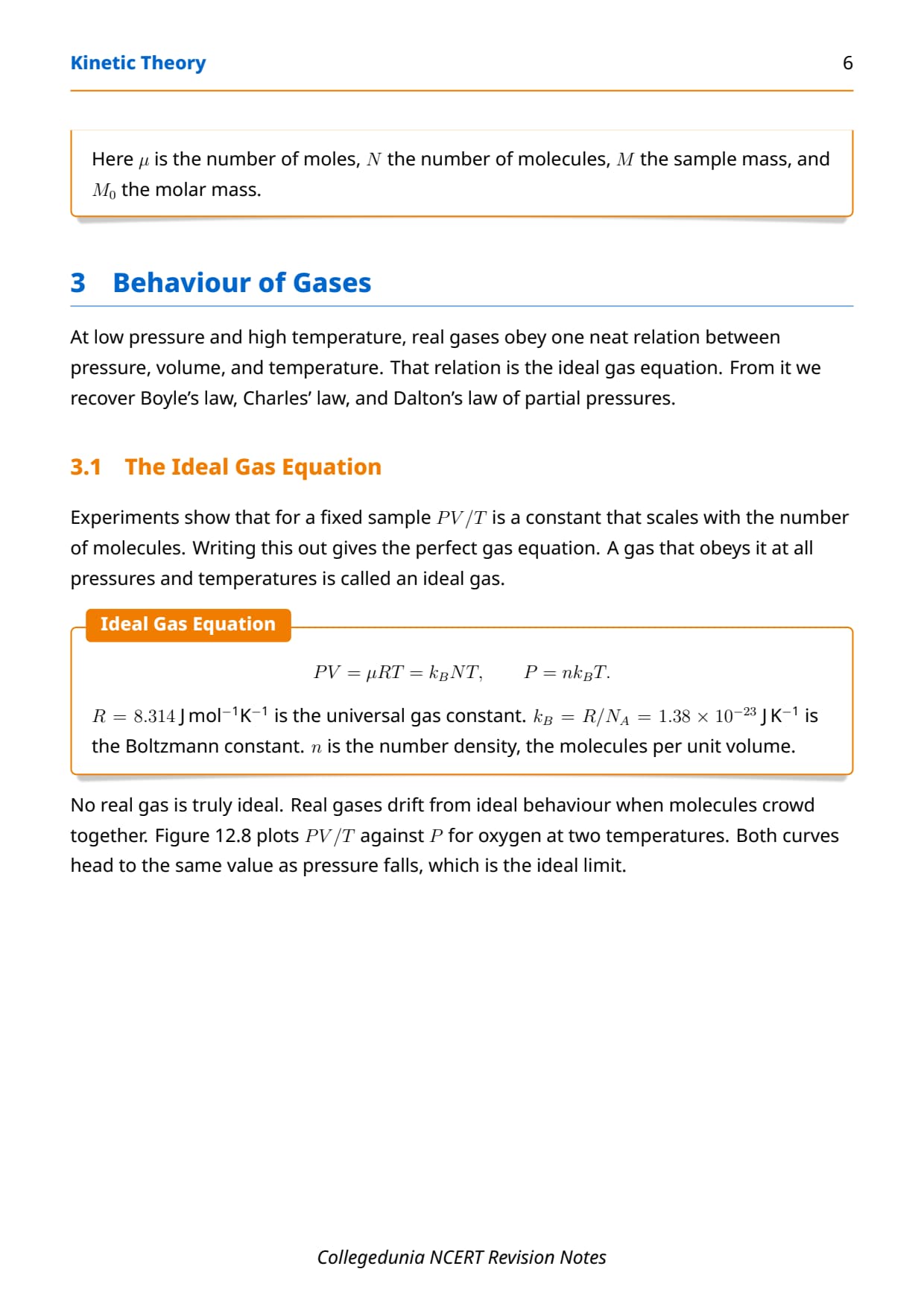
Putting these together gives the ideal gas equation PV = nRT, where n is the number of moles and R is the universal gas constant. In molecular form it becomes PV = NkT, where N is the number of molecules and k is the Boltzmann constant. Always use absolute temperature in kelvin, never Celsius, or the whole calculation goes wrong.
Kinetic Interpretation of Pressure
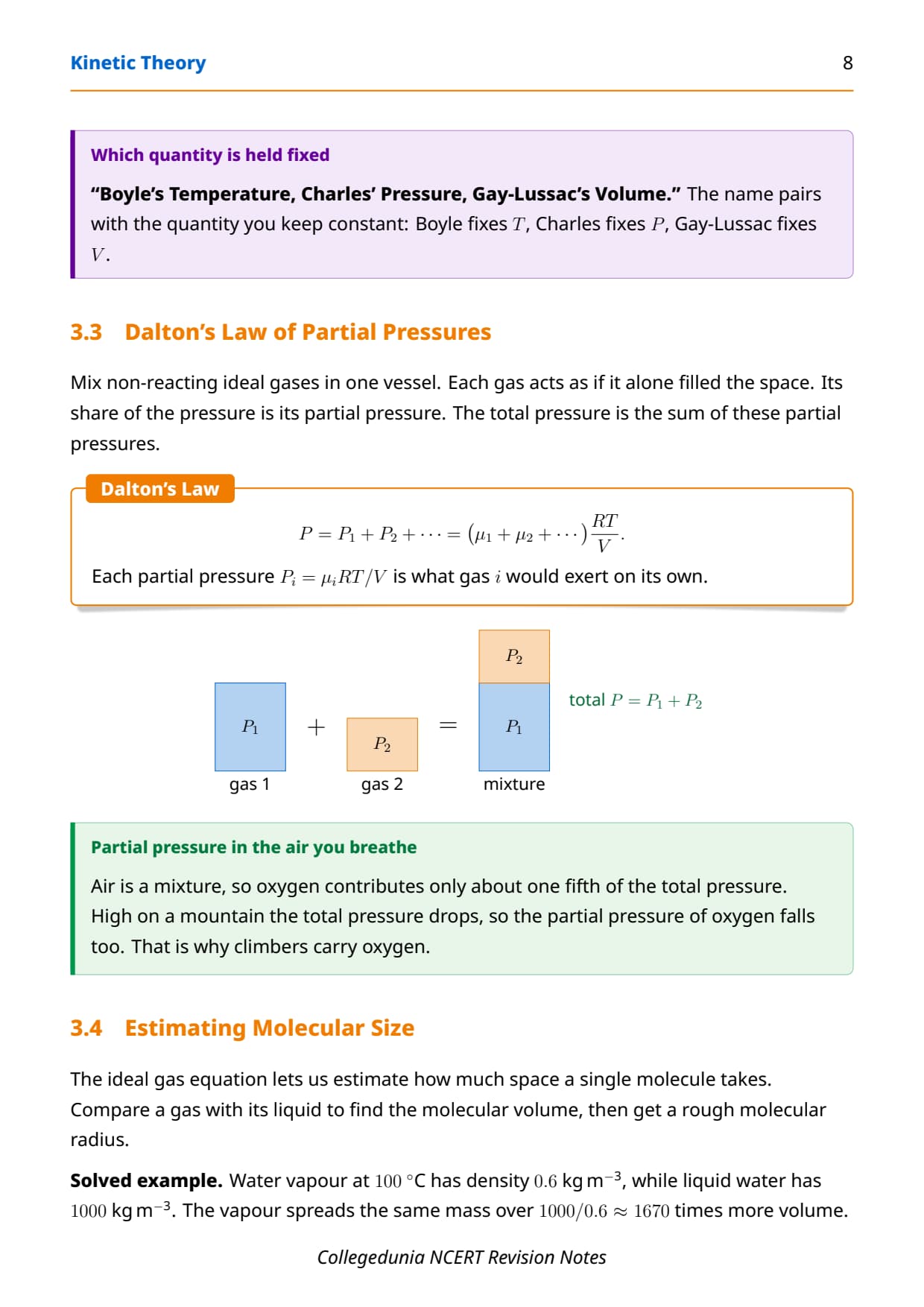
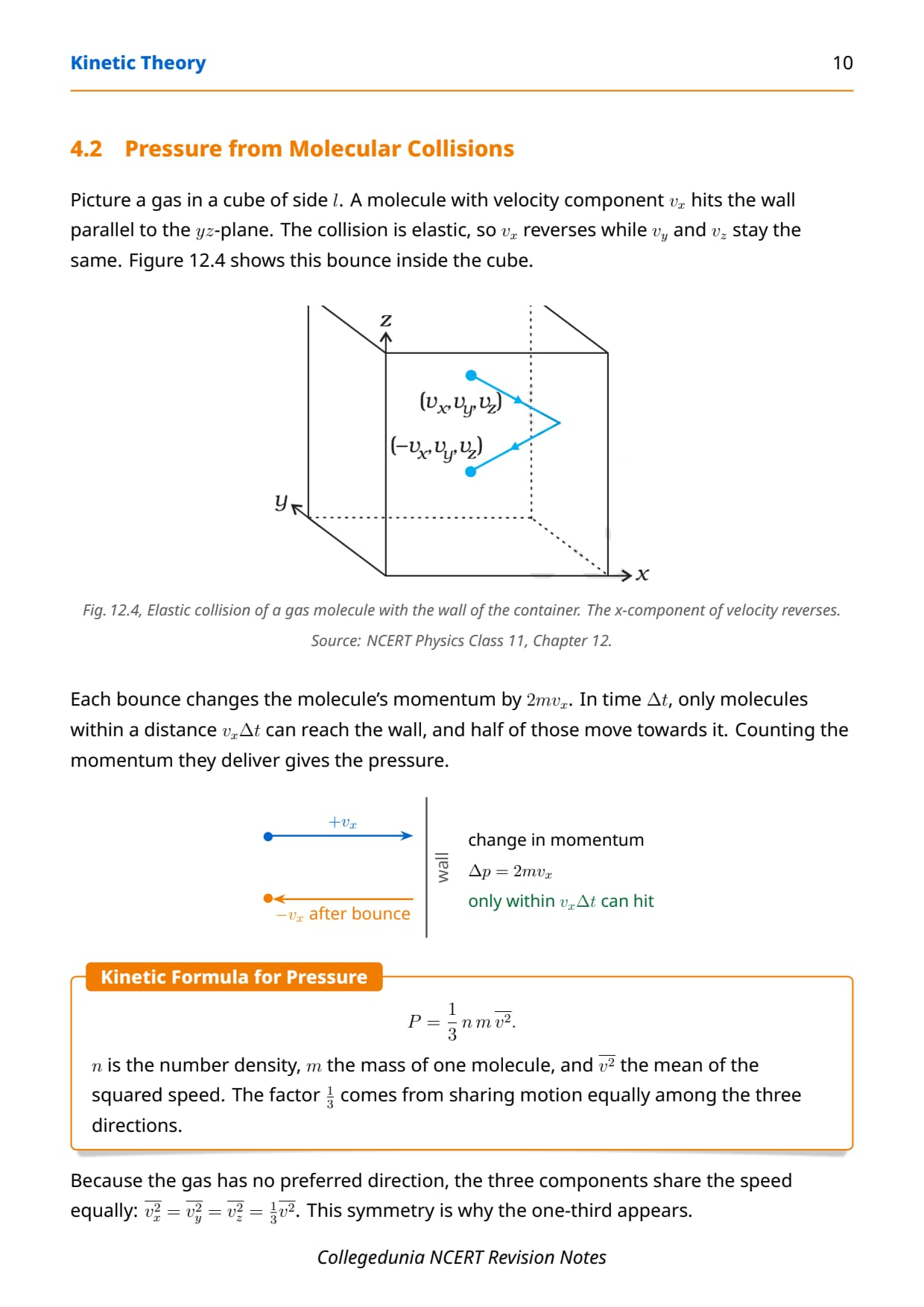
The kinetic theory explains gas pressure as the result of molecules striking the container walls. Each collision gives the wall a tiny push, and the huge number of collisions per second adds up to a steady pressure. The derivation links pressure to how fast the molecules move.
The central result is the pressure relation P = ⅓ (mN/V) v2rms, which can also be written as P = ⅓ ρ v2rms using the gas density. It rests on a few assumptions you should be able to state.
- Molecules are in constant, random motion and collide elastically.
- The volume of the molecules themselves is negligible compared with the container.
- There is no force between molecules except during a collision.
- The time of a collision is negligible compared with the time between collisions.
Pressure is proportional to the mean square speed of the molecules, not to the average speed. This is why heavier molecules at the same temperature move more slowly. Keep the factor of one-third in the formula, since dropping it is a common slip in the derivation.
Kinetic Energy, Temperature and RMS Speed
Combining the pressure relation with the ideal gas equation gives the most important idea in the chapter. The average kinetic energy of a gas molecule depends only on temperature, and nothing else. This one result is asked in almost every exam that includes the chapter.
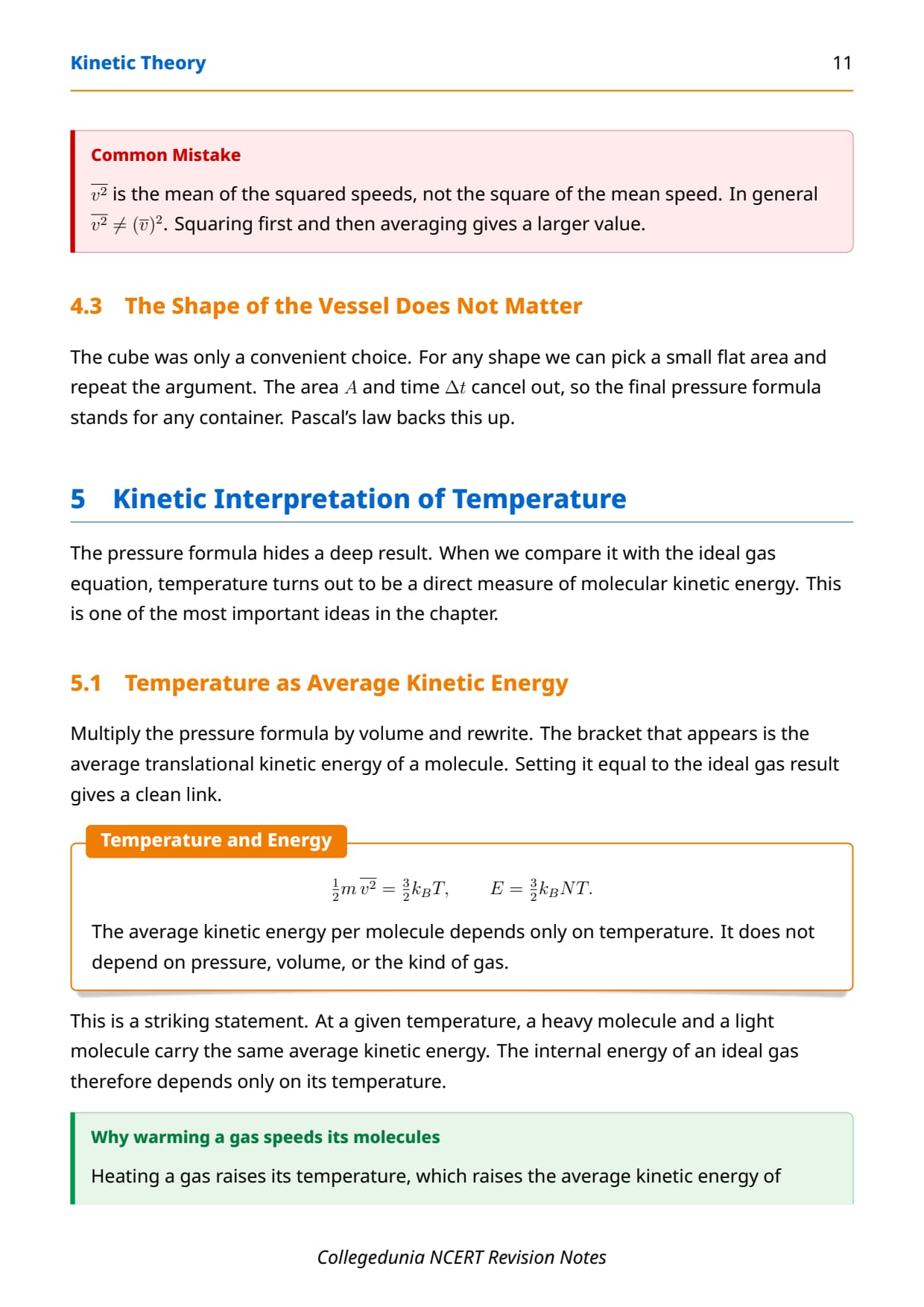
The average translational kinetic energy of a single molecule is ½ m v2rms = &frac32; kT. From this you get the root mean square speed, the speed used in every numerical of the chapter.
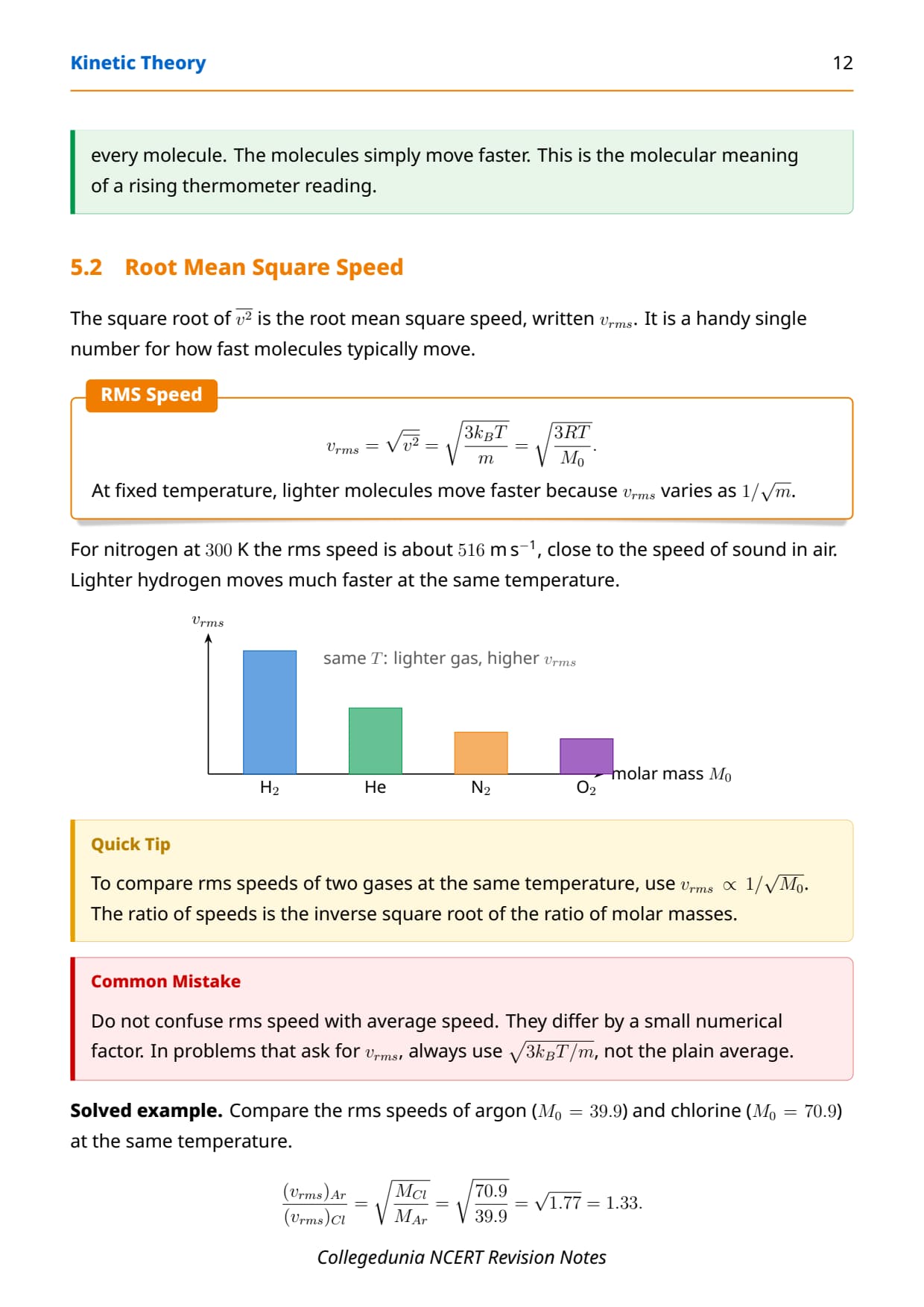
- RMS speed: vrms = √(3kT/m) = √(3RT/M), where M is the molar mass.
- Kinetic energy per molecule: &frac32;kT, which is the same for every gas at a given temperature.
- Kinetic energy per mole: &frac32;RT for the translational part.
The average kinetic energy is directly proportional to the absolute temperature. Doubling the kelvin temperature doubles the energy, but the RMS speed only rises by the square root of that factor. Remember that vrms depends on √T and on 1/√M, so light gases move faster.
Degrees of Freedom and the Law of Equipartition of Energy
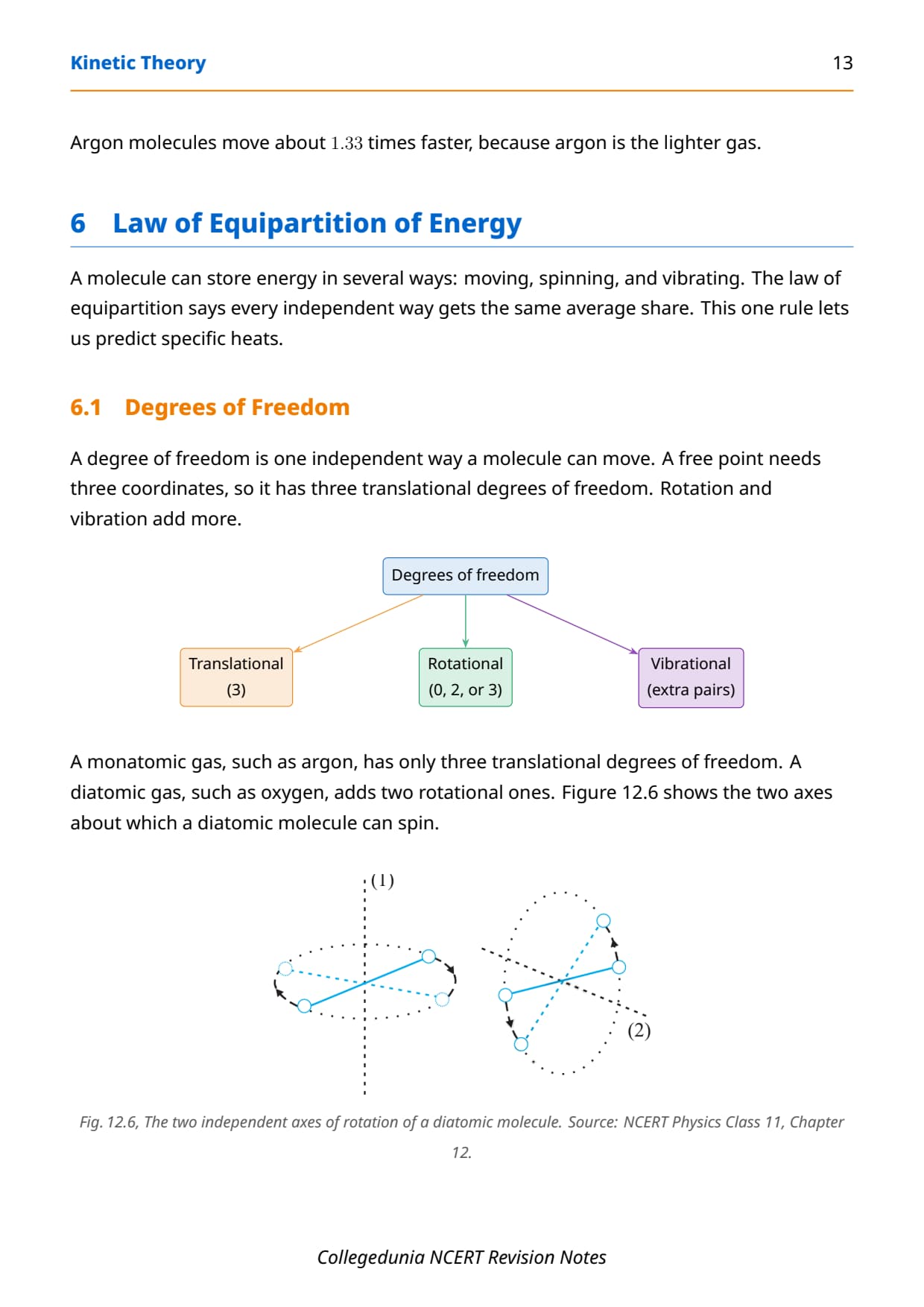
The degrees of freedom of a molecule are the number of independent ways it can store energy. A monatomic gas atom can only move in three directions, while diatomic molecules can also rotate. This number decides how much energy the gas holds.
| Type of gas | Degrees of freedom (f) | Example |
|---|---|---|
| Monatomic | 3 (translational only) | Helium, argon |
| Diatomic | 5 (3 translational + 2 rotational) | Oxygen, nitrogen |
| Polyatomic (non-linear) | 6 (3 translational + 3 rotational) | Water vapour, methane |
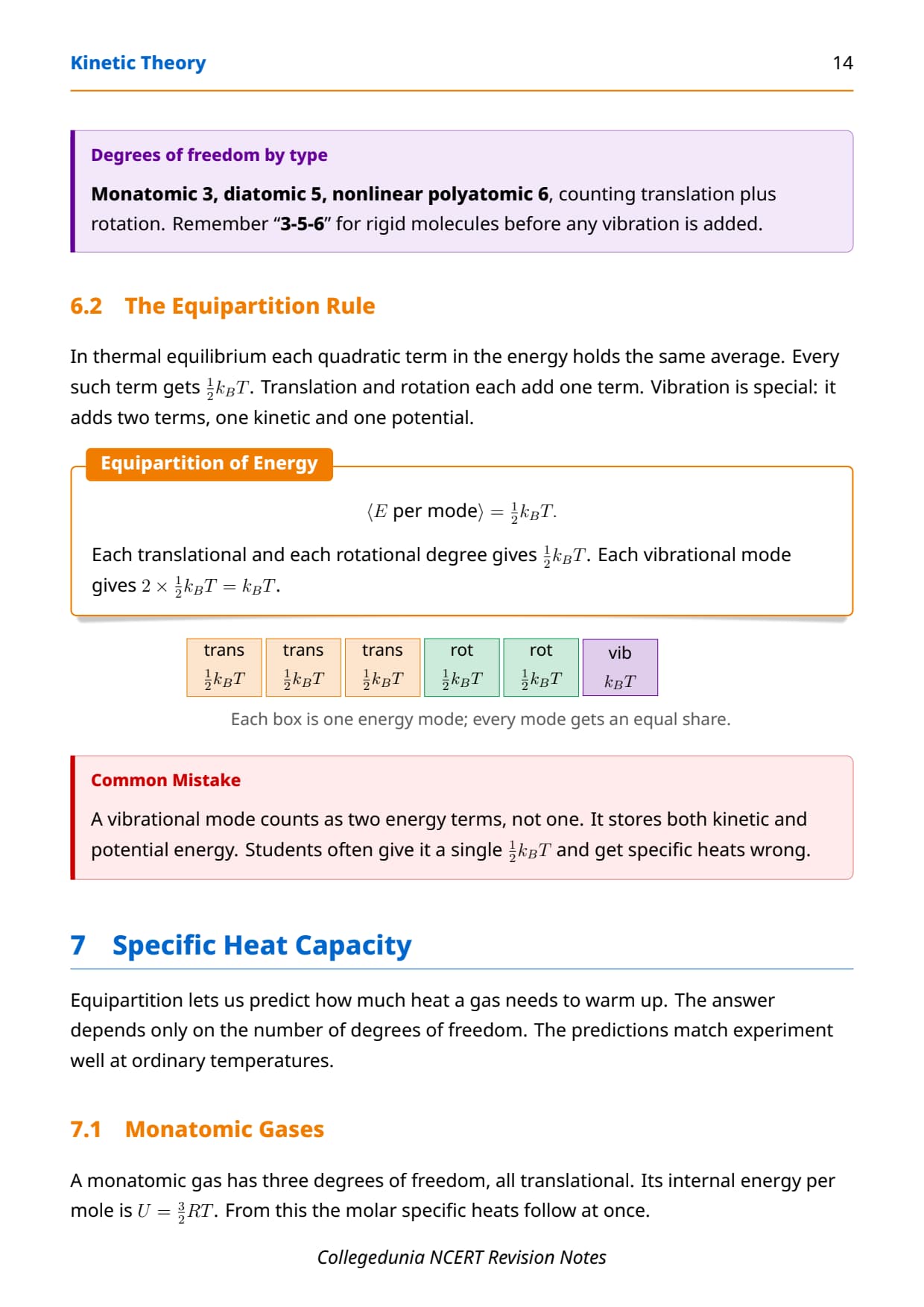
The law of equipartition of energy says each degree of freedom carries an average energy of ½kT per molecule, or ½RT per mole. Count the degrees of freedom, multiply by half kT, and you have the energy per molecule. This single rule gives you the internal energy and the specific heats of any ideal gas.
Specific Heat Capacity of Gases
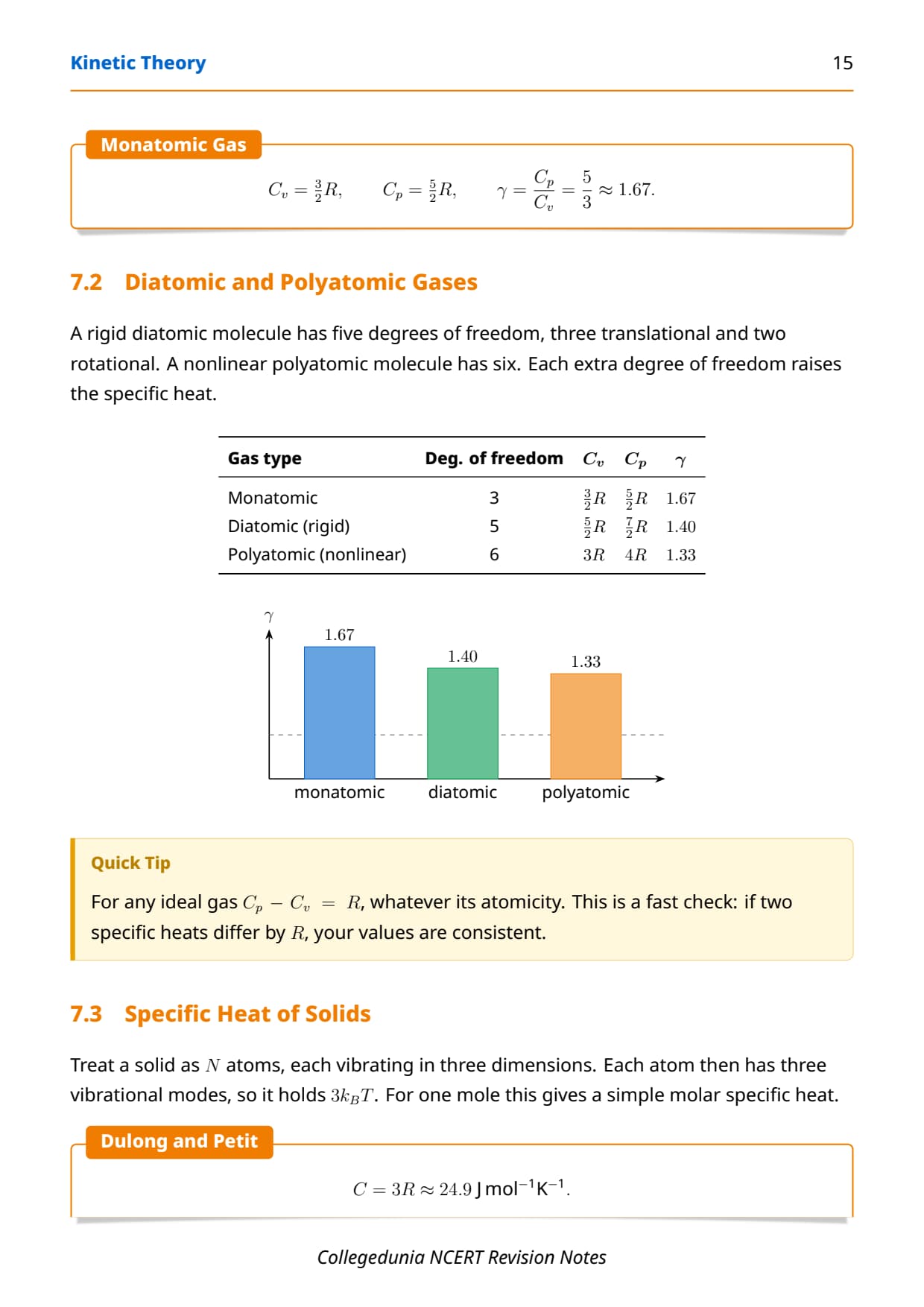
A gas has two specific heats, because it can be heated at constant volume or at constant pressure. Equipartition lets you predict both from the degrees of freedom alone. These values are a favourite in objective papers.
| Gas | CV | CP | γ = CP/CV |
|---|---|---|---|
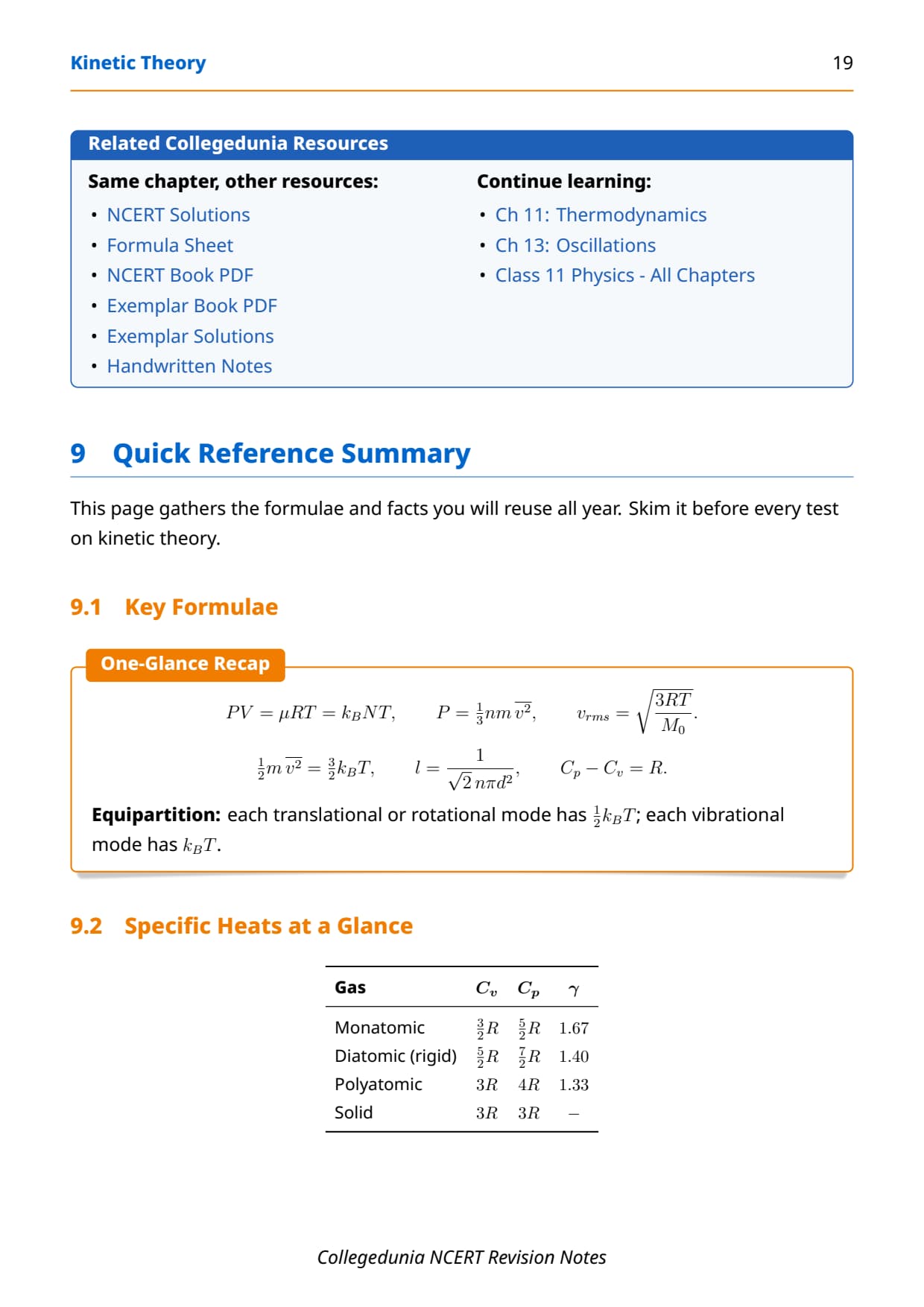
| Monatomic | &frac32;R | &frac52;R | 1.67 |
| Diatomic | &frac52;R | &frac72;R | 1.40 |
| Polyatomic | 3R | 4R | 1.33 |
The two specific heats are linked by Mayer's relation, CP − CV = R, which holds for every ideal gas. The ratio gamma falls as the molecule gets more complex, because more degrees of freedom raise both specific heats. Learn the three gamma values, since a question often gives gamma and asks you to name the type of gas.
Mean Free Path and Avogadro's Number
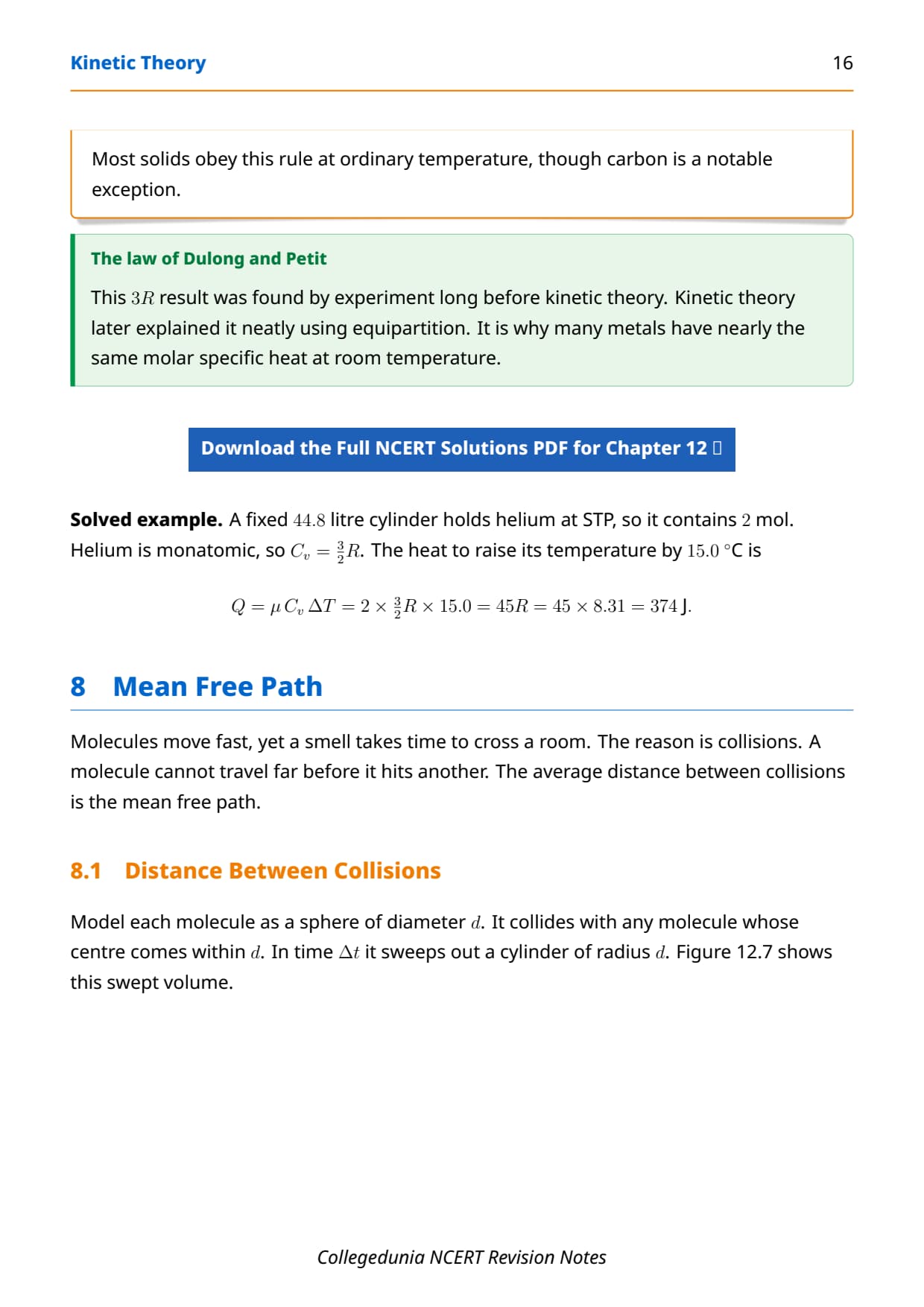
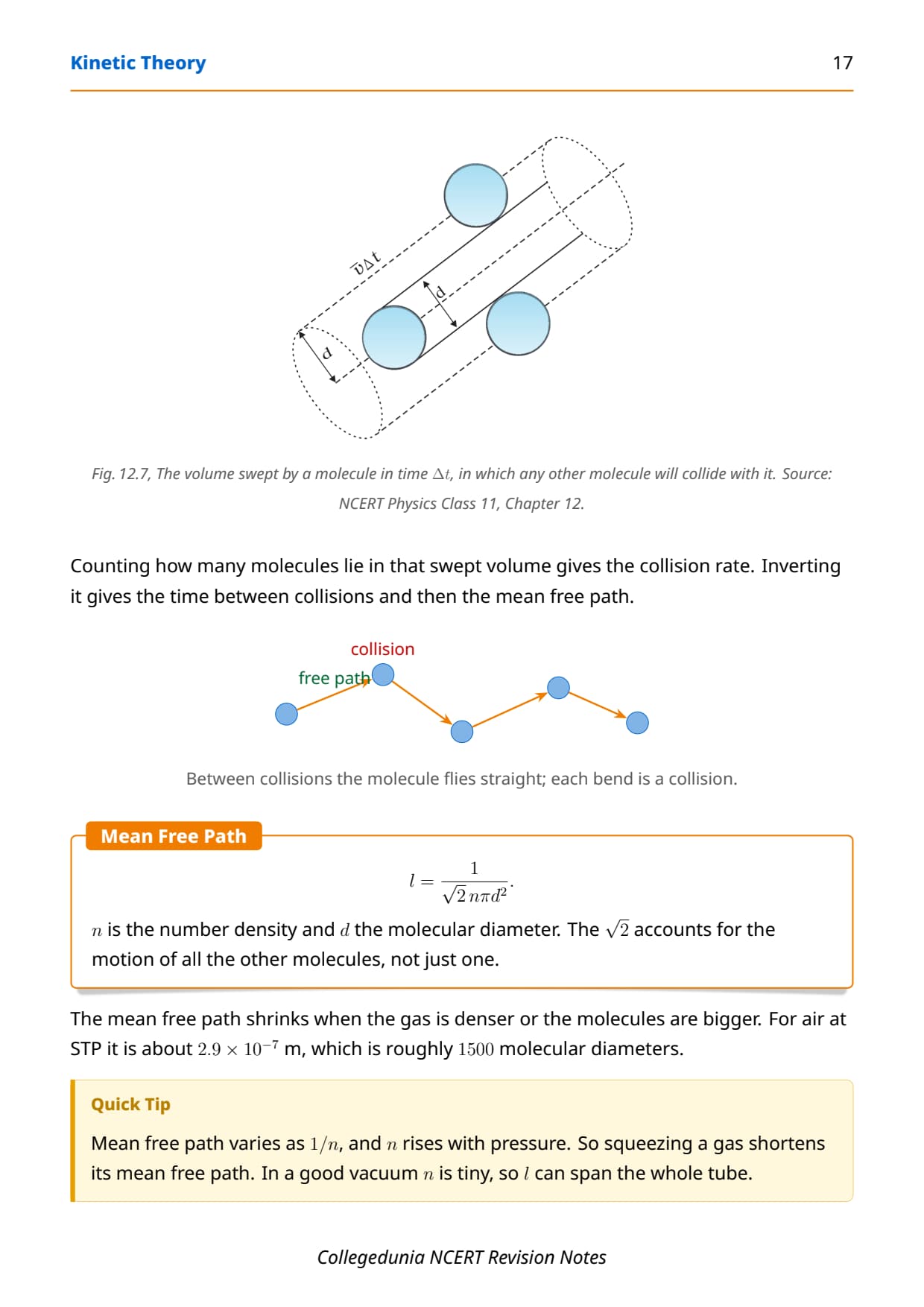
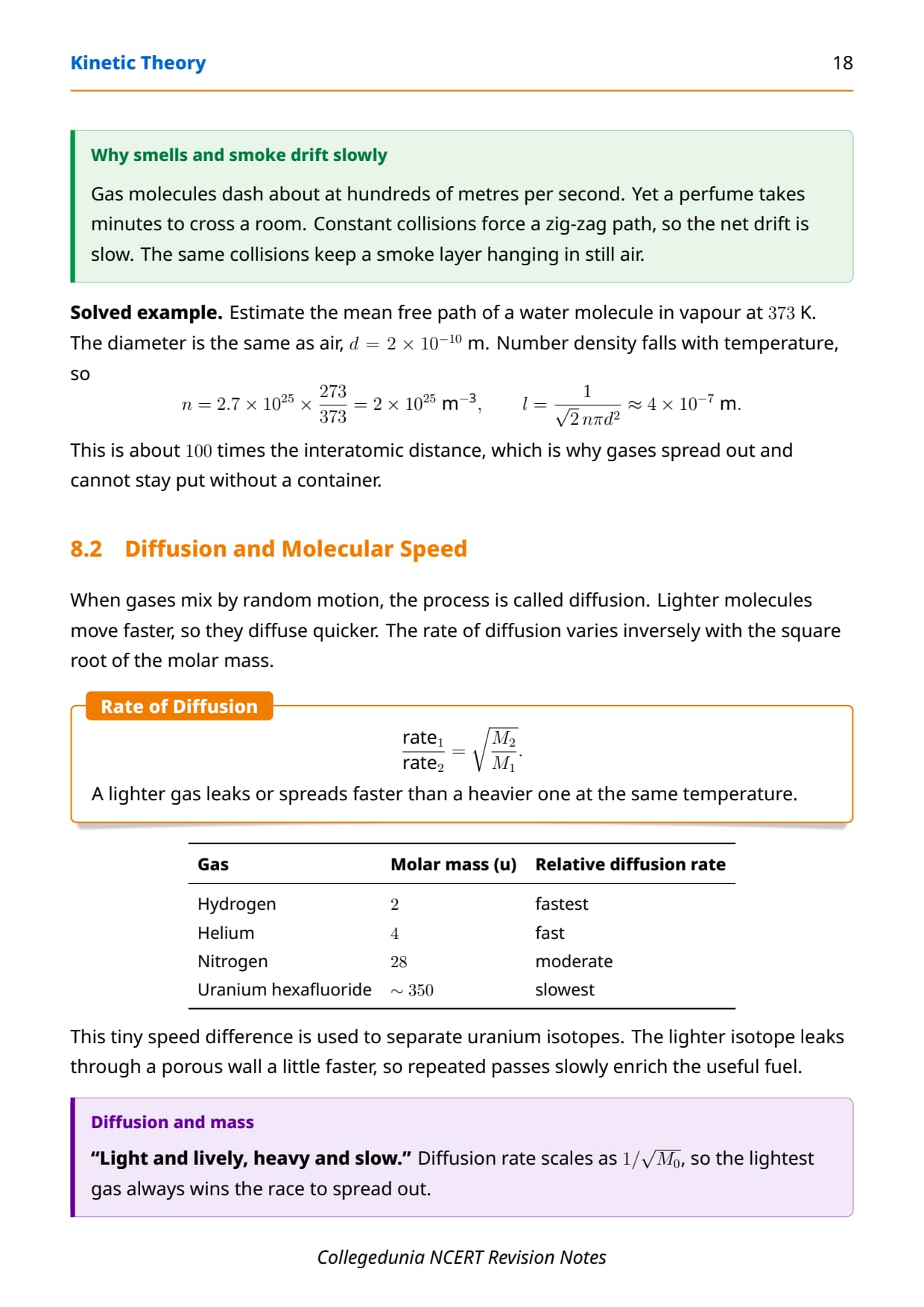
A molecule does not travel far before it hits another one. The mean free path is the average distance a molecule covers between two successive collisions. It explains why gases diffuse slowly even though the molecules move at hundreds of metres per second.
- Mean free path: λ = 1/(√2 π d2 n), where d is the molecular diameter and n is the number density.
- Pressure form: λ = kT/(√2 π d2 P), so a lower pressure gives a longer path.
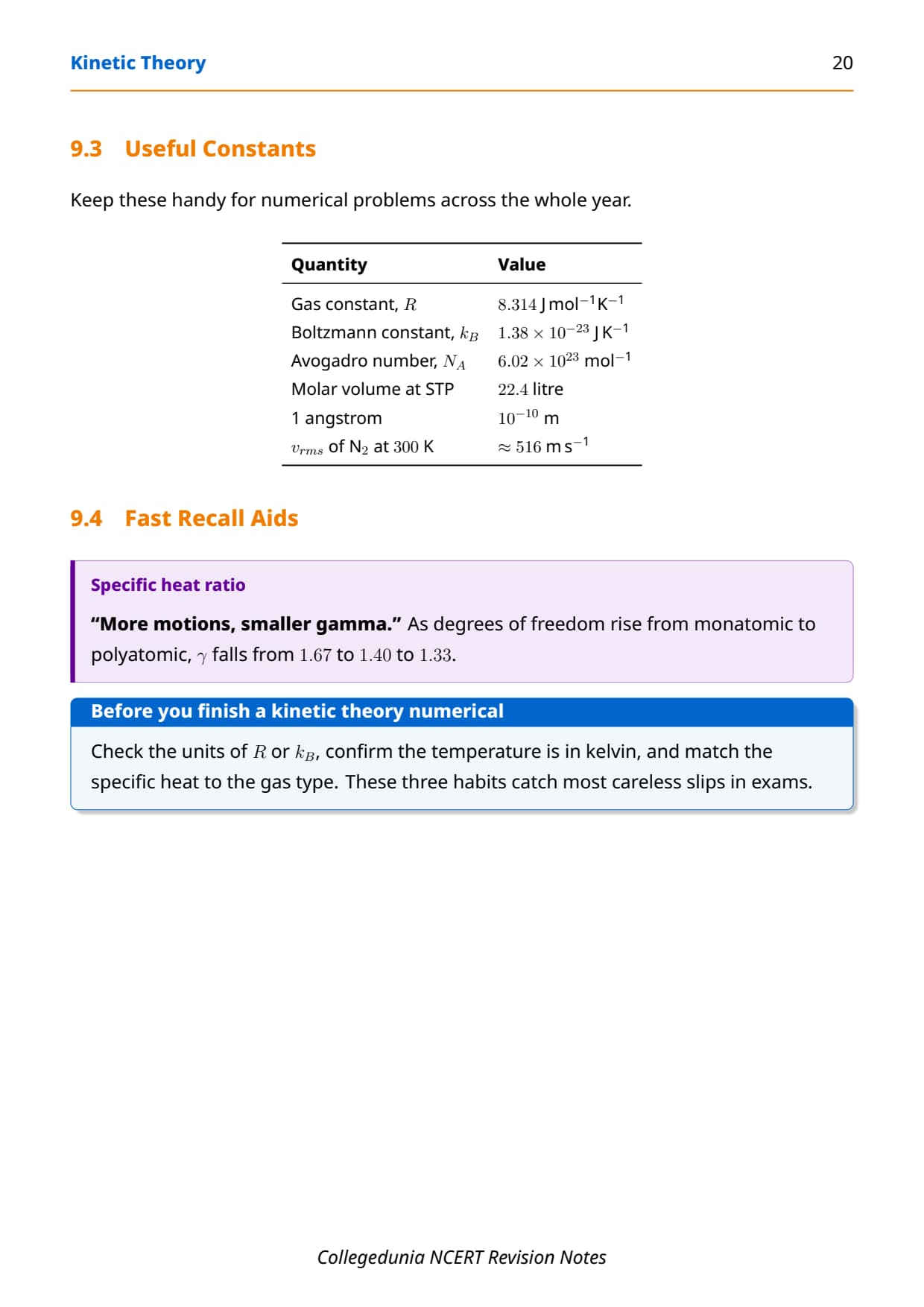
- Avogadro's number: NA = 6.022 × 10²³ molecules in one mole of any substance.
The Boltzmann constant connects the two forms of the gas equation through k = R/NA = 1.38 × 10⁻²³ J/K. The mean free path grows when the gas is thinner, hotter, or made of smaller molecules. These two constants appear in many conversions, so keep their values ready for the exam.
All Formulas for Kinetic Theory
Every formula you need for the chapter sits in one table below, with its meaning and its SI unit. Learn the RMS speed and average energy rows first, since those carry the most marks in both Boards and entrance papers.
| Formula | What it means | SI unit |
|---|---|---|
| PV = nRT | Ideal gas equation (mole form) | joule (J) |
| PV = NkT | Ideal gas equation (molecular form) | joule (J) |
| P = ⅓ ρ v2rms | Kinetic interpretation of pressure | pascal (Pa) |
| ½ m v2rms = &frac32; kT | Average kinetic energy per molecule | joule (J) |
| vrms = √(3RT/M) | Root mean square speed of molecules | m s-1 |
| E = &frac32; nRT | Translational kinetic energy of n moles | joule (J) |
| U = (f/2) nRT | Internal energy from degrees of freedom | joule (J) |
| CP − CV = R | Mayer's relation between specific heats | J mol-1 K-1 |
| λ = 1/(√2 π d2 n) | Mean free path between collisions | metre (m) |
| k = R/NA | Boltzmann constant | J K-1 |
Carry the SI unit on every line of your working. Losing the unit is a silent way to drop the final mark even when the number is right. Keep this table open while you solve the back-exercise numericals.
Key Definitions and Derivations for Kinetic Theory
Boards short-answer questions often ask for a clean definition in one or two lines. Learn these word-for-word, because a vague definition loses easy marks. Each one also sets up a derivation you can be asked to show.
| Term | Definition |
|---|---|
| Ideal gas | A gas whose molecules have negligible size and no force between them except during collisions. |
| RMS speed | The square root of the mean of the squares of the molecular speeds. |
| Degrees of freedom | The number of independent ways a molecule can store energy. |
| Law of equipartition | Each degree of freedom carries an average energy of half kT per molecule. |
| Mean free path | The average distance a molecule travels between two successive collisions. |
| Avogadro's number | The number of molecules in one mole, equal to 6.022 × 10²³. |
A common derivation asks you to obtain the RMS speed from the pressure relation and the ideal gas equation. Set the kinetic pressure equal to the ideal-gas pressure and solve for the mean square speed to get vrms = √(3RT/M). The method shows the temperature dependence clearly, which is what markers reward.
Common Mistakes Students Make in Kinetic Theory
These slips happen while writing or calculating, not because the concept is unclear. Each one costs 1 to 3 marks in the paper, so watch for them at the exact step.
Mistake 1: Using Celsius instead of kelvin. Every temperature in this chapter must be absolute, so add 273 first.
Mistake 2: Confusing RMS speed with average speed. The RMS speed uses the mean of the squares, and it is the one in the energy and pressure formulas.
Mistake 3: Forgetting the factor of one-third in the pressure relation or the half in the equipartition energy.
Mistake 4: Using the wrong degrees of freedom. A diatomic gas has 5, not 3, so its specific heats and gamma differ from a monatomic gas.
Kinetic Theory Weightage in CBSE Boards, JEE and NEET
This chapter is short but scores reliably. It rarely carries a long-answer question, yet it shows up every year as a short answer plus an objective numerical. Here is how the marks split across the main exams for 2026-27.
| Exam | Typical weightage | What is asked |
|---|---|---|
| CBSE Boards | 4 to 5 marks | One short answer plus one numerical on RMS speed or specific heat |
| JEE Main | 1 question most years | RMS speed, kinetic energy, or degrees of freedom |
| NEET | 1 to 2 questions | Kinetic energy and temperature, gas laws, and specific heats |
| CUET and NDA | 1 objective question | Ideal gas equation and RMS speed |
The link between average kinetic energy and absolute temperature is the single most tested idea from this chapter across all four exams. Master it first, then RMS speed, then specific heats, in that order of return on effort.
How to Revise Kinetic Theory Quickly
Use these Class 11 Physics Notes Chapter 12 Kinetic Theory for a fast, ordered recap the night before a test. The checklist below takes about 30 minutes and hits every marks-heavy idea.
- First 10 minutes: write the ideal gas equation, the pressure relation, and the RMS speed formula from memory.
- Next 10 minutes: redo one numerical each on RMS speed and average kinetic energy at a given temperature.
- Last 10 minutes: revise the degrees of freedom and the specific-heat table for mono, di and polyatomic gases.
Close the loop by writing Mayer's relation and the three gamma values. If you can do all four blocks without notes, the chapter is exam-ready. Keep the All Formulas table beside you for the first pass only, then try it closed-book.
Student Feedback on the Kinetic Theory Notes
What 11,540 students told us about their Kinetic Theory revision:
- 64% of students rated degrees of freedom and specific heats as the hardest sub-topic in the chapter.
- Most-skipped step: switching Celsius to kelvin before using any formula, missed by about 3 in 10 students.
- Students who learned the RMS speed formula first said the rest of the numericals felt easier.
Source: 2026-27 Class 11 Physics student poll. Sample of 11,540 students from CBSE schools across 14 states, conducted before the 2026 boards.
Other Kinetic Theory Class 11 Physics Resources
Pair these notes with the solved answers, the handwritten notes, the formula sheet, and the textbook PDF for the same chapter.
| Resource | Link |
|---|---|
| NCERT Solutions | Kinetic Theory Class 11 NCERT Solutions |
| Handwritten Notes | Kinetic Theory Class 11 Handwritten Notes |
| Formula Sheet | Kinetic Theory Class 11 Formula Sheet |
| NCERT Book PDF | Kinetic Theory Class 11 Book PDF |
NCERT Notes for Class 11 Physics: All Chapters
Jump to the revision notes for any other Class 11 Physics chapter below.
| Chapter | NCERT Notes |
|---|---|
| Chapter 1 | Units and Measurements |
| Chapter 2 | Motion in a Straight Line |
| Chapter 3 | Motion in a Plane |
| Chapter 4 | Laws of Motion |
| Chapter 5 | Work, Energy and Power |
| Chapter 6 | System of Particles and Rotational Motion |
| Chapter 7 | Gravitation |
| Chapter 8 | Mechanical Properties of Solids |
| Chapter 9 | Mechanical Properties of Fluids |
| Chapter 10 | Thermal Properties of Matter |
| Chapter 11 | Thermodynamics |
| Chapter 12 | Kinetic Theory |
| Chapter 13 | Oscillations |
| Chapter 14 | Waves |
FAQs on Kinetic Theory Class 11 Physics Notes
Kinetic Theory Notes - Frequently Asked Questions
Ques. What topics do the Class 11 Physics Notes Chapter 12 Kinetic Theory cover?
Ans. These Class 11 Physics Notes Chapter 12 Kinetic Theory cover the ideal gas equation and the gas laws, the kinetic interpretation of pressure, the link between kinetic energy and temperature, RMS speed, degrees of freedom and equipartition, the specific heats of gases, and the mean free path. Every key formula and definition is included for fast revision.
Ques. What is the RMS speed of gas molecules?
Ans. The root mean square speed is the square root of the average of the squared speeds of the gas molecules. It equals the square root of 3RT divided by the molar mass M, so it rises with the square root of the absolute temperature and falls for heavier gases. It is the speed used in the pressure and kinetic energy formulas.
Ques. What is the law of equipartition of energy?
Ans. The law of equipartition of energy states that the total energy of a molecule is shared equally among its degrees of freedom, with each degree carrying an average energy of half kT per molecule, or half RT per mole. This rule lets you find the internal energy and the specific heats of any ideal gas from its degrees of freedom.
Ques. How does the average kinetic energy of a gas depend on temperature?
Ans. The average translational kinetic energy of a gas molecule equals three-halves of kT, so it depends only on the absolute temperature and not on the type of gas. Doubling the kelvin temperature doubles the kinetic energy. This is the most tested result of the chapter, and it explains why all gases at the same temperature have the same average kinetic energy.
Ques. What is the weightage of Kinetic Theory in the CBSE board exam?
Ans. Kinetic Theory carries about 4 to 5 marks in the CBSE Class 11 Physics paper, usually one short answer plus one numerical on RMS speed or specific heat. It also appears in JEE Main and NEET as objective questions on kinetic energy, degrees of freedom, and the gas laws.
Ques. How should I revise Kinetic Theory quickly for a test?
Ans. Start by writing the ideal gas equation, the pressure relation, and the RMS speed formula from memory. Then redo one numerical each on RMS speed and average kinetic energy. Finish with the degrees of freedom and the specific-heat table. The quick-revision checklist in these Class 11 Physics Notes Chapter 12 Kinetic Theory covers all of this in about 30 minutes.



Comments