




These Class 11 Physics Notes Chapter 9 Mechanical Properties of Fluids gather every pressure rule, flow equation, and surface-tension idea that the Boards, JEE Main, JEE Advanced, NEET, CUET and NDA papers test in 2026-27. Use them to revise the whole chapter fast, with formulas, definitions and worked rules in one place.
This chapter links fluids at rest and fluids in motion, so it feeds directly into thermal physics and many numerical problems later in the year.
- CBSE Weightage: 4 to 6 marks, usually one short answer plus one numerical on pressure, Bernoulli or surface tension.
- Topics covered: pressure, Pascal's law, buoyancy, streamline flow, Bernoulli's principle, viscosity, terminal velocity, and surface tension.
- Key formulas: hydrostatic pressure, continuity equation, Bernoulli's equation, Stokes' law, and capillary rise.
These Class 11 Physics Notes Chapter 9 Mechanical Properties of Fluids are curated by subject experts, based on the 2026-27 NCERT textbook, and checked against the last five years of CBSE Board, JEE Main and NEET papers.
Topic-by-Topic Summary of Mechanical Properties of Fluids
The chapter splits into two halves. First it treats fluids at rest, where pressure and buoyancy rule. Then it treats fluids in motion, where flow, viscosity and surface effects take over. Here is the quick map of what each topic gives you.
- Pressure and Pascal's law: how pressure acts in a fluid at rest, and how a confined fluid passes it on equally in all directions.
- Buoyancy: the upward push on a submerged body, fixed by Archimedes' principle.
- Fluid flow: streamline flow, the equation of continuity, and Bernoulli's principle for a moving fluid.
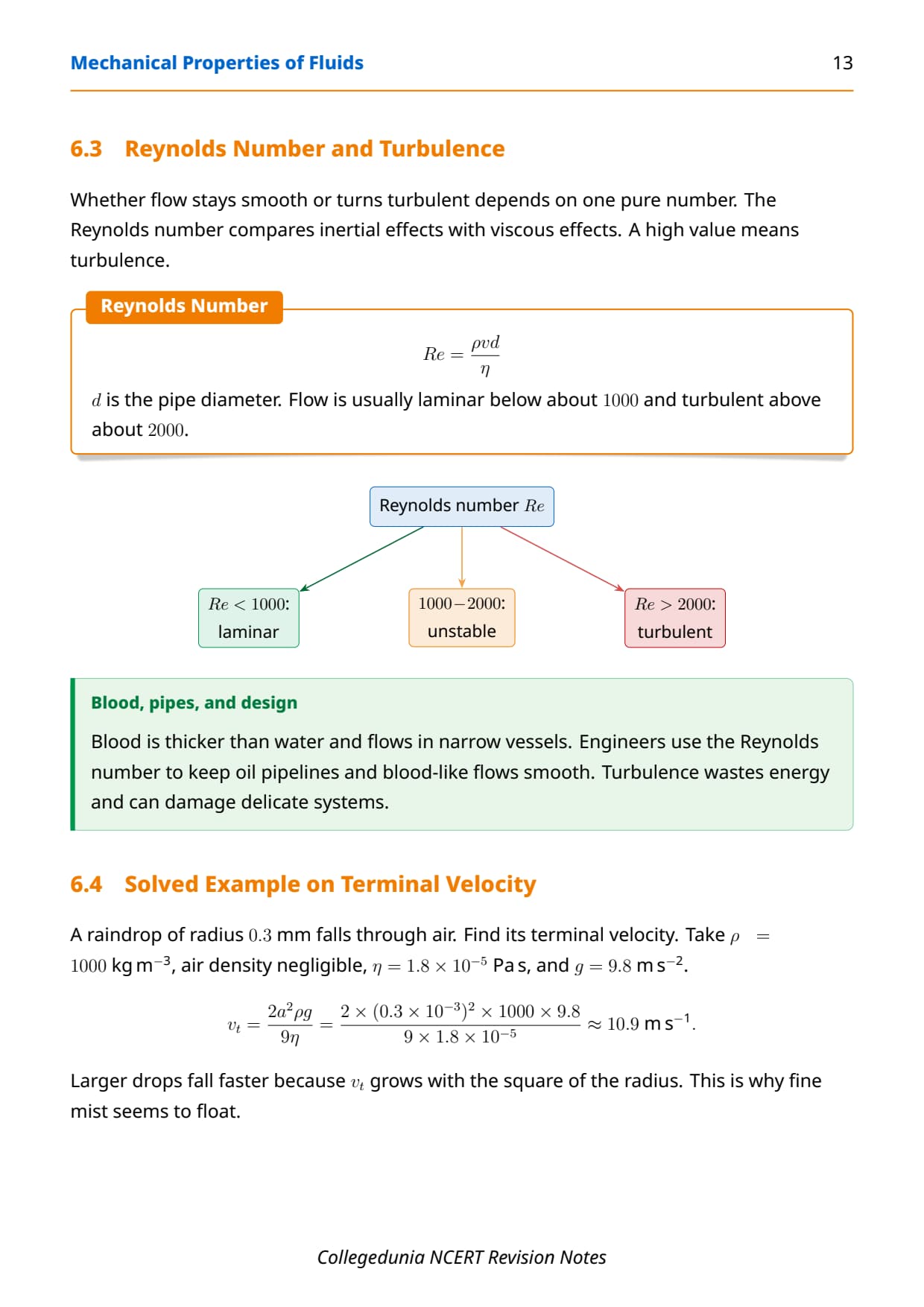
- Viscosity: internal friction in a fluid, Stokes' law, and the terminal velocity of a falling sphere.
- Surface tension: the pull along a liquid surface, plus capillary rise in a thin tube.
Revise the topics in this order, because the rest-fluid ideas set up the moving-fluid ones. Get pressure clear first, and Bernoulli's equation stops feeling hard. These Class 11 Physics Notes Chapter 9 Mechanical Properties of Fluids follow the same sequence as the NCERT textbook.
Pressure in Fluids, Pascal's Law and Atmospheric Pressure
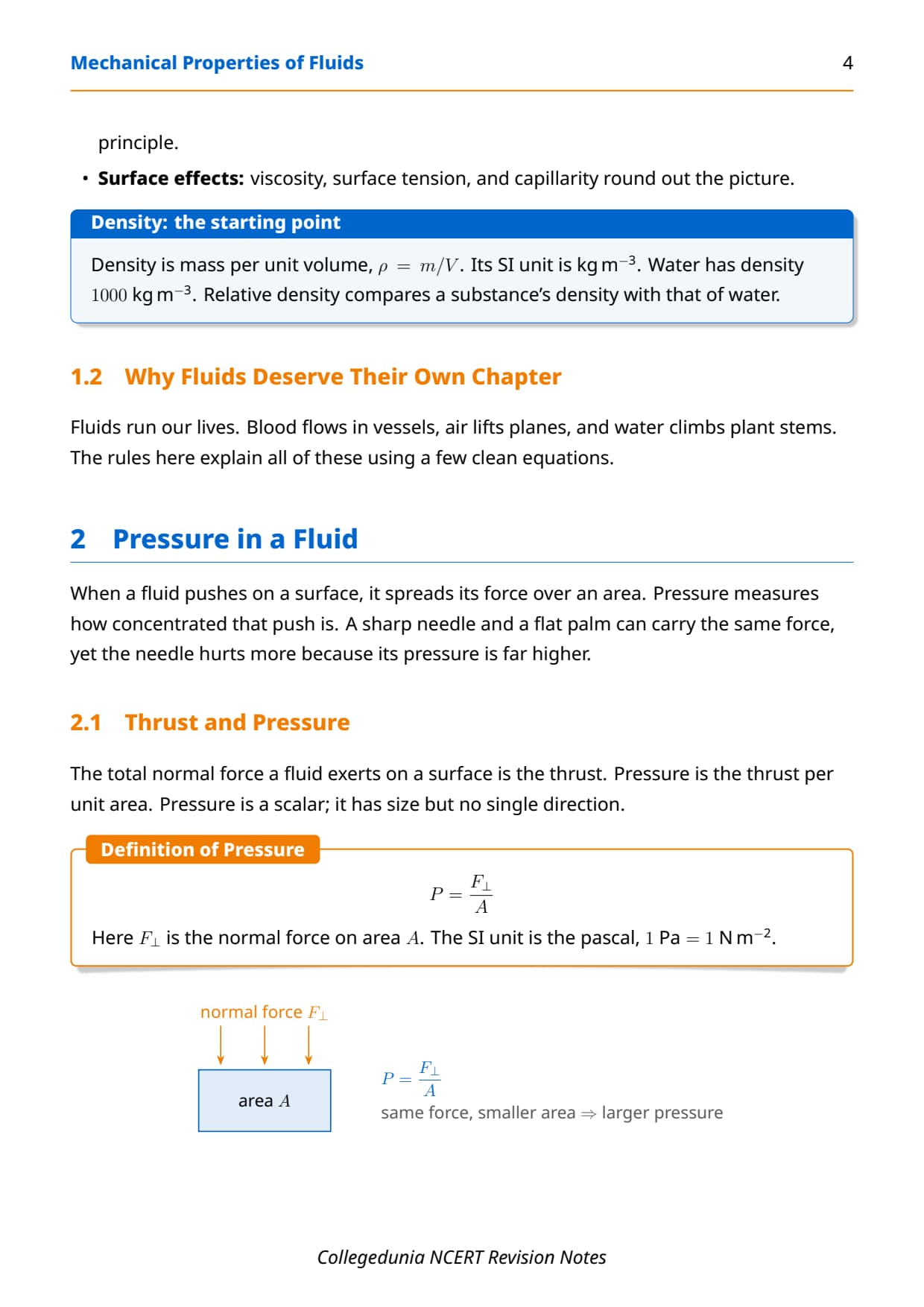
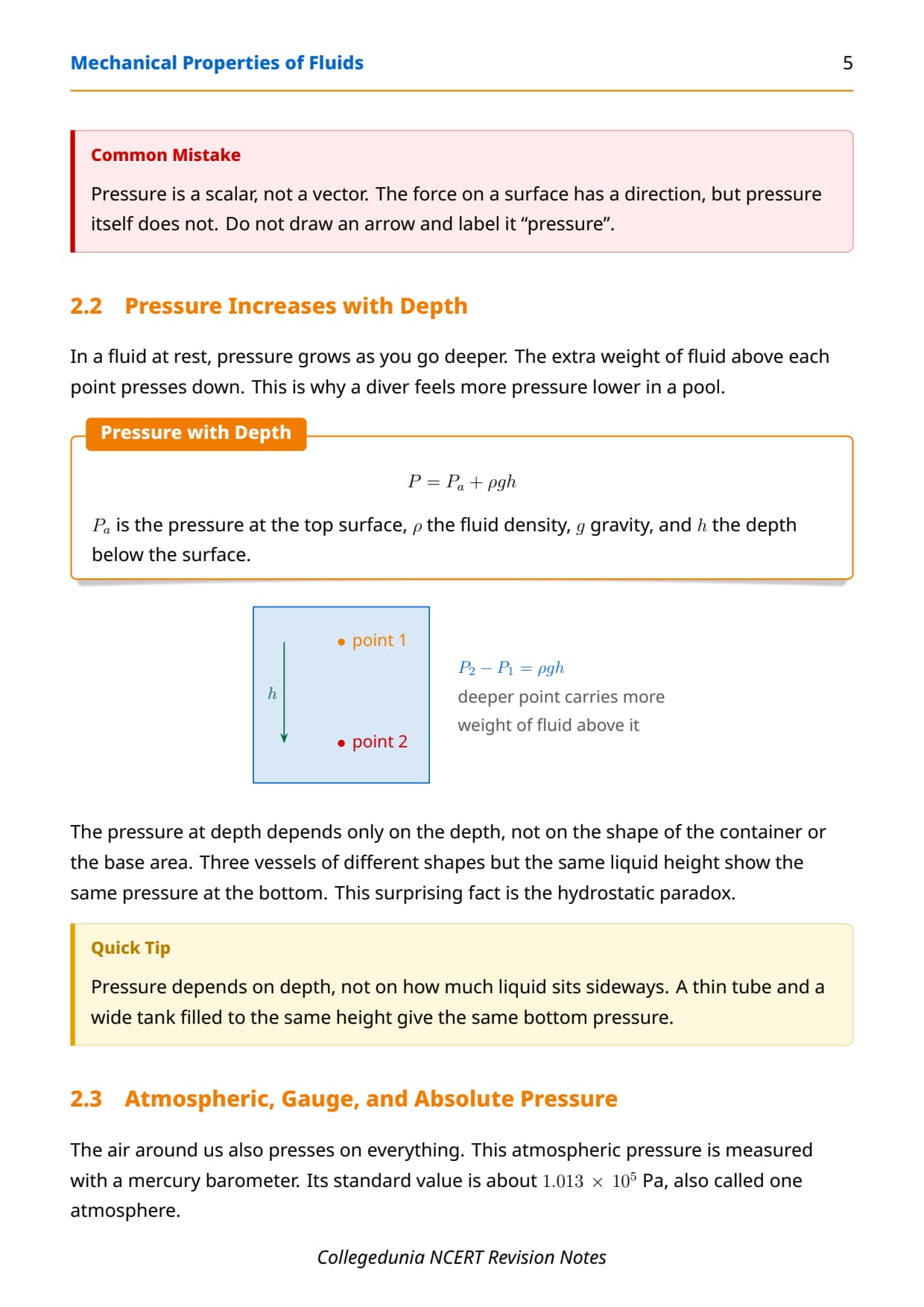
Pressure is the force acting at right angles per unit area, and in a fluid it acts equally in every direction. As you go deeper, pressure grows because the weight of fluid above you grows. This one idea drives most of the rest-fluid numericals.
- Hydrostatic pressure: at a depth h the pressure rises by ρgh, so pressure depends only on depth, not shape.
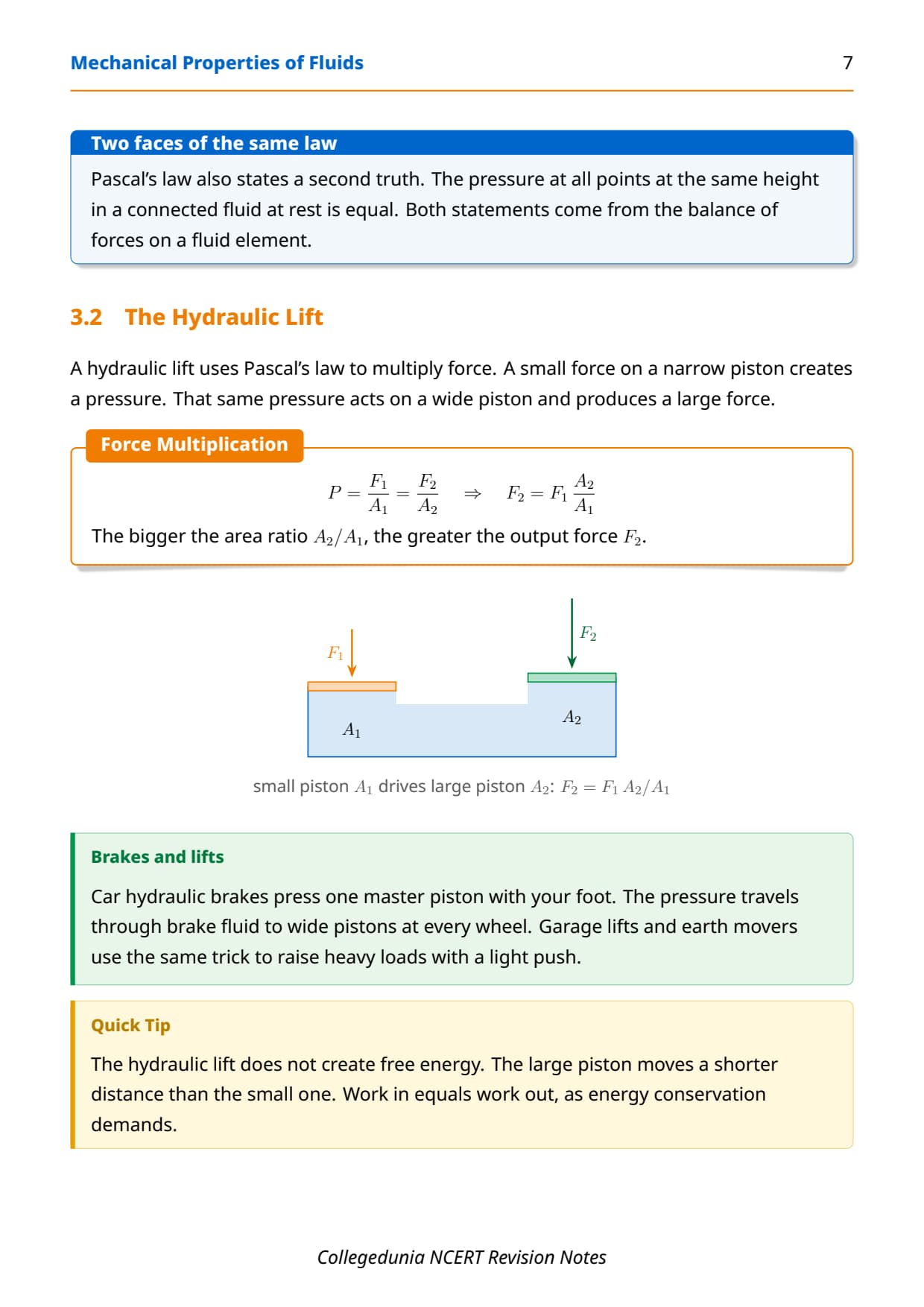
- Pascal's law: pressure applied to an enclosed fluid is passed on equally to every part, which is how a hydraulic lift multiplies force.
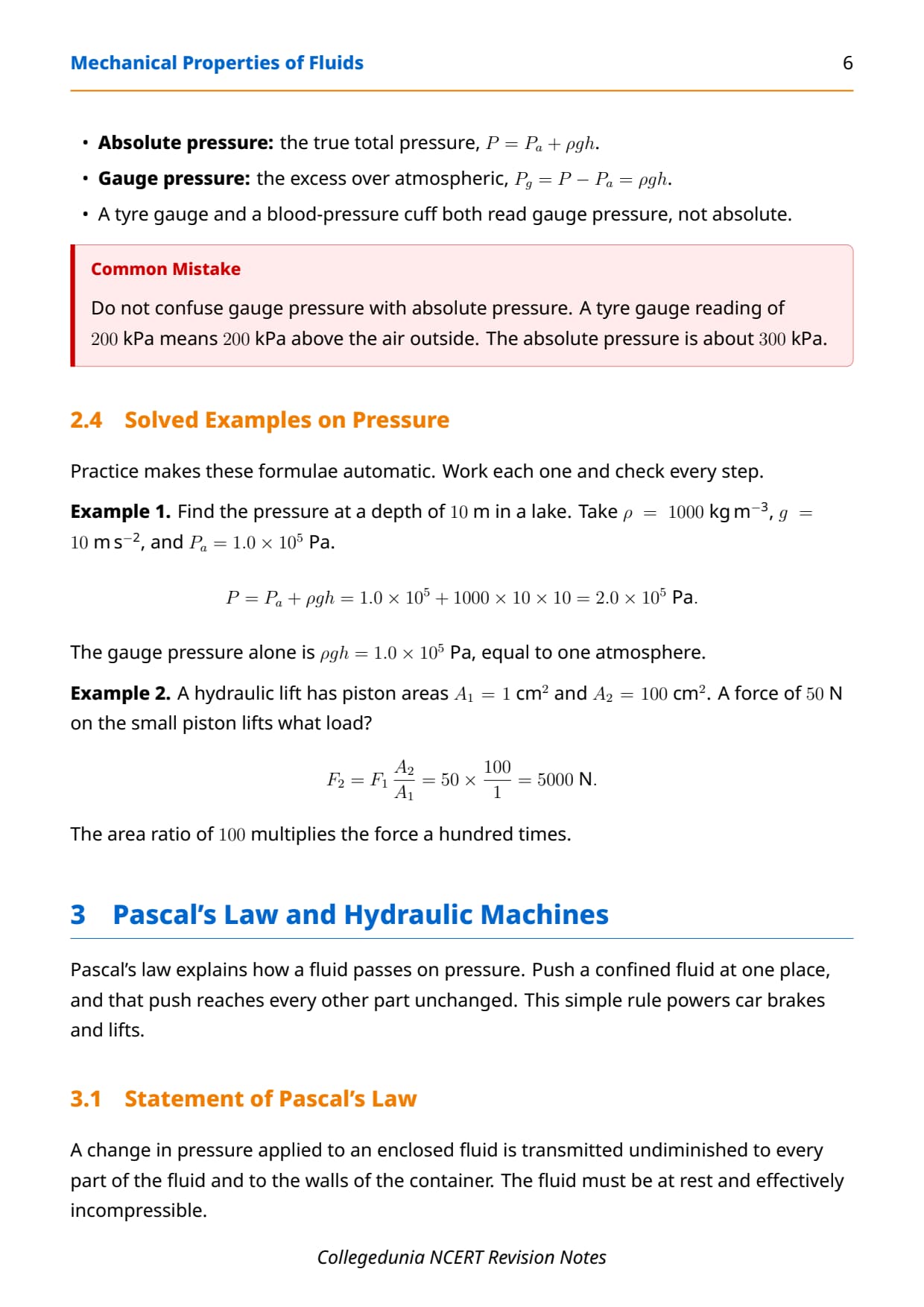
- Atmospheric pressure: the weight of the air column, about 1.013 × 10⁵ pascal at sea level, measured by a barometer.
- Gauge and absolute pressure: gauge pressure is the extra pressure above the atmosphere, so absolute pressure is atmospheric plus gauge.
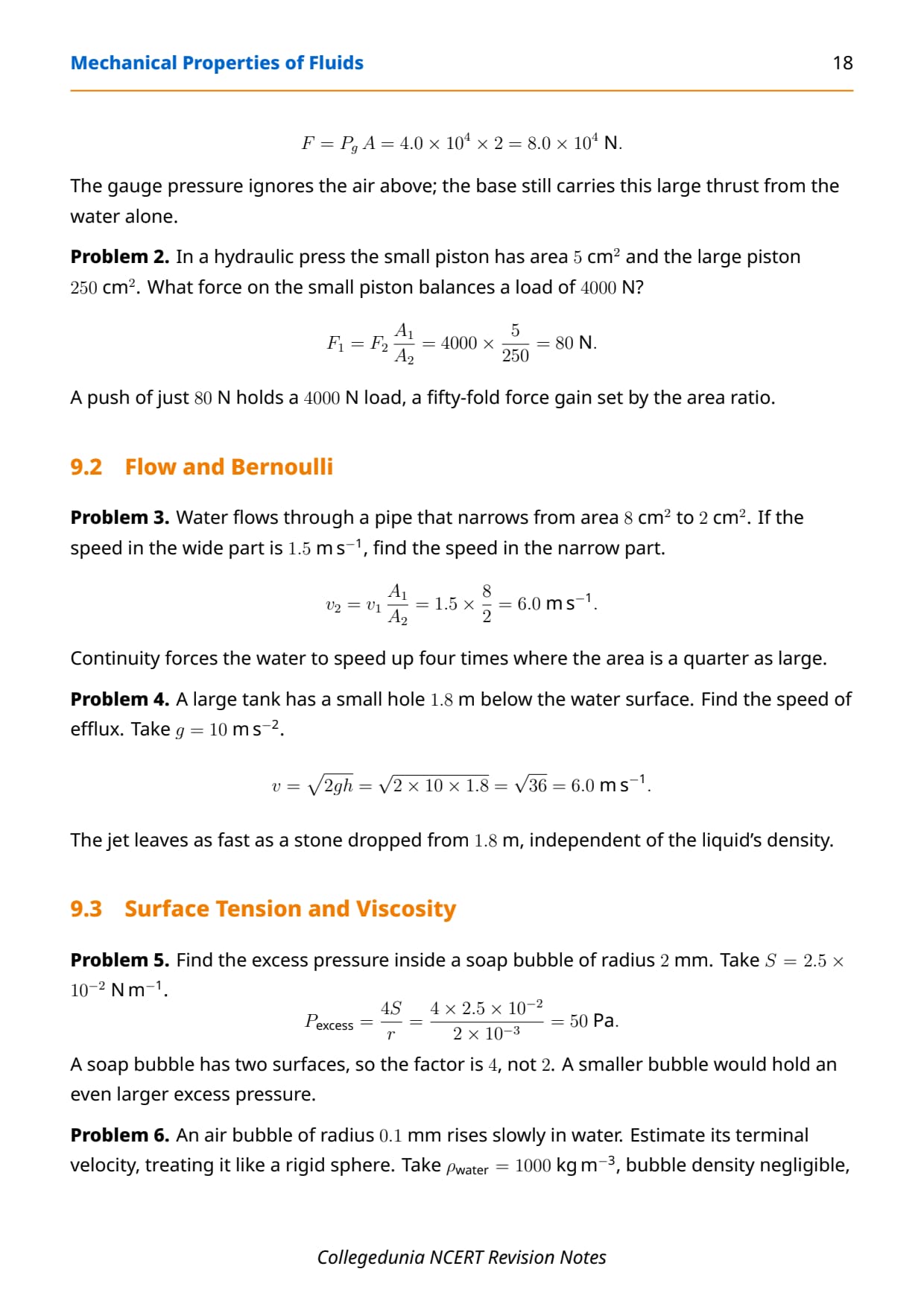
Always separate gauge pressure from absolute pressure before you substitute numbers. A hydraulic lift uses Pascal's law, so a small force on a small piston lifts a large load on a large piston. The pressure is the same on both pistons, but the force scales with the area.
Buoyancy, Archimedes' Principle and Floating Bodies
A body placed in a fluid feels an upward push called the buoyant force. This push exists because pressure at the bottom of the body is larger than at the top. Archimedes turned this into one clean rule that the exam tests every year.
Archimedes' principle states that the buoyant force on a body equals the weight of the fluid it displaces. Whether a body floats or sinks depends on how its density compares with the fluid's density.
- If the body's density is less than the fluid's, it floats.
- If the density is equal, it stays wherever placed, fully submerged.
- If the density is greater, it sinks.
- A floating body displaces its own weight of fluid, not its own volume.
A floating body sinks until the weight of displaced fluid equals its own weight. This law explains why a steel ship floats while a steel nail sinks. The ship's hollow shape lowers its average density below that of water, so it displaces enough water to hold its weight.
Streamline Flow, Equation of Continuity and Bernoulli's Principle
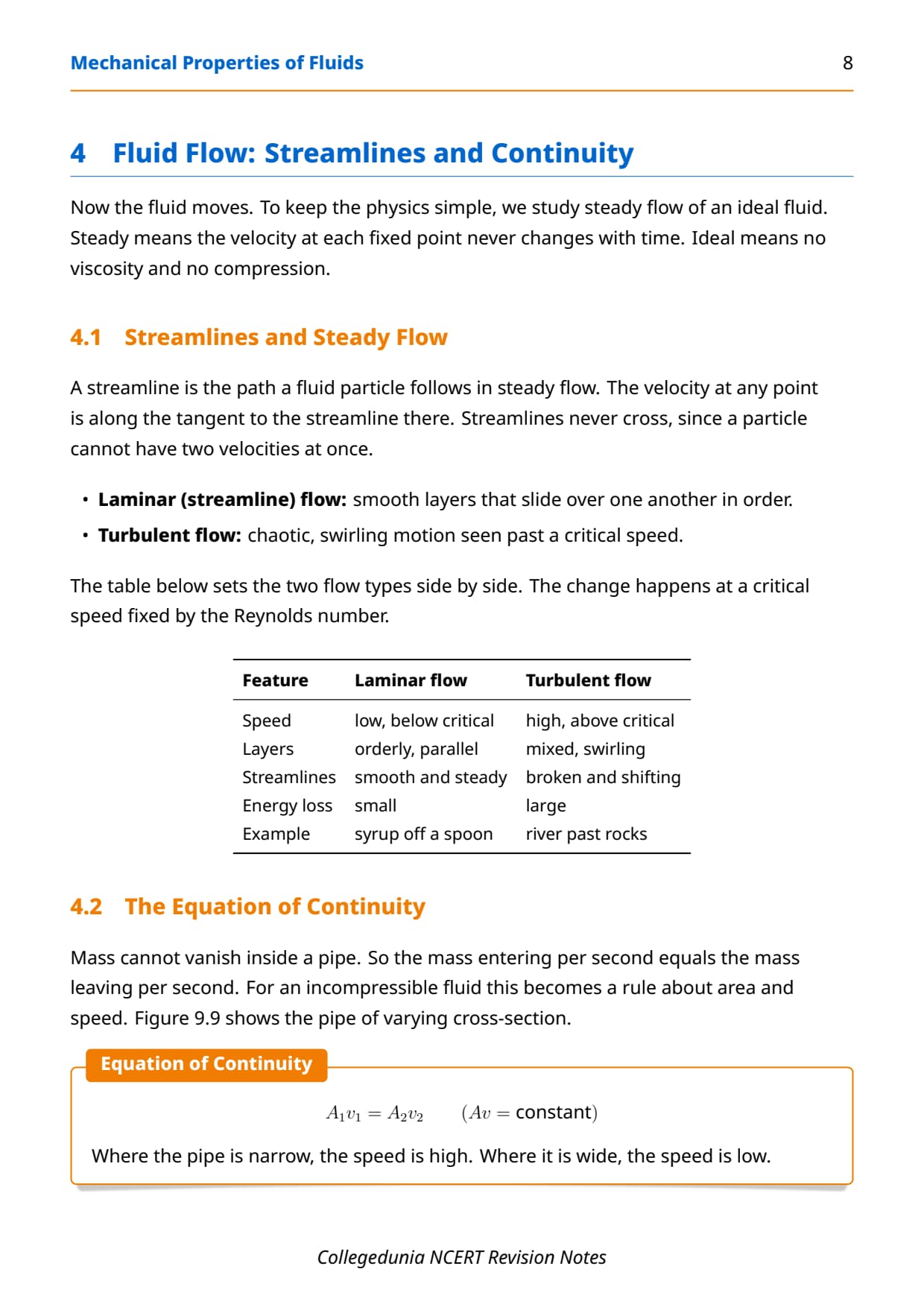
When a fluid moves smoothly, every particle passing a point follows the same path. This is streamline flow. Above a certain speed the flow becomes turbulent and the streamlines break up. The chapter models the smooth case with two key laws.
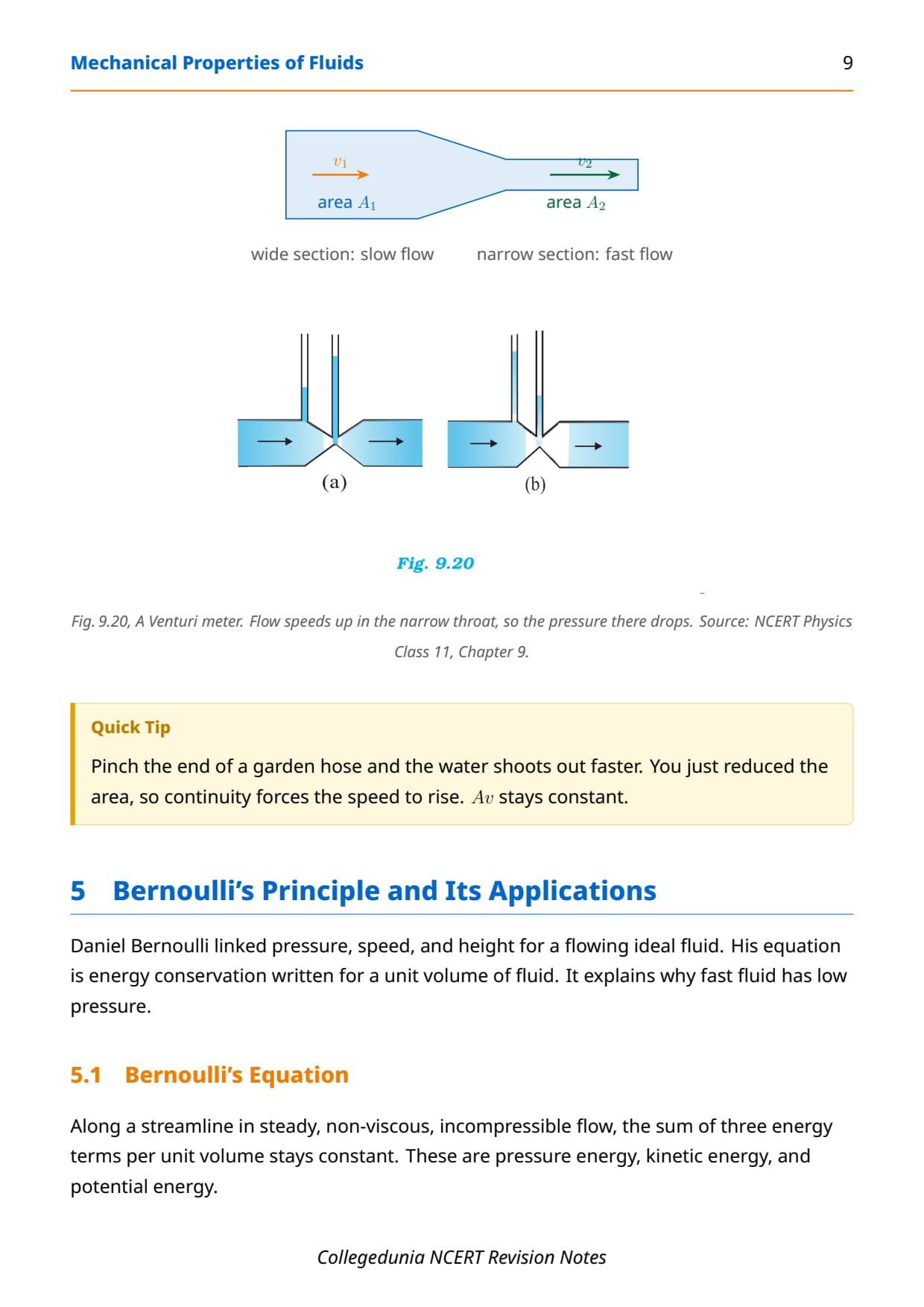
- Equation of continuity: for a fluid that cannot be squeezed, Av stays constant, so a narrow pipe gives a faster flow.
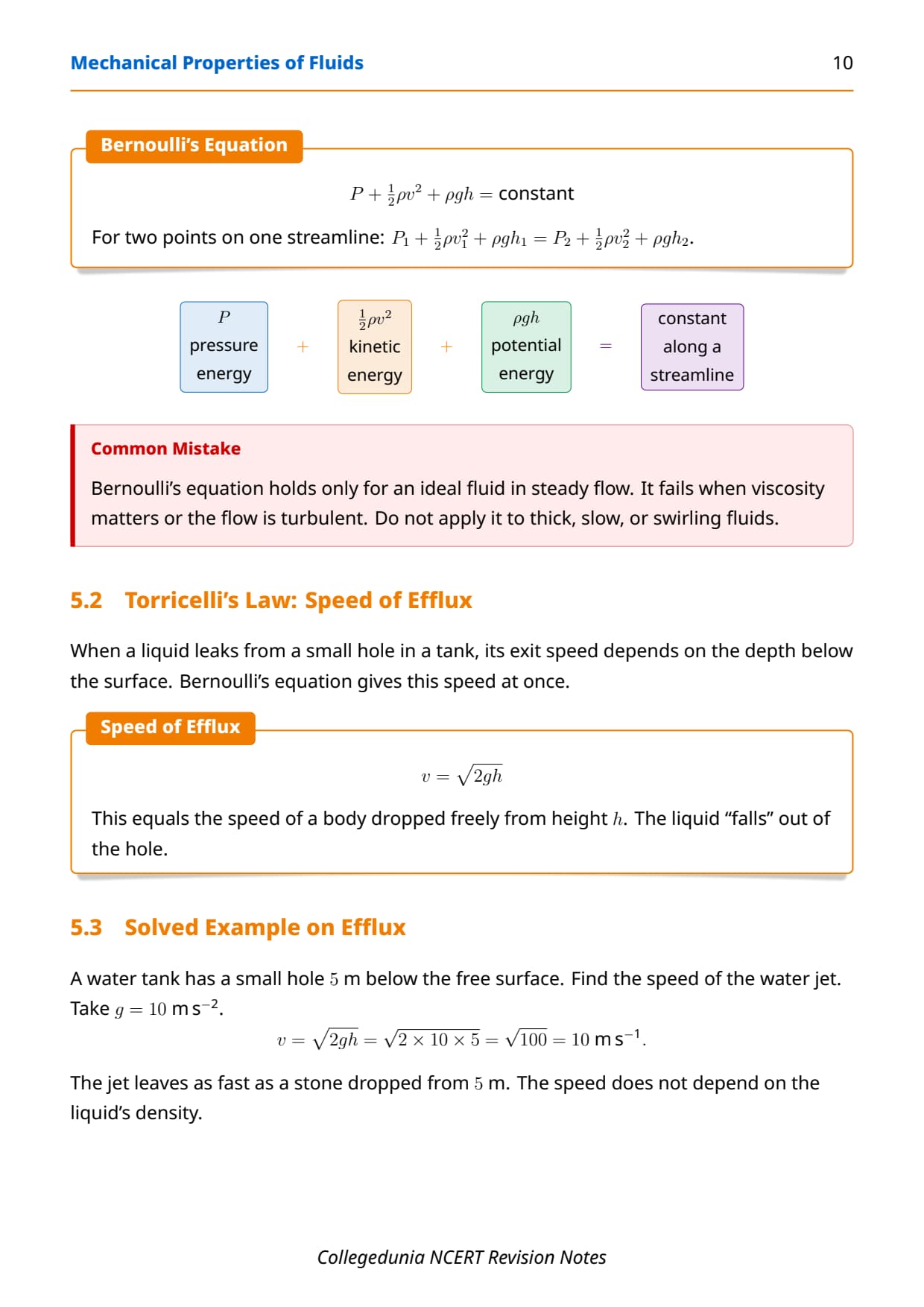
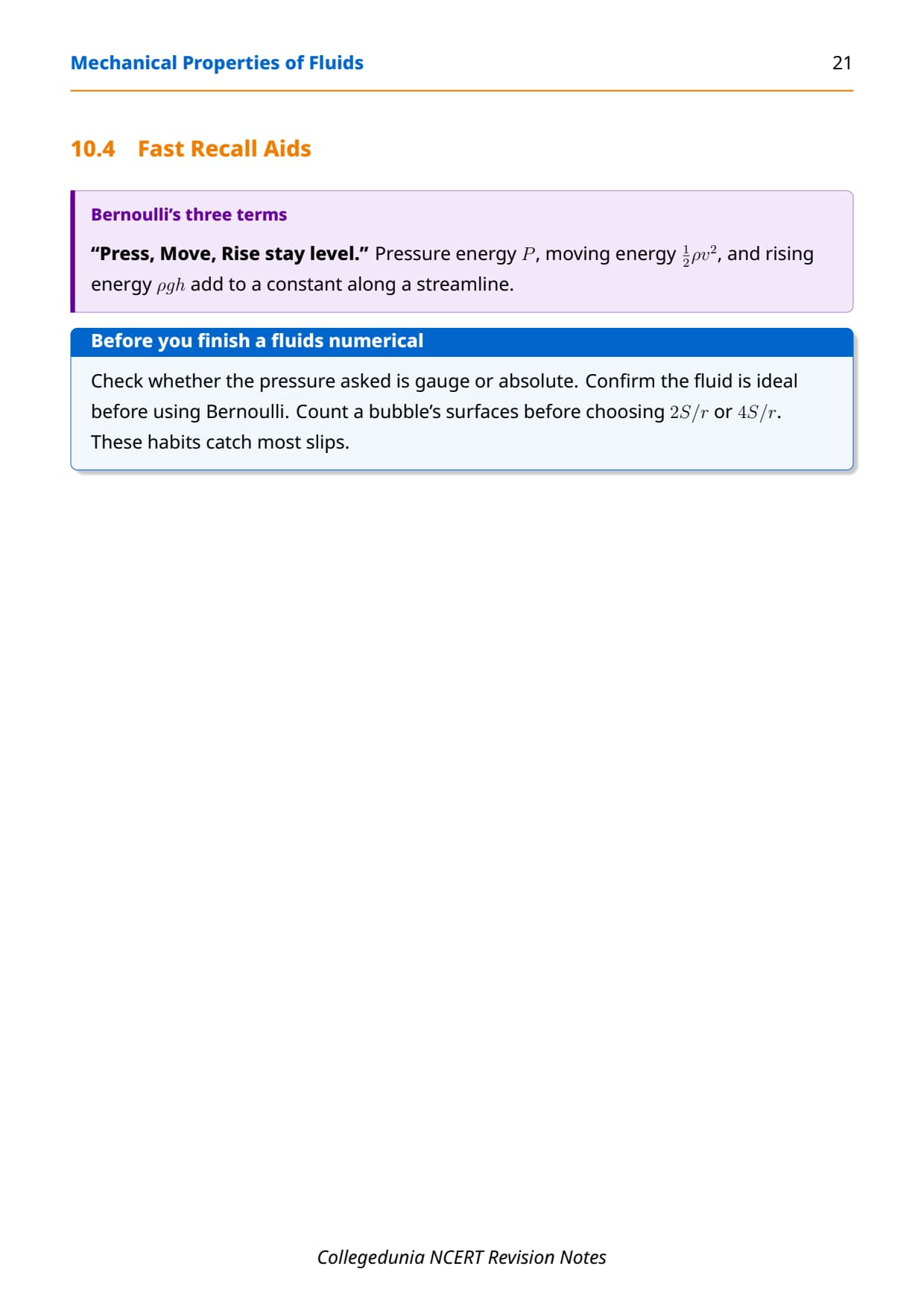
- Bernoulli's principle: along a streamline, P + ½ρv2 + ρgh stays constant.
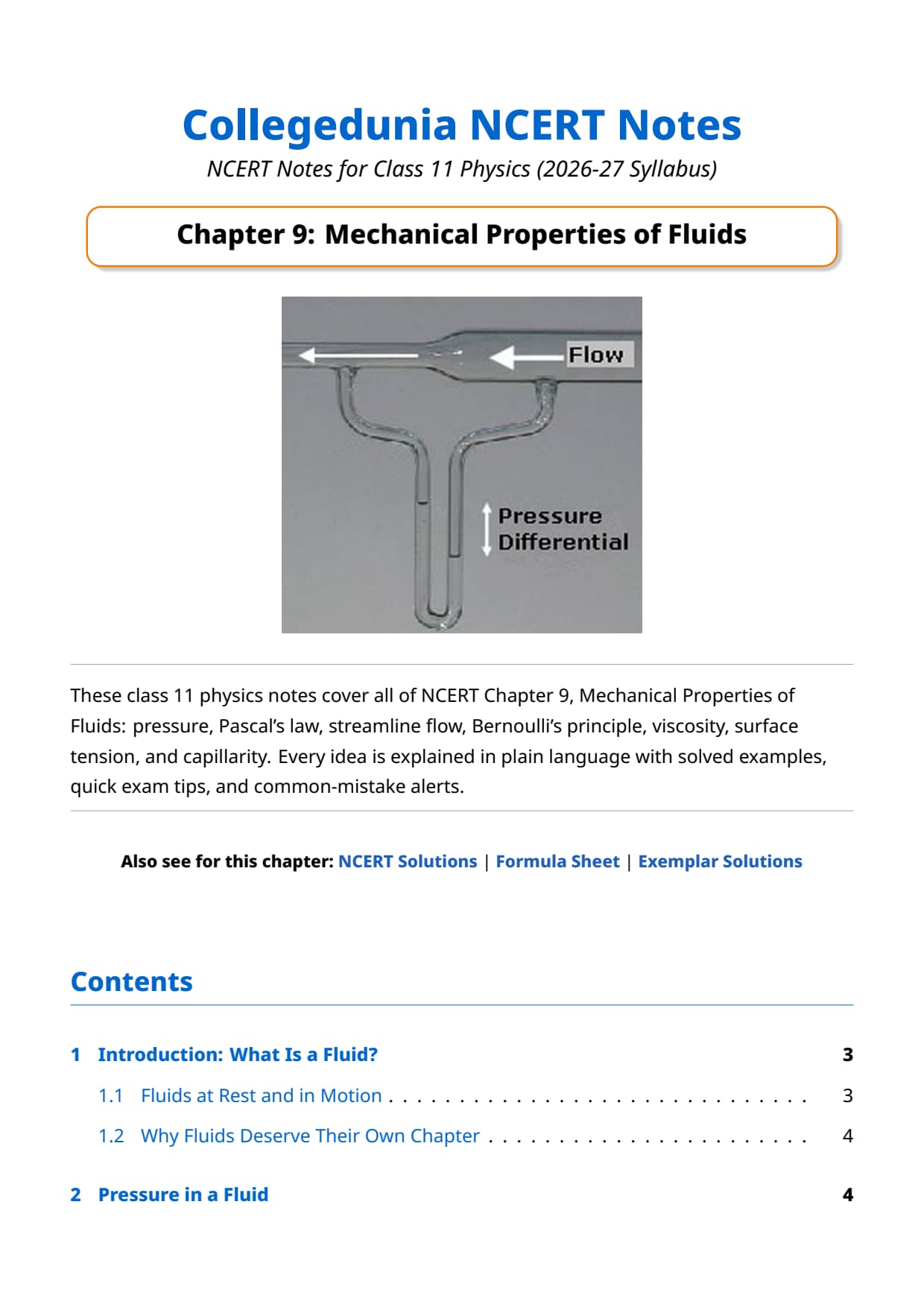
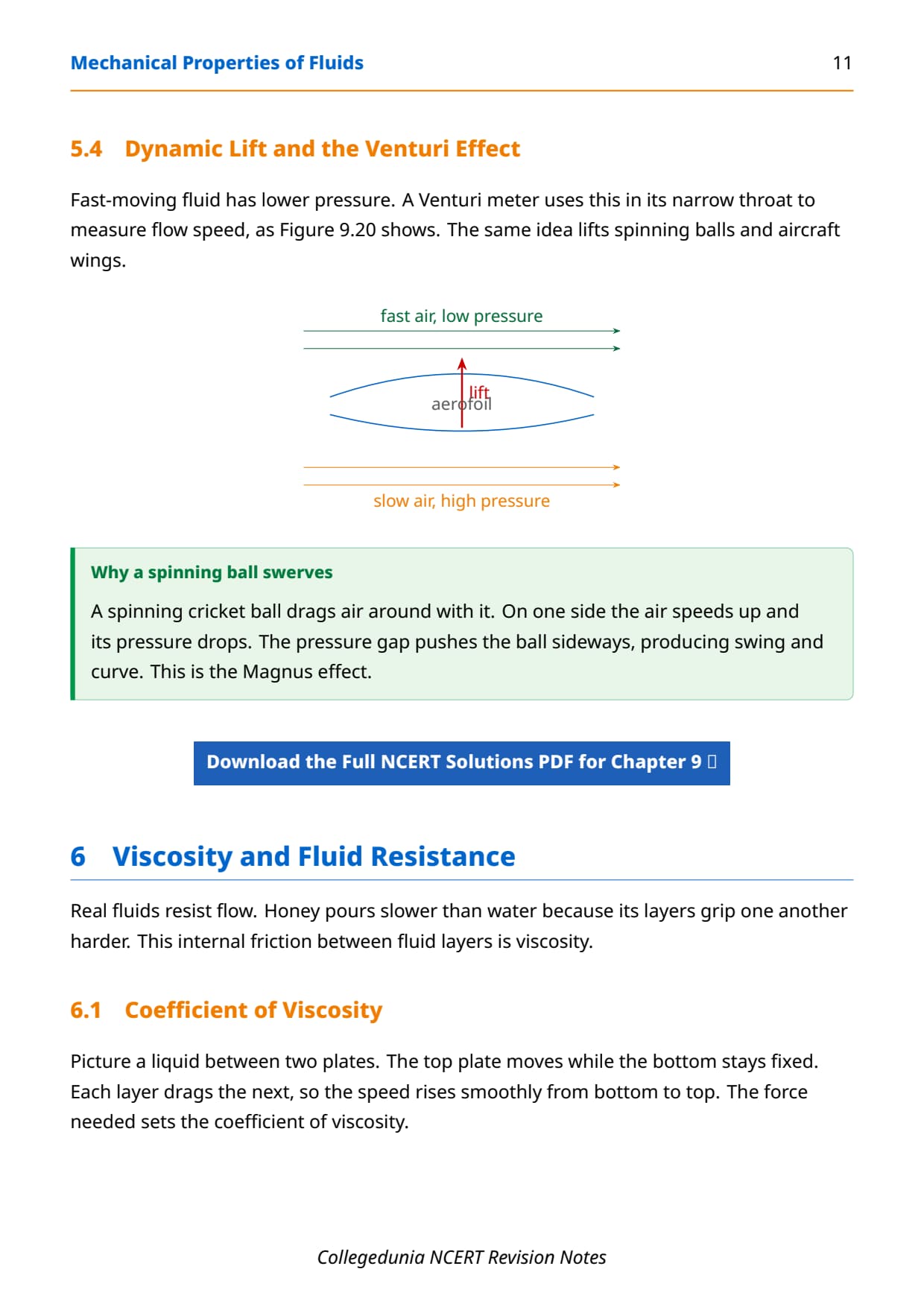
- Physical meaning: where a fluid moves faster, its pressure drops, which explains lift on an aircraft wing and the spin of a ball.
Bernoulli's equation is really the conservation of energy written for a flowing fluid. The three terms are the pressure energy, the kinetic energy, and the potential energy per unit volume. Faster flow means lower pressure, so speed and pressure trade off along a streamline. Remember that the law assumes a steady, non-viscous, incompressible flow.
Viscosity, Stokes' Law and Terminal Velocity
Viscosity is the internal friction between layers of a fluid that move at different speeds. A thick fluid like honey has a high viscosity, while water flows easily. This friction sets the speed at which a small sphere falls through a fluid.
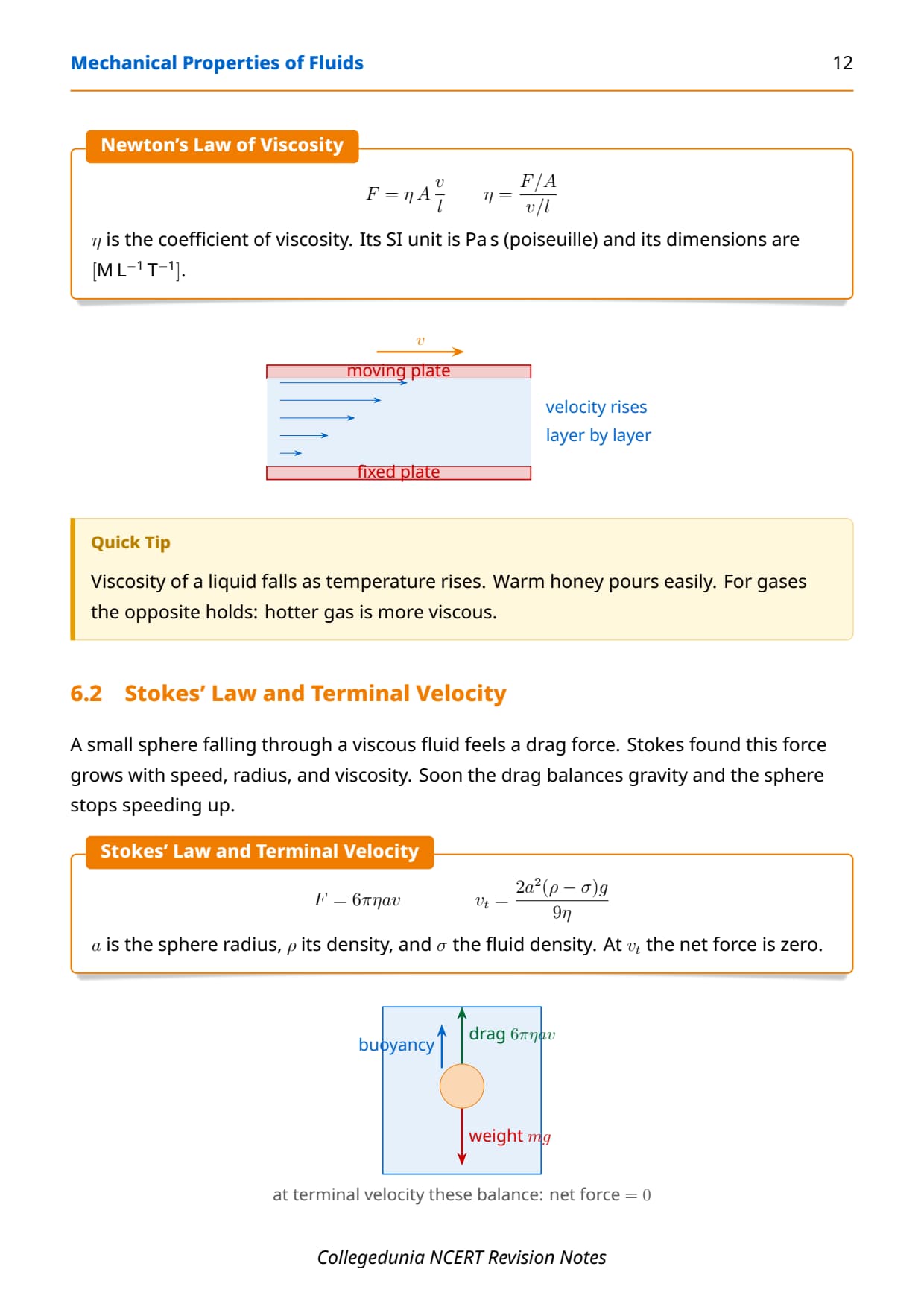
- Coefficient of viscosity: the viscous force follows F = ηA(dv/dx), where η is the coefficient of viscosity.
- Stokes' law: the drag on a small sphere is F = 6πηrv.
- Terminal velocity: the steady speed a sphere reaches when drag and buoyancy balance its weight.
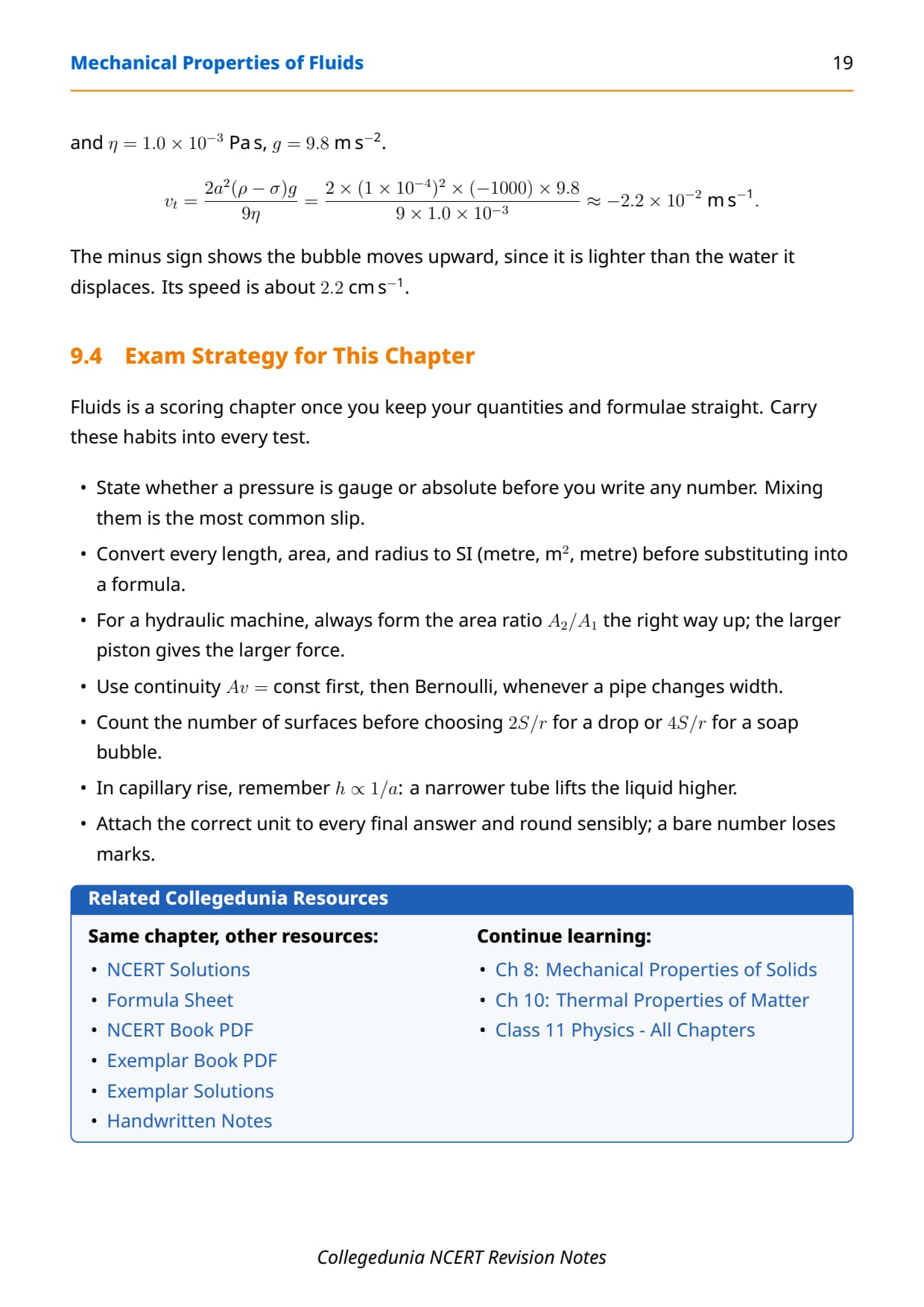
At terminal velocity the net force is zero, so the sphere stops speeding up and falls at a constant rate. Terminal velocity grows with the square of the radius, so a bigger drop falls faster. This is why fine mist floats in the air while large raindrops fall quickly. Viscosity also drops as temperature rises, which is why warm oil pours more easily.
Surface Tension, Surface Energy and Capillarity
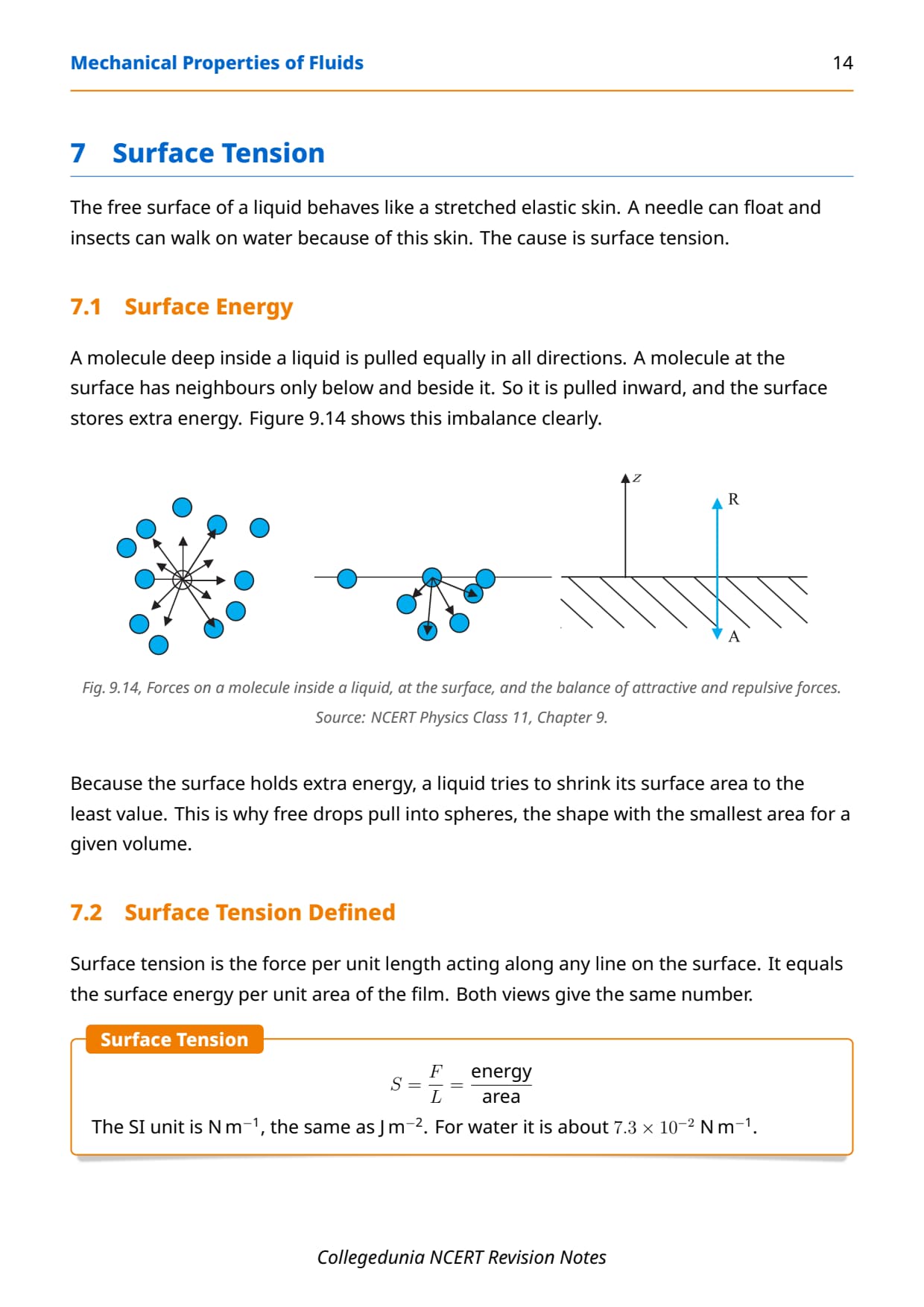
Surface tension is the force per unit length acting along the surface of a liquid. It exists because molecules at the surface are pulled inward by the liquid below them. This pull makes a liquid surface behave like a stretched elastic sheet.
- Surface tension: force per unit length, T = F/l, measured in newton per metre.
- Surface energy: the extra energy stored in the surface, equal to the work done to increase its area.
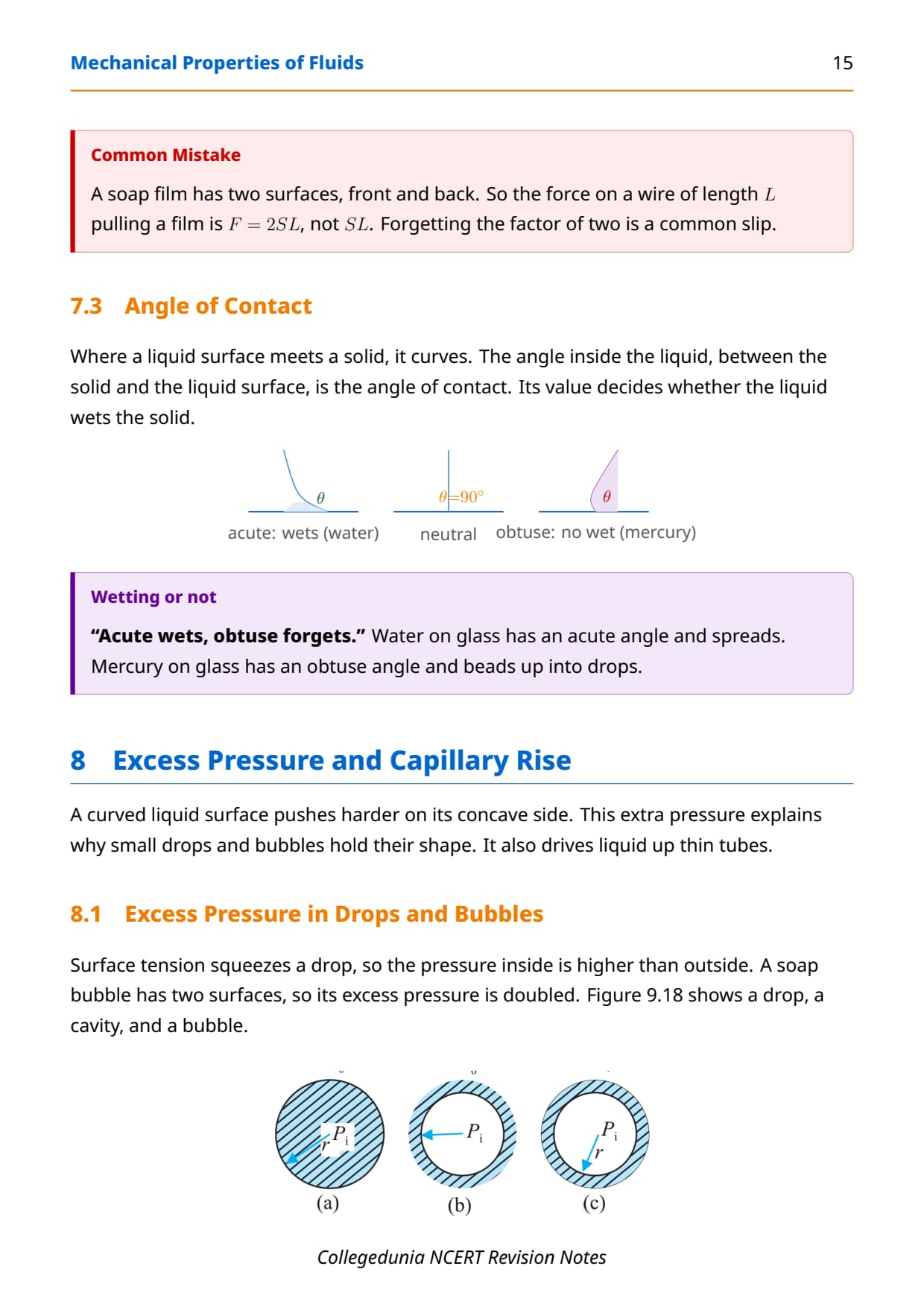
- Excess pressure: inside a drop the excess pressure is 2T/R; inside a bubble it is 4T/R.
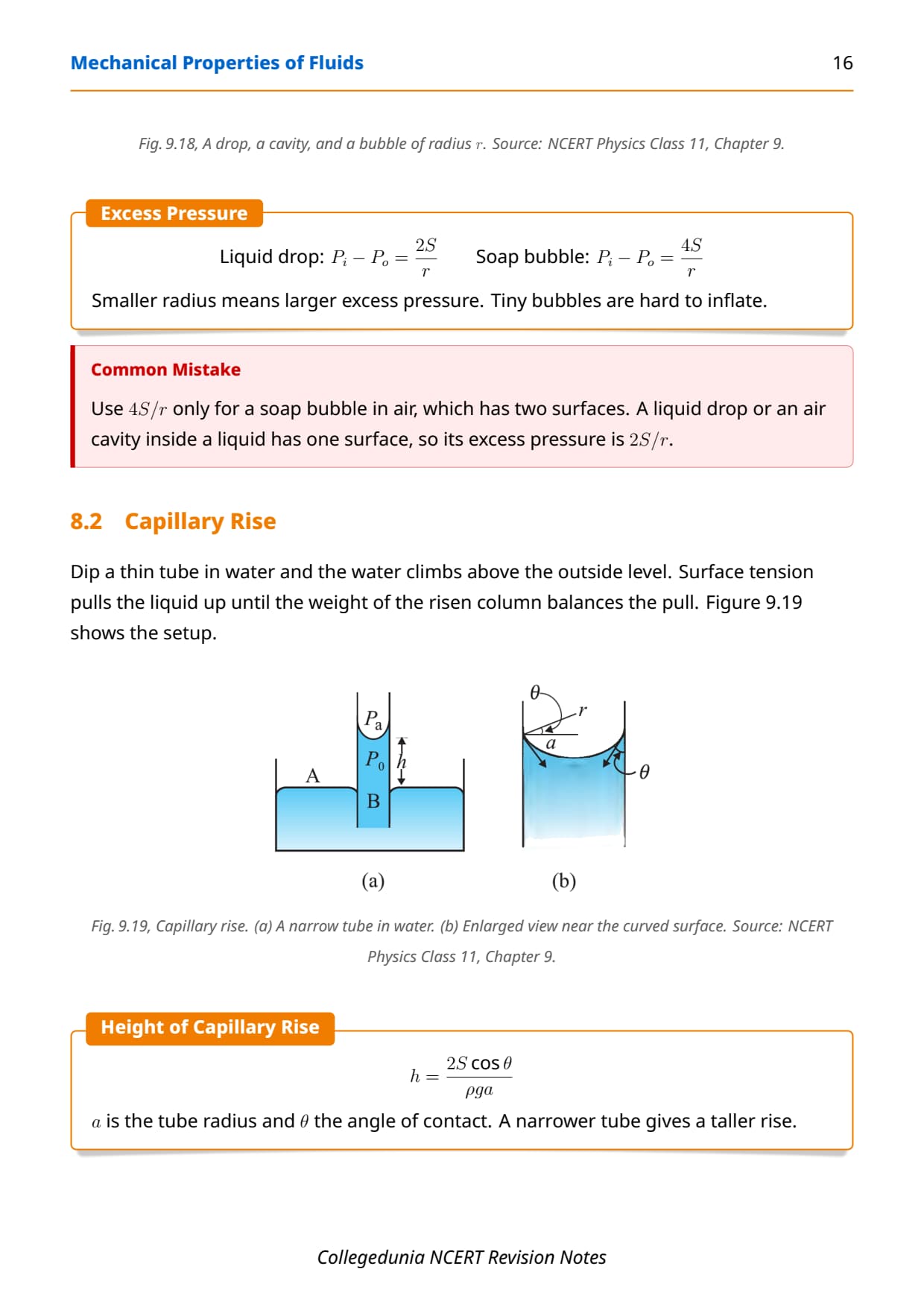
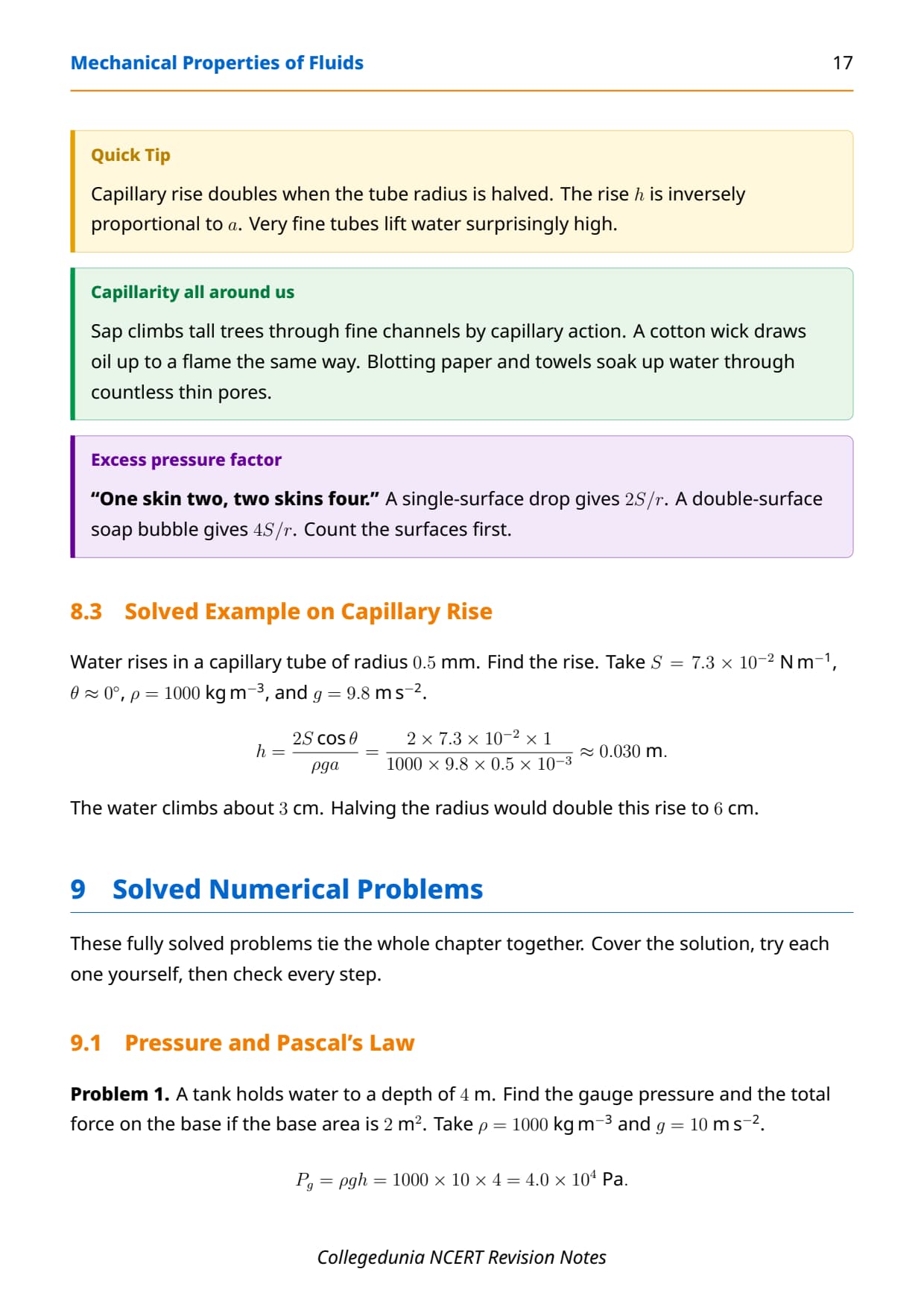
- Capillary rise: a liquid climbs a thin tube to a height h = 2Tcosθ/ρgr.
Surface tension makes small drops round, because a sphere has the least surface area for a given volume. Capillary action is why oil rises up a wick and water climbs into soil. The angle of contact decides whether a liquid rises or falls in the tube, so water rises in glass while mercury dips.
All Formulas for Mechanical Properties of Fluids
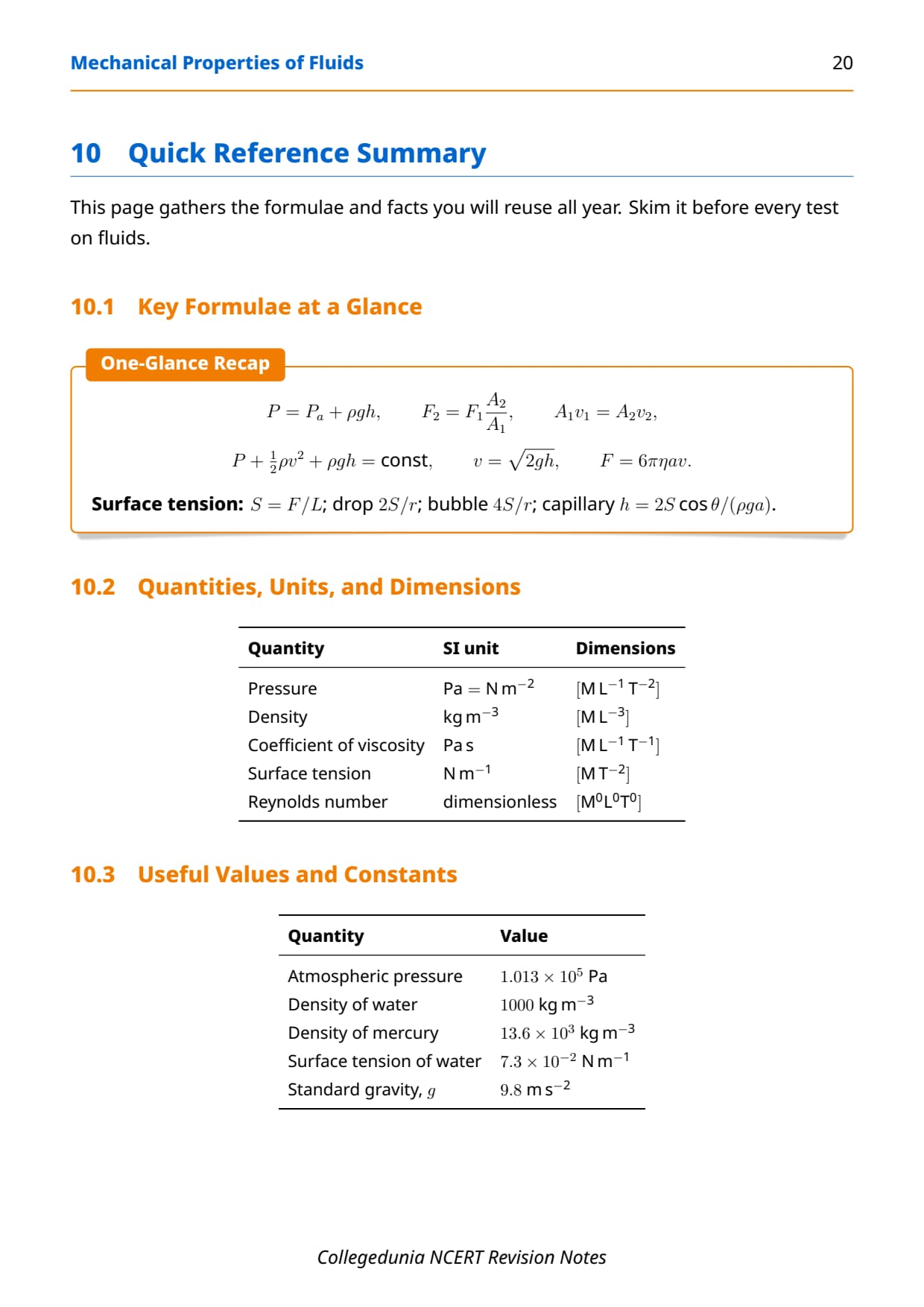
Every formula you need for the chapter sits in one table below, with its meaning and its SI unit. Learn the Bernoulli and continuity rows first, since those carry the most marks in both Boards and entrance papers.
| Formula | What it means | SI unit |
|---|---|---|
| P = F/A | Pressure as force per unit area | pascal (Pa) |
| P = P0 + ρgh | Pressure at depth h in a fluid | pascal (Pa) |
| FB = ρVg | Buoyant force (Archimedes' principle) | newton (N) |
| A1v1 = A2v2 | Equation of continuity | m3 s-1 |
| P + ½ρv2 + ρgh = constant | Bernoulli's equation along a streamline | pascal (Pa) |
| F = ηA(dv/dx) | Viscous force between fluid layers | newton (N) |
| F = 6πηrv | Stokes' drag on a small sphere | newton (N) |
| vt = 2r2(ρ − σ)g/9η | Terminal velocity of a sphere | m s-1 |
| T = F/l | Surface tension as force per unit length | N m-1 |
| h = 2Tcosθ/ρgr | Capillary rise in a thin tube | metre (m) |
Carry the SI unit on every line of your working. Losing the unit is a silent way to drop the final mark even when the number is right. Keep this table open while you solve the back-exercise numericals.
Key Definitions and Derivations for Mechanical Properties of Fluids
Boards short-answer questions often ask for a clean definition in one or two lines. Learn these word-for-word, because a vague definition loses easy marks. Each one also sets up a derivation you can be asked to show.
| Term | Definition |
|---|---|
| Pressure | The force acting at right angles per unit area on a surface. |
| Pascal's law | Pressure applied to an enclosed fluid is passed on equally in all directions. |
| Archimedes' principle | The buoyant force on a body equals the weight of the fluid it displaces. |
| Equation of continuity | For an incompressible fluid the product of area and speed stays constant. |
| Viscosity | The internal friction between layers of a fluid moving at different speeds. |
| Surface tension | The force per unit length acting along the free surface of a liquid. |
A common derivation asks you to get the capillary-rise formula by balancing the upward surface-tension force against the weight of the raised liquid column. Set the surface-tension pull equal to the weight of the lifted liquid to reach h = 2Tcosθ/ρgr. The rise is larger in a narrower tube, since h varies inversely with the radius.
Common Mistakes Students Make in Mechanical Properties of Fluids
These slips happen while writing or calculating, not because the concept is unclear. Each one costs 1 to 3 marks in the paper, so watch for them at the exact step.
Mistake 1: Confusing gauge pressure with absolute pressure. Add atmospheric pressure only when the question asks for absolute pressure.
Mistake 2: Using the drop formula for a bubble. Excess pressure is 2T/R for a drop but 4T/R for a soap bubble with two surfaces.
Mistake 3: Applying Bernoulli's equation to a viscous or turbulent flow. It holds only for steady, non-viscous, incompressible flow.
Mistake 4: Thinking a floating body displaces its own volume. It displaces its own weight of fluid, which is different unless the densities match.
Mechanical Properties of Fluids Weightage in CBSE Boards, JEE and NEET
This chapter is steady and rewarding. It carries at least one numerical every year, and Bernoulli plus surface tension are the favourites. Here is how the marks split across the main exams for 2026-27.
| Exam | Typical weightage | What is asked |
|---|---|---|
| CBSE Boards | 4 to 6 marks | One short answer plus one numerical on pressure, Bernoulli or surface tension |
| JEE Main | 1 to 2 questions | Continuity, Bernoulli, viscosity and terminal velocity |
| NEET | 1 to 2 questions | Pressure, buoyancy, surface tension and capillarity |
| CUET and NDA | 1 objective question | Pascal's law, Archimedes' principle and basic pressure |
Bernoulli's principle and surface tension together produce the most-tested questions from this chapter across all four exams. Master those two first, then viscosity and terminal velocity, in that order of return on effort.
How to Revise Mechanical Properties of Fluids Quickly
Use these Class 11 Physics Notes Chapter 9 Mechanical Properties of Fluids for a fast, ordered recap the night before a test. The checklist below takes about 30 minutes and hits every marks-heavy idea.
- First 10 minutes: write the pressure-at-depth, continuity and Bernoulli equations from memory, with each term labelled.
- Next 10 minutes: redo one Bernoulli numerical and one terminal-velocity numerical end to end.
- Last 10 minutes: revise surface tension, the excess-pressure formulas, and the capillary-rise derivation.
Close the loop by stating Archimedes' principle and Pascal's law in one line each. If you can do all four blocks without notes, the chapter is exam-ready. Keep the All Formulas table beside you for the first pass only, then try it closed-book.
Student Feedback on the Mechanical Properties of Fluids Notes
What 11,540 students told us about their Mechanical Properties of Fluids revision:
- 71% of students rated Bernoulli's principle as the hardest sub-topic in the chapter.
- Most-skipped step: using 4T/R for a bubble instead of 2T/R, missed by about 3 in 10 students.
- Students who revised pressure and buoyancy first said the flow section felt much easier.
Source: 2026-27 Class 11 Physics student poll. Sample of 11,540 students from CBSE schools across 14 states, conducted before the 2026 boards.
Other Mechanical Properties of Fluids Class 11 Physics Resources
Pair these notes with the solved answers, the handwritten notes, the formula sheet, and the textbook PDF for the same chapter.
| Resource | Link |
|---|---|
| NCERT Solutions | Mechanical Properties of Fluids Class 11 NCERT Solutions |
| Handwritten Notes | Mechanical Properties of Fluids Class 11 Handwritten Notes |
| Formula Sheet | Mechanical Properties of Fluids Class 11 Formula Sheet |
| NCERT Book PDF | Mechanical Properties of Fluids Class 11 Book PDF |
NCERT Notes for Class 11 Physics: All Chapters
Jump to the revision notes for any other Class 11 Physics chapter below.
| Chapter | NCERT Notes |
|---|---|
| Chapter 1 | Units and Measurements |
| Chapter 2 | Motion in a Straight Line |
| Chapter 3 | Motion in a Plane |
| Chapter 4 | Laws of Motion |
| Chapter 5 | Work, Energy and Power |
| Chapter 6 | System of Particles and Rotational Motion |
| Chapter 7 | Gravitation |
| Chapter 8 | Mechanical Properties of Solids |
| Chapter 9 | Mechanical Properties of Fluids |
| Chapter 10 | Thermal Properties of Matter |
| Chapter 11 | Thermodynamics |
| Chapter 12 | Kinetic Theory |
| Chapter 13 | Oscillations |
| Chapter 14 | Waves |
FAQs on Mechanical Properties of Fluids Class 11 Physics Notes
Mechanical Properties of Fluids Notes - Frequently Asked Questions
Ques. What topics do the Class 11 Physics Notes Chapter 9 Mechanical Properties of Fluids cover?
Ans. These Class 11 Physics Notes Chapter 9 Mechanical Properties of Fluids cover pressure and Pascal's law, atmospheric and gauge pressure, buoyancy and Archimedes' principle, streamline flow with the equation of continuity, Bernoulli's principle, viscosity and Stokes' law, terminal velocity, surface tension and capillarity. Every key formula and definition is included for fast revision.
Ques. What is Pascal's law in Mechanical Properties of Fluids?
Ans. Pascal's law states that pressure applied to an enclosed fluid is transmitted equally to every part of the fluid and to the walls of its container. It explains how a hydraulic lift works, where a small force on a small piston balances a large load on a large piston, because the pressure is the same on both.
Ques. What is Bernoulli's principle and where is it used?
Ans. Bernoulli's principle states that along a streamline the sum of pressure energy, kinetic energy and potential energy per unit volume stays constant. So where a fluid moves faster, its pressure is lower. It explains the lift on an aircraft wing, the spin of a ball, and the working of an atomiser. It holds only for steady, non-viscous, incompressible flow.
Ques. What is terminal velocity in this chapter?
Ans. Terminal velocity is the steady speed a small sphere reaches when the viscous drag and buoyant force together balance its weight, so the net force becomes zero. It depends on the square of the radius, so larger drops fall faster. This is why fine mist floats while large raindrops fall quickly.
Ques. What is the weightage of Mechanical Properties of Fluids in the CBSE board exam?
Ans. Mechanical Properties of Fluids carries about 4 to 6 marks in the CBSE Class 11 Physics paper, usually one short answer plus one numerical on pressure, Bernoulli or surface tension. It also appears in JEE Main and NEET as questions on continuity, viscosity, terminal velocity and capillarity.
Ques. How should I revise Mechanical Properties of Fluids quickly for a test?
Ans. Start by writing the pressure-at-depth, continuity and Bernoulli equations from memory with each term labelled. Then redo one Bernoulli numerical and one terminal-velocity numerical. Finish with surface tension, the excess-pressure formulas and the capillary-rise derivation. The quick-revision checklist in these Class 11 Physics Notes Chapter 9 Mechanical Properties of Fluids covers all of this in about 30 minutes.



Comments