




These Class 11 Physics Notes Chapter 13 Oscillations pull together every definition, formula and derivation on simple harmonic motion that the Boards, JEE Main, JEE Advanced, NEET, CUET and NDA papers test in 2026-27. Use them to revise the whole chapter fast, with the SHM equations, energy results and pendulum formulas in one place.
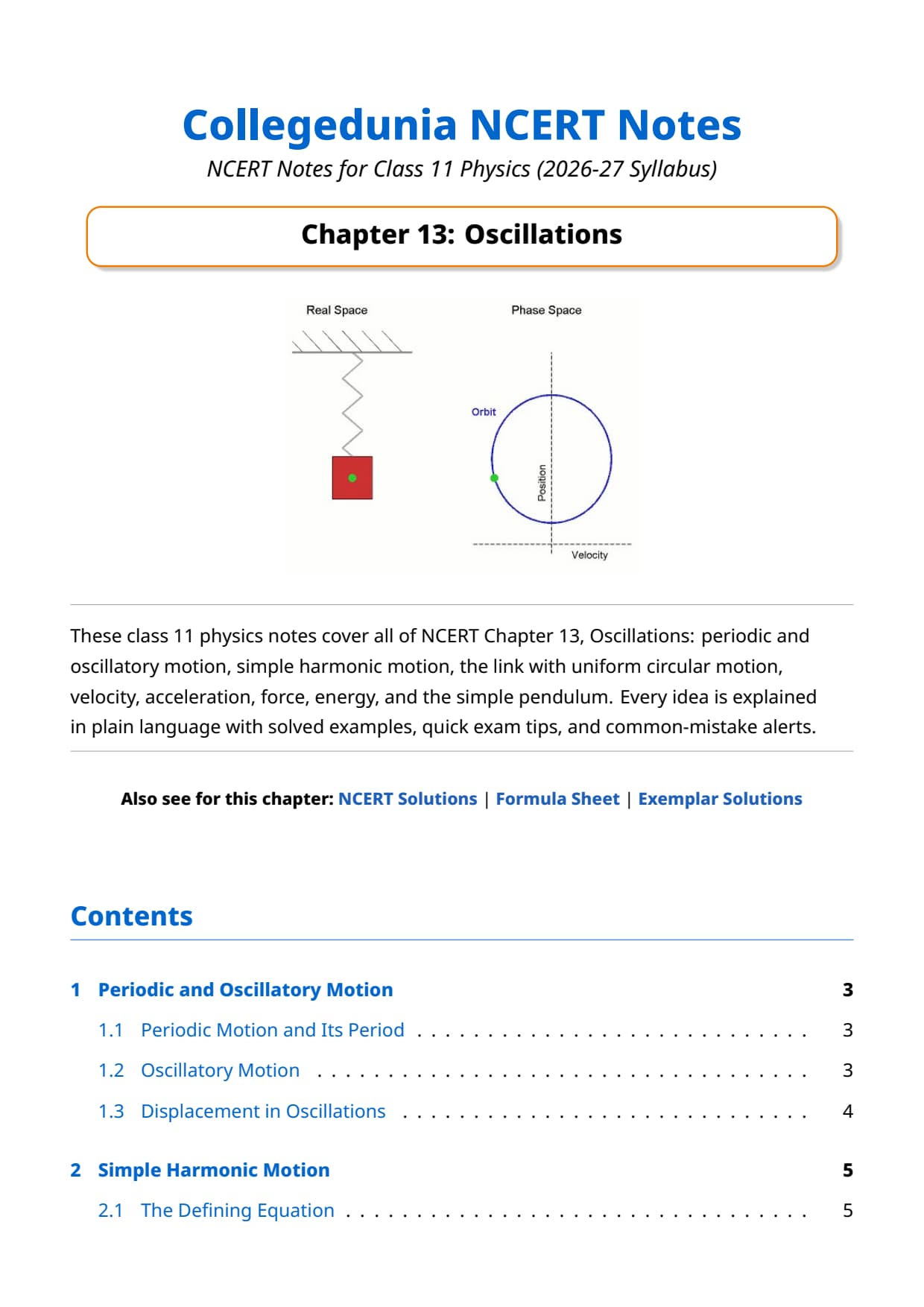
Oscillations is the bridge chapter that turns your motion and energy skills into the study of repeating motion, and it feeds directly into Waves right after it.
- CBSE Weightage: 4 to 5 marks, usually one short answer plus one numerical on the time period or energy of SHM.
- Topics covered: periodic and oscillatory motion, SHM, phase, energy in SHM, spring and pendulum oscillations, damping, and resonance.
- Key formulas: displacement, velocity and acceleration in SHM, plus the time period of a spring and a simple pendulum.
These Class 11 Physics Notes Chapter 13 Oscillations are curated by subject experts, based on the 2026-27 NCERT textbook, and checked against the last five years of CBSE Board, JEE Main and NEET papers.
Topic-by-Topic Summary of Oscillations
The chapter builds up from any to-and-fro motion, narrows it to simple harmonic motion, and then applies that one idea to springs and pendulums. Here is the quick map of what each topic gives you.
- Periodic and oscillatory motion: motion that repeats, and the special back-and-forth kind called oscillation.
- Simple harmonic motion (SHM): the displacement, velocity and acceleration equations that define the whole chapter.
- Phase and circular motion: SHM seen as the shadow of a particle moving in a circle.
- Energy in SHM: how kinetic and potential energy trade places while the total stays fixed.
- Springs, pendulums, damping and resonance: real systems that oscillate, and what slows them or drives them.
Revise the topics in this order, because each one uses the one before it. Once you fix the meaning of ω, every formula in the chapter falls out of it. These Class 11 Physics Notes Chapter 13 Oscillations follow the same sequence as the NCERT textbook.
Periodic and Oscillatory Motion Explained
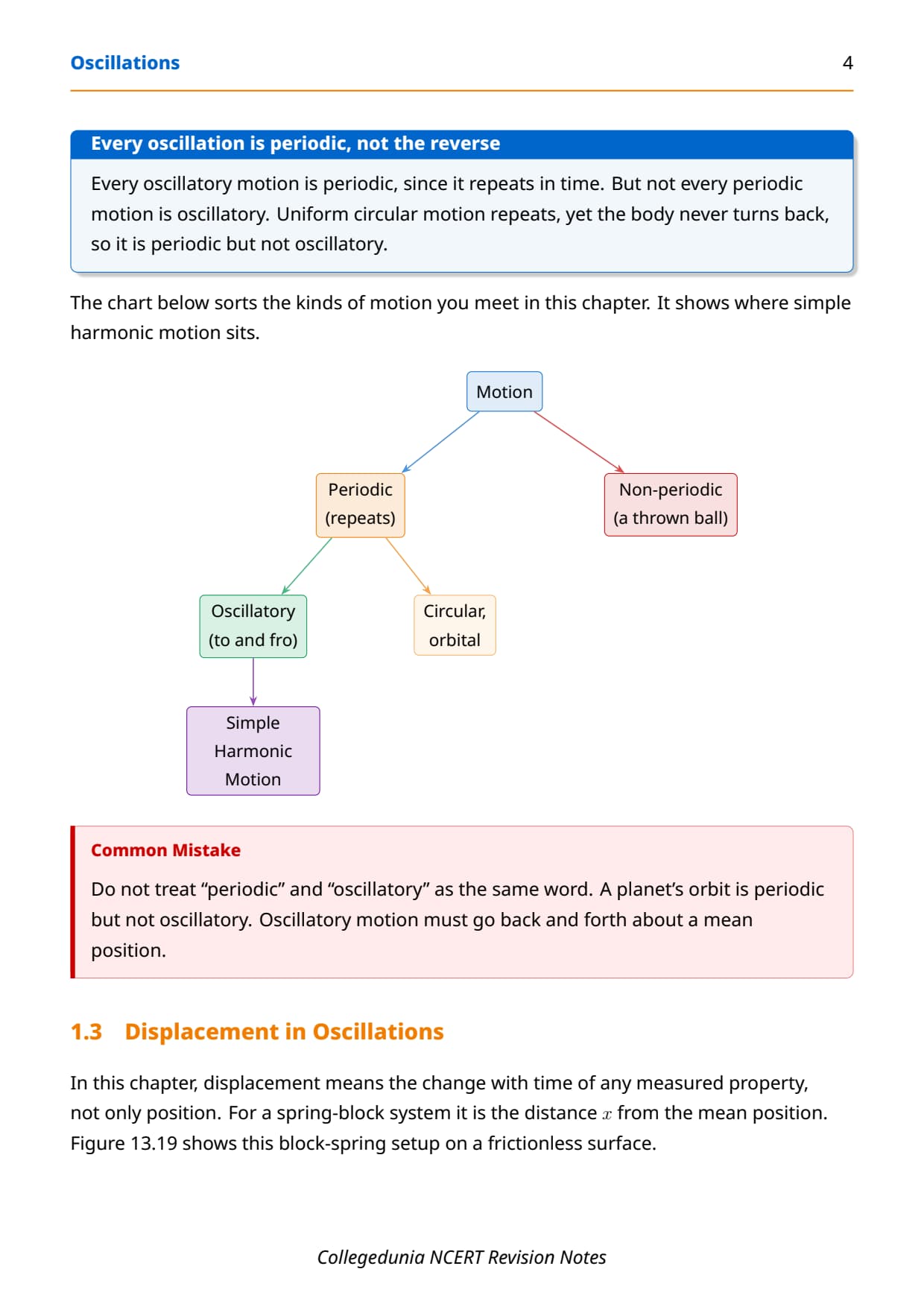
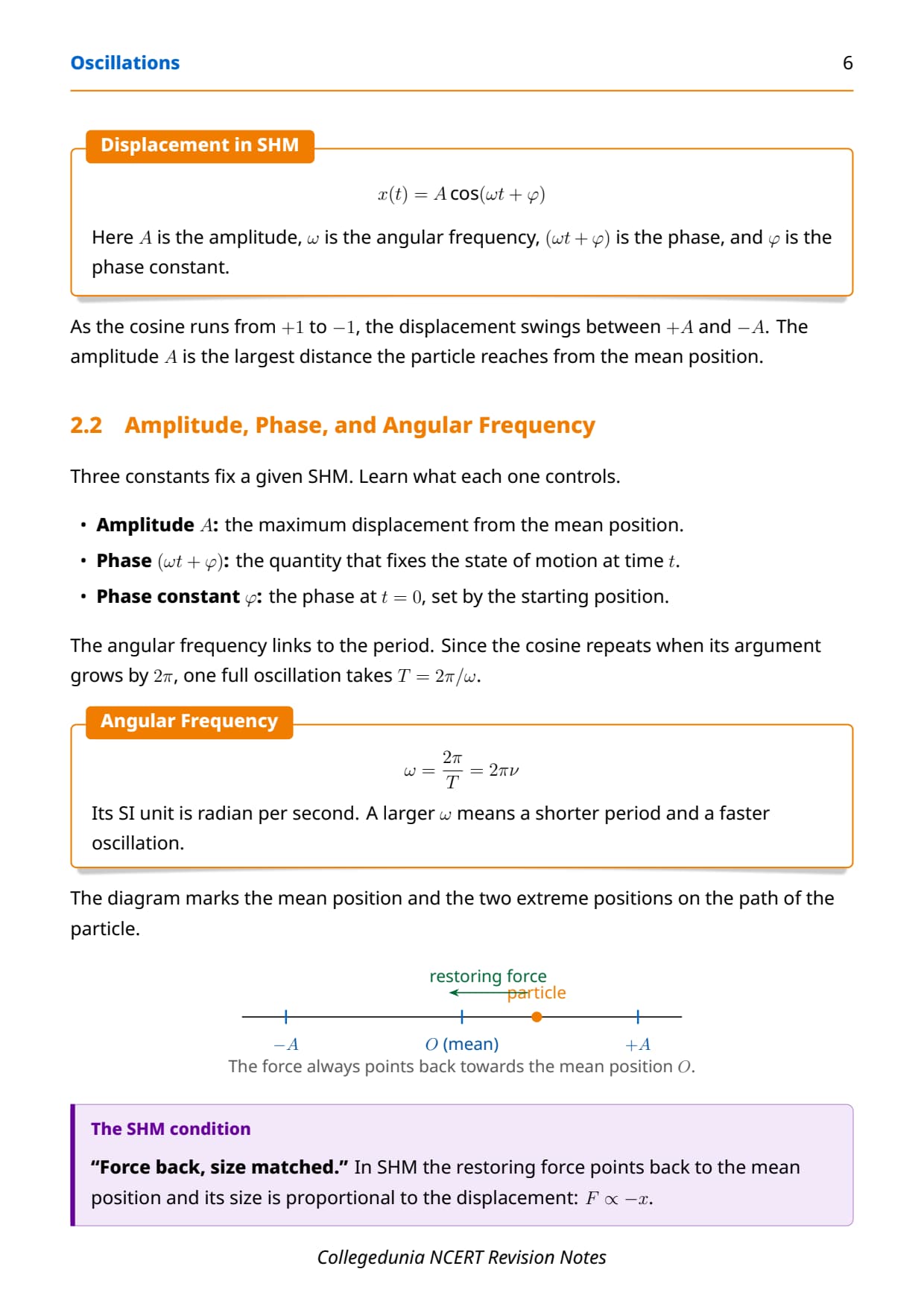
Periodic motion is any motion that repeats after a fixed time. Oscillatory motion is a special kind where the body moves to and fro about a mean position. Every oscillation is periodic, but not every periodic motion is an oscillation.
- Time period (T): the time for one full oscillation, measured in seconds.
- Frequency (ν): the number of oscillations per second, equal to 1/T, measured in hertz.
- Displacement: the distance of the body from its mean position at any instant.
Any periodic motion can be written as a sum of sine and cosine terms, which is why SHM matters so much. The planet going around the Sun is periodic but not oscillatory; a swinging pendulum is both. Keep this difference ready, because Boards ask it as a one-mark definition question.
Simple Harmonic Motion: Displacement, Velocity and Acceleration
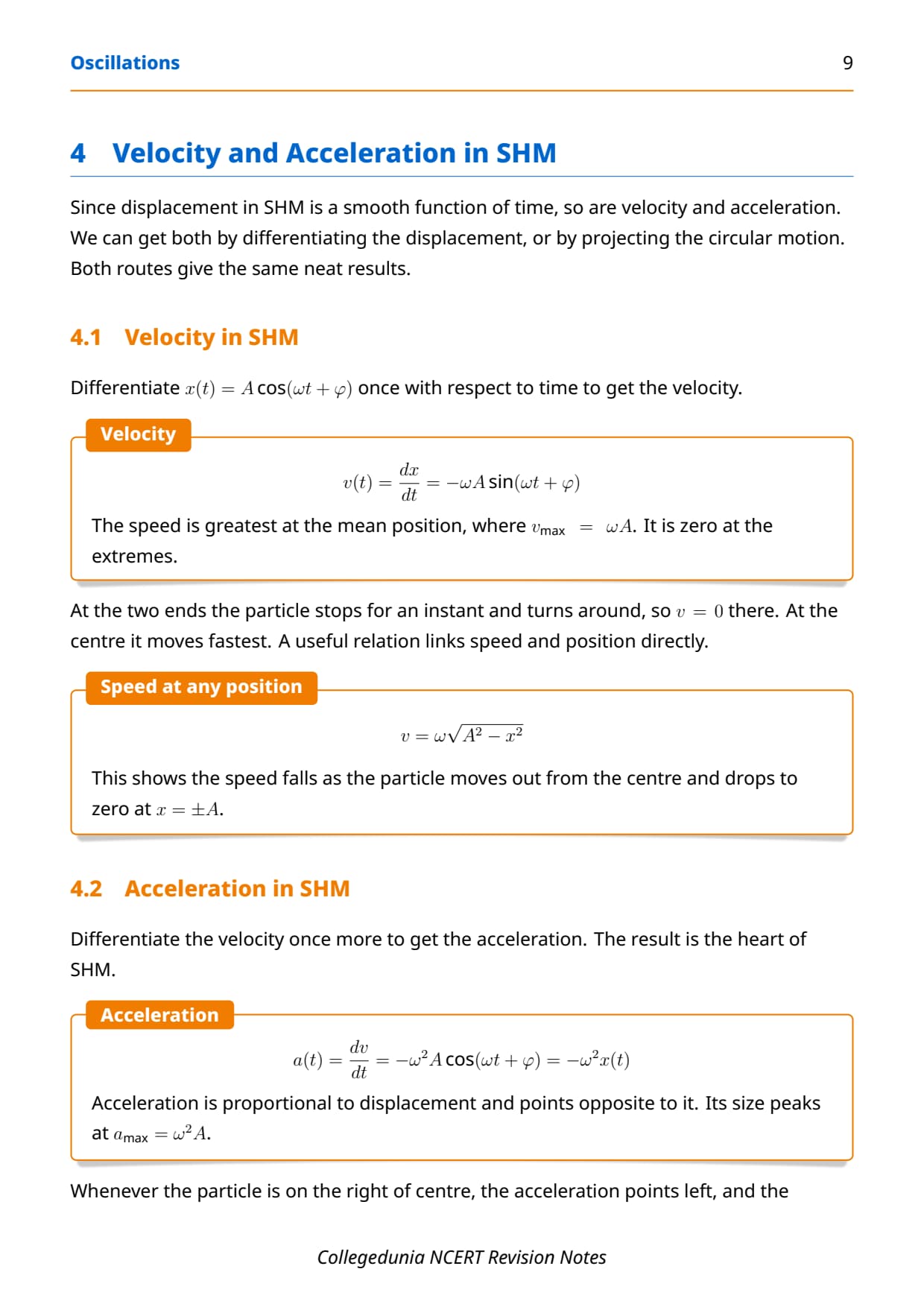
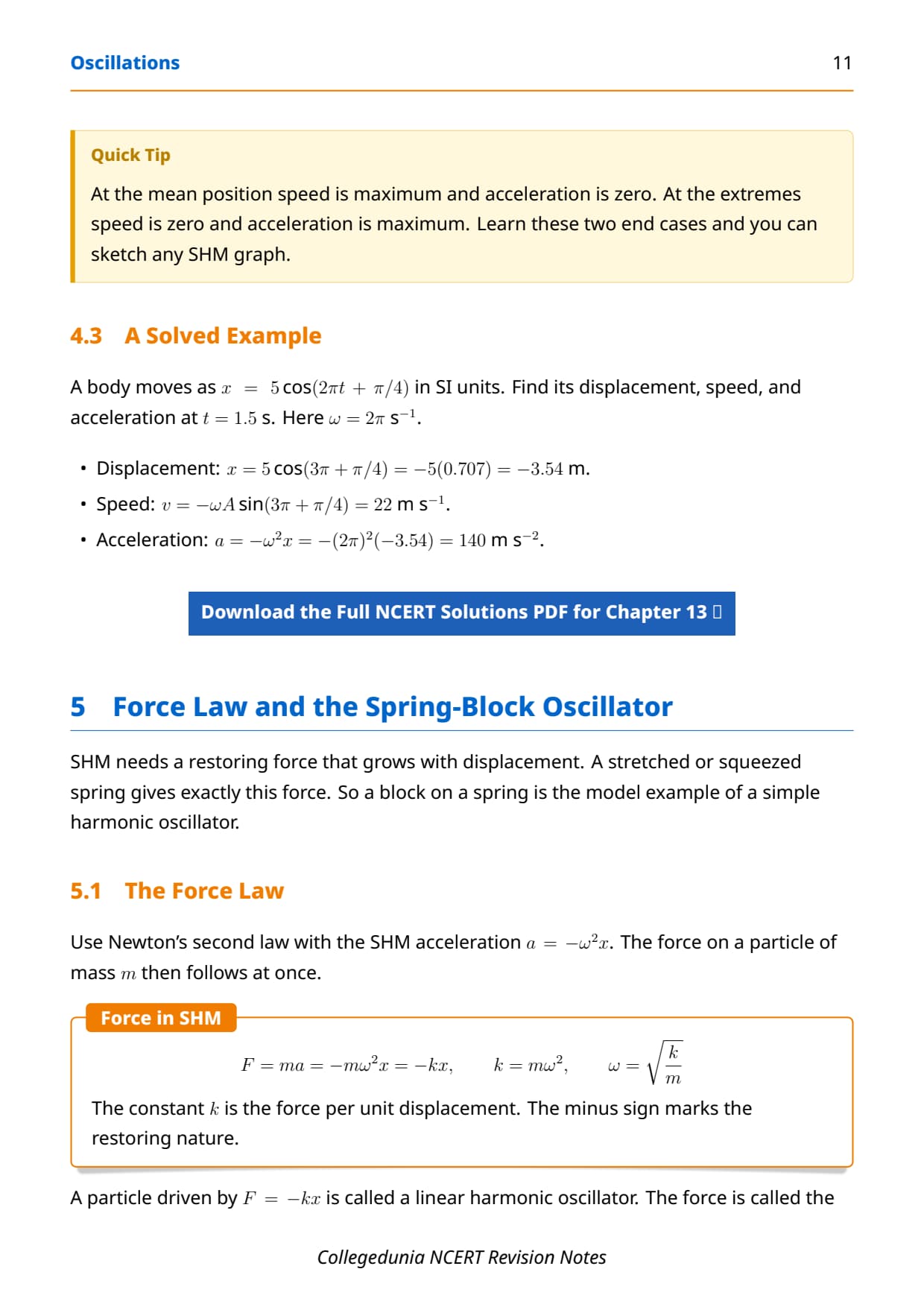
Simple harmonic motion is oscillatory motion where the acceleration is always directed towards the mean position and is proportional to the displacement. This single rule gives the three equations you use in every SHM numerical.
| Quantity | Equation | Maximum value |
|---|---|---|
| Displacement | x = A cos(ωt + φ) | A (amplitude) |
| Velocity | v = −Aω sin(ωt + φ) | Aω |
| Acceleration | a = −ω2x | Aω2 |
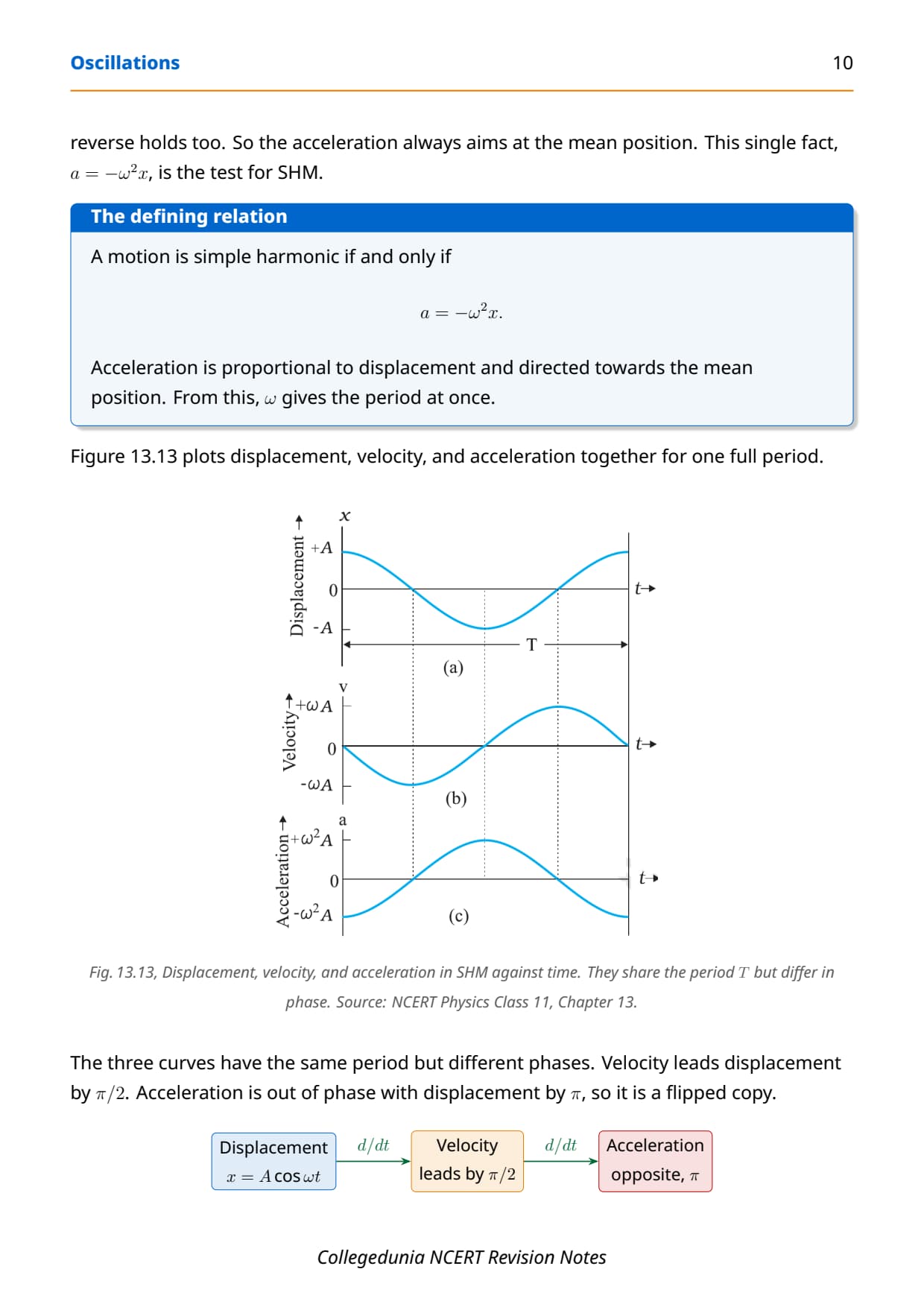
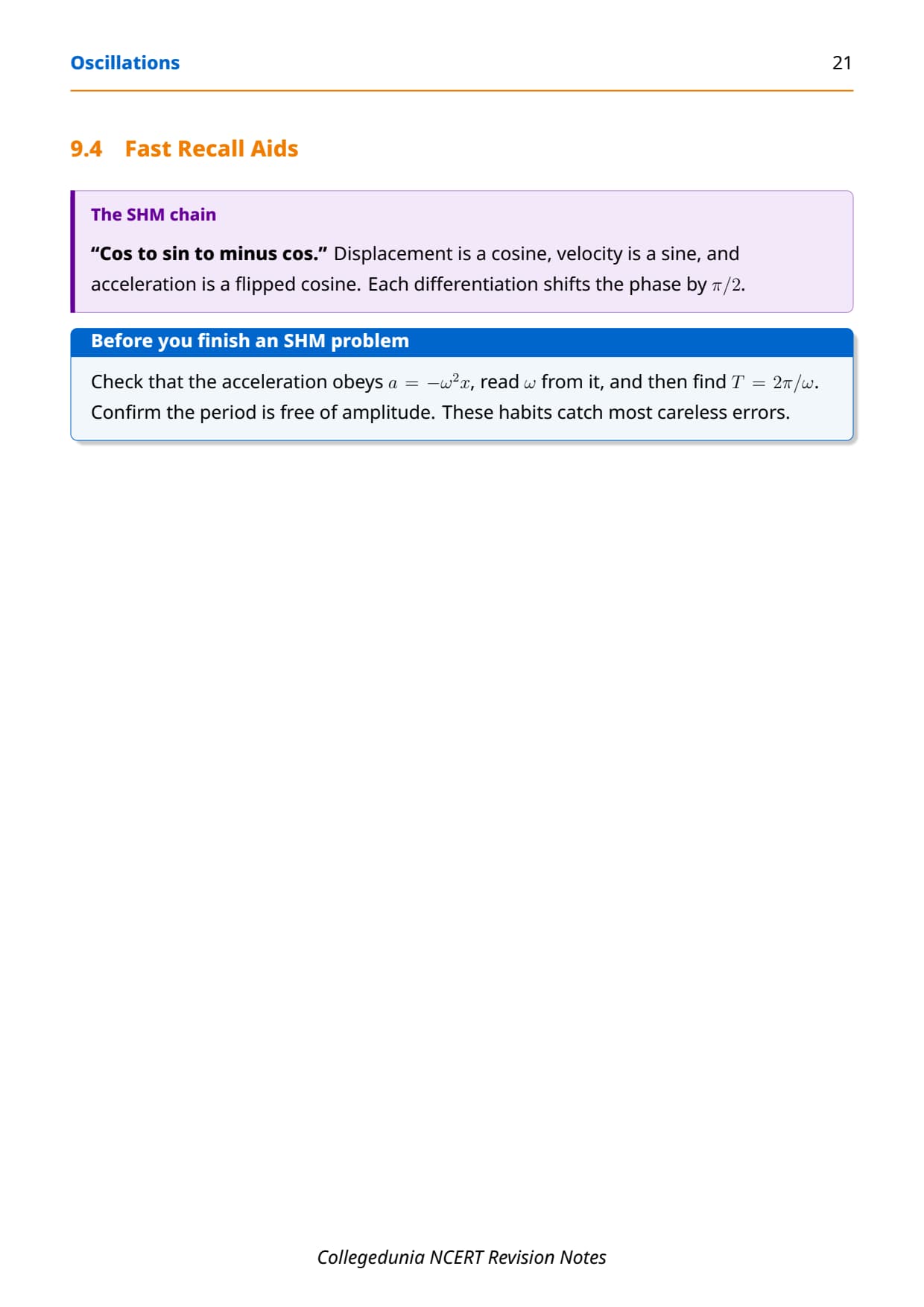
Velocity is largest at the mean position and zero at the extremes; acceleration is the reverse. The defining test of SHM is a = −ω2x — acceleration proportional to displacement and opposite in sign. A useful side result is v = ±ω√(A2 − x2), which links speed to position without needing time.
Phase and SHM as a Projection of Uniform Circular Motion
The quantity (ωt + φ) is called the phase, and it fixes the state of the oscillator at any instant. The constant φ is the phase constant, set by where the body starts. Phase is the idea that lets you compare two oscillations.
- Angular frequency (ω): the rate of change of phase, equal to 2π/T = 2πν.
- Phase constant (φ): the phase at time zero, which decides the starting position and direction.
- In phase / out of phase: two SHMs with a phase difference of 0 move together; a difference of π means they are exactly opposite.
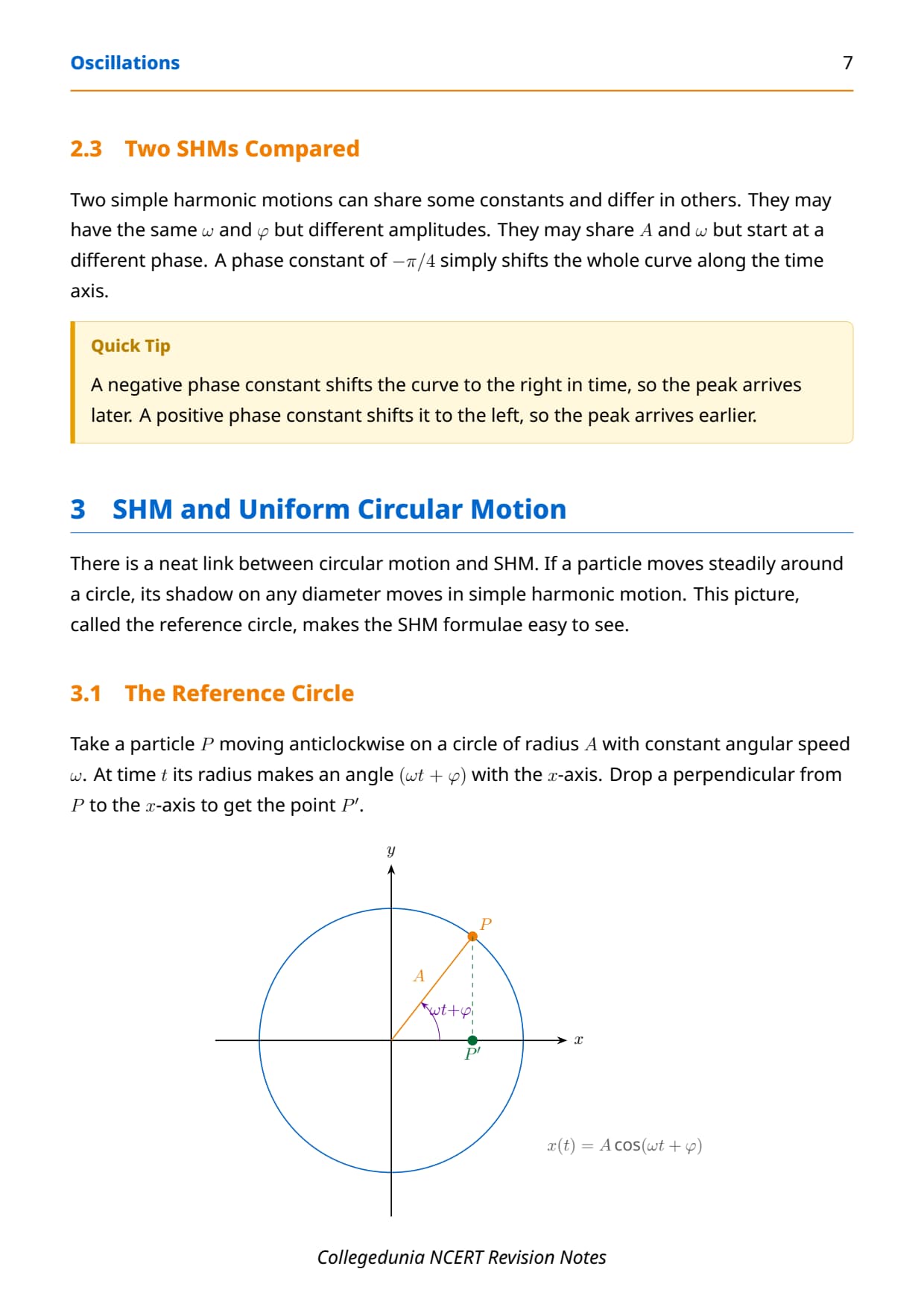
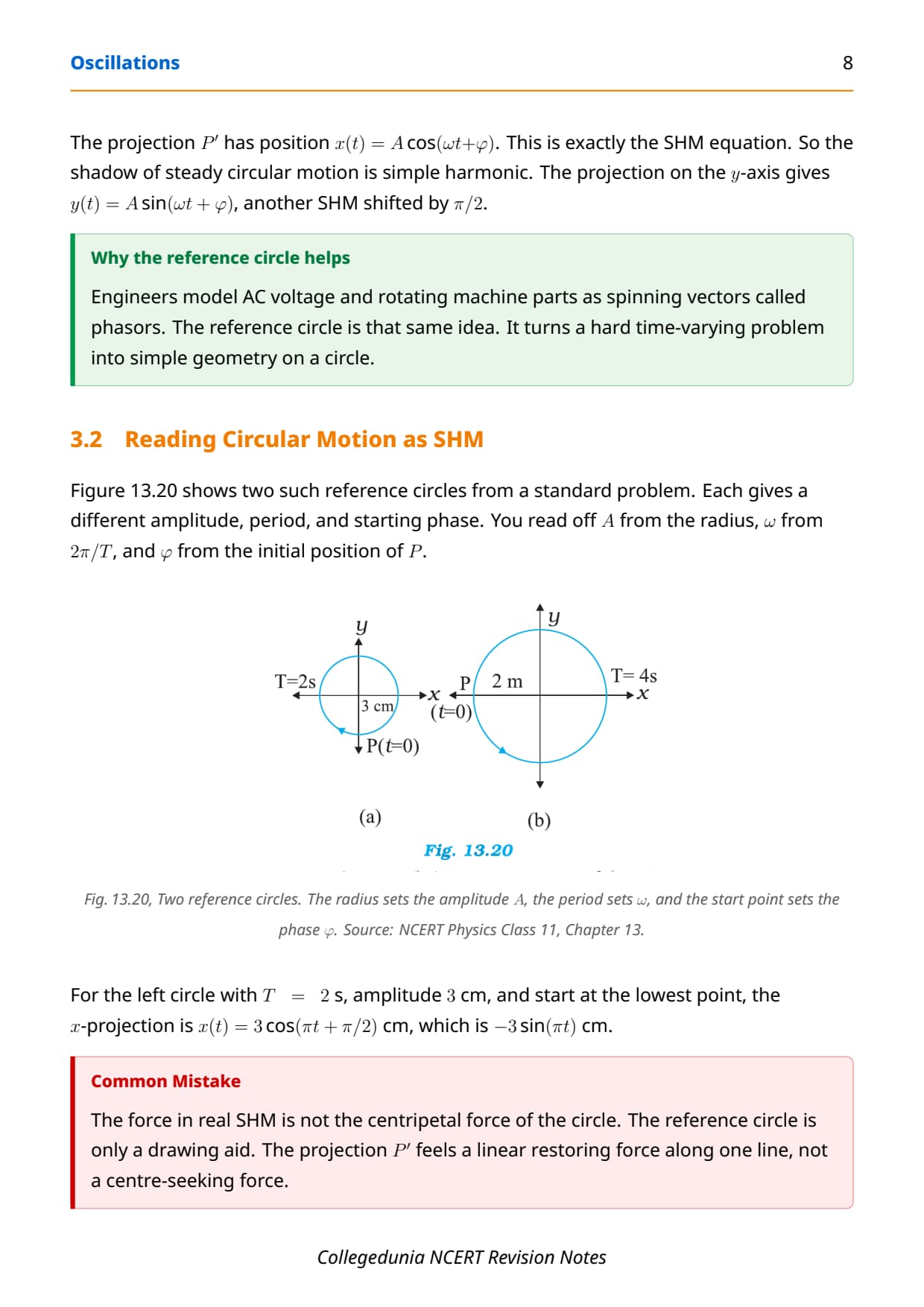
SHM is the projection, or shadow, of uniform circular motion on any diameter. Picture a particle going round a circle of radius A; the foot of the perpendicular from it onto a diameter performs SHM. This picture is why ω is called angular frequency, and it makes the sine and cosine forms feel natural rather than memorised.
Energy in Simple Harmonic Motion
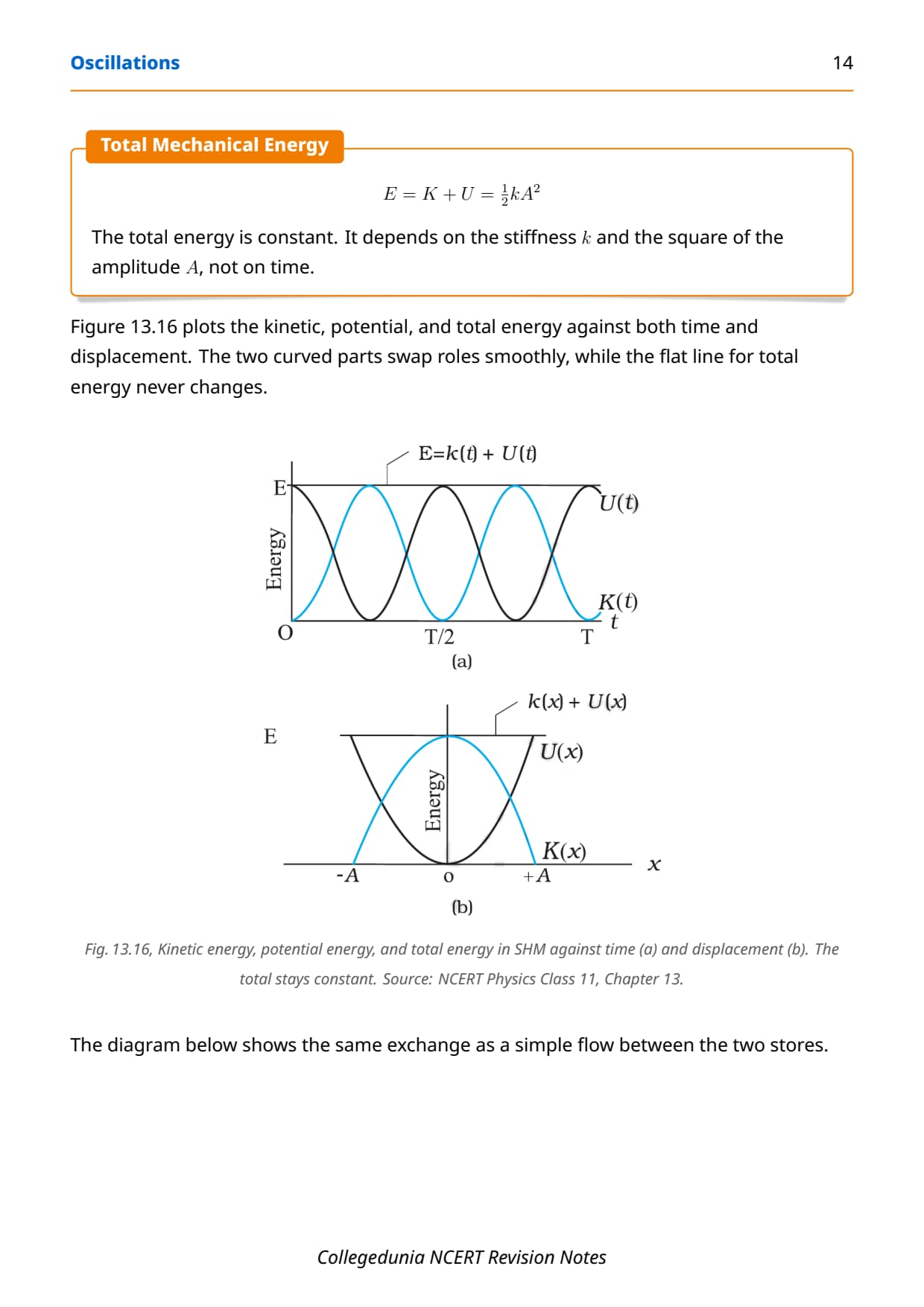
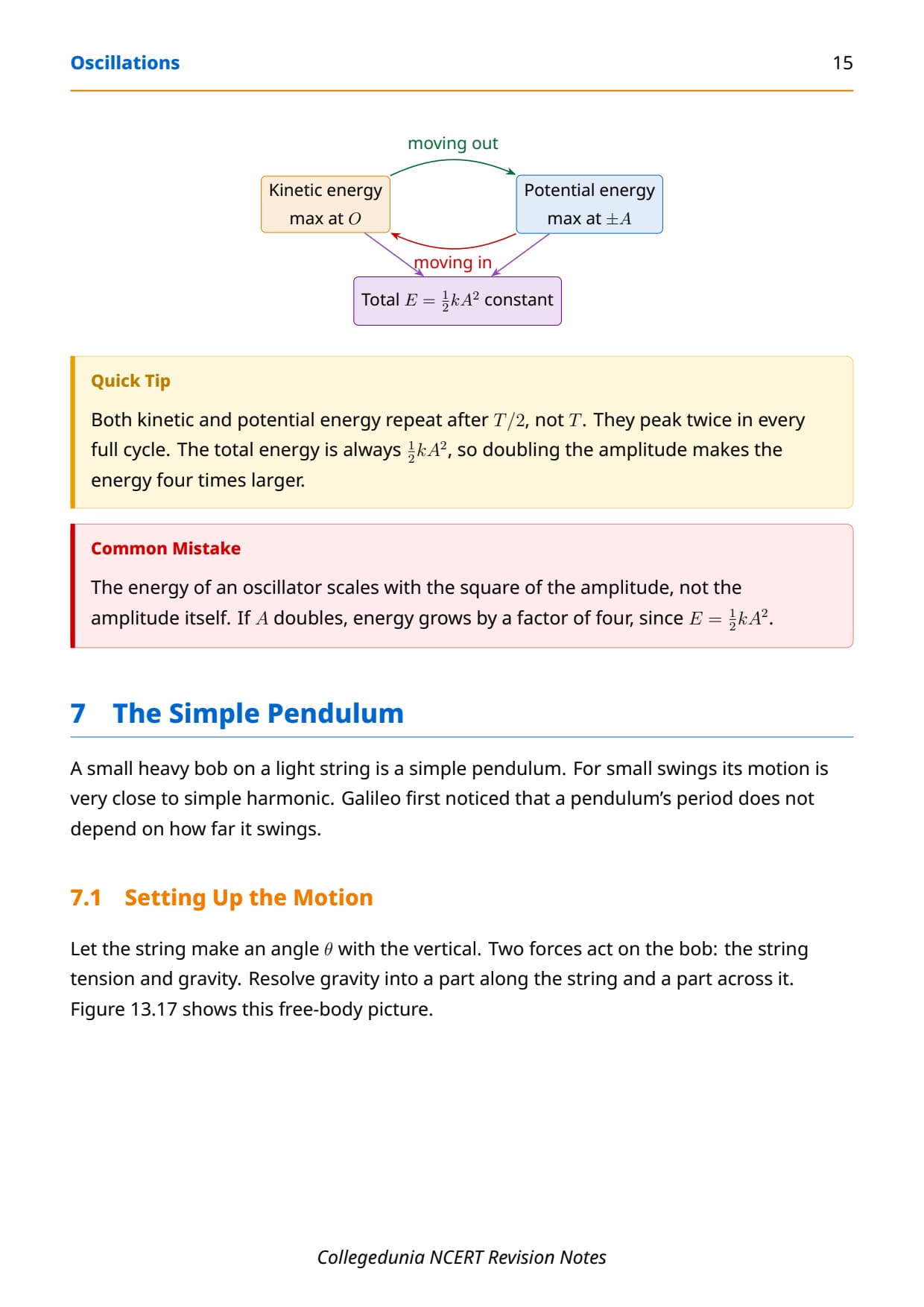
An oscillator carries both kinetic and potential energy, and the two keep swapping while the total stays constant. This is one of the most-tested ideas in the chapter, so learn where each energy peaks.
| Energy | Formula | Where it is maximum |
|---|---|---|
| Kinetic energy | KE = ½mω2(A2 − x2) | At the mean position (x = 0) |
| Potential energy | PE = ½mω2x2 | At the extremes (x = ±A) |
| Total energy | E = ½mω2A2 | Constant everywhere |
The total energy of SHM stays the same at every point and depends on the square of the amplitude. Both kinetic and potential energy vary with time, but they add up to a fixed value. A frequent exam point is that both energies complete one cycle in half the time period of the displacement.
Oscillations of a Spring and the Force Law for SHM
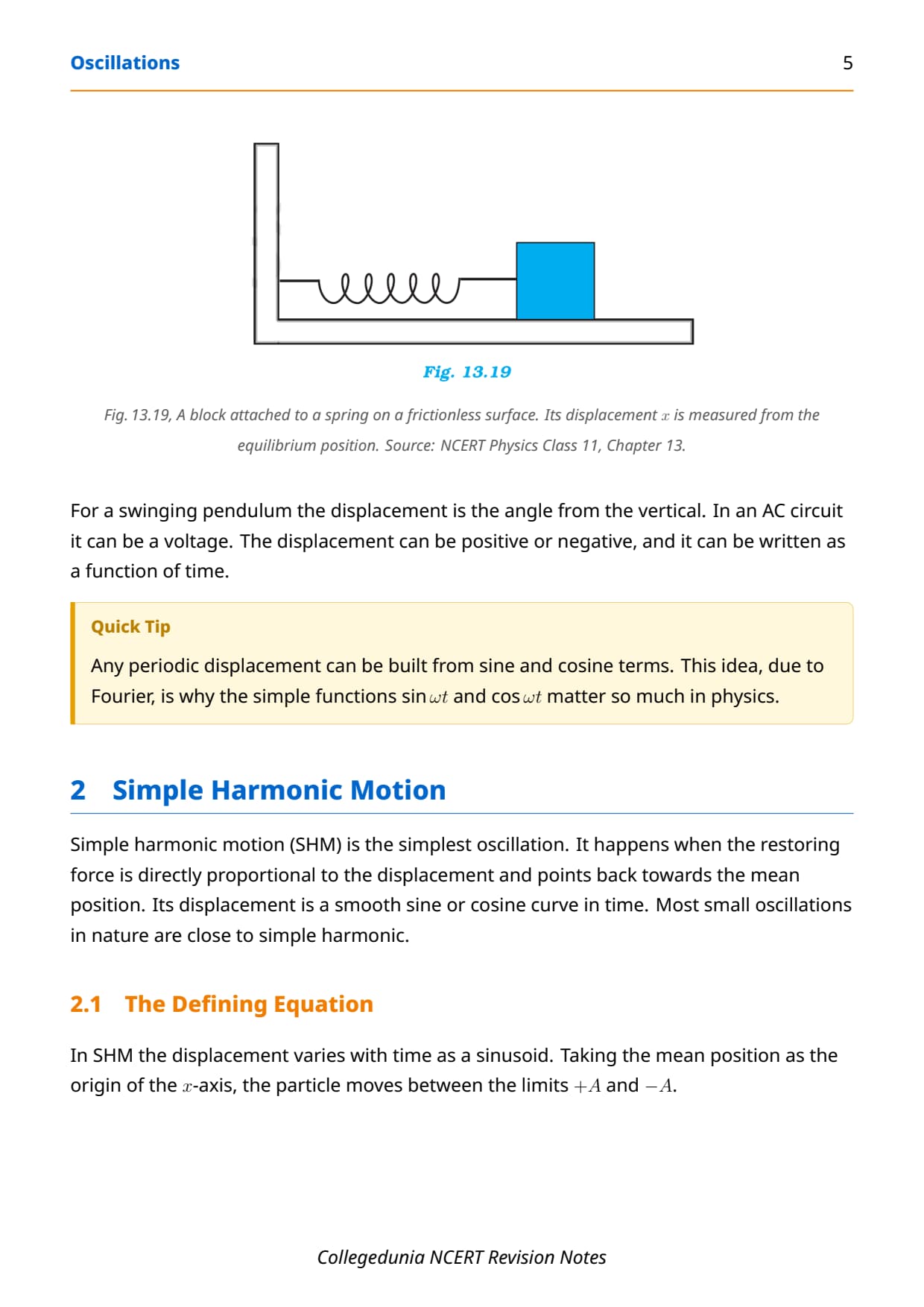
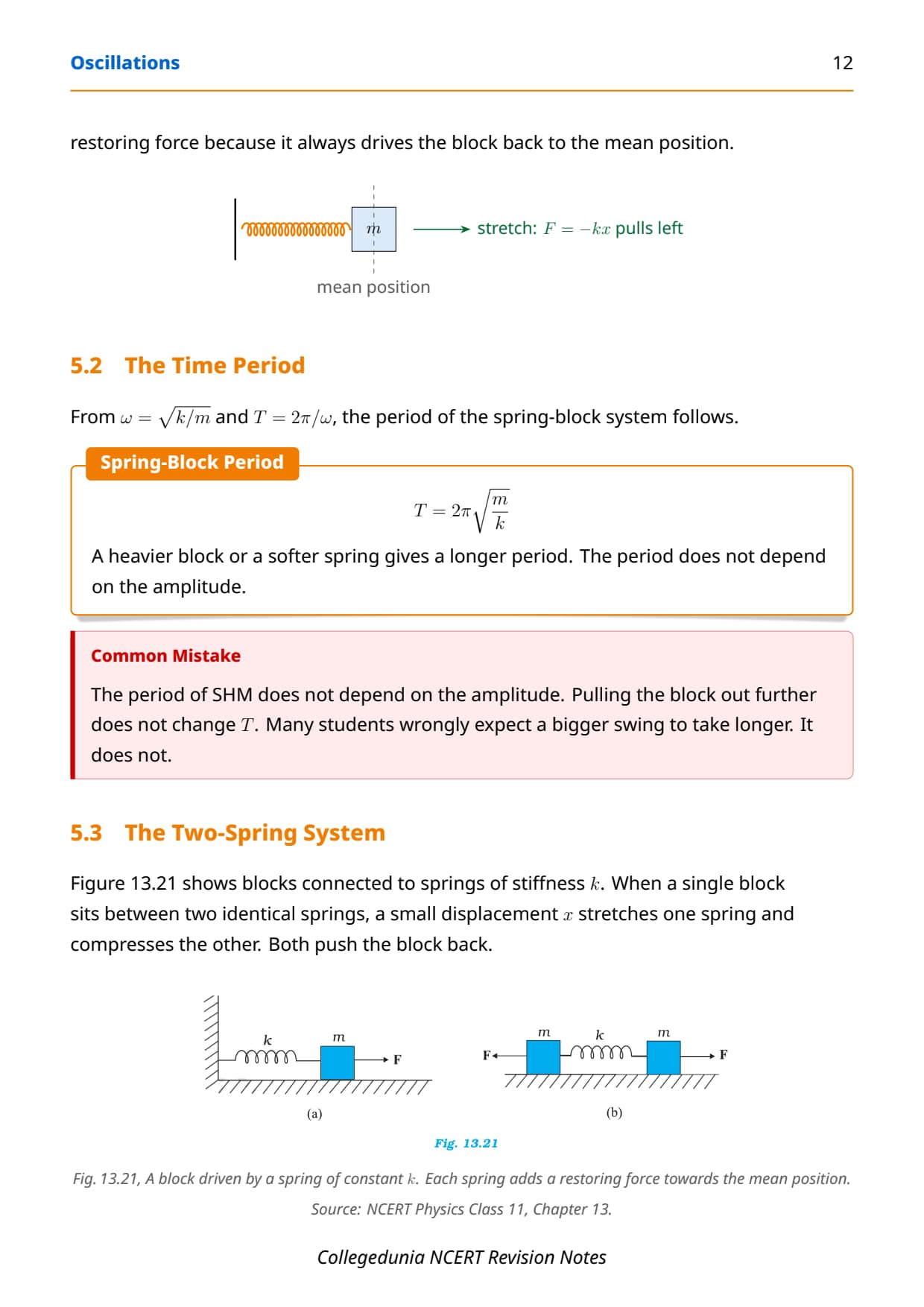
A block on a spring is the cleanest example of SHM. The spring provides a restoring force that always points back to the mean position, and this force is what makes the motion simple harmonic.
- Force law: the restoring force is F = −kx, where k is the spring constant.
- Angular frequency: ω = √(k/m), so a stiffer spring oscillates faster.
- Time period: T = 2π√(m/k), which grows with mass and shrinks with stiffness.
The minus sign in F = −kx is the whole point, because it means the force always fights the displacement. Comparing F = −kx with ma = −mω2x gives ω2 = k/m in one line. Notice the time period of a spring does not depend on gravity, which is a favourite trick in objective papers.
The Simple Pendulum and Its Time Period
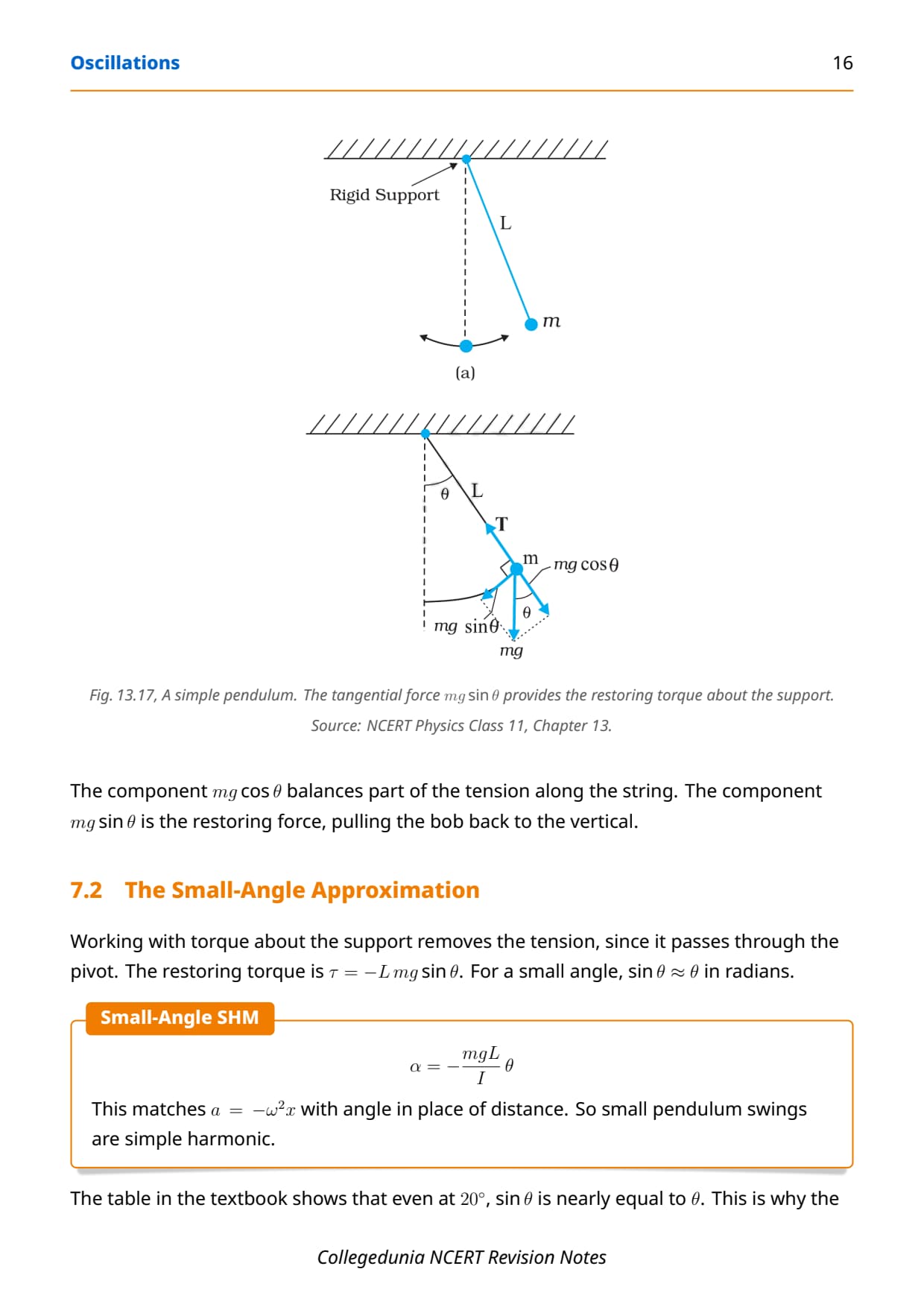
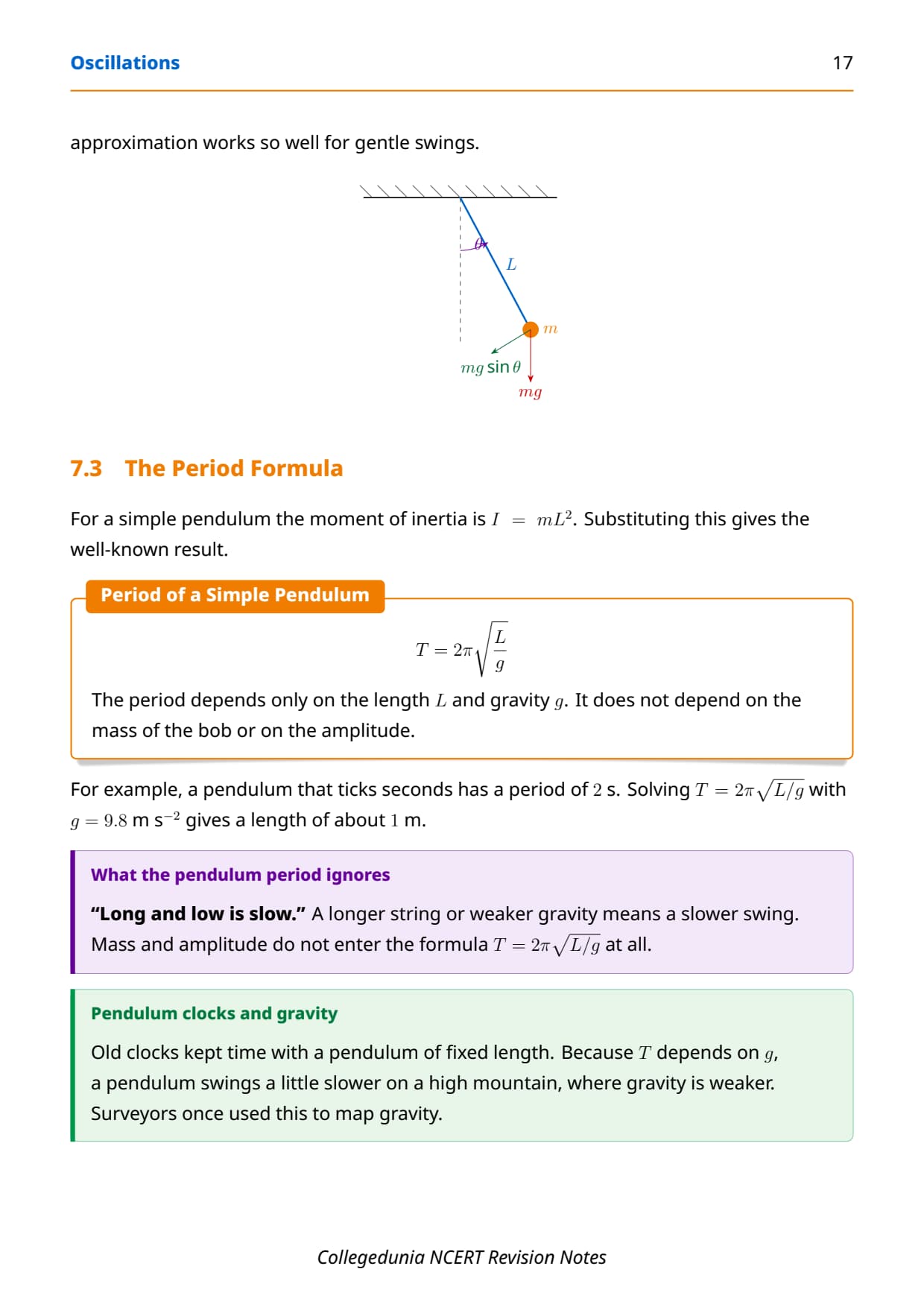
A simple pendulum is a small bob on a light, inextensible string. For small swings, its motion is simple harmonic, and its time period is one of the most useful results in the chapter.
| Quantity | Result | What it depends on |
|---|---|---|
| Time period | T = 2π√(L/g) | Length and gravity only |
| Angular frequency | ω = √(g/L) | Length and gravity only |
| Small-angle condition | sinθ ≈ θ | Swings under about 10 degrees |
The time period of a simple pendulum does not depend on the mass of the bob or on the amplitude, only on length and gravity. This holds only for small angles, where sinθ ≈ θ. A pendulum that keeps correct time on Earth would run slow on the Moon, because g there is smaller.
Damped Oscillations, Forced Oscillations and Resonance
Real oscillators lose energy and often need a push to keep going. The last part of the chapter covers what friction does to an oscillation and what happens when you drive it with an outside force.
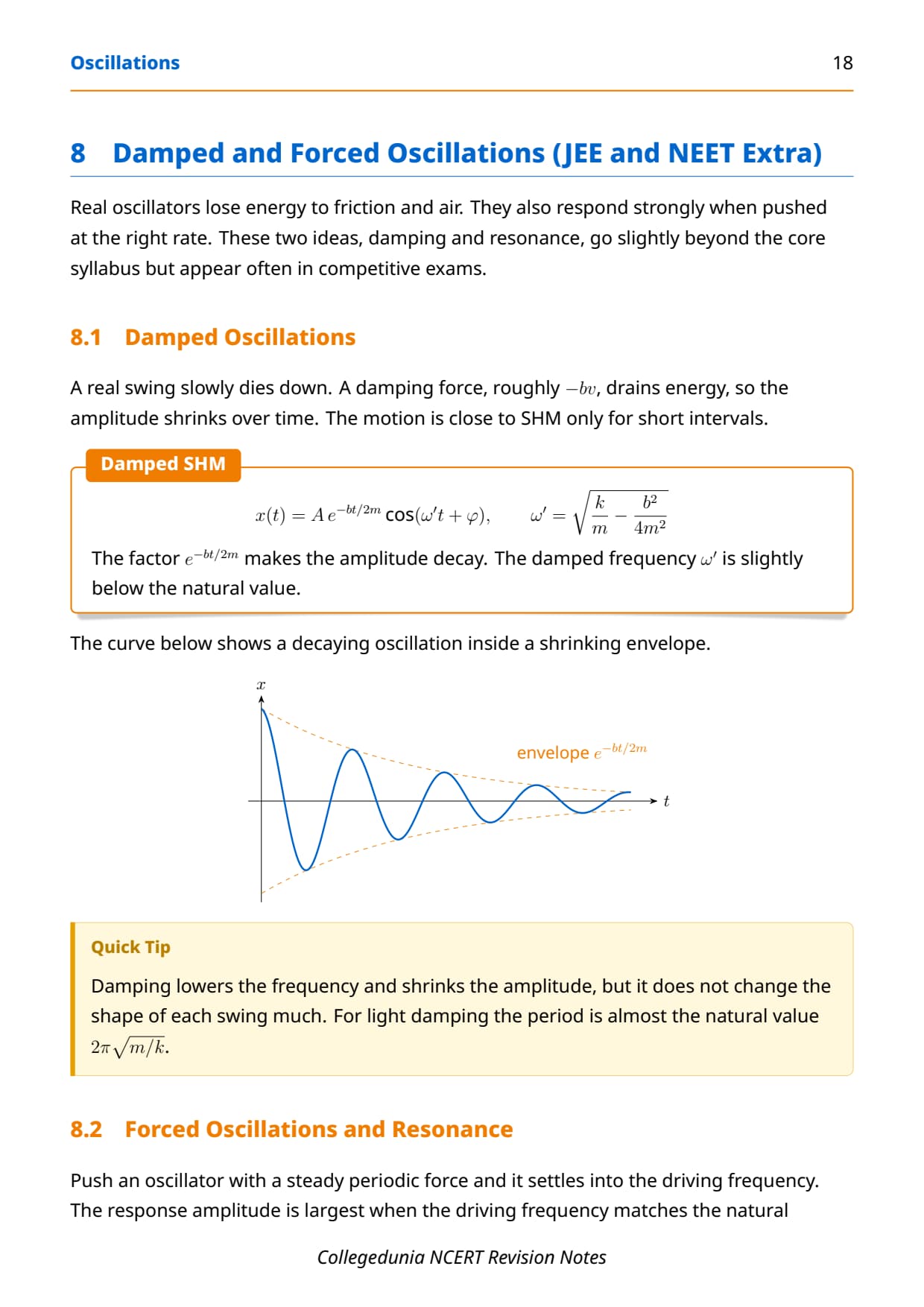
- Damped oscillation: a resistive force slowly reduces the amplitude, so the swing dies out over time.
- Forced oscillation: an external periodic force keeps the body oscillating at the driving frequency.
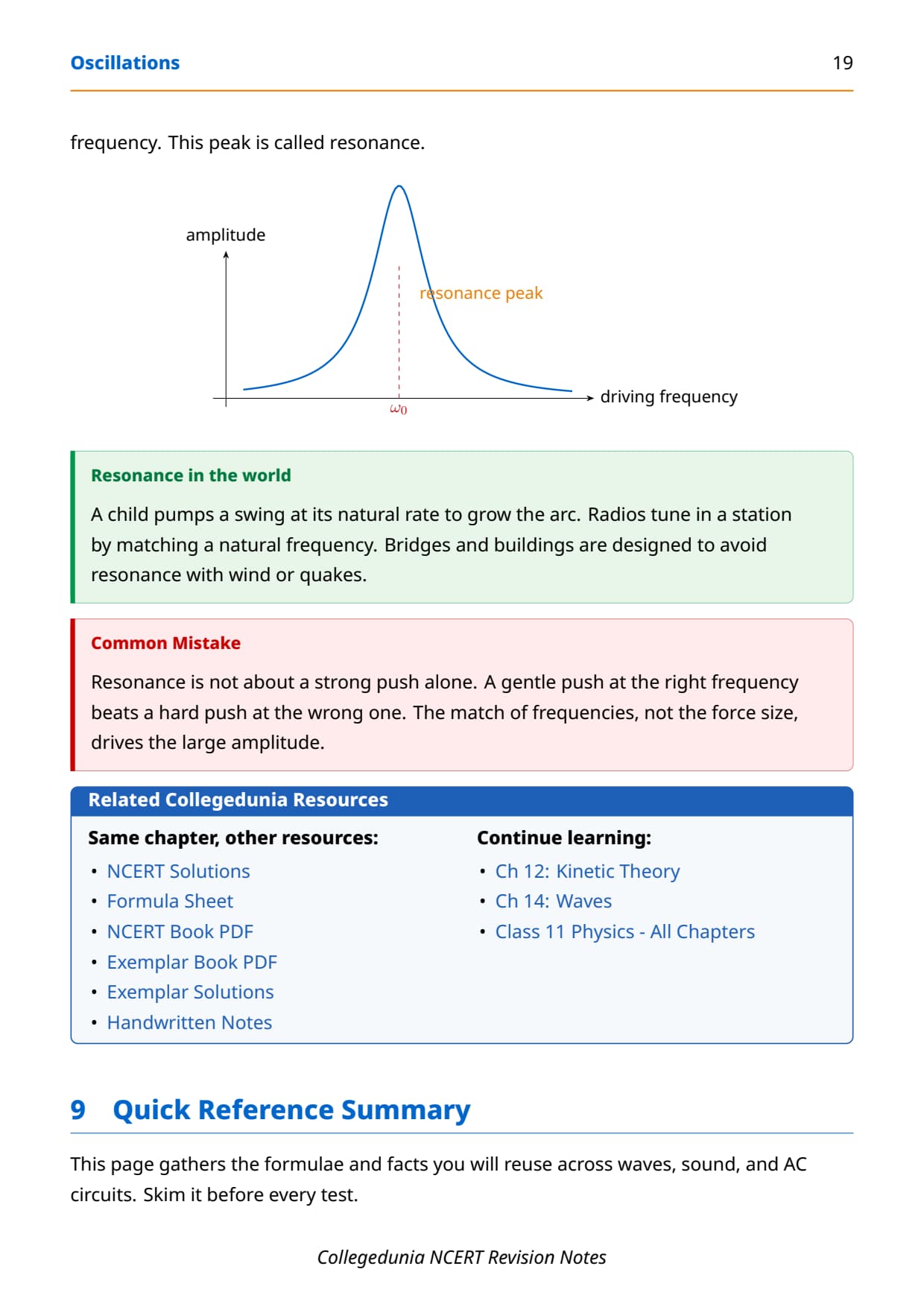
- Resonance: the amplitude becomes very large when the driving frequency matches the natural frequency of the system.
In damped SHM the amplitude falls off as A e−bt/2m, where b is the damping constant. Resonance is why soldiers break step on a bridge and why a radio picks out one station. These real-world links are common short-answer prompts, so keep one example of each ready for the exam.
All Formulas for Oscillations
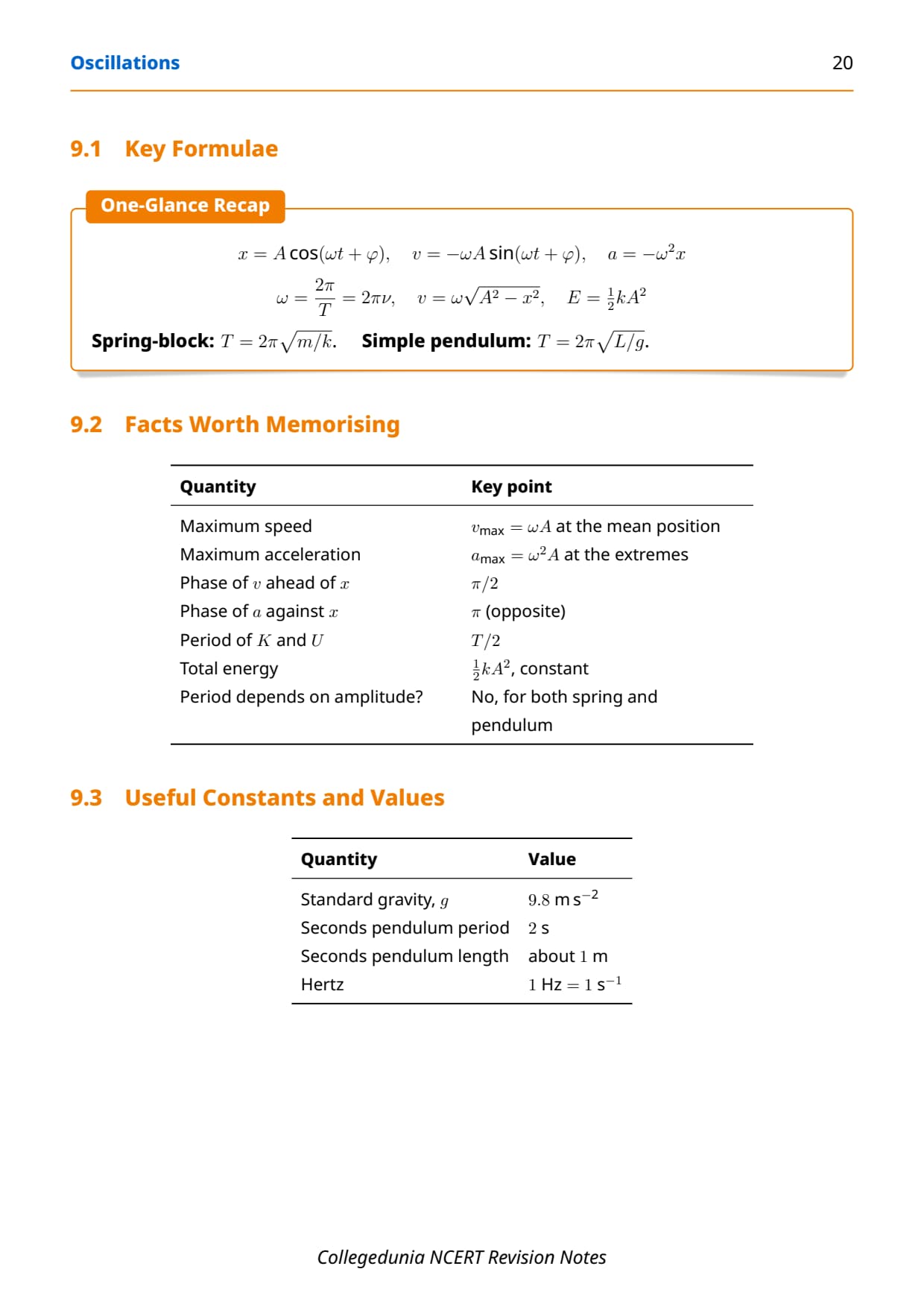
Every formula you need for the chapter sits in one table below, with its meaning and its SI unit. Learn the SHM equations and the two time-period formulas first, since those carry the most marks in both Boards and entrance papers.
| Formula | What it means | SI unit |
|---|---|---|
| x = A cos(ωt + φ) | Displacement in SHM at time t | metre (m) |
| v = ±ω√(A2 − x2) | Velocity in terms of position | m s-1 |
| a = −ω2x | Acceleration in SHM | m s-2 |
| ω = 2π/T = 2πν | Angular frequency | rad s-1 |
| F = −kx | Restoring force (force law of SHM) | newton (N) |
| T = 2π√(m/k) | Time period of a loaded spring | second (s) |
| T = 2π√(L/g) | Time period of a simple pendulum | second (s) |
| KE = ½mω2(A2 − x2) | Kinetic energy in SHM | joule (J) |
| PE = ½mω2x2 | Potential energy in SHM | joule (J) |
| E = ½mω2A2 | Total energy in SHM | joule (J) |
Carry the SI unit on every line of your working. Losing the unit is a silent way to drop the final mark even when the number is right. Keep this table open while you solve the back-exercise numericals.
Key Definitions and Derivations for Oscillations
Boards short-answer questions often ask for a clean definition in one or two lines. Learn these word-for-word, because a vague definition loses easy marks. Each one also sets up a derivation you can be asked to show.
| Term | Definition |
|---|---|
| Oscillatory motion | To-and-fro motion of a body about a fixed mean position. |
| Simple harmonic motion | Oscillation in which acceleration is proportional to displacement and directed towards the mean position. |
| Amplitude | The maximum displacement of the body from its mean position. |
| Time period | The time taken to complete one full oscillation. |
| Phase | The quantity that fixes the position and direction of the oscillator at an instant. |
| Resonance | The large rise in amplitude when the driving frequency equals the natural frequency. |
A common derivation asks you to show that a loaded spring performs SHM. Start from F = −kx, write ma = −kx, and read off a = −(k/m)x to get ω = √(k/m) and then T = 2π√(m/k). The same method, starting from the restoring torque, gives the pendulum result.
Common Mistakes Students Make in Oscillations
These slips happen while writing or calculating, not because the concept is unclear. Each one costs 1 to 3 marks in the paper, so watch for them at the exact step.
Mistake 1: Confusing periodic with oscillatory motion. Every oscillation is periodic, but circular motion is periodic without being oscillatory.
Mistake 2: Forgetting the minus sign in a = −ω2x and F = −kx. The sign is what makes the force restoring.
Mistake 3: Thinking the pendulum period depends on the mass of the bob. It depends only on length and gravity.
Mistake 4: Mixing up where energy peaks. Kinetic energy is maximum at the mean position, potential energy at the extremes.
Oscillations Weightage in CBSE Boards, JEE and NEET
This chapter is small but reliable. It usually carries one short answer plus one numerical, and it links closely to the Waves chapter that follows. Here is how the marks split across the main exams for 2026-27.
| Exam | Typical weightage | What is asked |
|---|---|---|
| CBSE Boards | 4 to 5 marks | One short answer plus one numerical on time period or energy |
| JEE Main | 1 to 2 questions | SHM equations, energy, spring and pendulum systems |
| NEET | 1 to 2 questions | Time period, phase, and energy in SHM |
| CUET and NDA | 1 objective question | Definitions, time period, and resonance |
The time period of a spring and a pendulum is the single most tested idea from this chapter across all four exams. Master those two formulas first, then the energy results, then phase and resonance, in that order of return on effort.
How to Revise Oscillations Quickly
Use these Class 11 Physics Notes Chapter 13 Oscillations for a fast, ordered recap the night before a test. The checklist below takes about 30 minutes and hits every marks-heavy idea.
- First 10 minutes: write the displacement, velocity and acceleration equations of SHM and the meaning of ω, A and φ from memory.
- Next 10 minutes: redo one spring numerical and one pendulum numerical using the two time-period formulas.
- Last 10 minutes: sketch the energy graph and mark where kinetic and potential energy peak.
Close the loop by writing one line each on damping and resonance. If you can do all four blocks without notes, the chapter is exam-ready. Keep the All Formulas table beside you for the first pass only, then try it closed-book.
Student Feedback on the Oscillations Notes
What 11,540 students told us about their Oscillations revision:
- 64% of students rated energy in SHM as the sub-topic they most often got wrong under time pressure.
- Most-skipped step: keeping the minus sign in the force law, missed by about 3 in 10 students.
- Students who learned SHM as the shadow of circular motion said the phase questions felt much easier.
Source: 2026-27 Class 11 Physics student poll. Sample of 11,540 students from CBSE schools across 14 states, conducted before the 2026 boards.
Other Oscillations Class 11 Physics Resources
Pair these notes with the solved answers, the handwritten notes, the formula sheet, and the textbook PDF for the same chapter.
| Resource | Link |
|---|---|
| NCERT Solutions | Oscillations Class 11 NCERT Solutions |
| Handwritten Notes | Oscillations Class 11 Handwritten Notes |
| Formula Sheet | Oscillations Class 11 Formula Sheet |
| NCERT Book PDF | Oscillations Class 11 Book PDF |
NCERT Notes for Class 11 Physics: All Chapters
Jump to the revision notes for any other Class 11 Physics chapter below.
| Chapter | NCERT Notes |
|---|---|
| Chapter 1 | Units and Measurements |
| Chapter 2 | Motion in a Straight Line |
| Chapter 3 | Motion in a Plane |
| Chapter 4 | Laws of Motion |
| Chapter 5 | Work, Energy and Power |
| Chapter 6 | System of Particles and Rotational Motion |
| Chapter 7 | Gravitation |
| Chapter 8 | Mechanical Properties of Solids |
| Chapter 9 | Mechanical Properties of Fluids |
| Chapter 10 | Thermal Properties of Matter |
| Chapter 11 | Thermodynamics |
| Chapter 12 | Kinetic Theory |
| Chapter 13 | Oscillations |
| Chapter 14 | Waves |
FAQs on Oscillations Class 11 Physics Notes
Oscillations Notes - Frequently Asked Questions
Ques. What topics do the Class 11 Physics Notes Chapter 13 Oscillations cover?
Ans. These Class 11 Physics Notes Chapter 13 Oscillations cover periodic and oscillatory motion, the displacement, velocity and acceleration equations of simple harmonic motion, phase and its link to circular motion, energy in SHM, the spring and simple pendulum, and damped and forced oscillations with resonance. Every key formula and definition is included for fast revision.
Ques. What is the condition for simple harmonic motion?
Ans. A motion is simple harmonic when the acceleration is directly proportional to the displacement from the mean position and always points back towards it. This is written as a = −ω2x. The negative sign shows the restoring nature, and ω is the angular frequency of the oscillation.
Ques. What is the time period of a simple pendulum?
Ans. The time period of a simple pendulum is T = 2π√(L/g), where L is the length of the string and g is the acceleration due to gravity. It depends only on length and gravity, not on the mass of the bob or the amplitude, and it holds only for small angles.
Ques. How is energy shared in simple harmonic motion?
Ans. In SHM the kinetic energy is maximum at the mean position and zero at the extremes, while the potential energy is the reverse. The total energy stays constant at ½mω2A2 and depends on the square of the amplitude. The two forms of energy keep trading places as the body oscillates.
Ques. What is resonance in oscillations?
Ans. Resonance happens when the frequency of an external driving force equals the natural frequency of the oscillating system. At this point the amplitude becomes very large. It explains why a radio tunes to one station and why marching soldiers break step while crossing a bridge, both common short-answer examples in this chapter.
Ques. What is the weightage of Oscillations in the CBSE board exam?
Ans. Oscillations carries about 4 to 5 marks in the CBSE Class 11 Physics paper, usually one short answer plus one numerical on the time period or energy of SHM. It also appears in JEE Main and NEET as questions on SHM equations, spring and pendulum systems, and resonance.



Comments