




These Class 11 Physics Notes Chapter 11 Thermodynamics pull together every law, process, heat-capacity relation, and engine formula that the Boards, JEE Main, JEE Advanced, NEET, CUET and NDA papers actually test in 2026-27. Use them to revise the whole chapter fast, with formulas, definitions and clear rules in one place.
This chapter connects the heat you learned in Thermal Properties of Matter to real machines like engines and refrigerators, so it links directly to the numericals you meet later in the year.
- CBSE Weightage: 6 to 8 marks, usually one short answer on a process plus one numerical on the first law or engine efficiency.
- Topics covered: zeroth law, internal energy, first law, thermodynamic processes, specific heats, second law, Carnot engine, and refrigerators.
- Key formulas: first law, Mayer's relation, work in each process, and Carnot efficiency.
These Class 11 Physics Notes Chapter 11 Thermodynamics are curated by subject experts, based on the 2026-27 NCERT textbook, and checked against the last five years of CBSE Board, JEE Main and NEET papers.
Topic-by-Topic Summary of Thermodynamics
The chapter builds machines from heat, one idea at a time. It starts with temperature and equilibrium, adds internal energy, states the first law, then applies it to processes and engines. Here is the quick map of what each topic gives you.
- Zeroth law: defines temperature through thermal equilibrium between bodies.
- Internal energy and first law: heat given to a gas either changes its internal energy or does work.
- Thermodynamic processes: isothermal, adiabatic, isobaric and isochoric changes, each with its own rule.
- Specific heats: Cp and Cv for a gas, linked by Mayer's relation.
- Second law and engines: the direction of heat flow, the Carnot engine, efficiency, and refrigerators.
Revise the topics in this order, because each one uses the one before it. Fix the sign convention first, and every first-law numerical becomes far easier. These Class 11 Physics Notes Chapter 11 Thermodynamics follow the same sequence as the NCERT textbook.
Thermal Equilibrium and the Zeroth Law of Thermodynamics
Thermodynamics starts by defining temperature properly. Two bodies are in thermal equilibrium when they are at the same temperature and no heat flows between them. The zeroth law makes this idea exact and is the first step in the whole chapter.
- Thermal equilibrium: two systems in contact stop exchanging heat once their temperatures are equal.
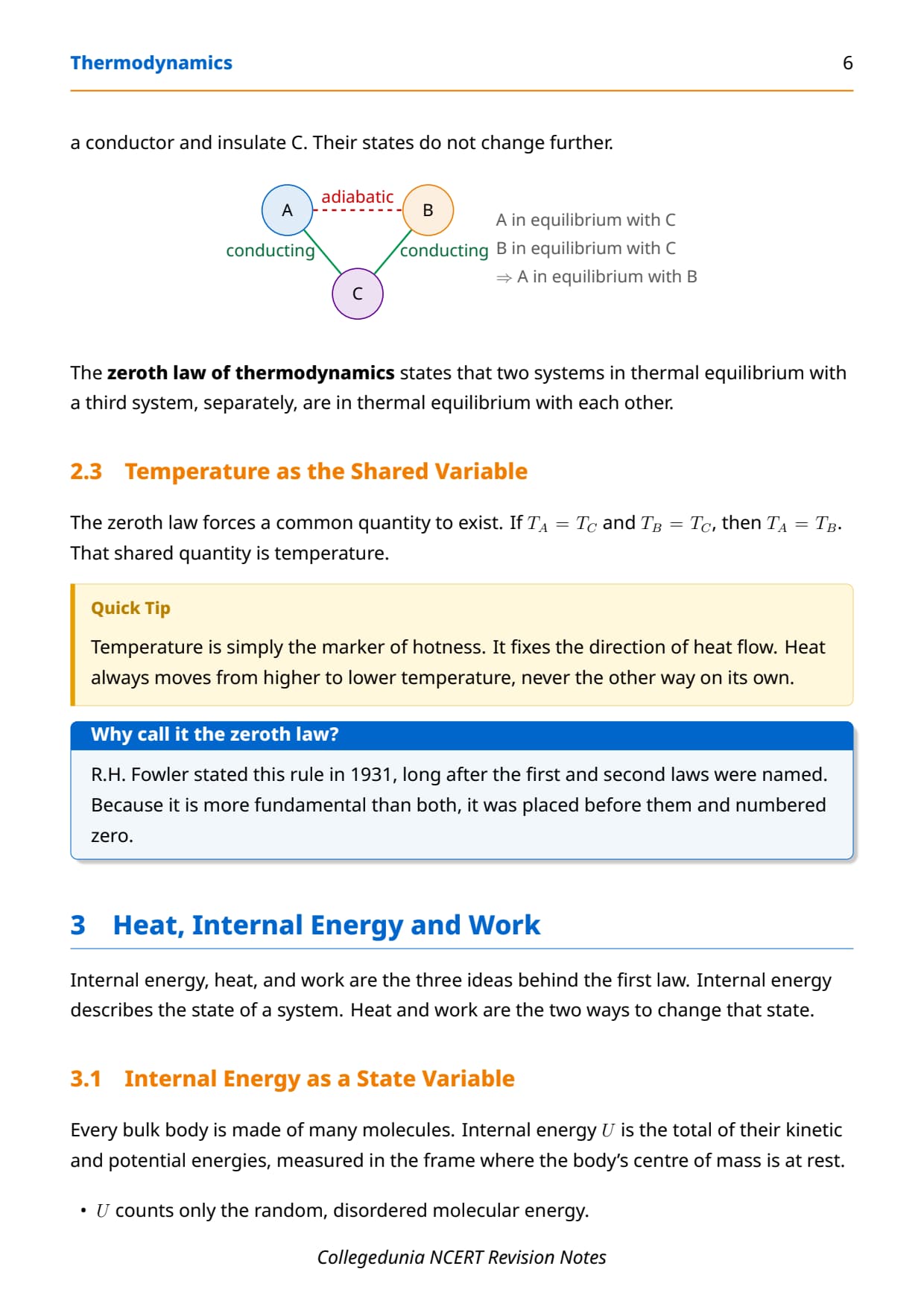
- Zeroth law: if A is in equilibrium with C, and B is in equilibrium with C, then A and B are in equilibrium with each other.
- Temperature: the property that decides the direction of heat flow between two bodies.
The zeroth law is what lets a thermometer work. The thermometer is the common body C, and matching its reading for two objects means they share the same temperature. This law is small but it is the reason temperature is a meaningful quantity in every later formula.
Internal Energy and the First Law of Thermodynamics
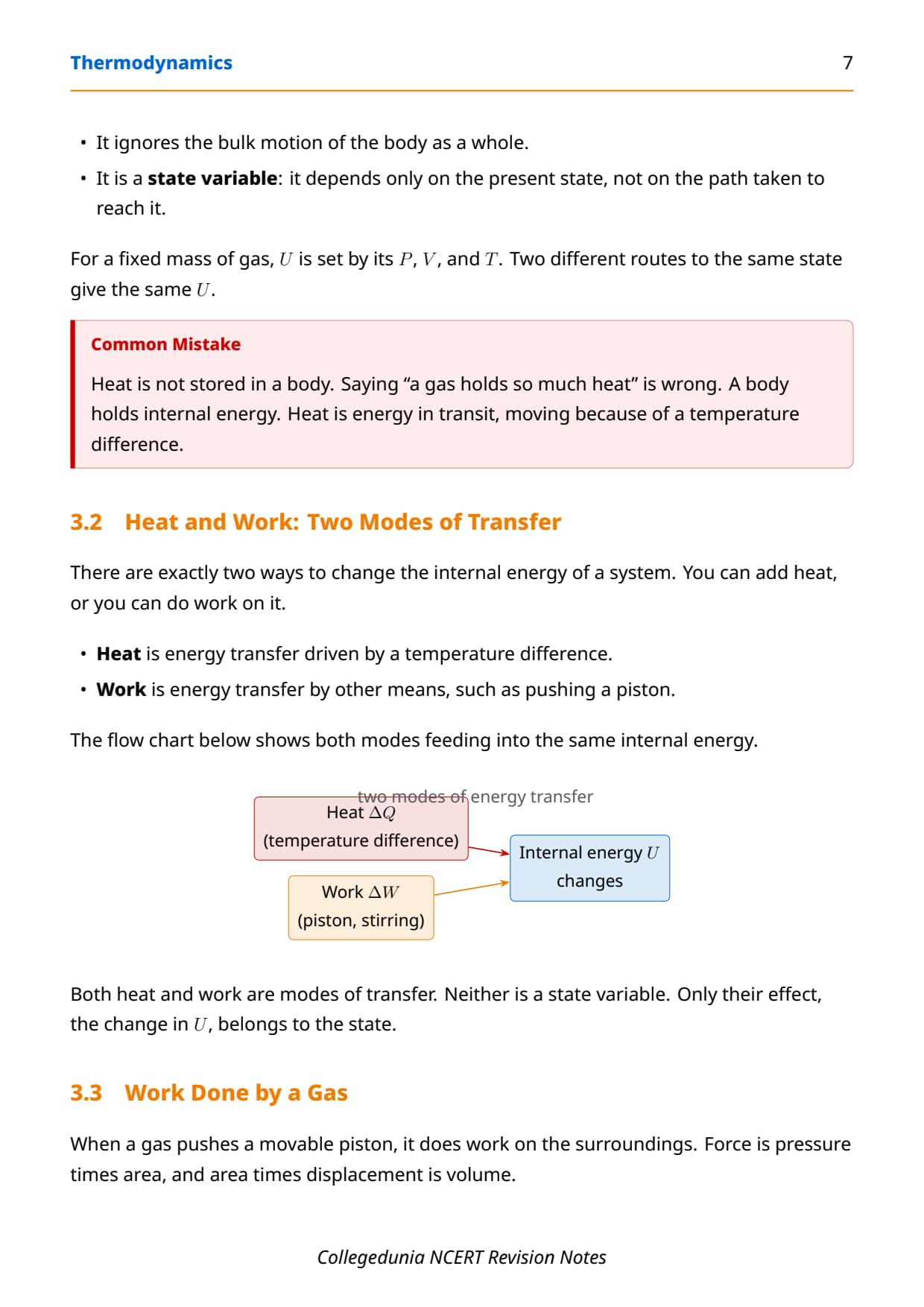
The internal energy of a gas is the total kinetic and potential energy of all its molecules. It is a state function, so it depends only on the current state, not on the path. The first law of thermodynamics is simply energy conservation applied to heat.
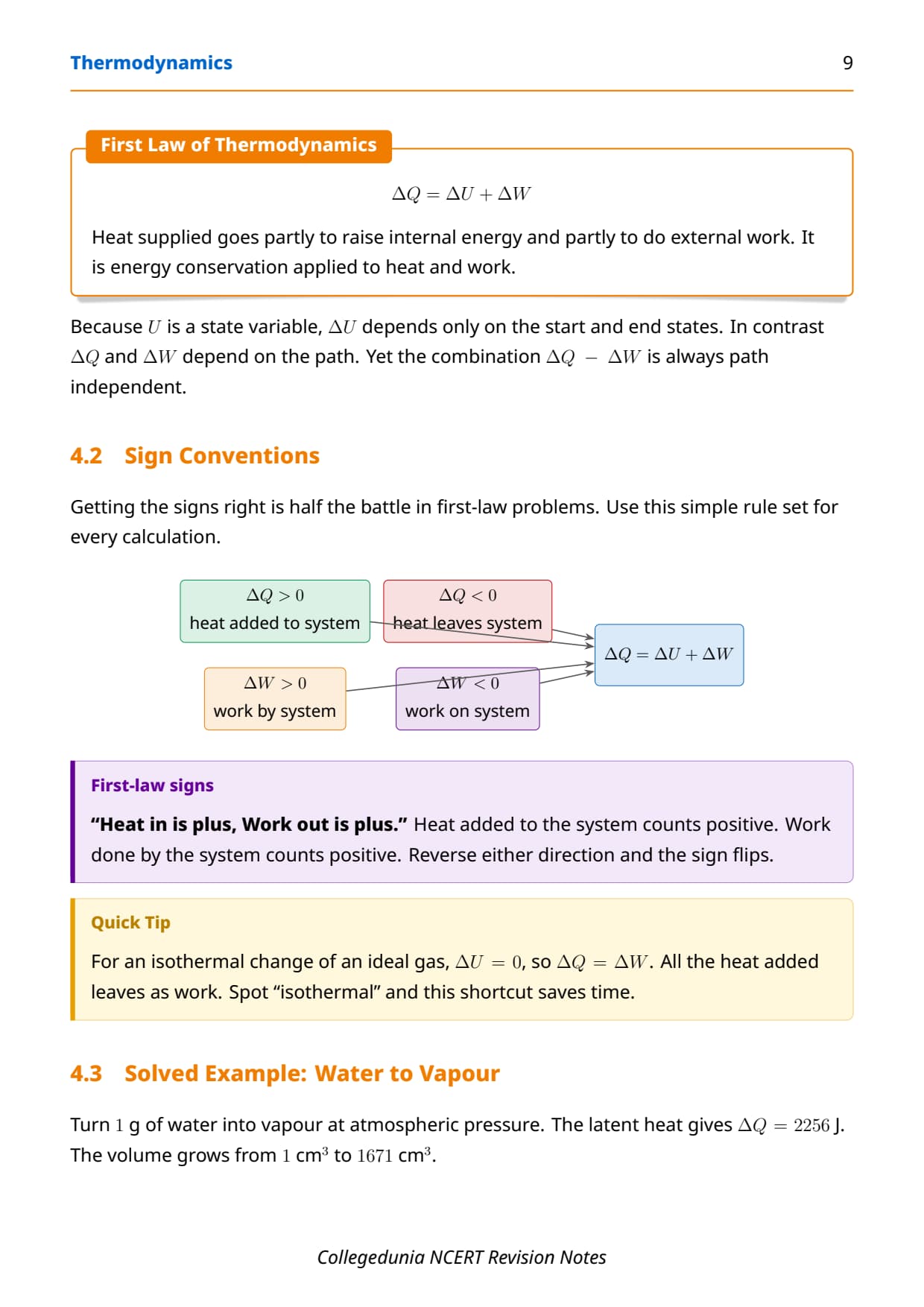
The first law is written as ΔQ = ΔU + ΔW. Heat added to a system either raises its internal energy or is spent doing work. The sign convention decides every answer, so learn it before you touch a numerical.
- Heat ΔQ: positive when heat is given to the system, negative when the system loses heat.
- Work ΔW: positive when the gas expands, negative when it is compressed.
- Internal energy ΔU: positive when temperature rises, since it depends only on temperature for an ideal gas.
Internal energy is a state function, but heat and work are path functions. This one line explains why the same two states can be joined by paths that need different amounts of heat. Keep it ready for the theory question that comes almost every year.
Thermodynamic Processes: Isothermal, Adiabatic, Isobaric and Isochoric
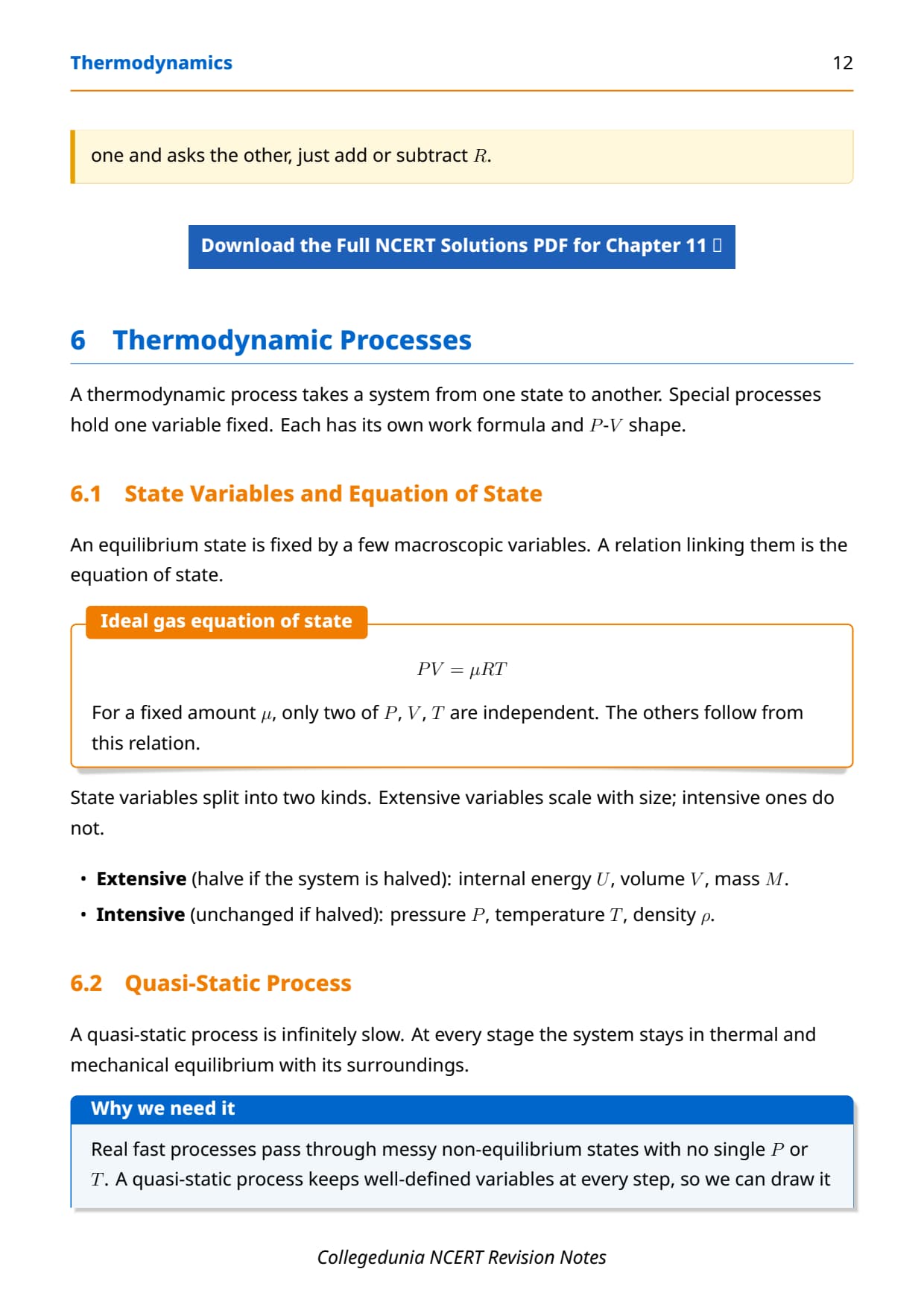
A thermodynamic process is any change that takes a gas from one state to another. The chapter studies four special processes, and each one fixes a different quantity. Knowing what stays constant tells you which term in the first law drops to zero.
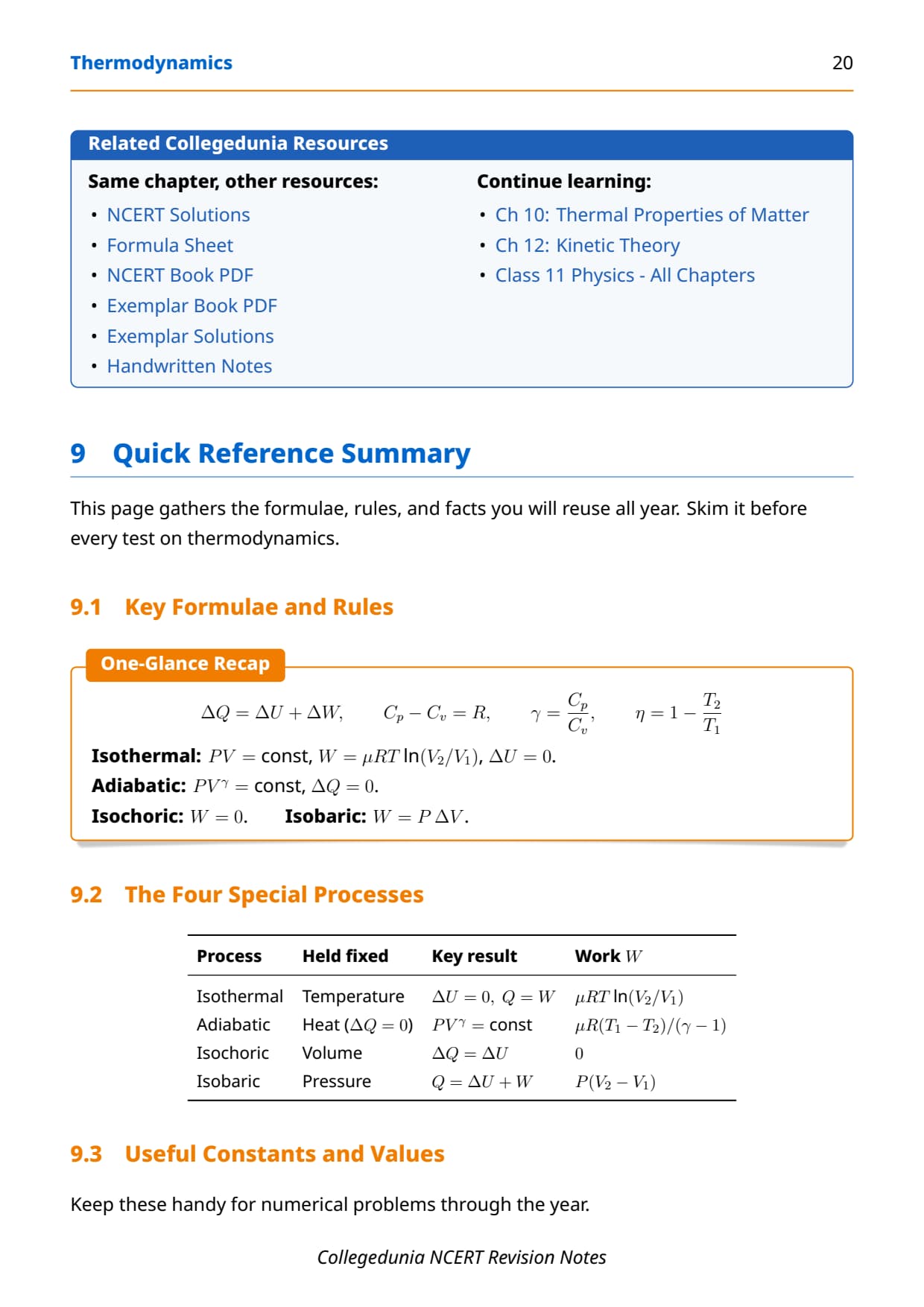
| Process | Quantity held constant | First-law result |
|---|---|---|
| Isothermal | Temperature (ΔU = 0) | ΔQ = ΔW |
| Adiabatic | No heat exchange (ΔQ = 0) | ΔW = −ΔU |
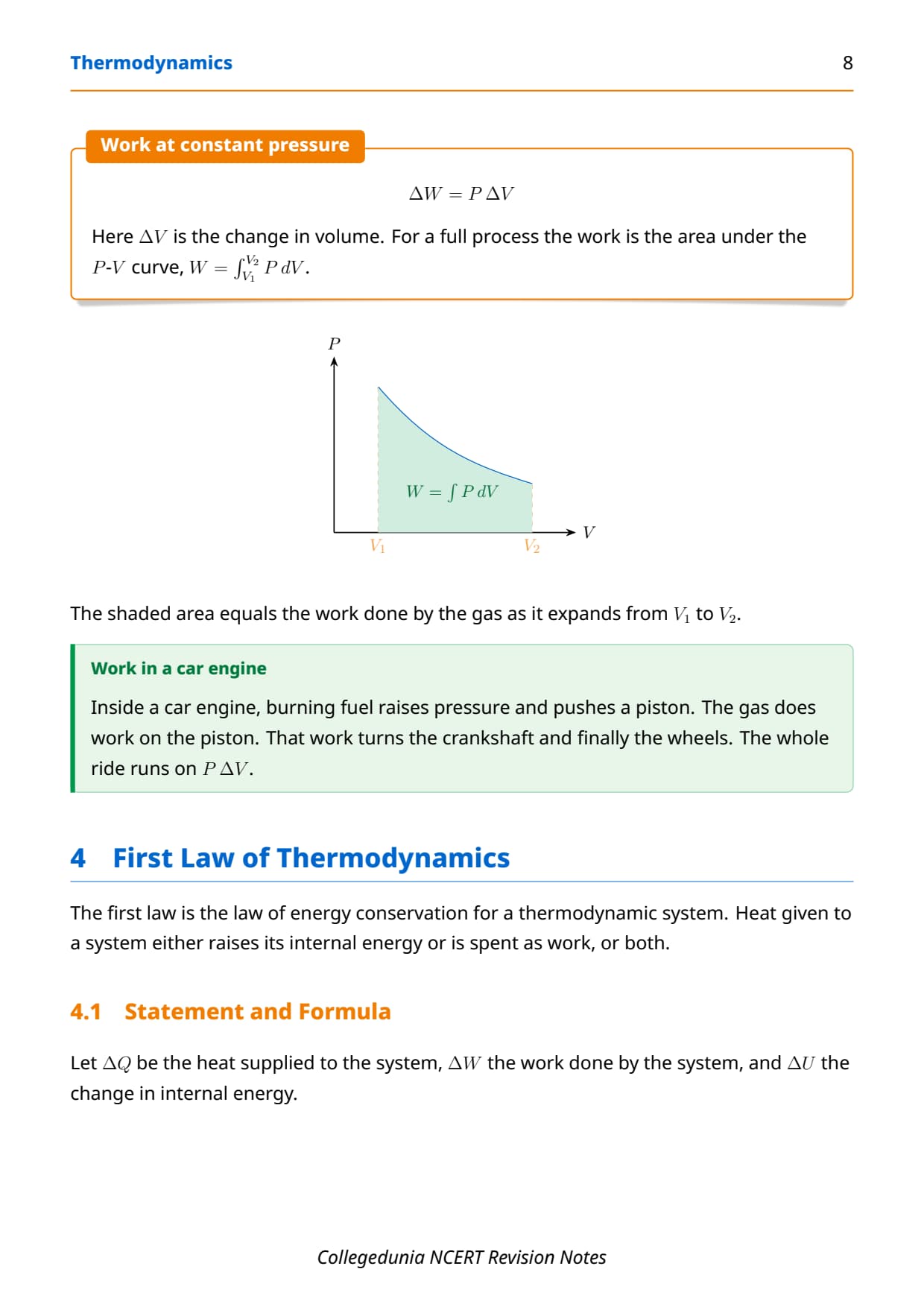
| Isobaric | Pressure | ΔW = pΔV |
| Isochoric | Volume (ΔW = 0) | ΔQ = ΔU |
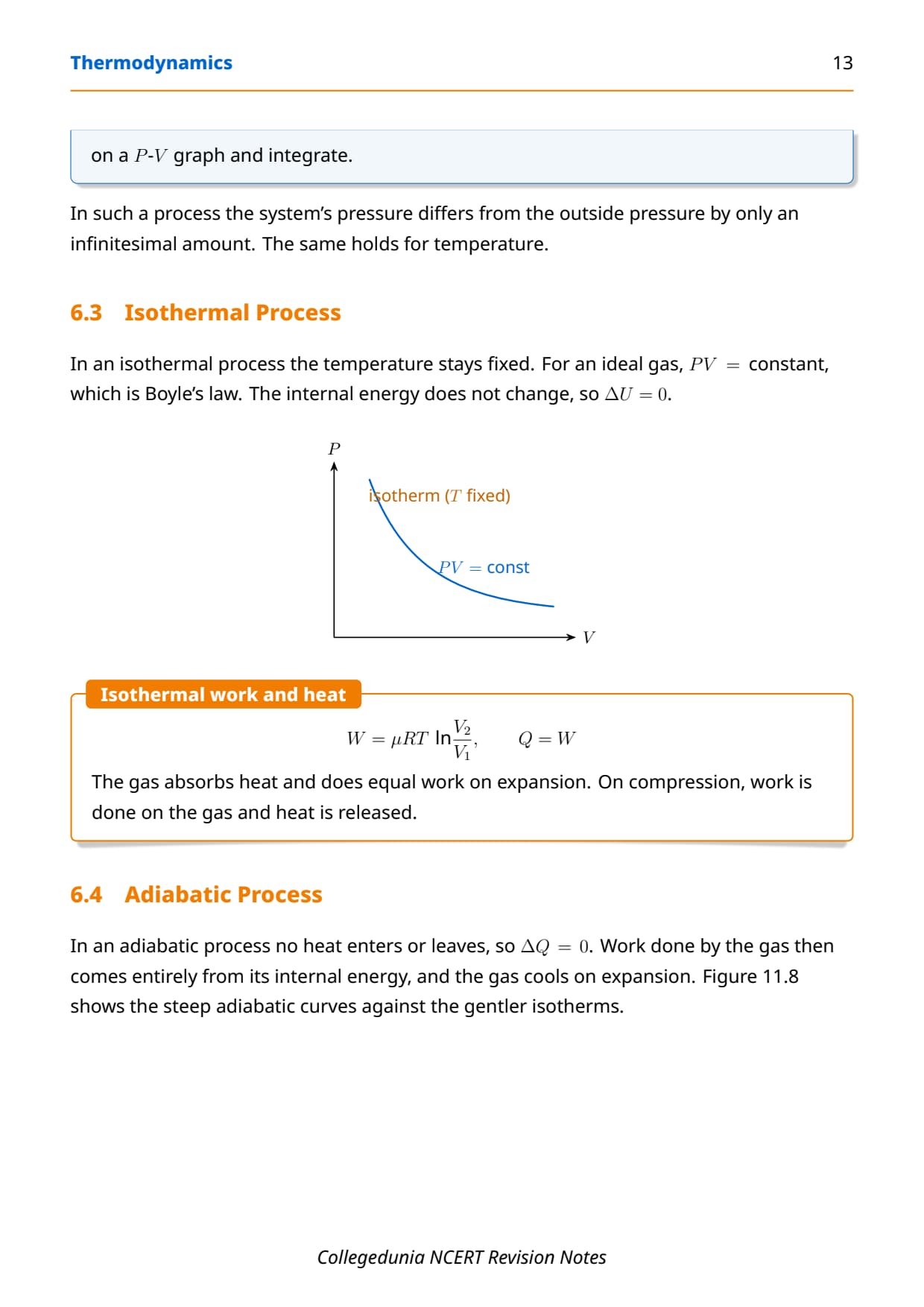
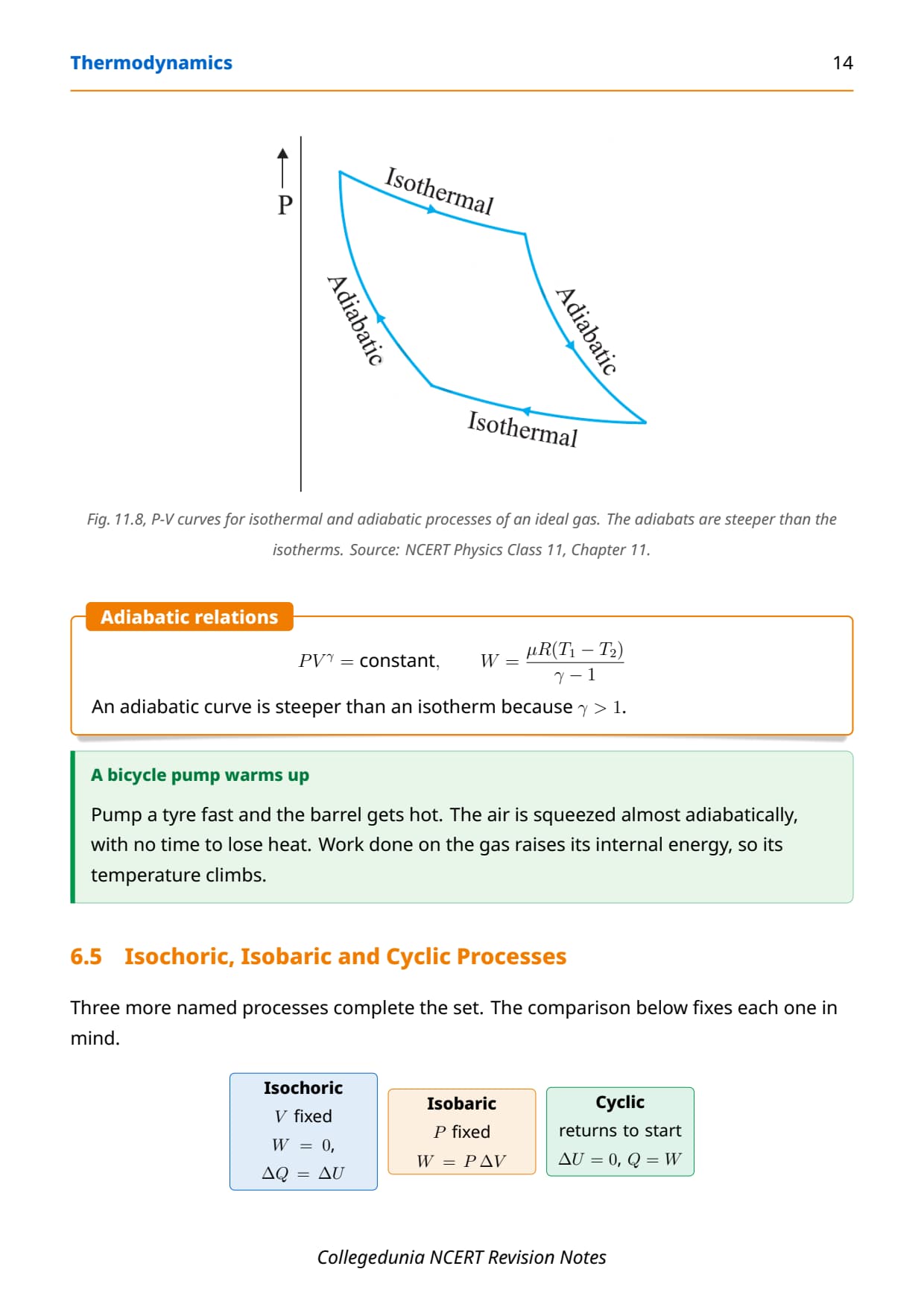
In an isothermal process the gas stays at one temperature, so all the heat becomes work. In an adiabatic process no heat enters or leaves, so the gas cools when it expands. Spot the constant quantity first, then cancel the matching term in the first law. This is the fastest route through any process numerical in the chapter.
Specific Heat Capacities Cp and Cv with Mayer's Relation
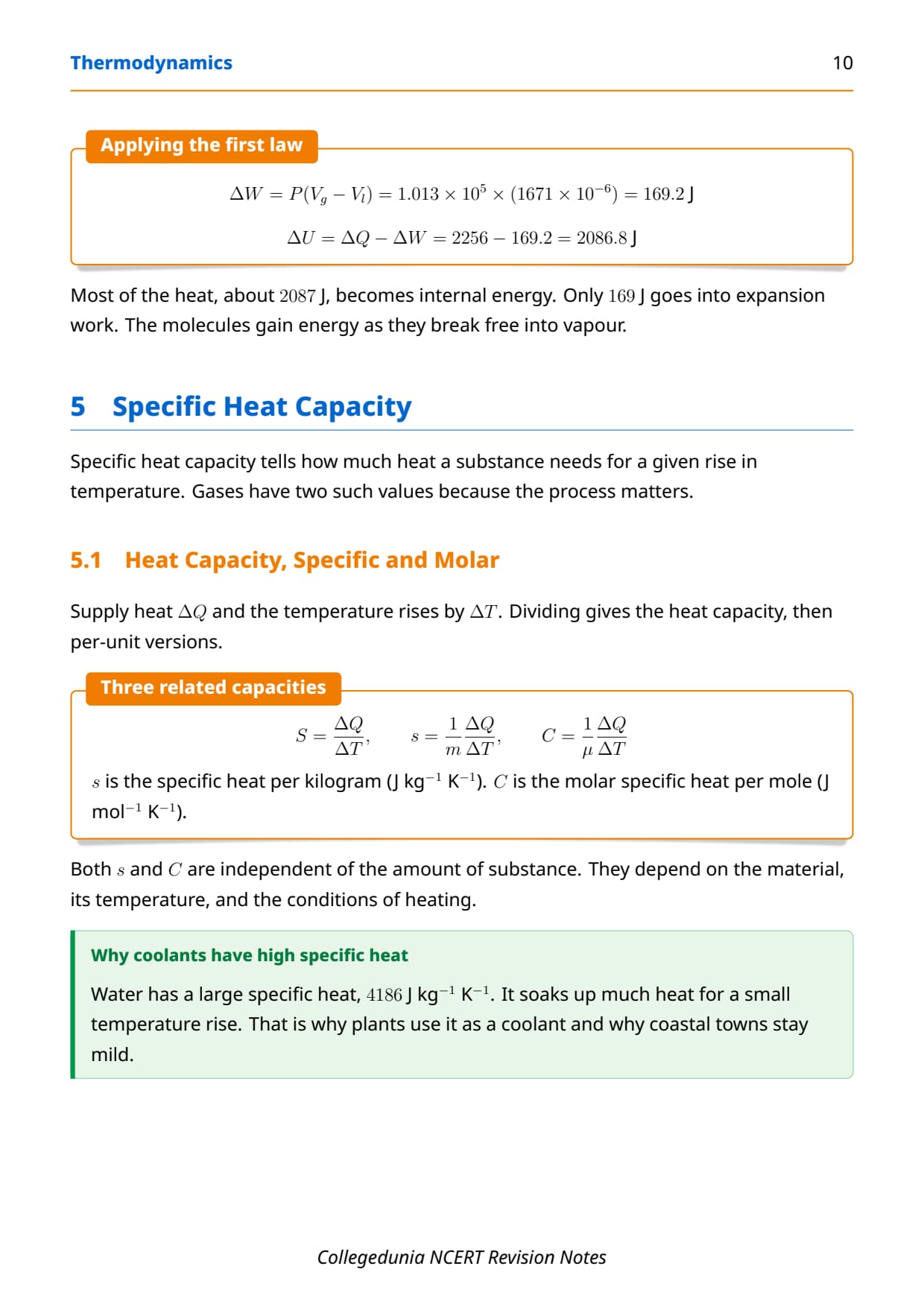
A gas has two main specific heats because it can be heated at constant pressure or at constant volume. Molar specific heat at constant volume is Cv, and at constant pressure it is Cp. These two are linked by a clean result called Mayer's relation.
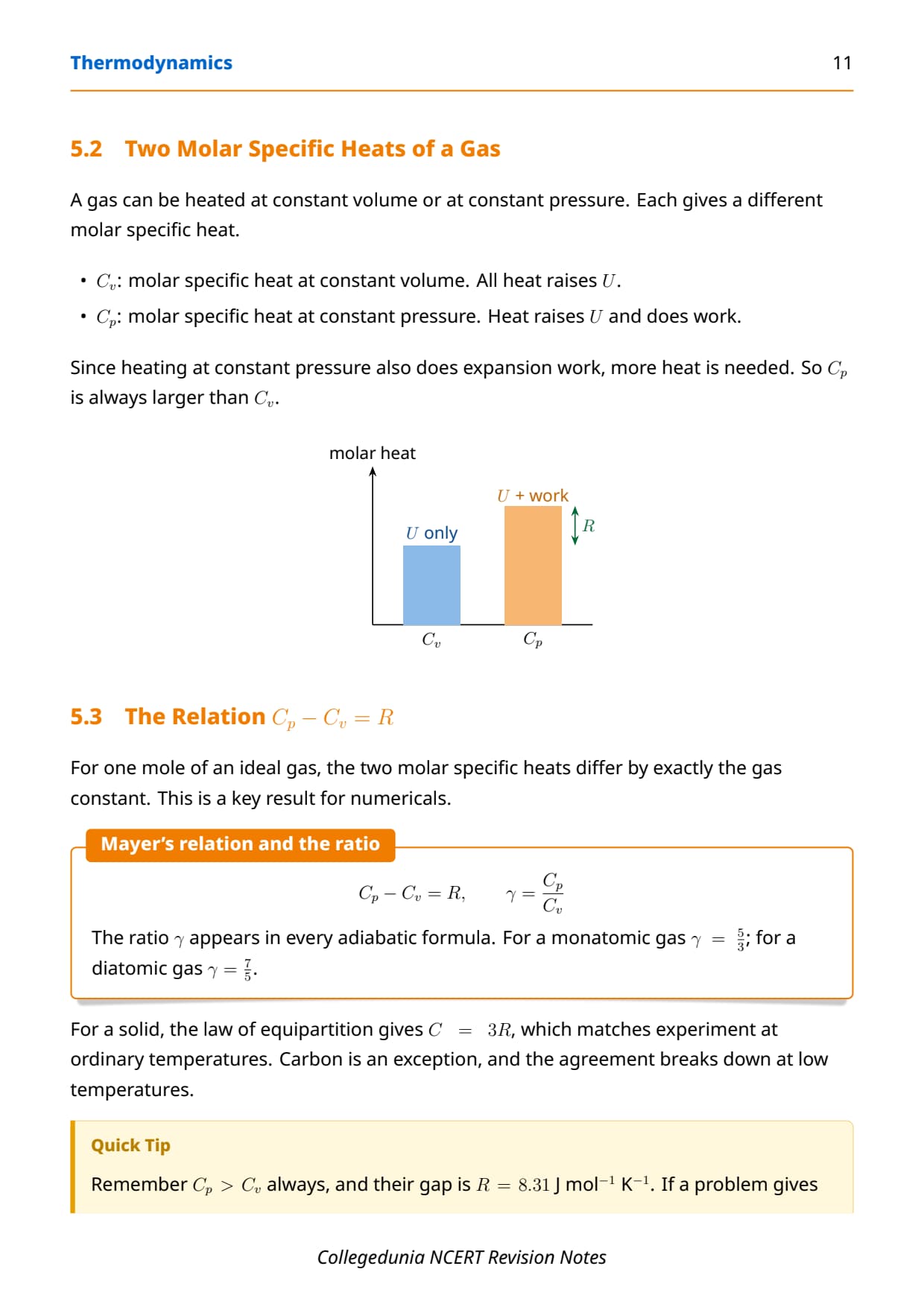
Mayer's relation states that Cp − Cv = R for one mole of an ideal gas. The value Cp is always larger, because at constant pressure extra heat is needed to do the expansion work.
- At constant volume: all heat raises internal energy, so ΔQ = nCvΔT.
- At constant pressure: heat raises internal energy and also does work, so Cp is bigger.
- Ratio of specific heats: γ = Cp/Cv, used in every adiabatic formula.
The gas does expansion work only at constant pressure, which is why Cp exceeds Cv by exactly R. Remember this reasoning, because Boards often ask you to explain the relation, not just state it. The ratio γ then carries straight into the adiabatic equations.
All Formulas for Thermodynamics
Every formula you need for the chapter sits in one table below, with its meaning and its SI unit. Learn the first-law and Carnot-efficiency rows first, since those carry the most marks in both Boards and entrance papers.
| Formula | What it means | SI unit |
|---|---|---|
| ΔQ = ΔU + ΔW | First law of thermodynamics | joule (J) |
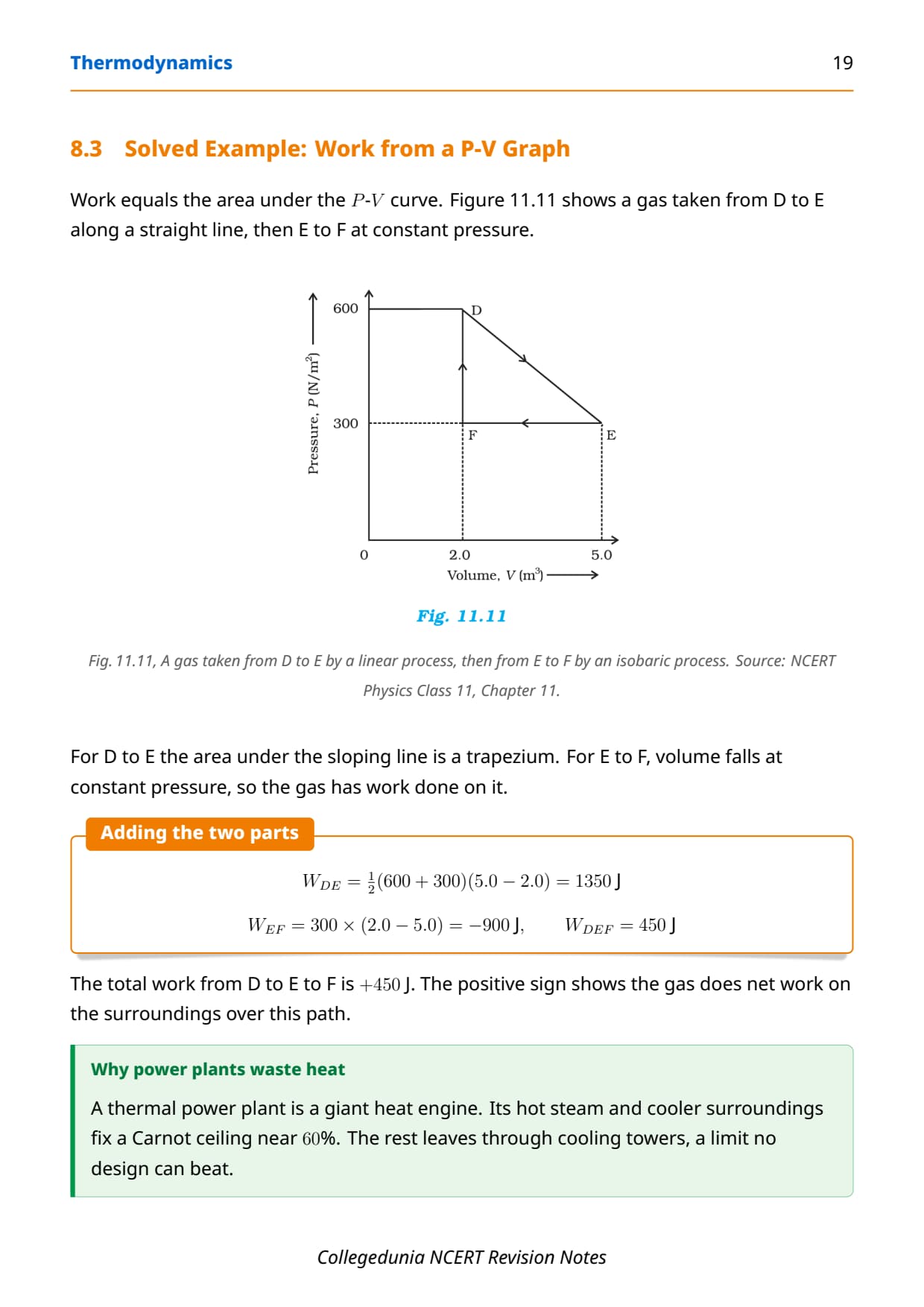
| ΔW = pΔV | Work done in an isobaric process | joule (J) |
| W = nRT ln(V2/V1) | Work done in an isothermal process | joule (J) |
| pVγ = constant | Adiabatic relation for an ideal gas | Dimensionless relation |
| Cp − Cv = R | Mayer's relation | J mol-1 K-1 |
| γ = Cp/Cv | Ratio of specific heats | Dimensionless |
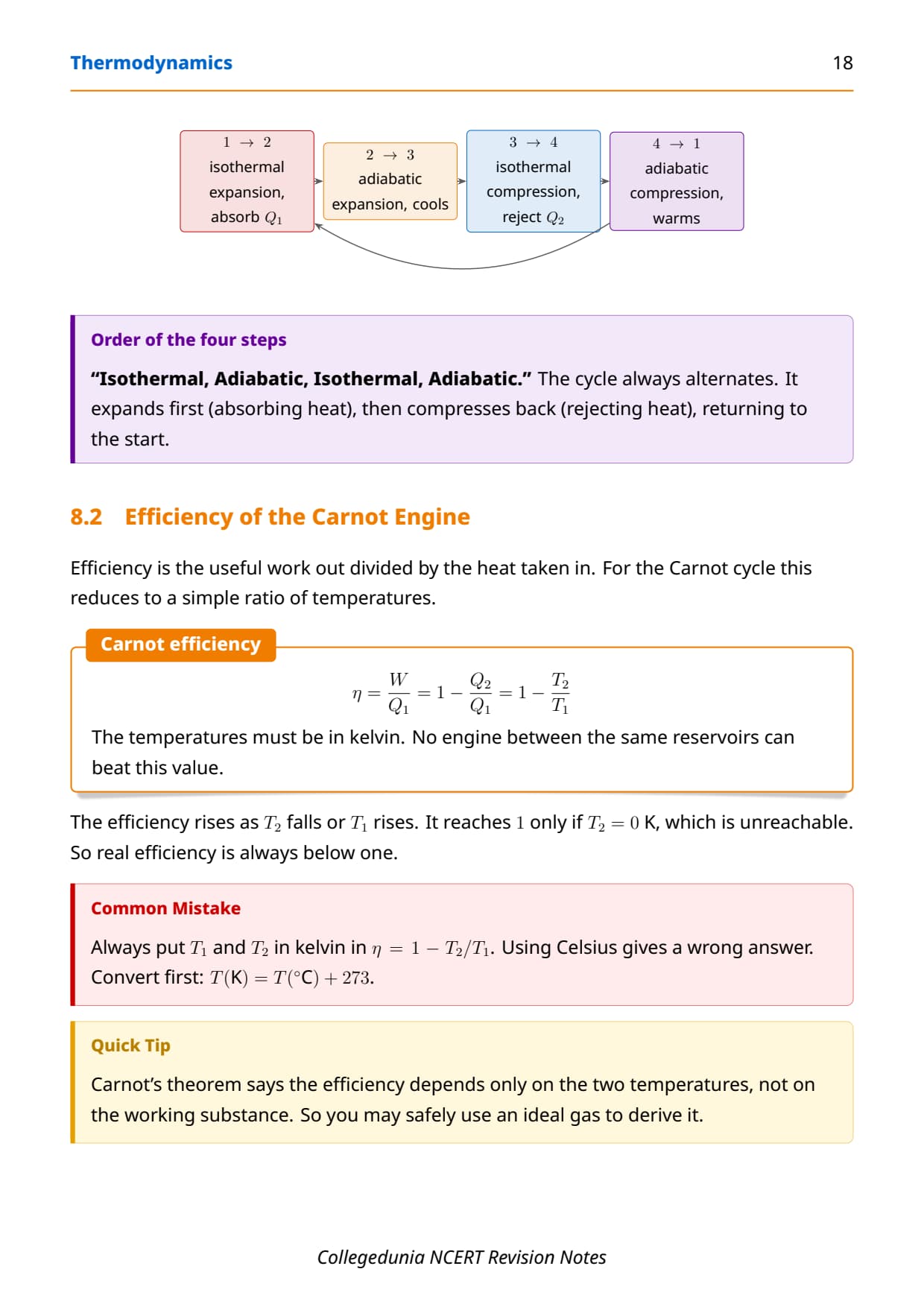
| η = 1 − Q2/Q1 | Efficiency of a heat engine | Dimensionless |
| ηCarnot = 1 − T2/T1 | Maximum (Carnot) efficiency | Dimensionless |
| α = Q2/(Q1 − Q2) | Coefficient of performance of a refrigerator | Dimensionless |
Use temperatures in kelvin in every engine formula. Putting Celsius into the Carnot efficiency is a silent way to lose the whole numerical even when the method is right. Keep this table open while you solve the back-exercise problems.
Key Definitions and Derivations for Thermodynamics
Boards short-answer questions often ask for a clean definition in one or two lines. Learn these word-for-word, because a vague definition loses easy marks. Each one also sets up a derivation you can be asked to show.
| Term | Definition |
|---|---|
| Thermal equilibrium | A state in which two bodies in contact are at the same temperature and exchange no heat. |
| Internal energy | The total kinetic and potential energy of all molecules of a system; a state function. |
| First law of thermodynamics | Heat given to a system equals the rise in internal energy plus the work done by it. |
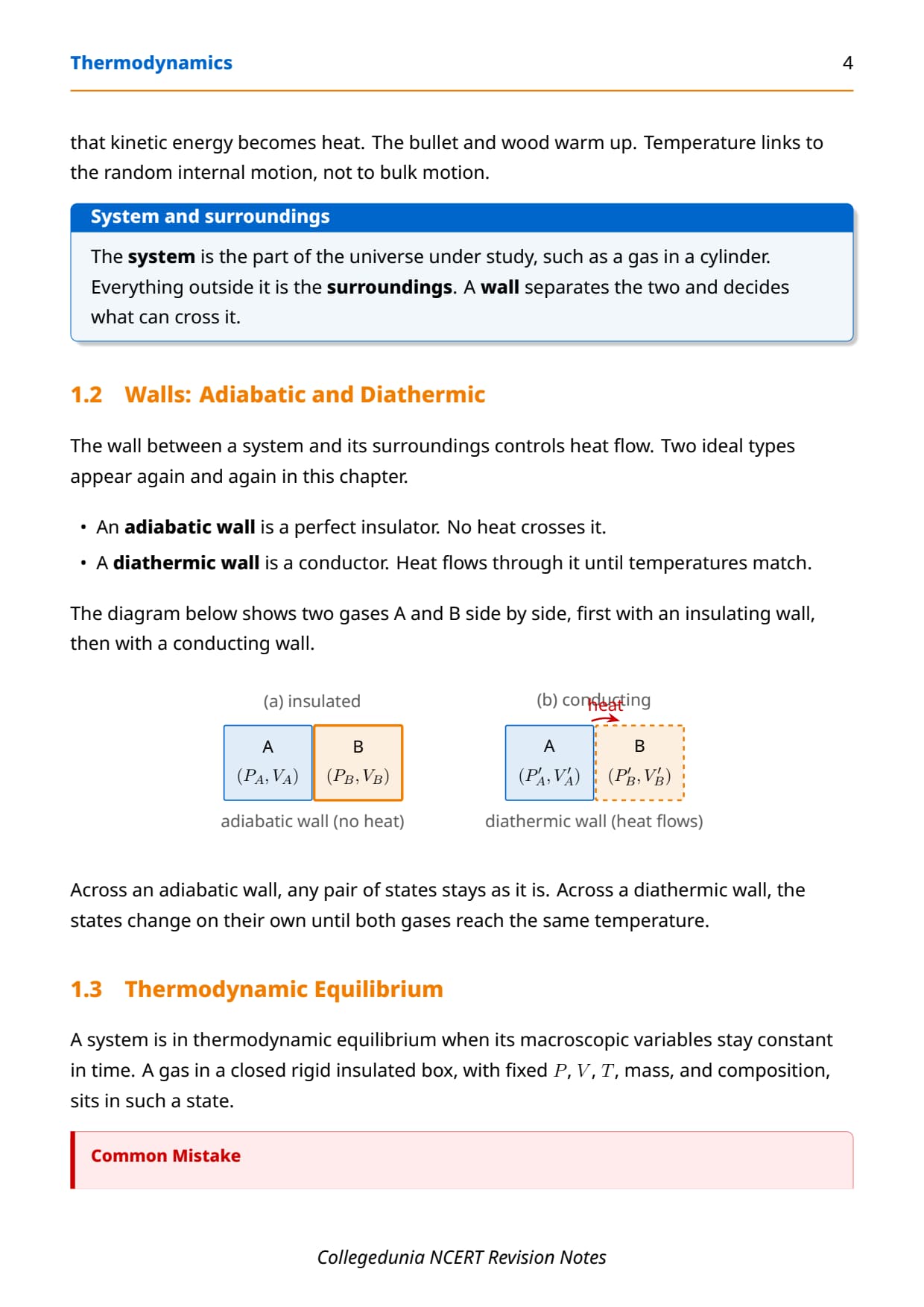
| Adiabatic process | A process in which no heat enters or leaves the system. |
| Reversible process | An ideal process that can be reversed exactly, leaving no change in surroundings. |
| Second law of thermodynamics | Heat cannot flow on its own from a colder to a hotter body. |
A common derivation asks you to prove Mayer's relation from the first law. Apply the first law at constant pressure and compare it with the constant-volume case to get Cp − Cv = R. The Carnot efficiency derivation is the other one that appears in Boards.
Second Law, Carnot Engine, Reversibility and Refrigerators
The first law allows heat to become work, but it never says in which direction heat flows on its own. The second law of thermodynamics fixes that direction and sets the limit on every engine. This section carries the highest-value numericals in the chapter.
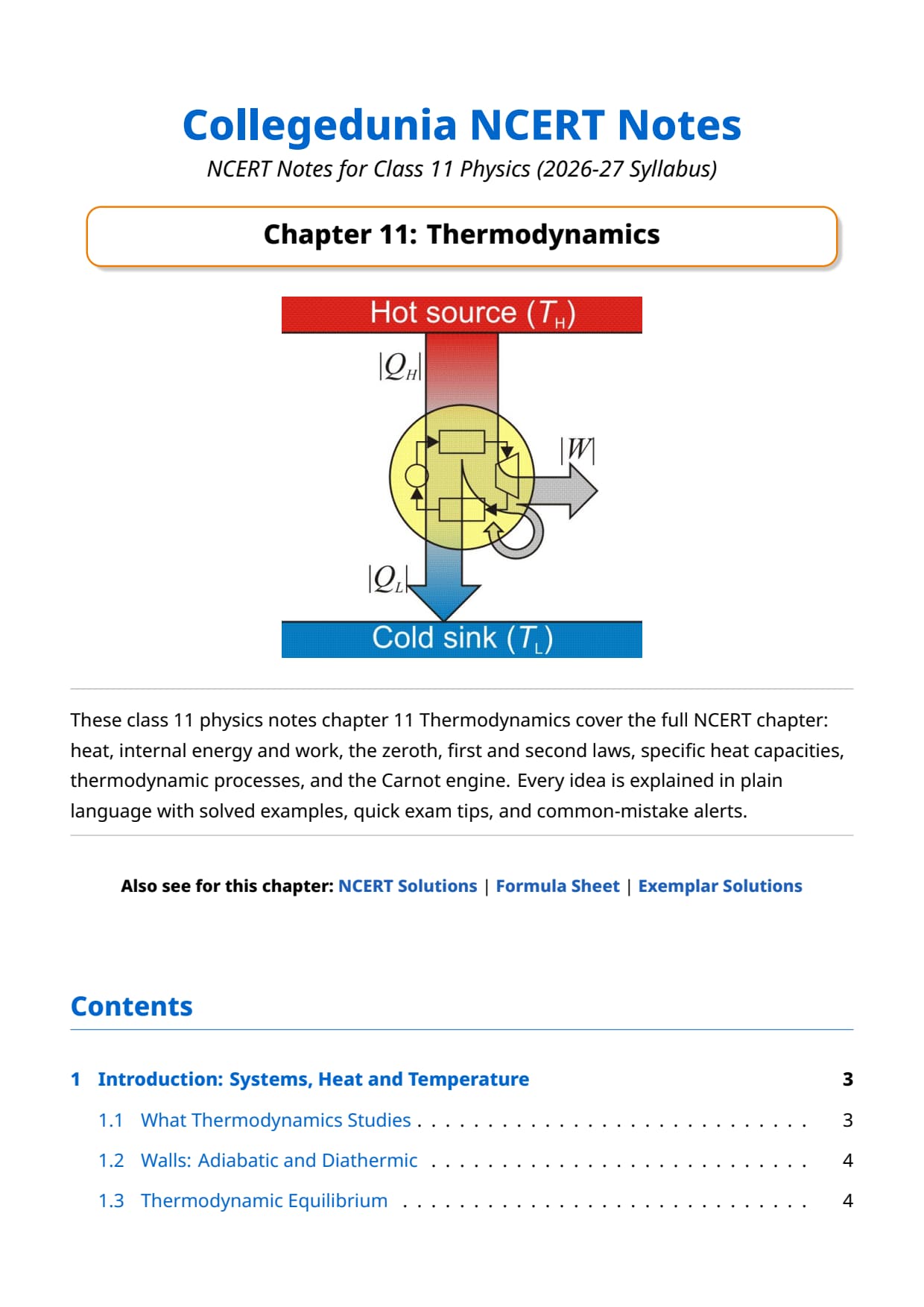
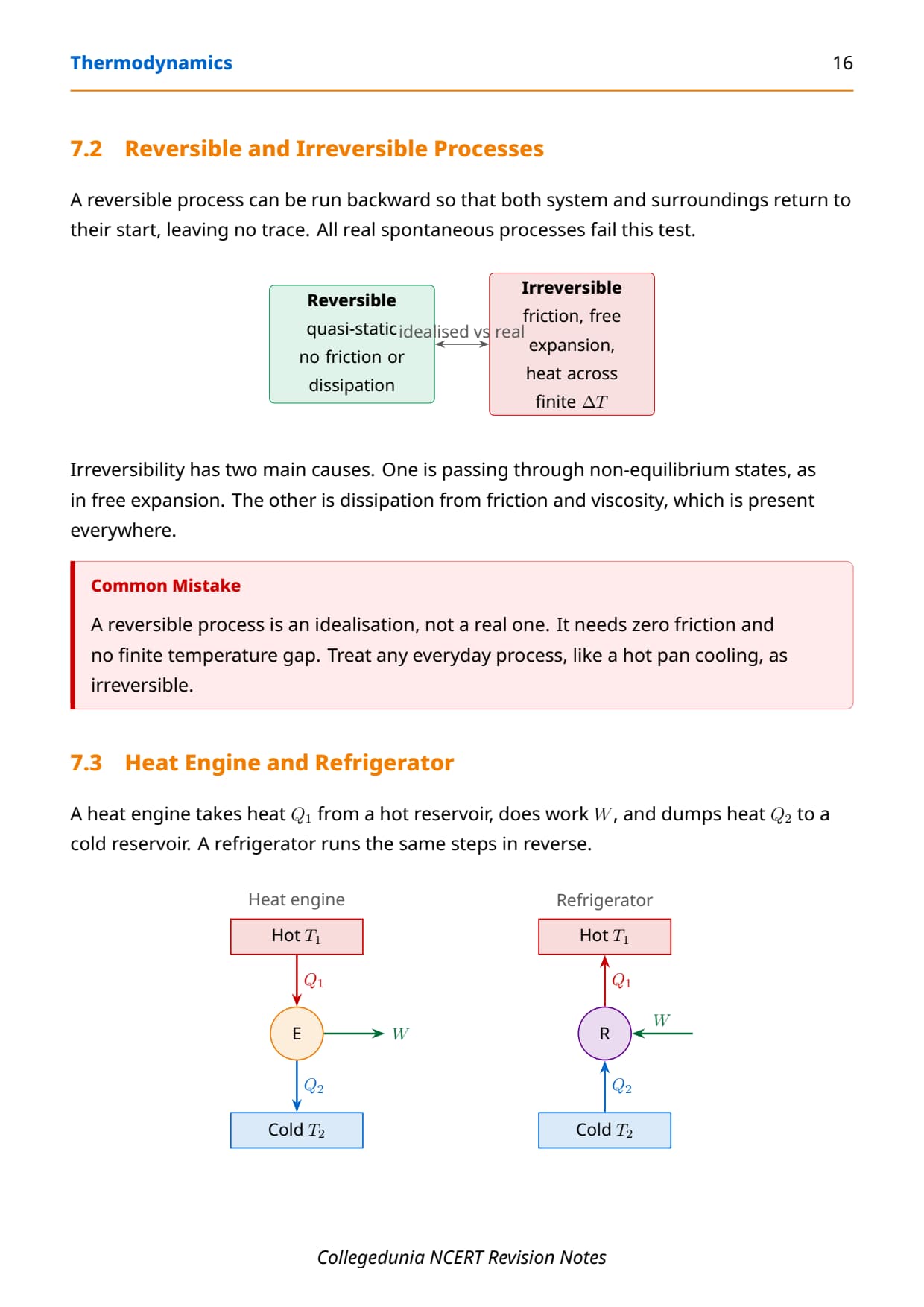
- Heat engine: a device that takes heat from a hot source, does work, and rejects the rest to a sink.
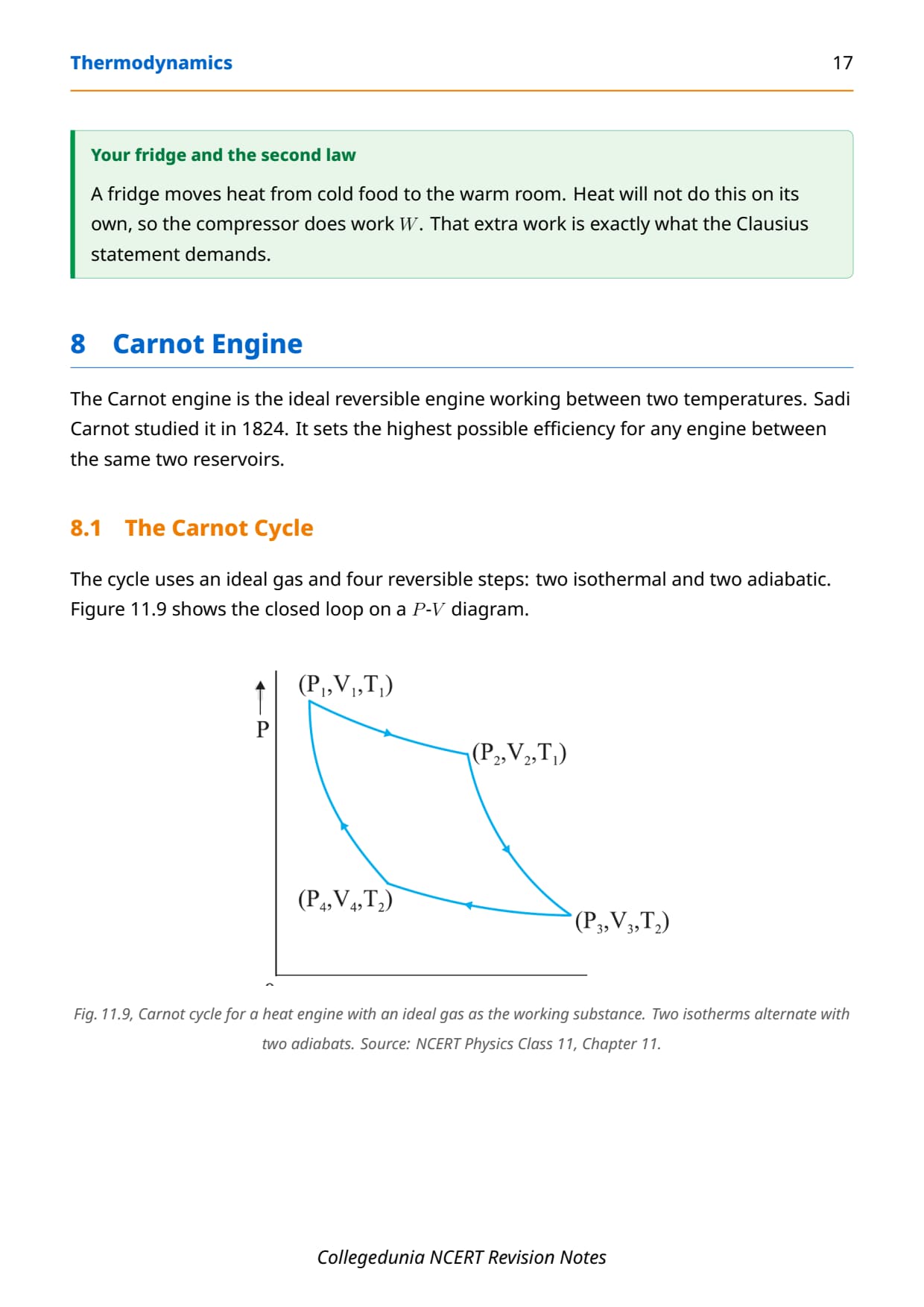
- Carnot engine: the ideal reversible engine with the maximum possible efficiency between two temperatures.
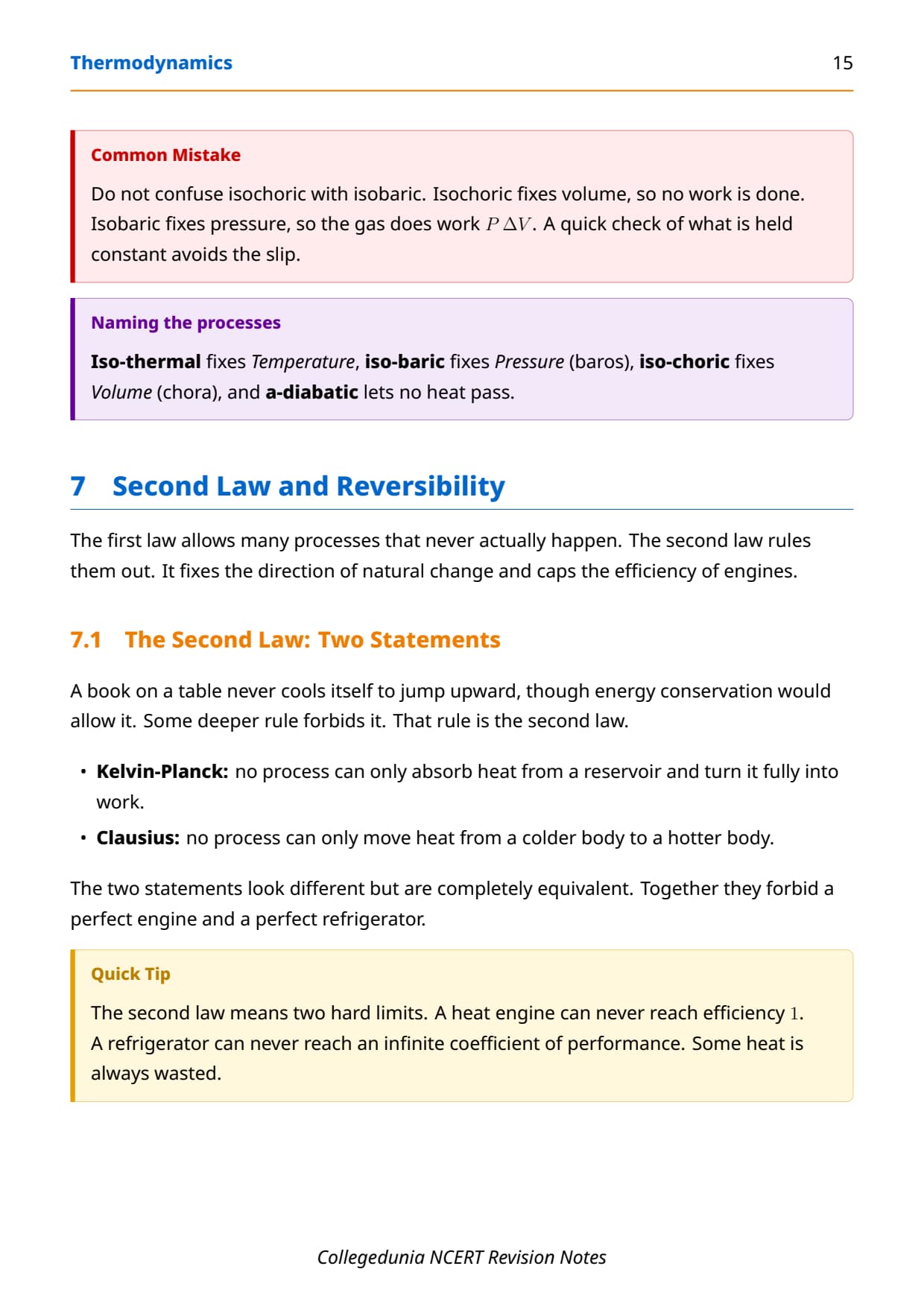
- Reversible vs irreversible: a reversible change is slow and ideal; every real process is irreversible.
- Refrigerator: a heat engine run in reverse, moving heat from a cold body to a hot one using work.
The Carnot efficiency η = 1 − T2/T1 depends only on the two temperatures, not on the working substance. No real engine can beat the Carnot efficiency between the same two temperatures. A refrigerator is judged instead by its coefficient of performance, which is the heat removed per unit of work done.
Common Mistakes Students Make in Thermodynamics
These slips happen while writing or calculating, not because the concept is unclear. Each one costs 1 to 3 marks in the paper, so watch for them at the exact step.
Mistake 1: Getting the sign of work wrong. Work is positive when the gas expands and negative when it is compressed.
Mistake 2: Using Celsius in engine formulas. Every temperature in the Carnot and efficiency formulas must be in kelvin.
Mistake 3: Setting ΔQ = 0 for isothermal instead of adiabatic. In an isothermal process it is ΔU that is zero.
Mistake 4: Treating internal energy as a path function. It depends only on the state, so it is the same for every path between two states.
Thermodynamics Weightage in CBSE Boards, JEE and NEET
This chapter is a reliable scorer. It appears every year as a short-answer definition plus a numerical on the first law or engine efficiency. Here is how the marks split across the main exams for 2026-27.
| Exam | Typical weightage | What is asked |
|---|---|---|
| CBSE Boards | 6 to 8 marks | One process definition plus a numerical on the first law or Carnot efficiency |
| JEE Main | 1 to 2 questions | First law, adiabatic relations, and engine efficiency |
| NEET | 1 to 2 questions | First law, thermodynamic processes, and Carnot engine |
| CUET and NDA | 1 objective question | Zeroth law, specific heats, and simple efficiency |
The first law and Carnot efficiency together make up most of the marks from this chapter across all four exams. Master those first, then the four processes, then the specific-heat relation, in that order of return on effort.
How to Revise Thermodynamics Quickly
Use these Class 11 Physics Notes Chapter 11 Thermodynamics for a fast, ordered recap the night before a test. The checklist below takes about 30 minutes and hits every marks-heavy idea.
- First 10 minutes: write the first law with its sign convention and the result for each of the four processes.
- Next 10 minutes: redo one numerical on isothermal work and one on Carnot efficiency.
- Last 10 minutes: state Mayer's relation, the second law, and the coefficient of performance from memory.
Close the loop by drawing the process table and filling the constant quantity for each row. If you can do all four blocks without notes, the chapter is exam-ready. Keep the All Formulas table beside you for the first pass only, then try it closed-book.
Student Feedback on the Thermodynamics Notes
What 13,470 students told us about their Thermodynamics revision:
- 71% of students rated the first-law sign convention as the hardest part of the chapter.
- Most-skipped step: converting temperature to kelvin before the Carnot formula, missed by about 3 in 10 students.
- Students who learned the four-process table first said the numericals felt much easier.
Source: 2026-27 Class 11 Physics student poll. Sample of 13,470 students from CBSE schools across 14 states, conducted before the 2026 boards.
Other Thermodynamics Class 11 Physics Resources
Pair these notes with the solved answers, the handwritten notes, the formula sheet, and the textbook PDF for the same chapter.
| Resource | Link |
|---|---|
| NCERT Solutions | Thermodynamics Class 11 NCERT Solutions |
| Handwritten Notes | Thermodynamics Class 11 Handwritten Notes |
| Formula Sheet | Thermodynamics Class 11 Formula Sheet |
| NCERT Book PDF | Thermodynamics Class 11 Book PDF |
NCERT Notes for Class 11 Physics: All Chapters
Jump to the revision notes for any other Class 11 Physics chapter below.
| Chapter | NCERT Notes |
|---|---|
| Chapter 1 | Units and Measurements |
| Chapter 2 | Motion in a Straight Line |
| Chapter 3 | Motion in a Plane |
| Chapter 4 | Laws of Motion |
| Chapter 5 | Work, Energy and Power |
| Chapter 6 | System of Particles and Rotational Motion |
| Chapter 7 | Gravitation |
| Chapter 8 | Mechanical Properties of Solids |
| Chapter 9 | Mechanical Properties of Fluids |
| Chapter 10 | Thermal Properties of Matter |
| Chapter 11 | Thermodynamics |
| Chapter 12 | Kinetic Theory |
| Chapter 13 | Oscillations |
| Chapter 14 | Waves |
FAQs on Thermodynamics Class 11 Physics Notes
Thermodynamics Notes - Frequently Asked Questions
Ques. What topics do the Class 11 Physics Notes Chapter 11 Thermodynamics cover?
Ans. These Class 11 Physics Notes Chapter 11 Thermodynamics cover the zeroth law and thermal equilibrium, internal energy and the first law, the four thermodynamic processes, specific heats with Mayer's relation, the second law, the Carnot engine and refrigerators. Every key formula and definition is included for fast revision.
Ques. What is the first law of thermodynamics?
Ans. The first law of thermodynamics states that ΔQ = ΔU + ΔW. Heat added to a system either raises its internal energy or is used to do work. It is simply the law of conservation of energy applied to heat, and it works for every thermodynamic process.
Ques. How are the four thermodynamic processes different?
Ans. In an isothermal process the temperature stays constant, in an adiabatic process no heat is exchanged, in an isobaric process the pressure stays constant, and in an isochoric process the volume stays constant. Spotting the constant quantity tells you which term of the first law drops to zero.
Ques. What is Mayer's relation in thermodynamics?
Ans. Mayer's relation links the two molar specific heats of an ideal gas as Cp − Cv = R. The specific heat at constant pressure is larger because extra heat is needed to do the expansion work. The ratio γ = Cp/Cv then appears in every adiabatic formula.
Ques. What is the efficiency of a Carnot engine?
Ans. The Carnot engine has the maximum possible efficiency between a hot source at T1 and a cold sink at T2, given by η = 1 − T2/T1. Both temperatures must be in kelvin. No real engine can beat this efficiency between the same two temperatures.
Ques. What is the weightage of Thermodynamics in the CBSE board exam?
Ans. Thermodynamics carries about 6 to 8 marks in the CBSE Class 11 Physics paper, usually one short answer on a process plus one numerical on the first law or Carnot efficiency. It also appears in JEE Main and NEET as questions on the first law, adiabatic relations and engine efficiency.



Comments