



The NCERT Class 11 History Chapter 5 Changing Cultural Traditions PDF brings together every name, date and debate that the Themes in World History paper actually tests. This is the Renaissance theme: Italian city-states, humanism at Padua and Bologna, Donatello and Leonardo da Vinci, Gutenberg's press and Copernicus. The official chapter file for the 2026-27 session is available below.
- Changing Cultural Traditions is Theme 5 of Themes in World History and runs from page 106 to page 122 of the printed book.
- The chapter covers roughly 1300 to 1700 in Europe, from the revival of Italian cities to the Scientific Revolution.
- It carries two timeline boxes, four activities and six exercise questions, split into Answer in Brief and Answer in a Short Essay.
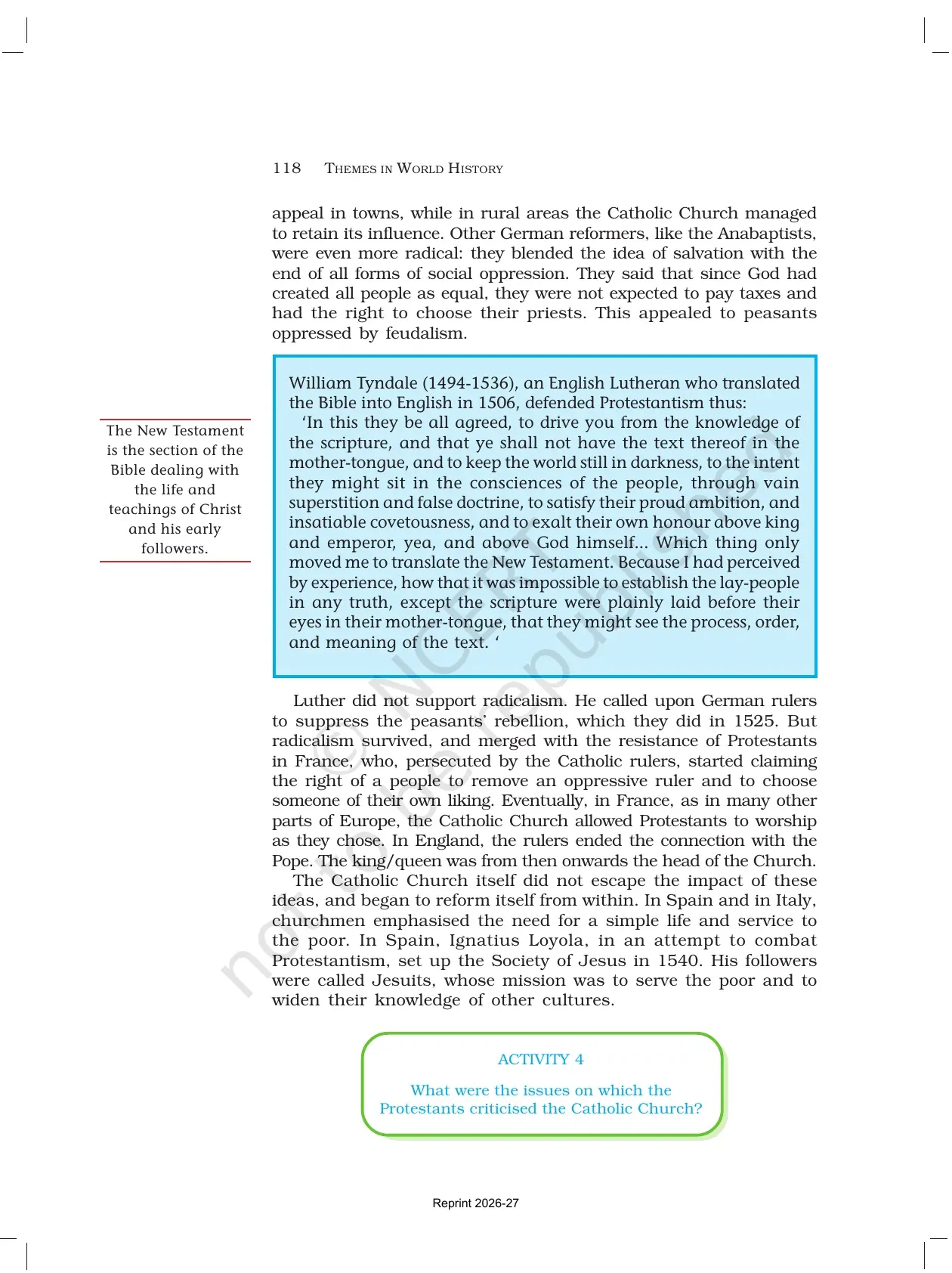
Every fact on this page is taken straight from the official NCERT Changing Cultural Traditions chapter for the 2026-27 session, checked name by name and date by date against the printed reprint.
What the Changing Cultural Traditions Class 11 PDF Contains, Section by Section
NCERT does not write this theme as one long essay. It is built as eleven short sections plus two dated timeline boxes and four activities. Knowing which section holds which name saves you a lot of hunting the night before the exam.
| Section in the chapter | What is printed there | Why it matters in the exam |
|---|---|---|
| Opening pages | Growth of towns, urban culture, and Jacob Burckhardt's 1860 book | Sets up the whole Renaissance debate asked in long answers |
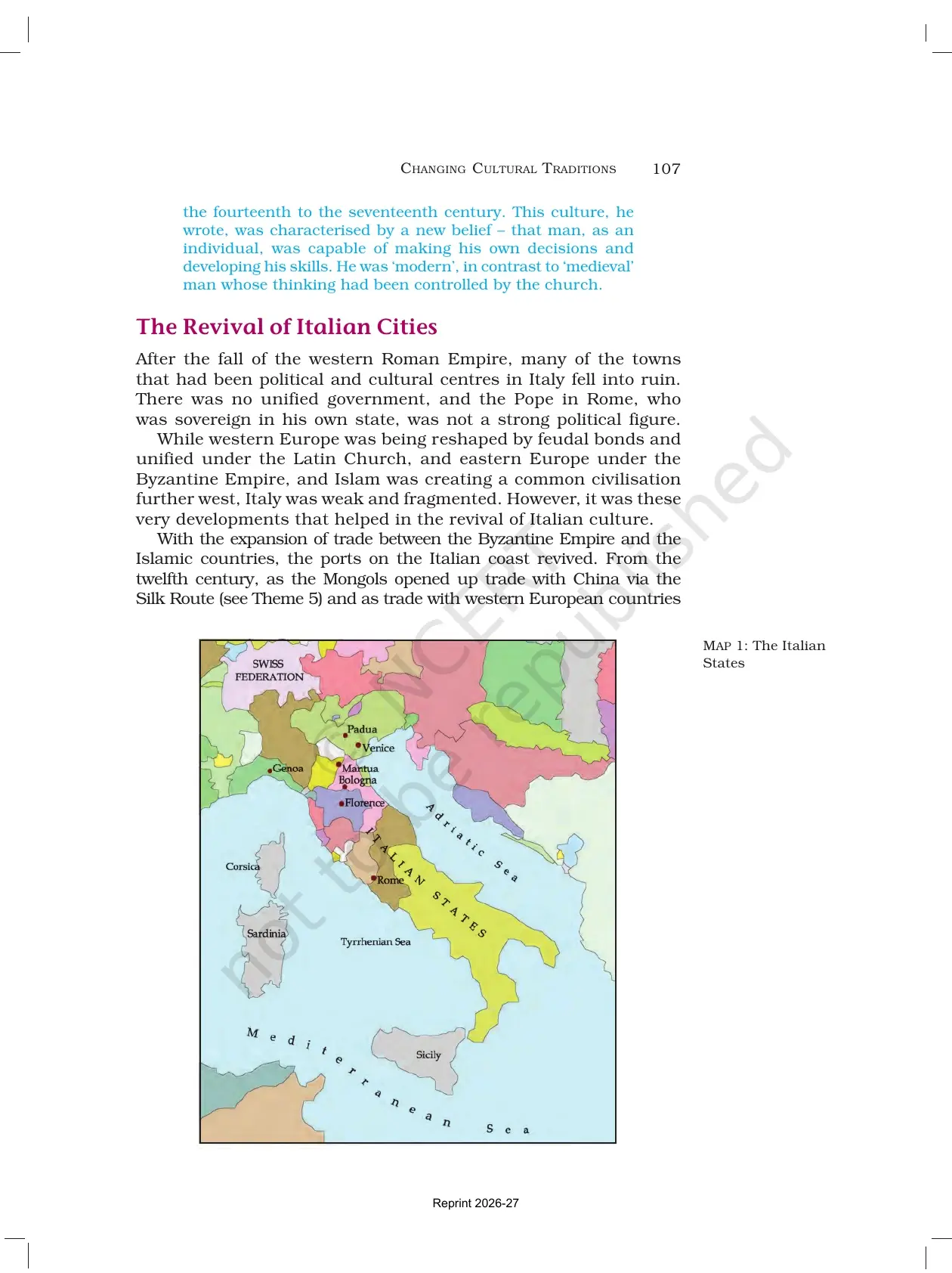
| The Revival of Italian Cities | Florence, Venice, Genoa, city-states, citizenship | Directly answers exercise question 3 on why Italian towns came first |
| Universities and Humanism | Padua, Bologna, Petrarch, the meaning of humanitas | The core of exercise question 5 on features of humanist thought |
| The Humanist View of History | The periodisation table from the Dark Ages to the Modern Age | One mark and two mark recall questions come from this table |
| Science and Philosophy | Ibn Sina, al-Razi, Ibn Rushd, Ptolemy's Almagest | The most skipped section, and an easy source of scoring points |
| Artists and Realism, Architecture | Donatello, Vesalius, Leonardo, Michelangelo, Brunelleschi | Feeds exercise questions 1 and 2 on revived Greek and Roman elements |
| The First Printed Books | Gutenberg, 1455, the debt to China and the Mongols | A favourite short note in Class 11 annual papers |
| Debates within Christianity | Erasmus, Thomas More, Martin Luther, the Reformation | Activity 4 and several source-based questions sit here |
| The Copernican Revolution, Reading the Universe | Copernicus, Kepler, Galileo, Newton, the science academies | Half of exercise question 6 on the seventeenth-century world view |
| Was there a European Renaissance? | Peter Burke's criticism of Burckhardt | The highest value long answer in the whole theme |
The Revival of Italian Cities and Why Florence and Venice Led the Change
After the fall of the western Roman Empire, Italy's old political towns fell into ruin. There was no single government, and the Pope in Rome, though sovereign in his own state, was not a strong political figure. NCERT then makes a neat argument: this weakness is exactly what let Italian culture revive.
- Trade between the Byzantine Empire and the Islamic countries brought the ports on the Italian coast back to life.
- From the twelfth century the Mongols opened trade with China through the Silk Route, and trade with western Europe grew as well.
- Italian towns stopped seeing themselves as part of an empire and began to act as independent city-states.
- Florence and Venice were republics; many other towns were court-cities ruled by princes.
- In Venice and Genoa the clergy were not politically dominant and there were no powerful feudal lords, so rich merchants and bankers helped govern the city.
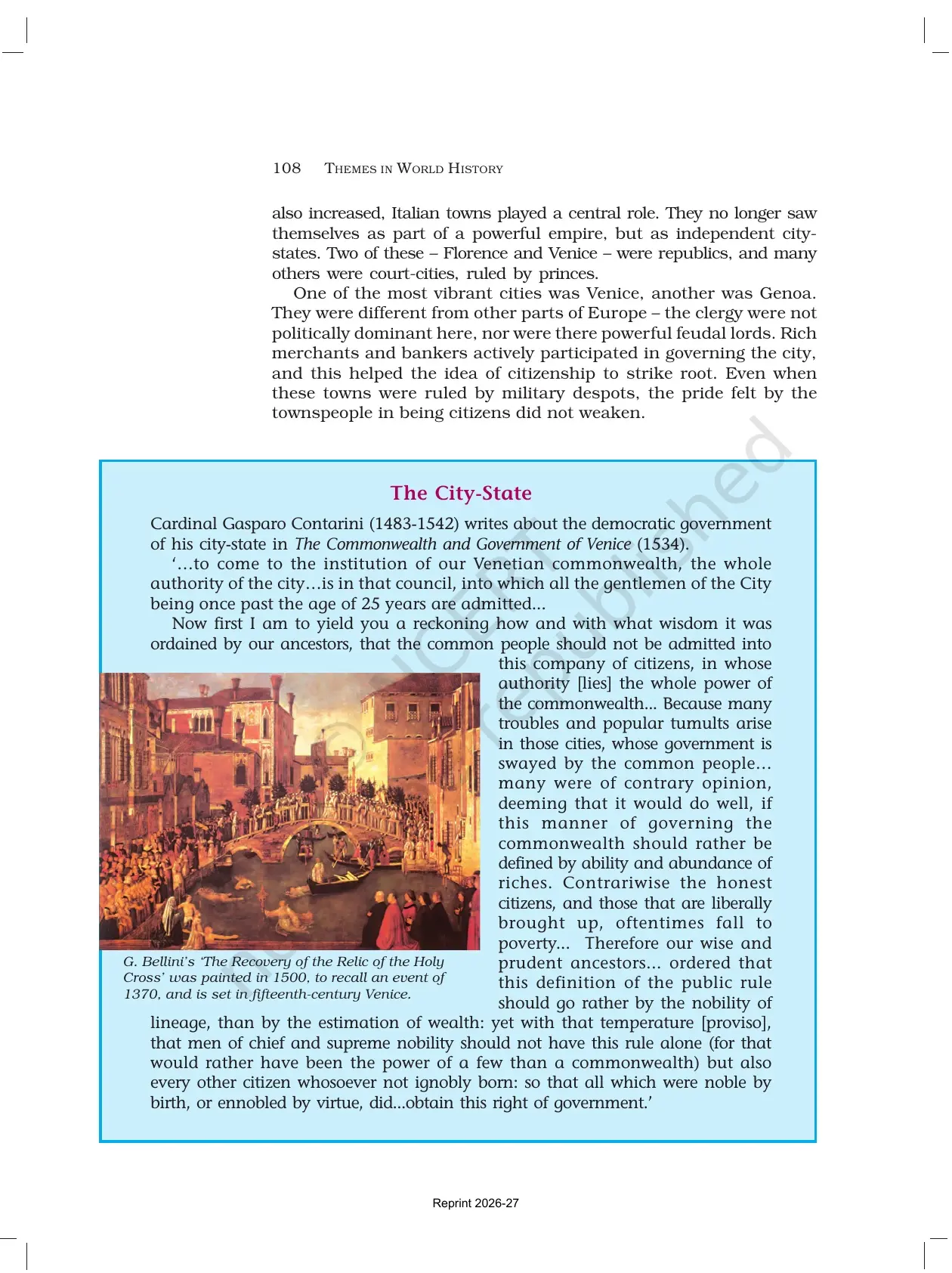
That last point is the one examiners want. Because merchants and bankers ran the council, the idea of citizenship took root, and the pride of being a citizen survived even under military despots. Cardinal Gasparo Contarini (1483 to 1542) describes that council in The Commonwealth and Government of Venice, written in 1534.
The Renaissance in Italian Towns Explained on Video
Source: Social School by Unacademy on YouTube
Universities and Humanism: Padua, Bologna and Francesco Petrarch
Europe's earliest universities were set up in Italian towns. Padua and Bologna had been centres of legal studies from the eleventh century, because trade on a large scale needed lawyers and notaries to write and read written agreements. Law stayed popular, but the way it was studied changed.
- Francesco Petrarch (1304 to 1378) argued that antiquity was a separate civilisation, best understood through the actual words of ancient Greek and Roman authors.
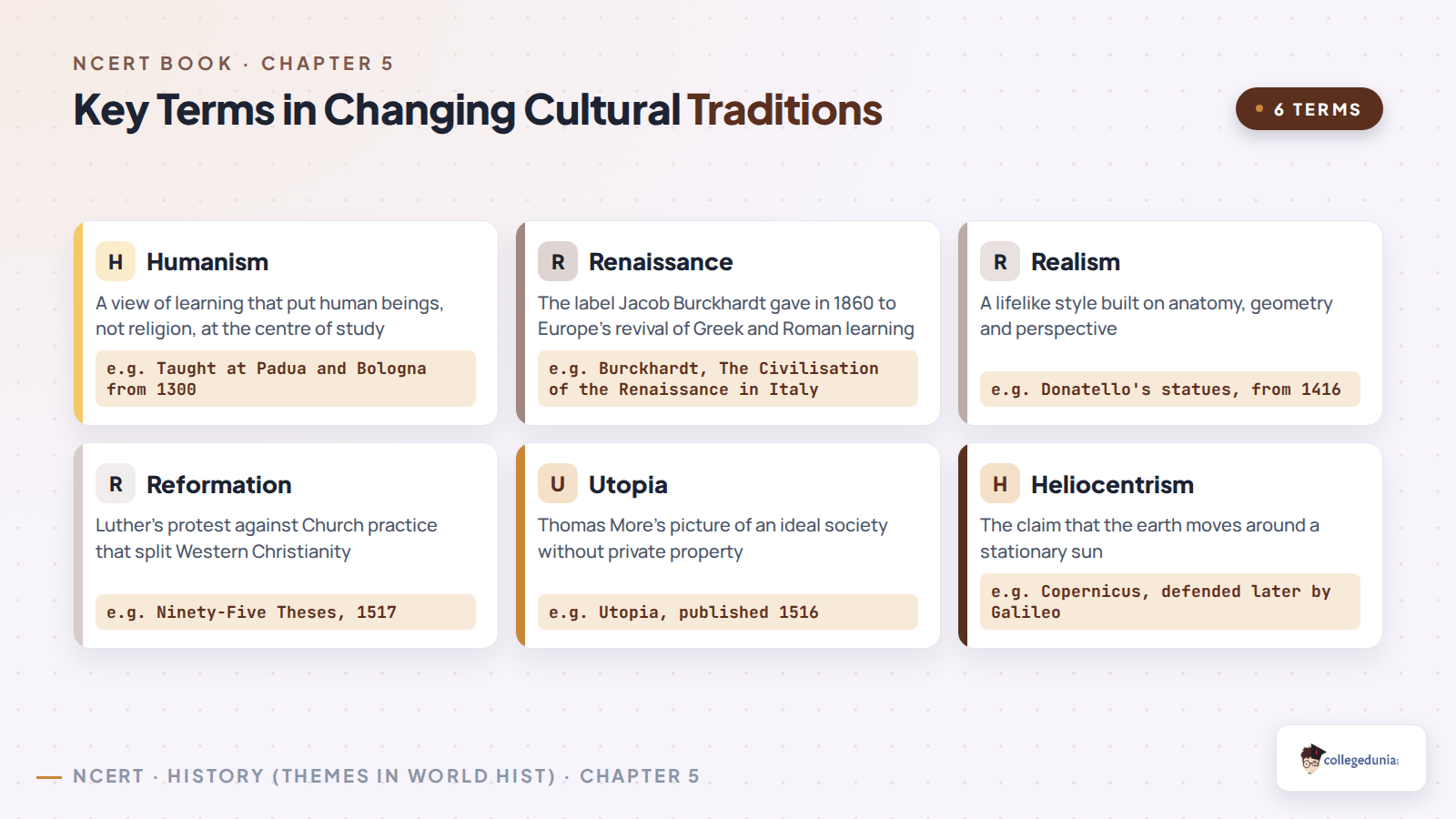
- This teaching programme said there was much to learn that religious teaching alone could not give. Nineteenth-century historians later called it humanism.
- By the early fifteenth century a humanist meant a master who taught grammar, rhetoric, poetry, history and moral philosophy.
- The Latin word humanitas, the root of humanities, was used centuries earlier by the Roman lawyer Cicero (106 to 43 BCE), a contemporary of Julius Caesar, to mean culture.
- Giovanni Pico della Mirandola (1463 to 1494) of Florence defended the value of debate in On the Dignity of Man, published in 1486.
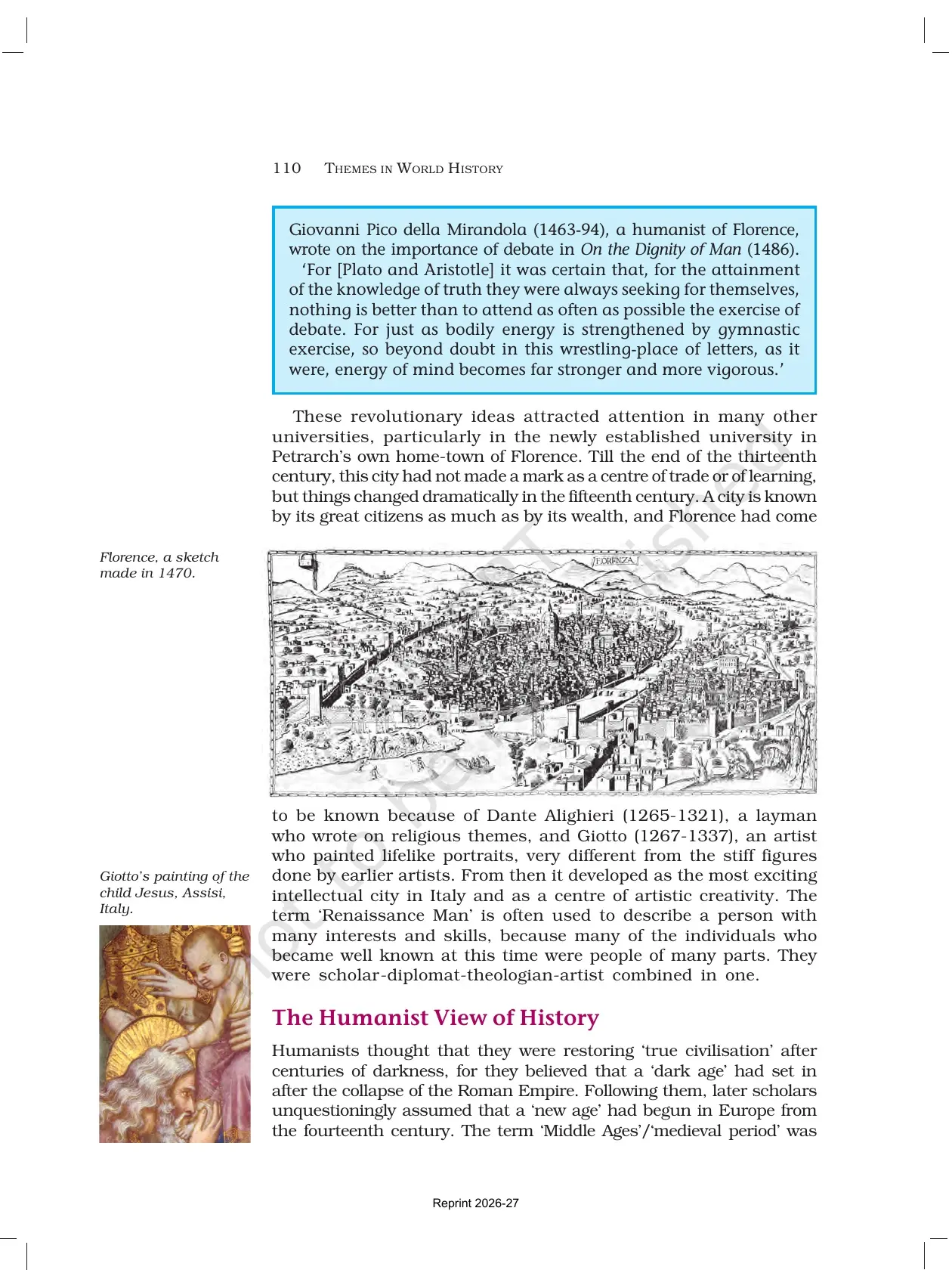
Florence itself was not a famous centre of trade or learning until the fifteenth century. It became one because of its people: Dante Alighieri (1265 to 1321), a layman who wrote on religious themes, and Giotto (1267 to 1337), who painted lifelike portraits instead of the stiff figures of earlier artists.
The Humanist View of History and the Periodisation Table NCERT Prints
Humanists believed a dark age had set in after the Roman Empire collapsed, and that they were restoring true civilisation. They used Middle Ages for the thousand years after the fall of Rome, and modern for their own time. The table below is printed in the chapter and is asked almost word for word.
| Period | Name used by humanists and later scholars |
|---|---|
| 5th to 14th century | The Middle Ages |
| 5th to 9th century | The Dark Ages |
| 9th to 11th century | The Early Middle Ages |
| 11th to 14th century | The Late Middle Ages |
| 15th century onwards | The Modern Age |
Tip: NCERT immediately questions its own table. Historians today are reluctant to call any century culturally dead, and the book says plainly that it seems unfair to label any period the Dark Ages. Write that line in any answer on periodisation.
Science and Philosophy: What Europe Owed to Arab Translators
This short section is skipped by most students and rewarded by most examiners. Fourteenth-century European scholars started reading Plato and Aristotle again, but not from Greek copies. They read Arabic translations made and preserved by Arab scholars.
| Name | Latin form | What the chapter says |
|---|---|---|
| Ibn Sina (980 to 1037) | Avicenna | Arab physician and philosopher of Bukhara in Central Asia |
| al-Razi | Rhazes | Author of a medical encyclopaedia |
| Ibn Rushd (1126 to 1198) | Averroes | Arab philosopher of Spain who tried to settle the tension between philosophical knowledge and religious belief |
Plato was Aflatun in Arabic and Aristotle was Aristu. Ptolemy's astronomy book survives as the Almagest, and the Arabic definite article al in that title is the clue NCERT points to. Ibn Rushd's method of resolving faith and reason was later taken up by Christian thinkers.
Artists and Realism: Donatello, Leonardo da Vinci and Andreas Vesalius
Art, architecture and books carried humanist ideas further than classrooms did. Sculptors had an advantage over painters: fragments of Roman art were being dug out of ruined cities a thousand years after the fall of Rome, and they could copy those proportions directly.
- In 1416, Donatello (1386 to 1466) broke new ground with lifelike statues.
- Andreas Vesalius (1514 to 1564), a Belgian and professor of medicine at the University of Padua, was the first to dissect the human body. NCERT calls this the beginning of modern physiology.
- Painters had no older models to copy, so they used geometry to work out perspective and watched changing light to give pictures a three-dimensional quality.
- Using oil as a medium gave paintings a richer colour than before, and costume designs show the influence of Chinese and Persian art brought in by the Mongols.
- Leonardo da Vinci (1452 to 1519) painted the Mona Lisa and The Last Supper, studied birds for years to design a flying machine, and signed himself disciple of experiment.
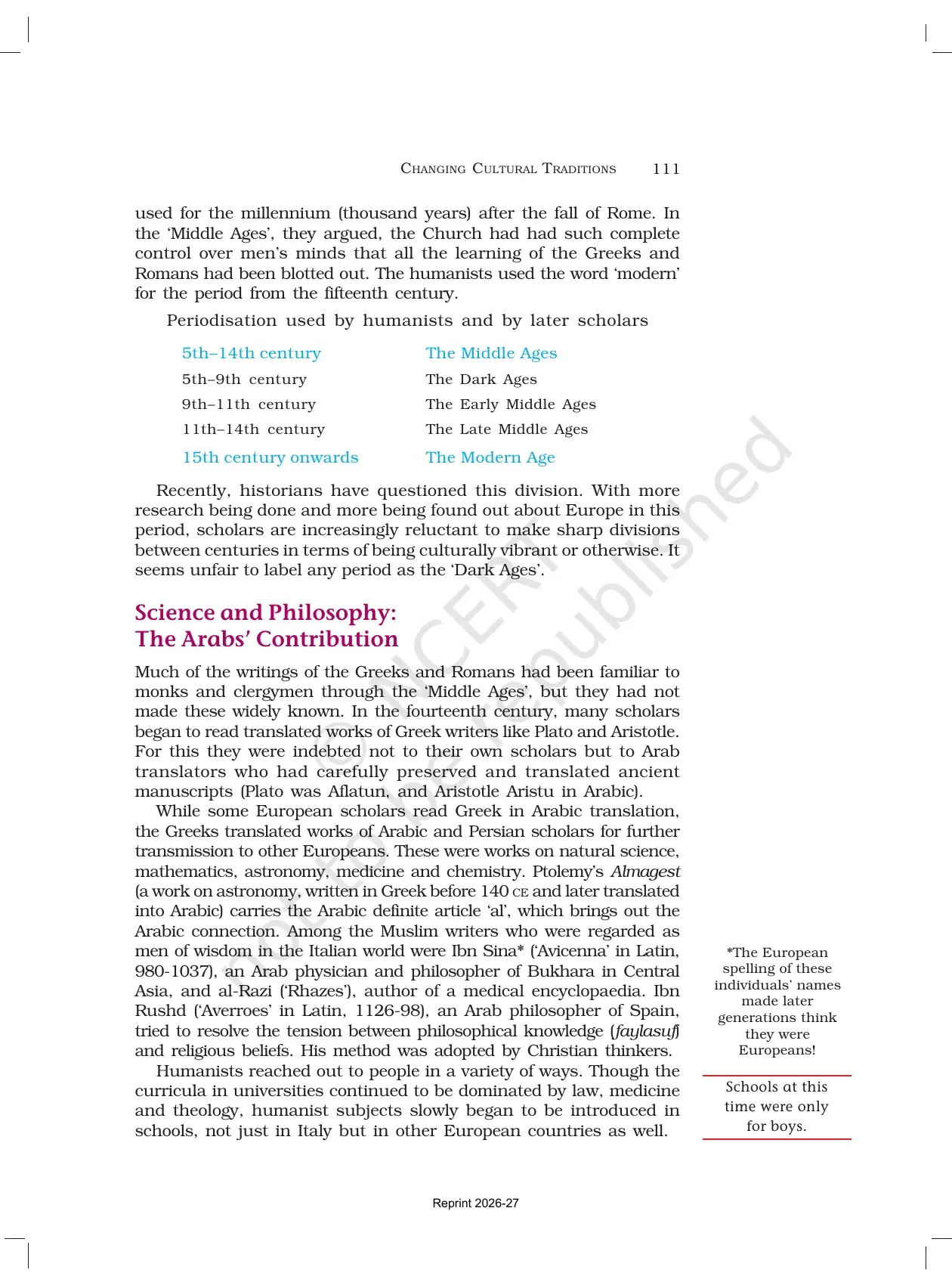
Anatomy, geometry and physics together gave Italian art the quality later called realism, which lasted until the nineteenth century. The German artist Albrecht Durer (1471 to 1528), whose brush drawing Praying Hands dates from 1508, put the same idea in one line: art is embedded in nature, and no one can make a beautiful figure from imagination alone.
Architecture in Rome and Florence: Michelangelo and Brunelleschi
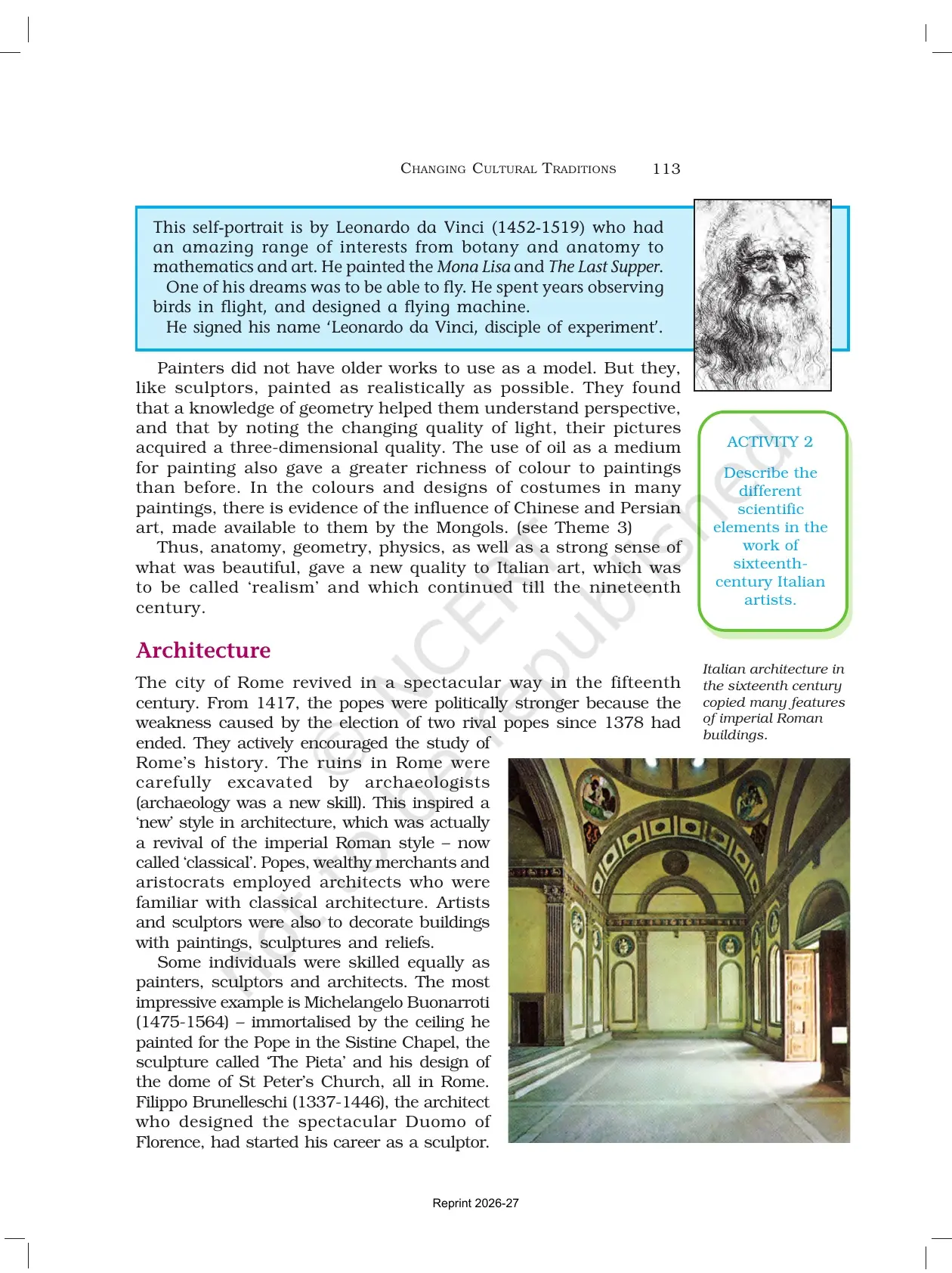
Rome revived in a striking way in the fifteenth century. From 1417 the popes were politically stronger, because the split caused by two rival popes since 1378 had ended, and they encouraged the study of Rome's own history. Archaeology was a brand new skill, and excavated ruins inspired a revival of the imperial Roman style, now called classical.
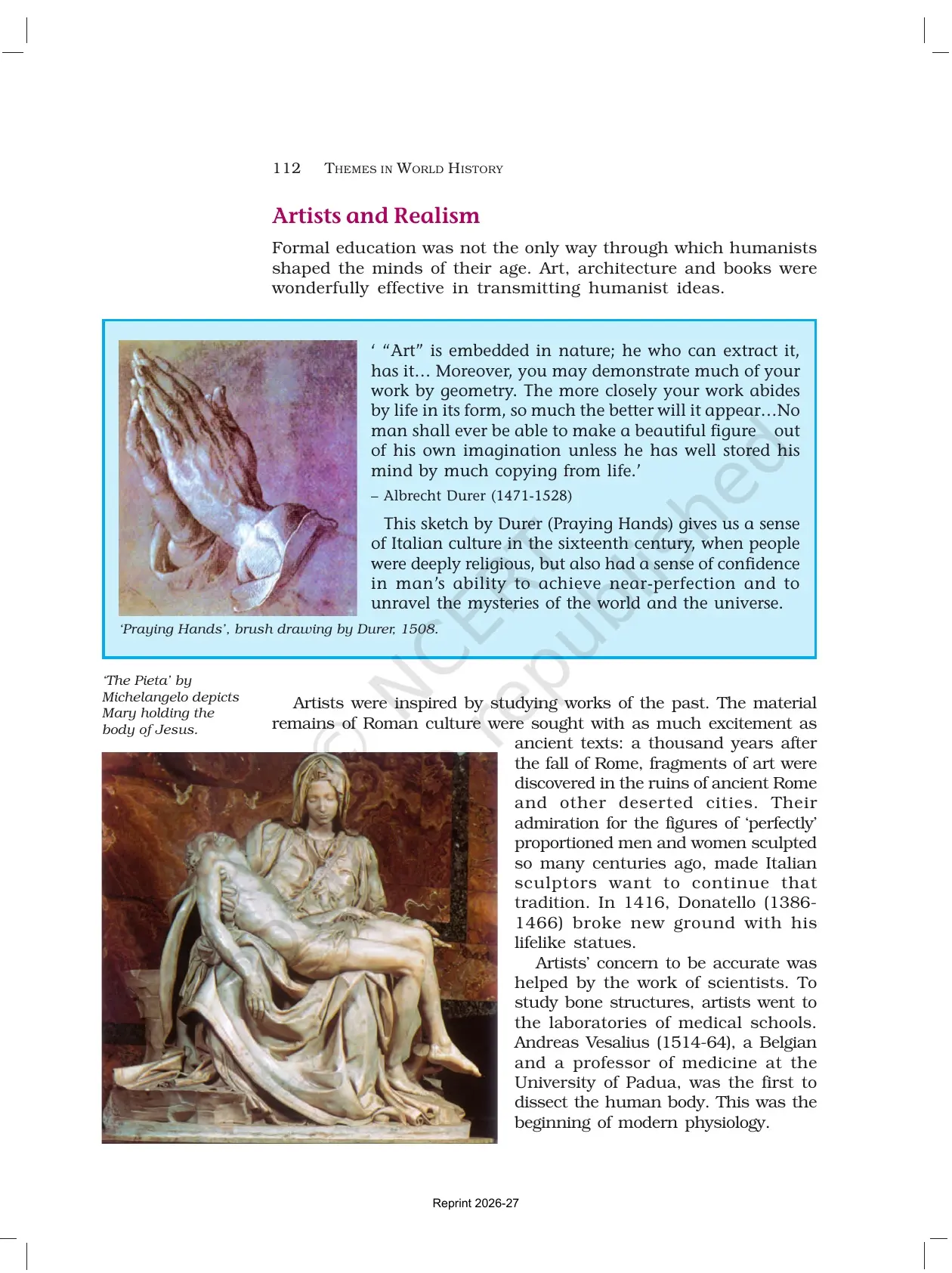
- Michelangelo Buonarroti (1475 to 1564) worked as painter, sculptor and architect: the Sistine Chapel ceiling, the sculpture called The Pieta, and the design of the dome of St Peter's Church, all in Rome.
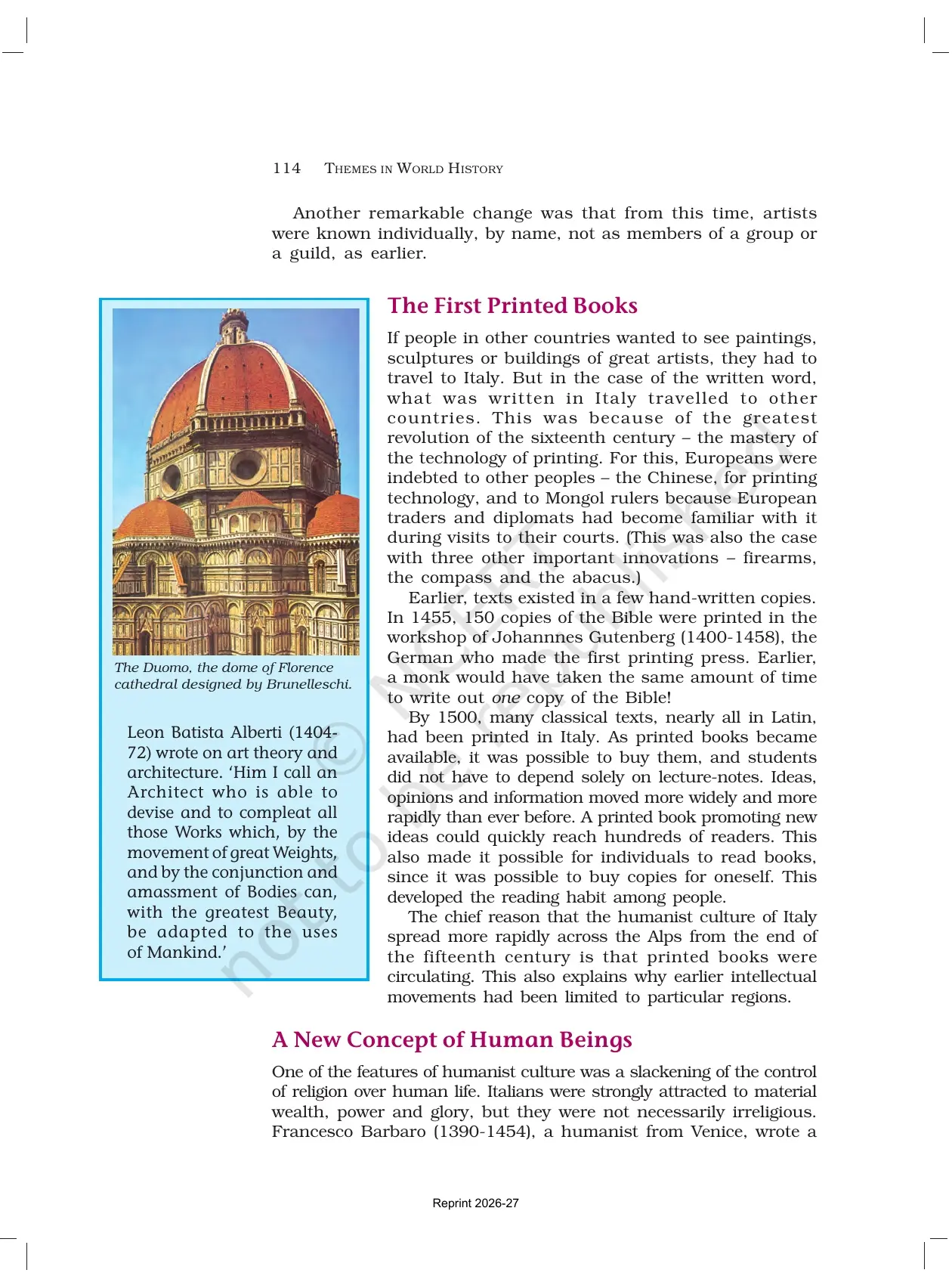
- Filippo Brunelleschi (1337 to 1446) designed the Duomo of Florence and had started his career as a sculptor.
- Leon Batista Alberti (1404 to 1472) wrote on art theory and architecture, and defined an architect by the ability to move great weights and join bodies beautifully.
- From this time artists were known individually by name, not as members of a guild. That single change is a two mark question on its own.
The First Printed Books: Gutenberg, 1455 and the Spread of Humanist Ideas
Paintings and buildings could not travel, so anyone who wanted to see them had to go to Italy. Writing could travel, and printing is what moved it. NCERT calls the mastery of printing the greatest revolution of the sixteenth century, and is careful about who Europe owed it to.
- Europeans took printing technology from the Chinese, and learned of it through traders and diplomats visiting Mongol courts. The same route brought firearms, the compass and the abacus.
- In 1455, 150 copies of the Bible were printed in the workshop of Johannes Gutenberg (1400 to 1458), the German who made the first printing press.
- A monk would have taken the same time to write out a single copy by hand.
- By 1500 many classical texts, nearly all in Latin, had been printed in Italy, so students no longer depended only on lecture notes.
- Printed books are the reason humanist culture crossed the Alps quickly from the end of the fifteenth century, while earlier movements had stayed local.
A New Concept of Human Beings and the Aspirations of Women in Italian Towns
Humanist culture loosened the hold of religion over daily life without making Italians irreligious. Francesco Barbaro (1390 to 1454) of Venice wrote a pamphlet defending the acquisition of wealth as a virtue. Lorenzo Valla (1406 to 1457) attacked the Christian ban on pleasure in his book On Pleasure. Niccolo Machiavelli, in chapter fifteen of The Prince (1513), named self-interest as the strongest motive behind every human action.
The new ideal of individuality left women out. Men from aristocratic families made the decisions, dowries went into family businesses, and daughters without an adequate dowry were sent to convents. Merchant families worked differently, because wives ran shops and looked after businesses when the men were away.
- Cassandra Fedele (1465 to 1558) of Venice knew Greek and Latin, was invited to give orations at the University of Padua, and wrote that every woman ought to seek the study of letters even though it offers her no reward.
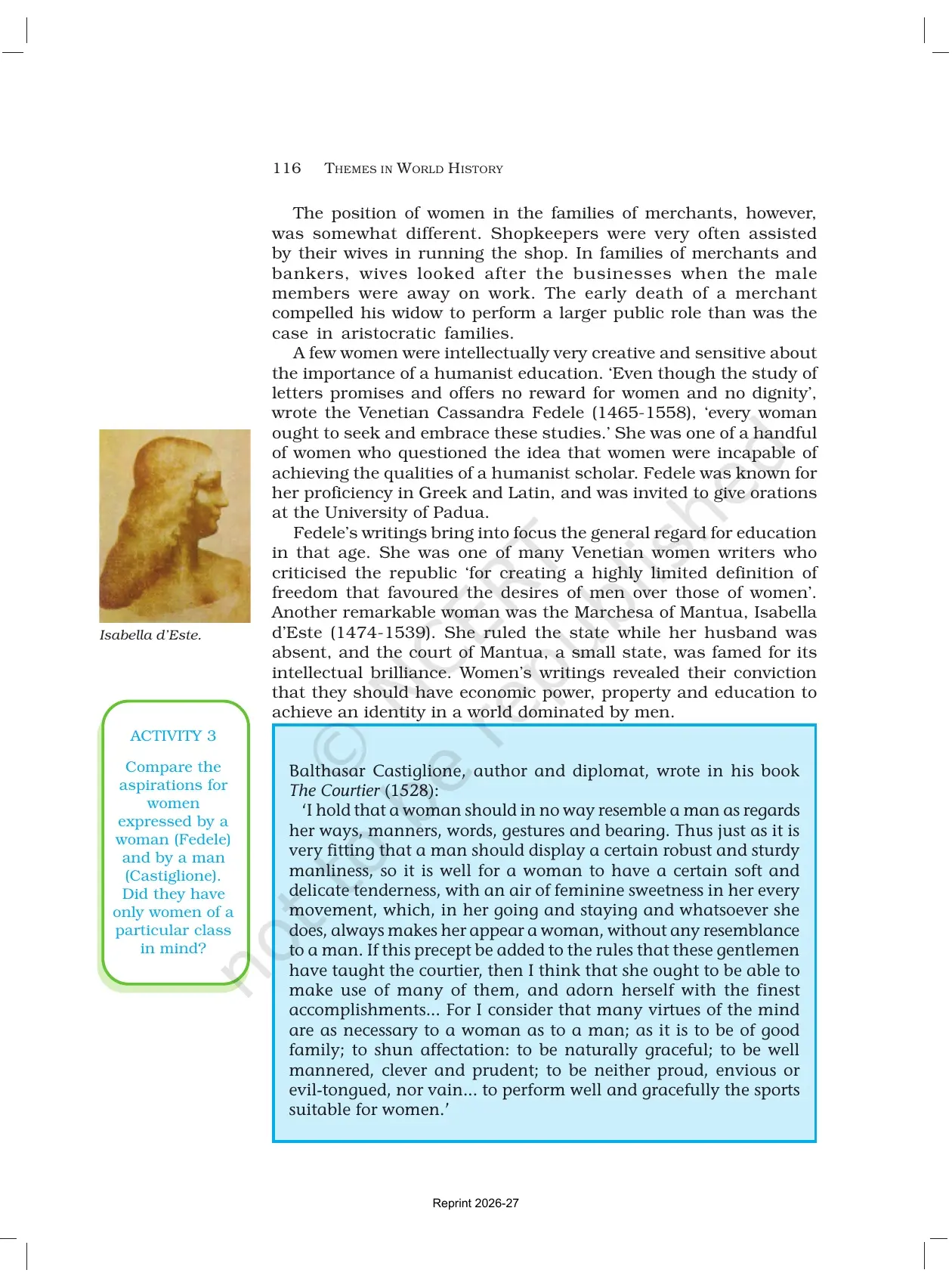
- Isabella d'Este (1474 to 1539), Marchesa of Mantua, ruled the state while her husband was away, and her court was famous for its intellectual brilliance.
- Balthasar Castiglione's The Courtier (1528) argues the opposite case, that a woman should in no way resemble a man in manner or bearing.
- Activity 3 asks you to compare Fedele and Castiglione, so keep one quotation from each ready.
Debates within Christianity and the Protestant Reformation of Martin Luther
In north Europe, humanism attracted members of the Church itself rather than professional scholars. They asked Christians to practise religion as the ancient texts laid it down and to drop later rituals. Their view of human beings as free and rational agents is what NCERT calls radically new.
- Thomas More (1478 to 1535) in England and Erasmus (1466 to 1536) in Holland said the Church had become greedy and was taking money from ordinary people at will.
- The clergy sold indulgences, documents that supposedly freed the buyer from the burden of his sins.
- Humanist scholars proved that the Donation of Constantine, the document behind the clergy's judicial and financial powers, was a later forgery.
- In 1517 the German monk Martin Luther (1483 to 1546) launched his campaign, arguing that a person needs no priest to reach God and that faith alone guides a right life.
- The Protestant Reformation broke the churches of Germany and Switzerland away from the Pope. Ulrich Zwingli (1484 to 1531) and later Jean Calvin (1509 to 1564) spread Luther's ideas in Switzerland.
- The Anabaptists went further, joining salvation with the end of social oppression, and argued that people created equal by God need not pay taxes and could choose their own priests.
Luther himself was not a radical: he asked German rulers to crush the peasants' rebellion, which they did in 1525. The Catholic Church then reformed from inside, and in Spain Ignatius Loyola set up the Society of Jesus in 1540, whose members, the Jesuits, served the poor and studied other cultures.
The Copernican Revolution and Reading the Universe
Scientists questioned the idea of man as a sinner from a completely different direction. Christians had held that the earth was sinful, that the weight of sin made it immobile, and that it stood still at the centre of the universe while the celestial planets moved around it.
- Copernicus (1473 to 1543), a contemporary of Martin Luther, said the planets including the earth rotate around the sun.
- He was a devout Christian and feared the reaction of traditionalist clergymen, so he refused to print De revolutionibus and handed the manuscript to his follower Joachim Rheticus on his deathbed.
- Johannes Kepler (1571 to 1630) made the sun-centred system popular through Cosmographical Mystery, showing that planets move in ellipses and not circles.
- Galileo Galilei (1564 to 1642) confirmed a dynamic world in his work The Motion, and remarked that the Bible lights the road to heaven but says little about how the heavens work.
- The revolution reached its climax with Isaac Newton's theory of gravitation.
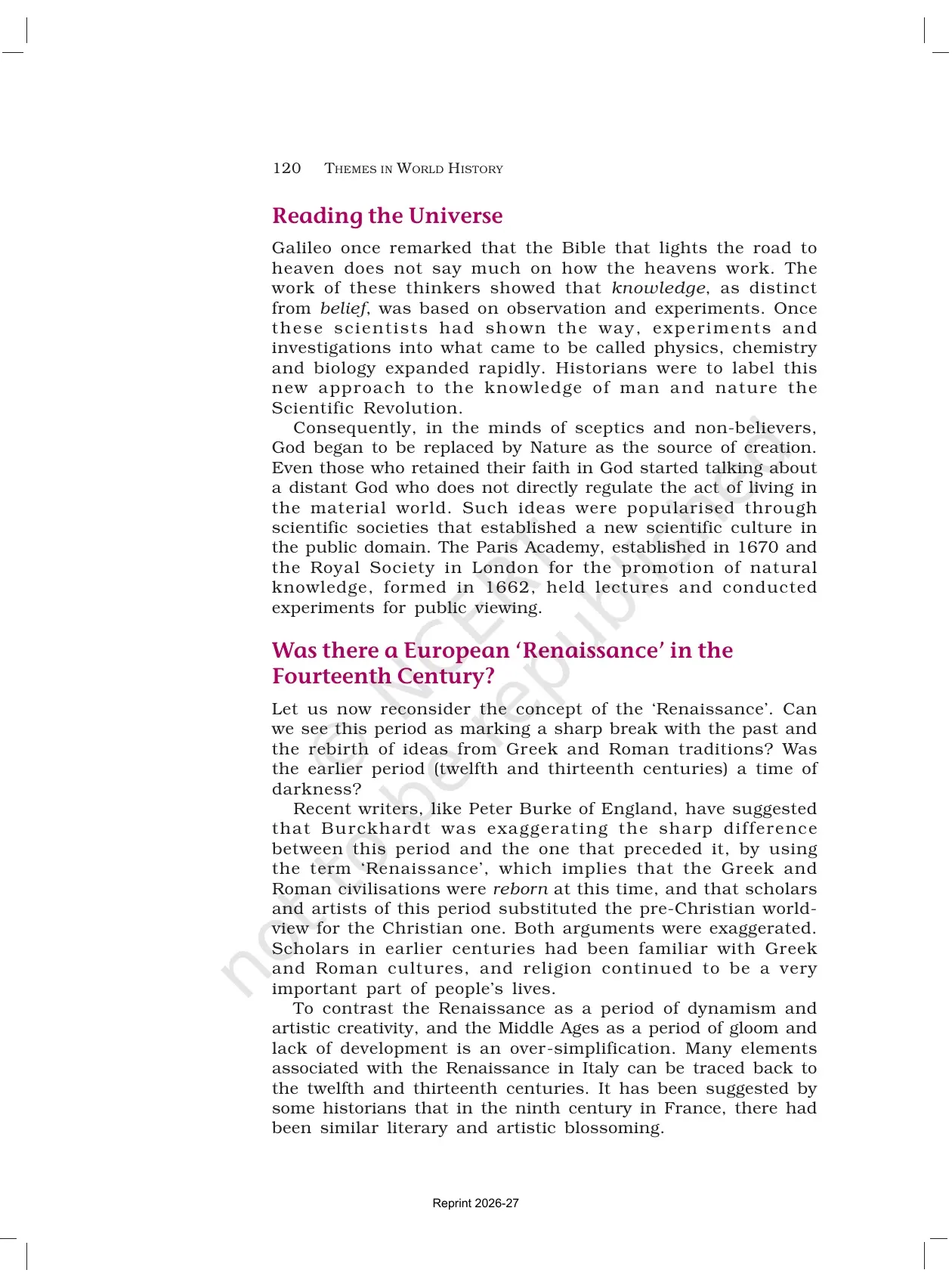
Historians call this new way of knowing the Scientific Revolution, because knowledge, unlike belief, now rested on observation and experiment. Scientific societies carried it into public life: the chapter text names the Paris Academy of 1670 and the Royal Society of London, formed in 1662 for the promotion of natural knowledge, while the timeline box separately lists an Academy of Sciences set up in Paris in 1673.
Was There a European Renaissance in the Fourteenth Century? The Debate Explained
The chapter closes by turning on its own title. Jacob Burckhardt (1818 to 1897) of the University of Basle, a student of Leopold von Ranke, wrote The Civilisation of the Renaissance in Italy in 1860 and argued that a new humanist culture had flowered in Italian towns. Later historians think he pushed the case too far.
- Peter Burke of England says Burckhardt exaggerated the break with the past. Renaissance means rebirth, but Greek and Roman culture had never been forgotten, and religion stayed central to people's lives.
- Many features of the Italian Renaissance can be traced to the twelfth and thirteenth centuries, and some historians point to a similar literary and artistic blossoming in ninth-century France.
- Europeans learned not only from Greece and Rome but from India, Arabia, Iran, Central Asia and China. Those debts went unacknowledged because early historians wrote from a Europe-centred viewpoint.
- The real change was that the private and public spheres began to separate. A man was no longer only a member of one of the three orders, and an artist was no longer only a member of a guild.
- Europe, once held together by the Roman Empire and later by Latin and Christianity, was dissolving into states each united by a common language.
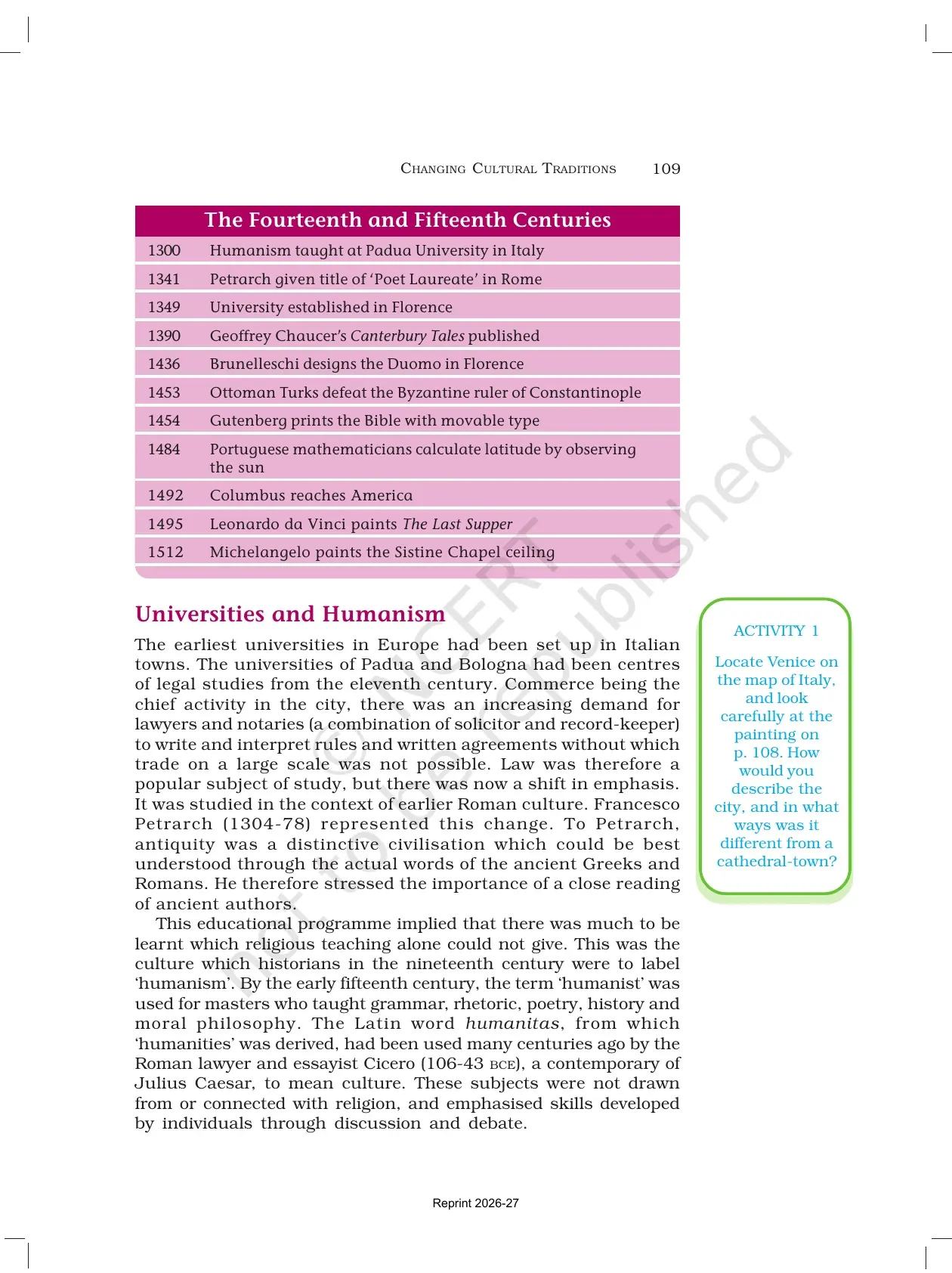
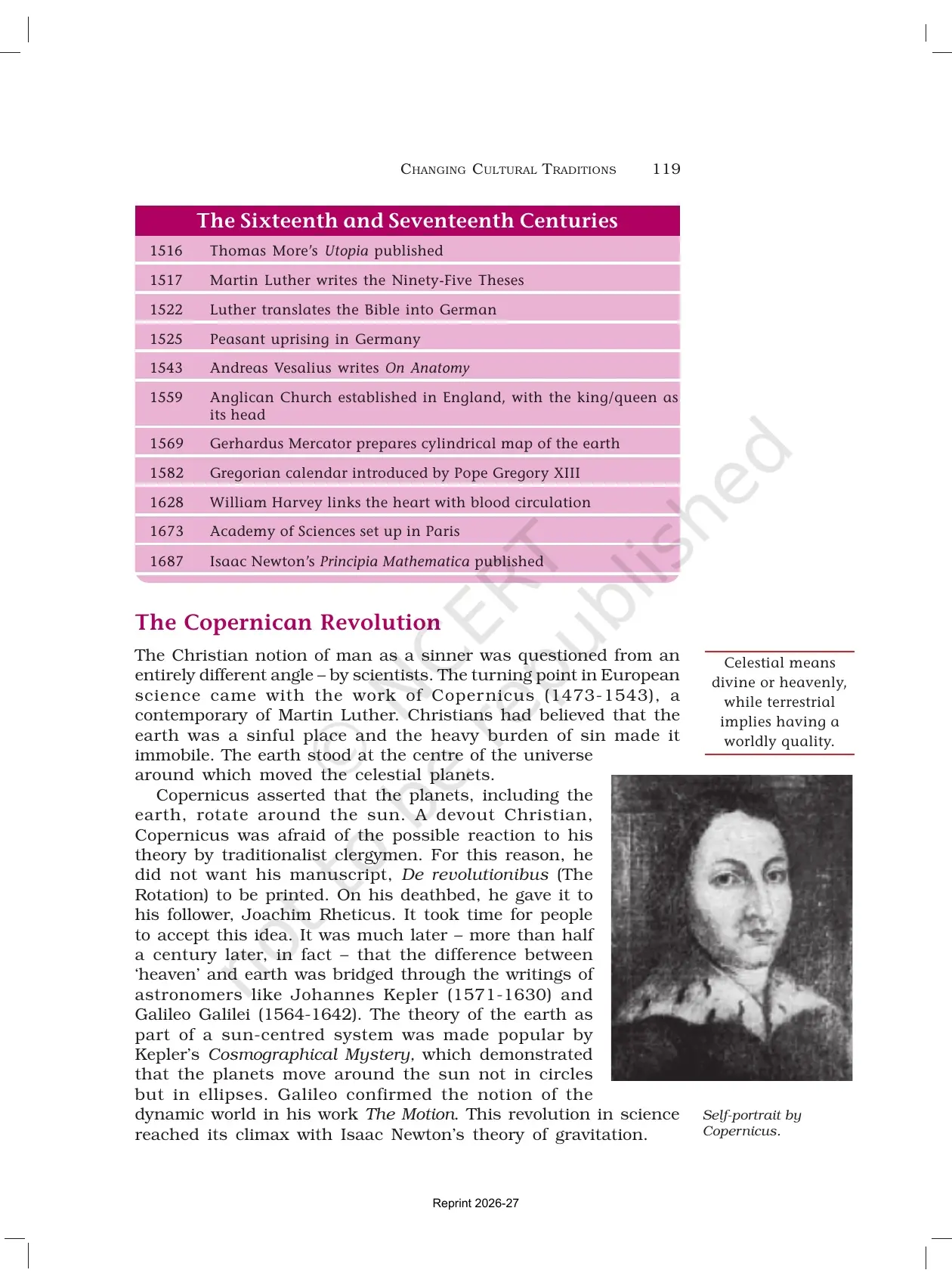
Both Timeline Boxes Printed in Changing Cultural Traditions, Date by Date
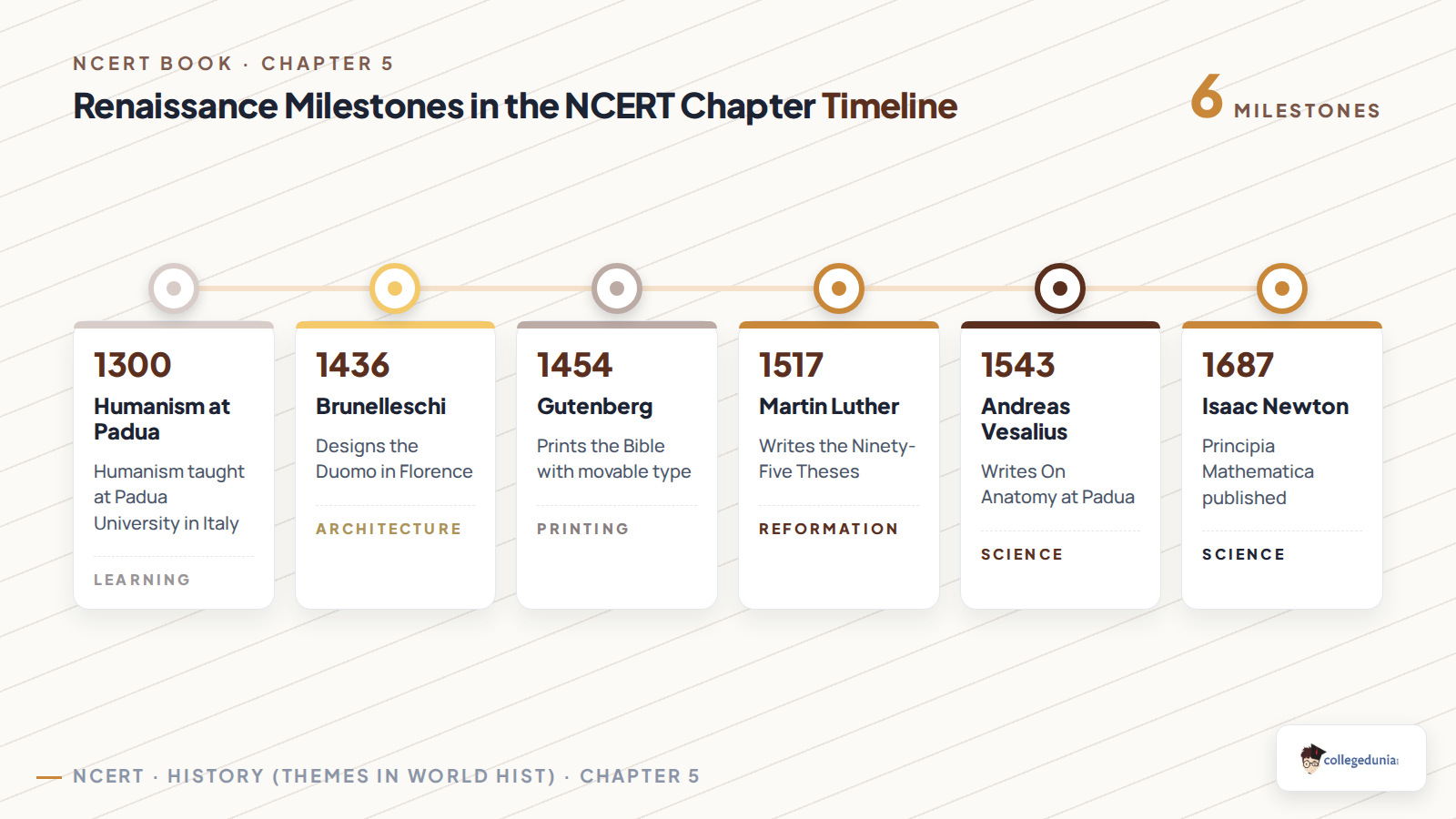
The two dated boxes are the cheapest marks in the theme. Learn them as two blocks, one for the fourteenth and fifteenth centuries and one for the sixteenth and seventeenth.
| Year | The Fourteenth and Fifteenth Centuries |
|---|---|
| 1300 | Humanism taught at Padua University in Italy |
| 1341 | Petrarch given the title of Poet Laureate in Rome |
| 1349 | University established in Florence |
| 1390 | Geoffrey Chaucer's Canterbury Tales published |
| 1436 | Brunelleschi designs the Duomo in Florence |
| 1453 | Ottoman Turks defeat the Byzantine ruler of Constantinople |
| 1454 | Gutenberg prints the Bible with movable type |
| 1484 | Portuguese mathematicians calculate latitude by observing the sun |
| 1492 | Columbus reaches America |
| 1495 | Leonardo da Vinci paints The Last Supper |
| 1512 | Michelangelo paints the Sistine Chapel ceiling |
| Year | The Sixteenth and Seventeenth Centuries |
|---|---|
| 1516 | Thomas More's Utopia published |
| 1517 | Martin Luther writes the Ninety-Five Theses |
| 1522 | Luther translates the Bible into German |
| 1525 | Peasant uprising in Germany |
| 1543 | Andreas Vesalius writes On Anatomy |
| 1559 | Anglican Church established in England, with the king or queen as its head |
| 1569 | Gerhardus Mercator prepares a cylindrical map of the earth |
| 1582 | Gregorian calendar introduced by Pope Gregory XIII |
| 1628 | William Harvey links the heart with blood circulation |
| 1673 | Academy of Sciences set up in Paris |
| 1687 | Isaac Newton's Principia Mathematica published |
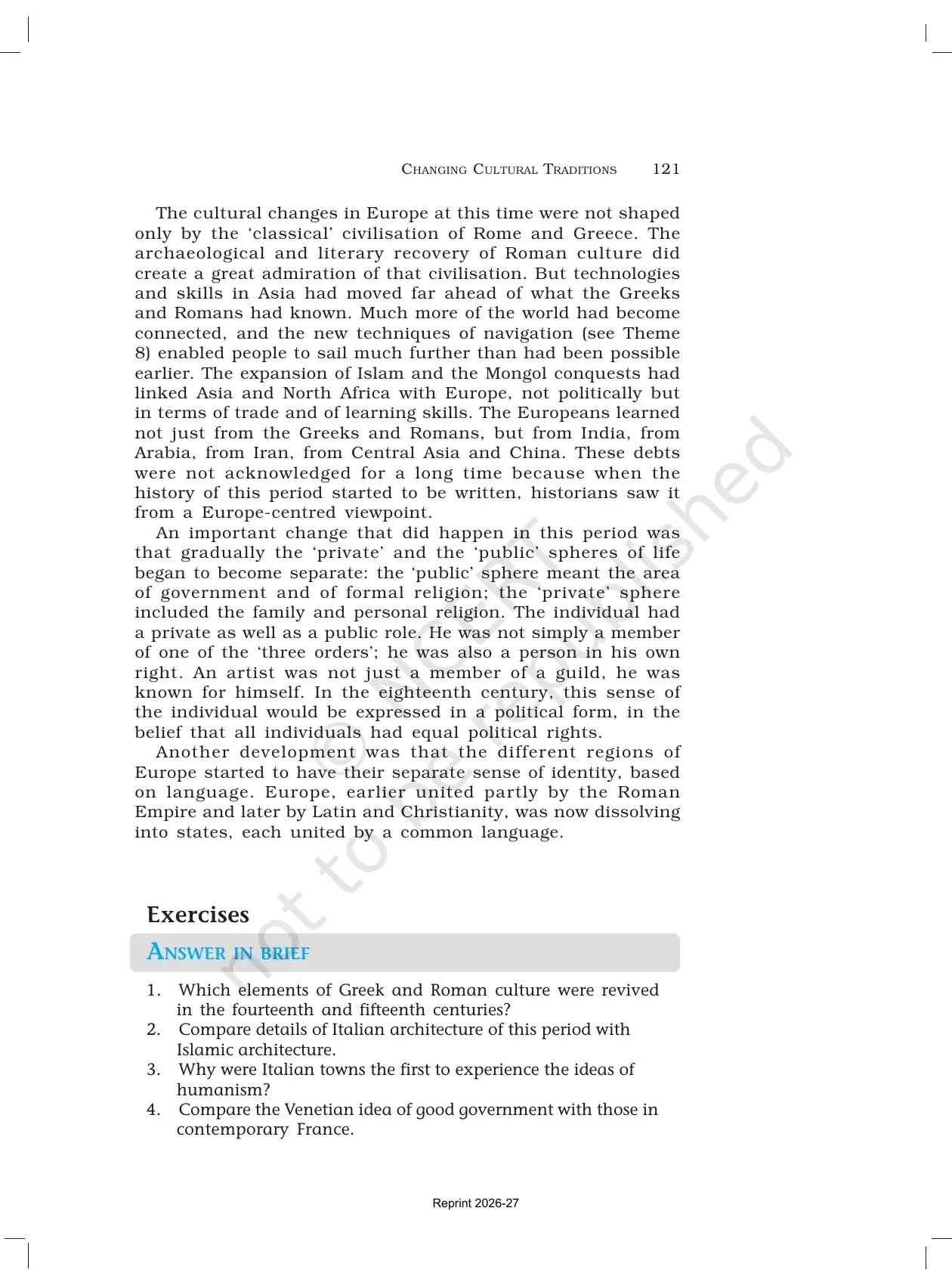
Exercises at the End of Changing Cultural Traditions and What Each One Tests
Six questions are printed at the end, four under Answer in Brief and two under Answer in a Short Essay. Four activities sit inside the chapter margins. The table shows where the answer to each one is hiding.
| Question | What it asks | Section to answer it from |
|---|---|---|
| Answer in Brief 1 | Which elements of Greek and Roman culture were revived in the fourteenth and fifteenth centuries | Universities and Humanism, Artists and Realism, Architecture |
| Answer in Brief 2 | Compare Italian architecture of this period with Islamic architecture | Architecture, plus the classical revival note from 1417 |
| Answer in Brief 3 | Why Italian towns were the first to feel the ideas of humanism | The Revival of Italian Cities |
| Answer in Brief 4 | Compare the Venetian idea of good government with those in contemporary France | The City-State box quoting Cardinal Contarini |
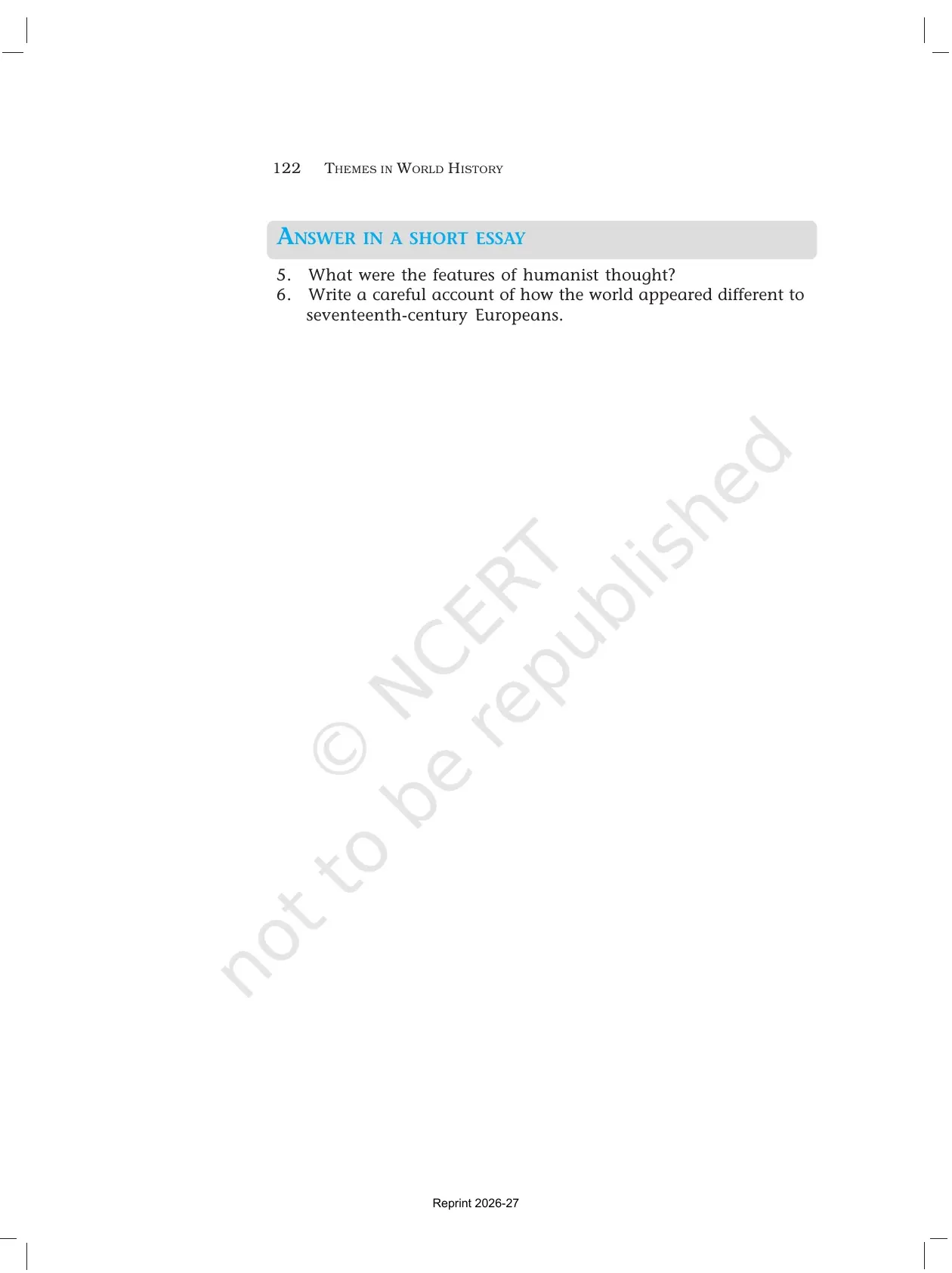
| Short Essay 5 | The features of humanist thought | Universities and Humanism, A New Concept of Human Beings |
| Short Essay 6 | How the world appeared different to seventeenth-century Europeans | The Copernican Revolution, Reading the Universe, the closing debate |
| Activities 1 to 4 | Venice on the map, science in Italian art, Fedele against Castiglione, Protestant criticism of the Catholic Church | Margin boxes on pages 109, 113, 116 and 118 |
Common Mistakes Students Make in the Changing Cultural Traditions Chapter
These five slips cost marks in almost every annual paper, and all five are avoidable by reading the chapter once carefully.
- Writing that the Renaissance began in Rome. The chapter starts with Florence and Venice, and Rome revives only from the fifteenth century.
- Mixing up Brunelleschi and Michelangelo. Brunelleschi designed the Duomo of Florence; Michelangelo designed the dome of St Peter's in Rome.
- Saying Europe rediscovered Greek texts on its own. NCERT credits Arab translators who preserved and translated them.
- Treating Copernicus as a rebel against religion. He was a devout Christian who was afraid to publish.
- Presenting Burckhardt's view as settled fact. The chapter's final section exists to challenge it, and long answers must carry that challenge.
Student Feedback on the Changing Cultural Traditions Chapter
What 12,840 Class 11 History students told us about this theme
Results from a Collegedunia poll run with Class 11 students before the 2026-27 annual exams:
- 68% said the two timeline boxes were the fastest marks in the whole theme once learned as a block.
- 3 out of 5 students could not name a single Arab scholar from the chapter on first attempt.
- 41% rated the closing debate section, on whether there was a Renaissance at all, as the hardest part to write in an answer.
- Students who read the exercise list first reported finishing the theme in about 2 hours, against 3 hours for the rest.
Source: 2026-27 Class 11 History student poll. Sample of 12,840 students from CBSE schools across 16 states.
How to Use the Changing Cultural Traditions PDF in a Three Block Revision Plan
This theme has many names and few concepts, so the order you read it in matters more than the number of hours you give it. Three sittings are enough.
- Block 1, about 45 minutes. Read the six exercise questions first, then read the chapter from the opening pages to Architecture. Mark every name and date as you go.
- Block 2, about 45 minutes. Read The First Printed Books through to Reading the Universe. Write the two timeline boxes out by hand once.
- Block 3, about 30 minutes. Read only the closing debate section, then write a rough answer to Short Essay 6 without looking back at the PDF.
Tip: keep one quotation ready from each of the four source boxes, Contarini, Pico della Mirandola, Machiavelli and Castiglione. A single quoted line lifts a source-based answer noticeably.
How the Changing Cultural Traditions Chapter PDF Works with Handwritten Notes
The book PDF gives you the original text, the timeline boxes and the question list. It does not give you a condensed revision sheet. That is what the handwritten notes page for the same theme adds, and using the two together is faster than reading either one twice.
| Resource | What it adds beyond the book PDF | Link |
|---|---|---|
| Handwritten Notes, Changing Cultural Traditions | A topper's handwritten revision pages with colour coded name lists, both timelines and the Renaissance debate in short points | Changing Cultural Traditions Class 11 Handwritten Notes |
| Handwritten Notes, Writing and City Life | The same handwritten treatment for the first theme of the book, useful when you revise the full paper | Writing and City Life Class 11 Handwritten Notes |
Themes in World History Chapters Available in NCERT Book PDF Format
Every link below opens the official NCERT chapter file for the 2026-27 session, in the same format as the Changing Cultural Traditions download on this page.
| Chapter | NCERT Book PDF |
|---|---|
| Chapter 1 | Writing and City Life Class 11 NCERT Book PDF |
| Chapter 2 | An Empire Across Three Continents Class 11 NCERT Book PDF |
| Chapter 3 | Nomadic Empires Class 11 NCERT Book PDF |
| Chapter 4 | The Three Orders Class 11 NCERT Book PDF |
| Chapter 5 | Changing Cultural Traditions Class 11 NCERT Book PDF |
Changing Cultural Traditions Class 11 History Chapter 5 NCERT Book PDF FAQs
Questions Class 11 Students Ask Most About the Changing Cultural Traditions Chapter PDF
Ques. Where can I download the NCERT Class 11 History Chapter 5 Changing Cultural Traditions PDF?
Ans. You can download it free from the card at the top of this page. It is the official NCERT chapter file from Themes in World History for the 2026-27 session, and it carries the full text, both timeline boxes, all four activities and the six exercise questions.
Ques. What is Chapter 5 of Class 11 History Themes in World History about?
Ans. It covers the European Renaissance, roughly from the fourteenth to the end of the seventeenth century. The theme moves from the revival of Italian cities like Florence and Venice, through humanism in the universities of Padua and Bologna, to realism in art, the printing press, the Protestant Reformation and the Copernican Revolution.
Ques. Why is the chapter called Changing Cultural Traditions instead of the Renaissance?
Ans. Because NCERT does not accept the label without question. The closing section asks directly whether there was a European Renaissance in the fourteenth century, and quotes Peter Burke's view that Jacob Burckhardt exaggerated the break with the past. Calling the theme Changing Cultural Traditions keeps that debate open.
Ques. Who was Jacob Burckhardt and why does the chapter open with him?
Ans. Jacob Burckhardt (1818 to 1897) was a Swiss scholar at the University of Basle and a student of Leopold von Ranke. In 1860 he wrote The Civilisation of the Renaissance in Italy, arguing that a new humanist culture had flowered in Italian towns. The chapter opens with him because the rest of the theme tests his claim.
Ques. Why were Italian towns the first to experience humanist ideas?
Ans. Trade with the Byzantine Empire and Islamic countries revived the Italian ports, and Mongol control of the Silk Route added trade with China. Italian towns became independent city-states where merchants and bankers, not clergy or feudal lords, ran the council. That merchant culture created demand for lawyers, notaries and universities.
Ques. What did Arab scholars contribute to the European recovery of Greek learning?
Ans. Arab translators preserved and translated ancient Greek manuscripts, which fourteenth-century Europeans then read in Arabic versions. Plato was known as Aflatun and Aristotle as Aristu. Ibn Sina, al-Razi and Ibn Rushd were treated as men of wisdom in Italy, and Ptolemy's Almagest still carries the Arabic article al in its title.
Ques. How many questions are printed in the exercises of Changing Cultural Traditions?
Ans. Six in total. Questions 1 to 4 sit under Answer in Brief and cover revived Greek and Roman elements, Italian against Islamic architecture, why Italian towns came first, and Venetian ideas of good government. Questions 5 and 6 sit under Answer in a Short Essay and cover humanist thought and the seventeenth-century world view.
Ques. Which dates from the timeline boxes are asked most often?
Ans. The high frequency ones are 1341 for Petrarch as Poet Laureate, 1453 for the Ottoman defeat of the Byzantine ruler of Constantinople, 1454 for Gutenberg printing the Bible with movable type, 1492 for Columbus reaching America, 1517 for Luther's Ninety-Five Theses and 1687 for Newton's Principia Mathematica.
Ques. Is the Class 11 History Chapter 5 PDF enough on its own for the exam?
Ans. For the content, yes. Every name, date and quotation the paper can ask about is printed in this file. What the PDF does not give you is a short revision sheet, which is why most students pair it with the Changing Cultural Traditions handwritten notes page linked above.
Ques. What is humanism?
Ans. Humanism is the name nineteenth-century historians gave to an educational and cultural programme that valued learning which religious teaching alone could not supply. By the early fifteenth century a humanist meant a master teaching grammar, rhetoric, poetry, history and moral philosophy. The word comes from the Latin humanitas, used by Cicero to mean culture.
Ques. How is the Renaissance defined in this chapter?
Ans. Renaissance literally means rebirth. Historians from the nineteenth century used it for the cultural changes in Europe between the fourteenth and seventeenth centuries, especially the recovery of Greek and Roman learning and the belief that a person could make his own decisions. NCERT prints the term and then questions how sharp that rebirth really was.
Ques. What was the Protestant Reformation?
Ans. It was the movement that began in 1517 when Martin Luther campaigned against the Catholic Church, arguing that a person needs no priest to reach God and that faith alone leads to a right life. It broke the churches of Germany and Switzerland away from the Pope, and Ulrich Zwingli and Jean Calvin carried the ideas further in Switzerland.



Comments