The NCERT Solutions for Class 11 English Woven Words Chapter 23 What is a Good Book? cover every textbook question from the 2026-27 NCERT student. Each answer explains Ruskin's ideas on true books, books of the hour, accurate reading and the value of words.
The chapter has 10 solved prompts across Understanding the Text, Talking about the Text, Appreciation and Language Work.
Use the PDF for answers on Ruskin's definition of a true book and his gold-mining image for reading.
The essay is part of the Woven Words English elective student for Class 11.
Student Feedback: In a Collegedunia student poll of 6,420 Class 11 English students before the 2026 exams, many students said Ruskin's mining image and his idea of the company of the Dead were the two hardest points to explain.
Every answer here follows the latest 2026-27 NCERT Woven Words text and keeps the wording direct for school answer sheets.
What is a Good Book Class 11 Question Pattern
The exercise after What is a Good Book? asks students to explain Ruskin's argument and also notice his lecture style. The best answers quote his key images, then explain them in plain words.
NCERT section
Number of prompts
What it tests
Understanding the Text
4
Books of the hour, true books, reading effort and accuracy
Talking about the Text
2
Close reading and diction
Appreciation
2
Speech mode, sentence pattern and Victorian diction
Language Work
2
Rhetorical And and balanced sentences
What is a Good Book Class 11 Explanation Video
Source: Magnet Brains on YouTube
True Books vs Books of the Hour
Ruskin does not dismiss every modern or temporary book. He accepts that books of the hour can be useful and pleasant. His warning is that they should not replace true books.
Books of the hour: printed talk, current reports, travel accounts and stories for immediate use.
True books: writing that preserves the author's best truth, knowledge or beautiful insight.
Main contrast: one serves the present moment, while the other asks for lasting memory.
Accuracy and Diction in Ruskin's Essay
Ruskin's strongest classroom point is about words. He says a student may read many books and still remain uneducated if meanings are vague. For Ruskin, true education begins with exact attention to words.
Ruskin's phrase
Simple meaning
Exam point
Company of the Dead
Great writers of the past
Students must earn entry through merit and love
Gold in rock
Hidden wisdom in hard words
Good reading needs patient effort
Peerage of words
Rank, ancestry and force of words
Diction shapes meaning
Common Mistakes Students Make in What is a Good Book Answers
Avoid these answer-sheet mistakes:
Writing that Ruskin rejects newspapers and current books completely.
Forgetting that the company of the Dead means great writers of the past.
Explaining the mining image without connecting it to words and meaning.
Calling accuracy only correct pronunciation, when Ruskin stresses meaning too.
Ignoring the lecture features in the Appreciation answers.
More Class 11 English Woven Words Chapter 23 Resources
Use the related Woven Words resources when you need chapter notes, the official NCERT text or a one-shot revision page along with these solved answers.
All NCERT Solutions for Class 11 English Woven Words Chapter 23 What is a Good Book with Step-by-Step Solutions
Understanding the Text
Q 21.1
What, according to Ruskin, are the limitations of the good book of the hour?
Concept used. Ruskin uses the phrase good book of the hour for useful or pleasant printed talk meant for immediate needs. Such writing may inform or entertain, but it does not carry permanent wisdom.
Answer focus
Separate usefulness from permanence. Ruskin does not reject current books, but he refuses to call them true books.
Books of the hour are like useful conversation printed for many people.
They include travel accounts, witty discussions, stories and reports of current events.
They are valuable for pleasure, information or occasional reference.
Their limitation is that they belong mainly to the present moment.
Ruskin compares them to letters and newspapers because they multiply or carry a voice.
A true book preserves what an author knows to be true, useful or beautiful for all time.
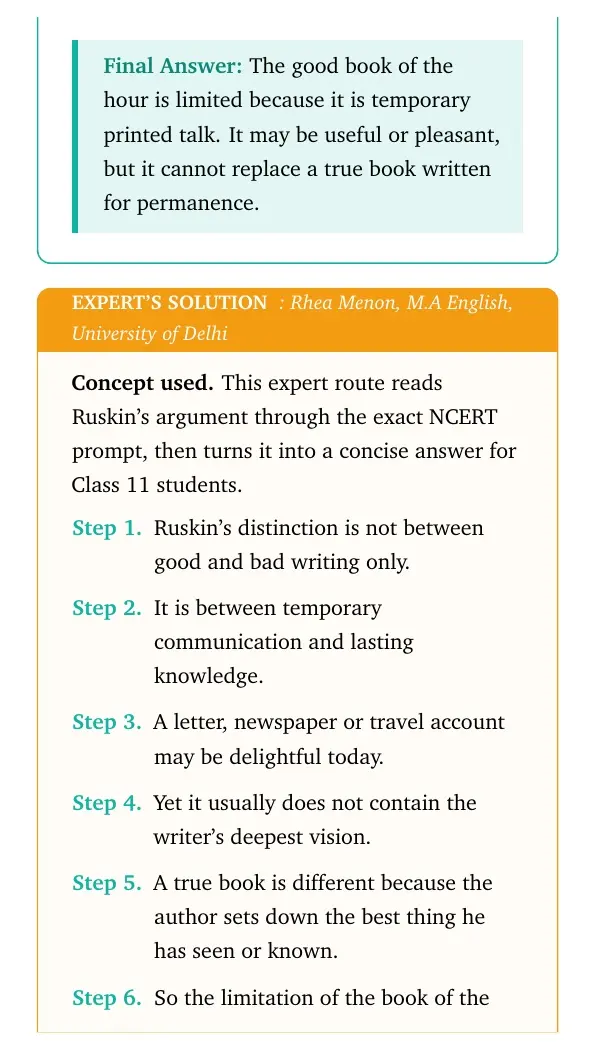
The good book of the hour is limited because it is temporary printed talk. It may be useful or pleasant, but it cannot replace a true book written for permanence.
RM
Rhea Menon
M.A English, University of Delhi
Verified Expert
Concept used. This expert route reads Ruskin's argument through the exact NCERT prompt, then turns it into a concise answer for Class 11 students.
Ruskin's distinction is not between good and bad writing only.
It is between temporary communication and lasting knowledge.
A letter, newspaper or travel account may be delightful today.
Yet it usually does not contain the writer's deepest vision.
A true book is different because the author sets down the best thing he has seen or known.
So the limitation of the book of the hour is its short life and narrow occasion.
For Ruskin, a book of the hour serves the day. A true book preserves an author's best truth beyond the day.
Q 21.2
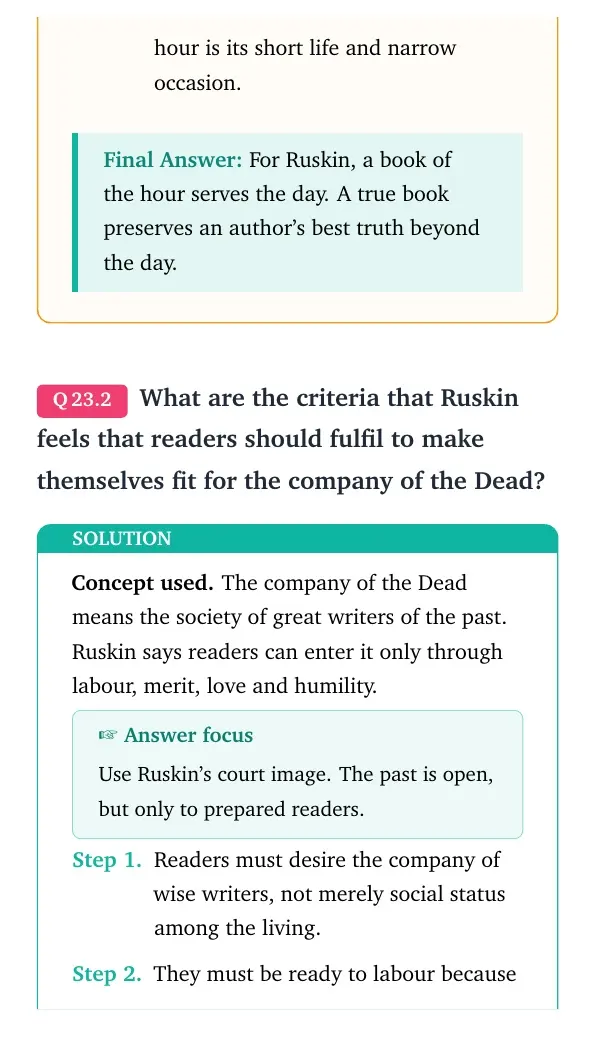
What are the criteria that Ruskin feels that students should fulfil to make themselves fit for the company of the Dead?
Concept used. The company of the Dead means the society of great writers of the past. Ruskin says students can enter it only through labour, merit, love and humility.
Answer focus
Use Ruskin's court image. The past is open, but only to prepared students.
Students must desire the company of wise writers, not merely social status among the living.
They must be ready to labour because this court is open to merit only.
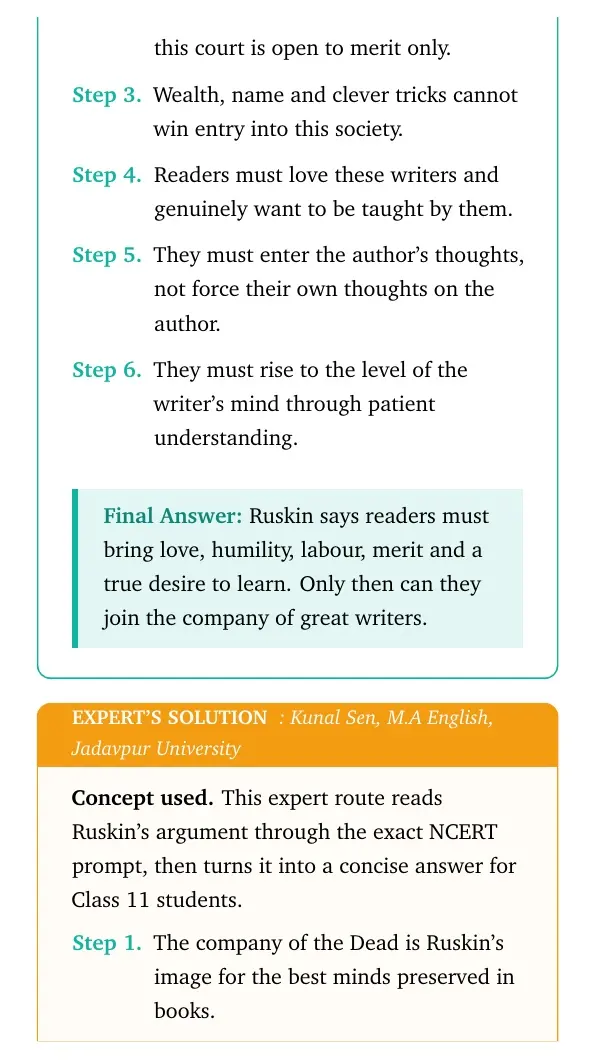
Wealth, name and clever tricks cannot win entry into this society.
Students must love these writers and genuinely want to be taught by them.
They must enter the author's thoughts, not force their own thoughts on the author.
They must rise to the level of the writer's mind through patient understanding.
Ruskin says students must bring love, humility, labour, merit and a true desire to learn. Only then can they join the company of great writers.
KS
Kunal Sen
M.A English, Jadavpur University
Verified Expert
Concept used. This expert route reads Ruskin's argument through the exact NCERT prompt, then turns it into a concise answer for Class 11 students.
The company of the Dead is Ruskin's image for the best minds preserved in books.
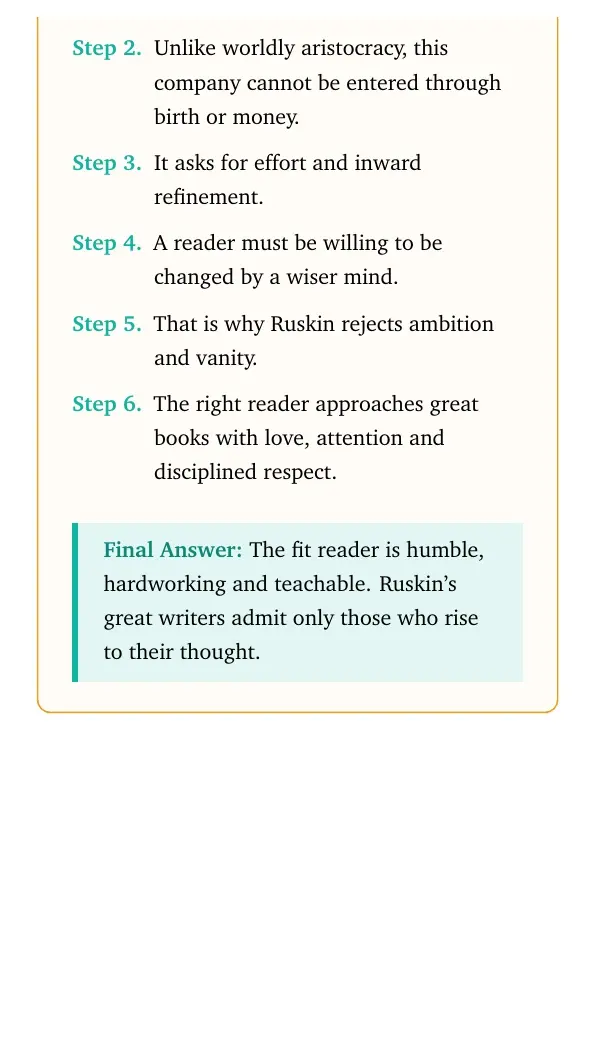
Unlike worldly aristocracy, this company cannot be entered through birth or money.
It asks for effort and inward refinement.
A student must be willing to be changed by a wiser mind.
That is why Ruskin rejects ambition and vanity.
The right student approaches great books with love, attention and disciplined respect.
The fit student is humble, hardworking and teachable. Ruskin's great writers admit only those who rise to their thought.
Q 21.3
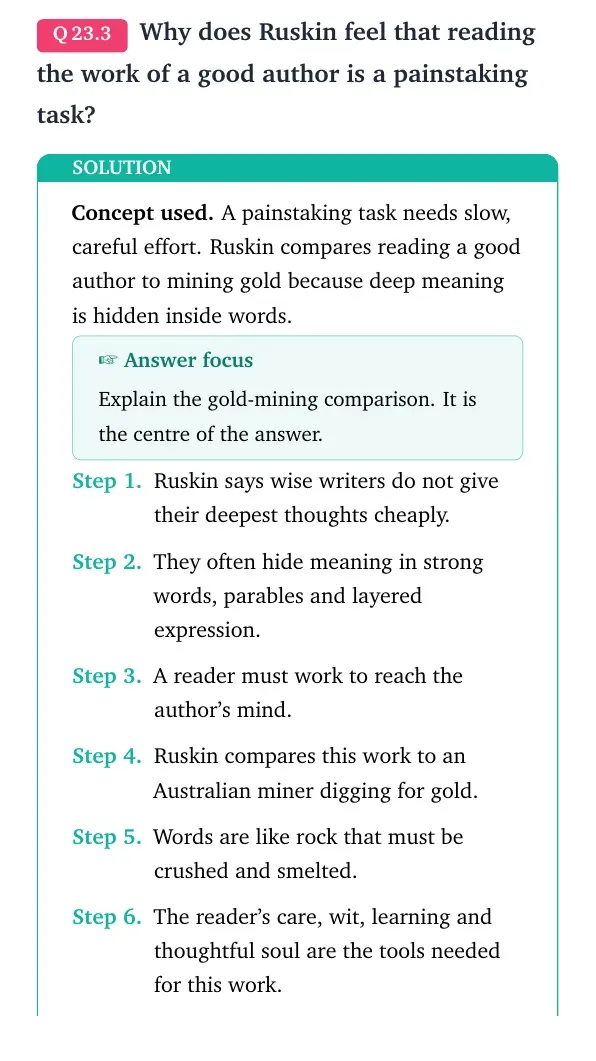
Why does Ruskin feel that reading the work of a good author is a painstaking task?
Concept used. A painstaking task needs slow, careful effort. Ruskin compares reading a good author to mining gold because deep meaning is hidden inside words.
Answer focus
Explain the gold-mining comparison. It is the centre of the answer.
Ruskin says wise writers do not give their deepest thoughts cheaply.
They often hide meaning in strong words, parables and layered expression.
A student must work to reach the author's mind.
Ruskin compares this work to an Australian miner digging for gold.
Words are like rock that must be crushed and smelted.
The student's care, wit, learning and thoughtful soul are the tools needed for this work.
Ruskin calls good reading painstaking because the author's best wisdom is hidden like gold in rock. The student must dig, crush and refine words carefully.
AR
Ananya Rao
M.A English, University of Mumbai
Verified Expert
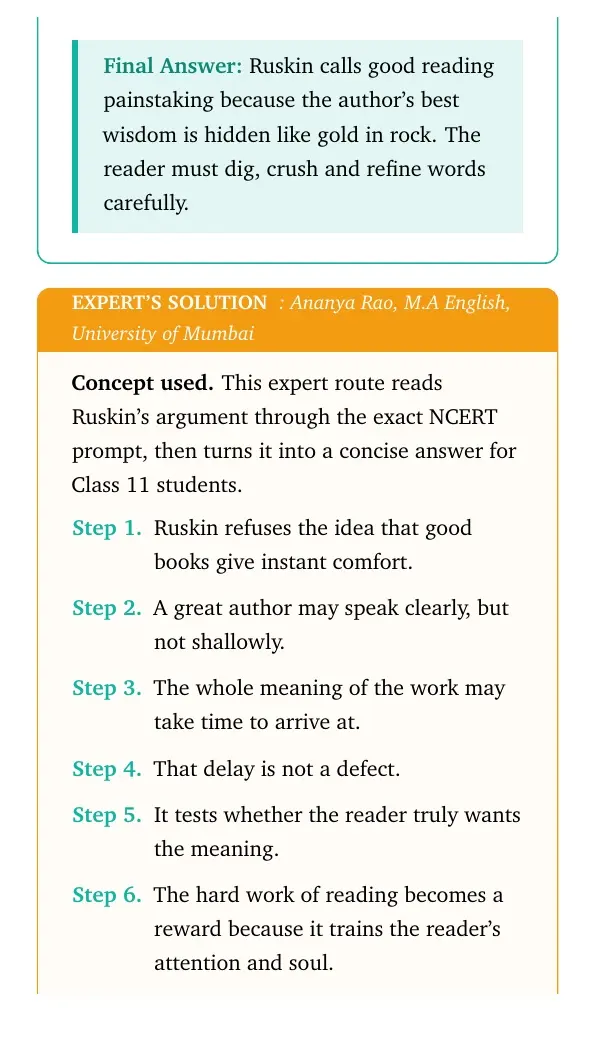
Concept used. This expert route reads Ruskin's argument through the exact NCERT prompt, then turns it into a concise answer for Class 11 students.
Ruskin refuses the idea that good books give instant comfort.
A great author may speak clearly, but not shallowly.
The whole meaning of the work may take time to arrive at.
That delay is not a defect.
It tests whether the student truly wants the meaning.
The hard work of reading becomes a reward because it trains the student's attention and soul.
Good reading is hard because wisdom is not skimmed. It is mined from exact words through patience and thought.
Q 21.4
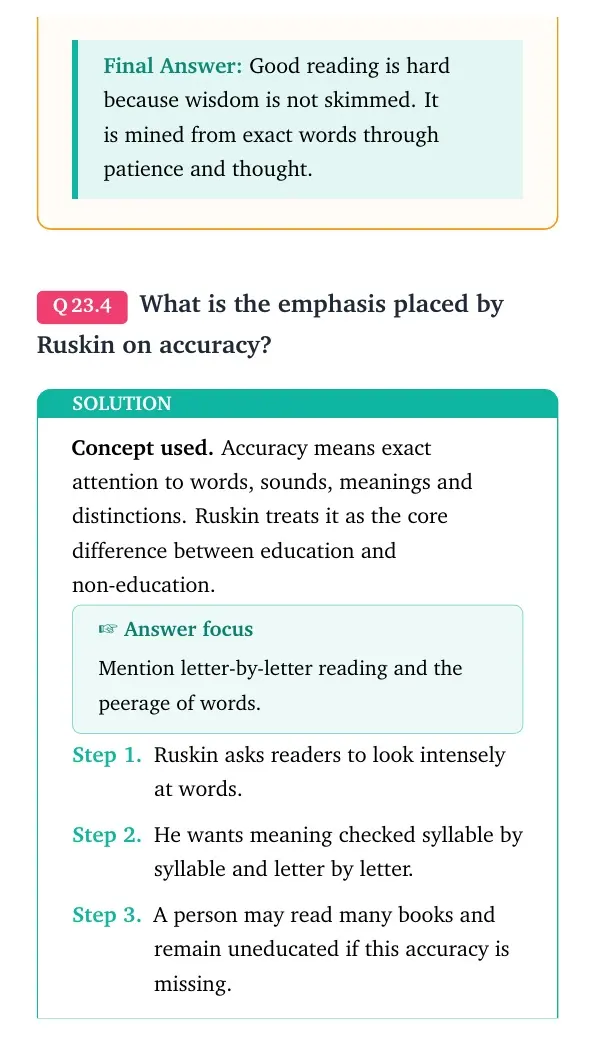
What is the emphasis placed by Ruskin on accuracy?
Concept used. Accuracy means exact attention to words, sounds, meanings and distinctions. Ruskin treats it as the core difference between education and non-education.
Answer focus
Mention letter-by-letter reading and the peerage of words.
Ruskin asks students to look intensely at words.
He wants meaning checked syllable by syllable and letter by letter.
A person may read many books and remain uneducated if this accuracy is missing.
A person who reads even ten pages accurately becomes more truly educated.
Ruskin says an educated person knows the ancestry, rank and relationships of words.
He also insists that wrong English meaning should trouble students more than wrong pronunciation alone.
Ruskin places the highest emphasis on accuracy. For him, true education begins when a student knows words precisely and watches meaning closely.
MS
Meera Sanyal
Ph.D English, University of Hyderabad
Verified Expert
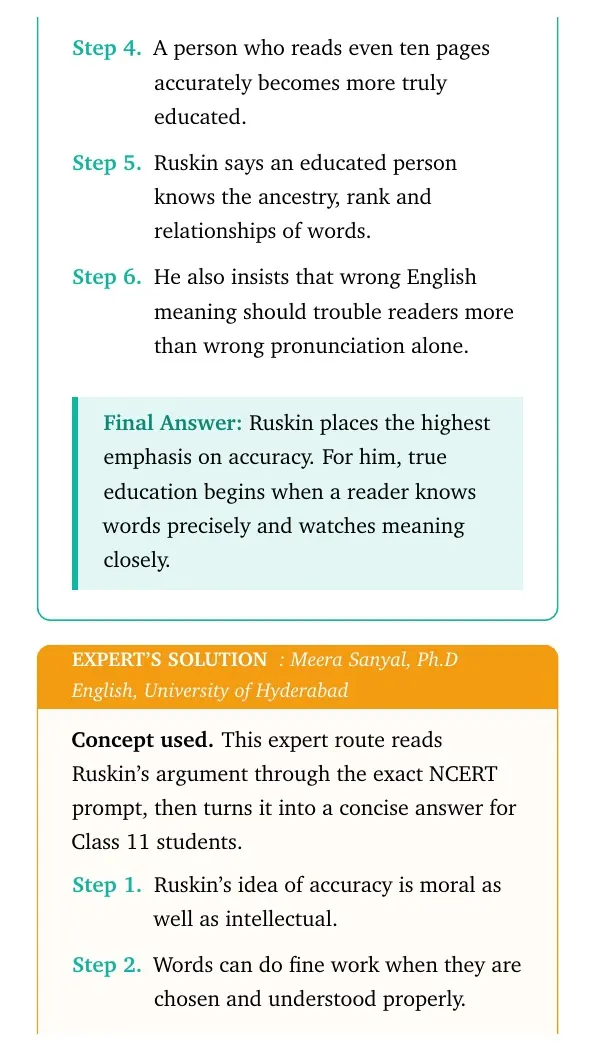
Concept used. This expert route reads Ruskin's argument through the exact NCERT prompt, then turns it into a concise answer for Class 11 students.
Ruskin's idea of accuracy is moral as well as intellectual.
Words can do fine work when they are chosen and understood properly.
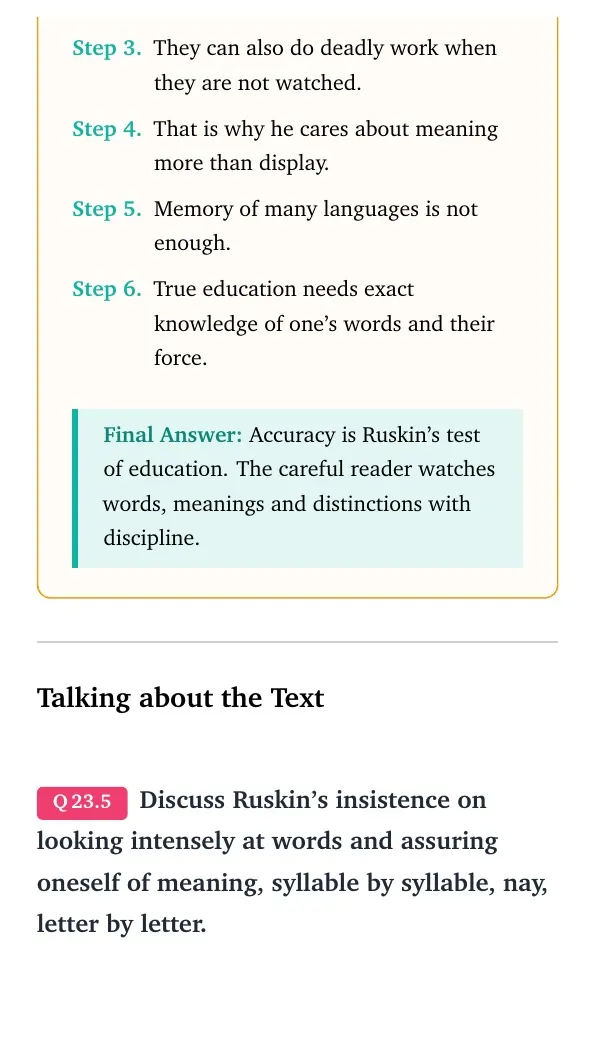
They can also do deadly work when they are not watched.
That is why he cares about meaning more than display.
Memory of many languages is not enough.
True education needs exact knowledge of one's words and their force.
Accuracy is Ruskin's test of education. The careful student watches words, meanings and distinctions with discipline.
Talking about the Text
Q 21.5
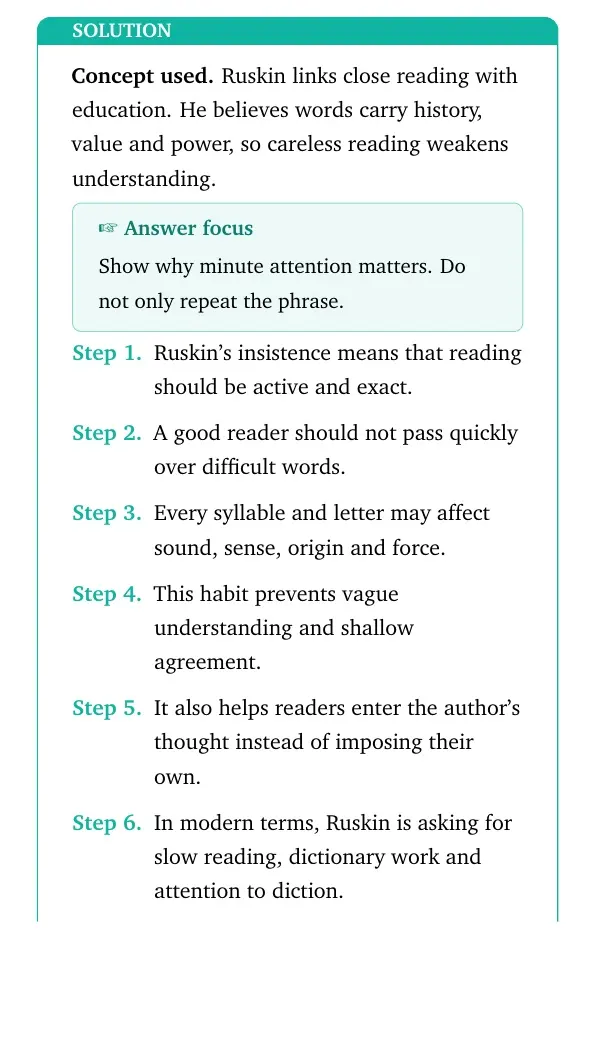
Discuss Ruskin's insistence on looking intensely at words and assuring oneself of meaning, syllable by syllable, nay, letter by letter.
Concept used. Ruskin links close reading with education. He believes words carry history, value and power, so careless reading weakens understanding.
Answer focus
Show why minute attention matters. Do not only repeat the phrase.
Ruskin's insistence means that reading should be active and exact.
A good student should not pass quickly over difficult words.
Every syllable and letter may affect sound, sense, origin and force.
This habit prevents vague understanding and shallow agreement.
It also helps students enter the author's thought instead of imposing their own.
In modern terms, Ruskin is asking for slow reading, dictionary work and attention to diction.
Ruskin insists on intense word study because true reading depends on exact meaning. Slow, accurate reading makes education real.
AT
Arvind Thomas
M.A English, EFLU Hyderabad
Verified Expert
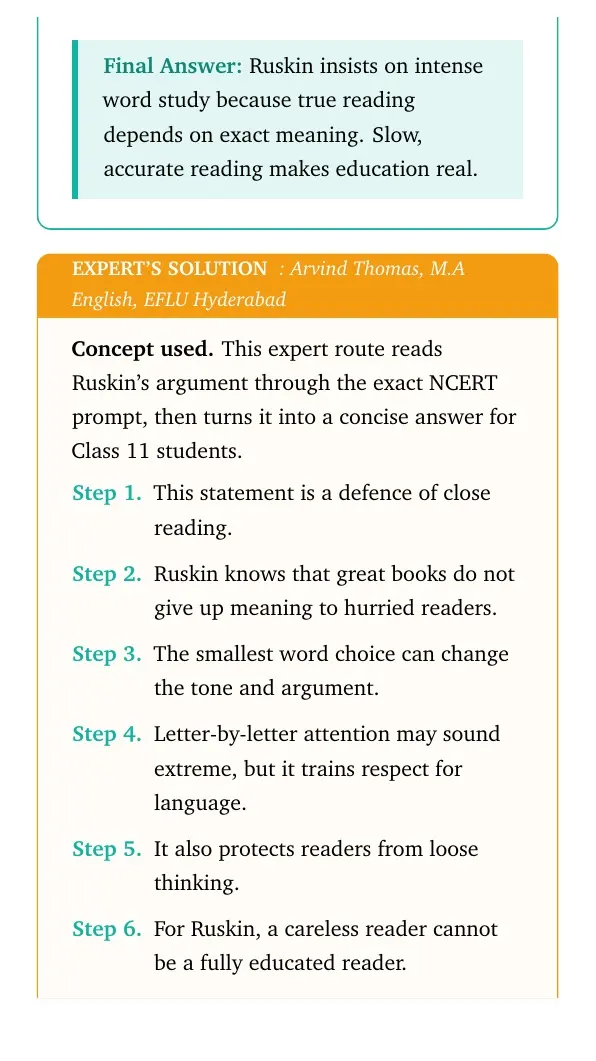
Concept used. This expert route reads Ruskin's argument through the exact NCERT prompt, then turns it into a concise answer for Class 11 students.
This statement is a defence of close reading.
Ruskin knows that great books do not give up meaning to hurried students.
The smallest word choice can change the tone and argument.
Letter-by-letter attention may sound extreme, but it trains respect for language.
It also protects students from loose thinking.
For Ruskin, a careless student cannot be a fully educated student.
The point is disciplined attention. Ruskin wants students to treat words as living carriers of thought, not as disposable marks.
Q 21.6
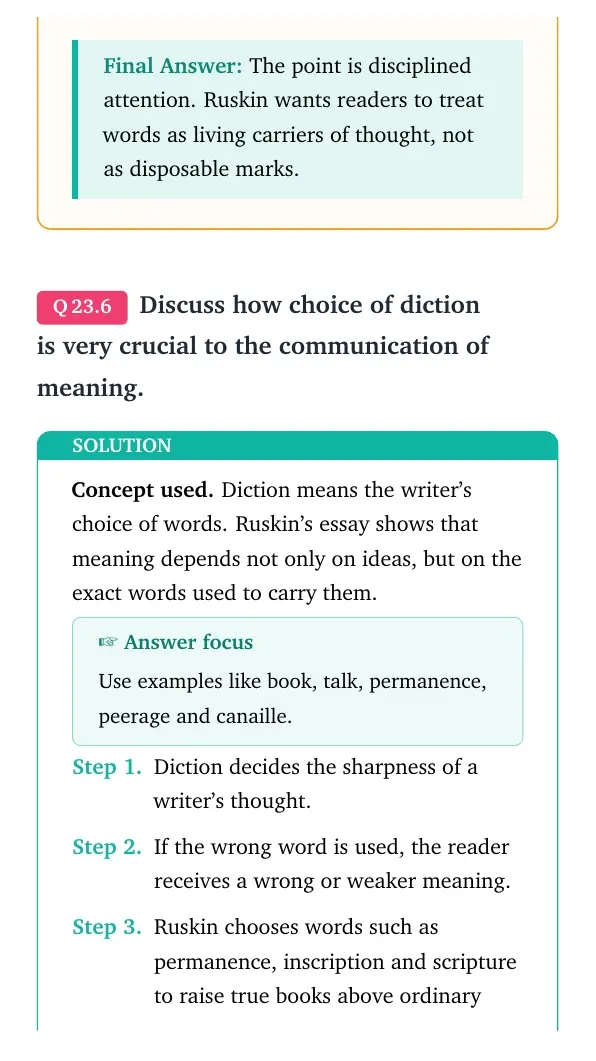
Discuss how choice of diction is very crucial to the communication of meaning.
Concept used. Diction means the writer's choice of words. Ruskin's essay shows that meaning depends not only on ideas, but on the exact words used to carry them.
Answer focus
Use examples like book, talk, permanence, peerage and canaille.
Diction decides the sharpness of a writer's thought.
If the wrong word is used, the student receives a wrong or weaker meaning.
Ruskin chooses words such as permanence, inscription and scripture to raise true books above ordinary printed talk.
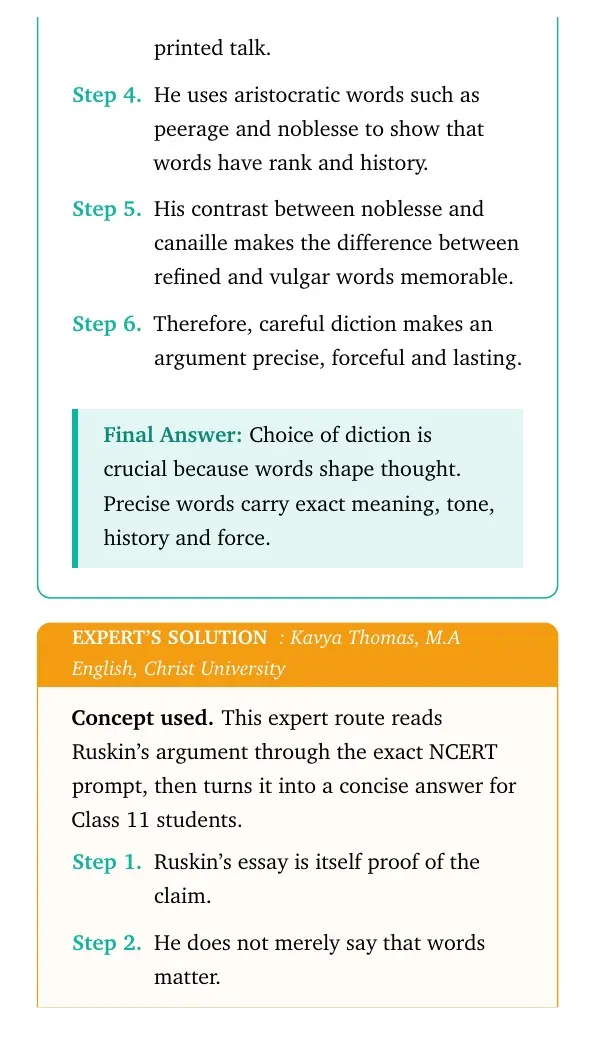
He uses aristocratic words such as peerage and noblesse to show that words have rank and history.
His contrast between noblesse and canaille makes the difference between refined and vulgar words memorable.
Therefore, careful diction makes an argument precise, forceful and lasting.
Choice of diction is crucial because words shape thought. Precise words carry exact meaning, tone, history and force.
KT
Kavya Thomas
M.A English, Christ University
Verified Expert
Concept used. This expert route reads Ruskin's argument through the exact NCERT prompt, then turns it into a concise answer for Class 11 students.
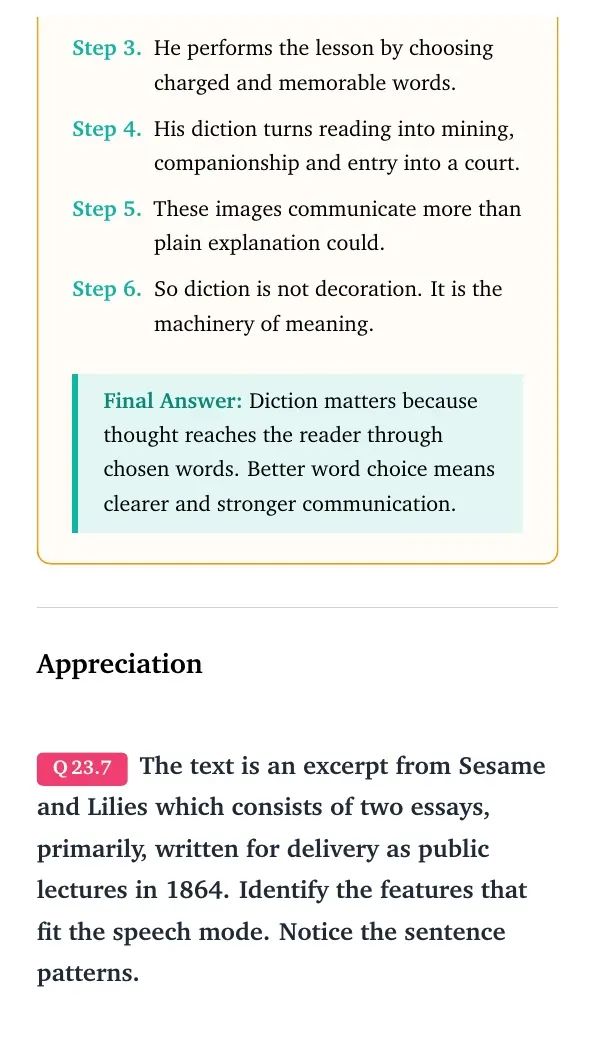
Ruskin's essay is itself proof of the claim.
He does not merely say that words matter.
He performs the lesson by choosing charged and memorable words.
His diction turns reading into mining, companionship and entry into a court.
These images communicate more than plain explanation could.
So diction is not decoration. It is the machinery of meaning.
Diction matters because thought reaches the student through chosen words. Better word choice means clearer and stronger communication.
Appreciation
Q 21.7
The text is an excerpt from Sesame and Lilies which consists of two essays, primarily, written for delivery as public lectures in 1864. Identify the features that fit the speech mode. Notice the sentence patterns.
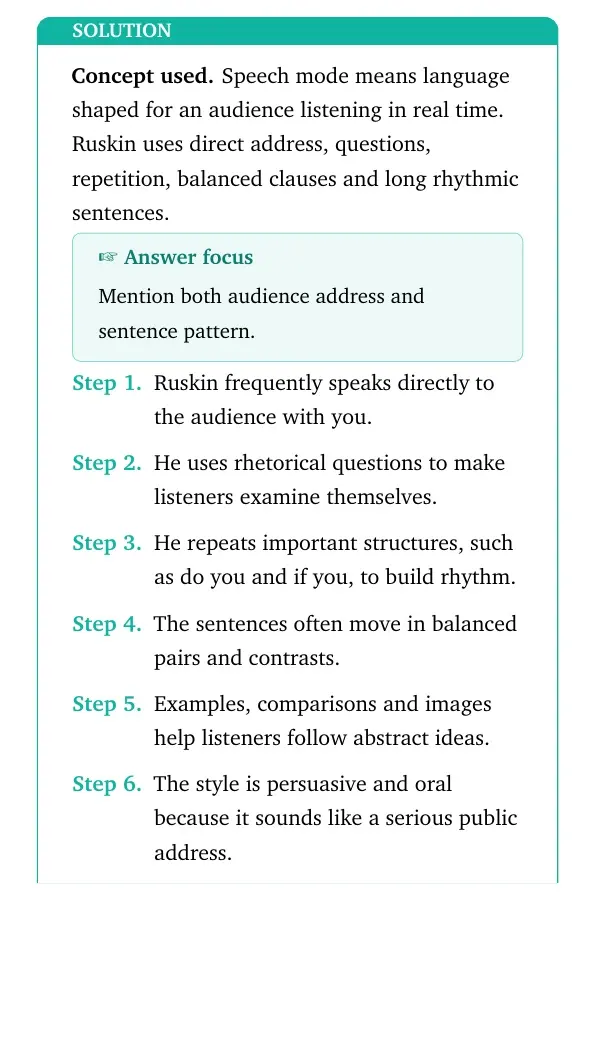
Concept used. Speech mode means language shaped for an students listening in real time. Ruskin uses direct address, questions, repetition, balanced clauses and long rhythmic sentences.
Answer focus
Mention both students address and sentence pattern.
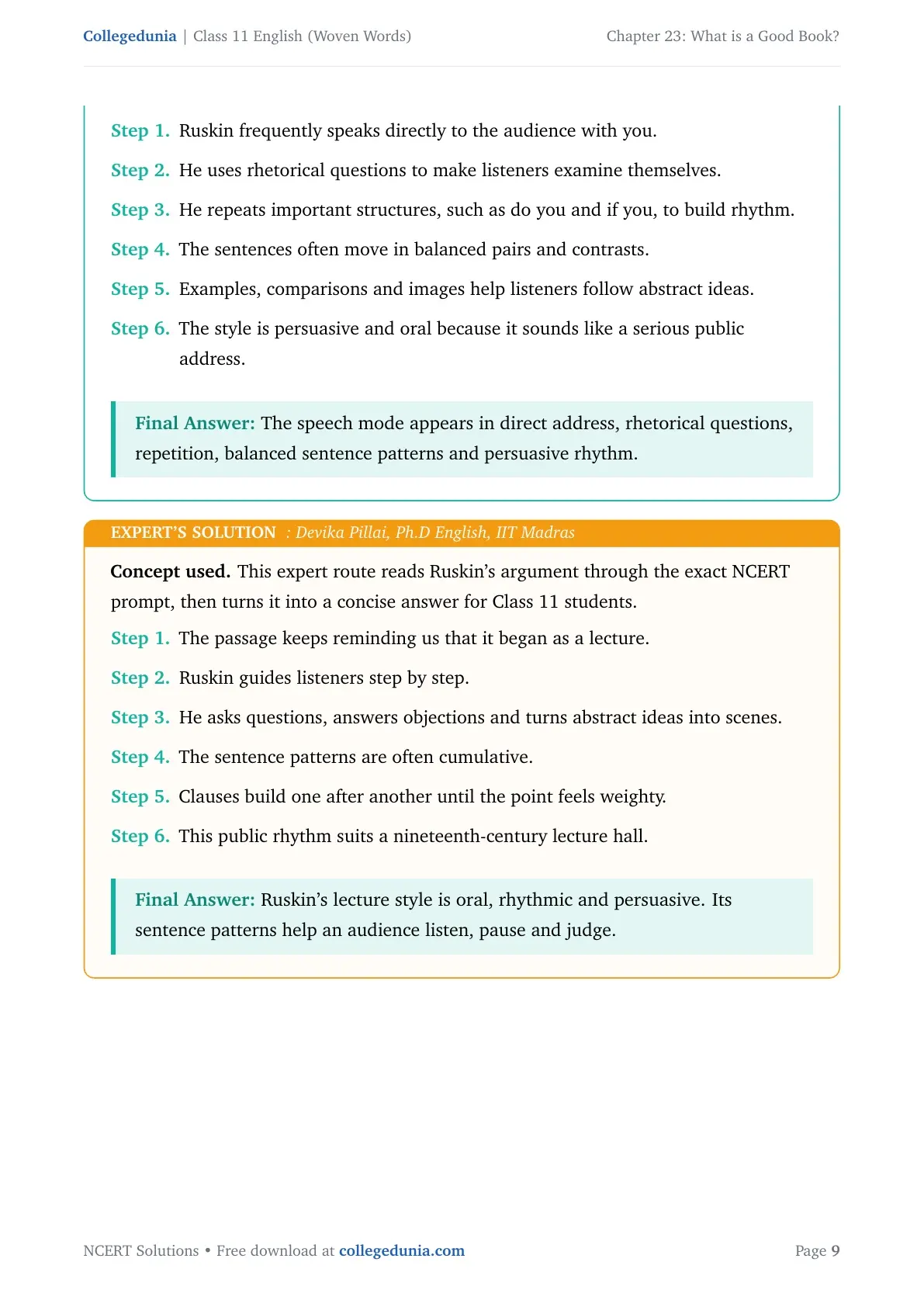
Ruskin frequently speaks directly to the students with you.
He uses rhetorical questions to make listeners examine themselves.
He repeats important structures, such as do you and if you, to build rhythm.
The sentences often move in balanced pairs and contrasts.
Examples, comparisons and images help listeners follow abstract ideas.
The style is persuasive and oral because it sounds like a serious public address.
The speech mode appears in direct address, rhetorical questions, repetition, balanced sentence patterns and persuasive rhythm.
DP
Devika Pillai
Ph.D English, IIT Madras
Verified Expert
Concept used. This expert route reads Ruskin's argument through the exact NCERT prompt, then turns it into a concise answer for Class 11 students.
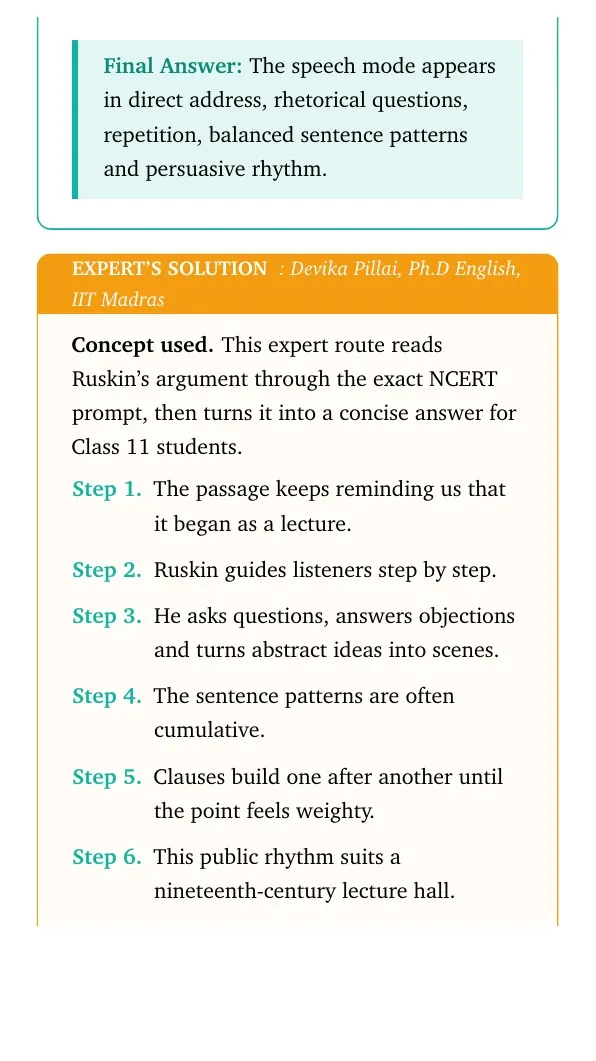
The passage keeps reminding us that it began as a lecture.
Ruskin guides listeners step by step.
He asks questions, answers objections and turns abstract ideas into scenes.
The sentence patterns are often cumulative.
Clauses build one after another until the point feels weighty.
This public rhythm suits a nineteenth-century lecture hall.
Ruskin's lecture style is oral, rhythmic and persuasive. Its sentence patterns help an students listen, pause and judge.
Q 21.8
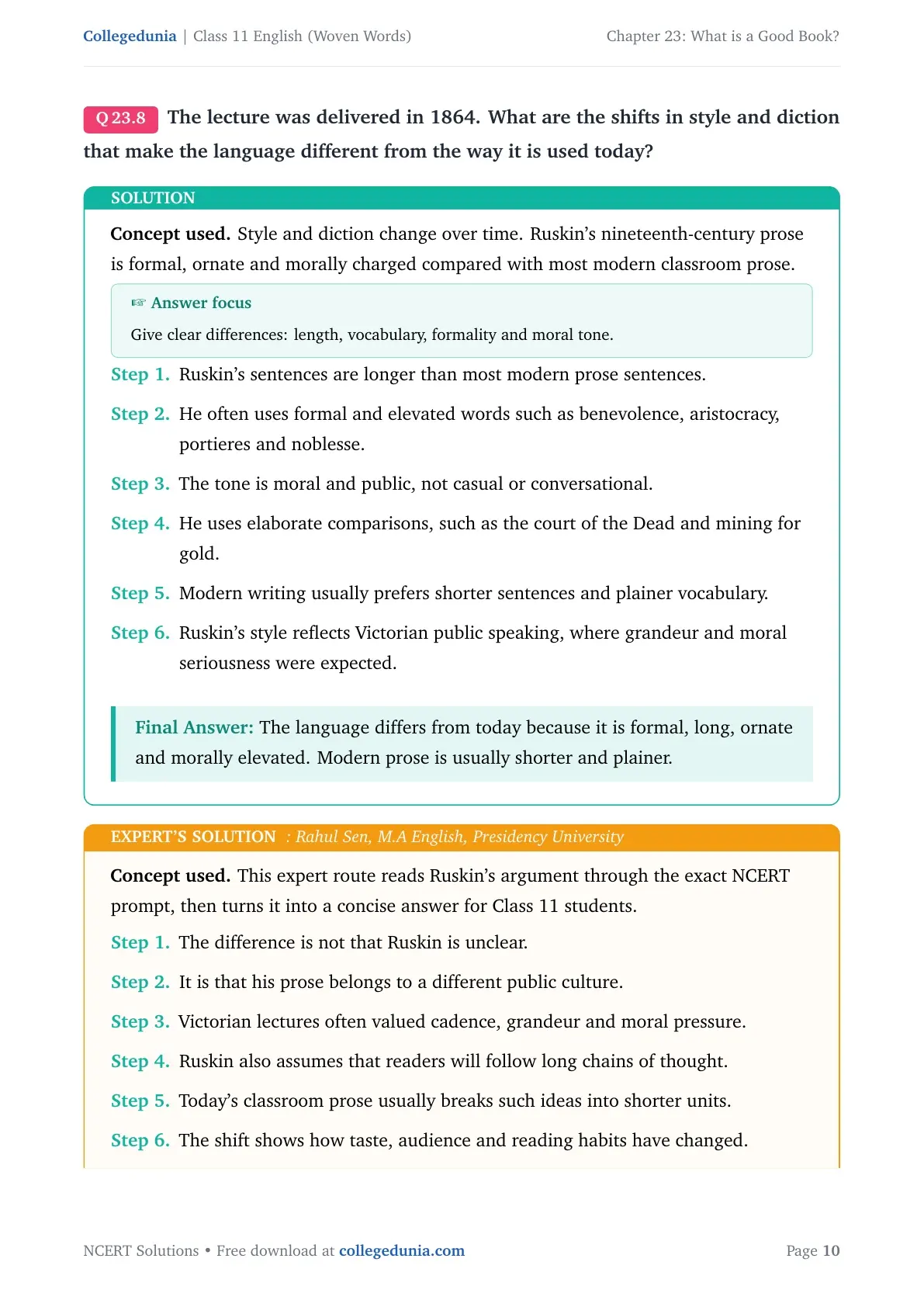
The lecture was delivered in 1864. What are the shifts in style and diction that make the language different from the way it is used today?
Concept used. Style and diction change over time. Ruskin's nineteenth-century prose is formal, ornate and morally charged compared with most modern classroom prose.
Answer focus
Give clear differences: length, vocabulary, formality and moral tone.
Ruskin's sentences are longer than most modern prose sentences.
He often uses formal and elevated words such as benevolence, aristocracy, portieres and noblesse.
The tone is moral and public, not casual or conversational.
He uses elaborate comparisons, such as the court of the Dead and mining for gold.
Modern writing usually prefers shorter sentences and plainer vocabulary.
Ruskin's style reflects Victorian public speaking, where grandeur and moral seriousness were expected.
The language differs from today because it is formal, long, ornate and morally elevated. Modern prose is usually shorter and plainer.
RS
Rahul Sen
M.A English, Presidency University
Verified Expert
Concept used. This expert route reads Ruskin's argument through the exact NCERT prompt, then turns it into a concise answer for Class 11 students.
The difference is not that Ruskin is unclear.
It is that his prose belongs to a different public culture.
Victorian lectures often valued cadence, grandeur and moral pressure.
Ruskin also assumes that students will follow long chains of thought.
Today's classroom prose usually breaks such ideas into shorter units.
The shift shows how taste, students and reading habits have changed.
Ruskin's diction is Victorian: formal, layered and oratorical. Today's English generally values speed, simplicity and directness.
Language Work
Q 21.9
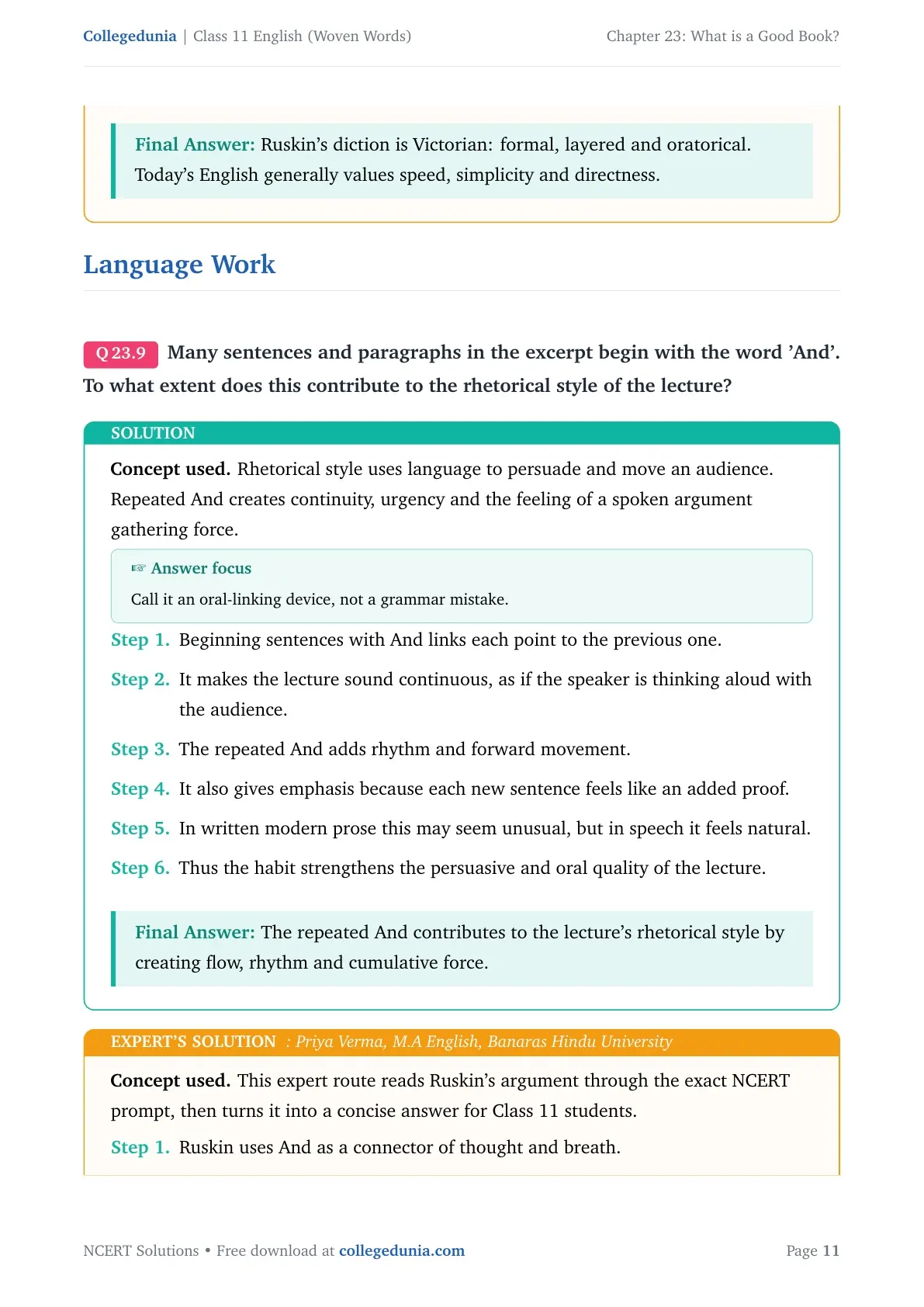
Many sentences and paragraphs in the excerpt begin with the word 'And'. To what extent does this contribute to the rhetorical style of the lecture?
Concept used. Rhetorical style uses language to persuade and move an students. Repeated And creates continuity, urgency and the feeling of a spoken argument gathering force.
Answer focus
Call it an oral-linking device, not a grammar mistake.
Beginning sentences with And links each point to the previous one.
It makes the lecture sound continuous, as if the speaker is thinking aloud with the students.
The repeated And adds rhythm and forward movement.
It also gives emphasis because each new sentence feels like an added proof.
In written modern prose this may seem unusual, but in speech it feels natural.
Thus the habit strengthens the persuasive and oral quality of the lecture.
The repeated And contributes to the lecture's rhetorical style by creating flow, rhythm and cumulative force.
PV
Priya Verma
M.A English, Banaras Hindu University
Verified Expert
Concept used. This expert route reads Ruskin's argument through the exact NCERT prompt, then turns it into a concise answer for Class 11 students.
Ruskin uses And as a connector of thought and breath.
It makes the students feel that the argument is unfolding before them.
The device also avoids a dry textbook tone.
Each new point seems to grow from the last.
This is why the passage sounds like a lecture rather than a compact essay.
The repeated opening is therefore a stylistic choice.
And gives Ruskin's lecture momentum. It joins ideas and makes the prose sound spoken, urgent and cumulative.
Q 21.10
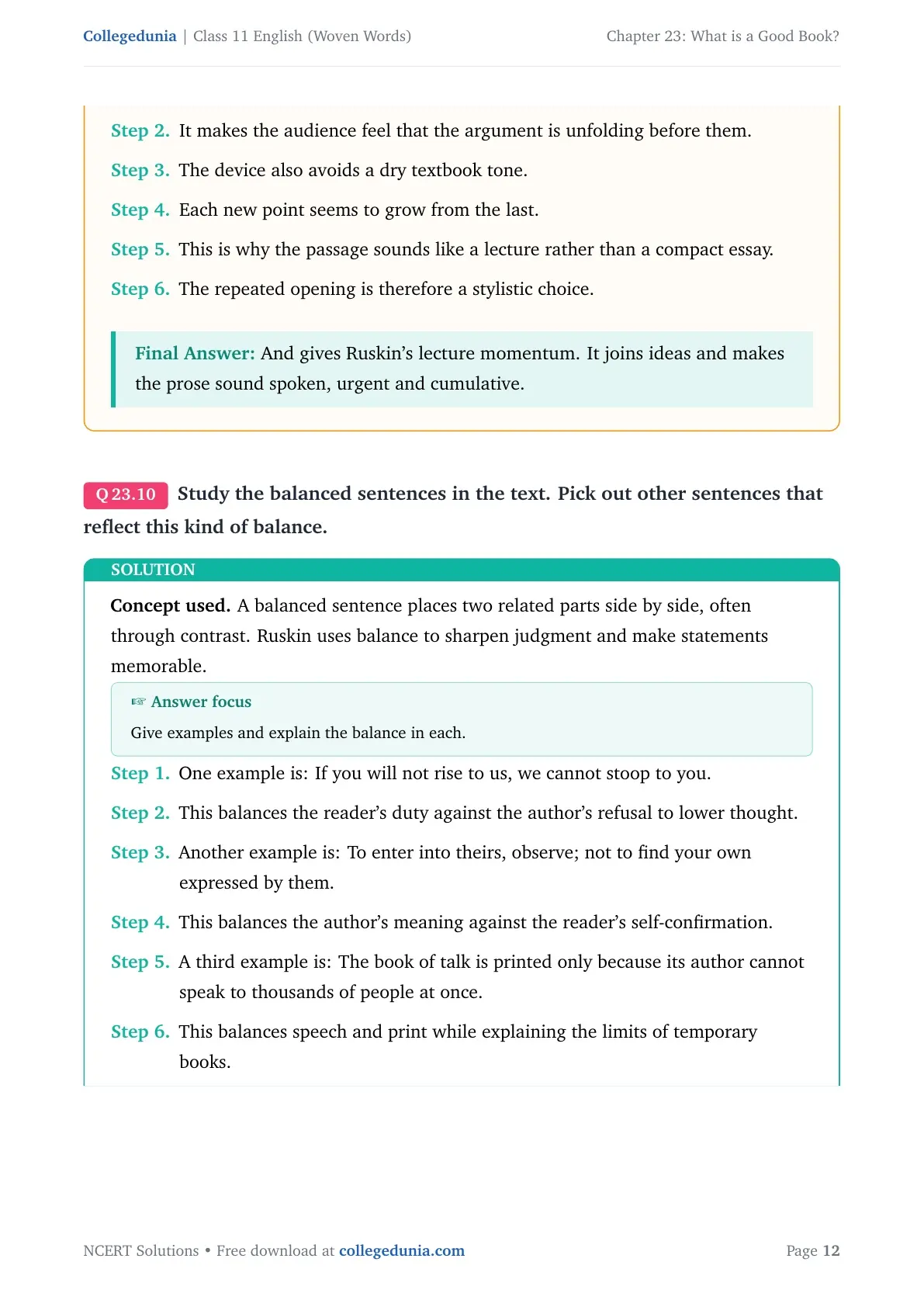
Study the balanced sentences in the text. Pick out other sentences that reflect this kind of balance.
Concept used. A balanced sentence places two related parts side by side, often through contrast. Ruskin uses balance to sharpen judgment and make statements memorable.
Answer focus
Give examples and explain the balance in each.
One example is: If you will not rise to us, we cannot stoop to you.
This balances the student's duty against the author's refusal to lower thought.
Another example is: To enter into theirs, observe; not to find your own expressed by them.
This balances the author's meaning against the student's self-confirmation.
A third example is: The book of talk is printed only because its author cannot speak to thousands of people at once.
This balances speech and print while explaining the limits of temporary books.
Examples include: If you will not rise to us, we cannot stoop to you; To enter into theirs, not to find your own expressed by them; Let the accent of words be watched, but let the meaning be watched more closely still. Each sentence balances two opposed ideas.
TJ
Tara Joshi
M.A English, University of Delhi
Verified Expert
Concept used. This expert route reads Ruskin's argument through the exact NCERT prompt, then turns it into a concise answer for Class 11 students.
Balanced structure is one reason Ruskin's prose sounds formal and forceful.
The student hears two halves weighing against each other.
Such sentences suit his habit of contrast: talk against writing, temporary against permanent, ambition against love.
They also help a listening students remember the point.
The style is therefore both grammatical and rhetorical.
It turns explanation into memorable judgment.
The best examples balance rise against stoop, the author's thought against the student's thought, and accent against meaning. This balance gives Ruskin's argument force.
What is a Good Book Class 11 NCERT Solutions FAQs
Ques. Who wrote What is a Good Book? in Class 11 Woven Words?
Ans. What is a Good Book? is by John Ruskin, a nineteenth-century critic and social thinker.
Ques. What is the main idea of What is a Good Book?
Ans. The essay explains that true books preserve lasting wisdom, while books of the hour serve temporary information or pleasure.
Ques. How many NCERT questions are solved in this PDF?
Ans. The PDF solves 10 NCERT prompts from Understanding the Text, Talking about the Text, Appreciation and Language Work.
Ques. Why does Ruskin compare reading to mining gold?
Ans. Ruskin compares reading to mining because a good author's deepest meaning is hidden inside words and must be reached with patient effort.







Comments