



The NCERT Solutions for Class 11 Geography Chapter 14 Biodiversity and Conservation cover all exercise questions from the latest 2026-27 NCERT book. The chapter explains biodiversity, its three levels, hotspots, exotic species, protected areas and conservation steps.
- Covers MCQs, short answers, long answers and the map-based project prompt.
- Focuses on high scoring terms: genetic diversity, species diversity, ecosystem diversity, hotspots and exotic species.
- Useful for school exams because each answer keeps the NCERT wording clear and direct.

Student Feedback: In a Collegedunia poll of 11,260 Class 11 Geography students preparing for the 2026 school exams, 74% said they knew the word biodiversity but confused its three levels.
Source: 2026-27 Class 11 Geography student poll across CBSE schools.
Every answer in this solution set is checked against the 2026-27 NCERT Geography textbook and written so students can revise the definition, example and conservation point together.
Biodiversity and Conservation Quick Revision for Class 11 Geography
Biodiversity means the variety of organisms found on the earth. NCERT explains it at three levels: genes, species and ecosystems. India is one of the twelve mega diversity countries, so the chapter links classroom geography with forests, wildlife and protected areas.
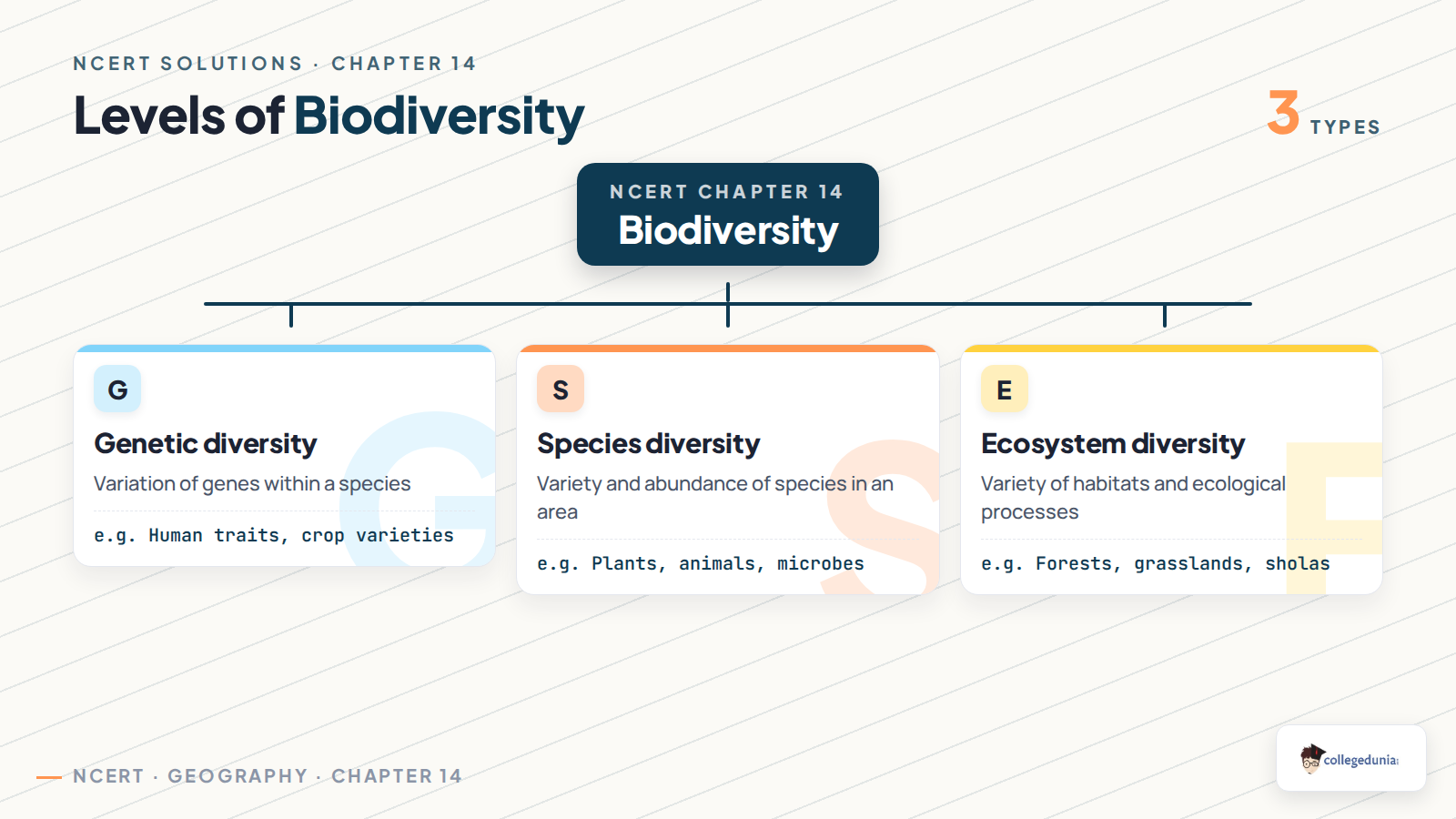
| Level | Meaning | Exam cue |
|---|---|---|
| Genetic diversity | Variation within the same species | Human traits and crop varieties |
| Species diversity | Variety of species in an area | Plants, animals and microbes |
| Ecosystem diversity | Variety of habitats and ecological processes | Forests, wetlands and grasslands |
Biodiversity and Conservation Explained for Class 11
Source: Magnet Brains on YouTube
Why Biodiversity Matters in the Biodiversity and Conservation Chapter
Biodiversity supports nature and human life at the same time. It maintains food chains, keeps nutrient cycles active and gives people timber, food, medicines and genetic material. NCERT also treats biodiversity as scientific value because every species helps researchers understand ecological balance.
- Ecological role: species keep pollination, soil formation and food webs stable.
- Economic role: forests and wildlife support food, fibre, timber and medicine resources.
- Scientific role: genetic resources help crop improvement, research and future problem solving.
Loss of Biodiversity and Conservation Steps for Class 11 Geography
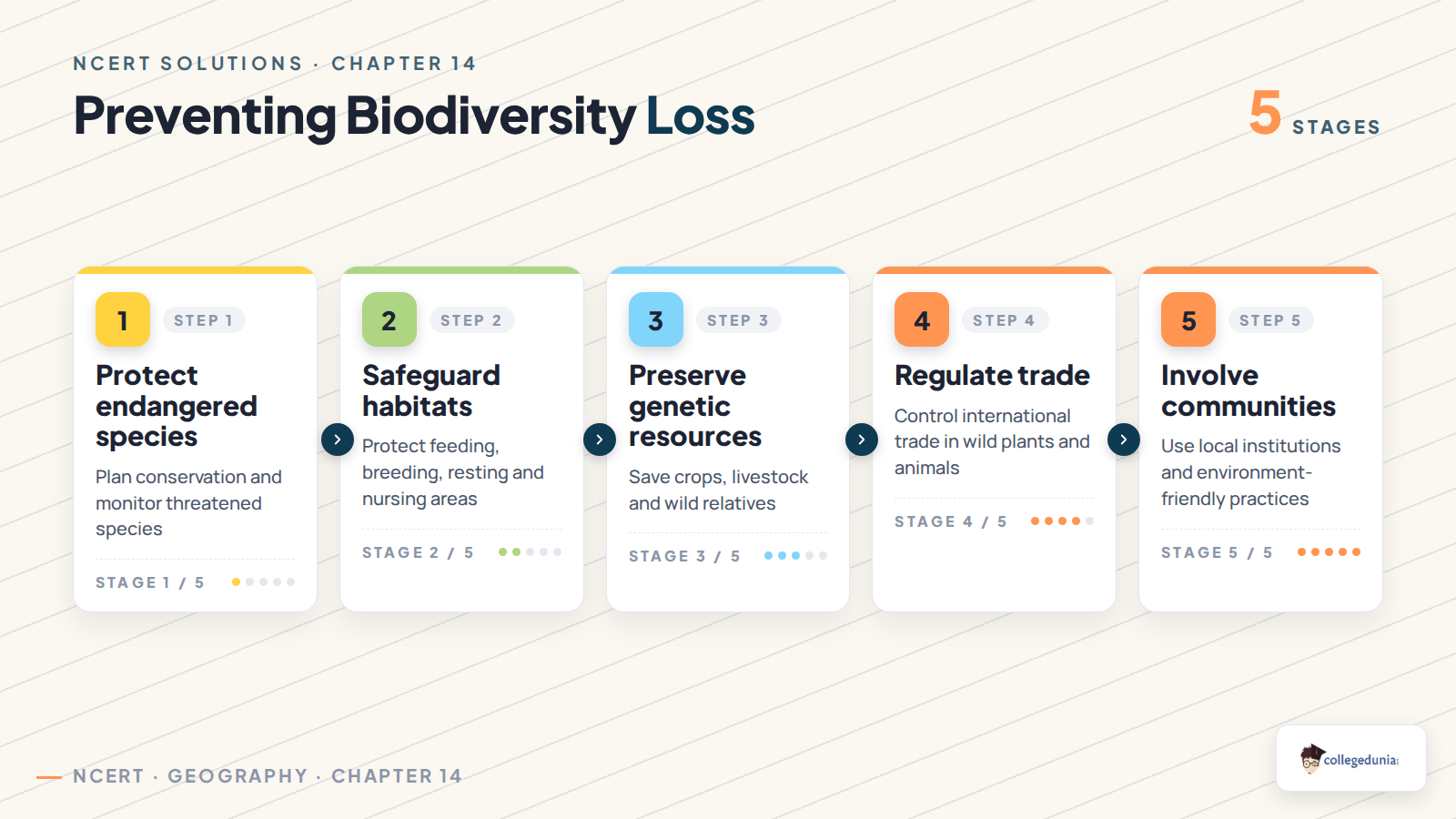
Biodiversity declines when habitats are destroyed, species are overused, exotic species spread or pollution weakens ecosystems. Protected areas such as national parks, wildlife sanctuaries and biosphere reserves conserve species in their natural habitat.
- Identify threatened plants, animals and habitats before the loss becomes irreversible.
- Protect feeding, breeding, resting and nursing sites of endangered species.
- Regulate trade in wild plants, animals and their products.
- Preserve genetic diversity in food crops, livestock, microbes and wild relatives.
- Involve local communities so conservation becomes practical, not just legal.
Related Geography Resources for Biodiversity and Conservation
Use the solutions PDF for exercise answers. Pair it with the book PDF and notes when you want to revise the theory before writing the answers.
| Resource | Best use | Link |
|---|---|---|
| NCERT Book PDF | Original reading and exercise questions | Biodiversity and Conservation Class 11 NCERT Book PDF |
| Notes | Quick definitions, hotspots and conservation terms | Biodiversity and Conservation Class 11 Notes |
| Handwritten Notes | Last minute recall before a school test | Biodiversity and Conservation Class 11 Handwritten Notes |
NCERT Solutions for All Class 11 Geography Chapters
All NCERT Solutions for Class 11 Geography Chapter 14 Biodiversity and Conservation with Step-by-Step Solutions
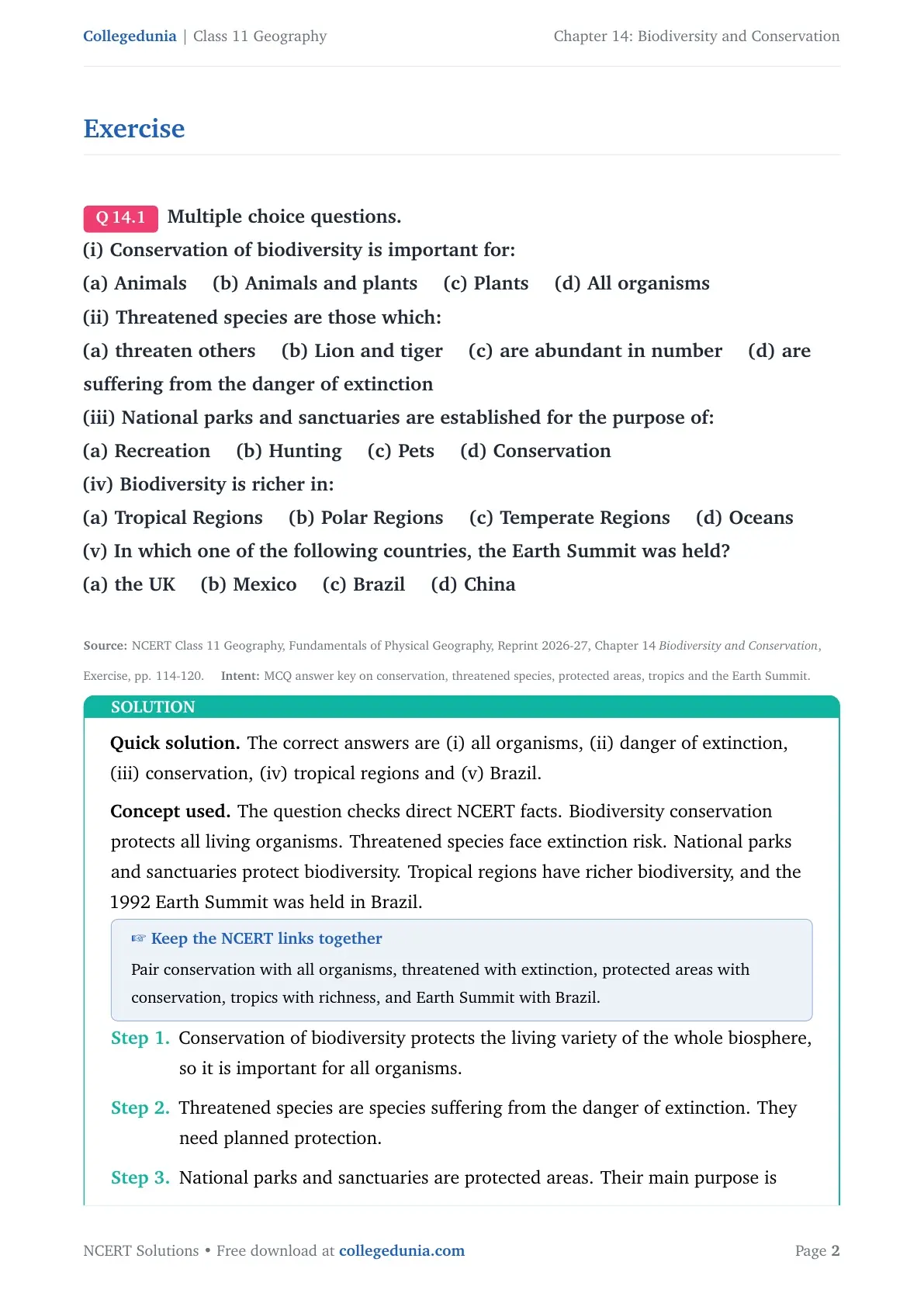
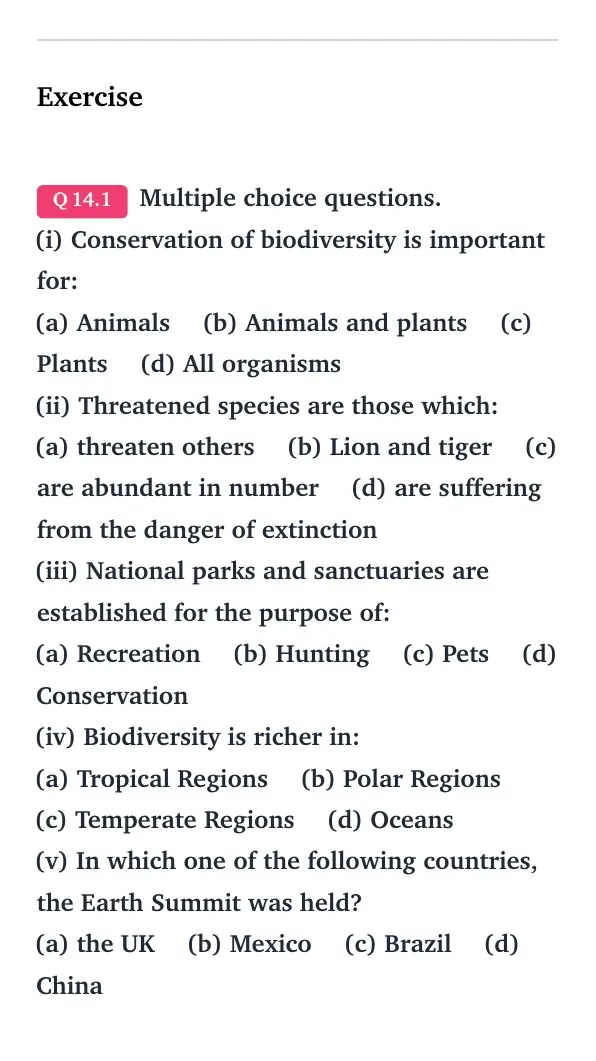
Question 1
Multiple choice questions.
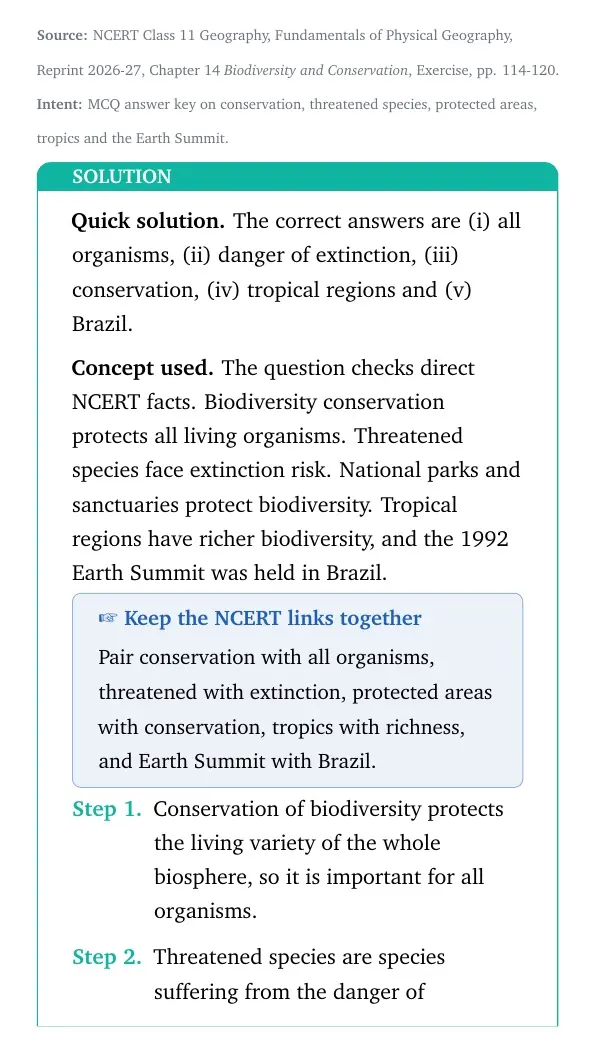
(i) Conservation of biodiversity is important for:
(a) Animals (b) Animals and plants (c) Plants (d) All organisms
(ii) Threatened species are those which:
(a) threaten others (b) Lion and tiger (c) are abundant in number (d) are suffering from the danger of extinction
(iii) National parks and sanctuaries are established for the purpose of:
(a) Recreation (b) Hunting (c) Pets (d) Conservation
(iv) Biodiversity is richer in:
(a) Tropical Regions (b) Polar Regions (c) Temperate Regions (d) Oceans
(v) In which one of the following countries, the Earth Summit was held?
(a) the UK (b) Mexico (c) Brazil (d) China
Quick solution. The correct answers are (i) all organisms, (ii) danger of extinction, (iii) conservation, (iv) tropical regions and (v) Brazil.
Concept used. The question checks direct NCERT facts. Biodiversity conservation protects all living organisms. Threatened species face extinction risk. National parks and sanctuaries protect biodiversity. Tropical regions have richer biodiversity, and the 1992 Earth Summit was held in Brazil.
- Conservation of biodiversity protects the living variety of the whole biosphere, so it is important for all organisms.
- Threatened species are species suffering from the danger of extinction. They need planned protection.
- National parks and sanctuaries are protected areas. Their main purpose is conservation, not hunting or recreation.
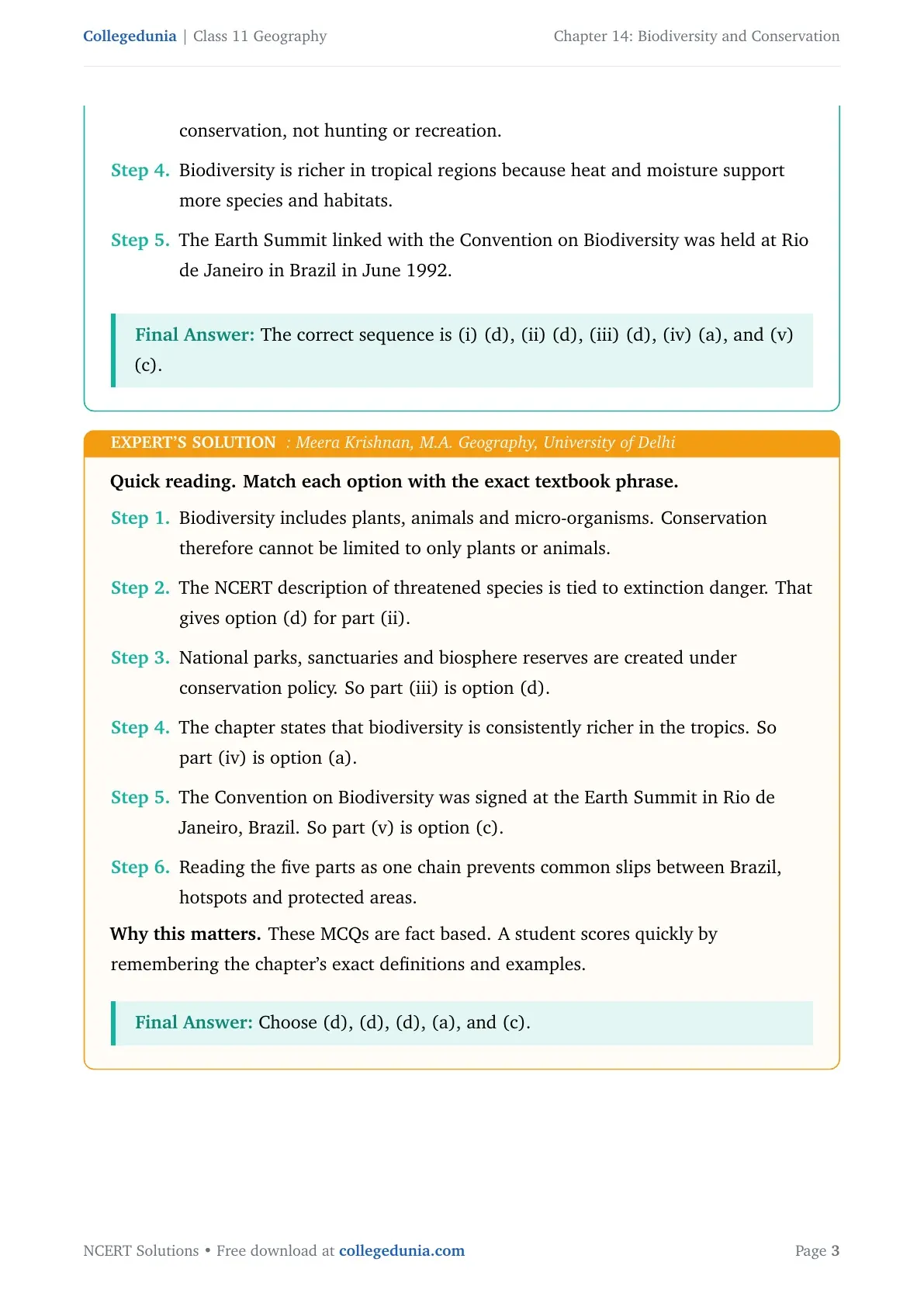
- Biodiversity is richer in tropical regions because heat and moisture support more species and habitats.
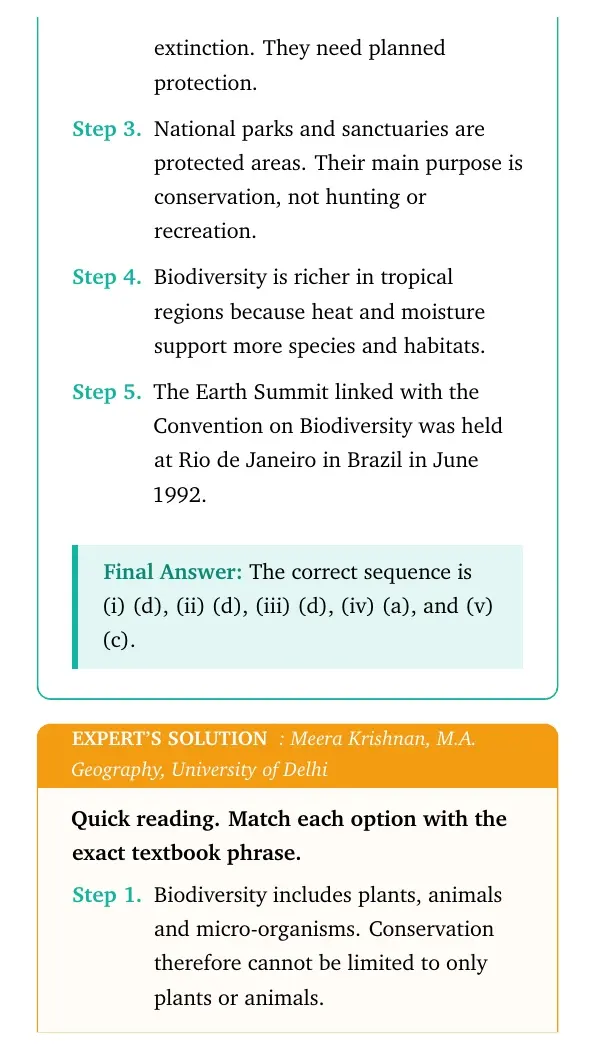
- The Earth Summit linked with the Convention on Biodiversity was held at Rio de Janeiro in Brazil in June 1992.
Final answer: The correct sequence is (i) (d), (ii) (d), (iii) (d), (iv) (a), and (v) (c).
Quick reading. Match each option with the exact textbook phrase.
- Biodiversity includes plants, animals and micro-organisms. Conservation therefore cannot be limited to only plants or animals.
- The NCERT description of threatened species is tied to extinction danger. That gives option (d) for part (ii).
- National parks, sanctuaries and biosphere reserves are created under conservation policy. So part (iii) is option (d).
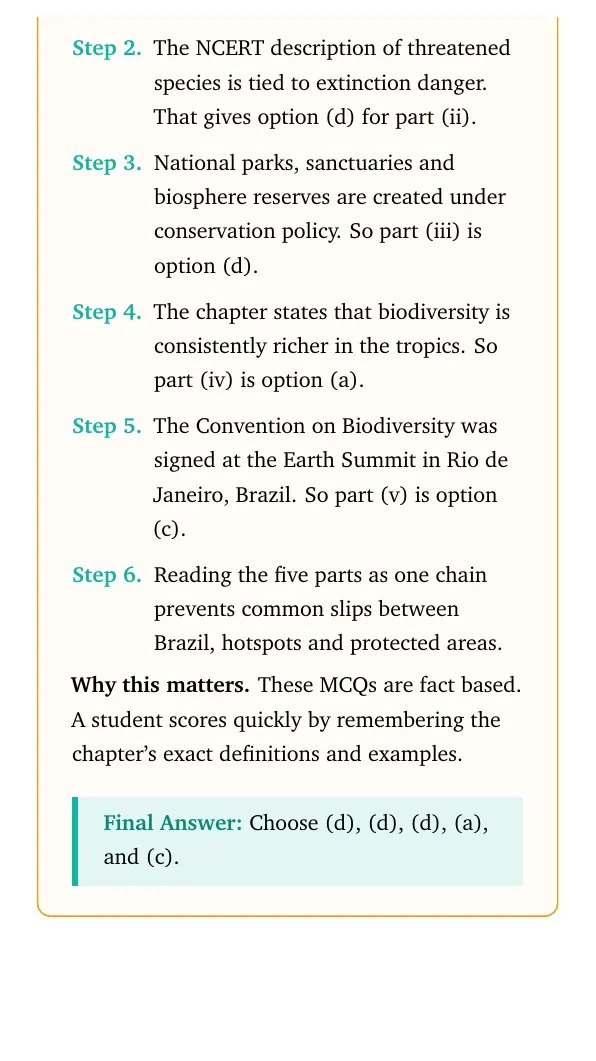
- The chapter states that biodiversity is consistently richer in the tropics. So part (iv) is option (a).
- The Convention on Biodiversity was signed at the Earth Summit in Rio de Janeiro, Brazil. So part (v) is option (c).
- Reading the five parts as one chain prevents common slips between Brazil, hotspots and protected areas.
Why this matters. These MCQs are fact based. A student scores quickly by remembering the chapter's exact definitions and examples.
Expert answer: Choose (d), (d), (d), (a), and (c).
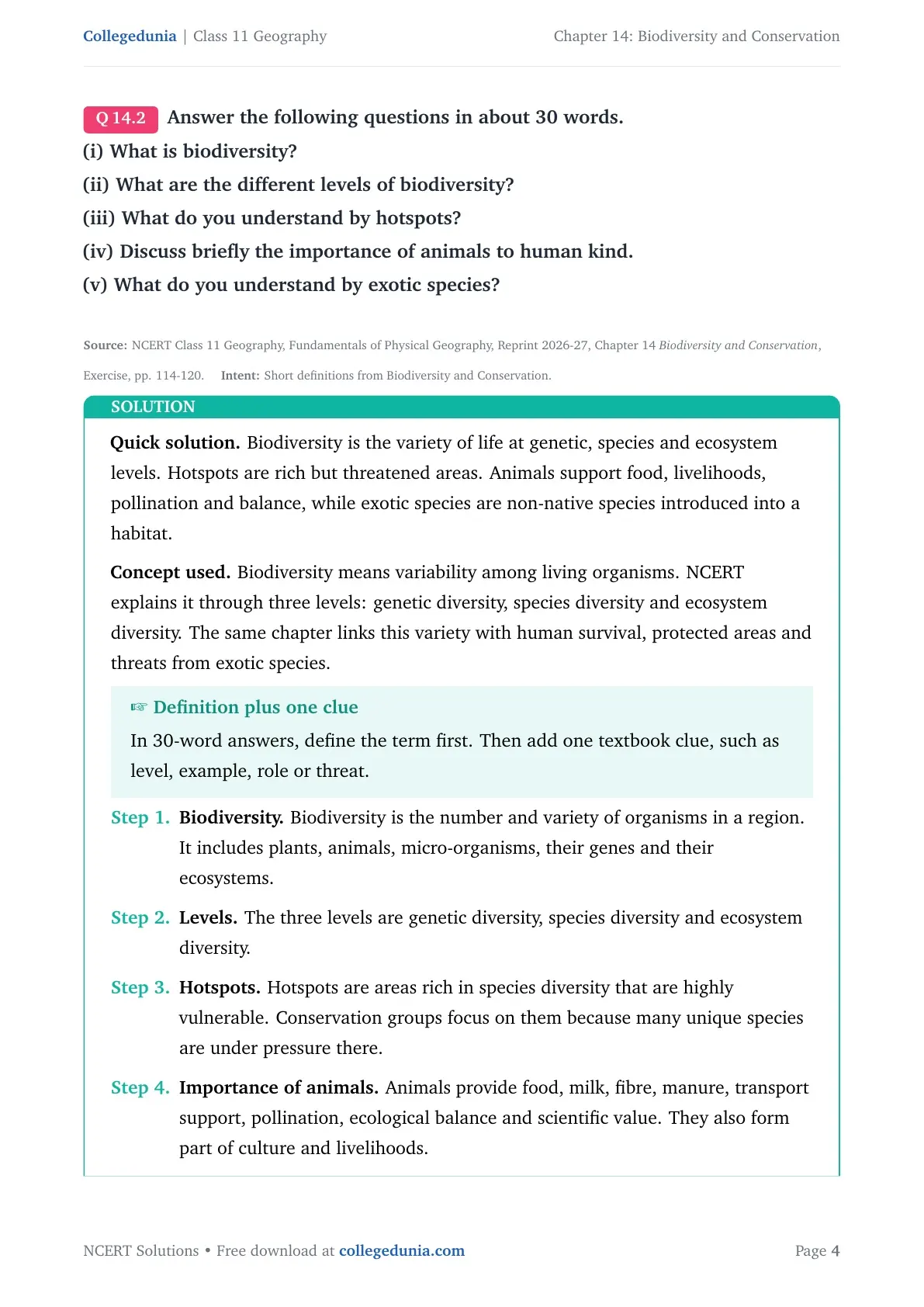
Question 2
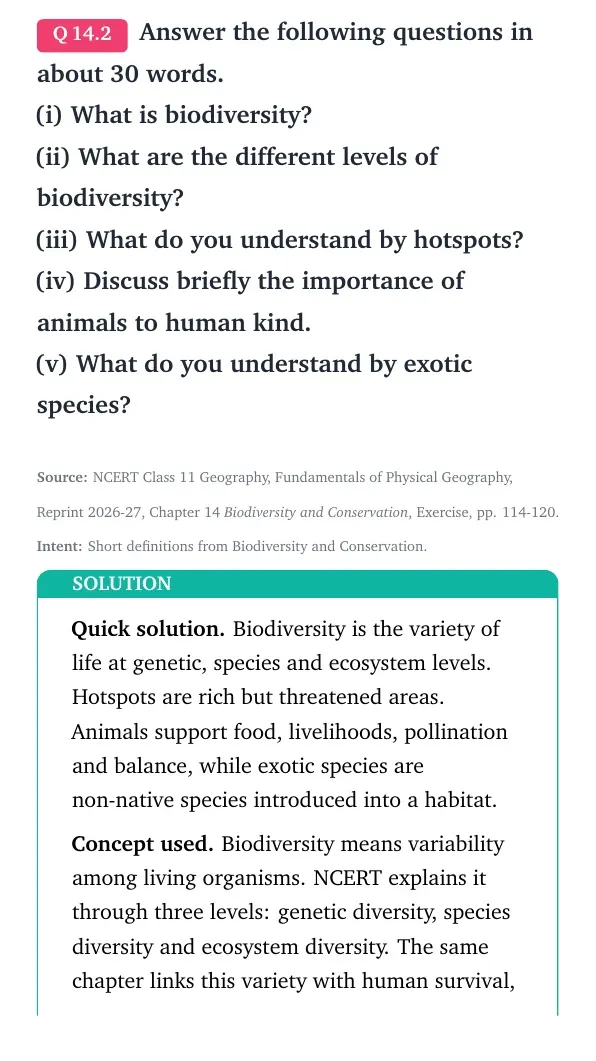
Answer the following questions in about 30 words.
(i) What is biodiversity?
(ii) What are the different levels of biodiversity?
(iii) What do you understand by hotspots?
(iv) Discuss briefly the importance of animals to human kind.
(v) What do you understand by exotic species?
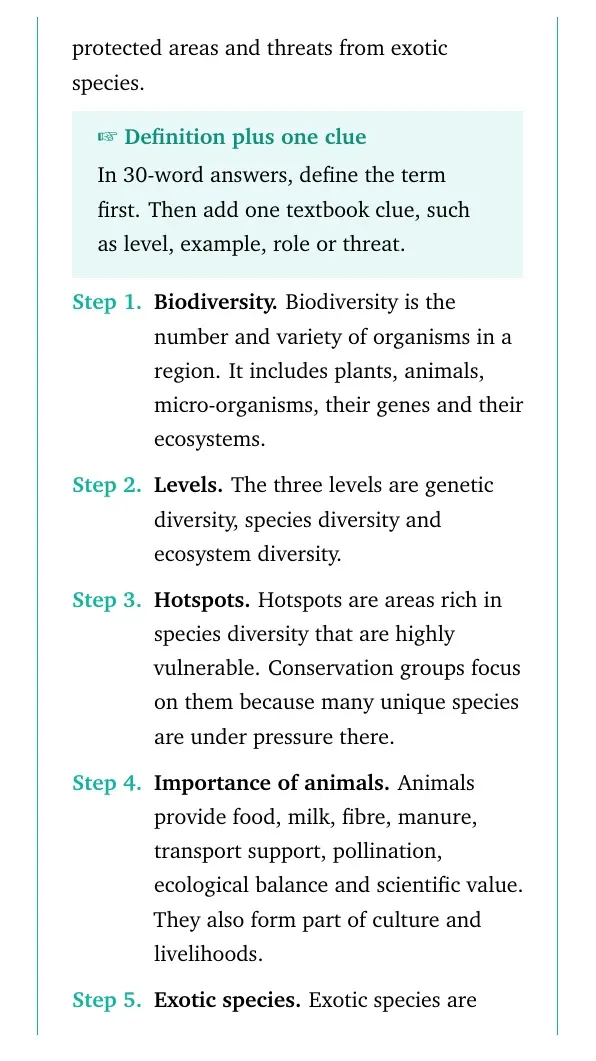
Quick solution. Biodiversity is the variety of life at genetic, species and ecosystem levels. Hotspots are rich but threatened areas. Animals support food, livelihoods, pollination and balance, while exotic species are non-native species introduced into a habitat.
Concept used. Biodiversity means variability among living organisms. NCERT explains it through three levels: genetic diversity, species diversity and ecosystem diversity. The same chapter links this variety with human survival, protected areas and threats from exotic species.
- Biodiversity. Biodiversity is the number and variety of organisms in a region. It includes plants, animals, micro-organisms, their genes and their ecosystems.
- Levels. The three levels are genetic diversity, species diversity and ecosystem diversity.
- Hotspots. Hotspots are areas rich in species diversity that are highly vulnerable. Conservation groups focus on them because many unique species are under pressure there.
- Importance of animals. Animals provide food, milk, fibre, manure, transport support, pollination, ecological balance and scientific value. They also form part of culture and livelihoods.
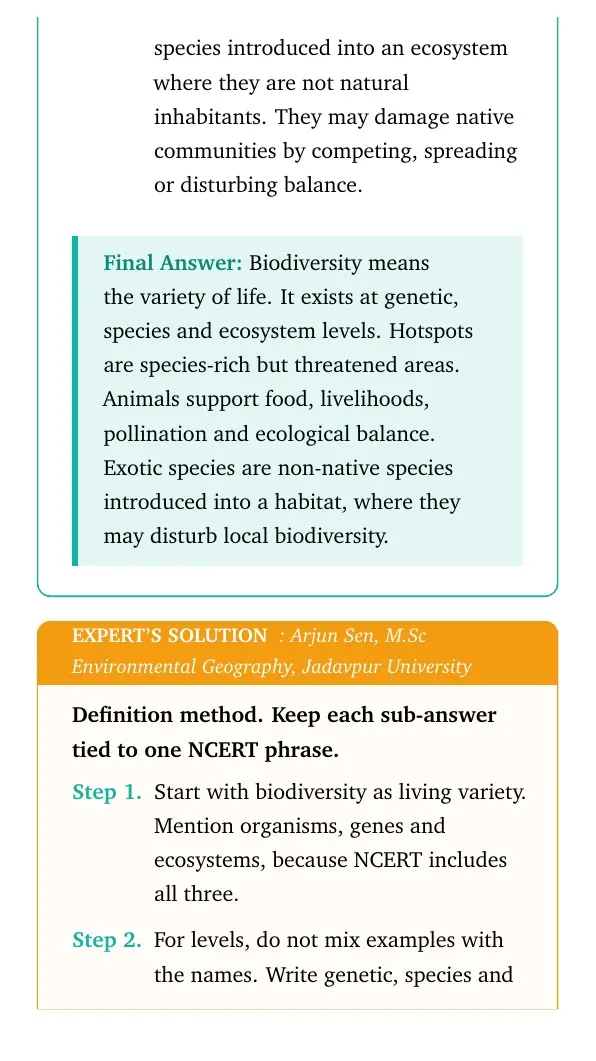
- Exotic species. Exotic species are species introduced into an ecosystem where they are not natural inhabitants. They may damage native communities by competing, spreading or disturbing balance.
Final answer: Biodiversity means the variety of life. It exists at genetic, species and ecosystem levels. Hotspots are species-rich but threatened areas. Animals support food, livelihoods, pollination and ecological balance. Exotic species are non-native species introduced into a habitat, where they may disturb local biodiversity.
Definition method. Keep each sub-answer tied to one NCERT phrase.
- Start with biodiversity as living variety. Mention organisms, genes and ecosystems, because NCERT includes all three.
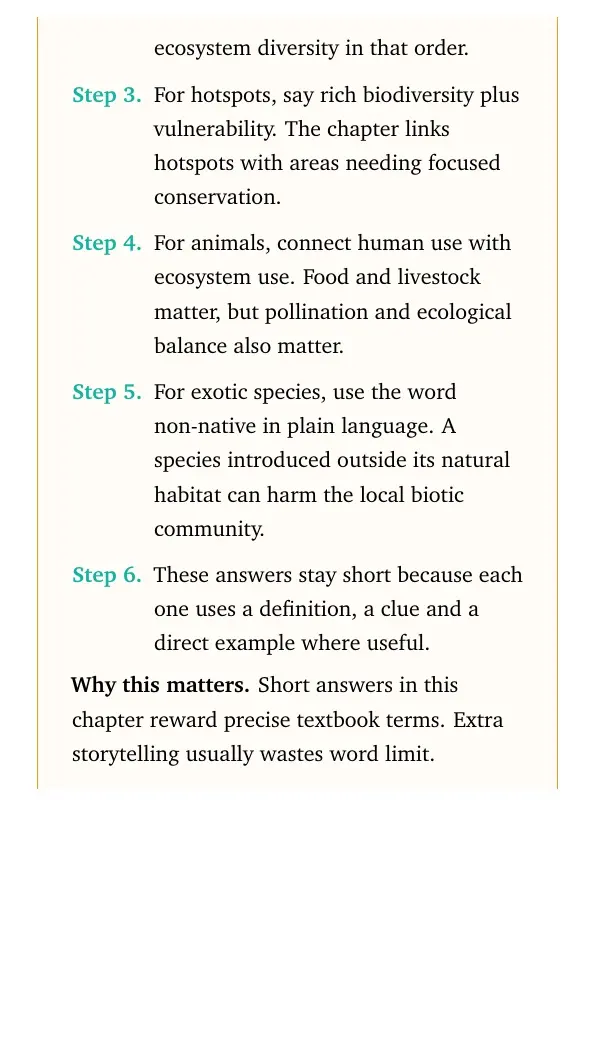
- For levels, do not mix examples with the names. Write genetic, species and ecosystem diversity in that order.
- For hotspots, say rich biodiversity plus vulnerability. The chapter links hotspots with areas needing focused conservation.
- For animals, connect human use with ecosystem use. Food and livestock matter, but pollination and ecological balance also matter.
- For exotic species, use the word non-native in plain language. A species introduced outside its natural habitat can harm the local biotic community.
- These answers stay short because each one uses a definition, a clue and a direct example where useful.
Why this matters. Short answers in this chapter reward precise textbook terms. Extra storytelling usually wastes word limit.
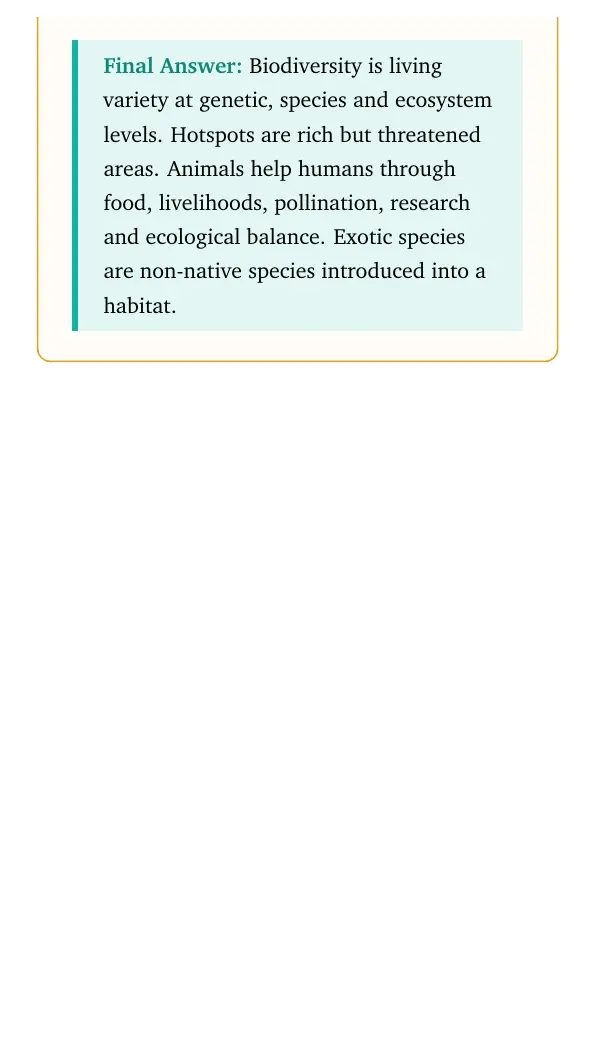
Expert answer: Biodiversity is living variety at genetic, species and ecosystem levels. Hotspots are rich but threatened areas. Animals help humans through food, livelihoods, pollination, research and ecological balance. Exotic species are non-native species introduced into a habitat.
Question 3
Answer the following questions in about 150 words.
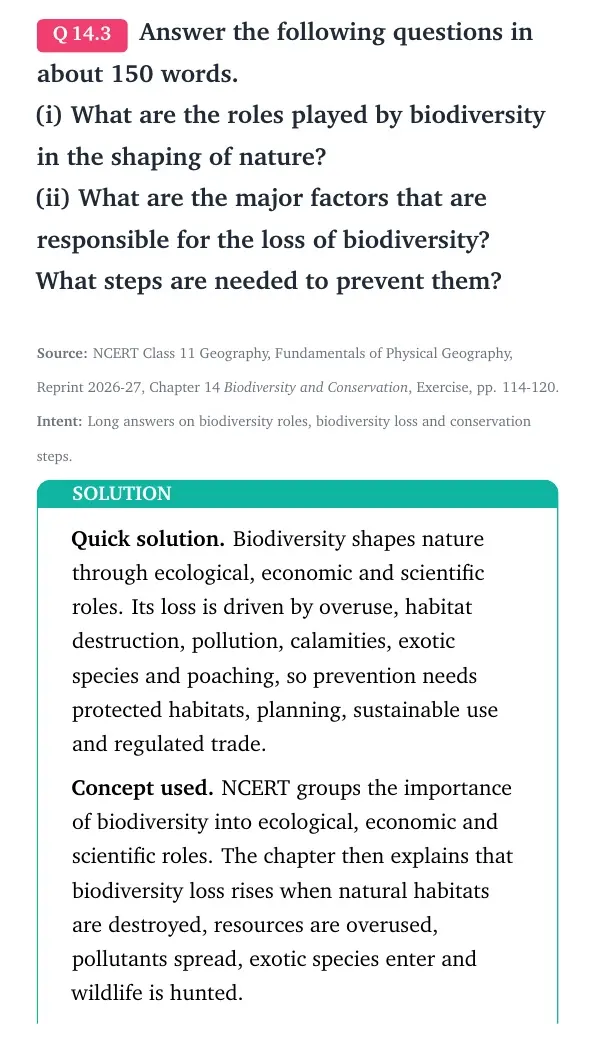
(i) What are the roles played by biodiversity in the shaping of nature?
(ii) What are the major factors that are responsible for the loss of biodiversity? What steps are needed to prevent them?
Quick solution. Biodiversity shapes nature through ecological, economic and scientific roles. Its loss is driven by overuse, habitat destruction, pollution, calamities, exotic species and poaching, so prevention needs protected habitats, planning, sustainable use and regulated trade.
Concept used. NCERT groups the importance of biodiversity into ecological, economic and scientific roles. The chapter then explains that biodiversity loss rises when natural habitats are destroyed, resources are overused, pollutants spread, exotic species enter and wildlife is hunted.
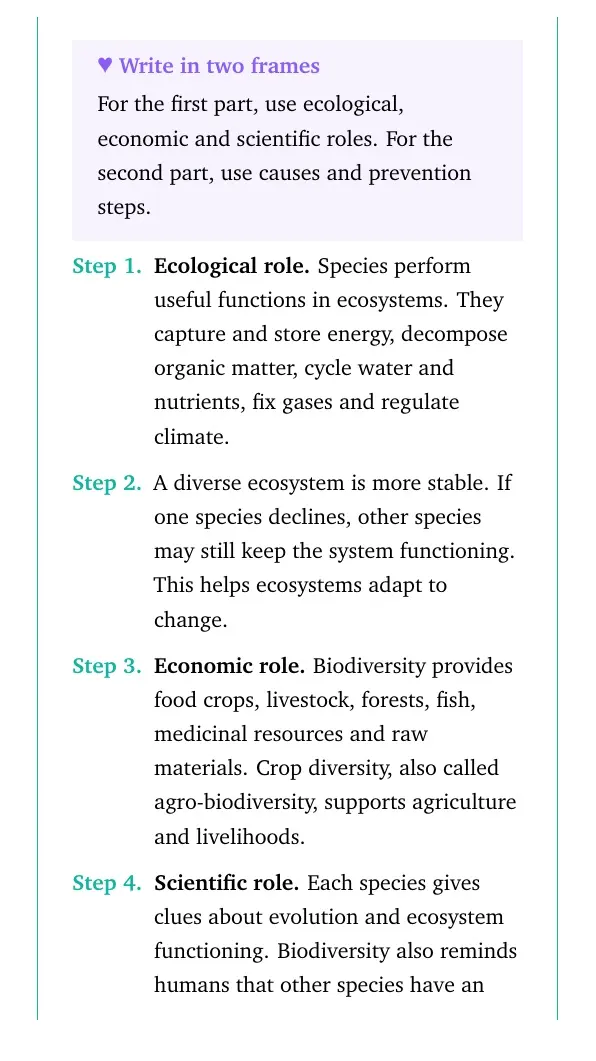
- Ecological role. Species perform useful functions in ecosystems. They capture and store energy, decompose organic matter, cycle water and nutrients, fix gases and regulate climate.
- A diverse ecosystem is more stable. If one species declines, other species may still keep the system functioning. This helps ecosystems adapt to change.
- Economic role. Biodiversity provides food crops, livestock, forests, fish, medicinal resources and raw materials. Crop diversity, also called agro-biodiversity, supports agriculture and livelihoods.
- Scientific role. Each species gives clues about evolution and ecosystem functioning. Biodiversity also reminds humans that other species have an intrinsic right to exist.
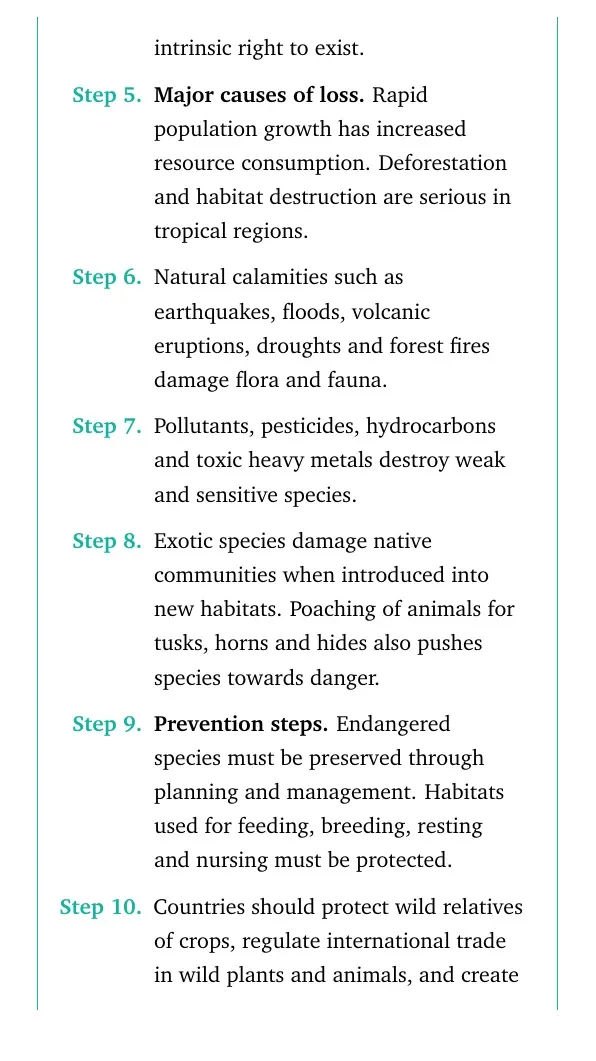
- Major causes of loss. Rapid population growth has increased resource consumption. Deforestation and habitat destruction are serious in tropical regions.
- Natural calamities such as earthquakes, floods, volcanic eruptions, droughts and forest fires damage flora and fauna.
- Pollutants, pesticides, hydrocarbons and toxic heavy metals destroy weak and sensitive species.
- Exotic species damage native communities when introduced into new habitats. Poaching of animals for tusks, horns and hides also pushes species towards danger.
- Prevention steps. Endangered species must be preserved through planning and management. Habitats used for feeding, breeding, resting and nursing must be protected.
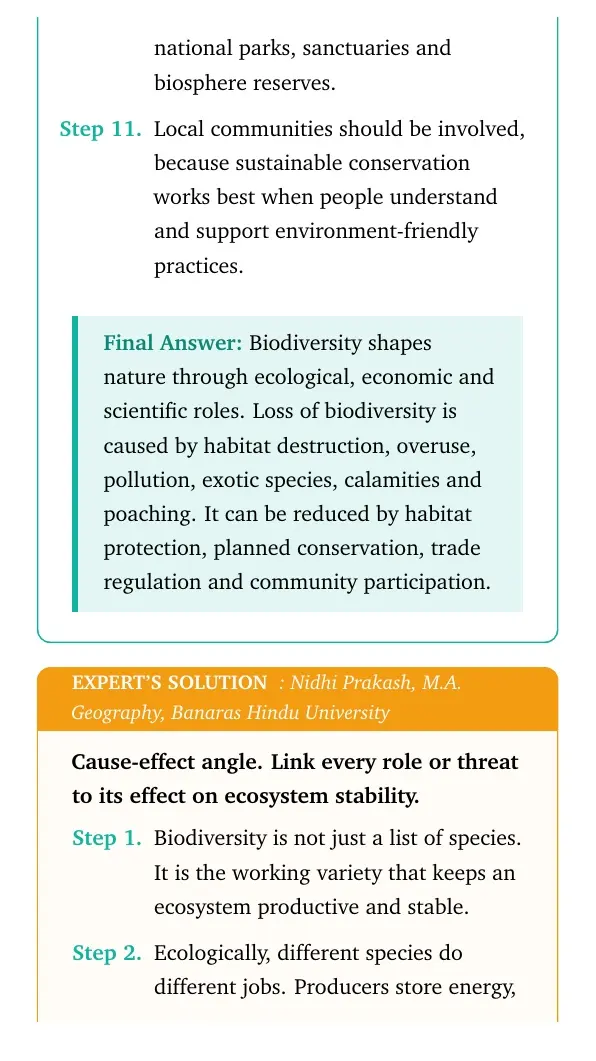
- Countries should protect wild relatives of crops, regulate international trade in wild plants and animals, and create national parks, sanctuaries and biosphere reserves.
- Local communities should be involved, because sustainable conservation works best when people understand and support environment-friendly practices.
Final answer: Biodiversity shapes nature through ecological, economic and scientific roles. Loss of biodiversity is caused by habitat destruction, overuse, pollution, exotic species, calamities and poaching. It can be reduced by habitat protection, planned conservation, trade regulation and community participation.
Cause-effect angle. Link every role or threat to its effect on ecosystem stability.
- Biodiversity is not just a list of species. It is the working variety that keeps an ecosystem productive and stable.
- Ecologically, different species do different jobs. Producers store energy, decomposers return nutrients, and organisms support water and gas cycles.
- Economically, biodiversity is a resource base. It supports agriculture, livestock, fish, forests, medicines and other products.
- Scientifically, biodiversity helps us understand evolution and the role of each species in sustaining ecosystems.
- Loss begins when habitats shrink. Tropical forests are especially important because NCERT notes that they contain a very large share of species.
- Over-exploitation adds pressure. When forests, fish, wildlife and land are used faster than they recover, species decline.
- Pollution, pesticides and toxic metals reduce sensitive species. Exotic species can also disturb a natural biotic community.
- Poaching adds direct pressure on animals such as tigers, elephants, rhinoceros and crocodiles.
- Prevention needs in-situ protection through national parks, sanctuaries and biosphere reserves, plus protection of feeding and breeding habitats.
- It also needs planning, trade regulation, crop and wild-relative preservation, and local community participation.
Why this matters. The answer is safest when it mirrors NCERT headings. Roles, causes and prevention steps each need their own paragraph or list.
Expert answer: Biodiversity builds ecosystem stability and human welfare; it is protected by conserving species, habitats, genetic resources and local cooperation.
Question 4
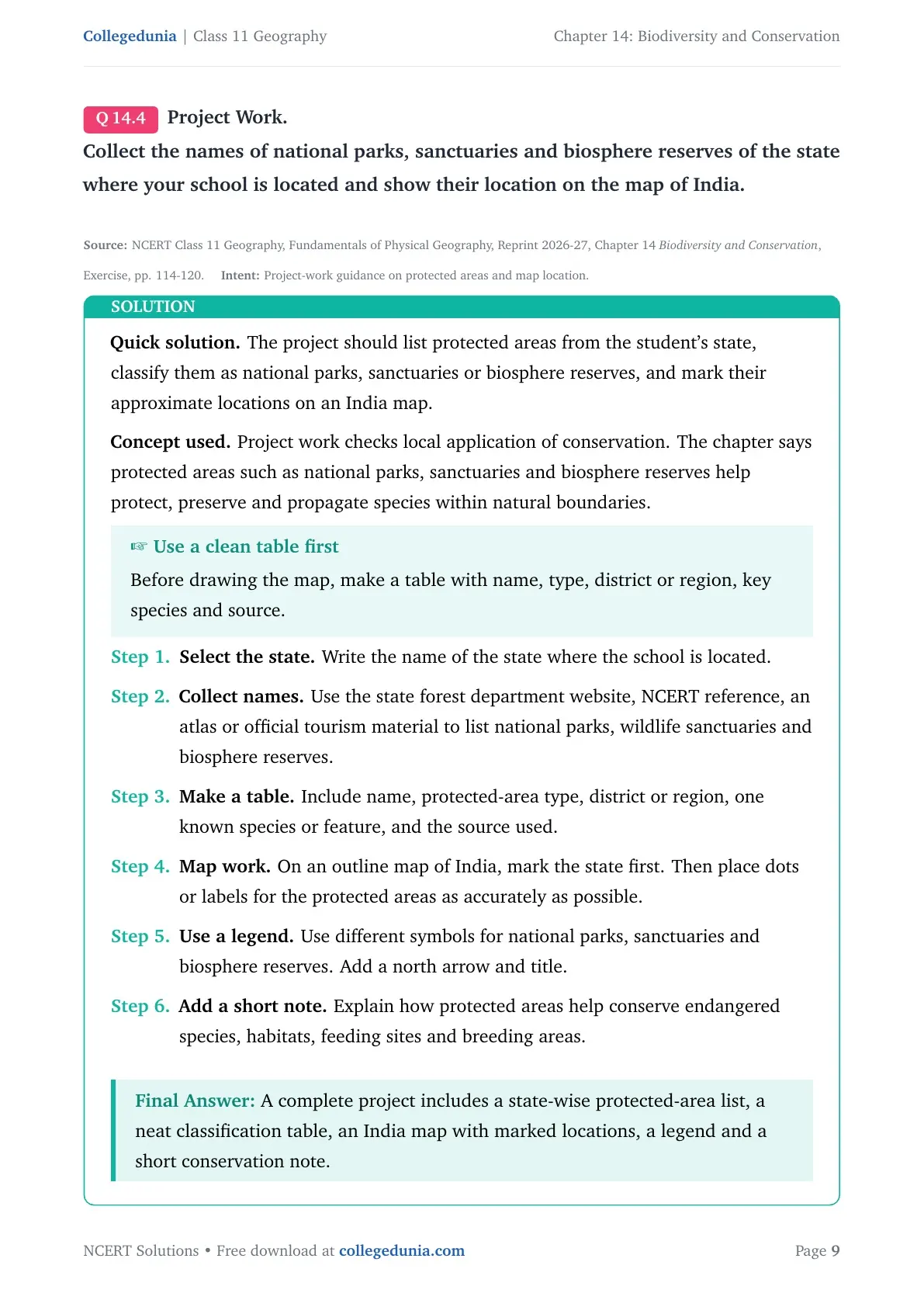
Project Work.
Collect the names of national parks, sanctuaries and biosphere reserves of the state where your school is located and show their location on the map of India.
Quick solution. The project should list protected areas from the student's state, classify them as national parks, sanctuaries or biosphere reserves, and mark their approximate locations on an India map.
Concept used. Project work checks local application of conservation. The chapter says protected areas such as national parks, sanctuaries and biosphere reserves help protect, preserve and propagate species within natural boundaries.
- Select the state. Write the name of the state where the school is located.
- Collect names. Use the state forest department website, NCERT reference, an atlas or official tourism material to list national parks, wildlife sanctuaries and biosphere reserves.
- Make a table. Include name, protected-area type, district or region, one known species or feature, and the source used.
- Map work. On an outline map of India, mark the state first. Then place dots or labels for the protected areas as accurately as possible.
- Use a legend. Use different symbols for national parks, sanctuaries and biosphere reserves. Add a north arrow and title.
- Add a short note. Explain how protected areas help conserve endangered species, habitats, feeding sites and breeding areas.
Final answer: A complete project includes a state-wise protected-area list, a neat classification table, an India map with marked locations, a legend and a short conservation note.
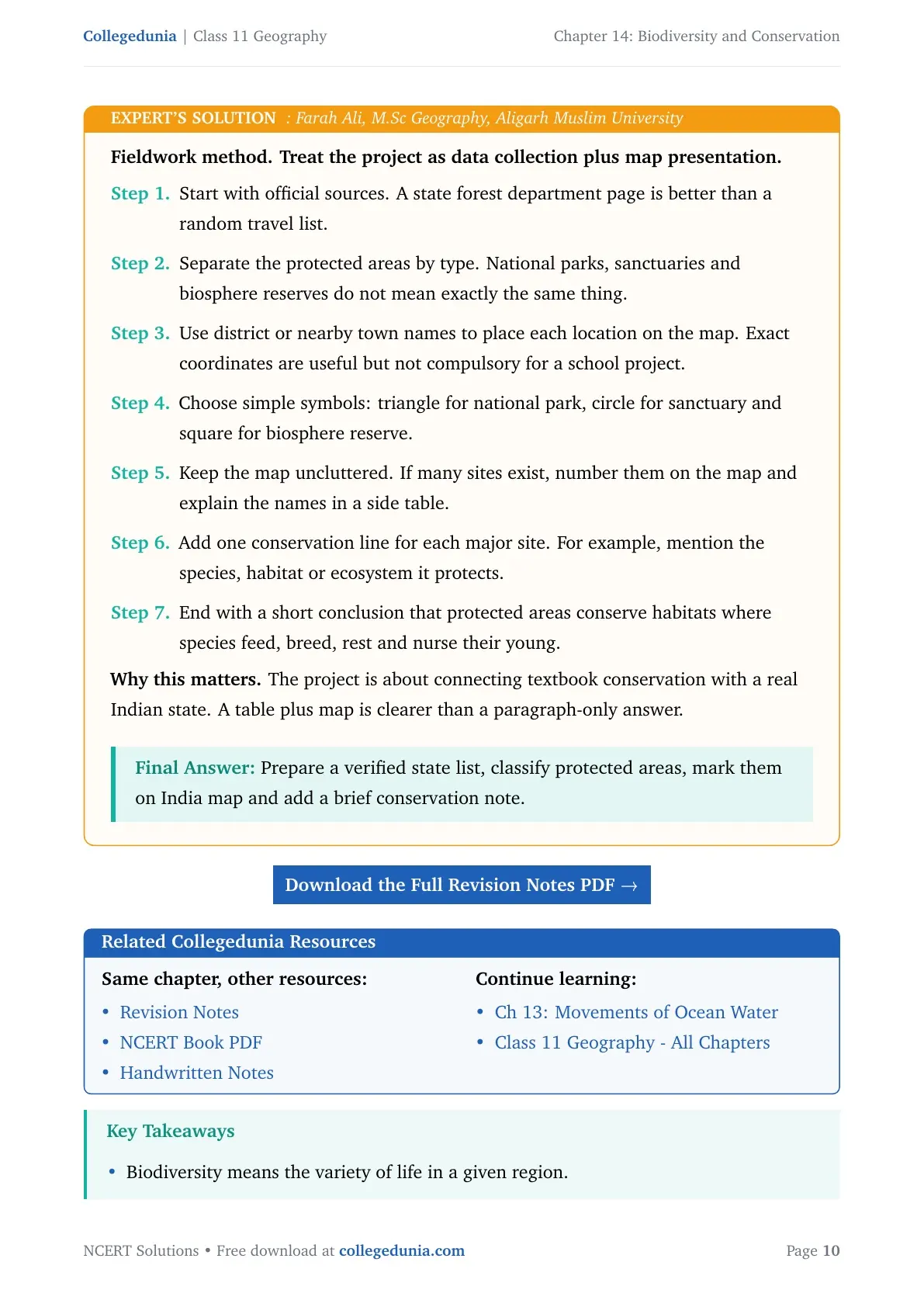
Fieldwork method. Treat the project as data collection plus map presentation.
- Start with official sources. A state forest department page is better than a random travel list.
- Separate the protected areas by type. National parks, sanctuaries and biosphere reserves do not mean exactly the same thing.
- Use district or nearby town names to place each location on the map. Exact coordinates are useful but not compulsory for a school project.
- Choose simple symbols: triangle for national park, circle for sanctuary and square for biosphere reserve.
- Keep the map uncluttered. If many sites exist, number them on the map and explain the names in a side table.
- Add one conservation line for each major site. For example, mention the species, habitat or ecosystem it protects.
- End with a short conclusion that protected areas conserve habitats where species feed, breed, rest and nurse their young.
Why this matters. The project is about connecting textbook conservation with a real Indian state. A table plus map is clearer than a paragraph-only answer.
Expert answer: Prepare a verified state list, classify protected areas, mark them on India map and add a brief conservation note.
Biodiversity and Conservation Class 11 NCERT Solutions FAQs
Ques. How many exercise question blocks are solved in Class 11 Geography Chapter 14 Biodiversity and Conservation?
Ans. The chapter has 4 NCERT exercise question blocks. This page and the downloadable PDF solve every MCQ, short-answer, long-answer and project-work prompt.
Ques. What are the three levels of biodiversity in Chapter 14?
Ans. The three levels are genetic diversity, species diversity and ecosystem diversity. Together, they show variety within species, among species and across habitats.
Ques. Why are biodiversity hotspots important?
Ans. Hotspots are areas with very rich and often endangered biodiversity. Protecting them saves many species and habitats in a focused conservation area.
Ques. What is an exotic species in Biodiversity and Conservation?
Ans. An exotic species is introduced from outside its natural range. It may become invasive and disturb native plants, animals or ecological processes.
Ques. How do these solutions help students revise the chapter?
Ans. Each answer gives the direct NCERT point first, then adds a simple expert explanation. This helps students revise definitions, examples and conservation steps together.



Comments