The NCERT Solutions for Class 11 Geography Chapter 7 Composition and Structure of Atmosphere cover all 7 textbook questions from the latest 2026-27 NCERT book. The chapter explains atmospheric gases, water vapour, dust particles, weather elements and the vertical layers from troposphere to exosphere.
Covers every Chapter 7 exercise question with a direct solution and an expert explanation.
Focuses on high scoring ideas: nitrogen, oxygen, carbon dioxide, dust particles, water vapour and troposphere.
Useful for school exams because the answers separate definitions, comparisons and diagram labelling points.
Student Feedback: In a Collegedunia poll of 9,420 Class 11 Geography students preparing for the 2026-27 school exams, 69% said they remembered the five atmospheric layers but confused gas composition with weather elements.
Source: 2026-27 Class 11 Geography student poll across CBSE schools.
Every answer in this chapter set is checked against the 2026-27 NCERT Geography textbook and written so that students can revise the fact, explanation and diagram framing together.
Composition and Structure of Atmosphere explains the air envelope around Earth. The chapter has two linked parts: what the atmosphere is made of, and how it is arranged vertically. The solutions PDF follows the same order so that each answer can be revised from the NCERT theory first and then written in exam style.
Chapter area
What students must know
Where it helps
Meaning of atmosphere
Air envelope held around Earth by gravity
Question 2(i)
Weather and climate elements
Temperature, pressure, wind, humidity, clouds and precipitation
Question 2(ii)
Gaseous composition
Nitrogen, oxygen, argon, carbon dioxide and ozone
Questions 1 and 2(iii)
Dust and water vapour
Aerosols help condensation; water vapour stores heat
Questions 1 and 2(iii)
Vertical structure
Troposphere, stratosphere, mesosphere, ionosphere and exosphere
Question 3(ii)
Start this chapter with percentages and layer names. Once those facts are clear, longer answers become a sequence: composition first, role second, then exam example.
Atmospheric Composition in Class 11 Geography Chapter 7
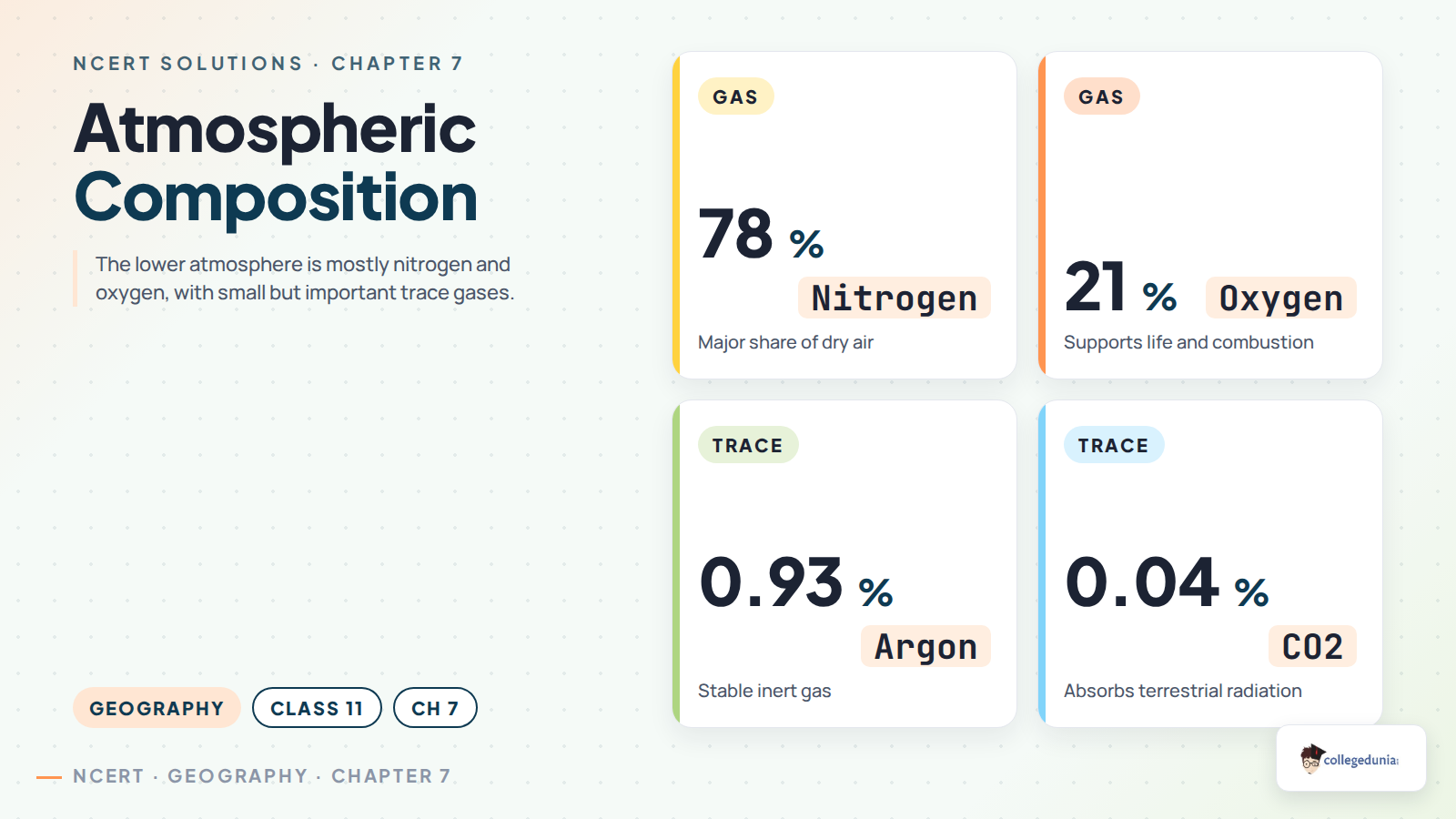
The dry lower atmosphere is dominated by nitrogen and oxygen. Nitrogen forms nearly four fifths of dry air, while oxygen forms about one fifth. Argon is a stable inert gas, and carbon dioxide is present in a small proportion but is climatically important because it absorbs outgoing terrestrial radiation.
Nitrogen: the largest share of dry air and a key part of the nitrogen cycle.
Oxygen: essential for respiration and combustion, but becomes negligible at great height.
Carbon dioxide: transparent to incoming solar radiation and relatively opaque to outgoing terrestrial radiation.
Dust particles: sea salt, ash, pollen, smoke soot and fine soil help water vapour condense into clouds.
This is why the MCQ answer set in the PDF gives nitrogen for the major gas, troposphere for the most important human layer, dust particles for aerosols and carbon dioxide for the greenhouse-gas property.
Composition and Structure of Atmosphere Class 11 Video Lesson
Structure of Atmosphere Diagram for Class 11 Geography
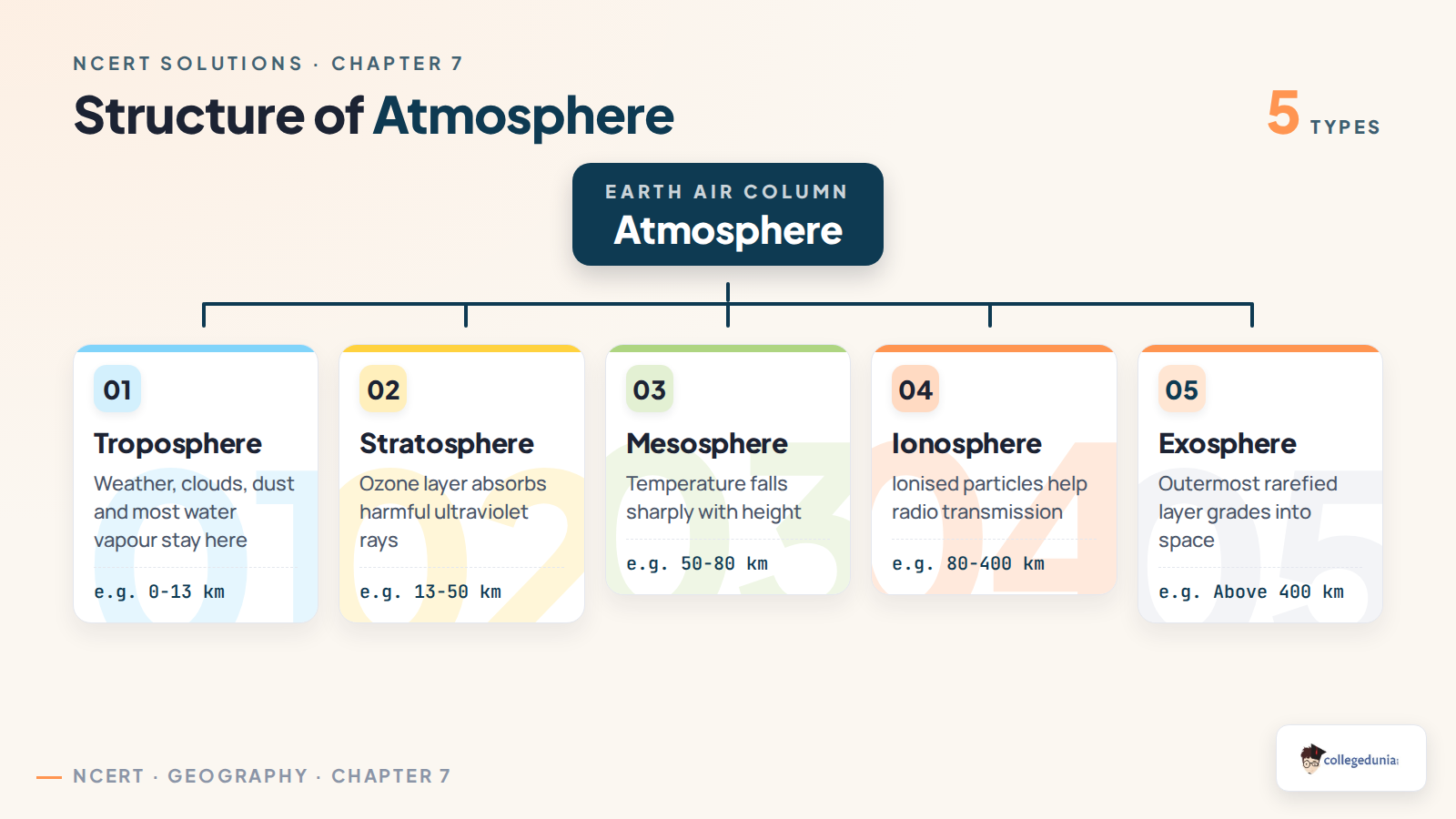
The atmosphere is divided into layers on the basis of height, temperature trend and function. Troposphere is the lowest and most important layer for human beings because weather, clouds, dust and most water vapour are concentrated there. Above it, the stratosphere contains the ozone layer, the mesosphere has falling temperature, the ionosphere has ionised particles and the exosphere fades into outer space.
Layer
Approximate height
Main feature
Troposphere
0 to 13 km
Weather processes and most water vapour
Stratosphere
13 to 50 km
Ozone layer and stable air
Mesosphere
50 to 80 km
Temperature falls with height
Ionosphere
80 to 400 km
Ionised particles and radio transmission
Exosphere
Above 400 km
Outermost rarefied air
How to Write Better Answers for Composition and Structure of Atmosphere
Chapter 7 answers score well when they are written as clear geography points rather than loose paragraphs. For definition questions, begin with the term. For composition questions, write gases, water vapour and dust particles separately. For structure questions, add a labelled vertical diagram and one function for each layer.
Use exact NCERT terms. Write atmosphere, weather elements, water vapour, dust particles, troposphere and stratosphere clearly.
Add numbers where needed. Nitrogen, oxygen, argon and carbon dioxide values make composition answers more precise.
Draw a simple layered diagram. Keep layers in the correct vertical order from ground to space.
Close with importance. Mention life, weather, ozone protection, condensation or radio transmission as the question requires.
All NCERT Solutions for Class 11 Geography Chapter 7 Composition and Structure of Atmosphere with Step-by-Step Solutions
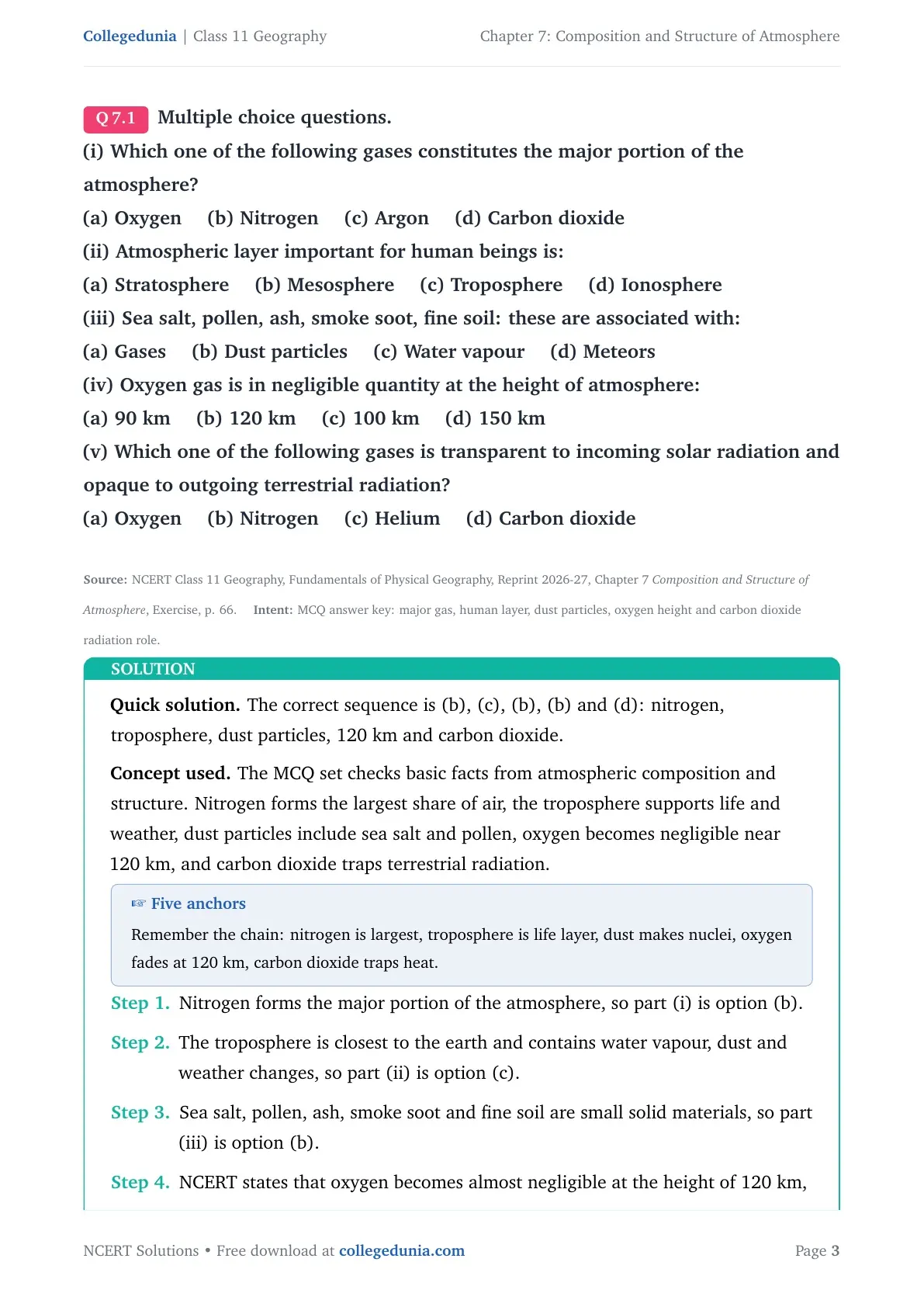
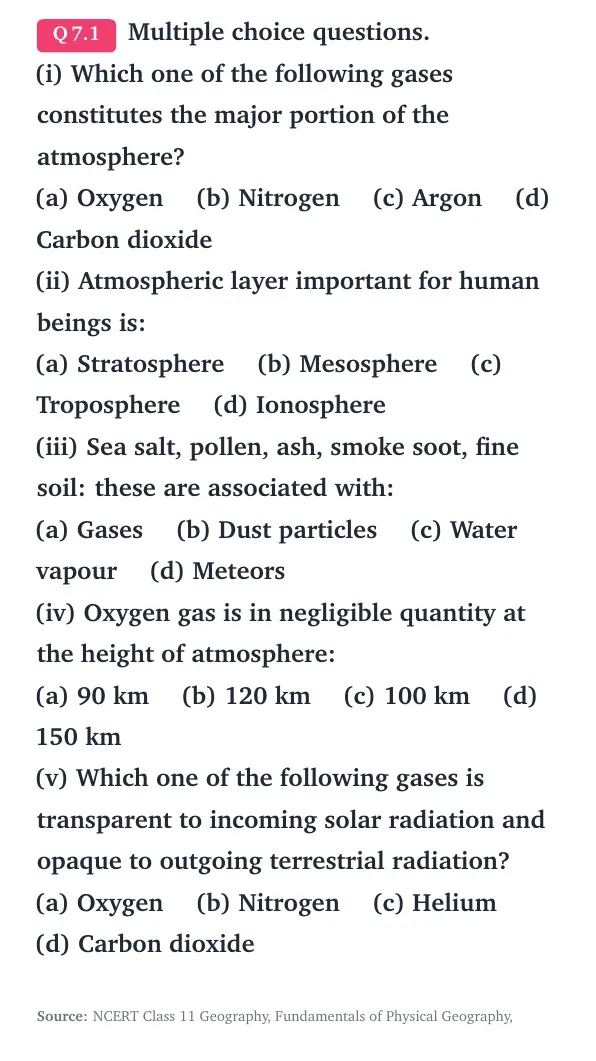
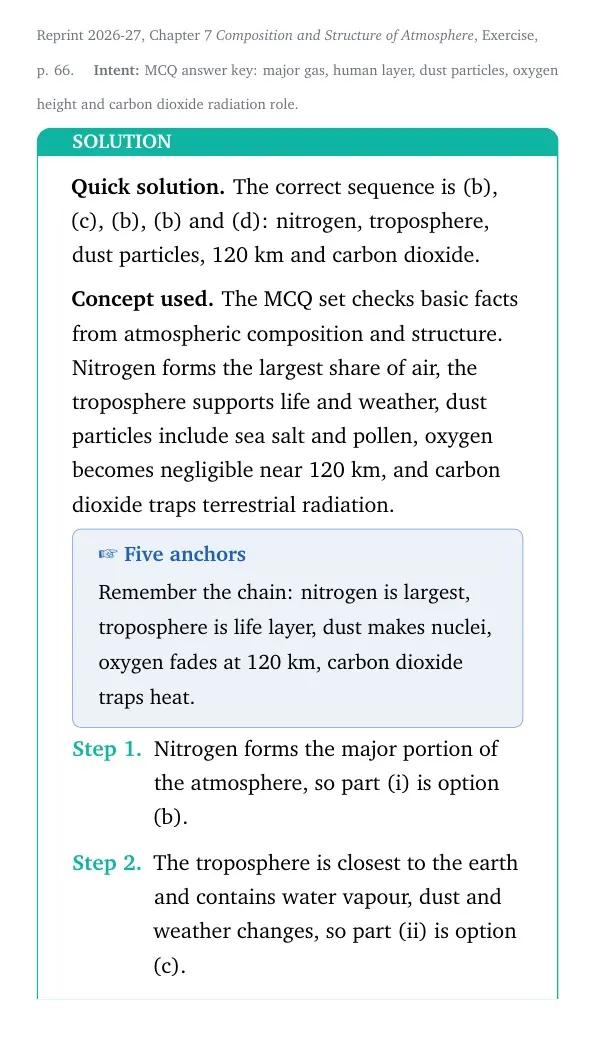
Q 7.1
Multiple choice questions.
(i) Which one of the following gases constitutes the major portion of the atmosphere?
(a) Oxygen (b) Nitrogen (c) Argon (d) Carbon dioxide
(ii) Atmospheric layer important for human beings is:
(a) Stratosphere (b) Mesosphere (c) Troposphere (d) Ionosphere
(iii) Sea salt, pollen, ash, smoke soot, fine soil: these are associated with:
(a) Gases (b) Dust particles (c) Water vapour (d) Meteors
(iv) Oxygen gas is in negligible quantity at the height of atmosphere:
(a) 90 km (b) 120 km (c) 100 km (d) 150 km
(v) Which one of the following gases is transparent to incoming solar radiation and opaque to outgoing terrestrial radiation?
(a) Oxygen (b) Nitrogen (c) Helium (d) Carbon dioxide
The correct sequence is (b), (c), (b), (b) and (d): nitrogen, troposphere, dust particles, 120 km and carbon dioxide.
Concept used. The MCQ set checks basic facts from atmospheric composition and structure. Nitrogen forms the largest share of air, the troposphere supports life and weather, dust particles include sea salt and pollen, oxygen becomes negligible near 120 km, and carbon dioxide traps terrestrial radiation.
Five anchors
Remember the chain: nitrogen is largest, troposphere is life layer, dust makes nuclei, oxygen fades at 120 km, carbon dioxide traps heat.
Nitrogen forms the major portion of the atmosphere, so part (i) is option (b).
The troposphere is closest to the earth and contains water vapour, dust and weather changes, so part (ii) is option (c).
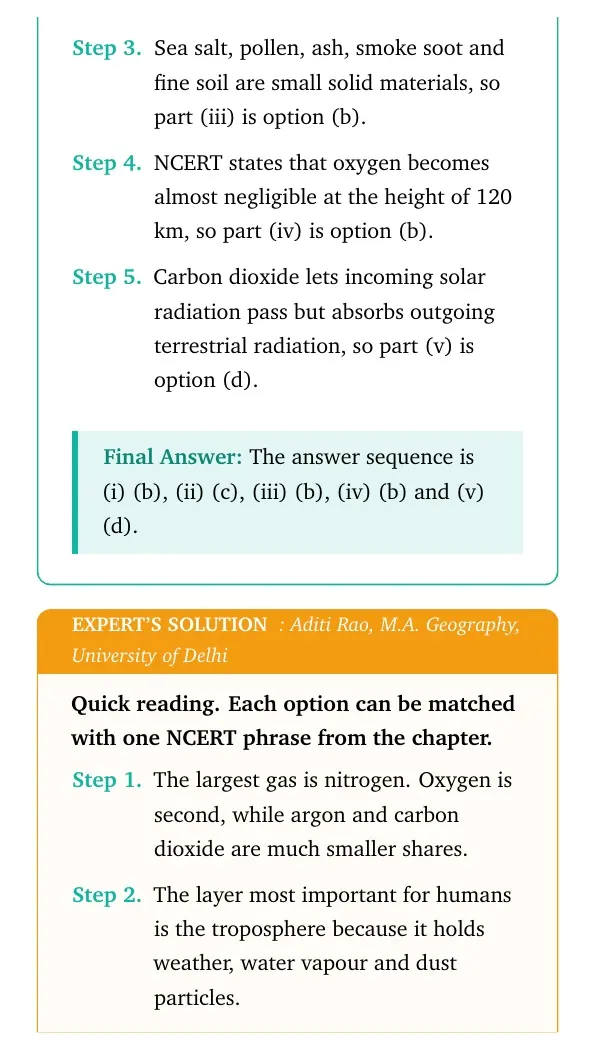
Sea salt, pollen, ash, smoke soot and fine soil are small solid materials, so part (iii) is option (b).
NCERT states that oxygen becomes almost negligible at the height of 120 km, so part (iv) is option (b).
Carbon dioxide lets incoming solar radiation pass but absorbs outgoing terrestrial radiation, so part (v) is option (d).
The answer sequence is (i) (b), (ii) (c), (iii) (b), (iv) (b) and (v) (d).
AR
Aditi Rao
M.A. Geography, University of Delhi
Verified Expert
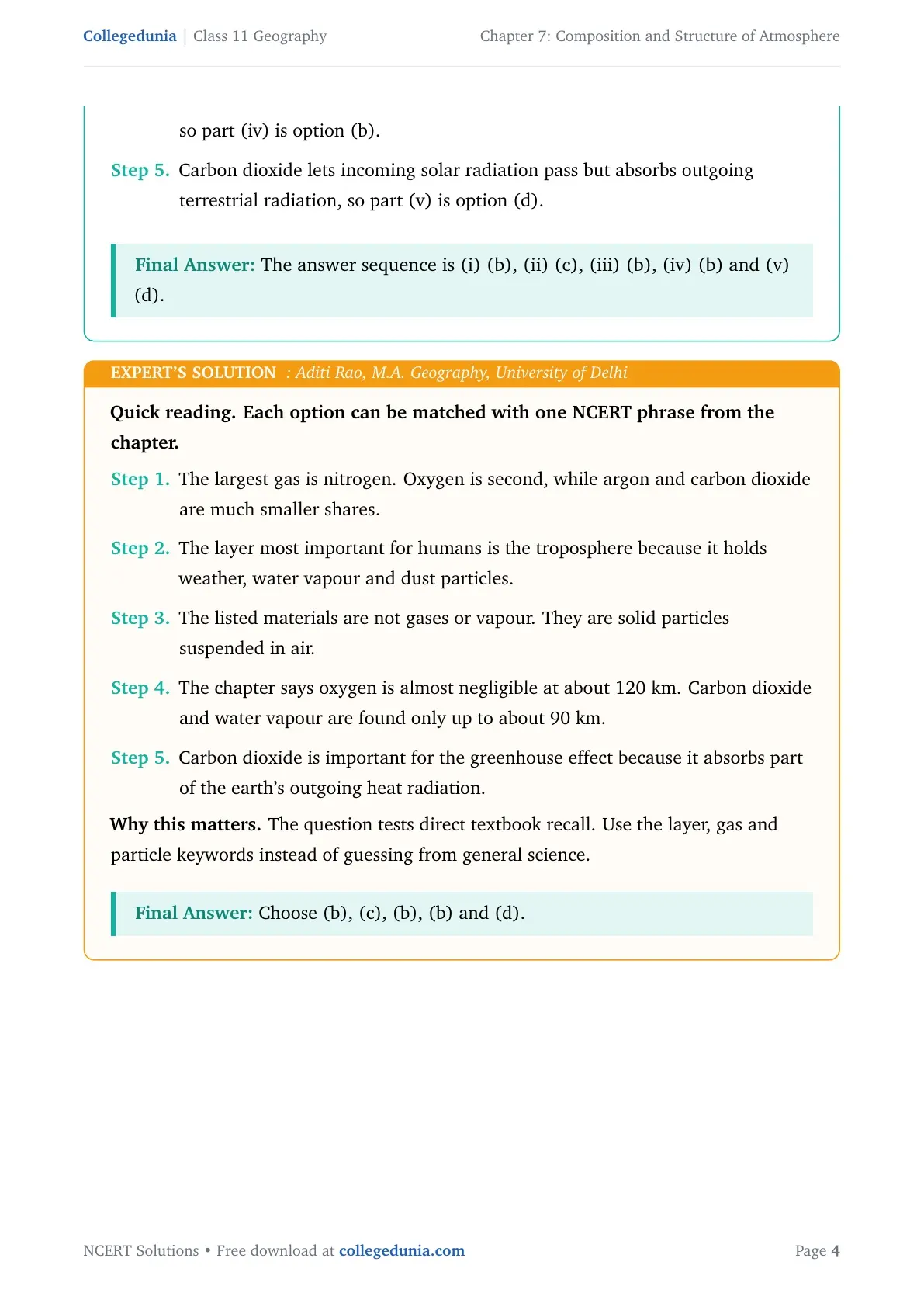
Quick reading. Each option can be matched with one NCERT phrase from the chapter.
The largest gas is nitrogen. Oxygen is second, while argon and carbon dioxide are much smaller shares.
The layer most important for humans is the troposphere because it holds weather, water vapour and dust particles.
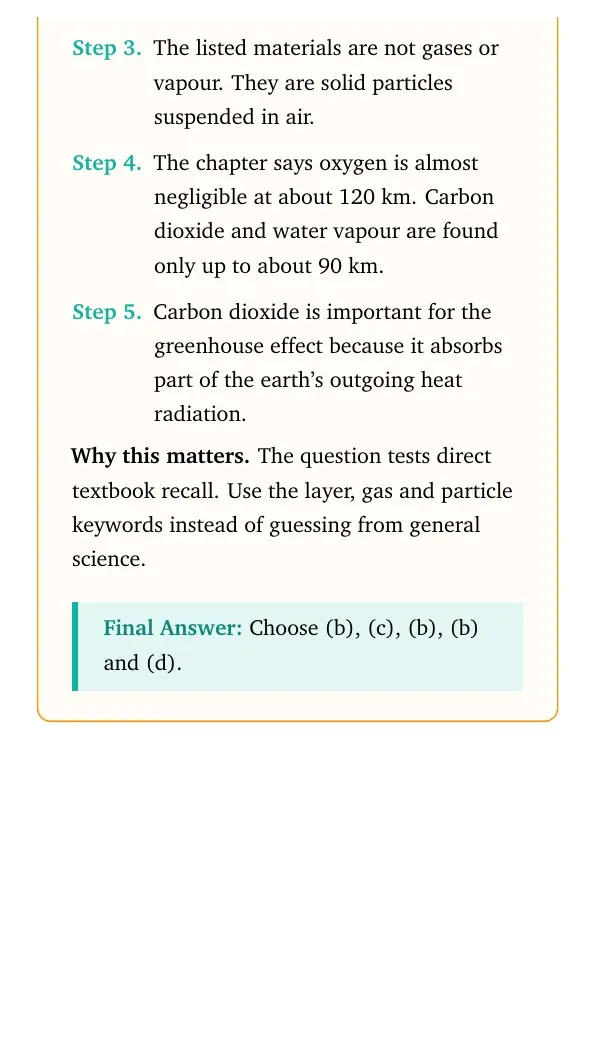
The listed materials are not gases or vapour. They are solid particles suspended in air.
The chapter says oxygen is almost negligible at about 120 km. Carbon dioxide and water vapour are found only up to about 90 km.
Carbon dioxide is important for the greenhouse effect because it absorbs part of the earth's outgoing heat radiation.
Why this matters. The question tests direct textbook recall. Use the layer, gas and particle keywords instead of guessing from general science.
Choose (b), (c), (b), (b) and (d).
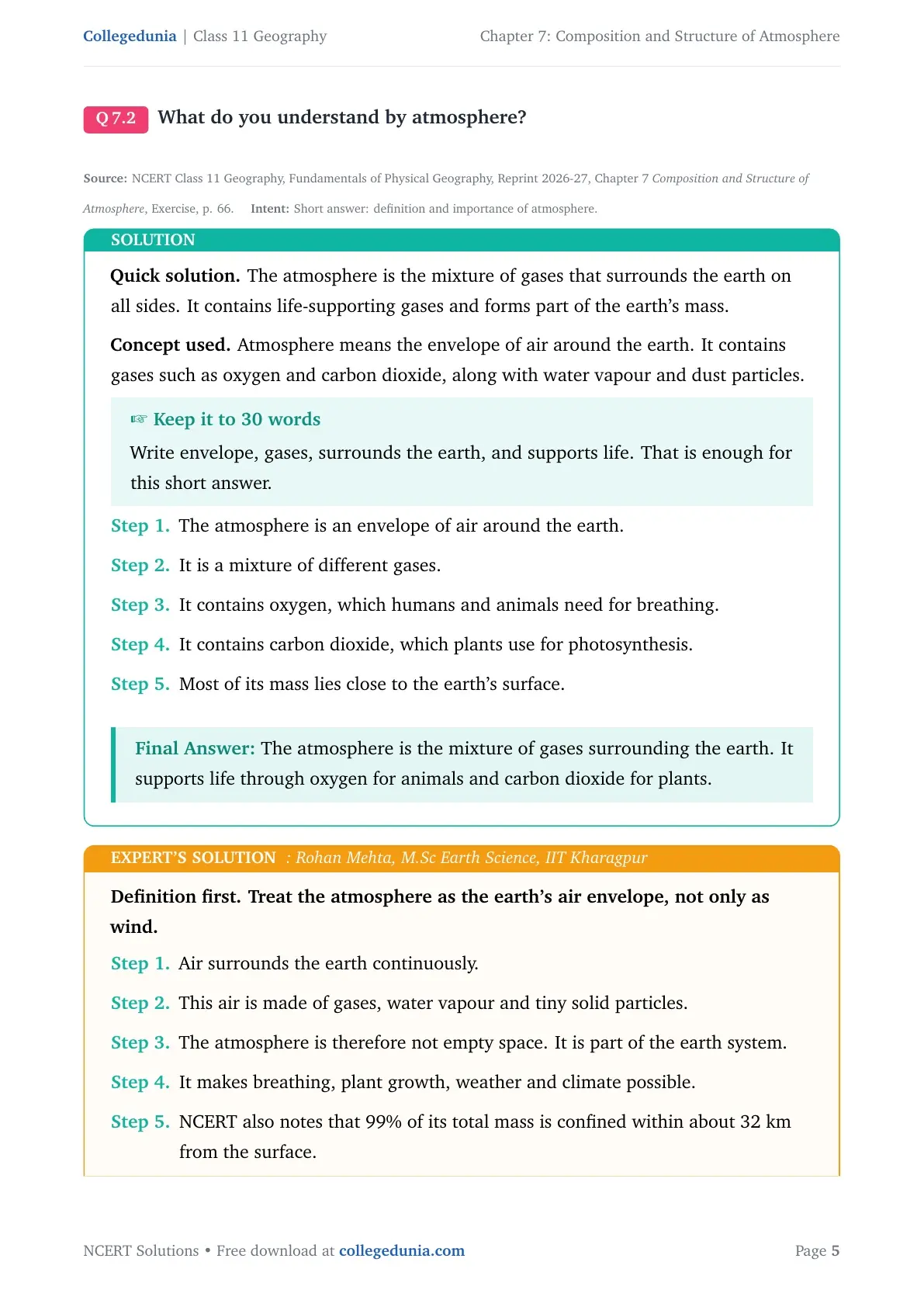
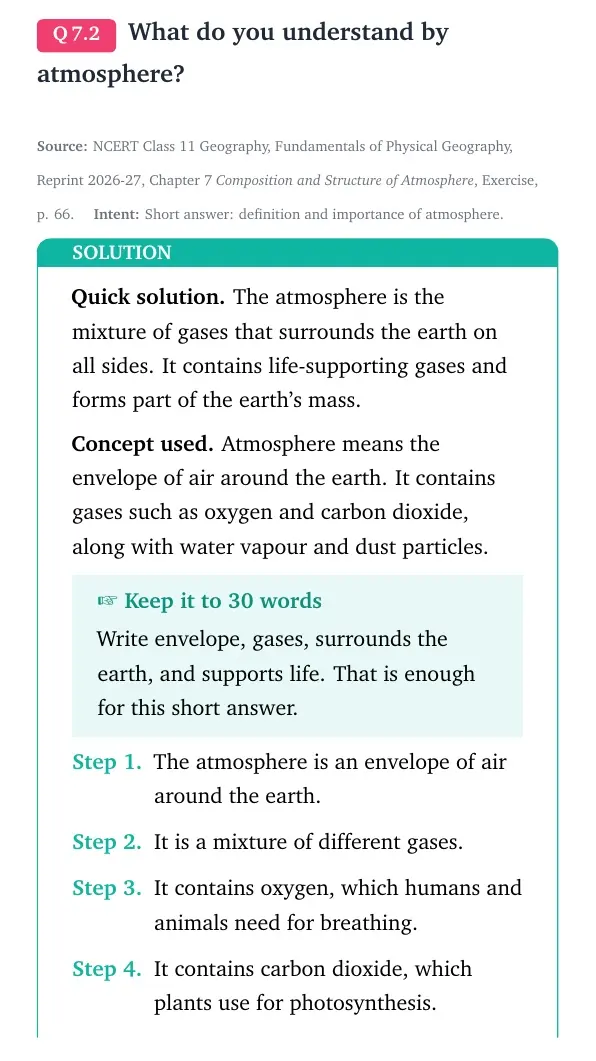
Q 7.2
What do you understand by atmosphere?
The atmosphere is the mixture of gases that surrounds the earth on all sides. It contains life-supporting gases and forms part of the earth's mass.
Concept used. Atmosphere means the envelope of air around the earth. It contains gases such as oxygen and carbon dioxide, along with water vapour and dust particles.
Keep it to 30 words
Write envelope, gases, surrounds the earth, and supports life. That is enough for this short answer.
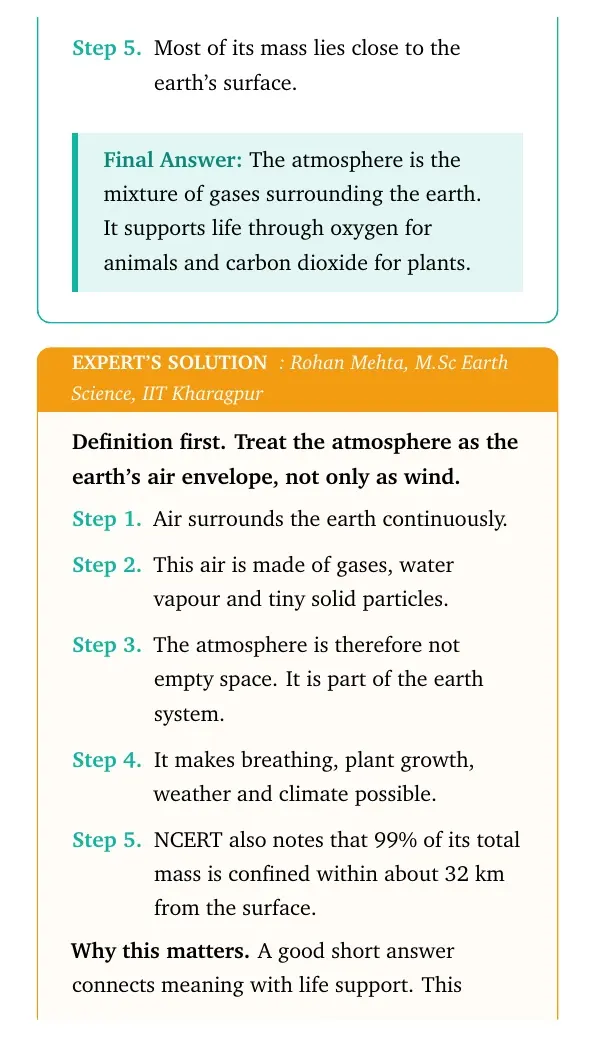
The atmosphere is an envelope of air around the earth.
It is a mixture of different gases.
It contains oxygen, which humans and animals need for breathing.
It contains carbon dioxide, which plants use for photosynthesis.
Most of its mass lies close to the earth's surface.
The atmosphere is the mixture of gases surrounding the earth. It supports life through oxygen for animals and carbon dioxide for plants.
RM
Rohan Mehta
M.Sc Earth Science, IIT Kharagpur
Verified Expert
Definition first. Treat the atmosphere as the earth's air envelope, not only as wind.
Air surrounds the earth continuously.
This air is made of gases, water vapour and tiny solid particles.
The atmosphere is therefore not empty space. It is part of the earth system.
It makes breathing, plant growth, weather and climate possible.
NCERT also notes that 99% of its total mass is confined within about 32 km from the surface.
Why this matters. A good short answer connects meaning with life support. This avoids a bare definition.
Atmosphere is the gaseous envelope around the earth, containing air components that sustain life and weather.
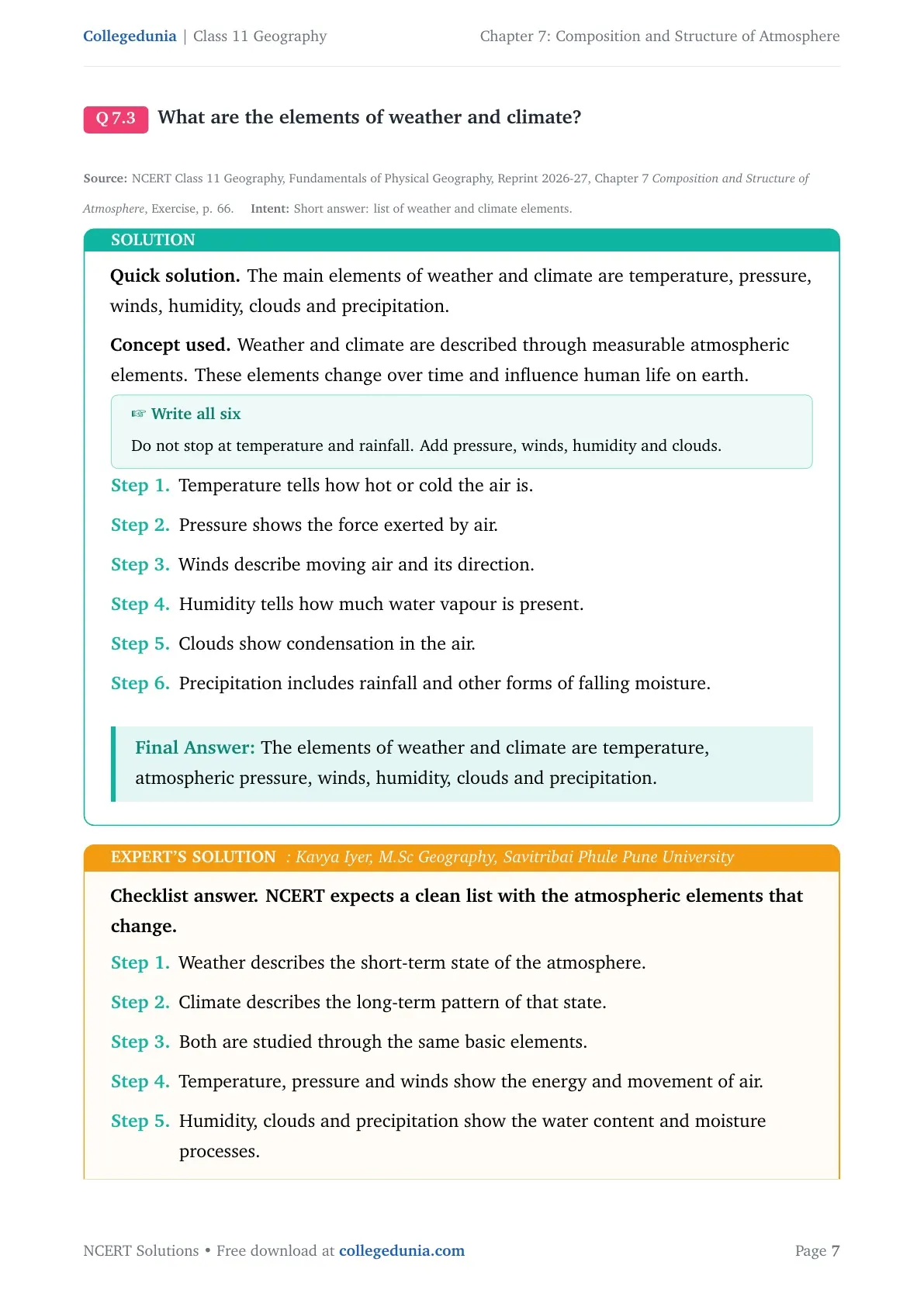
Q 7.3
What are the elements of weather and climate?
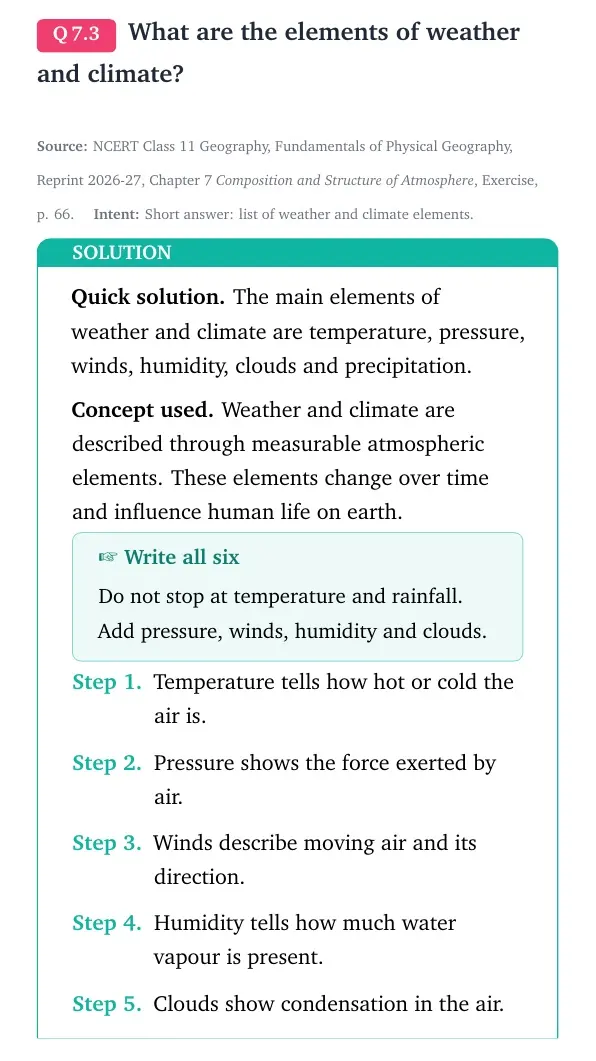
The main elements of weather and climate are temperature, pressure, winds, humidity, clouds and precipitation.
Concept used. Weather and climate are described through measurable atmospheric elements. These elements change over time and influence human life on earth.
Write all six
Do not stop at temperature and rainfall. Add pressure, winds, humidity and clouds.
Temperature tells how hot or cold the air is.
Pressure shows the force exerted by air.
Winds describe moving air and its direction.
Humidity tells how much water vapour is present.
Clouds show condensation in the air.
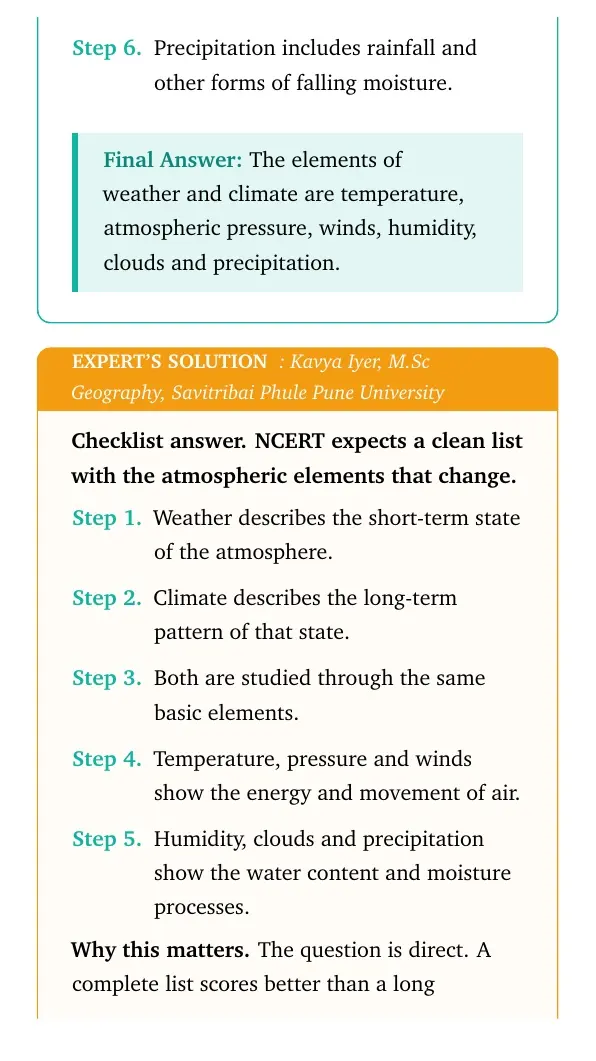
Precipitation includes rainfall and other forms of falling moisture.
The elements of weather and climate are temperature, atmospheric pressure, winds, humidity, clouds and precipitation.
KI
Kavya Iyer
M.Sc Geography, Savitribai Phule Pune University
Verified Expert
Checklist answer. NCERT expects a clean list with the atmospheric elements that change.
Weather describes the short-term state of the atmosphere.
Climate describes the long-term pattern of that state.
Both are studied through the same basic elements.
Temperature, pressure and winds show the energy and movement of air.
Humidity, clouds and precipitation show the water content and moisture processes.
Why this matters. The question is direct. A complete list scores better than a long explanation with missing terms.
Temperature, pressure, winds, humidity, clouds and precipitation are the main elements.
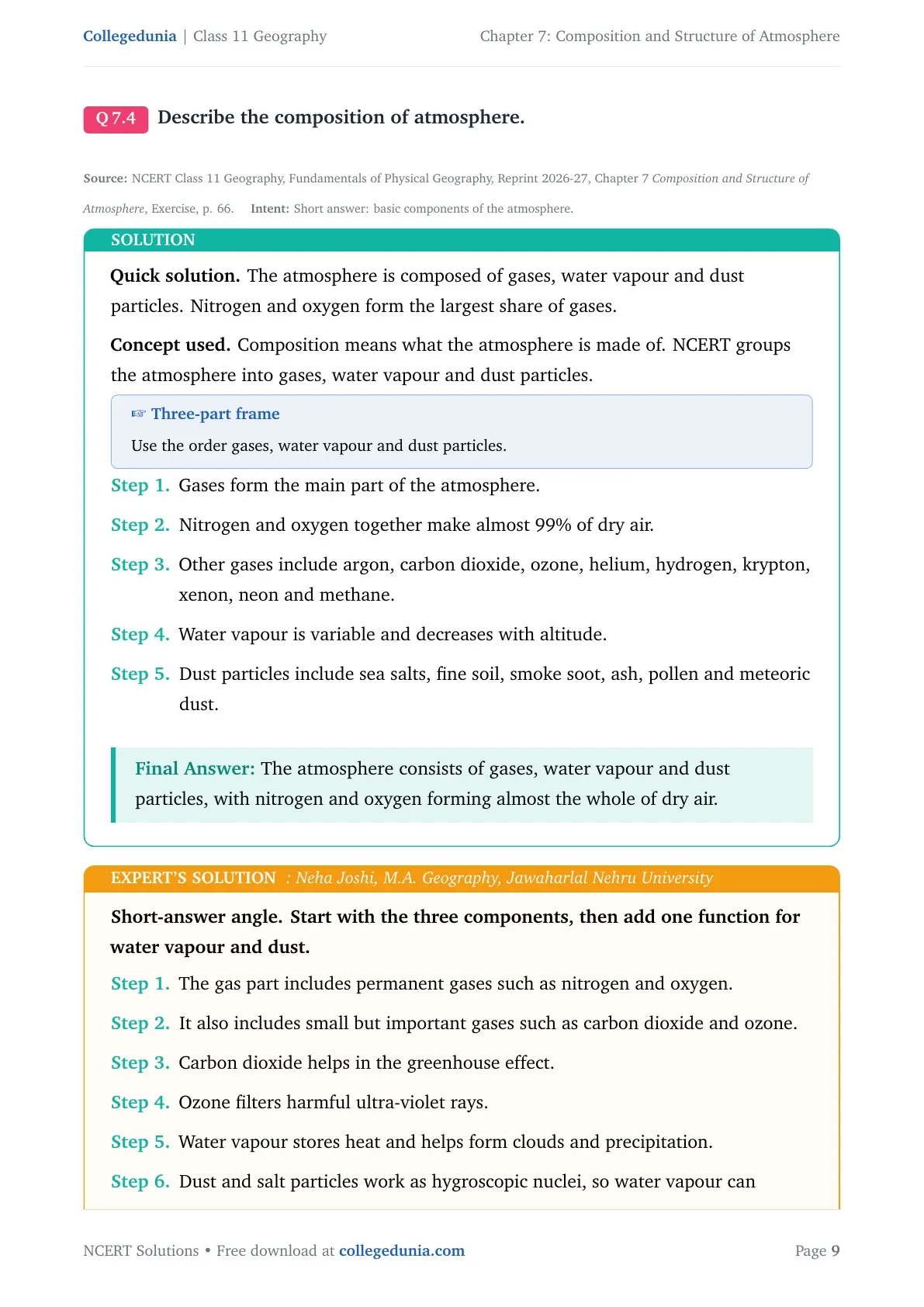
Q 7.4
Describe the composition of atmosphere.
The atmosphere is composed of gases, water vapour and dust particles. Nitrogen and oxygen form the largest share of gases.
Concept used. Composition means what the atmosphere is made of. NCERT groups the atmosphere into gases, water vapour and dust particles.
Three-part frame
Use the order gases, water vapour and dust particles.
Gases form the main part of the atmosphere.
Nitrogen and oxygen together make almost 99% of dry air.
Other gases include argon, carbon dioxide, ozone, helium, hydrogen, krypton, xenon, neon and methane.
Water vapour is variable and decreases with altitude.
Dust particles include sea salts, fine soil, smoke soot, ash, pollen and meteoric dust.
The atmosphere consists of gases, water vapour and dust particles, with nitrogen and oxygen forming almost the whole of dry air.
NJ
Neha Joshi
M.A. Geography, Jawaharlal Nehru University
Verified Expert
Short-answer angle. Start with the three components, then add one function for water vapour and dust.
The gas part includes permanent gases such as nitrogen and oxygen.
It also includes small but important gases such as carbon dioxide and ozone.
Carbon dioxide helps in the greenhouse effect.
Ozone filters harmful ultra-violet rays.
Water vapour stores heat and helps form clouds and precipitation.
Dust and salt particles work as hygroscopic nuclei, so water vapour can condense around them.
Why this matters. Composition is not only a percentage list. Functions of carbon dioxide, ozone, water vapour and dust make the answer stronger.
Atmosphere is made of gases, water vapour and dust particles, with key roles for carbon dioxide, ozone and dust nuclei.
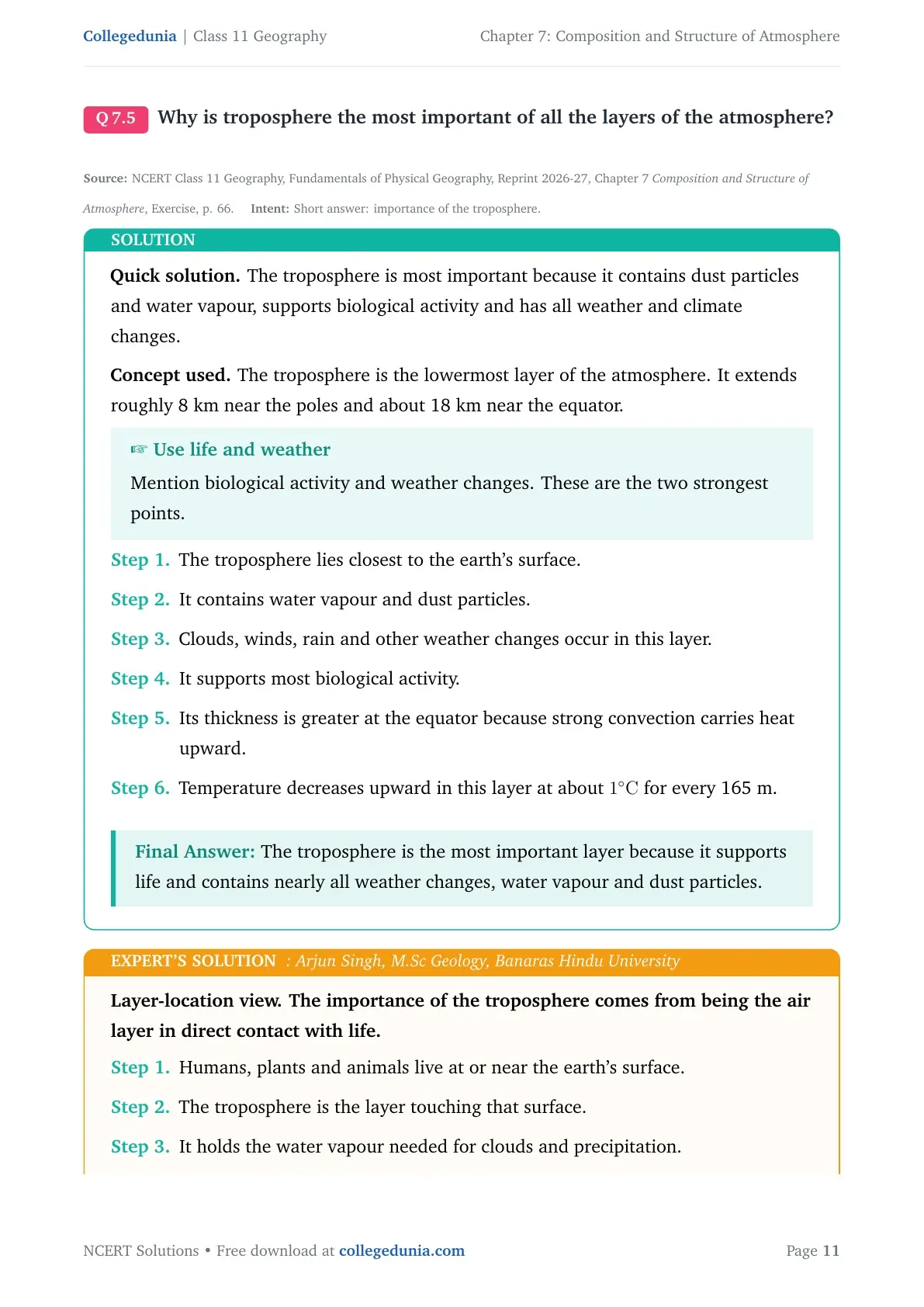
Q 7.5
Why is troposphere the most important of all the layers of the atmosphere?
The troposphere is most important because it contains dust particles and water vapour, supports biological activity and has all weather and climate changes.
Concept used. The troposphere is the lowermost layer of the atmosphere. It extends roughly 8 km near the poles and about 18 km near the equator.
Use life and weather
Mention biological activity and weather changes. These are the two strongest points.
The troposphere lies closest to the earth's surface.
It contains water vapour and dust particles.
Clouds, winds, rain and other weather changes occur in this layer.
It supports most biological activity.
Its thickness is greater at the equator because strong convection carries heat upward.
Temperature decreases upward in this layer at about 1∘C for every 165 m.
The troposphere is the most important layer because it supports life and contains nearly all weather changes, water vapour and dust particles.
AS
Arjun Singh
M.Sc Geology, Banaras Hindu University
Verified Expert
Layer-location view. The importance of the troposphere comes from being the air layer in direct contact with life.
Humans, plants and animals live at or near the earth's surface.
The troposphere is the layer touching that surface.
It holds the water vapour needed for clouds and precipitation.
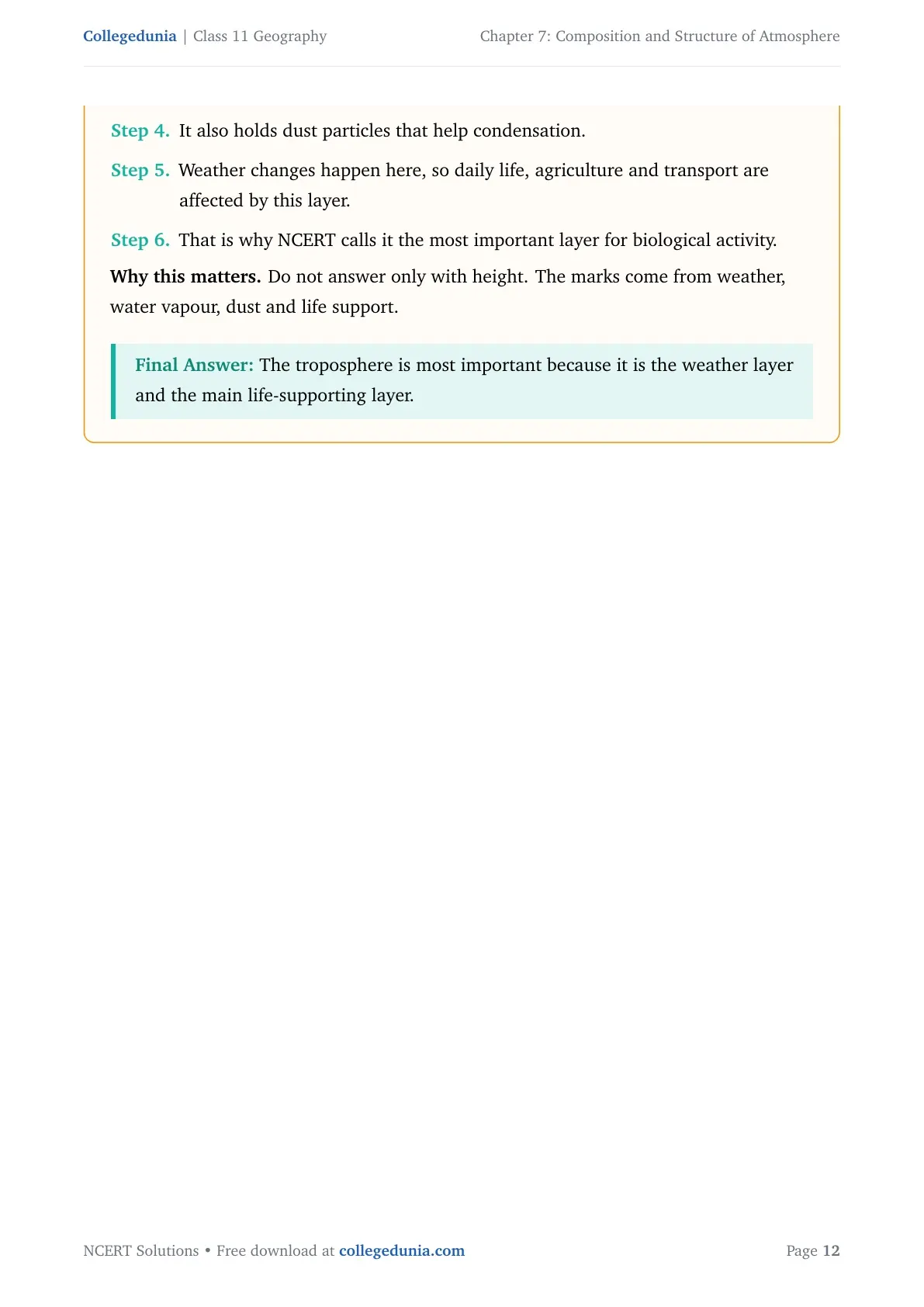
It also holds dust particles that help condensation.
Weather changes happen here, so daily life, agriculture and transport are affected by this layer.
That is why NCERT calls it the most important layer for biological activity.
Why this matters. Do not answer only with height. The marks come from weather, water vapour, dust and life support.
The troposphere is most important because it is the weather layer and the main life-supporting layer.
Q 7.6
Describe the composition of the atmosphere.
Atmospheric composition has three parts: gases, water vapour and dust particles. Nitrogen and oxygen dominate, while carbon dioxide, ozone, water vapour and dust have special climatic roles.
Concept used. Composition of atmosphere means both the substances present in air and their roles. NCERT explains gases first, then water vapour, then dust particles.
Add functions
For a 150-word answer, write what each component does, not only its name.
The atmosphere is mainly a mixture of gases. Nitrogen is the largest gas and oxygen is the second largest.
Nitrogen and oxygen together form almost 99% of the atmosphere by volume.
Other gases are present in small quantities. These include argon, carbon dioxide, neon, helium, ozone, methane, krypton, xenon and hydrogen.
Carbon dioxide is meteorologically important. It is transparent to incoming solar radiation but absorbs part of outgoing terrestrial radiation.
This makes carbon dioxide important for the greenhouse effect. Its amount has increased because of fossil fuel burning.
Ozone is found mainly between about 10 km and 50 km above the earth's surface.
Ozone absorbs harmful ultra-violet rays from the sun and protects life on earth.
Water vapour is variable. It decreases with altitude and also decreases from the equator towards the poles.
It may reach about 4% in warm wet tropical air but may be less than 1% in dry deserts and polar regions.
Water vapour absorbs some solar energy and helps preserve the earth's radiated heat like a blanket.
Dust particles include sea salts, fine soil, smoke soot, ash, pollen and meteoric particles.
Dust and salt particles act as hygroscopic nuclei around which water vapour condenses to form clouds.
The atmosphere is composed of gases, water vapour and dust particles. Nitrogen and oxygen dominate, while carbon dioxide, ozone, water vapour and dust control heat balance, protection and cloud formation.
FK
Farah Khan
M.A. Geography, Jamia Millia Islamia
Verified Expert
Three-part answer. The composition is best written as gases, variable moisture and suspended particles.
First, write the gas composition. Nitrogen and oxygen are the main gases.
Add the trace gases. Argon is present in a small amount, and carbon dioxide is small but highly important.
Explain carbon dioxide through radiation. It allows incoming solar rays but checks outgoing terrestrial heat.
Then explain ozone. It is concentrated in the upper atmosphere and absorbs harmful ultra-violet radiation.
Second, write water vapour. Its quantity changes with temperature, altitude and latitude.
Warm tropical air can hold more water vapour. Cold polar air and dry desert air hold much less.
Water vapour affects stability, instability, clouds, precipitation and temperature balance.
Third, write dust particles. They come from sea salts, soil, smoke, ash, pollen and meteoric material.
They are concentrated more in lower layers, but convection can lift them upward.
Their key role is cloud formation because droplets need nuclei to condense on.
End by linking all three parts. Gases give the basic air mixture, water vapour controls moisture, and dust supports condensation.
Why this matters. This question asks for a full description. A strong answer uses components, percentages where needed and functions, because the chapter treats composition as both matter and process.
Atmospheric composition includes major gases, variable water vapour and dust particles, each affecting life, heat and cloud formation.
Q 7.7
Draw a suitable diagram for the structure of the atmosphere and label it and describe it.
The atmosphere is divided into troposphere, stratosphere, mesosphere, thermosphere or ionosphere region, and exosphere. Temperature changes help separate these layers.
Concept used. Structure of atmosphere means the vertical arrangement of layers based on density and temperature conditions. Density is highest near the surface and decreases with height.
Label height breaks
Add 10 km, 50 km, 80 km and 400 km. These labels make the diagram useful.
0.92!%
[See diagram in the PDF version]
The troposphere is the lowest layer. Its average height is about 13 km, with about 8 km near the poles and 18 km near the equator.
All changes in weather and climate take place in the troposphere. Temperature falls with height in this layer.
The tropopause separates the troposphere from the stratosphere.
The stratosphere lies above the tropopause and extends up to about 50 km.
The stratosphere contains the ozone layer, which absorbs harmful ultra-violet radiation.
The mesosphere lies above the stratosphere and extends up to about 80 km.
In the mesosphere, temperature again decreases and may reach about -100∘C near 80 km.
The ionosphere lies roughly between 80 km and 400 km. It contains electrically charged ions and reflects radio waves.
The exosphere is the uppermost layer. It has extremely rarefied contents and gradually merges with outer space.
The atmosphere has five main layers: troposphere, stratosphere, mesosphere, thermosphere or ionosphere region, and exosphere, with boundaries such as tropopause, stratopause and mesopause.
MN
Meera Nair
Ph.D Geography, IISc Bangalore
Verified Expert
Diagram-first method. Draw from the earth upward, then describe each layer in the same order.
Start with the ground line and draw the troposphere directly above it. This shows why the layer affects living beings first.
Mark the troposphere up to about 10 to 13 km. Add weather, dust particles and water vapour inside the band.
Draw a boundary above it and name the boundary tropopause in the explanation. This boundary has nearly constant temperature.
Above that boundary, draw the stratosphere up to 50 km. Write ozone layer inside this band because that is its main NCERT feature.
The ozone layer absorbs harmful ultra-violet rays. This point explains why the stratosphere protects life.
Draw the mesosphere above the stratosphere and mark the 80 km level. Temperature decreases again in this layer.
Above 80 km, draw the ionosphere up to nearly 400 km. Write ions and radio-wave reflection because those are the scoring labels.
Finally, draw exosphere at the top. It is the rarefied outer layer and gradually merges with outer space.
After the diagram, describe the layers in the same upward order. This keeps the answer clear and prevents mixing heights.
Keep the labels short inside the diagram. Put longer details below it so the drawing stays readable.
Mention that geographers focus mainly on the lower two layers, because they affect weather, climate and life most directly.
Why this matters. The answer should combine drawing, height labels and description. A labelled vertical order makes the answer exam-ready and shows how temperature change separates layers.
A correct answer draws the vertical order and labels troposphere, stratosphere, mesosphere, ionosphere and exosphere with their main features.
Related Geography Resources for Composition and Structure of Atmosphere
Use the solutions PDF for solved answers, then move to the NCERT book and notes when you want to revise the chapter theory in a different format.
Composition and Structure of Atmosphere Class 11 NCERT Solutions FAQs
Ques. How many questions are solved in Class 11 Geography Chapter 7 Composition and Structure of Atmosphere?
Ans. The chapter has 7 NCERT exercise questions. This page and the downloadable PDF include a direct solution and an expert explanation for each one.
Ques. Which gas forms the major part of the atmosphere?
Ans. Nitrogen forms the major part of the atmosphere. It makes up nearly 78% of dry air, while oxygen forms about 21%.
Ques. Why is the troposphere important for human beings?
Ans. The troposphere is important because weather, clouds, dust particles and most water vapour occur in it. It is also the layer closest to Earth where living beings exist.
Ques. Which atmospheric layer contains the ozone layer?
Ans. The stratosphere contains the ozone layer. Ozone absorbs harmful ultraviolet radiation and protects life on Earth.















Comments