Education Journalist | Study Abroad Lead | Updated on - Oct 22, 2026
The NCERT Solutions for Class 11 History Chapter 3 Nomadic Empires explain the Mongols, their conquests and their rule across Eurasia. The answers follow the six textbook exercise questions for the 2026-27 session. Use them to connect pastoral life with military organisation, trade and administration. Each answer helps you support a historical argument with facts from Themes in World History.
Six textbook exercise answers with detailed explanations and alternative expert answers
Key ideas: pastoralism, decimal military units, the yam and changing Mongol rule
Compare conquest and administration without treating every Mongol ruler as identical
These answers explain the NCERT exercise questions using the textbook's evidence, chronology and historical arguments.
Nomadic Empires Student Feedback
Use this self-check after writing an answer: have you explained the cause, given textbook evidence and stated the result? Ask a classmate to identify any missing link in your argument.
Nomadic Empires Exercise Questions and Answer Coverage
The exercise moves from short explanations to longer historical arguments. Evidence matters more than a list of dates. Keep your answer focused on the precise issue in the question.
Question
Main issue
What an answer needs
1
Trade and steppe society
Scarce resources, exchange and conflict with settled communities
2
Genghis Khan and tribal identities
New military units and loyalties beyond older tribal divisions
3
Yasa and successors
Authority, continuity and the memory of Genghis Khan
4
Different historical views
Conquest, destruction and a wider account of Mongol achievements
5
Nomadic society and a large empire
Connections between mobile pastoral communities and settled populations
6
Changing rule in the thirteenth century
From conquest and extraction towards administration and accommodation
Nomadic Empires Chronology for Clear Historical Answers
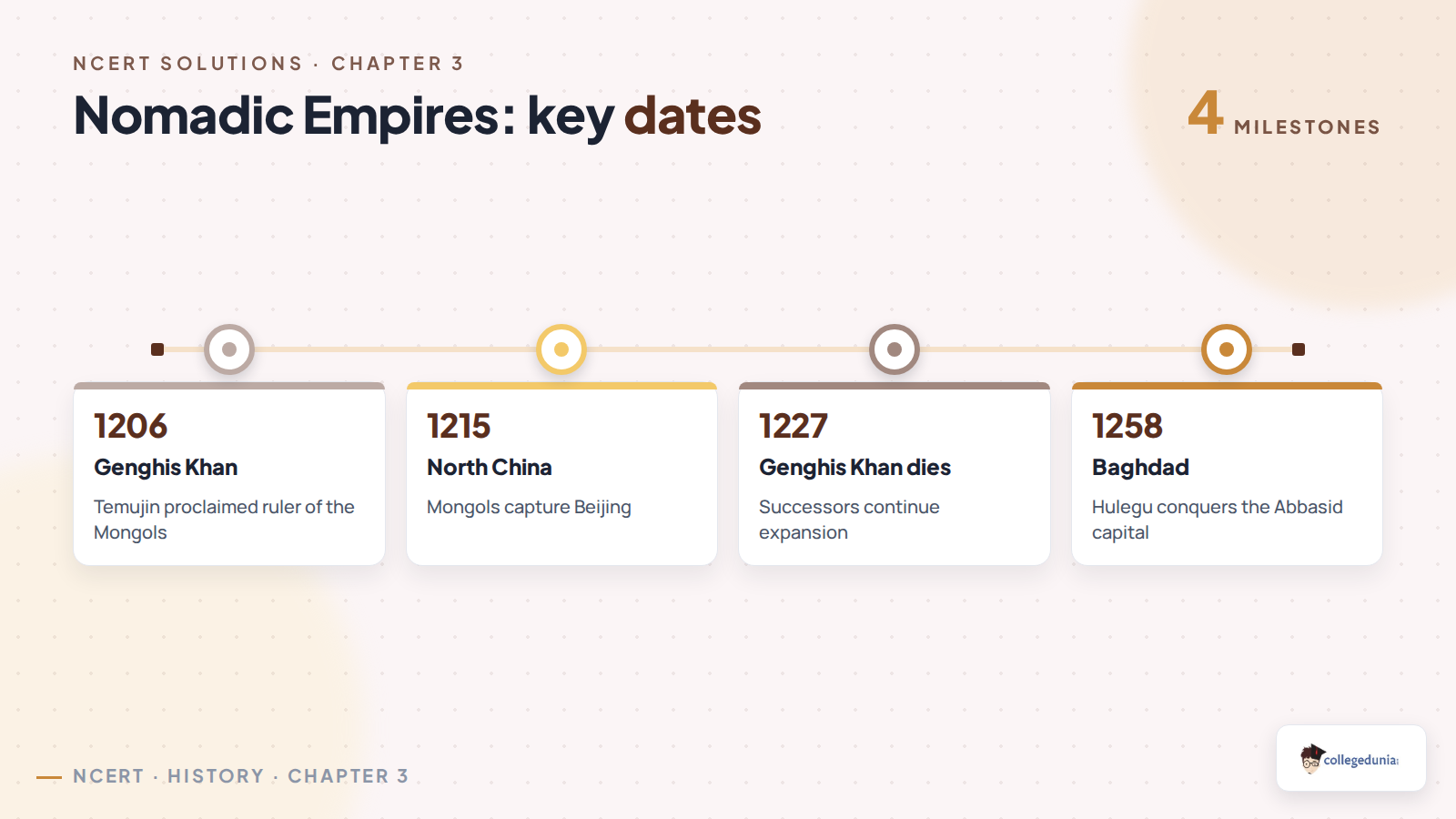
Temujin received the title Genghis Khan in 1206. His successors expanded Mongol power after his death in 1227. Avoid placing every later conquest in his lifetime.
1206: assembly of Mongol chiefs recognises Genghis Khan
1215: Mongol forces capture Beijing
1227: Genghis Khan dies
1258: Hulegu's forces capture Baghdad
The order helps explain change. Initial campaigns brought violence and destruction to many towns. Later rulers also needed revenue, skilled officials and secure routes.
Nomadic Empires Military Organisation and Imperial Rule
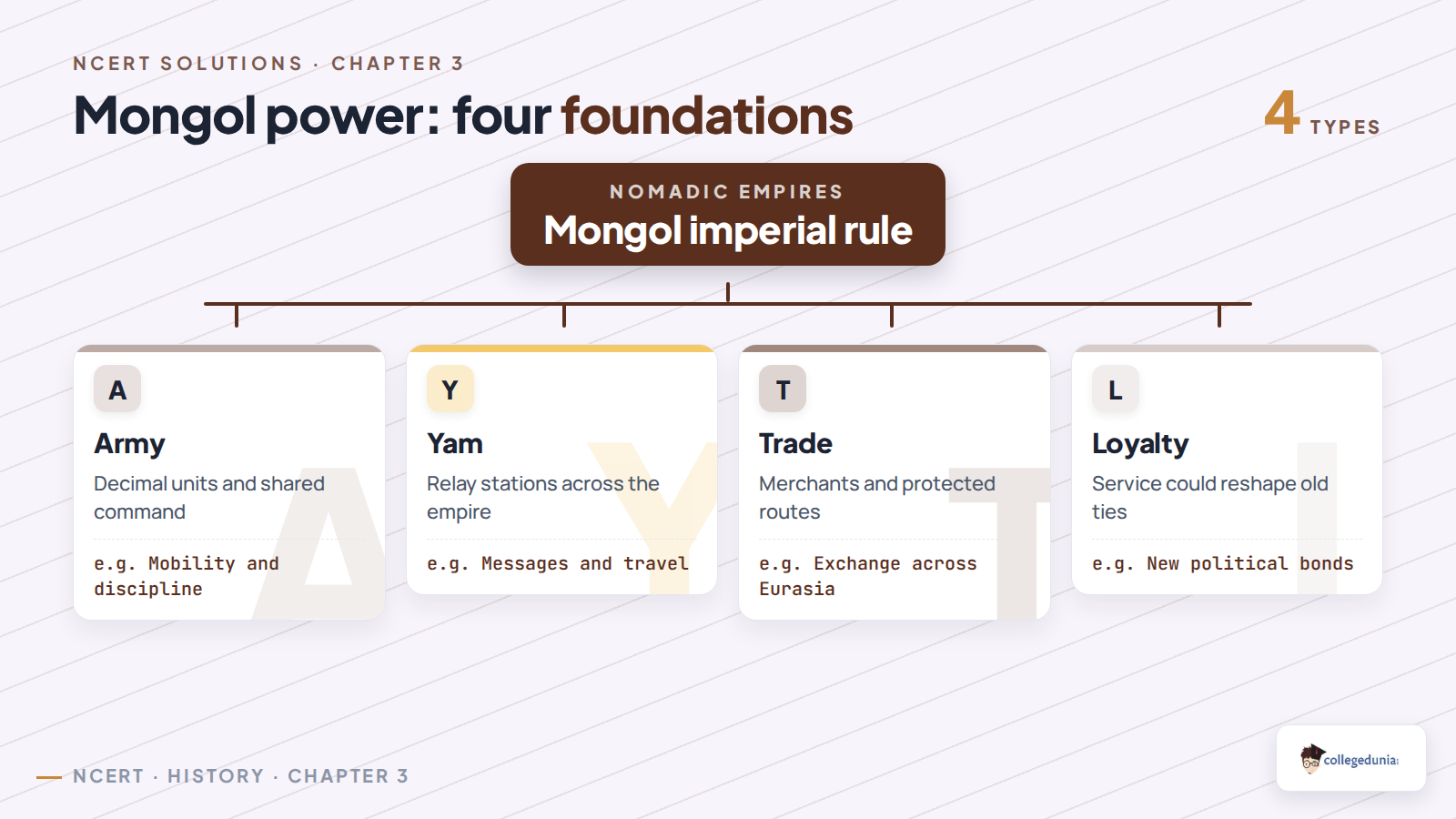
The decimal military system grouped soldiers into units of tens, hundreds, thousands and ten-thousands. Genghis Khan reorganised people across older tribal divisions. Service and loyalty helped support a new political order.
Mounted archers combined speed, coordination and skill
New units weakened some older tribal divisions
The yam relay system helped messages travel across long distances
Merchants connected pastoral and settled economies
Conquest and government required different kinds of work. Explain how later rulers used local officials and protected commerce. This adds the administrative side to an answer about Mongol power.
Nomadic Empires Common Mistakes in Long Answers
Avoid
Write instead
Calling pastoral nomads economically isolated
Explain their exchange with settled communities for goods they needed
Treating the yasa as a simple modern law book
Discuss how successors used Genghis Khan's authority and remembered rules
Describing only destruction
Consider violence alongside communication, commerce and administration
Using later conquests as Genghis Khan's own campaigns
Name the ruler and keep the chronology clear
A strong historical answer explains relationships. For example, show why trade was needed before describing conflict over access to goods.
Nomadic Empires Related Resources for Class 11
Resource
Use
Nomadic Empires Class 11 Notes (not yet available)
Read alongside the textbook exercise
Nomadic Empires Class 11 Handwritten Notes (not yet available)
Expert bylines are instructional personas used to present alternative explanations, as stated in the PDF.
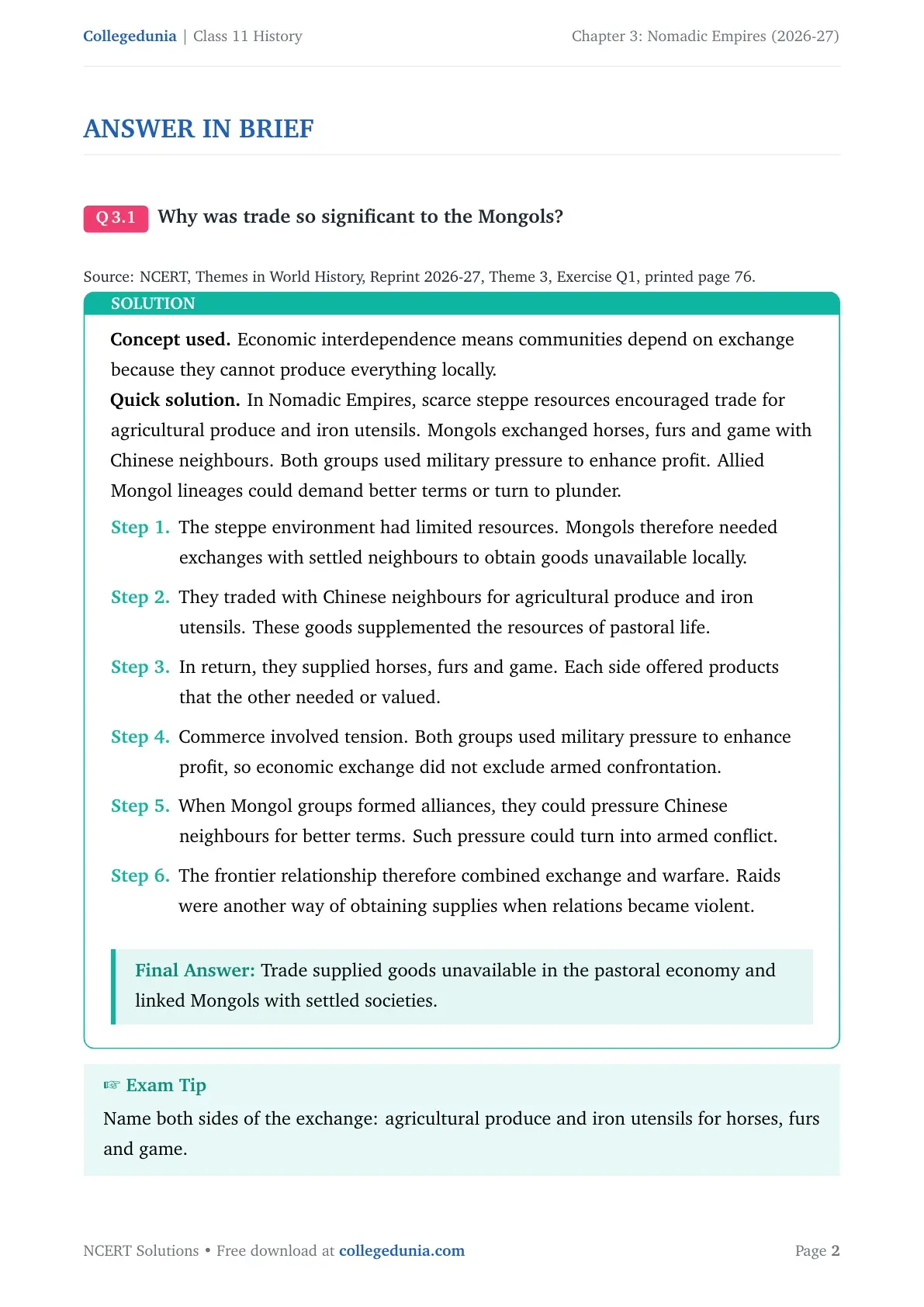
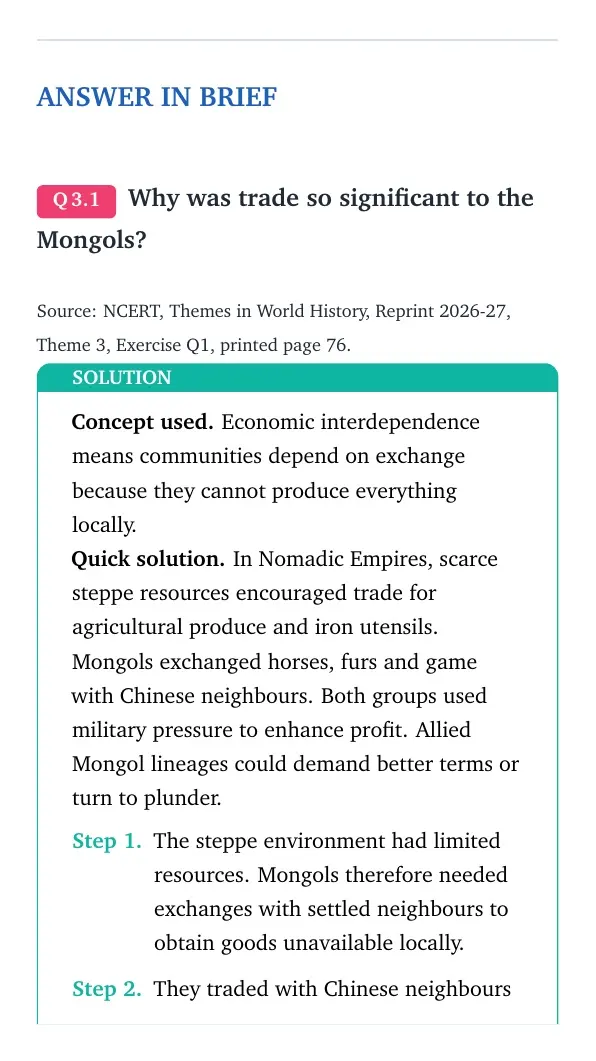
Q 3.1
Source: NCERT, Themes in World History, Reprint 2026-27, Theme 3, Exercise Q1, printed page 76.
Why was trade so significant to the Mongols?
Concept used. Economic interdependence means communities depend on exchange because they cannot produce everything locally.
Quick solution. In Nomadic Empires, scarce steppe resources encouraged trade for agricultural produce and iron utensils. Mongols exchanged horses, furs and game with Chinese neighbours. Both groups used military pressure to enhance profit. Allied Mongol lineages could demand better terms or turn to plunder.
The steppe environment had limited resources. Mongols therefore needed exchanges with settled neighbours to obtain goods unavailable locally.
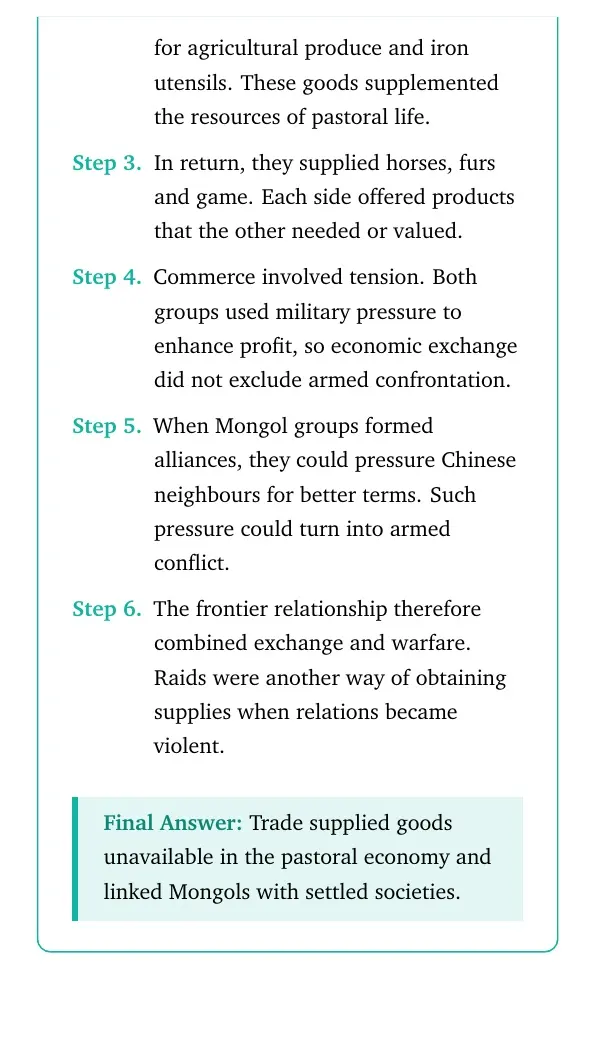
They traded with Chinese neighbours for agricultural produce and iron utensils. These goods supplemented the resources of pastoral life.
In return, they supplied horses, furs and game. Each side offered products that the other needed or valued.
Commerce involved tension. Both groups used military pressure to enhance profit, so economic exchange did not exclude armed confrontation.
When Mongol groups formed alliances, they could pressure Chinese neighbours for better terms. Such pressure could turn into armed conflict.
The frontier relationship therefore combined exchange and warfare. Raids were another way of obtaining supplies when relations became violent.
Trade supplied goods unavailable in the pastoral economy and linked Mongols with settled societies.
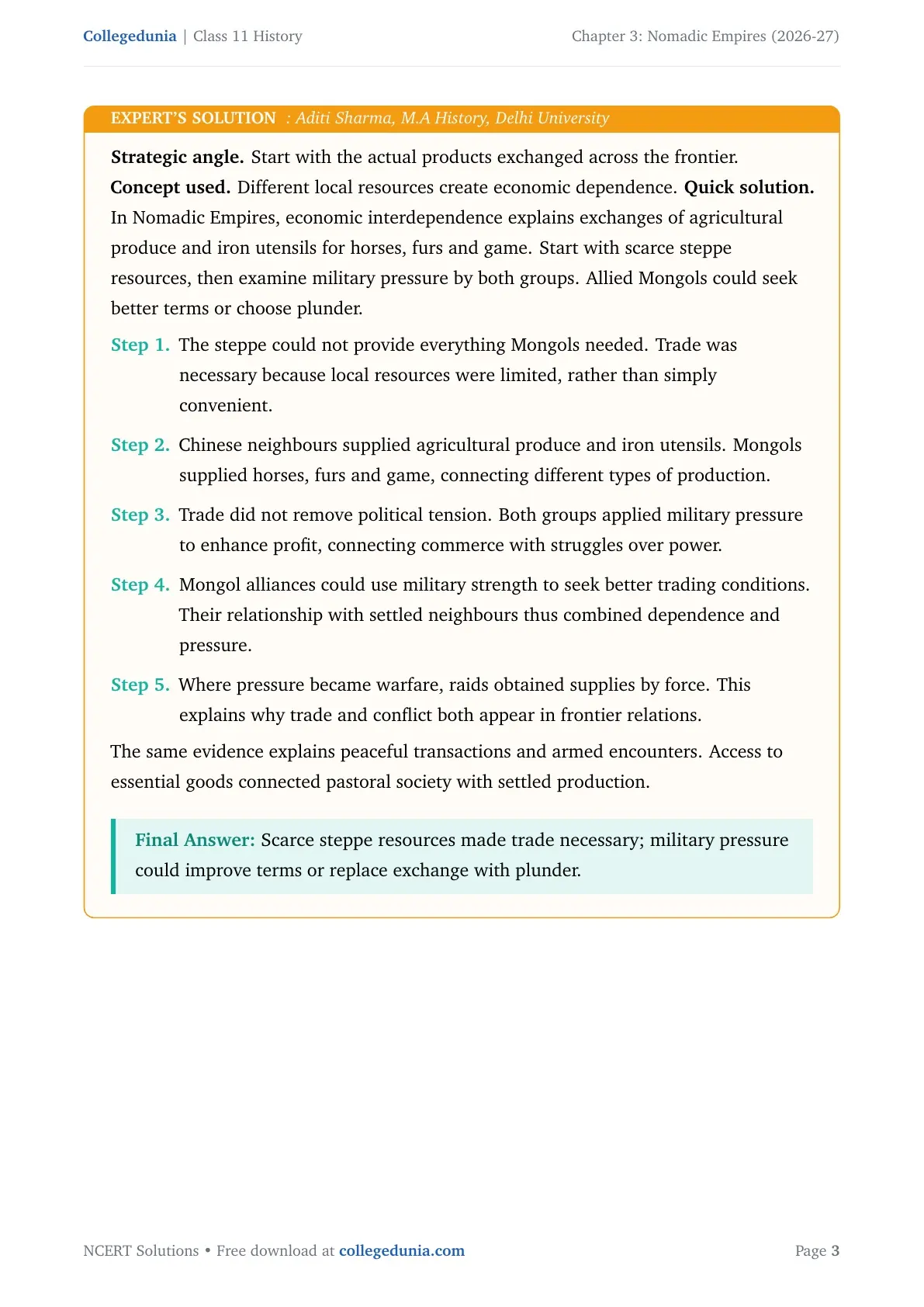
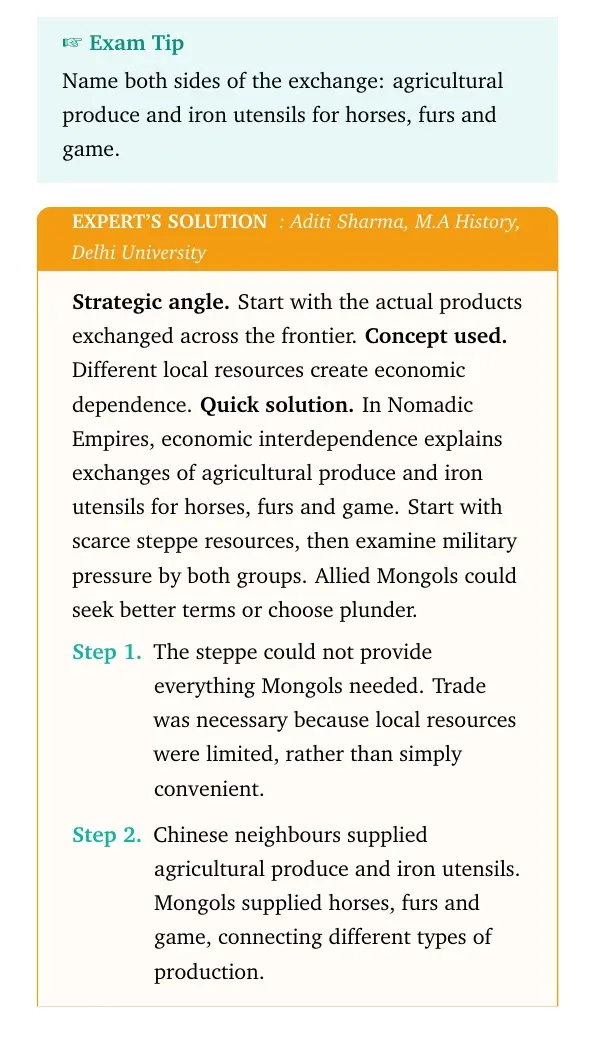
AS
Aditi Sharma
M.A History, Delhi University
Verified Expert
Strategic angle. Start with the actual products exchanged across the frontier. Concept used. Different local resources create economic dependence.
Quick solution. In Nomadic Empires, economic interdependence explains exchanges of agricultural produce and iron utensils for horses, furs and game. Start with scarce steppe resources, then examine military pressure by both groups. Allied Mongols could seek better terms or choose plunder.
The steppe could not provide everything Mongols needed. Trade was necessary because local resources were limited, rather than simply convenient.
Chinese neighbours supplied agricultural produce and iron utensils. Mongols supplied horses, furs and game, connecting different types of production.
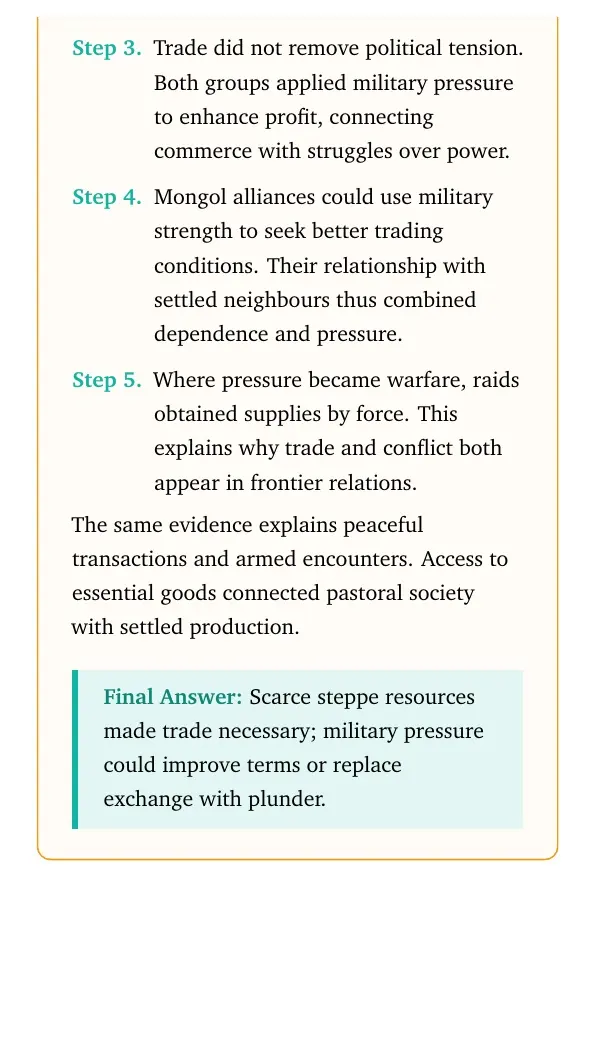
Trade did not remove political tension. Both groups applied military pressure to enhance profit, connecting commerce with struggles over power.
Mongol alliances could use military strength to seek better trading conditions. Their relationship with settled neighbours thus combined dependence and pressure.
Where pressure became warfare, raids obtained supplies by force. This explains why trade and conflict both appear in frontier relations.
The same evidence explains peaceful transactions and armed encounters. Access to essential goods connected pastoral society with settled production.
Scarce steppe resources made trade necessary; military pressure could improve terms or replace exchange with plunder.
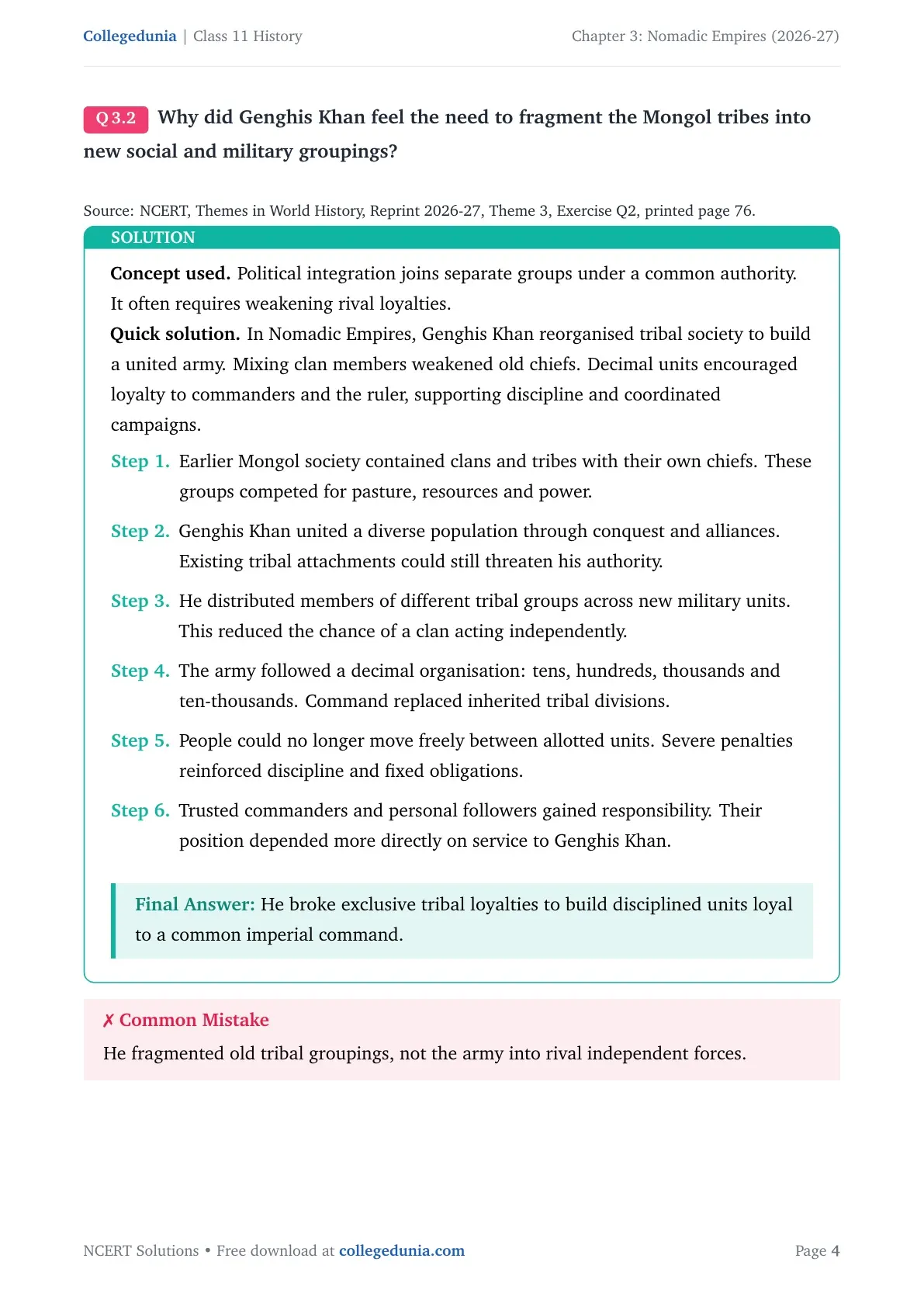
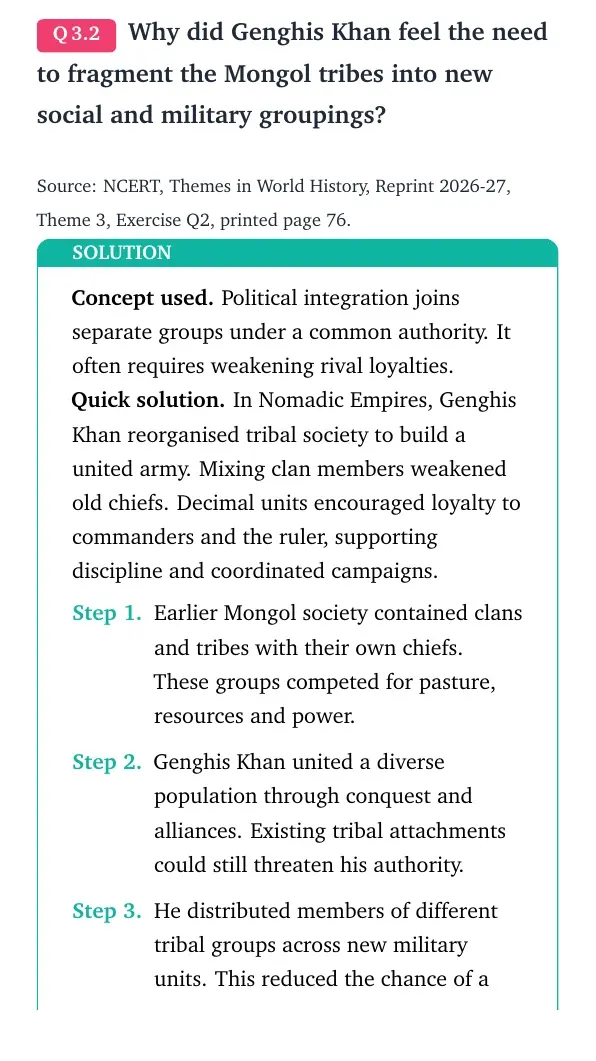
Q 3.2
Source: NCERT, Themes in World History, Reprint 2026-27, Theme 3, Exercise Q2, printed page 76.
Why did Genghis Khan feel the need to fragment the Mongol tribes into new social and military groupings?
Concept used. Political integration joins separate groups under a common authority. It often requires weakening rival loyalties.
Quick solution. In Nomadic Empires, Genghis Khan reorganised tribal society to build a united army. Mixing clan members weakened old chiefs. Decimal units encouraged loyalty to commanders and the ruler, supporting discipline and coordinated campaigns.
Earlier Mongol society contained clans and tribes with their own chiefs. These groups competed for pasture, resources and power.
Genghis Khan united a diverse population through conquest and alliances. Existing tribal attachments could still threaten his authority.
He distributed members of different tribal groups across new military units. This reduced the chance of a clan acting independently.
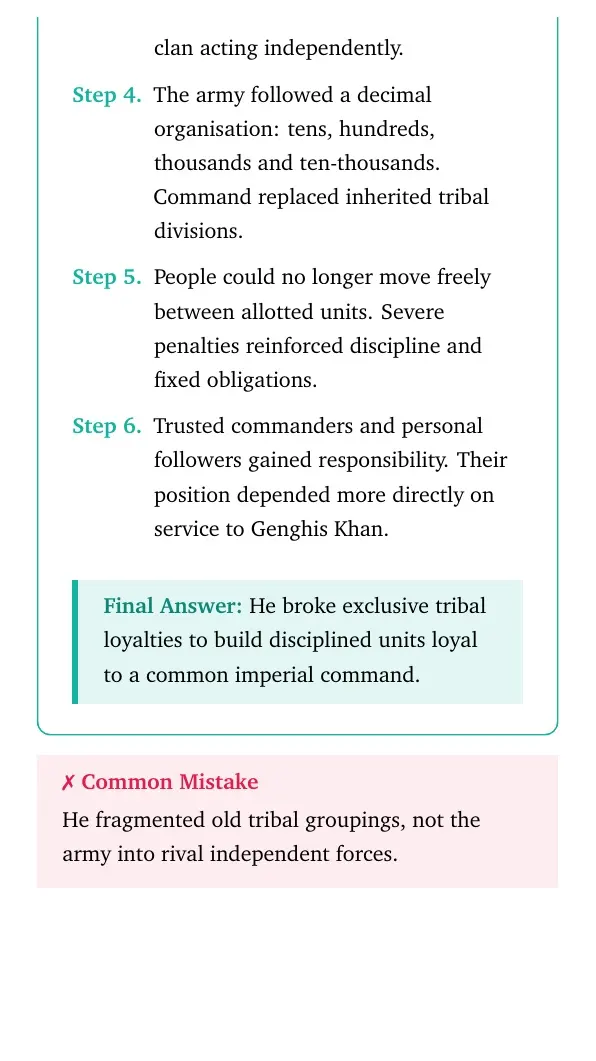
The army followed a decimal organisation: tens, hundreds, thousands and ten-thousands. Command replaced inherited tribal divisions.
People could no longer move freely between allotted units. Severe penalties reinforced discipline and fixed obligations.
Trusted commanders and personal followers gained responsibility. Their position depended more directly on service to Genghis Khan.
He broke exclusive tribal loyalties to build disciplined units loyal to a common imperial command.
RM
Rohit Mehta
M.A History, JNU
Verified Expert
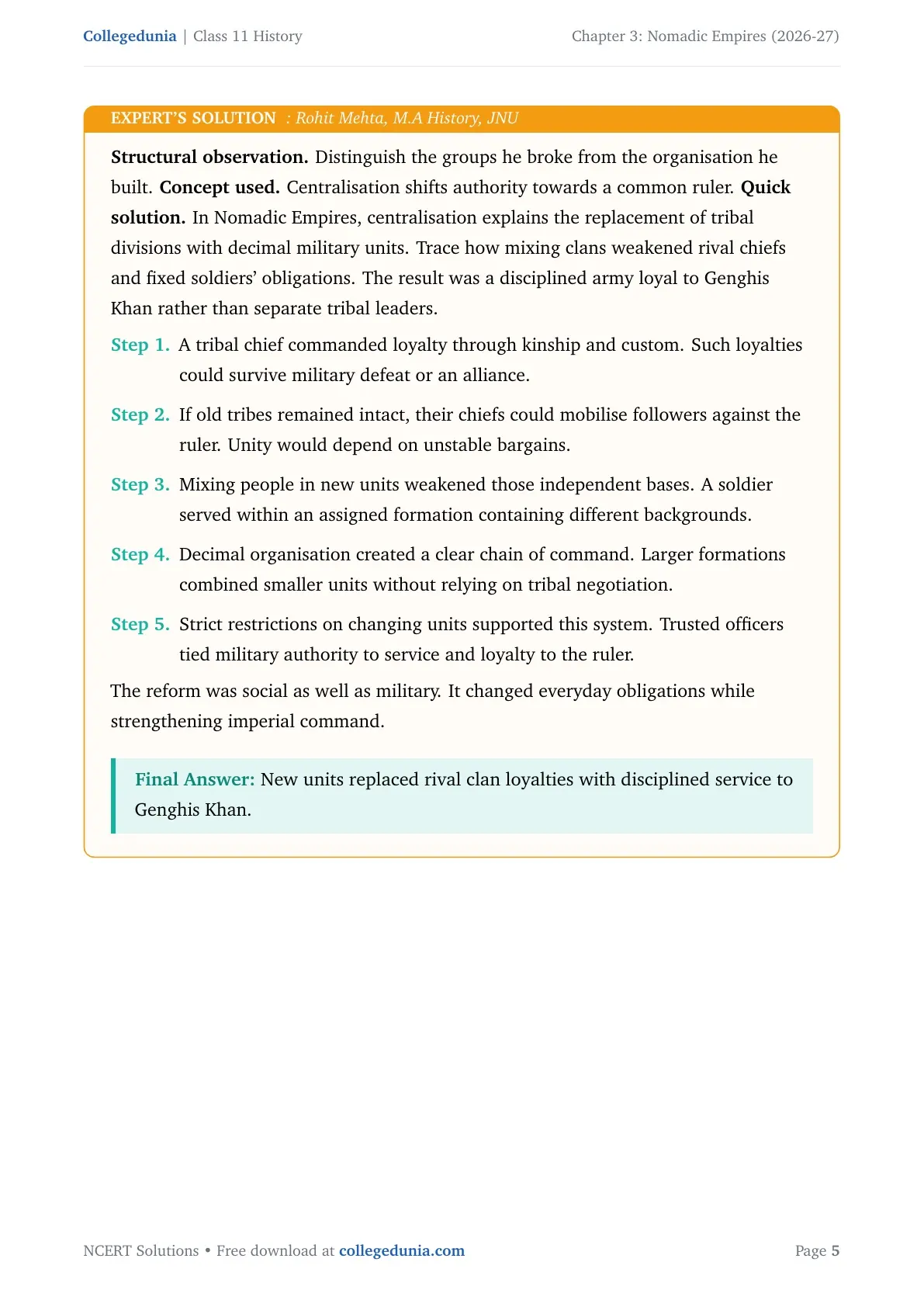
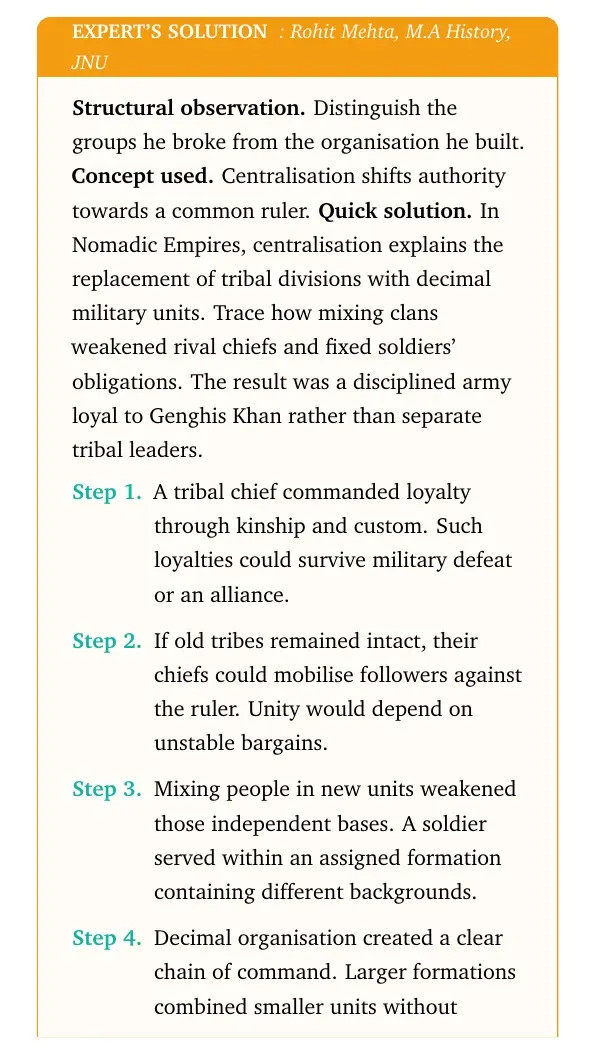
Structural observation. Distinguish the groups he broke from the organisation he built. Concept used. Centralisation shifts authority towards a common ruler.
Quick solution. In Nomadic Empires, centralisation explains the replacement of tribal divisions with decimal military units. Trace how mixing clans weakened rival chiefs and fixed soldiers' obligations. The result was a disciplined army loyal to Genghis Khan rather than separate tribal leaders.
A tribal chief commanded loyalty through kinship and custom. Such loyalties could survive military defeat or an alliance.
If old tribes remained intact, their chiefs could mobilise followers against the ruler. Unity would depend on unstable bargains.
Mixing people in new units weakened those independent bases. A soldier served within an assigned formation containing different backgrounds.
Decimal organisation created a clear chain of command. Larger formations combined smaller units without relying on tribal negotiation.
Strict restrictions on changing units supported this system. Trusted officers tied military authority to service and loyalty to the ruler.
The reform was social as well as military. It changed everyday obligations while strengthening imperial command.
New units replaced rival clan loyalties with disciplined service to Genghis Khan.
Q 3.3
Source: NCERT, Themes in World History, Reprint 2026-27, Theme 3, Exercise Q3, printed page 76.
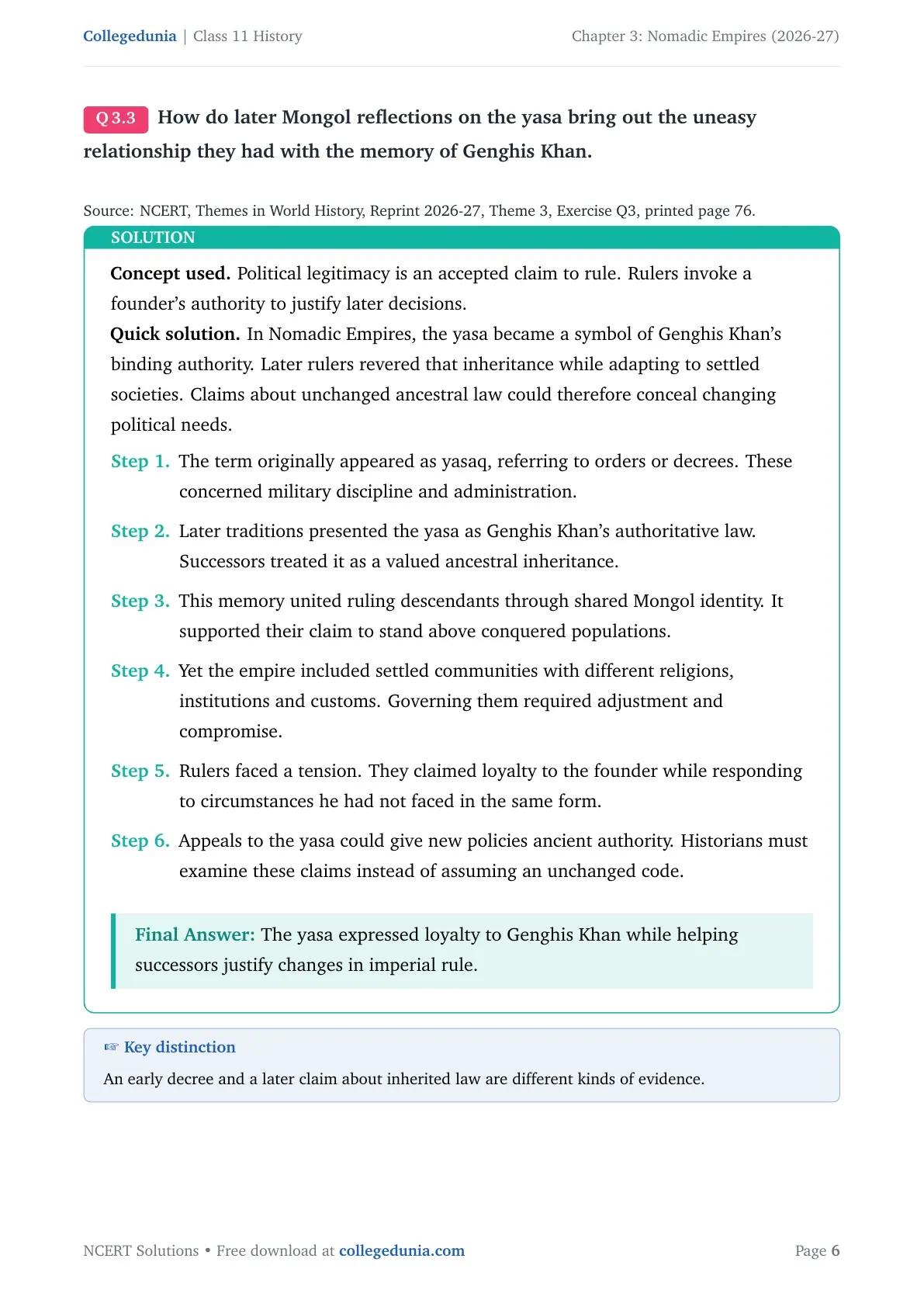
How do later Mongol reflections on the yasa bring out the uneasy relationship they had with the memory of Genghis Khan.
Concept used. Political legitimacy is an accepted claim to rule. Rulers invoke a founder's authority to justify later decisions.
Quick solution. In Nomadic Empires, the yasa became a symbol of Genghis Khan's binding authority. Later rulers revered that inheritance while adapting to settled societies. Claims about unchanged ancestral law could therefore conceal changing political needs.
The term originally appeared as yasaq, referring to orders or decrees. These concerned military discipline and administration.
Later traditions presented the yasa as Genghis Khan's authoritative law. Successors treated it as a valued ancestral inheritance.
This memory united ruling descendants through shared Mongol identity. It supported their claim to stand above conquered populations.
Yet the empire included settled communities with different religions, institutions and customs. Governing them required adjustment and compromise.
Rulers faced a tension. They claimed loyalty to the founder while responding to circumstances he had not faced in the same form.
Appeals to the yasa could give new policies ancient authority. Historians must examine these claims instead of assuming an unchanged code.
The yasa expressed loyalty to Genghis Khan while helping successors justify changes in imperial rule.
MN
Meera Nair
M.A History, University of Hyderabad
Verified Expert
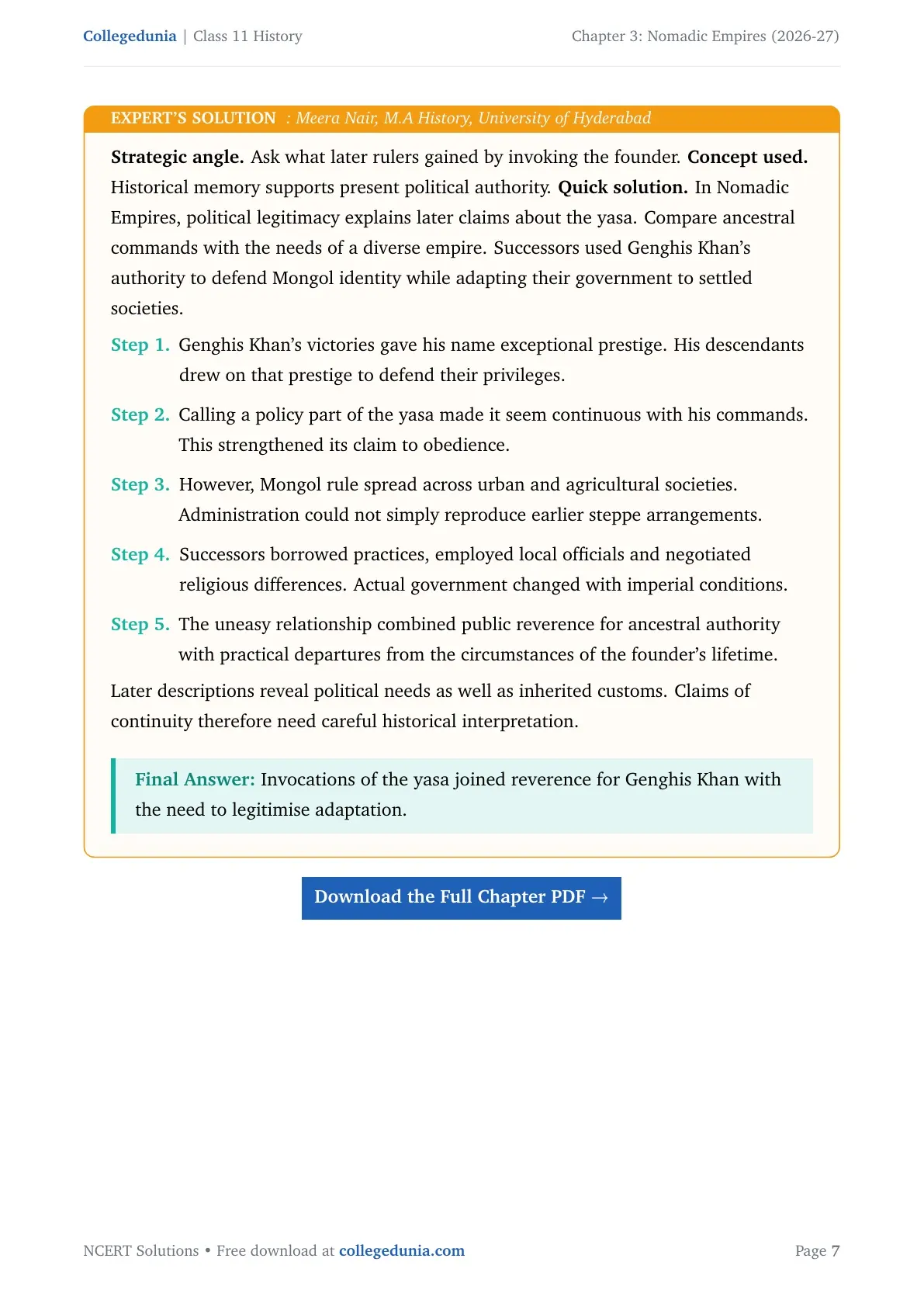
Strategic angle. Ask what later rulers gained by invoking the founder. Concept used. Historical memory supports present political authority.
Quick solution. In Nomadic Empires, political legitimacy explains later claims about the yasa. Compare ancestral commands with the needs of a diverse empire. Successors used Genghis Khan's authority to defend Mongol identity while adapting their government to settled societies.
Genghis Khan's victories gave his name exceptional prestige. His descendants drew on that prestige to defend their privileges.
Calling a policy part of the yasa made it seem continuous with his commands. This strengthened its claim to obedience.
However, Mongol rule spread across urban and agricultural societies. Administration could not simply reproduce earlier steppe arrangements.
Successors borrowed practices, employed local officials and negotiated religious differences. Actual government changed with imperial conditions.
The uneasy relationship combined public reverence for ancestral authority with practical departures from the circumstances of the founder's lifetime.
Later descriptions reveal political needs as well as inherited customs. Claims of continuity therefore need careful historical interpretation.
Invocations of the yasa joined reverence for Genghis Khan with the need to legitimise adaptation.
Q 3.4
Source: NCERT, Themes in World History, Reprint 2026-27, Theme 3, Exercise Q4, printed page 76.
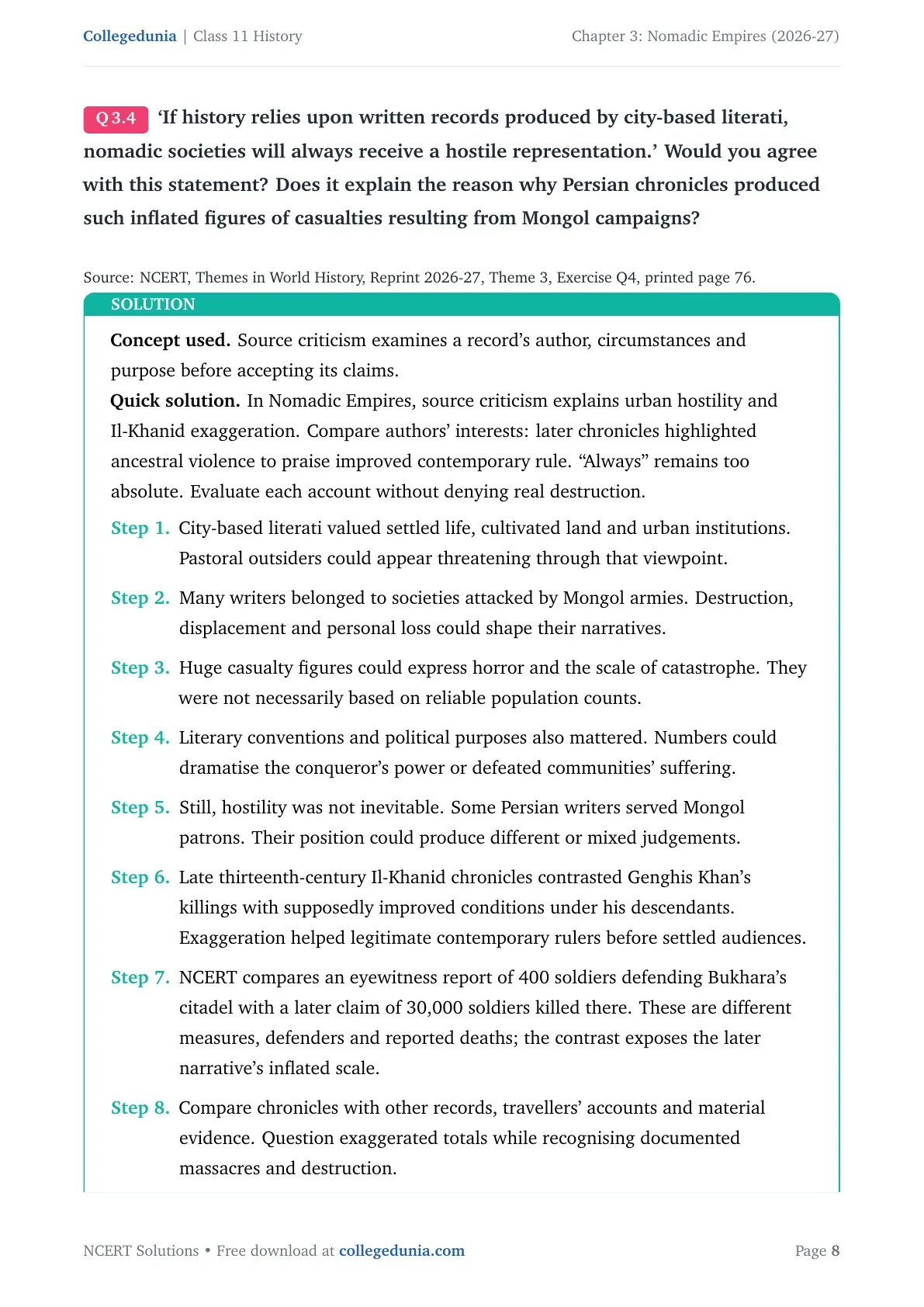
`If history relies upon written records produced by city-based literati, nomadic societies will always receive a hostile representation.' Would you agree with this statement? Does it explain the reason why Persian chronicles produced such inflated figures of casualties resulting from Mongol campaigns?
Concept used. Source criticism examines a record's author, circumstances and purpose before accepting its claims.
Quick solution. In Nomadic Empires, source criticism explains urban hostility and Il-Khanid exaggeration. Compare authors' interests: later chronicles highlighted ancestral violence to praise improved contemporary rule. ``Always'' remains too absolute. Evaluate each account without denying real destruction.
City-based literati valued settled life, cultivated land and urban institutions. Pastoral outsiders could appear threatening through that viewpoint.
Many writers belonged to societies attacked by Mongol armies. Destruction, displacement and personal loss could shape their narratives.
Huge casualty figures could express horror and the scale of catastrophe. They were not necessarily based on reliable population counts.
Literary conventions and political purposes also mattered. Numbers could dramatise the conqueror's power or defeated communities' suffering.
Still, hostility was not inevitable. Some Persian writers served Mongol patrons. Their position could produce different or mixed judgements.
Late thirteenth-century Il-Khanid chronicles contrasted Genghis Khan's killings with supposedly improved conditions under his descendants. Exaggeration helped legitimate contemporary rulers before settled intended publics.
NCERT compares an eyewitness report of 400 soldiers defending Bukhara's citadel with a later claim of 30,000 soldiers killed there. These are different measures, defenders and reported deaths; the contrast exposes the later narrative's inflated scale.
Compare chronicles with other records, travellers' accounts and material evidence. Question exaggerated totals while recognising documented massacres and destruction.
Urban bias partly explains hostile accounts and inflated totals, but each source needs individual evaluation.
AR
Arjun Rao
M.A History, Banaras Hindu University
Verified Expert
Quick reading. Separate the useful warning from its absolute wording. Concept used. Perspective shapes evidence without making it worthless.
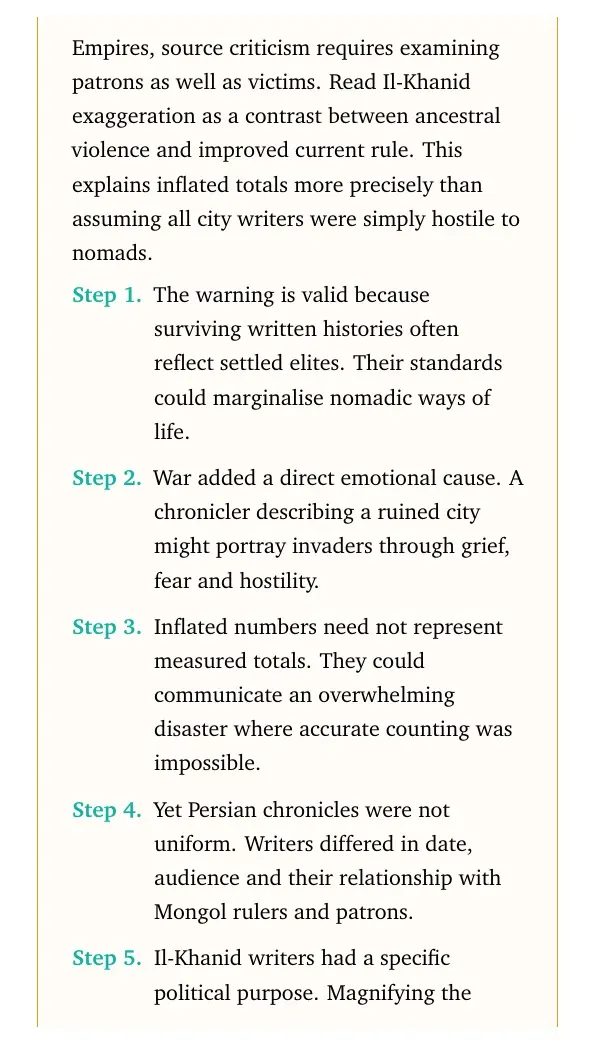
Quick solution. In Nomadic Empires, source criticism requires examining patrons as well as victims. Read Il-Khanid exaggeration as a contrast between ancestral violence and improved current rule. This explains inflated totals more precisely than assuming all city writers were simply hostile to nomads.
The warning is valid because surviving written histories often reflect settled elites. Their standards could marginalise nomadic ways of life.
War added a direct emotional cause. A chronicler describing a ruined city might portray invaders through grief, fear and hostility.
Inflated numbers need not represent measured totals. They could communicate an overwhelming disaster where accurate counting was impossible.
Yet Persian chronicles were not uniform. Writers differed in date, intended public and their relationship with Mongol rulers and patrons.
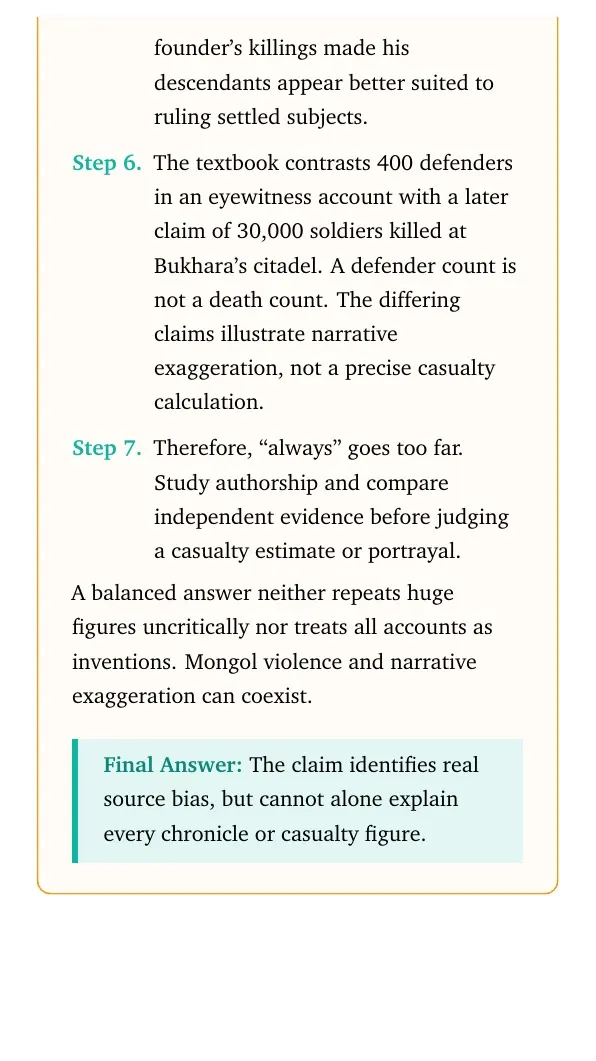
Il-Khanid writers had a specific political purpose. Magnifying the founder's killings made his descendants appear better suited to ruling settled subjects.
The textbook contrasts 400 defenders in an eyewitness account with a later claim of 30,000 soldiers killed at Bukhara's citadel. A defender count is not a death count. The differing claims illustrate narrative exaggeration, not a precise casualty calculation.
Therefore, ``always'' goes too far. Study authorship and compare independent evidence before judging a casualty estimate or portrayal.
A balanced answer neither repeats huge figures uncritically nor treats all accounts as inventions. Mongol violence and narrative exaggeration can coexist.
The claim identifies real source bias, but cannot alone explain every chronicle or casualty figure.
Q 3.5
Source: NCERT, Themes in World History, Reprint 2026-27, Theme 3, Exercise Q5, printed page 76.
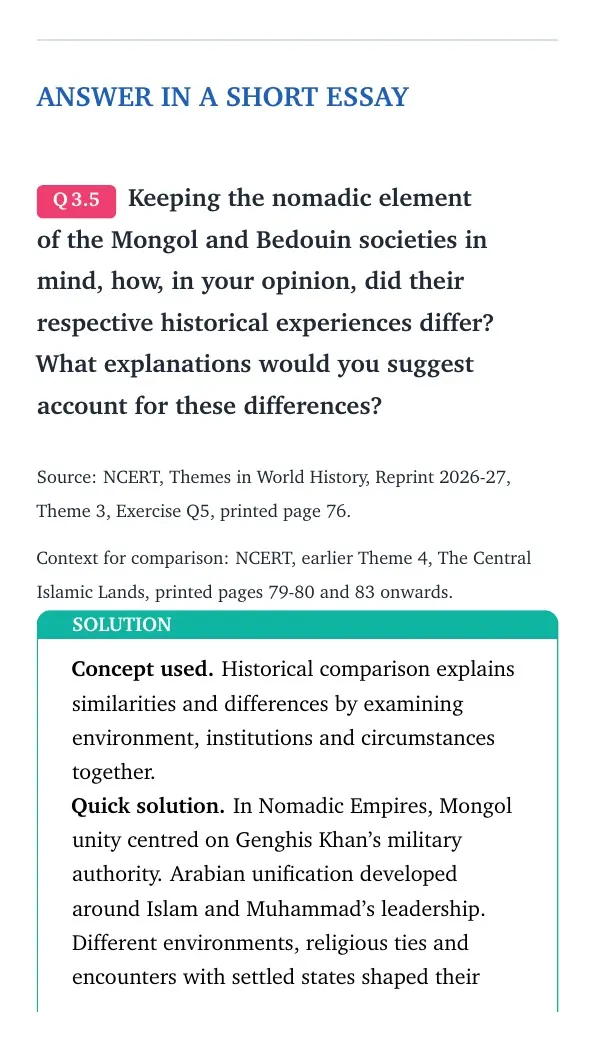
Keeping the nomadic element of the Mongol and Bedouin societies in mind, how, in your opinion, did their respective historical experiences differ? What explanations would you suggest account for these differences?
Concept used. Historical comparison explains similarities and differences by examining environment, institutions and circumstances together.
Quick solution. In Nomadic Empires, Mongol unity centred on Genghis Khan's military authority. Arabian unification developed around Islam and Muhammad's leadership. Different environments, religious ties and encounters with settled states shaped their empires despite shared pastoral backgrounds.
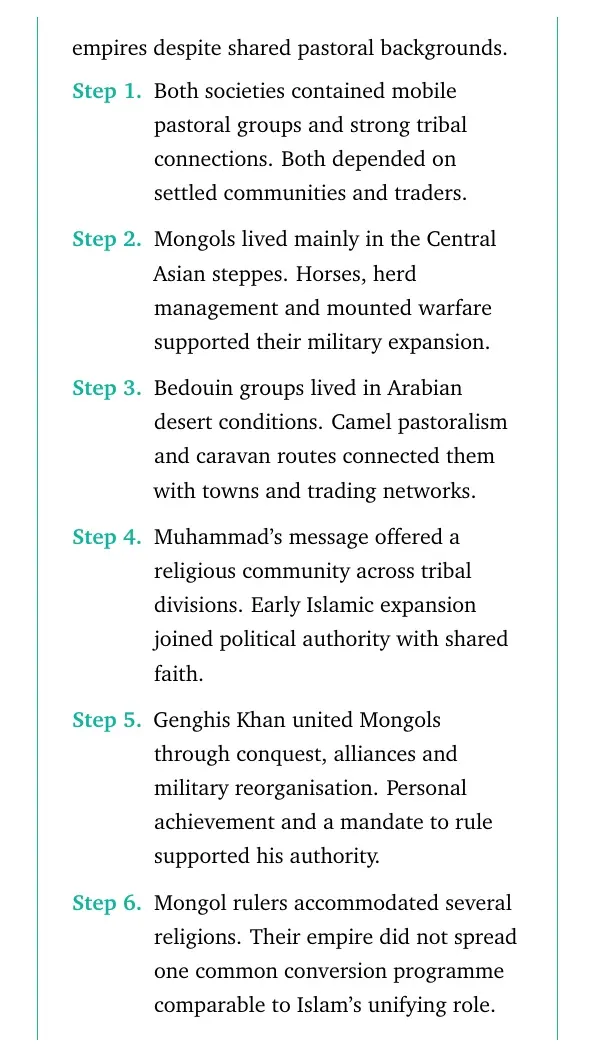
Both societies contained mobile pastoral groups and strong tribal connections. Both depended on settled communities and traders.
Mongols lived mainly in the Central Asian steppes. Horses, herd management and mounted warfare supported their military expansion.
Bedouin groups lived in Arabian desert conditions. Camel pastoralism and caravan routes connected them with towns and trading networks.
Muhammad's message offered a religious community across tribal divisions. Early Islamic expansion joined political authority with shared faith.
Genghis Khan united Mongols through conquest, alliances and military reorganisation. Personal achievement and a mandate to rule supported his authority.
Mongol rulers accommodated several religions. Their empire did not spread one common conversion programme comparable to Islam's unifying role.
Different neighbours and conquered populations shaped later government. Both traditions borrowed skills and institutions from settled societies.
These differences were historical, not evidence of a fixed destiny for either nomadic society.
Similar pastoral origins produced different empires because ecology, leadership, religion and political encounters differed.
KI
Kavya Iyer
M.A History, Jamia Millia Islamia
Verified Expert
Structural observation. A shared nomadic element is a starting point. Concept used. Similar livelihoods develop differently under different historical conditions.
Quick solution. In Nomadic Empires, historical comparison connects pastoral backgrounds with different political outcomes. Compare ecology, leadership and religious unity. Mongol military-dynastic integration differed from Islam's role in Arabian unification, while both traditions adapted to settled societies.
Establish the common base. Tribal organisation, animal husbandry and mobility mattered to both groups. Neither existed apart from settled neighbours.
Compare settings. Steppe grasslands favoured Mongol horse herding and cavalry. Arabian deserts shaped camel pastoralism and caravan contacts.
Compare unity. Muhammad's leadership and Islam created a community beyond tribal membership among Arabian groups and gave expansion a religious basis.
Genghis Khan built unity through victory, alliances and reorganised military service. Loyalty to his house remained a central imperial principle.
Compare religion. Mongol courts admitted several faiths, while Islam supplied shared religious bonds for the early caliphate.
Consider adaptation. Conquests exposed both traditions to literate administrators, cities and agricultural revenues, in different regions and periods.
Do not describe every Mongol or Arab as a nomad. Townspeople and conquered communities shaped these histories too.
Ecology and distinct religious-political forms of unity explain their different historical experiences.
Q 3.6
Source: NCERT, Themes in World History, Reprint 2026-27, Theme 3, Exercise Q6, printed page 76.
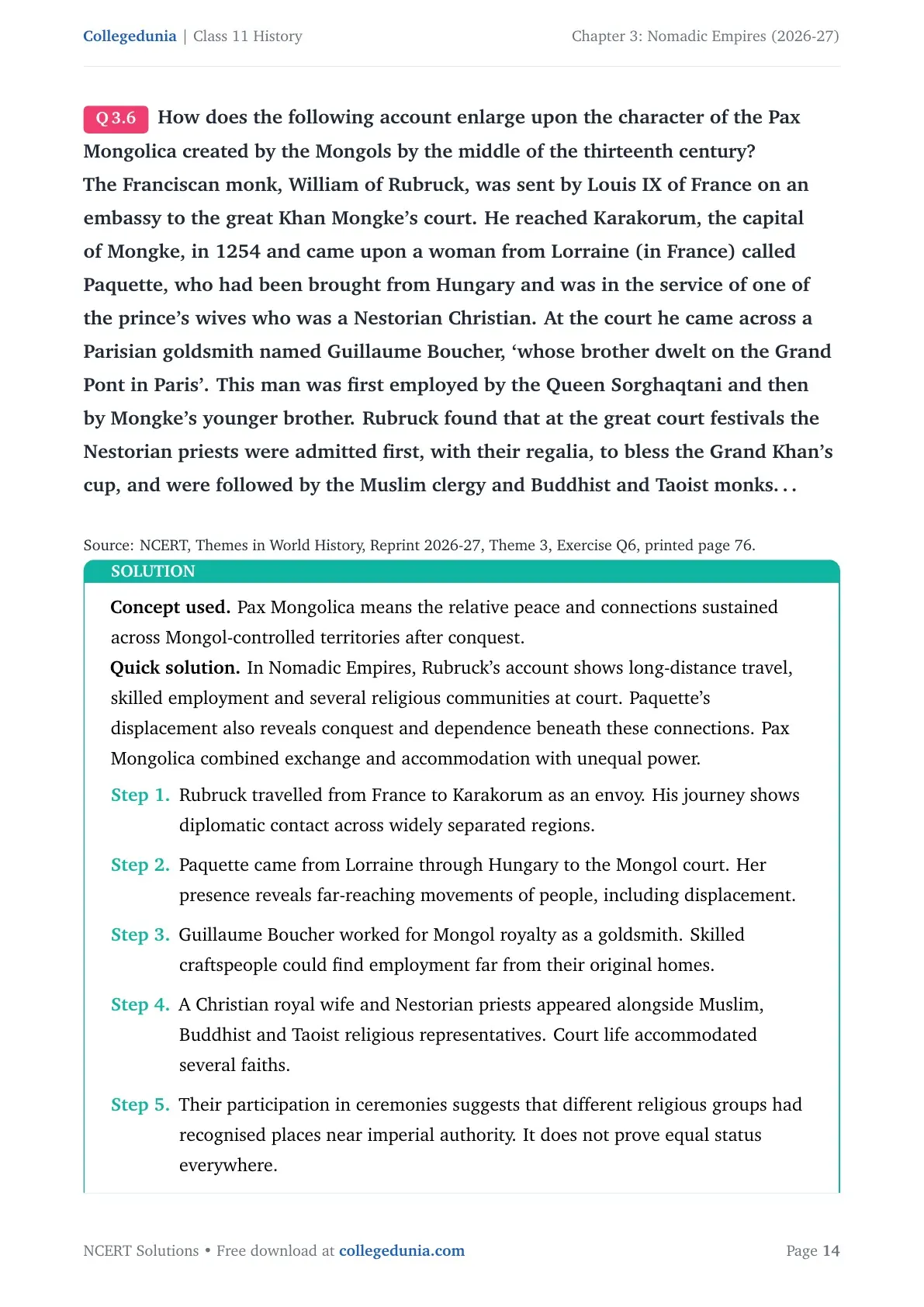
How does the following account enlarge upon the character of the Pax Mongolica created by the Mongols by the middle of the thirteenth century?
The Franciscan monk, William of Rubruck, was sent by Louis IX of France on an embassy to the great Khan Mongke's court. He reached Karakorum, the capital of Mongke, in 1254 and came upon a woman from Lorraine (in France) called Paquette, who had been brought from Hungary and was in the service of one of the prince's wives who was a Nestorian Christian. At the court he came across a Parisian goldsmith named Guillaume Boucher, `whose brother dwelt on the Grand Pont in Paris'. This man was first employed by the Queen Sorghaqtani and then by Mongke's younger brother. Rubruck found that at the great court festivals the Nestorian priests were admitted first, with their regalia, to bless the Grand Khan's cup, and were followed by the Muslim clergy and Buddhist and Taoist monks
Concept used. Pax Mongolica means the relative peace and connections sustained across Mongol-controlled territories after conquest.
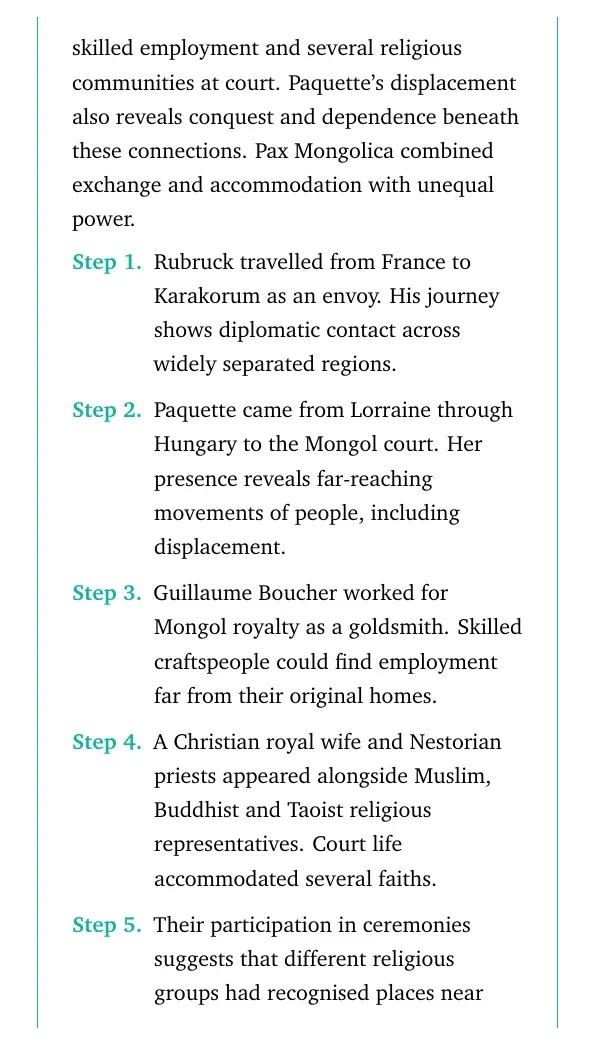
Quick solution. In Nomadic Empires, Rubruck's account shows long-distance travel, skilled employment and several religious communities at court. Paquette's displacement also reveals conquest and dependence beneath these connections. Pax Mongolica combined exchange and accommodation with unequal power.
Rubruck travelled from France to Karakorum as an envoy. His journey shows diplomatic contact across widely separated regions.
Paquette came from Lorraine through Hungary to the Mongol court. Her presence reveals far-reaching movements of people, including displacement.
Guillaume Boucher worked for Mongol royalty as a goldsmith. Skilled craftspeople could find employment far from their original homes.
A Christian royal wife and Nestorian priests appeared alongside Muslim, Buddhist and Taoist religious representatives. Court life accommodated several faiths.
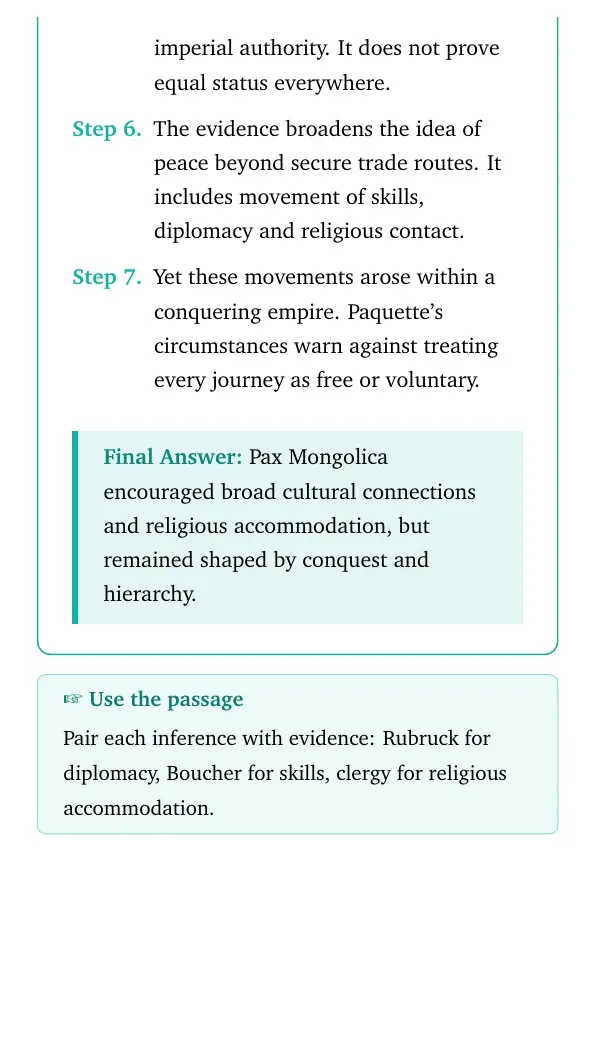
Their participation in ceremonies suggests that different religious groups had recognised places near imperial authority. It does not prove equal status everywhere.
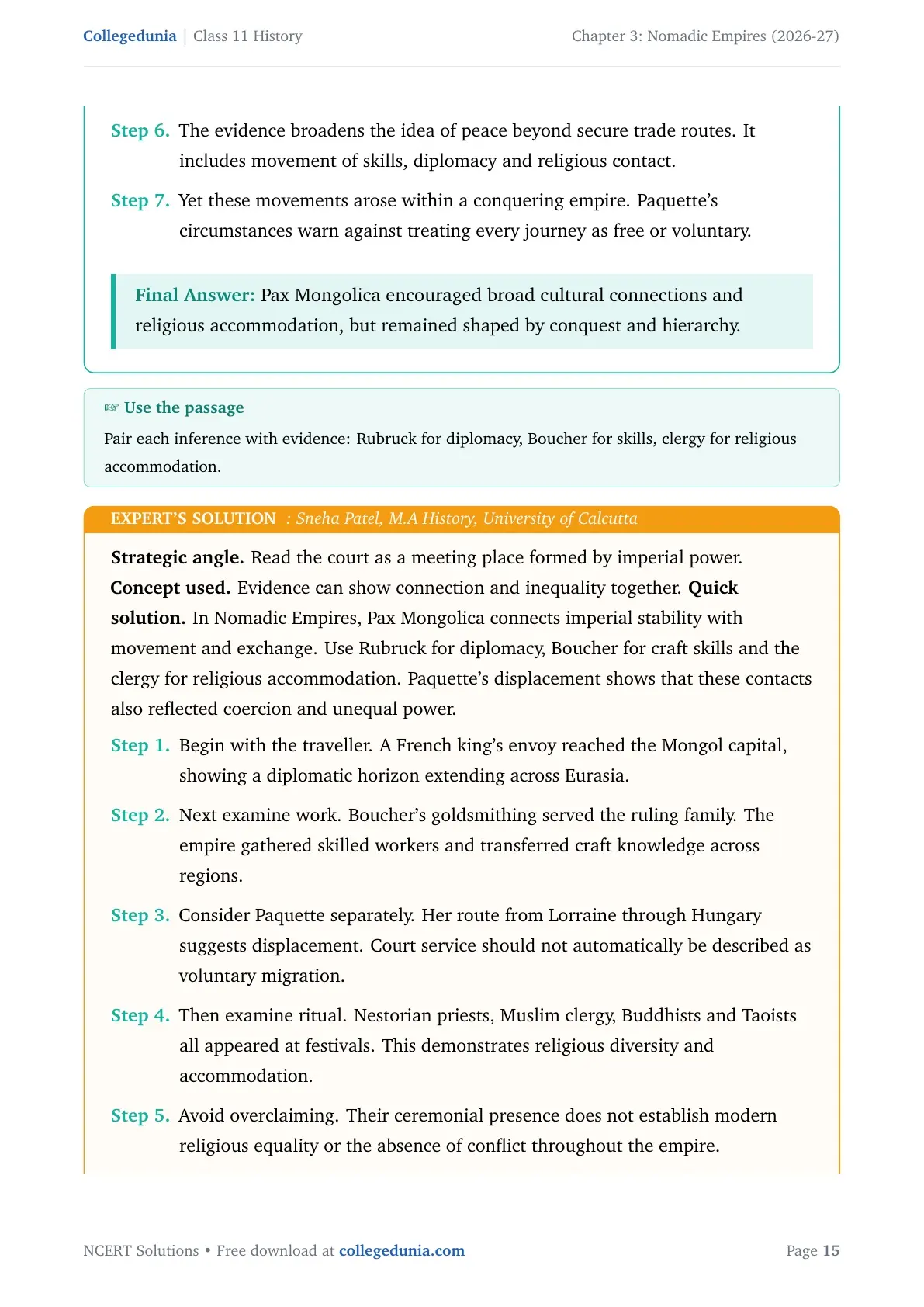
The evidence broadens the idea of peace beyond secure trade routes. It includes movement of skills, diplomacy and religious contact.
Yet these movements arose within a conquering empire. Paquette's circumstances warn against treating every journey as free or voluntary.
Pax Mongolica encouraged broad cultural connections and religious accommodation, but remained shaped by conquest and hierarchy.
SP
Sneha Patel
M.A History, University of Calcutta
Verified Expert
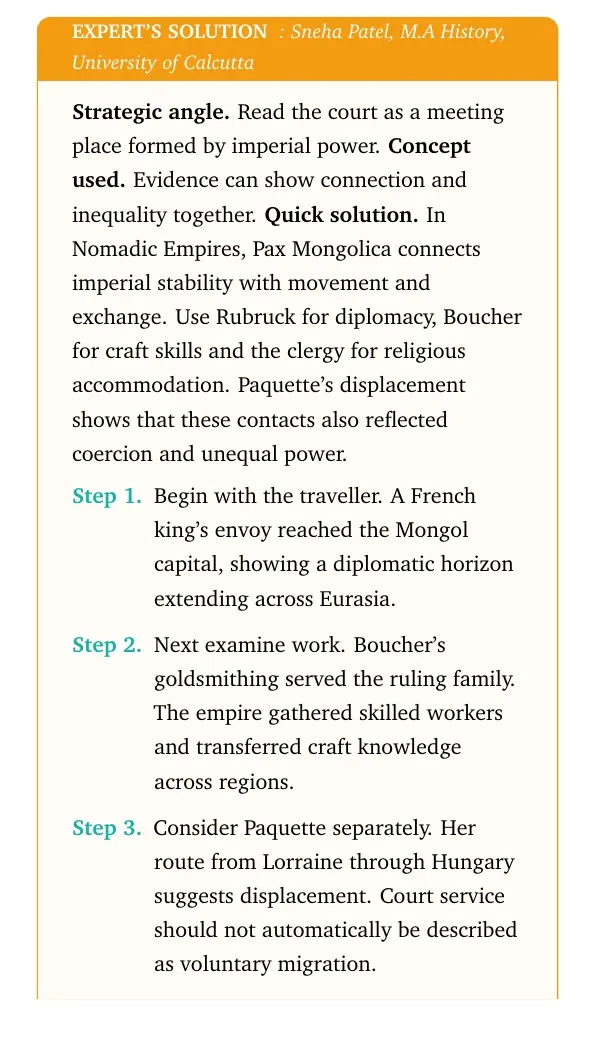
Strategic angle. Read the court as a meeting place formed by imperial power. Concept used. Evidence can show connection and inequality together.
Quick solution. In Nomadic Empires, Pax Mongolica connects imperial stability with movement and exchange. Use Rubruck for diplomacy, Boucher for craft skills and the clergy for religious accommodation. Paquette's displacement shows that these contacts also reflected coercion and unequal power.
Begin with the traveller. A French king's envoy reached the Mongol capital, showing a diplomatic horizon extending across Eurasia.
Next examine work. Boucher's goldsmithing served the ruling family. The empire gathered skilled workers and transferred craft knowledge across regions.
Consider Paquette separately. Her route from Lorraine through Hungary suggests displacement. Court service should not automatically be described as voluntary migration.
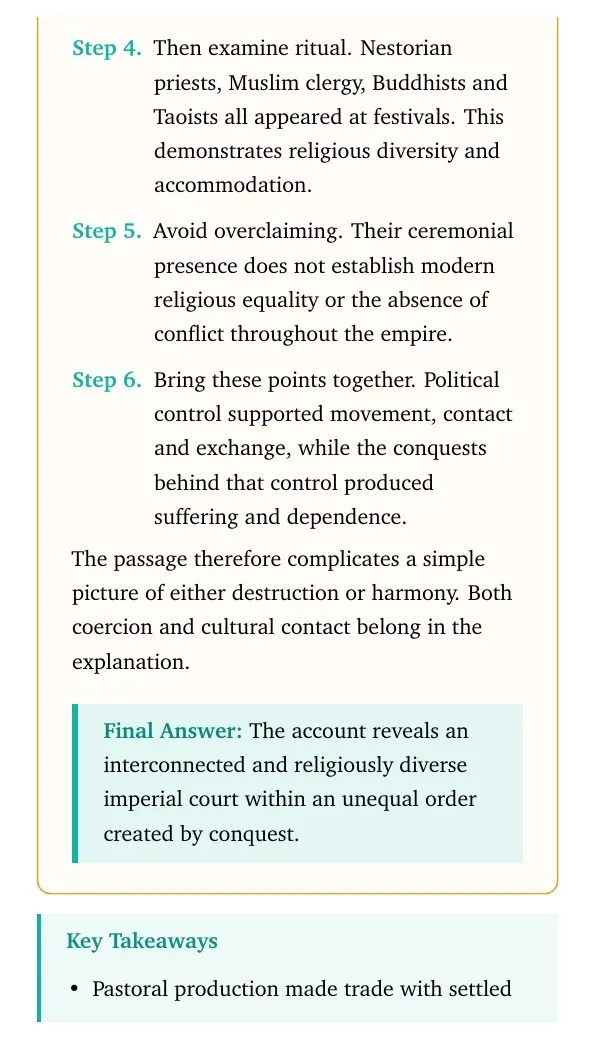
Then examine ritual. Nestorian priests, Muslim clergy, Buddhists and Taoists all appeared at festivals. This demonstrates religious diversity and accommodation.
Avoid overclaiming. Their ceremonial presence does not establish modern religious equality or the absence of conflict throughout the empire.
Bring these points together. Political control supported movement, contact and exchange, while the conquests behind that control produced suffering and dependence.
The passage therefore complicates a simple picture of either destruction or harmony. Both coercion and cultural contact belong in the explanation.
The account reveals an interconnected and religiously diverse imperial court within an unequal order created by conquest.
Nomadic Empires Class 11 History NCERT Solutions FAQs
Ques. How many exercise questions does Nomadic Empires have?
Ans. The textbook has six exercise questions. They cover trade, tribal organisation, the yasa, historical interpretations and changing Mongol rule.
Ques. Why do some older resources call Nomadic Empires Chapter 5?
Ans. Older editions used Chapter 5. The current rationalised Themes in World History textbook places Nomadic Empires as Chapter 3. Match the chapter title when using older resources.
Ques. How should I write a long answer on Mongol rule?
Ans. Start with a direct argument. Add relevant textbook facts, explain how they support the argument and end with the change or result.
Ques. Did Genghis Khan conquer Baghdad?
Ans. No. Hulegu conquered Baghdad in 1258, after Genghis Khan died in 1227.
Ques. What was the yam system?
Ans. The yam was a relay network with stations that helped officials and messages travel across the Mongol Empire.
Ques. Why were merchants important to the Mongols?
Ans. Merchants supplied goods and connected distant regions. Their work linked pastoral nomads with settled societies and supported long-distance exchange.
Ques. What does pastoralism mean?
Ans. Pastoralism is a way of life based on raising livestock. Mongol pastoral communities moved with their herds according to grazing needs.
Ques. What does yasa mean in this chapter?
Ans. The yasa refers to rules associated with Genghis Khan. His successors used this tradition to support authority and continuity.
Ques. What are nomadic empires?
Ans. Nomadic empires are large political formations built by mobile pastoral peoples. The Mongol Empire is the central example in this NCERT chapter.








Comments