History Strategist, UPSC Mentor | Updated on - Jul 21, 2026
The NCERT Solutions for Class 12 History Chapter 3 Kinship, Caste and Class cover every back-exercise question on early Indian society, according to the latest 2026-27 CBSE syllabus. Each answer reads the period c. 600 BCE to 600 CE through the Mahabharata, the Dharmashastras and inscriptions, always weighing the rule against what people actually did. These solutions help students prepare for the Class 12 History board paper in 2026-27.
Covers all 12 exercise questions from Theme 3, with full source-based, essay and map-work points.
This Class 12 History chapter usually carries 6 to 8 marks per board paper.
Pairs with the Notes, Handwritten Notes and NCERT Book PDF linked lower on this page.
Every solution for class 12 history chapter 3 in this Collegedunia compilation is curated by subject experts, written from the official NCERT Themes in Indian History Part I, and checked against the last five years of CBSE board papers.
Student Feedback: In a Collegedunia poll of 10,870 Class 12 History students conducted before the 2026 boards, 69% of students rated the "was the Mahabharata the work of a single author" question as the trickiest part of Kinship, Caste and Class. Most students said that learning the phases of composition as a timeline made the answer click.
Source: 2026-27 Class 12 History student poll. Sample of 10,870 students from CBSE schools across 14 states.
What the Kinship, Caste and Class Class 12 Chapter Is About
Kinship, Caste and Class is the third chapter of Themes in Indian History Part I. It studies early Indian society from about 600 BCE to 600 CE, mostly through one giant text, the Mahabharata, along with the Dharmasutras, the Dharmashastras and inscriptions. The big skill of the chapter is to read these texts carefully and tell what people were told to do from what they actually did.
The title points to the three social themes the chapter unpacks:
Kinship covers patriliny, the gotra, and the rules of marriage.
Caste covers the varna and jati order, non-Kshatriya kings and untouchability.
Class covers gender, property and who controlled wealth.
So the chapter is really about reading society off a single epic. A student who keeps the rule-versus-practice idea in mind can connect almost any question in chapter 3 history class 12 back to one tension: the Brahmanical norm against the evidence of inscriptions and stories. This is why history 12 class chapter 3 revision works best when you pair each rule with the case that breaks it.
Patriliny, Gotra and the Rules of Marriage
The first set of questions deals with kinship. Patriliny means tracing descent from father to son, and it shaped inheritance, succession and the value placed on sons. The marriage rules of gotra and exogamy sit alongside it, and both are tested for how often they were broken.
The main points students should remember about kinship are:
Patriliny: a son could claim the father's land, cattle, wealth and, for kings, the throne; it mattered most to elite families.
The gotra rule: a wife was meant to take her husband's gotra, and members of the same gotra could not marry.
Exogamy: the Brahmanical ideal was to marry outside the kin group.
Kanyadana: gifting a daughter in marriage was treated as the father's religious duty.
A key exam point is that these rules were not universally followed. Satavahana queens kept their fathers' gotra names, some married within the same gotra, and the dynasty practised endogamy, all against the texts. So the answer to "why was patriliny important among elite families" is that only they had property and thrones worth fixing a rule over, while the gotra question is really about how often the rule broke.
Were Kings Always Kshatriyas? The Varna Order
The caste questions turn on the varna order, the four-fold ranking the Brahmanas said was divine. The Shastras reserved kingship for Kshatriyas, but the chapter shows that the rule rarely held in practice. This gap between norm and reality is the heart of the caste answers.
Dynasty
What its origin shows
Mauryas
Disputed origin; Buddhist texts call them Kshatriyas, Brahmanical texts call them "low".
Shungas and Kanvas
The successors of the Mauryas were Brahmanas, not Kshatriyas.
Shakas
Central-Asian outsiders, treated as mlechchhas, yet Rudradaman rebuilt the Sudarshana lake.
Satavahanas
Their king Gotami-puta claimed to be a "unique Brahmana" while upholding varna.
The single insight for Question 3.2 is plain. Political power went to whoever could gather support and resources, not to birth as a Kshatriya. That one line, backed by naming as many dynasties as possible, earns the marks. The varna order was the ideal; the kings on the ground broke it again and again.
Dharma in the Drona, Hidimba and Matanga Stories
One comparison question sets three stories side by side to ask how dharma, the norm of right conduct, treated people of low birth. All three centre on an outsider figure, but they answer the question of birth very differently. Reading the source tradition behind each is what wins the marks.
Drona and Ekalavya: the Brahmanical story upholds the hierarchy; the nishada is denied his skill and his thumb so the prince Arjuna stays the best.
Hidimba and Bhima: the story bends the norm; a Pandava marries a rakshasa woman from outside the fold, and the marriage is accepted.
Matanga: the Buddhist Jataka rejects the norm; a chandala Bodhisattva shows that worth comes from virtue, not birth.
The high-scoring move is to name the source. Drona and Hidimba come from the Brahmanical Mahabharata, while Matanga comes from a Buddhist Jataka. That clash of viewpoints is the real contrast: the same theme of birth-versus-worth gets opposite answers depending on who tells the story.
Gender, Property and the Buddhist Social Contract
The class and gender questions ask how unequal early society was, and how it explained that inequality. The Manusmriti and the dice game show the sharp limits placed on women, while the Buddhist social contract offers an alternative to the Brahmanical view of the varna order.
Sons over daughters: under patriliny sons inherited; daughters had no claim and were married out.
Property law: the Manusmriti gave the estate to sons; women could keep only stridhana, the gifts received at marriage.
Draupadi at dice: Yudhisthira staked and lost the common wife, the sharpest image of a woman treated as property.
The two myths: the Purusha sukta made the varnas divine and fixed by birth; the Buddhist contract made kingship a human choice, with the mahasammata elected.
The difference between the two views flows from one split. The Purusha sukta says society is god-given and unchangeable; the Buddhist contract says it is man-made and therefore open to change. Yet practice was sometimes softer than the texts: the Vakataka queen Prabhavati Gupta held resources, and Satavahana women kept their gotra names, so gender differences were real but not absolute.
How the Mahabharata Was Built Over a Thousand Years
Two essay questions ask whether the Mahabharata had a single author and whether its variety lets us see early society. Both rest on the same idea: the epic grew in stages over about a thousand years, which is why it is so rich and why no one person could have written it.
Phase
What happened
c. 500 BCE
Charioteer-bards (sutas) sang of Kshatriya victories; the story spread orally.
From 5th c. BCE
Brahmanas took over the story and began to write it down.
200 BCE to 200 CE
Worship of Vishnu grew; Krishna was identified with Vishnu.
200 to 400 CE
Large didactic sections like the Manusmriti were added; the text reached about 100,000 verses.
One sharp point is the Critical Edition. V.S. Sukthankar's team worked from 1919 to 1966 and found that more than half its 13,000-plus pages are variant readings. So many versions imply many hands. Tradition credits the sage Vyasa, but the historian's evidence of phased growth and countless variants shows the epic was the work of many composers across centuries. This also answers Winternitz: the epic's sheer range opens a wide window on early Indian society.
Map Work and the Kuru-Panchala Lands
The map-work question asks students to compare this chapter's map with Map 1 of Chapter 2 and list the mahajanapadas and cities near the Kuru-Panchala lands. The point is to fix the Mahabharata's world inside the real geography of early states in the upper Ganga valley.
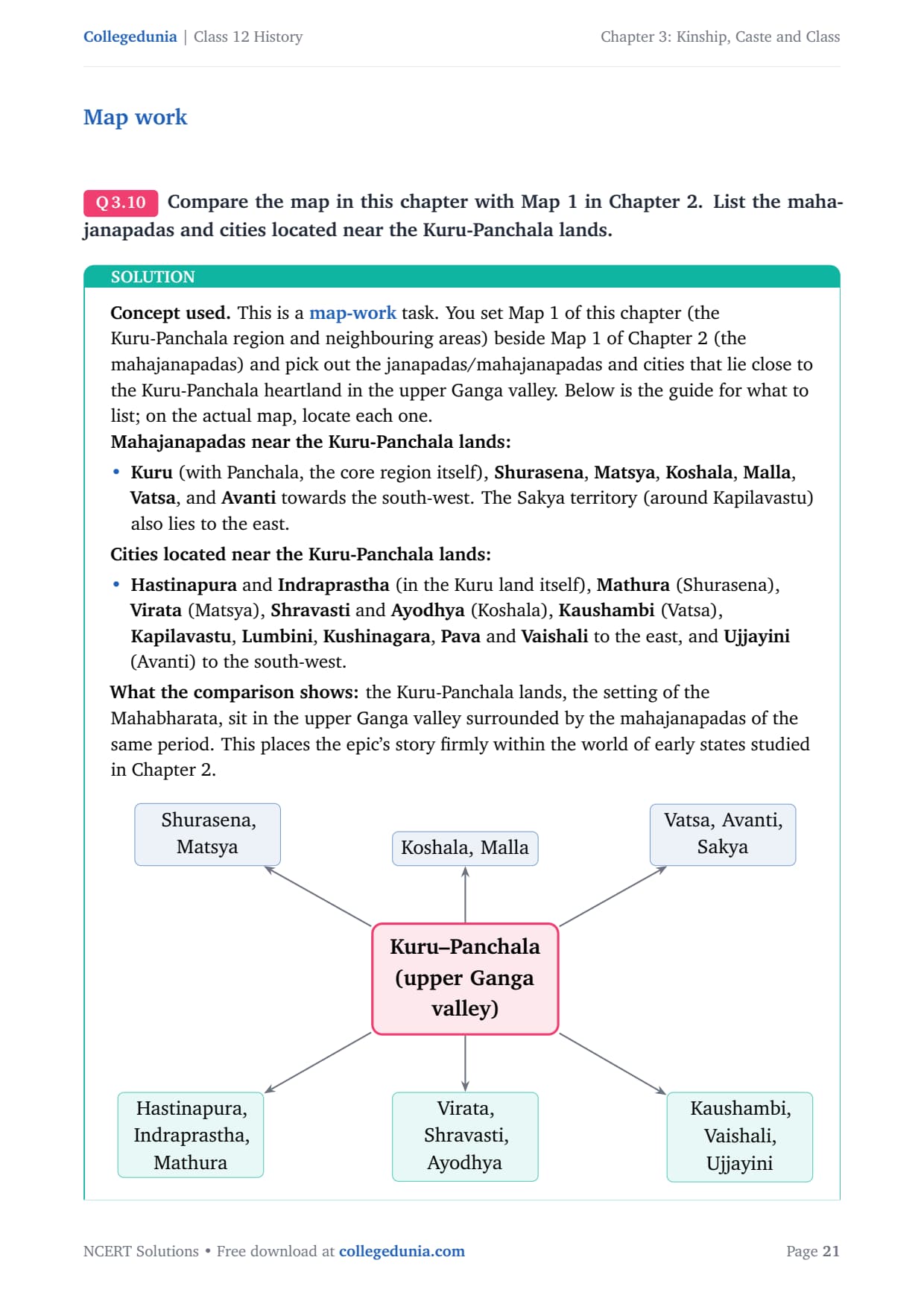
Mahajanapadas near Kuru-Panchala: Shurasena, Matsya, Koshala, Malla, Vatsa, Avanti and the Sakya land.
Cities to mark: Hastinapura and Indraprastha (in Kuru), Mathura, Virata, Shravasti, Ayodhya, Kaushambi, Vaishali and Ujjayini.
What it shows: the epic's heartland sits among the mahajanapadas of the sixth century BCE.
Why it matters: B.B. Lal's dig at Hastinapura ties the story's geography to early-state archaeology.
The skill being tested is turning a story into geography. List only the units that touch the Kuru-Panchala area, and leave off distant mahajanapadas like Gandhara or Anga. A neat, correctly placed map is the whole answer, and the comparison shows the Mahabharata was rooted in the landscape of the upper Ganga valley.
Kinship, Caste and Class Class 12 Exercise-wise Coverage
The chapter exercise has 12 questions. The table maps each one to its topic so students can plan revision and find the right NCERT answer fast. The full step-by-step solution for each sits in the question set lower on this page.
Question
Topic it tests
Q 3.1
Why patriliny mattered most to elite families
Q 3.2
Whether kings in early states were invariably Kshatriyas
Q 3.3
Dharma in the stories of Drona, Hidimba and Matanga
Q 3.4
Buddhist social contract versus the Purusha sukta
Q 3.5
Source-based reading of Yudhisthira's list of greetings
Q 3.6
Winternitz on the Mahabharata as a social mirror (essay)
Q 3.7
Whether the Mahabharata had a single author (essay)
Q 3.8
How important gender differences were in early societies (essay)
Q 3.9
Evidence that Brahmanical kinship rules were not always followed
Q 3.10 to 3.12
Map work and project-style activities
Questions 3.7, 3.8 and 3.9 are the most-asked long answers, so students preparing chapter 3 history class 12 revision should learn those three first. The map and project tasks (3.10 to 3.12) are also useful for the history project file class 12 chapter 3 that many schools assign.
Students who want the offline copy can save the class 12 history chapter 3 pdf from the download card above and tick off each question as they finish it.
Kinship, Caste and Class Important Questions and Previous Year Trends
CBSE sets a steady mix of source-based, short and long answers from this chapter. Knowing the pattern helps students decide how much to write. The chapter is a regular source of one 5-mark or 8-mark source-based question, which is why a focused list of chapter 3 history class 12 important questions saves a lot of revision time.
Source-based (often 8 marks): a passage on the Drona-Ekalavya story, the Purusha sukta, or Draupadi at dice, with three sub-parts.
Long answer (5 to 6 marks): the single-author debate, gender differences, or the Buddhist social contract.
Short answer (3 marks): patriliny, the gotra rule, or non-Kshatriya kings.
Objective and MCQ: dates, dynasty names, and who composed which source.
For quick recall before the exam, students often practise the class 12 history chapter 3 mcq set and a list of class 12 history chapter 3 important questions. The most repeated history class 12 chapter 3 question answer items are the single-author debate and the gender differences essay, so keep those answer points ready in your own words.
It also helps to attempt a short history class 12 chapter 3 mcq drill and the class 12 history chapter 3 extra questions and answers after you finish the main exercise. These extra sets test the small facts, such as exact dates and dynasty names, that examiners use for one-mark objective questions.
Working through the ncert solution class 12 history chapter 3 set twice, once open-book and once from memory, fixes those facts well before the board exam.
Common Mistakes Students Make in the Kinship, Caste and Class Chapter
A few errors cost marks every year in this chapter. Most come from stating the Brahmanical rule as if it were always obeyed, or from giving only one side of a debate. Avoiding them is the fastest way to lift a score.
Saying kings were always Kshatriyas - name the Mauryas, Shungas, Kanvas, Shakas and Satavahanas as exceptions.
Treating the gotra and exogamy rules as universal - the Satavahanas broke them.
Crediting the whole Mahabharata to Vyasa as fact - that is tradition, not historical proof.
Forgetting to name the source tradition in the Drona, Hidimba and Matanga comparison.
Calling gender rules absolute - cases like Prabhavati Gupta show some flexibility.
Students who fix these five points usually move from average to high marks on the long answers. The exam rewards careful wording, so write "the texts prescribed" and "in practice, however" to show you can separate norm from reality.
Kinship, Caste and Class PDF Download Formats and Languages
The solutions are free to download in more than one format, so students can pick what suits their device and revision style. The download card at the top of the page carries each option for this chapter.
Normal and HD PDF: the history class 12 chapter 3 pdf is offered in a normal size for quick downloads and an HD version for clear printing.
English medium: all 12 answers are written in simple English for the CBSE board paper.
Question-only set: a print-and-practise sheet of class 12 history chapter 3 extra questions for self-testing.
Whole-book pack: the chapter 3 history class 12 ncert solutions sit in one set that runs through every theme, so you can revise across the book in one place.
Many students search for class 12 chapter 3 history answers on their phone the night before a test, so a saved PDF means you can revise even without internet. Keep both the question set and the solved version handy for a full self-check.
How the Kinship, Caste and Class Solutions Pair with Notes and the Book PDF
These NCERT Solutions answer the back-exercise questions. To revise the full chapter, students should use them alongside the other resources for the same chapter, all linked in the table below.
Reading the original NCERT chapter text and figures
Tip: read the Notes first, then attempt these solutions on your own, and only then check the model answers here. That order builds memory faster than copying answers straight away.
All NCERT Solutions for Class 12 History Chapter 3 Kinship, Caste and Class
The table links the NCERT Solutions for every chapter in Themes in Indian History so students can move across the book in one click. Chapter 3 is highlighted.
All NCERT Solutions for Kinship, Caste and Class with Step-by-Step Solutions
Below are all 12 NCERT exercise questions for this chapter, exactly as they appear in the textbook. Tap Check Solution for the model answer or Expert Solution for the topper-style approach.
Q 3.1
Explain why patriliny may have been particularly important among
elite families.
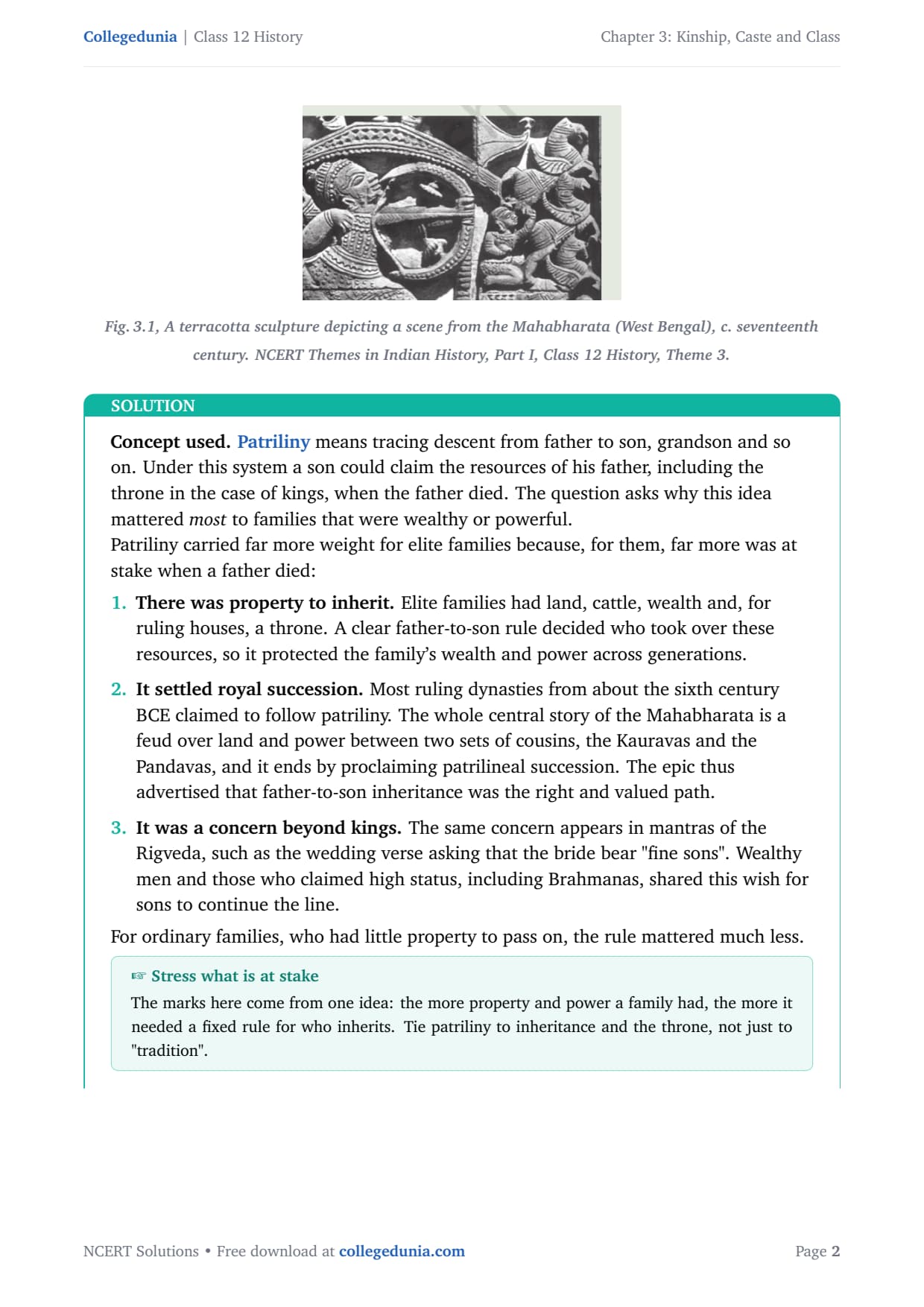
Fig. 3.1, A terracotta sculpture depicting a
scene from the Mahabharata (West Bengal), c. seventeenth century. NCERT Themes
in Indian History, Part I, Class 12 History, Theme 3.
Concept used.Patriliny means tracing descent from father
to son, grandson and so on. Under this system a son could claim the resources
of his father, including the throne in the case of kings, when the father
died. The question asks why this idea mattered most to families that
were wealthy or powerful.
Patriliny carried far more weight for elite families because, for them, far
more was at stake when a father died:
There was property to inherit. Elite families had land,
cattle, wealth and, for ruling houses, a throne. A clear father-to-son
rule decided who took over these resources, so it protected the
family's wealth and power across generations.
It settled royal succession. Most ruling dynasties from
about the sixth century BCE claimed to follow patriliny. The whole
central story of the Mahabharata is a feud over land and power between
two sets of cousins, the Kauravas and the Pandavas, and it ends by
proclaiming patrilineal succession. The epic thus advertised that
father-to-son inheritance was the right and valued path.
It was a concern beyond kings. The same concern appears in
mantras of the Rigveda, such as the wedding verse asking that the
bride bear "fine sons". Wealthy men and those who claimed high status,
including Brahmanas, shared this wish for sons to continue the line.
For ordinary families, who had little property to pass on, the rule mattered
much less.
Stress what is at stake
The marks here come from one idea: the more property and power a family had,
the more it needed a fixed rule for who inherits. Tie patriliny to inheritance
and the throne, not just to "tradition".
Patriliny mattered most to elite families because they had
property, wealth and (for kings) a throne to pass on. A clear father-to-son
rule protected this inheritance and settled royal succession, which is why the
Mahabharata and ritual texts such as the Rigveda valued the birth of sons.
AS
Ananya Sengupta
MA Ancient Indian History, JNU
Verified Expert
Strategic angle. Build the whole answer around one chain: elite
families have property and thrones, therefore they need a rule for
inheritance, therefore patriliny matters to them most. If you keep returning
to "what was at stake", you never drift into vague talk about custom.
Lead with the definition, then give three quick reasons. First, the material
one: only families with land, cattle and treasure, or a kingdom, actually had
something worth fixing the rules over. Second, the political one: ruling
dynasties from the sixth century BCE leaned on patriliny to decide succession,
and the Mahabharata itself ends by proclaiming it, so the epic doubles as
propaganda for the system. Third, the cultural one: the Rigvedic wedding
mantra praying for "fine sons" shows that even Brahmanas and other high-status
men wanted sons to carry the line forward.
Why this matters. The sharpest scripts add the contrast: ordinary
people, with little to inherit, had less reason to police descent so strictly.
Naming that contrast shows you understand patriliny as a response to wealth and
power, not a universal rule, which is exactly the historical judgement the
examiner is looking for.
For elite families, property and the throne made a fixed rule of
descent essential, so patriliny protected inheritance and royal succession;
the Mahabharata and Rigvedic mantras both reinforced the value of sons, while
ordinary families with little to inherit felt the rule far less.
Q 3.2
Discuss whether kings in early states were invariably Kshatriyas.
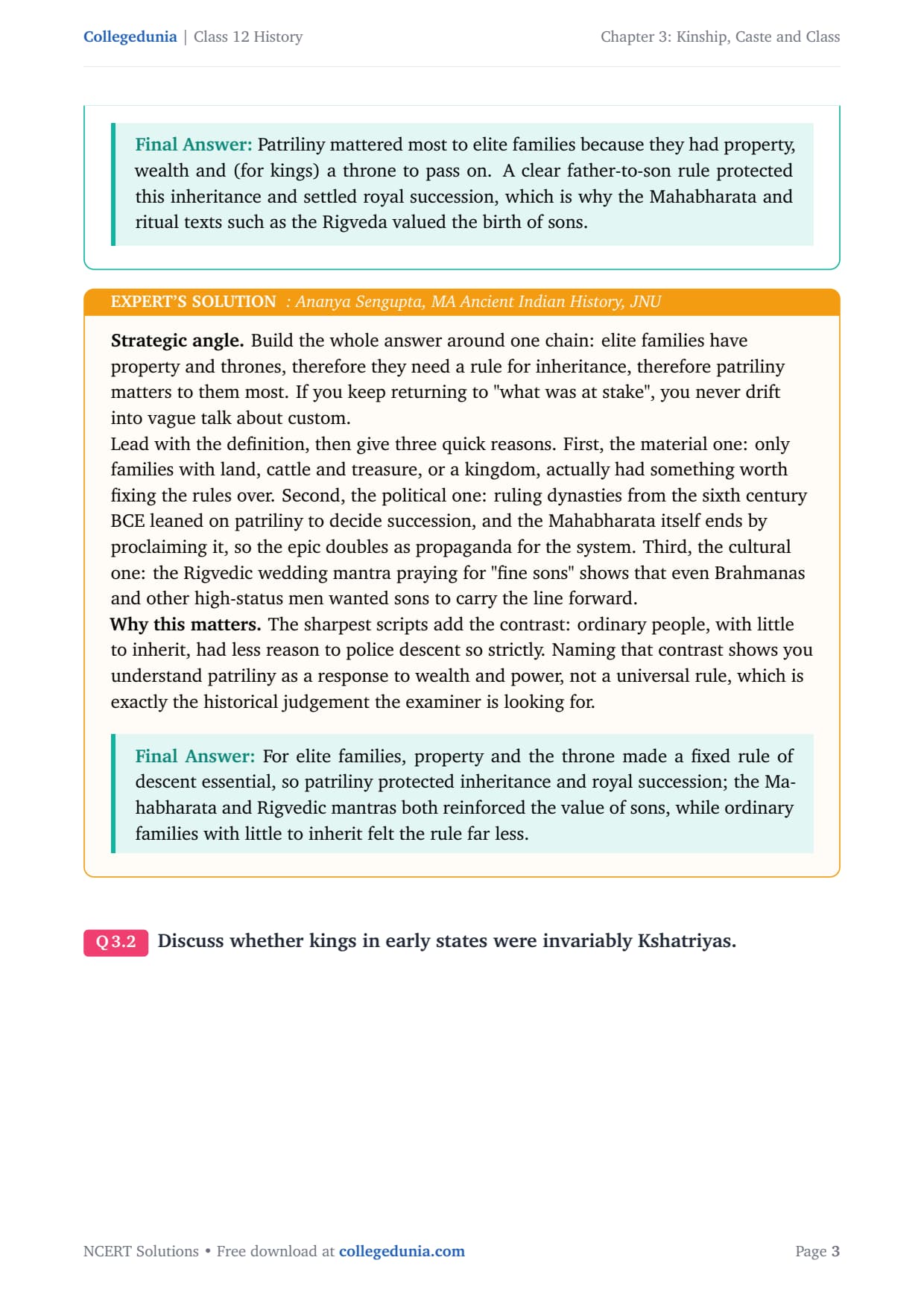
Fig. 3.3, A Satavahana ruler and his wife, a
rare sculptural depiction of a ruler, c. second century BCE. NCERT Themes in
Indian History, Part I, Class 12 History, Theme 3.
Concept used. According to the Shastras, only Kshatriyas
could be kings. "Invariably" means "in every case, without exception". So the
question is really asking whether the textbook rule actually held in practice.
The evidence shows it did not.
No, kings were not invariably Kshatriyas. Several important ruling
lineages had other origins:
The Mauryas. Their social background is hotly debated. Later
Buddhist texts called them Kshatriyas, but Brahmanical texts described
them as being of "low" origin.
The Shungas and Kanvas, the immediate successors of the
Mauryas, were Brahmanas.
The Shakas came from Central Asia and were treated as
mlechchhas (outsiders) by the Brahmanas, yet Rudradaman, the best-known
Shaka ruler, rebuilt the Sudarshana lake and used Sanskrit.
The Satavahanas. Their greatest king, Gotami-puta
Siri-Satakani, claimed to be a "unique Brahmana" (eka bamhana) even as
he claimed to uphold the varna order.
The deeper point made by the chapter is plain: political power was effectively
open to anyone who could muster support and resources, and rarely depended on
birth as a Kshatriya.
Rule versus reality
This question tests a key skill of the chapter: separating what the Shastras
prescribed from what people actually did. The gap between the two
is the real answer.
No. Although the Shastras reserved kingship for Kshatriyas, the
Mauryas were of disputed origin, the Shungas and Kanvas were Brahmanas, the
Shakas were Central-Asian outsiders, and the Satavahanas claimed Brahmana
status. Power went to whoever could command support and resources, not to
birth alone.
IS
Imran Sheikh
MA History, Jamia Millia Islamia
Verified Expert
Strategic angle. Set up the answer as rule against evidence. State the
Shastric rule in one line, then knock it down dynasty by dynasty. Each
counter-example is worth a mark, so name as many as you can: Mauryas, Shungas,
Kanvas, Shakas, Satavahanas.
Open by quoting the prescription, only Kshatriyas could be kings, so the
examiner sees you know the norm. Then march through the exceptions. The Mauryas
are the headline case because the sources themselves disagree about them.
Follow with the Shungas and Kanvas, who were plainly Brahmanas, and the Shakas,
foreign mlechchhas who still adopted Sanskritic ways through rulers like
Rudradaman. Close with the Satavahanas, whose king called himself a unique
Brahmana, which neatly proves that even self-described upholders of varna broke
the Kshatriya rule.
Why this matters. The conclusion is the chapter's own: in early states
political power rarely depended on birth as a Kshatriya. Stating that line
turns a list of exceptions into a clear historical argument, which is what
lifts the answer into the top band.
Kings were not invariably Kshatriyas. The Shastras said only
Kshatriyas could rule, but the Mauryas, Shungas, Kanvas, Shakas and Satavahanas
all show that power went to those who could gather support and resources, not
to Kshatriya birth.
Q 3.3
Compare and contrast the dharma or norms mentioned in the stories of
Drona, Hidimba and Matanga.
Concept used.Dharma here means the norms of right conduct
that the Brahmanical texts laid down for each social group. The three stories
all turn on the same question, how should people of different birth behave, but
they answer it from very different points of view. To "compare and contrast" is
to show both what they share and where they differ.
The three stories in brief:
Drona and Ekalavya (Source 7): Drona, a Brahmana teacher of
archery, refuses to teach Ekalavya, a forest-dwelling nishada. When
Ekalavya learns on his own and surpasses the prince Arjuna, Drona
demands his right thumb as guru-dakshina so that Arjuna stays
unrivalled.
Hidimba and Bhima (Source 9): Hidimba, a rakshasa woman,
falls in love with Bhima the Pandava and marries him; their son is
Ghatotkacha. This is a union with someone outside the Brahmanical fold.
Matanga (Source 10, Matanga Jataka): a Buddhist, Pali story in
which the Bodhisattva is born a chandala. He argues that worth comes
from virtue, not birth, and is shown to have spiritual power above the
proud Brahmanas.
What they share (compare): All three deal with people placed outside
or below the upper varnas, the nishada, the rakshasa and the chandala, and all
test the idea that birth should decide a person's place.
How they differ (contrast):
Drona's story upholds the Brahmanical norm. It justifies
denying skill and reward to a low-born nishada so that the
Kshatriya Arjuna remains the best. Dharma here protects the existing
hierarchy.
Hidimba's story shows flexibility. A Pandava marries outside
the Brahmanical order, a non-Brahmanical practice, and the marriage is
accepted (on conditions). Here the norms bend.
Matanga's story openly challenges the norm. Coming from a
Buddhist tradition, it argues that the free-from-vice deserve respect,
not the proud of birth, so it rejects the link between worth and birth.
Name the source tradition
A high-scoring answer notes that Drona and Hidimba come from the Brahmanical
Mahabharata while Matanga comes from a Buddhist Jataka. The clash of
viewpoints is the heart of the contrast.
All three stories concern people outside the upper varnas and test
whether birth should decide status. But the dharma differs: Drona's story
enforces the hierarchy (the nishada is denied his due), Hidimba's bends it
(marriage outside the fold is accepted), and Matanga's Buddhist story rejects
it, valuing virtue over birth.
LM
Lakshmi Menon
MPhil Archaeology, University of Calcutta
Verified Expert
Structural observation. The command words are "compare" and
"contrast", so your answer must have two clear halves. Spend one short
paragraph on the common thread, then a sharper section on the differences,
ideally a one-line verdict per story. Examiners reward that visible structure.
Start by summarising each story in a single sentence so the comparison rests on
facts, not vague memory. Then state the shared thread: all three put a
low-born or outsider figure, nishada, rakshasa, chandala, at the centre and ask
whether birth should fix their place. For the contrast, give each story a
verdict: Drona's dharma defends the hierarchy, Hidimba's relaxes it, and
Matanga's overturns it. The decisive move is to flag the source: the first two
sit inside the Brahmanical epic, the third inside a Buddhist Jataka, which
explains why their attitudes to birth pull in opposite directions.
A useful detail to drop in is who is being spoken to. The Drona story, the
chapter suggests, carried one message to the nishadas (know your place) and
another to the Kshatriyas (your supremacy is protected), so the same tale
polices both ends of the order. Hidimba's story, by contrast, shows the epic
quietly absorbing a non-Brahmanical practice, marriage with an outsider, on
terms the Pandavas could accept. The Matanga Jataka then flips the frame
entirely: written from the chandala's perspective, it makes the proud,
high-born Brahmana the one who fails the test of dharma, while the
"untouchable" Bodhisattva holds the moral and spiritual high ground. Naming
that shift in viewpoint, from a story told about outsiders to a story told by
one, is what turns a flat comparison into a real argument.
Why this matters. The examiner wants to see that you can read the same
theme, birth versus worth, across rival traditions. Showing that the answer to
"does birth decide dharma" changes depending on who is telling the story is
exactly the maturity this comparison is designed to test, and the cleanest
proof of it is that the Buddhist Jataka reverses the very judgement the
Brahmanical epic takes for granted.
Compare: all three centre on low-born or outsider figures and the
question of birth. Contrast: Drona's story enforces Brahmanical hierarchy,
Hidimba's permits marriage outside it, and the Buddhist Matanga Jataka rejects
birth in favour of virtue.
Q 3.4
In what ways was the Buddhist theory of a social contract different
from the Brahmanical view of society derived from the Purusha sukta?
Concept used. The chapter sets two explanations of social order
against each other. The Purusha sukta is a Rigvedic hymn used by
Brahmanas to make the varna order seem divine; the Buddhist social
contract myth (in the Sutta Pitaka) makes social and political order a matter
of human choice. The differences flow from this basic split, divine origin
versus human agency.
The Brahmanical view (Purusha sukta):
The four varnas are said to have emerged from the body of Purusha, the
primeval man: the Brahmana from his mouth, the Kshatriya from his arms,
the Vaishya from his thighs and the Shudra from his feet.
Social order is therefore divinely ordained and fixed
by birth. The hierarchy (Brahmana at the top) is presented as natural
and unchangeable.
The Buddhist view (social contract):
Originally human beings lived in an idyllic, peaceful state. As they
grew greedy and deceitful, they chose one person to punish wrongdoing
in return for a share of the rice. He was called the mahasammata
or "great elect".
Kingship and social institutions are thus based on human
choice and consent, with taxes as payment for the king's services.
The main differences:
Source of order: divine creation (Purusha's body) versus a
human agreement (the social contract).
Basis of status: fixed by birth in the Brahmanical view;
the Buddhist view rejects claims to status on the basis of birth.
Can it change? The Brahmanical order is permanent and natural;
the Buddhist view implies that since humans made the system, they can
also change it.
Birth versus choice
The clash is not just about kings. It is about whether inequality is god-given
and fixed, or man-made and open to reform, which is why the Buddhist view was
such a powerful critique of caste.
The Purusha sukta made society divine and fixed by birth, with the
four varnas born from the body of Purusha. The Buddhist social contract made
kingship and social order a matter of human choice, with the mahasammata
elected and taxes paid for his services, rejecting birth-based status and
implying that a man-made system could be changed.
AR
Arjun Reddy
MA History, University of Delhi
Verified Expert
Strategic angle. A "difference" question is easiest to mark when you
pair the two views point by point. Set up three axes, where order comes from,
what fixes status, and whether it can change, and answer each for both sides.
That table-in-prose structure guarantees full coverage.
First fix the two myths in a sentence each: varnas spring from Purusha's body
in the Rigvedic hymn; the mahasammata is elected by people tired of greed in
the Buddhist Sutta Pitaka. Then run the contrasts. On origin, one is divine,
the other a human pact. On status, one makes birth decisive while the Buddhists
explicitly reject birth as the basis of rank. On permanence, the Brahmanical
order is god-given and fixed, whereas a system humans created they can also
remake.
It is worth spelling out what each myth is doing for its authors. The Purusha
sukta is a tool of legitimation: by placing the Brahmana at the mouth of the
primeval being and the Shudra at his feet, it makes the existing pecking order
look like part of the cosmos itself, so the hierarchy cannot be questioned. The
Buddhist contract does the opposite work. It begins from equality and decline,
not from a fixed body, and explains the king as a paid official the people
chose to keep order, which quietly strips kingship and caste of any divine
backing. Pointing out that one story freezes the order while the other unfreezes
it is the cleanest way to show you understand the difference rather than just
list it.
Why this matters. The most insightful closing line is that the
Buddhist contract carries a reformist seed: if people built the order, people
can change it. Naming that implication shows you grasp why the social-contract
idea was a genuine alternative to caste, not just a different origin story,
which is the depth the question is testing, and it explains why Buddhism could
mount such a serious challenge to the varna system.
Purusha sukta: society is divine, born from Purusha's body, fixed by
birth. Buddhist social contract: society and kingship rest on human choice (the
elected mahasammata, taxes for services), reject birth-based status, and being
man-made, can be changed.
Q 3.5
The following is an excerpt from the Mahabharata, in which
Yudhisthira, the eldest Pandava, speaks to Sanjaya, a messenger. (He sends
respectful greetings to the Brahmanas and priest, then to teachers Drona and
Kripa, to Bhishma, to the old king and his sons, to the young Kuru warriors who
are "brothers, sons and grandsons", to the wise Vidura "born of a slave
woman", to the elderly ladies "known as our mothers", to wives, to
daughters-in-law and daughters, then to the courtesans, and finally to the
slave women and their children, the aged, the maimed and the helpless.) Try and
identify the criteria used to make this list, in terms of age, gender and
kinship ties. Are there any other criteria? For each category, explain why they
are placed in a particular position in the list.
Concept used. This is a source-based question: you read the
order of Yudhisthira's greetings and work out what decided that order. The list
is not random, it ranks people, and the ranking reveals the social values of
those who wrote the text. The main criteria are status, kinship, age and
gender.
The criteria behind the order:
Ritual and social status comes first. The list opens with the
Brahmanas and the chief priest, then teachers (Drona, Kripa) and elders
(Bhishma, the old king). The most respected and high-status figures are
greeted before anyone else.
Kinship and seniority within the family. Next come kinsmen by
seniority: the king's sons, then the young warriors described as
"brothers, sons and grandsons", that is, junior male kin. Vidura,
though wise, is placed carefully because he was "born of a slave
woman", so birth-status affects his position.
Gender, with women ranked by relationship and age. The women
come after the men. Among them the order again follows respect and
kinship: elderly ladies "known as our mothers" first, then wives, then
daughters-in-law and daughters.
Low status and dependence come last. The courtesans, then the
slave women and their children, and finally the aged, the maimed and
the helpless are greeted at the very end, the people lowest in status
or most dependent.
Are there other criteria? Yes. Besides age, gender and kinship, the
order is shaped by social and ritual status (Brahmanas and elders
high; slaves and courtesans low) and by dependence (the helpless come
last). Birth, as with Vidura, also colours a person's place.
Why each is placed where it is: those with the highest ritual status,
authority or seniority are honoured first; women are placed after men; and the
low-born, the servile and the dependent are placed last. The list mirrors the
hierarchy of the society that produced the epic.
Read the order, not just the names
The marks lie in the sequence. Show why priests open the list and slaves
close it: position equals status. Always connect each group's place to its
rank, gender or kinship.
The greetings are ranked by status, kinship, age and gender:
Brahmanas, teachers and elders first; then male kin by seniority; then women
(mothers, wives, daughters); and finally courtesans, slaves and the helpless.
Other criteria are ritual status, birth (Vidura, "born of a slave woman") and
dependence. Each group's place reflects its rank in the social order.
PB
Pooja Bhatt
MA Historical Geography, Aligarh Muslim University
Verified Expert
Picture-first. Treat the list as a ladder. Read it top to bottom and
ask at each rung, "why are these people here and not lower?" The answer is
almost always status, kinship, age or gender, and naming the rung for each
group is how you earn the marks.
Walk the ladder in order. The top rungs are ritual and social status: priests,
teachers, elders. The middle rungs are male kin arranged by seniority, with
Vidura's lower placement explained by his birth "of a slave woman". Then comes
the gender break, women as a block below the men, ordered among themselves by
respect and relationship, mothers before wives before daughters. The bottom
rungs are the low and the dependent: courtesans, slaves and their children, the
aged and the maimed. Flag the "other" criteria too, ritual status, birth and
dependence, so you answer that part of the question explicitly.
Two small touches lift the answer. First, point out that more than one
criterion can apply to a single person: Vidura is a kinsman by relationship,
yet his slave-born birth pulls his place down, so birth overrides pure kinship.
Second, notice that within the women the same logic repeats in miniature, age
and relationship rank them just as they rank the men, mothers above wives above
daughters, with courtesans and slave women at the bottom. Spotting that the
list is ranked twice over, once for men and again for women, shows you have
read the order closely rather than skimmed the names.
Why this matters. The examiner wants you to see that the order is the
argument: the epic's authors reveal their hierarchy simply by who they greet
first and last. Saying that the list "mirrors the social order" is the
interpretive line that takes the answer beyond mere description, and tying each
group's slot back to status, birth, gender or dependence is how you earn every
mark on offer.
Yudhisthira ranks his greetings by status, kinship, age and gender,
priests and elders first, male kin by seniority next, then women (mothers,
wives, daughters), and finally courtesans, slaves and the helpless. Ritual
status, birth and dependence are the other criteria, and the sequence reflects
society's hierarchy.
Q 3.6
This is what a famous historian of Indian literature, Maurice
Winternitz, wrote about the Mahabharata: "just because the Mahabharata
represents more of an entire literature and contains so much and so many
kinds of things, (it) gives us an insight into the most profound depths
of the soul of the Indian folk." Discuss.
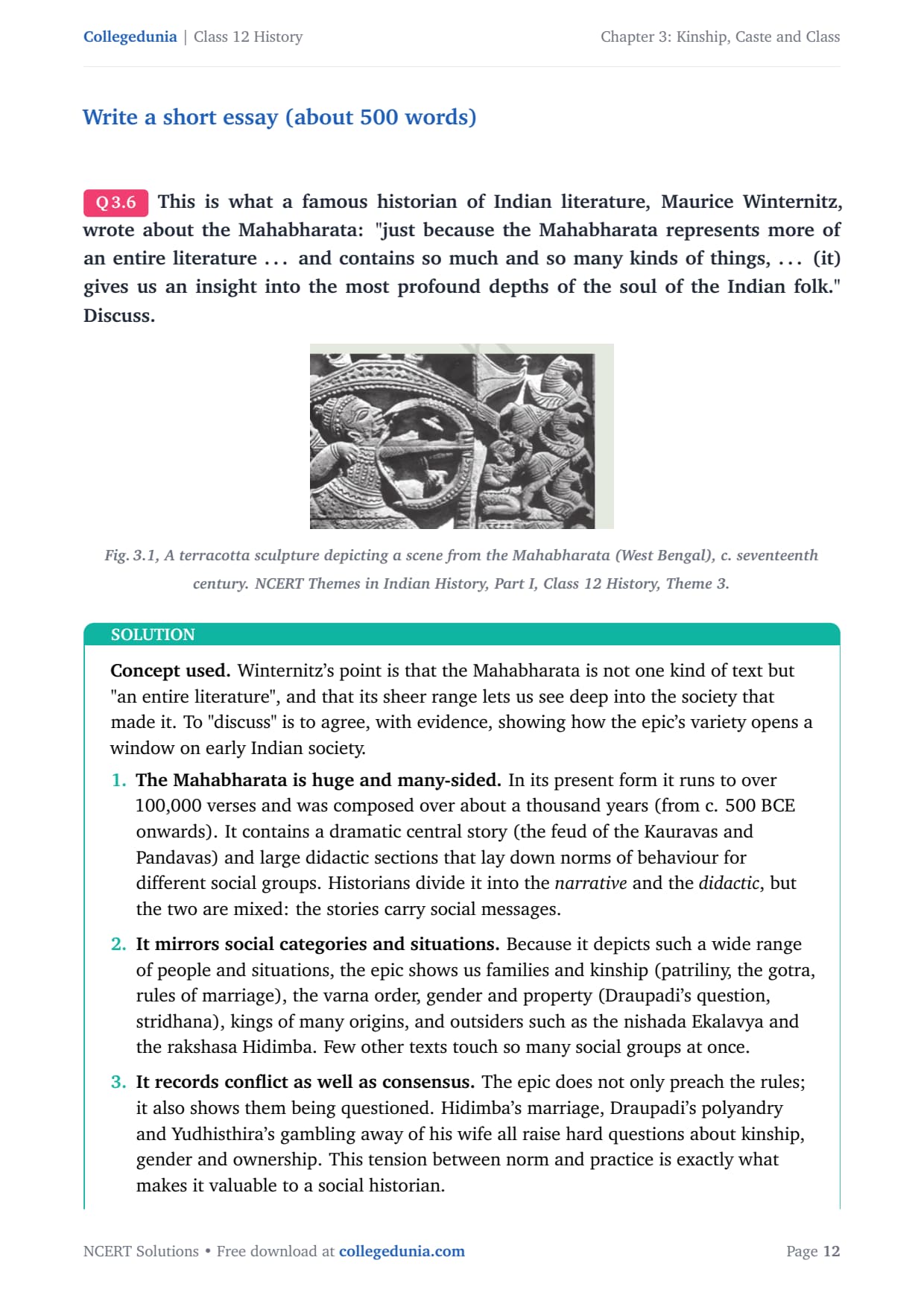
Fig. 3.1, A terracotta sculpture depicting a
scene from the Mahabharata (West Bengal), c. seventeenth century. NCERT Themes
in Indian History, Part I, Class 12 History, Theme 3.
Concept used. Winternitz's point is that the Mahabharata is not one
kind of text but "an entire literature", and that its sheer range lets us see
deep into the society that made it. To "discuss" is to agree, with evidence,
showing how the epic's variety opens a window on early Indian society.
The Mahabharata is huge and many-sided. In its present form it
runs to over 100,000 verses and was composed over about a thousand
years (from c. 500 BCE onwards). It contains a dramatic central story
(the feud of the Kauravas and Pandavas) and large didactic sections
that lay down norms of behaviour for different social groups.
Historians divide it into the narrative and the didactic,
but the two are mixed: the stories carry social messages.
It mirrors social categories and situations. Because it
depicts such a wide range of people and situations, the epic shows us
families and kinship (patriliny, the gotra, rules of marriage), the
varna order, gender and property (Draupadi's question, stridhana),
kings of many origins, and outsiders such as the nishada Ekalavya and
the rakshasa Hidimba. Few other texts touch so many social groups at
once.
It records conflict as well as consensus. The epic does not
only preach the rules; it also shows them being questioned. Hidimba's
marriage, Draupadi's polyandry and Yudhisthira's gambling away of his
wife all raise hard questions about kinship, gender and ownership. This
tension between norm and practice is exactly what makes it valuable to
a social historian.
It is a living, dynamic text. Its growth did not stop with the
Sanskrit version. It was retold in many languages, depicted in
sculpture and painting (as in Fig. 3.1), and performed in plays and
dance. Modern writers such as Mahashweta Devi ("Kunti O Nishadi") still
rework it to raise new questions. A text retold for two thousand years
truly reflects the changing "soul" of the people.
Assessment. Winternitz is broadly right. Precisely because the
Mahabharata is so vast, so varied and so often retold, it gives historians an
unusually rich picture of early Indian society. The caution is that it is a
literary text, written largely by and for Brahmanas, so it reflects ideals and
the values of its authors as much as everyday reality.
Agree, but with a caveat
Top essays accept Winternitz's claim and then add the historian's caution: the
epic shows ideals and elite viewpoints, not a simple record of facts. That
balance shows mature judgement.
Winternitz is largely right. The Mahabharata's huge size, its mix of
narrative and didactic sections, its sweep across families, varna, gender,
kings and outsiders, and its endless retellings make it a uniquely rich source
on early Indian society, as long as we remember it is a literary, largely
Brahmanical text that shows ideals as well as realities.
VD
Vikram Desai
MA Ancient History, Banaras Hindu University
Verified Expert
Strategic angle. An essay built on a quotation must first explain the
quotation, then prove it. Restate Winternitz's claim in your own words, "the
epic is so vast and varied that it reveals the whole society", then offer
evidence in four blocks: size and variety, social range, conflict, and
retellings. Bold sub-headings keep a 500-word answer in order.
Open with the scale: over 100,000 verses grown over a thousand years, mixing a
gripping story with rule-book didactic sections. Then show the social range,
this is where the marks are, by naming concrete cases: patriliny and gotra,
Draupadi's polyandry and stridhana, the disputed origins of kings, and
outsiders like Ekalavya and Hidimba. Next, stress that the epic shows conflict,
not just consensus, since norms are questioned inside the very stories. Finally,
use the "dynamic text" point: retellings in many languages, sculpture and
painting, and Mahashweta Devi's modern reworking prove the epic keeps absorbing
the people's concerns.
It helps to explain why the epic's variety lets us see "the soul of the
folk". Because the Mahabharata was composed and recomposed over centuries by
many hands, each layer carries the concerns of its own time, the bardic praise
of warriors, the Brahmanical rules on marriage and caste, the late didactic
sermons, so reading the whole text is almost like reading the changing society
itself. That is exactly Winternitz's point: a text this broad is not one
author's view but a deposit of generations. You can sharpen the answer by
linking the epic to the chapter's wider sources, the Manusmriti, the gotra
inscriptions of the Satavahanas, the Tamil Sangam poems, and noting that the
Mahabharata gathers in one place the same social world those scattered sources
describe.
Why this matters. The line that separates a good essay from a top one
is the caveat: the Mahabharata is literature, mostly Brahmanical, so it mirrors
ideals and authorial values as much as lived fact. Holding both the praise and
the caution together is precisely the critical reading the question invites,
and it shows the examiner you can use a literary source like a historian rather
than treat it as a plain record of events.
Agree with Winternitz: the epic's vast size, mixed narrative and
didactic content, wide social cast and constant retelling give deep insight
into early Indian society, while noting that as a largely Brahmanical literary
work it reflects ideals and authorial values, not plain fact.
Q 3.7
Discuss whether the Mahabharata could have been the work of a single
author.
Fig. 3.2, A section of a page from the Critical
Edition of the Mahabharata. The large bold print is the main text; the smaller
print lists variant readings from different manuscripts. NCERT Themes in Indian
History, Part I, Class 12 History, Theme 3.
Concept used.Authorship of a text means who composed it.
The chapter traces how the Mahabharata was built up in stages over many
centuries by different hands, which is strong evidence against a single
author. The traditional attribution to one sage, Vyasa, must be weighed against
this.
No, the Mahabharata is most unlikely to be the work of a single
author. The reasons:
It grew in distinct phases over about a thousand years. The
original story was probably composed by charioteer-bards (sutas) who
sang of Kshatriya victories and circulated orally. From the fifth
century BCE, Brahmanas took over the story and began to write it down.
Between c. 200 BCE and 200 CE, the worship of Vishnu grew and Krishna
was identified with Vishnu. Between c. 200 and 400 CE, large didactic
sections resembling the Manusmriti were added.
It swelled enormously. A text that perhaps began with fewer
than 10,000 verses grew to about 100,000 verses. Such growth points to
many authors adding material over time, not one composer.
There are huge regional variations. The Critical Edition
prepared under V.S. Sukthankar (1919–1966) compared manuscripts from
Kashmir and Nepal to Kerala and Tamil Nadu. More than half of its over
13,000 pages are taken up by variant readings (see Fig. 3.2). So many
versions imply many hands.
It remained a dynamic text. Even after the Sanskrit version,
the epic was retold in many languages and reworked by later writers,
proving its composition was a continuing, collective process.
What about Vyasa? Tradition attributes the whole epic to the sage
Vyasa, who is said to have dictated it to Ganesha. But this is a traditional
ascription; the historical evidence of phased growth and countless variants
shows that the text was the work of many composers across centuries.
Tradition versus evidence
The single-author idea (Vyasa) is a belief; the historian's evidence, phases of
composition, ballooning verse-count and thousands of variants, all point to
multiple authors. Naming this contrast is the heart of the essay.
No. The Mahabharata grew in clear phases over about a thousand years,
from bardic oral compositions to Brahmanical writing to late didactic
additions, swelling from under 10,000 to about 100,000 verses, with more than
half the Critical Edition given to regional variants. Although tradition credits
the sage Vyasa, the evidence shows it was the work of many authors.
TJ
Tara Joshi
MA Art History, Visva-Bharati University
Verified Expert
Strategic angle. Answer the question in line one, "no", then prove it
with a timeline of composition. The marks cluster around the phases of growth
and the evidence of variants, so make those your spine. Hold Vyasa back for a
neat closing contrast between tradition and evidence.
Lead with the staged composition: sutas compose and sing it orally; Brahmanas
write it down from the fifth century BCE; the Vishnu-Krishna layer comes c. 200
BCE to 200 CE; the big didactic sections are added c. 200 to 400 CE. Pair this
with the numbers, under 10,000 verses growing to about 100,000, which alone
argues against one author. Then bring in the Critical Edition: Sukthankar's team
took 47 years and over 13,000 pages, more than half of them variants gathered
from across the subcontinent (Fig. 3.2). End with the "dynamic text" point,
retellings in many languages, to show composition never really stopped.
A neat way to clinch the variant point is to read Fig. 3.2 aloud in your answer:
the page has a small block of bold main text and a much larger block of
small-print variant readings beneath it. That single image makes the argument
visible, if more than half the Critical Edition is footnotes recording how
different regions told the story, the text plainly passed through countless
hands. Pair the picture with the timeline and the verse-count, and the
single-author idea simply cannot stand.
Why this matters. The decisive move is to handle Vyasa honestly: name
the tradition, then explain why a historian sets it aside in favour of the
documented evidence of phased, collective authorship. Distinguishing a
traditional belief from historical proof is exactly the critical skill the
question rewards, and it is the difference between repeating a legend and
reasoning like a historian.
The Mahabharata was almost certainly not by a single author: it grew
in phases over a thousand years, from oral bardic verse to written Brahmanical
text to late didactic additions, ballooning to about 100,000 verses with
thousands of regional variants in the Critical Edition. The attribution to
Vyasa is traditional, not historical proof.
Q 3.8
How important were gender differences in early societies? Give
reasons for your answer.
Concept used.Gender differences means the unequal treatment
of men and women. The chapter shows that these differences were very important:
they shaped kinship, marriage, inheritance and access to wealth, almost always
to the disadvantage of women. To answer well you give reasons drawn from the
sources.
Gender differences were highly important. The reasons:
Sons were valued over daughters. Under patriliny, sons could
claim the father's resources, while daughters had no claim to the
household's resources. Daughters were instead married out (exogamy),
and the gift of a daughter in marriage, kanyadana, was treated as a
religious duty of the father.
Marriage controlled women. The lives of girls and women of
high-status families were carefully regulated so that they married at
the "right" time and to the "right" person. On marriage a woman was
expected to give up her father's gotra and adopt her husband's.
Property law favoured men. According to the Manusmriti, the
paternal estate was divided equally among sons (with a special share
for the eldest), and women could not claim a share. Land, cattle and
money were generally controlled by men.
Women's wealth was limited and watched. Women could keep the
gifts received at marriage as stridhana, inheritable by their children,
but the Manusmriti warned them against hoarding family property, or
even their own valuables, without the husband's permission.
Women could be treated as property. In the dice game,
Yudhisthira staked and lost the common wife Draupadi. Her famous
question, whether he could stake her after losing himself, exposes how
a wife's status depended on her husband.
A more complex reality. Yet the rules were not absolute. Some
high-status women, like the Vakataka queen Prabhavati Gupta, had access to
resources, and Satavahana women kept their father's gotra names against the
Brahmanical rule. So while gender differences were real and important, practice
was sometimes more flexible than the texts prescribed.
Use named evidence
Quote the rules and the named cases, Manusmriti, stridhana, Draupadi's
question, Prabhavati Gupta. Specific evidence is what turns a general answer
into a top one.
Gender differences were very important. Sons were preferred over
daughters, marriage tightly controlled women, the Manusmriti barred women from
the paternal estate and watched even their stridhana, and Draupadi could be
staked at dice, all showing male advantage. But cases like Prabhavati Gupta and
the Satavahana women show practice was sometimes more flexible than the
prescriptions.
DN
Devika Nair
MSc Archaeological Science, IIT Gandhinagar
Verified Expert
Structural observation. The command is "give reasons", so each
paragraph should be a clear reason backed by a source. Move through the life
cycle of a woman, birth, marriage, inheritance, wealth, and the structure
writes itself while covering every mark.
Reason one, at birth: patriliny prizes sons because they inherit, while
daughters have no claim and are married out under exogamy and kanyadana. Reason
two, at marriage: a woman's timing and partner are regulated and she must switch
to her husband's gotra. Reason three, in inheritance: the Manusmriti gives the
estate to sons and bars women, so men control land, cattle and money. Reason
four, in wealth: stridhana is a narrow exception, and even that is watched.
Clinch it with Draupadi's staking at dice, the sharpest image of a wife treated
as property.
Add one comparison to deepen the point: set the seven ways men could acquire
wealth (inheritance, finding, purchase, conquest, investment, work and gifts)
against the six ways open to women, almost all of which were gifts received at
or after marriage, from the husband, brother, mother or father. That contrast,
drawn straight from the Manusmriti, shows the inequality was built into the law
itself: men could earn and conquer wealth, while a woman's wealth flowed to her
mainly through the men around her. Quoting that pairing turns "women were
disadvantaged" into a precise, source-backed claim.
Why this matters. The answer rises to the top band when you add the
counter-evidence, Prabhavati Gupta's resources and the Satavahana women keeping
their gotra names. Showing that gender differences were powerful but not
absolute proves you can read prescription against practice, which is the
chapter's central method, and it is the balance, sharp inequality in the texts,
some flexibility in life, that the examiner is really looking for.
Very important: sons outranked daughters, marriage controlled women,
the Manusmriti excluded women from the estate and limited their stridhana, and
Draupadi could be staked at dice. Yet Prabhavati Gupta and the Satavahana women
show that in practice the differences were sometimes softened.
Q 3.9
Discuss the evidence that suggests that Brahmanical prescriptions
about kinship and marriage were not universally followed.
Concept used.Brahmanical prescriptions are the rules laid
down in the Dharmasutras and Dharmashastras, for example the rules of gotra and
exogamy. "Not universally followed" means many people did not obey them. The
chapter offers several pieces of evidence, mostly from the Satavahanas and from
the Mahabharata itself, that the rules were often broken.
The prescriptions: On marriage, a woman was expected to give up her
father's gotra and adopt her husband's; members of the same gotra could not
marry; and the texts recommended exogamy (marrying outside the kin group).
The evidence that they were not universally followed:
Women kept their father's gotra. Names of women who married
Satavahana rulers (known from inscriptions) show many kept gotra-derived
names such as Gotama and Vasistha, their fathers' gotras, instead of
adopting their husbands' gotra as the rule required.
Same-gotra marriage occurred. Some of these Satavahana women
belonged to the same gotra, which directly broke the rule that
members of one gotra could not marry.
Endogamy instead of exogamy. The Satavahanas practised
endogamy, marriage within the kin group (such as between cousins),
which ran counter to the exogamy recommended in Brahmanical texts. This
endogamous practice was, and is, common in south India.
Polyandry in the epic. Draupadi's marriage to the five
Pandavas is a clear case of polyandry, far from the Brahmanical ideal.
The author(s) offer several explanations for it, which suggests the
practice was real among some elites before it fell out of favour with
the Brahmanas.
Limited reach of Brahmana influence. The chapter itself notes
that, given the regional diversity of the subcontinent and the
difficulties of communication, the influence of the Brahmanas was by no
means all-pervasive.
Conclusion. Taken together, the Satavahana inscriptions and the
Mahabharata's polyandry show that the gotra rule, the same-gotra ban and
exogamy were all broken in practice. The prescriptions were recognised as
authoritative, but were also questioned and sometimes simply ignored.
Inscriptions versus norms
The Satavahana inscriptions are powerful because they are independent of the
Brahmanical texts. When real names contradict the rule, you have hard evidence
that the rule was not always obeyed.
Evidence that the rules were broken: Satavahana women kept their
father's gotra names instead of the husband's, some married within the same
gotra, and the dynasty practised endogamy rather than exogamy; the Mahabharata
shows Draupadi's polyandry; and the chapter admits Brahmana influence was not
all-pervasive across a diverse subcontinent.
RI
Rohan Iyer
MA Archaeology, Deccan College Pune
Verified Expert
Strategic angle. State the rule, then break it with evidence, that is
the whole essay. List the prescriptions first (gotra change, same-gotra ban,
exogamy) so the examiner sees the standard you are about to test, then line up
the counter-evidence case by case.
Lead with the Satavahanas because their inscriptions are the strongest proof:
women kept their fathers' gotra names, some shared a gotra yet married, and the
dynasty favoured endogamy over the prescribed exogamy. That is three rule-breaks
from one independent source. Then add the Mahabharata's polyandry, Draupadi and
the five Pandavas, and note that the author(s) pile up explanations precisely
because the practice was awkward for Brahmanical norms. Close with the chapter's
own admission that Brahmana influence was not all-pervasive across a diverse
land.
It is worth explaining why the gotra evidence is so telling. The rule had two
parts, a woman must switch to her husband's gotra, and same-gotra people must
not marry, and the Satavahana names break both at once. Several queens kept
metronymic names like Gotami and Vasithi, the feminine forms of the seers
Gotama and Vasistha, which means they were still being identified by their
father's gotra after marriage. And when two such women shared a gotra yet both
married into the same royal house, the no-same-gotra rule was openly ignored.
Add that this very dynasty practised cousin-marriage (endogamy), common in
south India then and now, and you have a ruling family that contradicted the
prescription on three separate counts. Then widen the lens with Draupadi's
polyandry in the epic and the chapter's own admission about patchy Brahmana
influence, and the case is complete.
Why this matters. The marker is testing whether you can prove a
negative, that a rule was not always followed, from concrete evidence rather
than assertion. Leaning on the Satavahana inscriptions, evidence outside the
Brahmanical tradition, is the move that makes the argument watertight, because
a name carved in stone cannot be dismissed as a story.
The rules were not universally followed: Satavahana inscriptions show
women keeping their father's gotra, same-gotra marriages and endogamy instead of
exogamy, while the Mahabharata records Draupadi's polyandry. The chapter also
notes that Brahmana influence was not all-pervasive across the diverse
subcontinent.
Q 3.10
Compare the map in this chapter with Map 1 in Chapter 2. List the
mahajanapadas and cities located near the Kuru-Panchala lands.
Concept used. This is a map-work task. You set Map 1 of this
chapter (the Kuru-Panchala region and neighbouring areas) beside Map 1 of
Chapter 2 (the mahajanapadas) and pick out the janapadas/mahajanapadas and
cities that lie close to the Kuru-Panchala heartland in the upper Ganga valley.
Below is the guide for what to list; on the actual map, locate each one.
Mahajanapadas near the Kuru-Panchala lands:
Kuru (with Panchala, the core region itself), Shurasena,
Matsya, Koshala, Malla, Vatsa, and
Avanti towards the south-west. The Sakya territory
(around Kapilavastu) also lies to the east.
Cities located near the Kuru-Panchala lands:
Hastinapura and Indraprastha (in the Kuru land
itself), Mathura (Shurasena), Virata (Matsya),
Shravasti and Ayodhya (Koshala), Kaushambi
(Vatsa), Kapilavastu, Lumbini, Kushinagara,
Pava and Vaishali to the east, and Ujjayini
(Avanti) to the south-west.
What the comparison shows: the Kuru-Panchala lands, the setting of the
Mahabharata, sit in the upper Ganga valley surrounded by the mahajanapadas of
the same period. This places the epic's story firmly within the world of early
states studied in Chapter 2.
!
[See diagram in the PDF version]
Match the two maps
Lay this chapter's Map 1 beside Chapter 2's mahajanapada map and read off only
the units that touch the Kuru-Panchala area. Do not list distant
mahajanapadas like Gandhara or Anga.
Near the Kuru-Panchala lands: mahajanapadas such as Kuru-Panchala,
Shurasena, Matsya, Koshala, Malla, Vatsa, Avanti and Sakya; and cities such as
Hastinapura, Indraprastha, Mathura, Virata, Shravasti, Ayodhya, Kaushambi,
Kapilavastu, Vaishali and Ujjayini. They place the Mahabharata's world in the
upper Ganga valley of early states.
NV
Nikhil Verma
MA Museology, MS University of Baroda
Verified Expert
Picture-first. Map work is scored on correct location, not prose.
Anchor everything on the Kuru-Panchala core in the upper Ganga valley, then read
outward in rings, the touching mahajanapadas first, then the cities inside them.
Place each label exactly on its dot.
Lock the core first: Kuru and Panchala, with Hastinapura and Indraprastha as
their cities. Then move out to the neighbours, Shurasena (Mathura) to the
south-west, Matsya (Virata), Koshala (Shravasti, Ayodhya), Vatsa (Kaushambi),
Malla and the Sakya land to the east, and Avanti (Ujjayini) to the south-west.
Keep the listing tight to "near", so distant mahajanapadas are left off. The
comparison with Chapter 2's map is the point: the epic's heartland sits in the
same mahajanapada belt.
A second reason the comparison is worth making is that it dates the epic's
setting. Map 1 of Chapter 2 plots the mahajanapadas of roughly the sixth
century BCE, the age of the first large states; when you see the Kuru-Panchala
heartland sitting right among them, you realise the Mahabharata's world is the
same world of emerging kingdoms. The chapter even links this to B.B. Lal's dig
at Hastinapura in the Upper Ganga doab, where the Kuru kingdom lay, which is why
the names on the two maps line up. So the map work is not just labelling dots:
it ties the literary geography of the epic to the archaeological and political
geography of early states. Mention that connection and your answer reads as
history, not just cartography.
Why this matters. The skill being tested is turning a story into
geography, fixing the Mahabharata's Kuru-Panchala world inside the real map of
early states. Correct, legible placement of the neighbouring janapadas and their
cities is the whole answer, and it shows the epic was rooted in the historical
landscape of the upper Ganga valley rather than floating in pure myth.
List the mahajanapadas touching Kuru-Panchala, Shurasena, Matsya,
Koshala, Malla, Vatsa, Avanti, Sakya, and their cities, Hastinapura,
Indraprastha, Mathura, Virata, Shravasti, Ayodhya, Kaushambi, Vaishali and
Ujjayini, placing the epic's world in the upper Ganga valley.
Q 3.11
Find out about retellings of the Mahabharata in other languages.
Discuss how they handle any two of the episodes of the text described in this
chapter, explaining any similarities or differences that you notice.
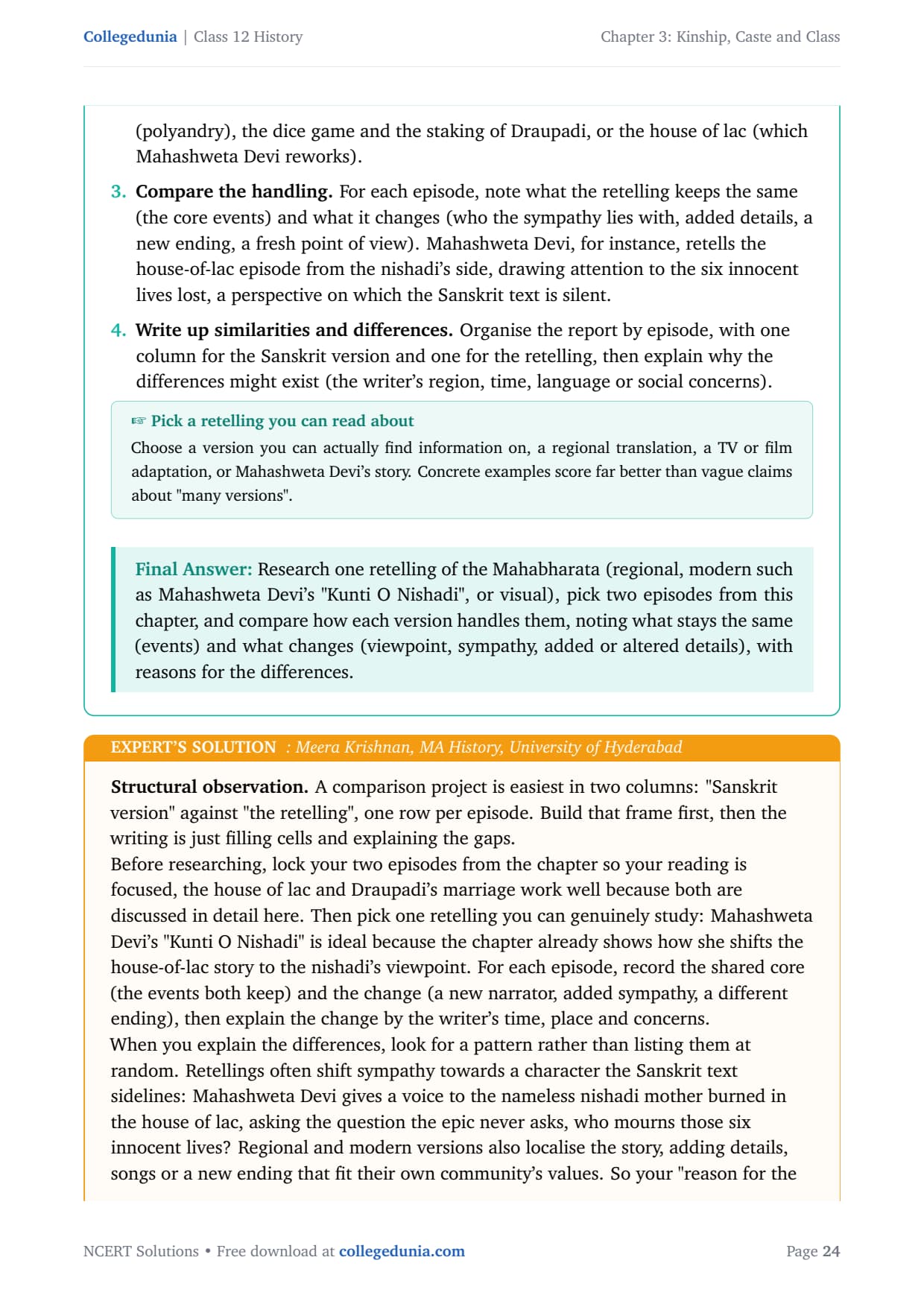
Fig. 3.9, Lord Ganesha the scribe. According to
tradition, Vyasa dictated the text to the deity; this illustration is from a
Persian translation of the Mahabharata, c. 1740–50. NCERT Themes in Indian
History, Part I, Class 12 History, Theme 3.
Concept used. This is a project (retellings). There is no
single correct answer; you are marked on how well you research a regional or
language retelling of the Mahabharata and compare its version of two episodes
with the Sanskrit version in this chapter. The guide below shows how to plan and
write it.
Find retellings. The epic was retold in many languages and
media: regional versions (for example in Tamil, Bengali, Hindi,
Malayalam, Persian), modern works such as Mahashweta Devi's Bengali
story "Kunti O Nishadi", and depictions in painting, sculpture, plays
and dance. The Persian translation behind Fig. 3.9 is one such
retelling. Pick one retelling to study.
Choose two episodes from this chapter. Good choices include
the story of Ekalavya and Drona, Hidimba's marriage to Bhima,
Draupadi's marriage (polyandry), the dice game and the staking of
Draupadi, or the house of lac (which Mahashweta Devi reworks).
Compare the handling. For each episode, note what the
retelling keeps the same (the core events) and what it changes (who the
sympathy lies with, added details, a new ending, a fresh point of
view). Mahashweta Devi, for instance, retells the house-of-lac episode
from the nishadi's side, drawing attention to the six innocent lives
lost, a perspective on which the Sanskrit text is silent.
Write up similarities and differences. Organise the report by
episode, with one column for the Sanskrit version and one for the
retelling, then explain why the differences might exist (the writer's
region, time, language or social concerns).
Pick a retelling you can read about
Choose a version you can actually find information on, a regional translation, a
TV or film adaptation, or Mahashweta Devi's story. Concrete examples score far
better than vague claims about "many versions".
Research one retelling of the Mahabharata (regional, modern such as
Mahashweta Devi's "Kunti O Nishadi", or visual), pick two episodes from this
chapter, and compare how each version handles them, noting what stays the same
(events) and what changes (viewpoint, sympathy, added or altered details), with
reasons for the differences.
MK
Meera Krishnan
MA History, University of Hyderabad
Verified Expert
Structural observation. A comparison project is easiest in two columns:
"Sanskrit version" against "the retelling", one row per episode. Build that
frame first, then the writing is just filling cells and explaining the gaps.
Before researching, lock your two episodes from the chapter so your reading is
focused, the house of lac and Draupadi's marriage work well because both are
discussed in detail here. Then pick one retelling you can genuinely study:
Mahashweta Devi's "Kunti O Nishadi" is ideal because the chapter already shows
how she shifts the house-of-lac story to the nishadi's viewpoint. For each
episode, record the shared core (the events both keep) and the change (a new
narrator, added sympathy, a different ending), then explain the change by the
writer's time, place and concerns.
When you explain the differences, look for a pattern rather than listing them at
random. Retellings often shift sympathy towards a character the Sanskrit text
sidelines: Mahashweta Devi gives a voice to the nameless nishadi mother burned
in the house of lac, asking the question the epic never asks, who mourns those
six innocent lives? Regional and modern versions also localise the story, adding
details, songs or a new ending that fit their own community's values. So your
"reason for the difference" column should usually point to the writer's time,
place and concerns, a forest community's viewpoint, a feminist reading, a
devotional emphasis, rather than to a mistake in copying. Framing the changes
that way shows you understand retelling as creative dialogue, which is the
chapter's exact point.
Why this matters. The project teaches the chapter's "dynamic text"
lesson, that the epic keeps being remade, by making you watch a single episode
change as it passes into a new language or a new age. Spotting both the
constant core and the meaningful changes is the historical skill being tested,
and explaining why a version changes is what separates a thoughtful
report from a mere summary.
Use a two-column table (Sanskrit version versus a chosen retelling
such as Mahashweta Devi's "Kunti O Nishadi") for two chapter episodes, record
what each keeps and what it changes, and explain the differences by the
retelling's language, period and social concerns.
Q 3.12
Imagine that you are an author and rewrite the story of Ekalavya from
a perspective of your choice.
Concept used. This is a creative project. There is no single
right answer; you are marked on how well you retell the Ekalavya story from a
chosen point of view while keeping the core events from Source 7. The guide
below shows how to plan it.
Recall the original story (Source 7). Drona, a Brahmana
teacher of the Kuru princes, refuses to teach Ekalavya, a
forest-dwelling nishada. Ekalavya makes a clay image of Drona, teaches
himself and becomes a superb archer. To keep Arjuna unrivalled, Drona
demands Ekalavya's right thumb as fee, and Ekalavya cuts it off and
gives it.
Choose a perspective. You could write as Ekalavya himself, as
his clay image of Drona, as a fellow nishada, as Drona troubled by his
own demand, or even as Arjuna. The point of view you pick should change
how the events feel.
Keep the core, change the lens. Retell the same events, the
refusal, the self-teaching, the demand for the thumb, but bring out the
feelings and judgements your chosen narrator would have, for example
Ekalavya's sense of injustice, or his devotion and dignity.
End with a reflection. Close by raising the question the
chapter raises, whether it was fair to deny a low-born nishada his skill
and his thumb so that a Kshatriya prince could stay the best.
Voice for the voiceless
The Sanskrit text tells the story from the side of Drona and the princes.
Retelling it from Ekalavya's side, as modern writers retell the epic, gives a
voice to the person the original silences, which is exactly the creative
historical work the project invites.
Retell Source 7's events, Drona's refusal, Ekalavya's self-teaching,
the demand for his thumb, from a chosen narrator (Ekalavya, Drona, a fellow
nishada, or Arjuna), keeping the core story but bringing out that narrator's
feelings, and close by reflecting on the fairness of denying the low-born
nishada his due.
SQ
Sara Qureshi
MA Archaeology, Aligarh Muslim University
Verified Expert
Picture-first. The strongest version chooses one voice and stays in it
from start to finish. Decide your narrator before you write, then run the whole
story through that single pair of eyes, the events stay fixed, but the meaning
shifts.
Pick Ekalavya himself for the most powerful effect: tell of being turned away by
Drona, of the patient self-teaching before the clay image, of the pride in your
own skill, and then of the demand for your thumb and the cost of giving it. Keep
every core fact from Source 7 so the retelling is recognisably the same story,
and let the emotion, hurt, devotion, quiet dignity, carry the new perspective.
Finish on the unfairness the chapter highlights, that a forest nishada was made
to cripple himself so a prince could remain unrivalled.
Why this matters. The project rewards exactly the skill the chapter
prizes: reading a story against its grain to recover the viewpoint it leaves
out. By giving Ekalavya his own voice, you turn a tale that justifies hierarchy
into one that questions it, which is the creative and historical point of the
exercise.
Choose a single narrator (ideally Ekalavya), retell Source 7's events
faithfully, the refusal, the clay image, the self-teaching, the thumb, while
voicing that narrator's feelings, and close by questioning the fairness of
denying a low-born nishada his skill so that a Kshatriya prince stays the best.
FAQs on Kinship, Caste and Class Class 12 NCERT Solutions
Kinship, Caste and Class Class 12 History Common Questions
Ques. Where can I get the class 12 history chapter 3 ncert solutions PDF?
Ans. You can download the Kinship, Caste and Class Class 12 History NCERT Solutions PDF directly from this page. It is free, follows the 2026-27 NCERT, and answers all 12 exercise questions step by step.
Ques. How many questions are there in class 12 history chapter 3 questions and answers?
Ans. The chapter has 12 exercise questions. Nine are written answers, and the last three (3.10 to 3.12) are map work and project activities used in the history project file class 12 chapter 3.
Ques. Which are the most important questions in history class 12 chapter 3 question answer practice?
Ans. Whether the Mahabharata had a single author (Q 3.7), how important gender differences were (Q 3.8), and the evidence that kinship rules were not always followed (Q 3.9) are the most-asked long answers. These three top every list of class 12 history chapter 3 important questions.
Ques. Were kings in early India always Kshatriyas?
Ans. No. The Shastras said only Kshatriyas could rule, but the Mauryas were of disputed origin, the Shungas and Kanvas were Brahmanas, the Shakas were Central-Asian outsiders, and the Satavahanas claimed Brahmana status. Power went to whoever could command support and resources.
Ques. Why was the Mahabharata not the work of a single author?
Ans. Because it grew in clear phases over about a thousand years, from bardic oral verse to Brahmanical writing to late didactic additions, swelling from under 10,000 to about 100,000 verses, with more than half the Critical Edition given to regional variants. The attribution to the sage Vyasa is traditional, not historical proof.
Ques. Is class 12 history chapter 3 hard to score in the board exam?
Ans. No. It is a good scoring chapter if you always separate the Brahmanical rule from what people actually did. Practise the source-based extracts and a few class 12 history chapter 3 mcq sets, and keep the single-author and gender debates ready in your own words.








Comments