The NCERT Solutions for Class 12 Biotechnology Chapter 8 Animal Cell Culture cover all 21 exercise questions for the 2026-27 session. The answers explain culture media, serum, passaging, cell viability and applications in clear steps.
Question count: 9 descriptive questions and 12 objective or assertion-reason questions.
Best for: CBSE board revision, biotechnology practical terms and quick PDF practice.
Each Animal Cell Culture NCERT solution is checked against the official NCERT exercise and arranged for fast 2026-27 revision.
Student Feedback: In a Collegedunia survey of 12,480 Class 12 Biotechnology students before the 2026 boards, 76% of students said finite and continuous cell lines needed the most revision.
Source: 2026-27 Class 12 Biotechnology student poll across CBSE schools.
Animal Cell Culture NCERT Solutions PDF for Class 12 Biotechnology
This page gives the solved exercise for Animal Cell Culture. The PDF keeps the main solution and expert solution together, so students can check the NCERT answer and a second explanation in one place.
Definitions: animal cell culture, primary culture and passaging.
Media questions: serum, synthetic media, bicarbonate buffer and DMEM.
Application questions: vaccines, therapeutic proteins, EPO, tPA and monoclonal antibodies.
Animal Cell Culture Important Topics for Class 12 Boards
Animal Cell Culture is a theory-heavy chapter. Students should learn the NCERT definitions first, then revise the objective questions at the end.
Topic
What to revise
Culture media
Natural, synthetic, serum-free and protein-free media
Cell lines
Finite line, continuous line, adherent cells and suspension cells
Viability assay
Trypan blue, dye exclusion and MTT assay
Applications
Vaccines, biopharmaceuticals and monoclonal antibodies
Finite and Continuous Cell Lines in Animal Cell Culture
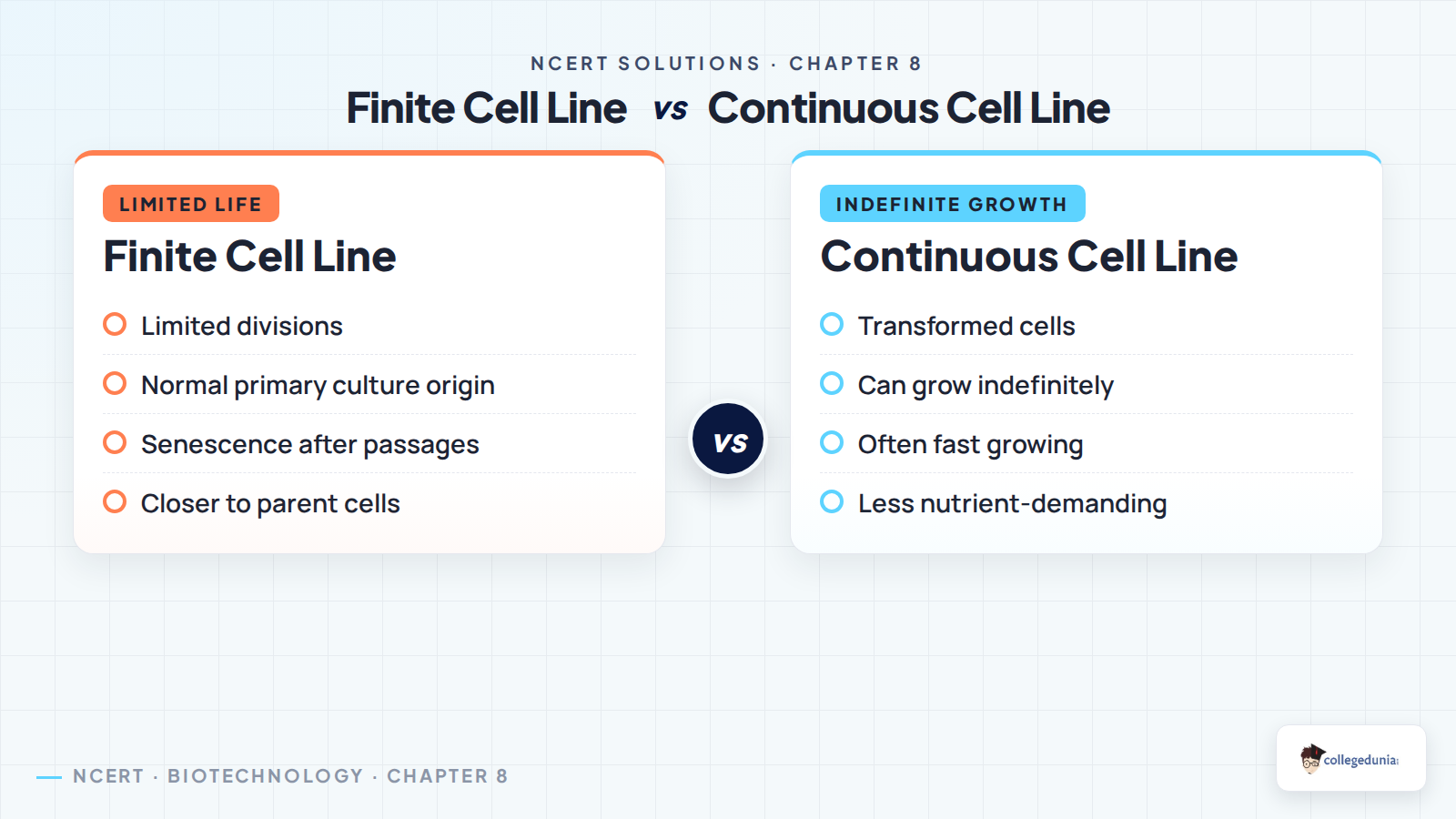
Many students mix up finite and continuous cell lines. A finite line has a limited life span. A continuous line can divide indefinitely after transformation.
How to Use Animal Cell Culture NCERT Solutions for Revision
Use the PDF after reading the textbook once. First answer the descriptive questions on paper. Then check the expert solution for missing terms and examples.
Revise culture media and serum from the NCERT summary.
Solve questions 1 to 9 without looking at the PDF.
Practise questions 10 to 21 as quick MCQs.
Mark weak terms like passaging, DMEM and MTT assay.
All NCERT Solutions for Class 12 Biotechnology Chapter 8 Animal Cell Culture with Step-by-Step Solutions
NCERT Exercise Solutions
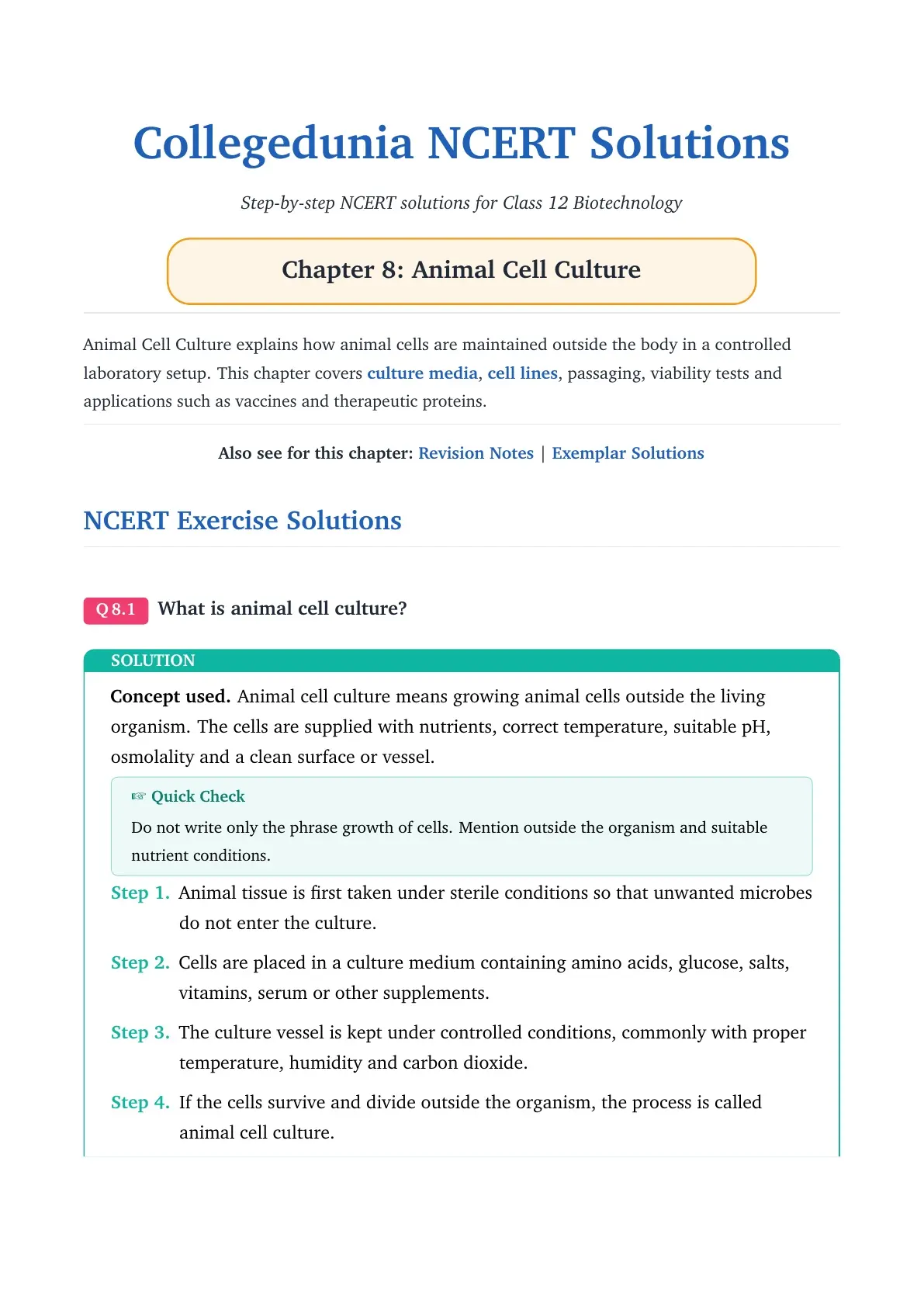
Q 8.1
What is animal cell culture?
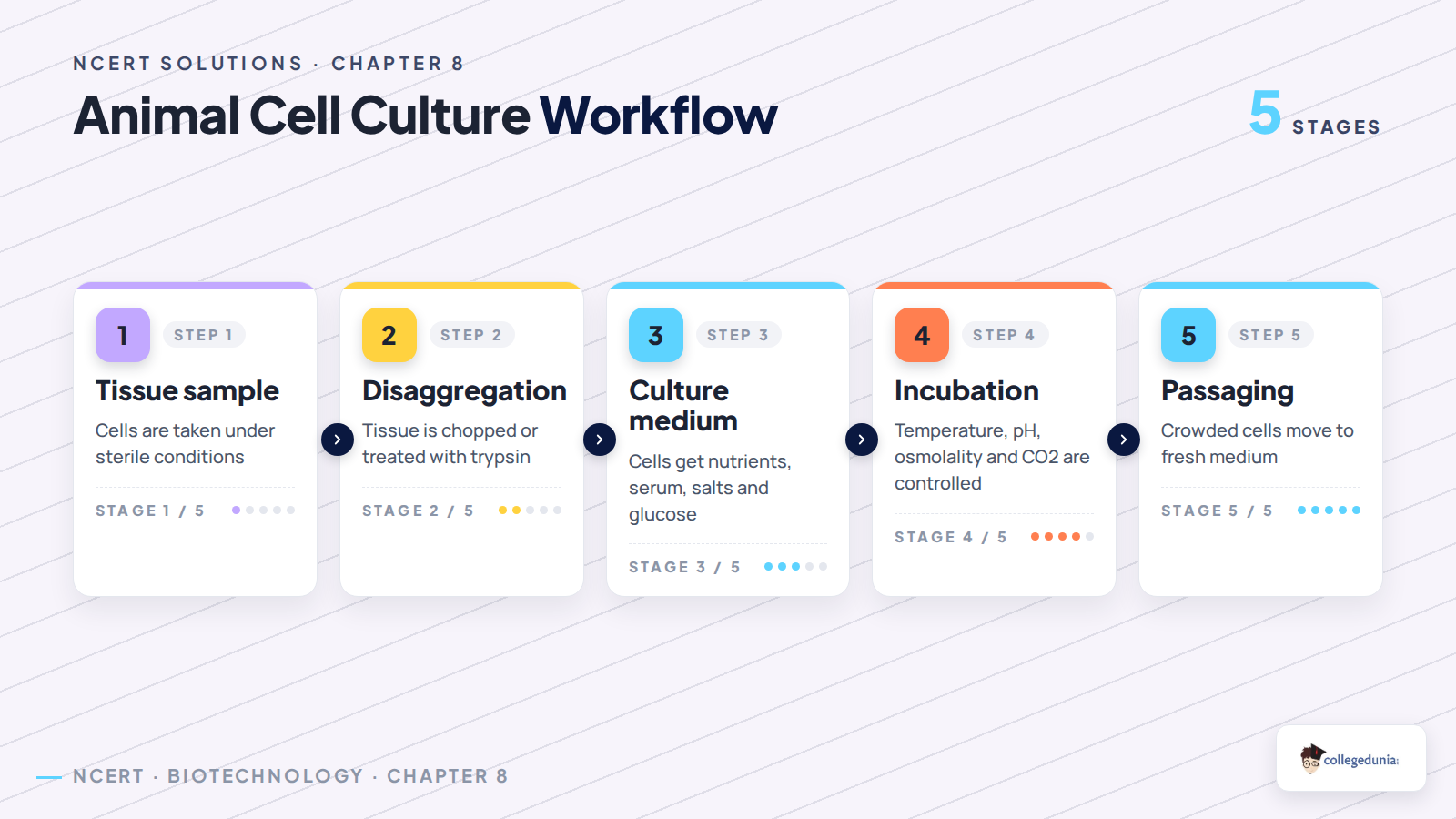
Concept used. Animal cell culture means growing animal cells outside the living organism. The cells are supplied with nutrients, correct temperature, suitable pH, osmolality and a clean surface or vessel.
Quick Check
Do not write only the phrase growth of cells. Mention outside the organism and suitable nutrient conditions.
Animal tissue is first taken under sterile conditions so that unwanted microbes do not enter the culture.
Cells are placed in a culture medium containing amino acids, glucose, salts, vitamins, serum or other supplements.
The culture vessel is kept under controlled conditions, commonly with proper temperature, humidity and carbon dioxide.
If the cells survive and divide outside the organism, the process is called animal cell culture.
Animal cell culture is the in vitro growth and maintenance of animal cells in suitable medium under controlled conditions.
AS
Aarav Sharma
M.Sc Biotechnology, AIIMS Delhi
Verified Expert
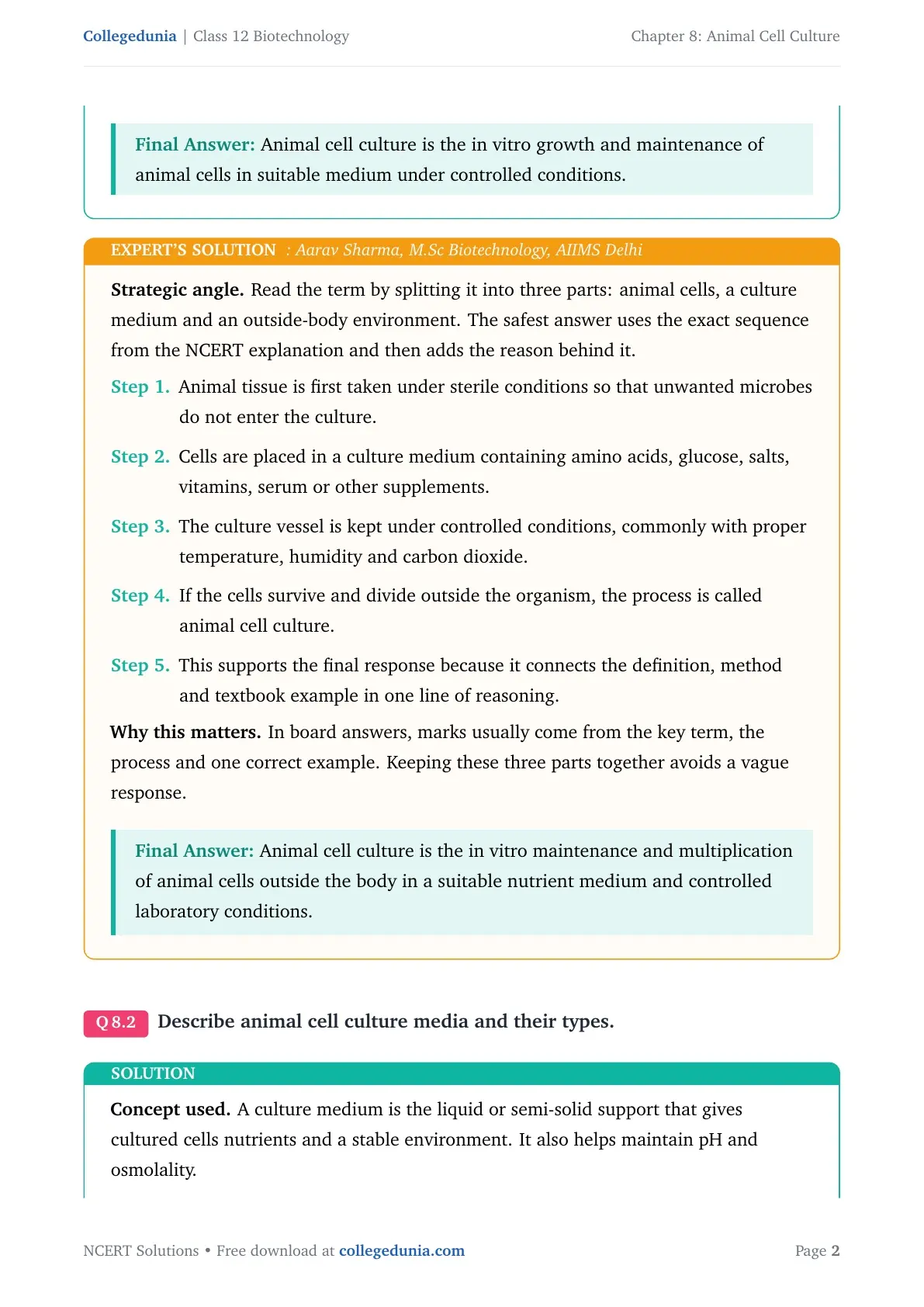
Strategic angle. Read the term by splitting it into three parts: animal cells, a culture medium and an outside-body environment. The safest answer uses the exact sequence from the NCERT explanation and then adds the reason behind it.
Animal tissue is first taken under sterile conditions so that unwanted microbes do not enter the culture.
Cells are placed in a culture medium containing amino acids, glucose, salts, vitamins, serum or other supplements.
The culture vessel is kept under controlled conditions, commonly with proper temperature, humidity and carbon dioxide.
If the cells survive and divide outside the organism, the process is called animal cell culture.
This supports the final response because it connects the definition, method and textbook example in one line of reasoning.
Why this matters. In board answers, marks usually come from the key term, the process and one correct example. Keeping these three parts together avoids a vague response.
Animal cell culture is the in vitro maintenance and multiplication of animal cells outside the body in a suitable nutrient medium and controlled laboratory conditions.
Q 8.2
Describe animal cell culture media and their types.
Concept used. A culture medium is the liquid or semi-solid support that gives cultured cells nutrients and a stable environment. It also helps maintain pH and osmolality.
Quick Check
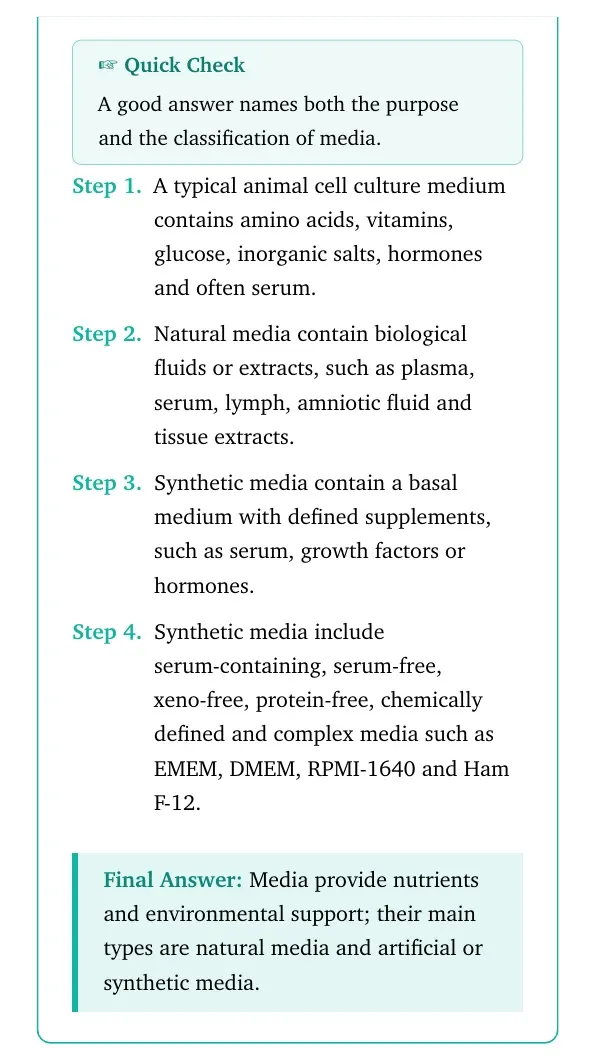
A good answer names both the purpose and the classification of media.
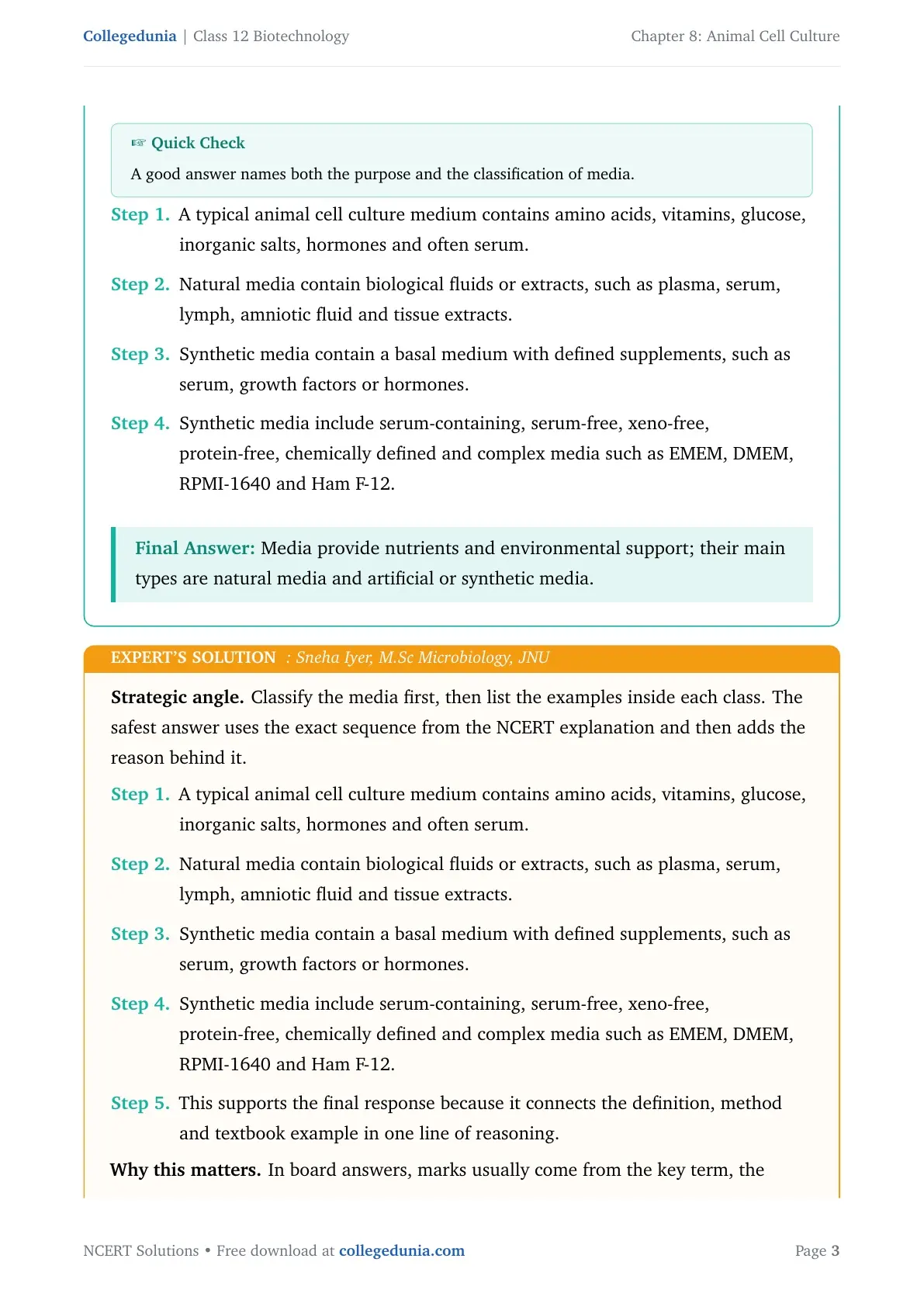
A typical animal cell culture medium contains amino acids, vitamins, glucose, inorganic salts, hormones and often serum.
Natural media contain biological fluids or extracts, such as plasma, serum, lymph, amniotic fluid and tissue extracts.
Synthetic media contain a basal medium with defined supplements, such as serum, growth factors or hormones.
Synthetic media include serum-containing, serum-free, xeno-free, protein-free, chemically defined and complex media such as EMEM, DMEM, RPMI-1640 and Ham F-12.
Media provide nutrients and environmental support; their main types are natural media and artificial or synthetic media.
SI
Sneha Iyer
M.Sc Microbiology, JNU
Verified Expert
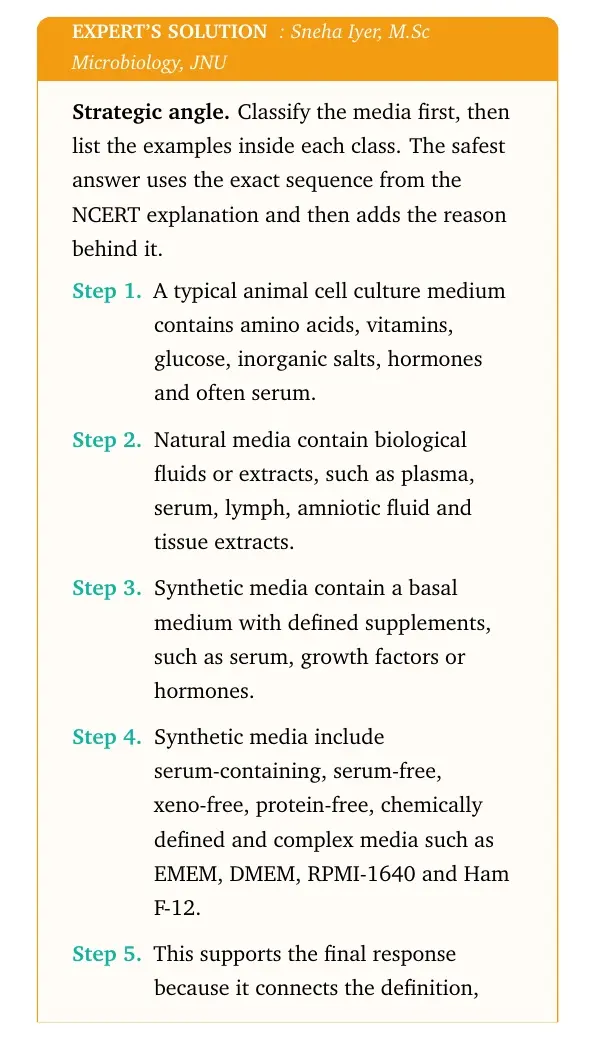
Strategic angle. Classify the media first, then list the examples inside each class. The safest answer uses the exact sequence from the NCERT explanation and then adds the reason behind it.
A typical animal cell culture medium contains amino acids, vitamins, glucose, inorganic salts, hormones and often serum.
Natural media contain biological fluids or extracts, such as plasma, serum, lymph, amniotic fluid and tissue extracts.
Synthetic media contain a basal medium with defined supplements, such as serum, growth factors or hormones.
Synthetic media include serum-containing, serum-free, xeno-free, protein-free, chemically defined and complex media such as EMEM, DMEM, RPMI-1640 and Ham F-12.
This supports the final response because it connects the definition, method and textbook example in one line of reasoning.
Why this matters. In board answers, marks usually come from the key term, the process and one correct example. Keeping these three parts together avoids a vague response.
Animal cell culture media are nutrient mixtures that support survival, growth and functions of cultured animal cells. They are broadly natural media and artificial or synthetic media.
Q 8.3
Write the advantages and disadvantages of serum in the culture media.
Concept used. Serum is the fluid part of blood after clotting. In culture medium it acts as a rich supplement for cell attachment, growth and metabolism.
Quick Check
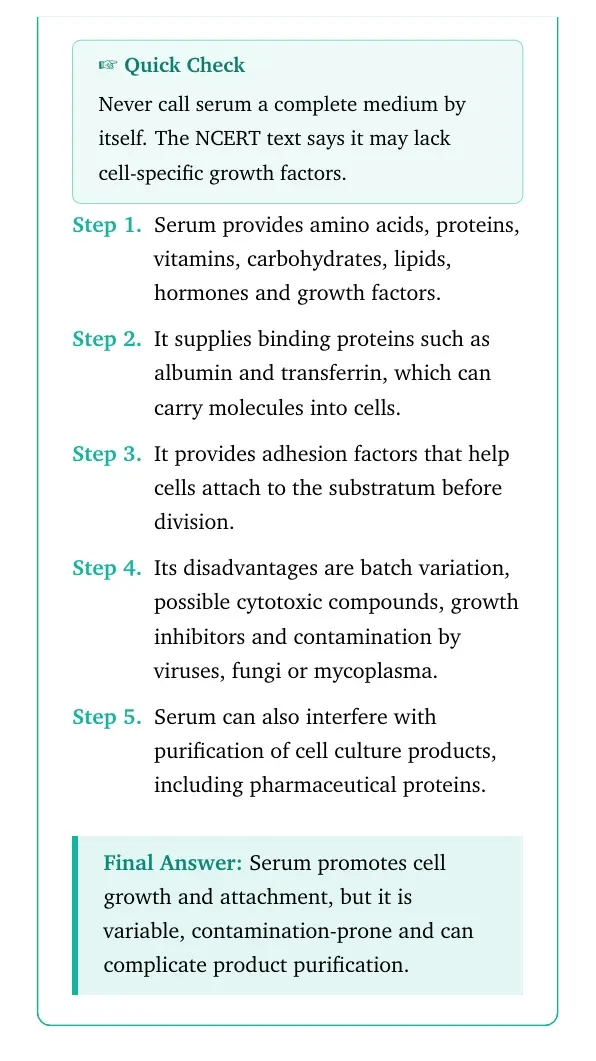
Never call serum a complete medium by itself. The NCERT text says it may lack cell-specific growth factors.
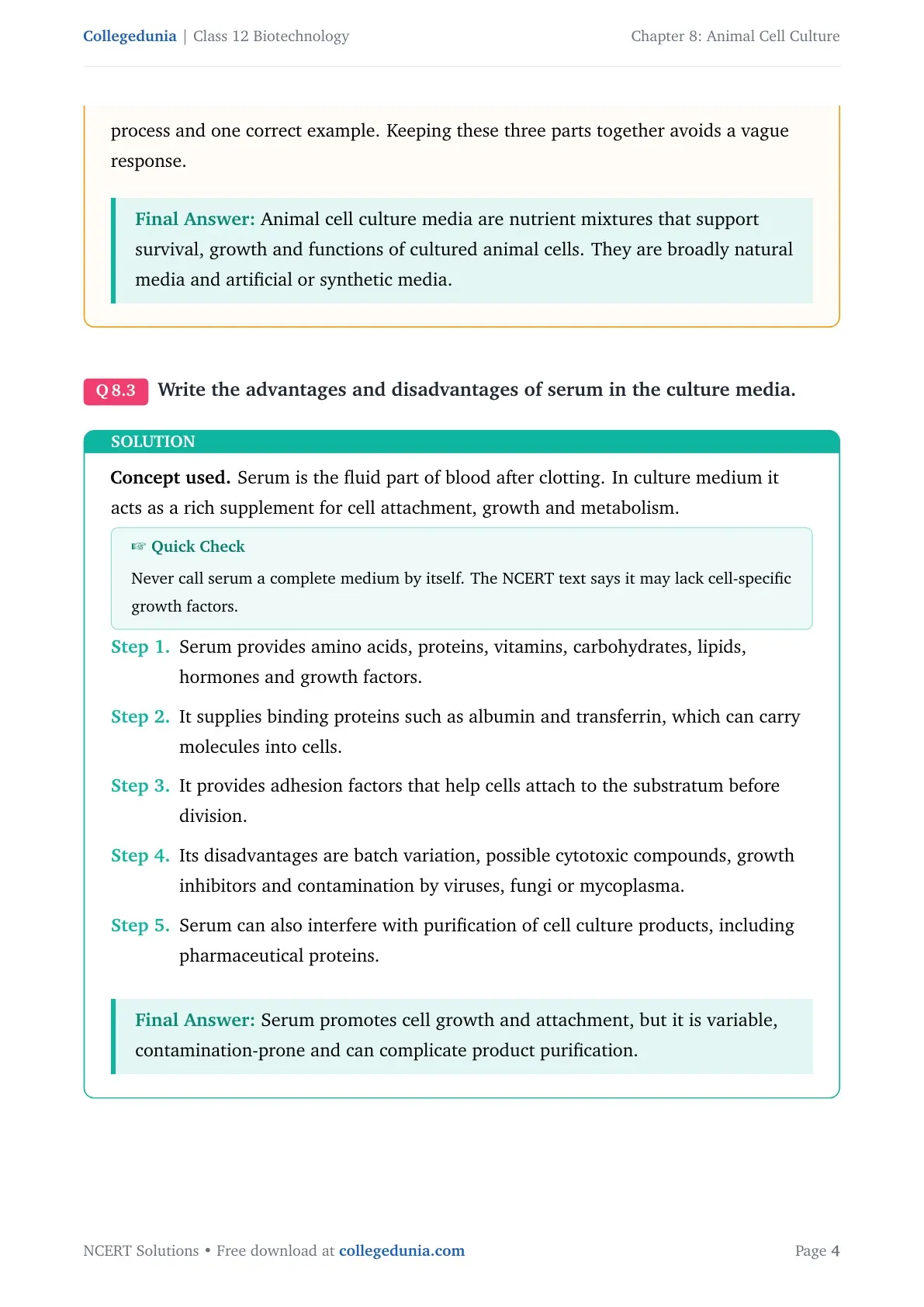
It supplies binding proteins such as albumin and transferrin, which can carry molecules into cells.
It provides adhesion factors that help cells attach to the substratum before division.
Its disadvantages are batch variation, possible cytotoxic compounds, growth inhibitors and contamination by viruses, fungi or mycoplasma.
Serum can also interfere with purification of cell culture products, including pharmaceutical proteins.
Serum promotes cell growth and attachment, but it is variable, contamination-prone and can complicate product purification.
PP
Pranav Patel
Ph.D Molecular Biology, NCBS Bangalore
Verified Expert
Strategic angle. Serum is useful because it is rich, but that same undefined richness creates control problems. The safest answer uses the exact sequence from the NCERT explanation and then adds the reason behind it.
It supplies binding proteins such as albumin and transferrin, which can carry molecules into cells.
It provides adhesion factors that help cells attach to the substratum before division.
Its disadvantages are batch variation, possible cytotoxic compounds, growth inhibitors and contamination by viruses, fungi or mycoplasma.
Serum can also interfere with purification of cell culture products, including pharmaceutical proteins.
This supports the final response because it connects the definition, method and textbook example in one line of reasoning.
Why this matters. In board answers, marks usually come from the key term, the process and one correct example. Keeping these three parts together avoids a vague response.
Serum supplies nutrients, growth factors, binding proteins and adhesion factors, but it varies by batch and may carry inhibitors or contaminants.
Q 8.4
Describe any two chemically synthesised media.
Concept used. Chemically synthesised or artificial media are prepared from a basal medium and supplements. Their composition is more controlled than natural fluids.
Quick Check
MS medium is not the best example here because it belongs mainly to plant tissue culture.
Dulbecco Minimal Essential Medium, or DMEM, is a commonly used animal cell culture medium.
It contains balanced salts, amino acids, vitamins and a carbon source, and it can be supplemented according to the cell type.
Roswell Park Memorial Institute medium, or RPMI-1640, is another synthetic medium used for many animal cell culture systems.
RPMI-1640 also supplies salts, nutrients and buffering support, and it is often used with serum or defined supplements.
DMEM and RPMI-1640 are examples of chemically synthesised media used for animal cell culture.
DG
Diya Gupta
M.Sc Biotechnology, Delhi University
Verified Expert
Strategic angle. Choose examples listed in the chapter, then explain what makes them synthetic. The safest answer uses the exact sequence from the NCERT explanation and then adds the reason behind it.
Dulbecco Minimal Essential Medium, or DMEM, is a commonly used animal cell culture medium.
It contains balanced salts, amino acids, vitamins and a carbon source, and it can be supplemented according to the cell type.
Roswell Park Memorial Institute medium, or RPMI-1640, is another synthetic medium used for many animal cell culture systems.
RPMI-1640 also supplies salts, nutrients and buffering support, and it is often used with serum or defined supplements.
This supports the final response because it connects the definition, method and textbook example in one line of reasoning.
Why this matters. In board answers, marks usually come from the key term, the process and one correct example. Keeping these three parts together avoids a vague response.
Two chemically synthesised media are DMEM and RPMI-1640. Both are artificial media used for animal cell culture.
Q 8.5
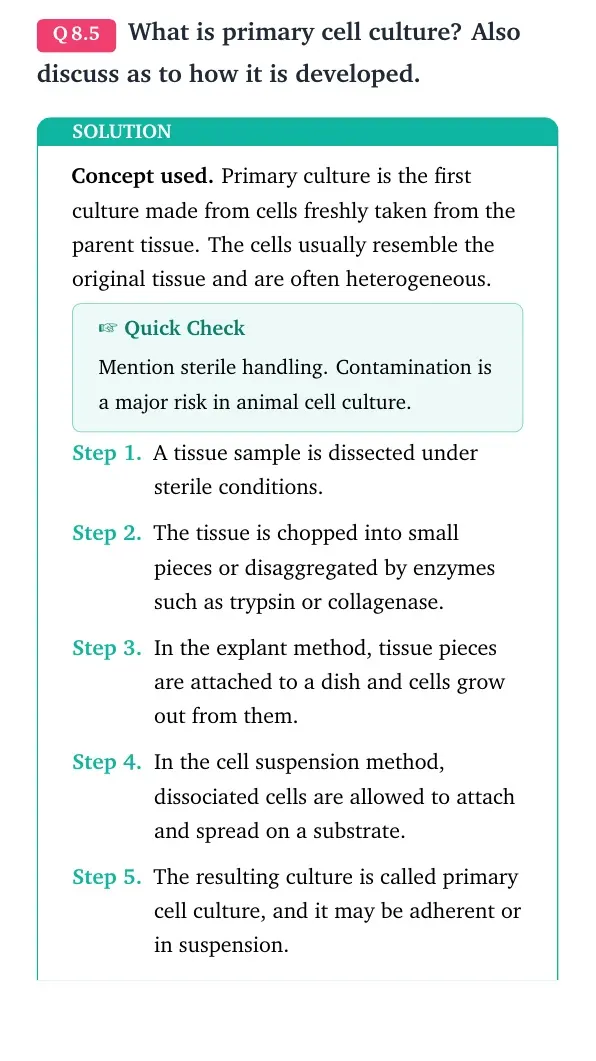
What is primary cell culture? Also discuss as to how it is developed.
Concept used. Primary culture is the first culture made from cells freshly taken from the parent tissue. The cells usually resemble the original tissue and are often heterogeneous.
Quick Check
Mention sterile handling. Contamination is a major risk in animal cell culture.
A tissue sample is dissected under sterile conditions.
The tissue is chopped into small pieces or disaggregated by enzymes such as trypsin or collagenase.
In the explant method, tissue pieces are attached to a dish and cells grow out from them.
In the cell suspension method, dissociated cells are allowed to attach and spread on a substrate.
The resulting culture is called primary cell culture, and it may be adherent or in suspension.
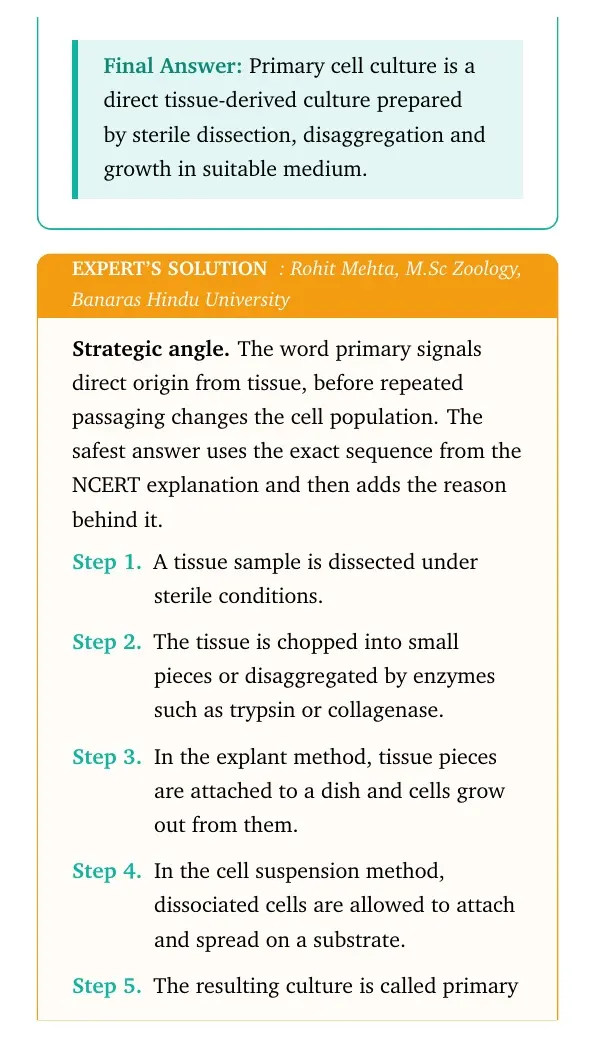
Primary cell culture is a direct tissue-derived culture prepared by sterile dissection, disaggregation and growth in suitable medium.
RM
Rohit Mehta
M.Sc Zoology, Banaras Hindu University
Verified Expert
Strategic angle. The word primary signals direct origin from tissue, before repeated passaging changes the cell population. The safest answer uses the exact sequence from the NCERT explanation and then adds the reason behind it.
A tissue sample is dissected under sterile conditions.
The tissue is chopped into small pieces or disaggregated by enzymes such as trypsin or collagenase.
In the explant method, tissue pieces are attached to a dish and cells grow out from them.
In the cell suspension method, dissociated cells are allowed to attach and spread on a substrate.
The resulting culture is called primary cell culture, and it may be adherent or in suspension.
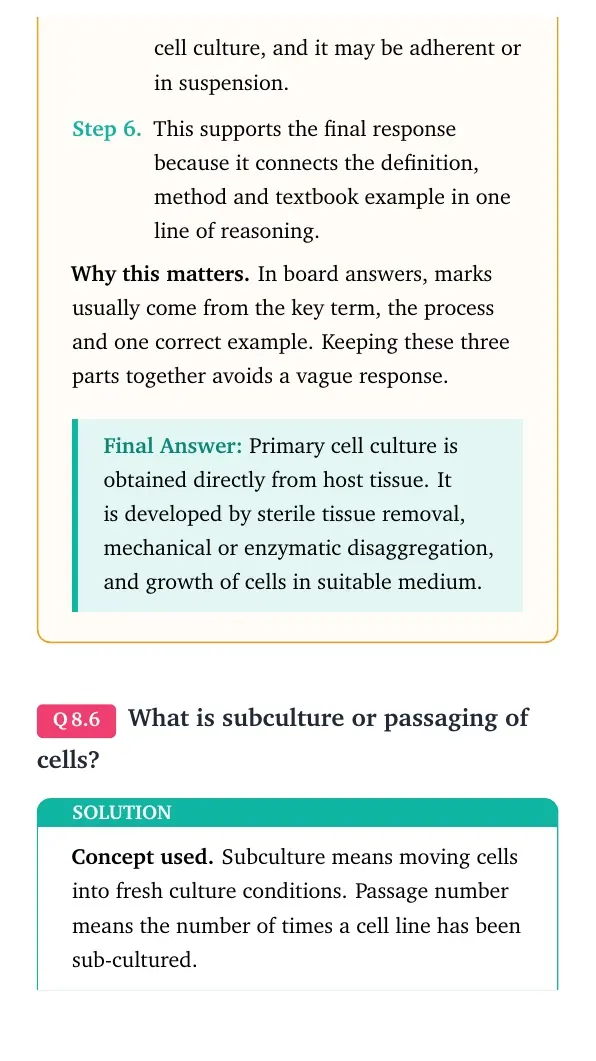
This supports the final response because it connects the definition, method and textbook example in one line of reasoning.
Why this matters. In board answers, marks usually come from the key term, the process and one correct example. Keeping these three parts together avoids a vague response.
Primary cell culture is obtained directly from host tissue. It is developed by sterile tissue removal, mechanical or enzymatic disaggregation, and growth of cells in suitable medium.
Q 8.6
What is subculture or passaging of cells?
Concept used. Subculture means moving cells into fresh culture conditions. Passage number means the number of times a cell line has been sub-cultured.
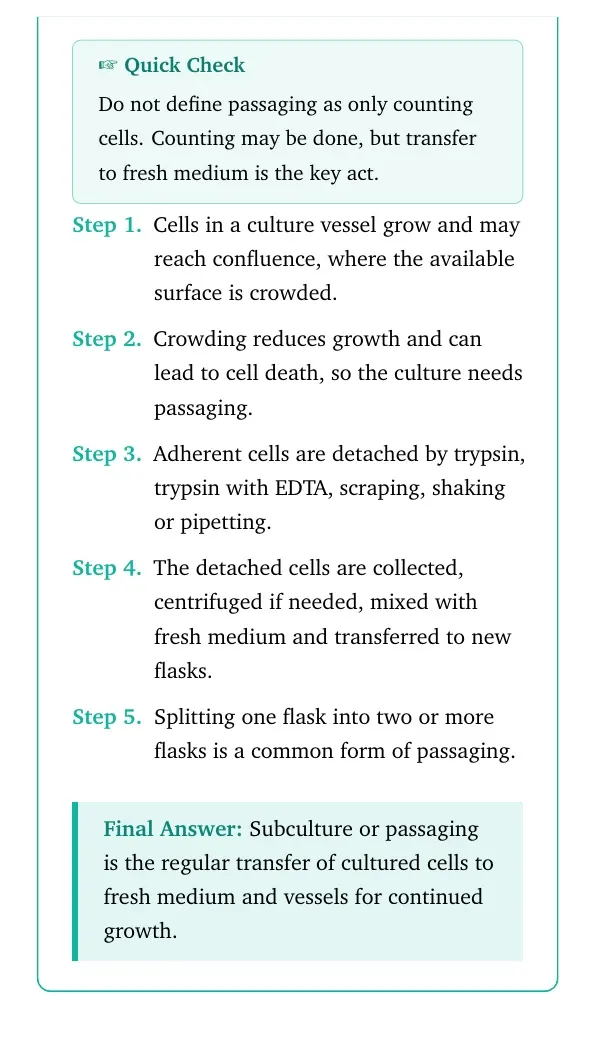
Quick Check
Do not define passaging as only counting cells. Counting may be done, but transfer to fresh medium is the key act.
Cells in a culture vessel grow and may reach confluence, where the available surface is crowded.
Crowding reduces growth and can lead to cell death, so the culture needs passaging.
Adherent cells are detached by trypsin, trypsin with EDTA, scraping, shaking or pipetting.
The detached cells are collected, centrifuged if needed, mixed with fresh medium and transferred to new flasks.
Splitting one flask into two or more flasks is a common form of passaging.
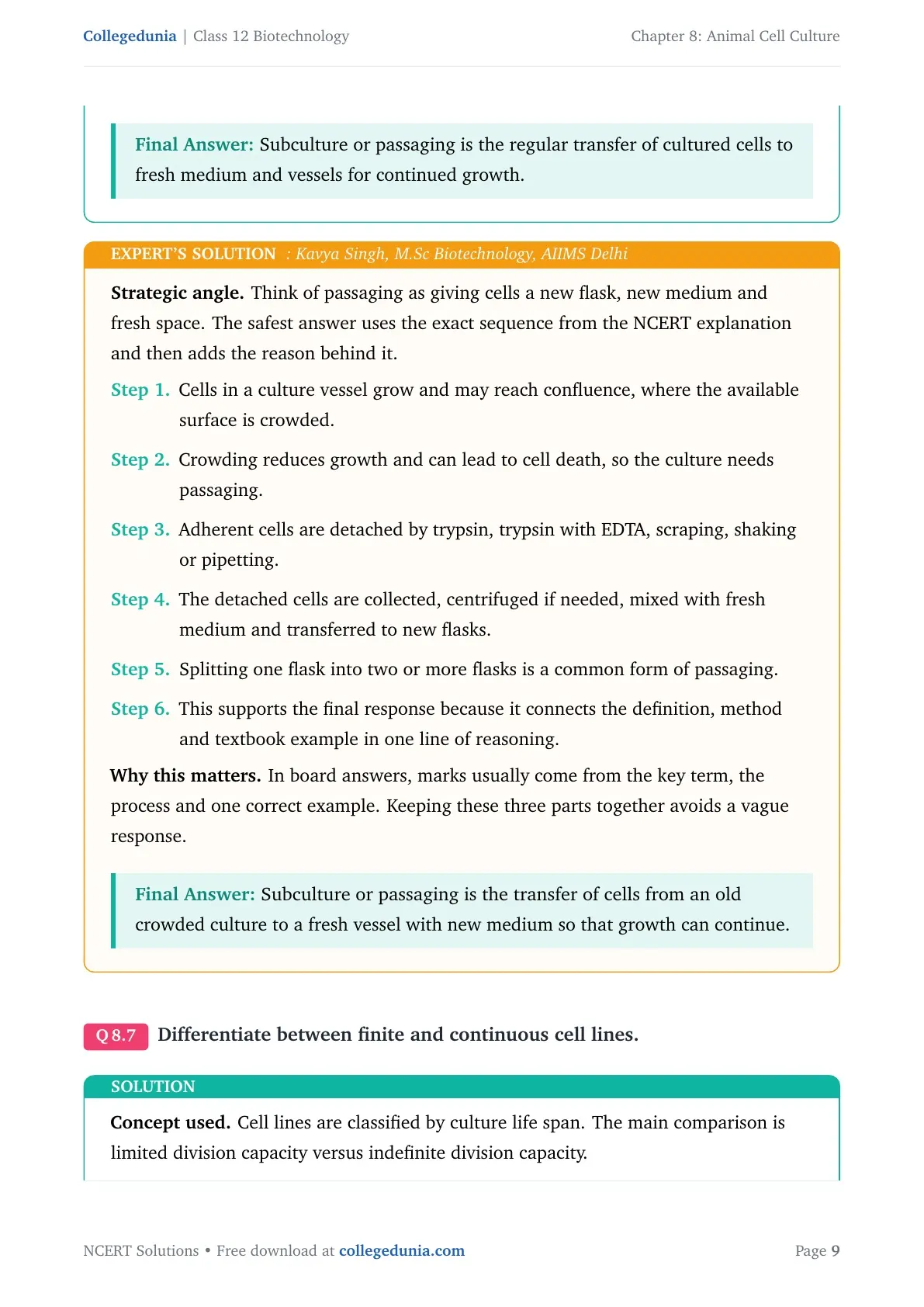
Subculture or passaging is the regular transfer of cultured cells to fresh medium and vessels for continued growth.
KS
Kavya Singh
M.Sc Biotechnology, AIIMS Delhi
Verified Expert
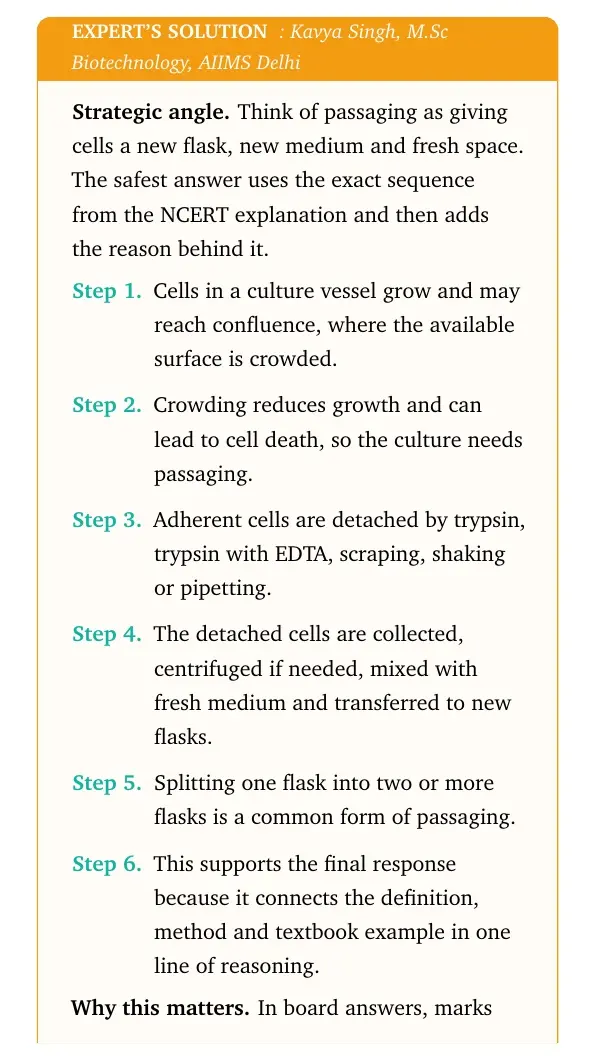
Strategic angle. Think of passaging as giving cells a new flask, new medium and fresh space. The safest answer uses the exact sequence from the NCERT explanation and then adds the reason behind it.
Cells in a culture vessel grow and may reach confluence, where the available surface is crowded.
Crowding reduces growth and can lead to cell death, so the culture needs passaging.
Adherent cells are detached by trypsin, trypsin with EDTA, scraping, shaking or pipetting.
The detached cells are collected, centrifuged if needed, mixed with fresh medium and transferred to new flasks.
Splitting one flask into two or more flasks is a common form of passaging.
This supports the final response because it connects the definition, method and textbook example in one line of reasoning.
Why this matters. In board answers, marks usually come from the key term, the process and one correct example. Keeping these three parts together avoids a vague response.
Subculture or passaging is the transfer of cells from an old crowded culture to a fresh vessel with new medium so that growth can continue.
Q 8.7
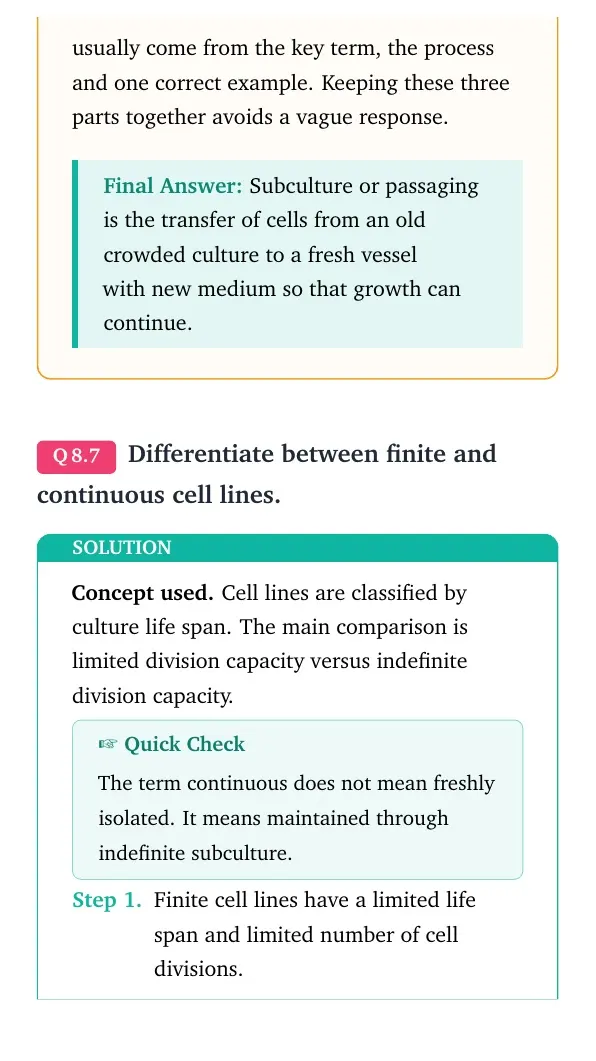
Differentiate between finite and continuous cell lines.
Concept used. Cell lines are classified by culture life span. The main comparison is limited division capacity versus indefinite division capacity.
Quick Check
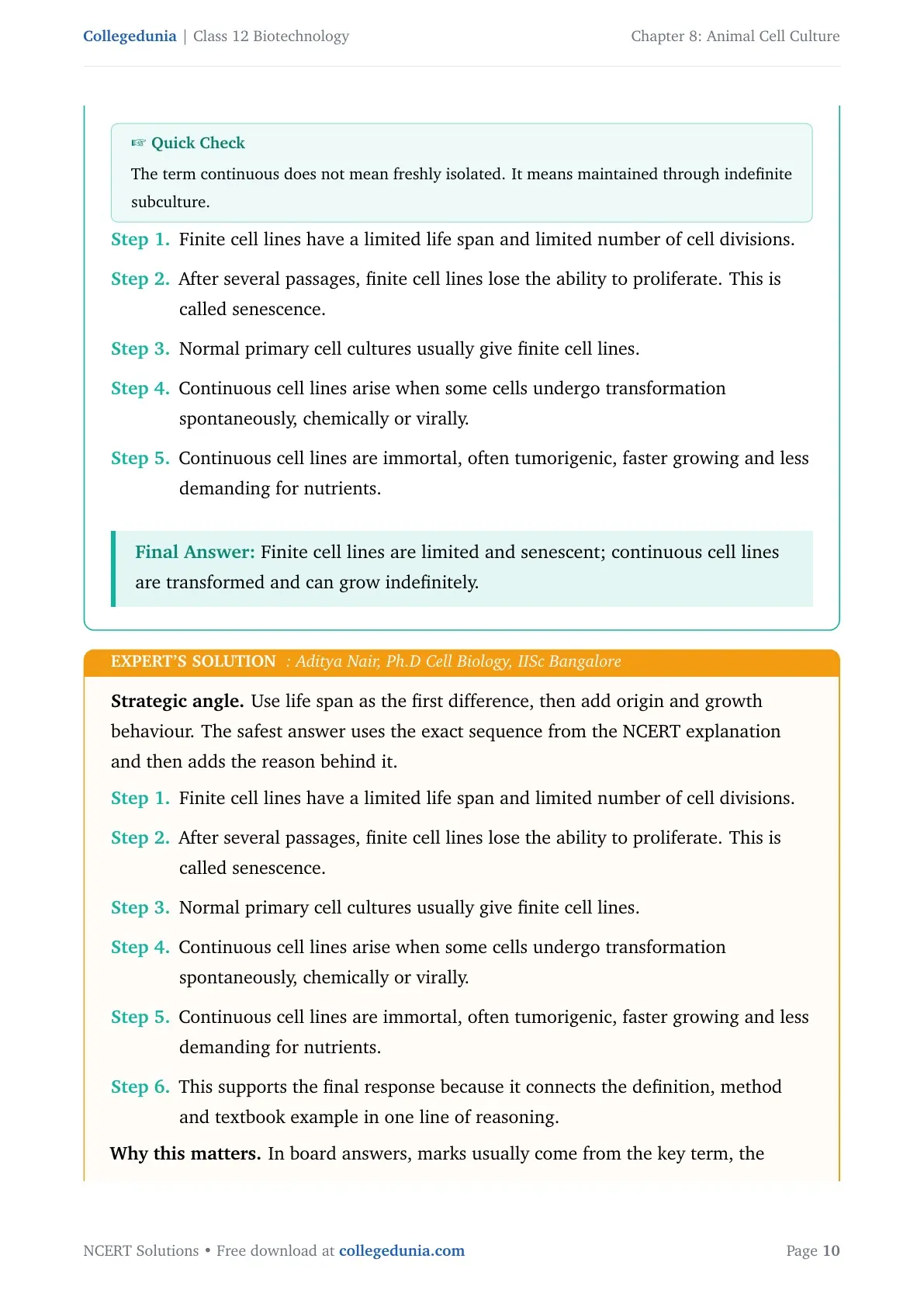
The term continuous does not mean freshly isolated. It means maintained through indefinite subculture.
Finite cell lines have a limited life span and limited number of cell divisions.
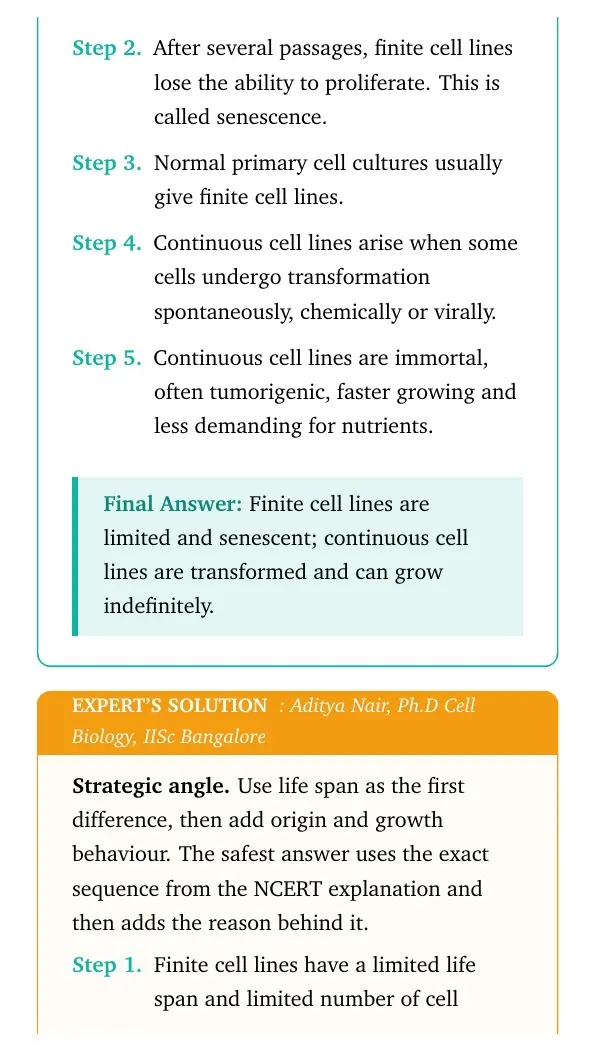
After several passages, finite cell lines lose the ability to proliferate. This is called senescence.
Normal primary cell cultures usually give finite cell lines.
Continuous cell lines arise when some cells undergo transformation spontaneously, chemically or virally.
Continuous cell lines are immortal, often tumorigenic, faster growing and less demanding for nutrients.
Finite cell lines are limited and senescent; continuous cell lines are transformed and can grow indefinitely.
AN
Aditya Nair
Ph.D Cell Biology, IISc Bangalore
Verified Expert
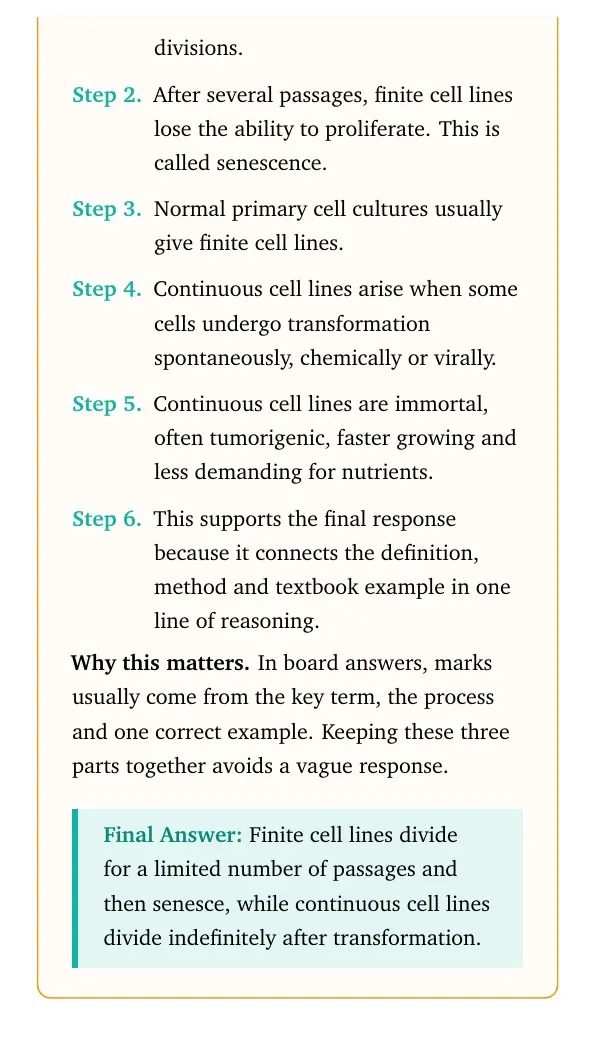
Strategic angle. Use life span as the first difference, then add origin and growth behaviour. The safest answer uses the exact sequence from the NCERT explanation and then adds the reason behind it.
Finite cell lines have a limited life span and limited number of cell divisions.
After several passages, finite cell lines lose the ability to proliferate. This is called senescence.
Normal primary cell cultures usually give finite cell lines.
Continuous cell lines arise when some cells undergo transformation spontaneously, chemically or virally.
Continuous cell lines are immortal, often tumorigenic, faster growing and less demanding for nutrients.
This supports the final response because it connects the definition, method and textbook example in one line of reasoning.
Why this matters. In board answers, marks usually come from the key term, the process and one correct example. Keeping these three parts together avoids a vague response.
Finite cell lines divide for a limited number of passages and then senesce, while continuous cell lines divide indefinitely after transformation.
Q 8.8
How is cell viability measurement performed?
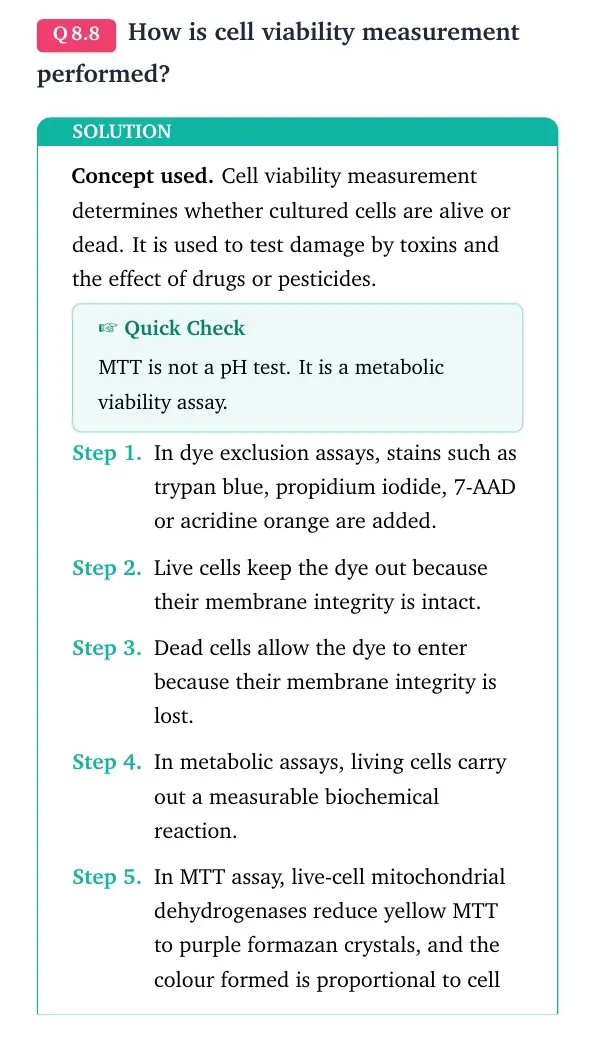
Concept used. Cell viability measurement determines whether cultured cells are alive or dead. It is used to test damage by toxins and the effect of drugs or pesticides.
Quick Check
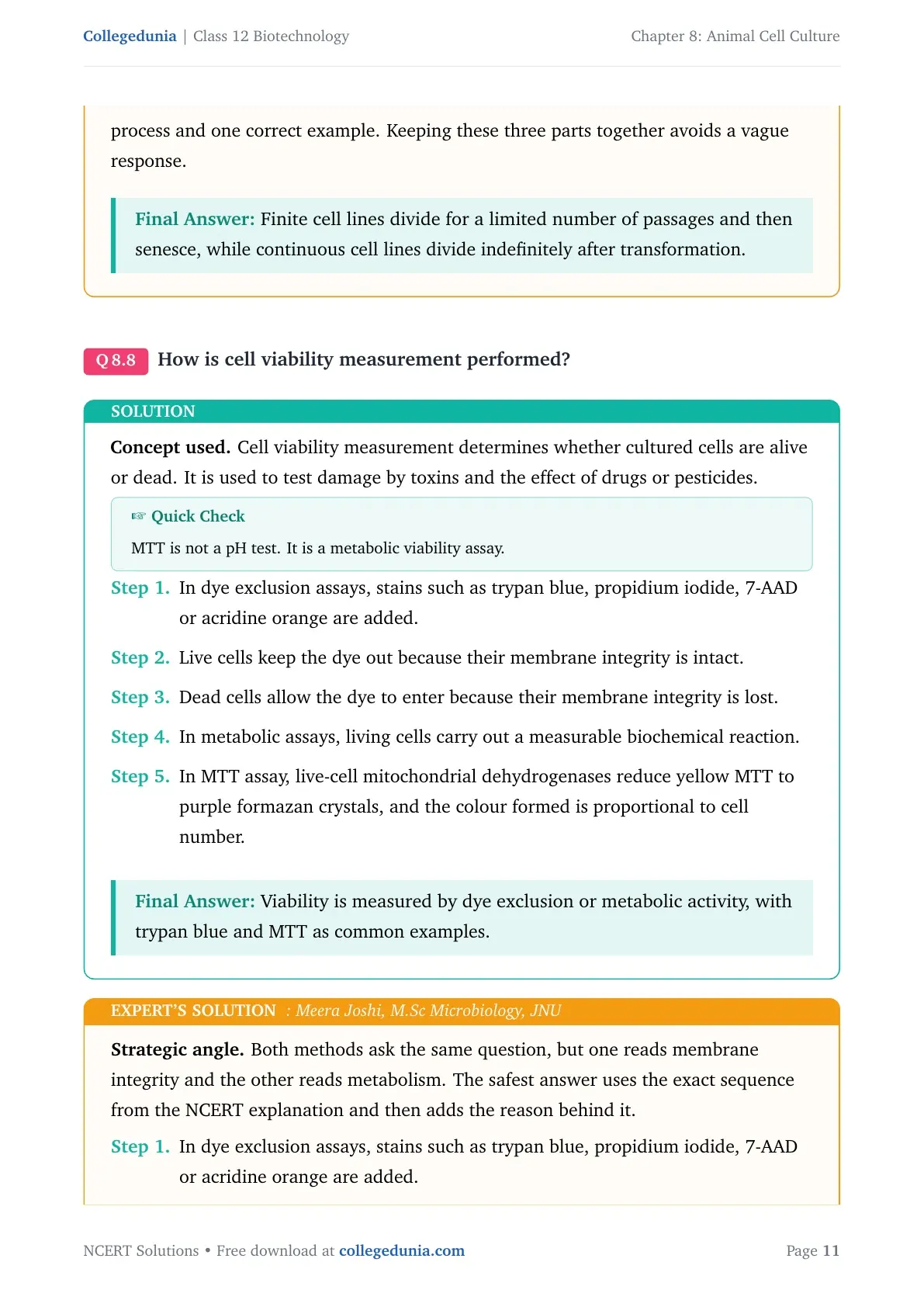
MTT is not a pH test. It is a metabolic viability assay.
In dye exclusion assays, stains such as trypan blue, propidium iodide, 7-AAD or acridine orange are added.
Live cells keep the dye out because their membrane integrity is intact.
Dead cells allow the dye to enter because their membrane integrity is lost.
In metabolic assays, living cells carry out a measurable biochemical reaction.
In MTT assay, live-cell mitochondrial dehydrogenases reduce yellow MTT to purple formazan crystals, and the colour formed is proportional to cell number.
Viability is measured by dye exclusion or metabolic activity, with trypan blue and MTT as common examples.
MJ
Meera Joshi
M.Sc Microbiology, JNU
Verified Expert
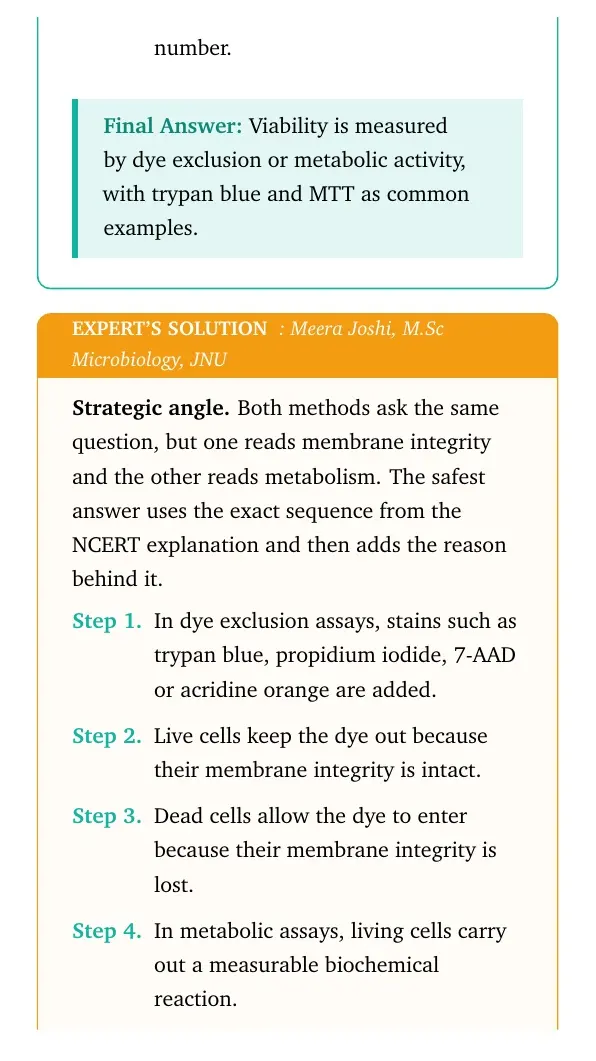
Strategic angle. Both methods ask the same question, but one reads membrane integrity and the other reads metabolism. The safest answer uses the exact sequence from the NCERT explanation and then adds the reason behind it.
In dye exclusion assays, stains such as trypan blue, propidium iodide, 7-AAD or acridine orange are added.
Live cells keep the dye out because their membrane integrity is intact.
Dead cells allow the dye to enter because their membrane integrity is lost.
In metabolic assays, living cells carry out a measurable biochemical reaction.
In MTT assay, live-cell mitochondrial dehydrogenases reduce yellow MTT to purple formazan crystals, and the colour formed is proportional to cell number.
This supports the final response because it connects the definition, method and textbook example in one line of reasoning.
Why this matters. In board answers, marks usually come from the key term, the process and one correct example. Keeping these three parts together avoids a vague response.
Cell viability is measured by dye exclusion assays or metabolic viability assays such as the MTT assay.
Q 8.9
Write a detailed account of application of cell culture.
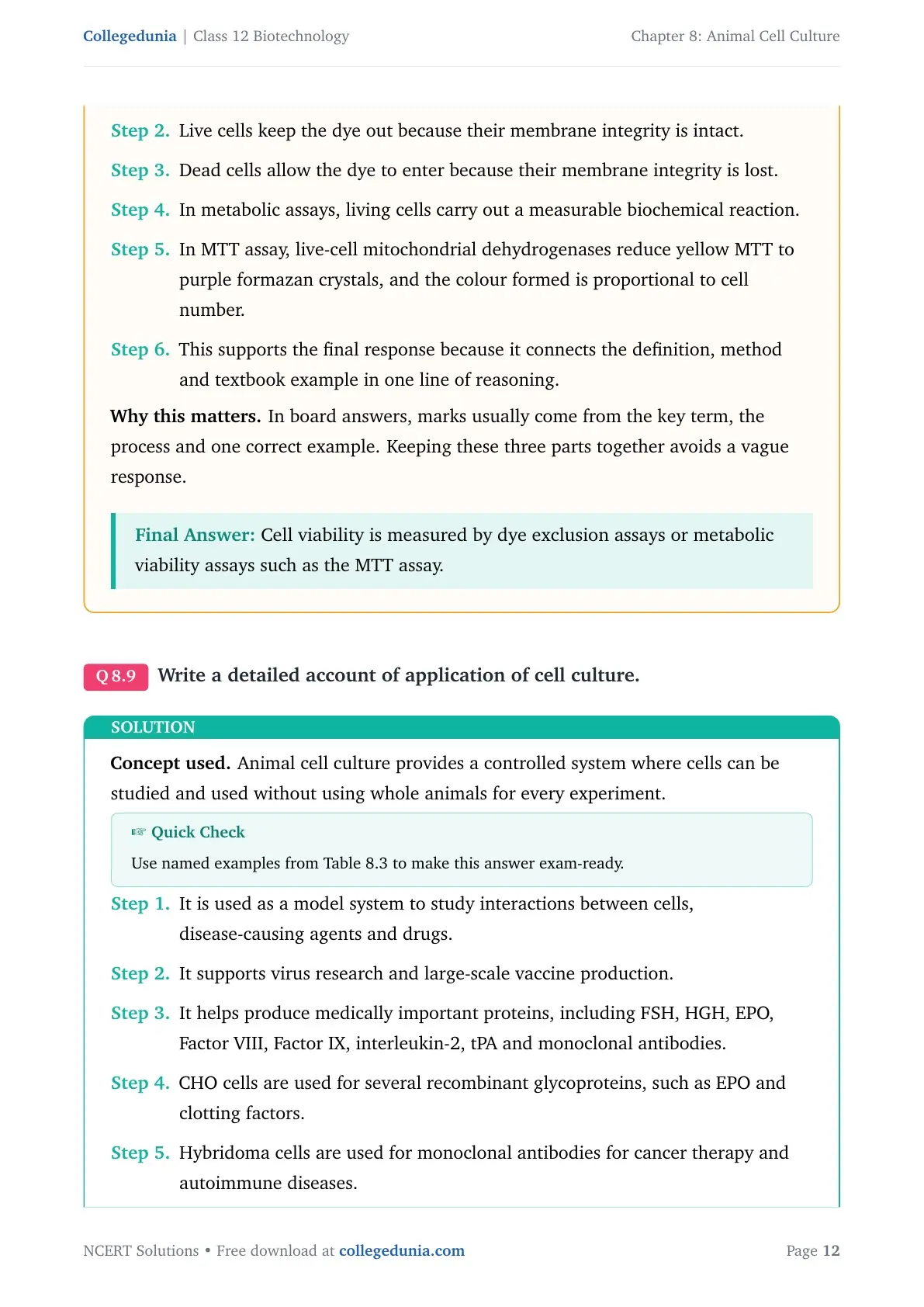
Concept used. Animal cell culture provides a controlled system where cells can be studied and used without using whole animals for every experiment.
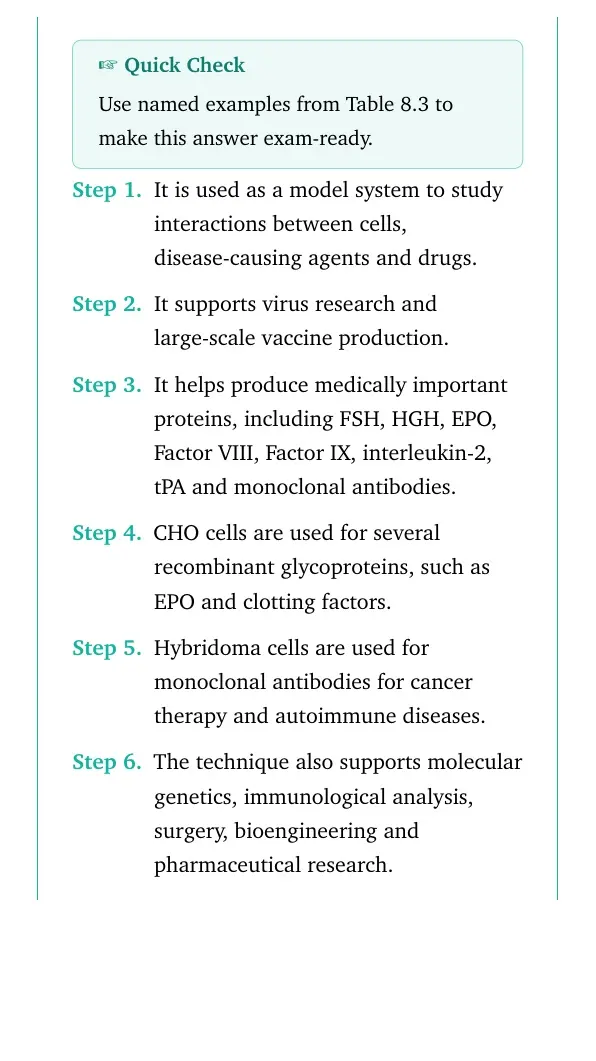
Quick Check
Use named examples from Table 8.3 to make this answer exam-ready.
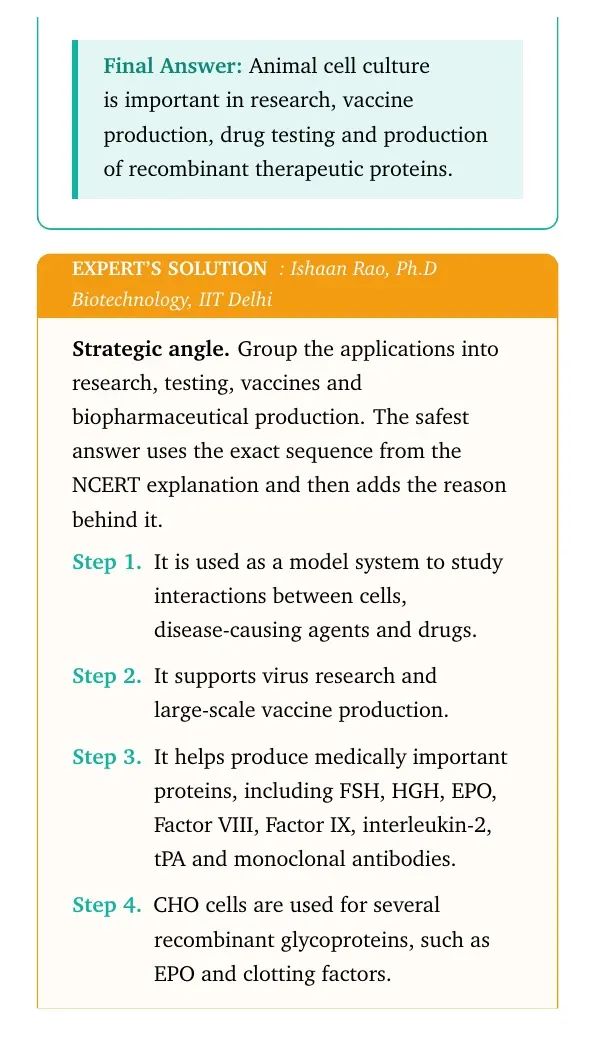
It is used as a model system to study interactions between cells, disease-causing agents and drugs.
It supports virus research and large-scale vaccine production.
It helps produce medically important proteins, including FSH, HGH, EPO, Factor VIII, Factor IX, interleukin-2, tPA and monoclonal antibodies.
CHO cells are used for several recombinant glycoproteins, such as EPO and clotting factors.
Hybridoma cells are used for monoclonal antibodies for cancer therapy and autoimmune diseases.
The technique also supports molecular genetics, immunological analysis, surgery, bioengineering and pharmaceutical research.
Animal cell culture is important in research, vaccine production, drug testing and production of recombinant therapeutic proteins.
IR
Ishaan Rao
Ph.D Biotechnology, IIT Delhi
Verified Expert
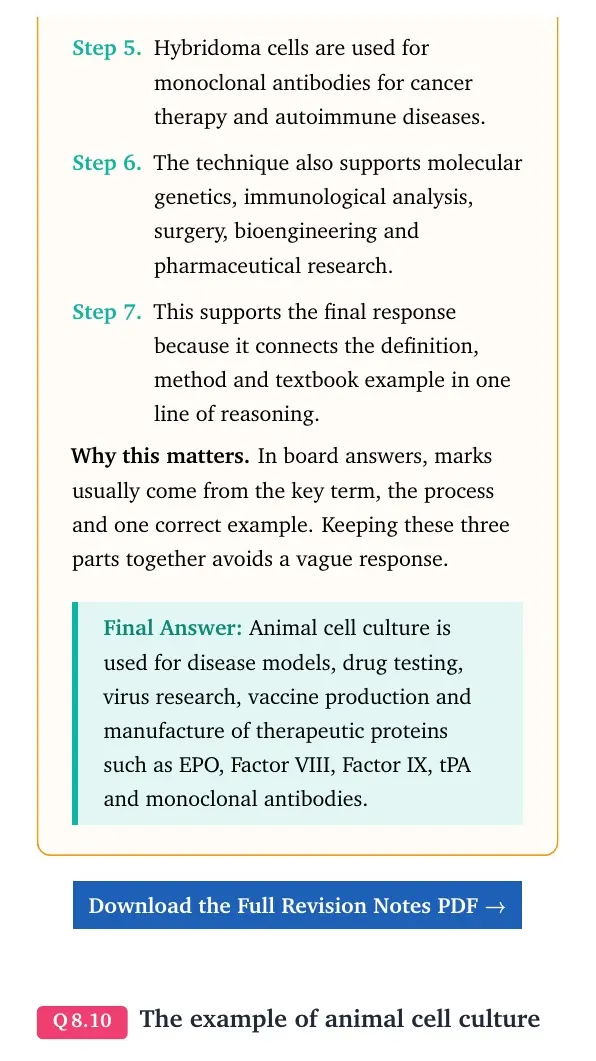
Strategic angle. Group the applications into research, testing, vaccines and biopharmaceutical production. The safest answer uses the exact sequence from the NCERT explanation and then adds the reason behind it.
It is used as a model system to study interactions between cells, disease-causing agents and drugs.
It supports virus research and large-scale vaccine production.
It helps produce medically important proteins, including FSH, HGH, EPO, Factor VIII, Factor IX, interleukin-2, tPA and monoclonal antibodies.
CHO cells are used for several recombinant glycoproteins, such as EPO and clotting factors.
Hybridoma cells are used for monoclonal antibodies for cancer therapy and autoimmune diseases.
The technique also supports molecular genetics, immunological analysis, surgery, bioengineering and pharmaceutical research.
This supports the final response because it connects the definition, method and textbook example in one line of reasoning.
Why this matters. In board answers, marks usually come from the key term, the process and one correct example. Keeping these three parts together avoids a vague response.
Animal cell culture is used for disease models, drug testing, virus research, vaccine production and manufacture of therapeutic proteins such as EPO, Factor VIII, Factor IX, tPA and monoclonal antibodies.
Q 8.10
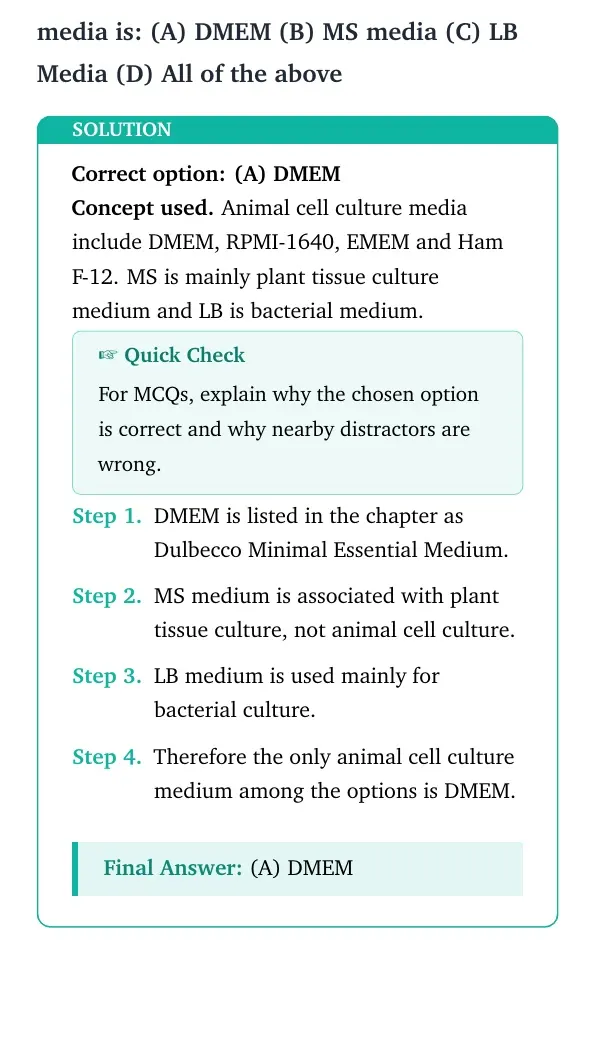
The example of animal cell culture media is: (A) DMEM (B) MS media (C) LB Media (D) All of the above
Correct option: (A) DMEM
Concept used. Animal cell culture media include DMEM, RPMI-1640, EMEM and Ham F-12. MS is mainly plant tissue culture medium and LB is bacterial medium.
Quick Check
For MCQs, explain why the chosen option is correct and why nearby distractors are wrong.
DMEM is listed in the chapter as Dulbecco Minimal Essential Medium.
MS medium is associated with plant tissue culture, not animal cell culture.
LB medium is used mainly for bacterial culture.
Therefore the only animal cell culture medium among the options is DMEM.
(A) DMEM
PR
Priya Reddy
M.Sc Biotechnology, AIIMS Delhi
Verified Expert
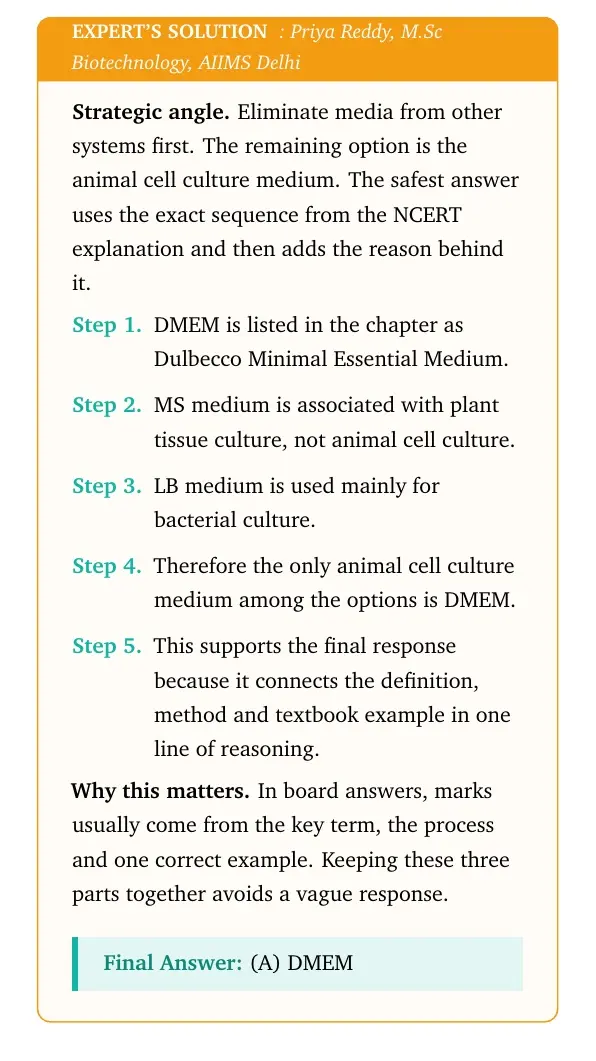
Strategic angle. Eliminate media from other systems first. The remaining option is the animal cell culture medium. The safest answer uses the exact sequence from the NCERT explanation and then adds the reason behind it.
DMEM is listed in the chapter as Dulbecco Minimal Essential Medium.
MS medium is associated with plant tissue culture, not animal cell culture.
LB medium is used mainly for bacterial culture.
Therefore the only animal cell culture medium among the options is DMEM.
This supports the final response because it connects the definition, method and textbook example in one line of reasoning.
Why this matters. In board answers, marks usually come from the key term, the process and one correct example. Keeping these three parts together avoids a vague response.
(A) DMEM
Q 8.11
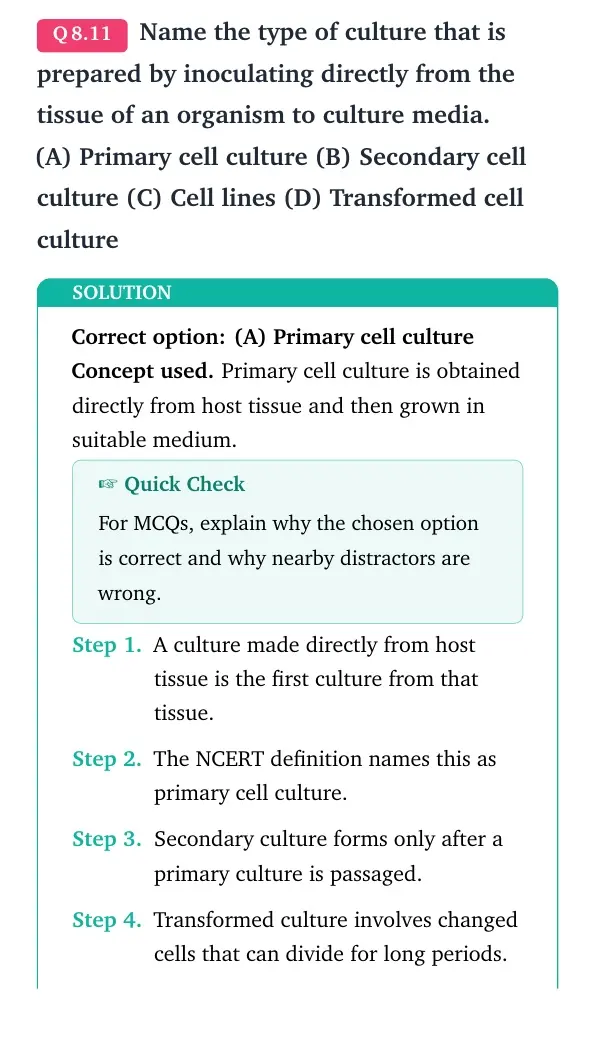
Name the type of culture that is prepared by inoculating directly from the tissue of an organism to culture media. (A) Primary cell culture (B) Secondary cell culture (C) Cell lines (D) Transformed cell culture
Correct option: (A) Primary cell culture
Concept used. Primary cell culture is obtained directly from host tissue and then grown in suitable medium.
Quick Check
For MCQs, explain why the chosen option is correct and why nearby distractors are wrong.
A culture made directly from host tissue is the first culture from that tissue.
The NCERT definition names this as primary cell culture.
Secondary culture forms only after a primary culture is passaged.
Transformed culture involves changed cells that can divide for long periods.
(A) Primary cell culture
KV
Karan Verma
M.Sc Cell Biology, Delhi University
Verified Expert
Strategic angle. Direct tissue origin is the clue. Directly from tissue means primary. The safest answer uses the exact sequence from the NCERT explanation and then adds the reason behind it.
A culture made directly from host tissue is the first culture from that tissue.
The NCERT definition names this as primary cell culture.
Secondary culture forms only after a primary culture is passaged.
Transformed culture involves changed cells that can divide for long periods.
This supports the final response because it connects the definition, method and textbook example in one line of reasoning.
Why this matters. In board answers, marks usually come from the key term, the process and one correct example. Keeping these three parts together avoids a vague response.
(A) Primary cell culture
Q 8.12
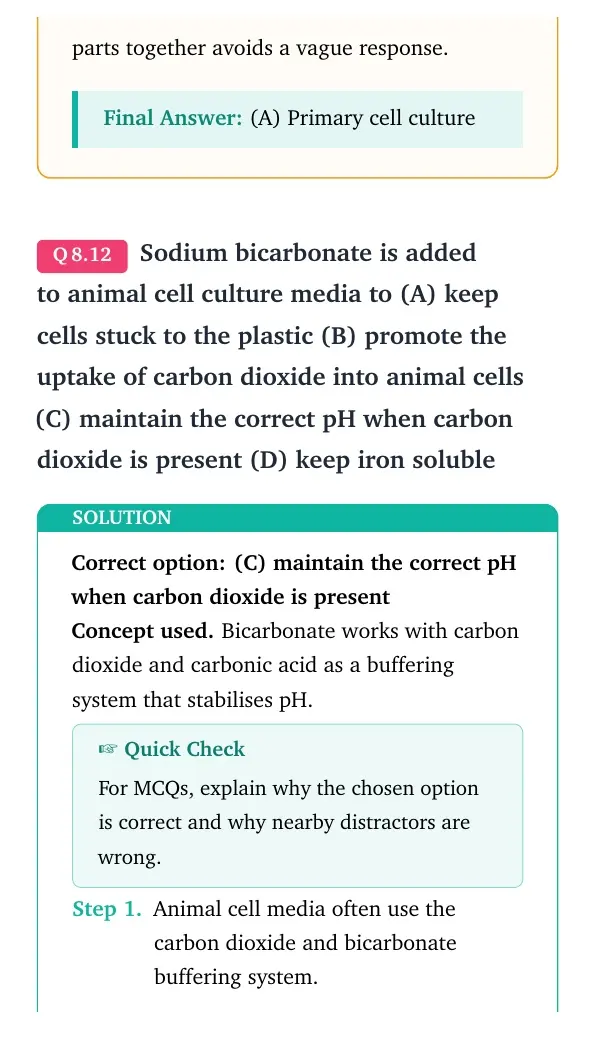
Sodium bicarbonate is added to animal cell culture media to (A) keep cells stuck to the plastic (B) promote the uptake of carbon dioxide into animal cells (C) maintain the correct pH when carbon dioxide is present (D) keep iron soluble
Correct option: (C) maintain the correct pH when carbon dioxide is present
Concept used. Bicarbonate works with carbon dioxide and carbonic acid as a buffering system that stabilises pH.
Quick Check
For MCQs, explain why the chosen option is correct and why nearby distractors are wrong.
Animal cell media often use the carbon dioxide and bicarbonate buffering system.
The concentrations of carbon dioxide, bicarbonate and pH are linked.
Changing carbon dioxide shifts the buffer balance and affects acidity.
So sodium bicarbonate is added to help maintain the correct pH when carbon dioxide is present.
(C) maintain the correct pH when carbon dioxide is present
AD
Aanya Desai
Ph.D Molecular Biology, NCBS Bangalore
Verified Expert
Strategic angle. Link sodium bicarbonate with pH buffer, not with attachment or iron chemistry. The safest answer uses the exact sequence from the NCERT explanation and then adds the reason behind it.
Animal cell media often use the carbon dioxide and bicarbonate buffering system.
The concentrations of carbon dioxide, bicarbonate and pH are linked.
Changing carbon dioxide shifts the buffer balance and affects acidity.
So sodium bicarbonate is added to help maintain the correct pH when carbon dioxide is present.
This supports the final response because it connects the definition, method and textbook example in one line of reasoning.
Why this matters. In board answers, marks usually come from the key term, the process and one correct example. Keeping these three parts together avoids a vague response.
(C) maintain the correct pH when carbon dioxide is present
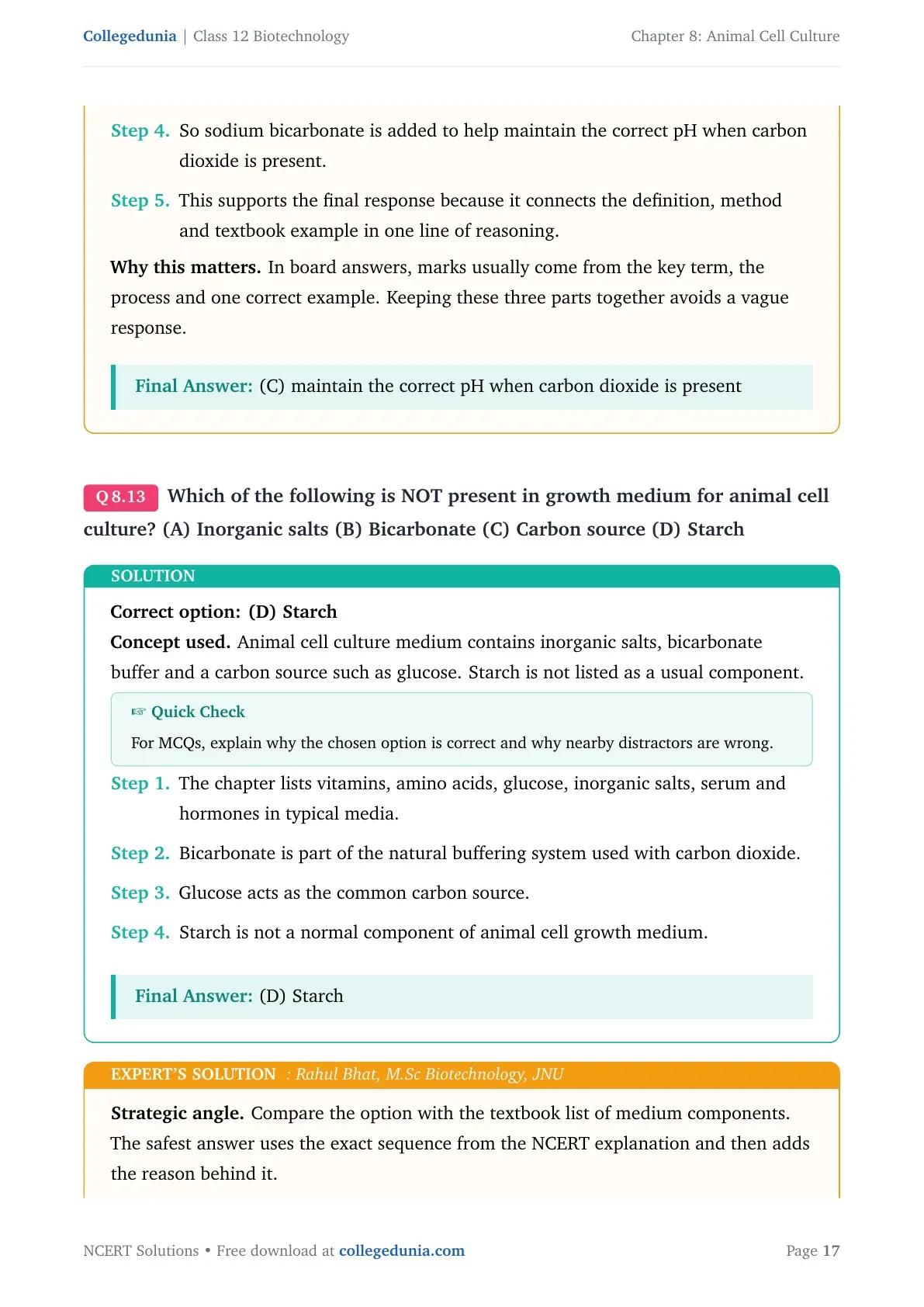
Q 8.13
Which of the following is NOT present in growth medium for animal cell culture? (A) Inorganic salts (B) Bicarbonate (C) Carbon source (D) Starch
Correct option: (D) Starch
Concept used. Animal cell culture medium contains inorganic salts, bicarbonate buffer and a carbon source such as glucose. Starch is not listed as a usual component.
Quick Check
For MCQs, explain why the chosen option is correct and why nearby distractors are wrong.
The chapter lists vitamins, amino acids, glucose, inorganic salts, serum and hormones in typical media.
Bicarbonate is part of the natural buffering system used with carbon dioxide.
Glucose acts as the common carbon source.
Starch is not a normal component of animal cell growth medium.
(D) Starch
RB
Rahul Bhat
M.Sc Biotechnology, JNU
Verified Expert
Strategic angle. Compare the option with the textbook list of medium components. The safest answer uses the exact sequence from the NCERT explanation and then adds the reason behind it.
The chapter lists vitamins, amino acids, glucose, inorganic salts, serum and hormones in typical media.
Bicarbonate is part of the natural buffering system used with carbon dioxide.
Glucose acts as the common carbon source.
Starch is not a normal component of animal cell growth medium.
This supports the final response because it connects the definition, method and textbook example in one line of reasoning.
Why this matters. In board answers, marks usually come from the key term, the process and one correct example. Keeping these three parts together avoids a vague response.
(D) Starch
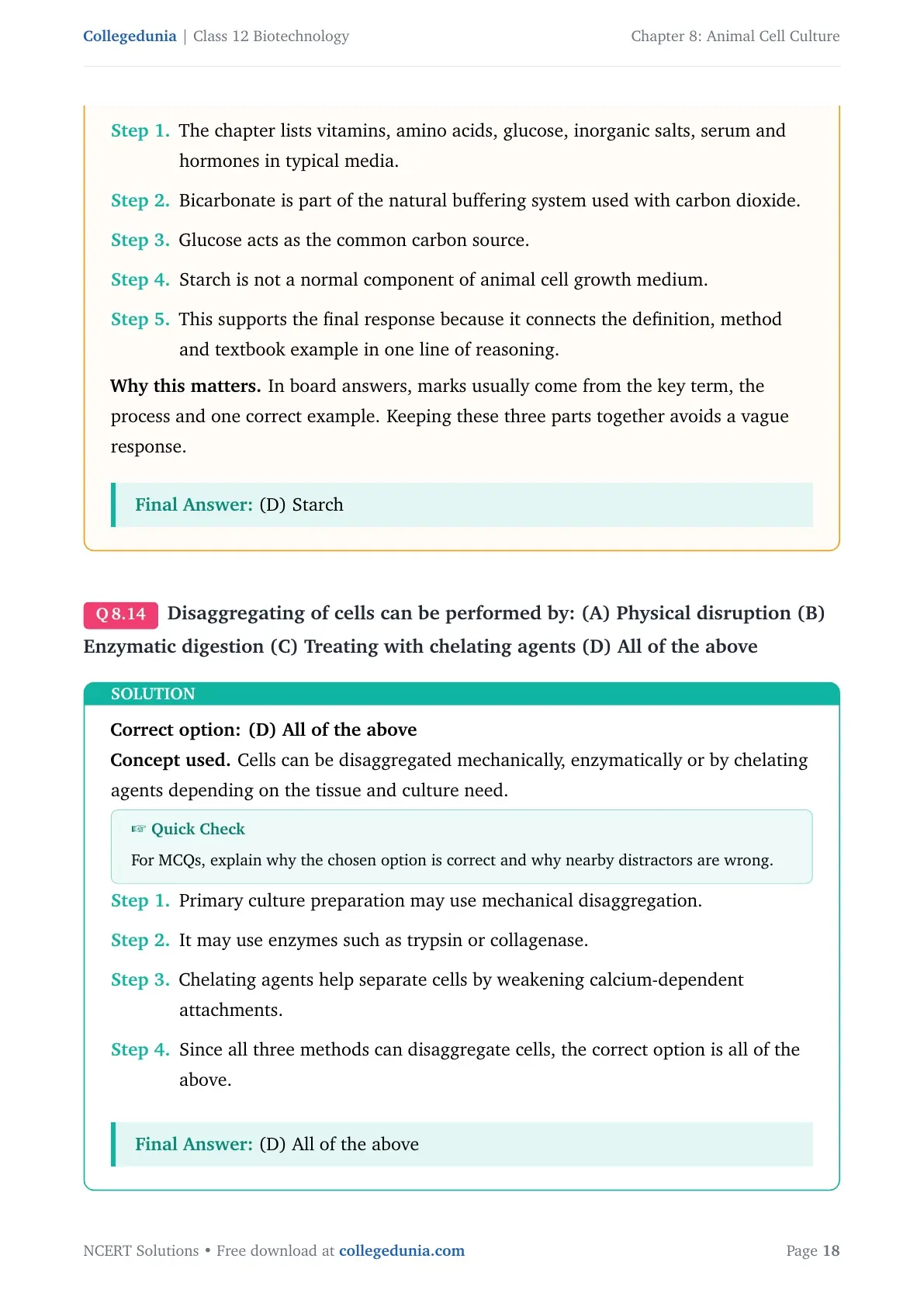
Q 8.14
Disaggregating of cells can be performed by: (A) Physical disruption (B) Enzymatic digestion (C) Treating with chelating agents (D) All of the above
Correct option: (D) All of the above
Concept used. Cells can be disaggregated mechanically, enzymatically or by chelating agents depending on the tissue and culture need.
Quick Check
For MCQs, explain why the chosen option is correct and why nearby distractors are wrong.
Primary culture preparation may use mechanical disaggregation.
It may use enzymes such as trypsin or collagenase.
Chelating agents help separate cells by weakening calcium-dependent attachments.
Since all three methods can disaggregate cells, the correct option is all of the above.
(D) All of the above
TK
Tara Kapoor
M.Sc Microbiology, AIIMS Delhi
Verified Expert
Strategic angle. When every listed method is a known disaggregation method, choose the inclusive option. The safest answer uses the exact sequence from the NCERT explanation and then adds the reason behind it.
Primary culture preparation may use mechanical disaggregation.
It may use enzymes such as trypsin or collagenase.
Chelating agents help separate cells by weakening calcium-dependent attachments.
Since all three methods can disaggregate cells, the correct option is all of the above.
This supports the final response because it connects the definition, method and textbook example in one line of reasoning.
Why this matters. In board answers, marks usually come from the key term, the process and one correct example. Keeping these three parts together avoids a vague response.
(D) All of the above
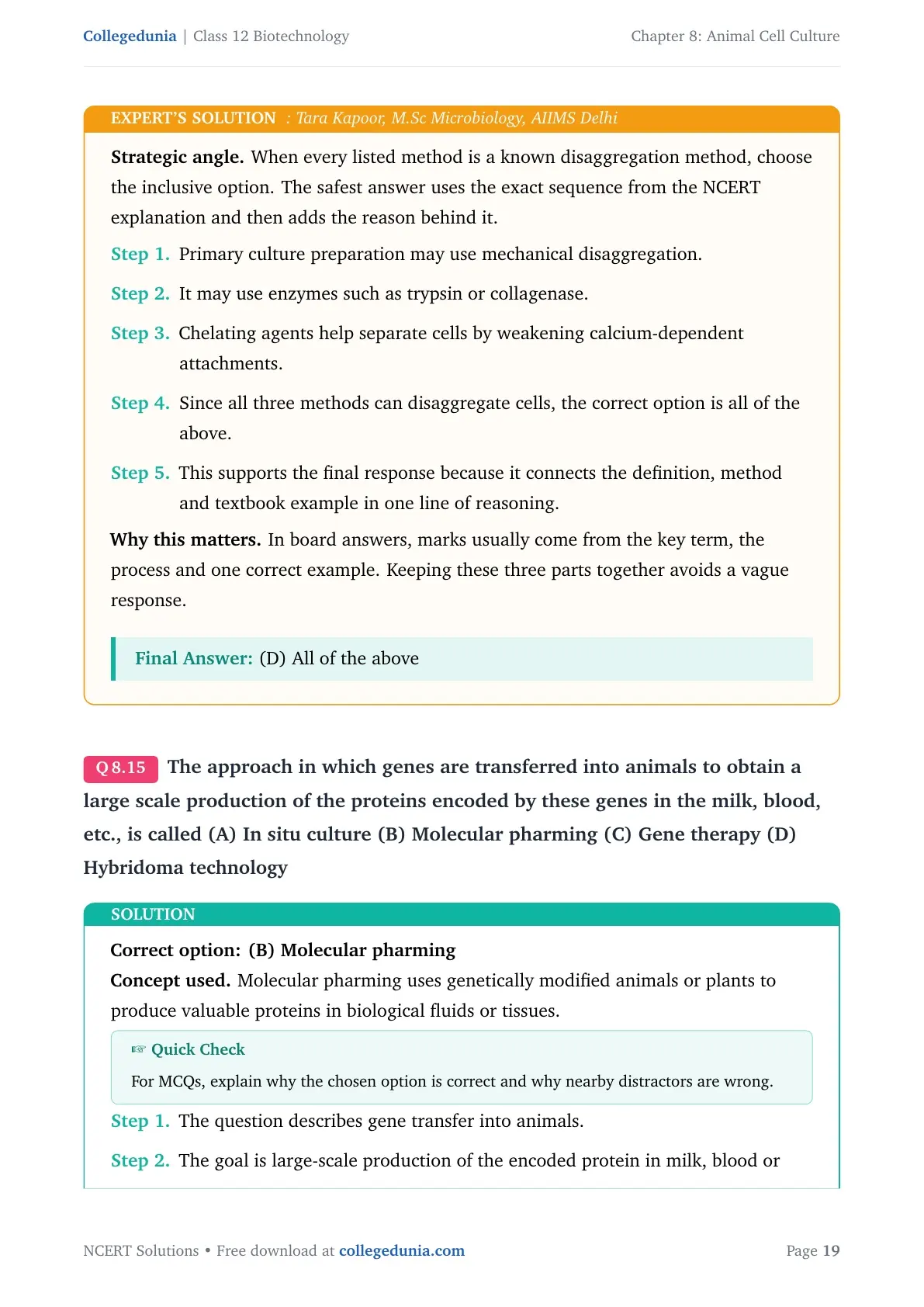
Q 8.15
The approach in which genes are transferred into animals to obtain a large scale production of the proteins encoded by these genes in the milk, blood, etc., is called (A) In situ culture (B) Molecular pharming (C) Gene therapy (D) Hybridoma technology
Correct option: (B) Molecular pharming
Concept used. Molecular pharming uses genetically modified animals or plants to produce valuable proteins in biological fluids or tissues.
Quick Check
For MCQs, explain why the chosen option is correct and why nearby distractors are wrong.
The question describes gene transfer into animals.
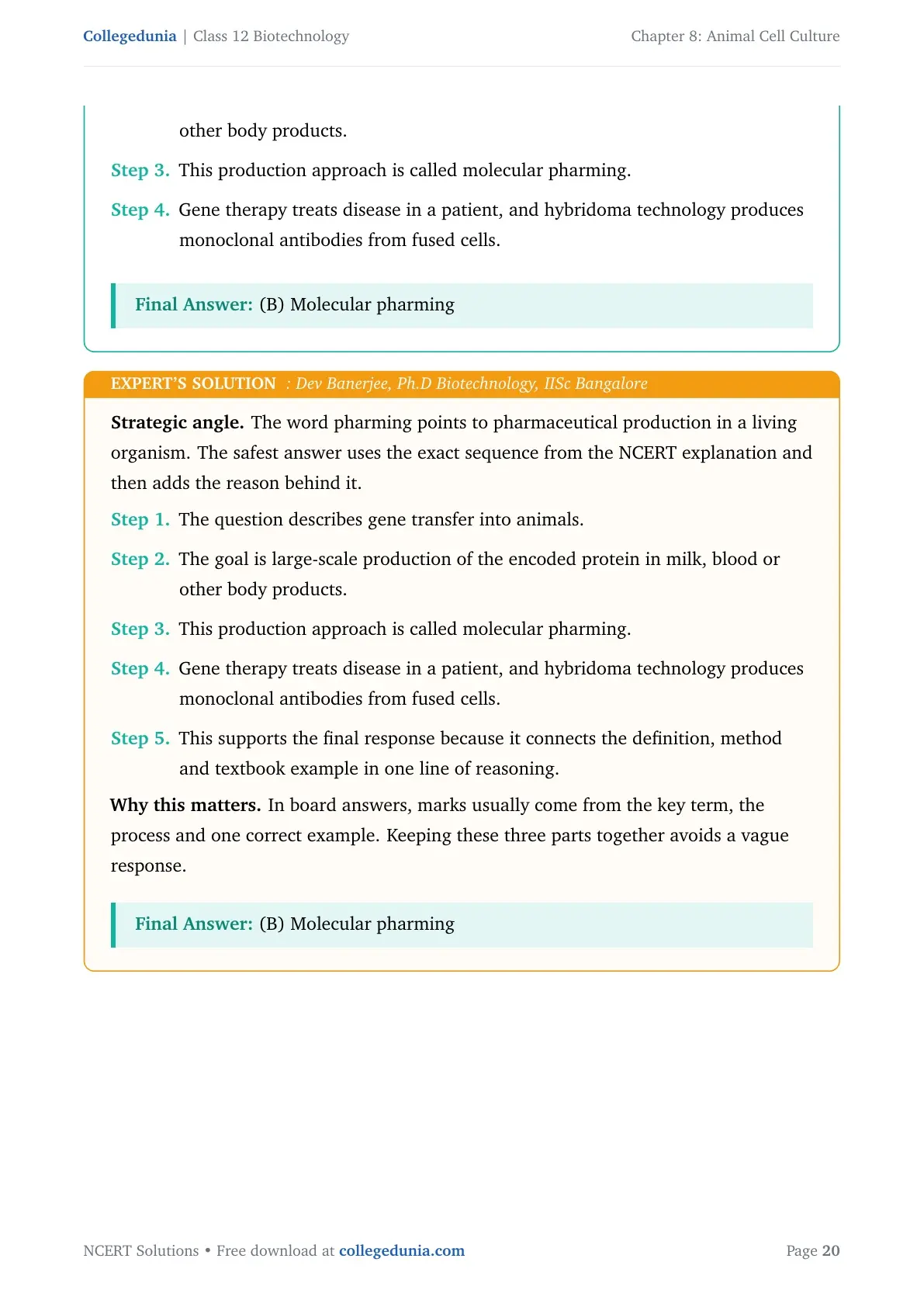
The goal is large-scale production of the encoded protein in milk, blood or other body products.
This production approach is called molecular pharming.
Gene therapy treats disease in a patient, and hybridoma technology produces monoclonal antibodies from fused cells.
(B) Molecular pharming
DB
Dev Banerjee
Ph.D Biotechnology, IISc Bangalore
Verified Expert
Strategic angle. The word pharming points to pharmaceutical production in a living organism. The safest answer uses the exact sequence from the NCERT explanation and then adds the reason behind it.
The question describes gene transfer into animals.
The goal is large-scale production of the encoded protein in milk, blood or other body products.
This production approach is called molecular pharming.
Gene therapy treats disease in a patient, and hybridoma technology produces monoclonal antibodies from fused cells.
This supports the final response because it connects the definition, method and textbook example in one line of reasoning.
Why this matters. In board answers, marks usually come from the key term, the process and one correct example. Keeping these three parts together avoids a vague response.
(B) Molecular pharming
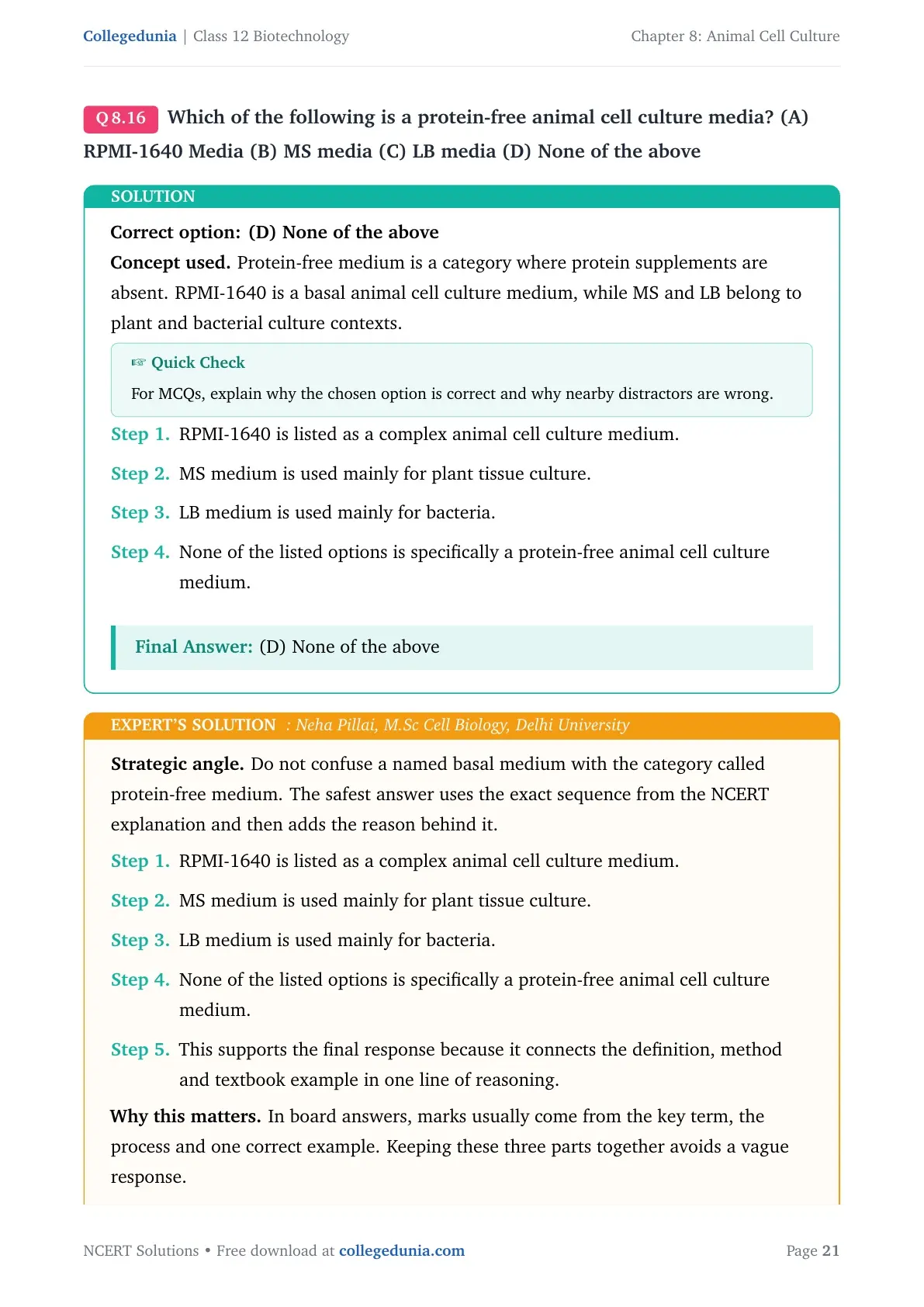
Q 8.16
Which of the following is a protein-free animal cell culture media? (A) RPMI-1640 Media (B) MS media (C) LB media (D) None of the above
Correct option: (D) None of the above
Concept used. Protein-free medium is a category where protein supplements are absent. RPMI-1640 is a basal animal cell culture medium, while MS and LB belong to plant and bacterial culture contexts.
Quick Check
For MCQs, explain why the chosen option is correct and why nearby distractors are wrong.
RPMI-1640 is listed as a complex animal cell culture medium.
MS medium is used mainly for plant tissue culture.
LB medium is used mainly for bacteria.
None of the listed options is specifically a protein-free animal cell culture medium.
(D) None of the above
NP
Neha Pillai
M.Sc Cell Biology, Delhi University
Verified Expert
Strategic angle. Do not confuse a named basal medium with the category called protein-free medium. The safest answer uses the exact sequence from the NCERT explanation and then adds the reason behind it.
RPMI-1640 is listed as a complex animal cell culture medium.
MS medium is used mainly for plant tissue culture.
LB medium is used mainly for bacteria.
None of the listed options is specifically a protein-free animal cell culture medium.
This supports the final response because it connects the definition, method and textbook example in one line of reasoning.
Why this matters. In board answers, marks usually come from the key term, the process and one correct example. Keeping these three parts together avoids a vague response.
(D) None of the above
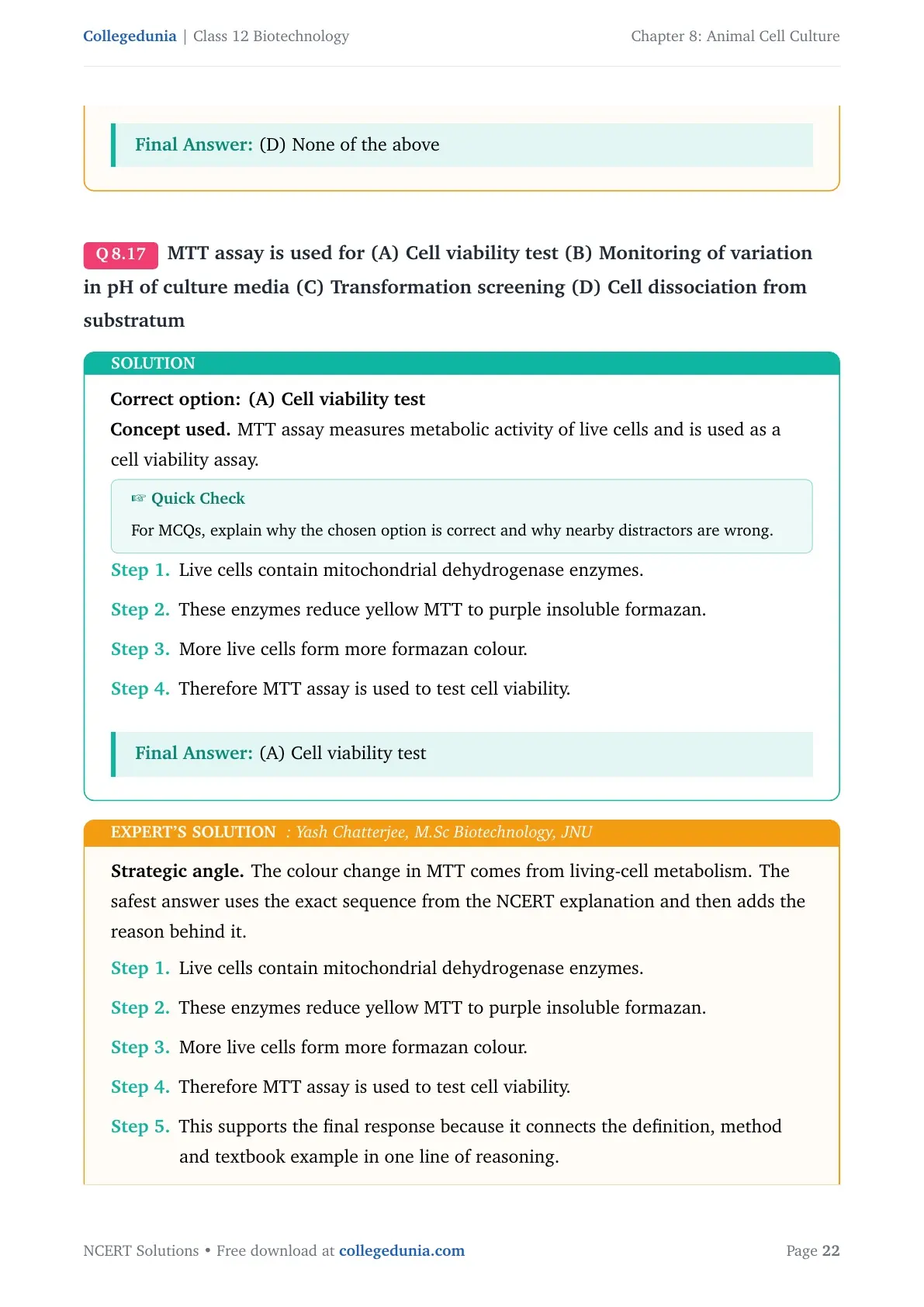
Q 8.17
MTT assay is used for (A) Cell viability test (B) Monitoring of variation in pH of culture media (C) Transformation screening (D) Cell dissociation from substratum
Correct option: (A) Cell viability test
Concept used. MTT assay measures metabolic activity of live cells and is used as a cell viability assay.
Quick Check
For MCQs, explain why the chosen option is correct and why nearby distractors are wrong.
Live cells contain mitochondrial dehydrogenase enzymes.
These enzymes reduce yellow MTT to purple insoluble formazan.
More live cells form more formazan colour.
Therefore MTT assay is used to test cell viability.
(A) Cell viability test
YC
Yash Chatterjee
M.Sc Biotechnology, JNU
Verified Expert
Strategic angle. The colour change in MTT comes from living-cell metabolism. The safest answer uses the exact sequence from the NCERT explanation and then adds the reason behind it.
Live cells contain mitochondrial dehydrogenase enzymes.
These enzymes reduce yellow MTT to purple insoluble formazan.
More live cells form more formazan colour.
Therefore MTT assay is used to test cell viability.
This supports the final response because it connects the definition, method and textbook example in one line of reasoning.
Why this matters. In board answers, marks usually come from the key term, the process and one correct example. Keeping these three parts together avoids a vague response.
(A) Cell viability test
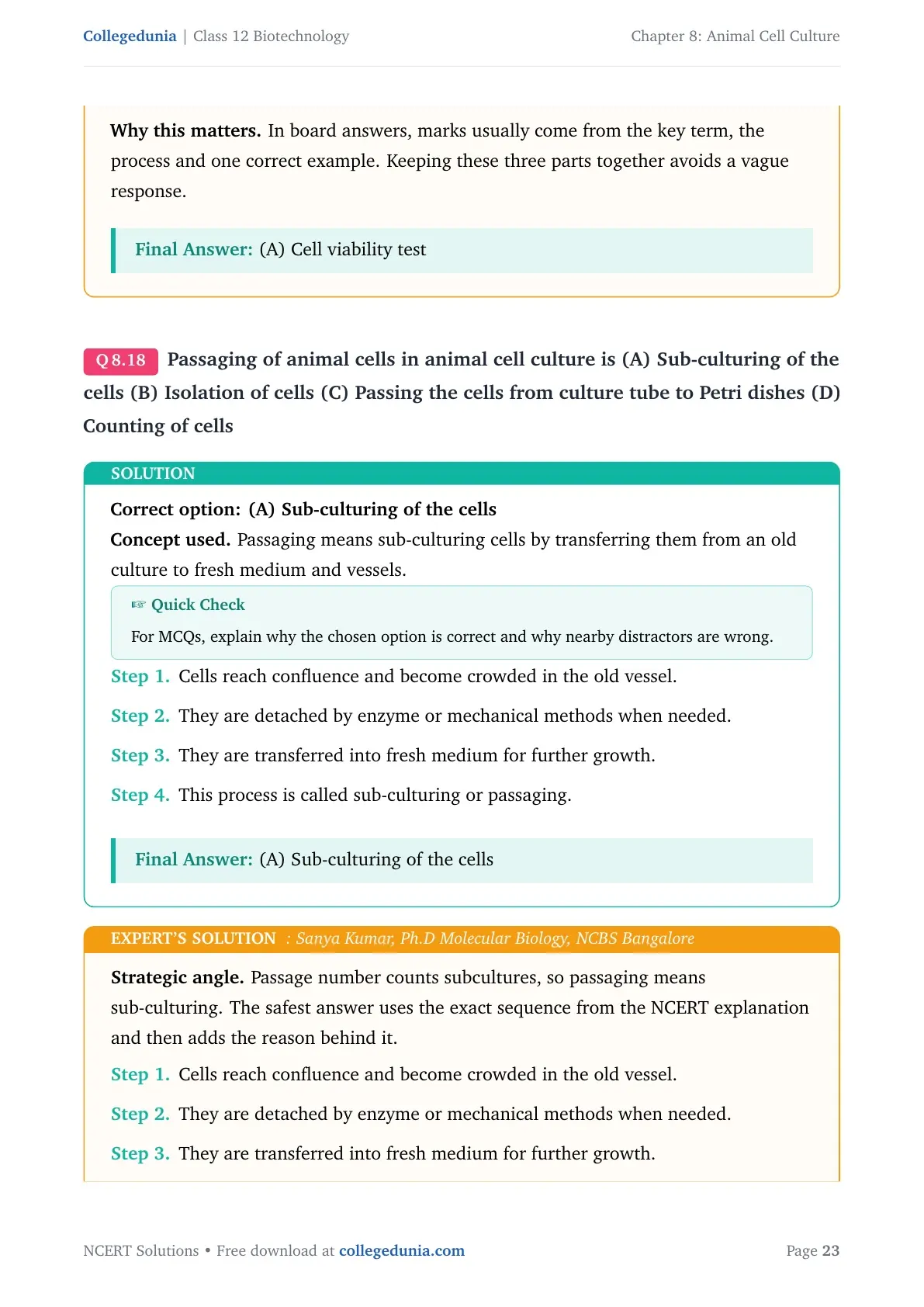
Q 8.18
Passaging of animal cells in animal cell culture is (A) Sub-culturing of the cells (B) Isolation of cells (C) Passing the cells from culture tube to Petri dishes (D) Counting of cells
Correct option: (A) Sub-culturing of the cells
Concept used. Passaging means sub-culturing cells by transferring them from an old culture to fresh medium and vessels.
Quick Check
For MCQs, explain why the chosen option is correct and why nearby distractors are wrong.
Cells reach confluence and become crowded in the old vessel.
They are detached by enzyme or mechanical methods when needed.
They are transferred into fresh medium for further growth.
This process is called sub-culturing or passaging.
(A) Sub-culturing of the cells
SK
Sanya Kumar
Ph.D Molecular Biology, NCBS Bangalore
Verified Expert
Strategic angle. Passage number counts subcultures, so passaging means sub-culturing. The safest answer uses the exact sequence from the NCERT explanation and then adds the reason behind it.
Cells reach confluence and become crowded in the old vessel.
They are detached by enzyme or mechanical methods when needed.
They are transferred into fresh medium for further growth.
This process is called sub-culturing or passaging.
This supports the final response because it connects the definition, method and textbook example in one line of reasoning.
Why this matters. In board answers, marks usually come from the key term, the process and one correct example. Keeping these three parts together avoids a vague response.
(A) Sub-culturing of the cells
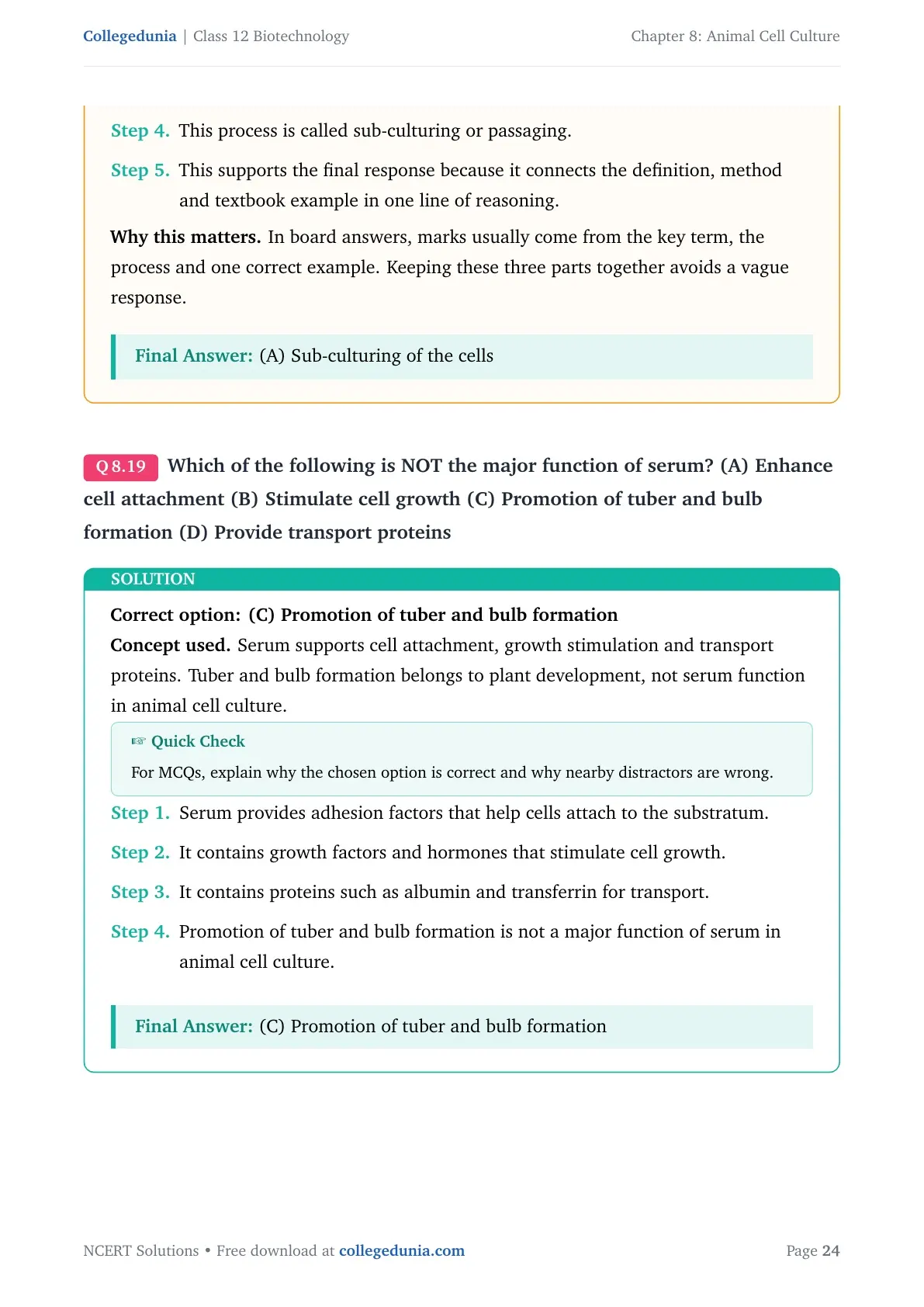
Q 8.19
Which of the following is NOT the major function of serum? (A) Enhance cell attachment (B) Stimulate cell growth (C) Promotion of tuber and bulb formation (D) Provide transport proteins
Correct option: (C) Promotion of tuber and bulb formation
Concept used. Serum supports cell attachment, growth stimulation and transport proteins. Tuber and bulb formation belongs to plant development, not serum function in animal cell culture.
Quick Check
For MCQs, explain why the chosen option is correct and why nearby distractors are wrong.
Serum provides adhesion factors that help cells attach to the substratum.
It contains growth factors and hormones that stimulate cell growth.
It contains proteins such as albumin and transferrin for transport.
Promotion of tuber and bulb formation is not a major function of serum in animal cell culture.
(C) Promotion of tuber and bulb formation
AI
Arjun Iyer
M.Sc Microbiology, AIIMS Delhi
Verified Expert
Strategic angle. Reject the plant-specific option when the question is about animal cell culture serum. The safest answer uses the exact sequence from the NCERT explanation and then adds the reason behind it.
Serum provides adhesion factors that help cells attach to the substratum.
It contains growth factors and hormones that stimulate cell growth.
It contains proteins such as albumin and transferrin for transport.
Promotion of tuber and bulb formation is not a major function of serum in animal cell culture.
This supports the final response because it connects the definition, method and textbook example in one line of reasoning.
Why this matters. In board answers, marks usually come from the key term, the process and one correct example. Keeping these three parts together avoids a vague response.
(C) Promotion of tuber and bulb formation
Q 8.20
Assertion: Serum is the most important component of culture media. Reason: Serum is a good source of nutrients and also helps in cell proliferation and cell-matrix attachment. (A) Both assertion and reason are true and the reason is the correct explanation of the assertion. (B) Both assertion and reason are true but the reason is not the correct explanation of the assertion. (C) Assertion is true but reason is false. (D) Both assertion and reason are false.
Correct option: (A) Both assertion and reason are true and the reason is the correct explanation of the assertion
Concept used. The chapter calls serum one of the most important components because it supplies nutrients, growth factors, binding proteins and adhesion factors.
Quick Check
For MCQs, explain why the chosen option is correct and why nearby distractors are wrong.
Serum is described as one of the most important components of culture media.
The reason states that serum supplies nutrients and supports proliferation and cell-matrix attachment.
These points are exactly why serum is important in many media.
So both statements are true, and the reason explains the assertion.
(A) Both assertion and reason are true and the reason is the correct explanation of the assertion
IS
Ishita Sharma
M.Sc Biotechnology, Delhi University
Verified Expert
Strategic angle. For assertion-reason items, test truth first, then test whether the reason explains the assertion. The safest answer uses the exact sequence from the NCERT explanation and then adds the reason behind it.
Serum is described as one of the most important components of culture media.
The reason states that serum supplies nutrients and supports proliferation and cell-matrix attachment.
These points are exactly why serum is important in many media.
So both statements are true, and the reason explains the assertion.
This supports the final response because it connects the definition, method and textbook example in one line of reasoning.
Why this matters. In board answers, marks usually come from the key term, the process and one correct example. Keeping these three parts together avoids a vague response.
(A) Both assertion and reason are true and the reason is the correct explanation of the assertion
Q 8.21
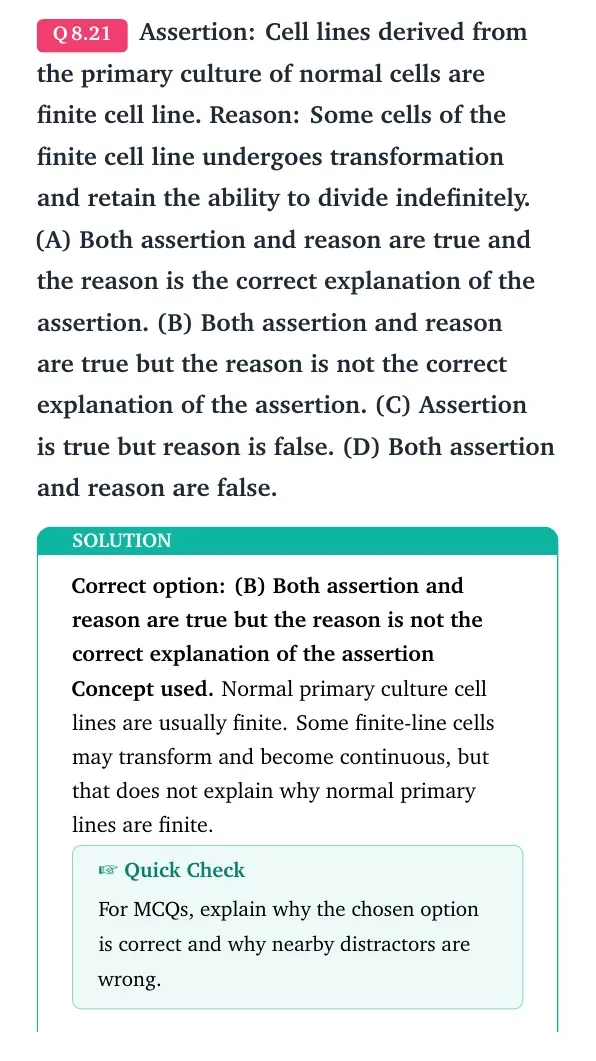
Assertion: Cell lines derived from the primary culture of normal cells are finite cell line. Reason: Some cells of the finite cell line undergoes transformation and retain the ability to divide indefinitely. (A) Both assertion and reason are true and the reason is the correct explanation of the assertion. (B) Both assertion and reason are true but the reason is not the correct explanation of the assertion. (C) Assertion is true but reason is false. (D) Both assertion and reason are false.
Correct option: (B) Both assertion and reason are true but the reason is not the correct explanation of the assertion
Concept used. Normal primary culture cell lines are usually finite. Some finite-line cells may transform and become continuous, but that does not explain why normal primary lines are finite.
Quick Check
For MCQs, explain why the chosen option is correct and why nearby distractors are wrong.
The assertion is true because normal primary culture-derived lines have limited division capacity.
The reason is also true because some cells can transform and divide indefinitely.
However, the reason describes the origin of continuous cell lines.
It does not explain the finite nature of normal primary cell lines.
Therefore both are true, but the reason is not the correct explanation.
(B) Both assertion and reason are true but the reason is not the correct explanation of the assertion
KP
Krishna Patel
Ph.D Cell Biology, IISc Bangalore
Verified Expert
Strategic angle. Separate the two facts: finite origin from normal cells, continuous origin after transformation. The safest answer uses the exact sequence from the NCERT explanation and then adds the reason behind it.
The assertion is true because normal primary culture-derived lines have limited division capacity.
The reason is also true because some cells can transform and divide indefinitely.
However, the reason describes the origin of continuous cell lines.
It does not explain the finite nature of normal primary cell lines.
Therefore both are true, but the reason is not the correct explanation.
This supports the final response because it connects the definition, method and textbook example in one line of reasoning.
Why this matters. In board answers, marks usually come from the key term, the process and one correct example. Keeping these three parts together avoids a vague response.
(B) Both assertion and reason are true but the reason is not the correct explanation of the assertion









Comments