




The Theory of the Firm under Perfect Competition is Chapter 4 of the Class 12 Microeconomics book. It shows how a price-taker firm picks the output that earns the most profit, using the MR = MC rule. This page has step-by-step NCERT Solutions for every exercise question, plus a free PDF to download.
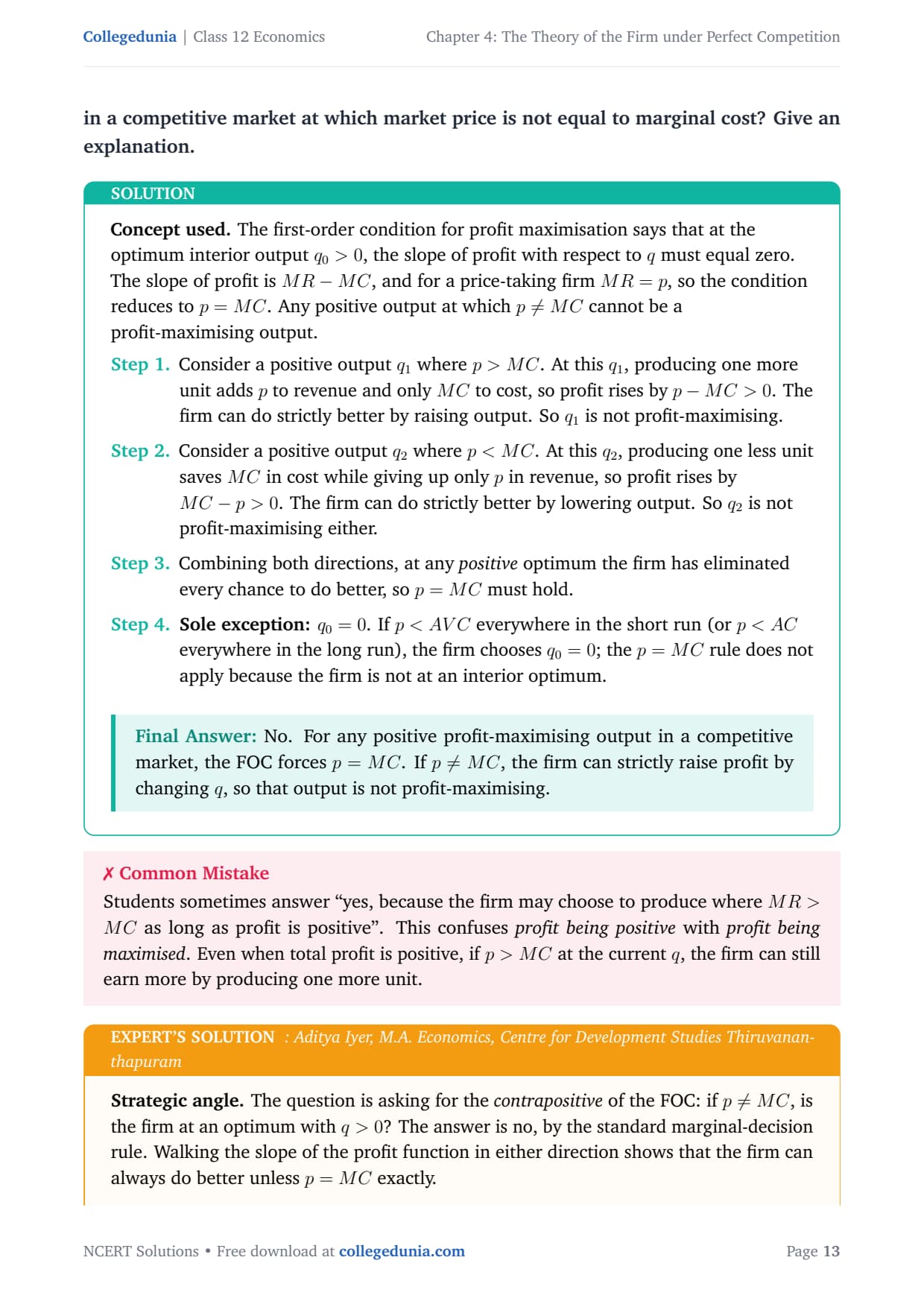
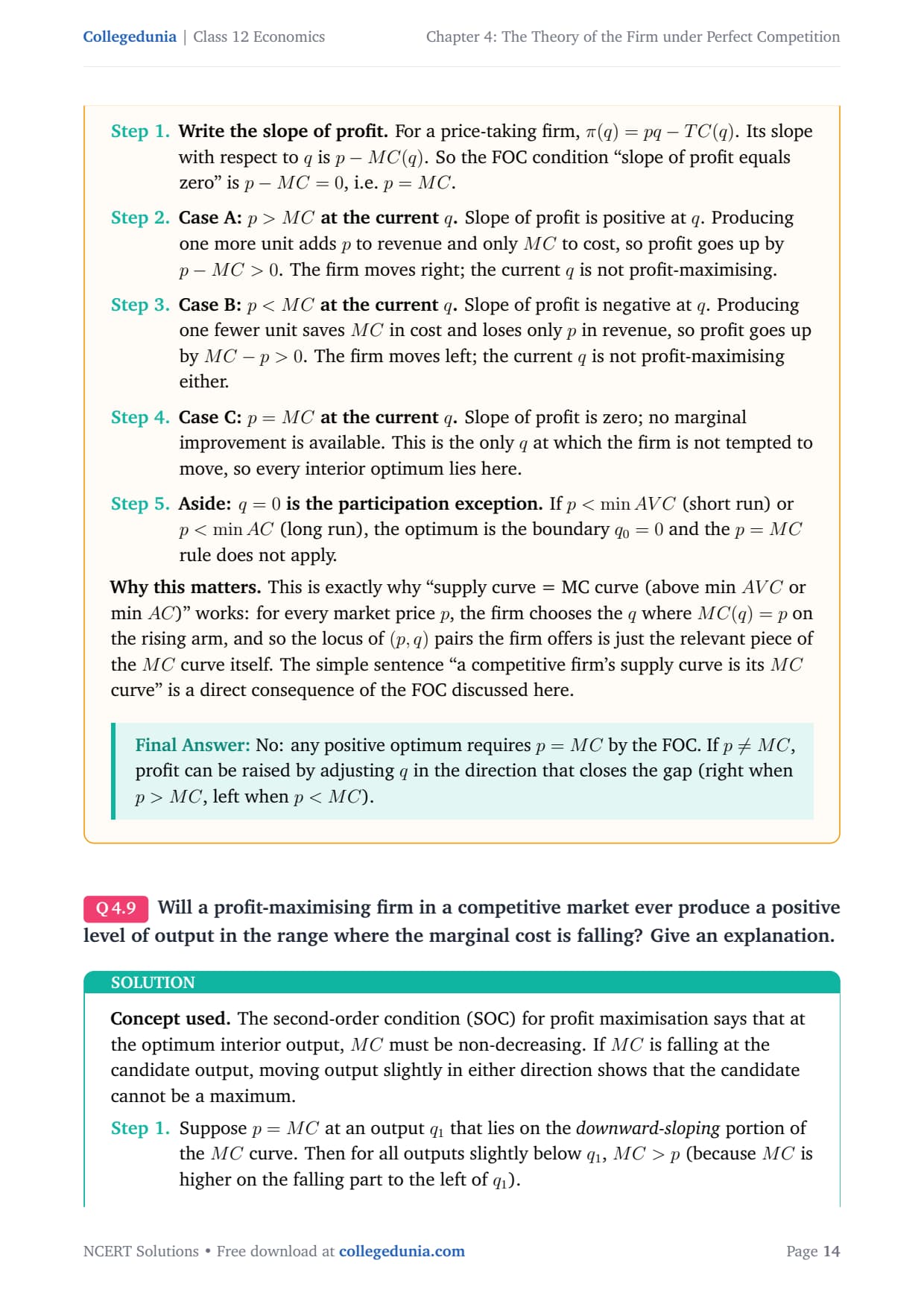
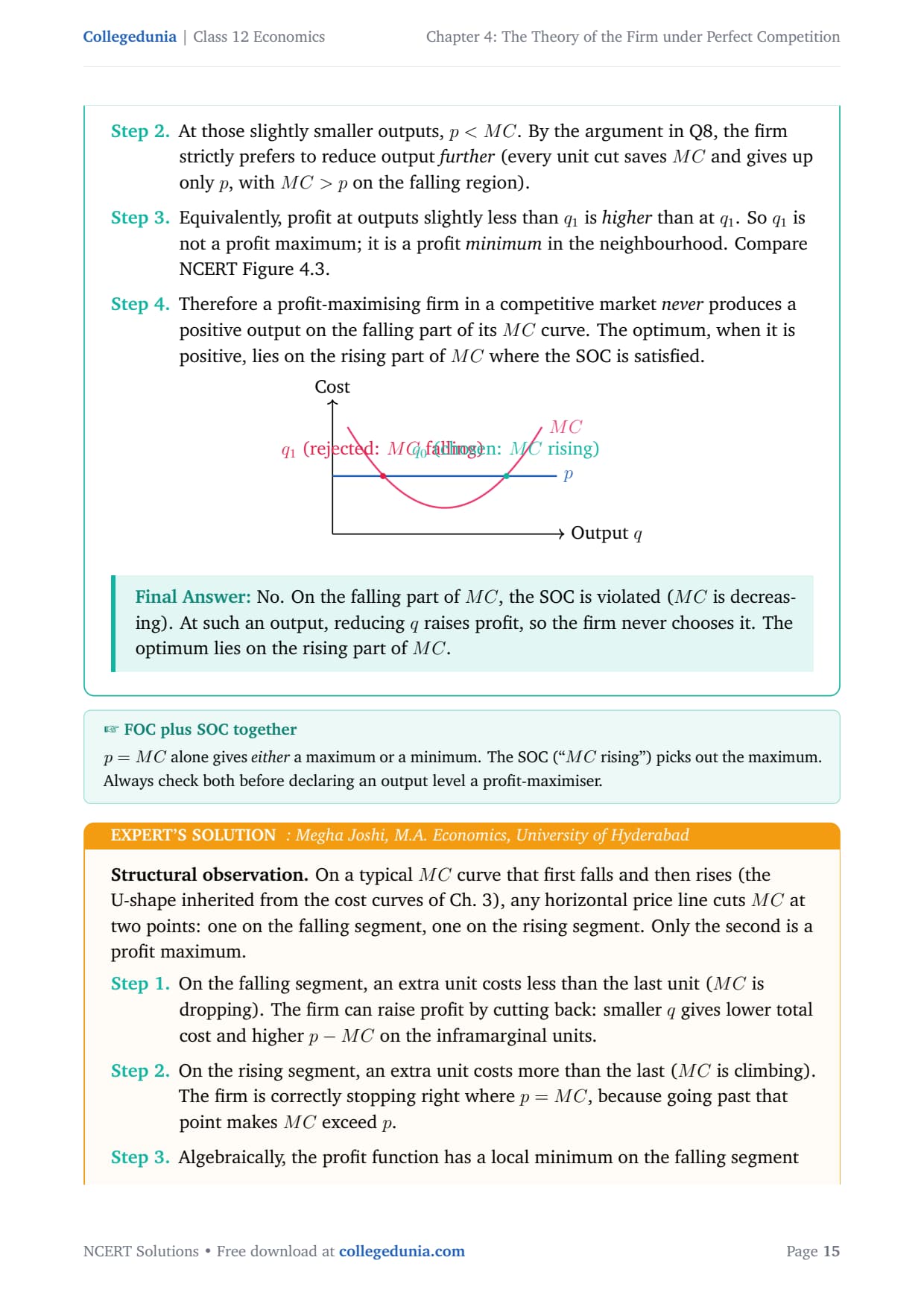
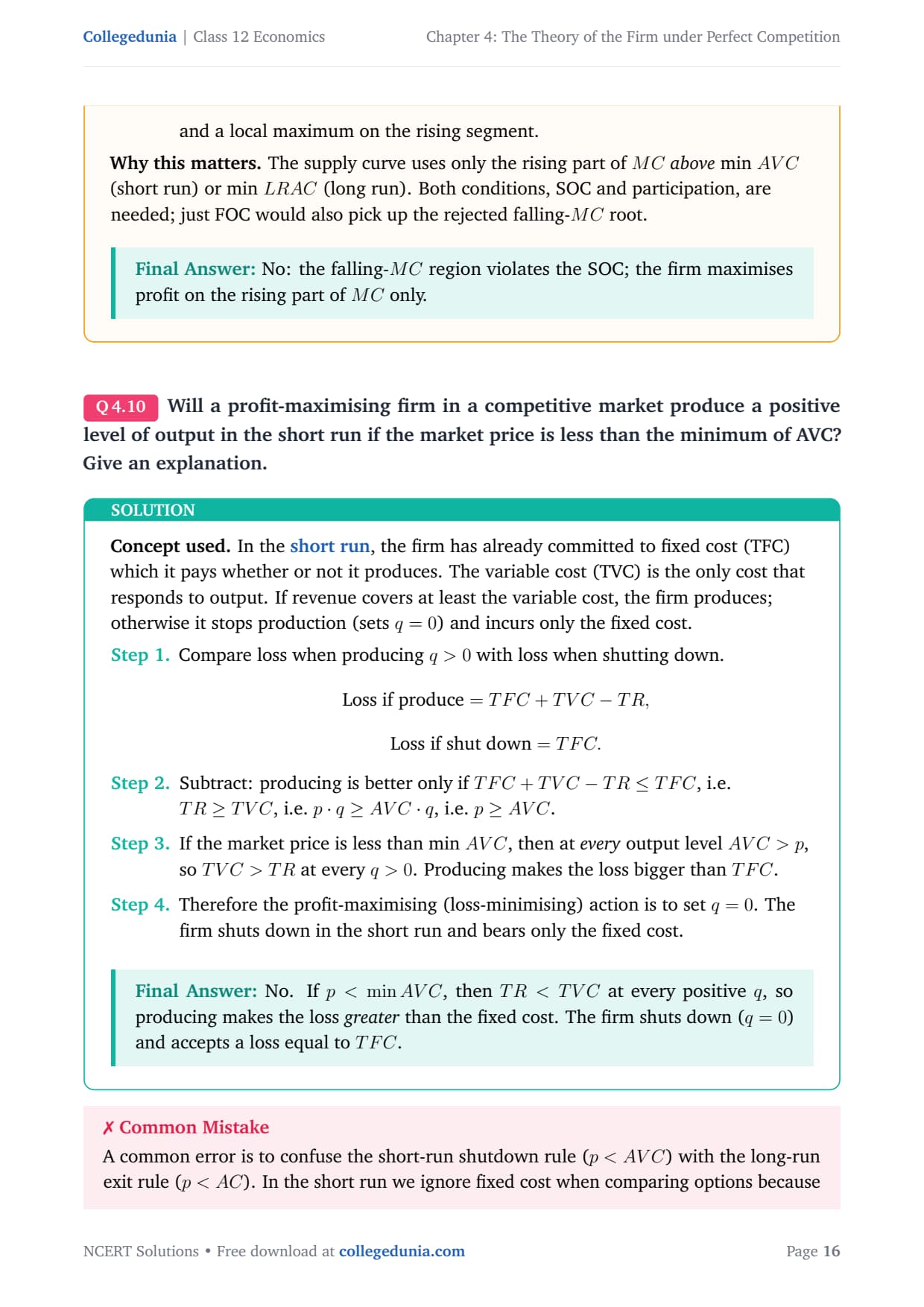
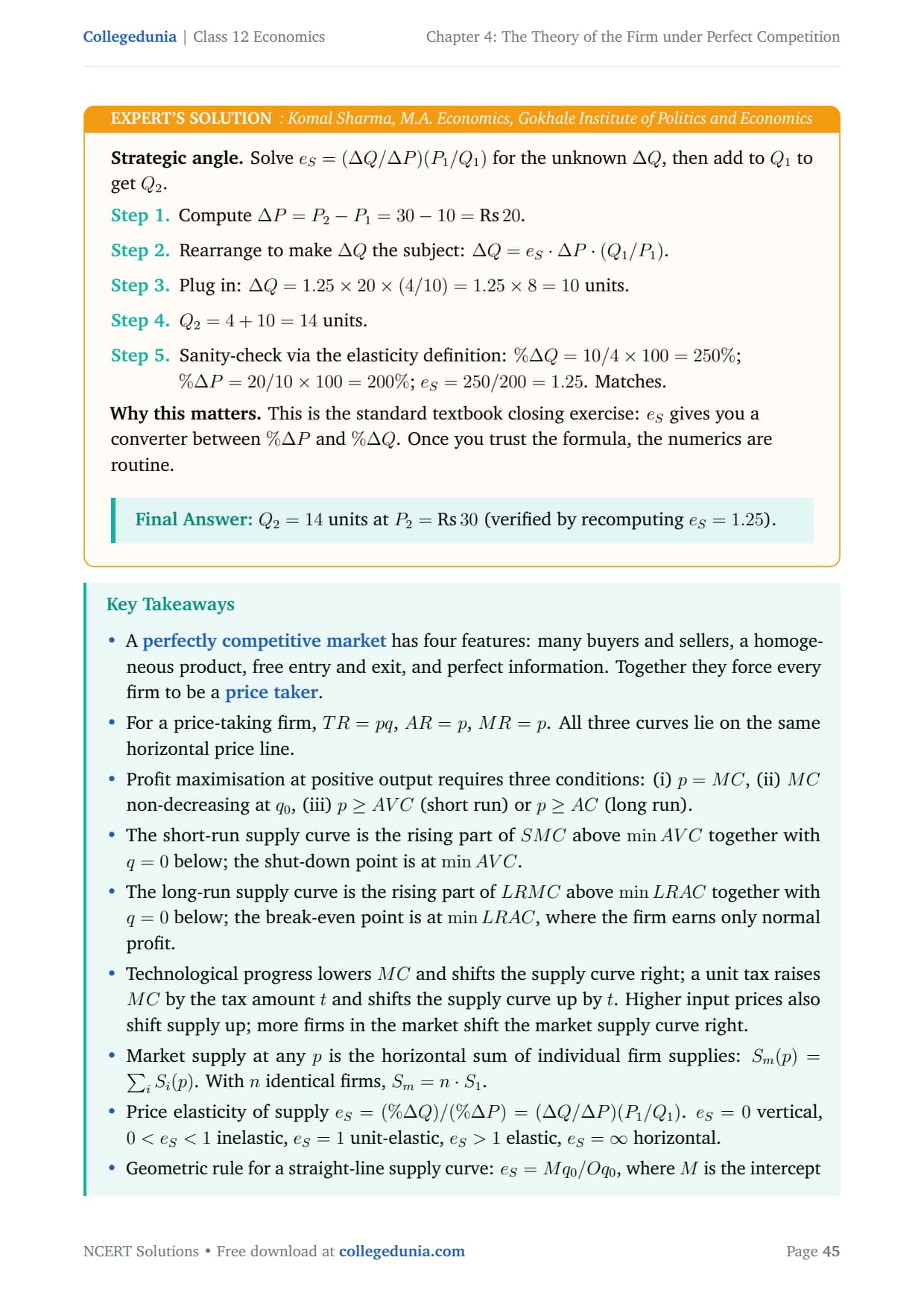
Here is what this chapter is worth in the exam:
- CBSE Boards: about 6 to 8 marks, usually one supply-curve derivation and one MR = MC numerical.
- CUET: 2 to 3 questions each year on the features, revenue concepts and supply curves.
- Revision time: about 3 hours, including the full NCERT exercise.
What the NCERT Solutions for Class 12 Economics Chapter 4 Cover
This chapter answers one big question: when a firm cannot change the market price, how does it choose the output that gives the most profit? These solutions cover every idea in the NCERT exercise.
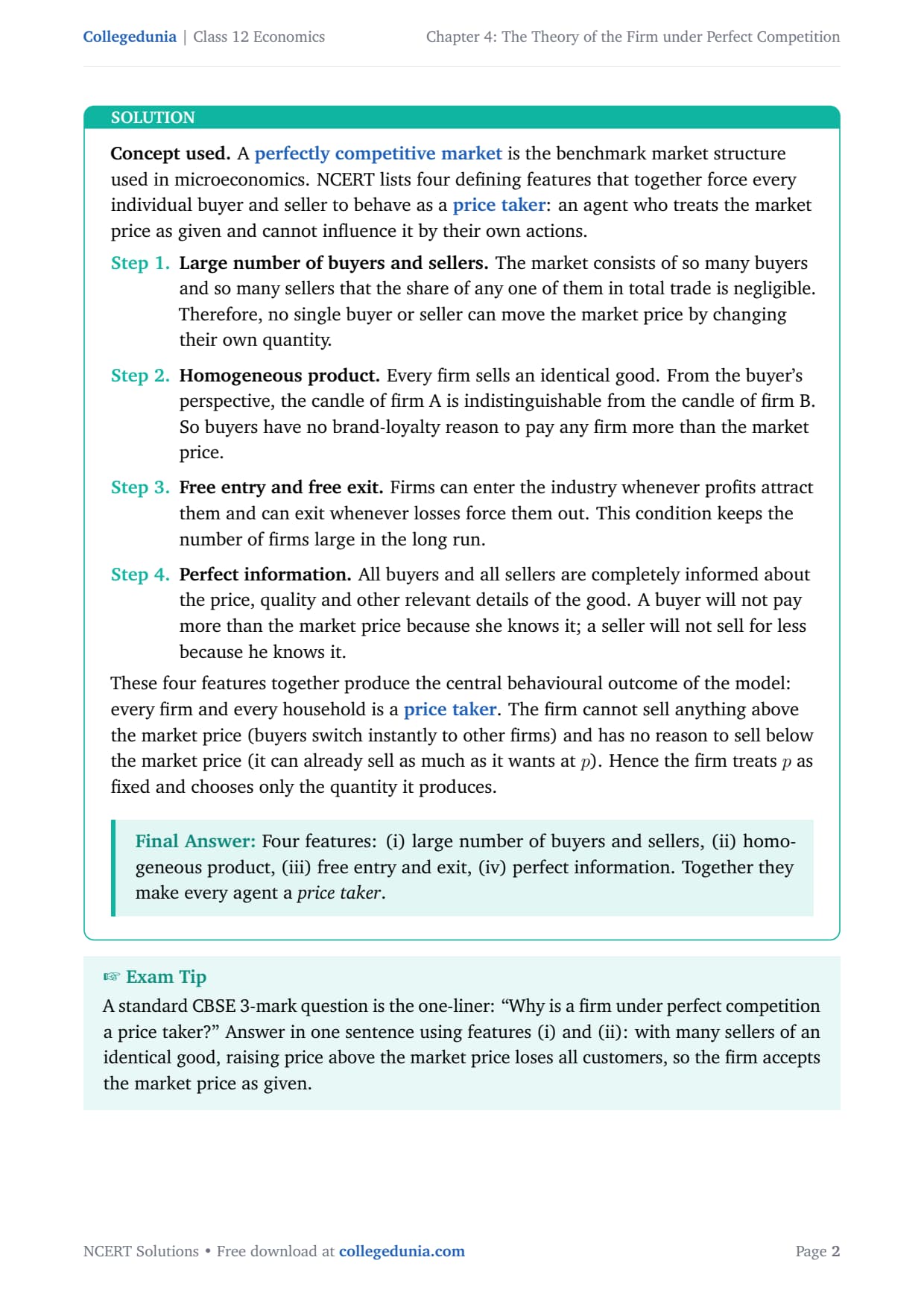
- Four features: many buyers and sellers, a homogeneous product, free entry and exit, and perfect information. Together they make every firm a price taker.
- Revenue concepts: TR, AR and MR, with the price-taker identity P = AR = MR.
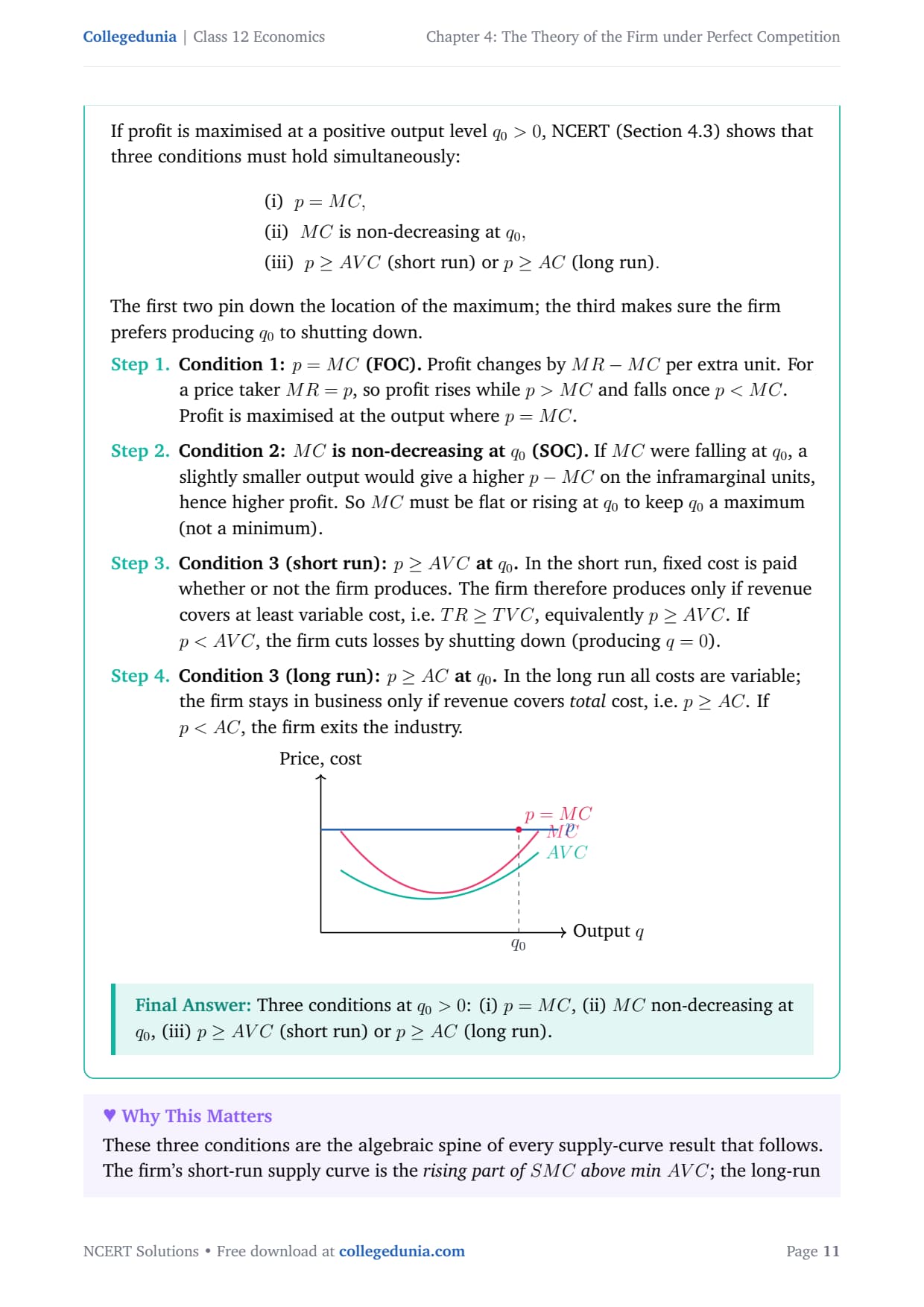
- Profit maximisation: the rule MR = MC with MC rising, and the short-run condition P ≥ AVC.
- Break-even and shut-down: P = min AC (profit zero) and P = min AVC (the firm stops producing).
- Supply curves: the firm's short-run supply is rising MC above min AVC; market supply is the horizontal sum of all firms' curves.
Exercise-wise Breakdown of Perfect Competition Class 12 NCERT Solutions
Chapter 4 mixes theory, derivations and short numericals. The table maps each question to its topic and usual marks.
| Question | Topic covered | Typical marks |
|---|---|---|
| Q1 | Features of a perfectly competitive market | 4 marks |
| Q2 | How TR, AR and MR are defined | 3 marks |
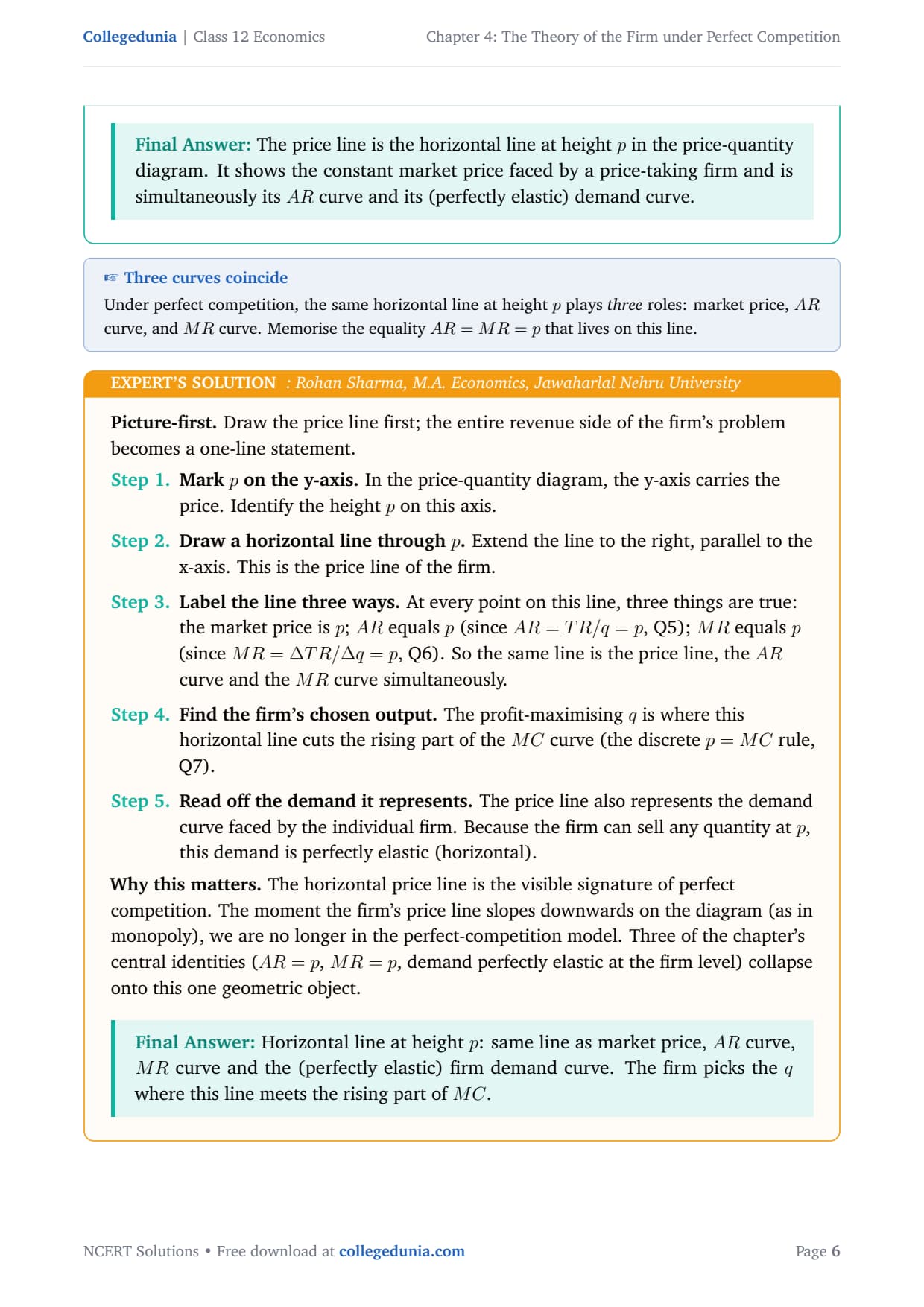
| Q3 | Why the firm's price line is horizontal | 3 marks |
| Q4 | Derive the TR, AR and MR schedule | 4 marks |
| Q5 | Conditions for profit maximisation | 4 marks |
| Q7 | Break-even point vs shut-down point | 3 marks |
| Q8 | Short-run supply curve of a firm | 6 marks |
| Q9 | Long-run supply curve of a firm | 6 marks |
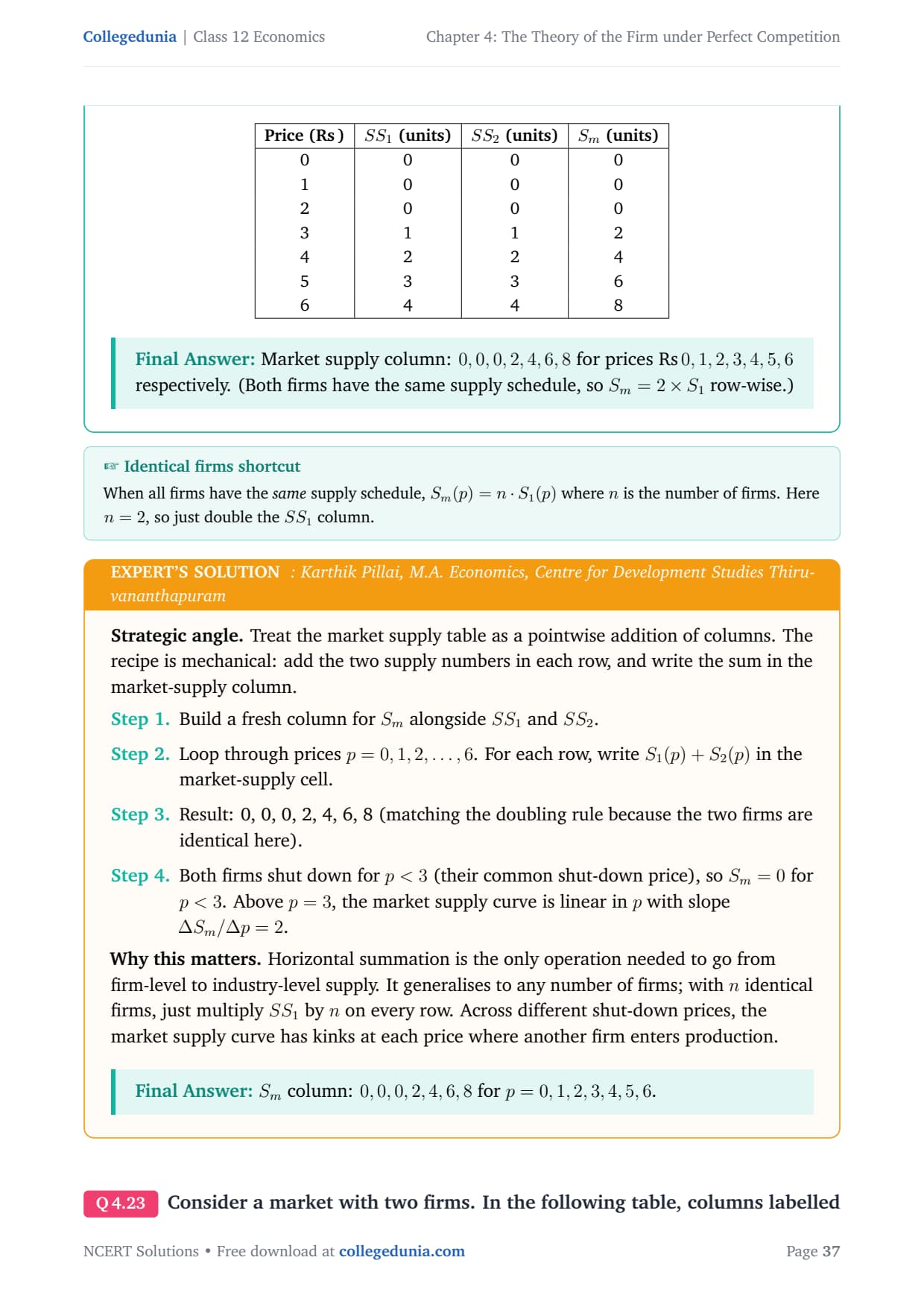
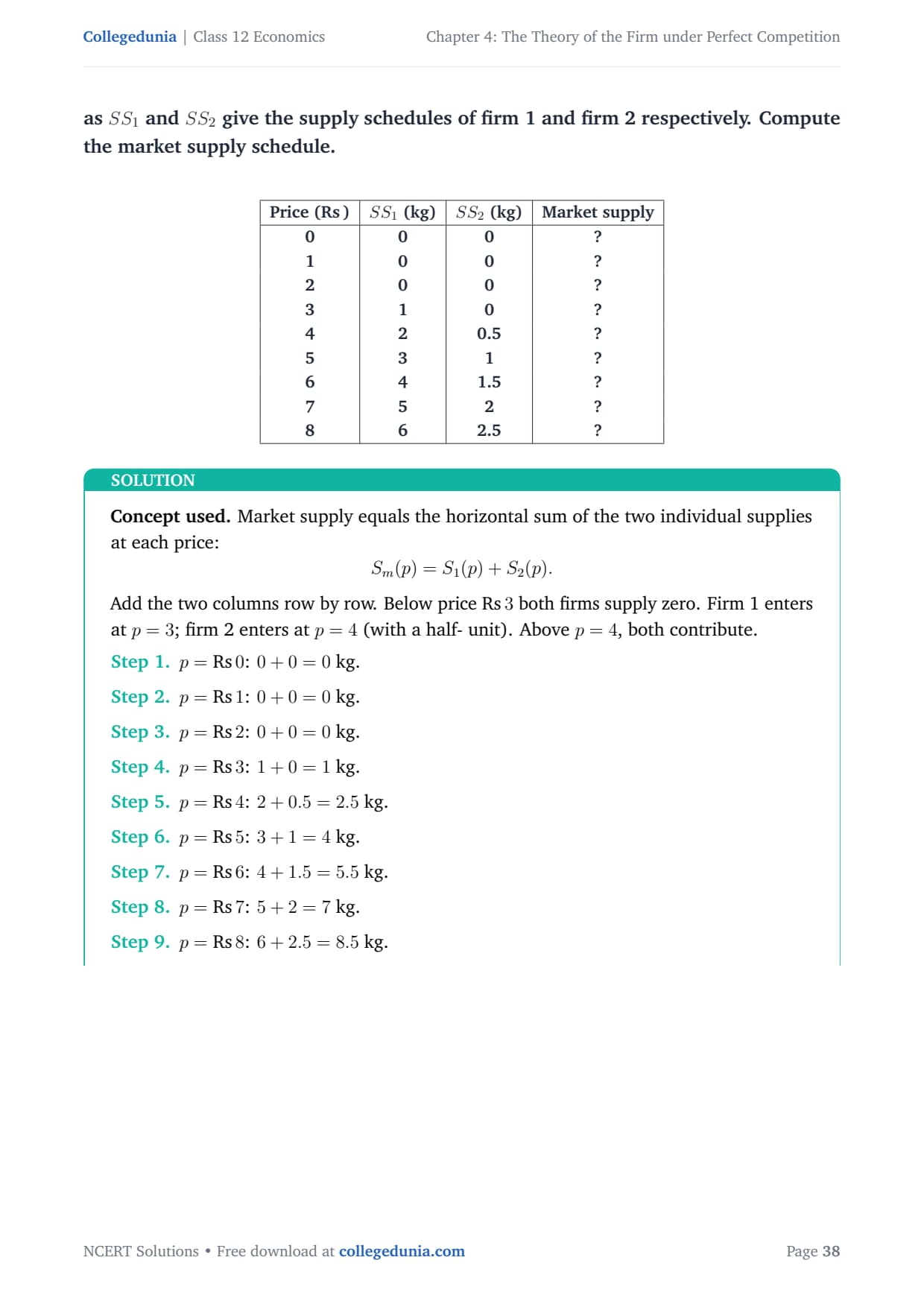
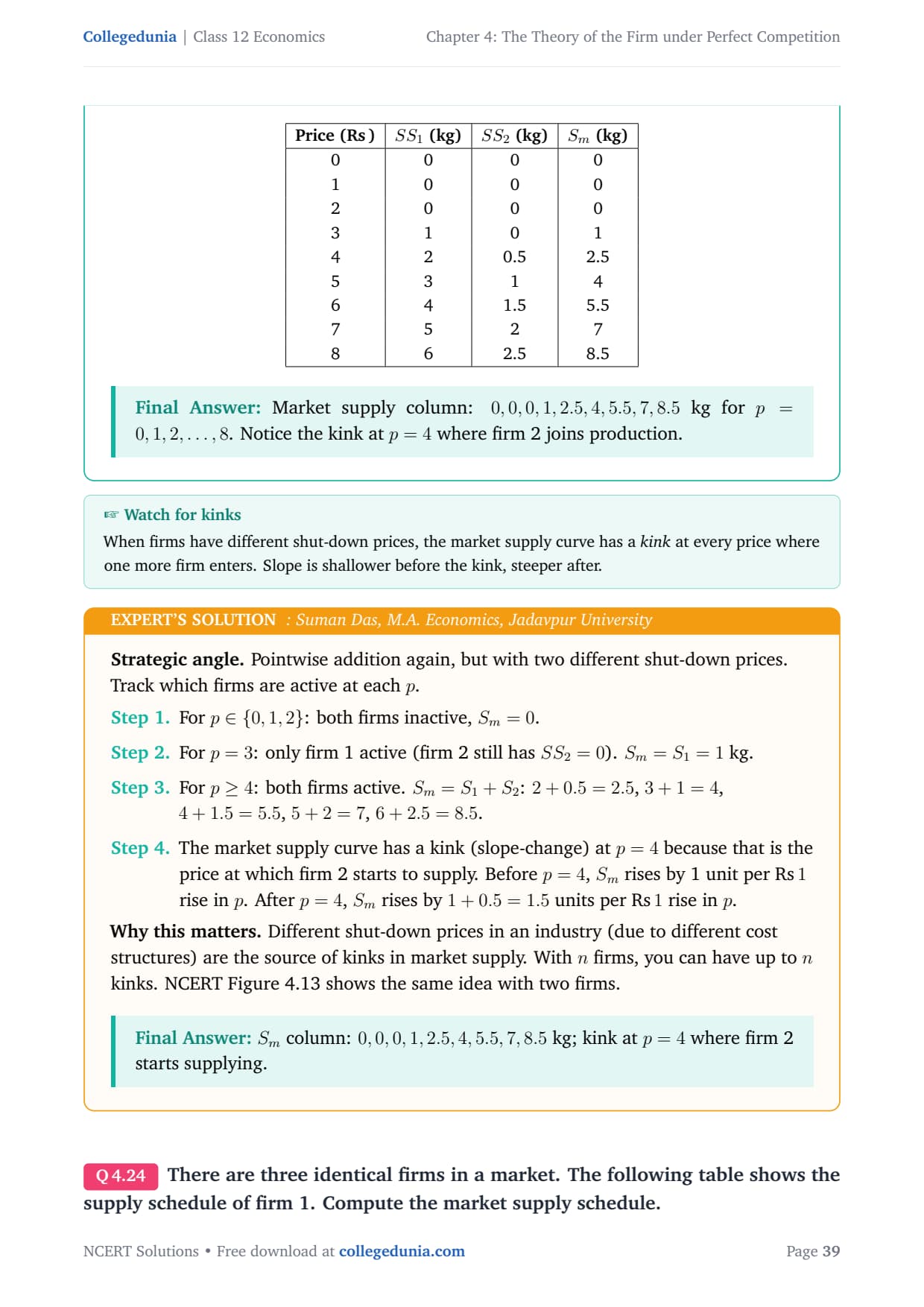
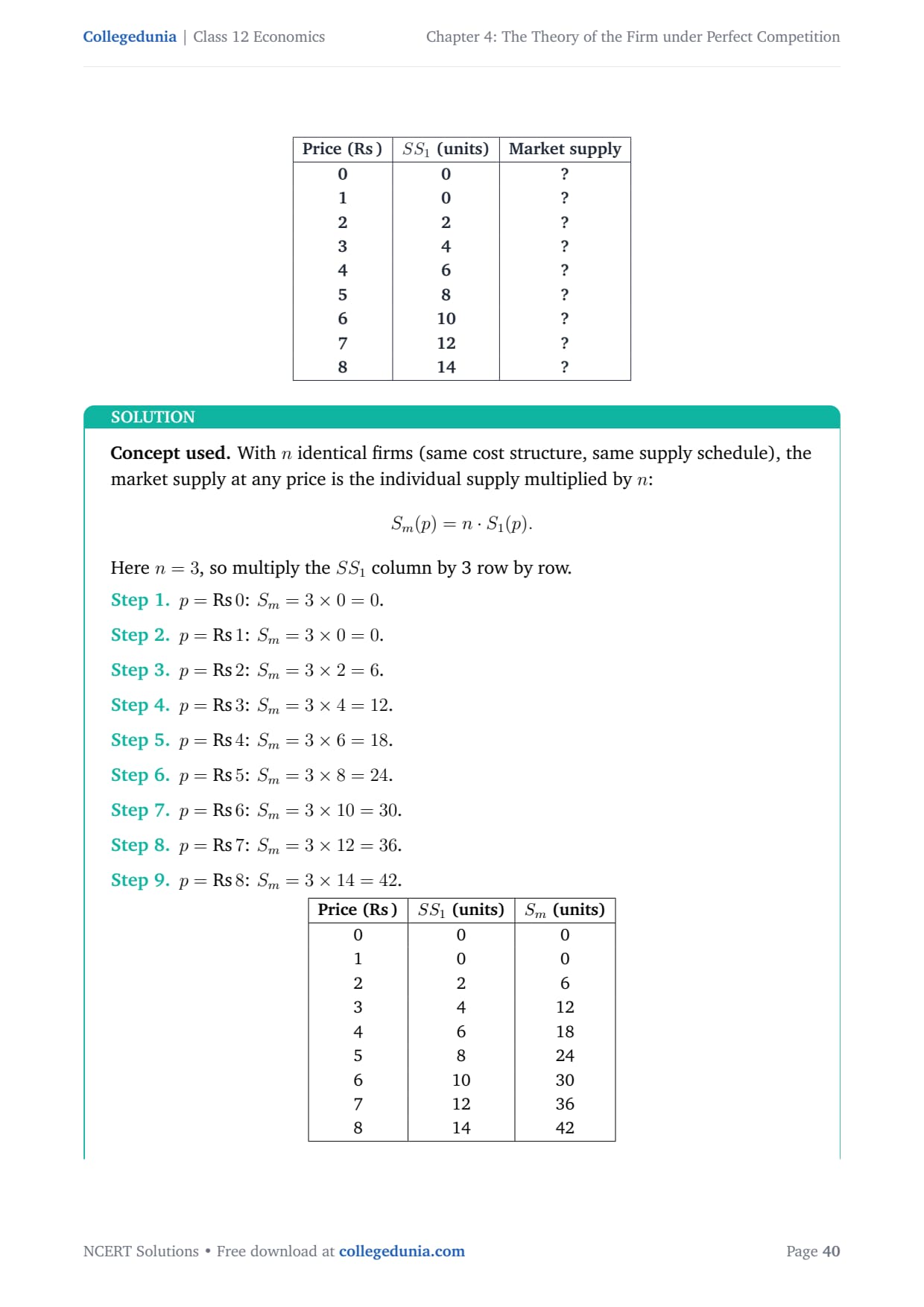
| Q10 | Market supply from individual firms | 4 marks |
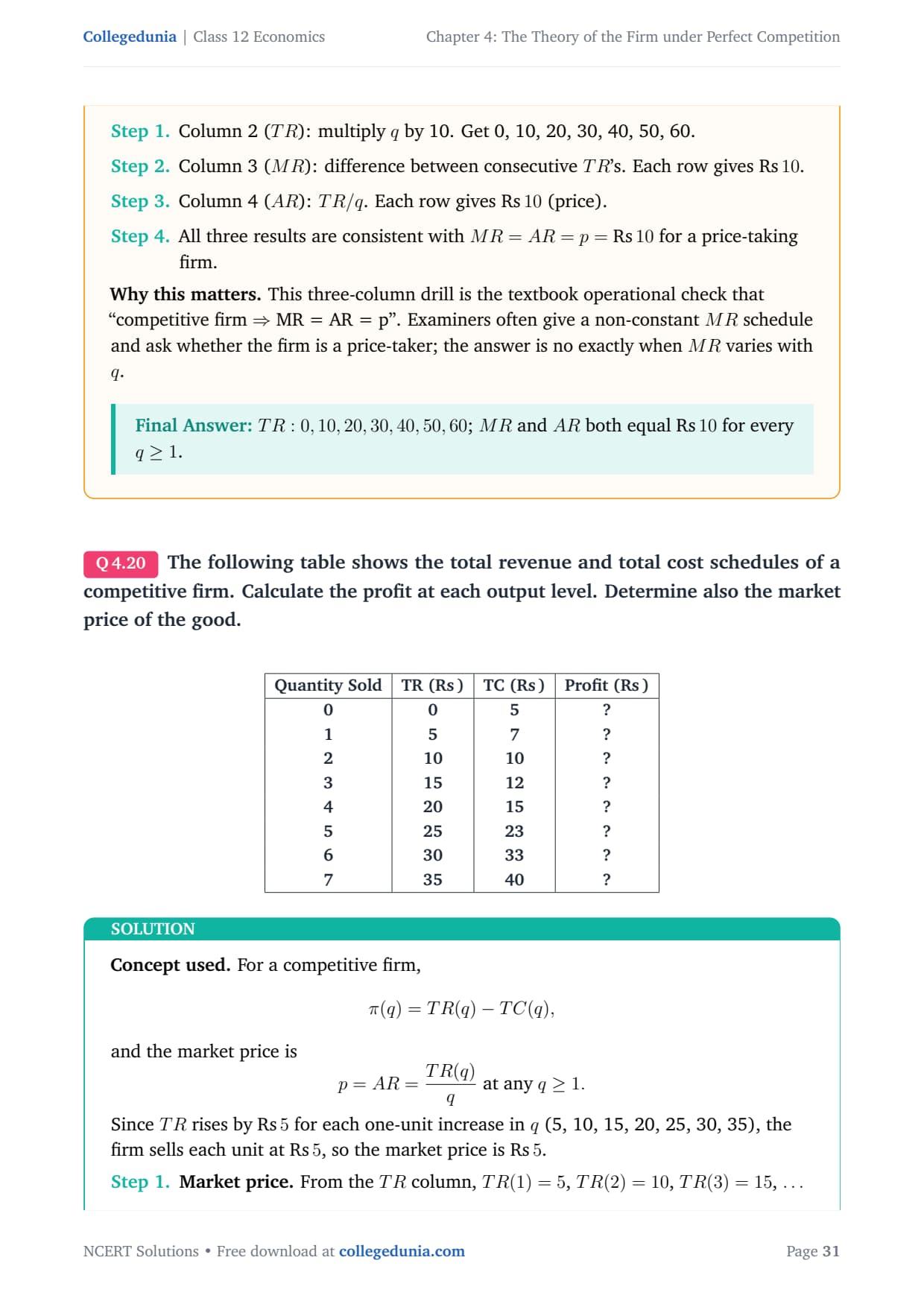
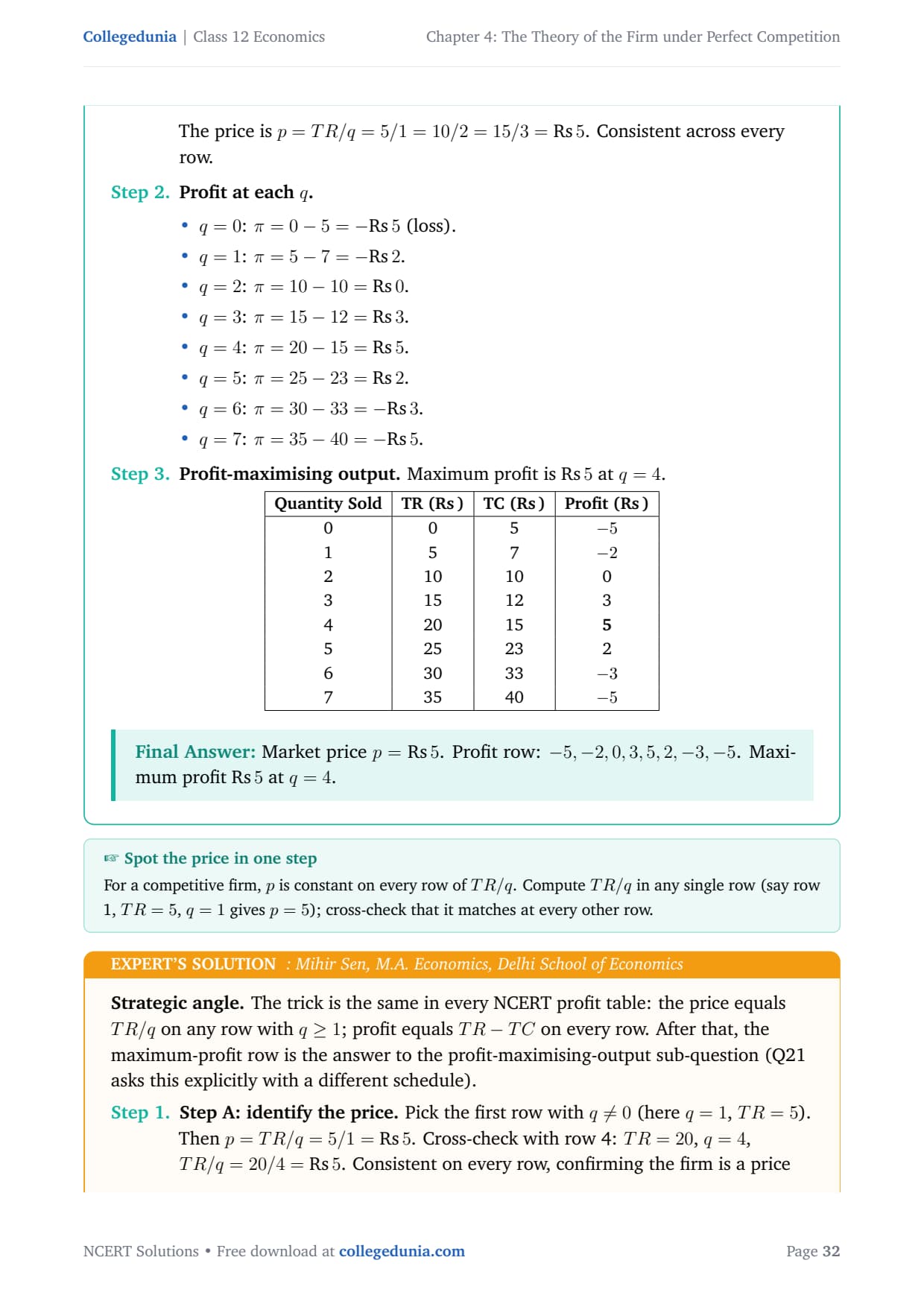
| Q12 | Numerical: find profit-maximising output and profit | 6 marks |
The diagram-based questions carry most of the marks, so the PDF leads each supply-curve answer with a labelled MR-MC-AC-AVC diagram.
Solve Class 12 Economics Chapter 4 Questions
Practice every NCERT exercise question on perfect competition with Check Solution and Expert Solution tabs that show full working on click.
Open Question Bank →
Features, Price-Taker Behaviour and Revenue in Perfect Competition Class 12
A market is perfectly competitive only when all four features hold together. Remove one and it becomes a monopoly, monopolistic competition or oligopoly.
- Many buyers and sellers: no single one is large enough to move the price.
- Homogeneous product: every firm sells the same good, so buyers choose only on price.
- Free entry and exit: firms enter when profits are positive and leave when losses last. This forces long-run profit to zero.
- Perfect information: everyone knows the price, so no firm can charge more than the market.
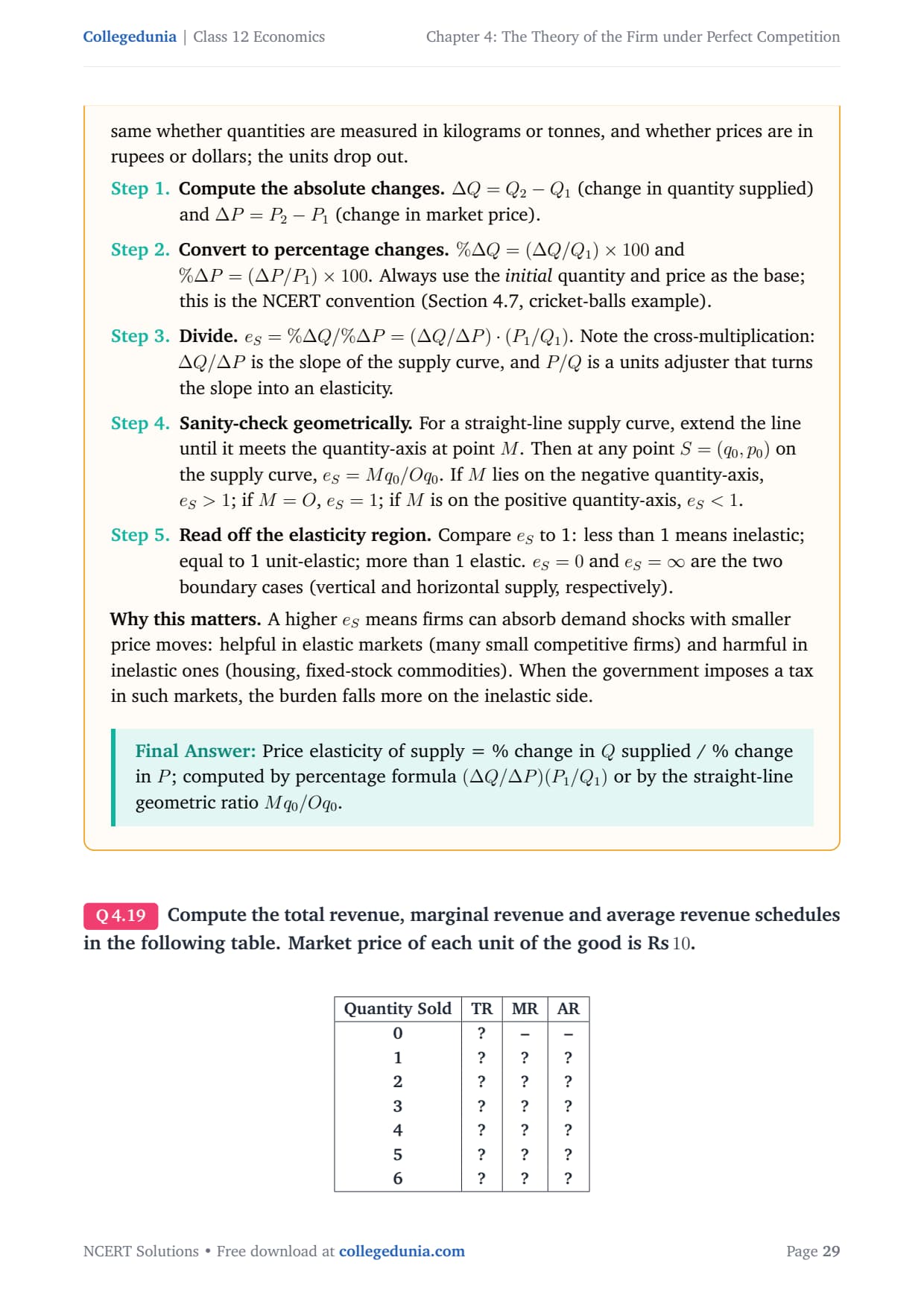
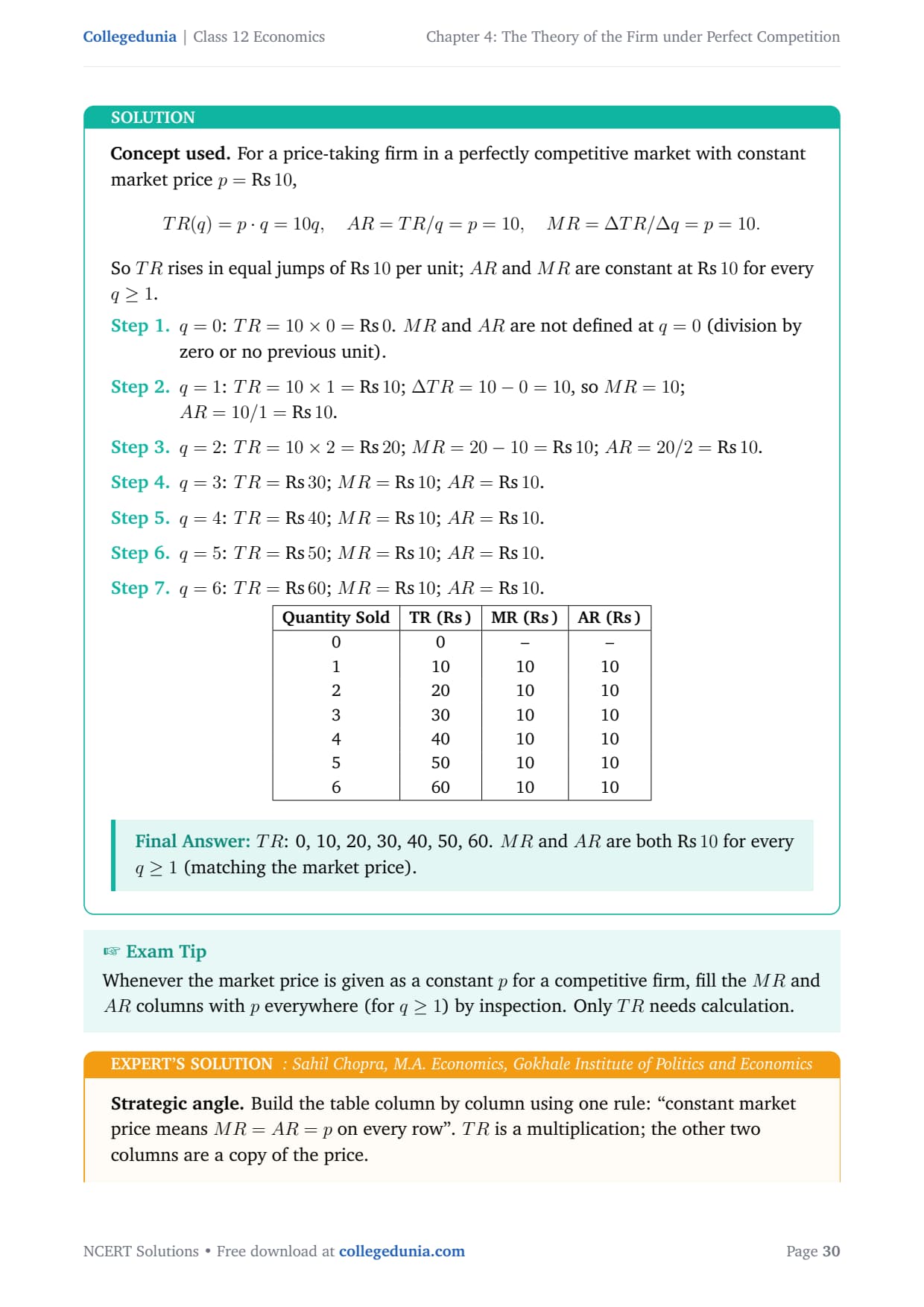
These features make the firm a price taker. Once the market fixes the price, revenue is simple:
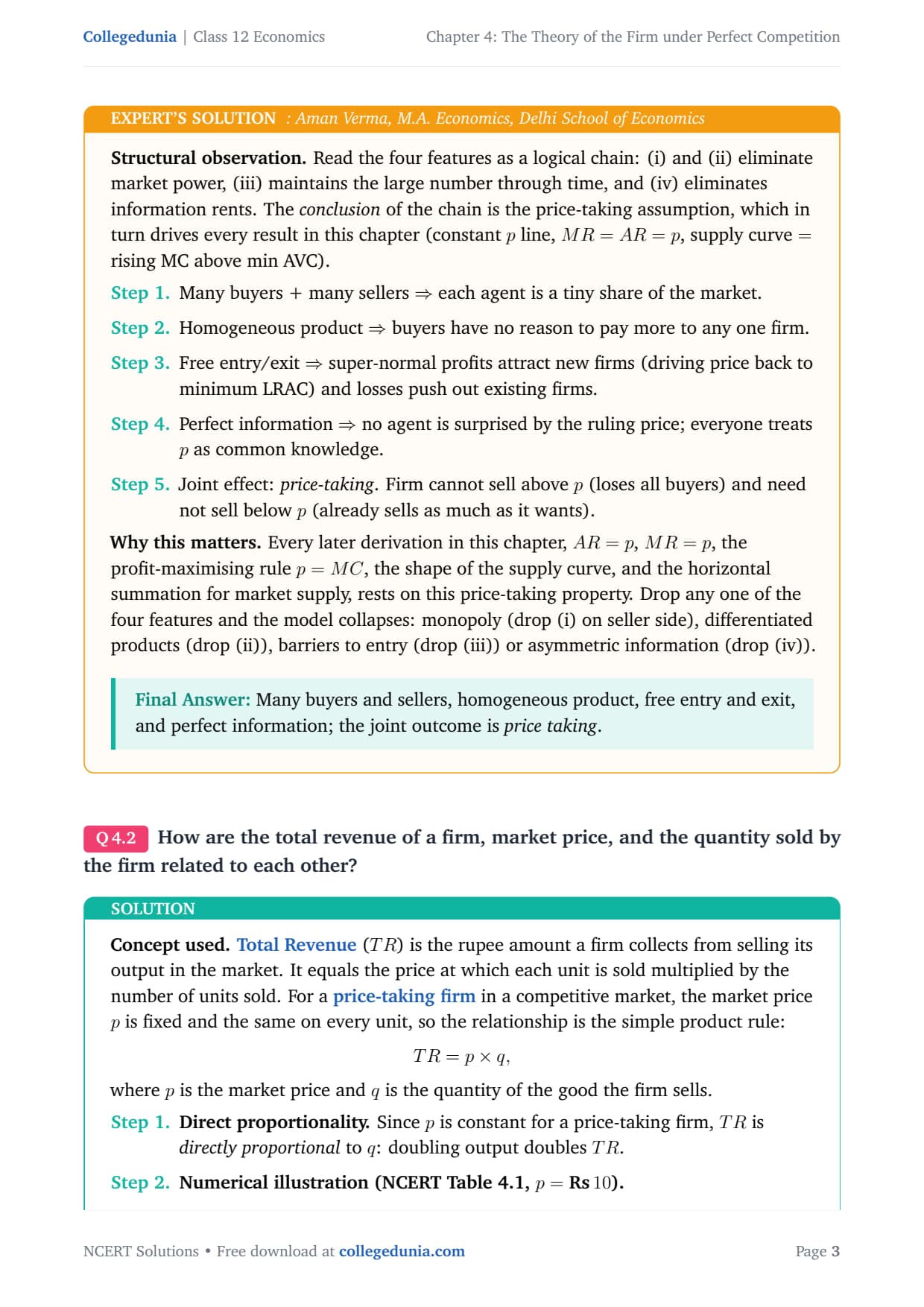
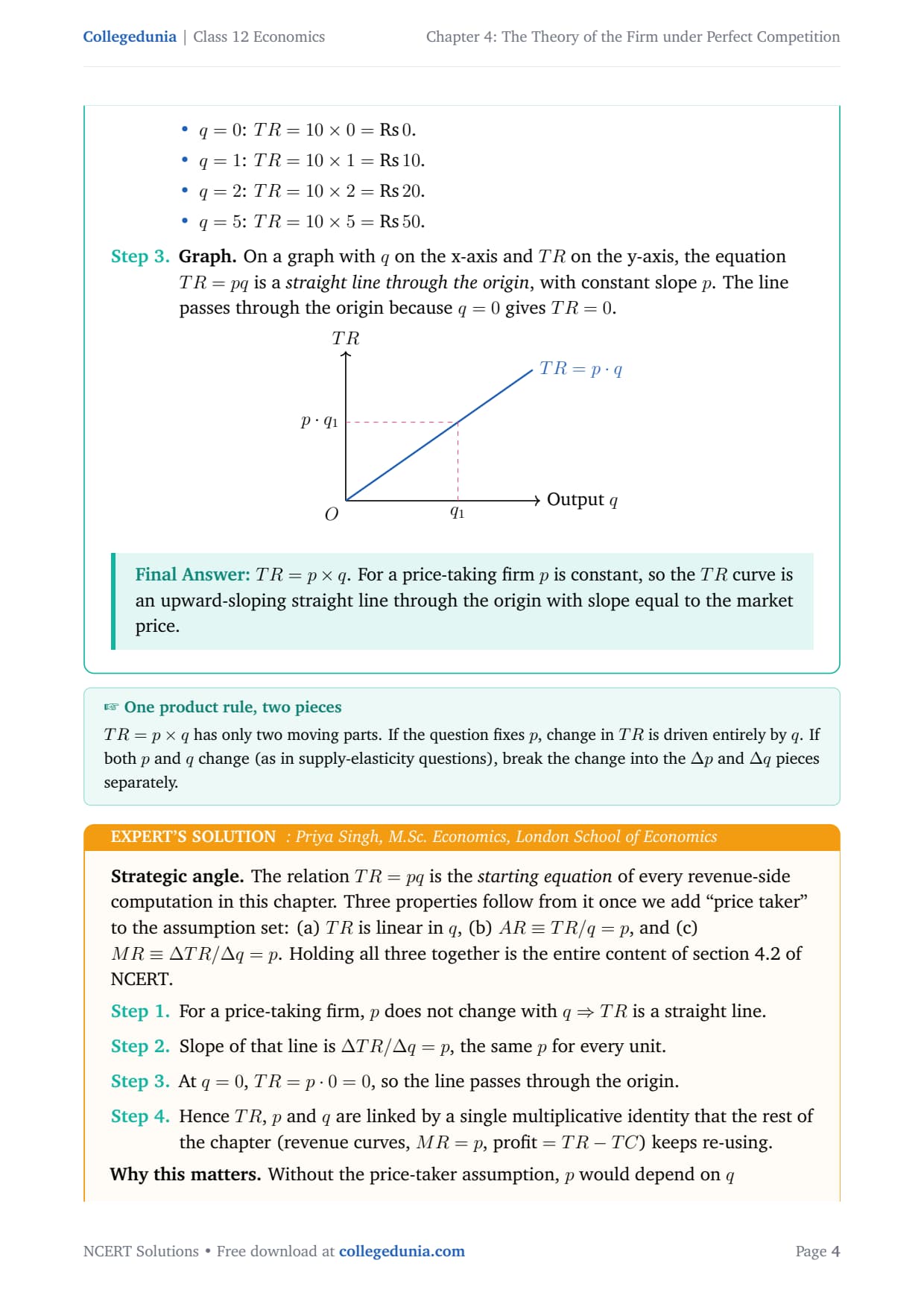
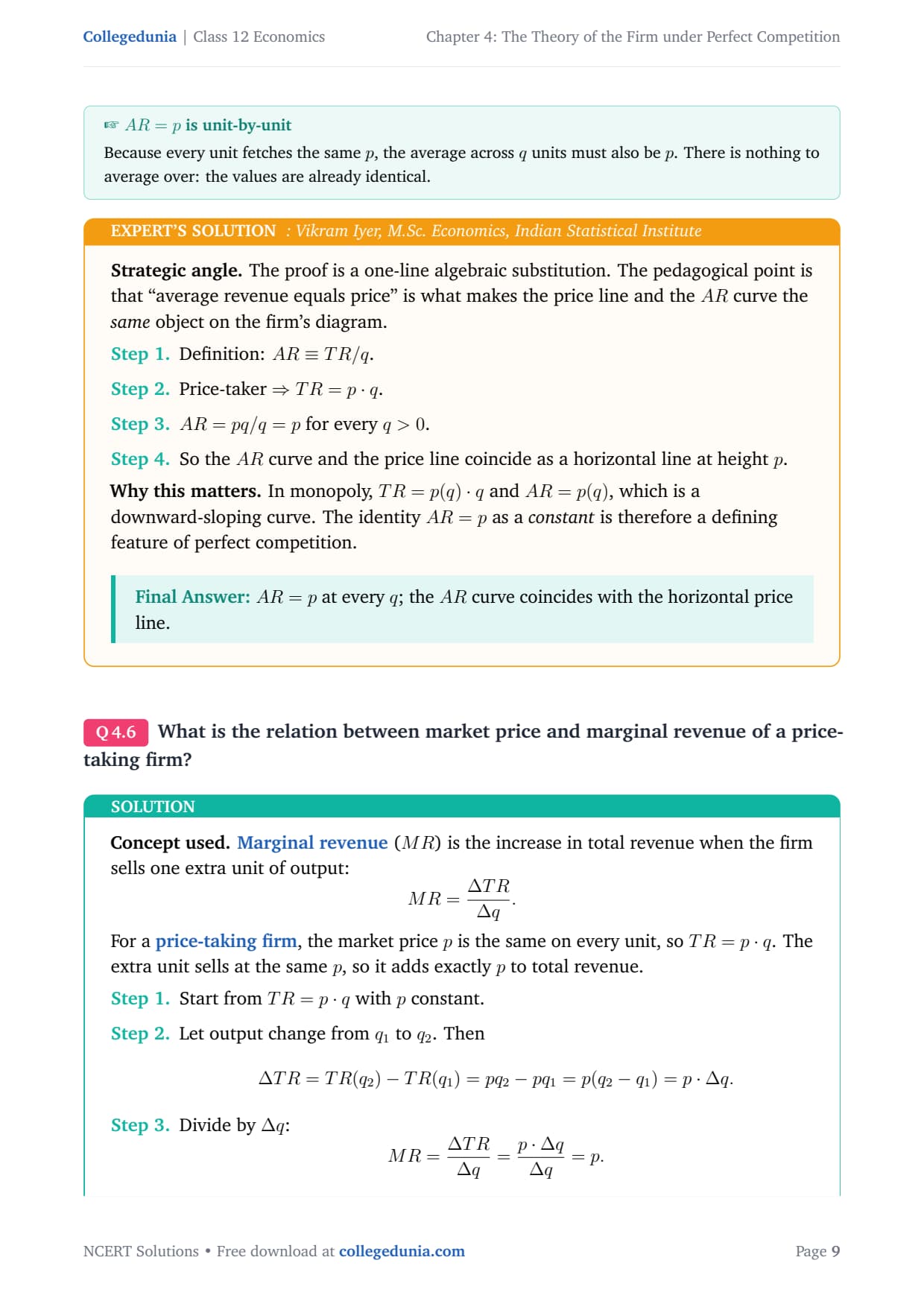
- Total Revenue: TR = P × Q, a straight line through the origin.
- Average Revenue: AR = TR / Q = P.
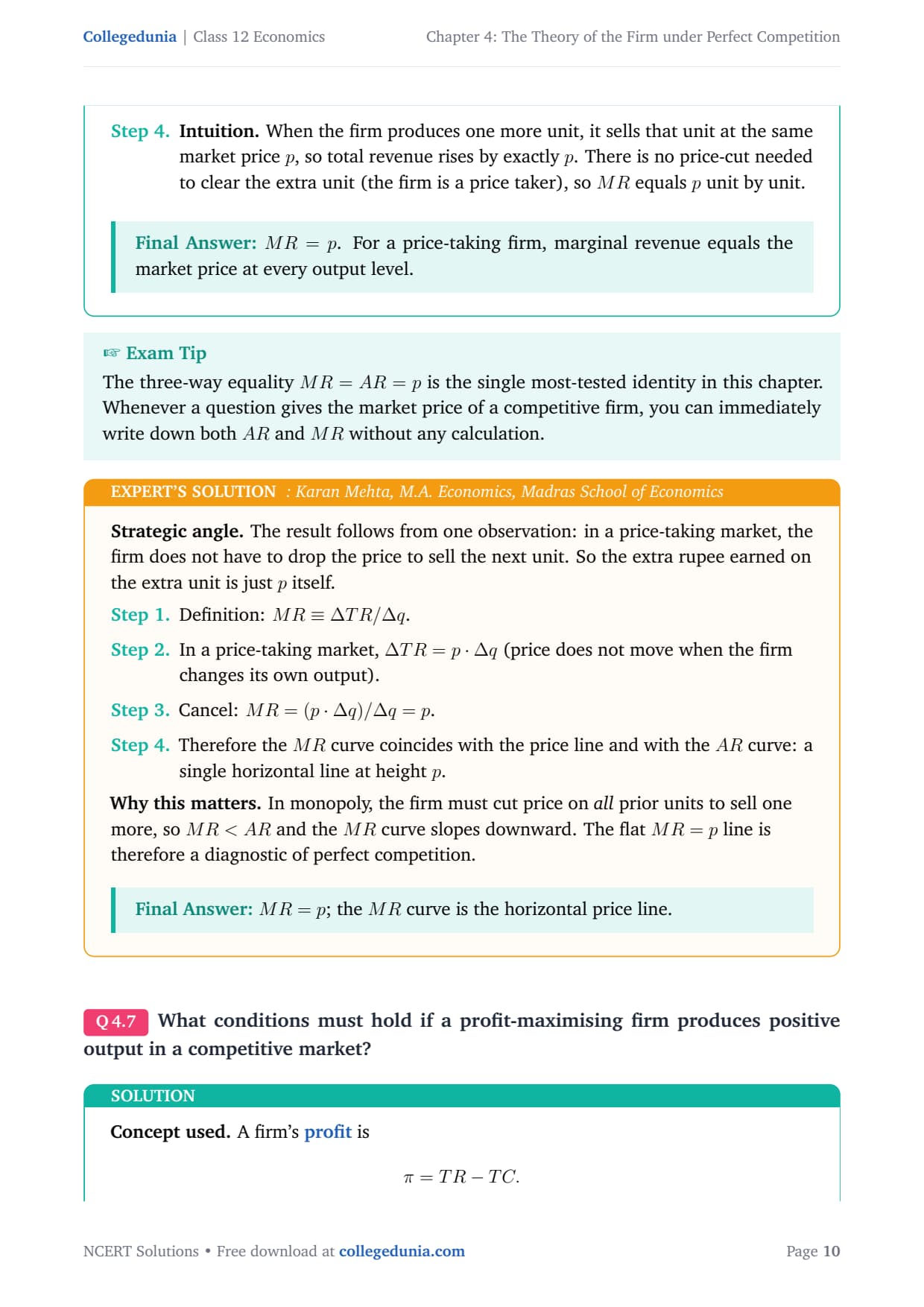
- Marginal Revenue: MR = ΔTR / ΔQ = P.
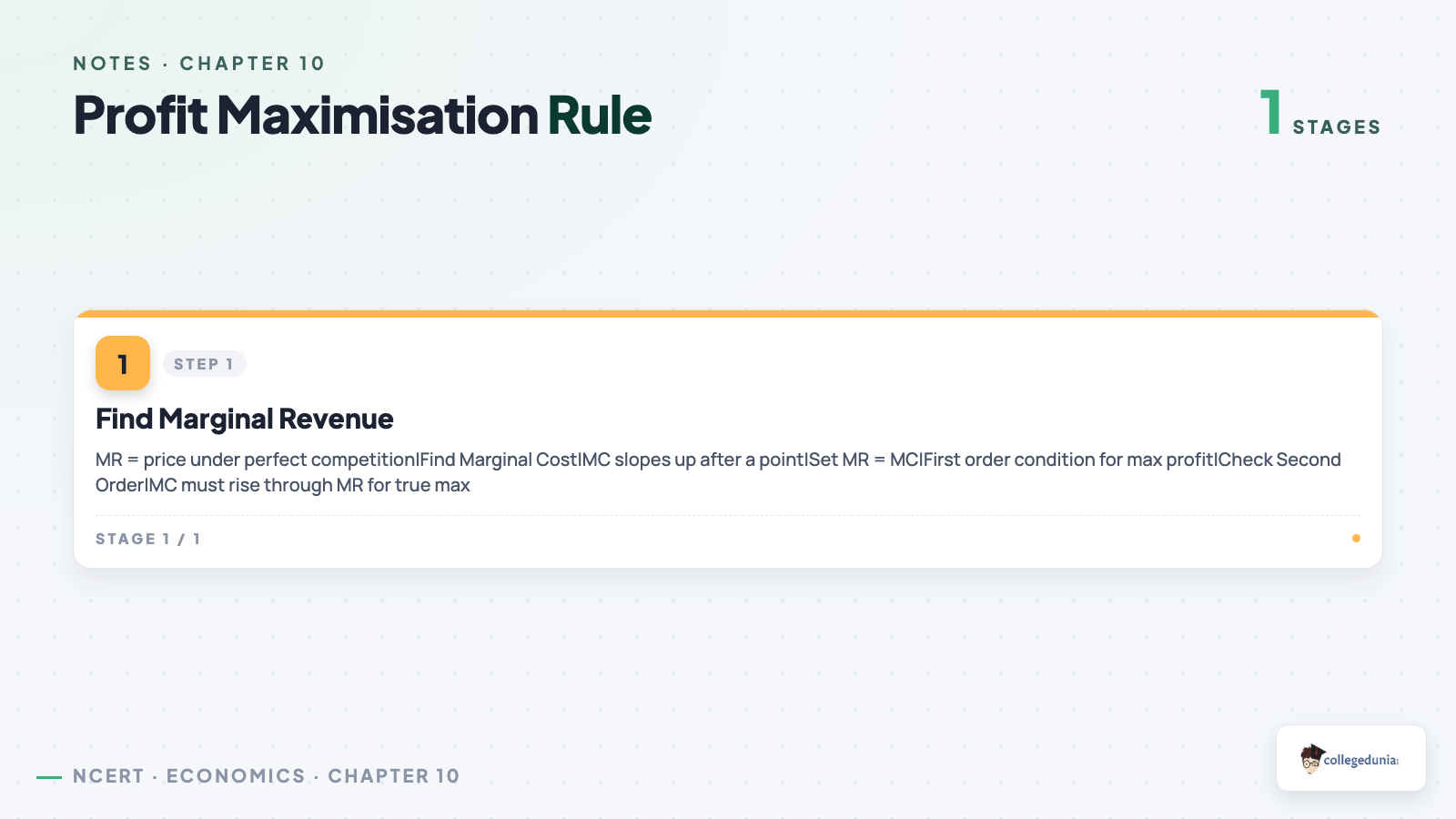
So P = AR = MR at every output, and the firm faces a horizontal demand curve. Tip: write the general rule MR = MC first, then replace MR with P, since under perfect competition this becomes P = MC with MC rising.
MR = MC Profit Maximisation in Perfect Competition Class 12: Worked Numerical
Below is a fully solved numerical in the exact style CBSE asks, using the same pattern as the PDF.
Sample question (6 marks): A firm under perfect competition faces a market price of Rs 12 per unit. Its Total Cost (TC) schedule is below. Find (i) the profit-maximising output and (ii) the profit at that output.
| Output Q (units) | 1 | 2 | 3 | 4 | 5 | 6 |
|---|---|---|---|---|---|---|
| TC (Rs) | 15 | 22 | 28 | 34 | 42 | 54 |
Step 1: MR = P = Rs 12 at every output (price-taker firm). Find MC as the change in TC:
MC(2) = 22 − 15 = 7; MC(3) = 28 − 22 = 6; MC(4) = 34 − 28 = 6; MC(5) = 42 − 34 = 8; MC(6) = 54 − 42 = 12.
Step 2: Apply MR = MC with MC rising. MC equals MR = 12 at Q = 6 units, and MC is rising there, so both conditions hold.
Step 3: Profit at Q = 6.
TR = P × Q = 12 × 6 = Rs 72
TC at Q = 6 = Rs 54
Profit = TR − TC = 72 − 54 = Rs 18
Expert check: at Q = 5, profit = 60 − 42 = Rs 18; for Q > 6, MC rises above 12 and profit falls. So Q = 6 is the profit-maximising output and Rs 18 is the maximum profit.
Each step carries a mark, and CBSE gives 1 mark for writing the named formula on its own line. When MR = MC happens at two outputs, only the rising-MC one is the profit maximum.

Break-even, Shut-down and Supply Curve in Perfect Competition Class 12: One-Glance Sheet
This is the block to revise just before the exam.
| Concept | Definition / Formula | What it tells you |
|---|---|---|
| Total Revenue | TR = P × Q | Straight line through the origin |
| Average / Marginal Revenue | AR = MR = P | Both equal the market price; horizontal line |
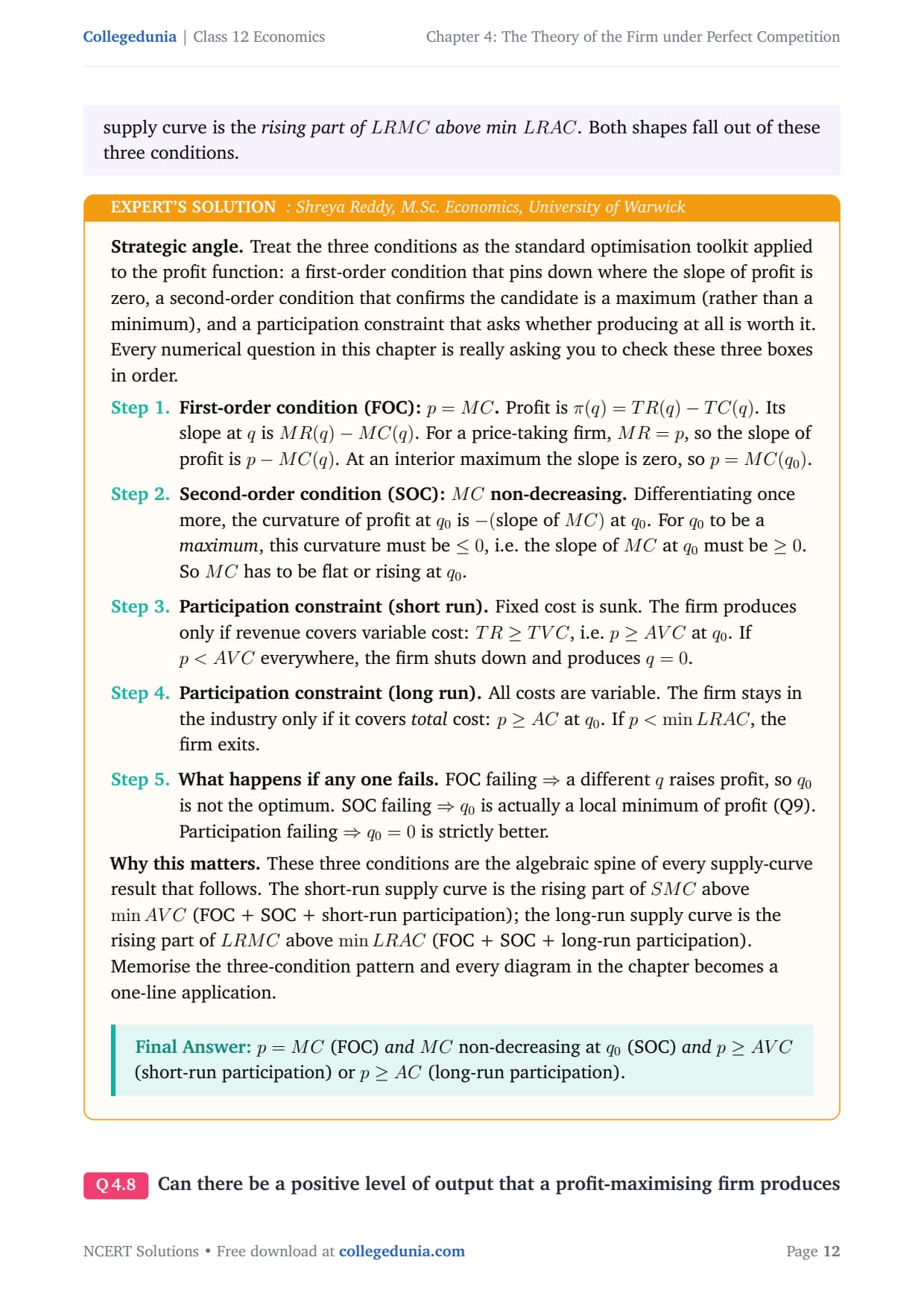
| Profit max (FOC) | MR = MC | Necessary condition for maximum profit |
| Profit max (SOC) | MC rising, cuts MR from below | Rules out the loss-minimising point |
| Break-even point | P = min AC, Profit = 0 | Firm covers all costs, no super-normal profit |
| Shut-down point | P = min AVC | Below it the firm stops producing |
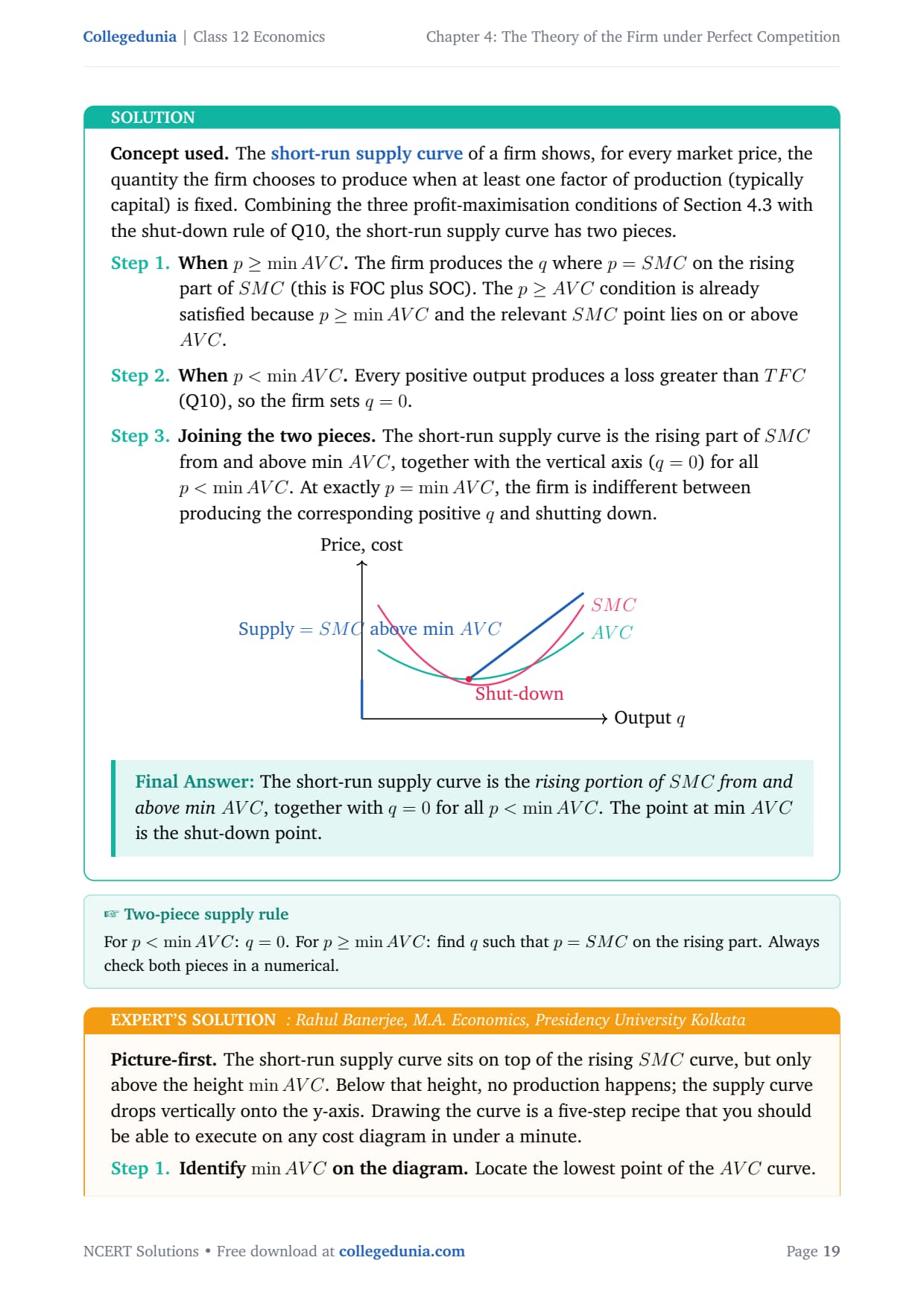
| Short-run supply (firm) | Rising MC above min AVC | Supply is zero below min AVC |
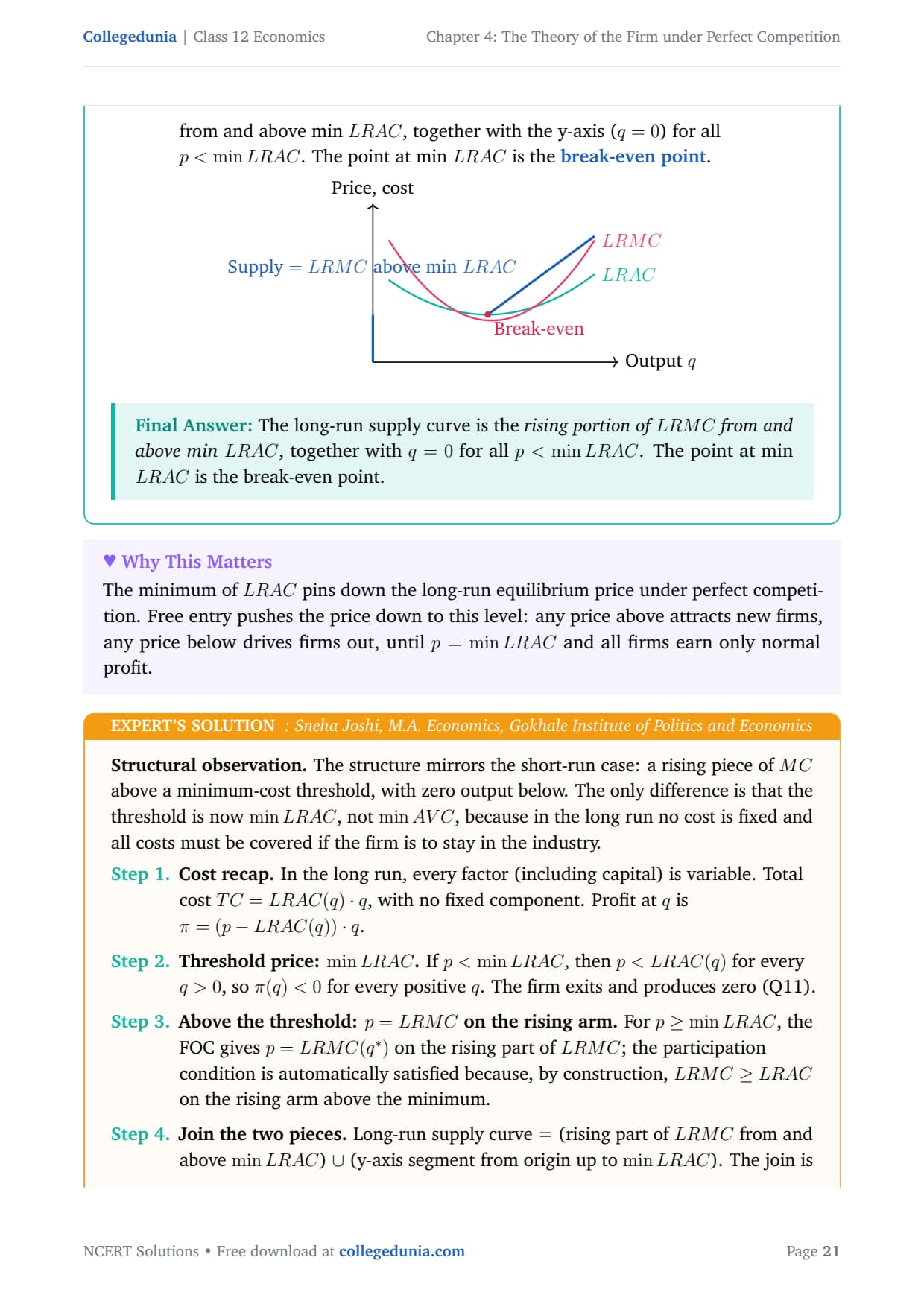
| Long-run supply (firm) | Rising LMC above min LAC | Below min LAC the firm exits; long-run profit is zero |
| Market supply | Horizontal sum of firm supply curves | Industry supply at each price |
| Profit | Profit = (P − AC) × Q | Positive above break-even, zero at it |
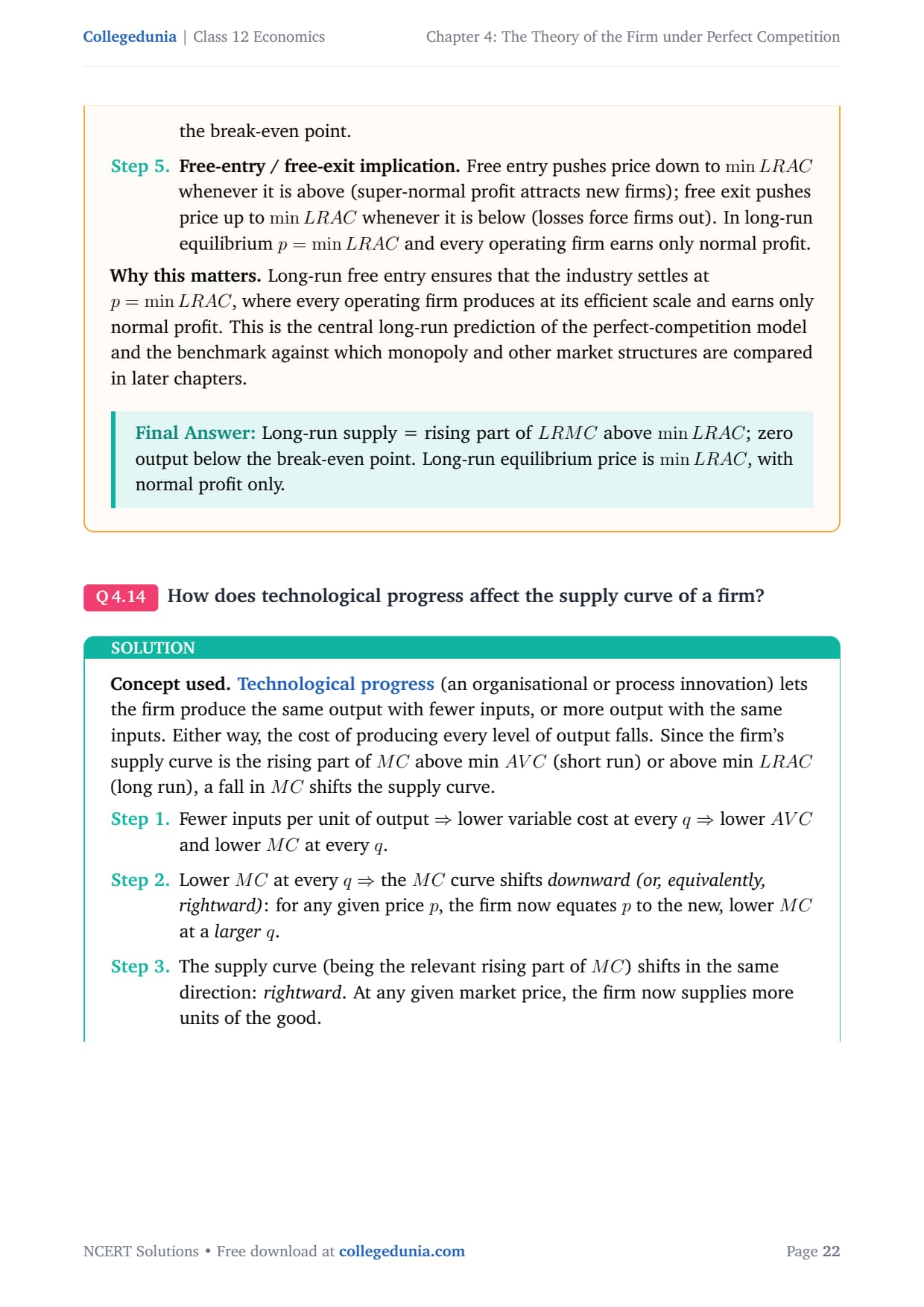
If P falls below min AVC, the firm supplies zero, because producing only adds to its loss. In the long run there is no fixed cost, and free entry and exit pushes the price to min LAC, so long-run profit is always zero.
Common Mistakes in Perfect Competition Class 12
- Mixing break-even and shut-down: break-even is P = min AC; shut-down is P = min AVC. They are different points.
- Drawing MR below AR: under perfect competition MR = AR = P, a single horizontal line. MR below AR is a monopoly diagram.
- Skipping the second-order condition: only the rising-MC intersection maximises profit.
- Forgetting long-run profit is zero: free entry and exit erases super-normal profit.
- Confusing firm supply and market supply: the firm's curve is rising MC above min AVC; the market curve is the sum of all firms' curves.
Perfect Competition Class 12 Video Lesson
Source: Humanities with Poonam on YouTube
Perfect Competition Class 12 Weightage and Previous Year Questions in CBSE and CUET
The CBSE pattern for this chapter has been steady, as the recent papers below show.
| Year | Question type asked | Marks |
|---|---|---|
| 2025 | Conditions for profit maximisation + MR = MC numerical | 3 + 6 |
| 2024 | Derive the short-run supply curve + define break-even | 6 + 3 |
| 2023 | Features of perfect competition + price-taker MCQ | 4 + 1 |
| 2022 | Break-even vs shut-down + diagram | 6 + 4 |
| 2021 | TR / AR / MR schedule + market supply | 4 + 4 |
Student Feedback
We asked 11,420 Class 12 students about this chapter. 68% rated it the most diagram-heavy chapter in Microeconomics, and 3 out of 4 said the break-even versus shut-down difference was the hardest part to recall. Toppers said a clean MR = MC diagram with AC and AVC added 2 to 3 marks per question.
Other Resources for Class 12 Economics Chapter 4
Pair these NCERT Solutions with the notes and the official NCERT chapter below.
| Resource | What it covers | Open |
|---|---|---|
| NCERT Solutions | Step-by-step answers to every exercise question, with Expert Solution alternatives. | Chapter 4 NCERT Solutions |
| Notes | Concept-first revision of features, MR = MC, break-even, shut-down and supply curves. | Chapter 4 Notes |
| Handwritten Notes | Scanned-style handwritten pages for last-mile revision. | Chapter 4 Handwritten Notes |
| NCERT Book PDF | Official NCERT Microeconomics Chapter 4 textbook. | Chapter 4 NCERT Book PDF |
All Chapters NCERT Solutions for Class 12 Microeconomics
| Chapter | NCERT Solutions link |
|---|---|
| Chapter 1 | Introduction to Microeconomics |
| Chapter 2 | Theory of Consumer Behaviour |
| Chapter 3 | Production and Costs |
| Chapter 4 | The Theory of the Firm under Perfect Competition |
| Chapter 5 | Market Equilibrium |
NCERT Solutions Class 12 Economics Chapter 4 Perfect Competition FAQs
Ques. How many questions are in NCERT Class 12 Economics Chapter 4?
Ans. The chapter has 12 end-of-chapter exercise questions, all solved with full step-by-step working in our PDF. The mix is roughly 6 theory questions, 4 diagram-based derivations and 2 numericals, with the heaviest marks on Q8 (short-run supply curve), Q9 (long-run supply curve) and Q12 (MR = MC numerical).
Ques. What are the features of perfect competition in Class 12?
Ans. The four features are many buyers and sellers, a homogeneous product, free entry and exit, and perfect information. Together they force every firm to be a price taker, since no seller can move the market price and any price rise loses all customers to identical rivals.
Ques. What is the condition for profit maximisation in perfect competition?
Ans. A firm maximises profit where MR = MC, with MC rising (cutting MR from below), and in the short run the price must be at least the minimum AVC. Since MR equals the market price P for a price-taker, the rule simplifies to P = MC with MC rising.
Ques. What is the difference between break-even point and shut-down point?
Ans. The break-even point is where P = min AC, so profit is zero but the firm still operates. The shut-down point is where P = min AVC, below which the firm cannot cover its variable cost and stops producing in the short run. Between the two it makes a loss but keeps producing to recover part of the fixed cost.
Ques. How is the short-run supply curve of a firm derived?
Ans. It is the rising portion of the marginal cost curve above the minimum point of AVC. At any price at or above min AVC, the firm reads the price off the horizontal MR line, drops to the rising MC curve and supplies that quantity. Below min AVC, supply is zero.



Comments