NCERT Solutions for Class 12 English (Suppl.) Chapter 12 Kaleidoscope: Time and Time Again give students clear answers for the 2026-27 poem questions. The PDF below explains city clock towers, repeated violence, public disorder, lightning, communal disharmony and the title's meaning in simple exam-ready steps.
Includes all 6 solved tasks from Responding to the Poem.
Matches the full NCERT 2026-27 Kaleidoscope question order for Class 12 English Elective revision.
Focuses on theme-based answers, civic time, social difference, natural force and critical tone.
The downloadable PDF keeps the NCERT sequence intact and adds expert solution tabs for deeper poetry interpretation.
Student Feedback: In a Collegedunia survey of 12,520 Class 12 English students conducted before the 2026 boards, many students said they understood the clock image but missed how civic time, communal tension and nature's force work together. This page separates each image, its social meaning and the final answer point.
Scope note: This page covers the NCERT Kaleidoscope poem Time and Time Again by A. K. Ramanujan. If your school uses an internal chapter list, confirm that this poetry unit is included before treating it as test-only revision.
Time and Time Again begins with clock towers in a city and gradually turns that image into a reflection on civic rhythm, disharmony and natural force. The answers here stay close to the NCERT prompts and show how each image changes from ordinary timekeeping into social meaning.
The main skill is to move from object to implication. Students should first explain the clock image, then connect it with public life, community difference and repeated disturbance. Every answer should connect the literal city detail with the larger idea it suggests.
NCERT area
What students answer
Best answer cue
Opening impression
Clock towers, city sounds and timekeeping
Start with the surface image, then add the deeper meaning.
Title and comparison
Repeated disturbance, different clocks and plural communities
Show how difference can belong to one shared city.
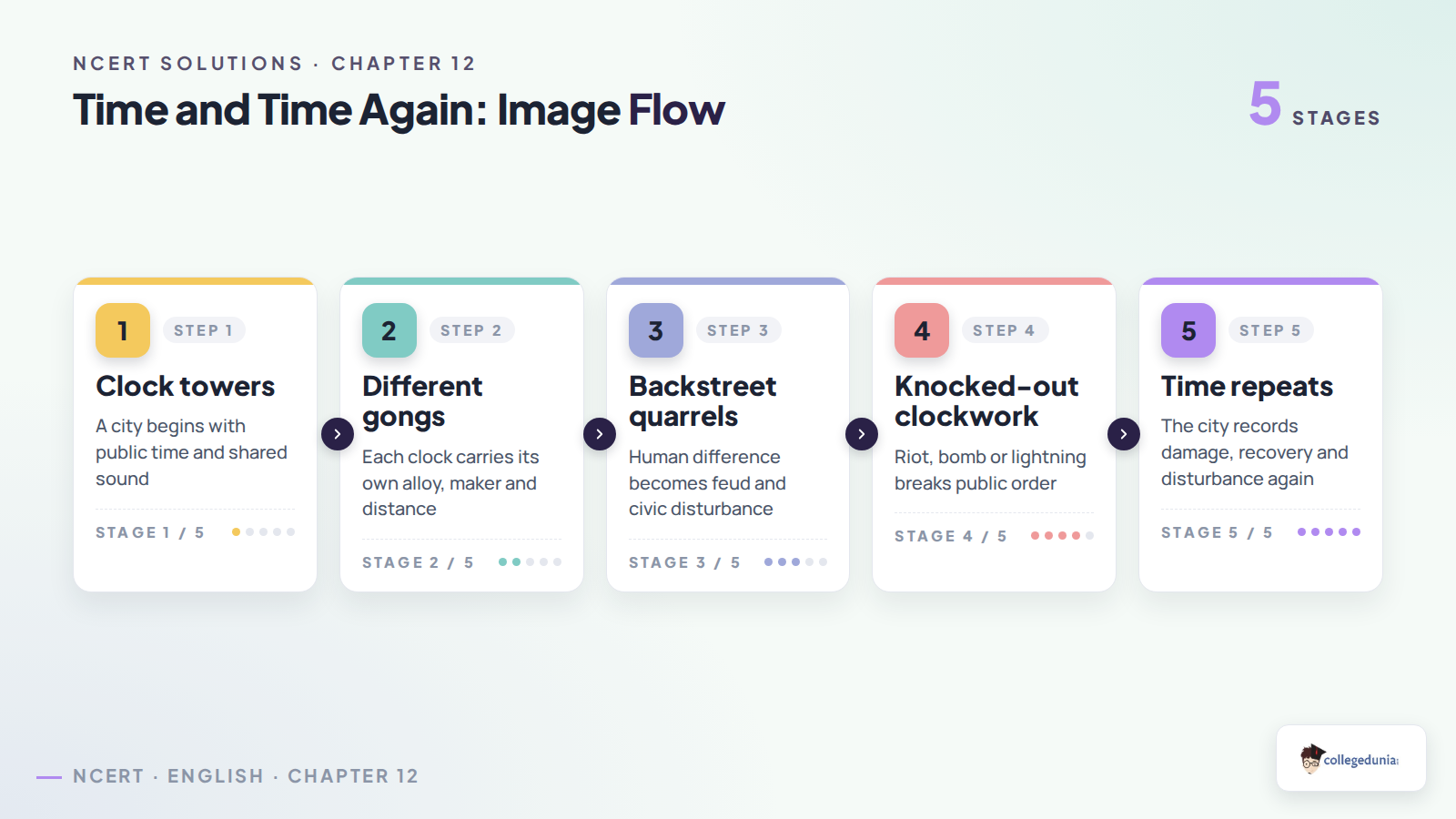
Time Image Flow for Time and Time Again NCERT Answers
The poem moves from clock sounds to clock differences, then to a damaged public clock after violence or lightning. A strong answer follows that movement instead of writing a general paragraph about time.
Clock towers create the first idea of public time and routine.
Different gongs suggest that shared life contains many separate histories.
Broken clockwork shows how violence and natural force disturb civic order.
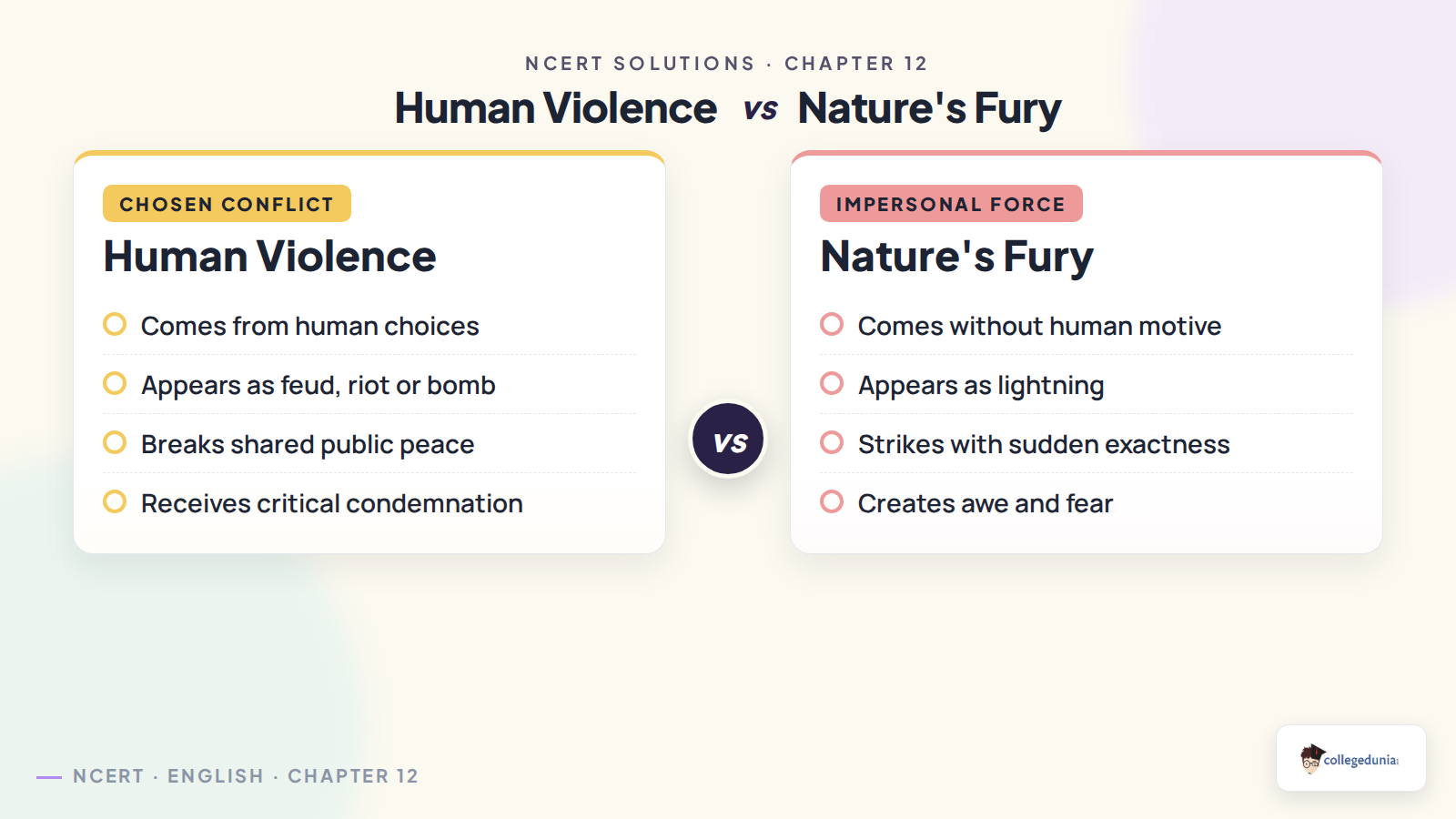
Human Violence and Nature's Fury in Chapter 12
The poem places human violence and natural force close together, but it does not treat them as the same thing. Human violence is linked with feuds, riots and bombs, so the tone is critical. Nature's fury appears through lightning, which strikes with sudden precision but without human hatred.
Human violence
Nature's fury
Comes from feuds, quarrels, riots and bombs
Appears as lightning and sudden natural force
Morally blamed because people choose it
Faced with fear, awe and acceptance
Damages public peace and shared civic time
Shows that human order remains fragile
How to Write Better Time and Time Again Answers
Begin each answer with the exact NCERT demand. If the question asks about the title, identify the line-group where the title becomes meaningful. If it asks about clocks, explain the physical reasons first and the implied social comparison next. If it asks about attitude, name the tone and support it with poem images.
Do not reduce the poem to a broad statement about clocks alone.
Use short textual references only when they support the explanation directly.
For communal disharmony, choose critical condemnation and show why the other options are weaker.
For nature's fury, avoid blaming nature in the same way as human violence.
Class 12 English Supplementary Chapter 12 Resource Links
Use these related resources when you want the same chapter in another format. The table is placed above the FAQ so students can move from solutions to notes, book PDF and handwritten revision without losing the chapter context.
All NCERT Solutions for Class 12 English Supplementary Chapters
The table below keeps the same resource type together, so students can move chapter by chapter through the Class 12 English supplementary Kaleidoscope question set.
All NCERT Solutions for Class 12 English (Suppl.) Chapter 12 Kaleidoscope: Time and Time Again with Step-by-Step Solutions
The expandable cards below reproduce the full solution set from the PDF. Use the Solution tab for a direct exam-ready answer and the Expert Solution tab for a deeper reading of Ramanujan's city image, clockwork and social critique.
Q 12.1
What did you think the poem was about when you read the first few lines?
Concept used. Opening expectation means the first impression a reader forms before the poem reveals its deeper concern. Here the first few lines seem to describe clock towers and timekeeping in a city.
Begin with the surface
For this question, first write what the lines seem to show. Then add how the poem later deepens that first impression.
At first, the poem seems to be about clock towers in an old city.
The speaker asks us to listen to their gongs round the clock.
The clocks are slightly off from one another.
Their different bronze sounds make the scene feel ordinary and urban.
So the first impression is that the poem will discuss time, clocks, and city life.
As the poem moves ahead, the clock image becomes more serious.
The clock towers also suggest public order, memory, and shared life.
Their broken clockwork later connects time with riots, bombs, and lightning.
The first few lines therefore prepare a quiet image that later becomes a social image.
The first few lines made the poem seem to be about clock towers, city sounds, and the odd way clocks keep time. Later, the same image opens into a deeper reflection on public disorder, violence, and nature's force.
AR
Aditi Rao
M.A English, University of Delhi
Verified Expert
Quick reading. The poem begins as if it is about sound and time. Ramanujan lets the reader hear a city before revealing that the city also carries conflict and damage.
The phrase old well-managed city creates an image of order.
Clock towers usually stand for public time and civic routine.
The gongs beating round the clock make the beginning sound regular.
Yet each clock is slightly off the others' time.
This small difference keeps the opening from being perfectly calm.
The reader may first expect a poem about timekeeping or city rhythm.
The later lines change that expectation by naming quarrels, riots, bombs, and lightning.
The opening is therefore a doorway from simple clock sound to a larger public anxiety.
This answer should not ignore the first impression. The poem starts with clocks, but the clock image soon becomes a way to think about repeated disturbance in human life.
At first, the poem appears to be about clocks and city time. The deeper subject appears later, when those clocks become signs of disorder, damaged harmony, and repeated disturbance.
Q 12.2
From which line does the import of the title strike the reader?
Concept used. The import of a title means the point at which its deeper meaning becomes clear. The title becomes sharp when the poem shows time returning through damage, conflict, and natural disturbance.
Title clue
The title is not only about clock time. It is also about repeated human and natural events.
The title begins to gain force in the last movement of the poem.
The clearest line-group is about knocked-out clockwork after a riot, a peace-march time bomb, or a precise act of nature.
These lines show that time is not only measured by clocks.
Time is also marked by repeated public shocks.
A riot damages civic order.
A time bomb turns even a peace march into violence.
Lightning shows nature acting with sudden force.
These events make the reader feel the phrase Time and Time Again.
The title suggests recurrence: order is made, disturbed, and remade again.
The import of the title strikes the reader in the last stanza, especially in the lines about knocked-out clockwork after a riot, a peace-march time bomb, or a precise act of nature. Those lines show repeated disturbances in time.
RM
Rahul Menon
M.A English, EFLU Hyderabad
Verified Expert
Structural observation. The title grows in meaning across the poem. At first, it refers to clocks being slightly out of time. In the last stanza, it refers to repeated patterns of damage.
The opening clock towers introduce ordinary measured time.
Their gongs differ slightly because each clock has a separate physical history.
This prepares the reader for difference inside a shared city.
The last stanza changes the scale of the image.
The phrase knocked-out clockwork means order has been violently broken.
Riot and time bomb bring human violence into the clock image.
The precise act of nature brings lightning into the same pattern.
The title now means that time records repeated disruptions, not only repeated hours.
So the answer can mention both stages. The title is hinted at early through gongs and clock time, but its full import arrives when broken clockwork is linked with violence and natural force.
The title's deeper force is felt in the last stanza, in the lines about knocked-out clockwork after riot, bomb, or lightning. They show time as a repeating record of disturbance.
Q 12.3
What makes for the differences between the timekeeping of the various clocks? What is the implicit comparison?
Concept used. An implicit comparison is a comparison that is suggested rather than stated directly. The clocks differ because of material, makers, distance, and history; the poem suggests that communities also differ for such accumulated reasons.
Split the answer
Answer the first half literally, then answer the second half interpretively. That keeps the comparison clear.
The clocks do not keep exactly the same time.
Their bronze is deeper or lighter because their alloy is different.
The maker's hand may have been unsteady.
Their positions in the city may be separated by distance.
Some clock towers may commemorate a donor's personal wish.
These accidents give each clock a different sound and sequence.
The implicit comparison is with human groups in a city.
Hindu, Christian, and Muslim communities also have different histories, memories, customs, and distances.
Like clocks, they share a city but do not always move in perfect harmony.
The poem suggests how small differences can become part of a larger civic rhythm, or a quarrel.
The clocks differ because of alloy, a maker's imperfect hand, mutual distance, and donor history. The implicit comparison is with communities in a city: they share public life, yet differ in history, sound, timing, and social memory.
MK
Meera Krishnan
Ph.D English, University of Hyderabad
Verified Expert
Strategic angle. Read the clocks as objects first. Then read them as social symbols. Ramanujan moves from metal, sound, and distance to public difference among communities.
Alloy affects tone, so one clock sounds deeper and another lighter.
A maker's shaking hand suggests human imperfection inside the object.
Distance means the gongs reach the listener at slightly different moments.
A donor's whim adds personal history to a public clock.
These details explain why the clocks do not produce one identical sequence.
The comparison then shifts to the city itself.
Communities also carry inherited differences.
Their alliances and quarrels may be seasonal, historical, and repeated.
The clock towers therefore become a compact image of plural urban life.
The poem does not say difference is wrong by itself. The trouble begins when difference turns into feud or violence. The clocks can sound different and still belong to one city.
Different materials, makers, distances, and donor histories create different clock sounds. The poem compares this with social difference among communities that share a city but often live by separate memories and tensions.
Q 12.4
Why is the act of nature described as 'precise'?
Concept used. Precision means exactness. The act of nature is called precise because lightning hits the clockwork with sudden accuracy, as if nature can strike public order at an exact point.
Nature and human violence
The poem places riot, bomb, and lightning close together. This makes the broken clockwork feel exposed to both human and natural force.
The poem imagines a clock tower damaged after a night of lightning.
Lightning does not argue like human beings do.
It strikes suddenly and exactly.
The word precise gives nature a terrifying accuracy.
The clockwork is knocked out, and the sky shows through it.
This makes the damage visible and sharp.
The phrase also contrasts with human riots and bombs.
Human violence may come from confusion, anger, and disorder.
Nature's force appears impersonal, exact, and unavoidable.
That exactness makes the act seem precise.
The act of nature is described as precise because lightning seems to strike the clockwork exactly and impersonally. Unlike human quarrels, nature's force appears sudden, accurate, and beyond negotiation.
NJ
Nandini Joshi
M.A English, Jadavpur University
Verified Expert
Picture-first. The image is visual: a clock tower has lost its face, and a zigzag sky is visible through the broken mechanism. The word precise fits that clean, sharp destruction.
Clockwork is a symbol of measurement and exact order.
Lightning is also exact in its own way because it strikes a point.
When lightning damages the clock, one precise force breaks another precise system.
The result is not slow decay.
It is a sudden, visible break in civic order.
The zigzag sky through the clockwork makes the strike feel sharply cut.
The poet sets this beside riot and a time bomb.
So nature's fury is not gentle, but it is not confused either.
This answer should avoid saying nature is morally better than people. The poem only suggests that nature acts with an exact power that humans cannot control.
Nature's act is precise because lightning damages the clockwork with exact, sudden force. The image shows an impersonal strike that breaks a carefully measured object.
Q 12.5
Which of the following reflects the poet's attitude towards communal disharmony?
(i) Critical condemnation
(ii) Helpless acceptance
(iii) Wistful lament
Concept used. Attitude means the speaker's stance toward a subject. In this poem, the stance toward communal disharmony is critical because the poem links feuds, quarrels, riots, and bomb violence with damaged public order.
Best option
Choose the option that fits the poem's tone toward violence. The poem does not romanticise or quietly accept disharmony.
The poem refers to perennial feuds and seasonal alliance.
These words show that communal relations can become unstable and repeated.
The phrase backstreet quarrel reduces such conflict to something petty and ugly.
The later mention of riot makes the criticism stronger.
A peace-march time bomb is an even sharper image because violence enters a setting meant for peace.
The poem does not sound helpless or sentimental.
It points to repeated social damage with controlled but clear disapproval.
Therefore the most suitable option is critical condemnation.
The correct option is (i) Critical condemnation. The poet criticises communal disharmony by linking it with feuds, quarrels, riots, bombs, and the damage of public order.
AS
Arjun Sen
M.A English, University of Calcutta
Verified Expert
Quick reading. The option must match the poem's moral pressure. Ramanujan does not write a soft lament only. He exposes the repeated ugliness of communal conflict.
Helpless acceptance would mean the poet simply gives in to the situation.
The poem does not do that because its images are pointed and disturbing.
Wistful lament would mean a tender, nostalgic sadness.
The tone here is sharper than nostalgia.
Critical condemnation fits the references to feuds, quarrels, riot, and bomb.
The damaged clock tower becomes a public sign of disorder.
The poem criticises the way repeated disharmony interrupts common civic life.
Its restraint makes the criticism stronger, not weaker.
The answer should still stay balanced. The poem is not a slogan. It uses city images to condemn the recurring violence that unsettles shared time and public peace.
Option (i), Critical condemnation, best reflects the poet's attitude. The poem's images show firm criticism of communal conflict and its repeated damage to shared public life.
Q 12.6
Is the poet's attitude a representation of how the average Indian feels both towards human violence and nature's fury?
Concept used. A representative attitude means a feeling that many people may recognise as their own. The poem presents a common Indian response: anger and sadness toward human violence, and awe before nature's force.
Balanced answer
Write about both halves of the question. One half is human violence; the other is nature's fury.
The poem's city contains Hindu, Christian, and Muslim presences.
This makes the setting recognisably plural.
The speaker notices feuds, alliances, quarrels, riots, and bombs.
Many Indians recognise the pain caused by such human violence.
The attitude toward this violence is critical and troubled.
Nature's fury is treated differently.
Lightning is not judged like a riot or bomb.
It is seen as precise, sudden, and powerful.
The average Indian may feel fear, awe, and acceptance before such natural force.
So the poem represents a mixed public feeling: moral criticism of human violence and humbled recognition of nature's power.
Yes. The poet's attitude can represent how many Indians feel: critical and pained toward human violence, but awed and humbled before nature's fury. The poem separates moral blame from natural force.
KN
Kavya Nair
Ph.D English, Jawaharlal Nehru University
Verified Expert
Strategic angle. The question asks for a public response, not only a private reading. Ramanujan's city stands for shared Indian life, where diversity, conflict, and natural force are all familiar.
The poem names different religious communities in one urban space.
This makes communal disharmony a public Indian concern.
The speaker's criticism of feuds and riots reflects a widely felt discomfort.
Most people do not see human violence as fate.
They see it as avoidable damage caused by human choices.
Nature's fury feels different because it does not come from human hatred.
Lightning can destroy, but it is impersonal.
The phrase precise act of nature gives it power without moral blame.
The poem therefore holds two attitudes together: protest against violence and awe before nature.
This makes the poem representative without making it simple. It shows how public life can be wounded by people, while nature reminds people of their smaller place in a larger order.
Yes. The poem reflects a recognisable Indian feeling: human violence deserves criticism because it is chosen, while nature's fury produces fear, awe, and acceptance because it exceeds human control.
Class 12 English Supplementary Chapter 12 Time and Time Again FAQs
Ques. How many questions are solved in Class 12 English Supplementary Chapter 12 Time and Time Again?
Ans. This page includes all 6 solved NCERT tasks from Responding to the Poem for Kaleidoscope: Time and Time Again.
Ques. What is the main idea of Time and Time Again by A. K. Ramanujan?
Ans. The poem uses clock towers to explore shared city time, social difference, repeated violence, damaged public order and nature's sudden force.
Ques. Which option reflects the poet's attitude toward communal disharmony?
Ans. Critical condemnation is the best option because the poem links communal conflict with feuds, quarrels, riots, bombs and civic damage.
Ques. Why should students use the PDF with the article?
Ans. The PDF keeps the full NCERT order and adds stepwise long answers plus expert solution support for quick 2026-27 revision.




Chapter12Kaleidoscope:TimeandTimeAgainSolutions.pdf?page=1&dpi=150)
Chapter12Kaleidoscope:TimeandTimeAgainSolutions.pdf?page=2&dpi=150)
Chapter12Kaleidoscope:TimeandTimeAgainSolutions.pdf?page=3&dpi=150)
Chapter12Kaleidoscope:TimeandTimeAgainSolutions.pdf?page=4&dpi=150)
Chapter12Kaleidoscope:TimeandTimeAgainSolutions.pdf?page=5&dpi=150)
Chapter12Kaleidoscope:TimeandTimeAgainSolutions.pdf?page=6&dpi=150)
Chapter12Kaleidoscope:TimeandTimeAgainSolutions.pdf?page=7&dpi=150)
Chapter12Kaleidoscope:TimeandTimeAgainSolutions.pdf?page=8&dpi=150)
Chapter12Kaleidoscope:TimeandTimeAgainSolutions.pdf?page=9&dpi=150)
Chapter12Kaleidoscope:TimeandTimeAgainSolutions.pdf?page=10&dpi=150)
Chapter12Kaleidoscope:TimeandTimeAgainSolutions.pdf?page=11&dpi=150)
Chapter12Kaleidoscope:TimeandTimeAgainSolutions.pdf?page=12&dpi=150)
Chapter12Kaleidoscope:TimeandTimeAgainSolutions.pdf?page=13&dpi=150)
Chapter12Kaleidoscope:TimeandTimeAgainSolutions_flat_MobileCard.pdf?page=1&dpi=150)
Chapter12Kaleidoscope:TimeandTimeAgainSolutions_flat_MobileCard.pdf?page=2&dpi=150)
Chapter12Kaleidoscope:TimeandTimeAgainSolutions_flat_MobileCard.pdf?page=3&dpi=150)
Chapter12Kaleidoscope:TimeandTimeAgainSolutions_flat_MobileCard.pdf?page=4&dpi=150)
Chapter12Kaleidoscope:TimeandTimeAgainSolutions_flat_MobileCard.pdf?page=5&dpi=150)
Chapter12Kaleidoscope:TimeandTimeAgainSolutions_flat_MobileCard.pdf?page=6&dpi=150)
Chapter12Kaleidoscope:TimeandTimeAgainSolutions_flat_MobileCard.pdf?page=7&dpi=150)
Chapter12Kaleidoscope:TimeandTimeAgainSolutions_flat_MobileCard.pdf?page=8&dpi=150)
Chapter12Kaleidoscope:TimeandTimeAgainSolutions_flat_MobileCard.pdf?page=9&dpi=150)
Chapter12Kaleidoscope:TimeandTimeAgainSolutions_flat_MobileCard.pdf?page=10&dpi=150)
Chapter12Kaleidoscope:TimeandTimeAgainSolutions_flat_MobileCard.pdf?page=11&dpi=150)
Chapter12Kaleidoscope:TimeandTimeAgainSolutions_flat_MobileCard.pdf?page=12&dpi=150)
Chapter12Kaleidoscope:TimeandTimeAgainSolutions_flat_MobileCard.pdf?page=13&dpi=150)
Chapter12Kaleidoscope:TimeandTimeAgainSolutions_flat_MobileCard.pdf?page=14&dpi=150)
Chapter12Kaleidoscope:TimeandTimeAgainSolutions_flat_MobileCard.pdf?page=15&dpi=150)
Chapter12Kaleidoscope:TimeandTimeAgainSolutions_flat_MobileCard.pdf?page=16&dpi=150)
Chapter12Kaleidoscope:TimeandTimeAgainSolutions_flat_MobileCard.pdf?page=17&dpi=150)
Chapter12Kaleidoscope:TimeandTimeAgainSolutions_flat_MobileCard.pdf?page=18&dpi=150)
Chapter12Kaleidoscope:TimeandTimeAgainSolutions_flat_MobileCard.pdf?page=19&dpi=150)
Chapter12Kaleidoscope:TimeandTimeAgainSolutions_flat_MobileCard.pdf?page=20&dpi=150)
Chapter12Kaleidoscope:TimeandTimeAgainSolutions_flat_MobileCard.pdf?page=21&dpi=150)
Chapter12Kaleidoscope:TimeandTimeAgainSolutions_flat_MobileCard.pdf?page=22&dpi=150)
Chapter12Kaleidoscope:TimeandTimeAgainSolutions_flat_MobileCard.pdf?page=23&dpi=150)
Chapter12Kaleidoscope:TimeandTimeAgainSolutions_flat_MobileCard.pdf?page=24&dpi=150)



Comments