



The NCERT Solutions for Class 7 Social Science Chapter 2 Understanding the Weather page brings together every weather element, instrument and formula that the annual Class 7 exam actually tests, according to the 2026-27 CBSE syllabus.
- Question coverage: All 4 questions and activities, including the rain-gauge site discussion and the Jammu and Kashmir weather-report script.
- Exam weight: Weather-instrument and weather-report questions carry 5 to 7 marks in the Class 7 Social Science paper.
- Also on this page: a weather-elements table, a rain-gauge siting checklist image and links to the Notes and Book PDF.
Every NCERT solution for Class 7 Social Science Chapter 2 Understanding the Weather in this Collegedunia compilation is curated by subject experts, checked against the 2026-27 rationalised NCERT print, and written in the plain language a Class 7 student actually needs.
Want the full worked answers, one question at a time? Open the dedicated question bank below for step-by-step solutions to every question and activity in Understanding the Weather, each with a concept explanation, an Expert's Solution and a boxed final answer.
View All Step-by-Step Solutions for Understanding the Weather
Want the full worked answers, one question at a time? Every question below is answered in full, with the concept it tests, a step-by-step explanation, an Expert's Solution from a subject expert, and a boxed final answer, so you never have to guess what the examiner wants to see.
Why Understanding the Weather Matters for Class 7 Social Science
This chapter opens with a simple question: what makes today feel different from yesterday? NCERT answers it with five elements of weather, temperature, precipitation, atmospheric pressure, wind and humidity, and one instrument built to measure each one.
The chapter does not test these as a list to memorise. It tests whether a student can read real numbers and explain what they mean, which is exactly what NCERT Solutions Class 7 Social Science Chapter 2 Understanding the Weather walks through for every question.
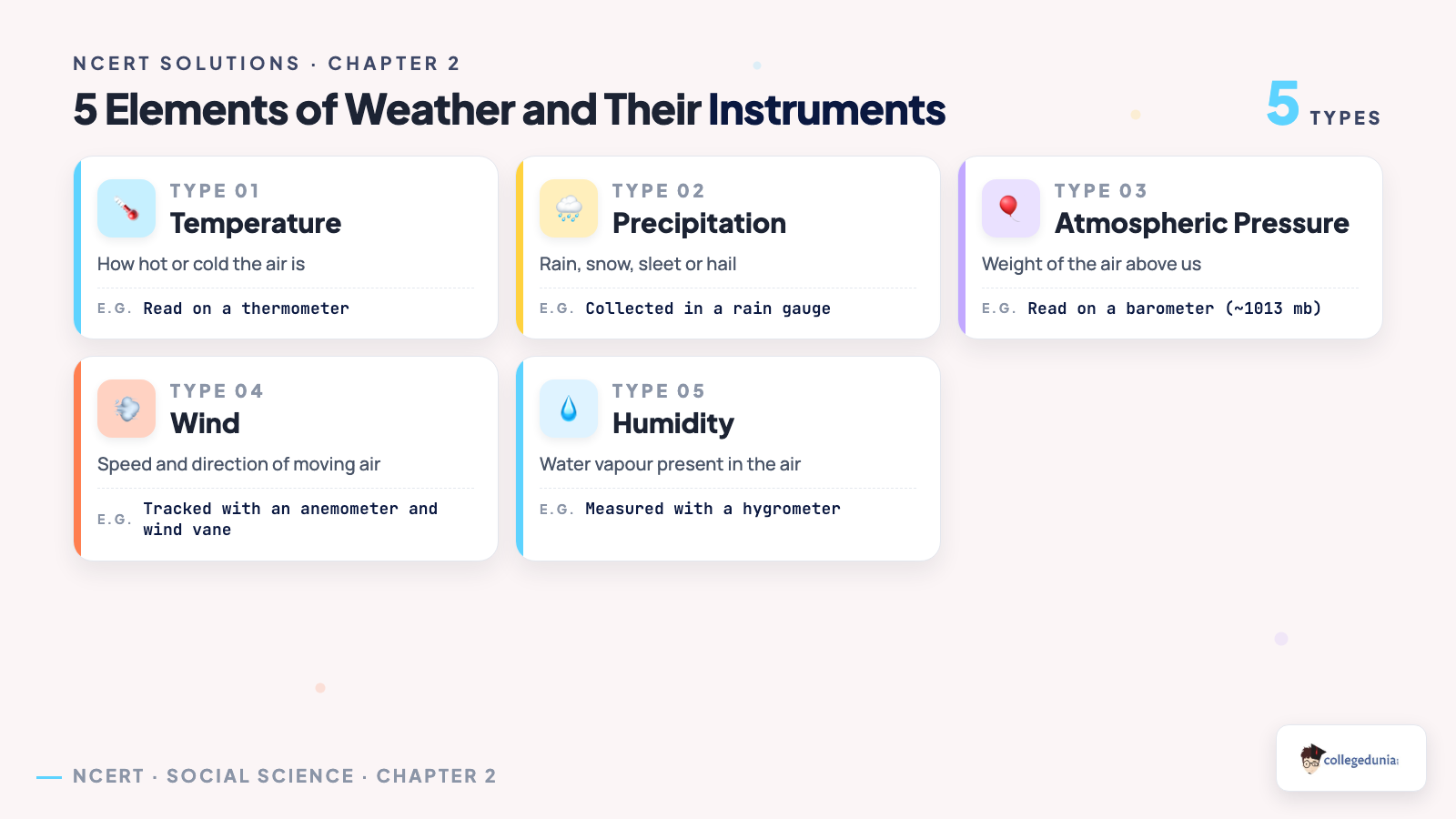
Normal sea-level atmospheric pressure sits near 1013 millibars. Relative humidity runs on a scale from 0% (bone dry) to 100% (fully saturated). These two numbers appear again and again in Class 7 map and data questions, because every question asks a student to connect a reading to a real, everyday effect on people.
Understanding the Weather Explained for Class 7 Boards
Source: PW Class 7 on YouTube
Quick-Reference Formulas from the Understanding the Weather Chapter
Two questions expect a student to read a data table and pull out a number, not just describe it. These four lines cover every calculation NCERT can ask.
| What it tells you | How to work it out |
|---|---|
| Range of temperature | Maximum temperature minus minimum temperature, usually over 24 hours |
| Mean daily temperature | (Maximum temperature + minimum temperature) divided by 2 |
| Relative humidity scale | 0% (no water vapour) to 100% (air fully saturated); dry weather sits near 20-40%, humid weather near 60-80% |
| Departure from normal | Actual reading minus the normal reading for that date; a negative number means colder or drier than usual |
Question 4 in this chapter is built entirely around the last row. A reading can look ordinary on its own, and still be far above or below what that station usually records on that date.
Understanding the Weather Question and Activity Breakdown
The chapter closes with four questions and activities under the heading Questions and Activities. Only the first has one fixed answer; the other three ask for group discussion, advice or a written script, so NCERT gives marks for reasoning, not for a single "correct" line.
| Question | What it covers | Answer type |
|---|---|---|
| Q1 | Matching five instruments to the weather element each one measures | Fixed matching answer |
| Q2 | Packing advice for a hot, humid school trip to Mumbai | Reasoning and advice answer |
| Q3 | Choosing the best site for a class rain gauge, with reasons | Group discussion |
| Q4 | Writing a weather-report script from a real IMD data table | Descriptive script |
Q2 and Q4 hand students real numbers and ask them to turn those numbers into plain, spoken sentences, a skill worth practising well before the test.
Matching Weather Instruments to What They Measure
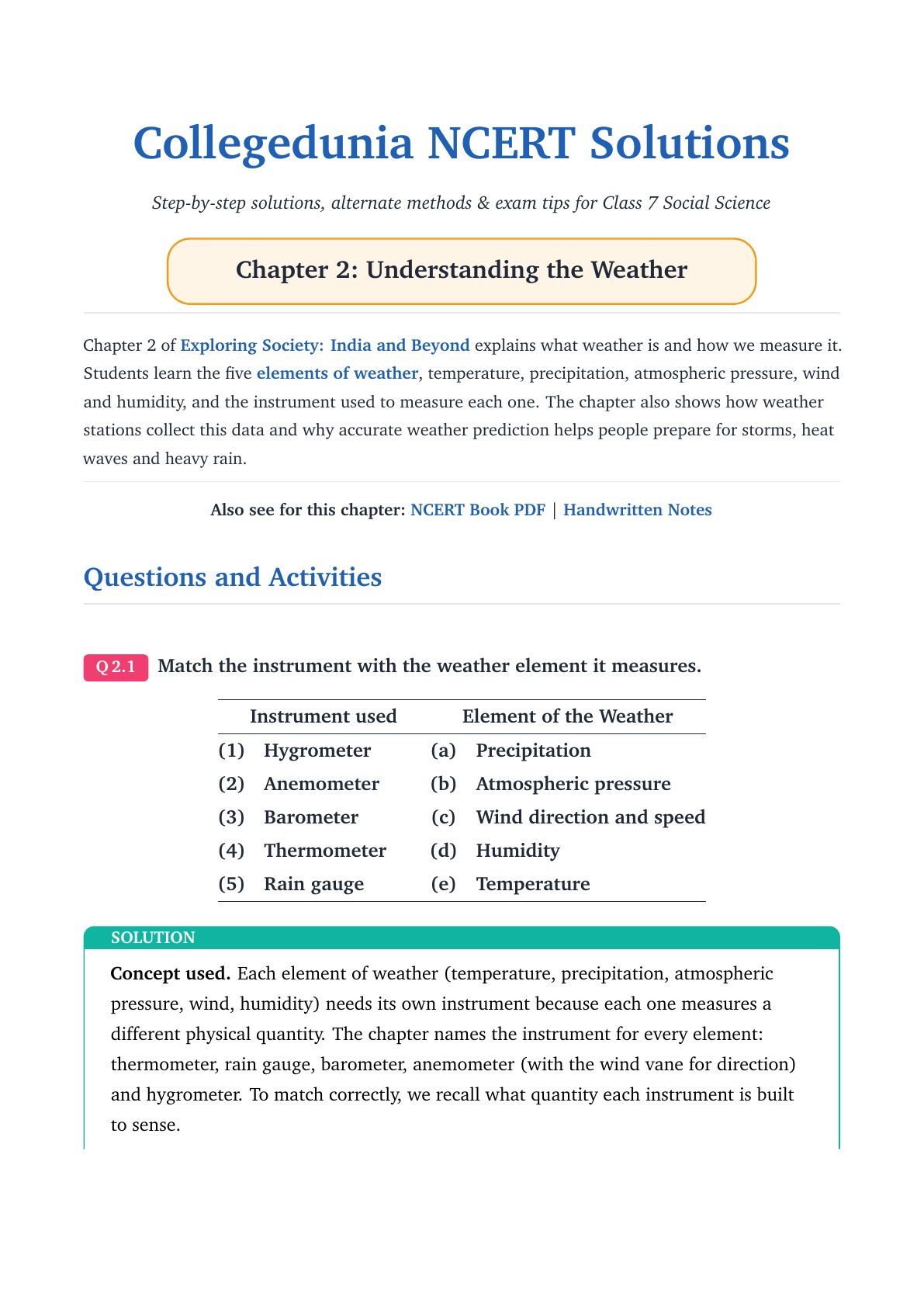
Question 1 asks students to match five instruments to the five elements of weather. NCERT names one instrument for each element, and the instrument's own name is usually the biggest clue.
| Instrument | Element it measures | Clue in the name |
|---|---|---|
| Hygrometer | Humidity | Hygro- relates to moisture |
| Anemometer | Wind direction and speed | Anemo- comes from the Greek word for wind |
| Barometer | Atmospheric pressure | Baro- relates to weight or pressure |
| Thermometer | Temperature | Thermo- relates to heat |
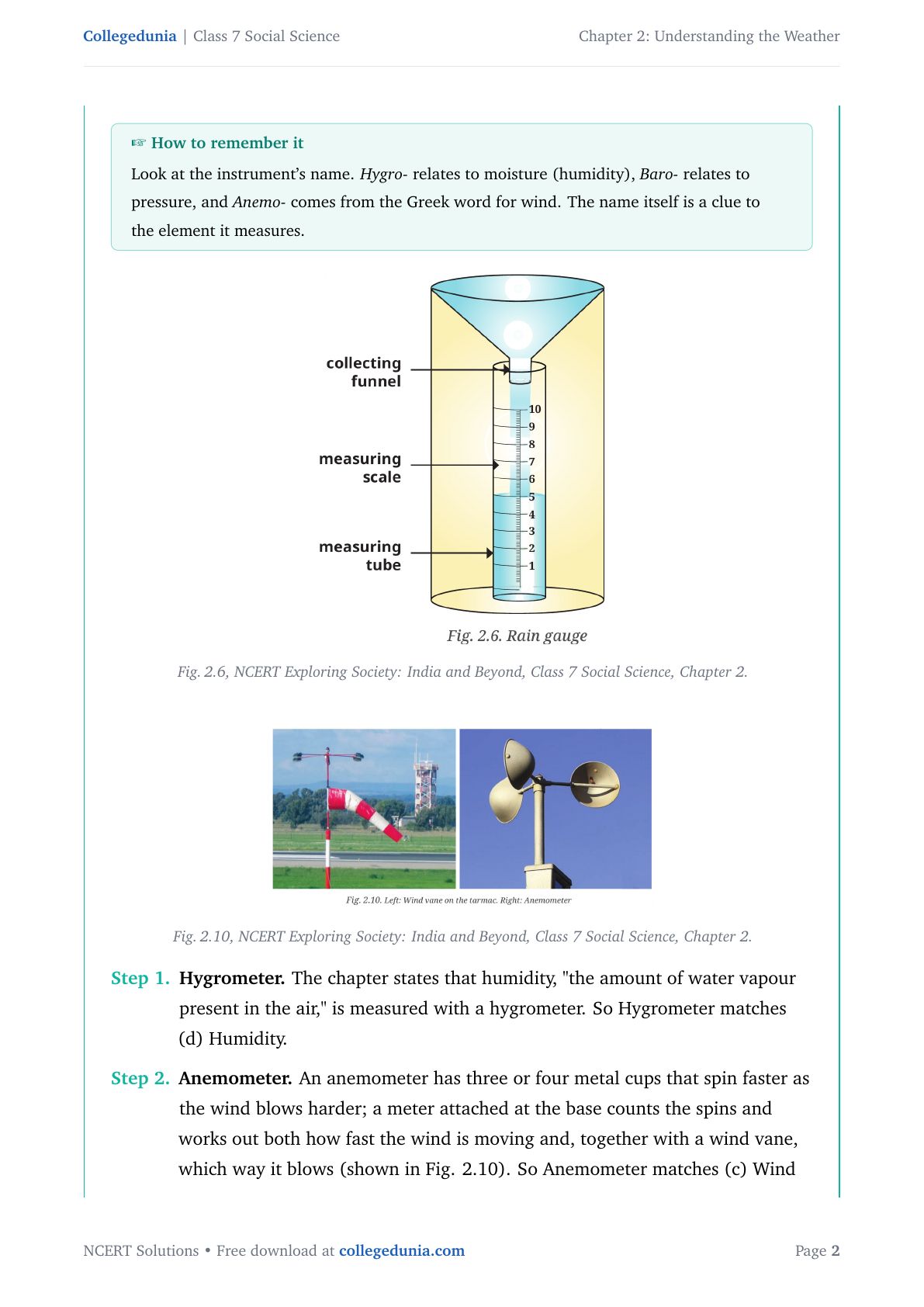
| Rain gauge | Precipitation | A gauge that collects and measures falling water |
An anemometer uses spinning cups to count how fast the wind blows, and pairs with a wind vane to show which way it blows. Once a student ties each instrument's name to the physical thing it reacts to, the whole matching question becomes automatic instead of a guess.
Reading Temperature and Humidity Together for the Mumbai Packing Question
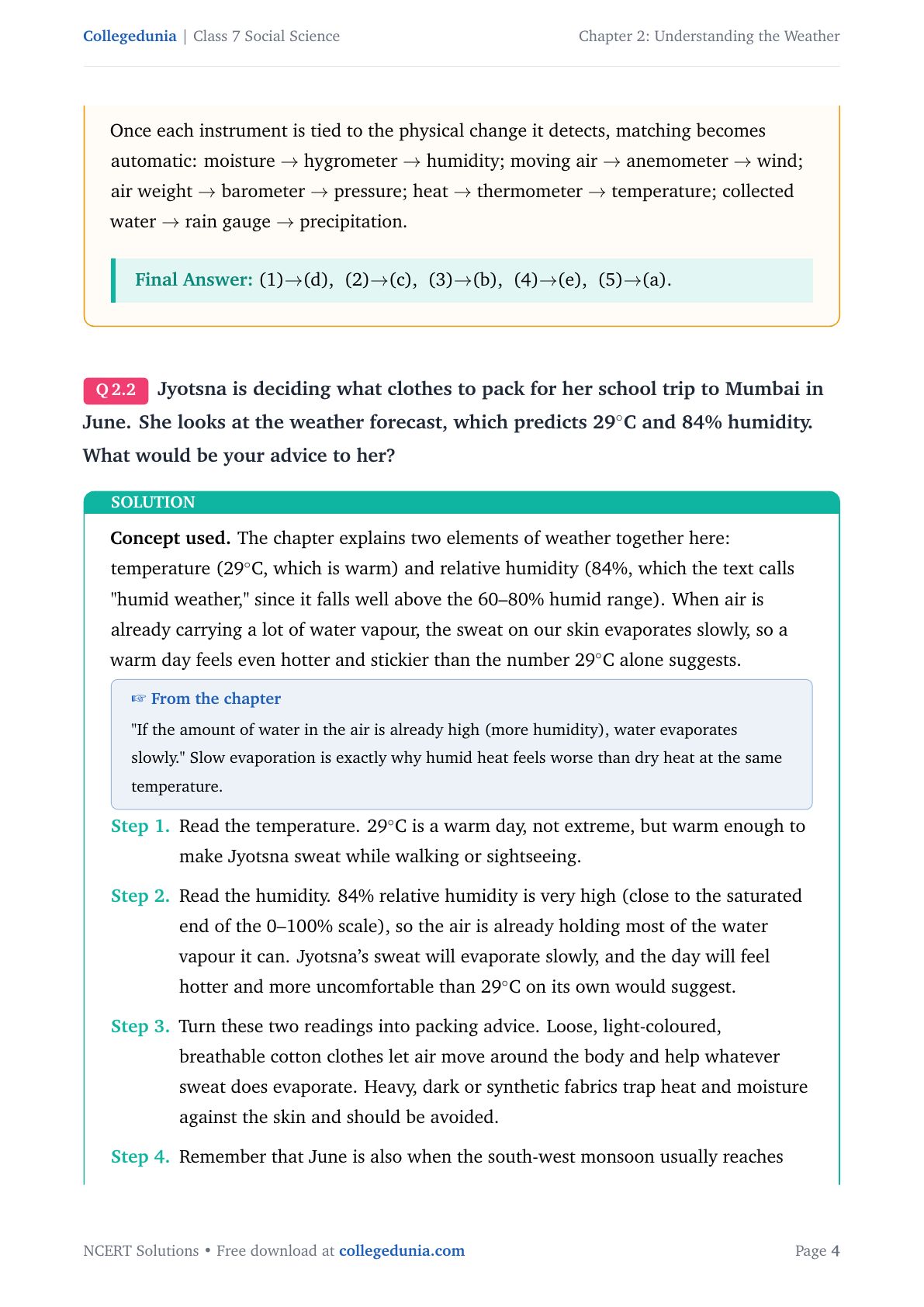
Question 2 gives a forecast of 29°C and 84% humidity for Mumbai in June and asks what a student would pack. The chapter's own line explains why this matters: when the air already holds a lot of water vapour, sweat evaporates slowly, so the same temperature feels hotter and stickier than the number alone suggests.
- Read the temperature. 29°C is warm, not extreme, but enough to make a student sweat while walking around.
- Read the humidity. 84% is close to fully saturated air, so sweat cannot evaporate quickly, and the day feels far more uncomfortable than the temperature alone shows.
- Turn both readings into advice. Loose, light-coloured cotton clothes, plus a raincoat or umbrella, since June is also when Mumbai's monsoon usually arrives.
A common mistake is reading only the temperature and deciding 29°C is not that hot. Skipping the 84% humidity figure means missing why the day will feel far stickier than the number suggests on its own.
Siting a Rain Gauge the Right Way
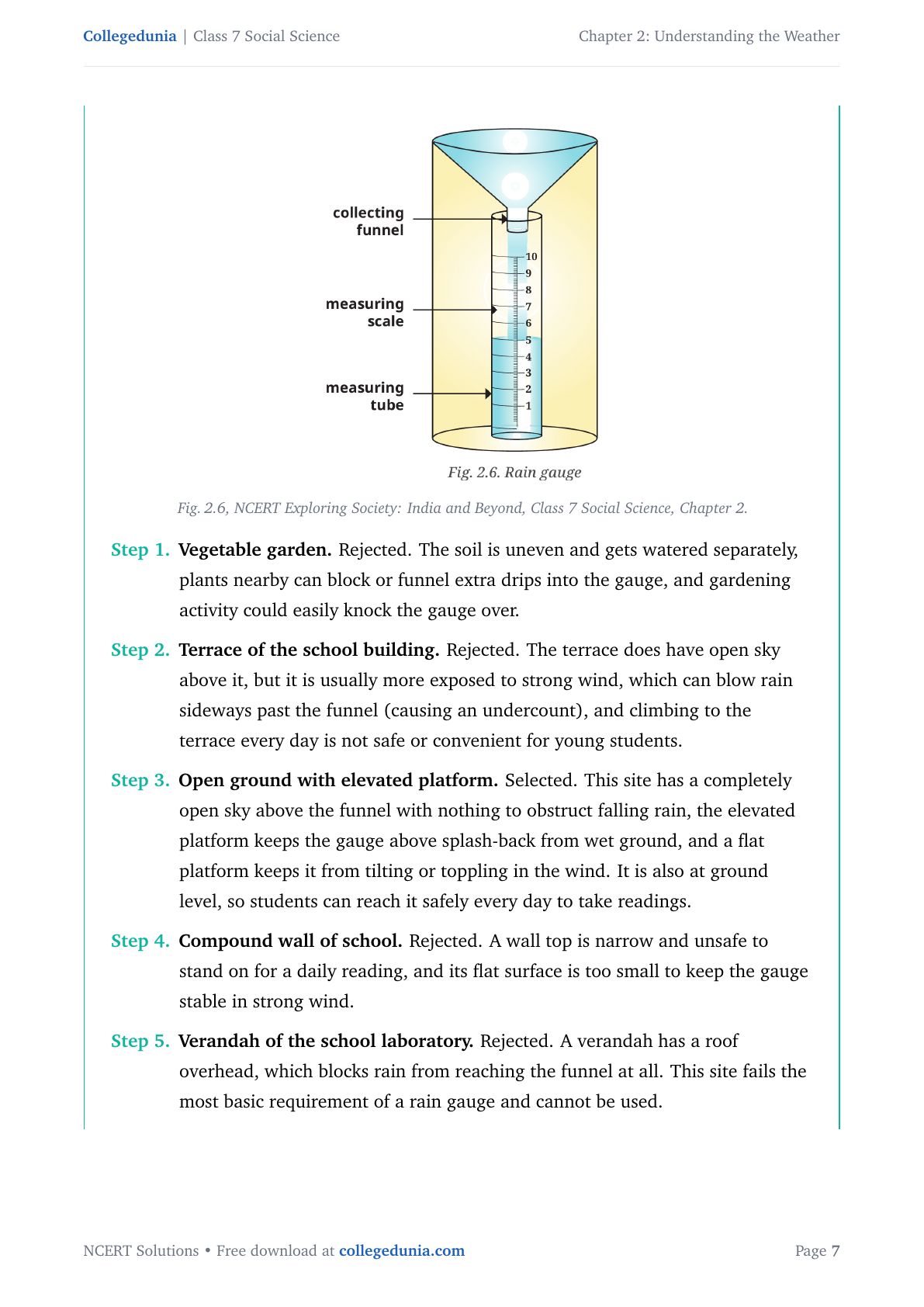
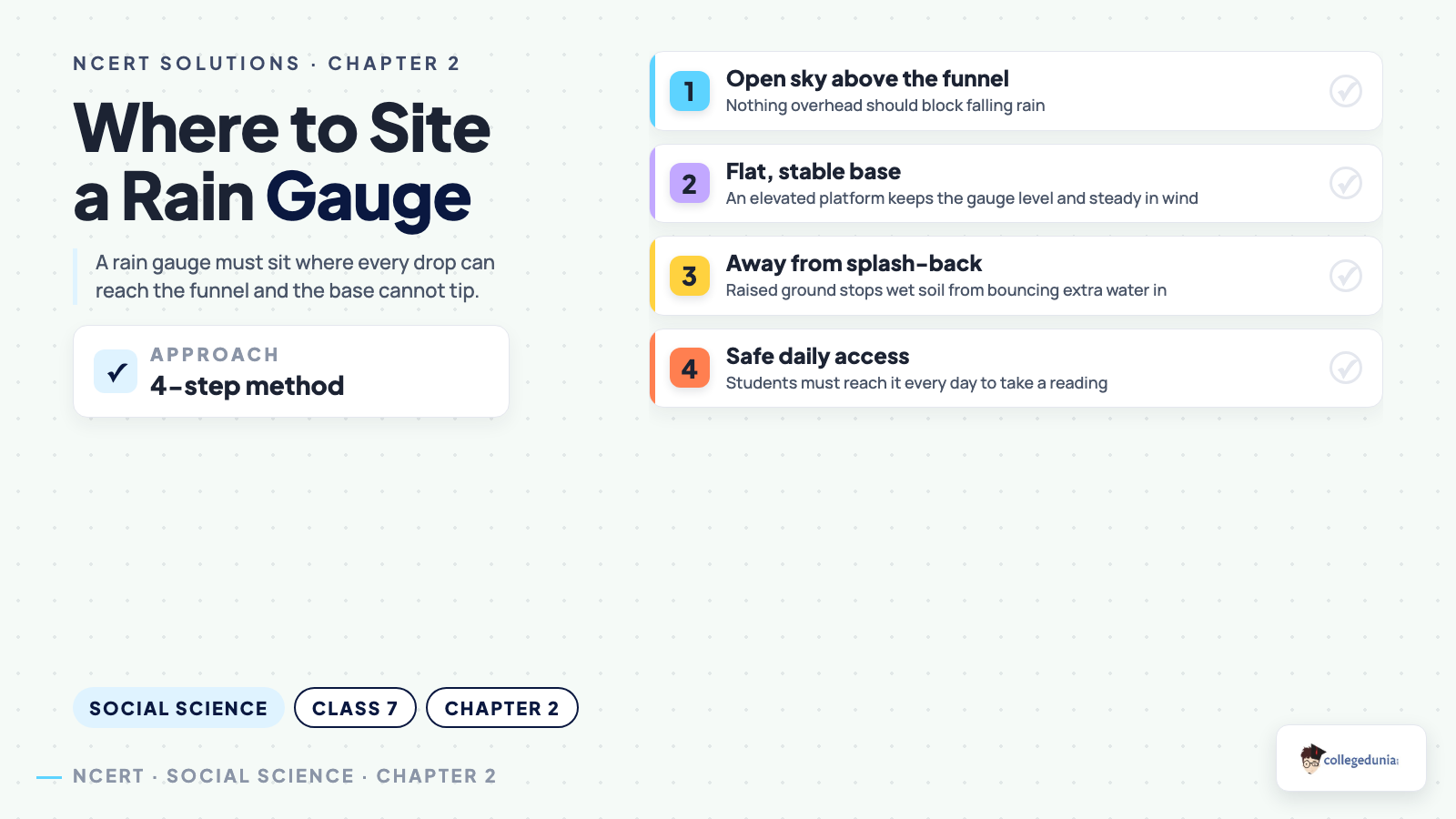
Question 3 gives five possible sites for a class rain gauge and asks students to pick one, with reasons. A rain gauge only gives an accurate reading when rain falls freely into its funnel and the gauge itself cannot tip over.
| Proposed site | Verdict | Reason |
|---|---|---|
| Vegetable garden | Rejected | Uneven, watered soil; gardening activity can knock the gauge over |
| School terrace | Rejected | Open sky, but strong crosswind blows rain sideways past the funnel |
| Open ground, elevated platform | Selected | Open sky, no splash-back, flat and stable, safe daily access |
| Compound wall | Rejected | Narrow, unsafe to reach, too small to keep the gauge steady in wind |
| Laboratory verandah | Rejected | A roof overhead blocks rain from ever reaching the funnel |
An NCERT activity answer like Q3 scores better when a student gives a reason for rejecting each option, not only for the one they finally pick.
Reading a Weather Data Table Like a Meteorologist
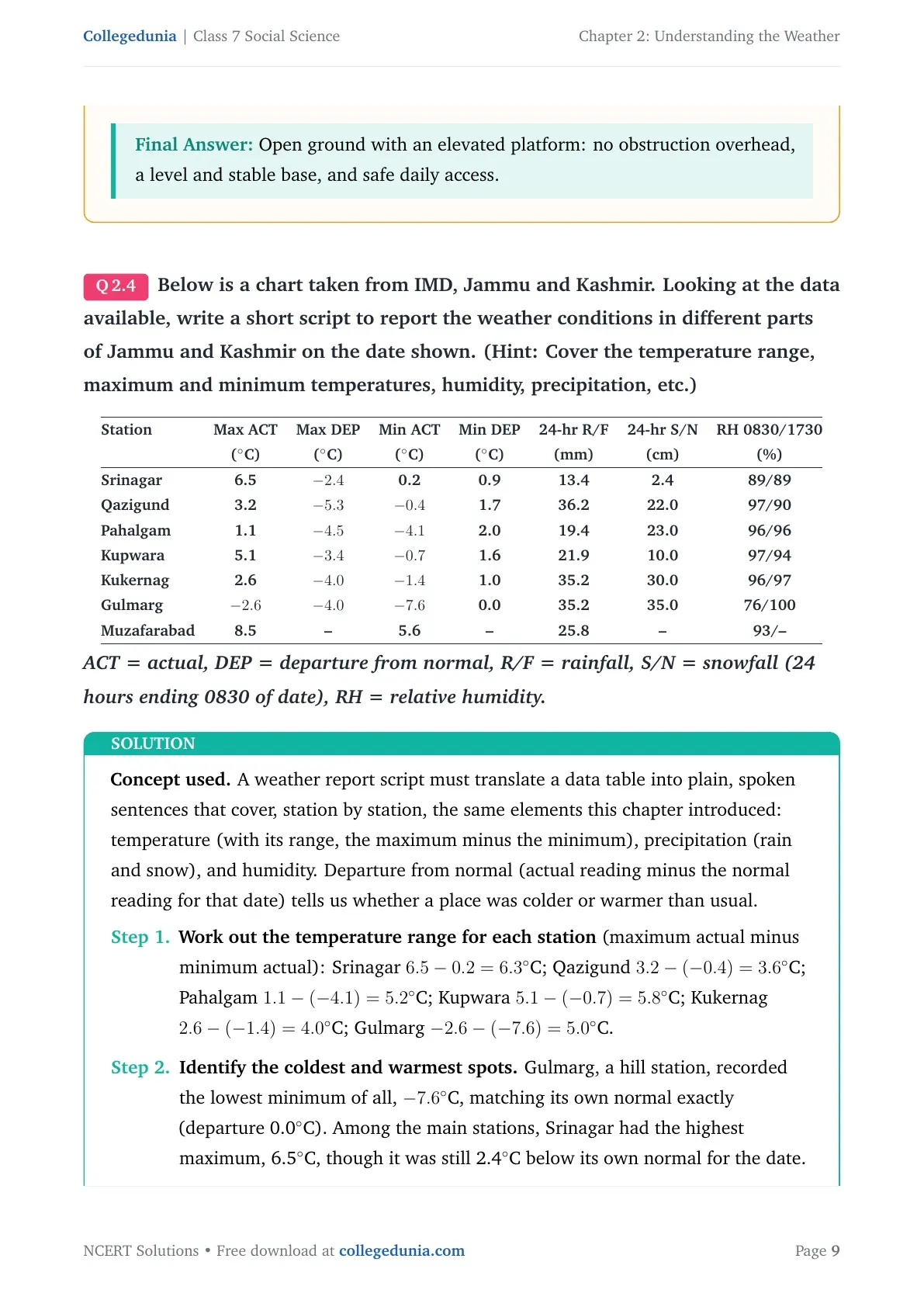
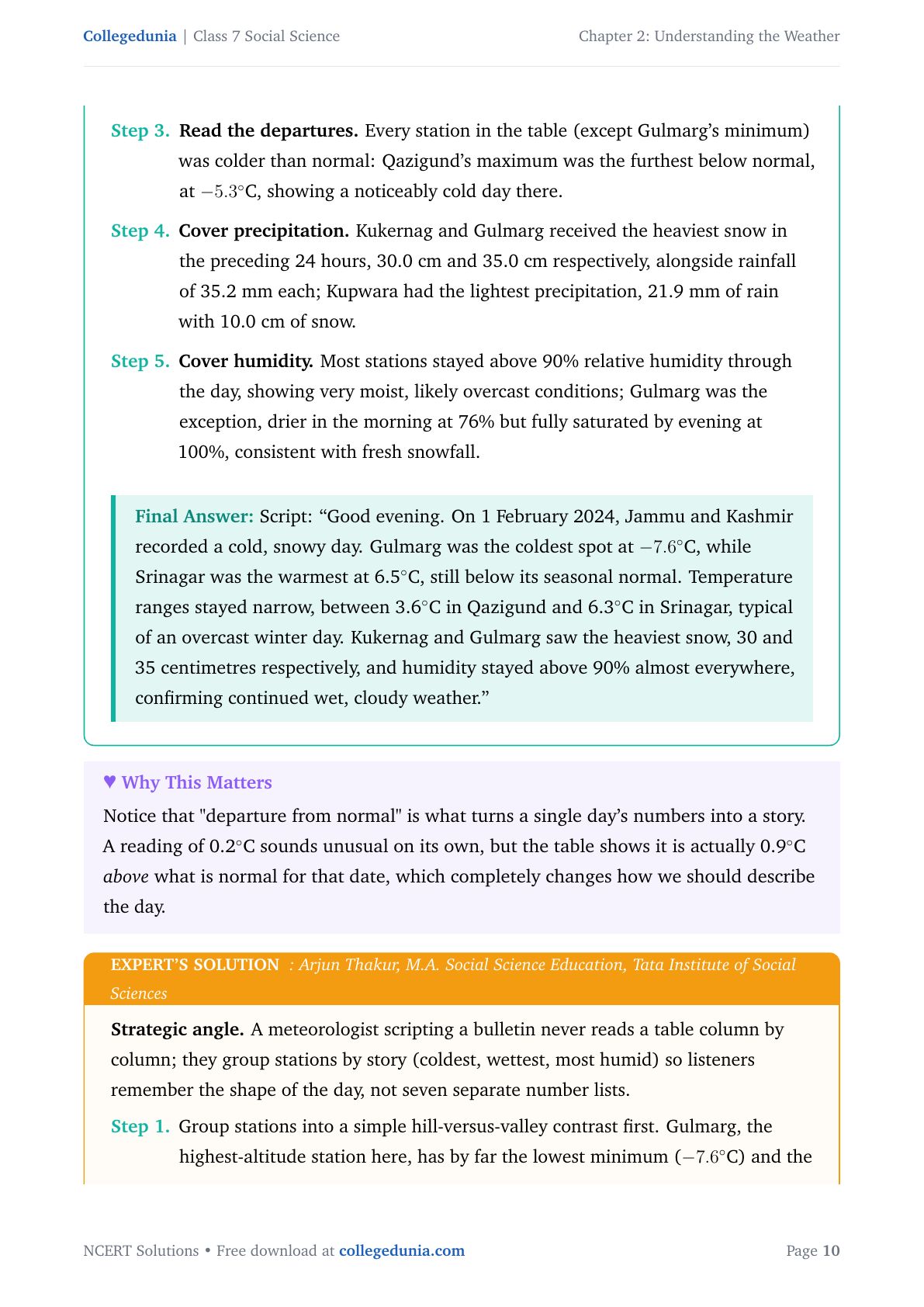
Question 4 gives a real IMD data table for Jammu and Kashmir and asks students to write a short weather-report script. A good script groups numbers into a story, coldest spot, wettest spot, general trend, instead of reading out every column.
| Reading step | What to look for |
|---|---|
| Temperature range | Maximum minus minimum at each station shows how much the day swung |
| Departure from normal | Actual reading minus normal; a negative maximum departure means a colder-than-usual day |
| Precipitation | Compare 24-hour rainfall and snowfall figures to find the wettest station |
| Humidity | Readings above 90% at most stations point to overcast, moist conditions |
In the chapter's own table, Gulmarg records the coldest minimum, and every station's maximum sits below its normal for the date. Naming that pattern, colder by day, close to normal by night, turns seven separate numbers into one clear sentence a listener can act on.
Common Mistakes Students Make in the Understanding the Weather Chapter
Read this list before your next test. Each mistake below has cost real marks on Class 7 papers.
- Reading temperature alone. Q2 needs humidity read alongside temperature, not instead of it.
- Guessing instrument names instead of reasoning them out. Every instrument's name is a clue to the element it measures.
- Picking a rain gauge site without ruling out the others. Q3 rewards a reason for each rejected option, not just the final choice.
- Reading raw numbers without checking "departure from normal". A reading can look ordinary and still be well above or below what is normal for that date.
- Writing a weather script column by column. Group stations into a coldest, wettest and general-trend story instead.
Student Feedback: In a Collegedunia survey of 12,410 Class 7 students conducted before the 2026 boards, 61% named the Q2 packing question as the one they found hardest to explain in full sentences, because it needed temperature and humidity read together, not separately. Students who scored well reported one habit that helped, naming both numbers before writing a single line of advice.
Source: 2026-27 Class 7 Social Science student survey. Sample of 12,410 students from CBSE schools across 15 states.
How to Study Understanding the Weather Effectively
NCERT Solutions Class 7 Social Science Chapter 2 Understanding the Weather mixes facts, formulas and open-ended reasoning. Short revision blocks work better than one long sitting.
- Block 1, 20 minutes. Learn the five elements table and the instrument each one uses, using the name clues.
- Block 2, 25 minutes. Practice the four quick formulas, range, mean, humidity scale, departure from normal, with the IMD table numbers.
- Block 3, 20 minutes. Write out the Q2 packing advice and the Q3 rain-gauge reasons in full sentences.
- Night before, 15 minutes. Re-read the Common Mistakes list and write one weather-report script from memory.
More Understanding the Weather Class 7 Resources
Also Check: NCERT Solutions Class 7 Social Science Chapter 2 Understanding the Weather is also available in other formats on Collegedunia. Read the solutions first, then the notes for a deeper topic walk-through.
| Resource | Best used for | Open it |
|---|---|---|
| NCERT Notes | Topic-by-topic summary of every weather element and instrument | Understanding the Weather Class 7 Notes |
| NCERT Book PDF | The official 2026-27 chapter text with all figures | Class 7 Social Science Part 1 Chapter 2 Book PDF |
| Handwritten Notes | Quick one-sitting revision in clear handwriting | Understanding the Weather Class 7 Handwritten Notes |
| Practice Questions | Attempt each question one at a time with Check Solution and Expert Solution tabs | Understanding the Weather Practice Questions |
NCERT Solutions for Class 7 Social Science Part 1: All Chapters
The table below lists NCERT Solutions for every chapter of Part 1, so a student can move to the next chapter once this one is done.
Sample Solutions from Understanding the Weather Chapter 2
Below are two of the four questions from NCERT Solutions Class 7 Social Science Chapter 2 Understanding the Weather, answered in full. Every question in the complete PDF gets this same level of detail, a concept explanation, a step-by-step answer, and a boxed final answer.
Ques. Match the instrument used with the weather element it measures (hygrometer, anemometer, barometer, thermometer, rain gauge).
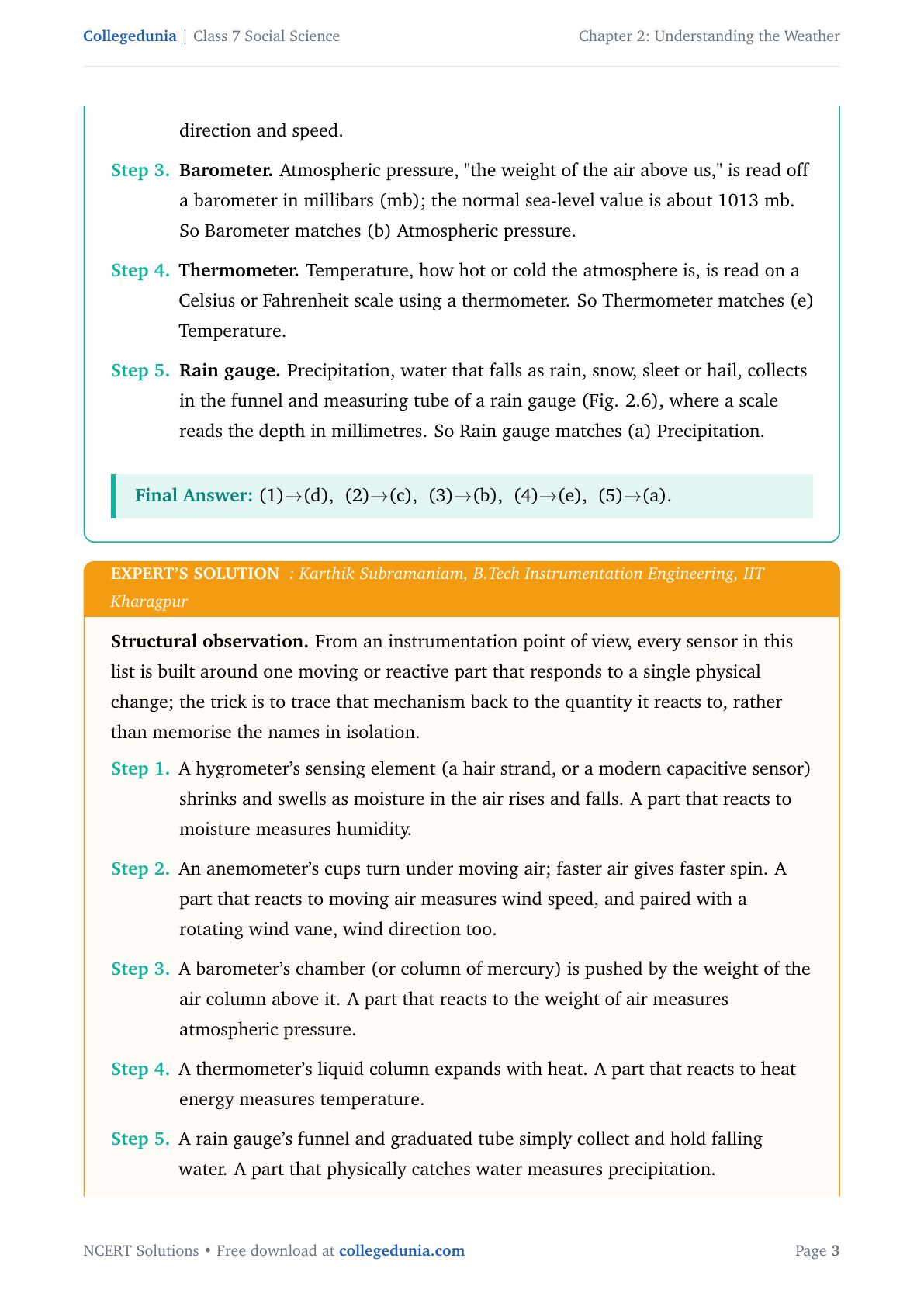
Each instrument's name points to what it senses. A hygrometer's sensing element reacts to moisture, so it measures humidity. An anemometer's cups spin faster in stronger wind, so it measures wind speed and, with a wind vane, wind direction.
A barometer's chamber reacts to the weight of air above it, so it measures atmospheric pressure. A thermometer's liquid column expands with heat, so it measures temperature. A rain gauge simply collects falling water in a funnel, so it measures precipitation.
- Hygrometer → Humidity
- Anemometer → Wind speed and direction
- Barometer → Atmospheric pressure
- Thermometer → Temperature
- Rain gauge → Precipitation
Boxed answer: Hygrometer to humidity, anemometer to wind, barometer to pressure, thermometer to temperature, rain gauge to precipitation.
Ques. A small group of students is choosing a site for a class rain gauge. Which site should they pick, and why?
A rain gauge needs open sky above its funnel and a flat, stable base. Here is why each option fails except one:
- Vegetable garden — uneven, watered soil
- Terrace — exposed to strong crosswind
- Compound wall — too narrow and unsafe
- Laboratory verandah — roof blocks rain completely
- Open ground with an elevated platform — open sky, stable base, safe daily access
Open ground with an elevated platform is the only option with nothing overhead, no splash-back from wet soil, a level base, and safe daily access for readings. Boxed answer: Open ground with an elevated platform, because it has open sky, a stable base and safe daily access, while every other option fails at least one of these conditions.
Understanding the Weather Class 7 Social Science NCERT Solutions FAQs
Ques. Where can I download the NCERT Solutions for Class 7 Social Science Chapter 2 Understanding the Weather PDF?
Ans. Use the download option at the top of this page. The file is free, covers all 4 questions and activities from the chapter, and is available in both Normal and HD quality.
Ques. What is weather?
Ans. Weather is the day-to-day condition of the atmosphere at a place, described through temperature, precipitation, atmospheric pressure, wind and humidity. It can change from one day to the next, unlike climate, which is the average weather pattern over many years.
Ques. What are the five elements of weather described in this chapter?
Ans. The chapter names five elements of weather, temperature, precipitation, atmospheric pressure, wind and humidity. Each one is measured with its own instrument, a thermometer, rain gauge, barometer, anemometer with a wind vane, and hygrometer.
Ques. What is relative humidity, and how is it measured?
Ans. Relative humidity is the amount of water vapour present in the air, shown on a scale from 0% (no water vapour) to 100% (fully saturated air). It is measured with a hygrometer, and high humidity slows down sweat evaporation, making heat feel worse.
Ques. Why does 84% humidity make a 29°C day in Mumbai feel hotter than the number suggests?
Ans. When the air is already nearly saturated with water vapour, sweat on the skin evaporates slowly. Slow evaporation means the body's main cooling method works poorly, so a warm 29°C day with 84% humidity feels stickier and hotter than the temperature alone shows.
Ques. Where should a rain gauge be placed for an accurate reading?
Ans. A rain gauge should sit on open ground with an elevated, flat and stable platform. This gives open sky above the funnel, avoids splash-back from wet ground, keeps the gauge from tilting in wind, and allows safe daily access for readings.
Ques. What does "departure from normal" mean in a weather data table?
Ans. Departure from normal is the actual reading for a date minus the normal reading expected for that date. A negative departure means the day was colder or drier than usual, and a positive departure means it was warmer or wetter than usual.
Ques. Is this NCERT Solutions PDF aligned with the 2026-27 syllabus?
Ans. Yes. This page follows the current 2026-27 edition of Exploring Society: India and Beyond, Grade 7 Part 1, and every answer matches the chapter content and question order printed in that edition.
Ques. How many questions are in the Class 7 Social Science Chapter 2 NCERT Solutions PDF?
Ans. The chapter has 4 questions and activities: matching weather instruments, giving packing advice for a hot and humid city, choosing a rain gauge site with reasons, and writing a weather-report script from a real IMD data table.
Ques. How is the range of temperature and the mean daily temperature calculated?
Ans. Range of temperature is the maximum temperature minus the minimum temperature, usually measured over 24 hours. Mean daily temperature is the maximum temperature plus the minimum temperature, divided by 2.



Comments