



5 to 7 marks in the Class 7 Social Science paper come from New Beginnings: Cities and States, the chapter that opens ancient Indian history in Exploring Society: India and Beyond. The NCERT Solutions below cover all 4 questions and activities on the Second Urbanisation, the mahajanapadas and Kautilya's Arthashastra for the 2026-27 session.
- Question coverage: All 4 questions and activities: Kautilya's Arthashastra, early republics, historical sources and iron metallurgy.
- Exam weight: These reasoning answers carry 5 to 7 marks in the annual paper.
- Also on this page: a Kautilya's-checklist image, a monarchy-vs-republic image, and links to the Notes and Book PDF.
Every NCERT solution for Class 7 Social Science Chapter 4 New Beginnings: Cities and States in this Collegedunia compilation is curated by subject experts, checked against the 2026-27 rationalised NCERT print, and written in the plain language a Class 7 student actually needs.
Want the full worked answers, one question at a time? Open the dedicated question bank below for step-by-step solutions to every question and activity in New Beginnings: Cities and States, each with a concept explanation, an Expert's Solution and a boxed final answer.
View All Step-by-Step Solutions for New Beginnings: Cities and States
Why New Beginnings: Cities and States Matters for Class 7 Social Science
This chapter moves Class 7 Social Science, Exploring Society: India and Beyond, Part 1, into ancient Indian history: how city life returned a thousand years after the Harappan cities faded, and how small clan-territories grew into large, organised states.
NCERT tests whether a student can explain why cities and states rose again in the 1st millennium BCE, which is exactly what NCERT Solutions Class 7 Social Science Chapter 4 New Beginnings: Cities and States walks through for every question.
| Concept | What it means | Why it matters |
|---|---|---|
| Second Urbanisation | The 1st millennium BCE revival of city life in the Ganga plains, a thousand years after Harappan cities faded | Explains why India's ancient history has two separate city-building phases, not one continuous one |
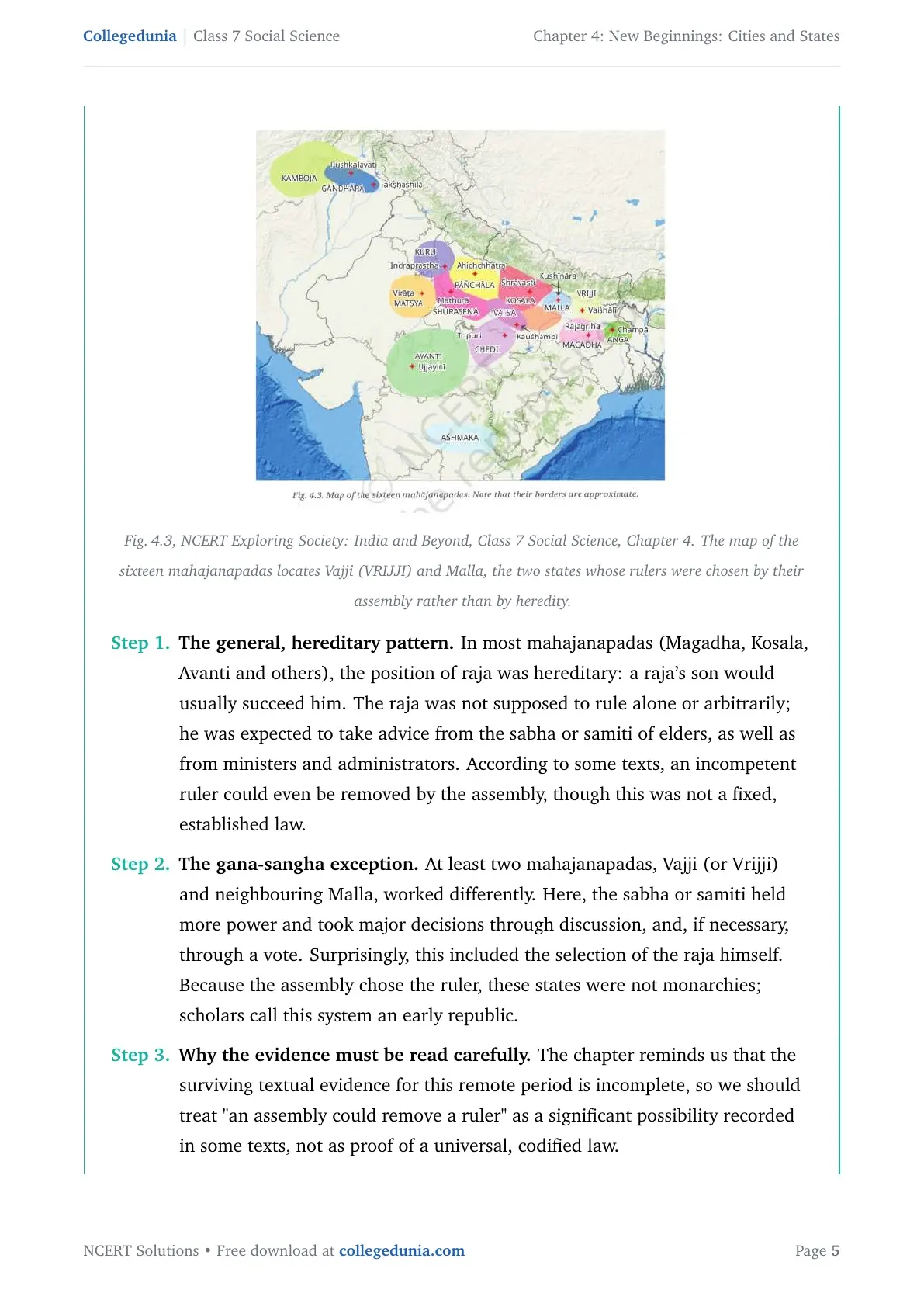
| Janapada vs mahajanapada | A janapada is a small clan-territory; several merged into a larger mahajanapada by the 8th-7th century BCE | Shows how sixteen large states came to dominate northern and central India |
| Sabha / samiti | Clan assemblies first named in the Vedas; advised the raja, or in gana-sanghas like Vajji and Malla, chose him | Reveals that early India had both hereditary monarchies and elected republics |
| Varna-jati system | Jati is an occupation-based community; varna is the four-fold Vedic category, Brahmin, Kshatriya, Vaishya, Shudra | Organised labour and status in the growing cities of this period |
Most Class 7 papers build a long answer around Kautilya's Arthashastra or the sabha/samiti system. Naming the exact term, not describing it in general words, earns full marks.
New Beginnings: Cities and States Explained for Class 7 Boards
Source: Magnet Brains on YouTube
New Beginnings Question and Activity Breakdown
The chapter closes with four questions under Questions and Activities. Each asks for reasoning, comparison or evidence, not a single fixed fact, so NCERT rewards structure over a one-line reply.
| Question | What it covers | Answer type |
|---|---|---|
| Q1 | Kautilya's Arthashastra quotation, and comparing its recommendations with today | Group discussion, long reasoning answer |
| Q2 | How rulers were chosen in early Vedic society and the mahajanapadas | Long reasoning answer |
| Q3 | Sources historians use to study the mahajanapadas | Applied, source-analysis answer |
| Q4 | Why iron metallurgy mattered for the growth of urbanism | Reasoning answer using text and own knowledge |
Only four questions, but each is long-form. Teachers usually pick Q1 or Q4 for a periodic test, so practise both in full sentences first.
Kautilya's Arthashastra and What a Kingdom Needs
Q1 opens with a quotation from the Arthashastra, a treatise on statecraft by Kautilya, chief minister to the first Maurya emperor, Chandragupta Maurya. Reading it closely means picking out each recommendation and asking whether a country still needs the same thing today.
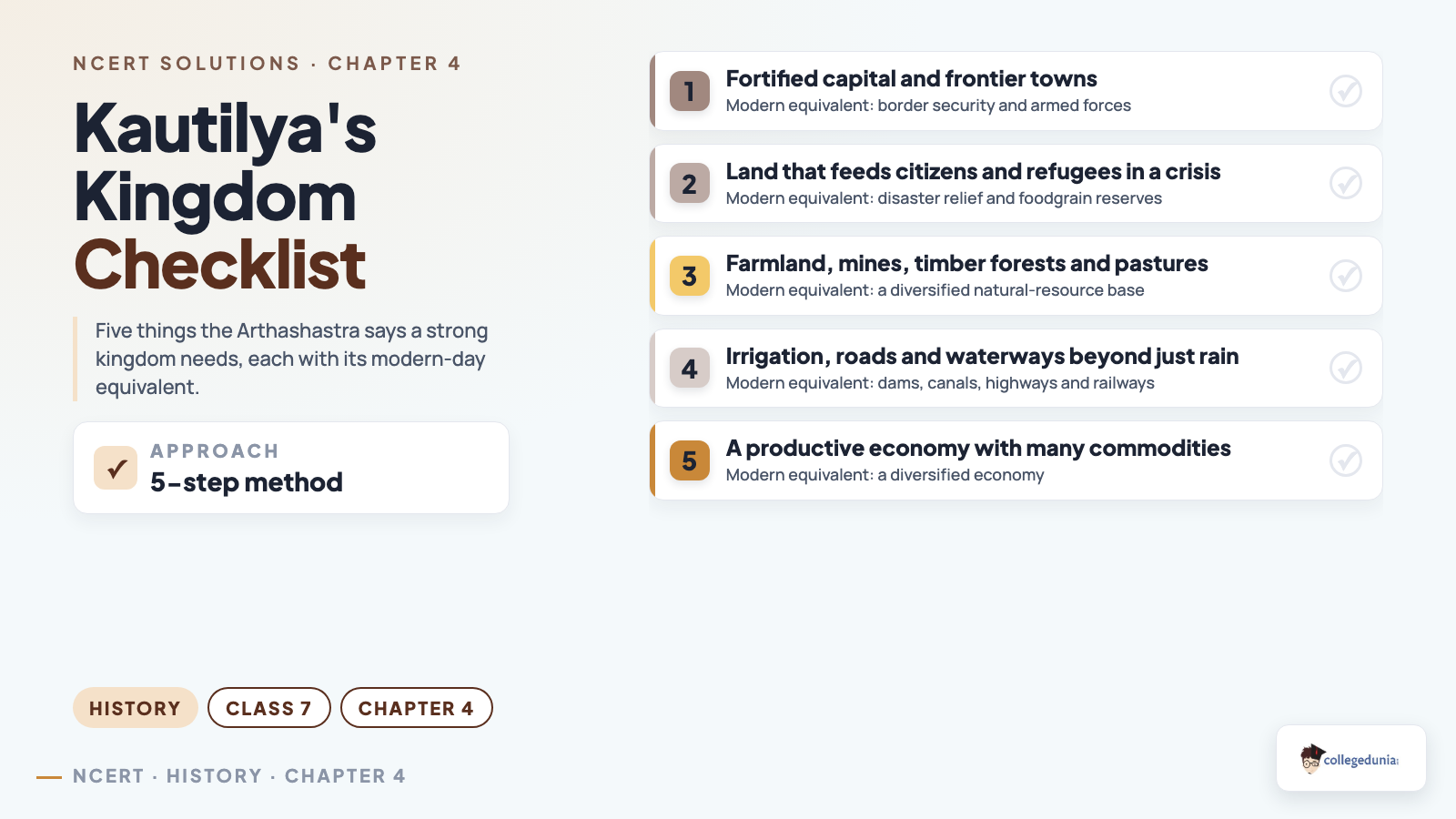
NCERT lists five features Kautilya believed a kingdom's land must have. Naming a clear modern equivalent for each one, not a vague "yes, it is still true", separates a full-mark Q1 answer from a half-mark one.
- A fortified capital and frontier towns. Today's equivalent: border security and armed forces.
- Land for citizens and outsiders in a crisis. The kingdom had to feed refugees too; today's equivalent: disaster relief and foodgrain reserves.
- Farmland, mines, forests and pastures. A mixed resource base mattered then and now, though elephants have been replaced by tanks and machinery.
- Irrigation, roads and waterways beyond rain. The ancient version of dams, canals, highways and railways.
- A productive economy with many commodities. Kautilya wanted trade in many goods, the ancient version of a diversified economy.
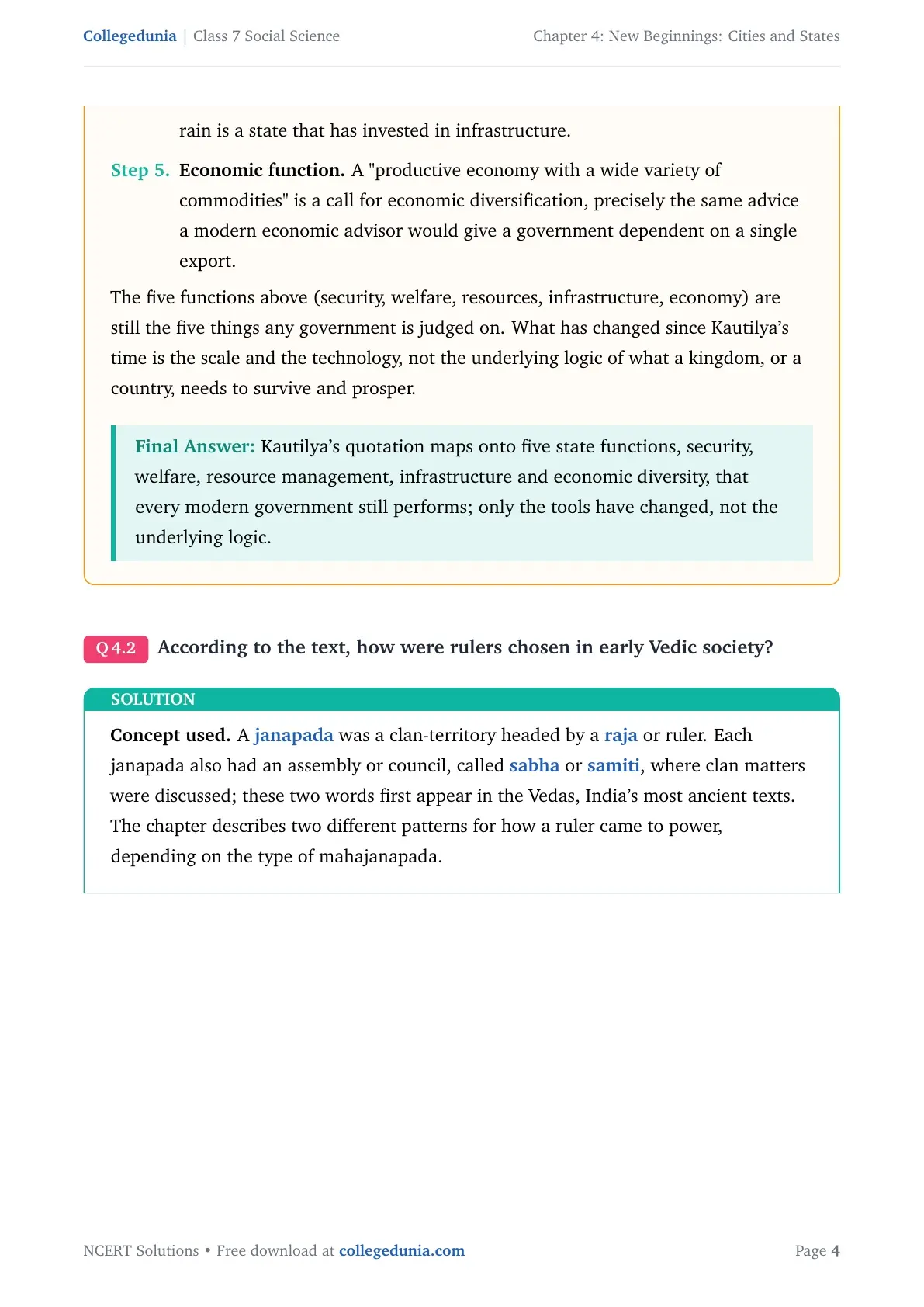
Fig. 4.1 shows the ruins of Rajagriha, capital of Magadha, exactly the fortified capital Kautilya recommends. A strong Q1 answer links each ancient point to one clear modern institution or technology.
How Rulers Were Chosen: Hereditary Rajas vs the Vajji and Malla Republics
A janapada was a clan-territory headed by a raja, with an assembly called sabha or samiti, first named in the Vedas. Q2 asks how a ruler actually came to power, and the chapter gives two different answers.
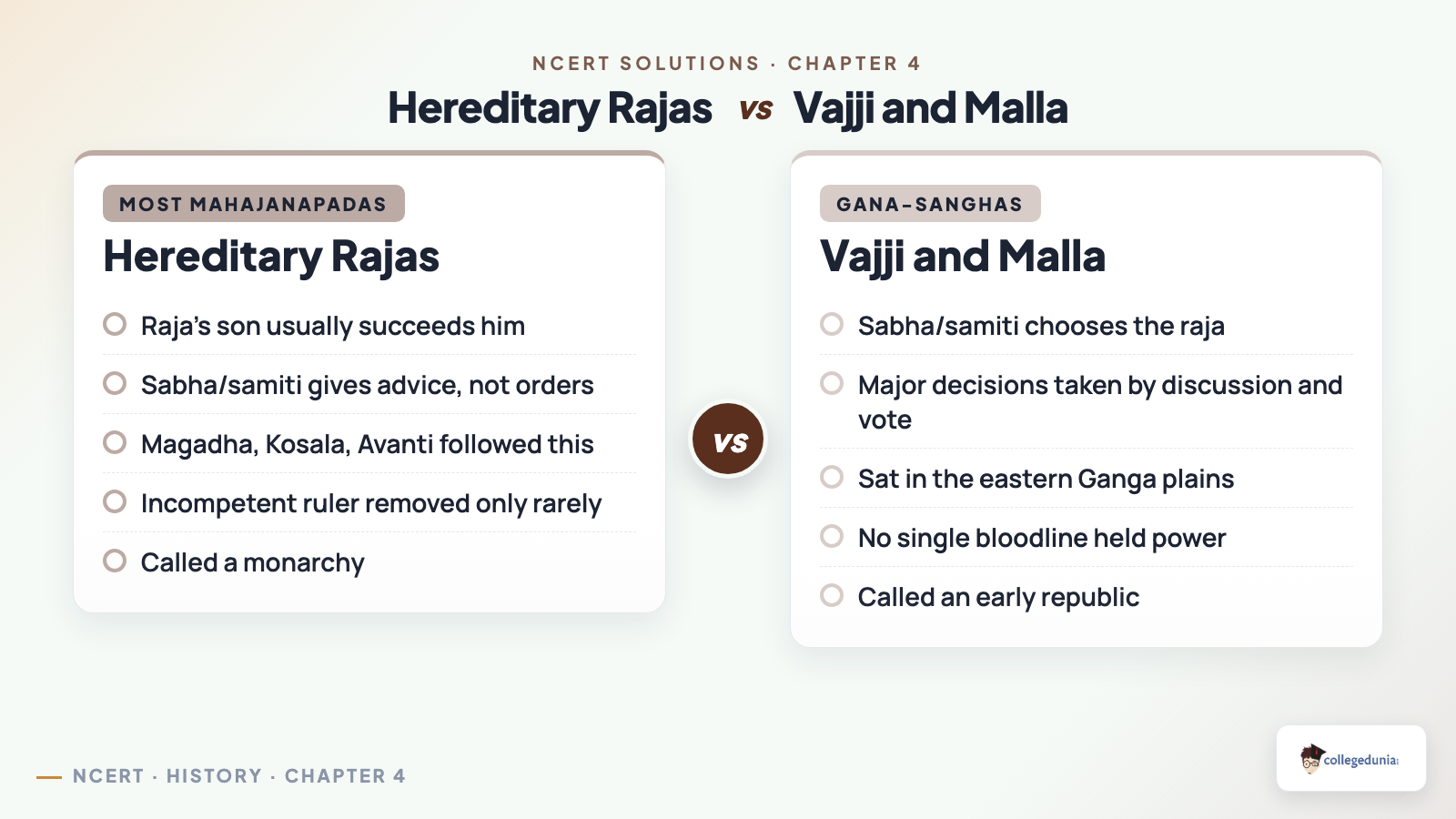
| Pattern | How it worked | Example states |
|---|---|---|
| Hereditary monarchy | Raja's son usually succeeds him; sabha/samiti only advises | Magadha, Kosala, Avanti |
| Gana-sangha (early republic) | Sabha/samiti chooses the raja through discussion and, if needed, a vote | Vajji (Vrijji) and Malla |
Surviving textual evidence for this remote period is incomplete. Treat "an assembly could remove a ruler" as a real possibility recorded in some texts, not as proof of a fixed, universal law. This caution line often separates a strong Q2 answer from an average one.
Sources Historians Use to Study the Mahajanapadas
Q3 asks students to imagine being a historian with no living witness to question. NCERT names two main kinds of evidence, archaeological remains and literary texts, and using more than one lets a historian cross-check one source against another.
- Archaeological excavations. Digging at Rajagriha and Kaushambi confirms fortified, moated cities existed exactly where texts place the mahajanapadas' capitals.
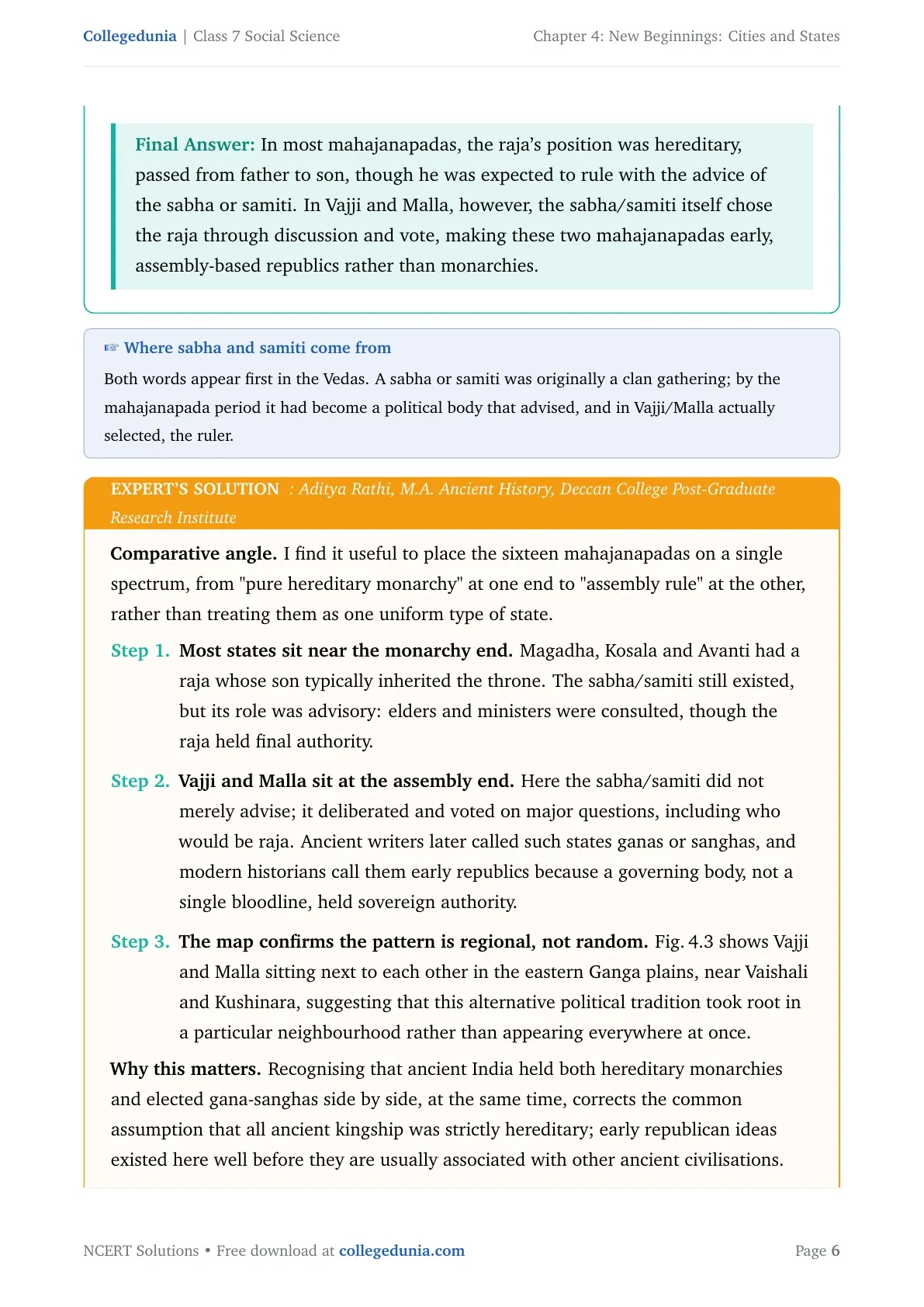
- Numismatic (coin) evidence. Punch-marked coins, first silver and later copper and gold, carry symbols showing which mahajanapada issued them and how trade crossed political boundaries.
- Literary evidence. Late Vedic, Buddhist and Jain texts name rulers, events and the frequently repeated list of sixteen mahajanapadas, detail stone and coins alone cannot supply.
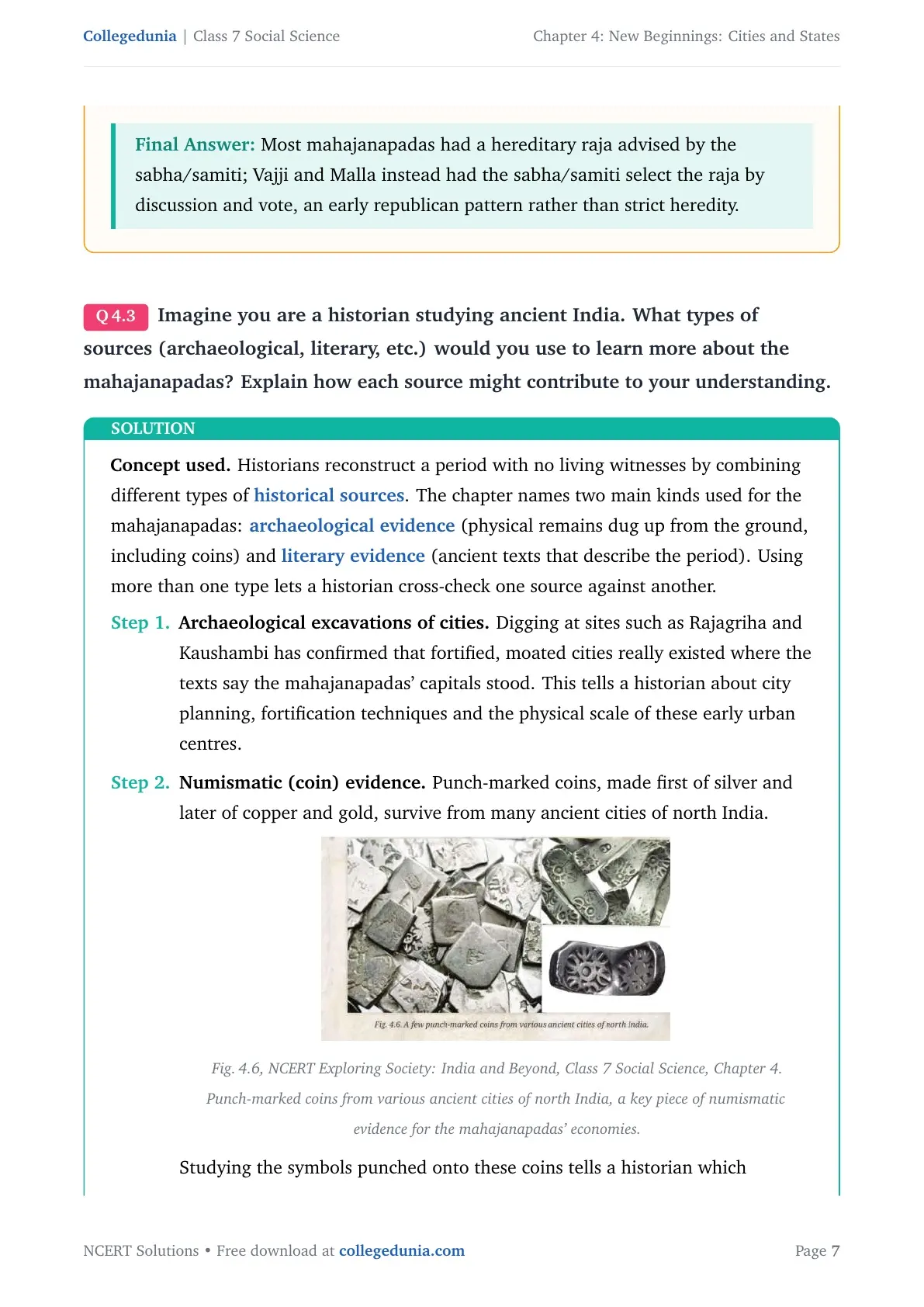
- Regional excavations beyond the Ganga plains. Southern sites such as Kodumanal, near Erode in Tamil Nadu, show shell and gemstone industries, evidence of a southern urban and trade story the northern texts barely mention.
A single coin or text can be damaged, biased or incomplete. Historians trust a conclusion more when archaeology, numismatics and literature all point the same way. A well-structured Q3 answer names all four source types and explains, in one line each, what only that evidence can show.
Why Iron Metallurgy Fuelled the Second Urbanisation
Iron metallurgy is the technology of extracting iron from ore and shaping it into tools and weapons. Urbanism needs a food surplus large enough to support non-farmers: traders, craftspeople, soldiers and rulers. Q4 asks students to connect these two ideas using the chapter and their own reasoning.
| Step in the chain | What changed |
|---|---|
| Better farming tools | Iron ploughshares and sickles hold a sharper edge than bronze, raising the food each farmer could grow |
| More food, more specialists | A food surplus could feed metalworkers, traders, priests, soldiers and rulers, the people who make up a city |
| Stronger armies | Iron weapons let smaller janapadas combine into bigger mahajanapadas by the 8th-7th century BCE |
| Bigger building projects | Durable iron tools were needed to quarry stone and shape timber for city walls and moats |
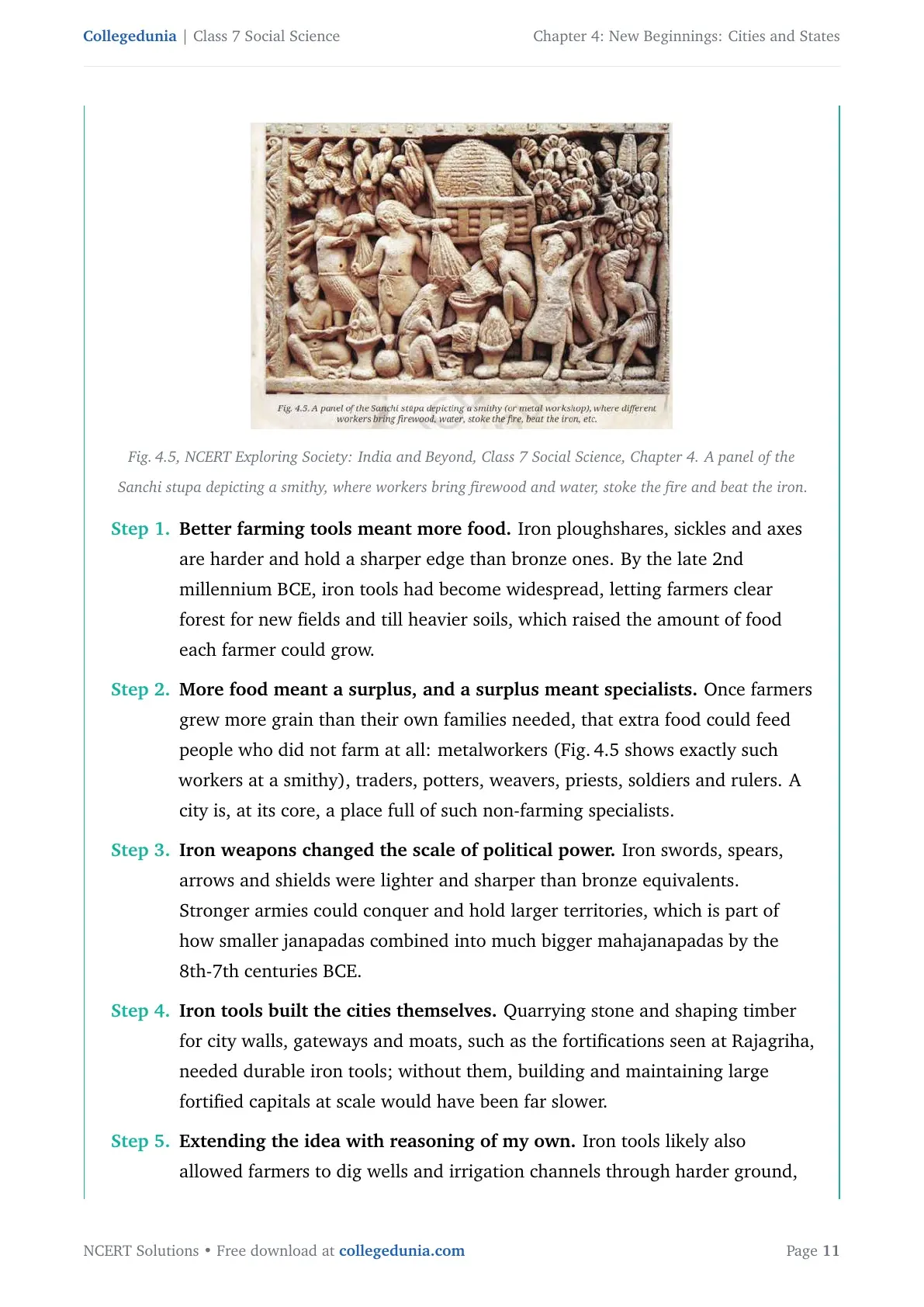
Fig. 4.5 shows a Sanchi stupa panel depicting a smithy, workers bringing firewood and water, stoking the fire and beating the iron. Better tool, more food, surplus, non-farming specialists, a city: naming this whole chain, not the technology alone, earns full marks on Q4.
Common Mistakes Students Make in the New Beginnings Chapter
Read this list before your next test. Each mistake below has cost real marks on Class 7 papers.
- Treating janapada and mahajanapada as the same thing. A janapada is a small clan-territory; several merged into one larger mahajanapada.
- Assuming every mahajanapada had a hereditary raja. Vajji and Malla had the sabha/samiti choose the ruler, an early republic pattern.
- Naming only one type of historical source for Q3, when NCERT expects archaeology, numismatics and literature together.
- Describing iron metallurgy without the food-surplus chain. Q4 expects: better tool, more food, surplus, city specialists.
- Confusing varna (the four-fold Vedic category) with jati (an occupation-based community), the two are related but not the same word.
Student Feedback: In a Collegedunia survey of 11,540 Class 7 students conducted before the 2026 boards, 58% named the hereditary-raja-versus-gana-sangha question as the hardest part of this chapter to write in full sentences. Students who scored well reported one habit that helped, naming Vajji and Malla by name in the very first line, instead of describing the assembly system in general words first.
Source: 2026-27 Class 7 Social Science student survey. Sample of 11,540 students from CBSE schools across 14 states.
How to Study New Beginnings: Cities and States Effectively
This chapter mixes definitions, reasoning and source analysis. Short revision blocks work better than one long sitting.
- Block 1, 20 minutes. Read Kautilya's five recommendations and write a modern equivalent for each from memory.
- Block 2, 25 minutes. Learn the janapada vs mahajanapada distinction, then note why Vajji and Malla differed from other states.
- Block 3, 20 minutes. List the four types of historical evidence and what each shows that the others cannot.
- Night before, 15 minutes. Re-read the Common Mistakes list and answer Q1 and Q4 from memory.
More New Beginnings Class 7 Resources
Also Check: NCERT Solutions Class 7 Social Science Chapter 4 New Beginnings: Cities and States is also available in other formats. Read the solutions first, then the notes for a deeper topic walk-through.
| Resource | Best used for | Open it |
|---|---|---|
| NCERT Notes | Topic-by-topic summary of the mahajanapadas, sabha/samiti and iron metallurgy | New Beginnings Class 7 Notes |
| NCERT Book PDF | The official 2026-27 chapter text with all figures | Class 7 Social Science Part 1 Chapter 4 Book PDF |
| Handwritten Notes | Quick one-sitting revision in clear handwriting | New Beginnings Class 7 Handwritten Notes |
NCERT Solutions for Class 7 Social Science Part 1: All Chapters
The table below lists NCERT Solutions for every chapter of Part 1, so you can move to the next chapter once this one is done.
Sample Solutions from New Beginnings Chapter 4
Below are two of the four questions from NCERT Solutions Class 7 Social Science Chapter 4 New Beginnings: Cities and States, answered in full. Every question in the complete PDF gets this same level of detail, a concept explanation, a step-by-step answer, and a boxed final answer.
- Concept used: the exact NCERT term or idea the question is testing, named upfront.
- Step-by-step answer: the reasoning broken into short, exam-ready points.
- Boxed answer: a final, one-look summary a student can revise from directly.
Ques. According to the text, how were rulers chosen in early Vedic society?
A janapada was a clan-territory headed by a raja or ruler. Each janapada also had an assembly, called sabha or samiti, first named in the Vedas. In most mahajanapadas, Magadha, Kosala, Avanti and others, the raja's position was hereditary, though he was expected to rule with the advice of the sabha or samiti.
At least two mahajanapadas, Vajji (or Vrijji) and neighbouring Malla, worked differently. Here the sabha or samiti held more power and chose the raja through discussion and, if necessary, a vote, making these two states early republics rather than monarchies.
Boxed answer: In most mahajanapadas, the raja's position was hereditary, passed from father to son, though he ruled with the sabha or samiti's advice. In Vajji and Malla, the sabha/samiti itself chose the raja through discussion and vote, an early, assembly-based republic rather than a monarchy.
Ques. Imagine you are a historian studying ancient India. What types of sources would you use to learn more about the mahajanapadas?
A historian would combine archaeological excavations of cities such as Rajagriha and Kaushambi, which confirm fortifications and city layout, with numismatic evidence, punch-marked coins that show which mahajanapada issued them and how trade crossed borders.
Literary evidence, late Vedic, Buddhist and Jain texts, supplies names, political events and the list of sixteen mahajanapadas. Regional excavations such as Kodumanal in Tamil Nadu add a southern perspective the northern texts barely mention.
Boxed answer: A historian would combine archaeological excavations, numismatic evidence from punch-marked coins, literary evidence from Vedic, Buddhist and Jain texts, and regional excavations such as Kodumanal, cross-checking each source type against the others to build a reliable picture.
New Beginnings: Cities and States Class 7 Social Science NCERT Solutions FAQs
Ques. Where can I download the NCERT Solutions for Class 7 Social Science Chapter 4 New Beginnings: Cities and States PDF?
Ans. Use the download option at the top of this page. The file is free, covers all 4 questions and activities from the chapter, and is available in both Normal and HD quality.
Ques. What is India's Second Urbanisation?
Ans. The Second Urbanisation is the revival of city life in the Ganga plains and neighbouring regions during the 1st millennium BCE, a thousand years after the earlier Harappan cities had faded.
Ques. What is the difference between a janapada and a mahajanapada?
Ans. A janapada is a small clan-territory headed by a raja. Several janapadas merged into a larger mahajanapada by the 8th-7th century BCE, and historical sources most often name sixteen such mahajanapadas.
Ques. Which two mahajanapadas were early republics, and how were their rulers chosen?
Ans. Vajji (also called Vrijji) and Malla were gana-sanghas, where the sabha or samiti chose the raja through discussion and, if necessary, a vote, rather than passing the position from father to son.
Ques. What sources do historians use to study the mahajanapadas?
Ans. Historians combine archaeological excavations of cities, numismatic evidence from punch-marked coins, literary evidence from late Vedic, Buddhist and Jain texts, and regional excavations such as Kodumanal in Tamil Nadu.
Ques. Why was iron metallurgy important for the growth of cities in this period?
Ans. Sharper iron tools raised farm output, creating a food surplus that could feed traders, craftspeople, soldiers and rulers. Iron weapons also strengthened armies, helping small janapadas combine into larger mahajanapadas.
Ques. Is this NCERT Solutions PDF aligned with the 2026-27 syllabus?
Ans. Yes. This page follows the current 2026-27 edition of Exploring Society: India and Beyond, Grade 7 Part 1, and every answer matches the chapter content and question order printed in that edition.
Ques. How many pages is the Class 7 Social Science Chapter 4 NCERT Solutions PDF?
Ans. The Solutions PDF runs to 14 pages and covers all 4 questions and activities from New Beginnings: Cities and States, with a concept explanation, step-by-step reasoning and a boxed final answer for each one.
Ques. What is a mahajanapada?
Ans. A mahajanapada is a large ancient Indian state formed when several smaller janapadas, or clan-territories, merged together by around the 8th-7th century BCE. Sixteen such mahajanapadas are most frequently named in ancient texts.
Ques. What is the varna-jati system?
Ans. Jati is an occupation-based community, while varna is the four-fold Vedic category of Brahmin, Kshatriya, Vaishya and Shudra. Together they organised labour, status and social groups in the cities of this period.
Ques. What are punch-marked coins?
Ans. Punch-marked coins are among India's earliest coins, first made of silver and later copper and gold, stamped with symbols that identify the mahajanapada that issued them. They are key evidence for the period's trade and economy.



Comments