



NCERT Solutions for Class 7 Social Science Chapter 8 How the Land Becomes Sacred cover every discussion, activity and project question per the 2026-27 CBSE syllabus, built around the chapter's idea of sacred ecology, the practice that protected a river, mountain or forest long before any forest department existed.
- Question coverage: All 8 questions and activities, covering David Suzuki's sacred-ecology quote, tirtha pilgrimage, sacred groves and the two-fold meaning of a tirthayatra.
- Exam weight: Discussion and note-writing answers like these carry 6 to 8 marks in the annual paper.
- Also on this page: a sacred-ecology classification image, a pilgrimage-to-trade flow image, and links to the Notes and Book PDF.
Every solution here is curated by subject experts, checked against the 2026-27 rationalised NCERT print, and written in the plain language a Class 7 student actually needs.
Want the full worked answers, one question at a time? Open the dedicated question bank below for step-by-step solutions to every question and activity in How the Land Becomes Sacred, each with a concept explanation, an Expert's Solution and a boxed final answer.
View All Step-by-Step Solutions for How the Land Becomes Sacred
Why How the Land Becomes Sacred Matters for Class 7 Social Science
This chapter of Class 7 Social Science, Exploring Society: India and Beyond, Part 1, shifts from kings and empires to a different question: why do people treat a river, a hill or a tree as holy? NCERT calls this sacred geography, and it spans Hindu, Buddhist, Jain and Sikh traditions alike.
NCERT does not test this chapter as a list of temple names. It tests whether a student can explain why a place becomes sacred and what that status actually protects, exactly what these NCERT Solutions walk through for every question.
| Concept | What it means | Why it matters |
|---|---|---|
| Sacred ecology | Treating rivers, mountains and forests as divine so communities protect rather than exploit them | Explains why sacred groves survive centuries of change |
| Tirtha | Literally a river ford or crossing point, and by extension a crossing from the ordinary world to the divine | Shows why pilgrimage sites are called "crossings", not just temples |
| Char dham | Four sites, Badrinath, Dwarka, Puri and Rameswaram, across India's four directions | Reveals how tirtha networks physically link the subcontinent |
| Two-fold significance of a tirthayatra | Spiritual merit for the pilgrim plus social, economic value for the wider region | Answers "why do people visit" with both halves examiners expect |
Most Class 7 papers build one long answer around sacred ecology or pilgrimage reasons. Naming the exact term, not just describing it in general words, is what earns full marks.
How the Land Becomes Sacred Explained for Class 7 Boards
Source: Magnet Brains on YouTube
How the Land Becomes Sacred Question and Activity Breakdown
The chapter closes with eight questions under Questions and Activities. Each asks for reasoning, a short essay, a project or an opinion rather than a single fixed fact, so NCERT marks structure and evidence, not a one-line reply.
| Question | What it covers | Answer type |
|---|---|---|
| Q1 | Discussing David Suzuki's statement on nature's words shaping how we treat it | Long discussion answer |
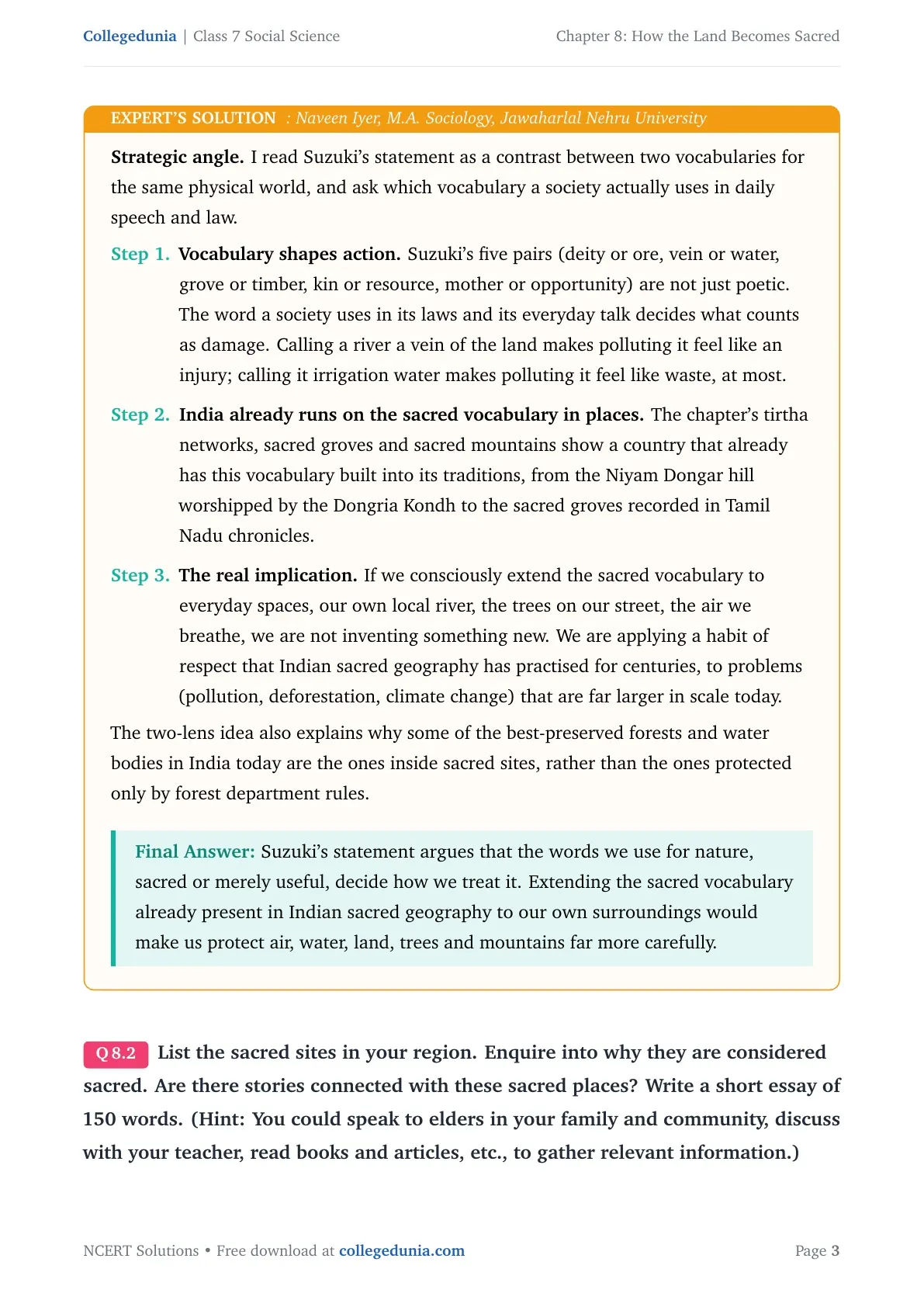
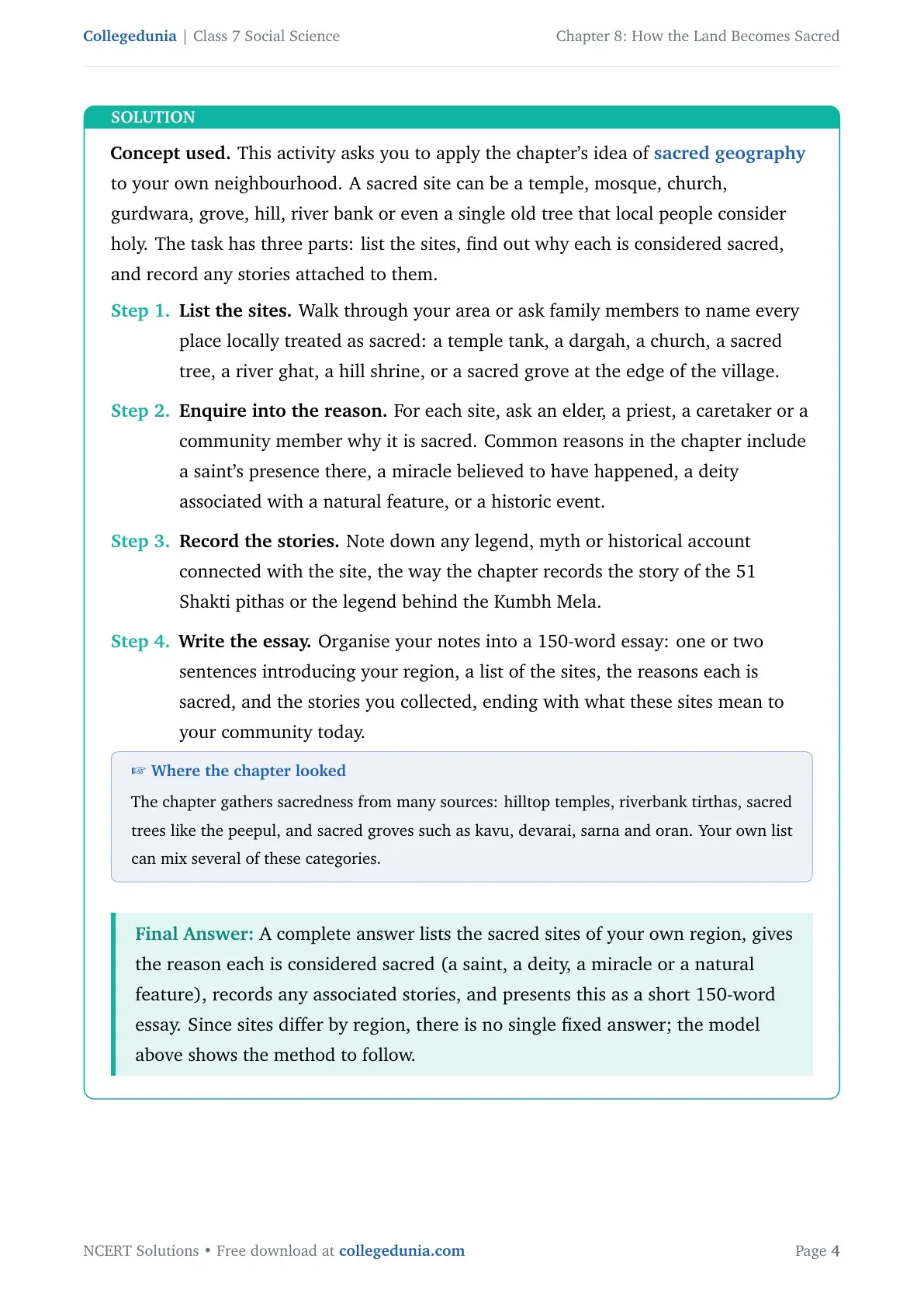
| Q2 | A 150-word essay on your region's sacred sites and why they are sacred | Research and word-limited essay |
| Q3 | Why rivers, mountains and forests are sacred, and their contribution to our lives | Long reasoning answer |
| Q4 | Why people visit a tirtha or other sacred site | Explain-type answer |
| Q5 | How pilgrimage routes fostered trade, and whether sacred sites help the economy today | Explain and opinion answer |
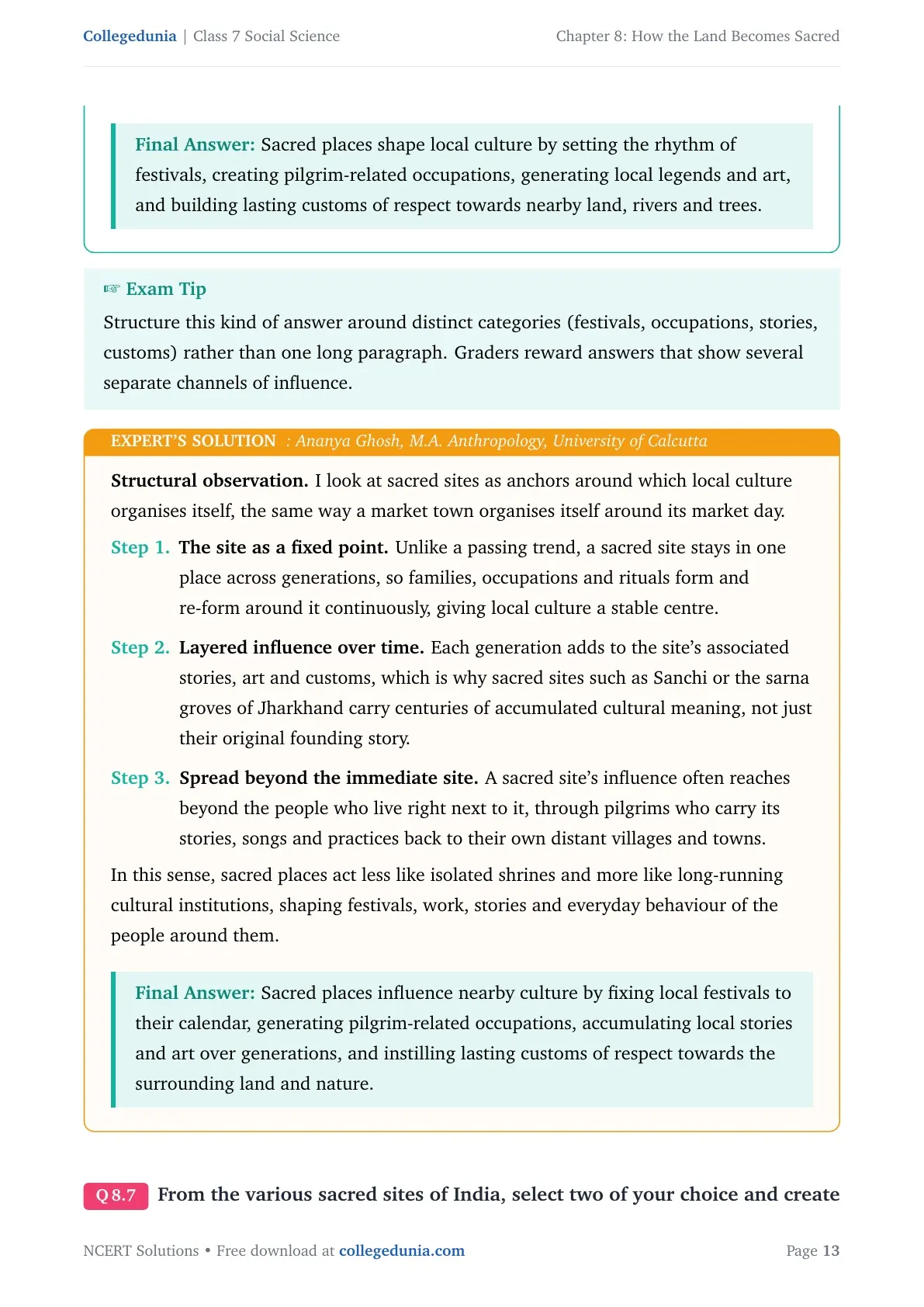
| Q6 | How sacred places influence the culture and traditions of nearby communities | Explain-type answer |
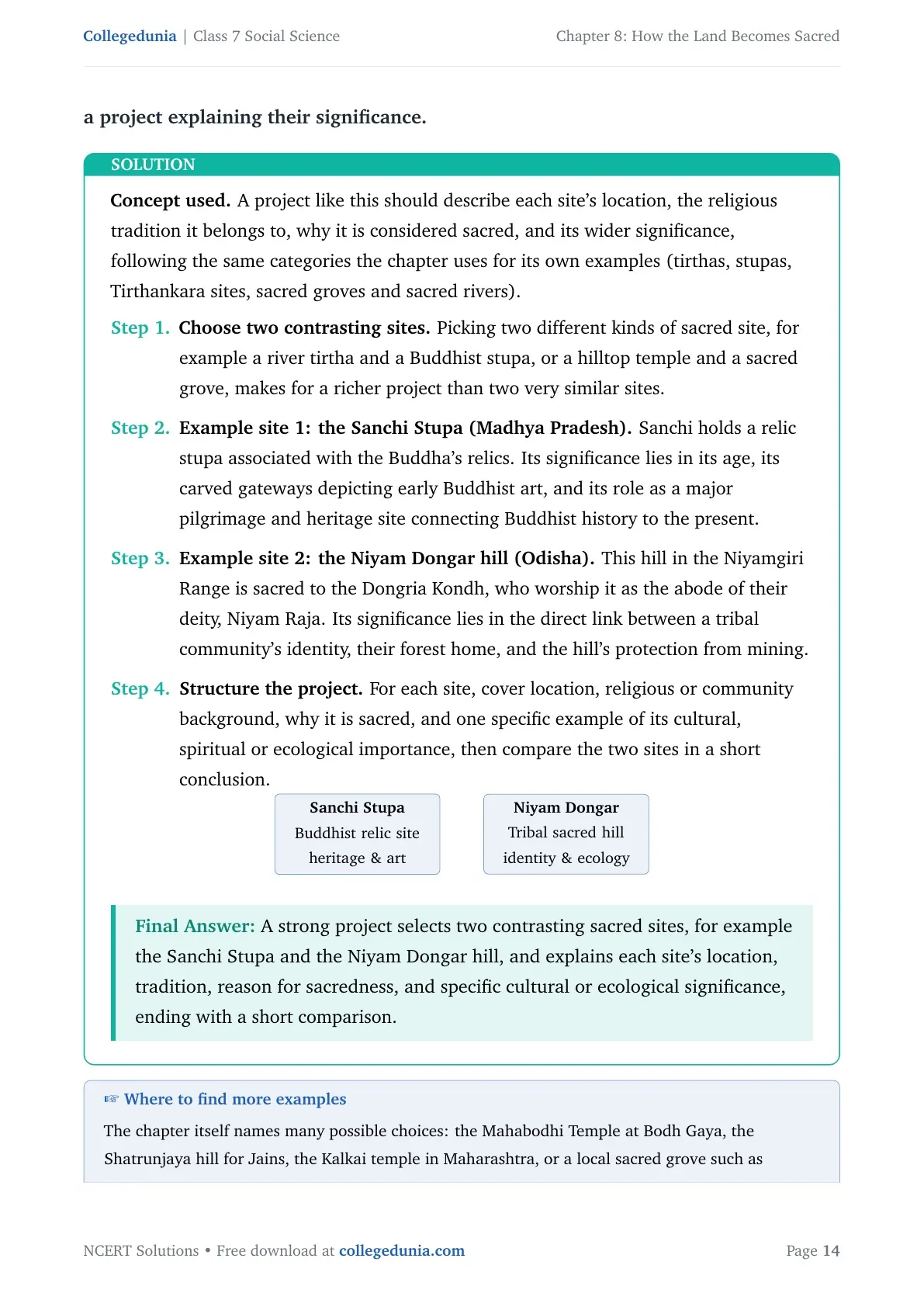
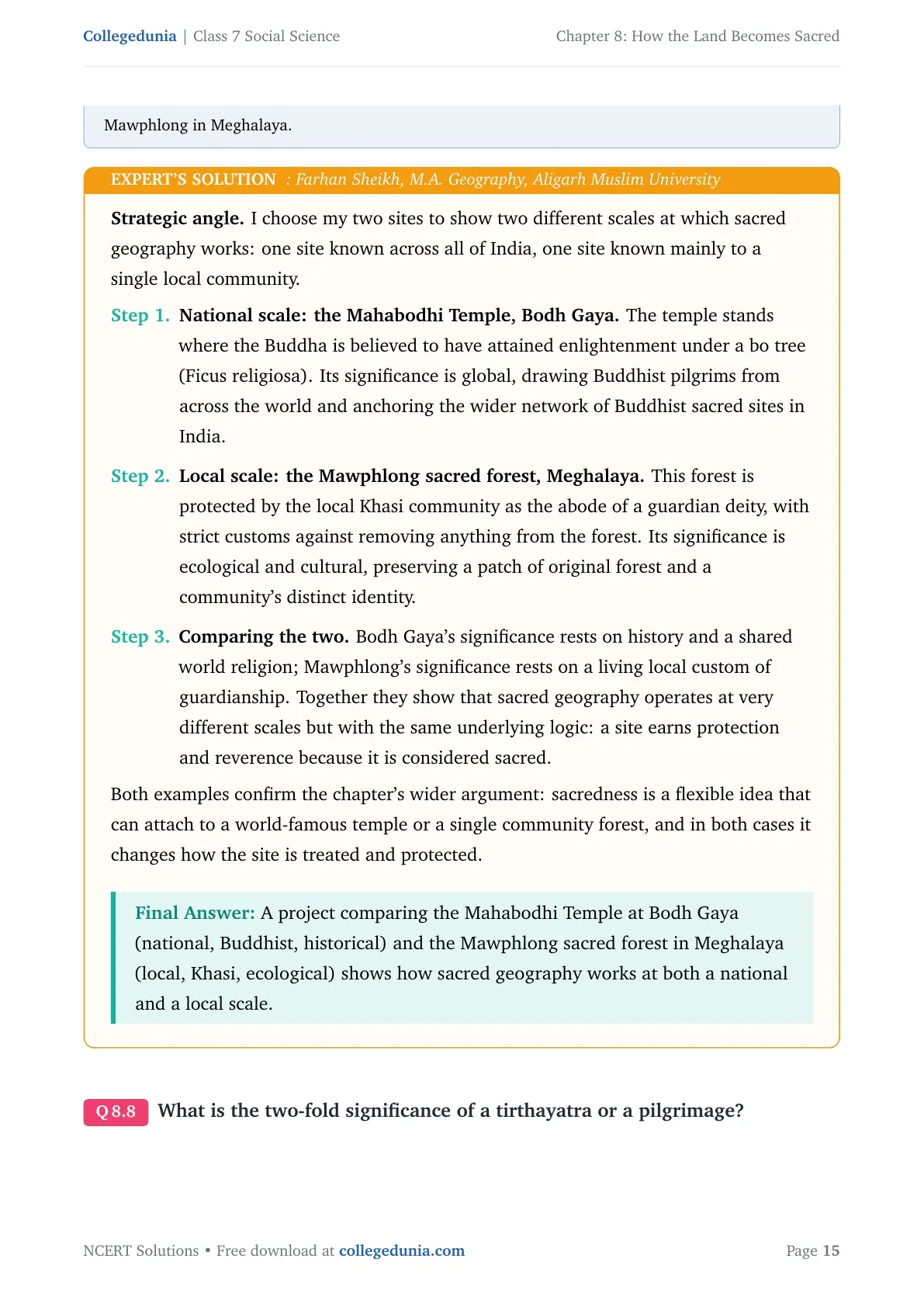
| Q7 | A project on two sacred sites of your choice and their significance | Project-type activity |
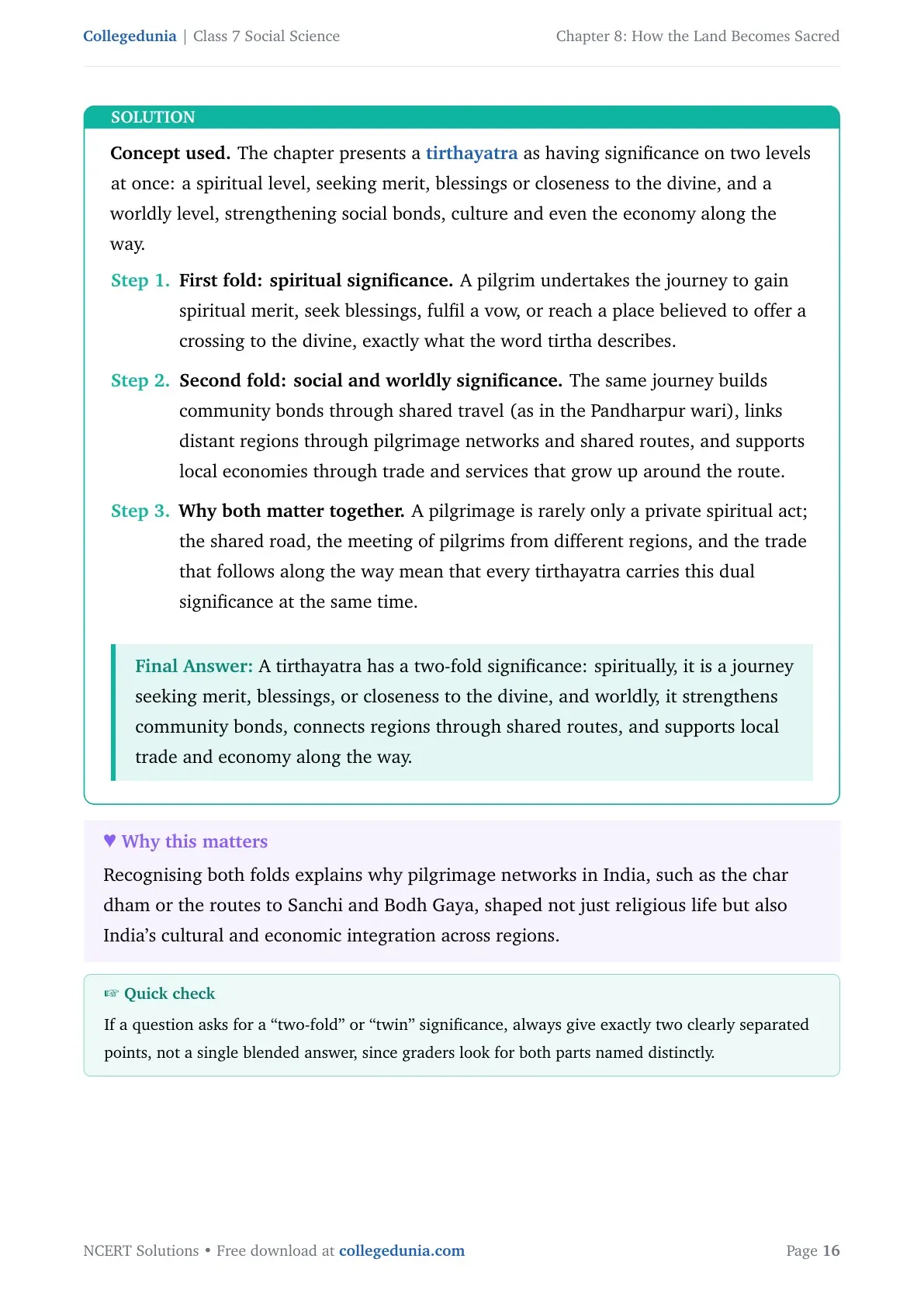
| Q8 | The two-fold significance of a tirthayatra or pilgrimage | Explain-type answer |
All eight are long-form or activity-based. Teachers usually pick Q3 or Q8 for a periodic test, so practising both in full sentences first is time well spent.
Sacred Ecology: How Rivers, Mountains and Groves Became Protected Spaces
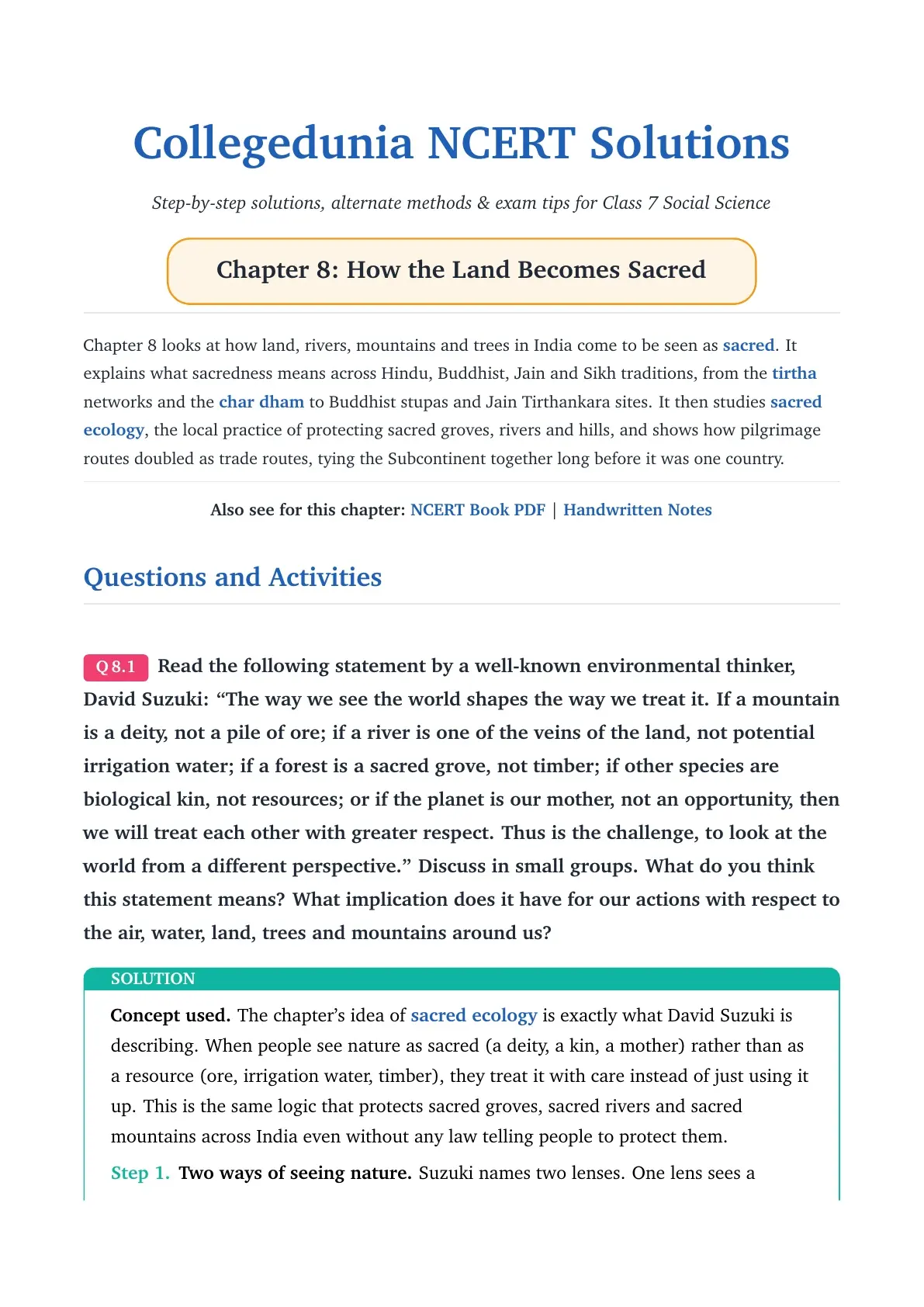
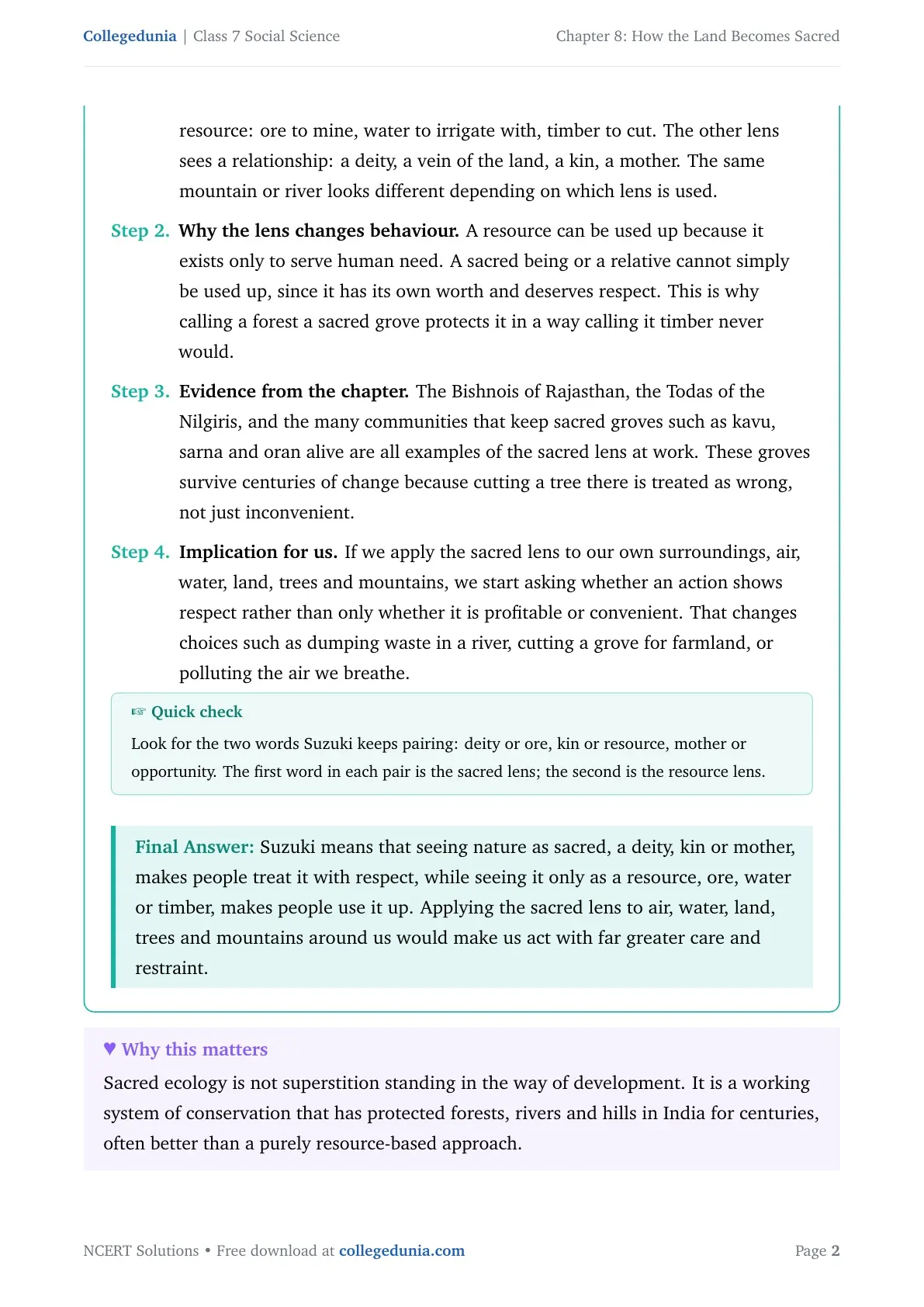
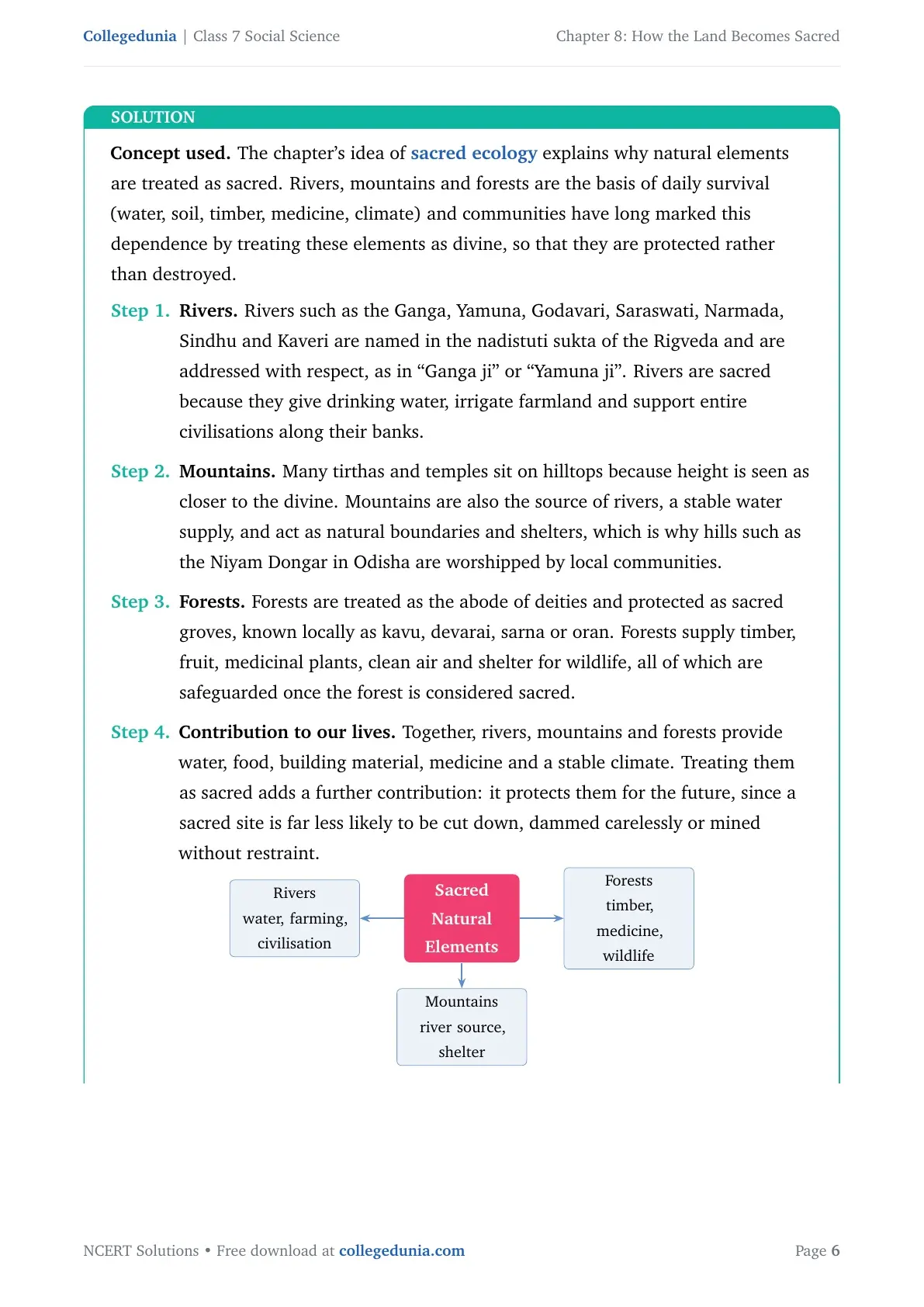
Q1 and Q3 both rest on sacred ecology: marking nature as divine, a deity, a kin, a mother, rather than as a resource, ore, timber, irrigation water, makes people treat it with care instead of using it up. Environmental thinker David Suzuki puts this exact contrast into words in Q1's quoted statement.
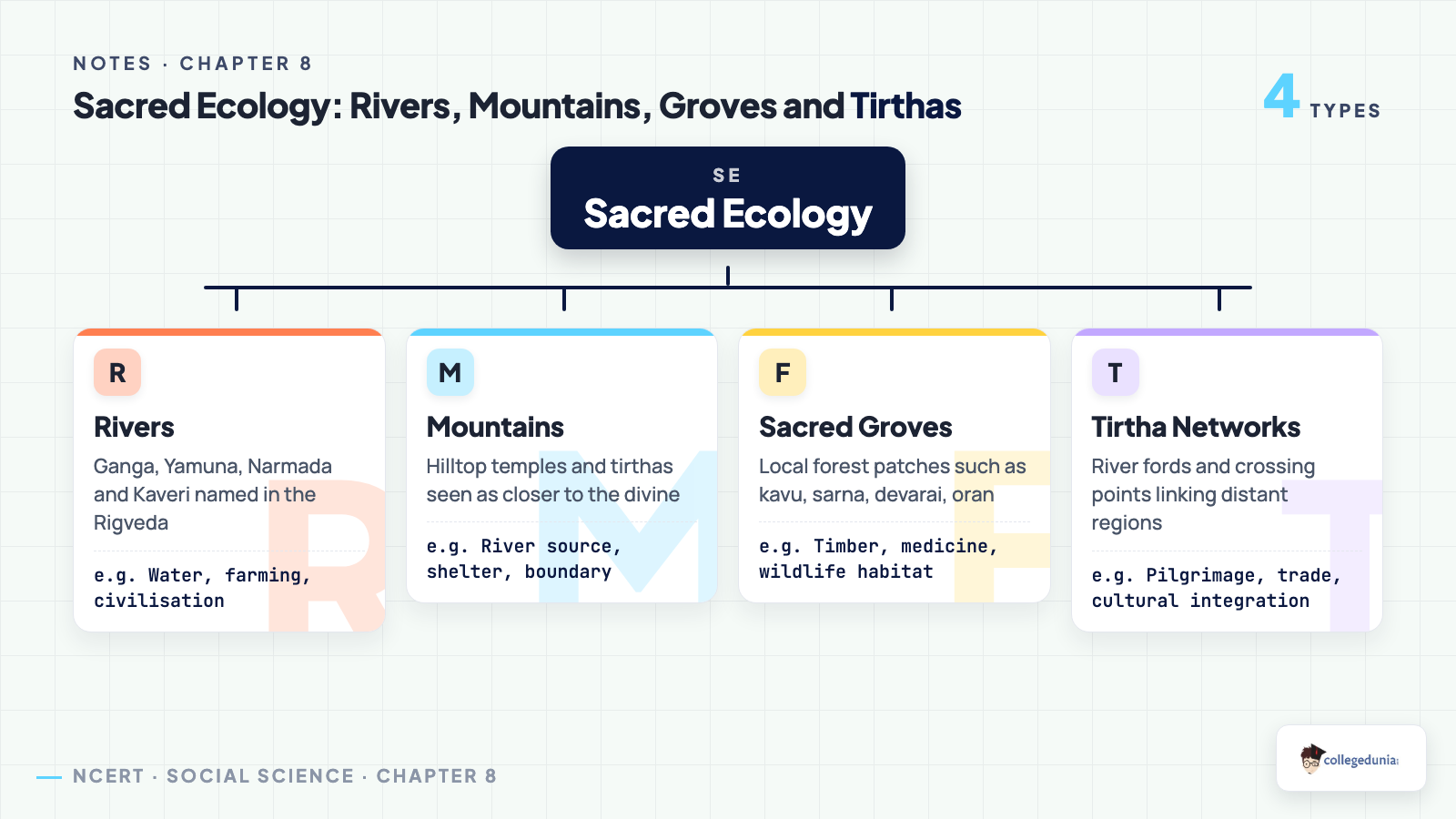
- Rivers. The Ganga, Yamuna, Godavari, Narmada and Kaveri are named with respect in the Rigveda's nadistuti sukta, addressed as "Ganga ji" or "Yamuna ji" even today.
- Mountains. Many tirthas sit on hilltops, height being seen as closer to the divine; hills like Niyam Dongar in Odisha are worshipped by local communities.
- Sacred groves. Forest patches known as kavu (Kerala), devarai (Maharashtra), sarna (Jharkhand) and oran (Rajasthan) stay uncut because clearing them is treated as wrong, not just inconvenient.
Calling a forest a sacred grove protects it in a way calling it timber never would, because a sacred being cannot simply be used up. The Bishnois of Rajasthan and the Todas of the Nilgiris are two communities the chapter names as living proof.
Tirtha Networks, the Char Dham and Why People Undertake a Pilgrimage
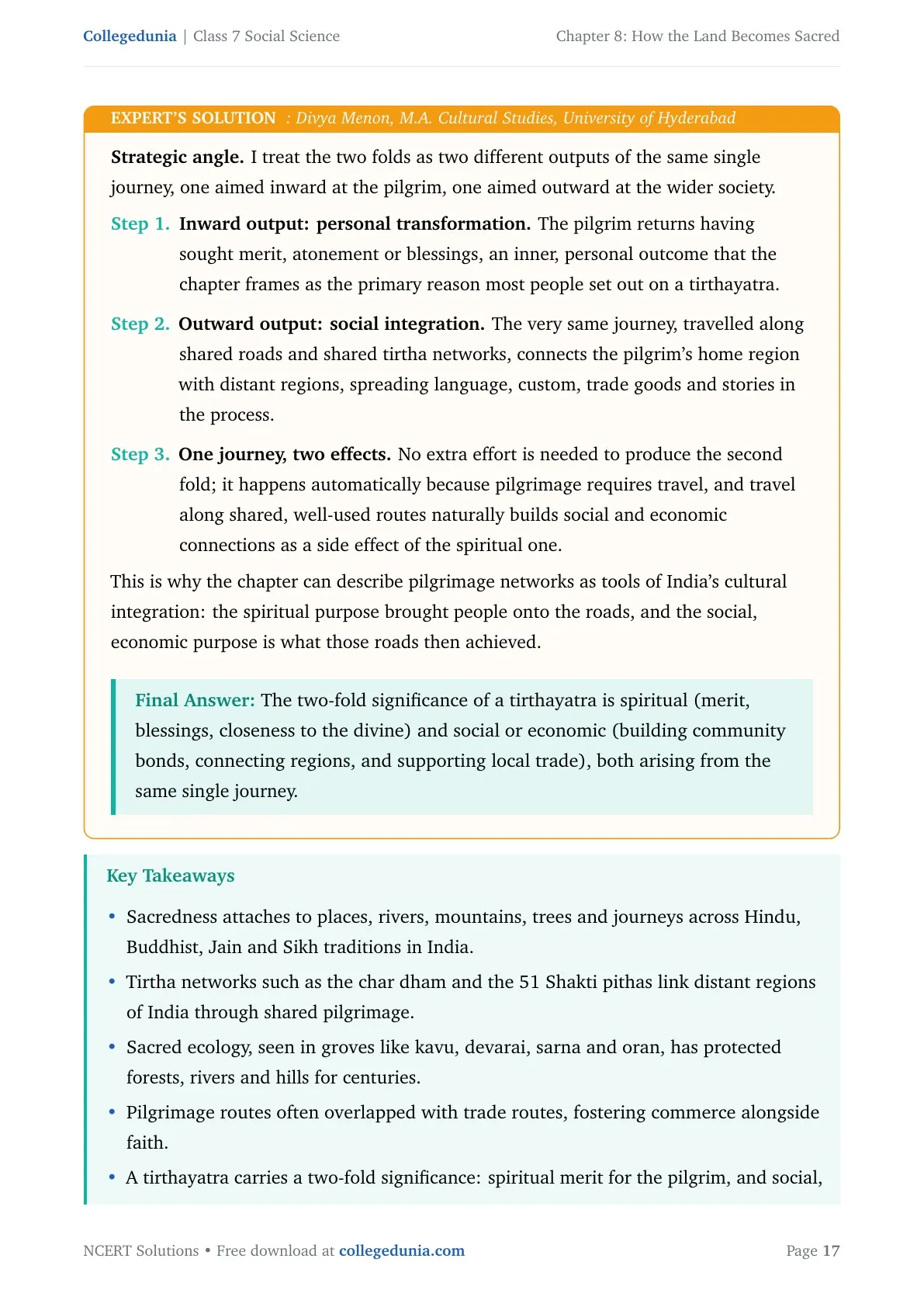
Q4 asks why people visit a tirtha, and Q8 asks for the two-fold significance of that journey, a tirthayatra. A tirtha is literally a crossing point, a river ford, and by extension a place where a person crosses from the ordinary world into the divine.
- Spiritual reasons. Pilgrims seek blessings, atonement, or the fulfilment of a personal vow, exactly what draws Jain pilgrims to a Tirthankara's liberation site.
- Personal and life-cycle reasons. Many Hindus aim to complete the char dham yatra once in a lifetime, often tied to a birth, marriage or health wish.
- Community and tradition. Group pilgrimages such as the Pandharpur wari turn a private act into a shared social event.
| Fold | What it means | Example from the chapter |
|---|---|---|
| Spiritual fold | Merit, blessings or closeness to the divine, sought by the individual pilgrim | A vow fulfilled at a char dham site |
| Social and worldly fold | Community bonds, connected regions and local trade, a side effect of the same journey | The Pandharpur wari, walked together in groups |
A "two-fold" question always wants exactly two named parts, not one blended answer, since examiners check both halves are present.
From Pilgrimage to Trade: How Sacred Routes Built Regional Economies
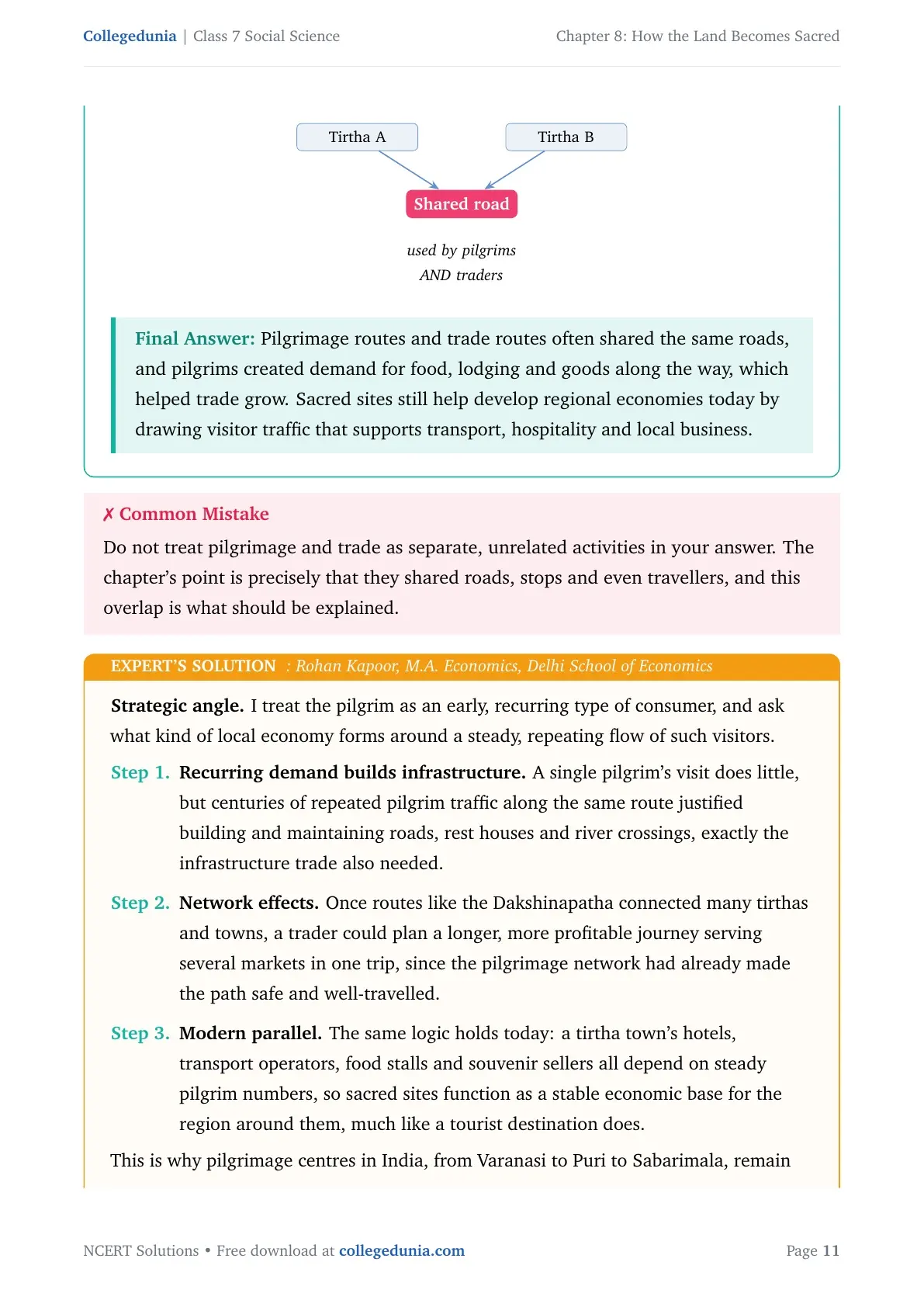
Q5 rests on the chapter's section From pilgrimage to trade: roads built for pilgrims travelling the Dakshinapatha and Uttarapatha also carried merchants, since both groups needed the same safe, maintained paths.
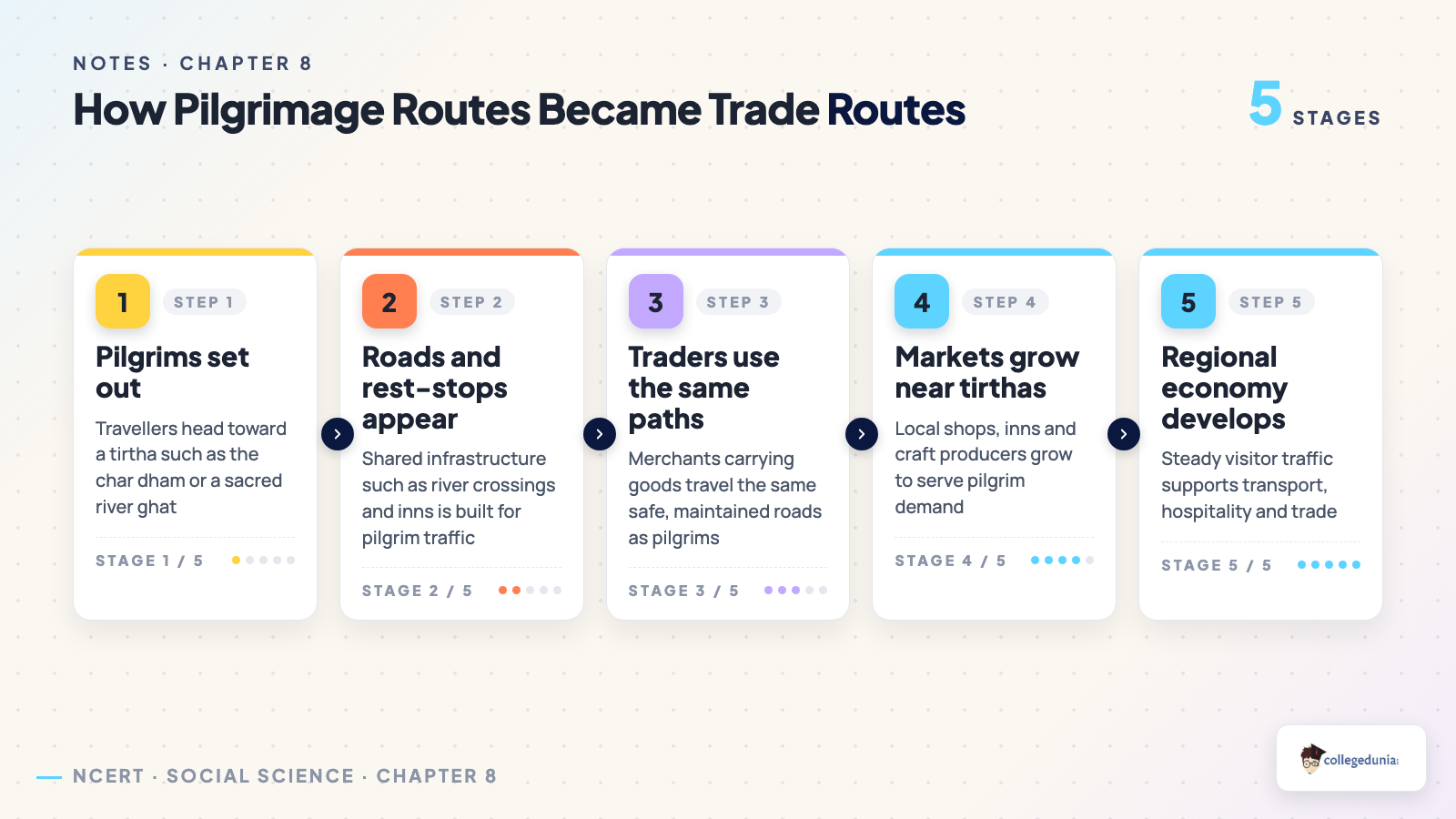
- Shared infrastructure. A road or river crossing built for pilgrims could equally serve a trader, so pilgrimage encouraged routes trade then used.
- Pilgrims as customers. Pilgrims needed food, lodging and offerings, so local markets and inns grew up around popular tirthas to serve them.
- Sacred sites help the economy today. A popular tirtha still draws visitors needing transport, food and lodging, much like the Kumbh Mela's huge temporary local economy.
Do not treat pilgrimage and trade as separate activities. The chapter's point is that they shared the same roads, stops and even travellers, and that overlap is what the answer should explain.
How Sacred Places Shape Local Culture and Traditions
Q6 asks how sacred places influence the culture of people living nearby. A sacred site becomes a fixed point around which festivals, occupations, stories and everyday habits organise themselves, generation after generation.
- Festivals and calendars. Local celebrations often follow a sacred site's own calendar, such as the Pandharpur wari or the Kumbh Mela.
- Occupations. Communities near sacred sites take up work that serves pilgrims: offerings, lodgings, or ritual items.
- Art and stories. Sacred sites generate their own local legends and art, such as the Tamil Nadu chronicle about a grove's protective deities.
- Everyday respect for nature. Not cutting trees in a sarna or oran becomes an accepted local custom, not an enforced rule.
Structure this answer around distinct categories rather than one long paragraph; graders reward several separate channels of influence.
Common Mistakes Students Make in the How the Land Becomes Sacred Chapter
Read this list before your next test. Each mistake below has cost real marks on Class 7 papers.
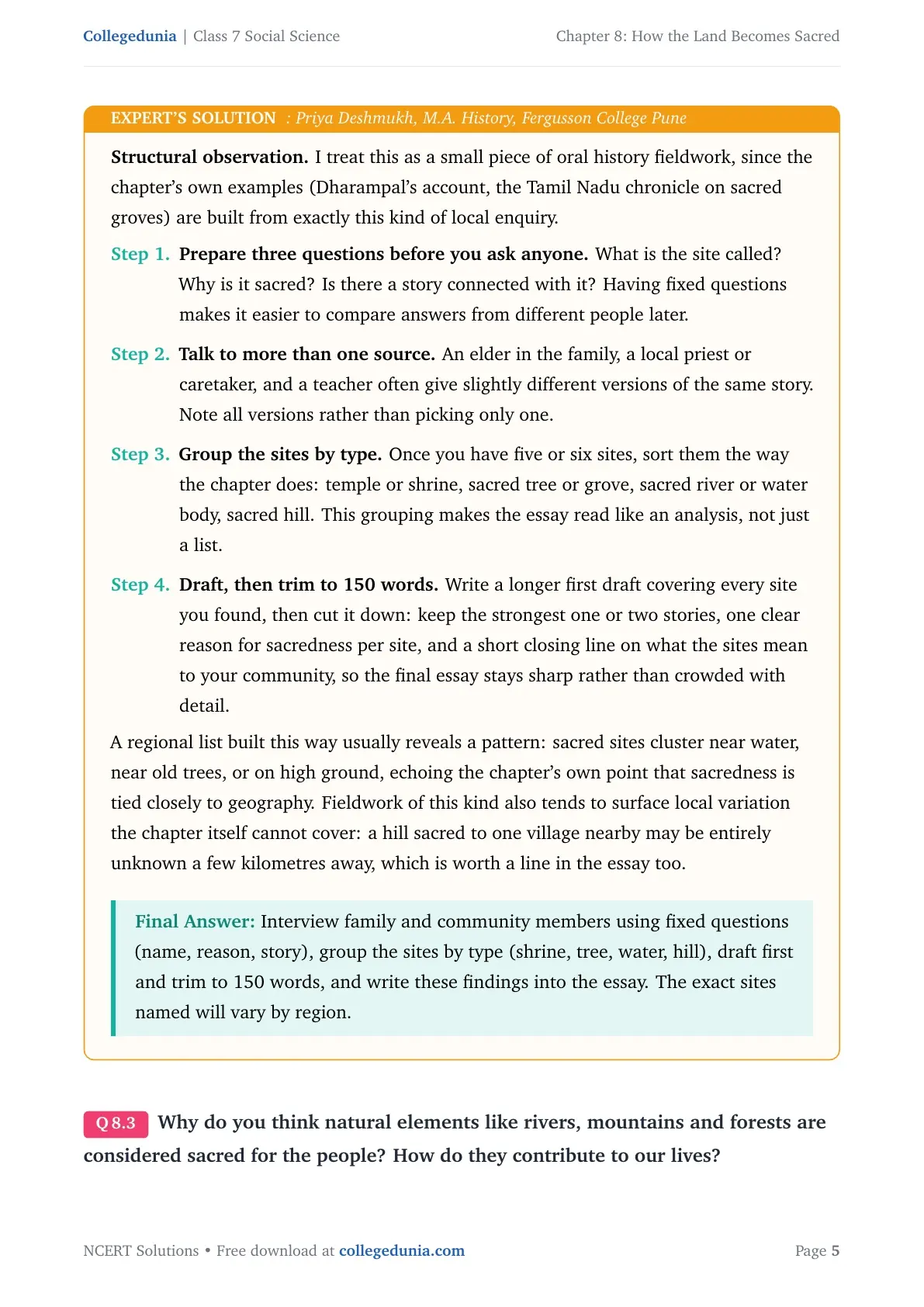
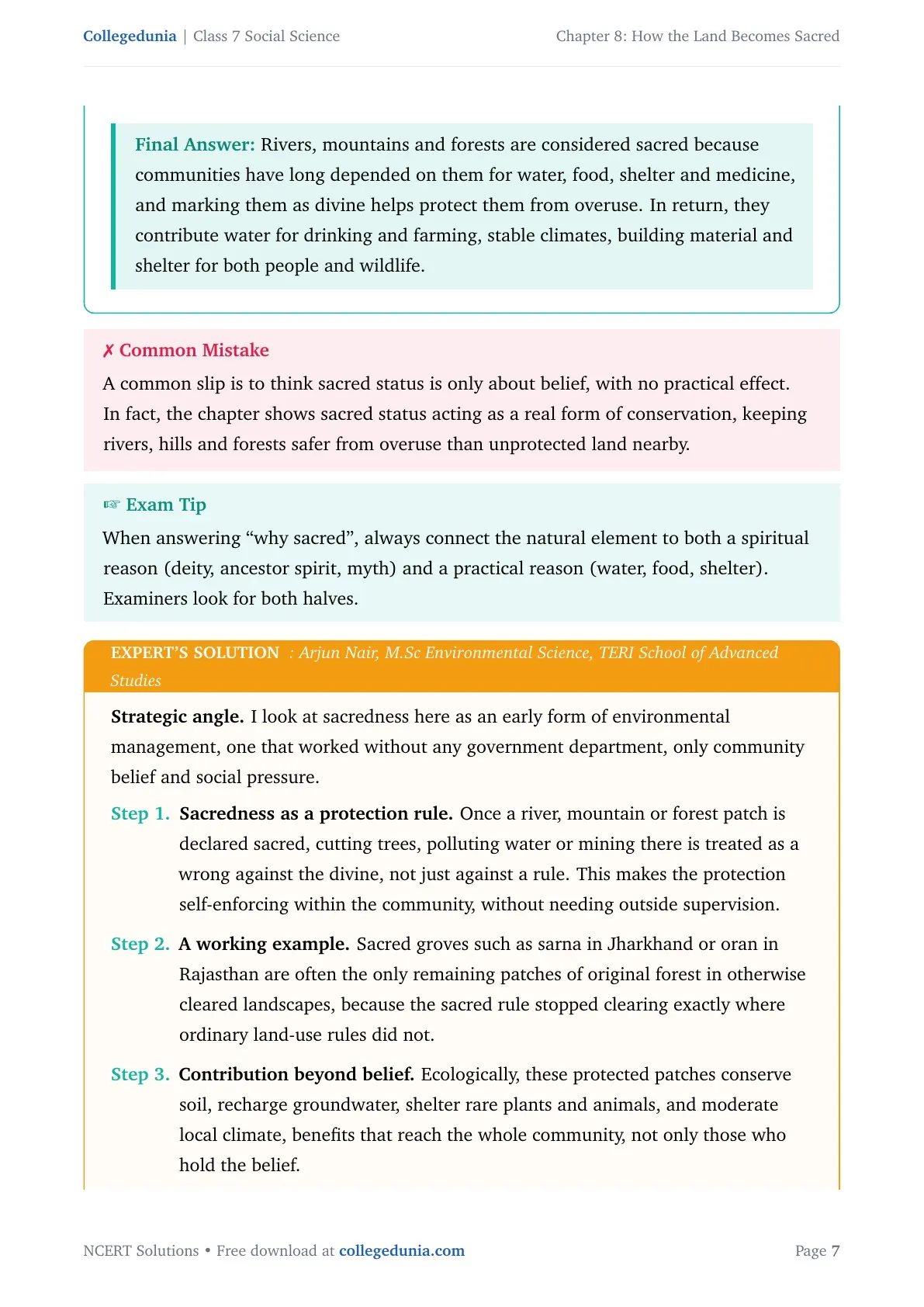
- Treating sacred status as "just belief". It is real conservation, keeping rivers, hills and groves safer than unprotected land nearby.
- Naming only one reason for pilgrimage. A strong Q4 or Q8 answer names both the spiritual reason and the social or economic one.
- Mixing up tirtha and tirthayatra. A tirtha is the sacred site itself; a tirthayatra is the journey made to reach it.
- Forgetting local names for sacred groves. Kavu, devarai, sarna and oran are region-specific; the generic word "forest" loses easy marks.
- Describing pilgrimage and trade as unrelated. Full marks in Q5 need the shared-roads link explained, not two separate stories.
Student Feedback
In a Collegedunia survey of 11,860 Class 7 students conducted before the 2026-27 annual exam, 58% named the two-fold significance of a tirthayatra as the hardest idea to explain. Students who scored well reported one habit that helped: writing the spiritual fold and the social or economic fold as two clearly separated points, not blended into one paragraph.
Source: 2026-27 Class 7 Social Science student survey. Sample of 11,860 students from CBSE schools across 14 states.
How to Study How the Land Becomes Sacred Effectively
This chapter mixes discussion answers, a research essay and a project. Short revision blocks work better than one long sitting.
- Block 1, 20 min. Learn sacred ecology and the Suzuki quote's two lenses, resource versus relationship.
- Block 2, 25 min. Practise pilgrimage reasons (Q4) and the two-fold significance of a tirthayatra (Q8) from memory.
- Block 3, 20 min. Learn the pilgrimage-to-trade link and two examples of sacred sites shaping culture.
- Night before, 15 min. Re-read Common Mistakes and outline your own region's sacred sites for Q2.
More How the Land Becomes Sacred Class 7 Resources
Also Check: This chapter is also available in other formats on Collegedunia. Read the solutions first, then the notes for a deeper topic walk-through.
| Resource | Best used for | Open it |
|---|---|---|
| NCERT Notes | Topic-by-topic summary of sacred ecology, tirtha networks and the pilgrimage-to-trade link | How the Land Becomes Sacred Class 7 Notes |
| NCERT Book PDF | The official 2026-27 chapter text with all figures | Class 7 Social Science Part 1 Chapter 8 Book PDF |
| Handwritten Notes | Quick one-sitting revision in clear handwriting | How the Land Becomes Sacred Class 7 Handwritten Notes |
NCERT Solutions for Class 7 Social Science Part 1: All Chapters
The table below lists NCERT Solutions for every chapter of Part 1, so you can move to the next chapter once this one is done.
Sample Solutions from How the Land Becomes Sacred Chapter 8
Below are two of the eight questions from NCERT Solutions Class 7 Social Science Chapter 8 How the Land Becomes Sacred, answered in full. Every question in the complete PDF gets this same level of detail, a concept explanation, a step-by-step answer, and a boxed final answer.
- Concept used: the exact NCERT term or idea the question is testing, named upfront.
- Step-by-step answer: the reasoning broken into short, exam-ready points.
- Boxed answer: a final, one-look summary a student can revise from directly.
Ques. Why do people visit a tirtha or other sacred sites?
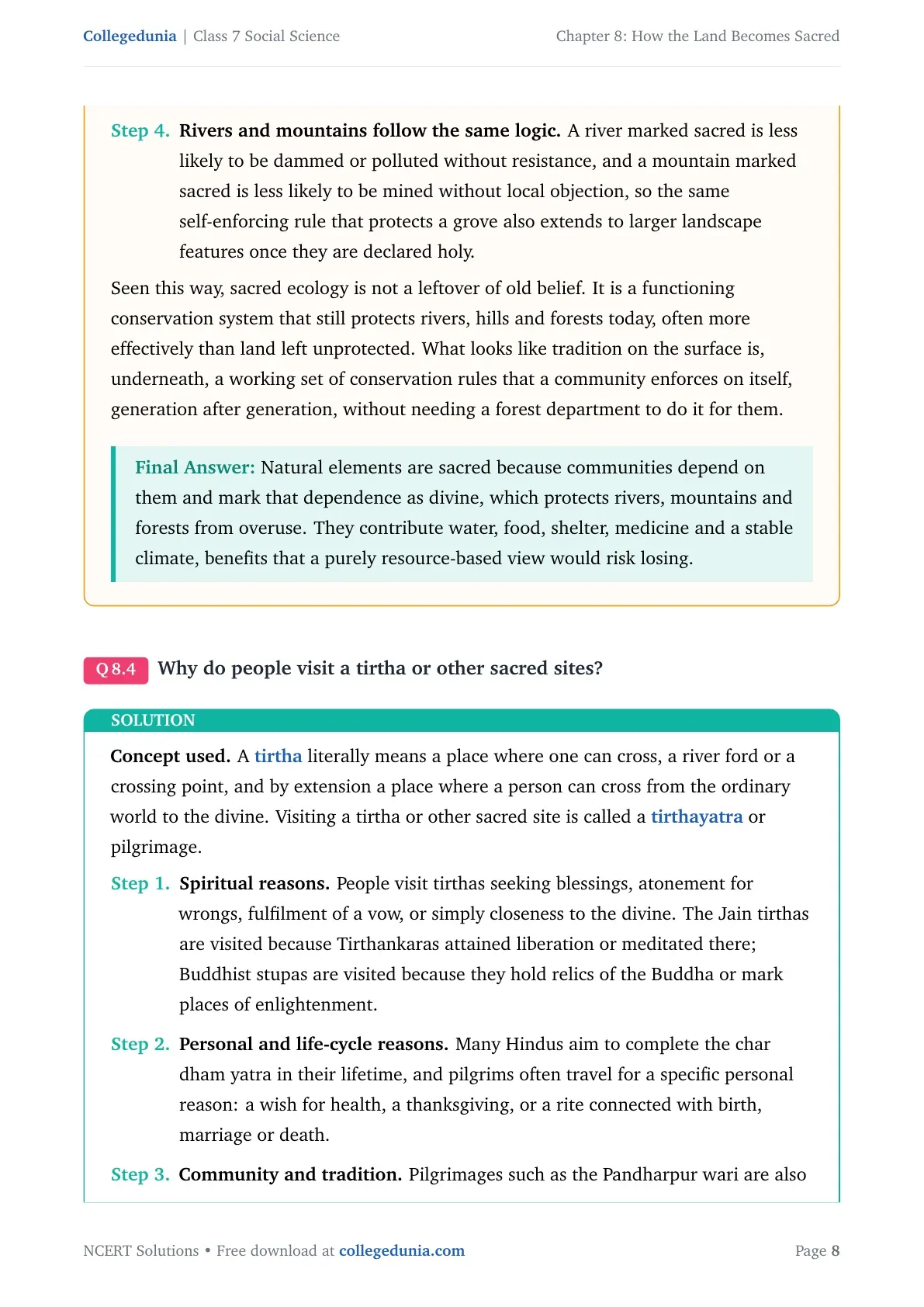
A tirtha literally means a place where one can cross, a river ford or crossing point, and by extension a place where a person can cross from the ordinary world to the divine. People visit for spiritual reasons: seeking blessings, atonement for wrongs, or the fulfilment of a vow. Jain tirthas are visited because Tirthankaras attained liberation there; Buddhist stupas are visited because they hold relics of the Buddha.
Many Hindus also aim to complete the char dham yatra in their lifetime, often for a personal reason tied to health or a life-cycle rite. Pilgrimages such as the Pandharpur wari are community events too, where groups walk and sing together, and since many sacred sites are rivers or hills, the journey often connects the pilgrim to nature as well as to the divine.
Boxed answer: People visit a tirtha or sacred site to seek blessings, atonement or spiritual merit, to keep a personal vow or complete a life-cycle rite, and to take part in a shared community tradition, often while also connecting with a sacred river, hill or grove.
Ques. What is the two-fold significance of a tirthayatra or a pilgrimage?
A tirthayatra has significance on two levels at once. The first fold is spiritual: a pilgrim undertakes the journey to gain merit, seek blessings, fulfil a vow, or reach a place believed to offer a crossing to the divine. The second fold is social and worldly: the same journey builds community bonds through shared travel, as in the Pandharpur wari, and supports local economies through the trade and services that grow up around the route.
A pilgrimage is rarely only a private spiritual act. The shared road, the meeting of pilgrims from different regions, and the trade that follows mean every tirthayatra carries both kinds of significance at the same time, which is why examiners expect both halves named separately.
Boxed answer: A tirthayatra has a two-fold significance: spiritually, it is a journey seeking merit, blessings, or closeness to the divine, and worldly, it strengthens community bonds, connects regions through shared routes, and supports local trade and economy along the way.
How the Land Becomes Sacred Class 7 Social Science NCERT Solutions FAQs
Ques. Where can I download the NCERT Solutions for Class 7 Social Science Chapter 8 How the Land Becomes Sacred PDF?
Ans. Use the download option at the top of this page. The file is free, covers all 8 questions and activities from the chapter, and is available in both Normal and HD quality.
Ques. What is sacred ecology?
Ans. Sacred ecology is the practice of treating rivers, mountains and forests as divine rather than as resources, which leads communities to protect them, as seen in sacred groves like kavu, sarna, devarai and oran.
Ques. What is a tirtha?
Ans. A tirtha literally means a river ford or crossing point, and by extension a place where a person can cross from the ordinary world into the divine. Visiting a tirtha is called a tirthayatra, or pilgrimage.
Ques. What are the char dham?
Ans. The char dham are four sacred sites, Badrinath, Dwarka, Puri and Rameswaram, spread across the four directions of India. Many Hindus aim to complete this pilgrimage circuit once in their lifetime.
Ques. Why are rivers, mountains and forests considered sacred?
Ans. Communities have long depended on rivers, mountains and forests for water, food, shelter and medicine, and marking them as divine protects them from overuse, since a sacred site is far less likely to be cut, dammed or mined without restraint.
Ques. What is the two-fold significance of a pilgrimage?
Ans. A pilgrimage has spiritual significance, merit, blessings and closeness to the divine for the individual pilgrim, and social or economic significance, community bonds, regional connections and local trade, for the wider society.
Ques. How did pilgrimage routes help ancient trade?
Ans. Roads and rest-stops built for pilgrims travelling to a tirtha, such as those along the Dakshinapatha and Uttarapatha, were also used by traders, and local markets grew around tirthas to serve pilgrim demand for food, lodging and goods.
Ques. What are sacred groves, and what are their local names?
Ans. Sacred groves are forest patches protected because they are considered the abode of a deity. Local names include kavu in Kerala, devarai in Maharashtra, sarna in Jharkhand and oran in Rajasthan.
Ques. How do sacred places influence local culture?
Ans. Sacred places shape local festivals and calendars, create pilgrim-related occupations, generate local legends and art, and build lasting customs of respect towards nearby land, rivers and trees.
Ques. Is this NCERT Solutions PDF aligned with the 2026-27 syllabus?
Ans. Yes. This page follows the current 2026-27 edition of Exploring Society: India and Beyond, Grade 7 Part 1, and every answer matches the chapter content and question order printed in that edition.
Ques. How many pages is the Class 7 Social Science Chapter 8 NCERT Solutions PDF?
Ans. The Solutions PDF runs to 18 pages and covers all 8 questions and activities from How the Land Becomes Sacred, with a concept explanation, step-by-step reasoning and a boxed final answer for each one.
Ques. What are the 51 Shakti pithas?
Ans. The 51 Shakti pithas are sites across India linked to the legend of Sati, whose body Vishnu is said to have cut with his chakra, scattering pieces that became sacred sites still visited today.



Comments