



Study Abroad Expert | Updated On - Nov 18, 2026
Indian Masters applicants planning a Fall 2027 intake now face a sharper two-way choice in Europe between Germany and Ireland. Both offer English-taught Masters, both grant long post-study work visas, and both sit far below the UK and US on sticker price. The DAAD and the Irish Department of Justice confirm the two routes work on very different cost-and-stay-back equations. The decision hinges on upfront cash, programme length, and how fast you want to earn.
- Public universities in Germany charge no tuition fees for most Masters programmes, while Irish universities charge Indian students €10,000 to €25,000 a year.
- Ireland’s Third Level Graduate Programme gives Masters graduates a 24-month stay-back on the Stamp 1G visa; Germany grants an 18-month Job Seeker residence permit after graduation.
- Germany requires a €11,904 blocked account for the student visa, around ₹10.8 lakh parked before the visa interview; Ireland asks for proof of €10,000 in funds, roughly ₹9 lakh.
Both countries tightened rules for international students in 2025, but neither has closed its doors the way the UK and Canada have. The gap is widening between study destinations that still want Indians and those pricing them out.
Also Read: Study in Germany
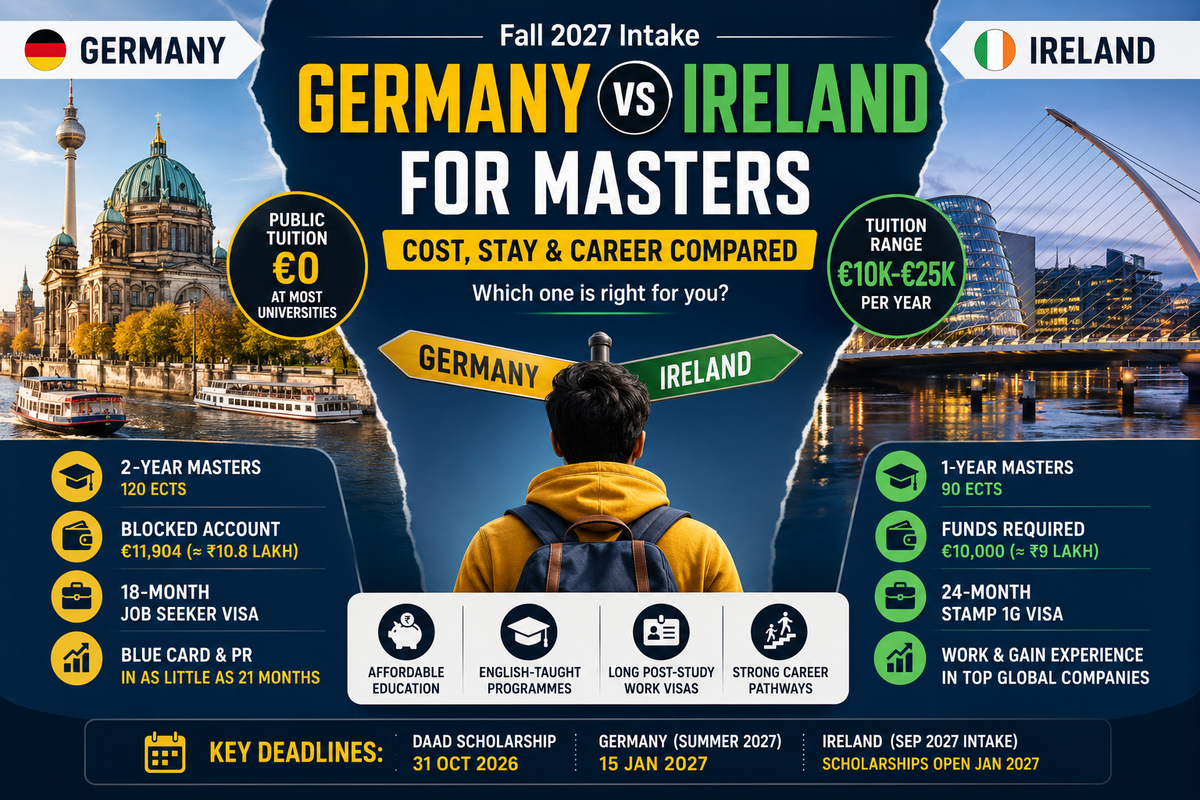
Germany vs Ireland Masters 2027 Snapshot
The two destinations occupy opposite ends of the pay-now-or-pay-later spectrum. Germany front-loads the maintenance proof but keeps tuition near zero. Ireland front-loads tuition but gives you an extra year of post-study work to recover it.
| Parameter | Germany | Ireland |
|---|---|---|
| Public tuition (per year) | €0 at most states; €3,000 in Baden-Württemberg | €10,000 to €25,000 |
| Semester fee | €150 to €350 | Included in tuition |
| Living cost (per year) | €11,904 blocked account minimum | €10,000 to €12,000 |
| Programme length | 2 years (120 ECTS) | 1 year (90 ECTS taught) |
| Post-study work visa | 18 months Job Seeker | 24 months Stamp 1G |
| Work during studies | 140 full days or 280 half days a year | 20 hours a week in term, 40 in vacations |
| PR pathway | Blue Card after 21 months (B1 German) | Stamp 4 after 5 years on Critical Skills |
Key Insight: The total two-year outlay evens out more than the sticker price suggests. A Berlin public Masters costs roughly ₹25 lakh all-in over two years. A Dublin Masters runs ₹30 to ₹40 lakh in a single year, but you start earning a year sooner on a 24-month graduate visa.
Tuition and Living Costs: Where the Money Actually Goes
Germany’s public universities are tuition-free for all international Masters students, except in Baden-Württemberg, where non-EU students pay €1,500 per semester. Students pay only a semester contribution of €150 to €350, which usually includes a public transport pass. The DAAD confirms this on its official international-student fee page.
Ireland charges full economic-cost fees to non-EU Masters students. Trinity College Dublin’s MSc in Computer Science sits at €25,310 for 2026 entry. University College Dublin’s MSc in Finance is €30,100. Lower-cost options like University of Galway or University of Limerick charge €15,000 to €18,000 for most taught Masters.
Living costs favour Germany only on paper. The blocked account requirement is €11,904 for 2026 entry, split into monthly transfers of €992. Ireland’s INIS evidence-of-funds rule asks for €10,000 for the first year, released as needed. Rent in Munich now rivals Dublin at €900 to €1,200 a month for a single room, so the on-ground gap is smaller than Indian agents often suggest.
How Long Can Indian Graduates Stay After the Degree?
Ireland offers the stronger post-study runway. The Third Level Graduate Programme was extended in May 2024 to give Masters graduates 24 months on a Stamp 1G visa to look for work. During this period graduates can work full-time without an employer-specific permit.
Germany grants an 18-month Job Seeker residence permit under Section 20 of the Residence Act. Graduates can take any job while hunting for one in their field. After securing qualifying employment, they switch to an EU Blue Card, which fast-tracks permanent residence in as little as 21 months if they clear a B1 German language test.
What it means for Indian Students: Germany’s shorter stay-back is offset by a much faster PR track. Ireland gives you more time to find work but the Stamp 4 permanent route needs five years on a Critical Skills Employment Permit first, not just a graduate visa.
Application Deadlines for Fall 2027 Intake
Germany runs a clear two-intake system through most universities’ uni-assist portal. Ireland uses rolling admissions with soft cut-offs that fill quickly in popular courses.
- Germany Summer Semester 2027: Applications close January 15, 2027 for non-EU students at most public universities.
- Germany Winter Semester 2027/28: The primary intake. Non-EU deadlines cluster around July 15, 2027, with earlier cut-offs at TU Munich and RWTH Aachen.
- Ireland September 2027 intake: Most programmes accept applications from October 2026 and close rolling by June 30, 2027, though Trinity Business School and UCD Smurfit close by March 31, 2027 for scholarship consideration.
- DAAD scholarship deadline: The main Study Scholarship for Indian postgraduates closes October 31, 2026 for the 2027/28 academic year.
Scholarships for Indian Masters Applicants
Germany’s funding ecosystem is broader. The DAAD Study Scholarship gives Indian Masters students a monthly stipend of €934, health insurance cover and a one-time research allowance. The Deutschlandstipendium adds €300 per month at 300-plus universities, with no nationality bar.
Ireland’s flagship is the Government of Ireland International Education Scholarship, which pays €10,000 for one year plus a full fee waiver. Only 60 awards go to students worldwide each year, and the 2027/28 round opens in January 2027. Individual universities also run merit awards of €2,000 to €5,000 for Indian applicants with top GPAs.
Important Distinction: German scholarships cover living costs but rarely tuition, because tuition is already zero. Irish scholarships cover tuition but only partial living costs, so students still need ₹8 to ₹10 lakh in personal funds. The all-in subsidy level is roughly similar for a top-scholarship Indian.
Which Country Suits Which Indian Student?
The choice tracks three things: the programme’s field, your German-language appetite, and how quickly you need to start earning. STEM students targeting research careers lean Germany. Business, data analytics and finance aspirants who want a fast job market lean Ireland.
- Pick Germany if you target engineering, automotive, pharmaceutical or research-heavy Masters, can commit two years, and are open to learning German to B1.
- Pick Ireland if you want a one-year Masters in business, data, pharma or tech, English-only teaching, and a direct route into companies like Google, Meta, Pfizer or Accenture.
- Pick Germany if the family budget is tight and the blocked account is manageable through an education loan.
- Pick Ireland if you can arrange ₹35 to ₹45 lakh upfront and want the fastest payback on investment.
Action Plan for 2027 Applicants
- Lock in an IELTS or TOEFL score by March 2027: Germany asks for 6.5 overall, Ireland for 6.5 with 6.0 in each band.
- Open a blocked account with Expatrio, Fintiba or Coracle by May 2027 if Germany is your primary target.
- Apply to the DAAD Study Scholarship before October 31, 2026 and the Government of Ireland award before March 2027.
- File the Germany national visa application at VFS Global at least 12 weeks before intake; Ireland’s long-stay ’D’ visa needs 8 weeks.
- Arrange proof of funds in a sponsor’s name or your own, dated within six months of application.
Germany and Ireland are now the two most reliable European routes for Indian Masters applicants priced out of the UK and US. The sticker prices look different but the net two-year cost converges once stipends, part-time earnings and the post-study visa window are counted. The right pick depends on your field and your tolerance for a second language, not on which country is "cheaper".
Keep an Eye On: The next hard date is the DAAD Study Scholarship deadline on October 31, 2026 for the 2027/28 intake, followed by the Germany Summer Semester 2027 application close on January 15, 2027. Irish university scholarship rounds for the September 2027 intake open from January 2027.



Comments