



D.Pharm stands for Diploma in Pharmacy and is a 2-year UG diploma programme. The course focuses on basic pharmaceutical sciences, drug dispensing, medicines and pharmacy practice. Students are also required to complete practical training as prescribed by the Pharmacy Council of India (PCI).
For D.Pharm admission, students must complete Class 12 with Physics, Chemistry, and Biology or Mathematics from a recognised board. Many colleges offer merit-based admission based on Class 12 marks, while some conduct state-level entrance exams or counselling processes. Admission criteria may vary by institution and state.
Course Highlight
| Top Colleges | Total Course Fees | Specialisation Areas | Average Starting Salary |
|---|---|---|---|
| JSS Academy of Higher Education & Research, Mysore, Manipal Academy of Higher Education, Manipal, Jamia Hamdard University, New Delhi | INR 2.2 K to INR 6.37 Lakh | Community Pharmacy, Hospital Pharmacy, Pharmaceutics, Pharmaceutical Chemistry, Pharmacology | Approximately INR 1.5–4 LPA |
Quick Facts
- Duration: 2 academic years, generally structured as Part I and Part II, plus at least 500 hours of practical training over a minimum of 3 months
- Eligibility: Class 12 Science with Physics, Chemistry and Biology or Mathematics from a recognised board
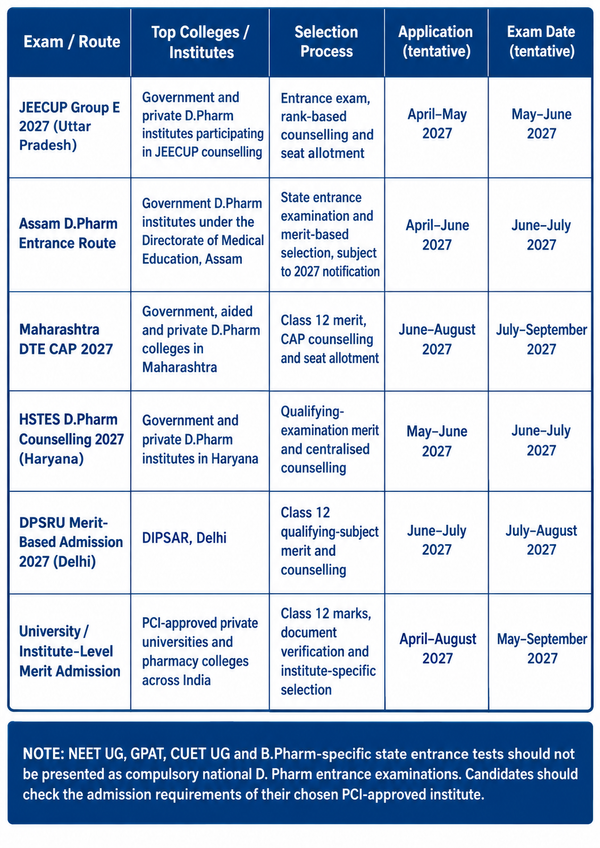
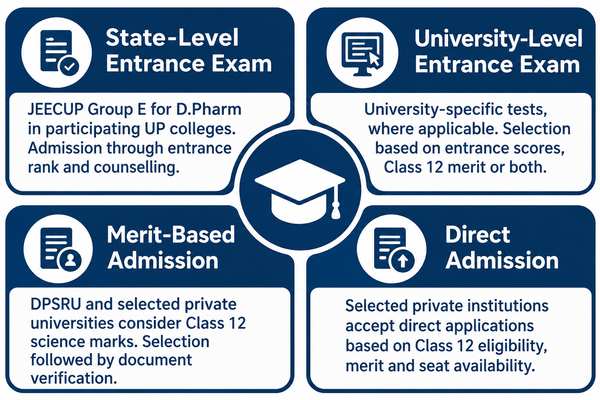
- Entrance Exam: JEECUP Group E in Uttar Pradesh, other state or institution-specific selection routes where notified
- Selection: Class 12 merit or applicable entrance examination, followed by counselling, document verification and seat allotment
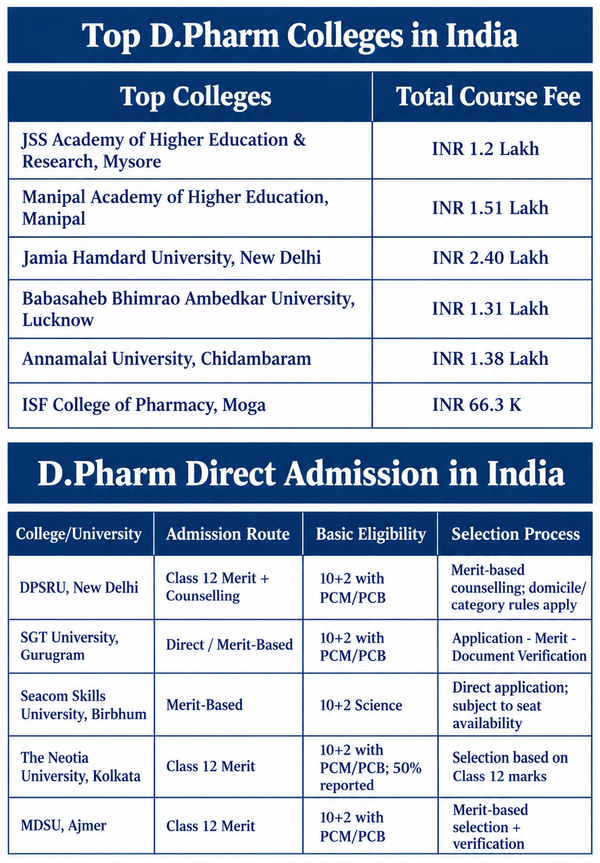
- Government Institution Fee Range: INR 3.9 K (Cooch Behar Polytechnic, Cooch Behar) to INR 3.47 Lakh (Chhatrapati Shahu Ji Maharaj University, Kanpur)
- Private Institution Fee Range: INR 2.2 K (AR College of Pharmacy and GH Patel Institute of Pharmacy, Vallabh Vidyanagar) to INR 6.37 Lakh (K.R. Mangalam University, Gurgaon)
- Admission Season: Applications March–July, Exams: May–July, Counselling: June–September (tentative).
Top Entrance Exams
Ques. Can Commerce or Arts students apply for D.Pharm?
Ans. Students who studied only Commerce or Arts in Class 12 are generally not eligible. D.Pharm requires the specified Science subjects, including Physics, Chemistry and Biology or Mathematics, under PCI eligibility regulations.
Ques. Is Mathematics compulsory for D.Pharm?
Ans. No. Mathematics is not compulsory for students who studied Biology along with Physics and Chemistry in Class 12. Both PCM and PCB students can apply if they meet the institution's eligibility requirements.
Ques. Is NEET required for D.Pharm admission in 2027?
Ans. No. NEET is not a compulsory entrance examination for D.Pharm. Admission usually takes place through Class 12 merit, an applicable state-level entrance examination or institution-specific counselling.
Ques. Which entrance exams are required for D.Pharm admission in India?
Ans. There is no common national D.Pharm entrance examination. JEECUP Group E is an important examination for participating D.Pharm institutions in Uttar Pradesh. Other states may use merit lists or their own selection procedures. Students should check the admission authority for the state and institution where they intend to apply.
Ques. Can students get direct admission to D.Pharm without an entrance exam?
Ans. Yes. Some institutions offer Class 12 merit-based admission without a separate entrance test. DPSRU, SGT University and The Neotia University are examples of institutions reporting merit-based D.Pharm admission.
Three Myths Busted
- Myth: Students must qualify for NEET to study D.Pharm.
- Fact: NEET is not a compulsory examination for D.Pharm. Most colleges use Class 12 merit, institution-specific selection or state-level admission processes.
- Myth: Only students who studied Biology in Class 12 can apply for D.Pharm.
- Fact: Both PCB and PCM students are eligible under PCI academic eligibility rules, provided they have Physics and Chemistry.
- Myth: D.Pharm graduates cannot pursue higher education.
- Fact: Eligible D.Pharm graduates can apply for B.Pharm lateral entry, generally entering the second year, subject to applicable admission regulations and institutional eligibility.
Types of Admission Routes in India
Ques. What is the minimum percentage required for D.Pharm admission?
Ans. PCI's basic D.Pharm eligibility rule does not prescribe a universal minimum percentage. Individual institutions may require 45%, 50%, 55% or other qualifying marks. For example, DPSRU reported a 55% aggregate requirement for general-category applicants in its 2026 admission criteria, with specified relaxations for eligible categories.
Ques. What is the average starting salary after D.Pharm in India?
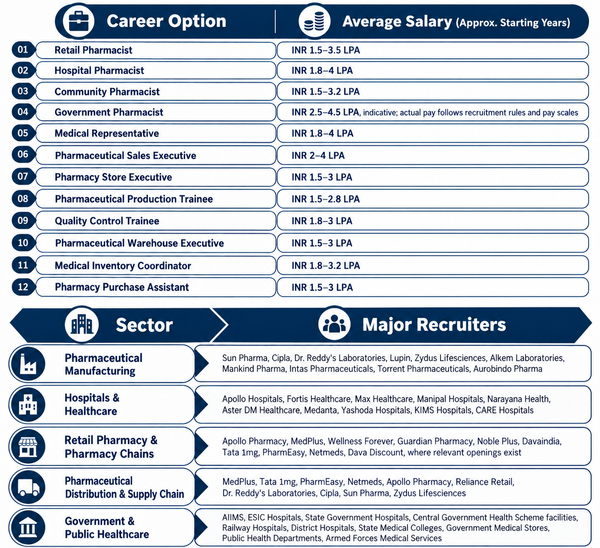
Ans. Freshers may earn approximately INR 1.5–4 LPA across pharmacy, healthcare, sales and related support roles. Salaries depend on the employer, city, job profile, professional registration, skills and experience.
Ques. Do D.Pharm colleges provide campus placements?
Ans. Some colleges offer placement assistance, industry exposure or access to employer recruitment activities. However, campus placements are not guaranteed. Students should ask colleges for D.Pharm-specific placement records rather than relying on B.Pharm or overall university placement figures.
Ques. What is the difference between D.Pharm and B.Pharm?
Ans. D.Pharm is a 2-year diploma with compulsory practical training that focuses on pharmacy fundamentals and dispensing. B.Pharm is a 4-year bachelor's degree covering pharmacy subjects in greater depth. B.Pharm generally provides broader eligibility for pharmaceutical industry roles, postgraduate pharmacy education and specialised career paths.
D.Pharm Admission Process
- Qualifying Examination: Class 12 or an equivalent recognised Science examination.
- Eligible Streams: Science stream with Physics, Chemistry and either Biology or Mathematics.
- Minimum Marks: No universal PCI percentage is prescribed in the basic D.Pharm eligibility rule. Many colleges specify their own minimum, commonly around 45%–55%.
- Entrance Registration: Register for JEECUP Group E or any other entrance examination specifically prescribed for D.Pharm by the relevant admission authority.
- Entrance Result: Download the entrance result or merit rank, where applicable. Apply for counselling or institutional admission.
- Counselling/Application: Register through the appropriate state authority, university portal or college website. Complete choice filling where required.
- Document Verification: Submit Class 10 and 12 marksheets, a qualifying certificate, identity proof, photographs, a transfer/migration certificate and applicable category or domicile certificates.
- Seat Confirmation: Accept the allotted seat and pay the prescribed admission fee before the deadline.
Top D.Pharm Colleges in India
Scholarships
- Merit-Based Scholarships: Some private universities provide tuition concessions to students with high Class 12 marks. Shri Guru Ram Rai University, Dehradun, reports merit-based tuition concessions for qualifying students.
- Entrance-Score Scholarships: A few institutions may link financial assistance to recognised entrance examination scores. Availability must be checked for D.Pharm specifically.
- Need-Based Scholarships: Eligible students from economically weaker households may apply for institutional fee concessions or government assistance, subject to income conditions.
- Government Scholarships: Eligible students may apply under schemes available through the National Scholarship Portal and applicable state scholarship departments.
- Category-Based Scholarships: SC, ST, OBC, minority and other eligible students may receive post-matric scholarships or fee reimbursement according to scheme rules.
- Sports Scholarships: Some universities provide sports-quota benefits or fee concessions to qualifying students. These benefits are not universally available for D.Pharm.
- Institution-Specific Scholarships: Universities may offer additional financial assistance for eligible students. Students should verify renewal rules, minimum academic performance and whether D.Pharm is covered.
D.Pharm Placement and Recruiters
Popular Specialisation
| Popular Specialisation | Core Focus | Common Career Options |
|---|---|---|
| Community Pharmacy | Prescription dispensing, patient counselling, medicine storage and pharmacy services | Community Pharmacist, Retail Pharmacist |
| Hospital Pharmacy | Hospital medicine distribution, prescription handling and inventory management | Hospital Pharmacist, Pharmacy Assistant |
| Pharmaceutics | Dosage forms, pharmaceutical preparations and manufacturing fundamentals | Production Trainee, Manufacturing Assistant |
| Pharmaceutical Chemistry | Drug composition, chemical properties and basic pharmaceutical analysis | Laboratory Assistant, Quality Control Trainee |
| Pharmacology | Drug action, therapeutic uses, side effects and medication safety | Pharmacy Support Staff, Medical Sales Representative |
| Pharmacy Management | Pharmacy operations, stock management, purchasing and regulatory responsibilities | Pharmacy Store Executive, Inventory Coordinator |
NOTE: D.Pharm generally follows a standard PCI-prescribed curriculum rather than offering separate formal specialisation degrees.
Ques. Does D.Pharm offer specialisations in Hospital Pharmacy or Pharmacology?
Ans. D.Pharm normally follows a common PCI-prescribed curriculum. Hospital Pharmacy, Pharmacology, Pharmaceutics and Pharmaceutical Chemistry are subjects or career-focus areas within the course, not separate formal D.Pharm specialisation degrees.
Ques. What factors affect the D.Pharm admission cutoff?
Ans. The main factors are Class 12 marks or entrance rank, number of applicants, available seats, category, domicile requirements and counselling preferences. Merit-based colleges may publish qualifying marks or merit lists, while entrance-based admission authorities may publish closing ranks.
Ques. What should students check before selecting a D.Pharm college?
Ans. Students should verify the college's current PCI approval, D.Pharm seat intake, total course fee, practical training arrangements, admission requirements, scholarship eligibility and course-specific placement support. PCI approval and compliance with State Pharmacy Council registration requirements are particularly important for students planning to work as pharmacists.
Higher Education Options
| Course | Duration |
|---|---|
| B.Pharm (Lateral Entry) | 3 Years |
| B.Pharm (Regular Entry) | 4 Years |
| M.Pharm (After Completing B.Pharm) | 2 Years |
| MBA in Pharmaceutical Management (After an Eligible Bachelor's Degree) | 2 Years |
| PhD in Pharmaceutical Sciences (After the Required Postgraduate Qualification) | 3–6 Years, depending on regulations and institution |
FAQs
Ques. What is D.Pharm, and how long does it take to complete?
Ans. D.Pharm stands for Diploma in Pharmacy. It is a 2-year diploma programme that teaches students about medicines, pharmaceutical sciences, dispensing and pharmacy operations. The course also requires at least 500 hours of practical training spread over a minimum of 3 months under PCI regulations.
Ques. Can D.Pharm graduates open a medical store in India?
Ans. Yes, D.Pharm graduates can open a medical store in India and may apply for pharmacist registration with the relevant State Pharmacy Council after meeting all applicable requirements. Operating a retail medical store also requires the necessary drug licences and compliance with the Drugs and Cosmetics Act and relevant rules. Completing D.Pharm alone does not automatically authorise someone to open or operate a pharmacy.
Ques. Can D.Pharm graduates apply for government pharmacist jobs?
Ans. Yes. D.Pharm graduates may apply for government pharmacist vacancies where a recognised diploma and State Pharmacy Council registration meet the prescribed eligibility criteria. Recruitment may involve a written examination, document verification and other selection requirements. Some vacancies require additional qualifications.
Ques. Can students pursue B.Pharm after completing D.Pharm?
Ans. Yes. Eligible D.Pharm graduates can apply for B.Pharm lateral entry, generally joining the second year of the degree programme. This usually takes 3 additional years. Admission depends on the applicable lateral-entry regulations, institutional eligibility and availability of seats.



Comments