



B.Pharm stands for Bachelor of Pharmacy, it is a 4-year undergraduate (UG) programme that focuses on pharmaceutical sciences, drug formulation, medicines, pharmacology and healthcare.
For B.Pharm admission, students must have passed Class 12 with Physics, Chemistry and Mathematics or Biology from a recognised board. Admission is based on entrance exams such as MHT CET, WBJEE, KCET, AP EAPCET, TG EAPCET and BITSAT, or Class 12 merit, depending on the college. After completing B.Pharm, graduates can pursue careers in pharmaceutical companies, hospitals, drug research, quality control and other healthcare sectors.
Course Highlights
| Top Colleges | Total Course Fees | Specialisation Areas | Average Starting Salary |
|---|---|---|---|
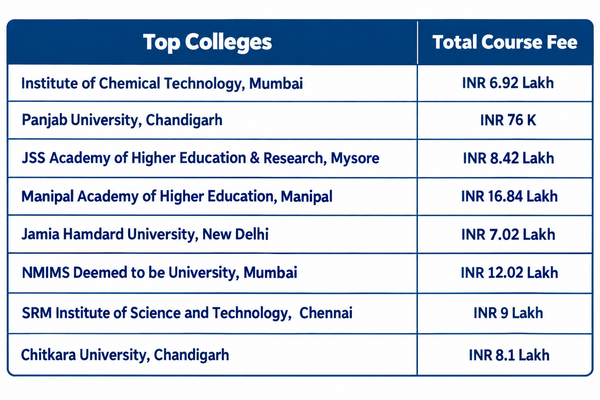
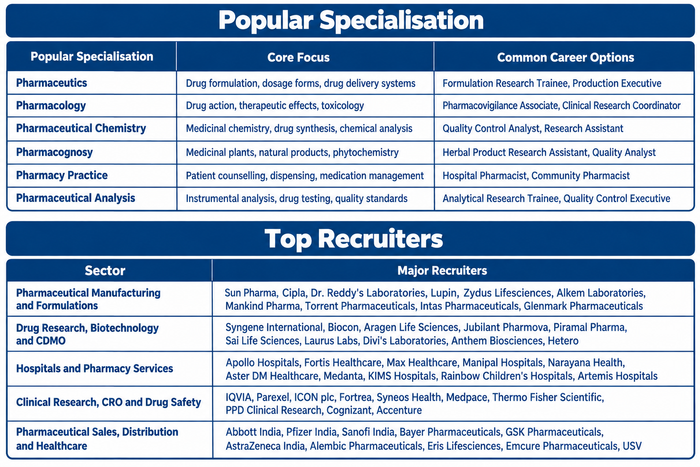
| Institute of Chemical Technology Mumbai, Panjab University Chandigarh & JSS Academy of Higher Education & Research, Mysore | INR 6 K to INR 25.29 Lakh | Pharmaceutics, Pharmacology, Pharmaceutical Chemistry, Pharmacognosy, Pharmacy Practice | INR 2.5–5 LPA (approximate) |
Quick Facts
- Duration: 4 years / 8 semesters, eligible D. Pharm graduates may enter through a 3-year lateral-entry pathway.
- Eligibility: Class 12 Science with Physics, Chemistry and Mathematics or Biology; English requirements follow applicable regulations and institutional rules.
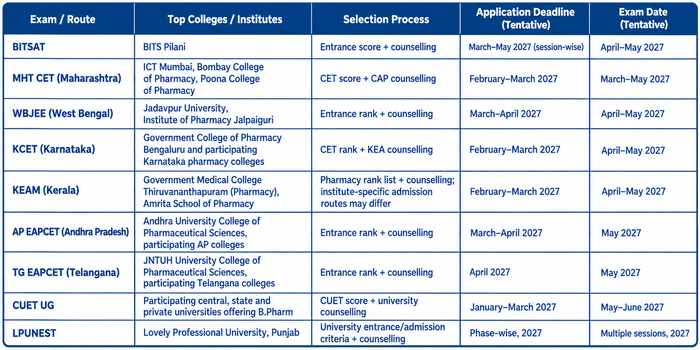
- Entrance Exam: MHT CET, WBJEE, KEAM, BITSAT, KCET, AP EAPCET, TG EAPCET and university-level examinations
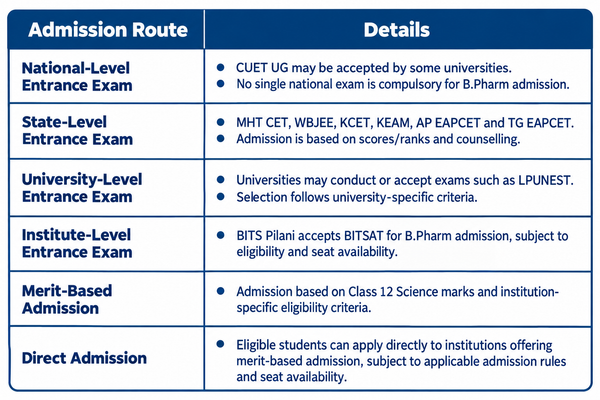
- Selection: Entrance examination score, rank, counselling, Class 12 merit or institution-specific selection
- Government Institution Fee Range: INR 6 K (The Tamil Nadu Dr M.G.R. Medical University, Chennai) to INR 12.11 Lakh (Andhra University, Visakhapatnam)
- Private Institution Fee Range: INR 38.4 K (Elixir Institute of Pharmacy, Pune) to INR 25.29 Lakh (BITS Hyderabad)
- Admission Season: Applications December–May, entrance examinations generally March–June, counselling and admissions mainly June–September
Top Entrance Exams
Ques. Does B.Pharm offer campus placements?
Ans. Yes. Several B.Pharm colleges provide placement assistance, internships, campus recruitment activities and career guidance. However, placement participation, job offers, salary packages and recruitment outcomes vary by institution. Students should verify programme-specific placement information rather than rely on university-wide highest packages.
Ques. What is the difference between B.Pharm and D.Pharm?
Ans. B.Pharm is a 4-year undergraduate degree, while D.Pharm is a 2-year diploma. B.Pharm covers pharmaceutical sciences, formulation, manufacturing, pharmacology and related subjects in greater depth. D.Pharm focuses on foundational pharmacy education. Eligible D.Pharm graduates may enter B.Pharm through lateral entry.
Ques. What is the difference between B.Pharm and Pharm.D?
Ans. B.Pharm is a 4-year undergraduate pharmacy degree, while the regular Pharm.D is a 6-year professional doctoral programme with an extensive clinical and hospital-training component. Pharm.D focuses more on patient-oriented pharmacy practice. B.Pharm graduates may also apply for the 3-year Pharm.D (Post Baccalaureate) programme where eligible.
Ques. Which B.Pharm specialisation is suitable for pharmaceutical research?
Ans. Pharmaceutics, Pharmaceutical Chemistry, Pharmacology and Pharmaceutical Analysis are relevant areas for students interested in research and drug development. A regular B.Pharm provides foundational knowledge in these subjects. Students can pursue an M.Pharm specialisation for advanced research and technical roles.
Three Myths Busted
- Myth: Only PCB students can pursue B.Pharm.
- Fact: Both PCM and PCB students are generally eligible, provided they meet the prescribed subjects and institution-specific requirements.
- Myth: NEET is compulsory for B.Pharm admission.
- Fact: NEET is not a universal B.Pharm requirement. Most major admission routes use state entrance examinations, university tests or qualifying-examination merit.
- Myth: B.Pharm graduates can only work in medical shops.
- Fact: Graduates can enter pharmaceutical manufacturing, drug safety, regulatory affairs, research, quality assurance, hospital pharmacy and pharmaceutical sales. Some roles require additional qualifications or registration.
Types of Admission Routes
Ques. Which government colleges offer B.Pharm at relatively low fees?
Ans. Institutions such as Panjab University, Chandigarh; Jadavpur University, Kolkata; Maharshi Dayanand University, Rohtak; and DIPSAR, New Delhi, offering B.Pharm at relatively low fees. Also, students should verify the current programme fee, approved intake and admission route before applying.
Ques. What is the average starting salary after B.Pharm in India?
Ans. Many early-career B.Pharm roles fall around INR 2.5–5 LPA. Entry-level salaries may be lower or higher depending on the position, employer, city, skills and recruitment requirements. Pharmacovigilance, regulatory affairs and specialised research-related roles may offer different ranges.
Ques. Can B.Pharm graduates become registered pharmacists in India?
Ans. Yes, graduates with a B.Pharm qualification from a PCI-approved institution can apply for registration with the relevant State Pharmacy Council, subject to applicable registration requirements. Completing the degree does not automatically mean that registration has been issued.
Ques. Can B.Pharm graduates apply for government jobs?
Ans. Yes, B.Pharm graduates can apply for eligible pharmacist and other pharmacy-related government recruitment examinations, such as in government hospitals, public healthcare services, railways and other government organisations. Selection depends on the advertised qualification, pharmacist registration, age limits, examination and other eligibility rules.
B.Pharm Admission Process
- Qualifying Examination: Class 12 or an equivalent recognised Science examination.
- Eligible Streams: PCM or PCB. Physics and Chemistry, along with Mathematics or Biology, are required under the applicable admission regulations.
- Minimum Marks: Many institutions prescribe approximately 45%–50% or more. Some, including BITS Pilani, have higher subject-specific requirements. There is no single universal percentage for all B.Pharm admissions.
- Entrance Registration: Apply for the applicable examination, such as MHT CET, WBJEE, KEAM, KCET, BITSAT or an accepted university entrance test.
- Entrance Result: Download the scorecard or rank and check eligibility for the chosen colleges.
- Counselling/Application: Register through the relevant state admission portal or the university's own application system.
- Document Verification: Includes Class 10 and 12 marksheets, identity proof, entrance scorecard, photographs, transfer or migration certificate, and reservation/domicile documents where applicable.
- Seat Confirmation: Accept the allotted seat and pay the required admission fee within the prescribed deadline.
Top B.Pharm Colleges in India
Scholarships
- Merit-Based Scholarships: Selected universities offer scholarships based on Class 12 PCM/PCB marks or academic performance. Minimum marks and continuation requirements vary.
- Entrance-Score Scholarships: LPU provides a scholarship route through LPUNEST. Applicable concessions depend on the university's score bands and programme-specific rules.
- Need-Based Scholarships: Eligible students may apply for income-based institutional assistance or government schemes, subject to family income and other conditions.
- Government Scholarships: Eligible students can explore schemes available through the National Scholarship Portal, subject to scheme-specific criteria.
- Category-Based Scholarships: SC, ST, OBC, EWS, minority and PwD students may qualify for central or state scholarships where applicable.
- Sports Scholarships: Some private universities provide concessions to students with recognised sports achievements.
- Institution-Specific Scholarships: Parul University advertises merit-, rank- and domicile-linked scholarship opportunities for eligible pharmacy applicants.
Career Opportunities After B.Pharm
| Career Option | Average Salary (Approx. Starting Years) |
|---|---|
| Community/Retail Pharmacist | INR 2–4 LPA |
| Hospital Pharmacist | INR 2.5–4.5 LPA |
| Quality Control Analyst | INR 2.5–5 LPA |
| Quality Assurance Executive | INR 2.5–5 LPA |
| Pharmaceutical Production Executive | INR 2.5–4.5 LPA |
| Regulatory Affairs Associate | INR 3–5 LPA |
| Pharmacovigilance/Drug Safety Associate | INR 3–5.5 LPA |
| Clinical Research Coordinator | INR 3–5.5 LPA |
| Medical Representative/Pharmaceutical Sales Executive | INR 2.5–5 LPA + incentives |
| Medical Writer | INR 3–5.5 LPA |
| Formulation Research Trainee | INR 3–5.5 LPA |
B.Pharm Specialisations & Top Recruiters
Higher Education Options
| Course | Duration |
|---|---|
| M.Pharm (Pharmaceutics, Pharmacology, Quality Assurance, Pharmaceutical Analysis, Regulatory Affairs and related specialisations) | 2 years |
| MBA in Pharmaceutical Management / Healthcare Management | 2 years |
| Pharm.D (Post Baccalaureate) | 3 years |
| M.Sc. in Clinical Research / Pharmacovigilance / Relevant Life Science Fields | 2 years; eligibility varies |
| Ph.D. in Pharmaceutical Sciences | 3–6 years after an eligible postgraduate qualification |
FAQs
Ques. Can PCM students apply for B.Pharm?
Ans. Yes. Students with Physics, Chemistry and Mathematics can apply for B.Pharm. Biology is not compulsory for all B.Pharm programmes. Students with PCB are also eligible under the applicable admission regulations.
Ques. Can Commerce or Arts students apply for B.Pharm?
Ans. No. Students who studied only Commerce or Arts without the required Science subjects are generally not eligible for regular B.Pharm admission. They must first obtain an accepted qualification with the compulsory subjects.
Ques. Is NEET compulsory for B.Pharm admission in 2027?
Ans. No. NEET is not compulsory for B.Pharm admission across India. Major entrance routes include MHT CET, WBJEE, KEAM, KCET, BITSAT and university-specific examinations. Institutions offering merit-based admission may consider Class 12 results.
Ques. What is the minimum percentage required for B.Pharm admission?
Ans. Many colleges prescribe 45%–50% or higher in Class 12, although no single minimum percentage applies to every institution. For example, BITS Pilani's published eligibility requires at least 75% aggregate in the relevant PCM/PCB subjects and 60% in each of those subjects.
Ques. What are the higher education options after B.Pharm?
Ans. Students can pursue M.Pharm, MBA in Pharmaceutical Management, Pharm.D (Post Baccalaureate) or eligible M.Sc. programmes in related fields. M.Pharm is a common option for technical specialisation, while MBA is relevant for management and pharmaceutical business careers. Further research studies usually require an appropriate postgraduate qualification.



Comments