



Education Journalist | Study Abroad Lead
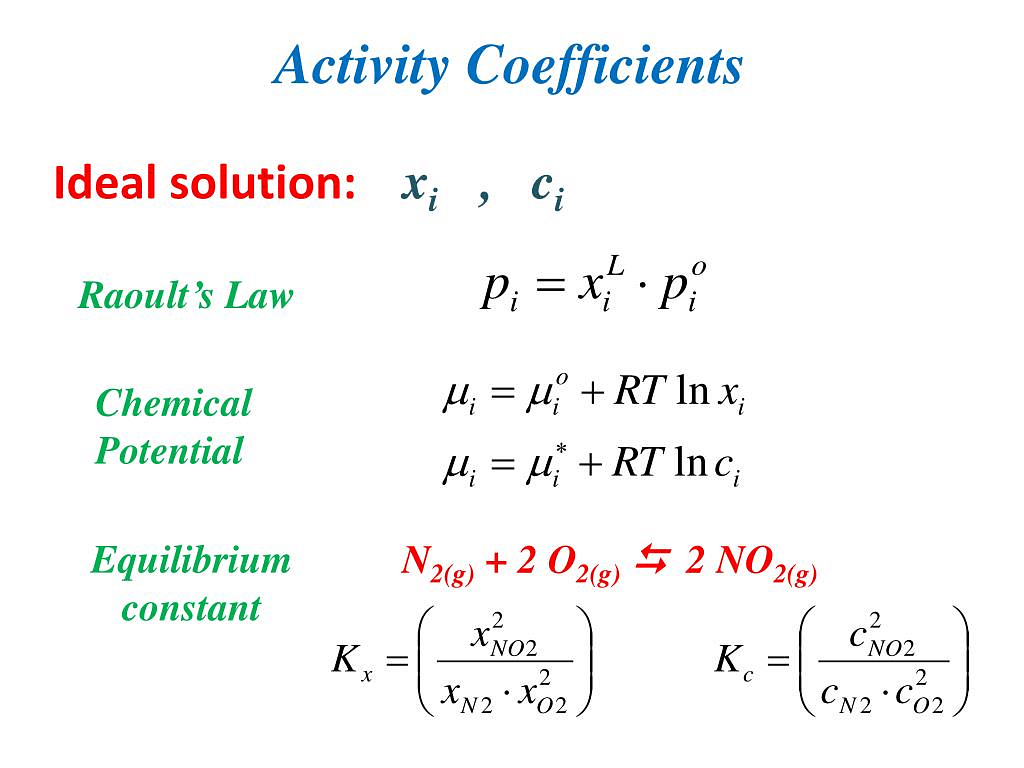
Activity Coefficient is a coefficient used in thermodynamics to explain deviations from ideal behaviour in a combination of synthetic substances. In an ideal mixture, the tiny interactions between each pair of species are equal (or equivalent, with zero solution enthalpy and volume changes during mixing), resulting in the mixture. Hence, the properties of the combinations can be communicated straightforwardly as far as basic focuses or halfway pressing factors of the substances are present, for example, Raoult's law. Deviations from the ideal are taken into account by changing the fixation with the activity coefficient. Similarly, equations containing gas can be adjusted to be less ideal by scaling the partial pressure by the fugacity coefficient.
| Table of Content |
Key Terms: Activity Coefficient, Ions, Thermodynamics, Ideal Mixture, Raoult’s Law, Deviations, Fugacity Coefficient, Henry’s Law, Ionic Strength, Electrolyte, Molar Concentration
Activity Coefficient Formula
[Click Here for Sample Questions]
As B go to nothing, the coefficient of action of substance B moves towards a steady state. This relationship is Henry's Law for solvable groups. These connections are identified from each other by the Gibbs-Duhem condition. Note that the overall activity coefficient is dimensionless.
Activity Coefficients
Activity Coefficient Equation
[Click Here for Sample Questions]
The ideal mixture is as follows:
\(\mu_{i}(\mathrm{P}, \mathrm{T}, \bar{x})=\mu_{i}^{0}(\mathrm{P}, \mathrm{T})+\bar{R} \mathrm{T} \ln \bar{x}_{i}\)
Read More: Ideal and Non-Ideal Solutions
Calculation of Activity Coefficient
[Click Here for Sample Questions]
In an ideal combination, the tiny connections between each pair of complex species are very similar (or visually the same, with zero enthalpy and volume changes in the assembly during mixing), and therefore the combination. So far, the characteristics can be directly communicated as there are basic fixed or semi-repressive factors of matter. For example, Raoult's law. Deviations from the ideal are forced by adjusting the focus via the action factor. Similarly, gas-containing joints can be adjusted for non-ideality by scaling the half-pressure factor by the fugacity coefficient.
Ionic Strength and Activity Coefficient
[Click Here for Sample Questions]
The ionic intensity of the response is part of the electrolyte focus, where C is the molar concentration of a particular particle, and Z is the charge on the particle. This is why KN sets upon the electrolyte fixation. Looking at the Debye-Hückel condition closely shows that γ diminishes as the particle charge expands, the hydrated ionic span diminishes, and the ionic strength of the arrangement increases. The influence of Ionic Strength on the activity factor is strongly based on the charge of the particles. The activity factor is the ratio of how successfully a particle can communicate in the arrangement. . In a weakened assembly (μ < 0.1 M), γ changes from 0 to 1. If the assembly turns out to be weak (fewer ions), it becomes γ61 and aA6.
For nonpartisan solutes, γ = 1
Read More: Concentration of a Solution: Percentage, Molarity, Mole Fraction
Activity Coefficient in Chemistry
Activity coefficient in science, is the ratio of the complex action of a substance to the molar focus. Intentional grouping of substances may not accurately indicate the viability of their synthesis, as addressed by the conditions of a particular reaction. In that case, instead of focusing on the calculation, any coefficient of action is established and used.
Activity Coefficient in Electrochemistry
The activity factor is used to represent the deviation from the ideal behaviour in a combination of synthetic materials using thermodynamics. Information about the activity coefficient is especially important for electrochemistry. This is because the behaviour of the electrolyte assembly is often far from ideal due to the effects of ionic air. Moreover, they are especially important for soil science. This is due to the small amount of solubility and the high convergence of the electrolyte.
Read More: Relation Between Molarity and Molality
Activity Coefficient of Water
Consistent b estimates for CO2 is 0.11 at 10 ° C and 0.20 at 330 ° C, where b is the number of particles released from the atom separation of the disintegrated salt and b is the molality of the salt broken up in the water, φ is the osmotic coefficient of water, and the consistent value 55.51 corresponds to the molar concentration of water. Under the above conditions, the activity of the solute (here water) is said to be the opposite of the activity of the solute in the number of salt particles.
Fugacity and Activity Coefficient
[Click Here for Sample Questions]
Currently, the use of these models is supported by considering the fugacity f, which replaces the synthetic potential µ, while ignoring its shortcomings. The fugacity coefficient φ deals with the relationship between the framework's fugacity and pressing factor level. In the exceptional case of the ideal gas, fugacity approaches framework pressure. This means that the fugacity coefficient increases in solidarity. The activity coefficient of the group of animals in the response addresses the relationship between genuine fugacity and the fugacity compared to the ideal placement (determined using the Lewis-Randall rule). This is under similar suspicions of temperature, pressure, and generation.
Read More: Ideal Gases Law: Ideal Gas Equation, Derivation, Examples
Things to Remember
- The activity coefficient is a coefficient used in thermodynamics to explain deviations from ideal behaviour in a combination of synthetic substances.
- The tiny interactions, in an ideal mixture, between each pair of species, are equal (or equivalent, with zero solution enthalpy and volume changes during mixing), resulting in the mixture.
- The properties of the combinations can be communicated straightforwardly as far as basic focuses or halfway pressing factors of the substances are present, for example, Raoult's law.
- The deviations from the ideal are taken into account by changing the fixation with the activity coefficient. In the same manner, the equations containing gas can be adjusted to be less ideal by scaling the partial pressure by the fugacity coefficient.
- The ideal mixture is as follows: \(\mu_{i}(\mathrm{P}, \mathrm{T}, \bar{x})=\mu_{i}^{0}(\mathrm{P}, \mathrm{T})+\bar{R} \mathrm{T} \ln \bar{x}_{i}\)
Sample Questions
Ques. (a) What is the activity coefficient of a solution?
(b) Instead of concentration can coefficient activity be used? (3 Marks)
Ans. (a) The activity coefficient is a thermodynamic property that affects the solubility of a solute in a solvent. The activity coefficient of the electrolyte solution is used to explain the concentration-dependent interactions between the ions in the solution.
(b) The measured concentration of a substance may not be an accurate indicator of its chemical potency, as expressed by the formula for a particular reaction. In this case, the activity coefficient is set arbitrarily and is used in the calculation instead of the concentration.
Ques. (a) Does the activity coefficient influence the rate constant?
(b) What is the activity coefficient of bimolecular reactions? (3 Marks)
Ans. (a) TST predicts that the rate constant depends on the activity coefficient of the aquatic species (Lasaga, 1998). For solutions that are not too concentrated (eg I = 0.1 M), the logarithmic rate constant of the elementary reaction with ions depends on the square root of the ionic strength of the solution.
(b) This coefficient is used to represent the rate constant of a bimolecular reaction. The activity coefficient γ0 is based on the theory that it is composed of two contributions, athermal γa0 and thermal γt0. The activity factor γ0 is related to the excess Gibbs energy ΔGE0 due to the following relationship.
Ques. (a) How can the calculation of the activity coefficient of electrolytic solutions be done?
(b) Is the coefficient activity greater than unity in phase separation? Explain (3 Marks)
Ans. (a) Theoretically, the activity factor of the electrolyte solution can be calculated using the Debye-Huckel equation or extensions such as the Davis equation, the Pitzer equation, and the TCPC model. Specific ion interaction theory (SIT) can also be used.
(b) For phase-separated mixtures, the activity coefficient is greater than 1. In thermodynamics, the activity coefficient is used to determine the non-ideal behaviour or deviation of a mixture, as predicted by Raoult's law. In a more physical sense, it defines the tendency of constituent molecules to escape from the mixture.
Ques. (a) What is the activity coefficient of an ion?
(b) What happens when the activity coefficient is 0 ? (3 Marks)
Ans. (a) Activity coefficient (dimensionless quantity). ϒi depends on the ionic strength of the solution. Ion activity is defined as follows: We use "activity" instead of "concentration" to explain the effect of the electrolyte on chemical equilibrium.
(b) In many cases, as xB approaches zero, the activity factor for substance B approaches a constant. This relationship is Henry's law for solvents. These relationships are related by the Gibbs-Duhem equation.
Ques. Explain the Isoporous vapour pressure technique? (5 Marks)
Ans. Isoporous vapour pressure techniques are one of the most useful methods for determining H2O joining at the gas phase equilibrated with an aqueous solution. This is a comparison method having a binary solution of non-volatile reference solutions of B and known properties from F. Commonly used reference solutions where data available to data are available are sucrose, NaCl, and CaCl2.
In this method, the dissolved B may be any non-electrolyte or electrolyte. A dish-containing dish containing each water, and one well-weighted sample of dissolved dissolution is located in a fountain pierced into a metal blade to produce good thermal equilibration. This arrangement is placed in the welding chamber and the air is exhausted and the device shakes gently in a thermostat for a maximum of several days or a week. During this time, H2O is transmitted under the vapour space until the chemical potential of water is the same in each solution. After that, the solution is said to be iso gravel. Finally, the dishes are removed from the device and weighed to make the viscoelasticity of each solution. H2O volatility is known as a function that causes the release cancellation and is the same as a solution of B solution and equilibrium dissolved in Mallery measured and equilibrium. Incompetent vapour pressure can also be used for non-aqueous solutions.
Ques. State a few examples of activity coefficients at infinite dilution? (5 Marks)
Ans. Activity coefficients at limitless dilution describe how solute-solvent interactions make a contribution to nonideal conduct and are preferred via way of means of chemical engineers for modelling separation processes (e.g., extraction and distillation). Some trendy observations made for ionic beverages include
- fragrant hydrocarbons with polarizable electrons showcase more potent interactions with ionic beverages than n-alkanes;
- solutes with polar practical businesses have better solubility because of appealing interactions with ionic beverages, and
- ionic beverages containing the tetrafluoroborate anion usually require greater electricity to conquer solvent–solvent interactions than the ones containing the bigger bis(trifluoromethylsulfonyl)amide ion. Progress has been made in modelling limitless dilution interest coefficients in ionic beverages with the use of the conductor-like screening model – actual solvents (COSMO-RS) approach and quantitative structure-assets fashions with the octanol-water partition coefficient, electron topological state (E-state), variety of solute hydrogen-bond donor businesses, and floor-weighted partial terrible floor location as descriptors. The nature of the descriptors shows the relative significance of hydrophobicity, hydrogen bonding, aromaticity, and fee distribution on solute–ionic liquid interactions.
Ques. Define Raoult’s law and Henry’s law of thermodynamics? (3 Marks)
Ans. Raoult's Law is a law of thermodynamics established by the French chemist François Marie Raoult in 1887. It states that the partial pressure of each component of an ideal liquid mixture is equal to the vapour pressure of the pure component multiplied by the mole fraction in the mixture.
Henry's law is a gas law in which the amount of gas that dissolves in a liquid is directly proportional to the partial pressure of that gas against the liquid when the temperature is kept constant. The constant of proportionality in this relationship is referred to as Henry's law constant (usually represented by "kH").
Related Links:



Comments