



Education Content Expert
Concentration of a Solution is defined as the amount of solute present in a given quantity of the solution. There are two parts to an aqueous solution namely the solute and the solvent. These are the two most important terms to understand when it comes to a solution’s concentration. The amount of solute in the solution must always be taken into consideration. The solution that has a relatively smaller amount of solute is called a Dilute Solution while a solution with a large amount of solute is called Concentrated Solution.
What is Concentration of a Solution?
[Click Here for Sample Questions]
Concentration of a solution is the amount of solute present in one litre of solution. It is denoted by the symbol C or S. The concentration of a solution formula is as follows:

Concentration of a Solution
On the basis of its concentration, a solution can be categorized into two types namely:
- Dilute Solution: A solution with less amount of solute is termed dilute solution.
- Concentrated Solution: A solution with a large amount of solute is called a concentrated solution.

Dilute and Concentrated Solutions
Read More: Types of Solutions
Methods to Determine Concentration of a Solution
[Click Here for Previous Years Questions]
The concentration of a solution can be determined through various methods. Different methods are used in different industries. For instance, a chemist works with the number of moles, whereas on the other hand, pharmacists work with percentage concentrations. Here are the various methods of expressing the concentration of a solution:
- Concentration in Parts Per Million (ppm)
- Mass Percentage (w/w)
- Volume Percentage (V/V)
- Mass by Volume Percentage (w/V)
- Molarity (M)
- Molality (m)
- Normality (N)
- Formality (F)
- Mole Fraction
Concentration in Parts Per Million (ppm)
[Click Here for Sample Questions]
Parts per million (ppm) is what percentage parts a particular molecule or compound makes up within the million parts of the entire solution. It describes chemical concentration dissolved during a solvent (usually water) or compounds in soil and is expressed in terms of weight. The formula for parts per million is:

Concentration in Parts Per Million Formula
Volume Percentage (V/V)
[Click Here for Previous Years Questions]
Weight/volume percentage, volume/volume percentage, and weight/weight percentage are all examples of per cent solutions. In each scenario, the concentration is computed as a percentage of the solute's volume or weight in relation to the total volume or weight of the solution. Solute in a liquid form is relevant to the numerator in weight units and the denominator in volume units. This is referred to as weight/volume per cent.

Volume Percentage Formula
Mass Percentage (w/w)
[Click Here for Sample Questions]
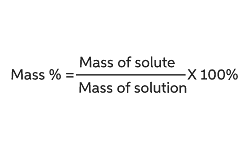
The term mass percentage (w/w) refers to the concentration expressed as a percentage of one component in a solution by mass. The mass of a component is divided by the total mass of the mixture and multiplied by 100 per cent to determine the mass percentage.
Mass by Volume Percentage (w/V)
[Click Here for Previous Years Questions]
The mass of the solute dissolved in 100 mL of the solution is known as mass by volume percentage. For example, if 1 g of solute is dissolved in 100 mL of solution, the mass by volume percent of the solution is 1 percent (mass/volume).
In terms of math, mass divided by volume percent =

Mass by Volume Percentage Formula
Molarity
[Click Here for Sample Questions]
The number of moles of solute in one litre of a solution is known as molarity (M).
To calculate a solute's molarity in a solution, we require two pieces of information:
- The amount of solute in a solution expressed in moles.
- The solute's concentration in a solution (in litres).
The equation for calculating molarity is:

Molarity Formula
Molality
[Click Here for Previous Years Questions]
The number of moles of solute dissolved in exactly one kilogramme of solvent is expressed as m. (Note that molality is represented by a lowercase m and is spelt with two "l"s.)
To determine the molality of a solute in a solution, we require two pieces of information:
- The number of moles of solute in the solution.
- The mass of solvent in the solution (in kilogrammes).
The following equation is used to calculate molality:

Molality Formula
Normality
[Click Here for Sample Questions]
Normality in chemistry is one of the expressions wont to measure the concentration of an answer. it's abbreviated as ‘N’ and is usually mentioned because of the equivalent concentration of an answer. it's mainly used as a measure of reactive species during a solution and through titration reactions or particularly in situations involving acid-base chemistry.
As per the quality definition, normality is described because of the number of gram or mole equivalents of solute present in one litre of an answer. once we say equivalent, it's the number of moles of reactive units during a compound. Normality (N) is calculated as

Normality Formula
Formality
[Click Here for Previous Years Questions]
Formality (F) is defined as the number of gram formula units present in one litre of solution. The concept of formality is applicable in the case of ionic solids like NaCl.

Formality Formula
Mole Fraction
[Click Here for Sample Questions]
A component's mole fraction, X, in a solution is the ratio of that component's moles to the total number of moles in the solution. To calculate mole fraction, we'd like to know:
- The number of moles of every component present within the solution.
The mole fraction of A, XA, during a solution consisting of A, B, C, ... is calculated using the formula:

Mole fraction of B, XB, can be calculated as:

Important Formulas at a Glance
[Click Here for Previous Years Questions]
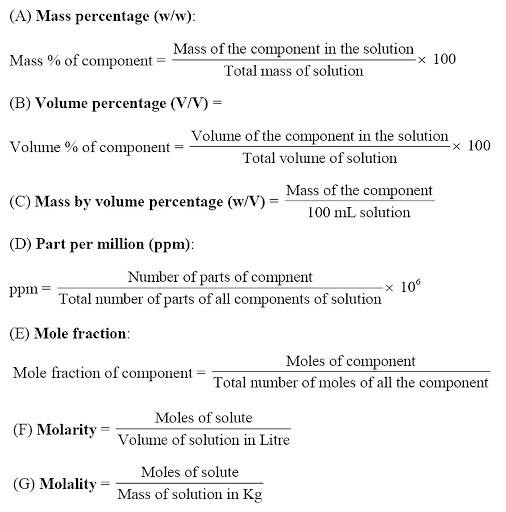
Here is a summarized list of important formulas for the concentration of a solution:
Things to Remember
- Concentration of a solution refers to the amount of solute present in a given solution.
- The concentration of a solution is calculated as: Weight of Solute in Grams/Volume of Solution in Liters.
- A dilute solution is one that has less quantity of solute in it whereas a concentrated solution has a large quantity of solute in it.
- It's called mass percentage (w/w) when the concentration is expressed as a percentage of one component in the solution by mass.
- The concentration of one component in a solution expressed as a percentage of the total volume is referred to as volume percentage.
- The number of moles of solute dissolved in one litre of a solution is referred to as molarity.
- The amount of gramme equivalents of solute present in a one-litre solution is referred to as normality.
Previous Years’ Questions (PYQs)
- A solution contains 4 g of NaOH and 16.2 g of water… (KEAM 2016)
- The molarity of NO3- in the solution after 2L of 3M… (VITEEE 2015)
- The difference between the boiling point and freezing point of an… (KEAM)
- How many grams of concentrated nitric acid solution should…
- A 5.2 molal aqueous solution of methyl alcohol…
- Mole fraction of A in H2O is 0.2. The molality…
- The volume of ethyl alcohol (density 1.15g/cc) that has to be added to prepare…
- Molarity equation of a mixture of solutions of same substance is given…
- Mole fraction of ethyl alcohol in aqueous ethyl alcohol solution…
- Solubility of a gas in a liquid increases with…
Sample Questions
Ques. Rashida made a sugar solution with 40 g of sugar and 600 ml of water. Calculate the mass as a percentage of the volume. (2 Marks)
Ans. Mass of Solute (Sugar) = 40g
Volume of Solution (Water) = 600 ml
The mass as a percentage of the volume will be:

Ques. What is a normality unit? (2 Marks)
Ans. A concentration measurement based on the gramme equivalent weight of the solute per litre of solution is known as normality. The gramme equivalent weight of a molecule* is a measure of its reactive capacity. Eq/L is the normality unit. The letter "N" is used to represent normality.
Ques. What does a solution's concentration mean? (2 Marks)
Ans. The amount of solute dissolved in a given amount of solvent or solution is referred to as solution concentration. A concentrated solution has a high concentration of dissolved solute. A dilute solution is one that has a little amount of dissolved solute.
Ques. Rita added 2 ml of water to 4 g of a powdered drug. Thus, the final volume is 3ml. Calculate the mass by volume percentage of the solution. (3 Marks)
Ans. Mass of solute = 4g
Volume of solution = 3 ml
Mass by volume percentage = (Mass of solute/Volume of solution) x 100
(4g/3ml) x 100 = 133 %Thus, the mass by volume percentage is 133%.
Ques. Define molarity and how do you calculate it? (3 Marks)
Ans. The number of moles of solute per litre of solution is referred to as molarity.

Divide the moles of solute by the litres of the solution to get the molarity.
In a 0.25 mol/L NaOH solution, for example, each litre contains 0.25 mol sodium hydroxide.
The number of moles of solute and the total volume of the solution is required to compute the molarity of a solution.
To find the molarity of a substance, use the following formula.
- Calculate the amount of solute contained in moles.
- Determine the amount of solution in litres.
- By multiplying the number of moles of solute by the number of litres of solution, the number of moles of solute is equal to the number of litres in the solution.
Ques. How to Make a Molarity to Normality Conversion? (3 Marks)
Ans. The molarity of a solution is the key to estimating its normalcy, as we all know. As a result, the most straightforward technique to convert molarity to normalcy is to:
N=M*n
Where,
The number of equivalents is N.
When n=1 in the case of some compounds, N and M are the same.
Ques. A solution of Na3PO4 is used to clean walls before putting up wallpaper. The concentration recommended for the same is 1.7 %. Calculate the mass of Na3PO4 required to make 2.0 L of the solution. (3 Marks)
Ans. Mass/Volume percentage is given as 1.7%
Volume of Solution = 2000 ml
Mass by volume percentage = (Mass of solute/Volume of solution)x100
1.7 % = (Mass of solute/2000ml)×100
Mass of solute = 34 g
Thus, the required mass of Na3PO4 is 34 g.
Ques. An example would be a solution created by dissolving 10.2 g of glucose (C6H12O6) in 405 g of water. The volume of the solution is 414ml. Calculate the concentration's molality. (3 Marks)
Ans. Molality is defined as the number of moles of solute divided by the mass of the solvent expressed in kg.
The moles of glucose must now be determined. Glucose has a molar mass of 180.16g/mol as discovered.
Glucose (10.1 gm)
0.0566 moles of glucose = 1-mole glucose/180.16g glucose
Now multiply the g of water by 405g to get the kg.
1kg1000g=0.405kg
Molality=0.0566/0.405=0.140m would be the answer.
Ques. How do normality and molarity relate to each other? (3 Marks)
Ans. Normality can be described as a multiple of molarity. Unlike molarity, which refers to the concentration of an ion or chemical in a solution, normality refers to the molar concentration of the acid or basic components of a solution. The link between Molarity and Normality is defined by the equation below:
Molarity*Molar Mass/ Equivalent Mass



Comments